• Importance ofcitation
• Source Identification
• Practice Activity
• APA Formatting Basics
• Formatting Practice
• Feedback and Correction
• In-text Citation (APA Style)
• Citation Challenge
Lesson Outline
3.
Think About...
Why isit essential to document the origins of the
information and ideas used in one's work?
4.
Citing sources isnot just a formality, it’s a
crucial element of academic integrity. When
you cite a source, you are acknowledging that
the idea or information you’re discussing
originated from someone else’s work.
Why Citation Matters
5.
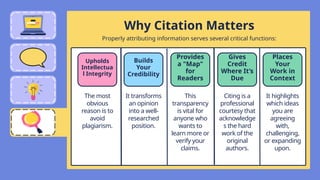
The most
obvious
reason isto
avoid
plagiarism.
It transforms
an opinion
into a well-
researched
position.
This
transparency
is vital for
anyone who
wants to
learn more or
verify your
claims.
Upholds
Intellectua
l Integrity
Builds
Your
Credibility
Provides
a "Map"
for
Readers
Why Citation Matters
Properly attributing information serves several critical functions:
Citing is a
professional
courtesy that
acknowledge
s the hard
work of the
original
authors.
Gives
Credit
Where It’s
Due
It highlights
which ideas
you are
agreeing
with,
challenging,
or expanding
upon.
Places
Your
Work in
Context
6.
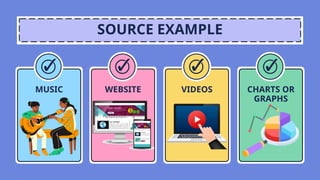
SOURCE
IDENTIFICATION
Your sources arethe
materials in which you found
the information the you
used. It does not matter
what type of source it is. It
can be in print or online. It
can be in image or
conversation it can be
copyrighted or not.
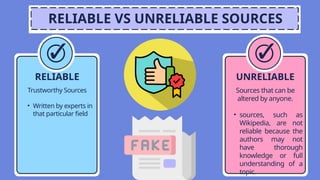
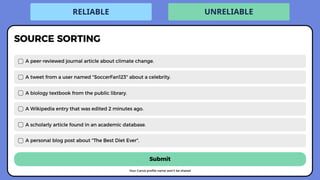
RELIABLE VS UNRELIABLESOURCES
UNRELIABLE
Sources that can be
altered by anyone.
• sources, such as
Wikipedia, are not
reliable because the
authors may not
have thorough
knowledge or full
understanding of a
topic.
RELIABLE
Trustworthy Sources
• Written by experts in
that particular field
10.
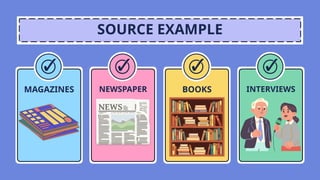
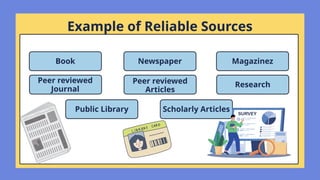
Example of ReliableSources
Book Newspaper Magazinez
Research
Public Library Scholarly Articles
Peer reviewed
Journal
Peer reviewed
Articles
11.
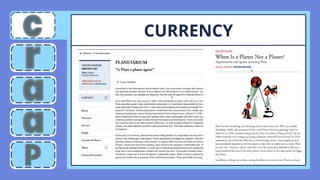
Timeliness of theinformation.
CURRENCY
QUALIFYING QUESTIONS YOU CAN ASK
• When was the information posted or published?
• Is the information current or out of date in regards to
your needs?
• Are the links functional?
The importance ofthe information for your
needs.
RELEVANCE
QUALIFYING QUESTIONS YOU CAN ASK
• Who is the intended audience?
• Does the information relate to your topic?
• Is the information at an appropriate level?
• Does the information back up your intended research?
14.
Authors credibility tobe writing about the topic.
How qualified are they to be saying what they’re
saying?
AUTHORITY
QUALIFYING QUESTIONS YOU CAN ASK
• Who is the author?
• Are the author’s credential or organization affiliation given?
• What are the author’s credential or organization affiliation given?
• What are the author’s qualification to write on this topic?
15.
The correctness, reliabilityand truthfulness of
the information.
ACCURACY
QUALIFYING QUESTIONS YOU CAN ASK
• Where does the information come from?
• Is the information supported by evidence?
• Has the information been reviewed?
• Can you verify the information in another source?
• Are there any grammar or spelling errors?
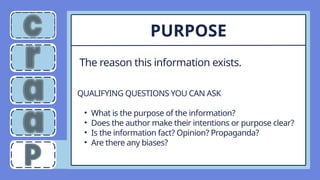
16.
The reason thisinformation exists.
PURPOSE
QUALIFYING QUESTIONS YOU CAN ASK
• What is the purpose of the information?
• Does the author make their intentions or purpose clear?
• Is the information fact? Opinion? Propaganda?
• Are there any biases?
American
Psychological
Association
(APA)
is a standardizedmethod for
acknowledging sources used
in academic writing. Now in
its 7th edition (released in
2019), it is widely used in the
social sciences, education,
and business to ensure
clarity, consistency, and the
avoidance of plagiarism.
20.
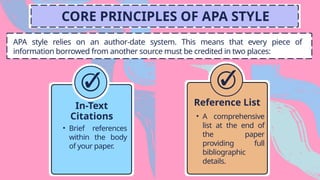
In-Text
Citations
• Brief references
withinthe body
of your paper.
Reference List
• A comprehensive
list at the end of
the paper
providing full
bibliographic
details.
APA style relies on an author-date system. This means that every piece of
information borrowed from another source must be credited in two places:
CORE PRINCIPLES OF APA STYLE
21.
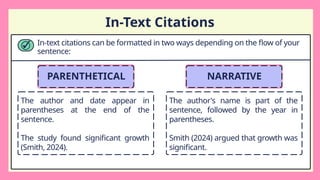
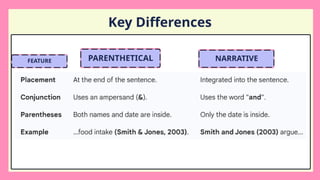
In-Text Citations
In-text citationscan be formatted in two ways depending on the flow of your
sentence:
PARENTHETICAL NARRATIVE
The author and date appear in
parentheses at the end of the
sentence.
The study found significant growth
(Smith, 2024).
The author's name is part of the
sentence, followed by the year in
parentheses.
Smith (2024) argued that growth was
significant.
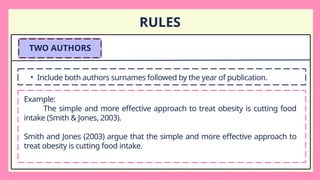
RULES
TWO AUTHORS
• Includeboth authors surnames followed by the year of publication.
Example:
The simple and more effective approach to treat obesity is cutting food
intake (Smith & Jones, 2003).
Smith and Jones (2003) argue that the simple and more effective approach to
treat obesity is cutting food intake.
24.
RULES
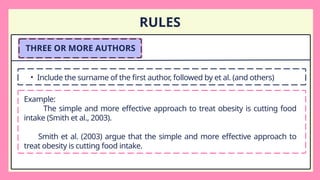
THREE OR MOREAUTHORS
• Include the surname of the first author, followed by et al. (and others)
Example:
The simple and more effective approach to treat obesity is cutting food
intake (Smith et al., 2003).
Smith et al. (2003) argue that the simple and more effective approach to
treat obesity is cutting food intake.
25.
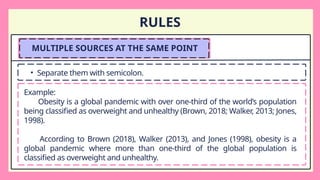
RULES
MULTIPLE SOURCES ATTHE SAME POINT
• Separate them with semicolon.
Example:
Obesity is a global pandemic with over one-third of the world’s population
being classified as overweight and unhealthy (Brown, 2018; Walker, 2013; Jones,
1998).
According to Brown (2018), Walker (2013), and Jones (1998), obesity is a
global pandemic where more than one-third of the global population is
classified as overweight and unhealthy.
26.
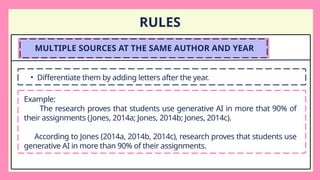
RULES
MULTIPLE SOURCES ATTHE SAME AUTHOR AND YEAR
• Differentiate them by adding letters after the year.
Example:
The research proves that students use generative AI in more that 90% of
their assignments (Jones, 2014a; Jones, 2014b; Jones, 2014c).
According to Jones (2014a, 2014b, 2014c), research proves that students use
generative AI in more than 90% of their assignments.
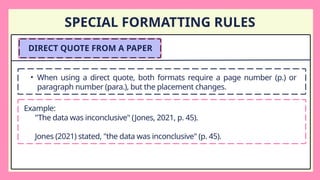
27.
SPECIAL FORMATTING RULES
DIRECTQUOTE FROM A PAPER
• When using a direct quote, both formats require a page number (p.) or
paragraph number (para.), but the placement changes.
Example:
"The data was inconclusive" (Jones, 2021, p. 45).
Jones (2021) stated, "the data was inconclusive" (p. 45).
28.
SPECIAL FORMATTING RULES
GROUPAUTHORS WITH ABBREVIATIONS
• If you are citing an organization with a well-known abbreviation (like the
CDC), you must define it in the first citation
Example:
Parenthetical (1st): (Centers for Disease Control and Prevention [CDC], 2020)
Narrative (1st): The Centers for Disease Control and Prevention (CDC, 2020)
reported...
29.
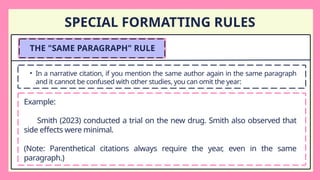
SPECIAL FORMATTING RULES
THE"SAME PARAGRAPH" RULE
• In a narrative citation, if you mention the same author again in the same paragraph
and it cannot be confused with other studies, you can omit the year:
Example:
Smith (2023) conducted a trial on the new drug. Smith also observed that
side effects were minimal.
(Note: Parenthetical citations always require the year, even in the same
paragraph.)
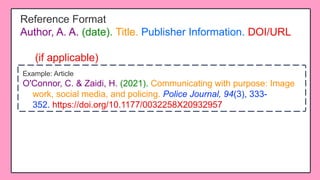
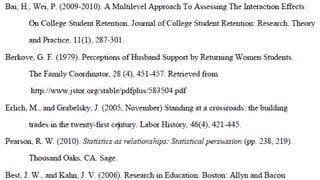
Reference Format
Author, A.A. (date). Title. Publisher Information. DOI/URL
(if applicable)
Example: Article
O'Connor, C. & Zaidi, H. (2021). Communicating with purpose: Image
work, social media, and policing. Police Journal, 94(3), 333-
352. https://doi.org/10.1177/0032258X20932957
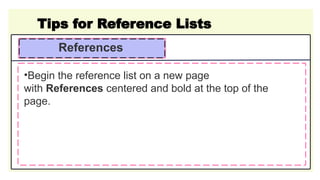
32.
Tips for ReferenceLists
References
•Begin the reference list on a new page
with References centered and bold at the top of the
page.
33.
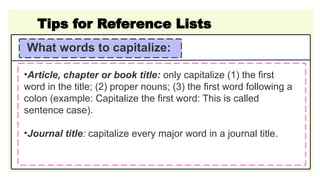
Tips for ReferenceLists
What words to capitalize:
•Article, chapter or book title: only capitalize (1) the first
word in the title; (2) proper nouns; (3) the first word following a
colon (example: Capitalize the first word: This is called
sentence case).
•Journal title: capitalize every major word in a journal title.
34.
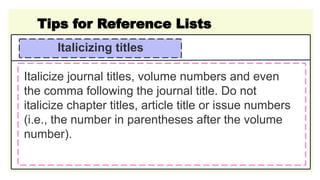
Tips for ReferenceLists
Italicizing titles
Italicize journal titles, volume numbers and even
the comma following the journal title. Do not
italicize chapter titles, article title or issue numbers
(i.e., the number in parentheses after the volume
number).
35.
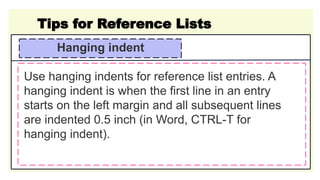
Tips for ReferenceLists
Hanging indent
Use hanging indents for reference list entries. A
hanging indent is when the first line in an entry
starts on the left margin and all subsequent lines
are indented 0.5 inch (in Word, CTRL-T for
hanging indent).
36.
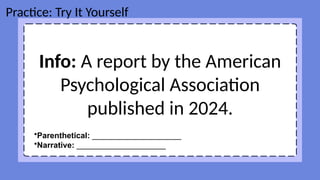
Info: A reportby the American
Psychological Association
published in 2024.
Practice: Try It Yourself
•Parenthetical: ____________________
•Narrative: ____________________
37.
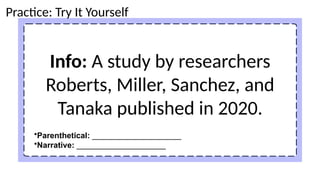
Info: A studyby researchers
Roberts, Miller, Sanchez, and
Tanaka published in 2020.
Practice: Try It Yourself
•Parenthetical: ____________________
•Narrative: ____________________
38.
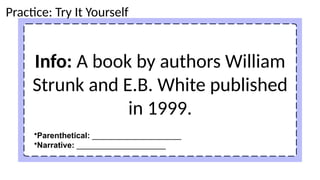
Info: A bookby authors William
Strunk and E.B. White published
in 1999.
Practice: Try It Yourself
•Parenthetical: ____________________
•Narrative: ____________________
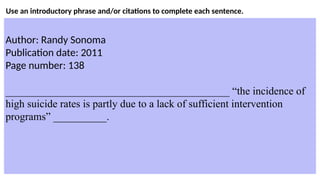
Use an introductoryphrase and/or citations to complete each sentence.
Author: Randy Sonoma
Publication date: 2011
Page number: 138
__________________________________________ “the incidence of
high suicide rates is partly due to a lack of sufficient intervention
programs” __________.
43.
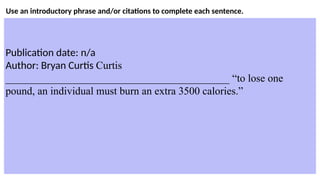
Use an introductoryphrase and/or citations to complete each sentence.
Publication date: n/a
Author: Bryan Curtis Curtis
__________________________________________ “to lose one
pound, an individual must burn an extra 3500 calories.”
44.
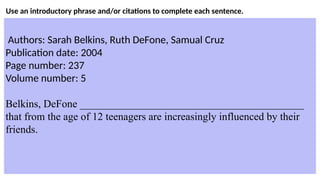
Use an introductoryphrase and/or citations to complete each sentence.
Authors: Sarah Belkins, Ruth DeFone, Samual Cruz
Publication date: 2004
Page number: 237
Volume number: 5
Belkins, DeFone __________________________________________
that from the age of 12 teenagers are increasingly influenced by their
friends.
45.
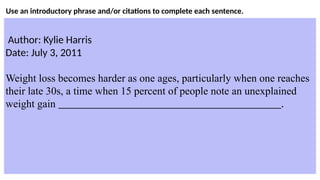
Use an introductoryphrase and/or citations to complete each sentence.
Author: Kylie Harris
Date: July 3, 2011
Weight loss becomes harder as one ages, particularly when one reaches
their late 30s, a time when 15 percent of people note an unexplained
weight gain __________________________________________.
46.
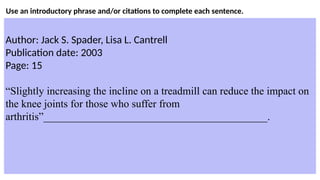
Use an introductoryphrase and/or citations to complete each sentence.
Author: Jack S. Spader, Lisa L. Cantrell
Publication date: 2003
Page: 15
“Slightly increasing the incline on a treadmill can reduce the impact on
the knee joints for those who suffer from
arthritis”__________________________________________.
47.
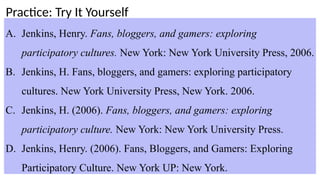
Practice: Try ItYourself
A. Jenkins, Henry. Fans, bloggers, and gamers: exploring
participatory cultures. New York: New York University Press, 2006.
B. Jenkins, H. Fans, bloggers, and gamers: exploring participatory
cultures. New York University Press, New York. 2006.
C. Jenkins, H. (2006). Fans, bloggers, and gamers: exploring
participatory culture. New York: New York University Press.
D. Jenkins, Henry. (2006). Fans, Bloggers, and Gamers: Exploring
Participatory Culture. New York UP: New York.
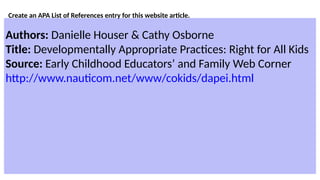
48.
Create an APAList of References entry for this website article.
Authors: Danielle Houser & Cathy Osborne
Title: Developmentally Appropriate Practices: Right for All Kids
Source: Early Childhood Educators’ and Family Web Corner
http://www.nauticom.net/www/cokids/dapei.html
Editor's Notes
#5 plagiarism is a serious academic offense.
Why Citation Matters?
Upholds Intellectual Integrity: Using someone else’s work without credit is considered intellectual theft. Citing ensures you are operating with honesty.
Builds Your Credibility: When you cite reputable sources, you show your audience that your arguments are backed by evidence and that you’ve done your "homework."
Provides a "Map" for Readers: Citations allow your readers to track down the original data or arguments for themselves.
Gives Credit Where It’s Due: Research and writing take immense effort.
Places Your Work in Context: By citing others, you show how your ideas fit into the broader "conversation" of your field.
#8 All of these sources were created by someone. Each work belongs to the person who created it. The work is that person's intellectual property.
#10 Examples of Unreliable Sources
1. Wikipedia: although this is a good starting point for finding initial ideas about a topic, some of their information and attached resources may not be reliable
2. Blogs, tweets
3. Personal websites
4. Forums
5. Sites created by organizations that may have political or biased agendas
6. Sites that provide biased information
7. Self-published sources
8. Opinionated articles such as editorials
9/ Online sources with an URL that ends in html, which is the basic building blocks of web pages
#11 You wanna check when the source was last publish.
A good source was publish within the last 10 years.
because when you research an older experiment there is a good chance that those results may have been disproved by more recent studies.
#13 a source that's providing you with information that is compatible applicable and related to your topic.
Example you found a source about your topic but the only difference is it is for adult.
#15 Be aware specially on this kind of phrases
"the recent study shows" but there is no recent study to show what they are saying.
"many people believe" who are these people?
So if you see something vague try to cut it down
#16 be careful about being bias.
example you are reading an article does it come to a medical company whose tryna promote their product or is it written from a qualified organization like WHO (World Health Organization) wherein their purpose it solely to give fact to the public.
Its important to know about bias fact vs bias opinion.
#21 parenthetical - we are citing the source at the end of the sentence. You should include the author's surname and the year of publication in brackets.
narrative - integrate the citation naturally into the sentence. In this format the author's surname appears outside the brackets while the year stays inside.
#26 If you are dealing with multiple papers published by the same author in the same year, you can differentiate them by adding letters after the year.
Three publication from the author on the same year.
#27 This is an altered text from a paper so we have enclosed the text in quotes.
And while citing you have to include the page number.
#30 The reference list is an alphabetical list of every source you used. It comes at the end of your paper and each reference entry should have corresponding in-text citation(s). Do not include sources you looked at but did not include in your assignment.
#31 Formatting differs depending on the type of source.
-Journal
-Book
-Website
-Conference
So it is highly recommended to use a bibliography software to format your references.
The main differences are the parts of the citation that are in italics.
#33 EXAMPLE:
1. Article, Chapter, or Book Title (Use sentence case.)
Type Example
Book TitleThe inner workings of the human brain: A guide to neuroscience.
Article TitleSocial media habits in France: A longitudinal study of Paris residents.
Chapter TitleEmotional intelligence in the classroom.
2. Journal Title (Use title case)
Type Example
Journal TitleJournal of Applied Psychology
Journal TitleThe New England Journal of Medicine
Journal TitleStudies in Higher Education
#35 A lot more TIPS
No date: Use (n.d.) if your source does not have a date.
Alphabetical by author’s last name:
Page numbers
URLs in reference lists
#36 . Parenthetical Citation
First Citation: (American Psychological Association [APA], 2024)
Subsequent Citations: (APA, 2024)
Narrative Citation
First Citation: American Psychological Association (APA, 2024)
Subsequent Citations: APA (2024)
#37 Parenthetical
(Roberts et al., 2020)
Narrative Usage:
"A study by Roberts et al. (2020) found that..."
#38 Format Style Example
Parenthetical Both authors and year .(Strunk & White, 1999)
inside parentheses
Narrative Authors part of the Strunk and White (1999)
sentence; year in
parentheses.
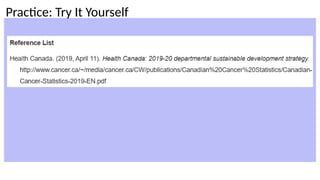
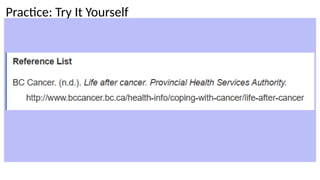
#40 (BC Cancer, n.d.)
There is no date listed for the above example - date is replaced with n.d. (no date).
#41 In-Text
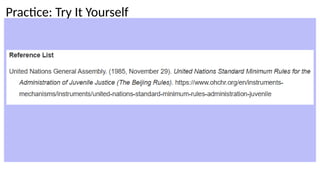
(United Nations General Assembly [UNGA], 1985)
#42 According to Sonoma (2011), “the incidence of high suicide rates is partly due to a lack of sufficient intervention programs” (p. 138).
Sonoma (2011) argues that “the incidence of high suicide rates is partly due to a lack of sufficient intervention programs” (p. 138).
Sonoma, (2011) warns that “the incidence of high suicide rates is partly due to a lack of sufficient intervention programs” (p. 138).
#43 Curtis (n.d.) tells us that “to lose one pound, an individual must burn an extra 3500 calories.”
Curtis (n.d.) explains that “to lose one pound, an individual must burn an extra 3500 calories.”
Curtis (n.d.) discovered that the difficulty losing weight lies in the fact that “to lose one pound, an individual must burn an extra 3500 calories.”
#44 Belkins, DeFone and Cruz (2004) have demonstrated that from the age of 12 teenagers are increasingly influenced by their friends.
Belkins, DeFone and Cruz (2004) found that from the age of 12 teenagers are increasingly influenced by their friends.
#45 Weight loss becomes harder as one ages, particularly when one reaches their late 30s, a time when 15 percent of people note an unexplained weight gain (Harris, 2011).
#46 “Slightly increasing the incline on a treadmill can reduce the impact on the knee joints for those who suffer from arthritis”(Spader & Cantrell, 2003, p. 15).
#48 Houser, D., & Osborne, C. (n.d.). Developmentally Appropriate Practices: Right for All Kids. Early Childhood Educator’s and Family Web Corner. Retrieved from http://www.nauticom.net/www/cokids/dapei.html

![SPECIAL FORMATTING RULES
GROUP AUTHORS WITH ABBREVIATIONS
• If you are citing an organization with a well-known abbreviation (like the
CDC), you must define it in the first citation
Example:
Parenthetical (1st): (Centers for Disease Control and Prevention [CDC], 2020)
Narrative (1st): The Centers for Disease Control and Prevention (CDC, 2020)
reported...](https://image.slidesharecdn.com/basicskillstostartaresearchpresentation-260202045806-a9d122ed/85/Basic-Skills-To-Start-a-Research-Presentation-pptx-28-320.jpg)