A N I N T R O D U C T I O N T O T HE C HI N E S E
L A N G U A GE ( HA N Y U )
Basic Chinese Mandarin ( 官话)
By: Ann Portia R. Lim
 -4000 years ago
 -one of the world’s oldest language
 -there are more than a billion native speakers of
Chinese worldwide
 -belongs to the Sin-Tibetan language family
 Standard Chinese language Hanyu- “language of the
Han”
 spoken by the Han, Hui, Manchu and other ethnic
groups that constitute 94% of the population of
China.
 There are 56 recognized ethnic groups in China using
as many as 80 diff. languages
 Hanyu- “language of the Han”
 Standard Chinese language spoken by the Han, Hui,
Manchu and other ethnic groups that constitute 94%
of the population of China.
 There are 56 recognized ethnic groups in China using
as many as 80 diff. languages
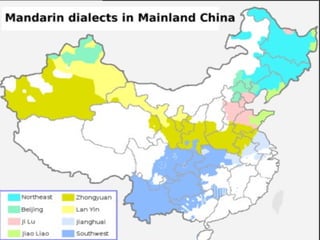
 Putonghua – “common speech”
 It is based on the northern dialect or Mandarin
dialect. The dialect of Beijing is used as the basis for
its pronunciation and modern vernacular literature
for its grammatical structure
Chinese Alphabet/Characters
 Unlike English, written Chinese is not directly
related to its pronunciation.
 Pinyin or “arranged sounds” system was developed
to provide phonetic notation for Chineses characters
Pinyin
 Pinyin adopts the Latin alphabet to transcribe
Chinese sounds
 Its Japanese counterpart is called “Romaji”
A N I N T R O D U C T I O N T O T HE C HI N E S E
( HA N Y U ) L A N GU A GE
Pinyin ( 拼音 ) and Pronunciation
Initials and Finals
 A syllable in the common speech of modern Chinese
usually consists of an initial, which is a consonant
that begins the syllable, and a final, which
constitutes the rest of the syllable.
Initials and Finals
 For example, in the syllable “ping”, “p” is the initial
and “ing” is the final. A syllable can stand without an
initial, such a “e”, but all syllables must have a final.
In the common speech of modern Chinese, there are
altogether 21 initials and 38 finals.
Pronunciation Key
 Initials: m,n,l,h and f are pronounced similarly to
their counterparts in the English language.
 b- unaspirated p- aspirated
 g-unaspiratd k-aspirated
 t- aspirated d- unaspirated
Pronunciation Key
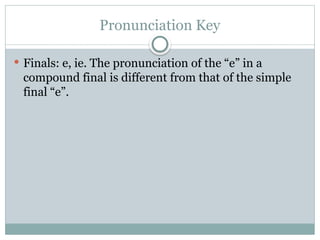
 Finals: e, ie. The pronunciation of the “e” in a
compound final is different from that of the simple
final “e”.
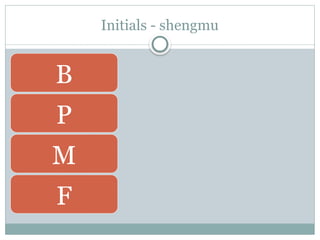
Initials - shengmu
B
P
M
F
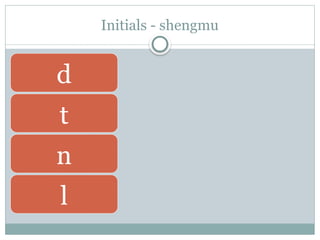
Initials - shengmu
d
t
n
l
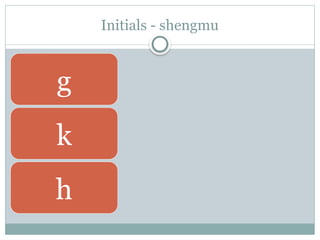
Initials - shengmu
g
k
h
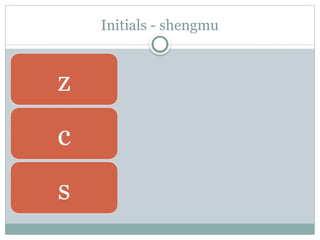
Initials - shengmu
z
c
s
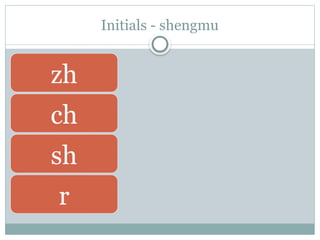
Initials - shengmu
zh
ch
sh
r
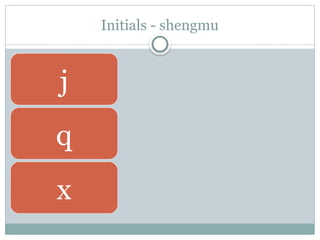
Initials - shengmu
j
q
x
Finals – yun mu
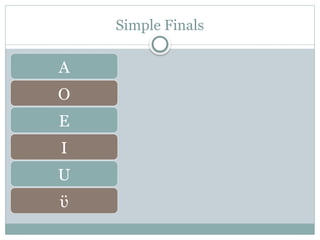
Simple Finals
A
O
E
I
U
ϋ
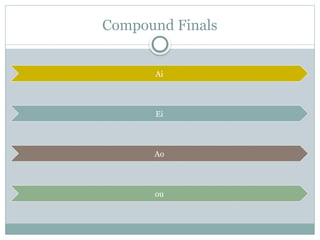
Compound Finals
Ai
Ei
Ao
ou
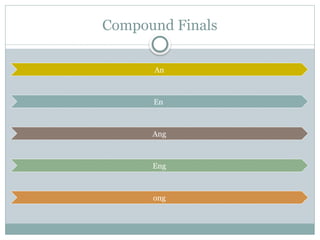
Compound Finals
An
En
Ang
Eng
ong
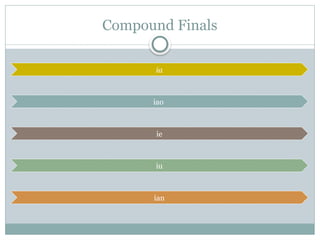
Compound Finals
ia
iao
ie
iu
ian
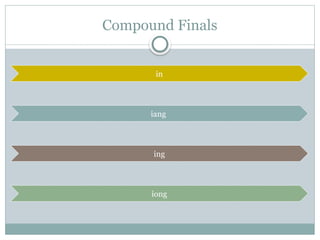
Compound Finals
in
iang
ing
iong
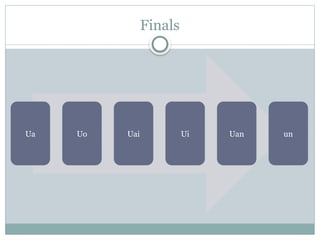
Finals
Ua Uo Uai Ui Uan un
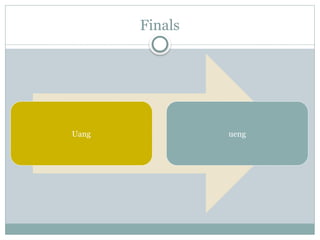
Finals
Uang ueng
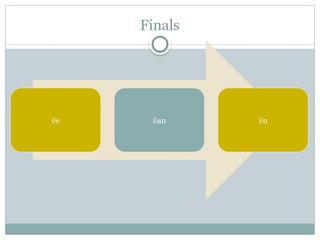
Finals
ϋe ϋan ϋn
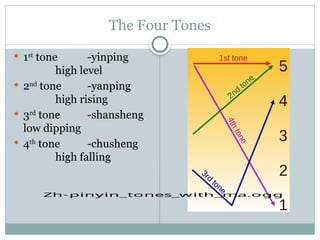
The Four Tones
 1st
tone -yinping
high level
 2nd
tone -yanping
high rising
 3rd
tone -shansheng
low dipping
 4th
tone -chusheng
high falling
Zh-pinyin_tones_with_ma.ogg
Grammar and Vocabulary
 The main characteristics of Chinese grammar is that
it lacks of morphological changes in person, tense,
gender, number, and case in the strict sense. Since
Chinese is a language with few inflexions, the order
of words in a sentence becomes of paramount
importance in determining grammar.
Grammar and Vocabulary
 Two sentences may contain the same words, but they
are arranged in different orders, they will carry
different meanings.
 Subject Predicate
 Ni hao.
 Wo hen hao.
 Libo ye hen hao.

Basic Chinese Mandarin Lesson One in Tourism Management

  • 1.
    A N IN T R O D U C T I O N T O T HE C HI N E S E L A N G U A GE ( HA N Y U ) Basic Chinese Mandarin ( 官话) By: Ann Portia R. Lim
  • 2.
     -4000 yearsago  -one of the world’s oldest language  -there are more than a billion native speakers of Chinese worldwide  -belongs to the Sin-Tibetan language family
  • 3.
     Standard Chineselanguage Hanyu- “language of the Han”  spoken by the Han, Hui, Manchu and other ethnic groups that constitute 94% of the population of China.  There are 56 recognized ethnic groups in China using as many as 80 diff. languages
  • 4.
     Hanyu- “languageof the Han”  Standard Chinese language spoken by the Han, Hui, Manchu and other ethnic groups that constitute 94% of the population of China.  There are 56 recognized ethnic groups in China using as many as 80 diff. languages
  • 6.
     Putonghua –“common speech”  It is based on the northern dialect or Mandarin dialect. The dialect of Beijing is used as the basis for its pronunciation and modern vernacular literature for its grammatical structure
  • 7.
    Chinese Alphabet/Characters  UnlikeEnglish, written Chinese is not directly related to its pronunciation.  Pinyin or “arranged sounds” system was developed to provide phonetic notation for Chineses characters
  • 8.
    Pinyin  Pinyin adoptsthe Latin alphabet to transcribe Chinese sounds  Its Japanese counterpart is called “Romaji”
  • 9.
    A N IN T R O D U C T I O N T O T HE C HI N E S E ( HA N Y U ) L A N GU A GE Pinyin ( 拼音 ) and Pronunciation
  • 10.
    Initials and Finals A syllable in the common speech of modern Chinese usually consists of an initial, which is a consonant that begins the syllable, and a final, which constitutes the rest of the syllable.
  • 11.
    Initials and Finals For example, in the syllable “ping”, “p” is the initial and “ing” is the final. A syllable can stand without an initial, such a “e”, but all syllables must have a final. In the common speech of modern Chinese, there are altogether 21 initials and 38 finals.
  • 12.
    Pronunciation Key  Initials:m,n,l,h and f are pronounced similarly to their counterparts in the English language.  b- unaspirated p- aspirated  g-unaspiratd k-aspirated  t- aspirated d- unaspirated
  • 13.
    Pronunciation Key  Finals:e, ie. The pronunciation of the “e” in a compound final is different from that of the simple final “e”.
  • 14.
  • 15.
  • 16.
  • 17.
  • 18.
  • 19.
  • 20.
  • 21.
  • 22.
  • 23.
  • 24.
  • 25.
  • 26.
  • 27.
  • 28.
  • 29.
    The Four Tones 1st tone -yinping high level  2nd tone -yanping high rising  3rd tone -shansheng low dipping  4th tone -chusheng high falling Zh-pinyin_tones_with_ma.ogg
  • 30.
    Grammar and Vocabulary The main characteristics of Chinese grammar is that it lacks of morphological changes in person, tense, gender, number, and case in the strict sense. Since Chinese is a language with few inflexions, the order of words in a sentence becomes of paramount importance in determining grammar.
  • 31.
    Grammar and Vocabulary Two sentences may contain the same words, but they are arranged in different orders, they will carry different meanings.  Subject Predicate  Ni hao.  Wo hen hao.  Libo ye hen hao.