BarcelonaBarcelona
arrios de
BarcelonaBarcelonaBarcelona
full book: http://www.lulu.com/content/e-book/barrios-de-barcelona/17073911
Welcome to Barcelona!Welcome to Barrios de Barcelona! Our guide is structured to allow you to explore
the unique and contrasting barrios (neighbourhoods) of Barcelona while
making sure you catch the highlights in each one. Every different barrio
has something to offer and this is outlined through our guide,
allowing for easy navigation of both the guide and the city.
Get out and explore!
Meet the Team
Lucy White, 21
Scotland
Barcelona favourite: magic fountain
James Treweek, 22
England
Barcelona favourite: Sagrada
Familia
Danielle Hines, 21
England
Barcelona favourite: The
music, whether you’re on the
street, in the metro or at a
concert, Barcelona is bursting
with sound
Luke Cy, 30
England
Barcelona favourite: Camp Nou
Katie Chakhova, 30
Canada
Barcelona favourite: street art
and cava
Jasmaine Vaughan, 19
Scotland
Barcelona favourite: learning
about the Catalan language and
culture
Rachel Jordan, 28
USA
Barcelona favourite: I love the culture
and the people!
4
Table of Contents
History						 5
Barcelona Now and Catalan Identity		 6
Survival Guide					 7
Getting Around				 9
Language Basics				 10
Barri Gotic			 12
Sandemans New Barcelona Walking Tours	 13
La Rambla					 14
Catedral de la Santa Creu i Santa Eulalia 	
(Barcelona Cathedral)				 15
Basilica de Santa Maria del Pi			 16
Homenatge als Castellers			 17
Mezcalaria El Antojo				 18
Anti-karaoke					 19
El Raval				 20
Mercat de la Boqueria			 21
CCCB & MACBA				 22
Street Art Tour					 23
Holala! Plaza or Tallers			 24
Restaurant L’Havana				 25
Restaurant Elisabets				 26
23 Robadors					 27
Born					 28
Museu de la Xocolata				 29
Museu Picasso					 30
Parc de la Ciutadella				 31
Fossar de les Moreres				 32
Basilica de Santa Maria del Mar		 33
Restaurant Galiy				 34
El Xampanye				 35
Barceloneta			 36
Barceloneta Beach			 37
Jai Ca					 38
L’Aquarium				 39
Absente Bar				 40
Gràcia & L’Eixample	 41
Sagrada Familia			 42
Park Güell				 43
El Corte Ingles				 44
Plaças de Gràcia			 45
Turó de la Rovira			 46
Hospital Sant Pau			 47
La Chappelle				 48
Khan Kaffran				 49
Unnatural Space			 50
Montjuic & Poble Sec	 51
Camp Nou				 52
Estadi Olimpic				 53
Jardí Botànic de Barcelona		 54
Font Magica de Montjuic		 55
Manga & Rosa				 56
Bar Bristol				 57
Sala de Montjuic			 58
Barcelona Extras		 59
Montserrat				 60
Montgat Beach				
61
5
HistoryThe first human settlements in Barcelona date back to Neolithic times. There are many theories about the formation of Barcelona. Some even think that
Barcelona was founded by Hercules.
The city itself was founded by the Romans who set up a colony called Barcino at the end of the 1st century BC, which was occupied by the Visigoths in
415 and renamed Barcinona. The colony had over a thousand inhabitants and was bounded by a defensive wall, the remains of which can still be seen
in the old town (within the history museum, very near to Jaume I metro station).
8thCentury
Moorsconquerthecity
9thCentury
Franksconquerthecity
1000-1200
Barcelonaisoneofthemostimportant
Mediterraneanports
1391Amassacreofthecity’sJewishcommunity
1450TheUniversitatdeBarcelonafounded
1640AlliedtoLouisXIIIofFrance,Catalonian
revoltagainsttheSpanishmonarchybeginsin
Barcelona1652BarcelonasiegedbyDonJuanJoséofAustria
whichendstheCatalanrebellion
1705-1714
TheWarofIndependenceagainstSpain.
Defeatedon11thofSeptember1714withthe
Catalonianconstitutionabolished
1882ConstructionofLaSagradaFamiliabeganon
the19thMarch
1888WorldExhibitionheldinBarcelona
1936-1939
TheSpanishCivilWar,afterwhich
Catalan
languageandcultureweresuppressed
1977Cataloniarecoverssomeself-government
undertheEstatutdeAutonomia
1992BarcelonahoststheOlympicGames,
whichrejuvenatedthecity
6
Barcelona Now and
Catalan Identity
In a symbolic referendum in 2009, 95 per cent of those who voted were in favour of Catalonia’s
independence from Spain and wanted it to achieve statehood, but there was a low voter
turnout (only 27%).
2009
The 2012 Catalan independence demonstration was a protest march which occurred in central
Barcelona on 11th of September. The protestors demanded the independence of Catalonia
and its consolidation as a sovereign state under the slogan “Catalunya, nou estat d’Europa” (in
English, “Catalonia, new state in Europe”). The number of participants was estimated at about
1.5 million to 2 million. The city centre was crowded for hours and many newspapers and other
news agencies described it as a “historic” demonstration and considered it to be the biggest
protest march ever held in Catalonia since the restoration of democracy in Spain, surpassing
other major demonstrations.
A demonstration in central Barcelona on 10 July 2010 against limitations of the autonomy of
Catalonia within Spain, and particularly against a recent decision of the Spanish Constitutional
Court to annul or reinterpret several articles of the 2006 Statute of Autonomy of Catalonia.
The number of people taking part in the demonstration was estimated at between 1.1 million
and 1.5 million. The demonstration was led by a banner with the slogan in Catalan “Som una
nació. Nosaltres decidim.” (in English, “We are a nation. We decide.”).
2010
2011
On La Diada, Catalonia’s National Holiday, 11th of November 2013, hundreds of thousands of
people demonstrated in Catalonia for the independence from Spain and the right to decide
about their future. To draw attention to their claim to independence, they formed a human
chain across Catalonia, with a remarkable length of 400 kilometres.
On 9th of November 2014, the Government of Catalonia held a non-binding vote on the
political future of the state. The ballot consisted of two questions: “Do you want Catalonia to
become a State?” and “Do you want this State to be independent?”.
2013
2014
Survival Guide Personal Safety
Overall, Spain is a generally safe place to be. When travelling, especially
alone, be sure to take the necessary precautions and stay in public areas
where there are plenty of people. If you are carrying a bag or a purse, be
aware of its location and keep it close to your body. The more popular areas
such as Las Ramblas or public transportation stations is where the skillful
pickpocketing can take place.
Money
The currency of Spain is the Euro (€). Exchanges can be made at the airport
or around the city at different locations that areclearly marked (Las Ramblas,
etc.). It is best to bring euros along with you to have on hand upon entering
the country. MasterCard and Visa are widely accepted in most areas as well.
Where to Stay
There are various different places to stay in the city. Hotels and hostels can
be found all over in many of the different neighborhoods.
Important Numbers
Ambulance No.: 061
Emergency No.: 122 (all emergencies)
Police No. 092 (local); 061 (regional)
Survival GuideTime
Be aware of the time difference. Barcelona is one hour ahead of the
UK, six hours ahead of New York and Toronto, nine hours ahead of Los
Angeles, and nine hours behind Sydney. During daylight savings time,
Spain’s clocks jump ahead during the last week of March and back
again in the last week of October.
Health
Water from the tap is perfectly safe to drink; however, it may not taste
the best. When ordering in a bar or restaurant you will typically be
given bottled water.
There are several hospitals that have 24 hr accident and emergency
services along with pharmacies in each neighborhood with hours from
9am-1pm and 4pm-8pm.
If you are traveling during the summer months, be sure to carry
sunscreen with you and reapply often. Also carrying water with you at
all times is beneficial to stay hydrated in the intense heat.
Electricity
Spain’s electricity is 220v and plugs have round posts. It is important
that you bring an adapter and a converter (or transformer) to use UK
and US cell phone chargers, laptops, and other electric items.
Tips
Tipping is an acceptable action. Locals typically leave a few cents or
round to the nearest euro for a coffee or drink, a euro or two for most
meals aside from the nicer establishments, for those expect closer
to ten to fifteen percent. Taxi drivers generally like to get roughly five
percent.
Spanish culture can be quite affectionate between family members
and close friends. When greeting one another people generally shake
hands or touch cheeks while making a kissing sound.
Nonverbal communication is important. Be aware of your body
language even the way you are standing can send messages that you
might be unaware of.
If you plan on visiting the museums, a Barcelona Museum Pass can be
purchased for 30€ and allows entry to six of Barcelona’s most popular
museums and skip the queues. It’s the best deal and is valid for three
consecutive months after redemption.
9
Getting AroundBarcelona has various modes of transportation, making it easy to get
around to different parts of the city. These modes include by way of
taxi, bus, metro, train, bike, and trams. Visit www.tmb.cat for ticket
information, bus stops, city transport map, and full timetables.
By Air
If coming in by air, there are several different ways to get to where you
are going. Grabbing a taxi may be less of a hassle, but will cost more
(approximately 30€) plus extra charges if traveling after 9pm and if you
plan to use the boot of the taxi. The airport train runs roughly every 30
minutes to the Barcelona Sants station costing approximately €4, making
this a cheaper option and will take about 15-20 minutes. Another cheaper
option would be taking the Aerobús service that runs every 5-10 minutes
Mon-Sat 6am-1am; 5.90€ or 10.20€ return to and from T1 and T2.
Bus
Buses and night buses are available daily 5am-10:30pm for single tickets
at 2.15€. Barcelona Tour Buses can be taken around the city on a two-
storey bus. Tickets can be purchased (27€ for 1 day; 35€ for 2 days) and
more information can be found at www.barcelonatours.es.
Metro
The metro system is a popular way of travel and the fastest way to get around
the city and runs on 6 lines. Tickets can be purchased at all metro stations.
There are various options for tickets to be purchased. Single (2.15€); T-Dia
(one day pass for 7.60€); 2 Day Pass (14€); 3 Day Pass (20€); for the best
deal, a T-10 ticket can be purchased (9.95€) that is valid for 10 journeys on
the metro and the train. Hours of the metro service are Mon-Thurs, Sun and
public holidays 5am-midnight; Fri 5am-2am; Sat and the day before public
holiday is 24-hr service. All metro stations can be identified with a red “M”.
Taxi
Taxis can be hailed in most of the more populated areas such as venues, train
and metro stations, etc. Calling ahead can be beneficial but be prepared
to be charged a few extra euros and few of the companies speak English.
Barna Taxi (tel: 933 222 222); Radio Taxi (tel: 933 033 033)
Bike Rental
A great way to get around the city is to rent a bike for roughly 20€ per day.
For more information visit www.bicing.cat.
10
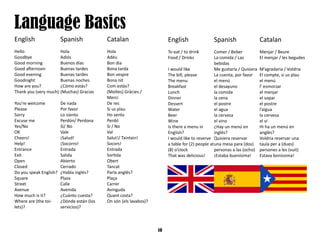
Language Basics
English
Hello
Goodbye
Good morning
Good afternoon
Good evening
Goodnight
How are you?
Thank you (very much)
You’re welcome
Please
Sorry
Excuse me
Yes/No
OK
Cheers!
Help!
Entrance
Exit
Open
Closed
Do you speak English?
Square
Street
Avenue
How much is it?
Where are (the toi-
lets)?
Spanish
Hola
Adiós
Buenos días
Buenas tardes
Buenas tardes
Buenas noches
¿Cómo estás?
(Muchas) Gracias
De nada
Por favor
Lo siento
Perdón/ Perdona
Sí/ No
Vale
¡Salud!
¡Socorro!
Entrada
Salida
Abierto
Cerrado
¿Habla inglés?
Plaza
Calle
Avenida
¿Cuánto cuesta?
¿Dónde están (los
servicios)?
Catalan
Hola
Adéu
Bon dia
Bona tarda
Bon vespre
Bona nit
Com estàs?
(Moltes) Gràcies /
Merci
De res
Si us plau
Ho sento
Perdó
Si / No
Val
Salut!/ Txintxin!
Socors!
Entrada
Sortida
Obert
Tancat
Parla anglès?
Plaça
Carrer
Avinguda
Quant costa?
On són (els lavabos)?
English
To eat / to drink
Food / Drinks
I would like
The bill, please
The menu
Breakfast
Lunch
Dinner
Dessert
Water
Beer
Wine
Is there a menu in
English?
I would like to reserve
a table for (2) people at
(8) o’clock
That was delicious!
Spanish
Comer / Beber
La comida / Las
bebidas
Me gustaría / Quisiera
La cuenta, por favor
el menú
el desayuno
la comida
la cena
el postre
el agua
la cerveza
el vino
¿Hay un menú en
inglés?
Quisiera reservar
una mesa para (dos)
personas a las (ocho)
¡Estaba buenísima!
Catalan
Menjar / Beure
El menjar / les begudes
M’agradaria / Voldria
El compte, si us plau
el menú
l’ esmorzar
el menjar
el sopar
el postre
l’aigua
la cervesa
el vi
Hi ha un menú en
anglès?
Voldria reservar una
taula per a (dues)
persones a les (vuit)
Estava boníssima!

CTR: Barrios de Barcelona

  • 1.
    BarcelonaBarcelona arrios de BarcelonaBarcelonaBarcelona full book:http://www.lulu.com/content/e-book/barrios-de-barcelona/17073911
  • 2.
    Welcome to Barcelona!Welcometo Barrios de Barcelona! Our guide is structured to allow you to explore the unique and contrasting barrios (neighbourhoods) of Barcelona while making sure you catch the highlights in each one. Every different barrio has something to offer and this is outlined through our guide, allowing for easy navigation of both the guide and the city. Get out and explore!
  • 3.
    Meet the Team LucyWhite, 21 Scotland Barcelona favourite: magic fountain James Treweek, 22 England Barcelona favourite: Sagrada Familia Danielle Hines, 21 England Barcelona favourite: The music, whether you’re on the street, in the metro or at a concert, Barcelona is bursting with sound Luke Cy, 30 England Barcelona favourite: Camp Nou Katie Chakhova, 30 Canada Barcelona favourite: street art and cava Jasmaine Vaughan, 19 Scotland Barcelona favourite: learning about the Catalan language and culture Rachel Jordan, 28 USA Barcelona favourite: I love the culture and the people!
  • 4.
    4 Table of Contents History 5 Barcelona Now and Catalan Identity 6 Survival Guide 7 Getting Around 9 Language Basics 10 Barri Gotic 12 Sandemans New Barcelona Walking Tours 13 La Rambla 14 Catedral de la Santa Creu i Santa Eulalia (Barcelona Cathedral) 15 Basilica de Santa Maria del Pi 16 Homenatge als Castellers 17 Mezcalaria El Antojo 18 Anti-karaoke 19 El Raval 20 Mercat de la Boqueria 21 CCCB & MACBA 22 Street Art Tour 23 Holala! Plaza or Tallers 24 Restaurant L’Havana 25 Restaurant Elisabets 26 23 Robadors 27 Born 28 Museu de la Xocolata 29 Museu Picasso 30 Parc de la Ciutadella 31 Fossar de les Moreres 32 Basilica de Santa Maria del Mar 33 Restaurant Galiy 34 El Xampanye 35 Barceloneta 36 Barceloneta Beach 37 Jai Ca 38 L’Aquarium 39 Absente Bar 40 Gràcia & L’Eixample 41 Sagrada Familia 42 Park Güell 43 El Corte Ingles 44 Plaças de Gràcia 45 Turó de la Rovira 46 Hospital Sant Pau 47 La Chappelle 48 Khan Kaffran 49 Unnatural Space 50 Montjuic & Poble Sec 51 Camp Nou 52 Estadi Olimpic 53 Jardí Botànic de Barcelona 54 Font Magica de Montjuic 55 Manga & Rosa 56 Bar Bristol 57 Sala de Montjuic 58 Barcelona Extras 59 Montserrat 60 Montgat Beach 61
  • 5.
    5 HistoryThe first humansettlements in Barcelona date back to Neolithic times. There are many theories about the formation of Barcelona. Some even think that Barcelona was founded by Hercules. The city itself was founded by the Romans who set up a colony called Barcino at the end of the 1st century BC, which was occupied by the Visigoths in 415 and renamed Barcinona. The colony had over a thousand inhabitants and was bounded by a defensive wall, the remains of which can still be seen in the old town (within the history museum, very near to Jaume I metro station). 8thCentury Moorsconquerthecity 9thCentury Franksconquerthecity 1000-1200 Barcelonaisoneofthemostimportant Mediterraneanports 1391Amassacreofthecity’sJewishcommunity 1450TheUniversitatdeBarcelonafounded 1640AlliedtoLouisXIIIofFrance,Catalonian revoltagainsttheSpanishmonarchybeginsin Barcelona1652BarcelonasiegedbyDonJuanJoséofAustria whichendstheCatalanrebellion 1705-1714 TheWarofIndependenceagainstSpain. Defeatedon11thofSeptember1714withthe Catalonianconstitutionabolished 1882ConstructionofLaSagradaFamiliabeganon the19thMarch 1888WorldExhibitionheldinBarcelona 1936-1939 TheSpanishCivilWar,afterwhich Catalan languageandcultureweresuppressed 1977Cataloniarecoverssomeself-government undertheEstatutdeAutonomia 1992BarcelonahoststheOlympicGames, whichrejuvenatedthecity
  • 6.
    6 Barcelona Now and CatalanIdentity In a symbolic referendum in 2009, 95 per cent of those who voted were in favour of Catalonia’s independence from Spain and wanted it to achieve statehood, but there was a low voter turnout (only 27%). 2009 The 2012 Catalan independence demonstration was a protest march which occurred in central Barcelona on 11th of September. The protestors demanded the independence of Catalonia and its consolidation as a sovereign state under the slogan “Catalunya, nou estat d’Europa” (in English, “Catalonia, new state in Europe”). The number of participants was estimated at about 1.5 million to 2 million. The city centre was crowded for hours and many newspapers and other news agencies described it as a “historic” demonstration and considered it to be the biggest protest march ever held in Catalonia since the restoration of democracy in Spain, surpassing other major demonstrations. A demonstration in central Barcelona on 10 July 2010 against limitations of the autonomy of Catalonia within Spain, and particularly against a recent decision of the Spanish Constitutional Court to annul or reinterpret several articles of the 2006 Statute of Autonomy of Catalonia. The number of people taking part in the demonstration was estimated at between 1.1 million and 1.5 million. The demonstration was led by a banner with the slogan in Catalan “Som una nació. Nosaltres decidim.” (in English, “We are a nation. We decide.”). 2010 2011 On La Diada, Catalonia’s National Holiday, 11th of November 2013, hundreds of thousands of people demonstrated in Catalonia for the independence from Spain and the right to decide about their future. To draw attention to their claim to independence, they formed a human chain across Catalonia, with a remarkable length of 400 kilometres. On 9th of November 2014, the Government of Catalonia held a non-binding vote on the political future of the state. The ballot consisted of two questions: “Do you want Catalonia to become a State?” and “Do you want this State to be independent?”. 2013 2014
  • 7.
    Survival Guide PersonalSafety Overall, Spain is a generally safe place to be. When travelling, especially alone, be sure to take the necessary precautions and stay in public areas where there are plenty of people. If you are carrying a bag or a purse, be aware of its location and keep it close to your body. The more popular areas such as Las Ramblas or public transportation stations is where the skillful pickpocketing can take place. Money The currency of Spain is the Euro (€). Exchanges can be made at the airport or around the city at different locations that areclearly marked (Las Ramblas, etc.). It is best to bring euros along with you to have on hand upon entering the country. MasterCard and Visa are widely accepted in most areas as well. Where to Stay There are various different places to stay in the city. Hotels and hostels can be found all over in many of the different neighborhoods. Important Numbers Ambulance No.: 061 Emergency No.: 122 (all emergencies) Police No. 092 (local); 061 (regional)
  • 8.
    Survival GuideTime Be awareof the time difference. Barcelona is one hour ahead of the UK, six hours ahead of New York and Toronto, nine hours ahead of Los Angeles, and nine hours behind Sydney. During daylight savings time, Spain’s clocks jump ahead during the last week of March and back again in the last week of October. Health Water from the tap is perfectly safe to drink; however, it may not taste the best. When ordering in a bar or restaurant you will typically be given bottled water. There are several hospitals that have 24 hr accident and emergency services along with pharmacies in each neighborhood with hours from 9am-1pm and 4pm-8pm. If you are traveling during the summer months, be sure to carry sunscreen with you and reapply often. Also carrying water with you at all times is beneficial to stay hydrated in the intense heat. Electricity Spain’s electricity is 220v and plugs have round posts. It is important that you bring an adapter and a converter (or transformer) to use UK and US cell phone chargers, laptops, and other electric items. Tips Tipping is an acceptable action. Locals typically leave a few cents or round to the nearest euro for a coffee or drink, a euro or two for most meals aside from the nicer establishments, for those expect closer to ten to fifteen percent. Taxi drivers generally like to get roughly five percent. Spanish culture can be quite affectionate between family members and close friends. When greeting one another people generally shake hands or touch cheeks while making a kissing sound. Nonverbal communication is important. Be aware of your body language even the way you are standing can send messages that you might be unaware of. If you plan on visiting the museums, a Barcelona Museum Pass can be purchased for 30€ and allows entry to six of Barcelona’s most popular museums and skip the queues. It’s the best deal and is valid for three consecutive months after redemption.
  • 9.
    9 Getting AroundBarcelona hasvarious modes of transportation, making it easy to get around to different parts of the city. These modes include by way of taxi, bus, metro, train, bike, and trams. Visit www.tmb.cat for ticket information, bus stops, city transport map, and full timetables. By Air If coming in by air, there are several different ways to get to where you are going. Grabbing a taxi may be less of a hassle, but will cost more (approximately 30€) plus extra charges if traveling after 9pm and if you plan to use the boot of the taxi. The airport train runs roughly every 30 minutes to the Barcelona Sants station costing approximately €4, making this a cheaper option and will take about 15-20 minutes. Another cheaper option would be taking the Aerobús service that runs every 5-10 minutes Mon-Sat 6am-1am; 5.90€ or 10.20€ return to and from T1 and T2. Bus Buses and night buses are available daily 5am-10:30pm for single tickets at 2.15€. Barcelona Tour Buses can be taken around the city on a two- storey bus. Tickets can be purchased (27€ for 1 day; 35€ for 2 days) and more information can be found at www.barcelonatours.es. Metro The metro system is a popular way of travel and the fastest way to get around the city and runs on 6 lines. Tickets can be purchased at all metro stations. There are various options for tickets to be purchased. Single (2.15€); T-Dia (one day pass for 7.60€); 2 Day Pass (14€); 3 Day Pass (20€); for the best deal, a T-10 ticket can be purchased (9.95€) that is valid for 10 journeys on the metro and the train. Hours of the metro service are Mon-Thurs, Sun and public holidays 5am-midnight; Fri 5am-2am; Sat and the day before public holiday is 24-hr service. All metro stations can be identified with a red “M”. Taxi Taxis can be hailed in most of the more populated areas such as venues, train and metro stations, etc. Calling ahead can be beneficial but be prepared to be charged a few extra euros and few of the companies speak English. Barna Taxi (tel: 933 222 222); Radio Taxi (tel: 933 033 033) Bike Rental A great way to get around the city is to rent a bike for roughly 20€ per day. For more information visit www.bicing.cat.
  • 10.
    10 Language Basics English Hello Goodbye Good morning Goodafternoon Good evening Goodnight How are you? Thank you (very much) You’re welcome Please Sorry Excuse me Yes/No OK Cheers! Help! Entrance Exit Open Closed Do you speak English? Square Street Avenue How much is it? Where are (the toi- lets)? Spanish Hola Adiós Buenos días Buenas tardes Buenas tardes Buenas noches ¿Cómo estás? (Muchas) Gracias De nada Por favor Lo siento Perdón/ Perdona Sí/ No Vale ¡Salud! ¡Socorro! Entrada Salida Abierto Cerrado ¿Habla inglés? Plaza Calle Avenida ¿Cuánto cuesta? ¿Dónde están (los servicios)? Catalan Hola Adéu Bon dia Bona tarda Bon vespre Bona nit Com estàs? (Moltes) Gràcies / Merci De res Si us plau Ho sento Perdó Si / No Val Salut!/ Txintxin! Socors! Entrada Sortida Obert Tancat Parla anglès? Plaça Carrer Avinguda Quant costa? On són (els lavabos)? English To eat / to drink Food / Drinks I would like The bill, please The menu Breakfast Lunch Dinner Dessert Water Beer Wine Is there a menu in English? I would like to reserve a table for (2) people at (8) o’clock That was delicious! Spanish Comer / Beber La comida / Las bebidas Me gustaría / Quisiera La cuenta, por favor el menú el desayuno la comida la cena el postre el agua la cerveza el vino ¿Hay un menú en inglés? Quisiera reservar una mesa para (dos) personas a las (ocho) ¡Estaba buenísima! Catalan Menjar / Beure El menjar / les begudes M’agradaria / Voldria El compte, si us plau el menú l’ esmorzar el menjar el sopar el postre l’aigua la cervesa el vi Hi ha un menú en anglès? Voldria reservar una taula per a (dues) persones a les (vuit) Estava boníssima!