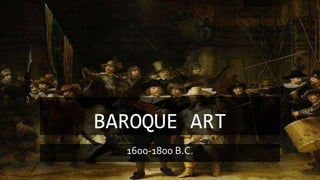
BAROQUE ART
1600-1800 B.C.
BAROQUE ART
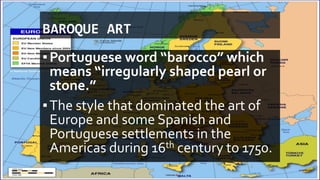
▪Portuguese word “barocco” which
means “irregularly shaped pearl or
stone.”
▪The style that dominated the art of
Europe and some Spanish and
Portuguese settlements in the
Americas during 16th century to 1750.
IMPORTANT EVENTS DURING
BAROQUE PERIOD
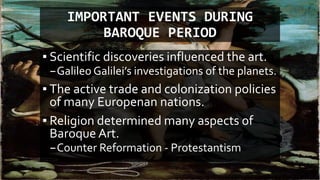
▪ Scientific discoveries influenced the art.
–Galileo Galilei’s investigations of the planets.
▪ The active trade and colonization policies
of many Europenan nations.
▪ Religion determined many aspects of
Baroque Art.
–Counter Reformation - Protestantism
IMPORTANT EVENTS DURING
BAROQUE PERIOD
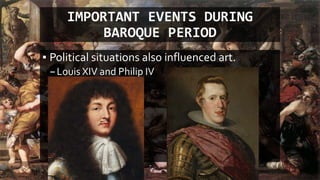
▪ Political situations also influenced art.
–Louis XIV and Philip IV
CHARACTERISTICS OF
BAROQUE ART
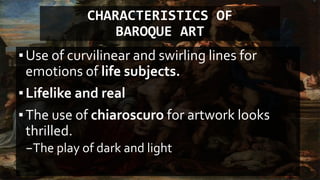
▪Use of curvilinear and swirling lines for
emotions of life subjects.
▪Lifelike and real
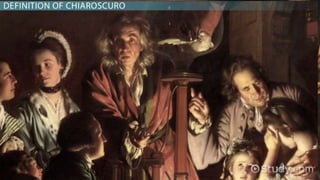
▪The use of chiaroscuro for artwork looks
thrilled.
–The play of dark and light
CHARACTERISTICS OF
BAROQUE ART
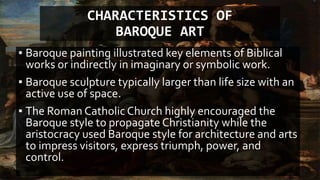
▪ Baroque painting illustrated key elements of Biblical
works or indirectly in imaginary or symbolic work.
▪ Baroque sculpture typically larger than life size with an
active use of space.
▪ The Roman Catholic Church highly encouraged the
Baroque style to propagate Christianity while the
aristocracy used Baroque style for architecture and arts
to impress visitors, express triumph, power, and
control.
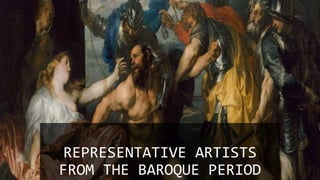
REPRESENTATIVE ARTISTS
FROM THE BAROQUE PERIOD
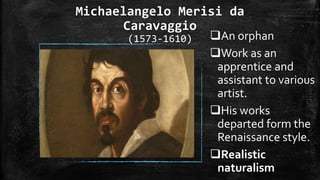
Michaelangelo Merisi da
Caravaggio
(1573-1610) An orphan
Work as an
apprentice and
assistant to various
artist.
His works
departed form the
Renaissance style.
Realistic
naturalism
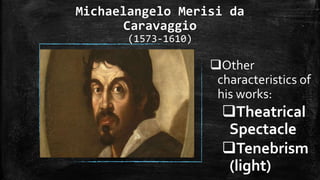
Michaelangelo Merisi da
Caravaggio
(1573-1610)
Other
characteristics of
his works:
Theatrical
Spectacle
Tenebrism
(light)
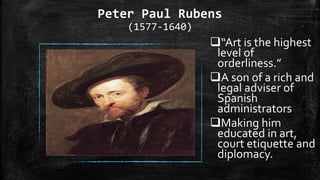
Peter Paul Rubens
(1577-1640)
“Art is the highest
level of
orderliness.”
A son of a rich and
legal adviser of
Spanish
administrators
Making him
educated in art,
court etiquette and
diplomacy.
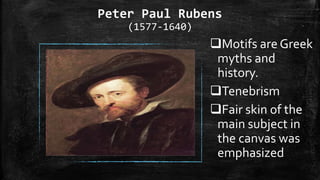
Peter Paul Rubens
(1577-1640)
Motifs are Greek
myths and
history.
Tenebrism
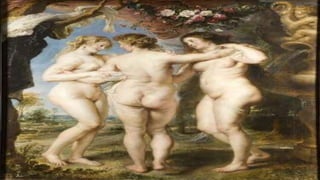
Fair skin of the
main subject in
the canvas was
emphasized
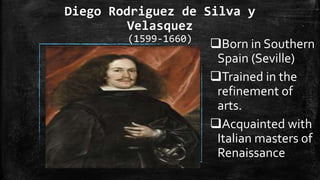
Diego Rodriguez de Silva y
Velasquez
(1599-1660)
Born in Southern
Spain (Seville)
Trained in the
refinement of
arts.
Acquainted with
Italian masters of
Renaissance
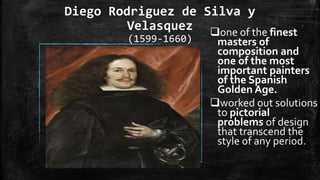
Diego Rodriguez de Silva y
Velasquez
(1599-1660)
one of the finest
masters of
composition and
one of the most
important painters
of the Spanish
Golden Age.
worked out solutions
to pictorial
problems of design
that transcend the
style of any period.
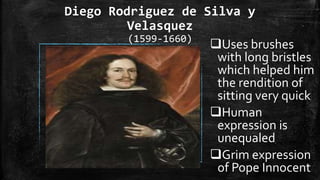
Diego Rodriguez de Silva y
Velasquez
(1599-1660)
Uses brushes
with long bristles
which helped him
the rendition of
sitting very quick
Human
expression is
unequaled
Grim expression
of Pope Innocent
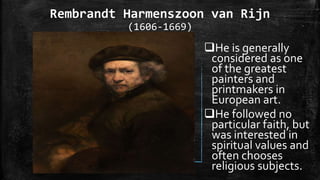
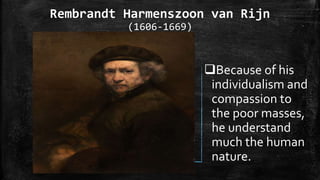
Rembrandt Harmenszoon van Rijn
(1606-1669)
He is generally
considered as one
of the greatest
painters and
printmakers in
European art.
He followed no
particular faith, but
was interested in
spiritual values and
often chooses
religious subjects.
Rembrandt Harmenszoon van Rijn
(1606-1669)
Because of his
individualism and
compassion to
the poor masses,
he understand
much the human
nature.
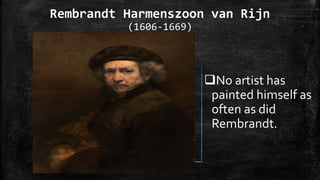
Rembrandt Harmenszoon van Rijn
(1606-1669)
No artist has
painted himself as
often as did
Rembrandt.
Rembrandt Harmenszoon van Rijn
(1606-1669)
The Nightwatch
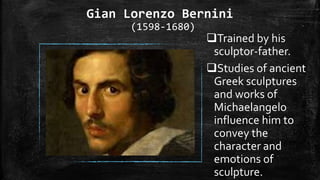
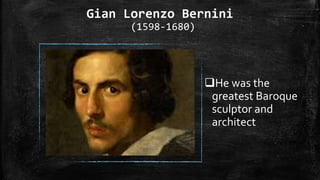
Gian Lorenzo Bernini
(1598-1680)
Trained by his
sculptor-father.
Studies of ancient
Greek sculptures
and works of
Michaelangelo
influence him to
convey the
character and
emotions of
sculpture.
Gian Lorenzo Bernini
(1598-1680)
He was the
greatest Baroque
sculptor and
architect
Gian Lorenzo Bernini
(1598-1680)
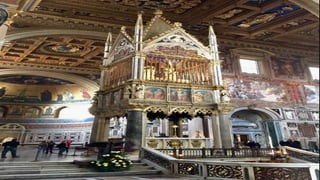
Pope Urban theVIII
commissioned him
to build a symbolic
structure over the
tomb of St. Peter’s
Basilica
Quiz
1-2.The style that dominated the art of Europe and some
_________ and ____________ settlements.
3-6. Give the four events that influenced the Baroque Art
7-8. Characteristics of Baroque Art
9. The art technique that make you feel that you’re within
that time where the art began.
10.Another technique of art that gives light when there’s no
source of light.
Quiz
11. Because of his individualism and compassion to the poor
masses, he understand much the human nature.
12. For him, “Art is the highest level of orderliness.”
13. His human expression is unequaled
14. Fair skin of the main subject in the canvas was his
emphasis
15. His works departed form the Renaissance style
Quiz
16. Studies of ancient Greek sculptures and works of
Michaelangelo influence him to convey the character and
emotions of sculpture.
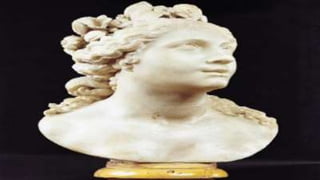
17. Venus at a Mirror
18. Symbolic structure over the tomb of St. Peter’s Basilica
19. Portrays the life of St. Matthew
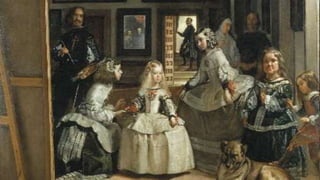
20. Las Meninas

BAROQUE ART.pptx

  • 1.
  • 2.
    BAROQUE ART ▪Portuguese word“barocco” which means “irregularly shaped pearl or stone.” ▪The style that dominated the art of Europe and some Spanish and Portuguese settlements in the Americas during 16th century to 1750.
  • 3.
    IMPORTANT EVENTS DURING BAROQUEPERIOD ▪ Scientific discoveries influenced the art. –Galileo Galilei’s investigations of the planets. ▪ The active trade and colonization policies of many Europenan nations. ▪ Religion determined many aspects of Baroque Art. –Counter Reformation - Protestantism
  • 4.
    IMPORTANT EVENTS DURING BAROQUEPERIOD ▪ Political situations also influenced art. –Louis XIV and Philip IV
  • 5.
    CHARACTERISTICS OF BAROQUE ART ▪Useof curvilinear and swirling lines for emotions of life subjects. ▪Lifelike and real ▪The use of chiaroscuro for artwork looks thrilled. –The play of dark and light
  • 7.
    CHARACTERISTICS OF BAROQUE ART ▪Baroque painting illustrated key elements of Biblical works or indirectly in imaginary or symbolic work. ▪ Baroque sculpture typically larger than life size with an active use of space. ▪ The Roman Catholic Church highly encouraged the Baroque style to propagate Christianity while the aristocracy used Baroque style for architecture and arts to impress visitors, express triumph, power, and control.
  • 8.
  • 9.
    Michaelangelo Merisi da Caravaggio (1573-1610)An orphan Work as an apprentice and assistant to various artist. His works departed form the Renaissance style. Realistic naturalism
  • 10.
    Michaelangelo Merisi da Caravaggio (1573-1610) Other characteristicsof his works: Theatrical Spectacle Tenebrism (light)
  • 13.
    Peter Paul Rubens (1577-1640) “Artis the highest level of orderliness.” A son of a rich and legal adviser of Spanish administrators Making him educated in art, court etiquette and diplomacy.
  • 14.
    Peter Paul Rubens (1577-1640) Motifsare Greek myths and history. Tenebrism Fair skin of the main subject in the canvas was emphasized
  • 16.
    Diego Rodriguez deSilva y Velasquez (1599-1660) Born in Southern Spain (Seville) Trained in the refinement of arts. Acquainted with Italian masters of Renaissance
  • 17.
    Diego Rodriguez deSilva y Velasquez (1599-1660) one of the finest masters of composition and one of the most important painters of the Spanish Golden Age. worked out solutions to pictorial problems of design that transcend the style of any period.
  • 18.
    Diego Rodriguez deSilva y Velasquez (1599-1660) Uses brushes with long bristles which helped him the rendition of sitting very quick Human expression is unequaled Grim expression of Pope Innocent
  • 20.
    Rembrandt Harmenszoon vanRijn (1606-1669) He is generally considered as one of the greatest painters and printmakers in European art. He followed no particular faith, but was interested in spiritual values and often chooses religious subjects.
  • 21.
    Rembrandt Harmenszoon vanRijn (1606-1669) Because of his individualism and compassion to the poor masses, he understand much the human nature.
  • 22.
    Rembrandt Harmenszoon vanRijn (1606-1669) No artist has painted himself as often as did Rembrandt.
  • 23.
    Rembrandt Harmenszoon vanRijn (1606-1669) The Nightwatch
  • 24.
    Gian Lorenzo Bernini (1598-1680) Trainedby his sculptor-father. Studies of ancient Greek sculptures and works of Michaelangelo influence him to convey the character and emotions of sculpture.
  • 25.
    Gian Lorenzo Bernini (1598-1680) Hewas the greatest Baroque sculptor and architect
  • 26.
    Gian Lorenzo Bernini (1598-1680) PopeUrban theVIII commissioned him to build a symbolic structure over the tomb of St. Peter’s Basilica
  • 28.
    Quiz 1-2.The style thatdominated the art of Europe and some _________ and ____________ settlements. 3-6. Give the four events that influenced the Baroque Art 7-8. Characteristics of Baroque Art 9. The art technique that make you feel that you’re within that time where the art began. 10.Another technique of art that gives light when there’s no source of light.
  • 29.
    Quiz 11. Because ofhis individualism and compassion to the poor masses, he understand much the human nature. 12. For him, “Art is the highest level of orderliness.” 13. His human expression is unequaled 14. Fair skin of the main subject in the canvas was his emphasis 15. His works departed form the Renaissance style
  • 30.
    Quiz 16. Studies ofancient Greek sculptures and works of Michaelangelo influence him to convey the character and emotions of sculpture. 17. Venus at a Mirror 18. Symbolic structure over the tomb of St. Peter’s Basilica 19. Portrays the life of St. Matthew 20. Las Meninas