REVISITING THAILAND’S
SA AUTOMOTIVE LESSONS
Prof. Justin Barnes
Chairman, B&M Analysts
Chair of Industrial Studies, UKZN
7th August 2013
Benchmarking and Manufacturing Analysts SA (Pty) Ltd owns
all rights, including those in copyright in the content of this
document, unless explicitly stated.
You are hereby authorised to make internal use of this
document by Benchmarking & Manufacturing Analysts SA
(Pty).
Findings, conclusions and recommendations are based on
information and sources believed to be accurate and reliable
at the time of publication.
The publisher makes no representation or warranty of any
kind as to the accuracy of any information provided, and
accepts no liability whatsoever for any loss or damage
resulting from opinion, errors, inaccuracies or omissions
affecting any part of the content.
© 2013 Benchmarking and Manufacturing Analysts SA (Pty)
Ltd
Copyright and Disclaimer
Presentation outline
• Contextualising the Thailand automotive
industry’s recent growth
• Overview of study tour to Thailand
• Development lessons:
• World Class Manufacturing standards
• Benefits of volume associated specialisation
• Labour market flexibility, and associated wage
model
• An innovation master plan?
• Lessons for the South African automotive
industry?
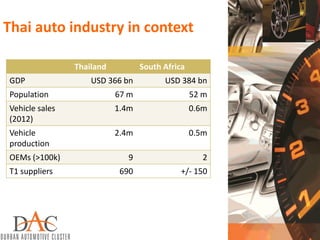
Thai auto industry in context
Thailand South Africa
GDP USD 366 bn USD 384 bn
Population 67 m 52 m
Vehicle sales
(2012)
1.4m 0.6m
Vehicle
production
2.4m 0.5m
OEMs (>100k) 9 2
T1 suppliers 690 +/- 150
Thai auto industry in context
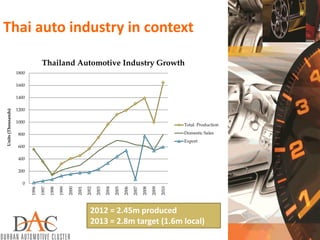
0
200
400
600
800
1000
1200
1400
1600
1800
1996
1997
1998
1999
2000
2001
2002
2003
2004
2005
2006
2007
2008
2009
2010
Units(Thousands)
Thailand Automotive Industry Growth
Total Production
Domestic Sales
Export
2012 = 2.45m produced
2013 = 2.8m target (1.6m local)
Thai auto industry in context
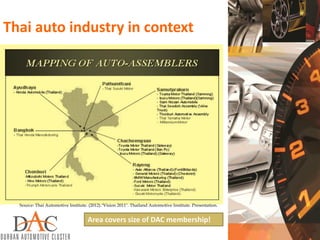
Source: Thai Automotive Institute. (2012)."Vision 2011". Thailand Automotive Institute. Presentation.
Area covers size of DAC membership!
Thai auto industry in context
Source: Board of investment. (2013). [Online] Available: www.boi.go.th.
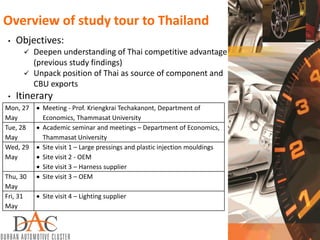
Overview of study tour to Thailand
• Objectives:
 Deepen understanding of Thai competitive advantage
(previous study findings)
 Unpack position of Thai as source of component and
CBU exports
• Itinerary
Mon, 27
May
 Meeting - Prof. Kriengkrai Techakanont, Department of
Economics, Thammasat University
Tue, 28
May
 Academic seminar and meetings – Department of Economics,
Thammasat University
Wed, 29
May
 Site visit 1 – Large pressings and plastic injection mouldings
 Site visit 2 - OEM
 Site visit 3 – Harness supplier
Thu, 30
May
 Site visit 3 – OEM
Fri, 31
May
 Site visit 4 – Lighting supplier
DL #1: WCM standards
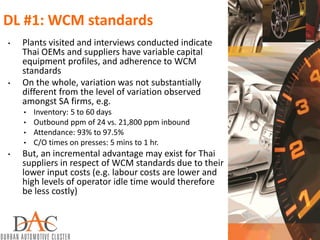
• Plants visited and interviews conducted indicate
Thai OEMs and suppliers have variable capital
equipment profiles, and adherence to WCM
standards
• On the whole, variation was not substantially
different from the level of variation observed
amongst SA firms, e.g.
• Inventory: 5 to 60 days
• Outbound ppm of 24 vs. 21,800 ppm inbound
• Attendance: 93% to 97.5%
• C/O times on presses: 5 mins to 1 hr.
• But, an incremental advantage may exist for Thai
suppliers in respect of WCM standards due to their
lower input costs (e.g. labour costs are lower and
high levels of operator idle time would therefore
be less costly)
DL #2: Volume associated
specialisation
• Localisation activities frequently linked to the vertical
integration of firms (but not exclusively so) rather than the
presence of base raw materials (steel and polymer largely
imported). Localisation of processes is enabled by the scale
of demand
• Scale of operations was substantially greater than that of
SA firms at all levels of the value chain:
 Single OEM production sites enjoy greater scale, and this is
complimented by sister production sites within close proximity
 Additional volume is secured via CKD production activity on
selected processes/products
 Tier 1 suppliers benefit from scale derived from full scale assembly
plants, multiple assemble plants and CKD production activity
• In some instances production scale seems to have
underpinned the Thai firms’ ability to position themselves
as regional/global centres of excellence for products,
suggesting this is a major source of Thai advantage
• Also, no 470.03 equivalent - localisation critical for exports
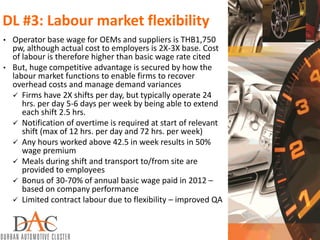
DL #3: Labour market flexibility
• Operator base wage for OEMs and suppliers is THB1,750
pw, although actual cost to employers is 2X-3X base. Cost
of labour is therefore higher than basic wage rate cited
• But, huge competitive advantage is secured by how the
labour market functions to enable firms to recover
overhead costs and manage demand variances
 Firms have 2X shifts per day, but typically operate 24
hrs. per day 5-6 days per week by being able to extend
each shift 2.5 hrs.
 Notification of overtime is required at start of relevant
shift (max of 12 hrs. per day and 72 hrs. per week)
 Any hours worked above 42.5 in week results in 50%
wage premium
 Meals during shift and transport to/from site are
provided to employees
 Bonus of 30-70% of annual basic wage paid in 2012 –
based on company performance
 Limited contract labour due to flexibility – improved QA
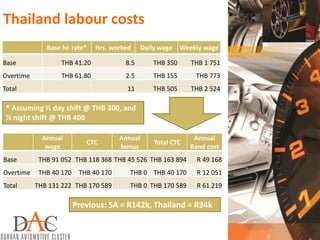
Thailand labour costs
Base hr. rate* Hrs. worked Daily wage Weekly wage
Base THB 41.20 8.5 THB 350 THB 1 751
Overtime THB 61.80 2.5 THB 155 THB 773
Total 11 THB 505 THB 2 524
Annual
wage
CTC
Annual
bonus
Total CTC
Annual
Rand cost
Base THB 91 052 THB 118 368 THB 45 526 THB 163 894 R 49 168
Overtime THB 40 170 THB 40 170 THB 0 THB 40 170 R 12 051
Total THB 131 222 THB 170 589 THB 0 THB 170 589 R 61 219
Previous: SA = R142k, Thailand = R34k
* Assuming ½ day shift @ THB 300, and
½ night shift @ THB 400
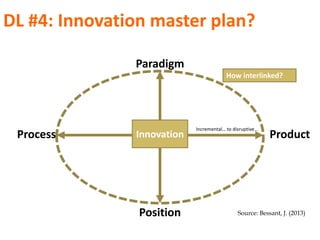
DL #4: Innovation master plan?
Innovation ProductProcess
Paradigm
Position Source: Bessant, J. (2013)
Incremental… to disruptive…
How interlinked?
Lessons for South Africa
• How to realise scale economies? SA vs.
Thailand or SSA vs. ASEAN?
• How to create an operating model that
is aligned with market demand
variances, and that reduces operating
risk?
• How far does driving WCM as the only
source of sustainable competitive
advantage take us?
• Linking the 4-Ps into a virtuous cycle
(process, product, position, and
paradigm challenges)?

Barnes dac agm 07 08 13

  • 1.
    REVISITING THAILAND’S SA AUTOMOTIVELESSONS Prof. Justin Barnes Chairman, B&M Analysts Chair of Industrial Studies, UKZN 7th August 2013
  • 2.
    Benchmarking and ManufacturingAnalysts SA (Pty) Ltd owns all rights, including those in copyright in the content of this document, unless explicitly stated. You are hereby authorised to make internal use of this document by Benchmarking & Manufacturing Analysts SA (Pty). Findings, conclusions and recommendations are based on information and sources believed to be accurate and reliable at the time of publication. The publisher makes no representation or warranty of any kind as to the accuracy of any information provided, and accepts no liability whatsoever for any loss or damage resulting from opinion, errors, inaccuracies or omissions affecting any part of the content. © 2013 Benchmarking and Manufacturing Analysts SA (Pty) Ltd Copyright and Disclaimer
  • 3.
    Presentation outline • Contextualisingthe Thailand automotive industry’s recent growth • Overview of study tour to Thailand • Development lessons: • World Class Manufacturing standards • Benefits of volume associated specialisation • Labour market flexibility, and associated wage model • An innovation master plan? • Lessons for the South African automotive industry?
  • 4.
    Thai auto industryin context Thailand South Africa GDP USD 366 bn USD 384 bn Population 67 m 52 m Vehicle sales (2012) 1.4m 0.6m Vehicle production 2.4m 0.5m OEMs (>100k) 9 2 T1 suppliers 690 +/- 150
  • 5.
    Thai auto industryin context 0 200 400 600 800 1000 1200 1400 1600 1800 1996 1997 1998 1999 2000 2001 2002 2003 2004 2005 2006 2007 2008 2009 2010 Units(Thousands) Thailand Automotive Industry Growth Total Production Domestic Sales Export 2012 = 2.45m produced 2013 = 2.8m target (1.6m local)
  • 6.
    Thai auto industryin context Source: Thai Automotive Institute. (2012)."Vision 2011". Thailand Automotive Institute. Presentation. Area covers size of DAC membership!
  • 7.
    Thai auto industryin context Source: Board of investment. (2013). [Online] Available: www.boi.go.th.
  • 8.
    Overview of studytour to Thailand • Objectives:  Deepen understanding of Thai competitive advantage (previous study findings)  Unpack position of Thai as source of component and CBU exports • Itinerary Mon, 27 May  Meeting - Prof. Kriengkrai Techakanont, Department of Economics, Thammasat University Tue, 28 May  Academic seminar and meetings – Department of Economics, Thammasat University Wed, 29 May  Site visit 1 – Large pressings and plastic injection mouldings  Site visit 2 - OEM  Site visit 3 – Harness supplier Thu, 30 May  Site visit 3 – OEM Fri, 31 May  Site visit 4 – Lighting supplier
  • 9.
    DL #1: WCMstandards • Plants visited and interviews conducted indicate Thai OEMs and suppliers have variable capital equipment profiles, and adherence to WCM standards • On the whole, variation was not substantially different from the level of variation observed amongst SA firms, e.g. • Inventory: 5 to 60 days • Outbound ppm of 24 vs. 21,800 ppm inbound • Attendance: 93% to 97.5% • C/O times on presses: 5 mins to 1 hr. • But, an incremental advantage may exist for Thai suppliers in respect of WCM standards due to their lower input costs (e.g. labour costs are lower and high levels of operator idle time would therefore be less costly)
  • 10.
    DL #2: Volumeassociated specialisation • Localisation activities frequently linked to the vertical integration of firms (but not exclusively so) rather than the presence of base raw materials (steel and polymer largely imported). Localisation of processes is enabled by the scale of demand • Scale of operations was substantially greater than that of SA firms at all levels of the value chain:  Single OEM production sites enjoy greater scale, and this is complimented by sister production sites within close proximity  Additional volume is secured via CKD production activity on selected processes/products  Tier 1 suppliers benefit from scale derived from full scale assembly plants, multiple assemble plants and CKD production activity • In some instances production scale seems to have underpinned the Thai firms’ ability to position themselves as regional/global centres of excellence for products, suggesting this is a major source of Thai advantage • Also, no 470.03 equivalent - localisation critical for exports
  • 11.
    DL #3: Labourmarket flexibility • Operator base wage for OEMs and suppliers is THB1,750 pw, although actual cost to employers is 2X-3X base. Cost of labour is therefore higher than basic wage rate cited • But, huge competitive advantage is secured by how the labour market functions to enable firms to recover overhead costs and manage demand variances  Firms have 2X shifts per day, but typically operate 24 hrs. per day 5-6 days per week by being able to extend each shift 2.5 hrs.  Notification of overtime is required at start of relevant shift (max of 12 hrs. per day and 72 hrs. per week)  Any hours worked above 42.5 in week results in 50% wage premium  Meals during shift and transport to/from site are provided to employees  Bonus of 30-70% of annual basic wage paid in 2012 – based on company performance  Limited contract labour due to flexibility – improved QA
  • 12.
    Thailand labour costs Basehr. rate* Hrs. worked Daily wage Weekly wage Base THB 41.20 8.5 THB 350 THB 1 751 Overtime THB 61.80 2.5 THB 155 THB 773 Total 11 THB 505 THB 2 524 Annual wage CTC Annual bonus Total CTC Annual Rand cost Base THB 91 052 THB 118 368 THB 45 526 THB 163 894 R 49 168 Overtime THB 40 170 THB 40 170 THB 0 THB 40 170 R 12 051 Total THB 131 222 THB 170 589 THB 0 THB 170 589 R 61 219 Previous: SA = R142k, Thailand = R34k * Assuming ½ day shift @ THB 300, and ½ night shift @ THB 400
  • 13.
    DL #4: Innovationmaster plan? Innovation ProductProcess Paradigm Position Source: Bessant, J. (2013) Incremental… to disruptive… How interlinked?
  • 14.
    Lessons for SouthAfrica • How to realise scale economies? SA vs. Thailand or SSA vs. ASEAN? • How to create an operating model that is aligned with market demand variances, and that reduces operating risk? • How far does driving WCM as the only source of sustainable competitive advantage take us? • Linking the 4-Ps into a virtuous cycle (process, product, position, and paradigm challenges)?