NBFC’s
What are NBFC’s
 A company registered Company Act -1956
 NBFCs are financial intermediaries engaged primarily in the
business of
1. Loans and advances
2. acquisition of shares/stock/bonds/debentures/securities issued by
government or local authority or other securities of like marketable
nature,
3. leasing,
4. hire-purchase,
5. insurance business,
6. chit business
Different Types Of NBFC’s
NBFC
TRADITIONAL
APPROACH OF
CLASSIFICATIO
N
MODERN
APPROACH OF
CLASSIFICATIO
N
RESIDUARY
NBFC
Equipment
Leasing Co.
Hire Purchase
Company
Loan Company
Investment
Company
Asset Finance
Company Loan Company
Investment
Company
Features of NBFC’s
 Registration with RBI is mandatory
 All the NBFC are not entitled to accept public deposits
 NBFC can accept public deposit for a minimum period of 12
months and maximum of 60 months
 They cannot accept deposits repayable on demand
 NBFCs cannot offer interest rates higher than the ceiling rate
prescribed by RBI from time to time (at present it is 12.5%)
 NBFCs cannot offer gifts/incentives or any other additional benefit
to the depositors
CONTD.
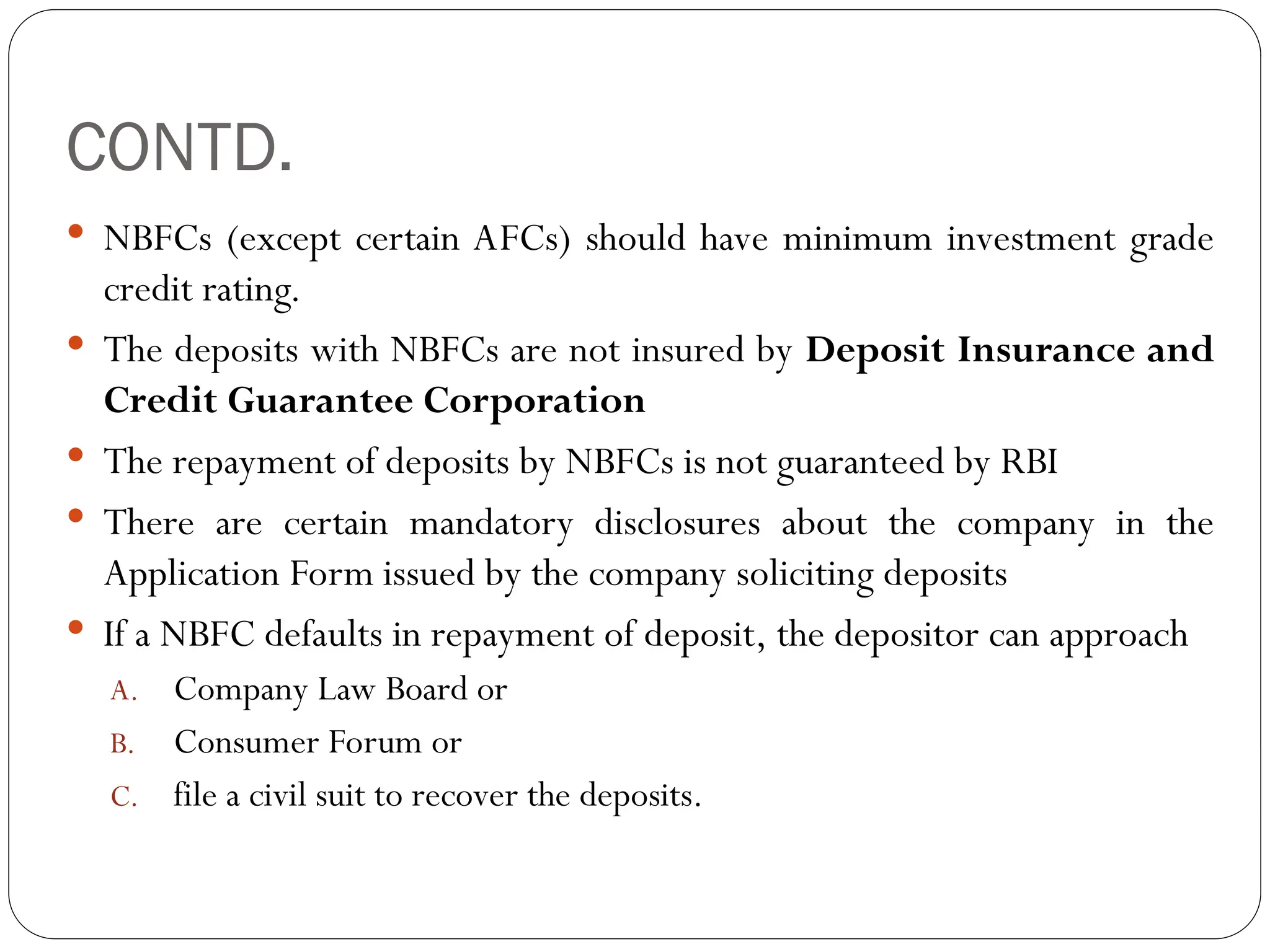
 NBFCs (except certain AFCs) should have minimum investment grade
credit rating.
 The deposits with NBFCs are not insured by Deposit Insurance and
Credit Guarantee Corporation
 The repayment of deposits by NBFCs is not guaranteed by RBI
 There are certain mandatory disclosures about the company in the
Application Form issued by the company soliciting deposits
 If a NBFC defaults in repayment of deposit, the depositor can approach
A. Company Law Board or
B. Consumer Forum or
C. file a civil suit to recover the deposits.
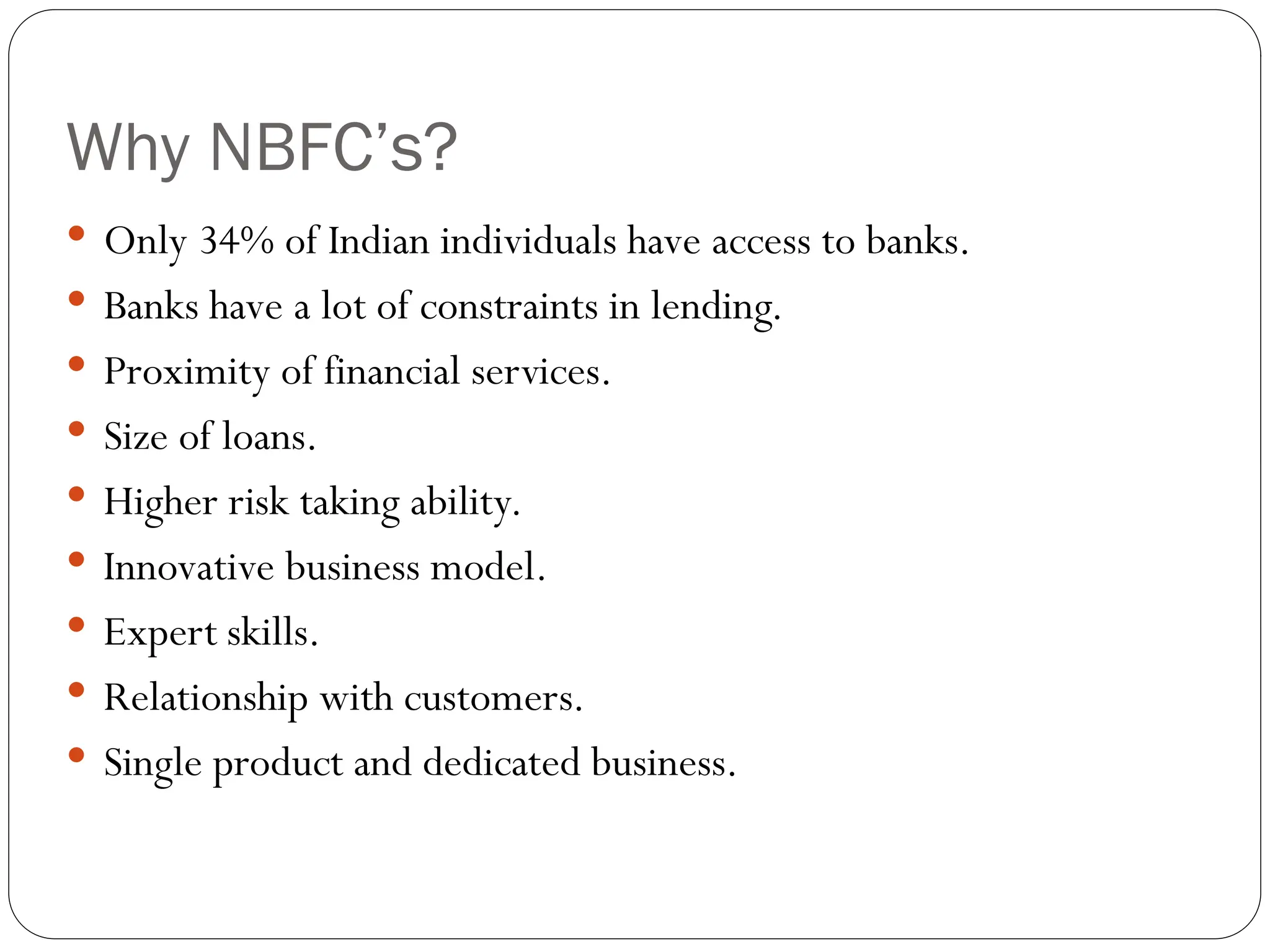
Why NBFC’s?
 Only 34% of Indian individuals have access to banks.
 Banks have a lot of constraints in lending.
 Proximity of financial services.
 Size of loans.
 Higher risk taking ability.
 Innovative business model.
 Expert skills.
 Relationship with customers.
 Single product and dedicated business.
 In truck financing majority of the truck drivers don’t have proper
papers to get the loans.
 Many SME’s in India are like truck drivers.
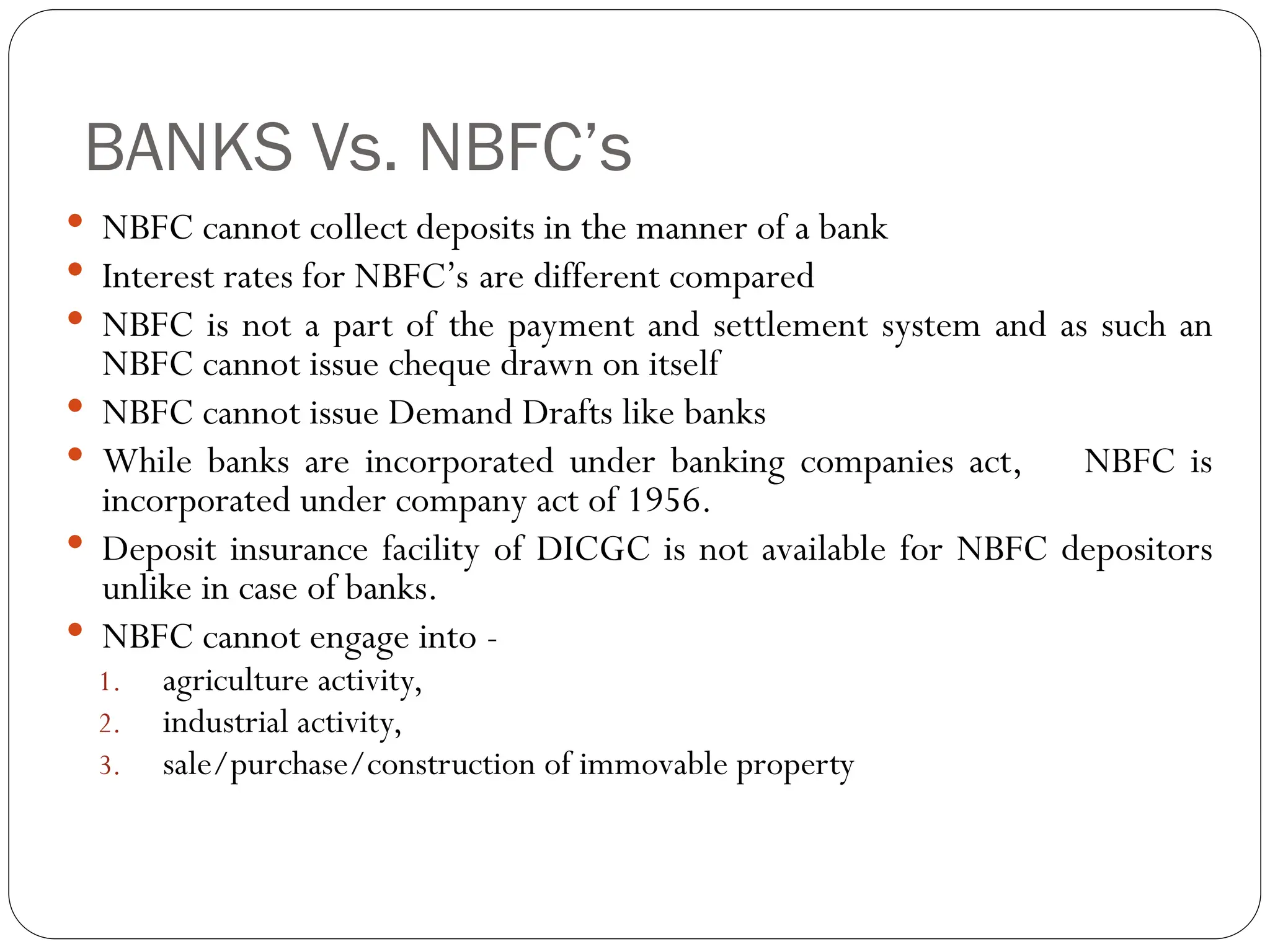
BANKS Vs. NBFC’s
 NBFC cannot collect deposits in the manner of a bank
 Interest rates for NBFC’s are different compared
 NBFC is not a part of the payment and settlement system and as such an
NBFC cannot issue cheque drawn on itself
 NBFC cannot issue Demand Drafts like banks
 While banks are incorporated under banking companies act, NBFC is
incorporated under company act of 1956.
 Deposit insurance facility of DICGC is not available for NBFC depositors
unlike in case of banks.
 NBFC cannot engage into -
1. agriculture activity,
2. industrial activity,
3. sale/purchase/construction of immovable property
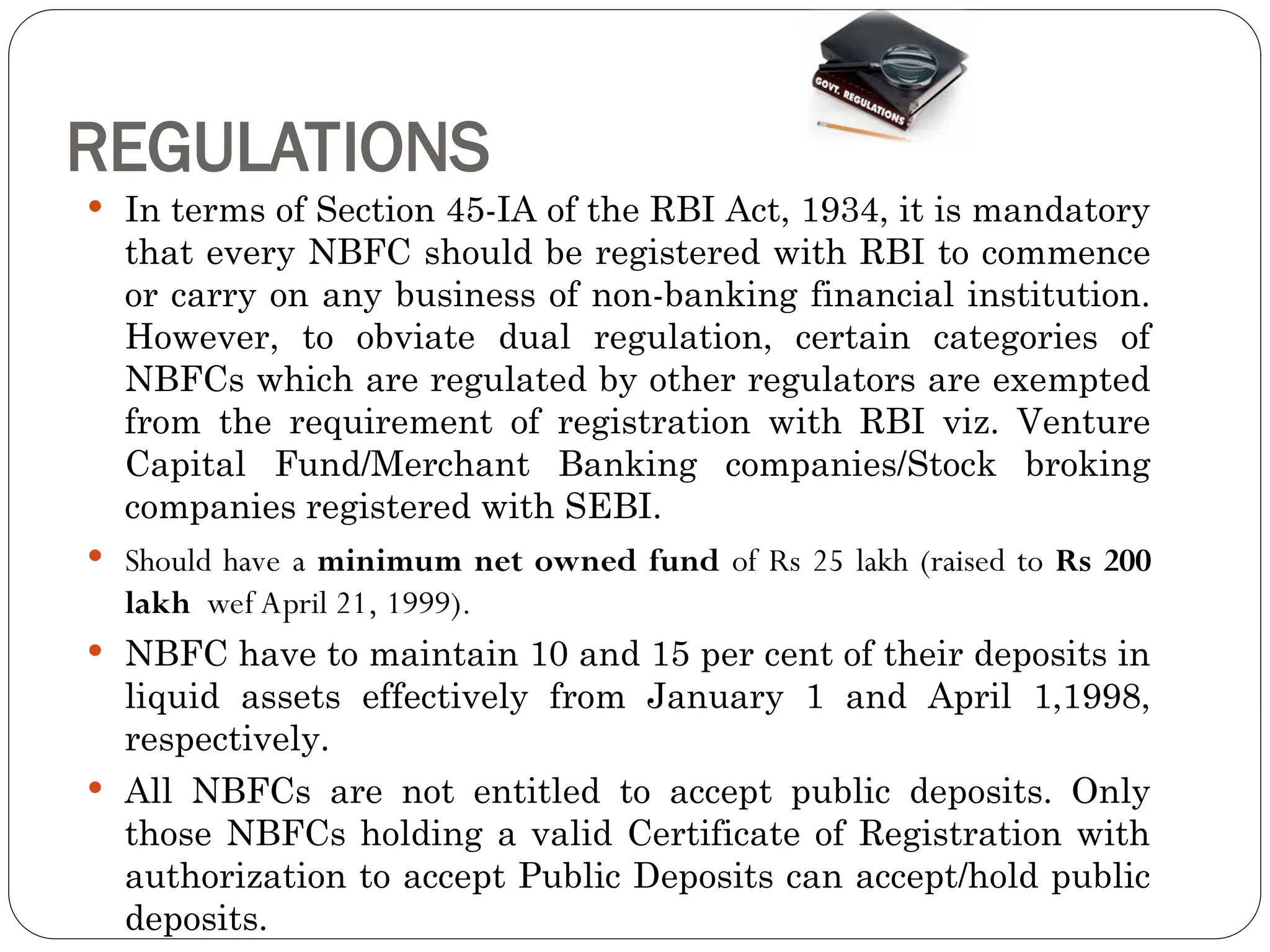
REGULATIONS
 In terms of Section 45-IA of the RBI Act, 1934, it is mandatory
that every NBFC should be registered with RBI to commence
or carry on any business of non-banking financial institution.
However, to obviate dual regulation, certain categories of
NBFCs which are regulated by other regulators are exempted
from the requirement of registration with RBI viz. Venture
Capital Fund/Merchant Banking companies/Stock broking
companies registered with SEBI.
 Should have a minimum net owned fund of Rs 25 lakh (raised to Rs 200
lakh wef April 21, 1999).
 NBFC have to maintain 10 and 15 per cent of their deposits in
liquid assets effectively from January 1 and April 1,1998,
respectively.
 All NBFCs are not entitled to accept public deposits. Only
those NBFCs holding a valid Certificate of Registration with
authorization to accept Public Deposits can accept/hold public
deposits.
REGULATIONS
 They have to create reserve fund and transfer not less
than 20 per cent of their net deposits to it every year.
 The NBFCs are allowed to accept/renew public
deposits for a minimum period of 12 months and
maximum period of 60 months. They cannot accept
deposits repayable on demand.
 NBFCs cannot offer interest rates higher than the
ceiling rate prescribed by RBI from time to time. The
present ceiling is 12.5 per cent per annum.
 They have to obtain a minimum credit rating from
anyone of the three credit rating agencies.
 NBFCs cannot offer gifts/incentives or any other
additional benefit to the depositors.
Types of NBFC
12
LEASING
LEASE is a contract between a lessor and a lessee for the hire of
a specific asset. The lessor retains the ownership of the asset
but conveys the right to use the asset to the lessee for an agreed
period of time in return for specific rentals.
 LESSOR is the legal owner of the asset. Lessor rents out the
asset to a lessee and receives income
 LESSEE pays rents in accordance with the terms of the lease;
receives economic benefits associated with the asset and also
incurs future obligations.
13
Leasing is defined as a written contract entered into
between a leasing company (“Lessor”) of the one
part and the User of the equipment (“Lessee”) of
the other part whereby the Lessee agrees to pay the
Lessor a specified sum of rentals over an obligatory
period of time in consideration for the use of
capital equipment owned by the Lessor without the
Lessee having to purchase or own the equipment.
14
 Generally, leases provide for the following terms:
1.The lessor allows the lessee the unrestricted right to use the
asset during the lease term
2.The lessee agrees to make periodic payments to the lessor and
to maintain the asset
3.Title to the asset remains with the lessor, who usually retakes
possession of the asset at the conclusion of the lease.
15
Difference Between Leasing And Hire Purchase
 The Lessor is the owner of the leased equipment and
the Lessee rent the equipment to use by paying to
the Lessor a fixed monthly rental. Ownership stays
with the Lessor.
 In hire purchase, the hirer services installment
payment for and is the beneficiary owner of the
equipment financed. Title to the equipment will be
pass on to the hirer upon full payment of all the
installment
16
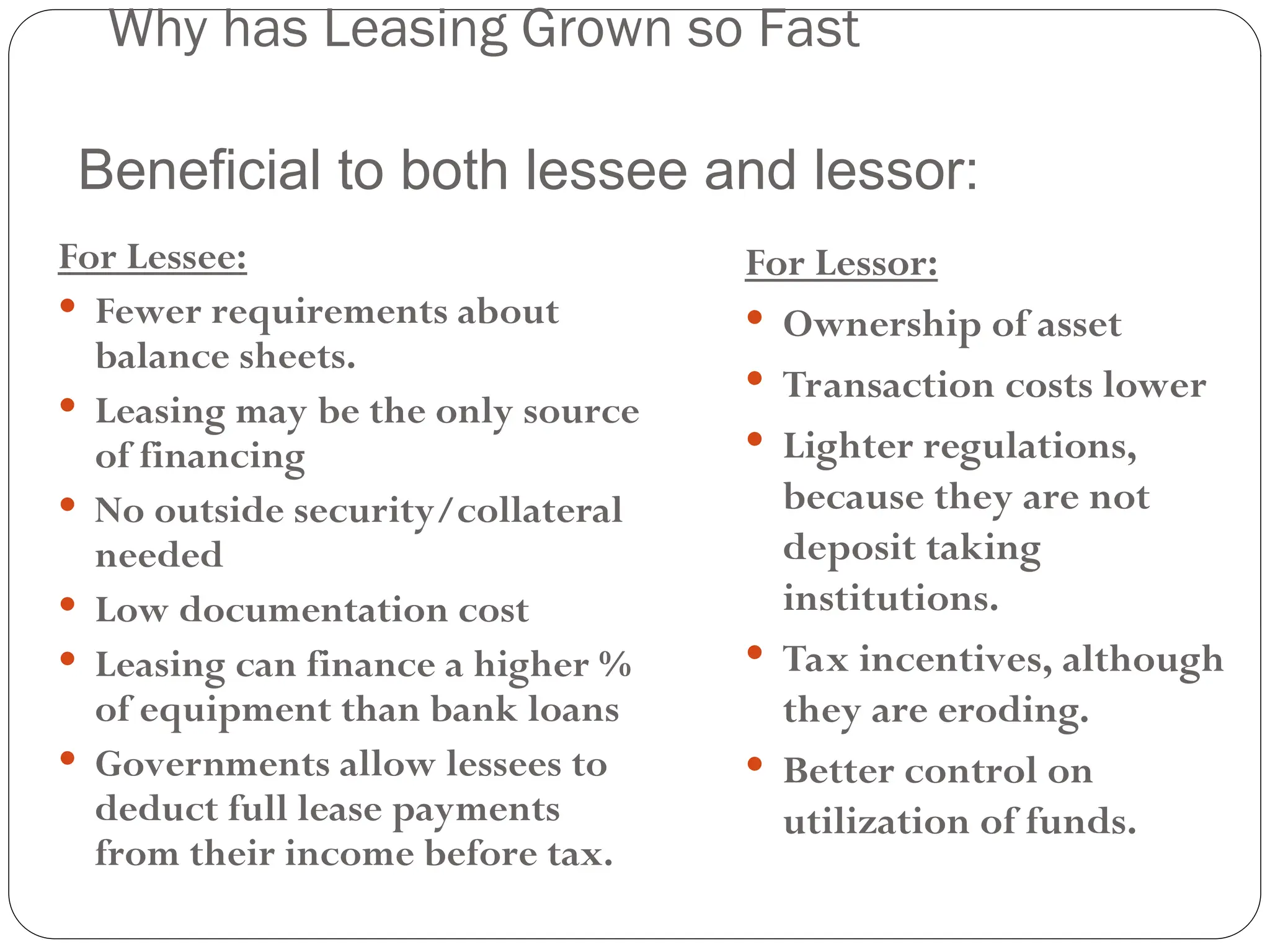
Why has Leasing Grown so Fast
For Lessee:
 Fewer requirements about
balance sheets.
 Leasing may be the only source
of financing
 No outside security/collateral
needed
 Low documentation cost
 Leasing can finance a higher %
of equipment than bank loans
 Governments allow lessees to
deduct full lease payments
from their income before tax.
For Lessor:
 Ownership of asset
 Transaction costs lower
 Lighter regulations,
because they are not
deposit taking
institutions.
 Tax incentives, although
they are eroding.
 Better control on
utilization of funds.
Beneficial to both lessee and lessor:
17
Who can Lease?
􀁺Sole Proprietorship
􀁺Partnership
􀁺Limited Company
􀁺Unlimited Company
􀁺Professional Firm
18
Types of Leases
OPERATING LEASE
(maintenance or service lease)
 Relatively short term agreement: akin to hiring an asset e.g. a
taxi, car for holidays
 Easily cancellable arrangement
 Risk/rewards do not usually pass to the lessee.
 Lessor remains responsible for repairs and maintenance.
 Payments by the lessee to the lessor are charged to P/L account
on a straight line basis
 Receipts are shown as revenue in the P/L account of the lessor
on a straight line basis.
 Note to the accounts if amounts are material
19
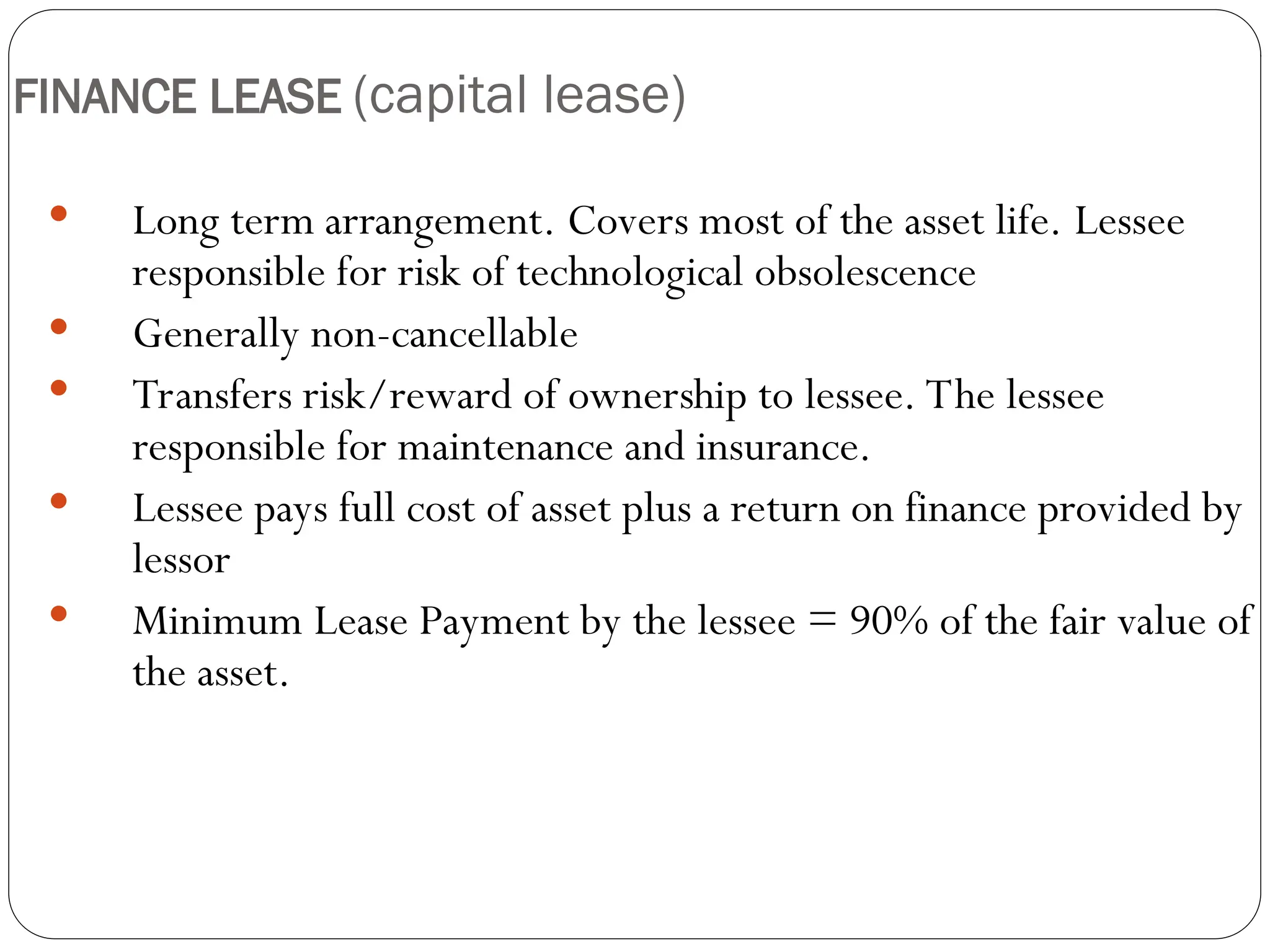
FINANCE LEASE (capital lease)
 Long term arrangement. Covers most of the asset life. Lessee
responsible for risk of technological obsolescence
 Generally non-cancellable
 Transfers risk/reward of ownership to lessee. The lessee
responsible for maintenance and insurance.
 Lessee pays full cost of asset plus a return on finance provided by
lessor
 Minimum Lease Payment by the lessee = 90% of the fair value of
the asset.
20
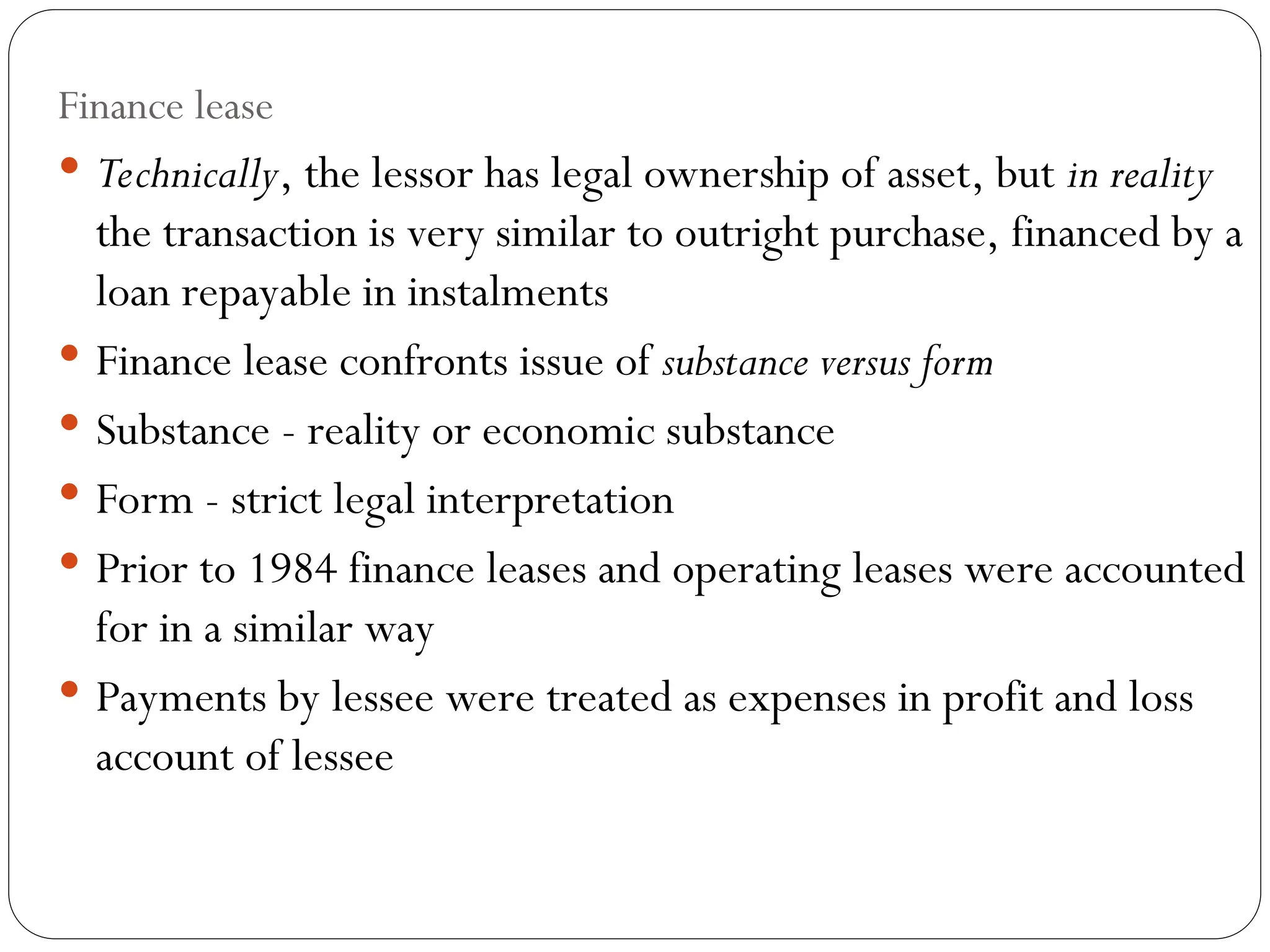
Finance lease
 Technically, the lessor has legal ownership of asset, but in reality
the transaction is very similar to outright purchase, financed by a
loan repayable in instalments
 Finance lease confronts issue of substance versus form
 Substance - reality or economic substance
 Form - strict legal interpretation
 Prior to 1984 finance leases and operating leases were accounted
for in a similar way
 Payments by lessee were treated as expenses in profit and loss
account of lessee
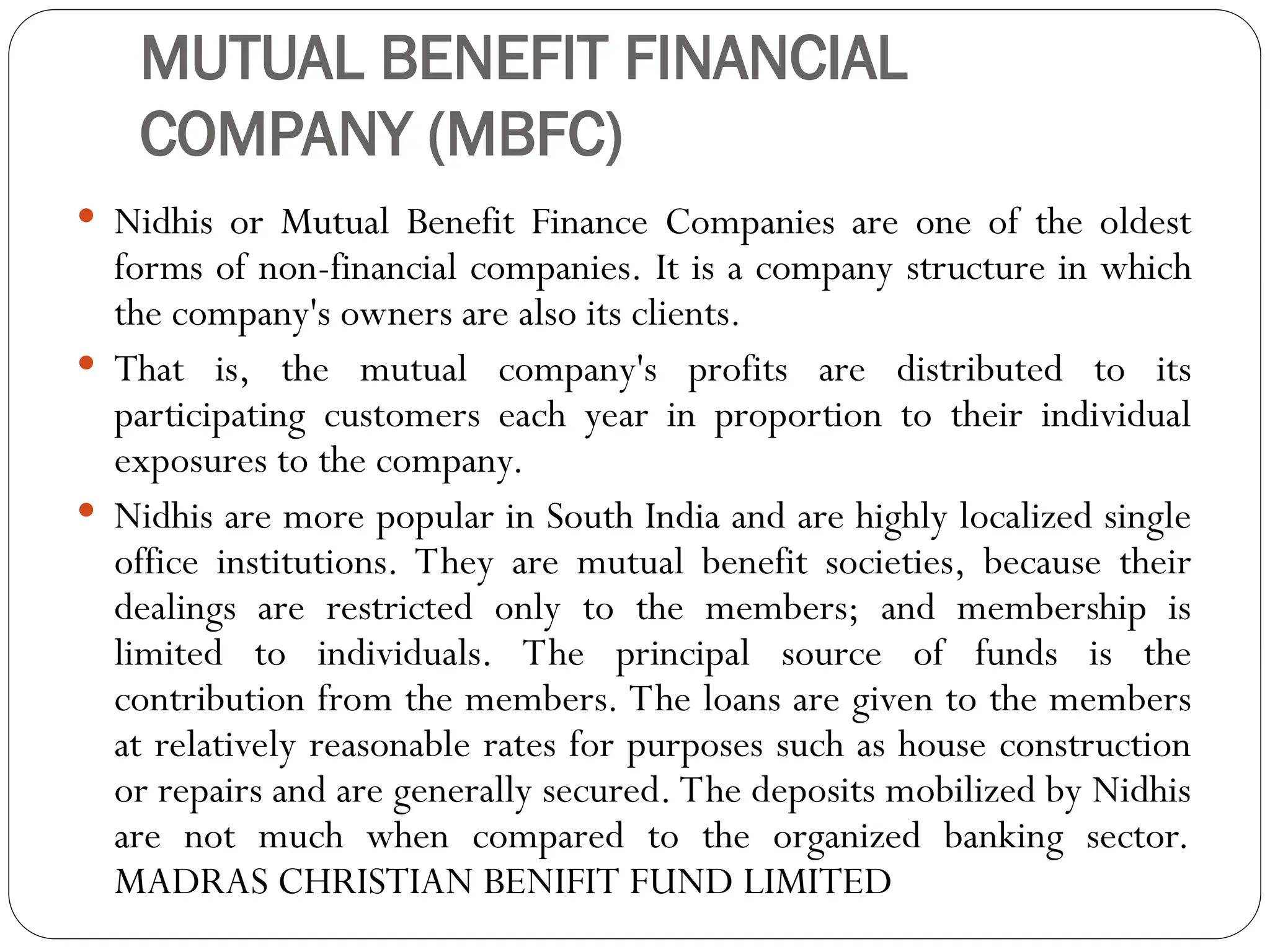
MUTUAL BENEFIT FINANCIAL
COMPANY (MBFC)
 Nidhis or Mutual Benefit Finance Companies are one of the oldest
forms of non-financial companies. It is a company structure in which
the company's owners are also its clients.
 That is, the mutual company's profits are distributed to its
participating customers each year in proportion to their individual
exposures to the company.
 Nidhis are more popular in South India and are highly localized single
office institutions. They are mutual benefit societies, because their
dealings are restricted only to the members; and membership is
limited to individuals. The principal source of funds is the
contribution from the members. The loans are given to the members
at relatively reasonable rates for purposes such as house construction
or repairs and are generally secured. The deposits mobilized by Nidhis
are not much when compared to the organized banking sector.
MADRAS CHRISTIAN BENIFIT FUND LIMITED
 Some of the important objectives of Nidhis are to enable the
members to save money, to invest their savings and to secure
loans at favorable rates of interest.
 They work on the principles of complete mutuality of interest
and are generally well-managed.
 The Government has granted certain concessions under Section
620A of the Companies Act, 1956.
 Primarily regulated by Department of Company Affairs (DCA)
under the directions / guidelines issued by them under Section
637 A of the Companies Act, 1956.
 The Government of India constituted an Expert Committee in
March 2000 (Chairman: Shri P.Sabanayagam)
INVESTMENT COMPANY
 Investment Company is any financial intermediary whose
principal business is that of buying and selling of securities.
 It is a company whose main business is holding securities of other
companies purely for investment purposes.
 The investment company invests money on behalf of its
shareholders who in turn share in the profits and losses.
 Example : G.M.W. SECURITIES AND INVESTMENTS
PRIVATE LIMITED
EQUIPMENT LEASING COMPANY
Equipment leasing company is any financial institution whose
principal business is that of leasing equipments or financing of such
an activity.
Leasing
Leasing is a process by which a firm can obtain the use of a certain
fixed assets for which it must pay a series of contractual, periodic,
tax deductible payments.
 The lessee is the receiver of the services or the assets under
the lease contract and the lessor is the owner of the assets. The
relationship between the tenant and the landlord is called a tenancy,
and can be for a fixed or an indefinite period of time (called the
term of the lease). The consideration for the lease is called rent.
 Shriram Transport Finance Corporation
HIRE-PURCHASE COMPANY
 Any financial intermediary whose principal business relates to
hire purchase transactions or financing of such transactions.
 A method of buying goods through making installment payments
over time.
 Under a hire purchase contract, the buyer is leasing the goods and
does not obtain ownership until the full amount of the contract is
paid.
 Hire purchase combines elements of both a loan and a lease. You
reach an agreement with the dealer to pay an initial deposit,
typically anything between 10% and 50%, and then pay off the
balance in monthly installments over an agreed period of time. At
the end of this period, the product is yours.
PROS & Cons
 The main advantage of a hire purchase agreement is that you can
buy something you couldn’t otherwise afford.
 On the downside however, you must be sure you can keep up
with payments or the lender will have the right to repossess the
vehicle.
 For most however, this is a safer form of finance than a regular
secured loan – which puts your house at jeopardy if you can’t
meet repayments.
 Interest rates can be high.
LOAN COMPANY
 Loan company means any financial institution whose principal
business is that of providing finance, whether by making loans or
advances or otherwise for any activity other than its own (excluding
any equipment leasing or hire-purchase finance activity).
 A loan is a type of debt. Like all debt instruments, a loan entails the
redistribution of financial assets over time, between the lender and
the borrower.
 Types of loans:
 Secured : A secured loan is a loan in which the borrower pledges
some asset (e.g. a car or property) as collateral.
 Unsecured : Unsecured loans are monetary loans that are not
secured against the borrower's assets.
 Credit card debt
 personal loans
 Bank overdrafts
 corporate bonds (may be secured or unsecured)
 Demand: Demand loans are short term loans that are typical in
that they do not have fixed dates for repayment and carry a
floating interest rate which varies according to the prime rate.
They can be "called" for repayment by the lending institution at
any time. Demand loans may be unsecured or secured.
MISCELLANEOUS NON-BANKING
COMPANIES (MNBCS)
 MNBCs are mainly engaged in the Chit Fund business.
 Conducting or supervising as a promoter, by which the
company enters into an agreement with a specified number of
subscribers that every one of them shall subscribe a certain sum
in instalments over a definite period and that every one of such
subscribers shall in turn, as determined by lot or by auction or
by tender or in such manner as may be provided for in the
arrangement, be entitled to the prize amount.
 A chit scheme generally has a predetermined value and
duration. Each scheme admits a particular number of
members (generally equal to the duration of the scheme),
who contribute a certain sum of money every month (or
everyday) to the ’pot’. The ’pot’ is then auctioned out every
month. The highest bidder (also known as the prized
subscriber)wins the ’pot’ for that month. The bid amount is
also called the ’discount’ and the prized subscriber wins the
sum of money equal to the chit value less the discount. The
discount money is then distributed among the rest of the
members (or the non-prized subscribers)as ’dividend’ and in
the subsequent month, the required contribution is brought
down by the amount of dividend.
 The Chit Fund companies have been exempted from all
the core provisions of Chapter IIIB of the RBI Act
including registration.
 In terms of Miscellaneous Non-Banking Companies (RB)
Directions, the companies can accept deposits up to 25
per cent and 15 per cent from public and shareholders,
respectively, for a period of 6 months to 36 months, but
cannot accept deposits repayable on demand/notice.
RESIDUARY NON-BANKING
COMPANIES (RNBCS)
 Company which receives deposits under any scheme or
arrangement, by whatever name called, in one lump-sum or in
instalments by way of contributions or subscriptions or by sale
of units or certificates or other instruments, or in any manner
are called RNBCs.
 RNBCs are a class of NBFCs which cannot be classified as
equipment leasing, hire purchase, loan, investment, nidhi or
chit fund companies, but which tap public savings by operating
various deposit schemes.
 The deposit acceptance activities of these companies are
governed by the provisions of Residuary Non Banking
Companies (Reserve Bank) Directions, 1987
HOUSING FINANCE
 The shelter sector of the Indian
financial system remained utterly
underdeveloped till 1980.
 The lack of adequate institutional
supply of credit for house building
was the main gap in the process of
financial development in India.
 The Indian housing industry is highly fragmented, with the
unorganized sector, comprising small builders and
contractors, accounting for over 70% of the housing units
constructed and the organized sector accounting for the rest.
 The organized sector comprises large builders and
government or government affiliated entities.
 Banks now control 40% of this market and continue to show
explosive growth.
 Finance for housing is provided in the form of mortgage loans.
 The suppliers of house mortgage loans in India are : HUDCO,
SHFSs, central and state governments, HDFC, Commercial
Banks, LIC (Jeevan Kutir & Jeevan Niwas) and NHB.
FACTORING
 Factoring is defined as ‘a continuing legal
relationship between a financial institution(the
factor) and a business concern (the client), selling
goods or providing services to trade customers
(the customers) on open account basis whereby
the Factor purchases the client’s book debts
(accounts receivables)either with or without
recourse to the client and in relation thereto
controls the credit extended to customers and
administers the sales ledgers’.
 FACTOR : A factor is a financial institution
which manages the debt collection on behalf
of its clients and bears the credit risks
associated with these.
 For servicing the receivables and bearing the
risk, the factor charges a fee which is usually
1-3 % of the face value of the receivables.
As to the payment to the client, the factor
may do so as the amount is collected, or he
make an advance payment. In the later, the
factor will charge an interest in addition to a
fee.
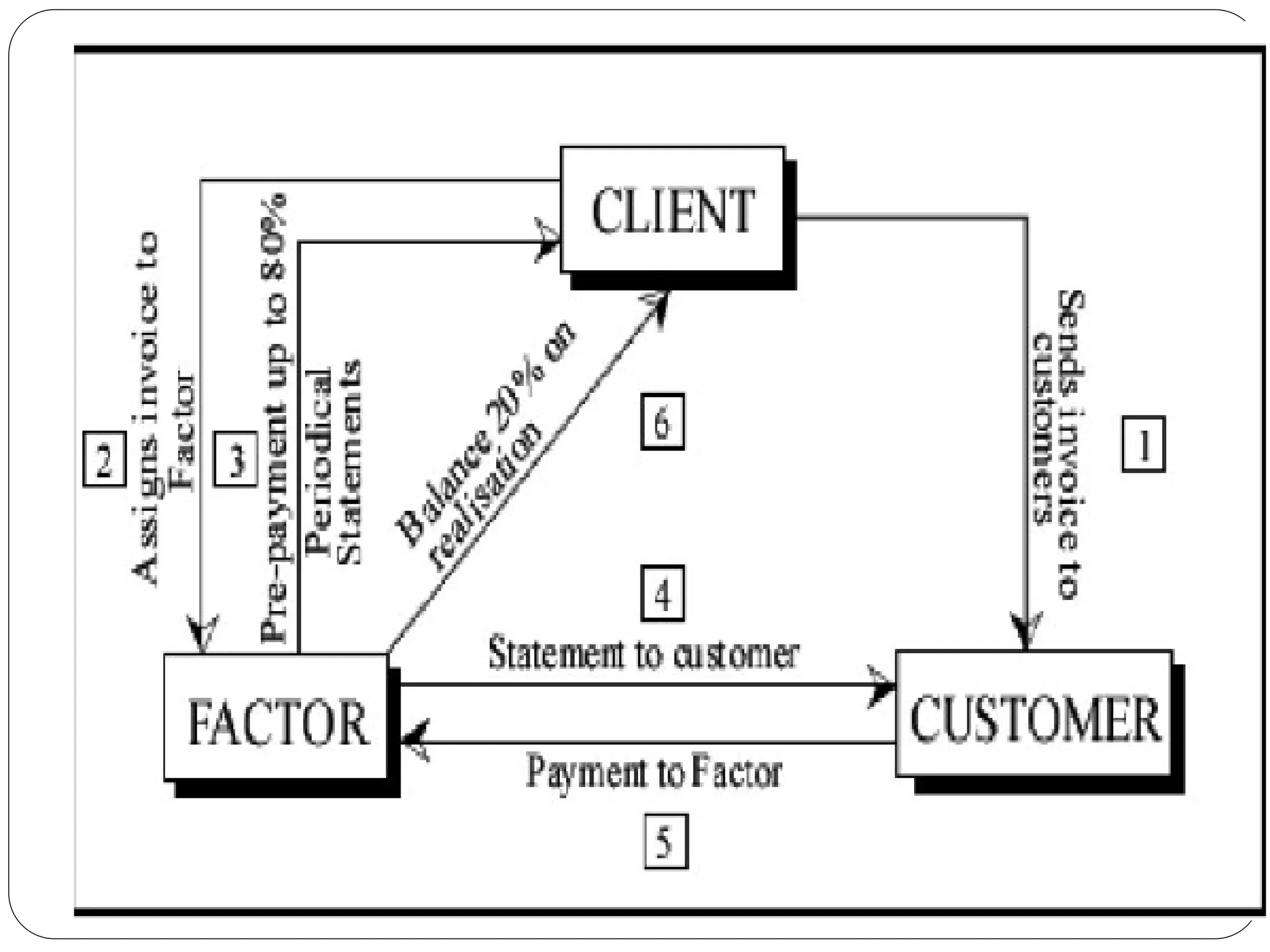
Factoring mechanism
 The parties involved in a factoring arrangement are:
 1. The Client or the seller
 2. The Debtor or the buyer
 3. The Factor (International factoring may have a correspondent
factor in addition to the domestic factor)
Banks and NBFC Introduction in India.ppt

Banks and NBFC Introduction in India.ppt

  • 1.
  • 2.
    What are NBFC’s A company registered Company Act -1956  NBFCs are financial intermediaries engaged primarily in the business of 1. Loans and advances 2. acquisition of shares/stock/bonds/debentures/securities issued by government or local authority or other securities of like marketable nature, 3. leasing, 4. hire-purchase, 5. insurance business, 6. chit business
  • 3.
    Different Types OfNBFC’s NBFC TRADITIONAL APPROACH OF CLASSIFICATIO N MODERN APPROACH OF CLASSIFICATIO N RESIDUARY NBFC Equipment Leasing Co. Hire Purchase Company Loan Company Investment Company Asset Finance Company Loan Company Investment Company
  • 4.
    Features of NBFC’s Registration with RBI is mandatory  All the NBFC are not entitled to accept public deposits  NBFC can accept public deposit for a minimum period of 12 months and maximum of 60 months  They cannot accept deposits repayable on demand  NBFCs cannot offer interest rates higher than the ceiling rate prescribed by RBI from time to time (at present it is 12.5%)  NBFCs cannot offer gifts/incentives or any other additional benefit to the depositors
  • 5.
    CONTD.  NBFCs (exceptcertain AFCs) should have minimum investment grade credit rating.  The deposits with NBFCs are not insured by Deposit Insurance and Credit Guarantee Corporation  The repayment of deposits by NBFCs is not guaranteed by RBI  There are certain mandatory disclosures about the company in the Application Form issued by the company soliciting deposits  If a NBFC defaults in repayment of deposit, the depositor can approach A. Company Law Board or B. Consumer Forum or C. file a civil suit to recover the deposits.
  • 6.
    Why NBFC’s?  Only34% of Indian individuals have access to banks.  Banks have a lot of constraints in lending.  Proximity of financial services.  Size of loans.  Higher risk taking ability.  Innovative business model.  Expert skills.  Relationship with customers.  Single product and dedicated business.
  • 7.
     In truckfinancing majority of the truck drivers don’t have proper papers to get the loans.  Many SME’s in India are like truck drivers.
  • 8.
    BANKS Vs. NBFC’s NBFC cannot collect deposits in the manner of a bank  Interest rates for NBFC’s are different compared  NBFC is not a part of the payment and settlement system and as such an NBFC cannot issue cheque drawn on itself  NBFC cannot issue Demand Drafts like banks  While banks are incorporated under banking companies act, NBFC is incorporated under company act of 1956.  Deposit insurance facility of DICGC is not available for NBFC depositors unlike in case of banks.  NBFC cannot engage into - 1. agriculture activity, 2. industrial activity, 3. sale/purchase/construction of immovable property
  • 9.
    REGULATIONS  In termsof Section 45-IA of the RBI Act, 1934, it is mandatory that every NBFC should be registered with RBI to commence or carry on any business of non-banking financial institution. However, to obviate dual regulation, certain categories of NBFCs which are regulated by other regulators are exempted from the requirement of registration with RBI viz. Venture Capital Fund/Merchant Banking companies/Stock broking companies registered with SEBI.  Should have a minimum net owned fund of Rs 25 lakh (raised to Rs 200 lakh wef April 21, 1999).  NBFC have to maintain 10 and 15 per cent of their deposits in liquid assets effectively from January 1 and April 1,1998, respectively.  All NBFCs are not entitled to accept public deposits. Only those NBFCs holding a valid Certificate of Registration with authorization to accept Public Deposits can accept/hold public deposits.
  • 10.
    REGULATIONS  They haveto create reserve fund and transfer not less than 20 per cent of their net deposits to it every year.  The NBFCs are allowed to accept/renew public deposits for a minimum period of 12 months and maximum period of 60 months. They cannot accept deposits repayable on demand.  NBFCs cannot offer interest rates higher than the ceiling rate prescribed by RBI from time to time. The present ceiling is 12.5 per cent per annum.  They have to obtain a minimum credit rating from anyone of the three credit rating agencies.  NBFCs cannot offer gifts/incentives or any other additional benefit to the depositors.
  • 11.
  • 12.
    12 LEASING LEASE is acontract between a lessor and a lessee for the hire of a specific asset. The lessor retains the ownership of the asset but conveys the right to use the asset to the lessee for an agreed period of time in return for specific rentals.  LESSOR is the legal owner of the asset. Lessor rents out the asset to a lessee and receives income  LESSEE pays rents in accordance with the terms of the lease; receives economic benefits associated with the asset and also incurs future obligations.
  • 13.
    13 Leasing is definedas a written contract entered into between a leasing company (“Lessor”) of the one part and the User of the equipment (“Lessee”) of the other part whereby the Lessee agrees to pay the Lessor a specified sum of rentals over an obligatory period of time in consideration for the use of capital equipment owned by the Lessor without the Lessee having to purchase or own the equipment.
  • 14.
    14  Generally, leasesprovide for the following terms: 1.The lessor allows the lessee the unrestricted right to use the asset during the lease term 2.The lessee agrees to make periodic payments to the lessor and to maintain the asset 3.Title to the asset remains with the lessor, who usually retakes possession of the asset at the conclusion of the lease.
  • 15.
    15 Difference Between LeasingAnd Hire Purchase  The Lessor is the owner of the leased equipment and the Lessee rent the equipment to use by paying to the Lessor a fixed monthly rental. Ownership stays with the Lessor.  In hire purchase, the hirer services installment payment for and is the beneficiary owner of the equipment financed. Title to the equipment will be pass on to the hirer upon full payment of all the installment
  • 16.
    16 Why has LeasingGrown so Fast For Lessee:  Fewer requirements about balance sheets.  Leasing may be the only source of financing  No outside security/collateral needed  Low documentation cost  Leasing can finance a higher % of equipment than bank loans  Governments allow lessees to deduct full lease payments from their income before tax. For Lessor:  Ownership of asset  Transaction costs lower  Lighter regulations, because they are not deposit taking institutions.  Tax incentives, although they are eroding.  Better control on utilization of funds. Beneficial to both lessee and lessor:
  • 17.
    17 Who can Lease? 􀁺SoleProprietorship 􀁺Partnership 􀁺Limited Company 􀁺Unlimited Company 􀁺Professional Firm
  • 18.
    18 Types of Leases OPERATINGLEASE (maintenance or service lease)  Relatively short term agreement: akin to hiring an asset e.g. a taxi, car for holidays  Easily cancellable arrangement  Risk/rewards do not usually pass to the lessee.  Lessor remains responsible for repairs and maintenance.  Payments by the lessee to the lessor are charged to P/L account on a straight line basis  Receipts are shown as revenue in the P/L account of the lessor on a straight line basis.  Note to the accounts if amounts are material
  • 19.
    19 FINANCE LEASE (capitallease)  Long term arrangement. Covers most of the asset life. Lessee responsible for risk of technological obsolescence  Generally non-cancellable  Transfers risk/reward of ownership to lessee. The lessee responsible for maintenance and insurance.  Lessee pays full cost of asset plus a return on finance provided by lessor  Minimum Lease Payment by the lessee = 90% of the fair value of the asset.
  • 20.
    20 Finance lease  Technically,the lessor has legal ownership of asset, but in reality the transaction is very similar to outright purchase, financed by a loan repayable in instalments  Finance lease confronts issue of substance versus form  Substance - reality or economic substance  Form - strict legal interpretation  Prior to 1984 finance leases and operating leases were accounted for in a similar way  Payments by lessee were treated as expenses in profit and loss account of lessee
  • 21.
    MUTUAL BENEFIT FINANCIAL COMPANY(MBFC)  Nidhis or Mutual Benefit Finance Companies are one of the oldest forms of non-financial companies. It is a company structure in which the company's owners are also its clients.  That is, the mutual company's profits are distributed to its participating customers each year in proportion to their individual exposures to the company.  Nidhis are more popular in South India and are highly localized single office institutions. They are mutual benefit societies, because their dealings are restricted only to the members; and membership is limited to individuals. The principal source of funds is the contribution from the members. The loans are given to the members at relatively reasonable rates for purposes such as house construction or repairs and are generally secured. The deposits mobilized by Nidhis are not much when compared to the organized banking sector. MADRAS CHRISTIAN BENIFIT FUND LIMITED
  • 22.
     Some ofthe important objectives of Nidhis are to enable the members to save money, to invest their savings and to secure loans at favorable rates of interest.  They work on the principles of complete mutuality of interest and are generally well-managed.  The Government has granted certain concessions under Section 620A of the Companies Act, 1956.  Primarily regulated by Department of Company Affairs (DCA) under the directions / guidelines issued by them under Section 637 A of the Companies Act, 1956.  The Government of India constituted an Expert Committee in March 2000 (Chairman: Shri P.Sabanayagam)
  • 23.
    INVESTMENT COMPANY  InvestmentCompany is any financial intermediary whose principal business is that of buying and selling of securities.  It is a company whose main business is holding securities of other companies purely for investment purposes.  The investment company invests money on behalf of its shareholders who in turn share in the profits and losses.  Example : G.M.W. SECURITIES AND INVESTMENTS PRIVATE LIMITED
  • 24.
    EQUIPMENT LEASING COMPANY Equipmentleasing company is any financial institution whose principal business is that of leasing equipments or financing of such an activity. Leasing Leasing is a process by which a firm can obtain the use of a certain fixed assets for which it must pay a series of contractual, periodic, tax deductible payments.  The lessee is the receiver of the services or the assets under the lease contract and the lessor is the owner of the assets. The relationship between the tenant and the landlord is called a tenancy, and can be for a fixed or an indefinite period of time (called the term of the lease). The consideration for the lease is called rent.  Shriram Transport Finance Corporation
  • 25.
    HIRE-PURCHASE COMPANY  Anyfinancial intermediary whose principal business relates to hire purchase transactions or financing of such transactions.  A method of buying goods through making installment payments over time.  Under a hire purchase contract, the buyer is leasing the goods and does not obtain ownership until the full amount of the contract is paid.  Hire purchase combines elements of both a loan and a lease. You reach an agreement with the dealer to pay an initial deposit, typically anything between 10% and 50%, and then pay off the balance in monthly installments over an agreed period of time. At the end of this period, the product is yours.
  • 26.
    PROS & Cons The main advantage of a hire purchase agreement is that you can buy something you couldn’t otherwise afford.
  • 27.
     On thedownside however, you must be sure you can keep up with payments or the lender will have the right to repossess the vehicle.  For most however, this is a safer form of finance than a regular secured loan – which puts your house at jeopardy if you can’t meet repayments.  Interest rates can be high.
  • 28.
    LOAN COMPANY  Loancompany means any financial institution whose principal business is that of providing finance, whether by making loans or advances or otherwise for any activity other than its own (excluding any equipment leasing or hire-purchase finance activity).  A loan is a type of debt. Like all debt instruments, a loan entails the redistribution of financial assets over time, between the lender and the borrower.  Types of loans:  Secured : A secured loan is a loan in which the borrower pledges some asset (e.g. a car or property) as collateral.
  • 29.
     Unsecured :Unsecured loans are monetary loans that are not secured against the borrower's assets.  Credit card debt  personal loans  Bank overdrafts  corporate bonds (may be secured or unsecured)  Demand: Demand loans are short term loans that are typical in that they do not have fixed dates for repayment and carry a floating interest rate which varies according to the prime rate. They can be "called" for repayment by the lending institution at any time. Demand loans may be unsecured or secured.
  • 30.
    MISCELLANEOUS NON-BANKING COMPANIES (MNBCS) MNBCs are mainly engaged in the Chit Fund business.  Conducting or supervising as a promoter, by which the company enters into an agreement with a specified number of subscribers that every one of them shall subscribe a certain sum in instalments over a definite period and that every one of such subscribers shall in turn, as determined by lot or by auction or by tender or in such manner as may be provided for in the arrangement, be entitled to the prize amount.
  • 31.
     A chitscheme generally has a predetermined value and duration. Each scheme admits a particular number of members (generally equal to the duration of the scheme), who contribute a certain sum of money every month (or everyday) to the ’pot’. The ’pot’ is then auctioned out every month. The highest bidder (also known as the prized subscriber)wins the ’pot’ for that month. The bid amount is also called the ’discount’ and the prized subscriber wins the sum of money equal to the chit value less the discount. The discount money is then distributed among the rest of the members (or the non-prized subscribers)as ’dividend’ and in the subsequent month, the required contribution is brought down by the amount of dividend.
  • 32.
     The ChitFund companies have been exempted from all the core provisions of Chapter IIIB of the RBI Act including registration.  In terms of Miscellaneous Non-Banking Companies (RB) Directions, the companies can accept deposits up to 25 per cent and 15 per cent from public and shareholders, respectively, for a period of 6 months to 36 months, but cannot accept deposits repayable on demand/notice.
  • 33.
    RESIDUARY NON-BANKING COMPANIES (RNBCS) Company which receives deposits under any scheme or arrangement, by whatever name called, in one lump-sum or in instalments by way of contributions or subscriptions or by sale of units or certificates or other instruments, or in any manner are called RNBCs.  RNBCs are a class of NBFCs which cannot be classified as equipment leasing, hire purchase, loan, investment, nidhi or chit fund companies, but which tap public savings by operating various deposit schemes.  The deposit acceptance activities of these companies are governed by the provisions of Residuary Non Banking Companies (Reserve Bank) Directions, 1987
  • 34.
    HOUSING FINANCE  Theshelter sector of the Indian financial system remained utterly underdeveloped till 1980.  The lack of adequate institutional supply of credit for house building was the main gap in the process of financial development in India.
  • 35.
     The Indianhousing industry is highly fragmented, with the unorganized sector, comprising small builders and contractors, accounting for over 70% of the housing units constructed and the organized sector accounting for the rest.  The organized sector comprises large builders and government or government affiliated entities.
  • 36.
     Banks nowcontrol 40% of this market and continue to show explosive growth.  Finance for housing is provided in the form of mortgage loans.  The suppliers of house mortgage loans in India are : HUDCO, SHFSs, central and state governments, HDFC, Commercial Banks, LIC (Jeevan Kutir & Jeevan Niwas) and NHB.
  • 37.
    FACTORING  Factoring isdefined as ‘a continuing legal relationship between a financial institution(the factor) and a business concern (the client), selling goods or providing services to trade customers (the customers) on open account basis whereby the Factor purchases the client’s book debts (accounts receivables)either with or without recourse to the client and in relation thereto controls the credit extended to customers and administers the sales ledgers’.
  • 38.
     FACTOR :A factor is a financial institution which manages the debt collection on behalf of its clients and bears the credit risks associated with these.  For servicing the receivables and bearing the risk, the factor charges a fee which is usually 1-3 % of the face value of the receivables. As to the payment to the client, the factor may do so as the amount is collected, or he make an advance payment. In the later, the factor will charge an interest in addition to a fee.
  • 39.
    Factoring mechanism  Theparties involved in a factoring arrangement are:  1. The Client or the seller  2. The Debtor or the buyer  3. The Factor (International factoring may have a correspondent factor in addition to the domestic factor)