Bank Database
1) Entities
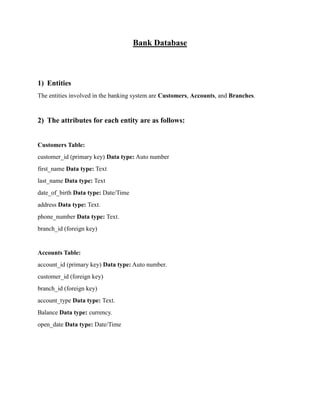
The entities involved in the banking system are Customers, Accounts, and Branches.
2) The attributes for each entity are as follows:
Customers Table:
customer_id (primary key) Data type: Auto number
first_name Data type: Text
last_name Data type: Text
date_of_birth Data type: Date/Time
address Data type: Text.
phone_number Data type: Text.
branch_id (foreign key)
Accounts Table:
account_id (primary key) Data type: Auto number.
customer_id (foreign key)
branch_id (foreign key)
account_type Data type: Text.
Balance Data type: currency.
open_date Data type: Date/Time
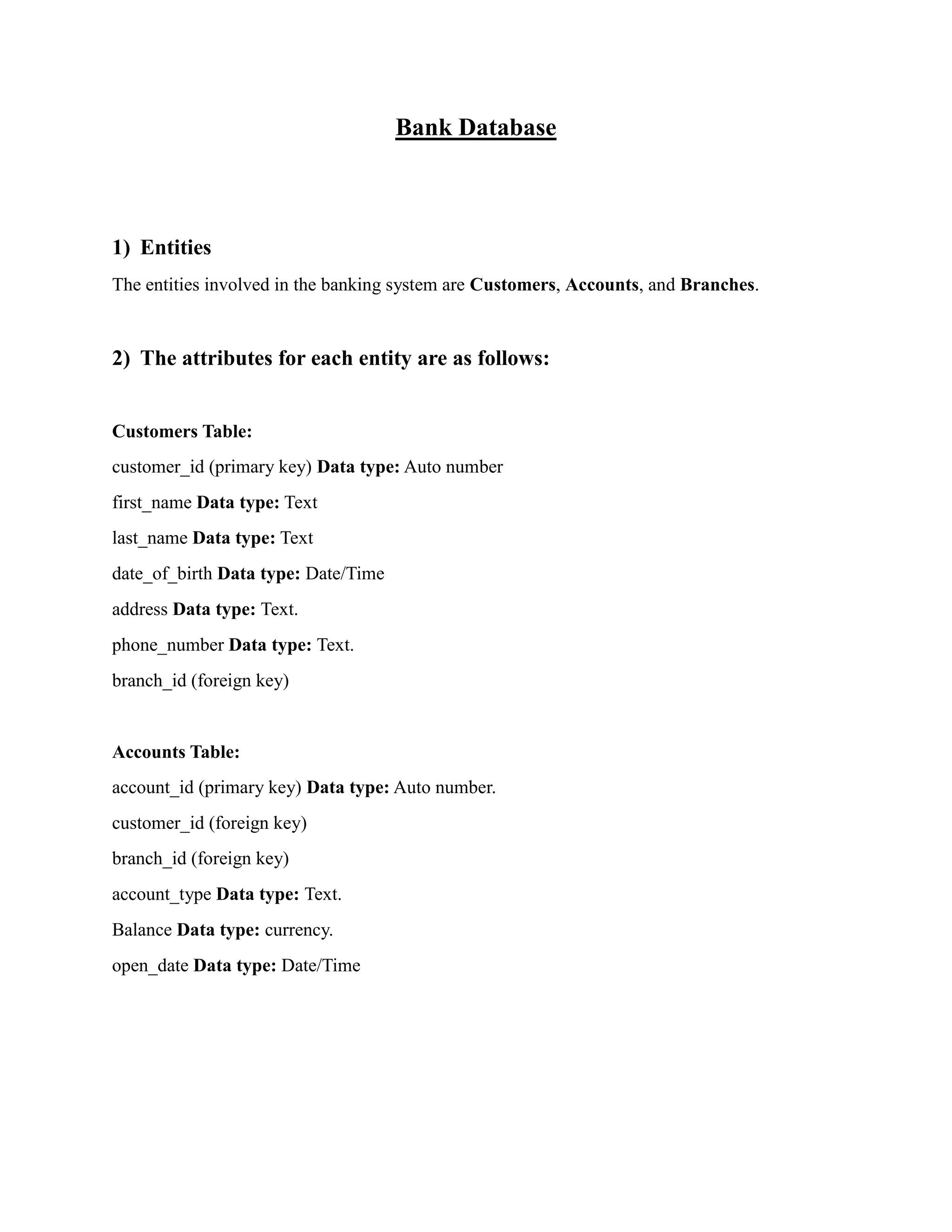
Branches Table:
branch_id (primary key) Data type: Auto number
branch_name Data type: Text
address Data type: Text.
phone_number Data type: Text
manager_name Data type: Text
opening_hours Data type: Date/Time
3) Relationships between the entities:
 The Customers and Accounts tables have a one-to-many relationship, as one customer
can have multiple accounts.
 The Branches and Accounts tables also have a one-to-many relationship, as one branch
can have multiple accounts.
 The Customers and Branches have a one-to-many relationship, as one branch can have
multiple customers.
4) The business rules for the relationships between the entities in the banking
system:
Relationship between Customers and Accounts:
 One customer can have multiple accounts.
 Each account belongs to only one customer.
 A customer must have at least one account.
Relationship between Customers and Branches:
 One branch can have multiple customers.
 Each customer belongs to only one branch.
 A branch may have no customers, but a customer must be associated with a branch.
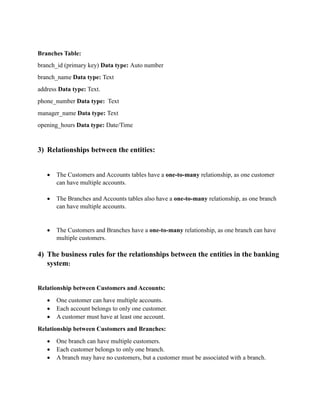
Relationship between Accounts and Branches:
 One branch can have multiple accounts.
 Each account belongs to only one branch.
 A branch may have no accounts, but an account must be associated with a branch.
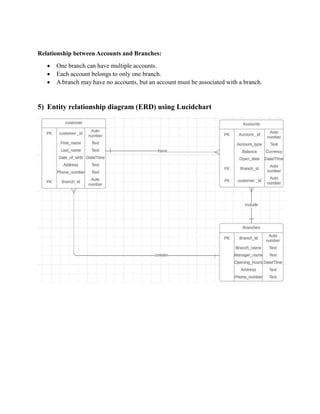
5) Entity relationship diagram (ERD) using Lucidchart
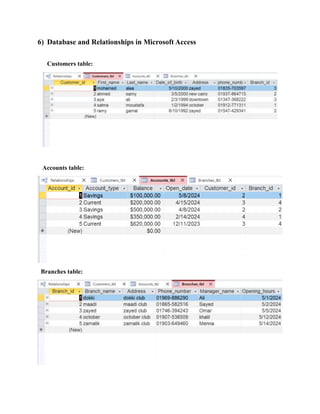
6) Database and Relationships in Microsoft Access
Customers table:
Accounts table:
Branches table:
Relationships generated from Microsoft Access:

Bank database design Access assignment.docx

  • 1.
    Bank Database 1) Entities Theentities involved in the banking system are Customers, Accounts, and Branches. 2) The attributes for each entity are as follows: Customers Table: customer_id (primary key) Data type: Auto number first_name Data type: Text last_name Data type: Text date_of_birth Data type: Date/Time address Data type: Text. phone_number Data type: Text. branch_id (foreign key) Accounts Table: account_id (primary key) Data type: Auto number. customer_id (foreign key) branch_id (foreign key) account_type Data type: Text. Balance Data type: currency. open_date Data type: Date/Time
  • 2.
    Branches Table: branch_id (primarykey) Data type: Auto number branch_name Data type: Text address Data type: Text. phone_number Data type: Text manager_name Data type: Text opening_hours Data type: Date/Time 3) Relationships between the entities:  The Customers and Accounts tables have a one-to-many relationship, as one customer can have multiple accounts.  The Branches and Accounts tables also have a one-to-many relationship, as one branch can have multiple accounts.  The Customers and Branches have a one-to-many relationship, as one branch can have multiple customers. 4) The business rules for the relationships between the entities in the banking system: Relationship between Customers and Accounts:  One customer can have multiple accounts.  Each account belongs to only one customer.  A customer must have at least one account. Relationship between Customers and Branches:  One branch can have multiple customers.  Each customer belongs to only one branch.  A branch may have no customers, but a customer must be associated with a branch.
  • 3.
    Relationship between Accountsand Branches:  One branch can have multiple accounts.  Each account belongs to only one branch.  A branch may have no accounts, but an account must be associated with a branch. 5) Entity relationship diagram (ERD) using Lucidchart
  • 4.
    6) Database andRelationships in Microsoft Access Customers table: Accounts table: Branches table:
  • 5.