2.1
Week 2: Entity-Relationship Model
 Entity, Relationship, and E-R Diagram
 Entity
 Attributes
 Weak/Regular Entity
 Relationship
 Degree
 Mapping Cardinality
 Relationship with Attributes
 Participation
 Keys
 Extended E-R Features
 Entity Specialization/Generalization
 Relationship Aggregation
 Design of an E-R Database Schema
2.2
Entity, Relationship, and E-R Diagram
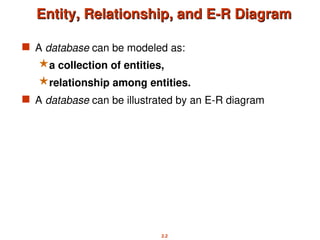
 A database can be modeled as:
a collection of entities,
relationship among entities.
 A database can be illustrated by an E-R diagram
2.3
E-R Diagrams
E-R Diagrams
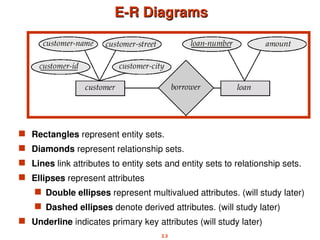
 Rectangles represent entity sets.
 Diamonds represent relationship sets.
 Lines link attributes to entity sets and entity sets to relationship sets.
 Ellipses represent attributes
 Double ellipses represent multivalued attributes. (will study later)
 Dashed ellipses denote derived attributes. (will study later)
 Underline indicates primary key attributes (will study later)
2.4
Entity Sets
Entity Sets
 An entity is an object that exists and is distinguishable
from other objects.
Example: specific person, company, event, plant
 Entities have attributes
Example: people have names and addresses
 An entity set is a set of entities of the same type that
share the same properties.
Example: set of all persons, companies, trees,
holidays
2.5
Entity Sets
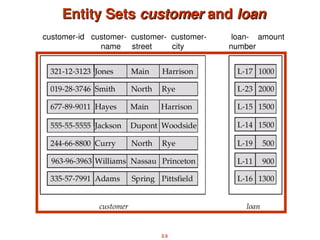
Entity Sets customer
customer and
and loan
loan
customer-id customer- customer- customer- loan- amount
name street city number
2.6
Attributes
Attributes
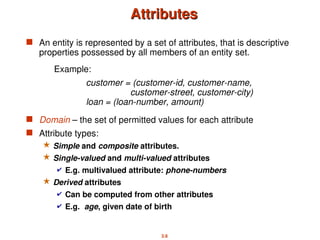
 An entity is represented by a set of attributes, that is descriptive
properties possessed by all members of an entity set.
 Domain – the set of permitted values for each attribute
 Attribute types:
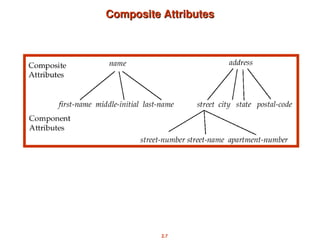
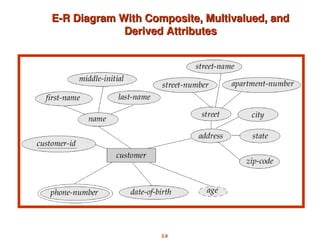
 Simple and composite attributes.
 Single-valued and multi-valued attributes
 E.g. multivalued attribute: phone-numbers
 Derived attributes
 Can be computed from other attributes
 E.g. age, given date of birth
Example:
customer = (customer-id, customer-name,
customer-street, customer-city)
loan = (loan-number, amount)
2.7
Composite Attributes
2.8
E-R Diagram With Composite, Multivalued, and
Derived Attributes
Derived Attributes
2.9
Weak Entity and Regular/Strong Entity
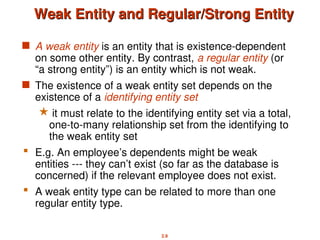
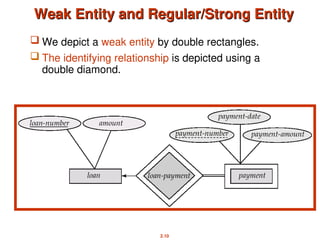
 A weak entity is an entity that is existence-dependent
on some other entity. By contrast, a regular entity (or
“a strong entity”) is an entity which is not weak.
 The existence of a weak entity set depends on the
existence of a identifying entity set
 it must relate to the identifying entity set via a total,
one-to-many relationship set from the identifying to
the weak entity set
 E.g. An employee’s dependents might be weak
entities --- they can’t exist (so far as the database is
concerned) if the relevant employee does not exist.
 A weak entity type can be related to more than one
regular entity type.
2.10
Weak Entity and Regular/Strong Entity
 We depict a weak entity by double rectangles.
 The identifying relationship is depicted using a
double diamond.
2.11
Relationship Sets
Relationship Sets
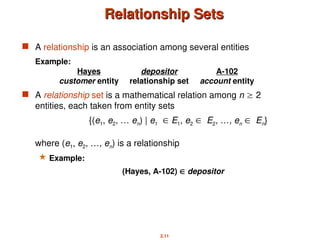
 A relationship is an association among several entities
Example:
Hayes depositor A-102
customer entity relationship set account entity
 A relationship set is a mathematical relation among n  2
entities, each taken from entity sets
{(e1, e2, … en) | e1  E1, e2  E2, …, en  En}
where (e1, e2, …, en) is a relationship
 Example:
(Hayes, A-102)  depositor
2.12
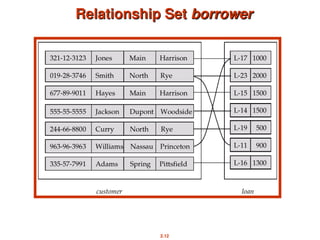
Relationship Set
Relationship Set borrower
borrower
2.13
Relationship Sets (Cont.)
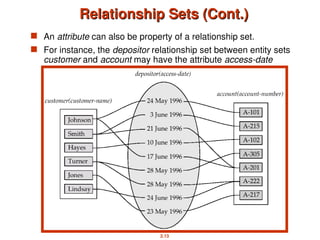
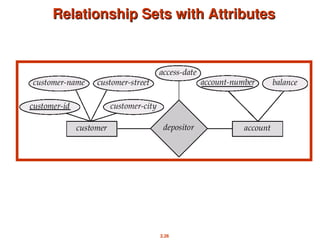
 An attribute can also be property of a relationship set.
 For instance, the depositor relationship set between entity sets
customer and account may have the attribute access-date
2.14
Degree of a Relationship Set
 Refers to number of entity sets that participate in a relationship
set.
 Relationship sets that involve two entity sets are binary (or degree
two). Generally, most relationship sets in a database system are
binary.
 Relationship sets may involve more than two entity sets.
 Relationships between more than two entity sets are rare. Most
relationships are binary. (More on this later.)
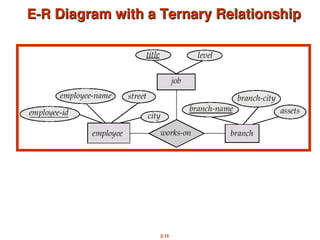
E.g. Suppose employees of a bank may have jobs
(responsibilities) at multiple branches, with different
jobs at different branches. Then there is a ternary
relationship set between entity sets employee, job
and branch
2.15
E-R
E-R Diagram with a Ternary Relationship
Diagram with a Ternary Relationship
2.16
Binary Vs. Non-Binary Relationships
 Some relationships that appear to be non-binary may be better
represented using binary relationships
 E.g. A ternary relationship parents, relating a child to his/her
father and mother, is best replaced by two binary relationships,
father and mother
 Using two binary relationships allows partial information (e.g.
only mother being know)
 But there are some relationships that are naturally non-binary
 E.g. works-on
2.17
Roles
Roles
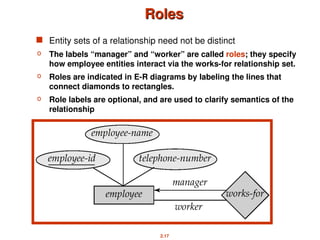
 Entity sets of a relationship need not be distinct
o The labels “manager” and “worker” are called roles; they specify
how employee entities interact via the works-for relationship set.
o Roles are indicated in E-R diagrams by labeling the lines that
connect diamonds to rectangles.
o Role labels are optional, and are used to clarify semantics of the
relationship
2.18
Mapping Cardinalities
 Express the number of entities to which another entity can be
associated via a relationship set.
 Most useful in describing binary relationship sets.
 For a binary relationship set the mapping cardinality must be
one of the following types:
 One to one
 One to many
 Many to one
 Many to many
2.19
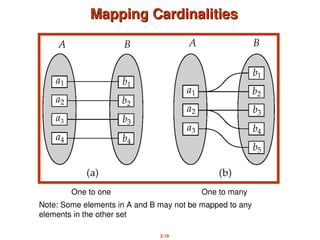
Mapping Cardinalities
One to one One to many
Note: Some elements in A and B may not be mapped to any
elements in the other set
2.20
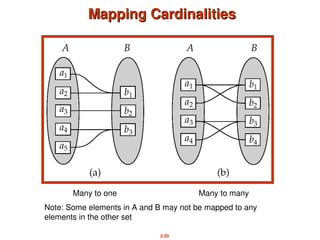
Mapping Cardinalities
Many to one Many to many
Note: Some elements in A and B may not be mapped to any
elements in the other set
2.21
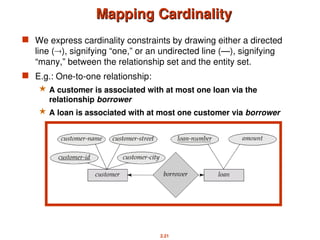
Mapping Cardinality
Mapping Cardinality
 We express cardinality constraints by drawing either a directed
line (), signifying “one,” or an undirected line (—), signifying
“many,” between the relationship set and the entity set.
 E.g.: One-to-one relationship:
 A customer is associated with at most one loan via the
relationship borrower
 A loan is associated with at most one customer via borrower
2.22
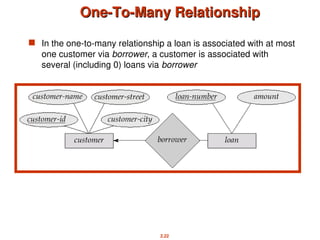
One-To-Many Relationship
 In the one-to-many relationship a loan is associated with at most
one customer via borrower, a customer is associated with
several (including 0) loans via borrower
2.23
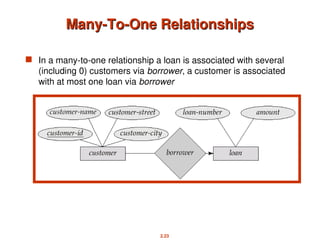
Many-To-One Relationships
 In a many-to-one relationship a loan is associated with several
(including 0) customers via borrower, a customer is associated
with at most one loan via borrower
2.24
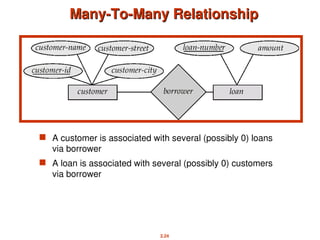
Many-To-Many Relationship
 A customer is associated with several (possibly 0) loans
via borrower
 A loan is associated with several (possibly 0) customers
via borrower
2.25
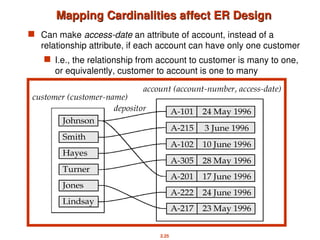
Mapping Cardinalities affect ER Design
 Can make access-date an attribute of account, instead of a
relationship attribute, if each account can have only one customer
 I.e., the relationship from account to customer is many to one,
or equivalently, customer to account is one to many
2.26
Relationship Sets with Attributes
2.27
Participation of an Entity Set in a
Relationship Set
Relationship Set
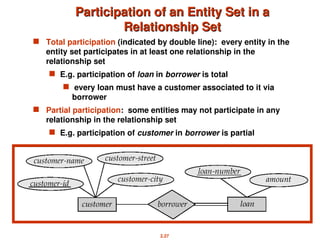
 Total participation (indicated by double line): every entity in the
entity set participates in at least one relationship in the
relationship set
 E.g. participation of loan in borrower is total
 every loan must have a customer associated to it via
borrower
 Partial participation: some entities may not participate in any
relationship in the relationship set
 E.g. participation of customer in borrower is partial
2.28
Keys
Keys
 A super key of an entity set is a set of one or more attributes
whose values uniquely determine each entity.
 A candidate key of an entity set is a minimal super key
 Customer-id is candidate key of customer
 account-number is candidate key of account
 Although several candidate keys may exist, one of the
candidate keys is selected to be the primary key.
2.29
Keys for Relationship Sets
 The combination of primary keys of the participating entity sets
forms a super key of a relationship set.
 (customer-id, account-number) is the super key of depositor
 NOTE: this means a pair of entity sets can have at most one
relationship in a particular relationship set.
 E.g. if we wish to track all access-dates to each account by
each customer, we cannot assume a relationship for each
access. We can use a multivalued attribute though
 Must consider the mapping cardinality of the relationship set
when deciding the what are the candidate keys
 Need to consider semantics of relationship set in selecting the
primary key in case of more than one candidate key
2.30
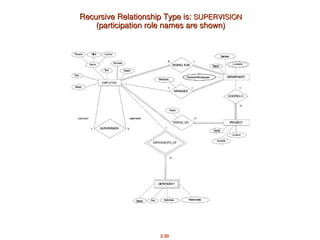
Recursive Relationship Type is:
Recursive Relationship Type is: SUPERVISION
SUPERVISION
(participation role names are shown)
2.31
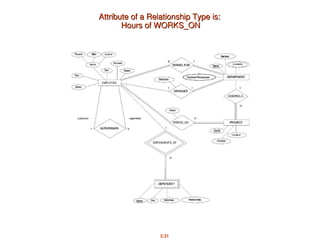
Attribute of a Relationship Type is:
Hours of WORKS_ON
Hours of WORKS_ON
2.32
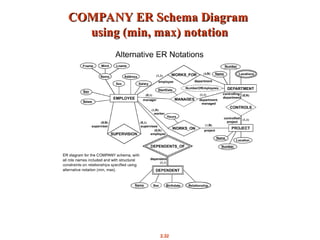
COMPANY ER Schema Diagram
using (min, max) notation
2.33
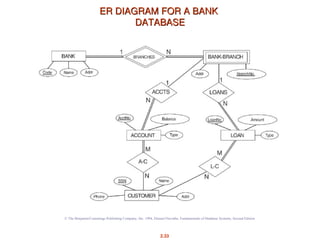
ER DIAGRAM FOR A BANK
DATABASE
DATABASE
© The Benjamin/Cummings Publishing Company, Inc. 1994, Elmasri/Navathe, Fundamentals of Database Systems, Second Edition
2.34
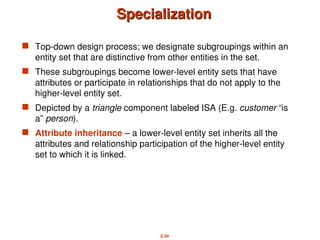
Specialization
Specialization
 Top-down design process; we designate subgroupings within an
entity set that are distinctive from other entities in the set.
 These subgroupings become lower-level entity sets that have
attributes or participate in relationships that do not apply to the
higher-level entity set.
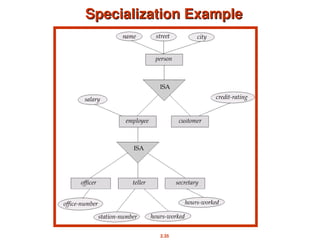
 Depicted by a triangle component labeled ISA (E.g. customer “is
a” person).
 Attribute inheritance – a lower-level entity set inherits all the
attributes and relationship participation of the higher-level entity
set to which it is linked.
2.35
Specialization Example
2.36
Generalization
Generalization
 A bottom-up design process – combine a number of entity sets
that share the same features into a higher-level entity set.
 Specialization and generalization are simple inversions of each
other; they are represented in an E-R diagram in the same way.
 The terms specialization and generalization are used
interchangeably.
2.37
Specialization and Generalization
(Contd.)
(Contd.)
 Can have multiple specializations of an entity set based on
different features.
 E.g. permanent-employee vs. temporary-employee, in addition to
officer vs. secretary vs. teller
 Each particular employee would be
 a member of one of permanent-employee or temporary-
employee,
 and also a member of one of officer, secretary, or teller
 The ISA relationship also referred to as superclass - subclass
relationship
2.38
Design Constraints on a
Specialization/Generalization
 Constraint on which entities can be members of a given
lower-level entity set.
 condition-defined
 E.g. all customers over 65 years are members of senior-
citizen entity set; senior-citizen ISA person.
 user-defined
 Constraint on whether or not entities may belong to more than
one lower-level entity set within a single generalization.
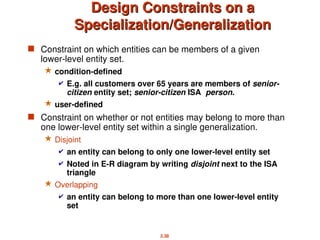
 Disjoint
 an entity can belong to only one lower-level entity set
 Noted in E-R diagram by writing disjoint next to the ISA
triangle
 Overlapping
 an entity can belong to more than one lower-level entity
set
2.39
Design Constraints on a
Specialization/Generalization (Contd.)
 Completeness constraint -- specifies whether or not an entity in
the higher-level entity set must belong to at least one of the
lower-level entity sets within a generalization.
 total : an entity must belong to one of the lower-level entity sets
 partial: an entity need not belong to one of the lower-level
entity sets
2.40
Aggregation
Aggregation
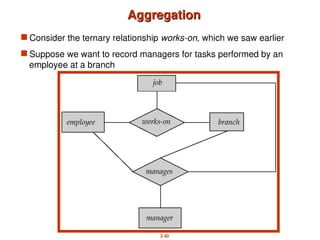
 Consider the ternary relationship works-on, which we saw earlier
 Suppose we want to record managers for tasks performed by an
employee at a branch
2.41
Aggregation (Cont.)
Aggregation (Cont.)
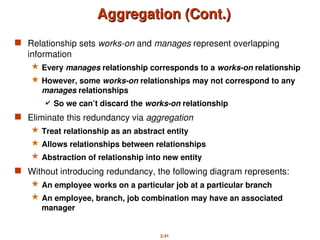
 Relationship sets works-on and manages represent overlapping
information
 Every manages relationship corresponds to a works-on relationship
 However, some works-on relationships may not correspond to any
manages relationships
 So we can’t discard the works-on relationship
 Eliminate this redundancy via aggregation
 Treat relationship as an abstract entity
 Allows relationships between relationships
 Abstraction of relationship into new entity
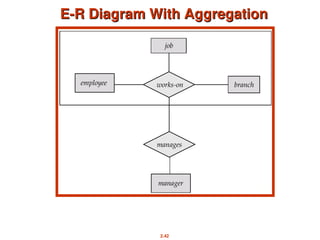
 Without introducing redundancy, the following diagram represents:
 An employee works on a particular job at a particular branch
 An employee, branch, job combination may have an associated
manager
2.42
E-R Diagram With Aggregation
2.43
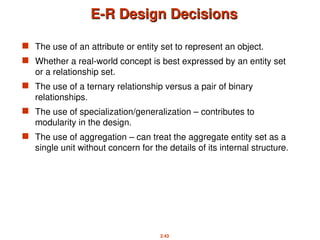
E-R Design Decisions
 The use of an attribute or entity set to represent an object.
 Whether a real-world concept is best expressed by an entity set
or a relationship set.
 The use of a ternary relationship versus a pair of binary
relationships.
 The use of specialization/generalization – contributes to
modularity in the design.
 The use of aggregation – can treat the aggregate entity set as a
single unit without concern for the details of its internal structure.
2.44
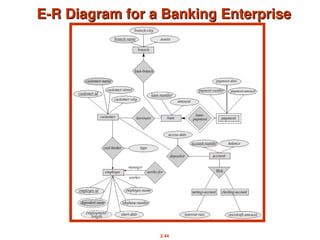
E-R Diagram for a Banking Enterprise
2.45
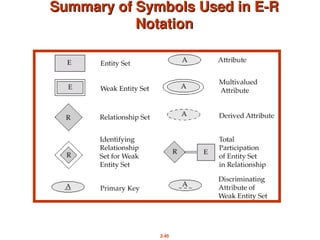
Summary of Symbols Used in E-R
Notation
Notation
2.46
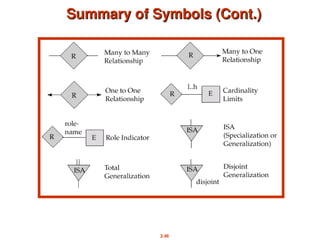
Summary of Symbols (Cont.)
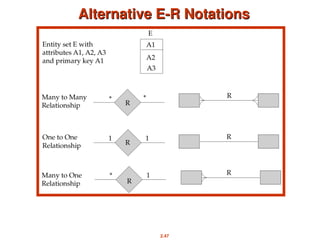
2.47
Alternative E-R Notations

Entity Relation -model presentation ppts

  • 1.
    2.1 Week 2: Entity-RelationshipModel Week 2: Entity-Relationship Model  Entity, Relationship, and E-R Diagram  Entity  Attributes  Weak/Regular Entity  Relationship  Degree  Mapping Cardinality  Relationship with Attributes  Participation  Keys  Extended E-R Features  Entity Specialization/Generalization  Relationship Aggregation  Design of an E-R Database Schema
  • 2.
    2.2 Entity, Relationship, andE-R Diagram Entity, Relationship, and E-R Diagram  A database can be modeled as: a collection of entities, relationship among entities.  A database can be illustrated by an E-R diagram
  • 3.
    2.3 E-R Diagrams E-R Diagrams Rectangles represent entity sets.  Diamonds represent relationship sets.  Lines link attributes to entity sets and entity sets to relationship sets.  Ellipses represent attributes  Double ellipses represent multivalued attributes. (will study later)  Dashed ellipses denote derived attributes. (will study later)  Underline indicates primary key attributes (will study later)
  • 4.
    2.4 Entity Sets Entity Sets An entity is an object that exists and is distinguishable from other objects. Example: specific person, company, event, plant  Entities have attributes Example: people have names and addresses  An entity set is a set of entities of the same type that share the same properties. Example: set of all persons, companies, trees, holidays
  • 5.
    2.5 Entity Sets Entity Setscustomer customer and and loan loan customer-id customer- customer- customer- loan- amount name street city number
  • 6.
    2.6 Attributes Attributes  An entityis represented by a set of attributes, that is descriptive properties possessed by all members of an entity set.  Domain – the set of permitted values for each attribute  Attribute types:  Simple and composite attributes.  Single-valued and multi-valued attributes  E.g. multivalued attribute: phone-numbers  Derived attributes  Can be computed from other attributes  E.g. age, given date of birth Example: customer = (customer-id, customer-name, customer-street, customer-city) loan = (loan-number, amount)
  • 7.
  • 8.
    2.8 E-R Diagram WithComposite, Multivalued, and E-R Diagram With Composite, Multivalued, and Derived Attributes Derived Attributes
  • 9.
    2.9 Weak Entity andRegular/Strong Entity Weak Entity and Regular/Strong Entity  A weak entity is an entity that is existence-dependent on some other entity. By contrast, a regular entity (or “a strong entity”) is an entity which is not weak.  The existence of a weak entity set depends on the existence of a identifying entity set  it must relate to the identifying entity set via a total, one-to-many relationship set from the identifying to the weak entity set  E.g. An employee’s dependents might be weak entities --- they can’t exist (so far as the database is concerned) if the relevant employee does not exist.  A weak entity type can be related to more than one regular entity type.
  • 10.
    2.10 Weak Entity andRegular/Strong Entity Weak Entity and Regular/Strong Entity  We depict a weak entity by double rectangles.  The identifying relationship is depicted using a double diamond.
  • 11.
    2.11 Relationship Sets Relationship Sets A relationship is an association among several entities Example: Hayes depositor A-102 customer entity relationship set account entity  A relationship set is a mathematical relation among n  2 entities, each taken from entity sets {(e1, e2, … en) | e1  E1, e2  E2, …, en  En} where (e1, e2, …, en) is a relationship  Example: (Hayes, A-102)  depositor
  • 12.
  • 13.
    2.13 Relationship Sets (Cont.) RelationshipSets (Cont.)  An attribute can also be property of a relationship set.  For instance, the depositor relationship set between entity sets customer and account may have the attribute access-date
  • 14.
    2.14 Degree of aRelationship Set Degree of a Relationship Set  Refers to number of entity sets that participate in a relationship set.  Relationship sets that involve two entity sets are binary (or degree two). Generally, most relationship sets in a database system are binary.  Relationship sets may involve more than two entity sets.  Relationships between more than two entity sets are rare. Most relationships are binary. (More on this later.) E.g. Suppose employees of a bank may have jobs (responsibilities) at multiple branches, with different jobs at different branches. Then there is a ternary relationship set between entity sets employee, job and branch
  • 15.
    2.15 E-R E-R Diagram witha Ternary Relationship Diagram with a Ternary Relationship
  • 16.
    2.16 Binary Vs. Non-BinaryRelationships Binary Vs. Non-Binary Relationships  Some relationships that appear to be non-binary may be better represented using binary relationships  E.g. A ternary relationship parents, relating a child to his/her father and mother, is best replaced by two binary relationships, father and mother  Using two binary relationships allows partial information (e.g. only mother being know)  But there are some relationships that are naturally non-binary  E.g. works-on
  • 17.
    2.17 Roles Roles  Entity setsof a relationship need not be distinct o The labels “manager” and “worker” are called roles; they specify how employee entities interact via the works-for relationship set. o Roles are indicated in E-R diagrams by labeling the lines that connect diamonds to rectangles. o Role labels are optional, and are used to clarify semantics of the relationship
  • 18.
    2.18 Mapping Cardinalities Mapping Cardinalities Express the number of entities to which another entity can be associated via a relationship set.  Most useful in describing binary relationship sets.  For a binary relationship set the mapping cardinality must be one of the following types:  One to one  One to many  Many to one  Many to many
  • 19.
    2.19 Mapping Cardinalities Mapping Cardinalities Oneto one One to many Note: Some elements in A and B may not be mapped to any elements in the other set
  • 20.
    2.20 Mapping Cardinalities Mapping Cardinalities Manyto one Many to many Note: Some elements in A and B may not be mapped to any elements in the other set
  • 21.
    2.21 Mapping Cardinality Mapping Cardinality We express cardinality constraints by drawing either a directed line (), signifying “one,” or an undirected line (—), signifying “many,” between the relationship set and the entity set.  E.g.: One-to-one relationship:  A customer is associated with at most one loan via the relationship borrower  A loan is associated with at most one customer via borrower
  • 22.
    2.22 One-To-Many Relationship One-To-Many Relationship In the one-to-many relationship a loan is associated with at most one customer via borrower, a customer is associated with several (including 0) loans via borrower
  • 23.
    2.23 Many-To-One Relationships Many-To-One Relationships In a many-to-one relationship a loan is associated with several (including 0) customers via borrower, a customer is associated with at most one loan via borrower
  • 24.
    2.24 Many-To-Many Relationship Many-To-Many Relationship A customer is associated with several (possibly 0) loans via borrower  A loan is associated with several (possibly 0) customers via borrower
  • 25.
    2.25 Mapping Cardinalities affectER Design Mapping Cardinalities affect ER Design  Can make access-date an attribute of account, instead of a relationship attribute, if each account can have only one customer  I.e., the relationship from account to customer is many to one, or equivalently, customer to account is one to many
  • 26.
    2.26 Relationship Sets withAttributes Relationship Sets with Attributes
  • 27.
    2.27 Participation of anEntity Set in a Participation of an Entity Set in a Relationship Set Relationship Set  Total participation (indicated by double line): every entity in the entity set participates in at least one relationship in the relationship set  E.g. participation of loan in borrower is total  every loan must have a customer associated to it via borrower  Partial participation: some entities may not participate in any relationship in the relationship set  E.g. participation of customer in borrower is partial
  • 28.
    2.28 Keys Keys  A superkey of an entity set is a set of one or more attributes whose values uniquely determine each entity.  A candidate key of an entity set is a minimal super key  Customer-id is candidate key of customer  account-number is candidate key of account  Although several candidate keys may exist, one of the candidate keys is selected to be the primary key.
  • 29.
    2.29 Keys for RelationshipSets Keys for Relationship Sets  The combination of primary keys of the participating entity sets forms a super key of a relationship set.  (customer-id, account-number) is the super key of depositor  NOTE: this means a pair of entity sets can have at most one relationship in a particular relationship set.  E.g. if we wish to track all access-dates to each account by each customer, we cannot assume a relationship for each access. We can use a multivalued attribute though  Must consider the mapping cardinality of the relationship set when deciding the what are the candidate keys  Need to consider semantics of relationship set in selecting the primary key in case of more than one candidate key
  • 30.
    2.30 Recursive Relationship Typeis: Recursive Relationship Type is: SUPERVISION SUPERVISION (participation role names are shown) (participation role names are shown)
  • 31.
    2.31 Attribute of aRelationship Type is: Attribute of a Relationship Type is: Hours of WORKS_ON Hours of WORKS_ON
  • 32.
    2.32 COMPANY ER SchemaDiagram COMPANY ER Schema Diagram using (min, max) notation using (min, max) notation
  • 33.
    2.33 ER DIAGRAM FORA BANK ER DIAGRAM FOR A BANK DATABASE DATABASE © The Benjamin/Cummings Publishing Company, Inc. 1994, Elmasri/Navathe, Fundamentals of Database Systems, Second Edition
  • 34.
    2.34 Specialization Specialization  Top-down designprocess; we designate subgroupings within an entity set that are distinctive from other entities in the set.  These subgroupings become lower-level entity sets that have attributes or participate in relationships that do not apply to the higher-level entity set.  Depicted by a triangle component labeled ISA (E.g. customer “is a” person).  Attribute inheritance – a lower-level entity set inherits all the attributes and relationship participation of the higher-level entity set to which it is linked.
  • 35.
  • 36.
    2.36 Generalization Generalization  A bottom-updesign process – combine a number of entity sets that share the same features into a higher-level entity set.  Specialization and generalization are simple inversions of each other; they are represented in an E-R diagram in the same way.  The terms specialization and generalization are used interchangeably.
  • 37.
    2.37 Specialization and Generalization Specializationand Generalization (Contd.) (Contd.)  Can have multiple specializations of an entity set based on different features.  E.g. permanent-employee vs. temporary-employee, in addition to officer vs. secretary vs. teller  Each particular employee would be  a member of one of permanent-employee or temporary- employee,  and also a member of one of officer, secretary, or teller  The ISA relationship also referred to as superclass - subclass relationship
  • 38.
    2.38 Design Constraints ona Design Constraints on a Specialization/Generalization Specialization/Generalization  Constraint on which entities can be members of a given lower-level entity set.  condition-defined  E.g. all customers over 65 years are members of senior- citizen entity set; senior-citizen ISA person.  user-defined  Constraint on whether or not entities may belong to more than one lower-level entity set within a single generalization.  Disjoint  an entity can belong to only one lower-level entity set  Noted in E-R diagram by writing disjoint next to the ISA triangle  Overlapping  an entity can belong to more than one lower-level entity set
  • 39.
    2.39 Design Constraints ona Design Constraints on a Specialization/Generalization (Contd.) Specialization/Generalization (Contd.)  Completeness constraint -- specifies whether or not an entity in the higher-level entity set must belong to at least one of the lower-level entity sets within a generalization.  total : an entity must belong to one of the lower-level entity sets  partial: an entity need not belong to one of the lower-level entity sets
  • 40.
    2.40 Aggregation Aggregation  Consider theternary relationship works-on, which we saw earlier  Suppose we want to record managers for tasks performed by an employee at a branch
  • 41.
    2.41 Aggregation (Cont.) Aggregation (Cont.) Relationship sets works-on and manages represent overlapping information  Every manages relationship corresponds to a works-on relationship  However, some works-on relationships may not correspond to any manages relationships  So we can’t discard the works-on relationship  Eliminate this redundancy via aggregation  Treat relationship as an abstract entity  Allows relationships between relationships  Abstraction of relationship into new entity  Without introducing redundancy, the following diagram represents:  An employee works on a particular job at a particular branch  An employee, branch, job combination may have an associated manager
  • 42.
    2.42 E-R Diagram WithAggregation E-R Diagram With Aggregation
  • 43.
    2.43 E-R Design Decisions E-RDesign Decisions  The use of an attribute or entity set to represent an object.  Whether a real-world concept is best expressed by an entity set or a relationship set.  The use of a ternary relationship versus a pair of binary relationships.  The use of specialization/generalization – contributes to modularity in the design.  The use of aggregation – can treat the aggregate entity set as a single unit without concern for the details of its internal structure.
  • 44.
    2.44 E-R Diagram fora Banking Enterprise E-R Diagram for a Banking Enterprise
  • 45.
    2.45 Summary of SymbolsUsed in E-R Summary of Symbols Used in E-R Notation Notation
  • 46.
    2.46 Summary of Symbols(Cont.) Summary of Symbols (Cont.)
  • 47.