THE ROLE OF THE MIDWIFE, PUBLIC /COMMUNITY HEALTH NURSE IN EFFORTS TO REDUCE MATERNAL, NEWBORN AND CHILD MORBIDITY AND MORTALITY PRESENTED AT THE 11th   BIENNIAL GENERAL MEETING/ 20th SCIENTIFIC  SESSION AND 31st COUNCIL MEETING, BANJUL, GAMBIA MARCH 12th – 19th  2011  By Mrs. Felicia Darkwah-Registered Nurse, Midwife, Dip in Nursing Education, MSc. & PGD in Midwifery, Former Lecturer in Nursing and Midwifery, University of  Ghana, Legon – Accra, Former Vice Dean, Dept of Nursing, Valley View University,  Accra, Executive Secretary, Nana Yaa Memorial Trust for Good Quality  Reproductive Health Service.
Introduction : Background The Republic of Ghana is located centrally in West Africa  with a land area of 238,537 square kilometres.  It is  bordered on the North by Burkina Faso, on the South by  the Gulf of Guinea which stretches across the 560  kilometres of the country’s coastline; on the East Ghana is  bordered by Togo and on the West by La Cote D’Ivoire and  has a population of 24million (2010 pop. census). 51% of  the inhabitants are females.  Those between the ages of 15  and 49 years, that is, the reproductive age group forms  24% of the total population and the current maternal  mortality rate is 451 deaths per 100,000 live  births.(NSMSP: 2008)1
DEFINITION OF TERMINOLOGIES MATERNAL DEATH Maternal death is the death of a woman while pregnant or  within 42 days of the termination of pregnancy, regardless  of the site and the duration of pregnancy, from any cause  related to or aggravated by the pregnancy or its  management (W.H.O.,1999:9.)2 .By 2005, it was estimated  to be 536,000, worldwide. (W.H.O.)3.  However, the latest  document from the W.H.O. states “maternal mortality adds  up to 600,000 women every year; 99% occurs in Sub- Saharan Africa.”(W.H.O,)4
Maternal death is a global tragedy. It  is traumatic for individual women, for  families, and for their communities  alike and so every effort should be  made to curtail its occurrences.  (W.H.O. 1999: 4)2
MATERNAL MORTALITY RATIO Maternal mortality ratio is the risk associated  with each pregnancy i.e. the obstetric risk It is calculated as the number of maternal  deaths during a given year per 100,000 live  births during the same period. Currently it is  defined as the proportion of births attended  by skilled health personnel (UN)5
MATERNAL MORTALITY RATE Maternal mortality rate measures both the obstetric risk and  the frequency with which women are exposed to this risk. It  is calculated as the number of maternal deaths in a given  period per 100,000 women of reproductive age of 15-49  years. Maternal mortality ratio and rate are often used  interchangeably. It is as low as 5 in Sweden, an average of  27 in developed Countries, and as high as 250 in  Botswana, 451 in Ghana and an average of 480 deaths per  100,000. Country –level differences in maternal mortality  are even more dramatic, for example 1,200 in Uganda and  1,800 in Sierra Leone.( W.H.O.)5
LIFETIME RISK OF MATERNAL DEATH Life time risk of maternal death takes into account  both the probability of becoming pregnant and the  probability of dying as a result of the pregnancy  cumulated across a woman’s reproductive years.  (W.H.O, 1999:10.)2  It was 1 in 7,300 in developed  regions and 1 in 22 in developing ones by 2005.  (W.H.O.)6 MATERNAL MORBIDITY Maternal morbidity is any illness or injury caused or  aggravated by or associated with, pregnancy or  childbirth. (W.H.O/ N.R.C).4
SKILLED ATTENDANT A Skilled attendant refers exclusively to  health professionals with midwifery skills (for  example doctors, midwives and nurses) who  have been trained to proficiency in the skills  necessary to manage normal pregnancies,  deliveries and diagnose and refer medical  and obstetric complications.  (W.H.O.,1999:31)2
THE MILLENNIUM DEVELOPMENT GOALS.  (M.D.G.’S) The HEALTH M.D.G.’S 4, 5 & 6.  In 1994, at the  International Conference on Population and  Development (ICPD), 179 Countries (including the  U.N. member States) committed to an ambitious  Programme of action (PoA) for improving sexual  and reproductive health and rights. (SRHR) over  the world, taking a strong human right’s based  approach. The PoA included the goals to reduce  maternal mortality and to ensure universal access  to reproductive health care by 2015.
MDG 5, target A= Aims at reducing maternal mortality ratio  by three quarters between 1990 and 2015 and increase the  proportion of births attended by skilled Professionals. MDG 5, target B=wishes to achieve:  (1) Universal access to reproductive health. (2) Increased contraceptive prevalence rate. (3) Reduced adolescent birth rate Antenatal care coverage (at least one to four visits. It is  claimed that 55% of pregnant  women in sub-Saharan Africa have no access (to ANC)  (5) Address the unmet needs for family planning.  It has been stated that MDG 5 is the most off track of all the MDGs.(U.N)3.
MDG 6 =COMBATING HIV /AIDS, MALARIA AND  OTHER DISEASES.  MDG 6 ,  A= Seeks to halt and begin to reverse  the spread of HIV /AIDS. Target  B= Achieve universal access to  prevention, treatment, care, including greater  transparency and support for HIV/AIDS. Target  C= halt and begin to reverse the  incidence of malaria, tuberculosis and other major  diseases. An estimated 33.2 million people are currently  living with HIV globally. HIV remains alarmingly high in  Southern Africa, China and in Eastern Europe (U.N.)3
Ghana is one of the 179 strong nations that pledged a  Programme of Action (PoA) and developed seven  Millennium Development Goals of which MDGs 4, 5 and 6  are health related as it has been stated in the definition of  terminologies in this paper. MDG 4 seeks to reduce Infant mortality by two thirds from  64/1000 to 22/1000 and that of Maternal mortality by three  quarters that is from 451 to 185 per 100,000 live births.  (Annual P.R. 2009)17  Maternal Mortality in developing countries including Ghana  is very high around (600.000 per year round the world). In  Ghana the rate was between 734/100,000 in (KBTH)  1140/100,000 (KATH) (LASSEY AND WILSON 1999)6. In  April 2010 it was reported from the ministry that Ghana’s  Maternal mortality is 451.
THE ROLE OF THE MIDWIFE IN EFFORTS TO REDUCE MATERNAL AND INFANT MORBIDITY AND MORTALITY   The Major role of the Midwife is the management  of the Childbearing woman for the reduction of the  unacceptably high maternal deaths.  And in my  opinion it should start from the preconception  period through to the postnatal period and beyond.  It has been recorded that when a woman survives  Childbearing and she is well, her child/children  survive and they thrive through to the school going  age (W.H.O. 2001)7.
THE CAUSES OF MATERNAL DEATHS Maternal mortality may be due to one of three phenomena as stated overleaf:
Table 1 shows the contributory factors/three delays that cause maternal  deaths in developing countries (Source: Ms Deborah Maine, The Safe Motherhood Action Agenda 1998:p37)8 Total contributory factors cause  7% of the deaths Poor quality of maternal health care i.e. interventions,  omissions, incorrect treatment, lack of supplies, inadequate  theatre facilities, insufficient skilled attendants, and poorly  motivated staff cause delay  3 3 Lack of good roads, poor transportation and communication  which prevents  the woman’s arriving at health facilities in  good time cause delay 2 2 Lack of basic education and decision making power, poverty,  traditional and cultural practices which restrict women from  seeking health care cause delay 1 1 CAUSES: the 3 delays NO
Table 2 illustrates the indirect causes of maternal deaths in developing countries They are responsible for 20% of the deaths. (Source: W.H.O.,1999: 14)2 Hepatitis 6 Heart disease 5 Malaria  4 Anaemia 3 Sickle Cell disease 2 HIV/AIDS  1 Causes  No.
Table 3 demonstrates the direct causes of maternal deaths in developing countries (Source: SMAA,1998:2)8 73% Total obstetric  causes responsibly for - Other direct causes include ectopic pregnancy,  embolism, and anaesthesia – related deaths * 8% Obstructed labour and ruptured uterus 5 12% Eclampsia/Pregnancy induced hypertension 4 13% globally but in Ghana 20-30% Unsafe Abortion  3 15% Infection  2 25% Excessive bleeding  1 Percentage Causes No.
GHANA GOVERNMENT POLICY TO ENHANCE MATERNAL AND CHILD SURVIVAL The various Governments of Ghana have put measures in place at different  times in the past.  The last but one  was called the National Reproductive  Health Service Protocols (M.O.H., 1999) together with the MDGs in pursuit  of the achievements of the health MDGs,4,5,&6 and the latest service protocol  known as the National Safe Motherhood service protocols are intended to  reduce maternal and infant morbidity and mortality (MOH Dec. 2008).  The strategies include: Free maternal health services through a special health insurance scheme The establishment of Community-based Health Planning and Services (CHPS) to carry safe motherhood services close to where women reside The adoption of maternal health record booklet which affords continuity of care  and freedom of choice of care provider.
Focused antenatal care  The use of partograph for labour management. Re-instatement of direct midwifery education for more midwives to be trained. Implementation of the increase in enrolment of girl child education up to the university level. Policy directive on the use of Misoprostol for the prevention and management of post partum haemorrhage Adoption of safe abortion care – comprehensive abortion care Re-positioning of Family planning services
Counselling and testing of all pregnant women for H.I.V & AIDS and Anti Retro-viral Therapy  (ART) for PMTCT where necessary at a subsidized rate, Intermittent Preventive Therapy (IPT) against malaria (Sulfadoxine USP 500mgs & Pyrimethamine 25 mgms) Continuation of : Tetanol  toxoid, for the prevention of  maternal and neonatal tetanus Iron, vitamins& folic acid routinely, for the prevention of anaemia
The number of Midwives available to provide quality  maternal services is woefully inadequate, especially in  rural communities where the Midwife performs as one of  the important persons in the achievement of the MDG’s 4,5  and 6. The Programme of Action recognizes the  partnership of Private enterprises – a term called Public  Private Partnership.  Midwifery education was established  in Ghana in 1928 and the Private Midwifery Practitioner has  been a very strong partner of the state in the delivery of  maternal health care.  At one point there were 500, or more  of them, but now they are dwindling in number.  Part of the  Agenda is to train more Midwives in order to aid in the  achievement of the MDGs 4, 5 and 6.
EFFORTS TO REDUCE MATERNAL AND INFANT MORBIDITY AND MORTALITIES IN THE PAST DECADE: THE ROLE OF THE MIDWIFE BEFORE THE YEAR 2000 MANAGEMENT OF THE THREE PHASES OF CHILDBIRTH Phase one during pregnancy: Antenatal Care Antenatal care is the health management and education given to the client during pregnancy.  Antenatal care is an important part of preventive health care.  It was initiated by Professor Ballantyne of the United Kingdom in the year 1901(Myles, 1985:173)11
The objectives of antenatal care are to:- Promote and maintain the physical, mental and social well being of mother and baby/babies by providing education on nutrition, rest, sleep and personal hygiene Detect and manage high risk conditions arising during pregnancy, whether medical, surgical or obstetric Ensure the delivery of a full term healthy baby with minimal stress or injury to mother and baby and to Help prepare the client to breastfeed successfully, experience normal puerperium and take good care of the child physically, psychologically and socially A safe delivery and post partum health depends on good  antenatal management
Routine management The routine management according to the National Reproductive Health Service Protocols (Ghana) included a standard recommendation as follows: Table 1 shows the recommended schedule *Thus making a total of twelve visits.  And if for any reason the standard antenatal visits are not accessible to the clients at least she should benefit from four basic visits at 10 weeks, 20 weeks, 30 weeks and 36 weeks.  Yet during that period the maternal mortality rate was between 755 (KBTH) and1140 (KATH) per 100,000 live births (Larsey and Wilson,  1998) every week till birth 9 th  – 12 th  visits 4 every two weeks till the 36 th  week 5 th  – 8 th  visits 3 every four weeks till 28 weeks 2 nd  – 4 th  visits 2 as early as 12 – 14 weeks First visit 1 Period Variable No
Phase two: Labour and delivery The goal of labour and delivery management is to promote  the most positive outcome which is, a healthy mother and  baby.  The objectives are to: Manage the four stages of labour accurately Make proper use of the partograph Identify complications early and treat or refer swiftly for a positive outcome Deliver placenta and membranes by the active management protocol (AMTSL).  Keep the mother and baby (if feasible) for one hour after the delivery of the placenta in delivery room, monitor vital signs ½ hourly and observe the uterus and introitus every half an hour
Phase three: the Post partum period The post partum period starts from the delivery of  the placenta to six weeks after delivery. The objectives of the management are to: Screen both mother and baby for the early detection and treatment for referral for any complications Re – enforce education on nutrition, rest, sleep and personal hygiene Counsel and motivate client for family planning (Ghana National R.H Service Protocol January 1999)9
AFTER THE YEAR 2000 TO DATE OBJECTIVES ANTENATAL CARE The definition and objectives are the same as before  except that the following have been included: to  educate on family planning, immunization, danger  signals e.g. STI, HIV/AIDS,  birth preparedness and complications readiness. Also the following management strategies have been  adopted.
They are: Focused antenatal care which demands that  the client is managed by the same care  provider throughout pregnancy. (National  Safe Motherhood Service Protocol; NSMSP  2007:21)12 *  A National Maternal health record booklet for continuity of care is in practice. (MOH/GHS,R&CH UNIT, 2005)13
ROUTINE MANAGEMENT For the uncomplicated pregnancy, at least four antenatal care visits should be made as follows:  Counsel the client at every visit and advise her to report to any health facility if she feels unwell.  (NSMSP, 2008)12.  This however has caused maternal deaths due to lack of proper decision making on the part of care providers ROUTINE LABORATORY TEST Counselling and HIV test, G6PD, Hepatitis B, CD4 count if HIV is positive and pelvic ultrasound have all been added to what used to be the case, i.e. before the year 2000. At 36 weeks Fourth visit 4 At 32 weeks Third visit 3 Between 24 and 28 weeks Second visit 2 At up to 16 weeks gestation First visit 1 PERIOD VARIABLE NO
THE ROLE OF THE MIDWIFE – ANTENTAL CARE Give Nefedipine 10mgs sublingual and refer to hospital.  In hospital give 10mgs sublingual and ask Doctor to see client Check B/p, urine for proteins and oedema at every visit – vigilantly P.I.H if diastolic pressure >100mmhg 4 Give: anti-retroviral prophylaxis at 28wks if mother is HIV positive and at 30wks and counsel client on feeding options (NSMP, 2008:10) Ask for counseling and HIV testing at first visit.  Do CD4 count if HIV is Positive HIV/AIDS 3 Give: paracetamol, I.V fluids of quinine 600mgs and refer to hospital.  In hospital give paracetamol.  Have an infusion trolley always in readiness, assist Doctor intelligently Give 3 intermittent preventive treatment (IPT) sulfadoxine 500mgs and pyremethamine 25mgs between 16 and36 weeks at 4 weeks interval Malaria 2 Provide 4 basic antenatal care: 1 st  visit up to 16 weeks Antenatal care 1 Secondary Intervention Primary Intervention Variable NO
Take blood for grouping and cross  matching.  Give I.V fluids of N/Saline  or ringers lactate 1000 mls. Give oral  misoprostol 400mg stat and repeat in  4hrs if necessary or I.M injection of  Ergometrine 0.2mgs. Refer to hospital Educate public/clients on  dangers of unprotected sex  and abortions Inevitable abortion 6 Give Nefedipine 10mgs sublingual  start magnesium sulphate 4 protocol  and transport client to hospital if not  in second stage. If she is in labour and near delivery  deliver by vacuum extraction, do  other delivery interventions  accurately and transfer to Hospital. In hospital – make sure I.V infusion  for emergency obstetric care (EOC) is  always ready – call Doctor, inform  labour ward staff. Check B/p, urine for  proteins and oedema at  every visit – vigilantly Severe pre –  eclampsia diastolic  >110mmhg 5
(National Safe Motherhood Service Protocol; NSMSP 2008:21) 12 *Ask for pelvic ultrasound by 20 weeks.  Also G6PD and Hepatitis B *Educate client on neonatal care  immunization and danger signs *Educate on birth preparedness and  complication readiness, STIS, HIV/AIDS  and family planning Miscellaneous 8 Same as inevitable abortion Educate and motivate on family  planning services Unsafe Abortion. In  Ghana it accounts  for20-30% of the  deaths. 7
INTRANATALLY The objectives of intranatal care are to:- Promote and maintain the physical, mental and social well being of mother and baby/babies by providing education on nutrition, rest, sleep and personal hygiene Detect and manage high risk conditions arising during labour, whether medical, surgical or obstetric Ensure the delivery of a full term healthy baby with minimal stress or injury to mother and baby and to Help prepare the client to breastfeed successfully, experience normal puerperium and take good care of the child physically, psychologically and socially A safe delivery and post partum health depends on good intranatal management
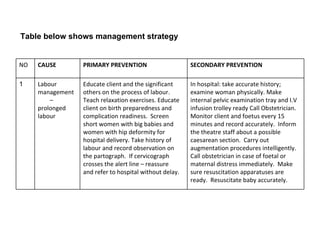
Table below shows management strategy In hospital: take accurate history;  examine woman physically. Make  internal pelvic examination tray and I.V  infusion trolley ready Call Obstetrician.   Monitor client and foetus every 15  minutes and record accurately.  Inform  the theatre staff about a possible  caesarean section.  Carry out  augmentation procedures intelligently.  Call obstetrician in case of foetal or  maternal distress immediately.  Make  sure resuscitation apparatuses are  ready.  Resuscitate baby accurately. Educate client and the significant  others on the process of labour.  Teach relaxation exercises. Educate  client on birth preparedness and  complication readiness.  Screen  short women with big babies and  women with hip deformity for  hospital delivery. Take history of  labour and record observation on  the partograph.  If cervicograph  crosses the alert line – reassure  and refer to hospital without delay. Labour  management –  prolonged  labour 1 SECONDARY PREVENTION PRIMARY PREVENTION CAUSE NO
Assess total amount blood loss through  interview and  observation of bed clothes and pads Check BP, pulse, temperature and assess  for shock. Take blood for grouping  and cross matching Give oxytocin IV 10 units IM and add 20  units to 500mls  IV fluid of normal saline or ringers solution Pass urine catheter to monitor urine  output Start broad – spectrum antibiotics Check uterus.  Massage to stimulate  contractions and  also expel any blood clots.  If bleeding is  profuse and  persists repeat oxytocin  infusion Administer misoprostol rectally 800mcg  Stat .  Do bimananual compression of uterus  Transfer to hospital In hospital do same as above. Make sure  trolley for EOC is ready. Call Doctor  Immediately .  Continue broad spectrum  antibiotics. Do not discharge before 48  hours. Check Hb at 1 st  visit and at week 36  gestation.  Administer iron folic acid and  vitamins in  pregnancy.  Educate on family  planning.  Conduct active management of the  3 rd  stage of labour.  Give oxytocin 10  Units IM within one minute of  delivery – after exclusion of another  baby.  Deliver placenta by controlled  cord traction when bladder is  empty.  Massage uterus to maintain  uterine contractions.  Repeat every  15 minutes for 2 hours.  Examine  placenta very carefully. Inform  obstetrician about missing  membranes and lobes of placenta  immediately. Do not discharge  before 48 hrs after delivery.  Because according to research  findings the majority of deaths  occur during the first 48 hours. Post partum  haemorrhage  causes 61% of  maternal  deaths P.P.H. 2
In hospital, assess accurately.  Continue IV fluids and broad  spectrum antibiotics Call Doctor for  internal pelvic assessment and  appropriate mode of delivery to  ensure safe mother (and baby).  Monitor accurately. Educate on good nutrition in  childhood. Assess accurately.  Make use of partograph in  delivery. Transfer as fast as  possible if cervicograph goes  flat. Take blood for grouping  and cross matching. Give IV  fluids. Give antibiotics.  Obstructed  labour and  ruptured  uterus  (account for  8% of the  deaths) 4 In hospital, management same as in  community Give broad spectrum antibiotics.  Keep patient in a separate room.  Continue strict infection prevention  strategies especially frequent hand  washing with soap and water Make use of mobile hand hygiene  Unit and good decontaminants Test and manage STIs and  anaemia during pregnancy.  Observe strict infection  prevention techniques during  delivery (especially, wash hands  with soap and water  frequently). Make use of good  decontaminants. Infection  (accounts for  15% of  maternal  deaths) 3
If placenta has been delivered- take  blood for grouping and cross  matching. Give IV fluids of 500mls g/s  or ringers lactate in 6 hours.  Administer 10 units of oxytocin stat Give ergometrine 0.2mgs I.M or  slowly I.V (NSMSP, 2007:3) Insert Foleys catheter for continues  drainage.  Do a bimanual  compression of the uterus if bleeding  still continues.  Examine placenta for  completeness or retention of  membranes or lobes.  Start broad  spectrum antibiotic. Transfer to  hospital.  In hospital: make sure a trolley for the  management of PPH is always at  hand.  Take blood for grouping and  cross matching. Start I.V infusion of  ringers lactate.  Call Doctor and carry  out all instructions of interventions  intelligently and accurately. Organize  for blood donors. Check B/P and pulse every 2  hours.  Encourage client to  empty bladder every 2 hours.  Encourage her to breastfeed.  Examine baby accurately.  Report any abnormalities. Carry  out routine eye instillation of  antibiotics. Make both mother  and baby comfortable.  Organize for blood donors * 4 th  stage of  labour –  post partum  haemorrhage  especially  first 2 – 6hrs 5
Give broad spectrum antibiotic Give pethedine 100mgs, diazepam  10mgs I.V slowly in separate syringes. Remove placenta manually Give 20 units oxytocin in 500mls of  ringers lactate at 40 – 60 dps/minute Give ergomentrine 0.2mgs I.M or  misoprostol 800 – 1000mcg rectally Transfer client to hospital  In hospital: Take a good history; take  blood for grouping and cross  matching. Start IV fluids. Call Doctor.  Carry out all instructions accurately  and intelligently.  Advise on family  planning Retained  placenta –  placenta not  delivered  within 30  minutes 6
USING THE PARTOGRAPH The WHO Partograph has been modified to make  it simpler and  easier to use.  The latent phase has been removed and plotting on  the graph begins in the active phase when the OS uteri is 4cm  dilated (NSMSP, 2008:57).12  But  in my view this modification is  dangerous, because it places the client and her baby who might  suffer from cervical dystocia at a very high risk of maternal and  neonatal death; for some midwives confessed at a workshop  organized by the Nana Yaa Memorial Trust for good quality  reproductive health services, an NGO, that they (midwives) ask  clients to go home and come back later, for lack of knowledge as to  what to do for the clients whose cervicograph are less than 4cm.
This misnomer has to be addressed very urgently to reduce  maternal and neonatal morbidity and mortality due to  prolonged labour and possible rupture of the uterus.  This is  because the 8 hours of latent phase  has been ignored on the  current partograph.  The Cubes of spaces are 24 hours.  If the  latent phase of 8 hours (which is the normal period for the  cervix to dilate 3cm) plus another 1 hour are added up – the  labour duration shall be 33 hours.  This obviously defeats the  purpose of reducing the duration of labour to 12 hours  (O’Driscoll, U.K) or 24 hours (Phillpott, S.A)
CONSTRAINTS:  THE CONSTRAINTS ARE MAINLY THROUGH THE THREE DELAYS  AS FOLLOWS: Lack of basic education and decision making power, poverty and  obnoxious cultural practices and traditions which restrict women from seeking health care, cause delay 1 Lack of good roads, poor transportation and communication  system which prevent  the woman’s arrival at health facilities in good time, cause delay 2 Poor quality of maternal health care i.e. omissions, incorrect treatment, lack of supplies, insufficient theatre facilities, inadequate skilled attendants, and poorly motivated staff, cause delay  3 These delays have to be addressed aggressively with other collaborators e.g. Queen mothers, District Assemblies, retraining and motivation of staff, expansion of  Midwifery Training Institutions, Scholarships for education up to Masters and PhD level for the supply of Lecturers in order to reduce the unacceptably high maternal and infants death rates.
EFFORTS IN REDUCING INFANT MORBIDITY AND MORTALITY   INFANT MORTALITY Infant mortality is the death of a child before his or  her first birth day per every 1,000 live births.  Infant  mortality is often used to measure the health of a  Community or State Globally, it was estimated to be 95 per 1,000.  It is  64 per 1000 in Ghana.  (NSMSP, 2008)  INFANT MORBIDITY Infant morbidity refers to the babies that are born with  health problems and live. (Save the Children, 2010.)14
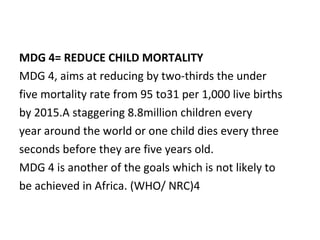
MDG 4= REDUCE CHILD MORTALITY  MDG 4, aims at reducing by two-thirds the under  five mortality rate from 95 to31 per 1,000 live births  by 2015.A staggering 8.8million children every  year around the world or one child dies every three  seconds before they are five years old. MDG 4 is another of the goals which is not likely to  be achieved in Africa. (WHO/ NRC)4
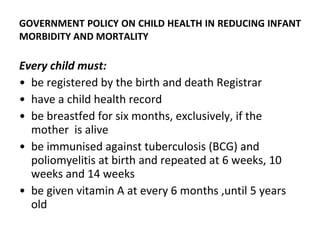
GOVERNMENT POLICY ON CHILD HEALTH IN REDUCING INFANT MORBIDITY AND MORTALITY Every child must: be registered by the birth and death Registrar have a child health record be breastfed for six months, exclusively, if the mother  is alive be immunised against tuberculosis (BCG) and poliomyelitis at birth and repeated at 6 weeks, 10 weeks and 14 weeks be given vitamin A at every 6 months ,until 5 years old
be immunized against measles and yellow fever at 9 months be made to sleep under insecticide bed-net to prevent mosquito bites and malaria. (M.O.H-GHANA)15 It is important to note that one of the best strategies to ensure child survival is to  make sure of maternal survival
CONSTRAINTS IN ACHIEVING POLICY  OF REDUCING INFANT MORBIDITY AND  MORTALITY * Non compliance of mothers in attending infant welfare clinics * Non use of bed-nets
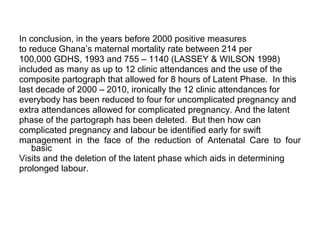
In conclusion, in the years before 2000 positive measures  to reduce Ghana’s maternal mortality rate between 214 per  100,000 GDHS, 1993 and 755 – 1140 (LASSEY & WILSON 1998)  included as many as up to 12 clinic attendances and the use of the  composite partograph that allowed for 8 hours of Latent Phase.  In this  last decade of 2000 – 2010, ironically the 12 clinic attendances for  everybody has been reduced to four for uncomplicated pregnancy and  extra attendances allowed for complicated pregnancy. And the latent  phase of the partograph has been deleted.  But then how can  complicated pregnancy and labour be identified early for swift  management in the face of the reduction of Antenatal Care to four basic  Visits and the deletion of the latent phase which aids in determining  prolonged labour.
Fortunately, however, measures to deal with malaria  through I.P.T, HIV/AIDS by the introduction of HIV test for  all pregnant women, CD4 count test, and ART for those  who require it, Misoprostol for the prevention and treatment  of PPH, inevitable abortion and unsafe abortion, the  permission granted the Community Midwife to use I.V  misoprostol and finally the free maternal health care and  others have all impacted positively on the maternal  mortality rate to bring it down to 451 per 100,000 by 2007.  This however has to be reduced further to 185 per 100,000  to fulfill the MDG 5 goal of reduction by ¾ by 2015.
For the first delay collaboration with traditional  Rulers on the abolition of obnoxious traditions and  customs  and weekly radio and television  programmes on education on maternal and child  health should be initiated. For delay 2, road are being constructed but until enough  are available maternity waiting homes built by District  Assemblies is the answer.  Cuba has been able to reduce  the maternal mortality from 118 to 31 per 100,000 through  maternity waiting homes.  As for delay 3, retraining and  motivating health Professionals and increasing midwifery  training institutions with the development of Lecturers  should suffice.
THE WAY FORWARD Government and quasi government institution to continue to provide educational facilities for girls and the higher institutions to increase their intake of females.  Increase midwifery training institutions for more competent and committed midwives, i.e. skilled attendants to be available for the needed good quality reproductive health service.
Upgrade all district hospitals for them to be able to provide complex health care specifically to include two obstetric theatres. In addition, Government is strongly requested to increase obstetric theatres to four in every regional hospital and provide up to four in all the teaching hospitals obstetric and gynaecology department, to avoid a client with impending rupture of uterus from waiting in theatre queue. (E.O.C)* In the Little Company of Mary Hospital of Pretoria, South Africa, there are 15 theatres and in the Mayor Clinic, Rochester, U.S.A., there are over 70 theatres.  So let African Governments think seriously about the need to increase the number of Obstetric theatres in order to curtail the agony of women who require theatre intervention and thereby save the lives of mothers and their babies.
4. Establish maternity waiting homes in all the resourced district health facilities for pregnant women who dwell in deprived communities to move in at 38 week gestation to wait on their deliveries. This would reduce the number of deaths which arise from delay in arriving at resourced health centres due to inaccessible road net work, lack of transportation and inadequate communication systems. (Delay two). 5. Initiate preconception health care in all health care institutions including private maternity homes in response to the government’s policy of public private partnership. This would enable the early recognition of the indirect causes of maternal death for good management and control before pregnancy takes place.
6. Revert to the 1999 schedule of Ante-natal care that made allowance for four to twelve antenatal clinic attendances. That was to ensure frequent monitoring of mother and baby especially during the third trimester when Pregnancy Induced Hypertension (P.I.H) and eclampsia are at a high prevalence rate. Re-instate the composite partograph which makes room for the latent phase in order to identify prolonged labour in good time for swift management and positive outcome Initiate weekly radio and television maternal and child health education programs 9. Strongly suggest the need for a bill of rights for the childbearing woman.
Dr. Halfdan Mahler, one time Director – General of  the World Health Organisation, once said maternal  mortality is  “a neglected tragedy, neglected  because those who suffer it are neglected people,  with the least power and influence over how  national resources shall be spent; they are the  poor, the rural peasants and above all women”.  (SMI, 1998:1)16
Since we are women, who have been empowered  professionally, let us develop a strong  communiqué, go back to our countries and submit  our communiqués in a unified manner to the  Ministry of Health and to Parliament for real  change to happen in the approaches in efforts to  reduce maternal and infant mortality and morbidity.  We have only four more years to the target period  of 2015. The dateline of the MDGs achievement.
May God help us to achieve the health MDGs 4, 5 and 6 by the year 2015. Thank you for your attention.
THE PRECONCEPTION CYCLE CARE 6.Educ. on the  menstrual cycle 7Educ n  .  Exercise and Relaxation 8.  Blood tests 10.  General counseling 11.  Immunization 12. Environmental  pollutants 13.  Psychosexual  counseling 14.  Family Planning 15.  Sub fertility HEALTHY CONCEPTION 1.Weight& height for the calculation of.BMI mass inde x Weight and height 2.Educ. on  Nutrition 3.  General Check ups 3a.  Urine 3b.  Stool 3c.  Blood Pressure 3d.  Breast examination and self breast examination 4.  Pre-marital sex avoidance 5. Avoidance of Social poisons 9.  Referral to level ‘C’ health facility/hospital for the management of the indirect causes of maternal deaths –  i.  Anaemia ii. Malaria iii. Sickle Cell disease iv. HIV/AIDS v. Heart Disease vi. Hepatitis
REFERENCES National Safe Motherhood Service Protocol (Ghana),December 2008 WHO, Reduction of maternal mortality. A joint  WHO/ UNFPA/ UNICEF, World Bank Statement pp  17, Geneva 1999 U.N, Towards the UN MDG Review Summit 2010. Recommendation to the UN, February 2011  (Internet) WHO/NRC, February 2011 (Internet) WHO, In Women’s Funding Network document, 2005 Lassey, A.T. & Wilson, J.B, (1998) Trends in Maternal mortality in Korle Bu Hospital, 1984 – 1994. Gh. Med. Journal 32:910-916 W.H.O, The Bamako declaration, July 2001 Safe Motherhood Action Agenda, 1997
9. M.O.H., Reproductive Health Protocol, 1999, Ghana 10. M.O.H., Road Map for Accelerating the attainment of the MDGs related to Maternal and Newborn Health in Ghana, 2003 11. MYLES, Margaret.  (1985), A Textbook for Midwives, Churchill Livingstone, Edinburgh 12. M.O.H., National Safe Motherhood Protocol, Dec 2008 13. M.O.H/G.H.S, R&CH Unit, National Maternal Health Record Unit, 2005 14. Save the Children, Internet Info, 2010 15. M.O.H., Child Health Record Book 16. Safe Motherhood Initiative, 1998 17. M.O.H. Ghana, 2009 Annual Progress Report (2009:9)
MIDWIVES PRAYER 1750 Have mercy upon me, oh Lord  And in all my actions  Let me have thy fear before my eyes  That I may be careful both for  rich and poor  To do good and not to hurt  To save lives and not to destroy  Help my infirmities and imperfections  And grant me skills and judgement  Happily to finish every work Through JESUS CHRIST OUR LORD. Amen.
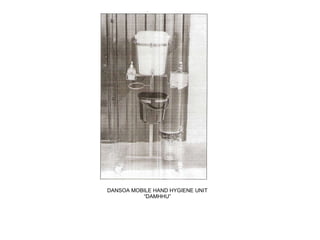
DANSOA MOBILE HAND HYGIENE UNIT “DAMHHU”

AWDF Woman of Substance on Maternal Health in Ghana

  • 1.
    THE ROLE OFTHE MIDWIFE, PUBLIC /COMMUNITY HEALTH NURSE IN EFFORTS TO REDUCE MATERNAL, NEWBORN AND CHILD MORBIDITY AND MORTALITY PRESENTED AT THE 11th BIENNIAL GENERAL MEETING/ 20th SCIENTIFIC SESSION AND 31st COUNCIL MEETING, BANJUL, GAMBIA MARCH 12th – 19th 2011 By Mrs. Felicia Darkwah-Registered Nurse, Midwife, Dip in Nursing Education, MSc. & PGD in Midwifery, Former Lecturer in Nursing and Midwifery, University of Ghana, Legon – Accra, Former Vice Dean, Dept of Nursing, Valley View University, Accra, Executive Secretary, Nana Yaa Memorial Trust for Good Quality Reproductive Health Service.
  • 2.
    Introduction : BackgroundThe Republic of Ghana is located centrally in West Africa with a land area of 238,537 square kilometres. It is bordered on the North by Burkina Faso, on the South by the Gulf of Guinea which stretches across the 560 kilometres of the country’s coastline; on the East Ghana is bordered by Togo and on the West by La Cote D’Ivoire and has a population of 24million (2010 pop. census). 51% of the inhabitants are females. Those between the ages of 15 and 49 years, that is, the reproductive age group forms 24% of the total population and the current maternal mortality rate is 451 deaths per 100,000 live births.(NSMSP: 2008)1
  • 3.
    DEFINITION OF TERMINOLOGIESMATERNAL DEATH Maternal death is the death of a woman while pregnant or within 42 days of the termination of pregnancy, regardless of the site and the duration of pregnancy, from any cause related to or aggravated by the pregnancy or its management (W.H.O.,1999:9.)2 .By 2005, it was estimated to be 536,000, worldwide. (W.H.O.)3. However, the latest document from the W.H.O. states “maternal mortality adds up to 600,000 women every year; 99% occurs in Sub- Saharan Africa.”(W.H.O,)4
  • 4.
    Maternal death isa global tragedy. It is traumatic for individual women, for families, and for their communities alike and so every effort should be made to curtail its occurrences. (W.H.O. 1999: 4)2
  • 5.
    MATERNAL MORTALITY RATIOMaternal mortality ratio is the risk associated with each pregnancy i.e. the obstetric risk It is calculated as the number of maternal deaths during a given year per 100,000 live births during the same period. Currently it is defined as the proportion of births attended by skilled health personnel (UN)5
  • 6.
    MATERNAL MORTALITY RATEMaternal mortality rate measures both the obstetric risk and the frequency with which women are exposed to this risk. It is calculated as the number of maternal deaths in a given period per 100,000 women of reproductive age of 15-49 years. Maternal mortality ratio and rate are often used interchangeably. It is as low as 5 in Sweden, an average of 27 in developed Countries, and as high as 250 in Botswana, 451 in Ghana and an average of 480 deaths per 100,000. Country –level differences in maternal mortality are even more dramatic, for example 1,200 in Uganda and 1,800 in Sierra Leone.( W.H.O.)5
  • 7.
    LIFETIME RISK OFMATERNAL DEATH Life time risk of maternal death takes into account both the probability of becoming pregnant and the probability of dying as a result of the pregnancy cumulated across a woman’s reproductive years. (W.H.O, 1999:10.)2 It was 1 in 7,300 in developed regions and 1 in 22 in developing ones by 2005. (W.H.O.)6 MATERNAL MORBIDITY Maternal morbidity is any illness or injury caused or aggravated by or associated with, pregnancy or childbirth. (W.H.O/ N.R.C).4
  • 8.
    SKILLED ATTENDANT ASkilled attendant refers exclusively to health professionals with midwifery skills (for example doctors, midwives and nurses) who have been trained to proficiency in the skills necessary to manage normal pregnancies, deliveries and diagnose and refer medical and obstetric complications. (W.H.O.,1999:31)2
  • 9.
    THE MILLENNIUM DEVELOPMENTGOALS. (M.D.G.’S) The HEALTH M.D.G.’S 4, 5 & 6. In 1994, at the International Conference on Population and Development (ICPD), 179 Countries (including the U.N. member States) committed to an ambitious Programme of action (PoA) for improving sexual and reproductive health and rights. (SRHR) over the world, taking a strong human right’s based approach. The PoA included the goals to reduce maternal mortality and to ensure universal access to reproductive health care by 2015.
  • 10.
    MDG 5, targetA= Aims at reducing maternal mortality ratio by three quarters between 1990 and 2015 and increase the proportion of births attended by skilled Professionals. MDG 5, target B=wishes to achieve: (1) Universal access to reproductive health. (2) Increased contraceptive prevalence rate. (3) Reduced adolescent birth rate Antenatal care coverage (at least one to four visits. It is claimed that 55% of pregnant women in sub-Saharan Africa have no access (to ANC) (5) Address the unmet needs for family planning. It has been stated that MDG 5 is the most off track of all the MDGs.(U.N)3.
  • 11.
    MDG 6 =COMBATINGHIV /AIDS, MALARIA AND OTHER DISEASES. MDG 6 , A= Seeks to halt and begin to reverse the spread of HIV /AIDS. Target B= Achieve universal access to prevention, treatment, care, including greater transparency and support for HIV/AIDS. Target C= halt and begin to reverse the incidence of malaria, tuberculosis and other major diseases. An estimated 33.2 million people are currently living with HIV globally. HIV remains alarmingly high in Southern Africa, China and in Eastern Europe (U.N.)3
  • 12.
    Ghana is oneof the 179 strong nations that pledged a Programme of Action (PoA) and developed seven Millennium Development Goals of which MDGs 4, 5 and 6 are health related as it has been stated in the definition of terminologies in this paper. MDG 4 seeks to reduce Infant mortality by two thirds from 64/1000 to 22/1000 and that of Maternal mortality by three quarters that is from 451 to 185 per 100,000 live births. (Annual P.R. 2009)17 Maternal Mortality in developing countries including Ghana is very high around (600.000 per year round the world). In Ghana the rate was between 734/100,000 in (KBTH) 1140/100,000 (KATH) (LASSEY AND WILSON 1999)6. In April 2010 it was reported from the ministry that Ghana’s Maternal mortality is 451.
  • 13.
    THE ROLE OFTHE MIDWIFE IN EFFORTS TO REDUCE MATERNAL AND INFANT MORBIDITY AND MORTALITY The Major role of the Midwife is the management of the Childbearing woman for the reduction of the unacceptably high maternal deaths. And in my opinion it should start from the preconception period through to the postnatal period and beyond. It has been recorded that when a woman survives Childbearing and she is well, her child/children survive and they thrive through to the school going age (W.H.O. 2001)7.
  • 14.
    THE CAUSES OFMATERNAL DEATHS Maternal mortality may be due to one of three phenomena as stated overleaf:
  • 15.
    Table 1 showsthe contributory factors/three delays that cause maternal deaths in developing countries (Source: Ms Deborah Maine, The Safe Motherhood Action Agenda 1998:p37)8 Total contributory factors cause 7% of the deaths Poor quality of maternal health care i.e. interventions, omissions, incorrect treatment, lack of supplies, inadequate theatre facilities, insufficient skilled attendants, and poorly motivated staff cause delay 3 3 Lack of good roads, poor transportation and communication which prevents the woman’s arriving at health facilities in good time cause delay 2 2 Lack of basic education and decision making power, poverty, traditional and cultural practices which restrict women from seeking health care cause delay 1 1 CAUSES: the 3 delays NO
  • 16.
    Table 2 illustratesthe indirect causes of maternal deaths in developing countries They are responsible for 20% of the deaths. (Source: W.H.O.,1999: 14)2 Hepatitis 6 Heart disease 5 Malaria 4 Anaemia 3 Sickle Cell disease 2 HIV/AIDS 1 Causes No.
  • 17.
    Table 3 demonstratesthe direct causes of maternal deaths in developing countries (Source: SMAA,1998:2)8 73% Total obstetric causes responsibly for - Other direct causes include ectopic pregnancy, embolism, and anaesthesia – related deaths * 8% Obstructed labour and ruptured uterus 5 12% Eclampsia/Pregnancy induced hypertension 4 13% globally but in Ghana 20-30% Unsafe Abortion 3 15% Infection 2 25% Excessive bleeding 1 Percentage Causes No.
  • 18.
    GHANA GOVERNMENT POLICYTO ENHANCE MATERNAL AND CHILD SURVIVAL The various Governments of Ghana have put measures in place at different times in the past. The last but one was called the National Reproductive Health Service Protocols (M.O.H., 1999) together with the MDGs in pursuit of the achievements of the health MDGs,4,5,&6 and the latest service protocol known as the National Safe Motherhood service protocols are intended to reduce maternal and infant morbidity and mortality (MOH Dec. 2008). The strategies include: Free maternal health services through a special health insurance scheme The establishment of Community-based Health Planning and Services (CHPS) to carry safe motherhood services close to where women reside The adoption of maternal health record booklet which affords continuity of care and freedom of choice of care provider.
  • 19.
    Focused antenatal care The use of partograph for labour management. Re-instatement of direct midwifery education for more midwives to be trained. Implementation of the increase in enrolment of girl child education up to the university level. Policy directive on the use of Misoprostol for the prevention and management of post partum haemorrhage Adoption of safe abortion care – comprehensive abortion care Re-positioning of Family planning services
  • 20.
    Counselling and testingof all pregnant women for H.I.V & AIDS and Anti Retro-viral Therapy (ART) for PMTCT where necessary at a subsidized rate, Intermittent Preventive Therapy (IPT) against malaria (Sulfadoxine USP 500mgs & Pyrimethamine 25 mgms) Continuation of : Tetanol toxoid, for the prevention of maternal and neonatal tetanus Iron, vitamins& folic acid routinely, for the prevention of anaemia
  • 21.
    The number ofMidwives available to provide quality maternal services is woefully inadequate, especially in rural communities where the Midwife performs as one of the important persons in the achievement of the MDG’s 4,5 and 6. The Programme of Action recognizes the partnership of Private enterprises – a term called Public Private Partnership. Midwifery education was established in Ghana in 1928 and the Private Midwifery Practitioner has been a very strong partner of the state in the delivery of maternal health care. At one point there were 500, or more of them, but now they are dwindling in number. Part of the Agenda is to train more Midwives in order to aid in the achievement of the MDGs 4, 5 and 6.
  • 22.
    EFFORTS TO REDUCEMATERNAL AND INFANT MORBIDITY AND MORTALITIES IN THE PAST DECADE: THE ROLE OF THE MIDWIFE BEFORE THE YEAR 2000 MANAGEMENT OF THE THREE PHASES OF CHILDBIRTH Phase one during pregnancy: Antenatal Care Antenatal care is the health management and education given to the client during pregnancy. Antenatal care is an important part of preventive health care. It was initiated by Professor Ballantyne of the United Kingdom in the year 1901(Myles, 1985:173)11
  • 23.
    The objectives ofantenatal care are to:- Promote and maintain the physical, mental and social well being of mother and baby/babies by providing education on nutrition, rest, sleep and personal hygiene Detect and manage high risk conditions arising during pregnancy, whether medical, surgical or obstetric Ensure the delivery of a full term healthy baby with minimal stress or injury to mother and baby and to Help prepare the client to breastfeed successfully, experience normal puerperium and take good care of the child physically, psychologically and socially A safe delivery and post partum health depends on good antenatal management
  • 24.
    Routine management Theroutine management according to the National Reproductive Health Service Protocols (Ghana) included a standard recommendation as follows: Table 1 shows the recommended schedule *Thus making a total of twelve visits. And if for any reason the standard antenatal visits are not accessible to the clients at least she should benefit from four basic visits at 10 weeks, 20 weeks, 30 weeks and 36 weeks. Yet during that period the maternal mortality rate was between 755 (KBTH) and1140 (KATH) per 100,000 live births (Larsey and Wilson, 1998) every week till birth 9 th – 12 th visits 4 every two weeks till the 36 th week 5 th – 8 th visits 3 every four weeks till 28 weeks 2 nd – 4 th visits 2 as early as 12 – 14 weeks First visit 1 Period Variable No
  • 25.
    Phase two: Labourand delivery The goal of labour and delivery management is to promote the most positive outcome which is, a healthy mother and baby. The objectives are to: Manage the four stages of labour accurately Make proper use of the partograph Identify complications early and treat or refer swiftly for a positive outcome Deliver placenta and membranes by the active management protocol (AMTSL). Keep the mother and baby (if feasible) for one hour after the delivery of the placenta in delivery room, monitor vital signs ½ hourly and observe the uterus and introitus every half an hour
  • 26.
    Phase three: thePost partum period The post partum period starts from the delivery of the placenta to six weeks after delivery. The objectives of the management are to: Screen both mother and baby for the early detection and treatment for referral for any complications Re – enforce education on nutrition, rest, sleep and personal hygiene Counsel and motivate client for family planning (Ghana National R.H Service Protocol January 1999)9
  • 27.
    AFTER THE YEAR2000 TO DATE OBJECTIVES ANTENATAL CARE The definition and objectives are the same as before except that the following have been included: to educate on family planning, immunization, danger signals e.g. STI, HIV/AIDS, birth preparedness and complications readiness. Also the following management strategies have been adopted.
  • 28.
    They are: Focusedantenatal care which demands that the client is managed by the same care provider throughout pregnancy. (National Safe Motherhood Service Protocol; NSMSP 2007:21)12 * A National Maternal health record booklet for continuity of care is in practice. (MOH/GHS,R&CH UNIT, 2005)13
  • 29.
    ROUTINE MANAGEMENT Forthe uncomplicated pregnancy, at least four antenatal care visits should be made as follows: Counsel the client at every visit and advise her to report to any health facility if she feels unwell. (NSMSP, 2008)12. This however has caused maternal deaths due to lack of proper decision making on the part of care providers ROUTINE LABORATORY TEST Counselling and HIV test, G6PD, Hepatitis B, CD4 count if HIV is positive and pelvic ultrasound have all been added to what used to be the case, i.e. before the year 2000. At 36 weeks Fourth visit 4 At 32 weeks Third visit 3 Between 24 and 28 weeks Second visit 2 At up to 16 weeks gestation First visit 1 PERIOD VARIABLE NO
  • 30.
    THE ROLE OFTHE MIDWIFE – ANTENTAL CARE Give Nefedipine 10mgs sublingual and refer to hospital. In hospital give 10mgs sublingual and ask Doctor to see client Check B/p, urine for proteins and oedema at every visit – vigilantly P.I.H if diastolic pressure >100mmhg 4 Give: anti-retroviral prophylaxis at 28wks if mother is HIV positive and at 30wks and counsel client on feeding options (NSMP, 2008:10) Ask for counseling and HIV testing at first visit. Do CD4 count if HIV is Positive HIV/AIDS 3 Give: paracetamol, I.V fluids of quinine 600mgs and refer to hospital. In hospital give paracetamol. Have an infusion trolley always in readiness, assist Doctor intelligently Give 3 intermittent preventive treatment (IPT) sulfadoxine 500mgs and pyremethamine 25mgs between 16 and36 weeks at 4 weeks interval Malaria 2 Provide 4 basic antenatal care: 1 st visit up to 16 weeks Antenatal care 1 Secondary Intervention Primary Intervention Variable NO
  • 31.
    Take blood forgrouping and cross matching. Give I.V fluids of N/Saline or ringers lactate 1000 mls. Give oral misoprostol 400mg stat and repeat in 4hrs if necessary or I.M injection of Ergometrine 0.2mgs. Refer to hospital Educate public/clients on dangers of unprotected sex and abortions Inevitable abortion 6 Give Nefedipine 10mgs sublingual start magnesium sulphate 4 protocol and transport client to hospital if not in second stage. If she is in labour and near delivery deliver by vacuum extraction, do other delivery interventions accurately and transfer to Hospital. In hospital – make sure I.V infusion for emergency obstetric care (EOC) is always ready – call Doctor, inform labour ward staff. Check B/p, urine for proteins and oedema at every visit – vigilantly Severe pre – eclampsia diastolic >110mmhg 5
  • 32.
    (National Safe MotherhoodService Protocol; NSMSP 2008:21) 12 *Ask for pelvic ultrasound by 20 weeks. Also G6PD and Hepatitis B *Educate client on neonatal care immunization and danger signs *Educate on birth preparedness and complication readiness, STIS, HIV/AIDS and family planning Miscellaneous 8 Same as inevitable abortion Educate and motivate on family planning services Unsafe Abortion. In Ghana it accounts for20-30% of the deaths. 7
  • 33.
    INTRANATALLY The objectivesof intranatal care are to:- Promote and maintain the physical, mental and social well being of mother and baby/babies by providing education on nutrition, rest, sleep and personal hygiene Detect and manage high risk conditions arising during labour, whether medical, surgical or obstetric Ensure the delivery of a full term healthy baby with minimal stress or injury to mother and baby and to Help prepare the client to breastfeed successfully, experience normal puerperium and take good care of the child physically, psychologically and socially A safe delivery and post partum health depends on good intranatal management
  • 34.
    Table below showsmanagement strategy In hospital: take accurate history; examine woman physically. Make internal pelvic examination tray and I.V infusion trolley ready Call Obstetrician. Monitor client and foetus every 15 minutes and record accurately. Inform the theatre staff about a possible caesarean section. Carry out augmentation procedures intelligently. Call obstetrician in case of foetal or maternal distress immediately. Make sure resuscitation apparatuses are ready. Resuscitate baby accurately. Educate client and the significant others on the process of labour. Teach relaxation exercises. Educate client on birth preparedness and complication readiness. Screen short women with big babies and women with hip deformity for hospital delivery. Take history of labour and record observation on the partograph. If cervicograph crosses the alert line – reassure and refer to hospital without delay. Labour management – prolonged labour 1 SECONDARY PREVENTION PRIMARY PREVENTION CAUSE NO
  • 35.
    Assess total amountblood loss through interview and observation of bed clothes and pads Check BP, pulse, temperature and assess for shock. Take blood for grouping and cross matching Give oxytocin IV 10 units IM and add 20 units to 500mls IV fluid of normal saline or ringers solution Pass urine catheter to monitor urine output Start broad – spectrum antibiotics Check uterus. Massage to stimulate contractions and also expel any blood clots. If bleeding is profuse and persists repeat oxytocin infusion Administer misoprostol rectally 800mcg Stat . Do bimananual compression of uterus Transfer to hospital In hospital do same as above. Make sure trolley for EOC is ready. Call Doctor Immediately . Continue broad spectrum antibiotics. Do not discharge before 48 hours. Check Hb at 1 st visit and at week 36 gestation. Administer iron folic acid and vitamins in pregnancy. Educate on family planning. Conduct active management of the 3 rd stage of labour. Give oxytocin 10 Units IM within one minute of delivery – after exclusion of another baby. Deliver placenta by controlled cord traction when bladder is empty. Massage uterus to maintain uterine contractions. Repeat every 15 minutes for 2 hours. Examine placenta very carefully. Inform obstetrician about missing membranes and lobes of placenta immediately. Do not discharge before 48 hrs after delivery. Because according to research findings the majority of deaths occur during the first 48 hours. Post partum haemorrhage causes 61% of maternal deaths P.P.H. 2
  • 36.
    In hospital, assessaccurately. Continue IV fluids and broad spectrum antibiotics Call Doctor for internal pelvic assessment and appropriate mode of delivery to ensure safe mother (and baby). Monitor accurately. Educate on good nutrition in childhood. Assess accurately. Make use of partograph in delivery. Transfer as fast as possible if cervicograph goes flat. Take blood for grouping and cross matching. Give IV fluids. Give antibiotics. Obstructed labour and ruptured uterus (account for 8% of the deaths) 4 In hospital, management same as in community Give broad spectrum antibiotics. Keep patient in a separate room. Continue strict infection prevention strategies especially frequent hand washing with soap and water Make use of mobile hand hygiene Unit and good decontaminants Test and manage STIs and anaemia during pregnancy. Observe strict infection prevention techniques during delivery (especially, wash hands with soap and water frequently). Make use of good decontaminants. Infection (accounts for 15% of maternal deaths) 3
  • 37.
    If placenta hasbeen delivered- take blood for grouping and cross matching. Give IV fluids of 500mls g/s or ringers lactate in 6 hours. Administer 10 units of oxytocin stat Give ergometrine 0.2mgs I.M or slowly I.V (NSMSP, 2007:3) Insert Foleys catheter for continues drainage. Do a bimanual compression of the uterus if bleeding still continues. Examine placenta for completeness or retention of membranes or lobes. Start broad spectrum antibiotic. Transfer to hospital. In hospital: make sure a trolley for the management of PPH is always at hand. Take blood for grouping and cross matching. Start I.V infusion of ringers lactate. Call Doctor and carry out all instructions of interventions intelligently and accurately. Organize for blood donors. Check B/P and pulse every 2 hours. Encourage client to empty bladder every 2 hours. Encourage her to breastfeed. Examine baby accurately. Report any abnormalities. Carry out routine eye instillation of antibiotics. Make both mother and baby comfortable. Organize for blood donors * 4 th stage of labour – post partum haemorrhage especially first 2 – 6hrs 5
  • 38.
    Give broad spectrumantibiotic Give pethedine 100mgs, diazepam 10mgs I.V slowly in separate syringes. Remove placenta manually Give 20 units oxytocin in 500mls of ringers lactate at 40 – 60 dps/minute Give ergomentrine 0.2mgs I.M or misoprostol 800 – 1000mcg rectally Transfer client to hospital In hospital: Take a good history; take blood for grouping and cross matching. Start IV fluids. Call Doctor. Carry out all instructions accurately and intelligently. Advise on family planning Retained placenta – placenta not delivered within 30 minutes 6
  • 39.
    USING THE PARTOGRAPHThe WHO Partograph has been modified to make it simpler and easier to use. The latent phase has been removed and plotting on the graph begins in the active phase when the OS uteri is 4cm dilated (NSMSP, 2008:57).12 But in my view this modification is dangerous, because it places the client and her baby who might suffer from cervical dystocia at a very high risk of maternal and neonatal death; for some midwives confessed at a workshop organized by the Nana Yaa Memorial Trust for good quality reproductive health services, an NGO, that they (midwives) ask clients to go home and come back later, for lack of knowledge as to what to do for the clients whose cervicograph are less than 4cm.
  • 40.
    This misnomer hasto be addressed very urgently to reduce maternal and neonatal morbidity and mortality due to prolonged labour and possible rupture of the uterus. This is because the 8 hours of latent phase has been ignored on the current partograph. The Cubes of spaces are 24 hours. If the latent phase of 8 hours (which is the normal period for the cervix to dilate 3cm) plus another 1 hour are added up – the labour duration shall be 33 hours. This obviously defeats the purpose of reducing the duration of labour to 12 hours (O’Driscoll, U.K) or 24 hours (Phillpott, S.A)
  • 41.
    CONSTRAINTS: THECONSTRAINTS ARE MAINLY THROUGH THE THREE DELAYS AS FOLLOWS: Lack of basic education and decision making power, poverty and obnoxious cultural practices and traditions which restrict women from seeking health care, cause delay 1 Lack of good roads, poor transportation and communication system which prevent the woman’s arrival at health facilities in good time, cause delay 2 Poor quality of maternal health care i.e. omissions, incorrect treatment, lack of supplies, insufficient theatre facilities, inadequate skilled attendants, and poorly motivated staff, cause delay 3 These delays have to be addressed aggressively with other collaborators e.g. Queen mothers, District Assemblies, retraining and motivation of staff, expansion of Midwifery Training Institutions, Scholarships for education up to Masters and PhD level for the supply of Lecturers in order to reduce the unacceptably high maternal and infants death rates.
  • 42.
    EFFORTS IN REDUCINGINFANT MORBIDITY AND MORTALITY INFANT MORTALITY Infant mortality is the death of a child before his or her first birth day per every 1,000 live births. Infant mortality is often used to measure the health of a Community or State Globally, it was estimated to be 95 per 1,000. It is 64 per 1000 in Ghana. (NSMSP, 2008) INFANT MORBIDITY Infant morbidity refers to the babies that are born with health problems and live. (Save the Children, 2010.)14
  • 43.
    MDG 4= REDUCECHILD MORTALITY MDG 4, aims at reducing by two-thirds the under five mortality rate from 95 to31 per 1,000 live births by 2015.A staggering 8.8million children every year around the world or one child dies every three seconds before they are five years old. MDG 4 is another of the goals which is not likely to be achieved in Africa. (WHO/ NRC)4
  • 44.
    GOVERNMENT POLICY ONCHILD HEALTH IN REDUCING INFANT MORBIDITY AND MORTALITY Every child must: be registered by the birth and death Registrar have a child health record be breastfed for six months, exclusively, if the mother is alive be immunised against tuberculosis (BCG) and poliomyelitis at birth and repeated at 6 weeks, 10 weeks and 14 weeks be given vitamin A at every 6 months ,until 5 years old
  • 45.
    be immunized againstmeasles and yellow fever at 9 months be made to sleep under insecticide bed-net to prevent mosquito bites and malaria. (M.O.H-GHANA)15 It is important to note that one of the best strategies to ensure child survival is to make sure of maternal survival
  • 46.
    CONSTRAINTS IN ACHIEVINGPOLICY OF REDUCING INFANT MORBIDITY AND MORTALITY * Non compliance of mothers in attending infant welfare clinics * Non use of bed-nets
  • 47.
    In conclusion, inthe years before 2000 positive measures to reduce Ghana’s maternal mortality rate between 214 per 100,000 GDHS, 1993 and 755 – 1140 (LASSEY & WILSON 1998) included as many as up to 12 clinic attendances and the use of the composite partograph that allowed for 8 hours of Latent Phase. In this last decade of 2000 – 2010, ironically the 12 clinic attendances for everybody has been reduced to four for uncomplicated pregnancy and extra attendances allowed for complicated pregnancy. And the latent phase of the partograph has been deleted. But then how can complicated pregnancy and labour be identified early for swift management in the face of the reduction of Antenatal Care to four basic Visits and the deletion of the latent phase which aids in determining prolonged labour.
  • 48.
    Fortunately, however, measuresto deal with malaria through I.P.T, HIV/AIDS by the introduction of HIV test for all pregnant women, CD4 count test, and ART for those who require it, Misoprostol for the prevention and treatment of PPH, inevitable abortion and unsafe abortion, the permission granted the Community Midwife to use I.V misoprostol and finally the free maternal health care and others have all impacted positively on the maternal mortality rate to bring it down to 451 per 100,000 by 2007. This however has to be reduced further to 185 per 100,000 to fulfill the MDG 5 goal of reduction by ¾ by 2015.
  • 49.
    For the firstdelay collaboration with traditional Rulers on the abolition of obnoxious traditions and customs and weekly radio and television programmes on education on maternal and child health should be initiated. For delay 2, road are being constructed but until enough are available maternity waiting homes built by District Assemblies is the answer. Cuba has been able to reduce the maternal mortality from 118 to 31 per 100,000 through maternity waiting homes. As for delay 3, retraining and motivating health Professionals and increasing midwifery training institutions with the development of Lecturers should suffice.
  • 50.
    THE WAY FORWARDGovernment and quasi government institution to continue to provide educational facilities for girls and the higher institutions to increase their intake of females. Increase midwifery training institutions for more competent and committed midwives, i.e. skilled attendants to be available for the needed good quality reproductive health service.
  • 51.
    Upgrade all districthospitals for them to be able to provide complex health care specifically to include two obstetric theatres. In addition, Government is strongly requested to increase obstetric theatres to four in every regional hospital and provide up to four in all the teaching hospitals obstetric and gynaecology department, to avoid a client with impending rupture of uterus from waiting in theatre queue. (E.O.C)* In the Little Company of Mary Hospital of Pretoria, South Africa, there are 15 theatres and in the Mayor Clinic, Rochester, U.S.A., there are over 70 theatres. So let African Governments think seriously about the need to increase the number of Obstetric theatres in order to curtail the agony of women who require theatre intervention and thereby save the lives of mothers and their babies.
  • 52.
    4. Establish maternitywaiting homes in all the resourced district health facilities for pregnant women who dwell in deprived communities to move in at 38 week gestation to wait on their deliveries. This would reduce the number of deaths which arise from delay in arriving at resourced health centres due to inaccessible road net work, lack of transportation and inadequate communication systems. (Delay two). 5. Initiate preconception health care in all health care institutions including private maternity homes in response to the government’s policy of public private partnership. This would enable the early recognition of the indirect causes of maternal death for good management and control before pregnancy takes place.
  • 53.
    6. Revert tothe 1999 schedule of Ante-natal care that made allowance for four to twelve antenatal clinic attendances. That was to ensure frequent monitoring of mother and baby especially during the third trimester when Pregnancy Induced Hypertension (P.I.H) and eclampsia are at a high prevalence rate. Re-instate the composite partograph which makes room for the latent phase in order to identify prolonged labour in good time for swift management and positive outcome Initiate weekly radio and television maternal and child health education programs 9. Strongly suggest the need for a bill of rights for the childbearing woman.
  • 54.
    Dr. Halfdan Mahler,one time Director – General of the World Health Organisation, once said maternal mortality is “a neglected tragedy, neglected because those who suffer it are neglected people, with the least power and influence over how national resources shall be spent; they are the poor, the rural peasants and above all women”. (SMI, 1998:1)16
  • 55.
    Since we arewomen, who have been empowered professionally, let us develop a strong communiqué, go back to our countries and submit our communiqués in a unified manner to the Ministry of Health and to Parliament for real change to happen in the approaches in efforts to reduce maternal and infant mortality and morbidity. We have only four more years to the target period of 2015. The dateline of the MDGs achievement.
  • 56.
    May God helpus to achieve the health MDGs 4, 5 and 6 by the year 2015. Thank you for your attention.
  • 57.
    THE PRECONCEPTION CYCLECARE 6.Educ. on the menstrual cycle 7Educ n . Exercise and Relaxation 8. Blood tests 10. General counseling 11. Immunization 12. Environmental pollutants 13. Psychosexual counseling 14. Family Planning 15. Sub fertility HEALTHY CONCEPTION 1.Weight& height for the calculation of.BMI mass inde x Weight and height 2.Educ. on Nutrition 3. General Check ups 3a. Urine 3b. Stool 3c. Blood Pressure 3d. Breast examination and self breast examination 4. Pre-marital sex avoidance 5. Avoidance of Social poisons 9. Referral to level ‘C’ health facility/hospital for the management of the indirect causes of maternal deaths – i. Anaemia ii. Malaria iii. Sickle Cell disease iv. HIV/AIDS v. Heart Disease vi. Hepatitis
  • 58.
    REFERENCES National SafeMotherhood Service Protocol (Ghana),December 2008 WHO, Reduction of maternal mortality. A joint WHO/ UNFPA/ UNICEF, World Bank Statement pp 17, Geneva 1999 U.N, Towards the UN MDG Review Summit 2010. Recommendation to the UN, February 2011 (Internet) WHO/NRC, February 2011 (Internet) WHO, In Women’s Funding Network document, 2005 Lassey, A.T. & Wilson, J.B, (1998) Trends in Maternal mortality in Korle Bu Hospital, 1984 – 1994. Gh. Med. Journal 32:910-916 W.H.O, The Bamako declaration, July 2001 Safe Motherhood Action Agenda, 1997
  • 59.
    9. M.O.H., ReproductiveHealth Protocol, 1999, Ghana 10. M.O.H., Road Map for Accelerating the attainment of the MDGs related to Maternal and Newborn Health in Ghana, 2003 11. MYLES, Margaret. (1985), A Textbook for Midwives, Churchill Livingstone, Edinburgh 12. M.O.H., National Safe Motherhood Protocol, Dec 2008 13. M.O.H/G.H.S, R&CH Unit, National Maternal Health Record Unit, 2005 14. Save the Children, Internet Info, 2010 15. M.O.H., Child Health Record Book 16. Safe Motherhood Initiative, 1998 17. M.O.H. Ghana, 2009 Annual Progress Report (2009:9)
  • 60.
    MIDWIVES PRAYER 1750Have mercy upon me, oh Lord And in all my actions Let me have thy fear before my eyes That I may be careful both for rich and poor To do good and not to hurt To save lives and not to destroy Help my infirmities and imperfections And grant me skills and judgement Happily to finish every work Through JESUS CHRIST OUR LORD. Amen.
  • 61.
    DANSOA MOBILE HANDHYGIENE UNIT “DAMHHU”