El Salvador

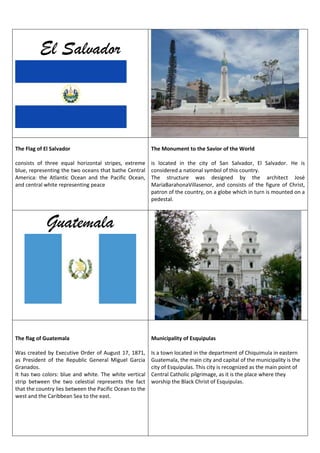
The Flag of El Salvador

The Monument to the Savior of the World

consists of three equal horizontal stripes, extreme
blue, representing the two oceans that bathe Central
America: the Atlantic Ocean and the Pacific Ocean,
and central white representing peace

is located in the city of San Salvador, El Salvador. He is
considered a national symbol of this country.
The structure was designed by the architect José
MaríaBarahonaVillasenor, and consists of the figure of Christ,
patron of the country, on a globe which in turn is mounted on a
pedestal.

Guatemala

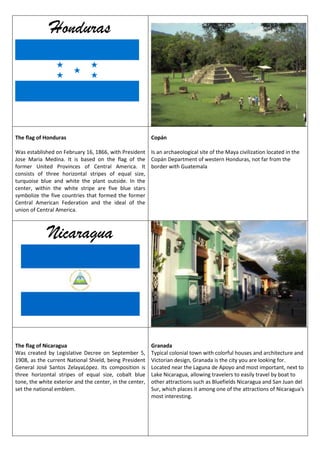
The flag of Guatemala

Municipality of Esquipulas

Was created by Executive Order of August 17, 1871,
as President of the Republic General Miguel Garcia
Granados.
It has two colors: blue and white. The white vertical
strip between the two celestial represents the fact
that the country lies between the Pacific Ocean to the
west and the Caribbean Sea to the east.

Is a town located in the department of Chiquimula in eastern
Guatemala, the main city and capital of the municipality is the
city of Esquipulas. This city is recognized as the main point of
Central Catholic pilgrimage, as it is the place where they
worship the Black Christ of Esquipulas.
Honduras

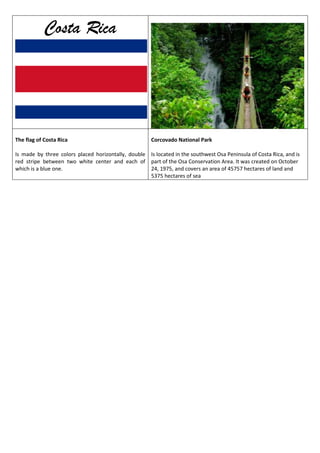
The flag of Honduras

Copán

Was established on February 16, 1866, with President Is an archaeological site of the Maya civilization located in the
Jose Maria Medina. It is based on the flag of the Copán Department of western Honduras, not far from the
former United Provinces of Central America. It border with Guatemala
consists of three horizontal stripes of equal size,
turquoise blue and white the plant outside. In the
center, within the white stripe are five blue stars
symbolize the five countries that formed the former
Central American Federation and the ideal of the
union of Central America.

Nicaragua

The flag of Nicaragua
Was created by Legislative Decree on September 5,
1908, as the current National Shield, being President
General José Santos ZelayaLópez. Its composition is
three horizontal stripes of equal size, cobalt blue
tone, the white exterior and the center, in the center,
set the national emblem.

Granada
Typical colonial town with colorful houses and architecture and
Victorian design, Granada is the city you are looking for.
Located near the Laguna de Apoyo and most important, next to
Lake Nicaragua, allowing travelers to easily travel by boat to
other attractions such as Bluefields Nicaragua and San Juan del
Sur, which places it among one of the attractions of Nicaragua's
most interesting.
Costa Rica

The flag of Costa Rica

Corcovado National Park

Is made by three colors placed horizontally, double Is located in the southwest Osa Peninsula of Costa Rica, and is
red stripe between two white center and each of part of the Osa Conservation Area. It was created on October
which is a blue one.
24, 1975, and covers an area of 45757 hectares of land and
5375 hectares of sea

Banderas CentroAmericanas y lugar representativo- ingles español

  • 1.
    El Salvador The Flagof El Salvador The Monument to the Savior of the World consists of three equal horizontal stripes, extreme blue, representing the two oceans that bathe Central America: the Atlantic Ocean and the Pacific Ocean, and central white representing peace is located in the city of San Salvador, El Salvador. He is considered a national symbol of this country. The structure was designed by the architect José MaríaBarahonaVillasenor, and consists of the figure of Christ, patron of the country, on a globe which in turn is mounted on a pedestal. Guatemala The flag of Guatemala Municipality of Esquipulas Was created by Executive Order of August 17, 1871, as President of the Republic General Miguel Garcia Granados. It has two colors: blue and white. The white vertical strip between the two celestial represents the fact that the country lies between the Pacific Ocean to the west and the Caribbean Sea to the east. Is a town located in the department of Chiquimula in eastern Guatemala, the main city and capital of the municipality is the city of Esquipulas. This city is recognized as the main point of Central Catholic pilgrimage, as it is the place where they worship the Black Christ of Esquipulas.
  • 2.
    Honduras The flag ofHonduras Copán Was established on February 16, 1866, with President Is an archaeological site of the Maya civilization located in the Jose Maria Medina. It is based on the flag of the Copán Department of western Honduras, not far from the former United Provinces of Central America. It border with Guatemala consists of three horizontal stripes of equal size, turquoise blue and white the plant outside. In the center, within the white stripe are five blue stars symbolize the five countries that formed the former Central American Federation and the ideal of the union of Central America. Nicaragua The flag of Nicaragua Was created by Legislative Decree on September 5, 1908, as the current National Shield, being President General José Santos ZelayaLópez. Its composition is three horizontal stripes of equal size, cobalt blue tone, the white exterior and the center, in the center, set the national emblem. Granada Typical colonial town with colorful houses and architecture and Victorian design, Granada is the city you are looking for. Located near the Laguna de Apoyo and most important, next to Lake Nicaragua, allowing travelers to easily travel by boat to other attractions such as Bluefields Nicaragua and San Juan del Sur, which places it among one of the attractions of Nicaragua's most interesting.
  • 3.
    Costa Rica The flagof Costa Rica Corcovado National Park Is made by three colors placed horizontally, double Is located in the southwest Osa Peninsula of Costa Rica, and is red stripe between two white center and each of part of the Osa Conservation Area. It was created on October which is a blue one. 24, 1975, and covers an area of 45757 hectares of land and 5375 hectares of sea