SCIENCE PROCESS SKILLS
Observing
Classifying
Measuring
Inferrin
g Predicting
Communicating
Science is more than a
collection of facts.
Learning the process skills is
preparation for becoming a
scientist.
Process skills are the tools
scientists use to “know”
about the world.
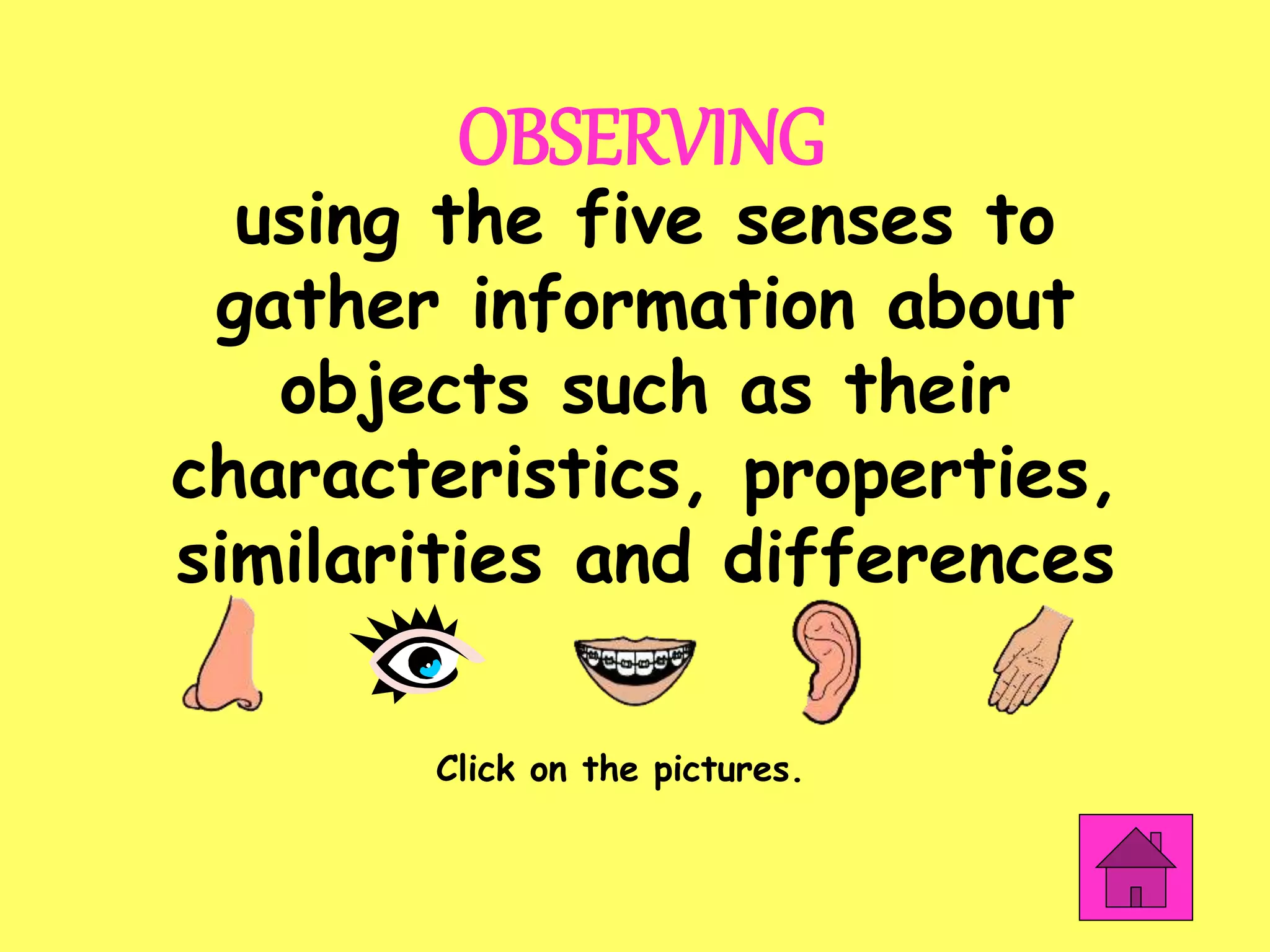
OBSERVING
using the five senses to
gather information about
objects such as their
characteristics, properties,
similarities and differences
Click on the pictures.
WHAT DO YOU SEE?
The creature has 5 eyes.
The baby is walking.
The car is orange.
Sample observations using sight:
WHAT DO YOU SMELL?
Sample observations using smell:
The fruit smells sweet.
The coffee smells strong.
The flowers are fragrant.
WHAT DO YOU FEEL?
Sample observations using touch:
The scissors are sharp.
The cat is soft.
The soap is slippery.
WHAT DO YOU HEAR?
The girl is laughing.
The audience is clapping.
Someone flushed the toilet.
Click the pictures to hear sounds:
WHAT DO YOU TASTE?
The watermelon is sweet.
The chili is spicy.
The milk is sour.
MEASUREMENT
comparing an unknown amount
with a known unit to
determine the length, weight,
temperature, quantity, or
capacity of an object or
event
MEASUREMENT
…..using both standard and
nonstandard units of measure or
estimates to describe the dimensions
of an object or event
…..comparing an unknown quantity
with a known quantity
……measurements are to be
recorded in an orderly and
systemic fashion with labeled
units of measure.
MEASUREMENT TOOLS
Click each graphic to find out more.
Length – linear measurement
base unit : meter
Volume – capacity
base unit : liter
Temperature – hot/cold
base unit : Celsius
Weight – mass
base unit : gram
After linking to the Web, click the
back button or close the browser.
Communicating
• Using written or spoken words,
graphs, tables, diagrams,
models, and video recordings to
share information and ideas
with others
• Observations and experiments should be
able to be duplicated so clear
communication is important
CLASSIFICATION
grouping or ordering objects or
events into categories based on
similarities, differences and
interrelationships.
Example:
Place all leaves having a certain vein pattern into
a one group.
Classify 10 playing cards into different groups.
INFERENCE
Explaining, making interpretations,
or drawing conclusions about a
specific event based on
observations and data
Examples of inference
Your turn to try
INFERENCE EXAMPLES
….saying a person who used the
pencil made a lot of mistakes
because the eraser was well worn.
….saying that a train is coming
because the cross gate is down.
MAKING INFERENCES
Read the paragraph then answer the questions.
Tommy and Johnny were hot and sweaty as they
sat outside the principal’s office. Dirt smeared
both of their faces. They could hear the teacher’s
voice as she gave Mr. Jones her account of what
happened. Tommy sneered at Johnny and Johnny
returned an angry glare. As Miss Green left Mr.
Jones’ office, the boys hung their heads so they
wouldn’t have to look her in the eye.
From the paragraph, you can INFER that……
a. The boys are best friends.
b. The boys had disappointed their teacher.
c. The principal was a nice man.
ANSWER
Click to
hear the
paragraph.
ANSWER: B
What are the clues?
We know the boys are mad at each other because Tommy
sneered at Johnny and he returned an angry glare.
We can guess they had been fighting because dirt
smeared their faces and they were sitting outside the
principal’s office.
The BIGGEST CLUE is the last sentence: the boys
hung their heads so they didn’t have to look her in the
eye.
Tommy and Johnny had
disappointed their teacher.
PREDICTING
forming an idea of an expected
result—not a guess– but a belief of
what will occur based on present
knowledge, observations, and
inferences
Example: Predicting the height of a plant in
two weeks time based on a graph of its
growth during the previous four weeks.
Real World Connection
Activity
WHO USES PREDICTIONS?
Meteorologist –uses weather trends of the
past to predict today’s weather.
Financial advisor – predicts which
investments will be profitable.
Doctors – make predictions of a
patient’s future well being/health.
ACTIVITY
What will a Magnet Attract?
Predict which objects you think the magnet will attract.
Test your predictions with a magnet.
Source:
Author Becky Sons. Retrieved from the Internet,
August 2009.
mrsmaineswiki.wikispaces.com/file/view/scienceprocessskills.ppt.
Adapted by Mrs. Baker, August 2010.

Bakers_scienceprocessskills[1].ppt

  • 1.
    SCIENCE PROCESS SKILLS Observing Classifying Measuring Inferrin gPredicting Communicating Science is more than a collection of facts. Learning the process skills is preparation for becoming a scientist. Process skills are the tools scientists use to “know” about the world.
  • 2.
    OBSERVING using the fivesenses to gather information about objects such as their characteristics, properties, similarities and differences Click on the pictures.
  • 3.
    WHAT DO YOUSEE? The creature has 5 eyes. The baby is walking. The car is orange. Sample observations using sight:
  • 4.
    WHAT DO YOUSMELL? Sample observations using smell: The fruit smells sweet. The coffee smells strong. The flowers are fragrant.
  • 5.
    WHAT DO YOUFEEL? Sample observations using touch: The scissors are sharp. The cat is soft. The soap is slippery.
  • 6.
    WHAT DO YOUHEAR? The girl is laughing. The audience is clapping. Someone flushed the toilet. Click the pictures to hear sounds:
  • 7.
    WHAT DO YOUTASTE? The watermelon is sweet. The chili is spicy. The milk is sour.
  • 8.
    MEASUREMENT comparing an unknownamount with a known unit to determine the length, weight, temperature, quantity, or capacity of an object or event
  • 9.
    MEASUREMENT …..using both standardand nonstandard units of measure or estimates to describe the dimensions of an object or event …..comparing an unknown quantity with a known quantity ……measurements are to be recorded in an orderly and systemic fashion with labeled units of measure.
  • 10.
    MEASUREMENT TOOLS Click eachgraphic to find out more. Length – linear measurement base unit : meter Volume – capacity base unit : liter Temperature – hot/cold base unit : Celsius Weight – mass base unit : gram After linking to the Web, click the back button or close the browser.
  • 11.
    Communicating • Using writtenor spoken words, graphs, tables, diagrams, models, and video recordings to share information and ideas with others • Observations and experiments should be able to be duplicated so clear communication is important
  • 12.
    CLASSIFICATION grouping or orderingobjects or events into categories based on similarities, differences and interrelationships. Example: Place all leaves having a certain vein pattern into a one group. Classify 10 playing cards into different groups.
  • 13.
    INFERENCE Explaining, making interpretations, ordrawing conclusions about a specific event based on observations and data Examples of inference Your turn to try
  • 14.
    INFERENCE EXAMPLES ….saying aperson who used the pencil made a lot of mistakes because the eraser was well worn. ….saying that a train is coming because the cross gate is down.
  • 15.
    MAKING INFERENCES Read theparagraph then answer the questions. Tommy and Johnny were hot and sweaty as they sat outside the principal’s office. Dirt smeared both of their faces. They could hear the teacher’s voice as she gave Mr. Jones her account of what happened. Tommy sneered at Johnny and Johnny returned an angry glare. As Miss Green left Mr. Jones’ office, the boys hung their heads so they wouldn’t have to look her in the eye. From the paragraph, you can INFER that…… a. The boys are best friends. b. The boys had disappointed their teacher. c. The principal was a nice man. ANSWER Click to hear the paragraph.
  • 16.
    ANSWER: B What arethe clues? We know the boys are mad at each other because Tommy sneered at Johnny and he returned an angry glare. We can guess they had been fighting because dirt smeared their faces and they were sitting outside the principal’s office. The BIGGEST CLUE is the last sentence: the boys hung their heads so they didn’t have to look her in the eye. Tommy and Johnny had disappointed their teacher.
  • 17.
    PREDICTING forming an ideaof an expected result—not a guess– but a belief of what will occur based on present knowledge, observations, and inferences Example: Predicting the height of a plant in two weeks time based on a graph of its growth during the previous four weeks. Real World Connection Activity
  • 18.
    WHO USES PREDICTIONS? Meteorologist–uses weather trends of the past to predict today’s weather. Financial advisor – predicts which investments will be profitable. Doctors – make predictions of a patient’s future well being/health.
  • 19.
    ACTIVITY What will aMagnet Attract? Predict which objects you think the magnet will attract. Test your predictions with a magnet.
  • 20.
    Source: Author Becky Sons.Retrieved from the Internet, August 2009. mrsmaineswiki.wikispaces.com/file/view/scienceprocessskills.ppt. Adapted by Mrs. Baker, August 2010.