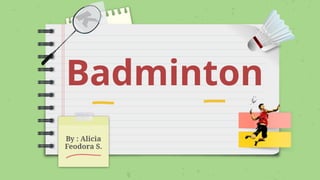
Badminton
By : Alicia
Feodora S.
Definition of
Badminton
Badminton is a game played by two or four
players on a rectangular court with a high net
across the middle. The players try to score
points by hitting a small object across the net
using a racket. Badminton is also played
outdoors as a casual recreational activity,
often as a garden or beach game.
The Top
organizatio
n in
badminton
world is
BWF
(Badminton
World
Badminton World Federation
(BWF) is the international
organization for the sport of
badminton. The Badminton World
Federation (BWF) is recognised by
the International Olympic
Committee (IOC) and the
International Paralympic
Committee (IPC) as the world
governing body for badminton. The
International Badminton
Federation (IBF), as it was
originally called, was established in
London, on 5 July 1934 with nine
founding member associations. The
BWF is a federation of 197
members.
History of
Badminton
In England this game was played by children known as battledores
or shuttlecocks. In 1854 the sport was well known on the streets of
London, when Punch magazine published a cartoon for the sport.
Then the British brought this game to Japan, China and Siam. The
sport of badminton was invented by British army officers in Pune
India in the 19th century when they added a net or net and played
it in opposite directions. Therefore the city of Pune was previously
known as Poona, at that time this game had another name, namely
Poona. In the 1850s troops brought the game back to England.1877
was the first time a draft rule was written by the Bath badminton
club. In 1893 the Badminton Association of England was formed.
The All England Championship was the first international event
held in 1899.
The Basic Skills In Badminton
:
1. Grip (Forehand, Backhand, Bevel, and Panhandle).
The correct way of holding a racquet is as simple as a friendly handshake.
Imagine the grip of the racquet as a hand approaching to shake your hand. Go
ahead and hold the racquet as if you're shaking someone's hand. Your thumb
should be pressing comfortably against one of the wider surface of the racquet
grip while the rest of your hand holds the racquet as if you’re shaking a
person’s hand. In order to execute strong badminton strokes with high
accuracy, your wrist needs to be flexible. To achieve this, make sure you:
* Do not grip your racquet too tightly. This will make your wrist less flexible in
rotating and flicking.
* Use only your thumb, index, and middle finger to control the racket. Your last
two (2) fingers should rest comfortably on the badminton grip to balance the
weight of the racquet. By doing this, it enables your wrist to be more flexible
and move more freely.
The Basic Skills In Badminton
:
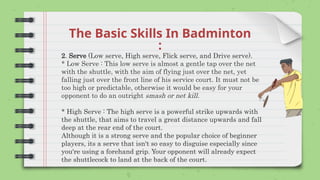
2. Serve (Low serve, High serve, Flick serve, and Drive serve).
* Low Serve : This low serve is almost a gentle tap over the net
with the shuttle, with the aim of flying just over the net, yet
falling just over the front line of his service court. It must not be
too high or predictable, otherwise it would be easy for your
opponent to do an outright smash or net kill.
* High Serve : The high serve is a powerful strike upwards with
the shuttle, that aims to travel a great distance upwards and fall
deep at the rear end of the court.
Although it is a strong serve and the popular choice of beginner
players, its a serve that isn't so easy to disguise especially since
you're using a forehand grip. Your opponent will already expect
the shuttlecock to land at the back of the court.
* Flick Serve : This flick serve is also played upwards but at a
much lesser altitude. It is most common for players to use their
backhand to execute the flick serve and the trajectory is lower as
this grip has less power. The whole point of the backhand flick
serve is deception, by mixing your serves up and making it look like
you're doing a low serve. For this reason, serving with your
backhand is thus very popular with competitive players.
* Drive Serve : This is an attacking serve that is used by top
badminton players like Lin Dan. The idea is to hit the shuttle
directly at your opponent, limiting their return options and
catching them off guard, winning you easy points. It's a good
change of pace but it is also risky as if your opponent is prepared,
he could just smash the shuttlecock back at you. This serve is
executed with your forehand through underarm action and
following through. The shuttle should be dropped a bit sideways
rather than in front of your body and hit flatter.
The Basic Skills In Badminton
:
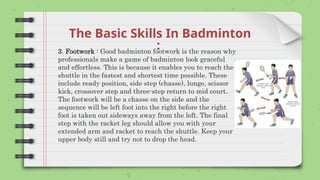
3. Footwork : Good badminton footwork is the reason why
professionals make a game of badminton look graceful
and effortless. This is because it enables you to reach the
shuttle in the fastest and shortest time possible. These
include ready position, side step (chasse), lunge, scissor
kick, crossover step and three-step return to mid court.
The footwork will be a chasse on the side and the
sequence will be left foot into the right before the right
foot is taken out sideways away from the left. The final
step with the racket leg should allow you with your
extended arm and racket to reach the shuttle. Keep your
upper body still and try not to drop the head.
The Basic Skills In Badminton
:
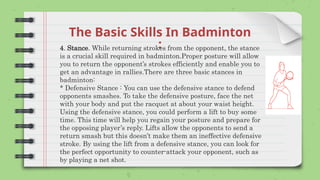
4. Stance. While returning strokes from the opponent, the stance
is a crucial skill required in badminton.Proper posture will allow
you to return the opponent’s strokes efficiently and enable you to
get an advantage in rallies.There are three basic stances in
badminton:
* Defensive Stance : You can use the defensive stance to defend
opponents smashes. To take the defensive posture, face the net
with your body and put the racquet at about your waist height.
Using the defensive stance, you could perform a lift to buy some
time. This time will help you regain your posture and prepare for
the opposing player’s reply. Lifts allow the opponents to send a
return smash but this doesn’t make them an ineffective defensive
stroke. By using the lift from a defensive stance, you can look for
the perfect opportunity to counter-attack your opponent, such as
by playing a net shot.
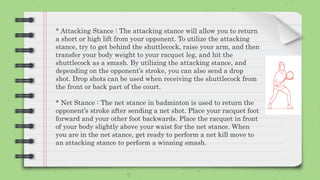
* Attacking Stance : The attacking stance will allow you to return
a short or high lift from your opponent. To utilize the attacking
stance, try to get behind the shuttlecock, raise your arm, and then
transfer your body weight to your racquet leg, and hit the
shuttlecock as a smash. By utilizing the attacking stance, and
depending on the opponent’s stroke, you can also send a drop
shot. Drop shots can be used when receiving the shuttlecock from
the front or back part of the court.
* Net Stance : The net stance in badminton is used to return the
opponent’s stroke after sending a net shot. Place your racquet foot
forward and your other foot backwards. Place the racquet in front
of your body slightly above your waist for the net stance. When
you are in the net stance, get ready to perform a net kill move to
an attacking stance to perform a winning smash.
The Basic Skill In Badminton :
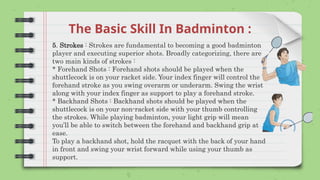
5. Strokes : Strokes are fundamental to becoming a good badminton
player and executing superior shots. Broadly categorizing, there are
two main kinds of strokes :
* Forehand Shots : Forehand shots should be played when the
shuttlecock is on your racket side. Your index finger will control the
forehand stroke as you swing overarm or underarm. Swing the wrist
along with your index finger as support to play a forehand stroke.
* Backhand Shots : Backhand shots should be played when the
shuttlecock is on your non-racket side with your thumb controlling
the strokes. While playing badminton, your light grip will mean
you’ll be able to switch between the forehand and backhand grip at
ease.
To play a backhand shot, hold the racquet with the back of your hand
in front and swing your wrist forward while using your thumb as
support.
Rules of Badminton :
1. A game starts with a coin toss. Whoever wins the toss gets to decide whether they would
serve or receive first OR what side of the court they want to be on. The side losing the toss
shall then exercise the remaining choice.
2. At no time during the game should the player touch the net, with his racquet or his body.
3. The shuttlecock should not be carried on or come to rest on the racquet.
4. A player should not reach over the net to hit the shuttlecock.
5. A serve must carry cross court (diagonally) to be valid.
6. During the serve, a player should not touch any of the lines of the court, until the server
strikes the shuttlecock. During the serve the shuttlecock should always be hit from below the
waist.
7. A point is added to a player's score as and when he wins a rally.
8. A player wins a rally when he strikes the shuttlecock and it touches the floor of the
opponent's side of the court or when the opponent commits a fault. The most common type of
fault is when a player fails to hit the shuttlecock over the net or it lands outside the boundary
of the court.
9. Each side can strike the shuttlecock only once before it passes over the net. Once hit, a
player can't strike the shuttlecock in a new movement or shot.
10. The shuttlecock hitting the ceiling, is counted as a fault.
Badminton notes for junior high school students .pptx

Badminton notes for junior high school students .pptx

  • 1.
  • 2.
    Definition of Badminton Badminton isa game played by two or four players on a rectangular court with a high net across the middle. The players try to score points by hitting a small object across the net using a racket. Badminton is also played outdoors as a casual recreational activity, often as a garden or beach game.
  • 3.
    The Top organizatio n in badminton worldis BWF (Badminton World Badminton World Federation (BWF) is the international organization for the sport of badminton. The Badminton World Federation (BWF) is recognised by the International Olympic Committee (IOC) and the International Paralympic Committee (IPC) as the world governing body for badminton. The International Badminton Federation (IBF), as it was originally called, was established in London, on 5 July 1934 with nine founding member associations. The BWF is a federation of 197 members.
  • 4.
    History of Badminton In Englandthis game was played by children known as battledores or shuttlecocks. In 1854 the sport was well known on the streets of London, when Punch magazine published a cartoon for the sport. Then the British brought this game to Japan, China and Siam. The sport of badminton was invented by British army officers in Pune India in the 19th century when they added a net or net and played it in opposite directions. Therefore the city of Pune was previously known as Poona, at that time this game had another name, namely Poona. In the 1850s troops brought the game back to England.1877 was the first time a draft rule was written by the Bath badminton club. In 1893 the Badminton Association of England was formed. The All England Championship was the first international event held in 1899.
  • 5.
    The Basic SkillsIn Badminton : 1. Grip (Forehand, Backhand, Bevel, and Panhandle). The correct way of holding a racquet is as simple as a friendly handshake. Imagine the grip of the racquet as a hand approaching to shake your hand. Go ahead and hold the racquet as if you're shaking someone's hand. Your thumb should be pressing comfortably against one of the wider surface of the racquet grip while the rest of your hand holds the racquet as if you’re shaking a person’s hand. In order to execute strong badminton strokes with high accuracy, your wrist needs to be flexible. To achieve this, make sure you: * Do not grip your racquet too tightly. This will make your wrist less flexible in rotating and flicking. * Use only your thumb, index, and middle finger to control the racket. Your last two (2) fingers should rest comfortably on the badminton grip to balance the weight of the racquet. By doing this, it enables your wrist to be more flexible and move more freely.
  • 6.
    The Basic SkillsIn Badminton : 2. Serve (Low serve, High serve, Flick serve, and Drive serve). * Low Serve : This low serve is almost a gentle tap over the net with the shuttle, with the aim of flying just over the net, yet falling just over the front line of his service court. It must not be too high or predictable, otherwise it would be easy for your opponent to do an outright smash or net kill. * High Serve : The high serve is a powerful strike upwards with the shuttle, that aims to travel a great distance upwards and fall deep at the rear end of the court. Although it is a strong serve and the popular choice of beginner players, its a serve that isn't so easy to disguise especially since you're using a forehand grip. Your opponent will already expect the shuttlecock to land at the back of the court.
  • 7.
    * Flick Serve: This flick serve is also played upwards but at a much lesser altitude. It is most common for players to use their backhand to execute the flick serve and the trajectory is lower as this grip has less power. The whole point of the backhand flick serve is deception, by mixing your serves up and making it look like you're doing a low serve. For this reason, serving with your backhand is thus very popular with competitive players. * Drive Serve : This is an attacking serve that is used by top badminton players like Lin Dan. The idea is to hit the shuttle directly at your opponent, limiting their return options and catching them off guard, winning you easy points. It's a good change of pace but it is also risky as if your opponent is prepared, he could just smash the shuttlecock back at you. This serve is executed with your forehand through underarm action and following through. The shuttle should be dropped a bit sideways rather than in front of your body and hit flatter.
  • 8.
    The Basic SkillsIn Badminton : 3. Footwork : Good badminton footwork is the reason why professionals make a game of badminton look graceful and effortless. This is because it enables you to reach the shuttle in the fastest and shortest time possible. These include ready position, side step (chasse), lunge, scissor kick, crossover step and three-step return to mid court. The footwork will be a chasse on the side and the sequence will be left foot into the right before the right foot is taken out sideways away from the left. The final step with the racket leg should allow you with your extended arm and racket to reach the shuttle. Keep your upper body still and try not to drop the head.
  • 9.
    The Basic SkillsIn Badminton : 4. Stance. While returning strokes from the opponent, the stance is a crucial skill required in badminton.Proper posture will allow you to return the opponent’s strokes efficiently and enable you to get an advantage in rallies.There are three basic stances in badminton: * Defensive Stance : You can use the defensive stance to defend opponents smashes. To take the defensive posture, face the net with your body and put the racquet at about your waist height. Using the defensive stance, you could perform a lift to buy some time. This time will help you regain your posture and prepare for the opposing player’s reply. Lifts allow the opponents to send a return smash but this doesn’t make them an ineffective defensive stroke. By using the lift from a defensive stance, you can look for the perfect opportunity to counter-attack your opponent, such as by playing a net shot.
  • 10.
    * Attacking Stance: The attacking stance will allow you to return a short or high lift from your opponent. To utilize the attacking stance, try to get behind the shuttlecock, raise your arm, and then transfer your body weight to your racquet leg, and hit the shuttlecock as a smash. By utilizing the attacking stance, and depending on the opponent’s stroke, you can also send a drop shot. Drop shots can be used when receiving the shuttlecock from the front or back part of the court. * Net Stance : The net stance in badminton is used to return the opponent’s stroke after sending a net shot. Place your racquet foot forward and your other foot backwards. Place the racquet in front of your body slightly above your waist for the net stance. When you are in the net stance, get ready to perform a net kill move to an attacking stance to perform a winning smash.
  • 11.
    The Basic SkillIn Badminton : 5. Strokes : Strokes are fundamental to becoming a good badminton player and executing superior shots. Broadly categorizing, there are two main kinds of strokes : * Forehand Shots : Forehand shots should be played when the shuttlecock is on your racket side. Your index finger will control the forehand stroke as you swing overarm or underarm. Swing the wrist along with your index finger as support to play a forehand stroke. * Backhand Shots : Backhand shots should be played when the shuttlecock is on your non-racket side with your thumb controlling the strokes. While playing badminton, your light grip will mean you’ll be able to switch between the forehand and backhand grip at ease. To play a backhand shot, hold the racquet with the back of your hand in front and swing your wrist forward while using your thumb as support.
  • 12.
    Rules of Badminton: 1. A game starts with a coin toss. Whoever wins the toss gets to decide whether they would serve or receive first OR what side of the court they want to be on. The side losing the toss shall then exercise the remaining choice. 2. At no time during the game should the player touch the net, with his racquet or his body. 3. The shuttlecock should not be carried on or come to rest on the racquet. 4. A player should not reach over the net to hit the shuttlecock. 5. A serve must carry cross court (diagonally) to be valid. 6. During the serve, a player should not touch any of the lines of the court, until the server strikes the shuttlecock. During the serve the shuttlecock should always be hit from below the waist. 7. A point is added to a player's score as and when he wins a rally. 8. A player wins a rally when he strikes the shuttlecock and it touches the floor of the opponent's side of the court or when the opponent commits a fault. The most common type of fault is when a player fails to hit the shuttlecock over the net or it lands outside the boundary of the court. 9. Each side can strike the shuttlecock only once before it passes over the net. Once hit, a player can't strike the shuttlecock in a new movement or shot. 10. The shuttlecock hitting the ceiling, is counted as a fault.