General Concepts
• Algorithm strategy
–Approach to solving a problem
–May combine several approaches
• Algorithm structure
–Iterative ⇒ execute action in loop
–Recursive ⇒ reapply action to subproblem(s)
• Problem type
–Satisfying ⇒ find any satisfactory solution
–Optimization ⇒ find best solutions (vs.
cost metric)
A short list of categories
• Many Algorithm types are to be
considered:
–Simple recursive algorithms
–Backtracking algorithms
–Divide and conquer algorithms
–Dynamic programming algorithms
–Greedy algorithms
–Branch and bound algorithms
–Brute force algorithms
–Randomized algorithms
Backtracking
• Suppose you have to make a series of
decisions, among various choices,
where
–You don’t have enough information to know
what to choose
–Each decision leads to a new set of choices
–Some sequence of choices (possibly more
than one) may be a solution to your
problem
• Backtracking is a methodical way of
trying out various sequences of
Backtracking Algorithm
• Based on depth-first recursive search
• Approach
1. Tests whether solution has been found
2. If found solution, return it
3. Else for each choice that can be made
a) Make that choice
b) Recur
c) If recursion returns a solution, return it
4. If no choices remain, return failure
• Some times called “search tree”
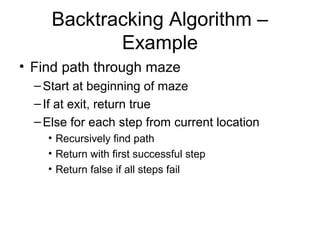
Backtracking Algorithm –
Example
• Find path through maze
–Start at beginning of maze
–If at exit, return true
–Else for each step from current location
• Recursively find path
• Return with first successful step
• Return false if all steps fail
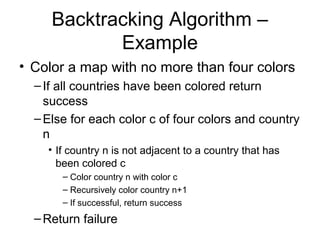
Backtracking Algorithm –
Example
• Color a map with no more than four colors
–If all countries have been colored return
success
–Else for each color c of four colors and country
n
• If country n is not adjacent to a country that has
been colored c
– Color country n with color c
– Recursively color country n+1
– If successful, return success
–Return failure

Backtacking

  • 2.
    General Concepts • Algorithmstrategy –Approach to solving a problem –May combine several approaches • Algorithm structure –Iterative ⇒ execute action in loop –Recursive ⇒ reapply action to subproblem(s) • Problem type –Satisfying ⇒ find any satisfactory solution –Optimization ⇒ find best solutions (vs. cost metric)
  • 3.
    A short listof categories • Many Algorithm types are to be considered: –Simple recursive algorithms –Backtracking algorithms –Divide and conquer algorithms –Dynamic programming algorithms –Greedy algorithms –Branch and bound algorithms –Brute force algorithms –Randomized algorithms
  • 4.
    Backtracking • Suppose youhave to make a series of decisions, among various choices, where –You don’t have enough information to know what to choose –Each decision leads to a new set of choices –Some sequence of choices (possibly more than one) may be a solution to your problem • Backtracking is a methodical way of trying out various sequences of
  • 5.
    Backtracking Algorithm • Basedon depth-first recursive search • Approach 1. Tests whether solution has been found 2. If found solution, return it 3. Else for each choice that can be made a) Make that choice b) Recur c) If recursion returns a solution, return it 4. If no choices remain, return failure • Some times called “search tree”
  • 6.
    Backtracking Algorithm – Example •Find path through maze –Start at beginning of maze –If at exit, return true –Else for each step from current location • Recursively find path • Return with first successful step • Return false if all steps fail
  • 7.
    Backtracking Algorithm – Example •Color a map with no more than four colors –If all countries have been colored return success –Else for each color c of four colors and country n • If country n is not adjacent to a country that has been colored c – Color country n with color c – Recursively color country n+1 – If successful, return success –Return failure