International Journal of Engineering Research and Development 
e-ISSN: 2278-067X, p-ISSN: 2278-800X, www.ijerd.com 
Volume 10, Issue 8 (August 2014), PP.10-19 
Faults Analysis in Simulated Two Machine Power System 
Vikash Anand1, Dr. M. M. Chaudhary2 
1Research Scholar, Electrical Engineering, NIT- Patna, India 
2Professor, Electrical Engineering, NIT- Patna, India 
Abstract:- With growing complexity of modern power system consists of generators, transformers, 
transmission and distribution lines etc. The probability of the failure or occurrence of abnormal condition is 
more on power lines. Short circuit and other abnormal conditions often occur on a power system. The heavy 
current associated with short circuit is likely to cause damage to equipment if suitable protective relays and 
circuit breakers are not provided for the protection of each section of the power system. The basic electrical 
quantities which are likely to change during abnormal conditions are current, voltage, phase-angle and 
frequency. In this report, at first, the power system stability and the causes of symmetrical and unsymmetrical 
fault has been discussed briefly and later on the three phase two machine power system model has been 
simulated to find out the critical clearing time graphically for all the types of fault. On comparisons of critical 
clearing time on the synchronous generator and asynchronous motor parameters with respect to all the faults and 
make conclusion about the severe fault, also find out the stabilize time of all mechanical and electrical 
parameters after fault is landing. 
Keywords:- Asynchronous Machine, MATLAB, Protective Devices, Synshronous Machine, Three Phase 
Power. 
I. INTRODUCTION 
The power system networks are continuously expanding over wide geographical area with increased 
number of interconnection to meet the rapid growth in the demand of electricity. The transmission and 
distribution networks are main carriers of electrical power. 
An electrical power system consists of generators, transformers, transmission and distribution lines etc. 
Short circuits and other abnormal conditions often occur on a power system. The heavy current associated with 
short circuits is likely to cause damage to equipment if suitable protective relays and circuit breakers are not 
provided for the protection of each section of the power system. Short circuits are usually called faults by power 
engineers. Basically, the failure of conducting path due to a break in a conductor is a type of fault. 
If a fault occurs in an element of a power system, an automatic protective device is needed to isolate 
the faulty element as quickly as possible to keep the healthy section of the system in normal operation. The fault 
must be cleared within a fraction of a second. If a short circuit persists on a system for a longer, it may cause 
damage to some important sections of the system. A heavy short circuit current may cause a fire. It may spread 
in the system and damage a part of it. The system voltage may reduce to a low level and individual generators in 
a power station or groups of generators in different power stations may lose synchronism. Thus, an uncleared 
heavy short circuit may cause the total failure of the system. 
A protective system includes circuit breakers, transducers and protective relays to isolate the faulty 
section of the power system from the healthy sections. The function of a protective relay is to detect and locate a 
fault and issue a command to the circuit breaker to disconnect the faulty element. It is a device which senses 
abnormal conditions on a power system by constantly monitoring electrical quantities of systems, which differ 
under normal and abnormal conditions. The basic electrical quantities which are likely to change during 
abnormal conditions are current, voltage, phase-angle (direction) and frequency. Protective relays utilize one or 
more of these quantities to detect abnormal conditions on a power system. 
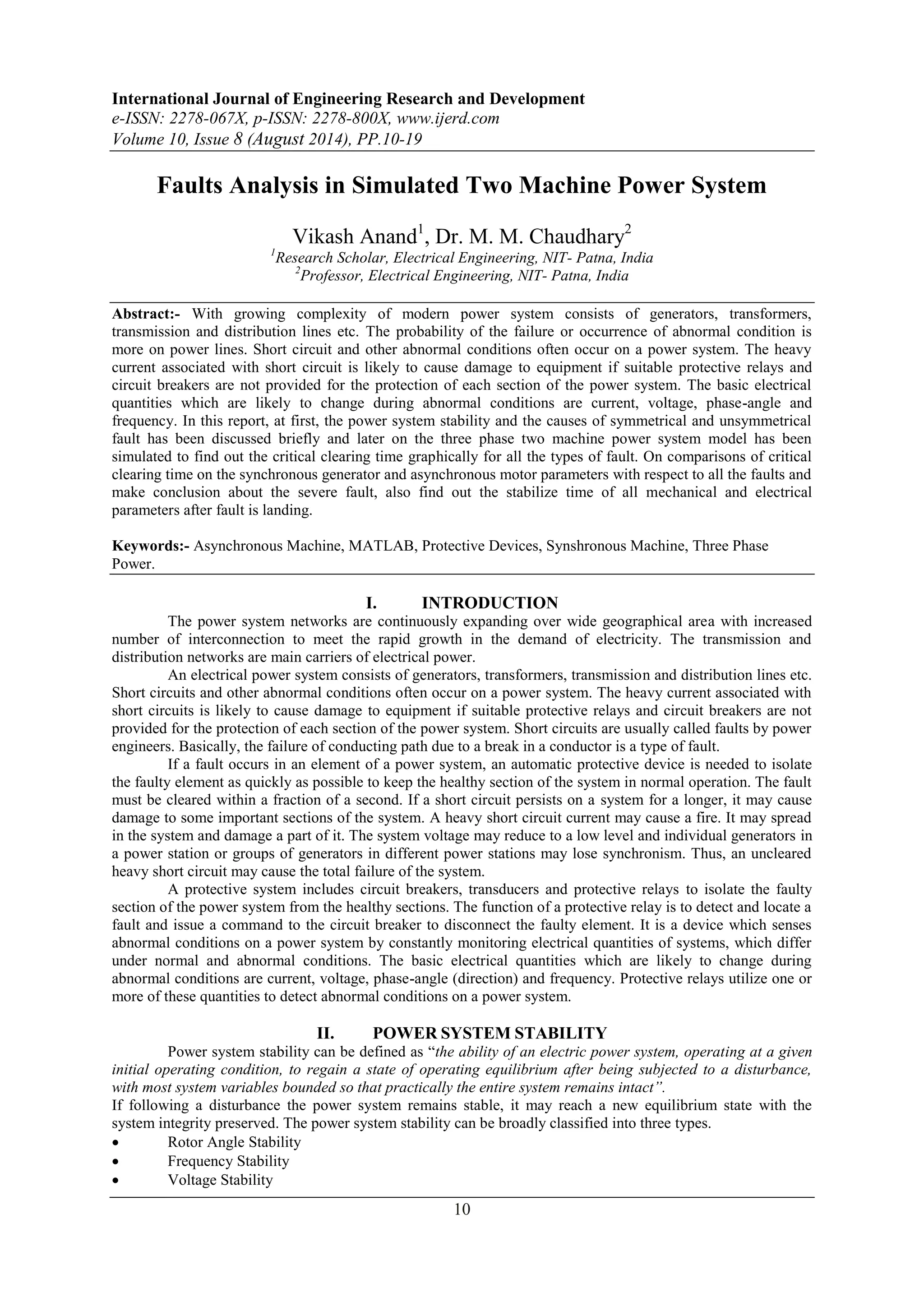
II. POWER SYSTEM STABILITY 
Power system stability can be defined as “the ability of an electric power system, operating at a given 
initial operating condition, to regain a state of operating equilibrium after being subjected to a disturbance, 
with most system variables bounded so that practically the entire system remains intact”. 
If following a disturbance the power system remains stable, it may reach a new equilibrium state with the 
system integrity preserved. The power system stability can be broadly classified into three types. 
 Rotor Angle Stability 
 Frequency Stability 
 Voltage Stability 
10
Faults Analysis in Simulated Two Machine Power System 
Frequency and voltage stability can be further categorized into short term and long term stability. Voltage 
stability may be classified into large disturbance and small disturbance voltage stability. 
This categorically comes under the short term and the long term stability respectively. 
Fig.1 Classification of Power System Stability 
III. POWER QUALITY PROBLEMS 
Transmission lines are often subjected to many kinds of faults, such as 
 Single phase-to-earth 
 Double phase-to-earth 
 Phase to phase (two phase) 
 Three phase with or without the earth 
Some of the causes of these faults are storms, insulation breakdown with age, operating beyond its 
capacities, improper maintenance etc. The faults are generally detected and faulty sections are isolated by 
protective relays. However, to minimize the downtime and to improve the reliability. It is very important to 
identify the fault location as quickly as possible. 
A power quality audit can help determine the causes of one’s problems and provide a well-designed 
plan to correct them. The findings will be included in a report outlining problems found during the audit and 
recommend solutions. Many businesses and organizations rely on computer systems and other electrical 
equipment to carry out mission-critical functions, but they aren't safeguarding against the dangers of an 
unreliable power supply. The power quality problems are as follows. 
11 
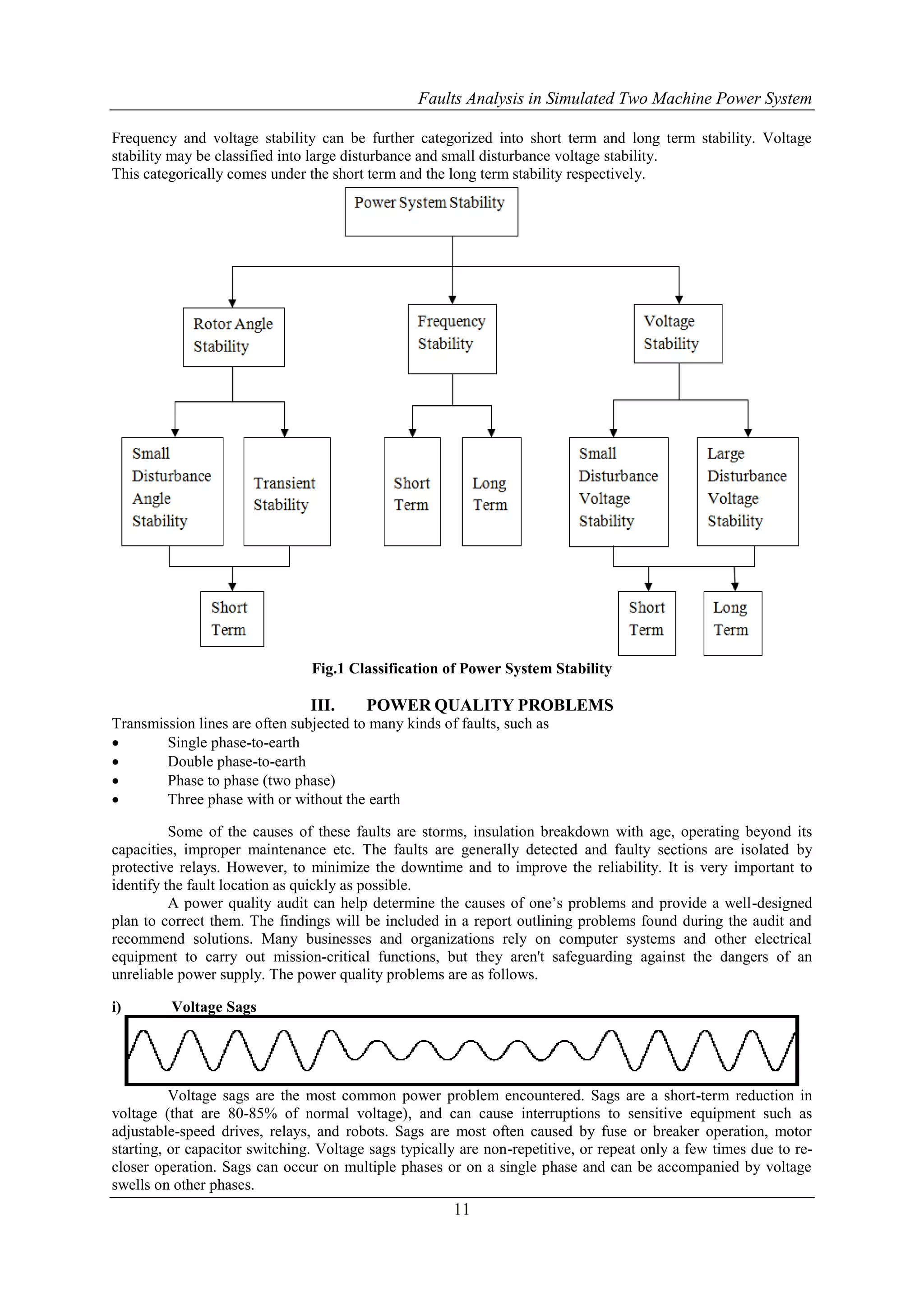
i) Voltage Sags 
Voltage sags are the most common power problem encountered. Sags are a short-term reduction in 
voltage (that are 80-85% of normal voltage), and can cause interruptions to sensitive equipment such as 
adjustable-speed drives, relays, and robots. Sags are most often caused by fuse or breaker operation, motor 
starting, or capacitor switching. Voltage sags typically are non-repetitive, or repeat only a few times due to re-closer 
operation. Sags can occur on multiple phases or on a single phase and can be accompanied by voltage 
swells on other phases.
Faults Analysis in Simulated Two Machine Power System 
12 
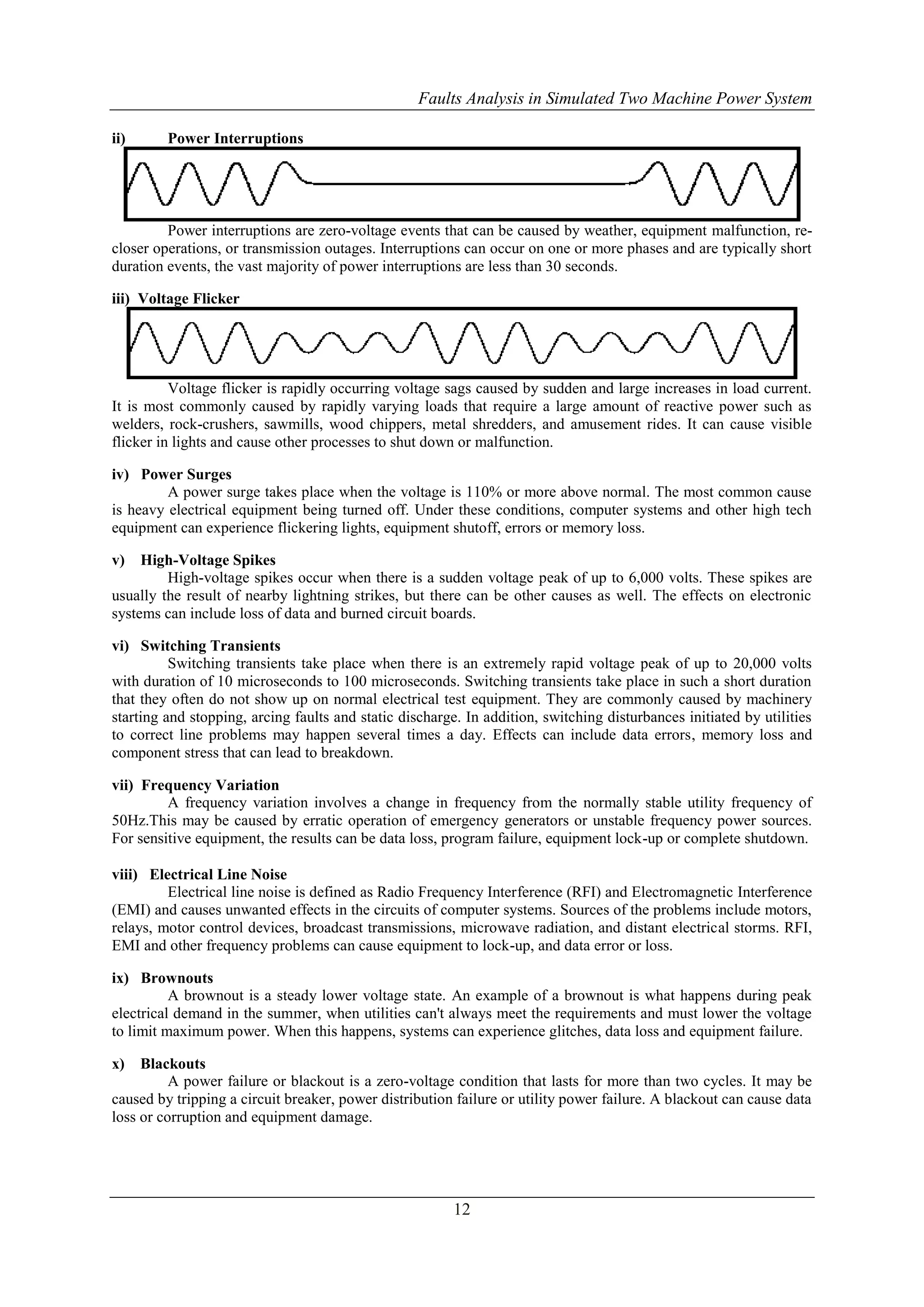
ii) Power Interruptions 
Power interruptions are zero-voltage events that can be caused by weather, equipment malfunction, re-closer 
operations, or transmission outages. Interruptions can occur on one or more phases and are typically short 
duration events, the vast majority of power interruptions are less than 30 seconds. 
iii) Voltage Flicker 
Voltage flicker is rapidly occurring voltage sags caused by sudden and large increases in load current. 
It is most commonly caused by rapidly varying loads that require a large amount of reactive power such as 
welders, rock-crushers, sawmills, wood chippers, metal shredders, and amusement rides. It can cause visible 
flicker in lights and cause other processes to shut down or malfunction. 
iv) Power Surges 
A power surge takes place when the voltage is 110% or more above normal. The most common cause 
is heavy electrical equipment being turned off. Under these conditions, computer systems and other high tech 
equipment can experience flickering lights, equipment shutoff, errors or memory loss. 
v) High-Voltage Spikes 
High-voltage spikes occur when there is a sudden voltage peak of up to 6,000 volts. These spikes are 
usually the result of nearby lightning strikes, but there can be other causes as well. The effects on electronic 
systems can include loss of data and burned circuit boards. 
vi) Switching Transients 
Switching transients take place when there is an extremely rapid voltage peak of up to 20,000 volts 
with duration of 10 microseconds to 100 microseconds. Switching transients take place in such a short duration 
that they often do not show up on normal electrical test equipment. They are commonly caused by machinery 
starting and stopping, arcing faults and static discharge. In addition, switching disturbances initiated by utilities 
to correct line problems may happen several times a day. Effects can include data errors, memory loss and 
component stress that can lead to breakdown. 
vii) Frequency Variation 
A frequency variation involves a change in frequency from the normally stable utility frequency of 
50Hz.This may be caused by erratic operation of emergency generators or unstable frequency power sources. 
For sensitive equipment, the results can be data loss, program failure, equipment lock-up or complete shutdown. 
viii) Electrical Line Noise 
Electrical line noise is defined as Radio Frequency Interference (RFI) and Electromagnetic Interference 
(EMI) and causes unwanted effects in the circuits of computer systems. Sources of the problems include motors, 
relays, motor control devices, broadcast transmissions, microwave radiation, and distant electrical storms. RFI, 
EMI and other frequency problems can cause equipment to lock-up, and data error or loss. 
ix) Brownouts 
A brownout is a steady lower voltage state. An example of a brownout is what happens during peak 
electrical demand in the summer, when utilities can't always meet the requirements and must lower the voltage 
to limit maximum power. When this happens, systems can experience glitches, data loss and equipment failure. 
x) Blackouts 
A power failure or blackout is a zero-voltage condition that lasts for more than two cycles. It may be 
caused by tripping a circuit breaker, power distribution failure or utility power failure. A blackout can cause data 
loss or corruption and equipment damage.
Faults Analysis in Simulated Two Machine Power System 
IV. CAUSES AND EFFECTS OF POWER QUALITY PROBLEMS 
POWER PROBLEMS CAUSES EFFECTS 
Voltage Spikes and 
Lightning, Utility grid switching, 
Surges 
Heavy industrial equipment 
13 
Equipment failure, System lock-up, 
Data corruption, Data loss 
Electrical Noise Arc Welders etc..., Switch mode 
power supplies, Fault clearing 
devices, Ground not dedicated or 
isolated 
Data corruption, Erroneous 
command functions, Loss of 
command functions, Improper 
wave shapes etc... 
Harmonics Switch mode power supplies, 
Nonlinear loads 
High neutral currents, Overheated 
neutral conductors, Overheated 
transformers, Voltage distortion, 
Loss of system capacity 
Voltage Fluctuations Brownouts, Unstable generators, 
Overburdened distribution systems, 
Start-up of heavy equipment 
System lock-up, System shutdown, 
Data corruption, Data Loss, 
Reduced performance, Loss of 
system control 
Power Outage & 
Interruptions 
Blackouts, Faulted or overload, 
conditions, Back-up generator start-up 
System crash, System lock-up, 
Power supply damage, Lost data, 
Complete shutdown loss of control 
Stable AC from DC 
source 
DC power plant available, Remote 
areas 
Unavailable AC power 
Emergency power 
source transfer, Peak 
shave power 
Back-up generator start-up, Power 
interruption transfer of utility source 
System crash, System lock-up, 
Power supply damage, Lost data, 
Complete shutdown loss of control 
Distribution Systems 
and Power quality 
questions 
Lack of understanding of system 
problems or coordination 
Unstable distribution system, Lost 
productivity and profitability. 
High energy cost / 
Power factor correction 
Need for energy savings and pay 
back for equipment investment. 
Lost profits increased cost. 
V. TWO MACHINE POWER SYSTEM 
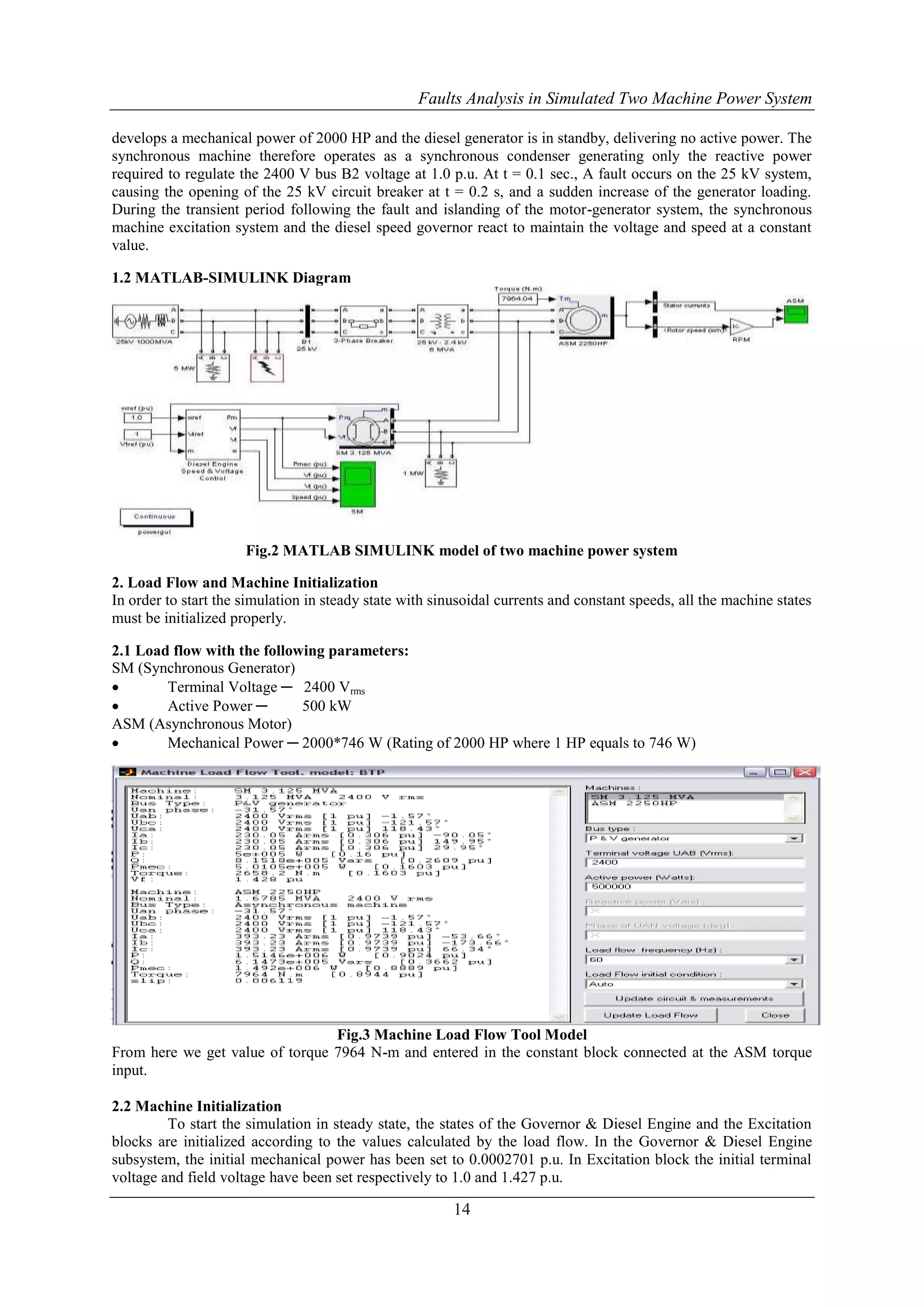
A two machine power system is simulated using MATLAB- SIMULINK to find the critical clearing 
time for the different types of fault then using information from their suitable waveform, it is observed that 
which one are most severe fault and the effects of fault on machine’s parameters. 
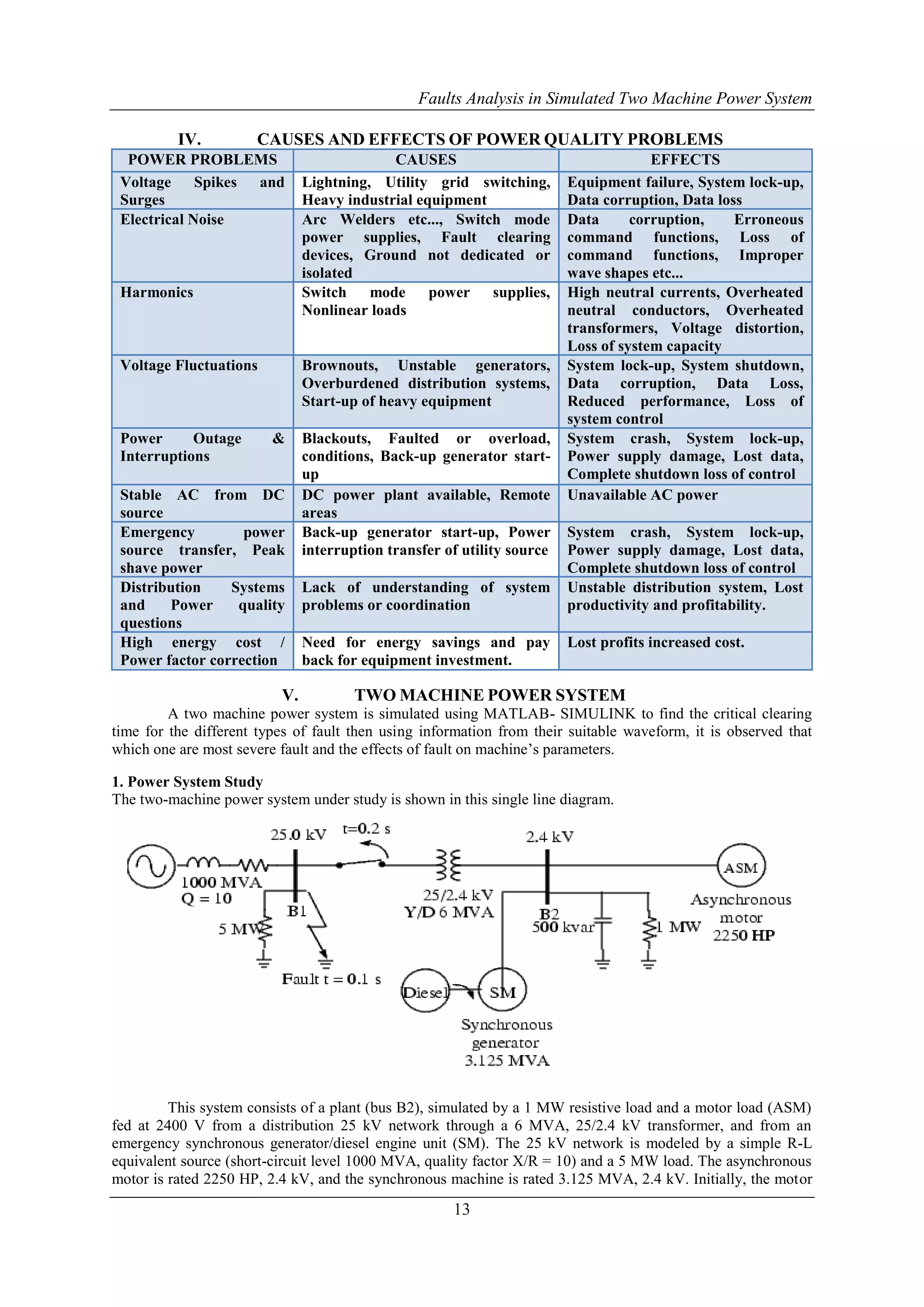
1. Power System Study 
The two-machine power system under study is shown in this single line diagram. 
This system consists of a plant (bus B2), simulated by a 1 MW resistive load and a motor load (ASM) 
fed at 2400 V from a distribution 25 kV network through a 6 MVA, 25/2.4 kV transformer, and from an 
emergency synchronous generator/diesel engine unit (SM). The 25 kV network is modeled by a simple R-L 
equivalent source (short-circuit level 1000 MVA, quality factor X/R = 10) and a 5 MW load. The asynchronous 
motor is rated 2250 HP, 2.4 kV, and the synchronous machine is rated 3.125 MVA, 2.4 kV. Initially, the motor
Faults Analysis in Simulated Two Machine Power System 
develops a mechanical power of 2000 HP and the diesel generator is in standby, delivering no active power. The 
synchronous machine therefore operates as a synchronous condenser generating only the reactive power 
required to regulate the 2400 V bus B2 voltage at 1.0 p.u. At t = 0.1 sec., A fault occurs on the 25 kV system, 
causing the opening of the 25 kV circuit breaker at t = 0.2 s, and a sudden increase of the generator loading. 
During the transient period following the fault and islanding of the motor-generator system, the synchronous 
machine excitation system and the diesel speed governor react to maintain the voltage and speed at a constant 
value. 
14 
1.2 MATLAB-SIMULINK Diagram 
Fig.2 MATLAB SIMULINK model of two machine power system 
2. Load Flow and Machine Initialization 
In order to start the simulation in steady state with sinusoidal currents and constant speeds, all the machine states 
must be initialized properly. 
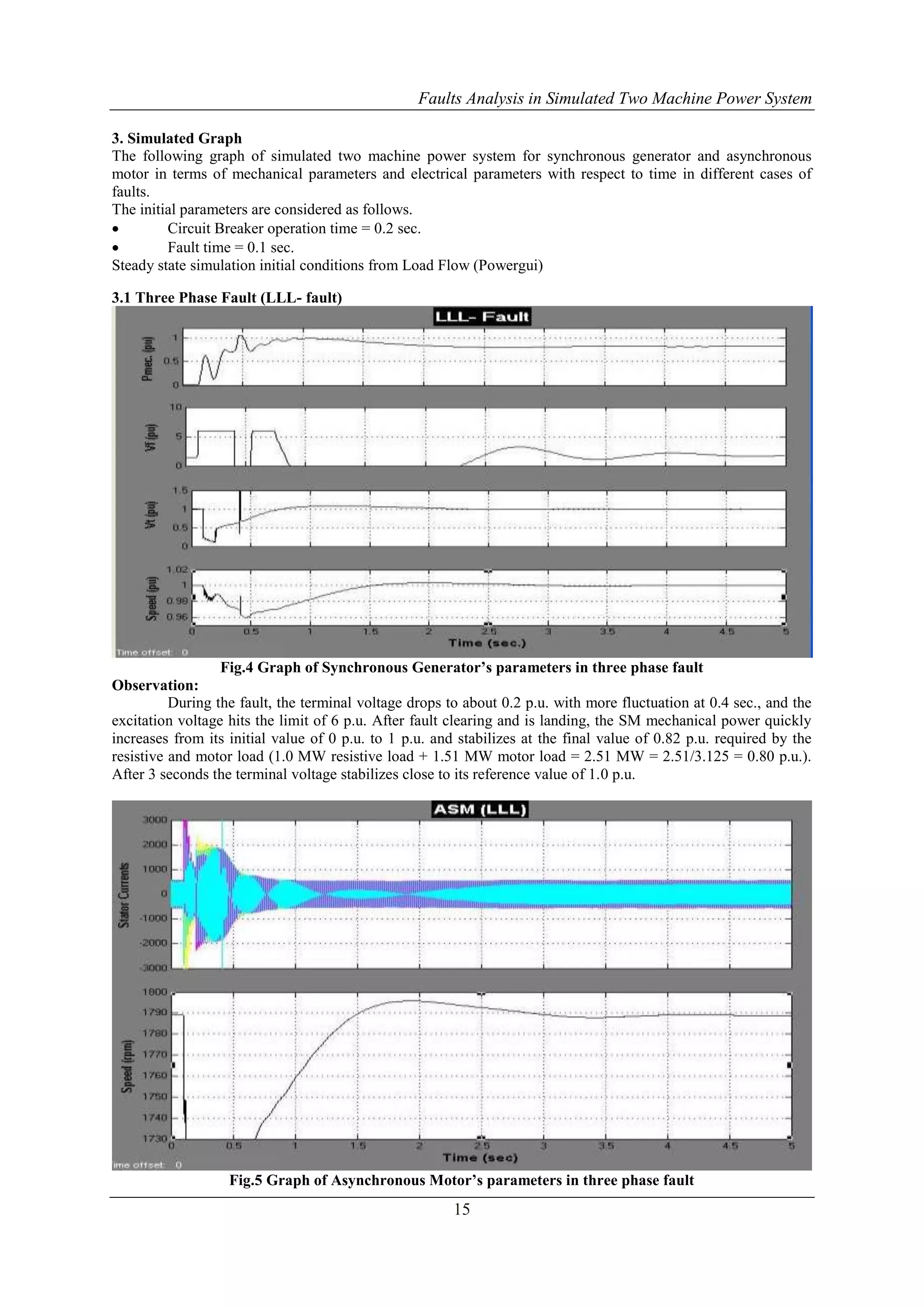
2.1 Load flow with the following parameters: 
SM (Synchronous Generator) 
 Terminal Voltage ─ 2400 Vrms 
 Active Power ─ 500 kW 
ASM (Asynchronous Motor) 
 Mechanical Power ─ 2000*746 W (Rating of 2000 HP where 1 HP equals to 746 W) 
Fig.3 Machine Load Flow Tool Model 
From here we get value of torque 7964 N-m and entered in the constant block connected at the ASM torque 
input. 
2.2 Machine Initialization 
To start the simulation in steady state, the states of the Governor & Diesel Engine and the Excitation 
blocks are initialized according to the values calculated by the load flow. In the Governor & Diesel Engine 
subsystem, the initial mechanical power has been set to 0.0002701 p.u. In Excitation block the initial terminal 
voltage and field voltage have been set respectively to 1.0 and 1.427 p.u.
Faults Analysis in Simulated Two Machine Power System 
3. Simulated Graph 
The following graph of simulated two machine power system for synchronous generator and asynchronous 
motor in terms of mechanical parameters and electrical parameters with respect to time in different cases of 
faults. 
The initial parameters are considered as follows. 
 Circuit Breaker operation time = 0.2 sec. 
 Fault time = 0.1 sec. 
Steady state simulation initial conditions from Load Flow (Powergui) 
15 
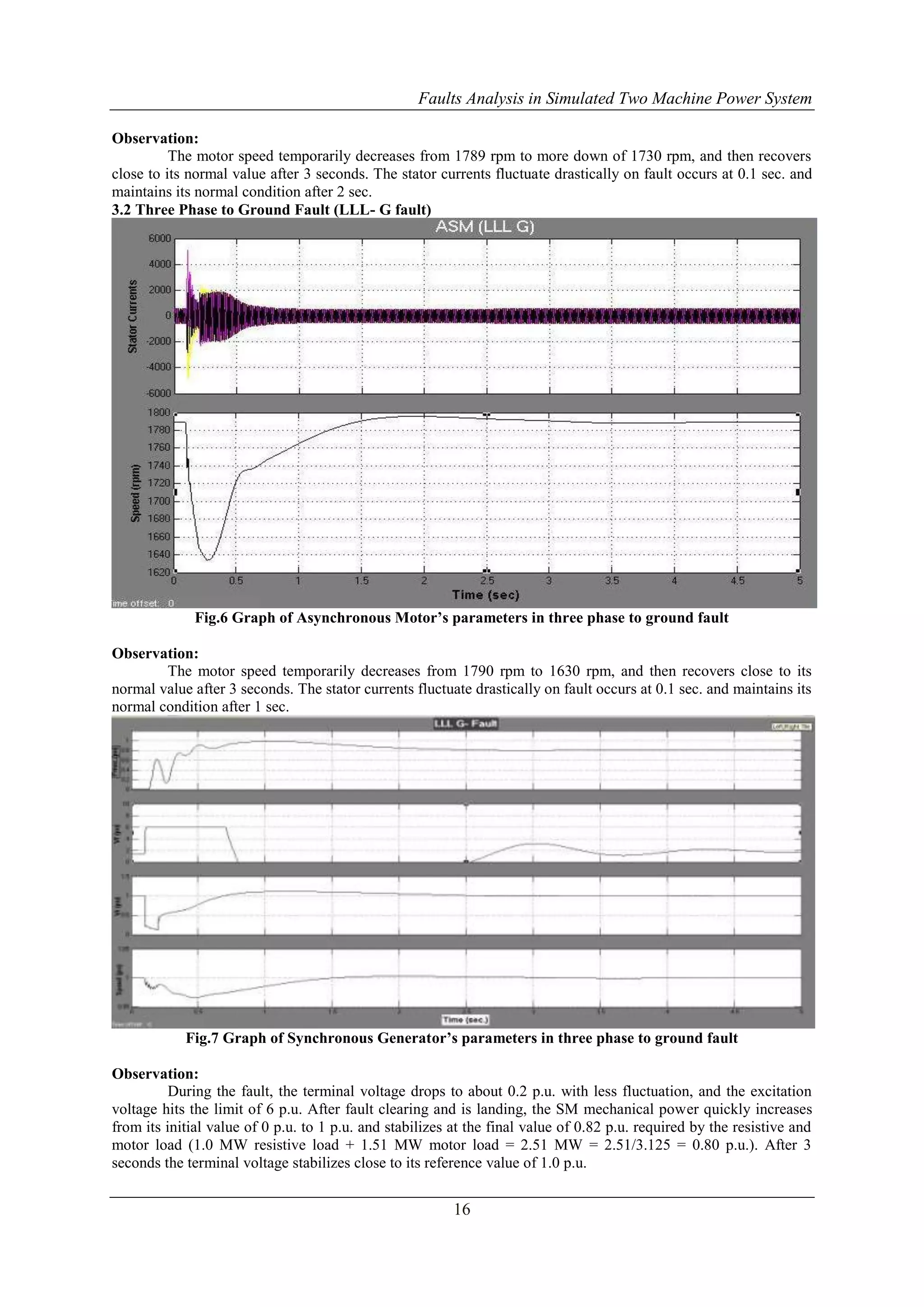
3.1 Three Phase Fault (LLL- fault) 
Fig.4 Graph of Synchronous Generator’s parameters in three phase fault 
Observation: 
During the fault, the terminal voltage drops to about 0.2 p.u. with more fluctuation at 0.4 sec., and the 
excitation voltage hits the limit of 6 p.u. After fault clearing and is landing, the SM mechanical power quickly 
increases from its initial value of 0 p.u. to 1 p.u. and stabilizes at the final value of 0.82 p.u. required by the 
resistive and motor load (1.0 MW resistive load + 1.51 MW motor load = 2.51 MW = 2.51/3.125 = 0.80 p.u.). 
After 3 seconds the terminal voltage stabilizes close to its reference value of 1.0 p.u. 
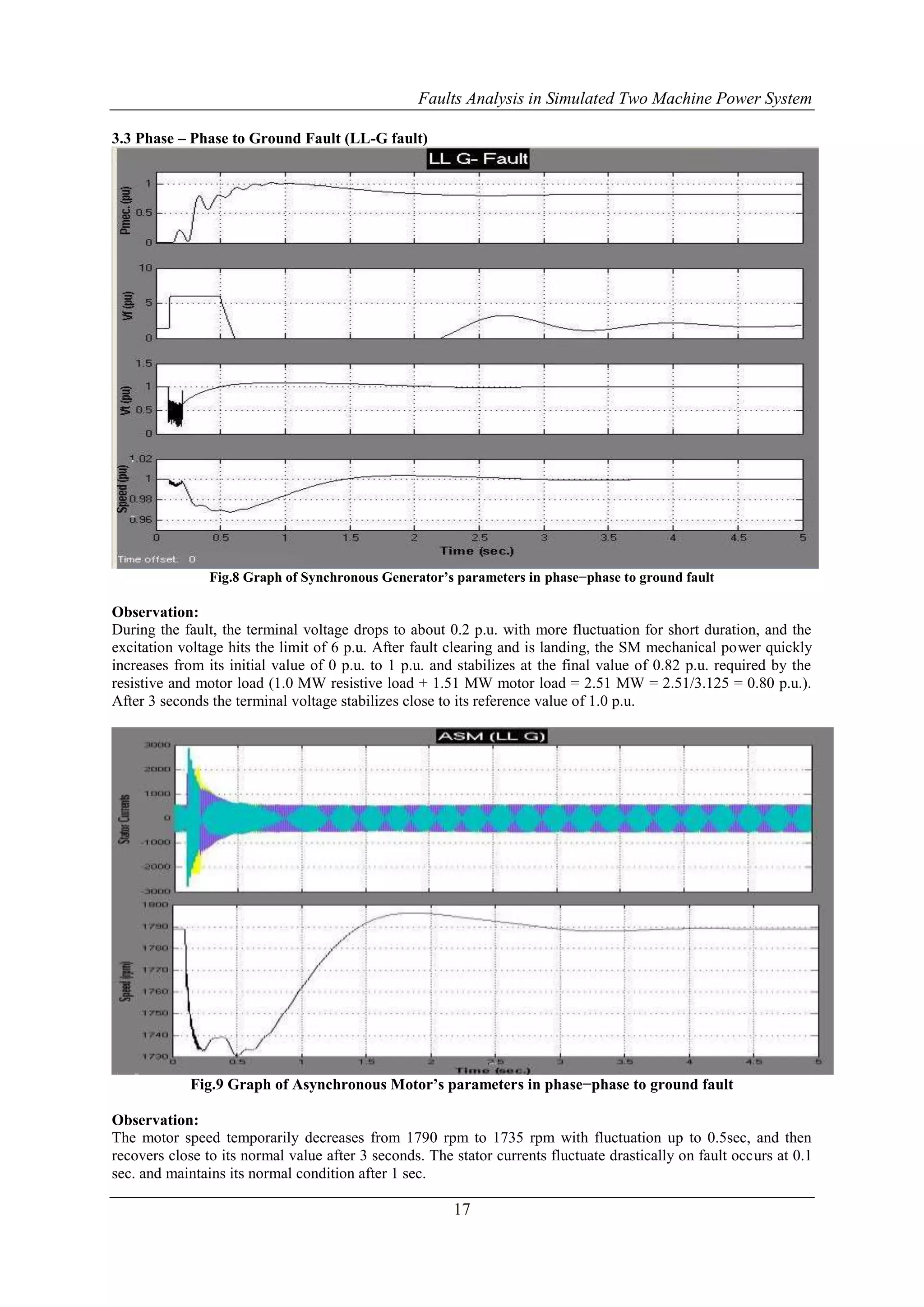
Fig.5 Graph of Asynchronous Motor’s parameters in three phase fault
Faults Analysis in Simulated Two Machine Power System 
16 
Observation: 
The motor speed temporarily decreases from 1789 rpm to more down of 1730 rpm, and then recovers 
close to its normal value after 3 seconds. The stator currents fluctuate drastically on fault occurs at 0.1 sec. and 
maintains its normal condition after 2 sec. 
3.2 Three Phase to Ground Fault (LLL- G fault) 
Fig.6 Graph of Asynchronous Motor’s parameters in three phase to ground fault 
Observation: 
The motor speed temporarily decreases from 1790 rpm to 1630 rpm, and then recovers close to its 
normal value after 3 seconds. The stator currents fluctuate drastically on fault occurs at 0.1 sec. and maintains its 
normal condition after 1 sec. 
Fig.7 Graph of Synchronous Generator’s parameters in three phase to ground fault 
Observation: 
During the fault, the terminal voltage drops to about 0.2 p.u. with less fluctuation, and the excitation 
voltage hits the limit of 6 p.u. After fault clearing and is landing, the SM mechanical power quickly increases 
from its initial value of 0 p.u. to 1 p.u. and stabilizes at the final value of 0.82 p.u. required by the resistive and 
motor load (1.0 MW resistive load + 1.51 MW motor load = 2.51 MW = 2.51/3.125 = 0.80 p.u.). After 3 
seconds the terminal voltage stabilizes close to its reference value of 1.0 p.u.
Faults Analysis in Simulated Two Machine Power System 
17 
3.3 Phase – Phase to Ground Fault (LL-G fault) 
Fig.8 Graph of Synchronous Generator’s parameters in phase−phase to ground fault 
Observation: 
During the fault, the terminal voltage drops to about 0.2 p.u. with more fluctuation for short duration, and the 
excitation voltage hits the limit of 6 p.u. After fault clearing and is landing, the SM mechanical power quickly 
increases from its initial value of 0 p.u. to 1 p.u. and stabilizes at the final value of 0.82 p.u. required by the 
resistive and motor load (1.0 MW resistive load + 1.51 MW motor load = 2.51 MW = 2.51/3.125 = 0.80 p.u.). 
After 3 seconds the terminal voltage stabilizes close to its reference value of 1.0 p.u. 
Fig.9 Graph of Asynchronous Motor’s parameters in phase−phase to ground fault 
Observation: 
The motor speed temporarily decreases from 1790 rpm to 1735 rpm with fluctuation up to 0.5sec, and then 
recovers close to its normal value after 3 seconds. The stator currents fluctuate drastically on fault occurs at 0.1 
sec. and maintains its normal condition after 1 sec.
Faults Analysis in Simulated Two Machine Power System 
18 
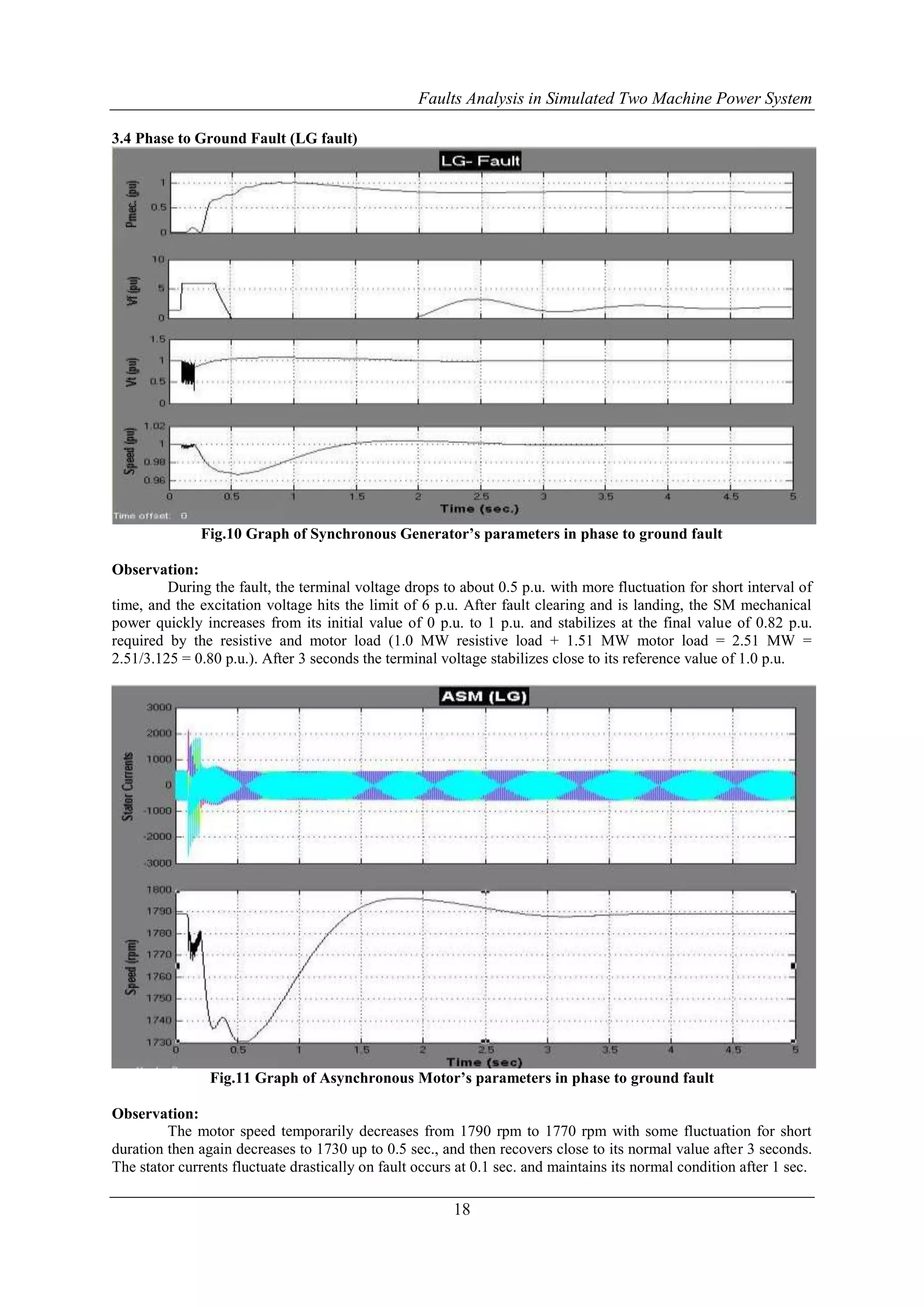
3.4 Phase to Ground Fault (LG fault) 
Fig.10 Graph of Synchronous Generator’s parameters in phase to ground fault 
Observation: 
During the fault, the terminal voltage drops to about 0.5 p.u. with more fluctuation for short interval of 
time, and the excitation voltage hits the limit of 6 p.u. After fault clearing and is landing, the SM mechanical 
power quickly increases from its initial value of 0 p.u. to 1 p.u. and stabilizes at the final value of 0.82 p.u. 
required by the resistive and motor load (1.0 MW resistive load + 1.51 MW motor load = 2.51 MW = 
2.51/3.125 = 0.80 p.u.). After 3 seconds the terminal voltage stabilizes close to its reference value of 1.0 p.u. 
Fig.11 Graph of Asynchronous Motor’s parameters in phase to ground fault 
Observation: 
The motor speed temporarily decreases from 1790 rpm to 1770 rpm with some fluctuation for short 
duration then again decreases to 1730 up to 0.5 sec., and then recovers close to its normal value after 3 seconds. 
The stator currents fluctuate drastically on fault occurs at 0.1 sec. and maintains its normal condition after 1 sec.
Faults Analysis in Simulated Two Machine Power System 
VI. CONCLUSION 
In case of synchronous generator, on occurring the fault, the terminal voltage drops to some extent of 
duration with more fluctuation in case of thee phase fault as comparison of all unsymmetrical fault and stabilizes 
close to its reference value of 1.0 p.u. Whereas the excitation voltage hits the some certain value, which is same 
for all the faults. After the fault clearing and is landing, the mechanical power quickly increases from its value 
of 0 p.u. to 1 p.u. and stabilizes at the final value of 0.82 p.u. required by the resistive and motor load. 
In case of asynchronous motor, the motor speed temporarily decreases from 1790 rpm to more down in 
case of three phase fault as comparison of all the fault, but in phase to ground fault the little bit fluctuation is 
occurred towards down for short duration , and then recovers close to its normal value after 3 seconds. The 
stator currents fluctuate drastically on fault occurs at 0.1 sec. and maintains its normal condition after 1 sec. 
REFERENCES 
[1]. Badri Ram and D. N. Vishwakarma, Power System Protection and Switchgear, McGraw Hill 
19 
Education (India) Pvt. Ltd. sixth edition. 
[2]. www.mathswork.com 
[3]. www.powersolution.com 
[4]. MATLAB / SIMPOWER SYSTEM help contained. 
[5]. Stanley H. Horowite, Power System Relaying, RSP Publication, third edition.

International Journal of Engineering Research and Development

  • 1.
    International Journal ofEngineering Research and Development e-ISSN: 2278-067X, p-ISSN: 2278-800X, www.ijerd.com Volume 10, Issue 8 (August 2014), PP.10-19 Faults Analysis in Simulated Two Machine Power System Vikash Anand1, Dr. M. M. Chaudhary2 1Research Scholar, Electrical Engineering, NIT- Patna, India 2Professor, Electrical Engineering, NIT- Patna, India Abstract:- With growing complexity of modern power system consists of generators, transformers, transmission and distribution lines etc. The probability of the failure or occurrence of abnormal condition is more on power lines. Short circuit and other abnormal conditions often occur on a power system. The heavy current associated with short circuit is likely to cause damage to equipment if suitable protective relays and circuit breakers are not provided for the protection of each section of the power system. The basic electrical quantities which are likely to change during abnormal conditions are current, voltage, phase-angle and frequency. In this report, at first, the power system stability and the causes of symmetrical and unsymmetrical fault has been discussed briefly and later on the three phase two machine power system model has been simulated to find out the critical clearing time graphically for all the types of fault. On comparisons of critical clearing time on the synchronous generator and asynchronous motor parameters with respect to all the faults and make conclusion about the severe fault, also find out the stabilize time of all mechanical and electrical parameters after fault is landing. Keywords:- Asynchronous Machine, MATLAB, Protective Devices, Synshronous Machine, Three Phase Power. I. INTRODUCTION The power system networks are continuously expanding over wide geographical area with increased number of interconnection to meet the rapid growth in the demand of electricity. The transmission and distribution networks are main carriers of electrical power. An electrical power system consists of generators, transformers, transmission and distribution lines etc. Short circuits and other abnormal conditions often occur on a power system. The heavy current associated with short circuits is likely to cause damage to equipment if suitable protective relays and circuit breakers are not provided for the protection of each section of the power system. Short circuits are usually called faults by power engineers. Basically, the failure of conducting path due to a break in a conductor is a type of fault. If a fault occurs in an element of a power system, an automatic protective device is needed to isolate the faulty element as quickly as possible to keep the healthy section of the system in normal operation. The fault must be cleared within a fraction of a second. If a short circuit persists on a system for a longer, it may cause damage to some important sections of the system. A heavy short circuit current may cause a fire. It may spread in the system and damage a part of it. The system voltage may reduce to a low level and individual generators in a power station or groups of generators in different power stations may lose synchronism. Thus, an uncleared heavy short circuit may cause the total failure of the system. A protective system includes circuit breakers, transducers and protective relays to isolate the faulty section of the power system from the healthy sections. The function of a protective relay is to detect and locate a fault and issue a command to the circuit breaker to disconnect the faulty element. It is a device which senses abnormal conditions on a power system by constantly monitoring electrical quantities of systems, which differ under normal and abnormal conditions. The basic electrical quantities which are likely to change during abnormal conditions are current, voltage, phase-angle (direction) and frequency. Protective relays utilize one or more of these quantities to detect abnormal conditions on a power system. II. POWER SYSTEM STABILITY Power system stability can be defined as “the ability of an electric power system, operating at a given initial operating condition, to regain a state of operating equilibrium after being subjected to a disturbance, with most system variables bounded so that practically the entire system remains intact”. If following a disturbance the power system remains stable, it may reach a new equilibrium state with the system integrity preserved. The power system stability can be broadly classified into three types.  Rotor Angle Stability  Frequency Stability  Voltage Stability 10
  • 2.
    Faults Analysis inSimulated Two Machine Power System Frequency and voltage stability can be further categorized into short term and long term stability. Voltage stability may be classified into large disturbance and small disturbance voltage stability. This categorically comes under the short term and the long term stability respectively. Fig.1 Classification of Power System Stability III. POWER QUALITY PROBLEMS Transmission lines are often subjected to many kinds of faults, such as  Single phase-to-earth  Double phase-to-earth  Phase to phase (two phase)  Three phase with or without the earth Some of the causes of these faults are storms, insulation breakdown with age, operating beyond its capacities, improper maintenance etc. The faults are generally detected and faulty sections are isolated by protective relays. However, to minimize the downtime and to improve the reliability. It is very important to identify the fault location as quickly as possible. A power quality audit can help determine the causes of one’s problems and provide a well-designed plan to correct them. The findings will be included in a report outlining problems found during the audit and recommend solutions. Many businesses and organizations rely on computer systems and other electrical equipment to carry out mission-critical functions, but they aren't safeguarding against the dangers of an unreliable power supply. The power quality problems are as follows. 11 i) Voltage Sags Voltage sags are the most common power problem encountered. Sags are a short-term reduction in voltage (that are 80-85% of normal voltage), and can cause interruptions to sensitive equipment such as adjustable-speed drives, relays, and robots. Sags are most often caused by fuse or breaker operation, motor starting, or capacitor switching. Voltage sags typically are non-repetitive, or repeat only a few times due to re-closer operation. Sags can occur on multiple phases or on a single phase and can be accompanied by voltage swells on other phases.
  • 3.
    Faults Analysis inSimulated Two Machine Power System 12 ii) Power Interruptions Power interruptions are zero-voltage events that can be caused by weather, equipment malfunction, re-closer operations, or transmission outages. Interruptions can occur on one or more phases and are typically short duration events, the vast majority of power interruptions are less than 30 seconds. iii) Voltage Flicker Voltage flicker is rapidly occurring voltage sags caused by sudden and large increases in load current. It is most commonly caused by rapidly varying loads that require a large amount of reactive power such as welders, rock-crushers, sawmills, wood chippers, metal shredders, and amusement rides. It can cause visible flicker in lights and cause other processes to shut down or malfunction. iv) Power Surges A power surge takes place when the voltage is 110% or more above normal. The most common cause is heavy electrical equipment being turned off. Under these conditions, computer systems and other high tech equipment can experience flickering lights, equipment shutoff, errors or memory loss. v) High-Voltage Spikes High-voltage spikes occur when there is a sudden voltage peak of up to 6,000 volts. These spikes are usually the result of nearby lightning strikes, but there can be other causes as well. The effects on electronic systems can include loss of data and burned circuit boards. vi) Switching Transients Switching transients take place when there is an extremely rapid voltage peak of up to 20,000 volts with duration of 10 microseconds to 100 microseconds. Switching transients take place in such a short duration that they often do not show up on normal electrical test equipment. They are commonly caused by machinery starting and stopping, arcing faults and static discharge. In addition, switching disturbances initiated by utilities to correct line problems may happen several times a day. Effects can include data errors, memory loss and component stress that can lead to breakdown. vii) Frequency Variation A frequency variation involves a change in frequency from the normally stable utility frequency of 50Hz.This may be caused by erratic operation of emergency generators or unstable frequency power sources. For sensitive equipment, the results can be data loss, program failure, equipment lock-up or complete shutdown. viii) Electrical Line Noise Electrical line noise is defined as Radio Frequency Interference (RFI) and Electromagnetic Interference (EMI) and causes unwanted effects in the circuits of computer systems. Sources of the problems include motors, relays, motor control devices, broadcast transmissions, microwave radiation, and distant electrical storms. RFI, EMI and other frequency problems can cause equipment to lock-up, and data error or loss. ix) Brownouts A brownout is a steady lower voltage state. An example of a brownout is what happens during peak electrical demand in the summer, when utilities can't always meet the requirements and must lower the voltage to limit maximum power. When this happens, systems can experience glitches, data loss and equipment failure. x) Blackouts A power failure or blackout is a zero-voltage condition that lasts for more than two cycles. It may be caused by tripping a circuit breaker, power distribution failure or utility power failure. A blackout can cause data loss or corruption and equipment damage.
  • 4.
    Faults Analysis inSimulated Two Machine Power System IV. CAUSES AND EFFECTS OF POWER QUALITY PROBLEMS POWER PROBLEMS CAUSES EFFECTS Voltage Spikes and Lightning, Utility grid switching, Surges Heavy industrial equipment 13 Equipment failure, System lock-up, Data corruption, Data loss Electrical Noise Arc Welders etc..., Switch mode power supplies, Fault clearing devices, Ground not dedicated or isolated Data corruption, Erroneous command functions, Loss of command functions, Improper wave shapes etc... Harmonics Switch mode power supplies, Nonlinear loads High neutral currents, Overheated neutral conductors, Overheated transformers, Voltage distortion, Loss of system capacity Voltage Fluctuations Brownouts, Unstable generators, Overburdened distribution systems, Start-up of heavy equipment System lock-up, System shutdown, Data corruption, Data Loss, Reduced performance, Loss of system control Power Outage & Interruptions Blackouts, Faulted or overload, conditions, Back-up generator start-up System crash, System lock-up, Power supply damage, Lost data, Complete shutdown loss of control Stable AC from DC source DC power plant available, Remote areas Unavailable AC power Emergency power source transfer, Peak shave power Back-up generator start-up, Power interruption transfer of utility source System crash, System lock-up, Power supply damage, Lost data, Complete shutdown loss of control Distribution Systems and Power quality questions Lack of understanding of system problems or coordination Unstable distribution system, Lost productivity and profitability. High energy cost / Power factor correction Need for energy savings and pay back for equipment investment. Lost profits increased cost. V. TWO MACHINE POWER SYSTEM A two machine power system is simulated using MATLAB- SIMULINK to find the critical clearing time for the different types of fault then using information from their suitable waveform, it is observed that which one are most severe fault and the effects of fault on machine’s parameters. 1. Power System Study The two-machine power system under study is shown in this single line diagram. This system consists of a plant (bus B2), simulated by a 1 MW resistive load and a motor load (ASM) fed at 2400 V from a distribution 25 kV network through a 6 MVA, 25/2.4 kV transformer, and from an emergency synchronous generator/diesel engine unit (SM). The 25 kV network is modeled by a simple R-L equivalent source (short-circuit level 1000 MVA, quality factor X/R = 10) and a 5 MW load. The asynchronous motor is rated 2250 HP, 2.4 kV, and the synchronous machine is rated 3.125 MVA, 2.4 kV. Initially, the motor
  • 5.
    Faults Analysis inSimulated Two Machine Power System develops a mechanical power of 2000 HP and the diesel generator is in standby, delivering no active power. The synchronous machine therefore operates as a synchronous condenser generating only the reactive power required to regulate the 2400 V bus B2 voltage at 1.0 p.u. At t = 0.1 sec., A fault occurs on the 25 kV system, causing the opening of the 25 kV circuit breaker at t = 0.2 s, and a sudden increase of the generator loading. During the transient period following the fault and islanding of the motor-generator system, the synchronous machine excitation system and the diesel speed governor react to maintain the voltage and speed at a constant value. 14 1.2 MATLAB-SIMULINK Diagram Fig.2 MATLAB SIMULINK model of two machine power system 2. Load Flow and Machine Initialization In order to start the simulation in steady state with sinusoidal currents and constant speeds, all the machine states must be initialized properly. 2.1 Load flow with the following parameters: SM (Synchronous Generator)  Terminal Voltage ─ 2400 Vrms  Active Power ─ 500 kW ASM (Asynchronous Motor)  Mechanical Power ─ 2000*746 W (Rating of 2000 HP where 1 HP equals to 746 W) Fig.3 Machine Load Flow Tool Model From here we get value of torque 7964 N-m and entered in the constant block connected at the ASM torque input. 2.2 Machine Initialization To start the simulation in steady state, the states of the Governor & Diesel Engine and the Excitation blocks are initialized according to the values calculated by the load flow. In the Governor & Diesel Engine subsystem, the initial mechanical power has been set to 0.0002701 p.u. In Excitation block the initial terminal voltage and field voltage have been set respectively to 1.0 and 1.427 p.u.
  • 6.
    Faults Analysis inSimulated Two Machine Power System 3. Simulated Graph The following graph of simulated two machine power system for synchronous generator and asynchronous motor in terms of mechanical parameters and electrical parameters with respect to time in different cases of faults. The initial parameters are considered as follows.  Circuit Breaker operation time = 0.2 sec.  Fault time = 0.1 sec. Steady state simulation initial conditions from Load Flow (Powergui) 15 3.1 Three Phase Fault (LLL- fault) Fig.4 Graph of Synchronous Generator’s parameters in three phase fault Observation: During the fault, the terminal voltage drops to about 0.2 p.u. with more fluctuation at 0.4 sec., and the excitation voltage hits the limit of 6 p.u. After fault clearing and is landing, the SM mechanical power quickly increases from its initial value of 0 p.u. to 1 p.u. and stabilizes at the final value of 0.82 p.u. required by the resistive and motor load (1.0 MW resistive load + 1.51 MW motor load = 2.51 MW = 2.51/3.125 = 0.80 p.u.). After 3 seconds the terminal voltage stabilizes close to its reference value of 1.0 p.u. Fig.5 Graph of Asynchronous Motor’s parameters in three phase fault
  • 7.
    Faults Analysis inSimulated Two Machine Power System 16 Observation: The motor speed temporarily decreases from 1789 rpm to more down of 1730 rpm, and then recovers close to its normal value after 3 seconds. The stator currents fluctuate drastically on fault occurs at 0.1 sec. and maintains its normal condition after 2 sec. 3.2 Three Phase to Ground Fault (LLL- G fault) Fig.6 Graph of Asynchronous Motor’s parameters in three phase to ground fault Observation: The motor speed temporarily decreases from 1790 rpm to 1630 rpm, and then recovers close to its normal value after 3 seconds. The stator currents fluctuate drastically on fault occurs at 0.1 sec. and maintains its normal condition after 1 sec. Fig.7 Graph of Synchronous Generator’s parameters in three phase to ground fault Observation: During the fault, the terminal voltage drops to about 0.2 p.u. with less fluctuation, and the excitation voltage hits the limit of 6 p.u. After fault clearing and is landing, the SM mechanical power quickly increases from its initial value of 0 p.u. to 1 p.u. and stabilizes at the final value of 0.82 p.u. required by the resistive and motor load (1.0 MW resistive load + 1.51 MW motor load = 2.51 MW = 2.51/3.125 = 0.80 p.u.). After 3 seconds the terminal voltage stabilizes close to its reference value of 1.0 p.u.
  • 8.
    Faults Analysis inSimulated Two Machine Power System 17 3.3 Phase – Phase to Ground Fault (LL-G fault) Fig.8 Graph of Synchronous Generator’s parameters in phase−phase to ground fault Observation: During the fault, the terminal voltage drops to about 0.2 p.u. with more fluctuation for short duration, and the excitation voltage hits the limit of 6 p.u. After fault clearing and is landing, the SM mechanical power quickly increases from its initial value of 0 p.u. to 1 p.u. and stabilizes at the final value of 0.82 p.u. required by the resistive and motor load (1.0 MW resistive load + 1.51 MW motor load = 2.51 MW = 2.51/3.125 = 0.80 p.u.). After 3 seconds the terminal voltage stabilizes close to its reference value of 1.0 p.u. Fig.9 Graph of Asynchronous Motor’s parameters in phase−phase to ground fault Observation: The motor speed temporarily decreases from 1790 rpm to 1735 rpm with fluctuation up to 0.5sec, and then recovers close to its normal value after 3 seconds. The stator currents fluctuate drastically on fault occurs at 0.1 sec. and maintains its normal condition after 1 sec.
  • 9.
    Faults Analysis inSimulated Two Machine Power System 18 3.4 Phase to Ground Fault (LG fault) Fig.10 Graph of Synchronous Generator’s parameters in phase to ground fault Observation: During the fault, the terminal voltage drops to about 0.5 p.u. with more fluctuation for short interval of time, and the excitation voltage hits the limit of 6 p.u. After fault clearing and is landing, the SM mechanical power quickly increases from its initial value of 0 p.u. to 1 p.u. and stabilizes at the final value of 0.82 p.u. required by the resistive and motor load (1.0 MW resistive load + 1.51 MW motor load = 2.51 MW = 2.51/3.125 = 0.80 p.u.). After 3 seconds the terminal voltage stabilizes close to its reference value of 1.0 p.u. Fig.11 Graph of Asynchronous Motor’s parameters in phase to ground fault Observation: The motor speed temporarily decreases from 1790 rpm to 1770 rpm with some fluctuation for short duration then again decreases to 1730 up to 0.5 sec., and then recovers close to its normal value after 3 seconds. The stator currents fluctuate drastically on fault occurs at 0.1 sec. and maintains its normal condition after 1 sec.
  • 10.
    Faults Analysis inSimulated Two Machine Power System VI. CONCLUSION In case of synchronous generator, on occurring the fault, the terminal voltage drops to some extent of duration with more fluctuation in case of thee phase fault as comparison of all unsymmetrical fault and stabilizes close to its reference value of 1.0 p.u. Whereas the excitation voltage hits the some certain value, which is same for all the faults. After the fault clearing and is landing, the mechanical power quickly increases from its value of 0 p.u. to 1 p.u. and stabilizes at the final value of 0.82 p.u. required by the resistive and motor load. In case of asynchronous motor, the motor speed temporarily decreases from 1790 rpm to more down in case of three phase fault as comparison of all the fault, but in phase to ground fault the little bit fluctuation is occurred towards down for short duration , and then recovers close to its normal value after 3 seconds. The stator currents fluctuate drastically on fault occurs at 0.1 sec. and maintains its normal condition after 1 sec. REFERENCES [1]. Badri Ram and D. N. Vishwakarma, Power System Protection and Switchgear, McGraw Hill 19 Education (India) Pvt. Ltd. sixth edition. [2]. www.mathswork.com [3]. www.powersolution.com [4]. MATLAB / SIMPOWER SYSTEM help contained. [5]. Stanley H. Horowite, Power System Relaying, RSP Publication, third edition.