1
Data Bulletin
0100DB0402R3/06
3/2006
Cedar Rapids, Iowa, USA
Arc-flash Application Guide
Arc-flash Energy Calculations for Circuit Breakers and Fuses
Class 100
Retain for future use.
INTRODUCTION The idea that short-circuits or faults in an electric power system are
undesirable is certainly not a novel concept. Recently, however, arcing
faults have begun to receive an increasing amount of attention as a
particularly damaging and potentially dangerous type of fault. Arcing fault
current is fault current that flows through the air, unlike “bolted” fault
current, which flows through conductors, busbars, or other equipment that
is (ideally) designed to withstand its effects. This current flow, through air,
releases a great deal of energy in the form of heat and pressure. In
controlled applications, such as arc welding, electrical arcs can be useful.
However, an “arc-flash,” which refers to the uncontrolled release of such
energy during an arcing fault, can result in significant damage to
equipment or worse, injury or death to workers exposed to the fault.
Estimates indicate that 10–15 serious arc-flash
incidents—those that result in burn injuries
requiring treatment in a burn center—occur each
day in the U.S., so it is not surprising that
awareness of the hazards associated with arc-
flash continues to grow. Present Occupational
Safety and Health Administration (OSHA)
regulations do not specifically address arc-flash
hazards, but industry standards such as National
Fire Protection Association (NFPA) 70E-2004,
Standard for Electrical Safety in the Workplace,
provide information on safe work practices and
required protective equipment for electrical
workers exposed to arc-flash hazards. OSHA
has begun to write citations based on the
NFPA 70E requirements. The National Electric
Code (NEC) 110.16 also requires that many
types of electrical equipment be field marked to
warn of potential arc-flash hazards [1].
The Personal Protective Equipment section of
this guide presents background information on
personal protective equipment (PPE) that can
help protect workers from arc-flash hazards.
The Calculation Methods section discusses three primary calculation
methods that are used to assess hazard levels and for the selection of
proper PPE. In general, the three methods do not produce identical results,
but the section Which Calculation Method is Correct? discusses several
arc-flash analysis principles that will help insure that the correct method is
chosen and that accurate results are obtained. Comparisons of the arc-
flash protection provided by several common overcurrent protective
devices are presented in the Device Comparisons section, while the
Conclusions section presents a summary of the items discussed in this
guide.
0100-0000
Arc-flash Application Guide 0100DB0402R3/06
Personal Protective Equipment 3/2006
© 2004–2006 Schneider Electric All Rights Reserved2
PERSONAL PROTECTIVE
EQUIPMENT
While properly maintained equipment and safe work practices can help to
minimize the probability that an arcing fault might be initiated, workers
potentially exposed to this hazard must still be adequately protected. The
severity of the hazard related to an arcing fault is measured by the amount
of energy that an arc delivers to an exposed worker. Calculation of this
“incident energy,” which is commonly measured in calories per square
centimeter (cal/cm2
) or joules per square centimeter (J/cm2
), provides a
basis for selection of proper PPE, including flame-resistant clothing, flash
suits, arc hoods, and the like. Also important to note is the flash-protection
boundary, the distance from a fault source inside which the incident energy
level exceeds 1.2 cal/cm2
, a level that can cause second degree burns on
exposed skin.
Both the incident energy and the flash-protection boundary vary based on
many parameters. Among the most important factors are the system
voltage, the arcing fault current level, the distance from a worker to the fault
source, and the duration of the fault. As such, the hazard level depends on
many system variables, including equipment type, prospective bolted fault
currents, and characteristics of the upstream protective devices. An analysis
of the potential arc-flash hazard at a given system location should be
performed so that workers can select and use appropriate levels of PPE.
Too little PPE leaves workers inadequately protected, and is therefore
obviously undesirable. Too much PPE is also undesirable, as it may hinder
movement and increase the level of risk associated with a specific work
task, or may create other hazards such as increased heat stress. Three
common methods that may be used to perform arc-flash analyses are
discussed further in the Calculation Methods section.
NFPA 70E-2004 defines five categories of protective clothing based on the
degree of protection provided by each class, which are defined in the PPE
“matrix” of Table 130.7(C)(10). PPE is assigned an Arc Rating (cal/cm2),
which defines the “...maximum incident energy resistance demonstrated by
a material.” The protective clothing characteristics are summarized in
Table 1.
Non-fire Resistant (FR) cotton has no arc rating, and can only be used at
locations and/or working distances having low available incident energy.
Within the flash-protection boundary, adequate protective clothing is
required. As the energy level increases, more layers of FR clothing are
needed to afford adequate protection. Non-FR synthetic clothing, including
synthetic-cotton blends, is not allowed at all, as it can easily ignite and/or
melt into the skin and aggravate a burn injury.
Note that PPE is to be considered a last line of defense rather than a
replacement for safe work practices or engineering controls that can reduce
the exposure to arc-flash hazards. Equipment should be placed in an
electrically safe work condition whenever possible. See NFPA 70E-2004 for
additional details on safe work practices.
CALCULATION METHODS As understanding of the arc-flash hazard has grown, several methods for
calculating the arc-flash hazard have been developed. Three of these
methods will be examined in this section—the theoretical model, the
equations and tables used in NFPA 70E-2004, and the calculation methods
presented in IEEE Std 1584™- 2002.
THEORETICAL MODEL Ralph H. Lee developed a theoretical model for calculation of arc-flash
energy in a paper published in 1982 [2]. Prior to this, arcing faults had been
recognized as damaging to electrical equipment and as a potential safety
hazard, but Lee’s work was one of the first—if not the first—to quantitatively
Table 1: Protective Clothing
Characteristic
(from NFPA 70E-2004)
Clothing
Category
Clothing
Description
Number
of Layers
Minimum
Arc Rating
of PPE
(cal/cm2
)
0
Untreated Natural
Fiber Clothing
1 N/A
1
Fire Resistant
Shirt and Fire
Resistant Pants
1 4
2
Cotton Underwear
plus Category 1
2 8
3
Fire Resistant
Coverall
Over Category 2
3 25
4
Multi-layer
Flash Suit
Over Category 2
4 40
0100DB0402R3/06 Arc-flash Application Guide
3/2006 Calculation Methods
© 2004–2006 Schneider Electric All Rights Reserved 3
assess the relationships between the energy produced by arcing faults, the
working distance, and the potential hazard to exposed workers. Lee
recognized that arcing faults are sources of intense heat and used heat
transfer equations to determine the effect of this heat energy on human
skin. Equations were presented that allowed for calculation of “just curable”
and “fatal” burn distances based on the value of bolted fault current and the
fault clearing time.
At the time, no testing had been performed to investigate the relationship
between bolted fault current and arcing fault current, so Lee concluded that
the arcing energy calculations should be based on the worst-case condition,
i.e., when the voltage across the arc is equal to half the system voltage.
Later testing showed that actual incident energy levels reached a maximum
of 79% of the theoretical value in a 600 V system and only 42% in a 2400 V
system [3], as the voltage across the arc was actually less than that
required to produce maximum arc power. The results of the theoretical
model tend to be conservative for any system, but are even more
conservative for systems operating at 1 kV or higher.
A more accurate calculation of arcing fault current is required to achieve
more accurate results. In addition, since the theoretical model does not take
into account other important factors, such as whether the arcing fault occurs
in open air or inside an equipment enclosure, it is not suitable for calculation
of incident energy levels or flash-hazard boundaries in a typical industrial or
commercial facility. The model is still useful, however, for calculating energy
levels in situations where no other method has been developed. Equations
based on Lee’s work are included in IEEE 1584 to cover system types that
are not otherwise covered by the IEEE 1584 equations, such as open-air
transmission or distribution systems, open-air substations, or systems
operating above 15 kV.
NFPA 70E-2004 Section 130.3(A) of NFPA 70E-2004 contains equations that allow for
calculation of flash-protection boundary distances for systems operating at
600 V or less. For systems operating above 600 V, the flash-protection
boundary is defined as “...the distance at which the incident energy level
equals 1.2 cal/cm2
” (or 1.5 cal/cm2
if the fault clearing time is less than 0.1
second). No equations are presented that allow for the determination of
distances for systems over 600 V. Annex D of NFPA 70E-2004 contains
equations for the calculation of incident energy levels and flash-protection
boundaries based on the theoretical model, on testing performed on 600 V
systems [4], and from IEEE 1584. No recommendations are given as to the
preferred calculation method.
NFPA 70E-2004 also provides a method for selecting PPE that requires little
or no calculation. Table 130.7(C)(9)(a) assigns “Hazard/Risk Category”
values for typical work tasks that might be performed on common types of
equipment, such as the insertion of starter buckets in a 600 V class motor
control center. The Hazard/Risk Category values correspond to the five
categories of PPE so that a worker may determine the level of clothing that
is required by simply finding the appropriate work task in the table. Included
with the table are several footnotes that define fault current ranges and fault
clearing times for which the Hazard/Risk category values are valid. For
system conditions that fall outside these parameters—such as with a main
lug switchboard protected by a slow-acting utility transformer primary fuse,
which may not clear a fault in the one second time frame that is assumed—
the tables may not be used to select PPE. Even for some conditions that do
fit the system conditions defined by the table, the recommended PPE may,
in some cases, be inadequate. For example, for a section of 480 V-class
switchgear, the assumed system parameters are “up to 65 kA available, and
up to 1.0 second clearing time.” Based on 65 kA bolted fault current and 1.0
Arc-flash Application Guide 0100DB0402R3/06
Which Calculation Method is Correct? 3/2006
© 2004–2006 Schneider Electric All Rights Reserved4
second fault duration, IEEE 1584 calculates an incident energy of
69 cal/cm2
at a 24” working distance, but Table 130.7(C)(9)(a) does not call
for PPE above Category 3 for any listed work task. Despite some
deficiencies, the table is still useful, particularly in facilities where little or no
system information is available.
IEEE STD 1584 IEEE Std 1584™-2002, IEEE Guide for Performing Arc-flash Hazard
Calculations, presents the most comprehensive set of equations to date for
calculating incident energy levels and flash-protection boundaries. Empirical
equations are given that cover systems at voltage levels ranging from 208 V
to 15 kV and for available bolted fault currents ranging from 700 A to
106 kA, sufficient to cover the majority of low-voltage and medium-voltage
installations. The equations are rather complex if calculations are to be
performed by hand, though the equations are easily implemented in a
spreadsheet or in other computer software. Simplified equations are also
provided for several common protective device types, including current-
limiting Class RK1 and Class L fuses (up to 2000 A), as well as for various
types of circuit breakers (100–6300 A). The fuse equations are based on
testing of one manufacturer’s current-limiting fuses. The breaker equations
are based on calculated results and are “generic” equations that correspond
to a general class or frame size of breakers rather than to a specific device.
They may be used if specific information about the breaker’s trip
characteristics is not available. In addition, restatements of the theoretical
equations are provided for calculation of energy levels in systems that fall
outside the scope of the test data. Future testing and analysis may result in
revisions of or additions to the present IEEE 1584 methods, but at present,
it represents the state-of-the-art methodology for arc-flash analysis and
should be used when possible. The IEEE 1584 calculation methods have
been implemented in several power system analysis software packages,
including SKM Power*Tools®
and ETAP®
.
WHICH CALCULATION METHOD
IS CORRECT?
In addition to the three methods discussed in Calculation Methods there
are other methods or tools available for calculation of arc-flash hazard levels
including various Windows and DOS-based shortcut calculator programs,
IEEE 1584-based calculators on equipment manufacturer’s web sites, or
equipment-specific equations, such as those developed for the Square D®
Masterpact®
NW and NT “low arc-flash” (LF and L1F) circuit breakers [5].
Even IEEE 1584 presents two alternate calculation methods for many
situations—the general equations and the simplified equations for circuit
breakers and fuses. For a given system location, one can calculate several
different values for incident energy levels or for the flash-hazard boundary
distance. While the calculation results may be close to one another in many
situations, this may not always be the case.
How can one be sure which method produces the best results for a given
situation? No single calculation method is applicable to all situations, but
several principles may be followed to ensure that the best results are
obtained in a given situation:
1. Verify that actual system conditions fall within the method’s range
of applicability. Many of the available calculation methods are at least
partially based on empirical equations—i.e., equations derived from test
results. These equations are valid over the range of system conditions
where testing was performed, but cannot be extended to other situations
with a high degree of confidence. For example, the equations in
IEEE 1584 cannot be used to calculate arc-flash hazard levels at
locations with greater than 106 kA available bolted fault current or in a
DC system. This principle is also important when using the NPFA 70E
tables to assess arc-flash hazard levels, as the tables are based on
0100DB0402R3/06 Arc-flash Application Guide
3/2006 Which Calculation Method is Correct?
© 2004–2006 Schneider Electric All Rights Reserved 5
specific assumptions regarding available fault currents and fault clearing
times.
2. Out with the old, in with the new. Arc-flash hazard analysis is a
relatively new science, and as a result the available calculation methods
have changed significantly as understanding of the arc-flash
phenomenon has grown over the past 20+ years. Newer test results,
industry standards, and calculation methods are more likely to
accurately represent the actual hazard levels than older methods. They
should be used in preference to older methods that may be based on
smaller sets of test data or may be applicable over a smaller range of
system conditions.
3. Use device-specific equations rather than general equations. While
the general equations in IEEE 1584 are based on lab testing over a wide
range of system conditions, the testing cannot possibly accurately
characterize the performance of every available protective device in
every possible situation. In particular, the general equations may not
adequately characterize current-limiting action of fuses or circuit
breakers, and can therefore give results that may be overly conservative
for such devices. When equations based on testing of specific devices—
such as the IEEE 1584 equations for current-limiting fuses or the
Square D®
equations for low arc-flash Masterpact®
circuit breakers—
are available, they should be used rather than the general calculation
methods. One exception to this rule would be when there is significant
motor contribution to fault current at a given location, as discussed in
Step 6. Recall also that the simplified equations in IEEE 1584 for circuit
breakers are not device-specific equations, but rather are general
equations that may be used if little or no information is available for a
given circuit breaker. If accurate information about a breaker’s trip
characteristics is available, it should be used along with the IEEE 1584
general equations rather than the simplified circuit breaker equations.
4. Know which device clears the fault and use realistic fault current
values. When determining the arc-flash hazard level at a given location,
two of the major variables to consider are the bolted fault current level at
that location and the characteristics of the upstream protective device.
For example, consider calculation of fault current at a 200 A, 480 V
lighting panel fed from a 200 A feeder breaker located in a facility’s main
switchboard (device “A” in Figure 1). The panel also contains a main
breaker (device “B”) and several feeder breakers (e.g., device “C”). The
facility engineer intends to use the IEEE 1584 general equations to
calculate the incident energy level at the panel so that a worker at the
panel can be adequately protected.
First, the engineer must determine which circuit breaker acts to clear the
fault. Depending on exactly where in the panel the fault initiates, any of
the three devices might initially act to clear the fault. Typically, the worst-
case scenario will be for the fault to occur on the line-side of the panel’s
main circuit breaker, in which case it must be cleared by the upstream
feeder device (“A”). This breaker, which would normally be set to
selectively coordinate with device “B”, should have the longest tripping
time of the three devices shown for a given value of fault current. Even if
the arcing fault initiates on the load-side of branch circuit breaker “C”,
the fault could easily propagate to the line-side of the other devices in
the same enclosure. Therefore, to ensure that the calculations reflect the
maximum energy level to which a worker might be exposed, the trip
characteristics of device “A” should be considered.
What value of fault current should be considered—the available bolted
fault current at the switchboard containing device “A”, or the available
fault current at the lighting panel itself? Suppose that 100 kA bolted fault
A
B
C
Figure 1: Sample Panel Configuration
0100-0001
Arc-flash Application Guide 0100DB0402R3/06
Which Calculation Method is Correct? 3/2006
© 2004–2006 Schneider Electric All Rights Reserved6
current is available at the switchboard, but the panel is located 100 feet
away. The impedance of 100 feet of #3/0 AWG conductor drops the
available bolted fault current at the panel to approximately 28 kA. Since
the concern in this case is over arcing faults at the lighting panel, this is
the value of bolted fault current that should be used as an input to the
IEEE 1584 equations. IEEE 1584 is then used to calculate the arcing
fault current level, approximately 15 kA. The device’s trip characteristics
must be consulted in order to determine its clearing time at 15 kA, and
then IEEE 1584 is used to calculate the incident energy level and flash-
protection boundary at the panel.
In some situations, the best practice may be to calculate two incident
energy levels and flash-protection boundaries for a single piece of
equipment. For example, consider a lineup of 480 V drawout switchgear
with a main circuit breaker and several feeder circuit breakers. The
circuit breaker cubicles are more physically separated from one another
than circuit breakers are in a typical electrical panel, so propagation of a
fault from a feeder to the line-side of the main would be expected to be
more difficult. If a fault were to occur when a feeder circuit breaker was
racked in or out, then the main circuit breaker would be expected to
clear the fault. However, when the main circuit breaker is racked in or
out, then the upstream protective device—possibly a fuse or relay on the
primary side of an upstream transformer—would be called upon to clear
the fault. In this case, the upstream protective device may act relatively
slowly, which could mean that workers are exposed to a much higher
level of arc-flash hazard when racking the main than when racking a
feeder. In cases such as this, or in other situations when workers may
potentially be exposed to flash hazards in a section of gear on the line-
side of the main (i.e., in a fire pump section), more than one calculation
per piece of equipment may be warranted.
Note also that while IEEE 1584 can be used to calculate hazard levels
for bolted faults up to 106 kA, it is not likely that the available bolted fault
current levels in many parts of the system will be this high, particularly
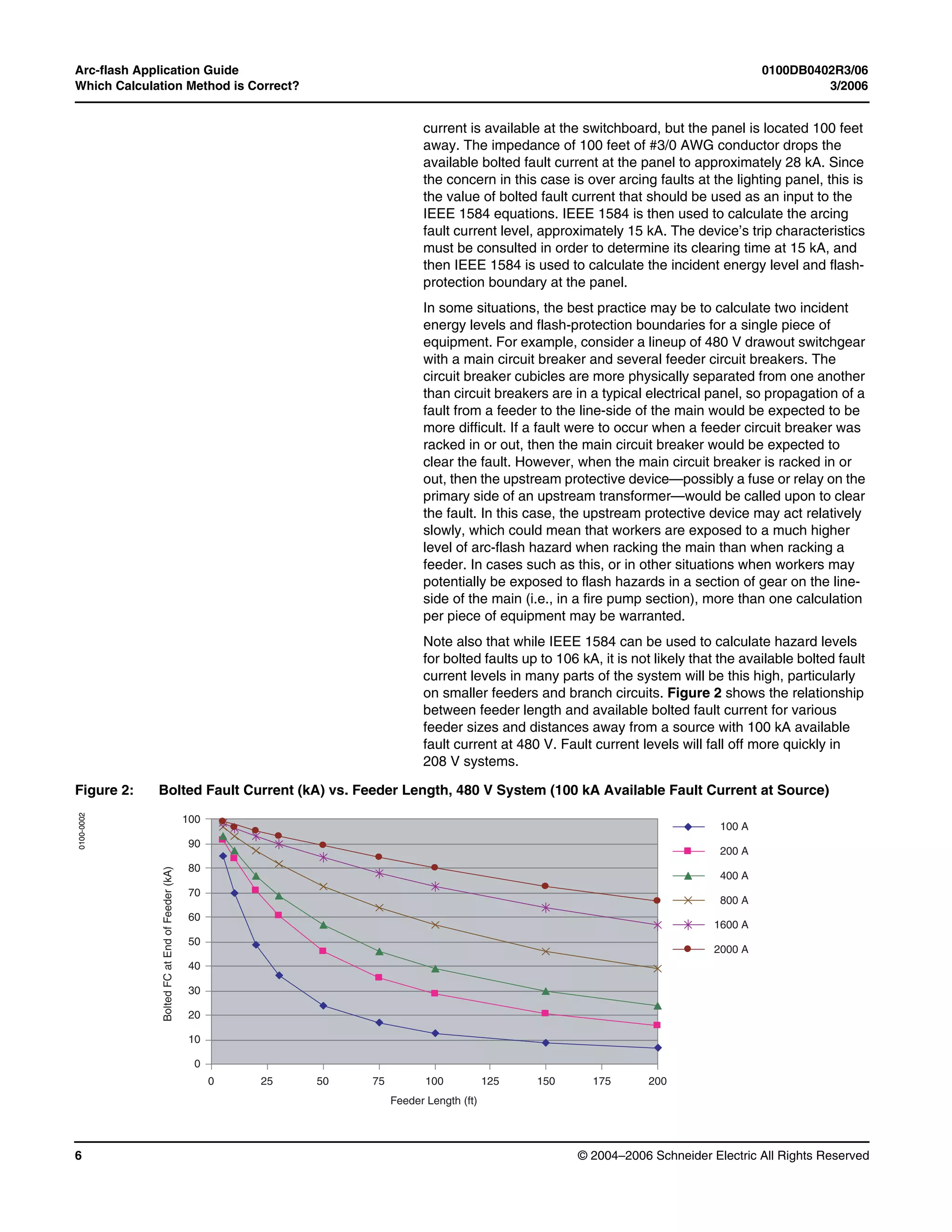
on smaller feeders and branch circuits. Figure 2 shows the relationship
between feeder length and available bolted fault current for various
feeder sizes and distances away from a source with 100 kA available
fault current at 480 V. Fault current levels will fall off more quickly in
208 V systems.
Figure 2: Bolted Fault Current (kA) vs. Feeder Length, 480 V System (100 kA Available Fault Current at Source)
50
40
30
20
10
0
0 25 50 75 100 125
60
Feeder Length (ft)
BoltedFCatEndofFeeder(kA)
150 175 200
70
80
90
100
100 A
200 A
400 A
800 A
1600 A
2000 A
0100-0002
0100DB0402R3/06 Arc-flash Application Guide
3/2006 Which Calculation Method is Correct?
© 2004–2006 Schneider Electric All Rights Reserved 7
5. Quantify the variables. As mentioned previously, the system voltage
level, the level of arcing fault current, and the clearing time of the fault
are among the most significant parameters that determine the level of
arc-flash hazard in a system. However, several other variables must be
considered—at least when using the IEEE 1584 general equations—and
they must be determined before incident energy levels or flash-
protection boundaries may be calculated. These variables include:
— Working Distance: Working distance is defined as the distance
from the electric arc to the worker’s face and body (torso). The
incident energy levels drop off fairly quickly as the distance from the
arcing fault is increased, so choosing the correct working distance is
important if an accurate determination of required PPE is to be
made. Typical working distances for various types of equipment are
given in Table 3 of Section 4.8 of IEEE 1584, and range from 18”
(455 mm) for low-voltage panels and MCCs to 36” (910 mm) for
medium-voltage switchgear. When comparing the results of
calculations performed using the IEEE 1584 general equations to
those performed using simplified, equipment-specific equations, note
that the simplified equations assume a fixed working distance
(typically 18”).
— Bus Gap: The length of the arc depends on the gap between phase
conductors or from phase to ground, which is referred to in
IEEE 1584 as the “bus gap.” Longer arcs have higher impedance
values than shorter arcs, and therefore result in a larger voltage drop
across the arc and a lower value of arcing fault current than shorter
arcs. Typical values for bus gaps for various classes of equipment
are given in Table 2 of IEEE 1584.
— Equipment Configuration: Incident energy from an arc in open air
should, in theory, drop as 1/d2 (d=distance) as one moves away from
the source of the arc. Testing of arcs that started in a typical
equipment enclosure (i.e., an “arc-in-a-box”) showed that energy
levels fell off more slowly (1/d1.5) as a result of energy being
reflected off the back and sides of the enclosure and focused in the
direction of the worker. This results in incident energy levels for “in-
box” configurations that may be 20–40% higher at typical working
distances [3, 4]. For power distribution systems in a typical industrial
or commercial facility, practically every arcing fault should be
considered to be an “in-box” configuration.
— System Grounding: Testing showed that system grounding has a
relatively small (but “statistically significant”) impact on incident
energy levels in some cases. The IEEE 1584 calculations differ
slightly depending on whether a system is solidly grounded or
ungrounded (including high-resistance grounding), so a software
program based on IEEE 1584 will require information regarding
system grounding.
6. Be aware of motor contribution. It is widely recognized that motors
contribute to fault current, but IEEE 1584 addresses motor contribution
to a fault only briefly, and other calculation methods generally do not
address it at all. The level of arcing fault current at a given location
depends on the level of bolted fault current, so when motor loads are
present, the motor contribution adds to the arcing fault current as well.
However, this portion of the arcing fault current does not flow through
the upstream protective device, and therefore does not make devices
with inverse-time characteristics trip any faster than they would if the
motor load were not present. Incident energy levels and flash-protection
boundary distances may therefore be increased, as the motor
Arc-flash Application Guide 0100DB0402R3/06
Device Comparisons 3/2006
© 2004–2006 Schneider Electric All Rights Reserved8
contribution increases the available fault current without any
corresponding reduction in fault duration.
This can be taken into account in the IEEE 1584 general equations, but
the IEEE 1584 simplified equations (for current-limiting fuses and circuit
breakers) or other device-specific equations (e.g., for Square D®
Masterpact®
circuit breakers) do not take motor contribution into
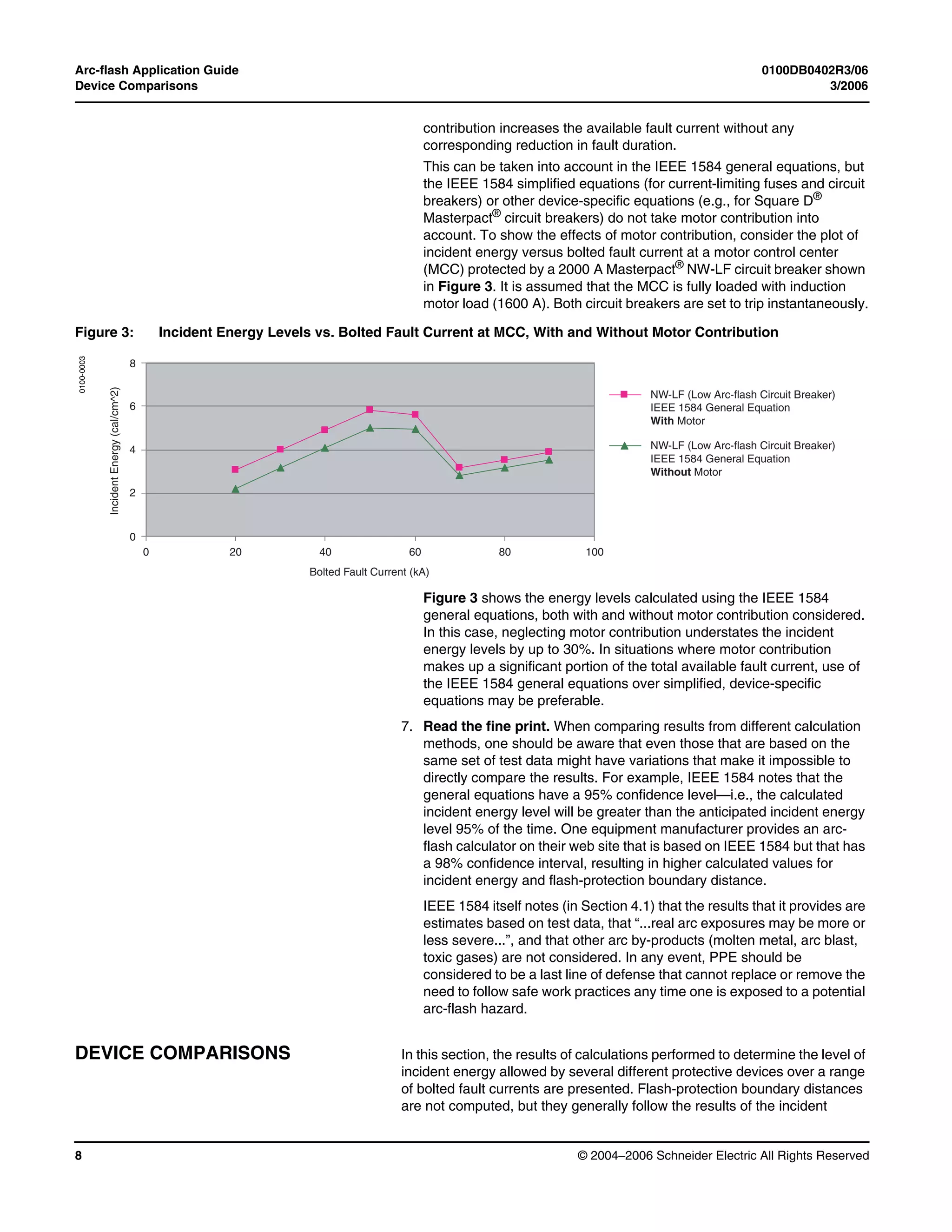
account. To show the effects of motor contribution, consider the plot of
incident energy versus bolted fault current at a motor control center
(MCC) protected by a 2000 A Masterpact®
NW-LF circuit breaker shown
in Figure 3. It is assumed that the MCC is fully loaded with induction
motor load (1600 A). Both circuit breakers are set to trip instantaneously.
Figure 3 shows the energy levels calculated using the IEEE 1584
general equations, both with and without motor contribution considered.
In this case, neglecting motor contribution understates the incident
energy levels by up to 30%. In situations where motor contribution
makes up a significant portion of the total available fault current, use of
the IEEE 1584 general equations over simplified, device-specific
equations may be preferable.
7. Read the fine print. When comparing results from different calculation
methods, one should be aware that even those that are based on the
same set of test data might have variations that make it impossible to
directly compare the results. For example, IEEE 1584 notes that the
general equations have a 95% confidence level—i.e., the calculated
incident energy level will be greater than the anticipated incident energy
level 95% of the time. One equipment manufacturer provides an arc-
flash calculator on their web site that is based on IEEE 1584 but that has
a 98% confidence interval, resulting in higher calculated values for
incident energy and flash-protection boundary distance.
IEEE 1584 itself notes (in Section 4.1) that the results that it provides are
estimates based on test data, that “...real arc exposures may be more or
less severe...”, and that other arc by-products (molten metal, arc blast,
toxic gases) are not considered. In any event, PPE should be
considered to be a last line of defense that cannot replace or remove the
need to follow safe work practices any time one is exposed to a potential
arc-flash hazard.
DEVICE COMPARISONS In this section, the results of calculations performed to determine the level of
incident energy allowed by several different protective devices over a range
of bolted fault currents are presented. Flash-protection boundary distances
are not computed, but they generally follow the results of the incident
Figure 3: Incident Energy Levels vs. Bolted Fault Current at MCC, With and Without Motor Contribution
8
6
4
2
0
0 20 40 60 80 100
Bolted Fault Current (kA)
IncidentEnergy(cal/cm^2)
NW-LF (Low Arc-flash Circuit Breaker)
IEEE 1584 General Equation
With Motor
NW-LF (Low Arc-flash Circuit Breaker)
IEEE 1584 General Equation
Without Motor
0100-0003
0100DB0402R3/06 Arc-flash Application Guide
3/2006 Device Comparisons
© 2004–2006 Schneider Electric All Rights Reserved 9
energy calculations—higher incident energy levels correspond to greater
flash-protection boundary distances. Calculations are performed per the
IEEE 1584 general equations or simplified, device-specific equations, as
noted. When the IEEE 1584 general equations are used for calculations
involving circuit breakers, unless otherwise noted, all breakers are set so
that they will trip instantaneously. Calculations were performed assuming a
480 V, solidly grounded system with a working distance of 18 inches and an
“in-box” configuration.
A summary of the relative advantages of the types of devices considered is
given in Table 2. For each type of device, information on conditions if/when
each allows the lowest values of incident energy are provided. The table
also shows if/when the devices allow the use of Category 1 or lower PPE,
the least restrictive (and most comfortable) category of protective clothing.
Current-limiting fuses are Class RK-1 or Class L, depending on the size.
The “Low Arc-flash Circuit Breaker” device type refers to Square D®
Masterpact®
NT-LF and/or NW-LF or NW-L1F circuit breakers, which are
designed to limit the available arc-flash incident energy [5]. The table
assumes that adjustable breakers are set to trip instantaneously. Larger
devices were evaluated for bolted fault currents ranging from
20–100 kA, while smaller devices were evaluated starting at 5 kA bolted
fault current. Note that the table does not consider other application issues
related to breakers and fuses, such as the possibility of single-phasing,
exposure to hazards when fuses are replaced, equipment footprint, and so
forth.
2000 A CIRCUIT BREAKERS AND FUSES Figure 4 shows the incident energy levels allowed by a 2000 A Masterpact®
NW-LF (low arc-flash) circuit breaker, a Masterpact®
NW-H (standard)
circuit breaker, and a 2000 A Class L current-limiting fuse. The energy
levels for the NW-LF circuit breaker are calculated with equipment-specific
equations published by Square D®
, while energy levels for the fuse are
calculated using the IEEE 1584 equations for current-limiting fuses. Energy
levels for the NW-H circuit breaker are calculated using the IEEE 1584
general equations and the published trip curves.
Table 2: Summary of
Device Performance
Device Type Lowest
Incident Energy
Category
0 or 1 PPE?
Fuses ≤400 A
Lower for most
FC values
Yes
Circuit Breakers
≤400 A
Higher but still
below 2 cal/cm2 Yes
Fuses 600–1600 A
When operating in
current-limiting
region
When operating in
current-limiting
region
Circuit Breakers
600–1600 A
Higher than low AF
circuit breaker but
lower than fuse at
low FC
Below 50 kA
bolted FC
Low AF
Circuit Breakers
600–1600 A
At low FC
Below 65 kA
bolted FC
2000 A Fuses No
Above 104 kA
bolted FC
Standard Circuit
Breaker 2000 A
Lower than fuse
below ~95 kA
Below 39 kA
bolted FC
Low AF Circuit
Breaker 2000 A
Yes
Below 65 kA
bolted FC
Fuse > 2000 A No No
Circuit Breaker
> 2000 A
Yes
Below 50 kA
bolted FC
Figure 4: Incident Energy vs. Bolted Fault Current for 2000 A Circuit Breakers and 2000 A Class “L” Fuse
100
75
50
25
0
IncidentEnergy(cal/cm^2)
0 20 40 60 80 100
Bolted Fault Current (kA)
120
NW-LF (Low Arc-flash Circuit Breaker)
NW-H (Standard Circuit Breaker)
2000L Fuse (Current-limiting Fuse)
0100-0004
Arc-flash Application Guide 0100DB0402R3/06
Device Comparisons 3/2006
© 2004–2006 Schneider Electric All Rights Reserved10
Current-limiting fuses are shown to be very effective at limiting incident
energy levels when they operate in their current-limiting region. However,
the 2000 A fuse is large enough that it does not clear the fault quickly until
fault currents reach higher levels. In this case, the energy levels allowed by
the fuse are still above the Category 1 PPE level (4 cal/cm2
) at 100 kA
bolted fault current. Energy levels remain above 25 cal/cm2
(requiring the
use of Category 4 PPE) until bolted fault current levels exceed 50 kA. The
incident energy levels allowed by the NW-H circuit breaker exceed
4 cal/cm2
for fault currents exceeding 39 kA (reaching 9.3 cal/cm2
at
100 kA) while the energy levels allowed by the NW-LF circuit breaker stay
below 4 cal/cm2
through approximately 65 kA available bolted fault current.
Figure 4 shows that, in fact, the 2000 A circuit breakers—particularly the
low arc-flash Masterpact®
—provide significantly better overall arc-flash
protection than the 2000 A fuse.
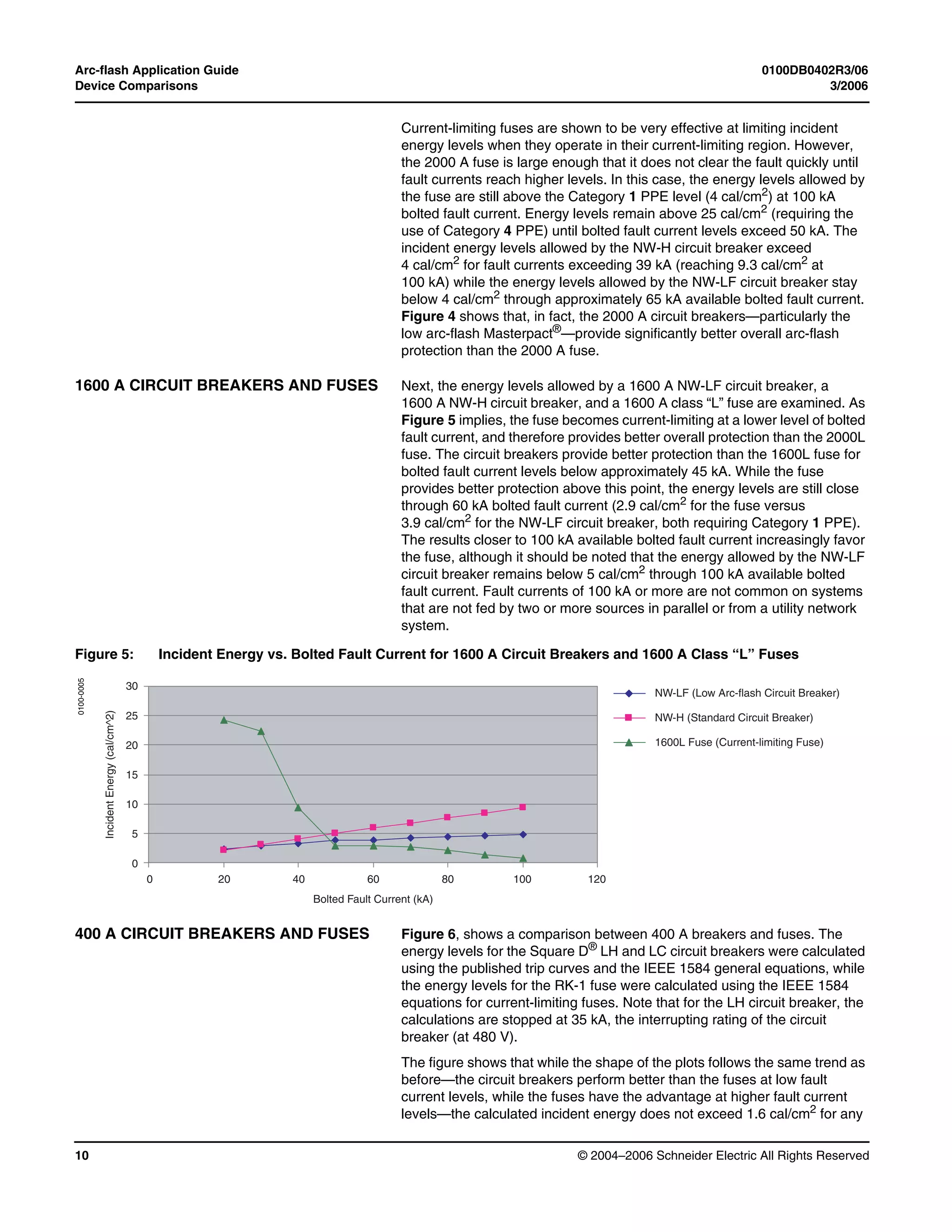
1600 A CIRCUIT BREAKERS AND FUSES Next, the energy levels allowed by a 1600 A NW-LF circuit breaker, a
1600 A NW-H circuit breaker, and a 1600 A class “L” fuse are examined. As
Figure 5 implies, the fuse becomes current-limiting at a lower level of bolted
fault current, and therefore provides better overall protection than the 2000L
fuse. The circuit breakers provide better protection than the 1600L fuse for
bolted fault current levels below approximately 45 kA. While the fuse
provides better protection above this point, the energy levels are still close
through 60 kA bolted fault current (2.9 cal/cm2
for the fuse versus
3.9 cal/cm2
for the NW-LF circuit breaker, both requiring Category 1 PPE).
The results closer to 100 kA available bolted fault current increasingly favor
the fuse, although it should be noted that the energy allowed by the NW-LF
circuit breaker remains below 5 cal/cm2
through 100 kA available bolted
fault current. Fault currents of 100 kA or more are not common on systems
that are not fed by two or more sources in parallel or from a utility network
system.
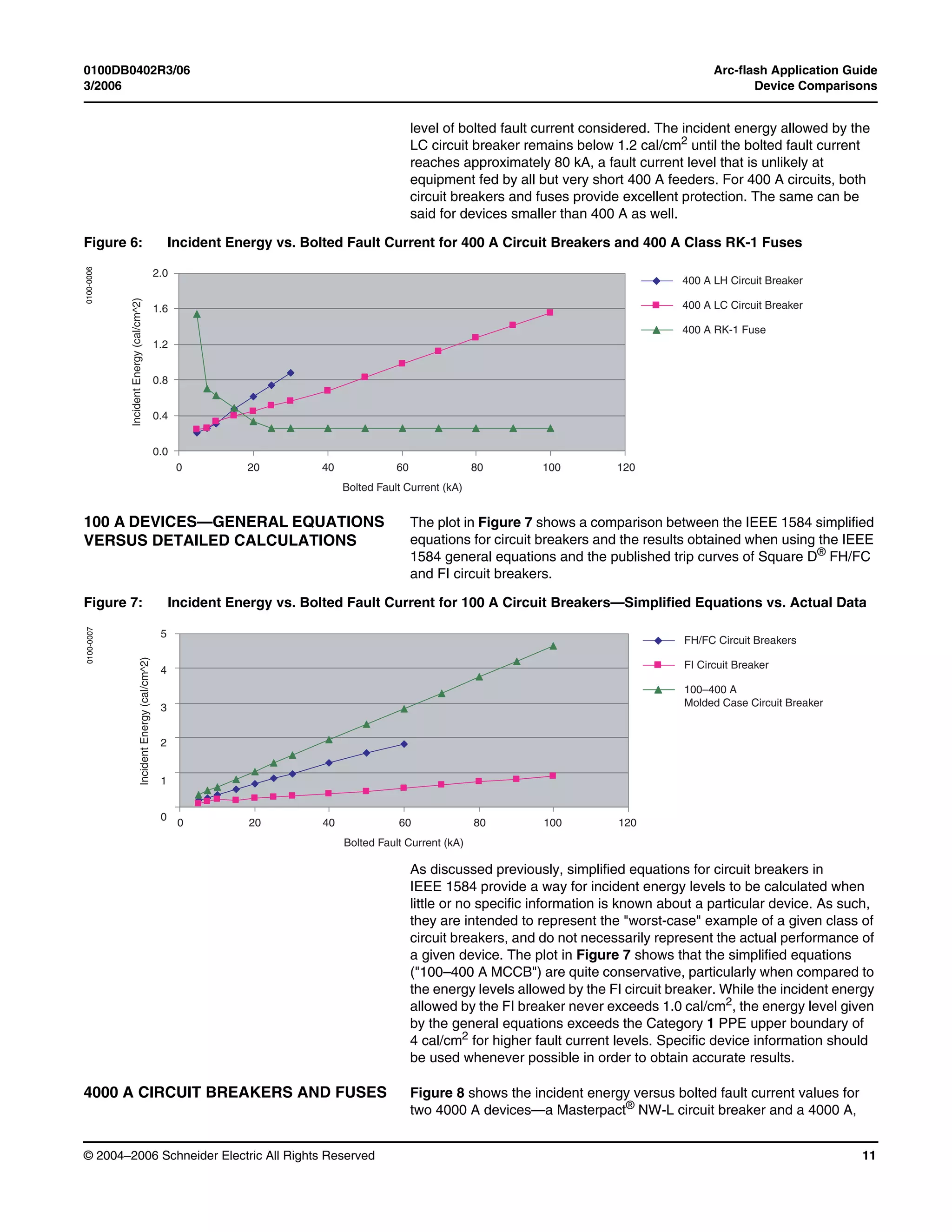
400 A CIRCUIT BREAKERS AND FUSES Figure 6, shows a comparison between 400 A breakers and fuses. The
energy levels for the Square D® LH and LC circuit breakers were calculated
using the published trip curves and the IEEE 1584 general equations, while
the energy levels for the RK-1 fuse were calculated using the IEEE 1584
equations for current-limiting fuses. Note that for the LH circuit breaker, the
calculations are stopped at 35 kA, the interrupting rating of the circuit
breaker (at 480 V).
The figure shows that while the shape of the plots follows the same trend as
before—the circuit breakers perform better than the fuses at low fault
current levels, while the fuses have the advantage at higher fault current
levels—the calculated incident energy does not exceed 1.6 cal/cm2
for any
Figure 5: Incident Energy vs. Bolted Fault Current for 1600 A Circuit Breakers and 1600 A Class “L” Fuses
0 20 40 60 80 100
Bolted Fault Current (kA)
120
IncidentEnergy(cal/cm^2)
25
20
15
10
5
0
30
NW-LF (Low Arc-flash Circuit Breaker)
NW-H (Standard Circuit Breaker)
1600L Fuse (Current-limiting Fuse)
0100-0005
0100DB0402R3/06 Arc-flash Application Guide
3/2006 Device Comparisons
© 2004–2006 Schneider Electric All Rights Reserved 11
level of bolted fault current considered. The incident energy allowed by the
LC circuit breaker remains below 1.2 cal/cm2
until the bolted fault current
reaches approximately 80 kA, a fault current level that is unlikely at
equipment fed by all but very short 400 A feeders. For 400 A circuits, both
circuit breakers and fuses provide excellent protection. The same can be
said for devices smaller than 400 A as well.
100 A DEVICES—GENERAL EQUATIONS
VERSUS DETAILED CALCULATIONS
The plot in Figure 7 shows a comparison between the IEEE 1584 simplified
equations for circuit breakers and the results obtained when using the IEEE
1584 general equations and the published trip curves of Square D®
FH/FC
and FI circuit breakers.
As discussed previously, simplified equations for circuit breakers in
IEEE 1584 provide a way for incident energy levels to be calculated when
little or no specific information is known about a particular device. As such,
they are intended to represent the "worst-case" example of a given class of
circuit breakers, and do not necessarily represent the actual performance of
a given device. The plot in Figure 7 shows that the simplified equations
("100–400 A MCCB") are quite conservative, particularly when compared to
the energy levels allowed by the FI circuit breaker. While the incident energy
allowed by the FI breaker never exceeds 1.0 cal/cm2, the energy level given
by the general equations exceeds the Category 1 PPE upper boundary of
4 cal/cm2 for higher fault current levels. Specific device information should
be used whenever possible in order to obtain accurate results.
4000 A CIRCUIT BREAKERS AND FUSES Figure 8 shows the incident energy versus bolted fault current values for
two 4000 A devices—a Masterpact®
NW-L circuit breaker and a 4000 A,
Figure 6: Incident Energy vs. Bolted Fault Current for 400 A Circuit Breakers and 400 A Class RK-1 Fuses
0 20 40 60 80 100
Bolted Fault Current (kA)
120
2.0
1.6
1.2
0.8
0.4
IncidentEnergy(cal/cm^2)
0.0
400 A LH Circuit Breaker
400 A LC Circuit Breaker
400 A RK-1 Fuse
0100-0006
Figure 7: Incident Energy vs. Bolted Fault Current for 100 A Circuit Breakers—Simplified Equations vs. Actual Data
0 20 40 60 80 100
Bolted Fault Current (kA)
120
5
4
3
2
1
IncidentEnergy(cal/cm^2)
0
FH/FC Circuit Breakers
FI Circuit Breaker
100–400 A
Molded Case Circuit Breaker
0100-0007
Arc-flash Application Guide 0100DB0402R3/06
Device Comparisons 3/2006
© 2004–2006 Schneider Electric All Rights Reserved12
Class "L" fuse. No device-specific equations are available for devices of this
size, so the IEEE 1584 general equations and published device trip curves
were used for the calculations.
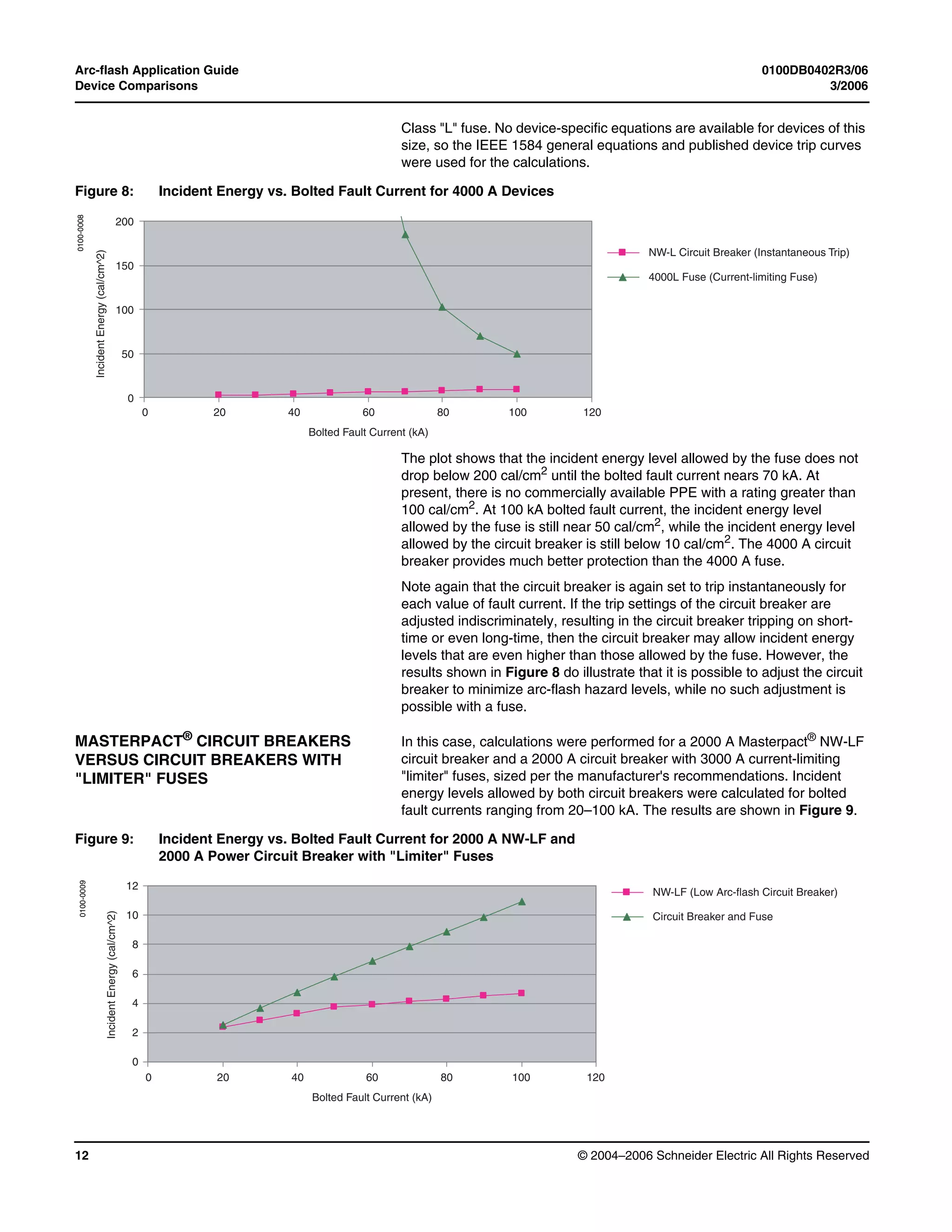
The plot shows that the incident energy level allowed by the fuse does not
drop below 200 cal/cm2 until the bolted fault current nears 70 kA. At
present, there is no commercially available PPE with a rating greater than
100 cal/cm2
. At 100 kA bolted fault current, the incident energy level
allowed by the fuse is still near 50 cal/cm2, while the incident energy level
allowed by the circuit breaker is still below 10 cal/cm2. The 4000 A circuit
breaker provides much better protection than the 4000 A fuse.
Note again that the circuit breaker is again set to trip instantaneously for
each value of fault current. If the trip settings of the circuit breaker are
adjusted indiscriminately, resulting in the circuit breaker tripping on short-
time or even long-time, then the circuit breaker may allow incident energy
levels that are even higher than those allowed by the fuse. However, the
results shown in Figure 8 do illustrate that it is possible to adjust the circuit
breaker to minimize arc-flash hazard levels, while no such adjustment is
possible with a fuse.
MASTERPACT® CIRCUIT BREAKERS
VERSUS CIRCUIT BREAKERS WITH
"LIMITER" FUSES
In this case, calculations were performed for a 2000 A Masterpact®
NW-LF
circuit breaker and a 2000 A circuit breaker with 3000 A current-limiting
"limiter" fuses, sized per the manufacturer's recommendations. Incident
energy levels allowed by both circuit breakers were calculated for bolted
fault currents ranging from 20–100 kA. The results are shown in Figure 9.
Figure 8: Incident Energy vs. Bolted Fault Current for 4000 A Devices
200
150
100
50
0
IncidentEnergy(cal/cm^2)
0 20 40 60 80 100
Bolted Fault Current (kA)
120
NW-L Circuit Breaker (Instantaneous Trip)
4000L Fuse (Current-limiting Fuse)
0100-0008
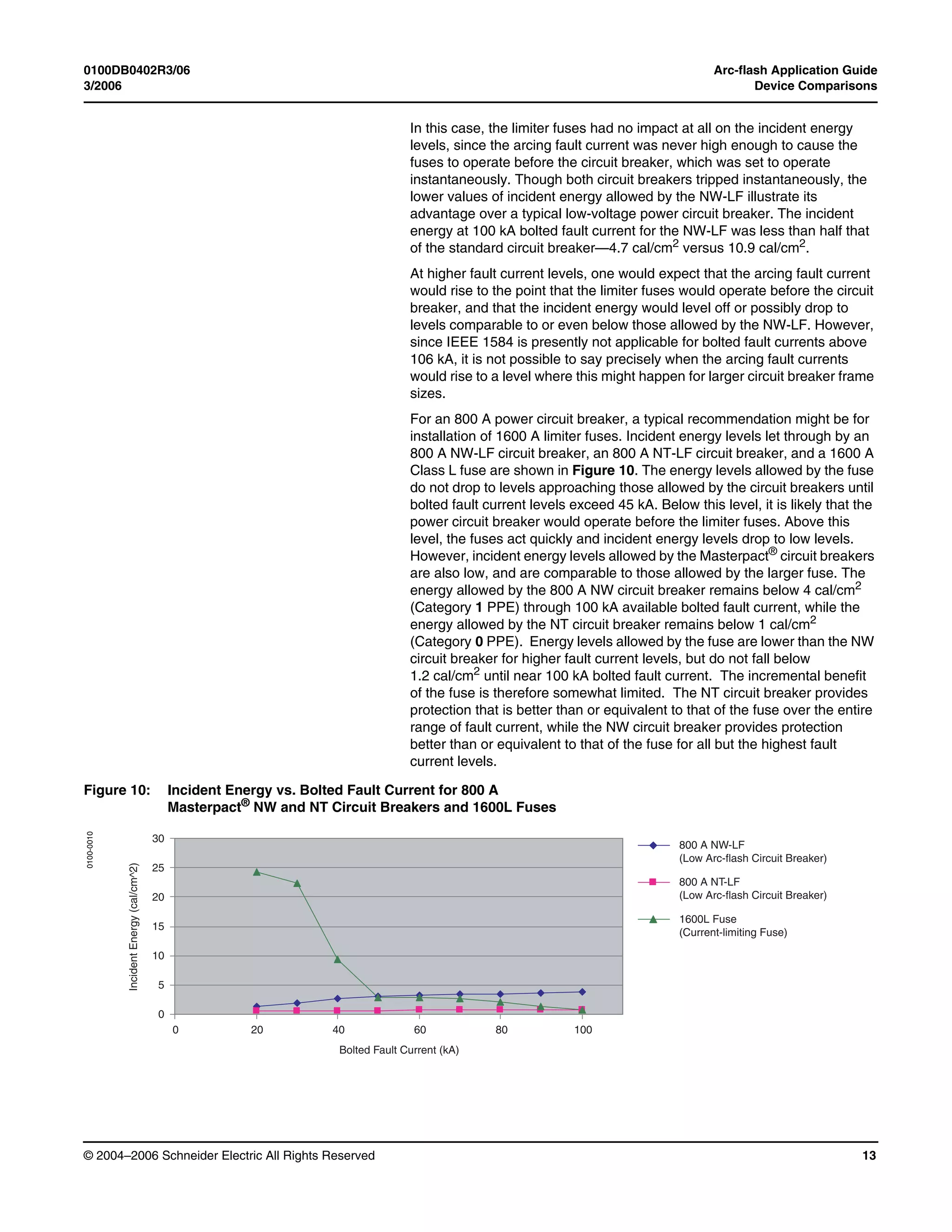
Figure 9: Incident Energy vs. Bolted Fault Current for 2000 A NW-LF and
2000 A Power Circuit Breaker with "Limiter" Fuses
10
8
6
4
2
0
0 20 40 60 80 100
12
Bolted Fault Current (kA)
IncidentEnergy(cal/cm^2)
120
NW-LF (Low Arc-flash Circuit Breaker)
Circuit Breaker and Fuse
0100-0009
0100DB0402R3/06 Arc-flash Application Guide
3/2006 Device Comparisons
© 2004–2006 Schneider Electric All Rights Reserved 13
In this case, the limiter fuses had no impact at all on the incident energy
levels, since the arcing fault current was never high enough to cause the
fuses to operate before the circuit breaker, which was set to operate
instantaneously. Though both circuit breakers tripped instantaneously, the
lower values of incident energy allowed by the NW-LF illustrate its
advantage over a typical low-voltage power circuit breaker. The incident
energy at 100 kA bolted fault current for the NW-LF was less than half that
of the standard circuit breaker—4.7 cal/cm2
versus 10.9 cal/cm2
.
At higher fault current levels, one would expect that the arcing fault current
would rise to the point that the limiter fuses would operate before the circuit
breaker, and that the incident energy would level off or possibly drop to
levels comparable to or even below those allowed by the NW-LF. However,
since IEEE 1584 is presently not applicable for bolted fault currents above
106 kA, it is not possible to say precisely when the arcing fault currents
would rise to a level where this might happen for larger circuit breaker frame
sizes.
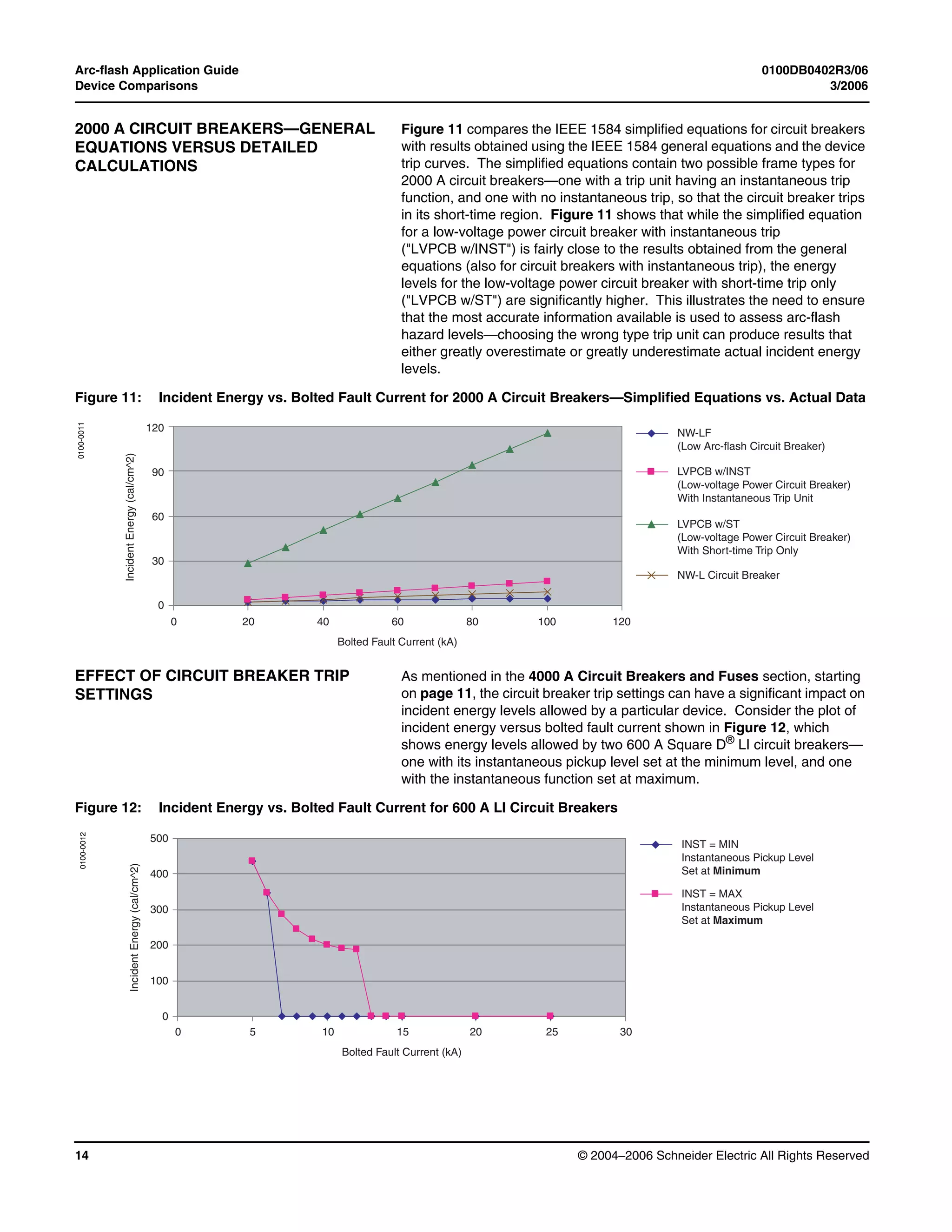
For an 800 A power circuit breaker, a typical recommendation might be for
installation of 1600 A limiter fuses. Incident energy levels let through by an
800 A NW-LF circuit breaker, an 800 A NT-LF circuit breaker, and a 1600 A
Class L fuse are shown in Figure 10. The energy levels allowed by the fuse
do not drop to levels approaching those allowed by the circuit breakers until
bolted fault current levels exceed 45 kA. Below this level, it is likely that the
power circuit breaker would operate before the limiter fuses. Above this
level, the fuses act quickly and incident energy levels drop to low levels.
However, incident energy levels allowed by the Masterpact® circuit breakers
are also low, and are comparable to those allowed by the larger fuse. The
energy allowed by the 800 A NW circuit breaker remains below 4 cal/cm2
(Category 1 PPE) through 100 kA available bolted fault current, while the
energy allowed by the NT circuit breaker remains below 1 cal/cm2
(Category 0 PPE). Energy levels allowed by the fuse are lower than the NW
circuit breaker for higher fault current levels, but do not fall below
1.2 cal/cm2 until near 100 kA bolted fault current. The incremental benefit
of the fuse is therefore somewhat limited. The NT circuit breaker provides
protection that is better than or equivalent to that of the fuse over the entire
range of fault current, while the NW circuit breaker provides protection
better than or equivalent to that of the fuse for all but the highest fault
current levels.
Figure 10: Incident Energy vs. Bolted Fault Current for 800 A
Masterpact®
NW and NT Circuit Breakers and 1600L Fuses
25
20
15
10
5
0
0 20 40 60 80 100
30
Bolted Fault Current (kA)
IncidentEnergy(cal/cm^2)
800 A NW-LF
(Low Arc-flash Circuit Breaker)
800 A NT-LF
(Low Arc-flash Circuit Breaker)
1600L Fuse
(Current-limiting Fuse)
0100-0010
Arc-flash Application Guide 0100DB0402R3/06
Device Comparisons 3/2006
© 2004–2006 Schneider Electric All Rights Reserved14
2000 A CIRCUIT BREAKERS—GENERAL
EQUATIONS VERSUS DETAILED
CALCULATIONS
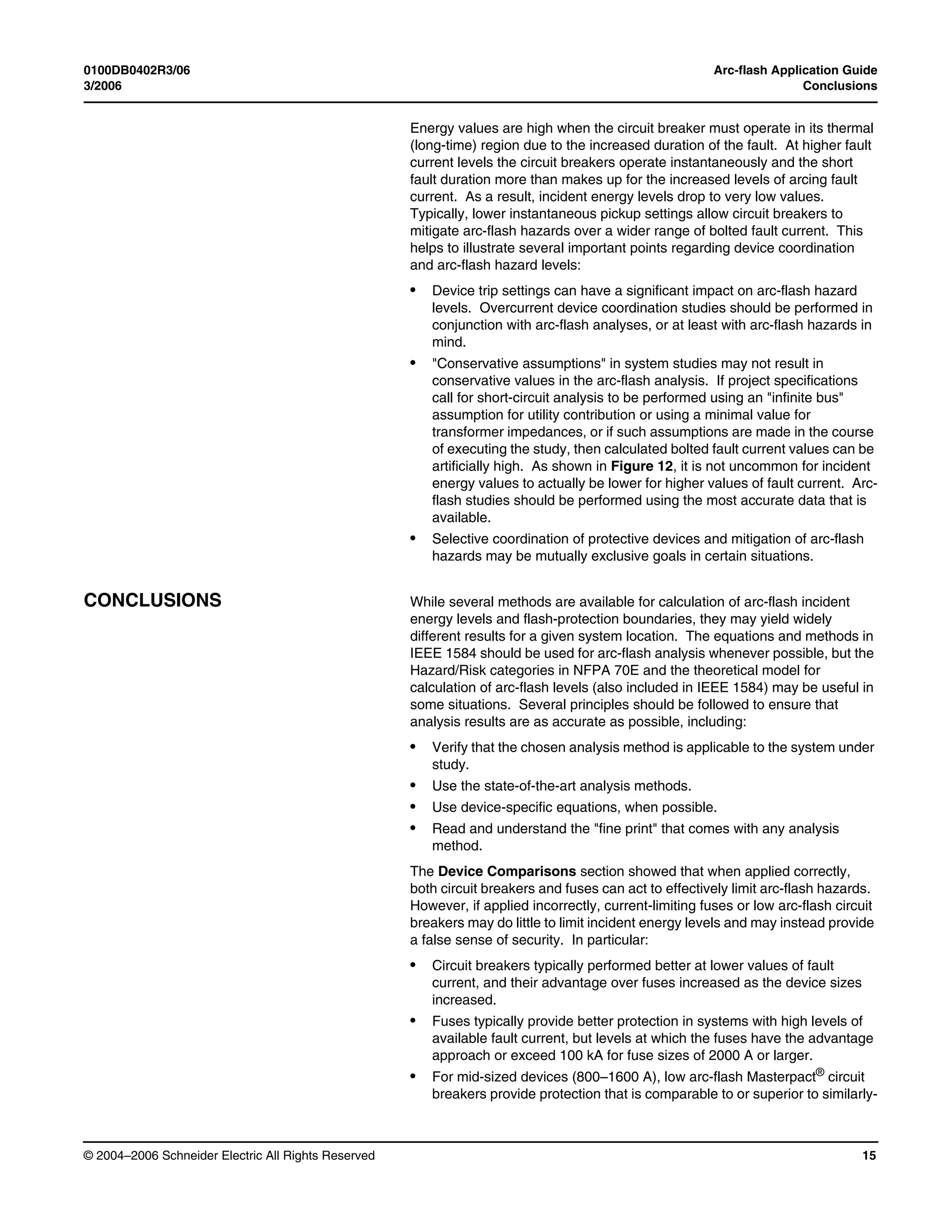
Figure 11 compares the IEEE 1584 simplified equations for circuit breakers
with results obtained using the IEEE 1584 general equations and the device
trip curves. The simplified equations contain two possible frame types for
2000 A circuit breakers—one with a trip unit having an instantaneous trip
function, and one with no instantaneous trip, so that the circuit breaker trips
in its short-time region. Figure 11 shows that while the simplified equation
for a low-voltage power circuit breaker with instantaneous trip
("LVPCB w/INST") is fairly close to the results obtained from the general
equations (also for circuit breakers with instantaneous trip), the energy
levels for the low-voltage power circuit breaker with short-time trip only
("LVPCB w/ST") are significantly higher. This illustrates the need to ensure
that the most accurate information available is used to assess arc-flash
hazard levels—choosing the wrong type trip unit can produce results that
either greatly overestimate or greatly underestimate actual incident energy
levels.
EFFECT OF CIRCUIT BREAKER TRIP
SETTINGS
As mentioned in the 4000 A Circuit Breakers and Fuses section, starting
on page 11, the circuit breaker trip settings can have a significant impact on
incident energy levels allowed by a particular device. Consider the plot of
incident energy versus bolted fault current shown in Figure 12, which
shows energy levels allowed by two 600 A Square D® LI circuit breakers—
one with its instantaneous pickup level set at the minimum level, and one
with the instantaneous function set at maximum.
Figure 11: Incident Energy vs. Bolted Fault Current for 2000 A Circuit Breakers—Simplified Equations vs. Actual Data
120
90
60
30
0
0 20 40 60 80 100 120
Bolted Fault Current (kA)
IncidentEnergy(cal/cm^2)
NW-LF
(Low Arc-flash Circuit Breaker)
LVPCB w/INST
(Low-voltage Power Circuit Breaker)
With Instantaneous Trip Unit
LVPCB w/ST
(Low-voltage Power Circuit Breaker)
With Short-time Trip Only
NW-L Circuit Breaker
0100-0011
Figure 12: Incident Energy vs. Bolted Fault Current for 600 A LI Circuit Breakers
500
400
300
200
100
0
0 5 10 15 20 25 30
Bolted Fault Current (kA)
IncidentEnergy(cal/cm^2)
INST = MIN
Instantaneous Pickup Level
Set at Minimum
INST = MAX
Instantaneous Pickup Level
Set at Maximum
0100-0012
0100DB0402R3/06 Arc-flash Application Guide
3/2006 Conclusions
© 2004–2006 Schneider Electric All Rights Reserved 15
Energy values are high when the circuit breaker must operate in its thermal
(long-time) region due to the increased duration of the fault. At higher fault
current levels the circuit breakers operate instantaneously and the short
fault duration more than makes up for the increased levels of arcing fault
current. As a result, incident energy levels drop to very low values.
Typically, lower instantaneous pickup settings allow circuit breakers to
mitigate arc-flash hazards over a wider range of bolted fault current. This
helps to illustrate several important points regarding device coordination
and arc-flash hazard levels:
• Device trip settings can have a significant impact on arc-flash hazard
levels. Overcurrent device coordination studies should be performed in
conjunction with arc-flash analyses, or at least with arc-flash hazards in
mind.
• "Conservative assumptions" in system studies may not result in
conservative values in the arc-flash analysis. If project specifications
call for short-circuit analysis to be performed using an "infinite bus"
assumption for utility contribution or using a minimal value for
transformer impedances, or if such assumptions are made in the course
of executing the study, then calculated bolted fault current values can be
artificially high. As shown in Figure 12, it is not uncommon for incident
energy values to actually be lower for higher values of fault current. Arc-
flash studies should be performed using the most accurate data that is
available.
• Selective coordination of protective devices and mitigation of arc-flash
hazards may be mutually exclusive goals in certain situations.
CONCLUSIONS While several methods are available for calculation of arc-flash incident
energy levels and flash-protection boundaries, they may yield widely
different results for a given system location. The equations and methods in
IEEE 1584 should be used for arc-flash analysis whenever possible, but the
Hazard/Risk categories in NFPA 70E and the theoretical model for
calculation of arc-flash levels (also included in IEEE 1584) may be useful in
some situations. Several principles should be followed to ensure that
analysis results are as accurate as possible, including:
• Verify that the chosen analysis method is applicable to the system under
study.
• Use the state-of-the-art analysis methods.
• Use device-specific equations, when possible.
• Read and understand the "fine print" that comes with any analysis
method.
The Device Comparisons section showed that when applied correctly,
both circuit breakers and fuses can act to effectively limit arc-flash hazards.
However, if applied incorrectly, current-limiting fuses or low arc-flash circuit
breakers may do little to limit incident energy levels and may instead provide
a false sense of security. In particular:
• Circuit breakers typically performed better at lower values of fault
current, and their advantage over fuses increased as the device sizes
increased.
• Fuses typically provide better protection in systems with high levels of
available fault current, but levels at which the fuses have the advantage
approach or exceed 100 kA for fuse sizes of 2000 A or larger.
• For mid-sized devices (800–1600 A), low arc-flash Masterpact® circuit
breakers provide protection that is comparable to or superior to similarly-
Arc-flash Application Guide 0100DB0402R3/06
Data Bulletin 3/2006
Electrical equipment should be installed, operated, serviced, and maintained only by
qualified personnel. No responsibility is assumed by Schneider Electric for any
consequences arising out of the use of this material.
© 2004–2006 Schneider Electric All Rights Reserved
Schneider Electric USA
3700 Sixth Street SW
Cedar Rapids, Iowa 52404
1-888-SquareD (1-888-778-2733)
www.us.SquareD.com
sized fuses. Required PPE does not exceed Category 1 through 65 kA
for the Masterpact®
circuit breakers.
• For smaller devices (400 A or less), both circuit breakers and fuses
generally provide excellent protection.
• Based on recommended sizing of limiter fuses, the fuses have little or no
impact on arc-flash levels for larger frame power circuit breakers. For
smaller frame circuit breakers, they are able to provide protection
comparable to or better than NW-LF and NT-LF circuit breakers only for
systems with high levels of available bolted fault current.
When adjustable circuit breakers are set indiscriminately, increased trip
times can compromise the arc-flash protection that would otherwise be
provided by the circuit breakers. Arc-flash studies should be performed in
conjunction with short-circuit and coordination studies, and in some cases,
selectivity between devices may have to be compromised if arc-flash levels
are to be kept low. As always, PPE should be considered as a last line of
defense, and not as a replacement for safe work practices or engineering
controls that can help limit exposure to arc-flash hazards.
REFERENCES [1] National Fire Protection Association, Inc., NFPA 70, National Electrical
Code, 2002 ed.
[2] R. H. Lee, The Other Electrical Hazard: Electric Arc Blast Burns, IEEE
Transactions on Industry Applications, Vol. IA-18, No. 3 (May/June
1982).
[3] T.E. Neal, A.H. Bingham, and R.L. Doughty, Protective Clothing
Guidelines for Electric Arc Exposure, IEEE Petroleum and Chemical
Industry Conference Record of Conference Papers, Paper No.
PCIC, 96–34 (1996).
[4] R.L. Doughty, T.E. Neal, and H.L. Floyd, Predicting Incident Energy to
Better Manage the Electric Arc Hazard on 600V Power Distribution
Systems, IEEE Petroleum and Chemical Industry Conference
Record of Conference Papers, Paper No. PCIC, 98–36 (1998).
[5] Square D® Data Bulletin 0613DB0202R0603, Arc-flash Protection with
Masterpact® NW and NT Circuit Breakers, (July 2003).

Arc flash application guide

  • 1.
    1 Data Bulletin 0100DB0402R3/06 3/2006 Cedar Rapids,Iowa, USA Arc-flash Application Guide Arc-flash Energy Calculations for Circuit Breakers and Fuses Class 100 Retain for future use. INTRODUCTION The idea that short-circuits or faults in an electric power system are undesirable is certainly not a novel concept. Recently, however, arcing faults have begun to receive an increasing amount of attention as a particularly damaging and potentially dangerous type of fault. Arcing fault current is fault current that flows through the air, unlike “bolted” fault current, which flows through conductors, busbars, or other equipment that is (ideally) designed to withstand its effects. This current flow, through air, releases a great deal of energy in the form of heat and pressure. In controlled applications, such as arc welding, electrical arcs can be useful. However, an “arc-flash,” which refers to the uncontrolled release of such energy during an arcing fault, can result in significant damage to equipment or worse, injury or death to workers exposed to the fault. Estimates indicate that 10–15 serious arc-flash incidents—those that result in burn injuries requiring treatment in a burn center—occur each day in the U.S., so it is not surprising that awareness of the hazards associated with arc- flash continues to grow. Present Occupational Safety and Health Administration (OSHA) regulations do not specifically address arc-flash hazards, but industry standards such as National Fire Protection Association (NFPA) 70E-2004, Standard for Electrical Safety in the Workplace, provide information on safe work practices and required protective equipment for electrical workers exposed to arc-flash hazards. OSHA has begun to write citations based on the NFPA 70E requirements. The National Electric Code (NEC) 110.16 also requires that many types of electrical equipment be field marked to warn of potential arc-flash hazards [1]. The Personal Protective Equipment section of this guide presents background information on personal protective equipment (PPE) that can help protect workers from arc-flash hazards. The Calculation Methods section discusses three primary calculation methods that are used to assess hazard levels and for the selection of proper PPE. In general, the three methods do not produce identical results, but the section Which Calculation Method is Correct? discusses several arc-flash analysis principles that will help insure that the correct method is chosen and that accurate results are obtained. Comparisons of the arc- flash protection provided by several common overcurrent protective devices are presented in the Device Comparisons section, while the Conclusions section presents a summary of the items discussed in this guide. 0100-0000
  • 2.
    Arc-flash Application Guide0100DB0402R3/06 Personal Protective Equipment 3/2006 © 2004–2006 Schneider Electric All Rights Reserved2 PERSONAL PROTECTIVE EQUIPMENT While properly maintained equipment and safe work practices can help to minimize the probability that an arcing fault might be initiated, workers potentially exposed to this hazard must still be adequately protected. The severity of the hazard related to an arcing fault is measured by the amount of energy that an arc delivers to an exposed worker. Calculation of this “incident energy,” which is commonly measured in calories per square centimeter (cal/cm2 ) or joules per square centimeter (J/cm2 ), provides a basis for selection of proper PPE, including flame-resistant clothing, flash suits, arc hoods, and the like. Also important to note is the flash-protection boundary, the distance from a fault source inside which the incident energy level exceeds 1.2 cal/cm2 , a level that can cause second degree burns on exposed skin. Both the incident energy and the flash-protection boundary vary based on many parameters. Among the most important factors are the system voltage, the arcing fault current level, the distance from a worker to the fault source, and the duration of the fault. As such, the hazard level depends on many system variables, including equipment type, prospective bolted fault currents, and characteristics of the upstream protective devices. An analysis of the potential arc-flash hazard at a given system location should be performed so that workers can select and use appropriate levels of PPE. Too little PPE leaves workers inadequately protected, and is therefore obviously undesirable. Too much PPE is also undesirable, as it may hinder movement and increase the level of risk associated with a specific work task, or may create other hazards such as increased heat stress. Three common methods that may be used to perform arc-flash analyses are discussed further in the Calculation Methods section. NFPA 70E-2004 defines five categories of protective clothing based on the degree of protection provided by each class, which are defined in the PPE “matrix” of Table 130.7(C)(10). PPE is assigned an Arc Rating (cal/cm2), which defines the “...maximum incident energy resistance demonstrated by a material.” The protective clothing characteristics are summarized in Table 1. Non-fire Resistant (FR) cotton has no arc rating, and can only be used at locations and/or working distances having low available incident energy. Within the flash-protection boundary, adequate protective clothing is required. As the energy level increases, more layers of FR clothing are needed to afford adequate protection. Non-FR synthetic clothing, including synthetic-cotton blends, is not allowed at all, as it can easily ignite and/or melt into the skin and aggravate a burn injury. Note that PPE is to be considered a last line of defense rather than a replacement for safe work practices or engineering controls that can reduce the exposure to arc-flash hazards. Equipment should be placed in an electrically safe work condition whenever possible. See NFPA 70E-2004 for additional details on safe work practices. CALCULATION METHODS As understanding of the arc-flash hazard has grown, several methods for calculating the arc-flash hazard have been developed. Three of these methods will be examined in this section—the theoretical model, the equations and tables used in NFPA 70E-2004, and the calculation methods presented in IEEE Std 1584™- 2002. THEORETICAL MODEL Ralph H. Lee developed a theoretical model for calculation of arc-flash energy in a paper published in 1982 [2]. Prior to this, arcing faults had been recognized as damaging to electrical equipment and as a potential safety hazard, but Lee’s work was one of the first—if not the first—to quantitatively Table 1: Protective Clothing Characteristic (from NFPA 70E-2004) Clothing Category Clothing Description Number of Layers Minimum Arc Rating of PPE (cal/cm2 ) 0 Untreated Natural Fiber Clothing 1 N/A 1 Fire Resistant Shirt and Fire Resistant Pants 1 4 2 Cotton Underwear plus Category 1 2 8 3 Fire Resistant Coverall Over Category 2 3 25 4 Multi-layer Flash Suit Over Category 2 4 40
  • 3.
    0100DB0402R3/06 Arc-flash ApplicationGuide 3/2006 Calculation Methods © 2004–2006 Schneider Electric All Rights Reserved 3 assess the relationships between the energy produced by arcing faults, the working distance, and the potential hazard to exposed workers. Lee recognized that arcing faults are sources of intense heat and used heat transfer equations to determine the effect of this heat energy on human skin. Equations were presented that allowed for calculation of “just curable” and “fatal” burn distances based on the value of bolted fault current and the fault clearing time. At the time, no testing had been performed to investigate the relationship between bolted fault current and arcing fault current, so Lee concluded that the arcing energy calculations should be based on the worst-case condition, i.e., when the voltage across the arc is equal to half the system voltage. Later testing showed that actual incident energy levels reached a maximum of 79% of the theoretical value in a 600 V system and only 42% in a 2400 V system [3], as the voltage across the arc was actually less than that required to produce maximum arc power. The results of the theoretical model tend to be conservative for any system, but are even more conservative for systems operating at 1 kV or higher. A more accurate calculation of arcing fault current is required to achieve more accurate results. In addition, since the theoretical model does not take into account other important factors, such as whether the arcing fault occurs in open air or inside an equipment enclosure, it is not suitable for calculation of incident energy levels or flash-hazard boundaries in a typical industrial or commercial facility. The model is still useful, however, for calculating energy levels in situations where no other method has been developed. Equations based on Lee’s work are included in IEEE 1584 to cover system types that are not otherwise covered by the IEEE 1584 equations, such as open-air transmission or distribution systems, open-air substations, or systems operating above 15 kV. NFPA 70E-2004 Section 130.3(A) of NFPA 70E-2004 contains equations that allow for calculation of flash-protection boundary distances for systems operating at 600 V or less. For systems operating above 600 V, the flash-protection boundary is defined as “...the distance at which the incident energy level equals 1.2 cal/cm2 ” (or 1.5 cal/cm2 if the fault clearing time is less than 0.1 second). No equations are presented that allow for the determination of distances for systems over 600 V. Annex D of NFPA 70E-2004 contains equations for the calculation of incident energy levels and flash-protection boundaries based on the theoretical model, on testing performed on 600 V systems [4], and from IEEE 1584. No recommendations are given as to the preferred calculation method. NFPA 70E-2004 also provides a method for selecting PPE that requires little or no calculation. Table 130.7(C)(9)(a) assigns “Hazard/Risk Category” values for typical work tasks that might be performed on common types of equipment, such as the insertion of starter buckets in a 600 V class motor control center. The Hazard/Risk Category values correspond to the five categories of PPE so that a worker may determine the level of clothing that is required by simply finding the appropriate work task in the table. Included with the table are several footnotes that define fault current ranges and fault clearing times for which the Hazard/Risk category values are valid. For system conditions that fall outside these parameters—such as with a main lug switchboard protected by a slow-acting utility transformer primary fuse, which may not clear a fault in the one second time frame that is assumed— the tables may not be used to select PPE. Even for some conditions that do fit the system conditions defined by the table, the recommended PPE may, in some cases, be inadequate. For example, for a section of 480 V-class switchgear, the assumed system parameters are “up to 65 kA available, and up to 1.0 second clearing time.” Based on 65 kA bolted fault current and 1.0
  • 4.
    Arc-flash Application Guide0100DB0402R3/06 Which Calculation Method is Correct? 3/2006 © 2004–2006 Schneider Electric All Rights Reserved4 second fault duration, IEEE 1584 calculates an incident energy of 69 cal/cm2 at a 24” working distance, but Table 130.7(C)(9)(a) does not call for PPE above Category 3 for any listed work task. Despite some deficiencies, the table is still useful, particularly in facilities where little or no system information is available. IEEE STD 1584 IEEE Std 1584™-2002, IEEE Guide for Performing Arc-flash Hazard Calculations, presents the most comprehensive set of equations to date for calculating incident energy levels and flash-protection boundaries. Empirical equations are given that cover systems at voltage levels ranging from 208 V to 15 kV and for available bolted fault currents ranging from 700 A to 106 kA, sufficient to cover the majority of low-voltage and medium-voltage installations. The equations are rather complex if calculations are to be performed by hand, though the equations are easily implemented in a spreadsheet or in other computer software. Simplified equations are also provided for several common protective device types, including current- limiting Class RK1 and Class L fuses (up to 2000 A), as well as for various types of circuit breakers (100–6300 A). The fuse equations are based on testing of one manufacturer’s current-limiting fuses. The breaker equations are based on calculated results and are “generic” equations that correspond to a general class or frame size of breakers rather than to a specific device. They may be used if specific information about the breaker’s trip characteristics is not available. In addition, restatements of the theoretical equations are provided for calculation of energy levels in systems that fall outside the scope of the test data. Future testing and analysis may result in revisions of or additions to the present IEEE 1584 methods, but at present, it represents the state-of-the-art methodology for arc-flash analysis and should be used when possible. The IEEE 1584 calculation methods have been implemented in several power system analysis software packages, including SKM Power*Tools® and ETAP® . WHICH CALCULATION METHOD IS CORRECT? In addition to the three methods discussed in Calculation Methods there are other methods or tools available for calculation of arc-flash hazard levels including various Windows and DOS-based shortcut calculator programs, IEEE 1584-based calculators on equipment manufacturer’s web sites, or equipment-specific equations, such as those developed for the Square D® Masterpact® NW and NT “low arc-flash” (LF and L1F) circuit breakers [5]. Even IEEE 1584 presents two alternate calculation methods for many situations—the general equations and the simplified equations for circuit breakers and fuses. For a given system location, one can calculate several different values for incident energy levels or for the flash-hazard boundary distance. While the calculation results may be close to one another in many situations, this may not always be the case. How can one be sure which method produces the best results for a given situation? No single calculation method is applicable to all situations, but several principles may be followed to ensure that the best results are obtained in a given situation: 1. Verify that actual system conditions fall within the method’s range of applicability. Many of the available calculation methods are at least partially based on empirical equations—i.e., equations derived from test results. These equations are valid over the range of system conditions where testing was performed, but cannot be extended to other situations with a high degree of confidence. For example, the equations in IEEE 1584 cannot be used to calculate arc-flash hazard levels at locations with greater than 106 kA available bolted fault current or in a DC system. This principle is also important when using the NPFA 70E tables to assess arc-flash hazard levels, as the tables are based on
  • 5.
    0100DB0402R3/06 Arc-flash ApplicationGuide 3/2006 Which Calculation Method is Correct? © 2004–2006 Schneider Electric All Rights Reserved 5 specific assumptions regarding available fault currents and fault clearing times. 2. Out with the old, in with the new. Arc-flash hazard analysis is a relatively new science, and as a result the available calculation methods have changed significantly as understanding of the arc-flash phenomenon has grown over the past 20+ years. Newer test results, industry standards, and calculation methods are more likely to accurately represent the actual hazard levels than older methods. They should be used in preference to older methods that may be based on smaller sets of test data or may be applicable over a smaller range of system conditions. 3. Use device-specific equations rather than general equations. While the general equations in IEEE 1584 are based on lab testing over a wide range of system conditions, the testing cannot possibly accurately characterize the performance of every available protective device in every possible situation. In particular, the general equations may not adequately characterize current-limiting action of fuses or circuit breakers, and can therefore give results that may be overly conservative for such devices. When equations based on testing of specific devices— such as the IEEE 1584 equations for current-limiting fuses or the Square D® equations for low arc-flash Masterpact® circuit breakers— are available, they should be used rather than the general calculation methods. One exception to this rule would be when there is significant motor contribution to fault current at a given location, as discussed in Step 6. Recall also that the simplified equations in IEEE 1584 for circuit breakers are not device-specific equations, but rather are general equations that may be used if little or no information is available for a given circuit breaker. If accurate information about a breaker’s trip characteristics is available, it should be used along with the IEEE 1584 general equations rather than the simplified circuit breaker equations. 4. Know which device clears the fault and use realistic fault current values. When determining the arc-flash hazard level at a given location, two of the major variables to consider are the bolted fault current level at that location and the characteristics of the upstream protective device. For example, consider calculation of fault current at a 200 A, 480 V lighting panel fed from a 200 A feeder breaker located in a facility’s main switchboard (device “A” in Figure 1). The panel also contains a main breaker (device “B”) and several feeder breakers (e.g., device “C”). The facility engineer intends to use the IEEE 1584 general equations to calculate the incident energy level at the panel so that a worker at the panel can be adequately protected. First, the engineer must determine which circuit breaker acts to clear the fault. Depending on exactly where in the panel the fault initiates, any of the three devices might initially act to clear the fault. Typically, the worst- case scenario will be for the fault to occur on the line-side of the panel’s main circuit breaker, in which case it must be cleared by the upstream feeder device (“A”). This breaker, which would normally be set to selectively coordinate with device “B”, should have the longest tripping time of the three devices shown for a given value of fault current. Even if the arcing fault initiates on the load-side of branch circuit breaker “C”, the fault could easily propagate to the line-side of the other devices in the same enclosure. Therefore, to ensure that the calculations reflect the maximum energy level to which a worker might be exposed, the trip characteristics of device “A” should be considered. What value of fault current should be considered—the available bolted fault current at the switchboard containing device “A”, or the available fault current at the lighting panel itself? Suppose that 100 kA bolted fault A B C Figure 1: Sample Panel Configuration 0100-0001
  • 6.
    Arc-flash Application Guide0100DB0402R3/06 Which Calculation Method is Correct? 3/2006 © 2004–2006 Schneider Electric All Rights Reserved6 current is available at the switchboard, but the panel is located 100 feet away. The impedance of 100 feet of #3/0 AWG conductor drops the available bolted fault current at the panel to approximately 28 kA. Since the concern in this case is over arcing faults at the lighting panel, this is the value of bolted fault current that should be used as an input to the IEEE 1584 equations. IEEE 1584 is then used to calculate the arcing fault current level, approximately 15 kA. The device’s trip characteristics must be consulted in order to determine its clearing time at 15 kA, and then IEEE 1584 is used to calculate the incident energy level and flash- protection boundary at the panel. In some situations, the best practice may be to calculate two incident energy levels and flash-protection boundaries for a single piece of equipment. For example, consider a lineup of 480 V drawout switchgear with a main circuit breaker and several feeder circuit breakers. The circuit breaker cubicles are more physically separated from one another than circuit breakers are in a typical electrical panel, so propagation of a fault from a feeder to the line-side of the main would be expected to be more difficult. If a fault were to occur when a feeder circuit breaker was racked in or out, then the main circuit breaker would be expected to clear the fault. However, when the main circuit breaker is racked in or out, then the upstream protective device—possibly a fuse or relay on the primary side of an upstream transformer—would be called upon to clear the fault. In this case, the upstream protective device may act relatively slowly, which could mean that workers are exposed to a much higher level of arc-flash hazard when racking the main than when racking a feeder. In cases such as this, or in other situations when workers may potentially be exposed to flash hazards in a section of gear on the line- side of the main (i.e., in a fire pump section), more than one calculation per piece of equipment may be warranted. Note also that while IEEE 1584 can be used to calculate hazard levels for bolted faults up to 106 kA, it is not likely that the available bolted fault current levels in many parts of the system will be this high, particularly on smaller feeders and branch circuits. Figure 2 shows the relationship between feeder length and available bolted fault current for various feeder sizes and distances away from a source with 100 kA available fault current at 480 V. Fault current levels will fall off more quickly in 208 V systems. Figure 2: Bolted Fault Current (kA) vs. Feeder Length, 480 V System (100 kA Available Fault Current at Source) 50 40 30 20 10 0 0 25 50 75 100 125 60 Feeder Length (ft) BoltedFCatEndofFeeder(kA) 150 175 200 70 80 90 100 100 A 200 A 400 A 800 A 1600 A 2000 A 0100-0002
  • 7.
    0100DB0402R3/06 Arc-flash ApplicationGuide 3/2006 Which Calculation Method is Correct? © 2004–2006 Schneider Electric All Rights Reserved 7 5. Quantify the variables. As mentioned previously, the system voltage level, the level of arcing fault current, and the clearing time of the fault are among the most significant parameters that determine the level of arc-flash hazard in a system. However, several other variables must be considered—at least when using the IEEE 1584 general equations—and they must be determined before incident energy levels or flash- protection boundaries may be calculated. These variables include: — Working Distance: Working distance is defined as the distance from the electric arc to the worker’s face and body (torso). The incident energy levels drop off fairly quickly as the distance from the arcing fault is increased, so choosing the correct working distance is important if an accurate determination of required PPE is to be made. Typical working distances for various types of equipment are given in Table 3 of Section 4.8 of IEEE 1584, and range from 18” (455 mm) for low-voltage panels and MCCs to 36” (910 mm) for medium-voltage switchgear. When comparing the results of calculations performed using the IEEE 1584 general equations to those performed using simplified, equipment-specific equations, note that the simplified equations assume a fixed working distance (typically 18”). — Bus Gap: The length of the arc depends on the gap between phase conductors or from phase to ground, which is referred to in IEEE 1584 as the “bus gap.” Longer arcs have higher impedance values than shorter arcs, and therefore result in a larger voltage drop across the arc and a lower value of arcing fault current than shorter arcs. Typical values for bus gaps for various classes of equipment are given in Table 2 of IEEE 1584. — Equipment Configuration: Incident energy from an arc in open air should, in theory, drop as 1/d2 (d=distance) as one moves away from the source of the arc. Testing of arcs that started in a typical equipment enclosure (i.e., an “arc-in-a-box”) showed that energy levels fell off more slowly (1/d1.5) as a result of energy being reflected off the back and sides of the enclosure and focused in the direction of the worker. This results in incident energy levels for “in- box” configurations that may be 20–40% higher at typical working distances [3, 4]. For power distribution systems in a typical industrial or commercial facility, practically every arcing fault should be considered to be an “in-box” configuration. — System Grounding: Testing showed that system grounding has a relatively small (but “statistically significant”) impact on incident energy levels in some cases. The IEEE 1584 calculations differ slightly depending on whether a system is solidly grounded or ungrounded (including high-resistance grounding), so a software program based on IEEE 1584 will require information regarding system grounding. 6. Be aware of motor contribution. It is widely recognized that motors contribute to fault current, but IEEE 1584 addresses motor contribution to a fault only briefly, and other calculation methods generally do not address it at all. The level of arcing fault current at a given location depends on the level of bolted fault current, so when motor loads are present, the motor contribution adds to the arcing fault current as well. However, this portion of the arcing fault current does not flow through the upstream protective device, and therefore does not make devices with inverse-time characteristics trip any faster than they would if the motor load were not present. Incident energy levels and flash-protection boundary distances may therefore be increased, as the motor
  • 8.
    Arc-flash Application Guide0100DB0402R3/06 Device Comparisons 3/2006 © 2004–2006 Schneider Electric All Rights Reserved8 contribution increases the available fault current without any corresponding reduction in fault duration. This can be taken into account in the IEEE 1584 general equations, but the IEEE 1584 simplified equations (for current-limiting fuses and circuit breakers) or other device-specific equations (e.g., for Square D® Masterpact® circuit breakers) do not take motor contribution into account. To show the effects of motor contribution, consider the plot of incident energy versus bolted fault current at a motor control center (MCC) protected by a 2000 A Masterpact® NW-LF circuit breaker shown in Figure 3. It is assumed that the MCC is fully loaded with induction motor load (1600 A). Both circuit breakers are set to trip instantaneously. Figure 3 shows the energy levels calculated using the IEEE 1584 general equations, both with and without motor contribution considered. In this case, neglecting motor contribution understates the incident energy levels by up to 30%. In situations where motor contribution makes up a significant portion of the total available fault current, use of the IEEE 1584 general equations over simplified, device-specific equations may be preferable. 7. Read the fine print. When comparing results from different calculation methods, one should be aware that even those that are based on the same set of test data might have variations that make it impossible to directly compare the results. For example, IEEE 1584 notes that the general equations have a 95% confidence level—i.e., the calculated incident energy level will be greater than the anticipated incident energy level 95% of the time. One equipment manufacturer provides an arc- flash calculator on their web site that is based on IEEE 1584 but that has a 98% confidence interval, resulting in higher calculated values for incident energy and flash-protection boundary distance. IEEE 1584 itself notes (in Section 4.1) that the results that it provides are estimates based on test data, that “...real arc exposures may be more or less severe...”, and that other arc by-products (molten metal, arc blast, toxic gases) are not considered. In any event, PPE should be considered to be a last line of defense that cannot replace or remove the need to follow safe work practices any time one is exposed to a potential arc-flash hazard. DEVICE COMPARISONS In this section, the results of calculations performed to determine the level of incident energy allowed by several different protective devices over a range of bolted fault currents are presented. Flash-protection boundary distances are not computed, but they generally follow the results of the incident Figure 3: Incident Energy Levels vs. Bolted Fault Current at MCC, With and Without Motor Contribution 8 6 4 2 0 0 20 40 60 80 100 Bolted Fault Current (kA) IncidentEnergy(cal/cm^2) NW-LF (Low Arc-flash Circuit Breaker) IEEE 1584 General Equation With Motor NW-LF (Low Arc-flash Circuit Breaker) IEEE 1584 General Equation Without Motor 0100-0003
  • 9.
    0100DB0402R3/06 Arc-flash ApplicationGuide 3/2006 Device Comparisons © 2004–2006 Schneider Electric All Rights Reserved 9 energy calculations—higher incident energy levels correspond to greater flash-protection boundary distances. Calculations are performed per the IEEE 1584 general equations or simplified, device-specific equations, as noted. When the IEEE 1584 general equations are used for calculations involving circuit breakers, unless otherwise noted, all breakers are set so that they will trip instantaneously. Calculations were performed assuming a 480 V, solidly grounded system with a working distance of 18 inches and an “in-box” configuration. A summary of the relative advantages of the types of devices considered is given in Table 2. For each type of device, information on conditions if/when each allows the lowest values of incident energy are provided. The table also shows if/when the devices allow the use of Category 1 or lower PPE, the least restrictive (and most comfortable) category of protective clothing. Current-limiting fuses are Class RK-1 or Class L, depending on the size. The “Low Arc-flash Circuit Breaker” device type refers to Square D® Masterpact® NT-LF and/or NW-LF or NW-L1F circuit breakers, which are designed to limit the available arc-flash incident energy [5]. The table assumes that adjustable breakers are set to trip instantaneously. Larger devices were evaluated for bolted fault currents ranging from 20–100 kA, while smaller devices were evaluated starting at 5 kA bolted fault current. Note that the table does not consider other application issues related to breakers and fuses, such as the possibility of single-phasing, exposure to hazards when fuses are replaced, equipment footprint, and so forth. 2000 A CIRCUIT BREAKERS AND FUSES Figure 4 shows the incident energy levels allowed by a 2000 A Masterpact® NW-LF (low arc-flash) circuit breaker, a Masterpact® NW-H (standard) circuit breaker, and a 2000 A Class L current-limiting fuse. The energy levels for the NW-LF circuit breaker are calculated with equipment-specific equations published by Square D® , while energy levels for the fuse are calculated using the IEEE 1584 equations for current-limiting fuses. Energy levels for the NW-H circuit breaker are calculated using the IEEE 1584 general equations and the published trip curves. Table 2: Summary of Device Performance Device Type Lowest Incident Energy Category 0 or 1 PPE? Fuses ≤400 A Lower for most FC values Yes Circuit Breakers ≤400 A Higher but still below 2 cal/cm2 Yes Fuses 600–1600 A When operating in current-limiting region When operating in current-limiting region Circuit Breakers 600–1600 A Higher than low AF circuit breaker but lower than fuse at low FC Below 50 kA bolted FC Low AF Circuit Breakers 600–1600 A At low FC Below 65 kA bolted FC 2000 A Fuses No Above 104 kA bolted FC Standard Circuit Breaker 2000 A Lower than fuse below ~95 kA Below 39 kA bolted FC Low AF Circuit Breaker 2000 A Yes Below 65 kA bolted FC Fuse > 2000 A No No Circuit Breaker > 2000 A Yes Below 50 kA bolted FC Figure 4: Incident Energy vs. Bolted Fault Current for 2000 A Circuit Breakers and 2000 A Class “L” Fuse 100 75 50 25 0 IncidentEnergy(cal/cm^2) 0 20 40 60 80 100 Bolted Fault Current (kA) 120 NW-LF (Low Arc-flash Circuit Breaker) NW-H (Standard Circuit Breaker) 2000L Fuse (Current-limiting Fuse) 0100-0004
  • 10.
    Arc-flash Application Guide0100DB0402R3/06 Device Comparisons 3/2006 © 2004–2006 Schneider Electric All Rights Reserved10 Current-limiting fuses are shown to be very effective at limiting incident energy levels when they operate in their current-limiting region. However, the 2000 A fuse is large enough that it does not clear the fault quickly until fault currents reach higher levels. In this case, the energy levels allowed by the fuse are still above the Category 1 PPE level (4 cal/cm2 ) at 100 kA bolted fault current. Energy levels remain above 25 cal/cm2 (requiring the use of Category 4 PPE) until bolted fault current levels exceed 50 kA. The incident energy levels allowed by the NW-H circuit breaker exceed 4 cal/cm2 for fault currents exceeding 39 kA (reaching 9.3 cal/cm2 at 100 kA) while the energy levels allowed by the NW-LF circuit breaker stay below 4 cal/cm2 through approximately 65 kA available bolted fault current. Figure 4 shows that, in fact, the 2000 A circuit breakers—particularly the low arc-flash Masterpact® —provide significantly better overall arc-flash protection than the 2000 A fuse. 1600 A CIRCUIT BREAKERS AND FUSES Next, the energy levels allowed by a 1600 A NW-LF circuit breaker, a 1600 A NW-H circuit breaker, and a 1600 A class “L” fuse are examined. As Figure 5 implies, the fuse becomes current-limiting at a lower level of bolted fault current, and therefore provides better overall protection than the 2000L fuse. The circuit breakers provide better protection than the 1600L fuse for bolted fault current levels below approximately 45 kA. While the fuse provides better protection above this point, the energy levels are still close through 60 kA bolted fault current (2.9 cal/cm2 for the fuse versus 3.9 cal/cm2 for the NW-LF circuit breaker, both requiring Category 1 PPE). The results closer to 100 kA available bolted fault current increasingly favor the fuse, although it should be noted that the energy allowed by the NW-LF circuit breaker remains below 5 cal/cm2 through 100 kA available bolted fault current. Fault currents of 100 kA or more are not common on systems that are not fed by two or more sources in parallel or from a utility network system. 400 A CIRCUIT BREAKERS AND FUSES Figure 6, shows a comparison between 400 A breakers and fuses. The energy levels for the Square D® LH and LC circuit breakers were calculated using the published trip curves and the IEEE 1584 general equations, while the energy levels for the RK-1 fuse were calculated using the IEEE 1584 equations for current-limiting fuses. Note that for the LH circuit breaker, the calculations are stopped at 35 kA, the interrupting rating of the circuit breaker (at 480 V). The figure shows that while the shape of the plots follows the same trend as before—the circuit breakers perform better than the fuses at low fault current levels, while the fuses have the advantage at higher fault current levels—the calculated incident energy does not exceed 1.6 cal/cm2 for any Figure 5: Incident Energy vs. Bolted Fault Current for 1600 A Circuit Breakers and 1600 A Class “L” Fuses 0 20 40 60 80 100 Bolted Fault Current (kA) 120 IncidentEnergy(cal/cm^2) 25 20 15 10 5 0 30 NW-LF (Low Arc-flash Circuit Breaker) NW-H (Standard Circuit Breaker) 1600L Fuse (Current-limiting Fuse) 0100-0005
  • 11.
    0100DB0402R3/06 Arc-flash ApplicationGuide 3/2006 Device Comparisons © 2004–2006 Schneider Electric All Rights Reserved 11 level of bolted fault current considered. The incident energy allowed by the LC circuit breaker remains below 1.2 cal/cm2 until the bolted fault current reaches approximately 80 kA, a fault current level that is unlikely at equipment fed by all but very short 400 A feeders. For 400 A circuits, both circuit breakers and fuses provide excellent protection. The same can be said for devices smaller than 400 A as well. 100 A DEVICES—GENERAL EQUATIONS VERSUS DETAILED CALCULATIONS The plot in Figure 7 shows a comparison between the IEEE 1584 simplified equations for circuit breakers and the results obtained when using the IEEE 1584 general equations and the published trip curves of Square D® FH/FC and FI circuit breakers. As discussed previously, simplified equations for circuit breakers in IEEE 1584 provide a way for incident energy levels to be calculated when little or no specific information is known about a particular device. As such, they are intended to represent the "worst-case" example of a given class of circuit breakers, and do not necessarily represent the actual performance of a given device. The plot in Figure 7 shows that the simplified equations ("100–400 A MCCB") are quite conservative, particularly when compared to the energy levels allowed by the FI circuit breaker. While the incident energy allowed by the FI breaker never exceeds 1.0 cal/cm2, the energy level given by the general equations exceeds the Category 1 PPE upper boundary of 4 cal/cm2 for higher fault current levels. Specific device information should be used whenever possible in order to obtain accurate results. 4000 A CIRCUIT BREAKERS AND FUSES Figure 8 shows the incident energy versus bolted fault current values for two 4000 A devices—a Masterpact® NW-L circuit breaker and a 4000 A, Figure 6: Incident Energy vs. Bolted Fault Current for 400 A Circuit Breakers and 400 A Class RK-1 Fuses 0 20 40 60 80 100 Bolted Fault Current (kA) 120 2.0 1.6 1.2 0.8 0.4 IncidentEnergy(cal/cm^2) 0.0 400 A LH Circuit Breaker 400 A LC Circuit Breaker 400 A RK-1 Fuse 0100-0006 Figure 7: Incident Energy vs. Bolted Fault Current for 100 A Circuit Breakers—Simplified Equations vs. Actual Data 0 20 40 60 80 100 Bolted Fault Current (kA) 120 5 4 3 2 1 IncidentEnergy(cal/cm^2) 0 FH/FC Circuit Breakers FI Circuit Breaker 100–400 A Molded Case Circuit Breaker 0100-0007
  • 12.
    Arc-flash Application Guide0100DB0402R3/06 Device Comparisons 3/2006 © 2004–2006 Schneider Electric All Rights Reserved12 Class "L" fuse. No device-specific equations are available for devices of this size, so the IEEE 1584 general equations and published device trip curves were used for the calculations. The plot shows that the incident energy level allowed by the fuse does not drop below 200 cal/cm2 until the bolted fault current nears 70 kA. At present, there is no commercially available PPE with a rating greater than 100 cal/cm2 . At 100 kA bolted fault current, the incident energy level allowed by the fuse is still near 50 cal/cm2, while the incident energy level allowed by the circuit breaker is still below 10 cal/cm2. The 4000 A circuit breaker provides much better protection than the 4000 A fuse. Note again that the circuit breaker is again set to trip instantaneously for each value of fault current. If the trip settings of the circuit breaker are adjusted indiscriminately, resulting in the circuit breaker tripping on short- time or even long-time, then the circuit breaker may allow incident energy levels that are even higher than those allowed by the fuse. However, the results shown in Figure 8 do illustrate that it is possible to adjust the circuit breaker to minimize arc-flash hazard levels, while no such adjustment is possible with a fuse. MASTERPACT® CIRCUIT BREAKERS VERSUS CIRCUIT BREAKERS WITH "LIMITER" FUSES In this case, calculations were performed for a 2000 A Masterpact® NW-LF circuit breaker and a 2000 A circuit breaker with 3000 A current-limiting "limiter" fuses, sized per the manufacturer's recommendations. Incident energy levels allowed by both circuit breakers were calculated for bolted fault currents ranging from 20–100 kA. The results are shown in Figure 9. Figure 8: Incident Energy vs. Bolted Fault Current for 4000 A Devices 200 150 100 50 0 IncidentEnergy(cal/cm^2) 0 20 40 60 80 100 Bolted Fault Current (kA) 120 NW-L Circuit Breaker (Instantaneous Trip) 4000L Fuse (Current-limiting Fuse) 0100-0008 Figure 9: Incident Energy vs. Bolted Fault Current for 2000 A NW-LF and 2000 A Power Circuit Breaker with "Limiter" Fuses 10 8 6 4 2 0 0 20 40 60 80 100 12 Bolted Fault Current (kA) IncidentEnergy(cal/cm^2) 120 NW-LF (Low Arc-flash Circuit Breaker) Circuit Breaker and Fuse 0100-0009
  • 13.
    0100DB0402R3/06 Arc-flash ApplicationGuide 3/2006 Device Comparisons © 2004–2006 Schneider Electric All Rights Reserved 13 In this case, the limiter fuses had no impact at all on the incident energy levels, since the arcing fault current was never high enough to cause the fuses to operate before the circuit breaker, which was set to operate instantaneously. Though both circuit breakers tripped instantaneously, the lower values of incident energy allowed by the NW-LF illustrate its advantage over a typical low-voltage power circuit breaker. The incident energy at 100 kA bolted fault current for the NW-LF was less than half that of the standard circuit breaker—4.7 cal/cm2 versus 10.9 cal/cm2 . At higher fault current levels, one would expect that the arcing fault current would rise to the point that the limiter fuses would operate before the circuit breaker, and that the incident energy would level off or possibly drop to levels comparable to or even below those allowed by the NW-LF. However, since IEEE 1584 is presently not applicable for bolted fault currents above 106 kA, it is not possible to say precisely when the arcing fault currents would rise to a level where this might happen for larger circuit breaker frame sizes. For an 800 A power circuit breaker, a typical recommendation might be for installation of 1600 A limiter fuses. Incident energy levels let through by an 800 A NW-LF circuit breaker, an 800 A NT-LF circuit breaker, and a 1600 A Class L fuse are shown in Figure 10. The energy levels allowed by the fuse do not drop to levels approaching those allowed by the circuit breakers until bolted fault current levels exceed 45 kA. Below this level, it is likely that the power circuit breaker would operate before the limiter fuses. Above this level, the fuses act quickly and incident energy levels drop to low levels. However, incident energy levels allowed by the Masterpact® circuit breakers are also low, and are comparable to those allowed by the larger fuse. The energy allowed by the 800 A NW circuit breaker remains below 4 cal/cm2 (Category 1 PPE) through 100 kA available bolted fault current, while the energy allowed by the NT circuit breaker remains below 1 cal/cm2 (Category 0 PPE). Energy levels allowed by the fuse are lower than the NW circuit breaker for higher fault current levels, but do not fall below 1.2 cal/cm2 until near 100 kA bolted fault current. The incremental benefit of the fuse is therefore somewhat limited. The NT circuit breaker provides protection that is better than or equivalent to that of the fuse over the entire range of fault current, while the NW circuit breaker provides protection better than or equivalent to that of the fuse for all but the highest fault current levels. Figure 10: Incident Energy vs. Bolted Fault Current for 800 A Masterpact® NW and NT Circuit Breakers and 1600L Fuses 25 20 15 10 5 0 0 20 40 60 80 100 30 Bolted Fault Current (kA) IncidentEnergy(cal/cm^2) 800 A NW-LF (Low Arc-flash Circuit Breaker) 800 A NT-LF (Low Arc-flash Circuit Breaker) 1600L Fuse (Current-limiting Fuse) 0100-0010
  • 14.
    Arc-flash Application Guide0100DB0402R3/06 Device Comparisons 3/2006 © 2004–2006 Schneider Electric All Rights Reserved14 2000 A CIRCUIT BREAKERS—GENERAL EQUATIONS VERSUS DETAILED CALCULATIONS Figure 11 compares the IEEE 1584 simplified equations for circuit breakers with results obtained using the IEEE 1584 general equations and the device trip curves. The simplified equations contain two possible frame types for 2000 A circuit breakers—one with a trip unit having an instantaneous trip function, and one with no instantaneous trip, so that the circuit breaker trips in its short-time region. Figure 11 shows that while the simplified equation for a low-voltage power circuit breaker with instantaneous trip ("LVPCB w/INST") is fairly close to the results obtained from the general equations (also for circuit breakers with instantaneous trip), the energy levels for the low-voltage power circuit breaker with short-time trip only ("LVPCB w/ST") are significantly higher. This illustrates the need to ensure that the most accurate information available is used to assess arc-flash hazard levels—choosing the wrong type trip unit can produce results that either greatly overestimate or greatly underestimate actual incident energy levels. EFFECT OF CIRCUIT BREAKER TRIP SETTINGS As mentioned in the 4000 A Circuit Breakers and Fuses section, starting on page 11, the circuit breaker trip settings can have a significant impact on incident energy levels allowed by a particular device. Consider the plot of incident energy versus bolted fault current shown in Figure 12, which shows energy levels allowed by two 600 A Square D® LI circuit breakers— one with its instantaneous pickup level set at the minimum level, and one with the instantaneous function set at maximum. Figure 11: Incident Energy vs. Bolted Fault Current for 2000 A Circuit Breakers—Simplified Equations vs. Actual Data 120 90 60 30 0 0 20 40 60 80 100 120 Bolted Fault Current (kA) IncidentEnergy(cal/cm^2) NW-LF (Low Arc-flash Circuit Breaker) LVPCB w/INST (Low-voltage Power Circuit Breaker) With Instantaneous Trip Unit LVPCB w/ST (Low-voltage Power Circuit Breaker) With Short-time Trip Only NW-L Circuit Breaker 0100-0011 Figure 12: Incident Energy vs. Bolted Fault Current for 600 A LI Circuit Breakers 500 400 300 200 100 0 0 5 10 15 20 25 30 Bolted Fault Current (kA) IncidentEnergy(cal/cm^2) INST = MIN Instantaneous Pickup Level Set at Minimum INST = MAX Instantaneous Pickup Level Set at Maximum 0100-0012
  • 15.
    0100DB0402R3/06 Arc-flash ApplicationGuide 3/2006 Conclusions © 2004–2006 Schneider Electric All Rights Reserved 15 Energy values are high when the circuit breaker must operate in its thermal (long-time) region due to the increased duration of the fault. At higher fault current levels the circuit breakers operate instantaneously and the short fault duration more than makes up for the increased levels of arcing fault current. As a result, incident energy levels drop to very low values. Typically, lower instantaneous pickup settings allow circuit breakers to mitigate arc-flash hazards over a wider range of bolted fault current. This helps to illustrate several important points regarding device coordination and arc-flash hazard levels: • Device trip settings can have a significant impact on arc-flash hazard levels. Overcurrent device coordination studies should be performed in conjunction with arc-flash analyses, or at least with arc-flash hazards in mind. • "Conservative assumptions" in system studies may not result in conservative values in the arc-flash analysis. If project specifications call for short-circuit analysis to be performed using an "infinite bus" assumption for utility contribution or using a minimal value for transformer impedances, or if such assumptions are made in the course of executing the study, then calculated bolted fault current values can be artificially high. As shown in Figure 12, it is not uncommon for incident energy values to actually be lower for higher values of fault current. Arc- flash studies should be performed using the most accurate data that is available. • Selective coordination of protective devices and mitigation of arc-flash hazards may be mutually exclusive goals in certain situations. CONCLUSIONS While several methods are available for calculation of arc-flash incident energy levels and flash-protection boundaries, they may yield widely different results for a given system location. The equations and methods in IEEE 1584 should be used for arc-flash analysis whenever possible, but the Hazard/Risk categories in NFPA 70E and the theoretical model for calculation of arc-flash levels (also included in IEEE 1584) may be useful in some situations. Several principles should be followed to ensure that analysis results are as accurate as possible, including: • Verify that the chosen analysis method is applicable to the system under study. • Use the state-of-the-art analysis methods. • Use device-specific equations, when possible. • Read and understand the "fine print" that comes with any analysis method. The Device Comparisons section showed that when applied correctly, both circuit breakers and fuses can act to effectively limit arc-flash hazards. However, if applied incorrectly, current-limiting fuses or low arc-flash circuit breakers may do little to limit incident energy levels and may instead provide a false sense of security. In particular: • Circuit breakers typically performed better at lower values of fault current, and their advantage over fuses increased as the device sizes increased. • Fuses typically provide better protection in systems with high levels of available fault current, but levels at which the fuses have the advantage approach or exceed 100 kA for fuse sizes of 2000 A or larger. • For mid-sized devices (800–1600 A), low arc-flash Masterpact® circuit breakers provide protection that is comparable to or superior to similarly-
  • 16.
    Arc-flash Application Guide0100DB0402R3/06 Data Bulletin 3/2006 Electrical equipment should be installed, operated, serviced, and maintained only by qualified personnel. No responsibility is assumed by Schneider Electric for any consequences arising out of the use of this material. © 2004–2006 Schneider Electric All Rights Reserved Schneider Electric USA 3700 Sixth Street SW Cedar Rapids, Iowa 52404 1-888-SquareD (1-888-778-2733) www.us.SquareD.com sized fuses. Required PPE does not exceed Category 1 through 65 kA for the Masterpact® circuit breakers. • For smaller devices (400 A or less), both circuit breakers and fuses generally provide excellent protection. • Based on recommended sizing of limiter fuses, the fuses have little or no impact on arc-flash levels for larger frame power circuit breakers. For smaller frame circuit breakers, they are able to provide protection comparable to or better than NW-LF and NT-LF circuit breakers only for systems with high levels of available bolted fault current. When adjustable circuit breakers are set indiscriminately, increased trip times can compromise the arc-flash protection that would otherwise be provided by the circuit breakers. Arc-flash studies should be performed in conjunction with short-circuit and coordination studies, and in some cases, selectivity between devices may have to be compromised if arc-flash levels are to be kept low. As always, PPE should be considered as a last line of defense, and not as a replacement for safe work practices or engineering controls that can help limit exposure to arc-flash hazards. REFERENCES [1] National Fire Protection Association, Inc., NFPA 70, National Electrical Code, 2002 ed. [2] R. H. Lee, The Other Electrical Hazard: Electric Arc Blast Burns, IEEE Transactions on Industry Applications, Vol. IA-18, No. 3 (May/June 1982). [3] T.E. Neal, A.H. Bingham, and R.L. Doughty, Protective Clothing Guidelines for Electric Arc Exposure, IEEE Petroleum and Chemical Industry Conference Record of Conference Papers, Paper No. PCIC, 96–34 (1996). [4] R.L. Doughty, T.E. Neal, and H.L. Floyd, Predicting Incident Energy to Better Manage the Electric Arc Hazard on 600V Power Distribution Systems, IEEE Petroleum and Chemical Industry Conference Record of Conference Papers, Paper No. PCIC, 98–36 (1998). [5] Square D® Data Bulletin 0613DB0202R0603, Arc-flash Protection with Masterpact® NW and NT Circuit Breakers, (July 2003).