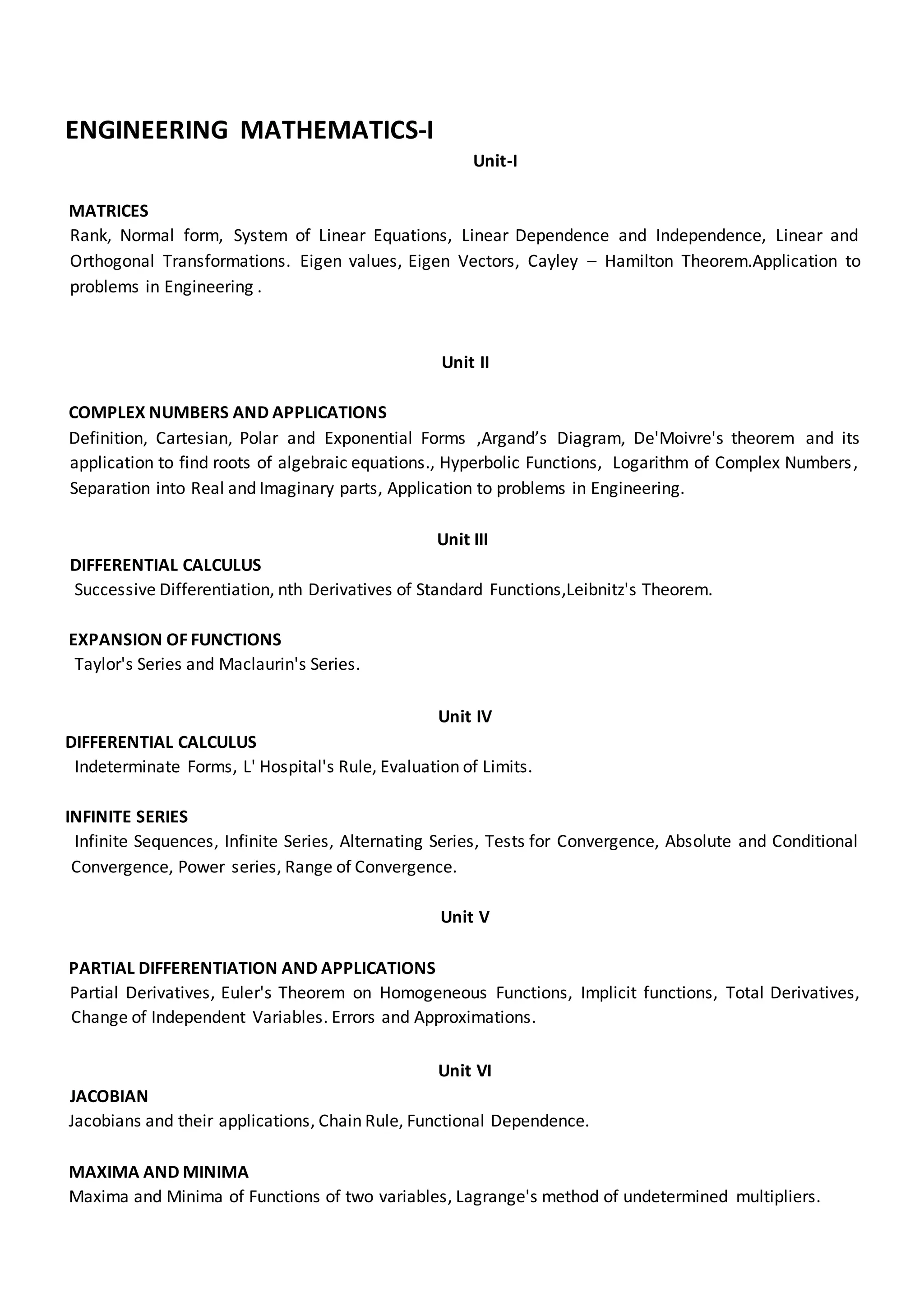
ENGINEERING MATHEMATICS-I
Unit-I
MATRICES
Rank, Normal form, System of Linear Equations, Linear Dependence and Independence, Linear and
Orthogonal Transformations. Eigen values, Eigen Vectors, Cayley – Hamilton Theorem.Application to
problems in Engineering .
Unit II
COMPLEX NUMBERS AND APPLICATIONS
Definition, Cartesian, Polar and Exponential Forms ,Argand’s Diagram, De'Moivre's theorem and its
application to find roots of algebraic equations., Hyperbolic Functions, Logarithm of Complex Numbers,
Separation into Real and Imaginary parts, Application to problems in Engineering.
Unit III
DIFFERENTIAL CALCULUS
Successive Differentiation, nth Derivatives of Standard Functions,Leibnitz's Theorem.
EXPANSION OF FUNCTIONS
Taylor's Series and Maclaurin's Series.
Unit IV
DIFFERENTIAL CALCULUS
Indeterminate Forms, L' Hospital's Rule, Evaluation of Limits.
INFINITE SERIES
Infinite Sequences, Infinite Series, Alternating Series, Tests for Convergence, Absolute and Conditional
Convergence, Power series, Range of Convergence.
Unit V
PARTIAL DIFFERENTIATION AND APPLICATIONS
Partial Derivatives, Euler's Theorem on Homogeneous Functions, Implicit functions, Total Derivatives,
Change of Independent Variables. Errors and Approximations.
Unit VI
JACOBIAN
Jacobians and their applications, Chain Rule, Functional Dependence.
MAXIMA AND MINIMA
Maxima and Minima of Functions of two variables, Lagrange's method of undetermined multipliers.
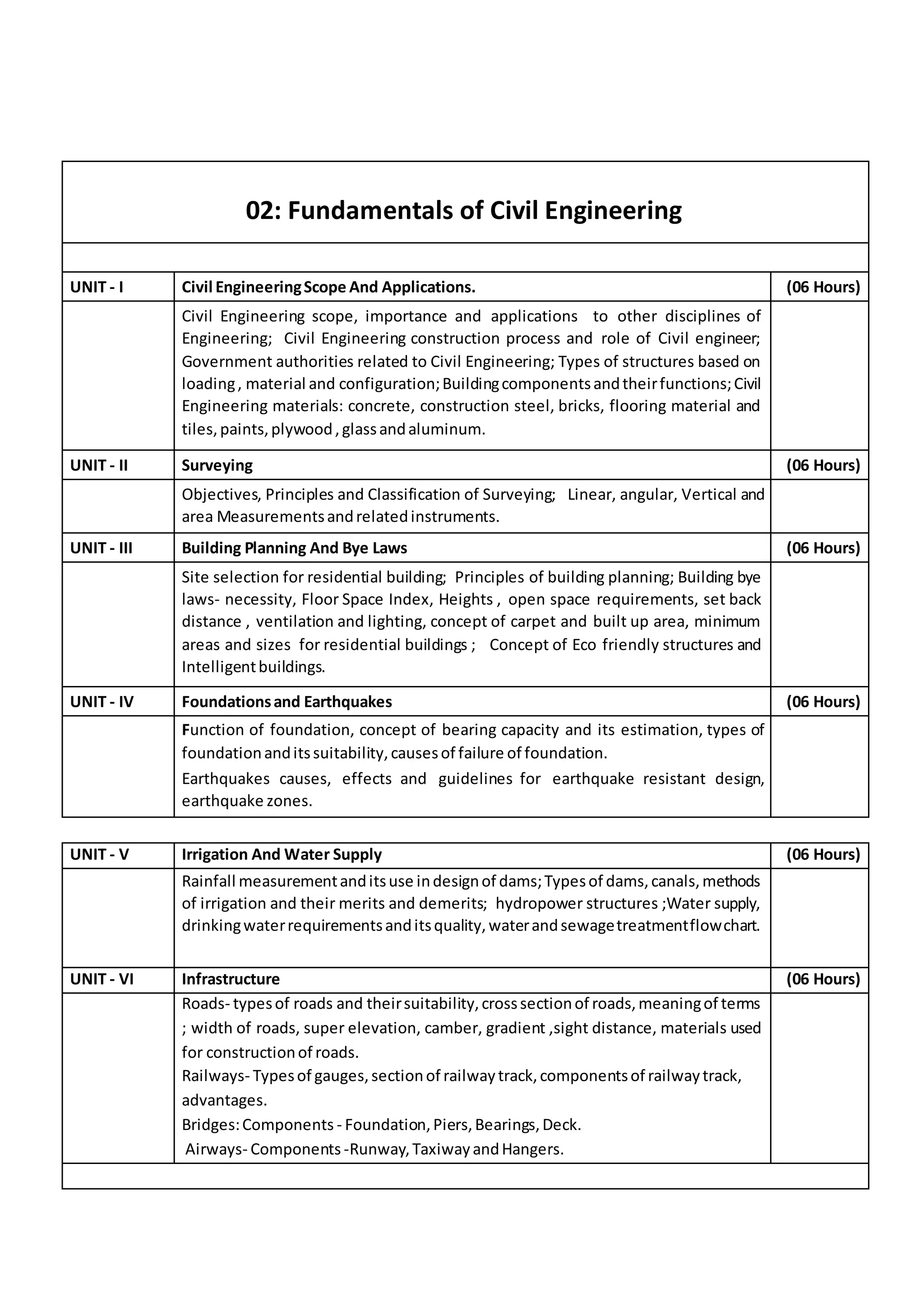
02: Fundamentals of Civil Engineering
UNIT - I Civil EngineeringScope And Applications. (06 Hours)
Civil Engineering scope, importance and applications to other disciplines of
Engineering; Civil Engineering construction process and role of Civil engineer;
Government authorities related to Civil Engineering; Types of structures based on
loading, material and configuration;Buildingcomponentsandtheirfunctions;Civil
Engineering materials: concrete, construction steel, bricks, flooring material and
tiles,paints,plywood,glassandaluminum.
UNIT - II Surveying (06 Hours)
Objectives, Principles and Classification of Surveying; Linear, angular, Vertical and
area Measurementsandrelatedinstruments.
UNIT - III Building Planning And Bye Laws (06 Hours)
Site selection for residential building; Principles of building planning; Building bye
laws- necessity, Floor Space Index, Heights , open space requirements, set back
distance , ventilation and lighting, concept of carpet and built up area, minimum
areas and sizes for residential buildings ; Concept of Eco friendly structures and
Intelligentbuildings.
UNIT - IV Foundationsand Earthquakes (06 Hours)
Function of foundation, concept of bearing capacity and its estimation, types of
foundationanditssuitability,causesof failure of foundation.
Earthquakes causes, effects and guidelines for earthquake resistant design,
earthquake zones.
UNIT - V Irrigation And Water Supply (06 Hours)
Rainfall measurementanditsuse indesignof dams;Typesof dams,canals,methods
of irrigation and their merits and demerits; hydropower structures ;Water supply,
drinkingwaterrequirementsanditsquality,waterandsewagetreatmentflowchart.
UNIT - VI Infrastructure (06 Hours)
Roads- typesof roads and theirsuitability,crosssectionof roads,meaningof terms
; width of roads, super elevation, camber, gradient ,sight distance, materials used
for constructionof roads.
Railways- Typesof gauges,sectionof railwaytrack,componentsof railwaytrack,
advantages.
Bridges:Components - Foundation,Piers,Bearings,Deck.
Airways- Components -Runway,TaxiwayandHangers.
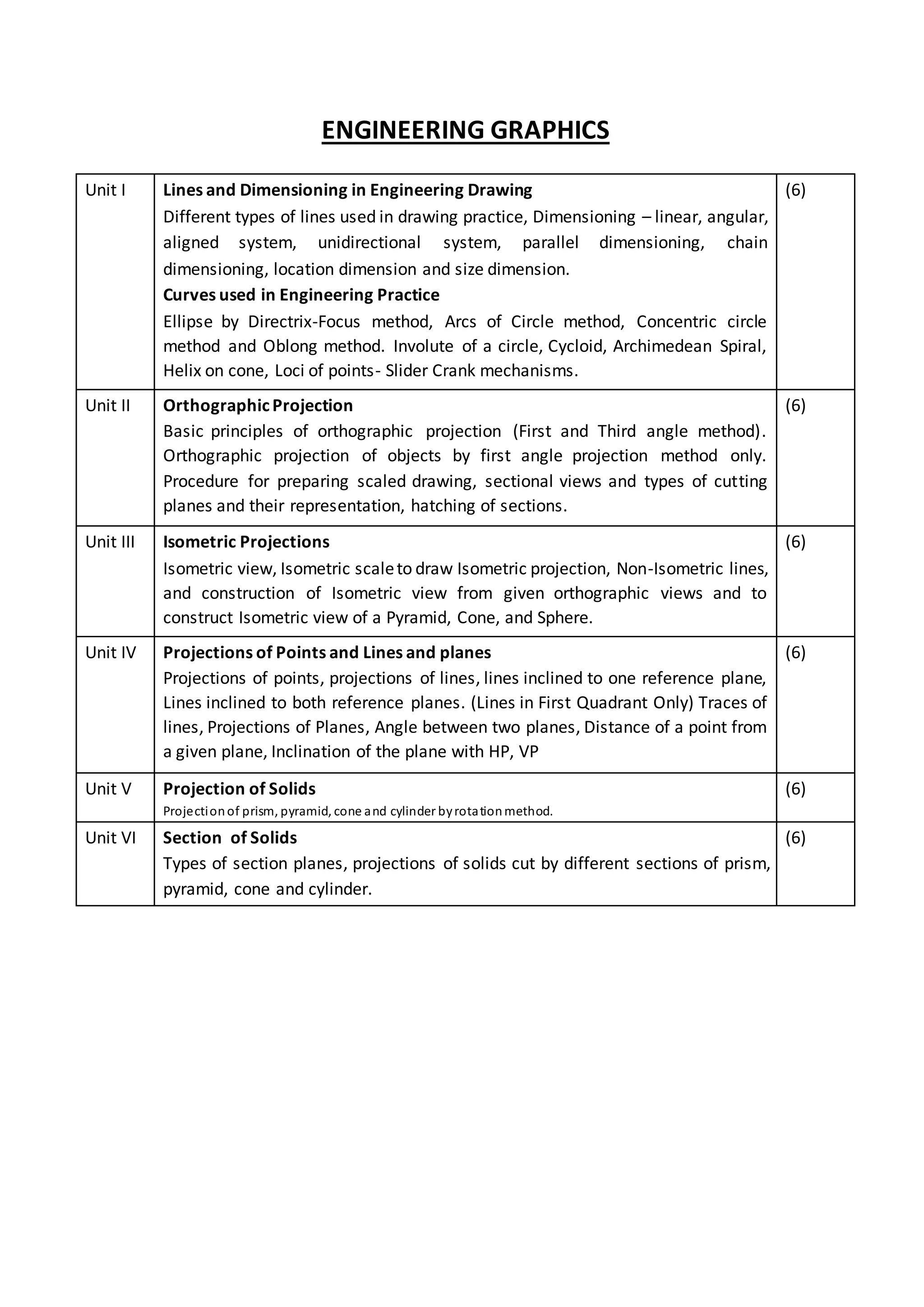
ENGINEERING GRAPHICS
Unit I Lines and Dimensioning in Engineering Drawing
Different types of lines used in drawing practice, Dimensioning – linear, angular,
aligned system, unidirectional system, parallel dimensioning, chain
dimensioning, location dimension and size dimension.
Curves used in Engineering Practice
Ellipse by Directrix-Focus method, Arcs of Circle method, Concentric circle
method and Oblong method. Involute of a circle, Cycloid, Archimedean Spiral,
Helix on cone, Loci of points- Slider Crank mechanisms.
(6)
Unit II OrthographicProjection
Basic principles of orthographic projection (First and Third angle method).
Orthographic projection of objects by first angle projection method only.
Procedure for preparing scaled drawing, sectional views and types of cutting
planes and their representation, hatching of sections.
(6)
Unit III Isometric Projections
Isometric view, Isometric scaleto draw Isometric projection, Non-Isometric lines,
and construction of Isometric view from given orthographic views and to
construct Isometric view of a Pyramid, Cone, and Sphere.
(6)
Unit IV Projections of Points and Lines and planes
Projections of points, projections of lines, lines inclined to one reference plane,
Lines inclined to both reference planes. (Lines in First Quadrant Only) Traces of
lines, Projections of Planes, Angle between two planes, Distance of a point from
a given plane, Inclination of the plane with HP, VP
(6)
Unit V Projection of Solids
Projectionof prism, pyramid, cone and cylinder byrotationmethod.
(6)
Unit VI Section of Solids
Types of section planes, projections of solids cut by different sections of prism,
pyramid, cone and cylinder.
(6)
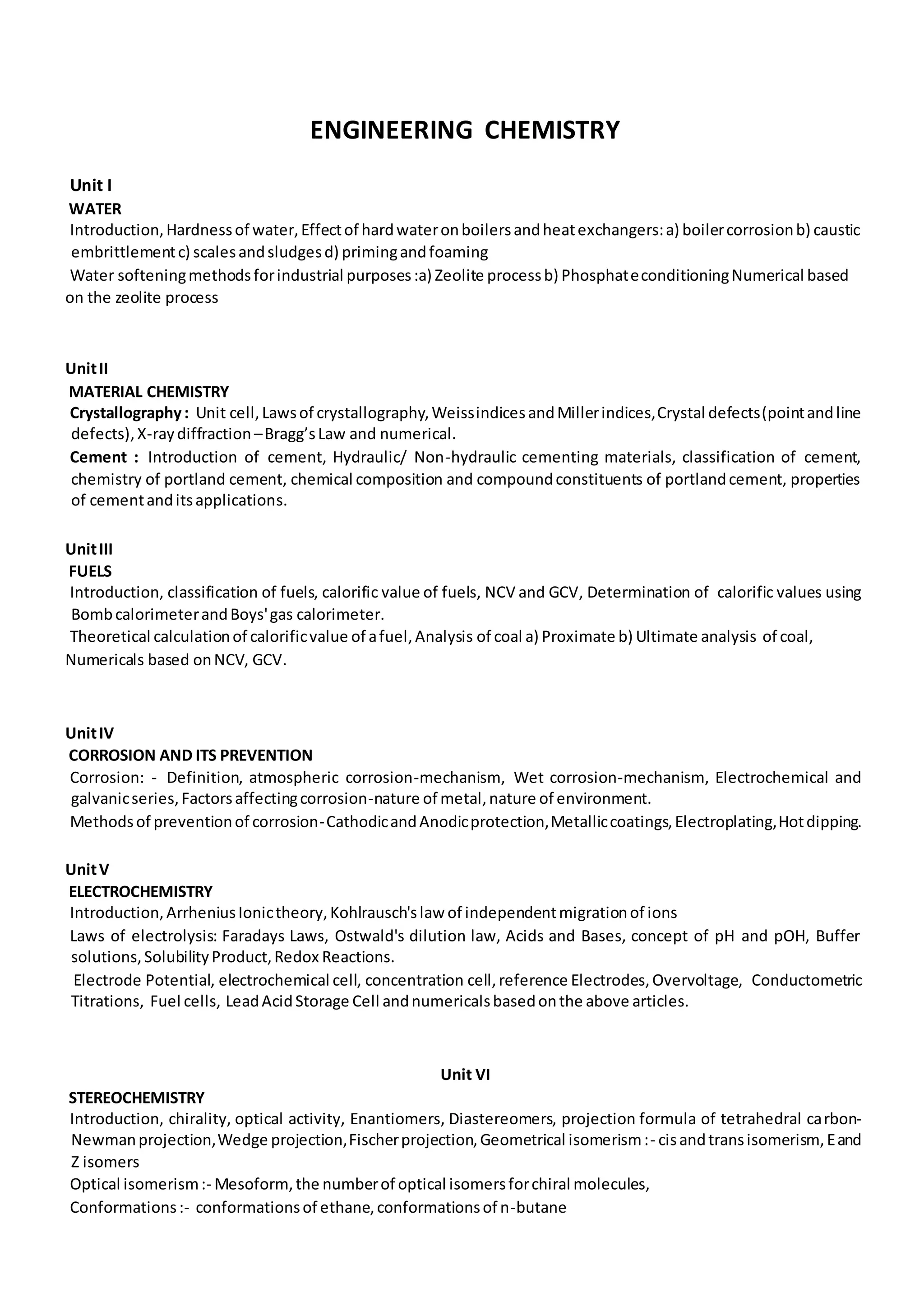
ENGINEERING CHEMISTRY
Unit I
WATER
Introduction,Hardnessof water,Effectof hardwateronboilersandheatexchangers:a) boilercorrosionb) caustic
embrittlementc) scalesandsludgesd) primingandfoaming
Water softeningmethodsforindustrial purposes:a) Zeolite processb) PhosphateconditioningNumerical based
on the zeolite process
UnitII
MATERIAL CHEMISTRY
Crystallography: Unit cell,Lawsof crystallography,WeissindicesandMillerindices,Crystal defects(pointandline
defects),X-raydiffraction –Bragg’sLaw and numerical.
Cement : Introduction of cement, Hydraulic/ Non-hydraulic cementing materials, classification of cement,
chemistry of portland cement, chemical composition and compoundconstituents of portlandcement, properties
of cementanditsapplications.
UnitIII
FUELS
Introduction, classification of fuels, calorific value of fuels, NCV and GCV, Determination of calorific values using
BombcalorimeterandBoys'gas calorimeter.
Theoretical calculationof calorificvalue of afuel,Analysis of coal a) Proximate b) Ultimate analysis of coal,
Numericals based onNCV, GCV.
UnitIV
CORROSION AND ITS PREVENTION
Corrosion: - Definition, atmospheric corrosion-mechanism, Wet corrosion-mechanism, Electrochemical and
galvanicseries,Factorsaffectingcorrosion-nature of metal,nature of environment.
Methodsof preventionof corrosion-CathodicandAnodicprotection,Metalliccoatings,Electroplating,Hotdipping.
UnitV
ELECTROCHEMISTRY
Introduction,ArrheniusIonictheory,Kohlrausch'slaw of independentmigrationof ions
Laws of electrolysis: Faradays Laws, Ostwald's dilution law, Acids and Bases, concept of pH and pOH, Buffer
solutions,SolubilityProduct,Redox Reactions.
Electrode Potential, electrochemical cell, concentration cell,reference Electrodes,Overvoltage, Conductometric
Titrations, Fuel cells, LeadAcidStorage Cell andnumericalsbasedonthe above articles.
Unit VI
STEREOCHEMISTRY
Introduction, chirality, optical activity, Enantiomers, Diastereomers, projection formula of tetrahedral carbon-
Newmanprojection,Wedge projection,Fischerprojection,Geometrical isomerism:- cisandtransisomerism,Eand
Z isomers
Optical isomerism:- Mesoform,the numberof optical isomersforchiral molecules,
Conformations:- conformationsof ethane,conformationsof n-butane
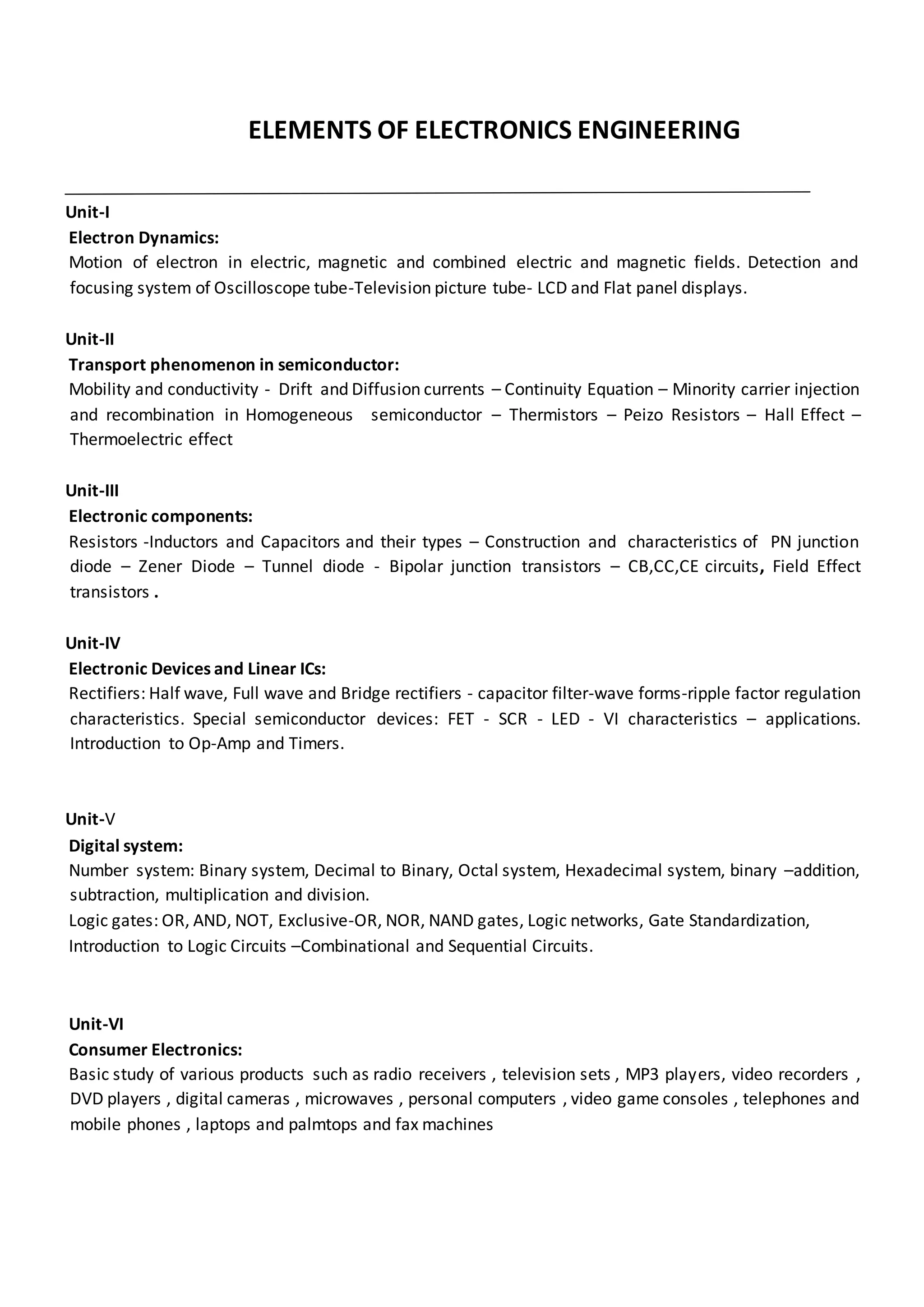
ELEMENTS OF ELECTRONICS ENGINEERING
Unit-I
Electron Dynamics:
Motion of electron in electric, magnetic and combined electric and magnetic fields. Detection and
focusing system of Oscilloscope tube-Television picture tube- LCD and Flat panel displays.
Unit-II
Transport phenomenon in semiconductor:
Mobility and conductivity - Drift and Diffusion currents – Continuity Equation – Minority carrier injection
and recombination in Homogeneous semiconductor – Thermistors – Peizo Resistors – Hall Effect –
Thermoelectric effect
Unit-III
Electronic components:
Resistors -Inductors and Capacitors and their types – Construction and characteristics of PN junction
diode – Zener Diode – Tunnel diode - Bipolar junction transistors – CB,CC,CE circuits, Field Effect
transistors .
Unit-IV
Electronic Devices and Linear ICs:
Rectifiers: Half wave, Full wave and Bridge rectifiers - capacitor filter-wave forms-ripple factor regulation
characteristics. Special semiconductor devices: FET - SCR - LED - VI characteristics – applications.
Introduction to Op-Amp and Timers.
Unit-V
Digital system:
Number system: Binary system, Decimal to Binary, Octal system, Hexadecimal system, binary –addition,
subtraction, multiplication and division.
Logic gates: OR, AND, NOT, Exclusive-OR, NOR, NAND gates, Logic networks, Gate Standardization,
Introduction to Logic Circuits –Combinational and Sequential Circuits.
Unit-VI
Consumer Electronics:
Basic study of various products such as radio receivers , television sets , MP3 players, video recorders ,
DVD players , digital cameras , microwaves , personal computers , video game consoles , telephones and
mobile phones , laptops and palmtops and fax machines

B tech sem 1 syllabus

  • 1.
    ENGINEERING MATHEMATICS-I Unit-I MATRICES Rank, Normalform, System of Linear Equations, Linear Dependence and Independence, Linear and Orthogonal Transformations. Eigen values, Eigen Vectors, Cayley – Hamilton Theorem.Application to problems in Engineering . Unit II COMPLEX NUMBERS AND APPLICATIONS Definition, Cartesian, Polar and Exponential Forms ,Argand’s Diagram, De'Moivre's theorem and its application to find roots of algebraic equations., Hyperbolic Functions, Logarithm of Complex Numbers, Separation into Real and Imaginary parts, Application to problems in Engineering. Unit III DIFFERENTIAL CALCULUS Successive Differentiation, nth Derivatives of Standard Functions,Leibnitz's Theorem. EXPANSION OF FUNCTIONS Taylor's Series and Maclaurin's Series. Unit IV DIFFERENTIAL CALCULUS Indeterminate Forms, L' Hospital's Rule, Evaluation of Limits. INFINITE SERIES Infinite Sequences, Infinite Series, Alternating Series, Tests for Convergence, Absolute and Conditional Convergence, Power series, Range of Convergence. Unit V PARTIAL DIFFERENTIATION AND APPLICATIONS Partial Derivatives, Euler's Theorem on Homogeneous Functions, Implicit functions, Total Derivatives, Change of Independent Variables. Errors and Approximations. Unit VI JACOBIAN Jacobians and their applications, Chain Rule, Functional Dependence. MAXIMA AND MINIMA Maxima and Minima of Functions of two variables, Lagrange's method of undetermined multipliers.
  • 2.
    02: Fundamentals ofCivil Engineering UNIT - I Civil EngineeringScope And Applications. (06 Hours) Civil Engineering scope, importance and applications to other disciplines of Engineering; Civil Engineering construction process and role of Civil engineer; Government authorities related to Civil Engineering; Types of structures based on loading, material and configuration;Buildingcomponentsandtheirfunctions;Civil Engineering materials: concrete, construction steel, bricks, flooring material and tiles,paints,plywood,glassandaluminum. UNIT - II Surveying (06 Hours) Objectives, Principles and Classification of Surveying; Linear, angular, Vertical and area Measurementsandrelatedinstruments. UNIT - III Building Planning And Bye Laws (06 Hours) Site selection for residential building; Principles of building planning; Building bye laws- necessity, Floor Space Index, Heights , open space requirements, set back distance , ventilation and lighting, concept of carpet and built up area, minimum areas and sizes for residential buildings ; Concept of Eco friendly structures and Intelligentbuildings. UNIT - IV Foundationsand Earthquakes (06 Hours) Function of foundation, concept of bearing capacity and its estimation, types of foundationanditssuitability,causesof failure of foundation. Earthquakes causes, effects and guidelines for earthquake resistant design, earthquake zones. UNIT - V Irrigation And Water Supply (06 Hours) Rainfall measurementanditsuse indesignof dams;Typesof dams,canals,methods of irrigation and their merits and demerits; hydropower structures ;Water supply, drinkingwaterrequirementsanditsquality,waterandsewagetreatmentflowchart. UNIT - VI Infrastructure (06 Hours) Roads- typesof roads and theirsuitability,crosssectionof roads,meaningof terms ; width of roads, super elevation, camber, gradient ,sight distance, materials used for constructionof roads. Railways- Typesof gauges,sectionof railwaytrack,componentsof railwaytrack, advantages. Bridges:Components - Foundation,Piers,Bearings,Deck. Airways- Components -Runway,TaxiwayandHangers.
  • 3.
    ENGINEERING GRAPHICS Unit ILines and Dimensioning in Engineering Drawing Different types of lines used in drawing practice, Dimensioning – linear, angular, aligned system, unidirectional system, parallel dimensioning, chain dimensioning, location dimension and size dimension. Curves used in Engineering Practice Ellipse by Directrix-Focus method, Arcs of Circle method, Concentric circle method and Oblong method. Involute of a circle, Cycloid, Archimedean Spiral, Helix on cone, Loci of points- Slider Crank mechanisms. (6) Unit II OrthographicProjection Basic principles of orthographic projection (First and Third angle method). Orthographic projection of objects by first angle projection method only. Procedure for preparing scaled drawing, sectional views and types of cutting planes and their representation, hatching of sections. (6) Unit III Isometric Projections Isometric view, Isometric scaleto draw Isometric projection, Non-Isometric lines, and construction of Isometric view from given orthographic views and to construct Isometric view of a Pyramid, Cone, and Sphere. (6) Unit IV Projections of Points and Lines and planes Projections of points, projections of lines, lines inclined to one reference plane, Lines inclined to both reference planes. (Lines in First Quadrant Only) Traces of lines, Projections of Planes, Angle between two planes, Distance of a point from a given plane, Inclination of the plane with HP, VP (6) Unit V Projection of Solids Projectionof prism, pyramid, cone and cylinder byrotationmethod. (6) Unit VI Section of Solids Types of section planes, projections of solids cut by different sections of prism, pyramid, cone and cylinder. (6)
  • 4.
    ENGINEERING CHEMISTRY Unit I WATER Introduction,Hardnessofwater,Effectof hardwateronboilersandheatexchangers:a) boilercorrosionb) caustic embrittlementc) scalesandsludgesd) primingandfoaming Water softeningmethodsforindustrial purposes:a) Zeolite processb) PhosphateconditioningNumerical based on the zeolite process UnitII MATERIAL CHEMISTRY Crystallography: Unit cell,Lawsof crystallography,WeissindicesandMillerindices,Crystal defects(pointandline defects),X-raydiffraction –Bragg’sLaw and numerical. Cement : Introduction of cement, Hydraulic/ Non-hydraulic cementing materials, classification of cement, chemistry of portland cement, chemical composition and compoundconstituents of portlandcement, properties of cementanditsapplications. UnitIII FUELS Introduction, classification of fuels, calorific value of fuels, NCV and GCV, Determination of calorific values using BombcalorimeterandBoys'gas calorimeter. Theoretical calculationof calorificvalue of afuel,Analysis of coal a) Proximate b) Ultimate analysis of coal, Numericals based onNCV, GCV. UnitIV CORROSION AND ITS PREVENTION Corrosion: - Definition, atmospheric corrosion-mechanism, Wet corrosion-mechanism, Electrochemical and galvanicseries,Factorsaffectingcorrosion-nature of metal,nature of environment. Methodsof preventionof corrosion-CathodicandAnodicprotection,Metalliccoatings,Electroplating,Hotdipping. UnitV ELECTROCHEMISTRY Introduction,ArrheniusIonictheory,Kohlrausch'slaw of independentmigrationof ions Laws of electrolysis: Faradays Laws, Ostwald's dilution law, Acids and Bases, concept of pH and pOH, Buffer solutions,SolubilityProduct,Redox Reactions. Electrode Potential, electrochemical cell, concentration cell,reference Electrodes,Overvoltage, Conductometric Titrations, Fuel cells, LeadAcidStorage Cell andnumericalsbasedonthe above articles. Unit VI STEREOCHEMISTRY Introduction, chirality, optical activity, Enantiomers, Diastereomers, projection formula of tetrahedral carbon- Newmanprojection,Wedge projection,Fischerprojection,Geometrical isomerism:- cisandtransisomerism,Eand Z isomers Optical isomerism:- Mesoform,the numberof optical isomersforchiral molecules, Conformations:- conformationsof ethane,conformationsof n-butane
  • 5.
    ELEMENTS OF ELECTRONICSENGINEERING Unit-I Electron Dynamics: Motion of electron in electric, magnetic and combined electric and magnetic fields. Detection and focusing system of Oscilloscope tube-Television picture tube- LCD and Flat panel displays. Unit-II Transport phenomenon in semiconductor: Mobility and conductivity - Drift and Diffusion currents – Continuity Equation – Minority carrier injection and recombination in Homogeneous semiconductor – Thermistors – Peizo Resistors – Hall Effect – Thermoelectric effect Unit-III Electronic components: Resistors -Inductors and Capacitors and their types – Construction and characteristics of PN junction diode – Zener Diode – Tunnel diode - Bipolar junction transistors – CB,CC,CE circuits, Field Effect transistors . Unit-IV Electronic Devices and Linear ICs: Rectifiers: Half wave, Full wave and Bridge rectifiers - capacitor filter-wave forms-ripple factor regulation characteristics. Special semiconductor devices: FET - SCR - LED - VI characteristics – applications. Introduction to Op-Amp and Timers. Unit-V Digital system: Number system: Binary system, Decimal to Binary, Octal system, Hexadecimal system, binary –addition, subtraction, multiplication and division. Logic gates: OR, AND, NOT, Exclusive-OR, NOR, NAND gates, Logic networks, Gate Standardization, Introduction to Logic Circuits –Combinational and Sequential Circuits. Unit-VI Consumer Electronics: Basic study of various products such as radio receivers , television sets , MP3 players, video recorders , DVD players , digital cameras , microwaves , personal computers , video game consoles , telephones and mobile phones , laptops and palmtops and fax machines