Beatriz Pont
Education Policy
Visiting Researcher, LIEPP, Science Po
October 14, 2015
20th Annual Boisi Lecture in Education & Public Policy
Center for the Study of Testing, Evaluation
and Education Policy
An international perspective on
educational change strategies
for equity and quality
2
From policy making to the classroom: a far reach
Purpose:
Review OECD education reforms related
to equity and quality to understand
change strategies
Sources: PISA; OECD edu policy outlook
Findings:
Focus on key policy areas. Volume and
speed of reforms.
Lack of clarity in change strategies. Gap
between expectations and
implementation.
Conclusions:
High expectations: matched with policy
capacity to reach the classrooms?
Need to focus on vision, implementation
and evaluation of reforms.
An overview of change and reforms in
education
Policies for equity and quality in
education
Results and conclusions: A gap between
policies, expectations and capacity to
reach meaningful change?
An international perspective on education reforms
for equity and quality
4
Common
core;
Funding
grants
Subsidies for
disadvantaged
schools Reforms in
school leadership
and teachers
Support to
students
from specific
populations
Setting national
priorities for
education
New middle
school reform
National
commitment to
ECEC
School
improvement
VET
reforms
Teacher training
reform
School
evaluation
reform
Student
funding
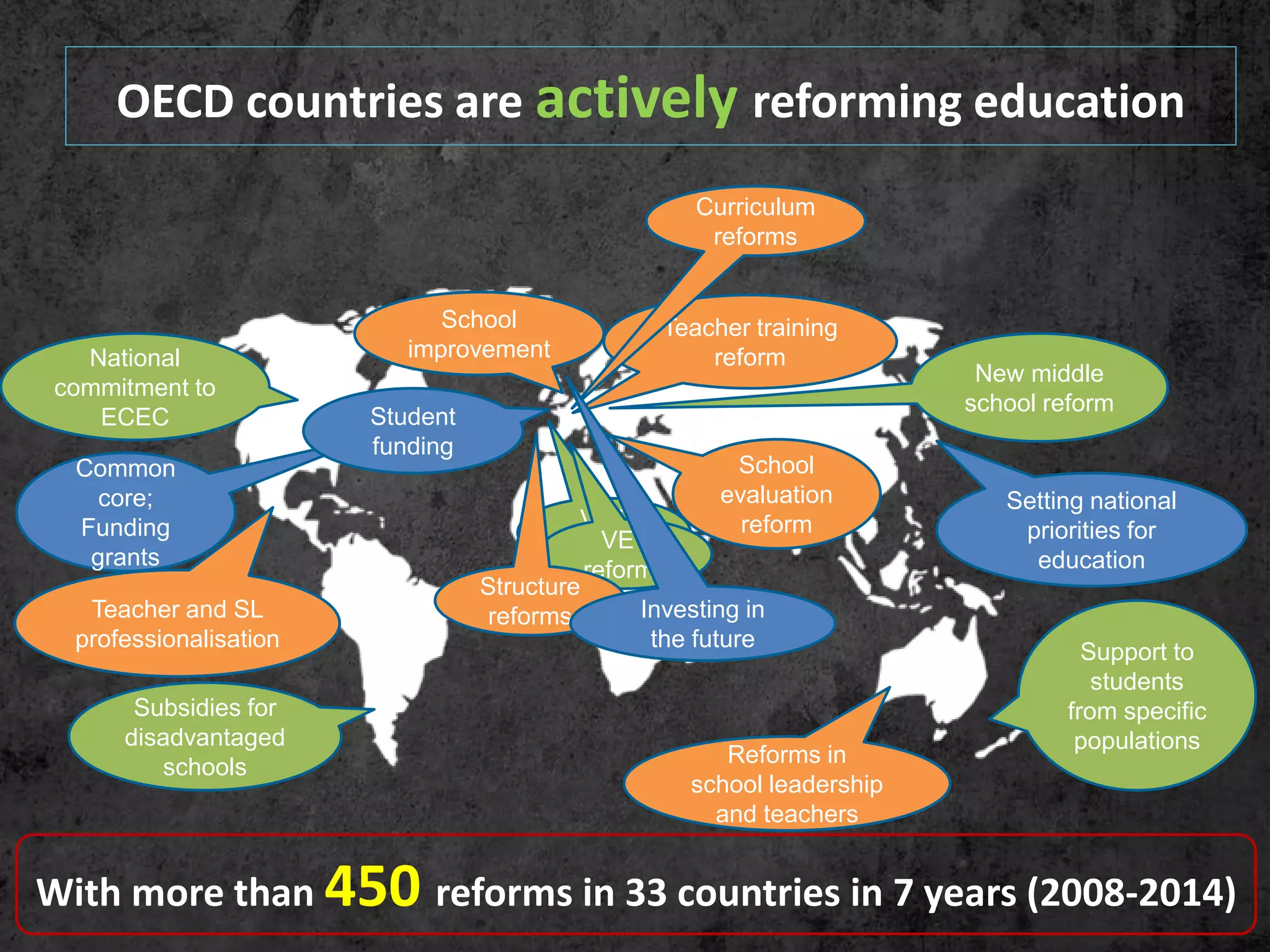
With more than 450 reforms in 33 countries in 7 years (2008-2014)
OECD countries are actively reforming education
VET
reforms
Curriculum
reforms
Structure
reformsTeacher and SL
professionalisation
Investing in
the future
0
10
20
30
40
50
60
70
80
Mexico
Turkey
Greece
Hungary
SlovakRepublic
Sweden
UnitedStates
Portugal
Italy
Luxembourg
Spain
NewZealand
France
Norway
OECDaverage2003
Iceland
CzechRepublic
Australia
Belgium
Austria
Germany
Ireland
Denmark
Netherlands
Poland
Canada
Switzerland
Finland
Japan
Korea
% of students
below proficiency
Level 2
Percentage of students below Level 2 in 2012
Percentage of students below Level 2 in 2003
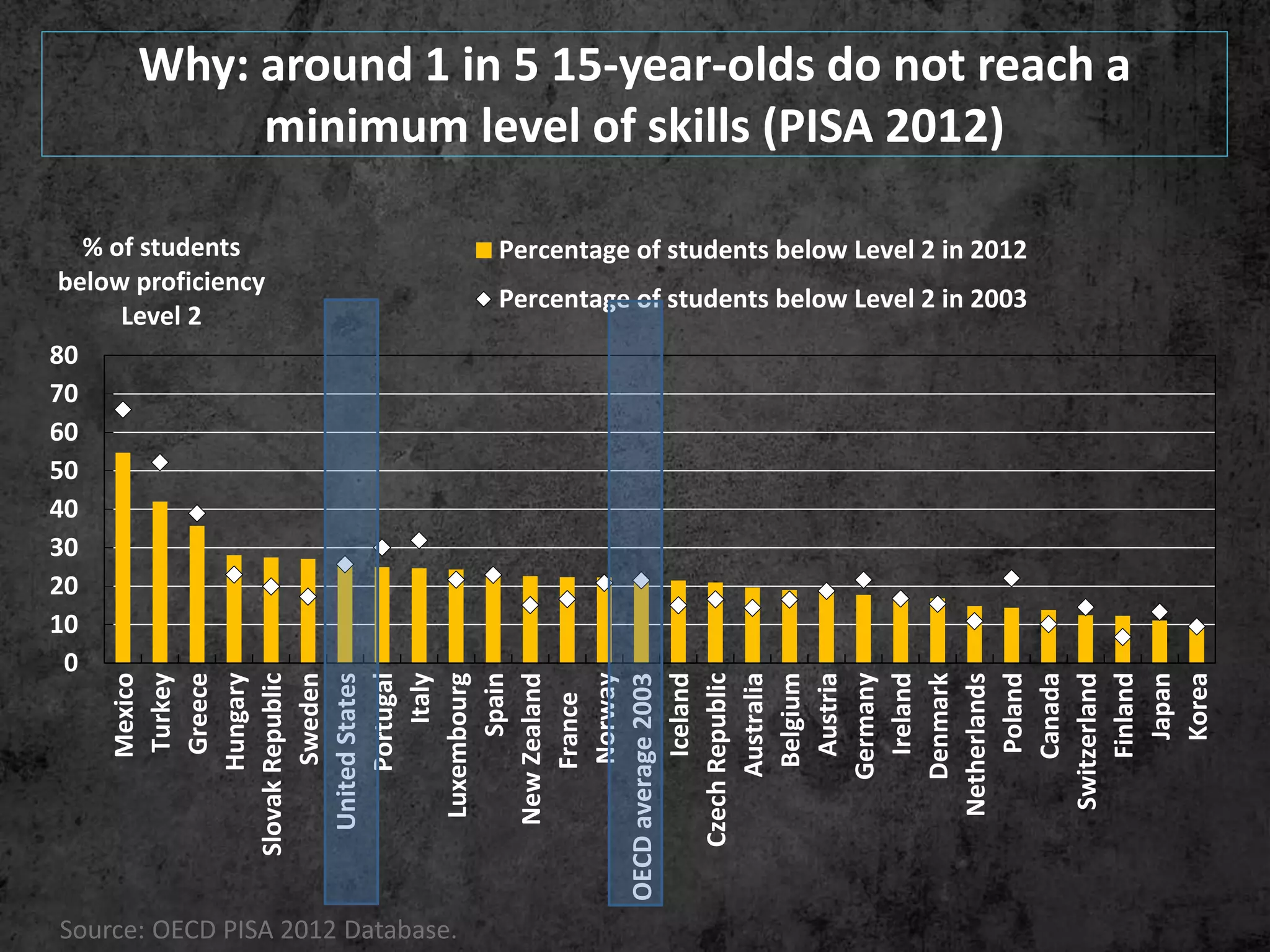
Why: around 1 in 5 15-year-olds do not reach a
minimum level of skills (PISA 2012)
Source: OECD PISA 2012 Database.
0
20
40
60
80
100
Mexico
Turkey
Portugal
Spain
Italy
Iceland
Chile1
NewZealand
Denmark
Belgium
Norway
OECDaverage
Greece
Netherlands
France
UnitedKingdom
Ireland
Luxembourg
Estonia
Australia
Germany
Hungary
Austria
UnitedStates
Switzerland
Finland
Israel
Sweden
Canada
CzechRepublic
SlovakRepublic
Slovenia
Poland
Korea
% 25-34 55-64
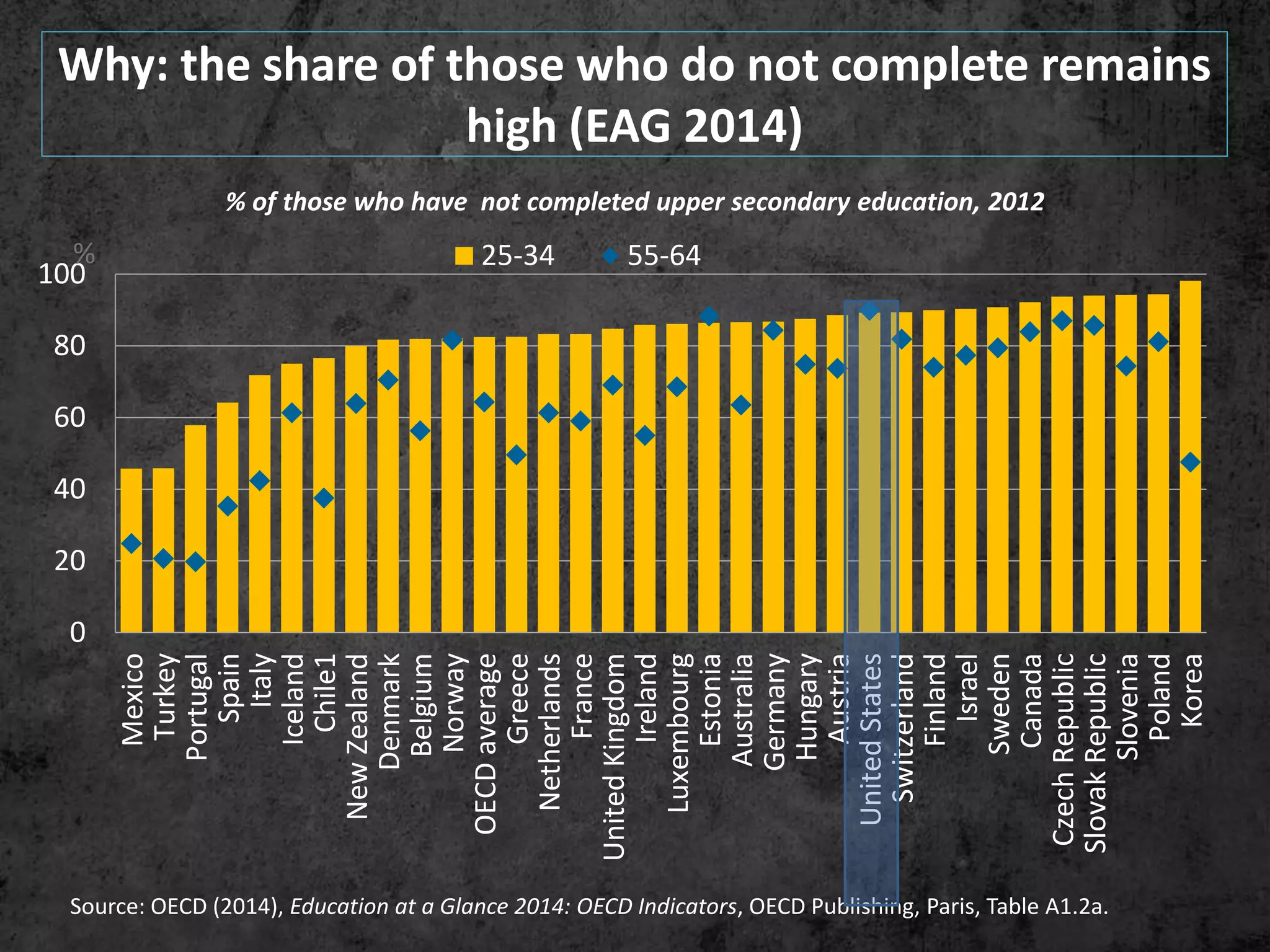
Why: the share of those who do not complete remains
high (EAG 2014)
% of those who have not completed upper secondary education, 2012
Source: OECD (2014), Education at a Glance 2014: OECD Indicators, OECD Publishing, Paris, Table A1.2a.
11
5 7
9 10
5
7 6
4
17
5 6
4
13
5
11
14
7
16
13
10 11
25
8
26
16
8 8
12
4 4 5 5
10
6
15
20
12
27
9
6
12
10
7
17
9 7
19
13
5
8
8
5
5
6
9 7
8
8
7
6
6 8
8
6 6
0
8
4
2
0
5
10
15
20
25
30
35
40
Colombia
Mexico
Israel
Turkey
UnitedKingdom
Austria
UnitedStates
NewZealand
Norway
Italy
Australia
Canada
Korea
Hungary
Switzerland
Belgium
Ireland
Sweden
SlovakRepublic
France
OECDaverage
Latvia
Spain
Estonia
Greece
Portugal
CzechRepublic
Finland
Poland
Germany
Netherlands
Iceland
Denmark
Slovenia
Luxembourg
Unemployed Inactive
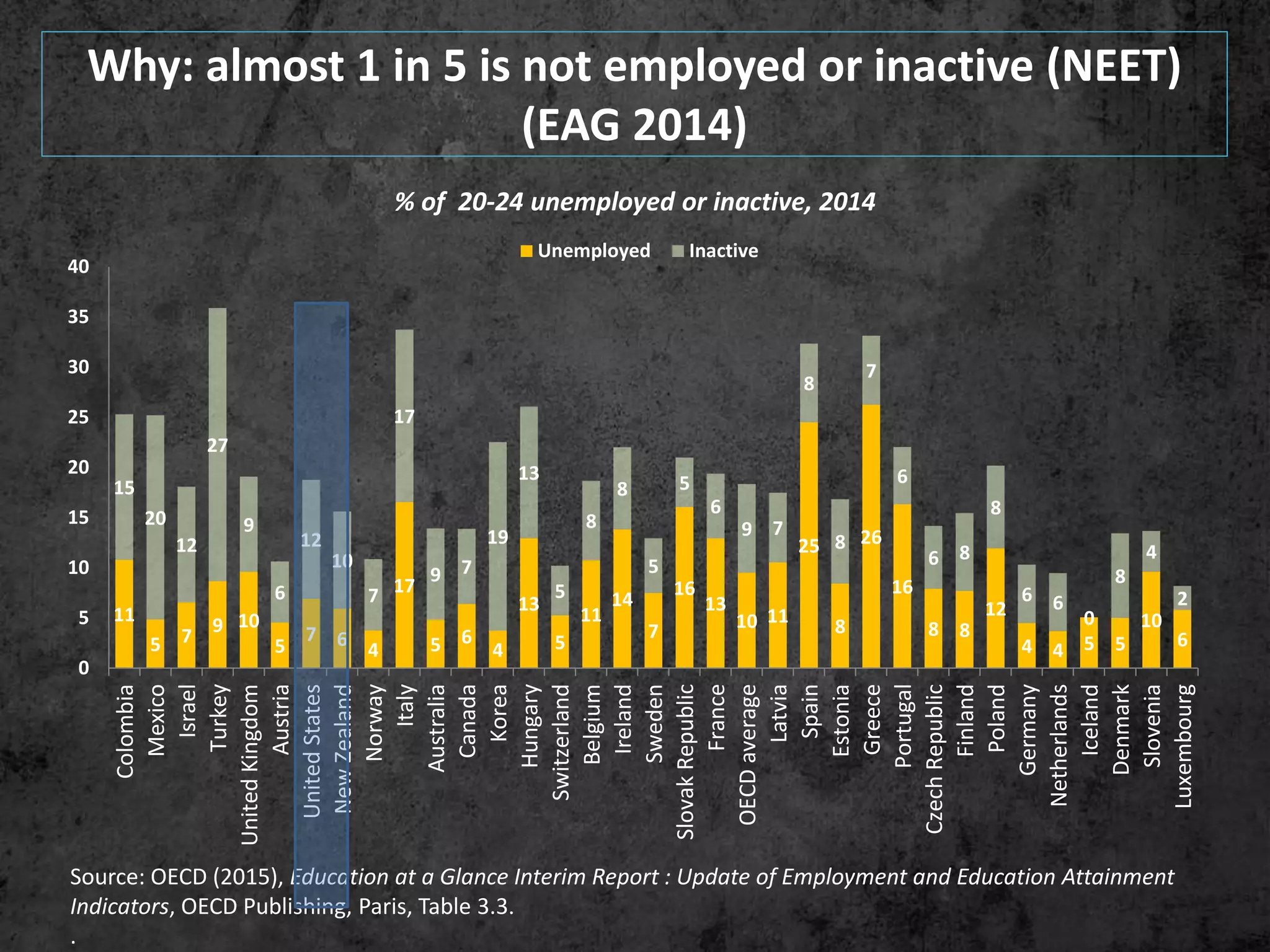
Why: almost 1 in 5 is not employed or inactive (NEET)
(EAG 2014)
% of 20-24 unemployed or inactive, 2014
Source: OECD (2015), Education at a Glance Interim Report : Update of Employment and Education Attainment
Indicators, OECD Publishing, Paris, Table 3.3.
.
0.0
0.5
1.0
1.5
2.0
2.5
3.0
Hungary
NewZealand
France
Israel
Belgium
Germany
Luxembourg
Chile
Denmark
Austria
Portugal
CzechRepublic
Spain
Poland
OECDaverage
Australia
Ireland
Switzerland
Greece
Slovenia
UnitedStates
Netherlands
Japan
Sweden
Italy
Finland
United…
Mexico
Canada
Norway
Turkey
Korea
Iceland
Estonia
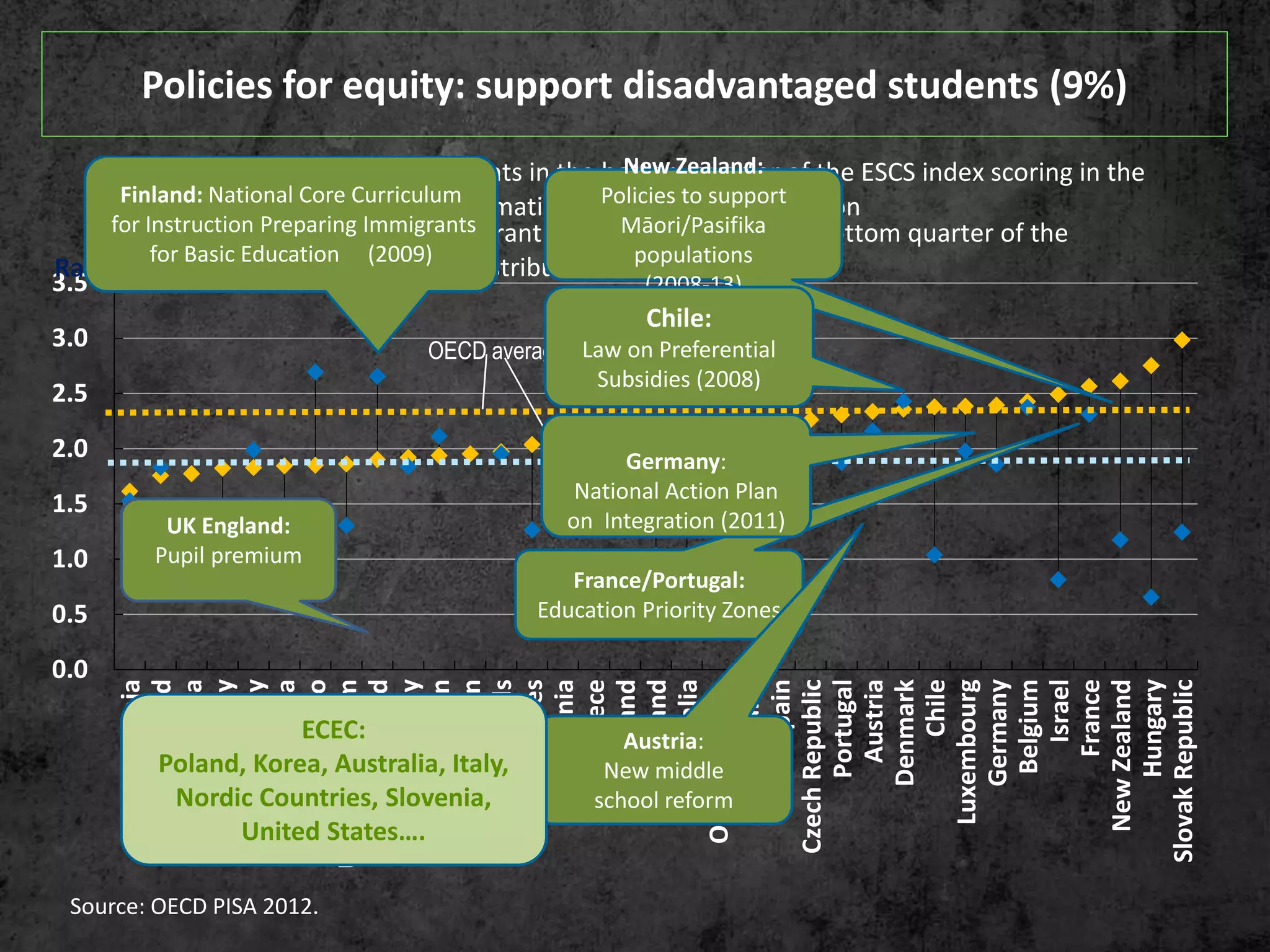
Students in the bottom quarter of the ESCS index Immigrant students
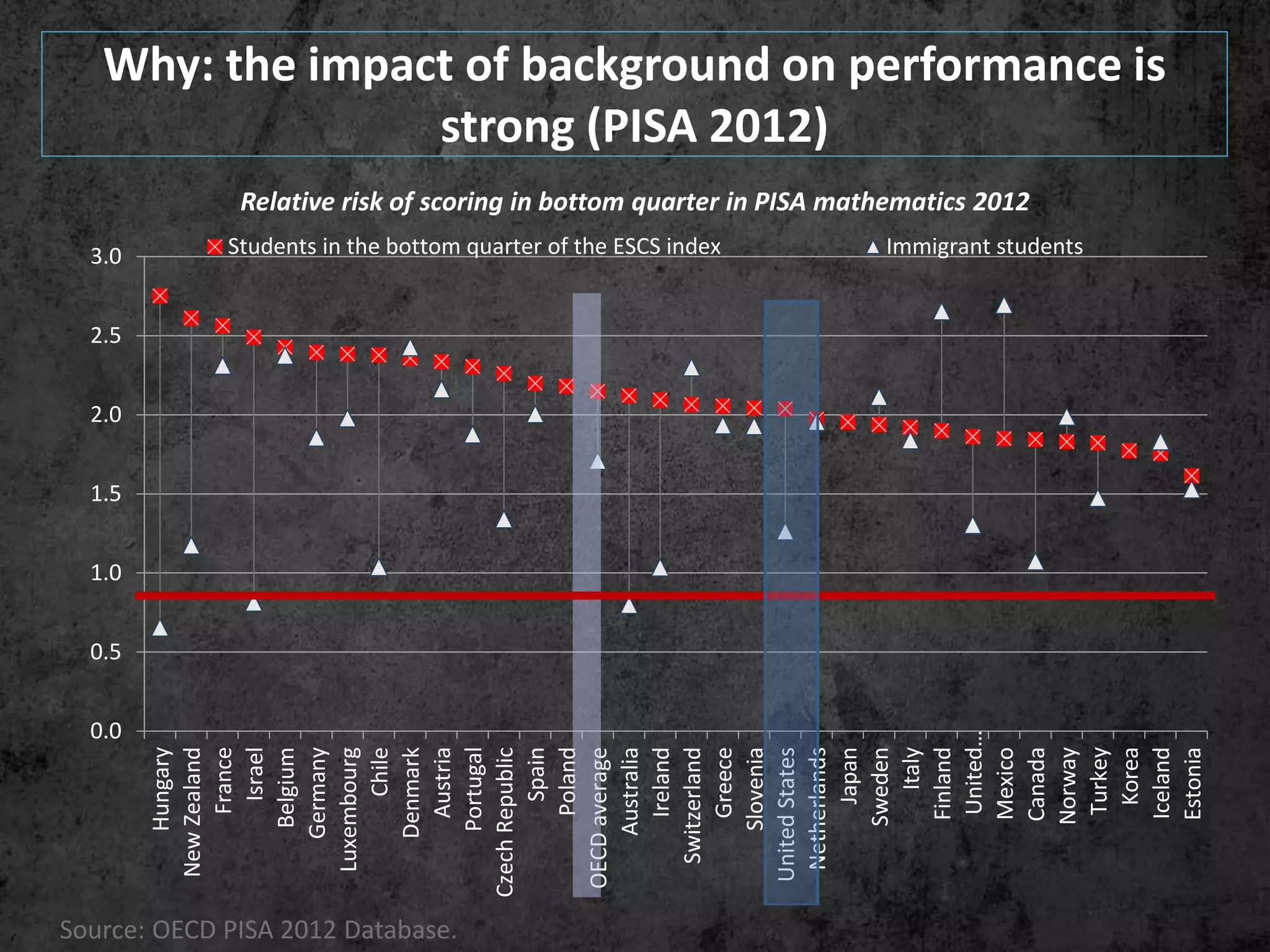
Why: the impact of background on performance is
strong (PISA 2012)
Source: OECD PISA 2012 Database.
Relative risk of scoring in bottom quarter in PISA mathematics 2012
USA
Poland
New Zealand
Greece
UK
Estonia
Finland
Slovak Rep.
Luxembourg
Germany
Austria
Czech Rep.
France
Japan
Turkey
Sweden
Hungary
Australia
Israel
Canada
Ireland
Chile
Belgium
Netherlands
Spain
Denmark
Switzerland
Iceland
Slovenia
Portugal
Norway
Mexico
Korea
Italy
R² = 0.30
R² = 0.33
350
400
450
500
550
600
650
-0.5-0.3-0.10.10.30.50.70.91.11.31.5
Mathematicsperformance(scorepoints)
Equity in resource allocation
(index-point difference)
-
Less equity
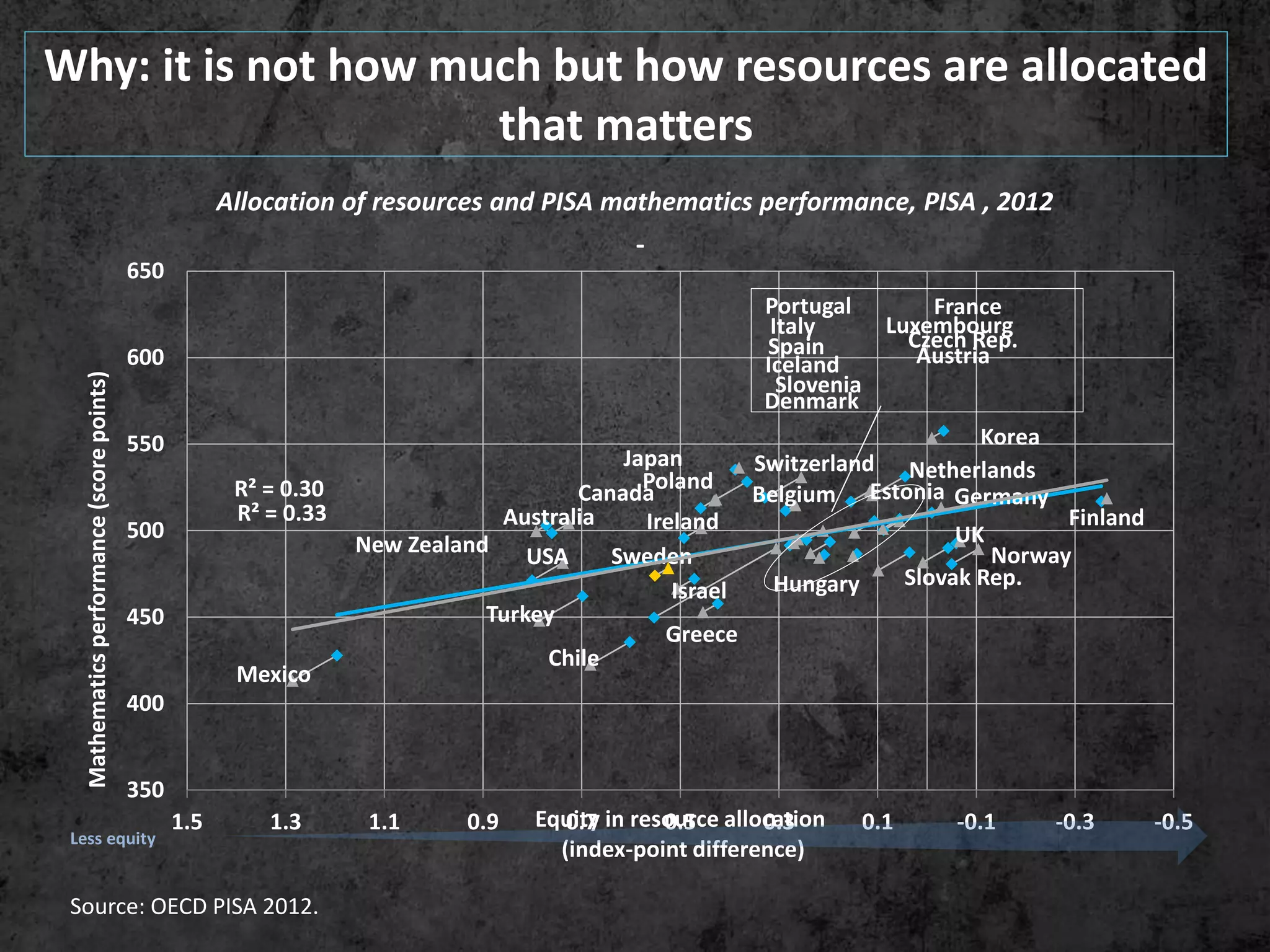
Why: it is not how much but how resources are allocated
that matters
Allocation of resources and PISA mathematics performance, PISA , 2012
Source: OECD PISA 2012.
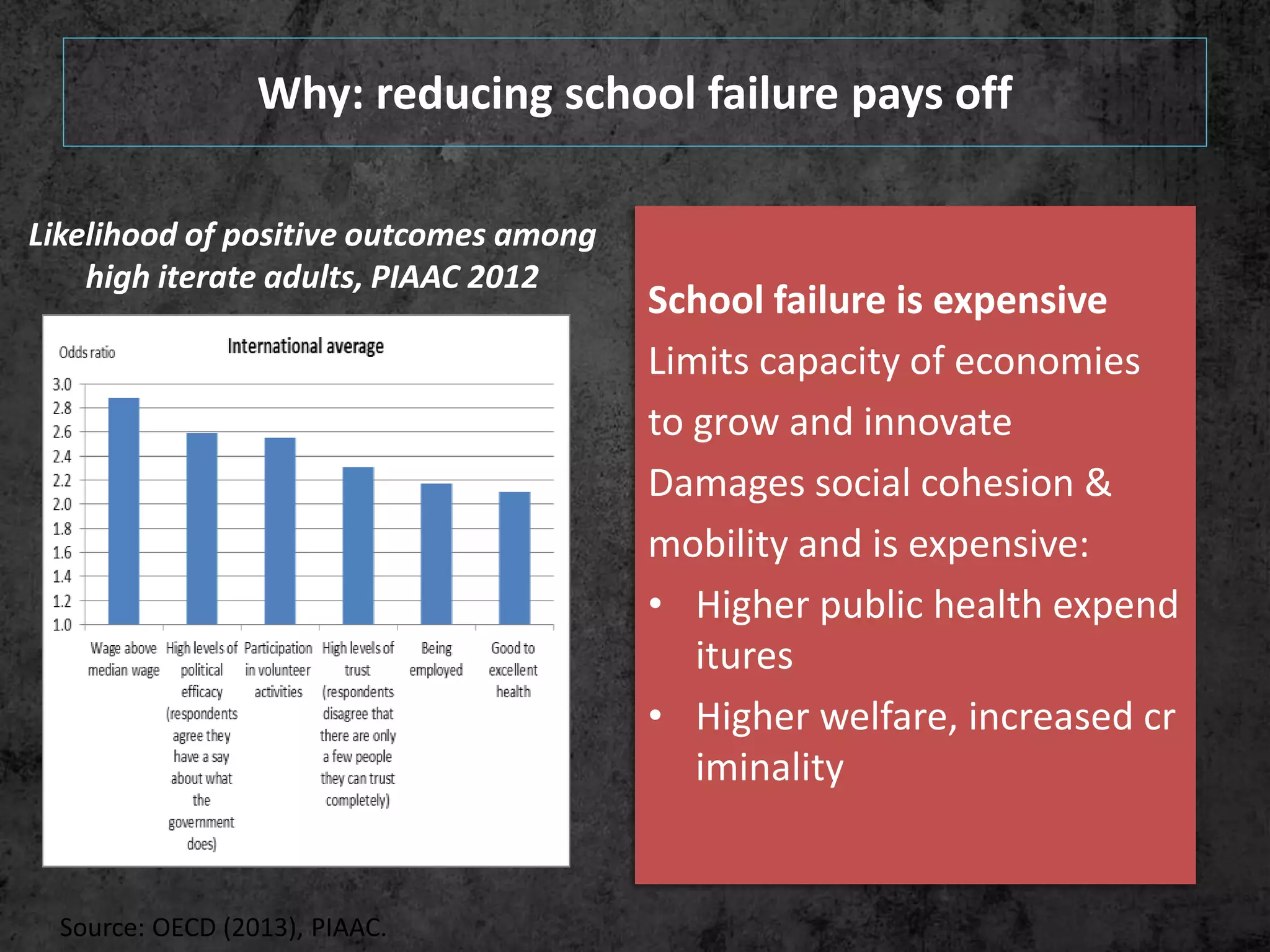
Why: reducing school failure pays off
School failure is expensive
Limits capacity of economies
to grow and innovate
Damages social cohesion &
mobility and is expensive:
• Higher public health expend
itures
• Higher welfare, increased cr
iminality
Source: OECD (2013), PIAAC.
Likelihood of positive outcomes among
high iterate adults, PIAAC 2012
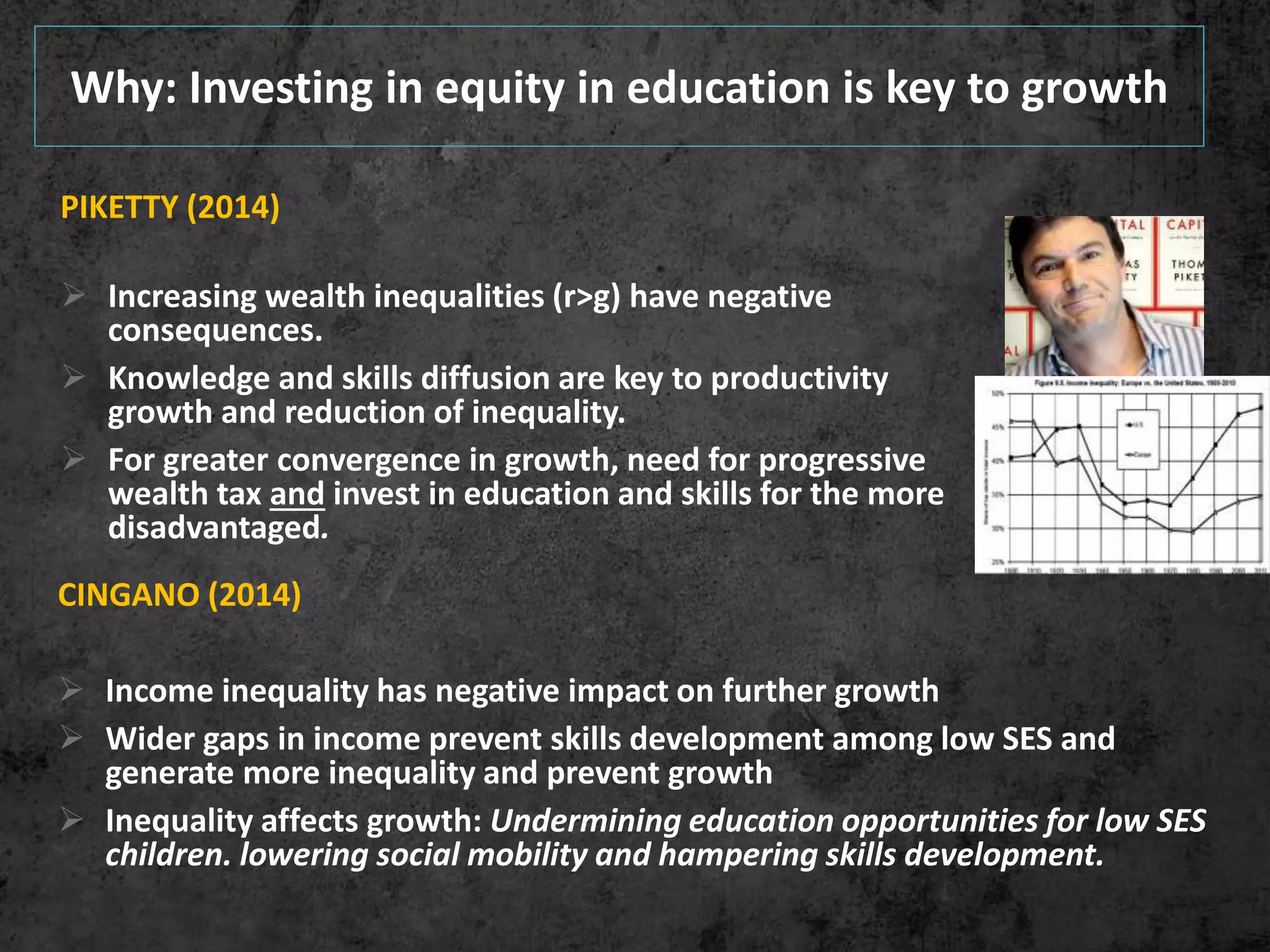
Why: Investing in equity in education is key to growth
PIKETTY (2014)
 Increasing wealth inequalities (r>g) have negative
consequences.
 Knowledge and skills diffusion are key to productivity
growth and reduction of inequality.
 For greater convergence in growth, need for progressive
wealth tax and invest in education and skills for the more
disadvantaged.
CINGANO (2014)
 Income inequality has negative impact on further growth
 Wider gaps in income prevent skills development among low SES and
generate more inequality and prevent growth
 Inequality affects growth: Undermining education opportunities for low SES
children. lowering social mobility and hampering skills development.
Chile
Hungary
Slovak Republic
Portugal Luxembourg
France New Zealand
Belgium
Israel
Germany
TurkeyGreece
Spain
United Kingdom
Czech Republic
Denmark
Slovenia
Ireland
Austria
Switzerland
Poland
United States
Netherlands
EstoniaFinland
Japan
Sweden
Australia Canada
Iceland
Norway
Mexico
Korea
Italy
350
400
450
500
550
600
051015202530
Puntuaciónmediaenmatemáticas
Porcentaje de variación en el rendimiento explicado por el índice PISA de los derechos económicos, sociales y culturales status
OECD
average
OECD
average
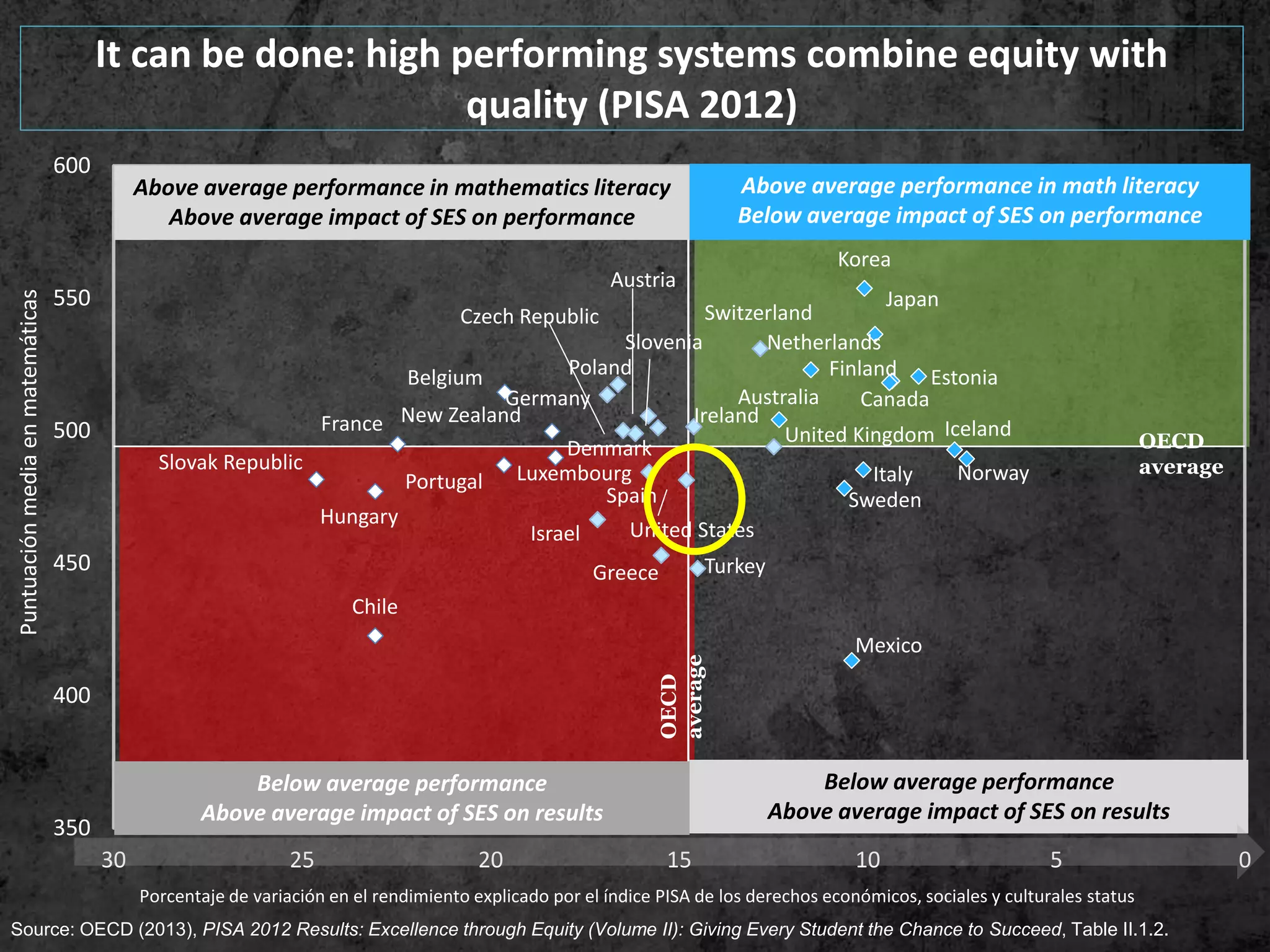
Above average performance in mathematics literacy
Above average impact of SES on performance
Above average performance in math literacy
Below average impact of SES on performance
Below average performance
Above average impact of SES on results
Below average performance
Above average impact of SES on results
Source: OECD (2013), PISA 2012 Results: Excellence through Equity (Volume II): Giving Every Student the Chance to Succeed, Table II.1.2.
It can be done: high performing systems combine equity with
quality (PISA 2012)
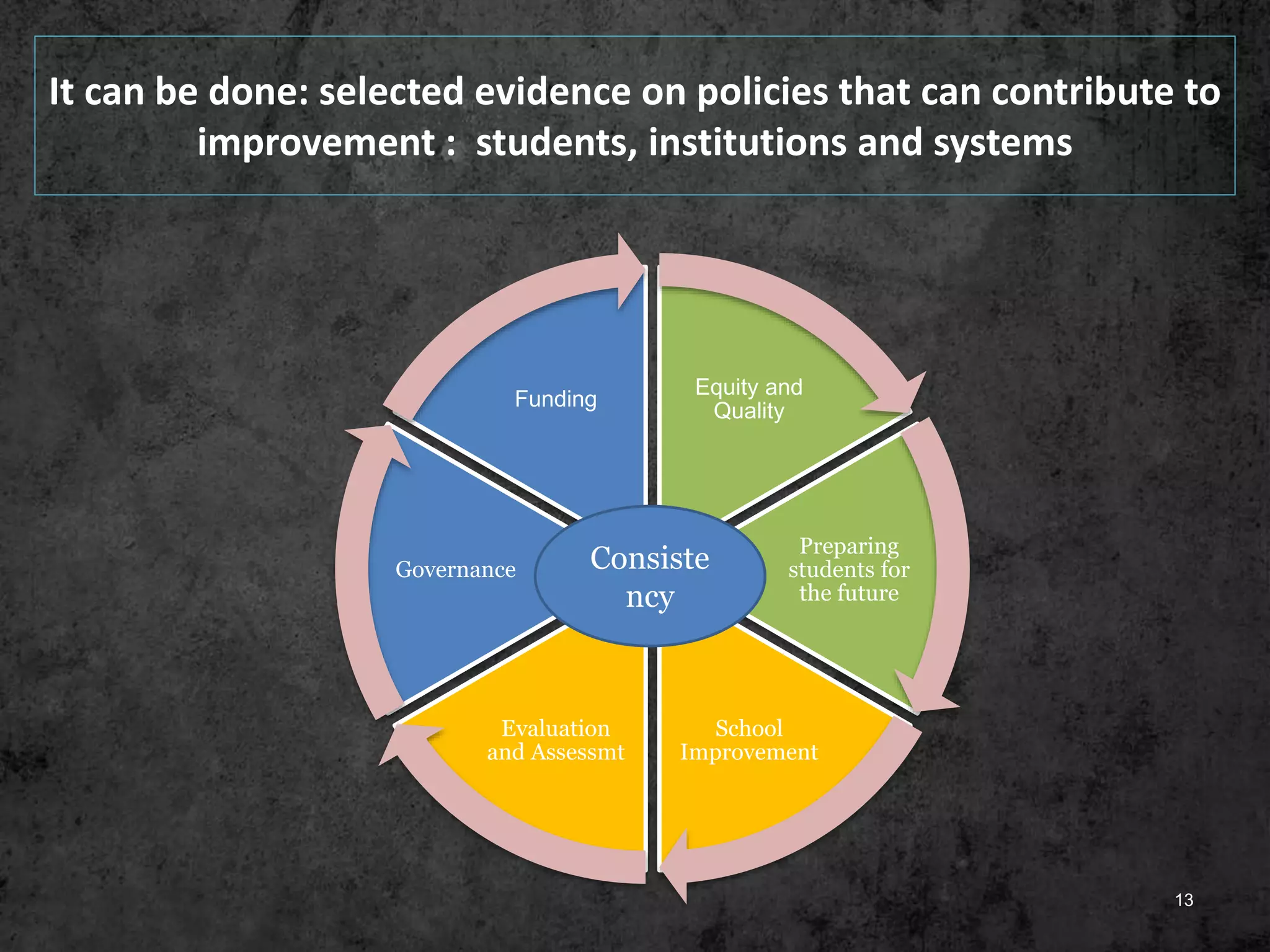
It can be done: selected evidence on policies that can contribute to
improvement : students, institutions and systems
Equity and
Quality
Preparing
students for
the future
School
Improvement
Evaluation
and Assessmt
Governance
Funding
13
Consiste
ncy
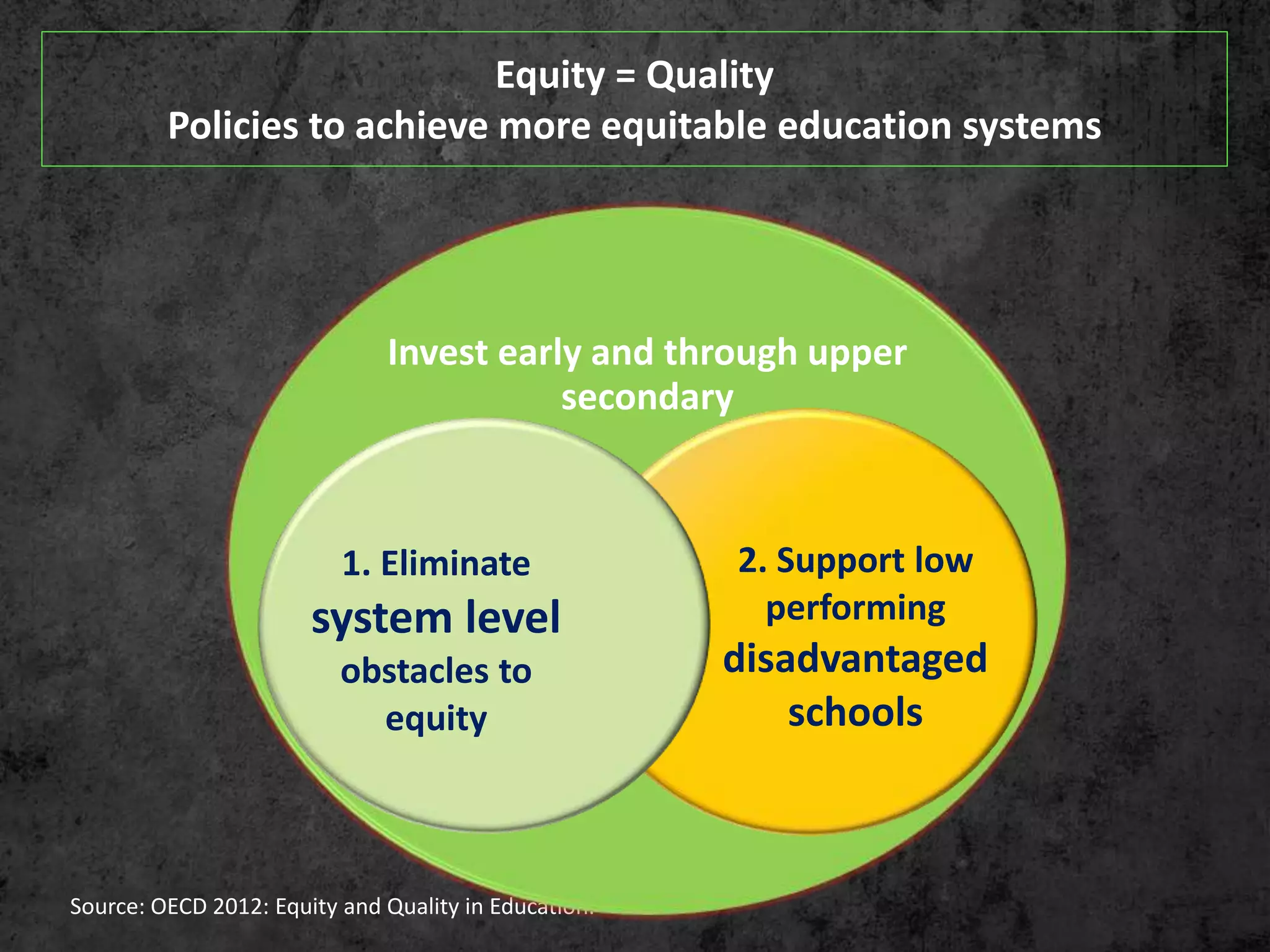
Equity = Quality
Policies to achieve more equitable education systems
Source: OECD 2012: Equity and Quality in Education.
Invest early and through upper
secondary
2. Support low
performing
disadvantaged
schools
1. Eliminate
system level
obstacles to
equity
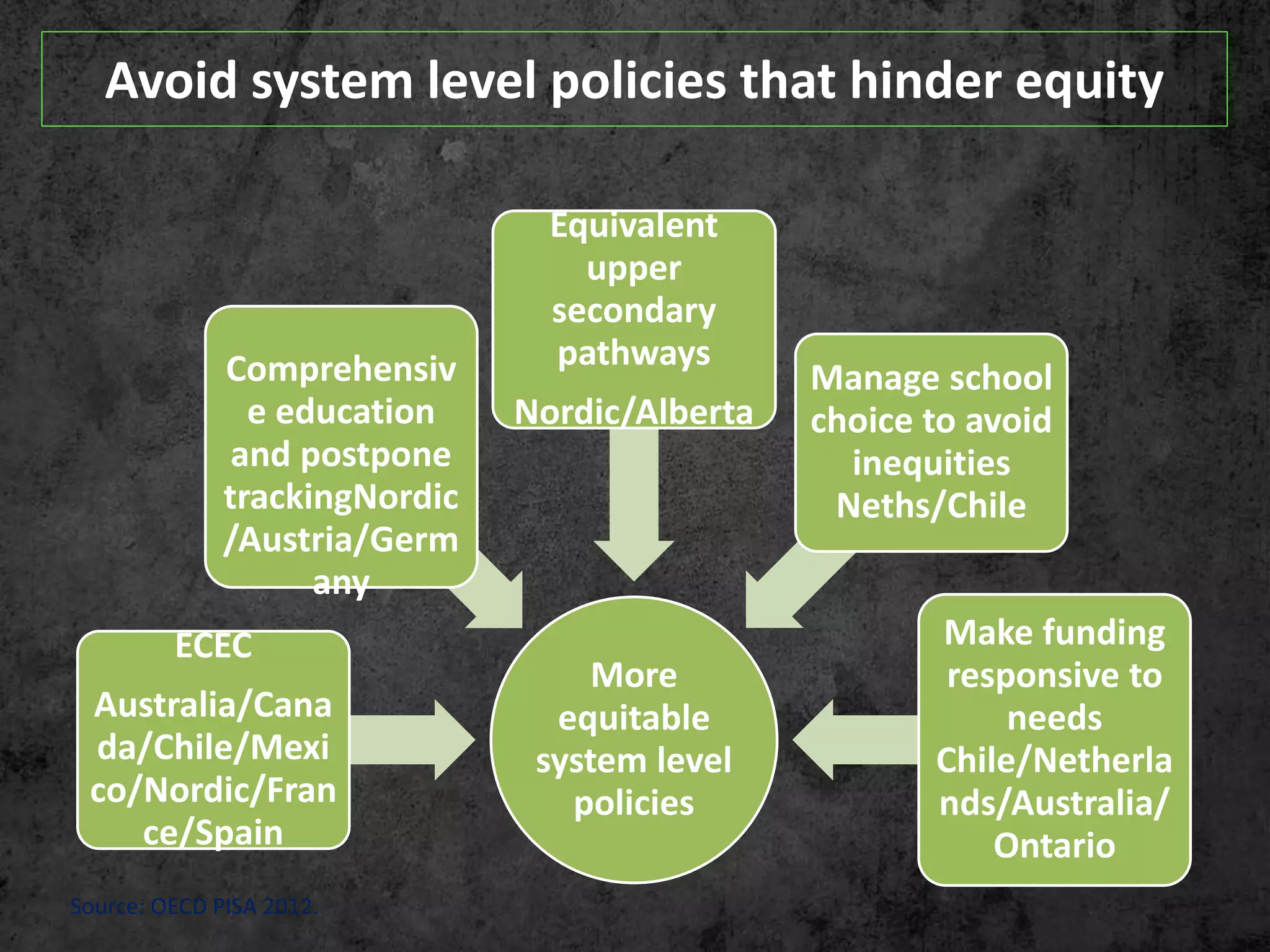
More
equitable
system level
policies
ECEC
Australia/Cana
da/Chile/Mexi
co/Nordic/Fran
ce/Spain
Comprehensiv
e education
and postpone
trackingNordic
/Austria/Germ
any
Equivalent
upper
secondary
pathways
Nordic/Alberta
Manage school
choice to avoid
inequities
Neths/Chile
Make funding
responsive to
needs
Chile/Netherla
nds/Australia/
Ontario
Avoid system level policies that hinder equity
Source: OECD PISA 2012.
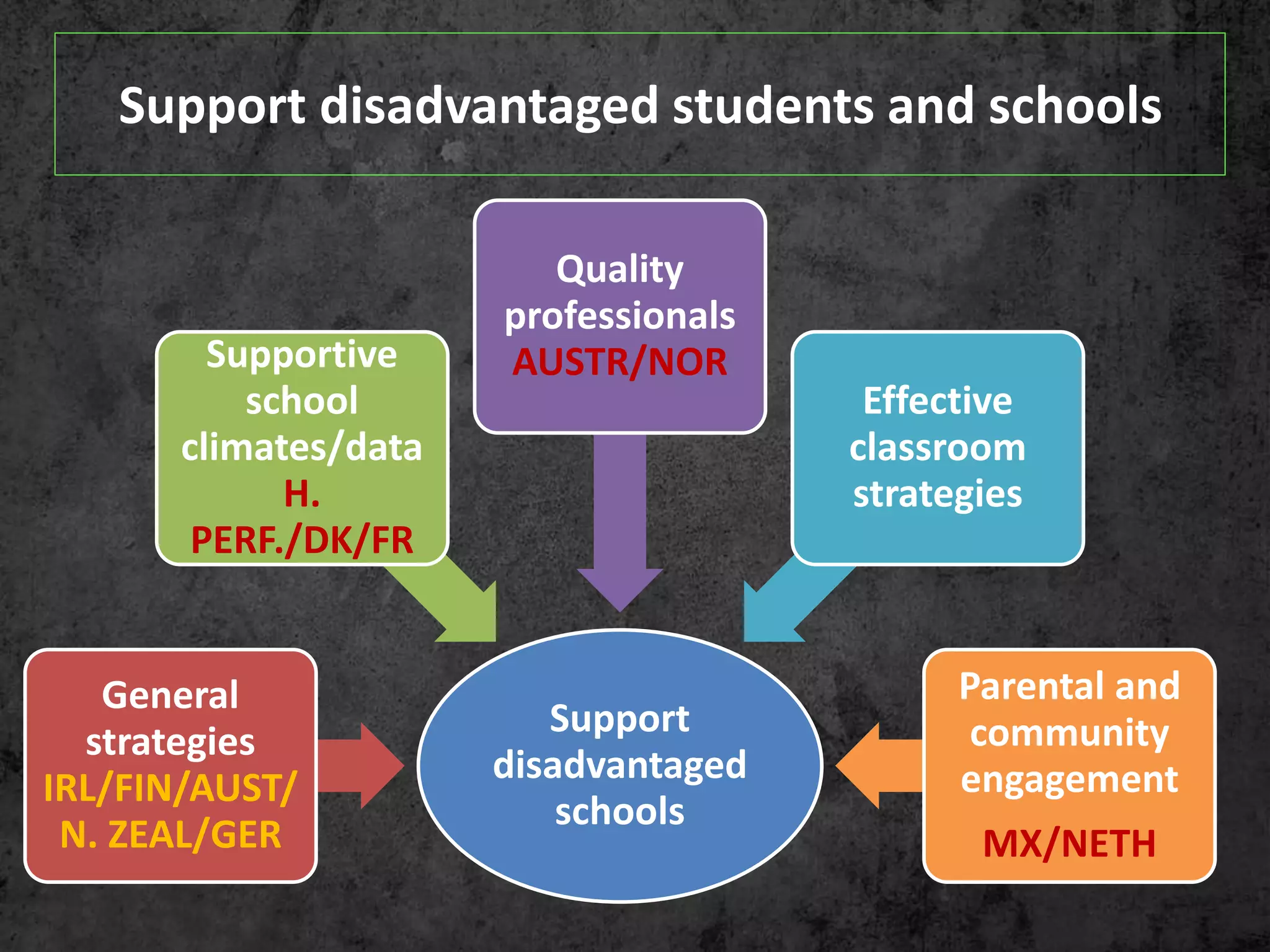
Support disadvantaged students and schools
Support
disadvantaged
schools
General
strategies
IRL/FIN/AUST/
N. ZEAL/GER
Supportive
school
climates/data
H.
PERF./DK/FR
Quality
professionals
AUSTR/NOR
Effective
classroom
strategies
Parental and
community
engagement
MX/NETH
17
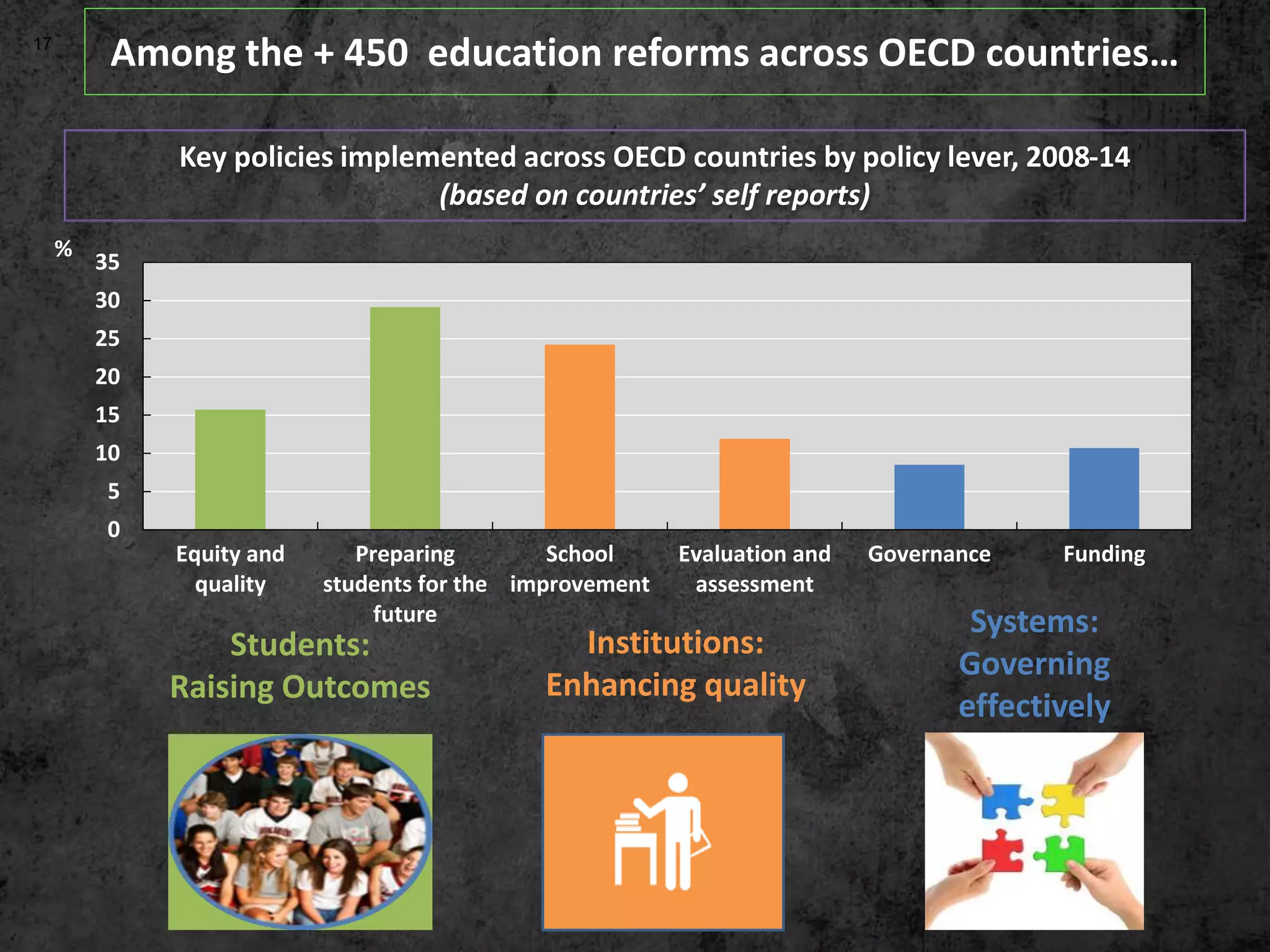
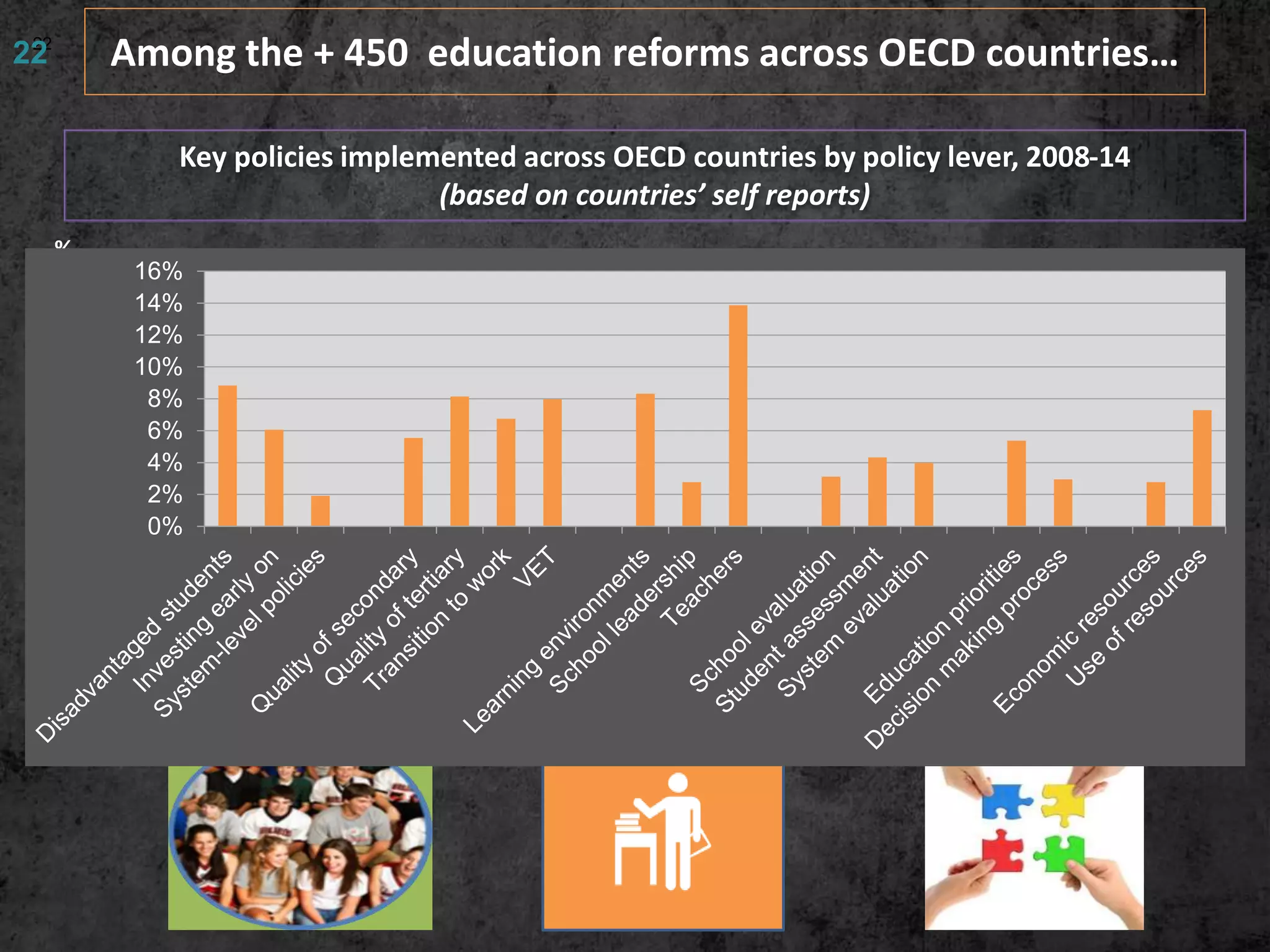
Among the + 450 education reforms across OECD countries…
Key policies implemented across OECD countries by policy lever, 2008-14
(based on countries’ self reports)
0
5
10
15
20
25
30
35
Equity and
quality
Preparing
students for the
future
School
improvement
Evaluation and
assessment
Governance Funding
%
Students:
Raising Outcomes
Institutions:
Enhancing quality
Systems:
Governing
effectively
0.0
0.5
1.0
1.5
2.0
2.5
3.0
3.5
Estonia
Iceland
Korea
Turkey
Norway
Canada
Mexico
UnitedKingdom
Finland
Italy
Sweden
Japan
Netherlands
UnitedStates
Slovenia
Greece
Switzerland
Ireland
Australia
OECDaverage
Poland
Spain
CzechRepublic
Portugal
Austria
Denmark
Chile
Luxembourg
Germany
Belgium
Israel
France
NewZealand
Hungary
SlovakRepublic
Ratio
Increased likelihood of students in the bottom quarter of the ESCS index scoring in the
bottom quarter of the mathematics performance distribution
Increased likelihood of immigrant students scoring in the bottom quarter of the
mathematics performance distribution
OECD average
UK England:
Pupil premium
New Zealand:
Policies to support
Māori/Pasifika
populations
(2008-13)
France/Portugal:
Education Priority Zones
Chile:
Law on Preferential
Subsidies (2008)
Austria:
New middle
school reform
Germany:
National Action Plan
on Integration (2011)
Finland: National Core Curriculum
for Instruction Preparing Immigrants
for Basic Education (2009)
ECEC:
Poland, Korea, Australia, Italy,
Nordic Countries, Slovenia,
United States….
Policies for equity: support disadvantaged students (9%)
Source: OECD PISA 2012.
0
10
20
30
40
50
60
70
80
90
100
Korea
Finland
Mexico
Alberta…
Flanders…
Netherlands
Australia
England(UK)
Israel
UnitedStates
Chile
Average
Norway
Japan
Denmark
Poland
Iceland
Estonia
Brazil
Italy
CzechRepublic
Portugal
Spain
Sweden
France
SlovakRepublic
Percentageofteachers
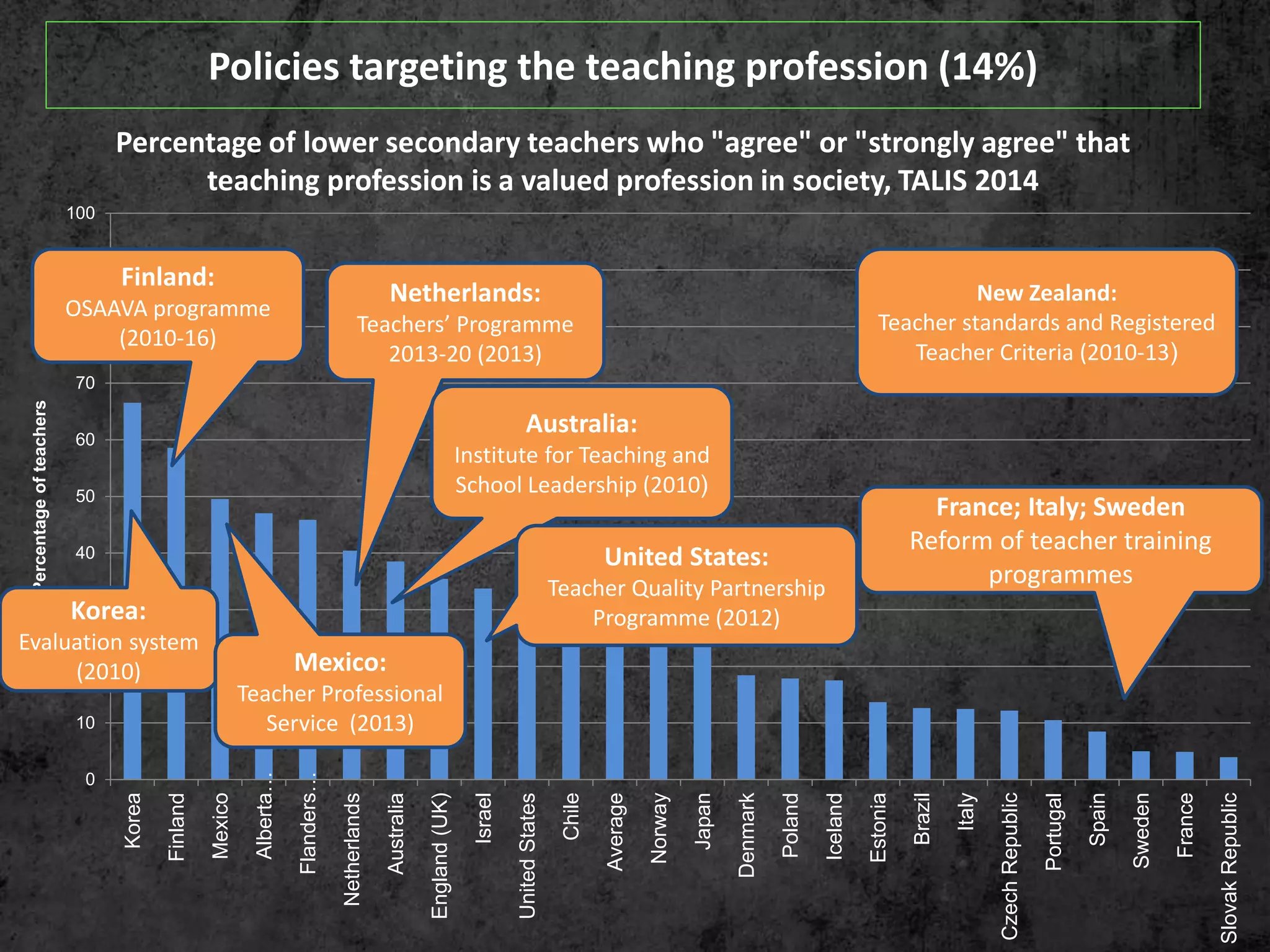
Percentage of lower secondary teachers who "agree" or "strongly agree" that
teaching profession is a valued profession in society, TALIS 2014
Netherlands:
Teachers’ Programme
2013-20 (2013)
Australia:
Institute for Teaching and
School Leadership (2010)
Finland:
OSAAVA programme
(2010-16)
New Zealand:
Teacher standards and Registered
Teacher Criteria (2010-13)
United States:
Teacher Quality Partnership
Programme (2012)
France; Italy; Sweden
Reform of teacher training
programmes
Korea:
Evaluation system
(2010) Mexico:
Teacher Professional
Service (2013)
Policies targeting the teaching profession (14%)
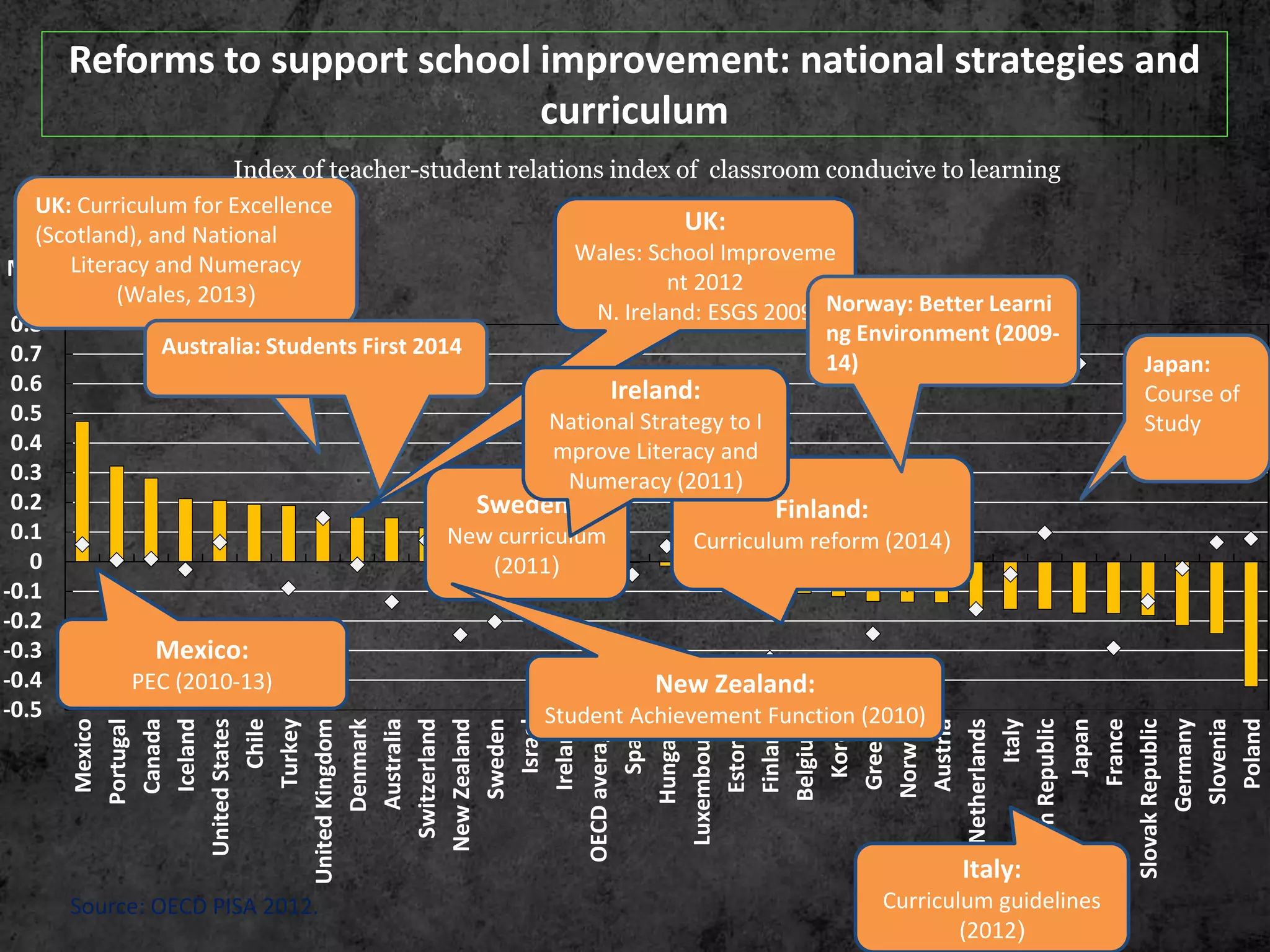
Reforms to support school improvement: national strategies and
curriculum
Source: OECD PISA 2012.
-0.5
-0.4
-0.3
-0.2
-0.1
0
0.1
0.2
0.3
0.4
0.5
0.6
0.7
0.8
Mexico
Portugal
Canada
Iceland
UnitedStates
Chile
Turkey
UnitedKingdom
Denmark
Australia
Switzerland
NewZealand
Sweden
Israel
Ireland
OECDaverage
Spain
Hungary
Luxembourg
Estonia
Finland
Belgium
Korea
Greece
Norway
Austria
Netherlands
Italy
CzechRepublic
Japan
France
SlovakRepublic
Germany
Slovenia
Poland
Mean index
Mexico:
PEC (2010-13)
UK: Curriculum for Excellence
(Scotland), and National
Literacy and Numeracy
(Wales, 2013)
Sweden:
New curriculum
(2011)
Finland:
Curriculum reform (2014)
Italy:
Curriculum guidelines
(2012)
Japan:
Course of
Study
Australia: Students First 2014
New Zealand:
Student Achievement Function (2010)
UK:
Wales: School Improveme
nt 2012
N. Ireland: ESGS 2009
Ireland:
National Strategy to I
mprove Literacy and
Numeracy (2011)
Norway: Better Learni
ng Environment (2009-
14)
Index of teacher-student relations index of classroom conducive to learning
-1.5
-1
-0.5
0
0.5
1
1.5
Japan
France
Switzerland
Spain
Netherlands
Poland
Luxembourg
Mexico
Finland
Korea
Belgium
Israel
Estonia
Denmark
SlovakRepublic
Norway
CzechRepublic
OECDaverage
Iceland
Ireland
Hungary
Portugal
Chile
Austria
Sweden
Greece
Germany
Italy
NewZealand
Slovenia
Canada
UnitedKingdom
Australia
UnitedStates
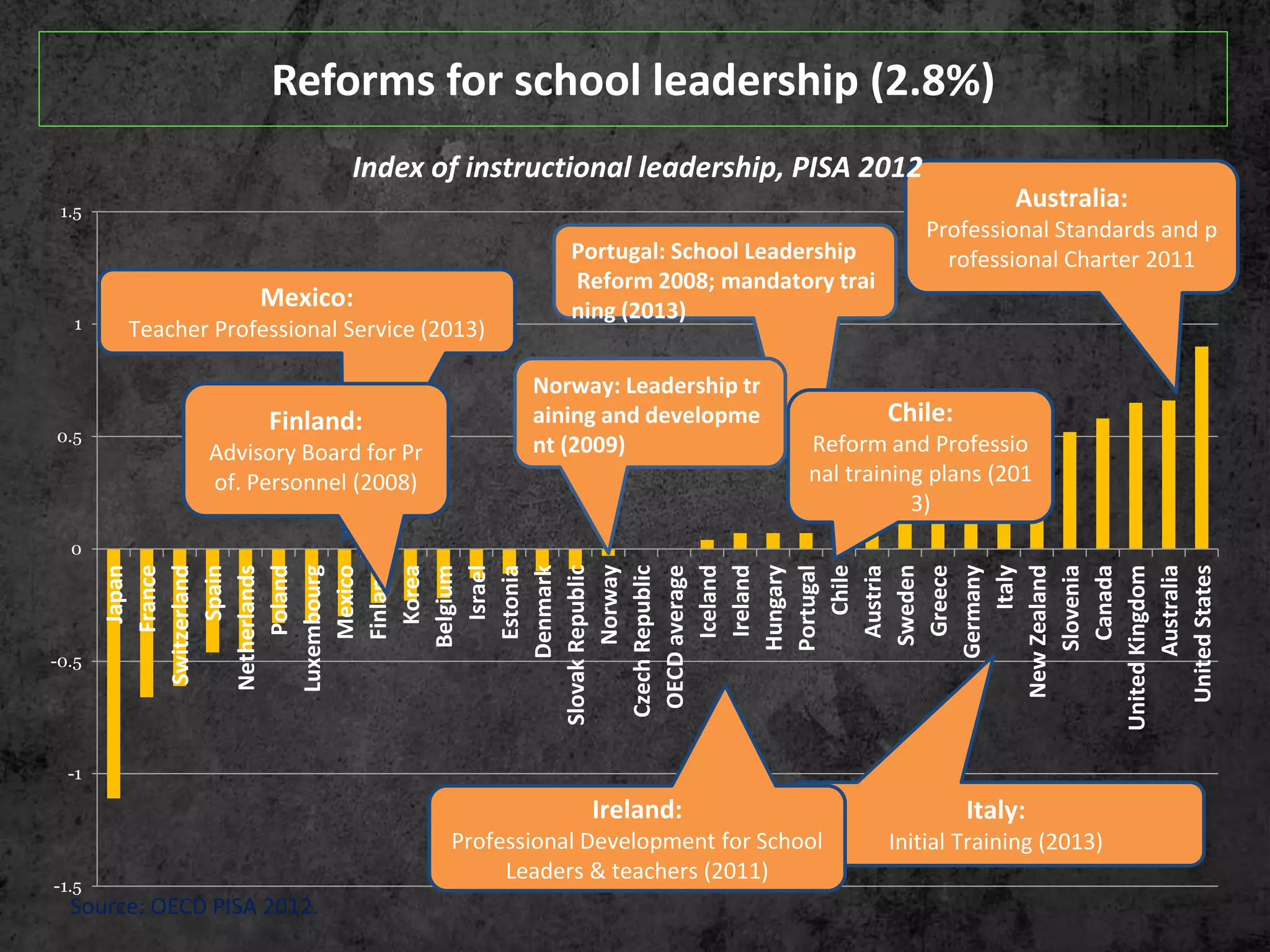
Reforms for school leadership (2.8%)
Source: OECD PISA 2012.
Portugal: School Leadership
Reform 2008; mandatory trai
ning (2013)Mexico:
Teacher Professional Service (2013)
Australia:
Professional Standards and p
rofessional Charter 2011
Chile:
Reform and Professio
nal training plans (201
3)
Norway: Leadership tr
aining and developme
nt (2009)
Index of instructional leadership, PISA 2012
Italy:
Initial Training (2013)
Ireland:
Professional Development for School
Leaders & teachers (2011)
Finland:
Advisory Board for Pr
of. Personnel (2008)
22
22 Among the + 450 education reforms across OECD countries…
Key policies implemented across OECD countries by policy lever, 2008-14
(based on countries’ self reports)
0
5
10
15
20
25
30
35
Equity and
quality
Preparing
students for the
future
School
improvement
Evaluation and
assessment
Governance Funding
%
Students:
Raising Outcomes
Institutions:
Enhancing quality
Systems:
Governing
effectively
0%
2%
4%
6%
8%
10%
12%
14%
16%
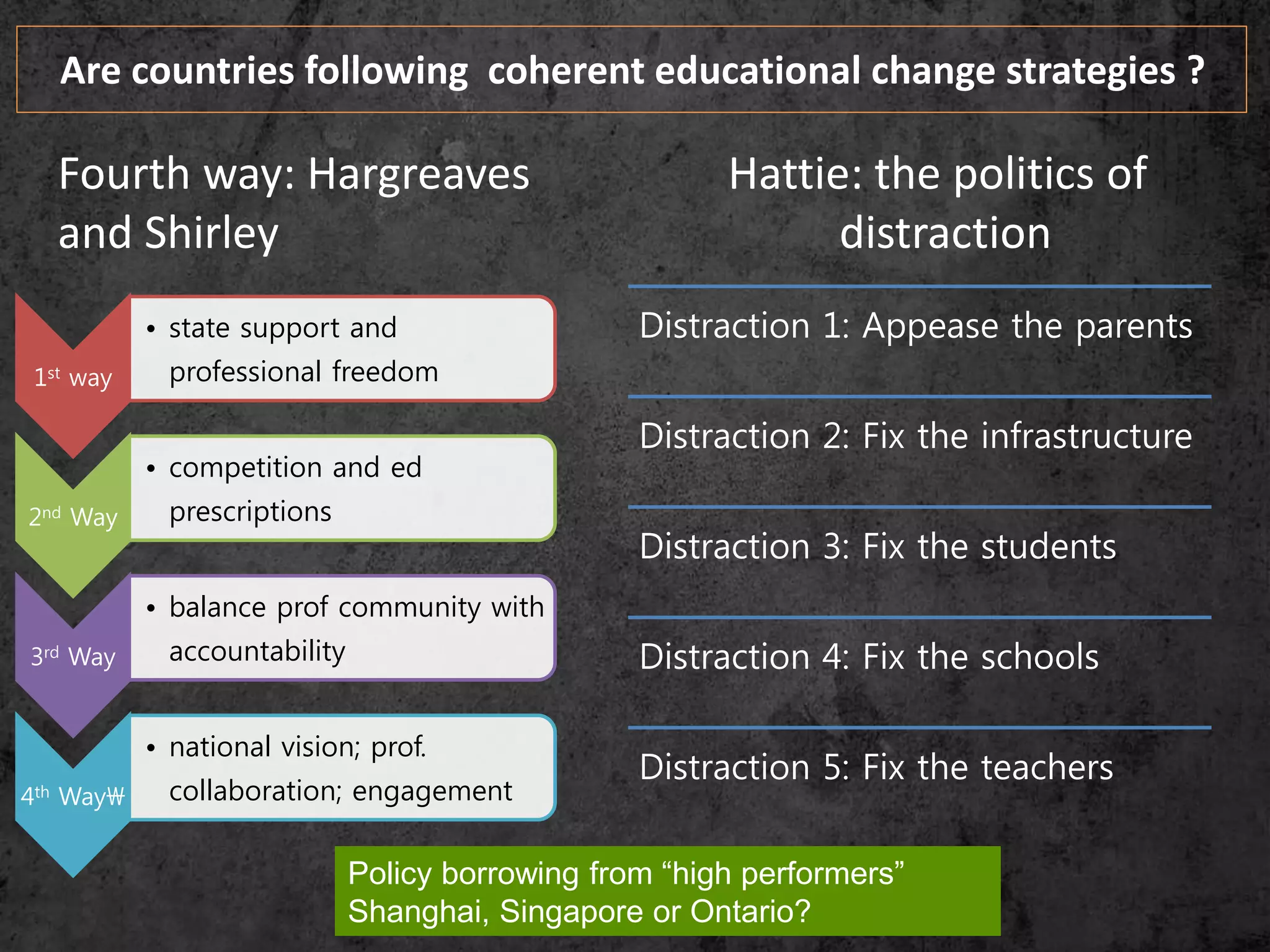
Are countries following coherent educational change strategies ?
1st way
• state support and
professional freedom
2nd Way
• competition and ed
prescriptions
3rd Way
• balance prof community with
accountability
4th Way
• national vision; prof.
collaboration; engagement
Fourth way: Hargreaves
and Shirley
Distraction 1: Appease the parents
Distraction 2: Fix the infrastructure
Distraction 3: Fix the students
Distraction 4: Fix the schools
Distraction 5: Fix the teachers
Hattie: the politics of
distraction
Policy borrowing from “high performers”
Shanghai, Singapore or Ontario?
-4
-2
0
2
4
6
8
10
Israel
Turkey
Mexico
Portugal
Italy
Poland
Chile
Germany
Korea
Greece
Peru
Estonia
Switzerland
Japan
UnitedStates
Spain
Austria
UnitedKingdom
OECDaverage2003
Norway
Luxembourg
Ireland
Hungary
SlovakRepublic
Canada
France
Belgium
Netherlands
Denmark
Iceland
Australia
NewZealand
CzechRepublic
Finland
Sweden
Annualisedchangeinmathematicsperformance
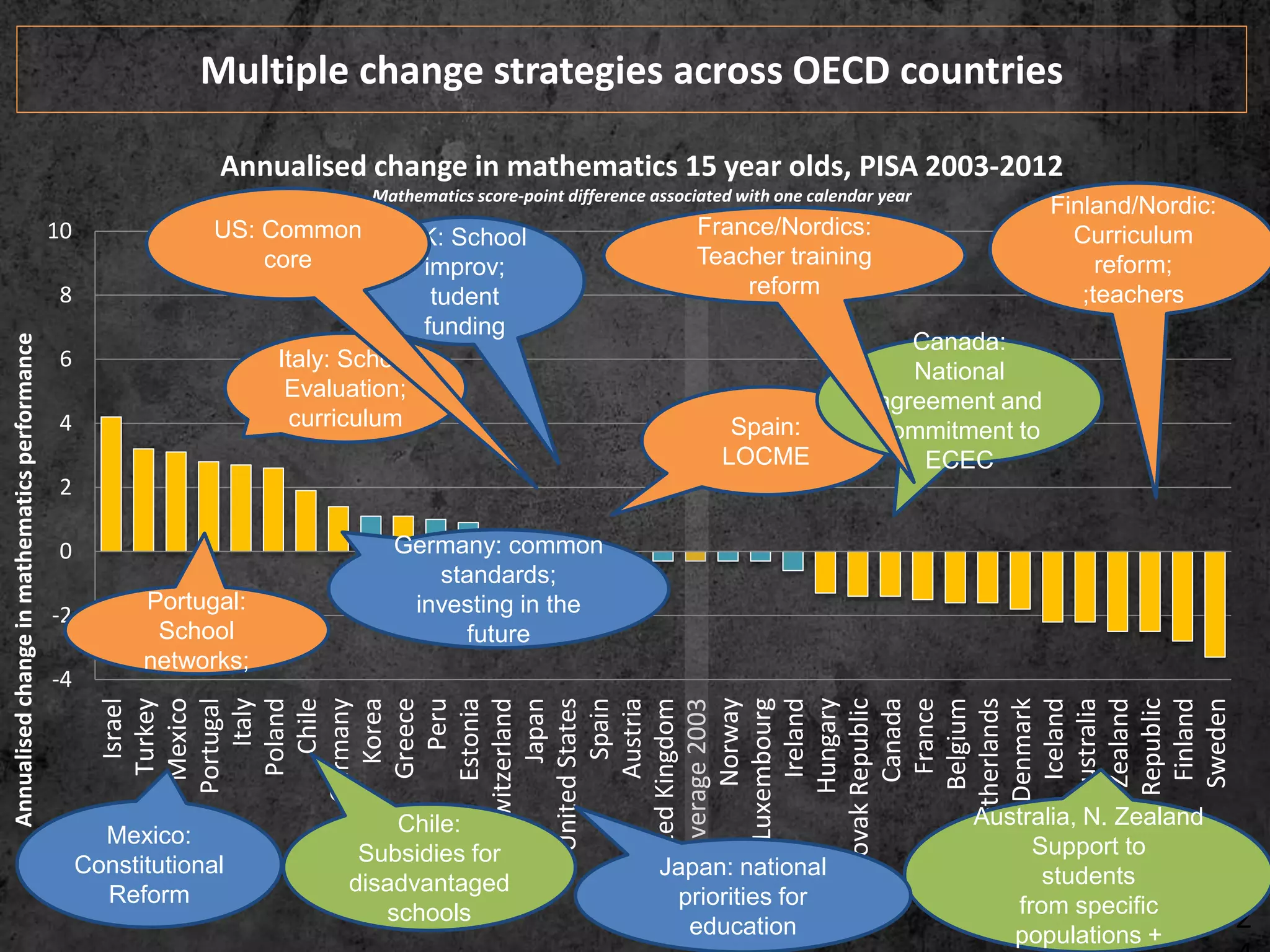
Multiple change strategies across OECD countries
2
Chile:
Subsidies for
disadvantaged
schools
Australia, N. Zealand
Support to
students
from specific
populations +
Japan: national
priorities for
education
Spain:
LOCME
Canada:
National
agreement and
commitment to
ECEC
Portugal:
School
networks;
France/Nordics:
Teacher training
reform
Annualised change in mathematics 15 year olds, PISA 2003-2012
Mathematics score-point difference associated with one calendar year
Italy: School
Evaluation;
curriculum
UK: School
improv;
tudent
funding
Finland/Nordic:
Curriculum
reform;
;teachers
Mexico:
Constitutional
Reform
Germany: common
standards;
investing in the
future
US: Common
core
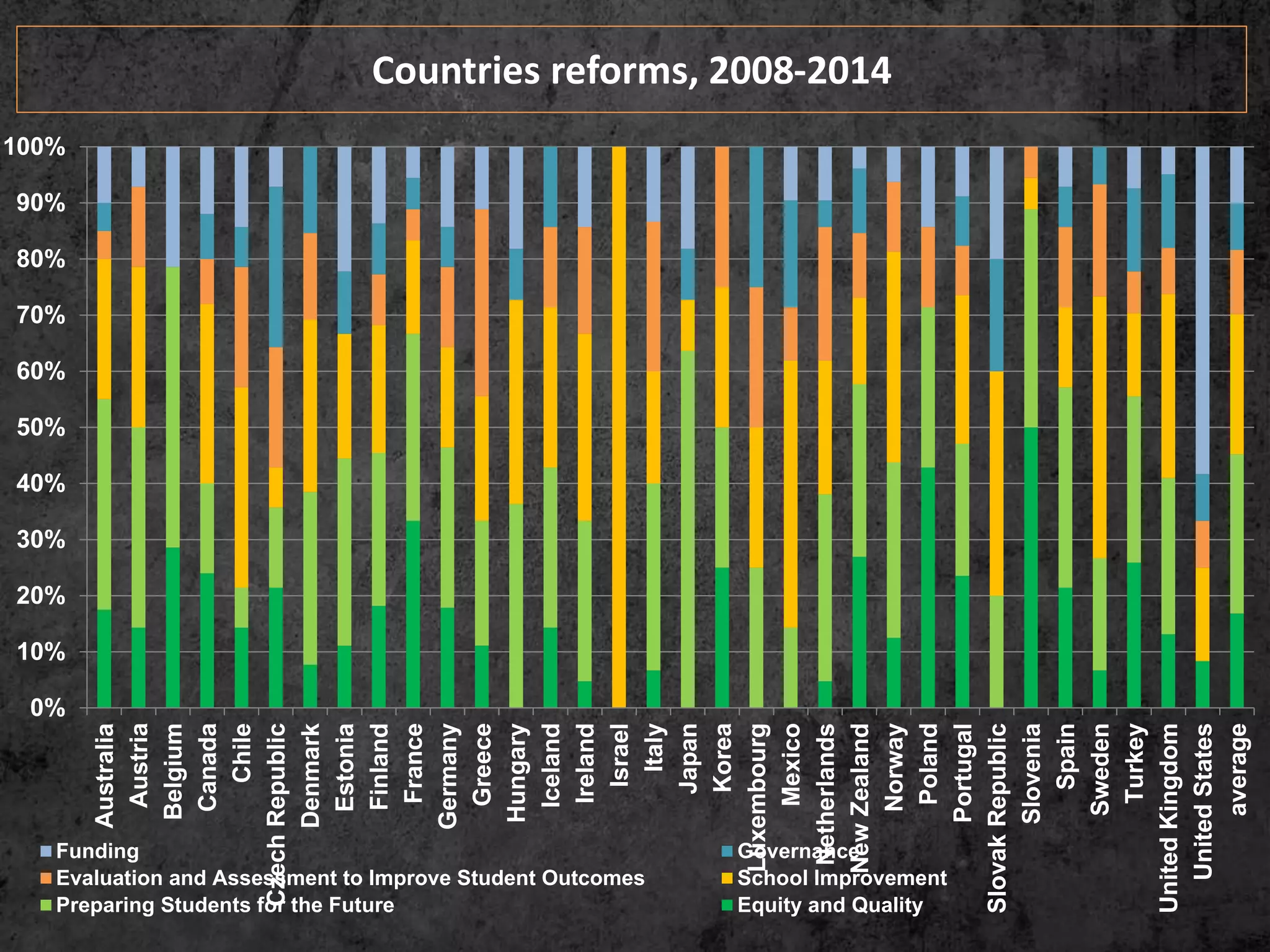
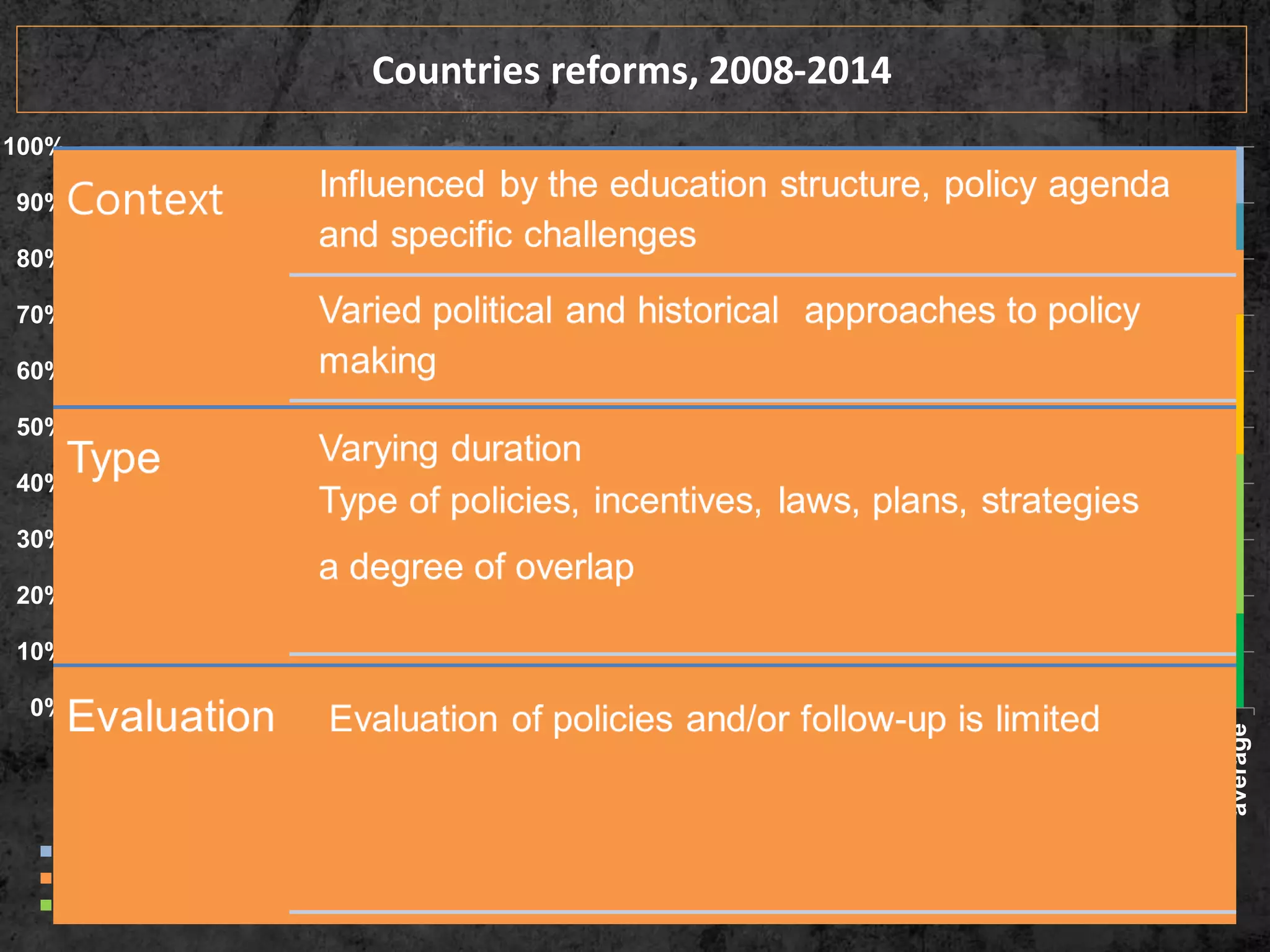
Countries reforms, 2008-2014
0%
10%
20%
30%
40%
50%
60%
70%
80%
90%
100%
Australia
Austria
Belgium
Canada
Chile
CzechRepublic
Denmark
Estonia
Finland
France
Germany
Greece
Hungary
Iceland
Ireland
Israel
Italy
Japan
Korea
Luxembourg
Mexico
Netherlands
NewZealand
Norway
Poland
Portugal
SlovakRepublic
Slovenia
Spain
Sweden
Turkey
UnitedKingdom
UnitedStates
average
Funding Governance
Evaluation and Assessment to Improve Student Outcomes School Improvement
Preparing Students for the Future Equity and Quality
Countries reforms, 2008-2014
0%
10%
20%
30%
40%
50%
60%
70%
80%
90%
100%
Australia
Austria
Belgium
Canada
Chile
CzechRepublic
Denmark
Estonia
Finland
France
Germany
Greece
Hungary
Iceland
Ireland
Israel
Italy
Japan
Korea
Luxembourg
Mexico
Netherlands
NewZealand
Norway
Poland
Portugal
SlovakRepublic
Slovenia
Spain
Sweden
Turkey
UnitedKingdom
UnitedStates
average
Funding Governance
Evaluation and Assessment to Improve Student Outcomes School Improvement
Preparing Students for the Future Equity and Quality
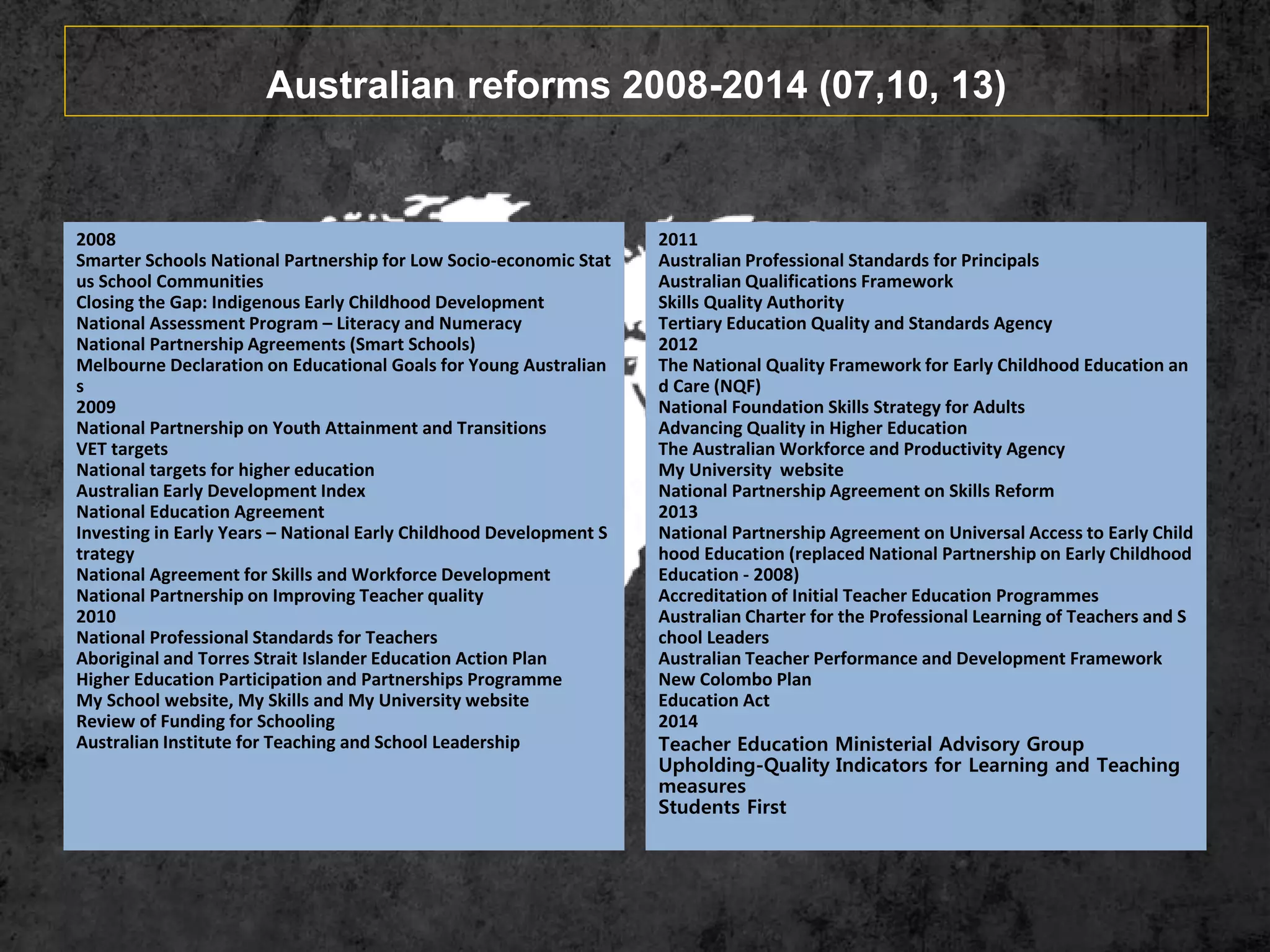
Australian reforms 2008-2014 (07,10, 13)
2008
Smarter Schools National Partnership for Low Socio-economic Stat
us School Communities
Closing the Gap: Indigenous Early Childhood Development
National Assessment Program – Literacy and Numeracy
National Partnership Agreements (Smart Schools)
Melbourne Declaration on Educational Goals for Young Australian
s
2009
National Partnership on Youth Attainment and Transitions
VET targets
National targets for higher education
Australian Early Development Index
National Education Agreement
Investing in Early Years – National Early Childhood Development S
trategy
National Agreement for Skills and Workforce Development
National Partnership on Improving Teacher quality
2010
National Professional Standards for Teachers
Aboriginal and Torres Strait Islander Education Action Plan
Higher Education Participation and Partnerships Programme
My School website, My Skills and My University website
Review of Funding for Schooling
Australian Institute for Teaching and School Leadership
2011
Australian Professional Standards for Principals
Australian Qualifications Framework
Skills Quality Authority
Tertiary Education Quality and Standards Agency
2012
The National Quality Framework for Early Childhood Education an
d Care (NQF)
National Foundation Skills Strategy for Adults
Advancing Quality in Higher Education
The Australian Workforce and Productivity Agency
My University website
National Partnership Agreement on Skills Reform
2013
National Partnership Agreement on Universal Access to Early Child
hood Education (replaced National Partnership on Early Childhood
Education - 2008)
Accreditation of Initial Teacher Education Programmes
Australian Charter for the Professional Learning of Teachers and S
chool Leaders
Australian Teacher Performance and Development Framework
New Colombo Plan
Education Act
2014
Teacher Education Ministerial Advisory Group
Upholding-Quality Indicators for Learning and Teaching
measures
Students First
Irish reforms 2008-2014 (07,11)
Delivering Equality of Opportunity in Schools: Action Plan for Educational Inclusion (DEIS) 2005
Traveller Education Strategy 2006
Survey on Lifeskills in Primary (2009) and Post-Primary Schools (2012) 2009
Project Maths 2010
Intercultural Education Strategy 2010
Springboard programme 2011
Professional development for teachers and school leaders 2011
Initial Teacher Education Criteria and Guidelines for Programme Providers 2011
Higher education reforms 2011
National Strategy to Improve Literacy and Numeracy among Children and Young People 2011-20 2011
Increase in reading instruction 2011
National Strategy for Higher Education to 2030 2011
ICT Action Plan 2012
Standardised assessment in literacy and numeracy 2012
School Self Evaluation: Guidelines for Primary Schools 2012
School Self-Evaluation: Guidelines for Post-Primary Schools 2012
Investing in education infrastructure 2012
Third Level Bursary Scheme – scholarship scheme 2012
Action Plan for Jobs 2012
Procedures for Induction and Procedures and Criteria for Probation 2013
Education and Training Boards Act 2013
SOLAS – New National Education and Training Authority 2013
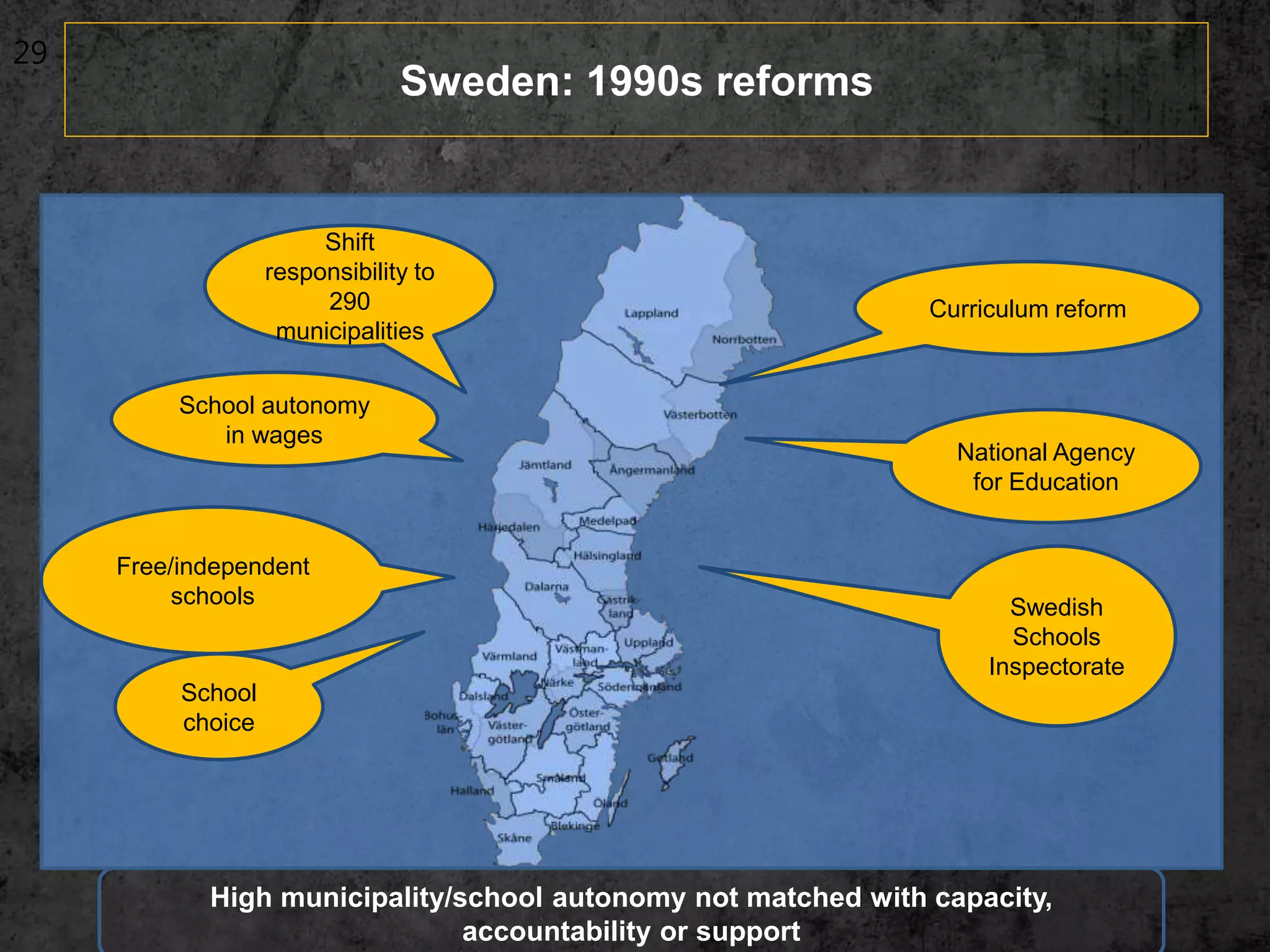
29
School autonomy
in wages
Swedish
Schools
Inspectorate
National Agency
for Education
Free/independent
schools
Shift
responsibility to
290
municipalities
Curriculum reform
School
choice
High municipality/school autonomy not matched with capacity,
accountability or support
Sweden: 1990s reforms
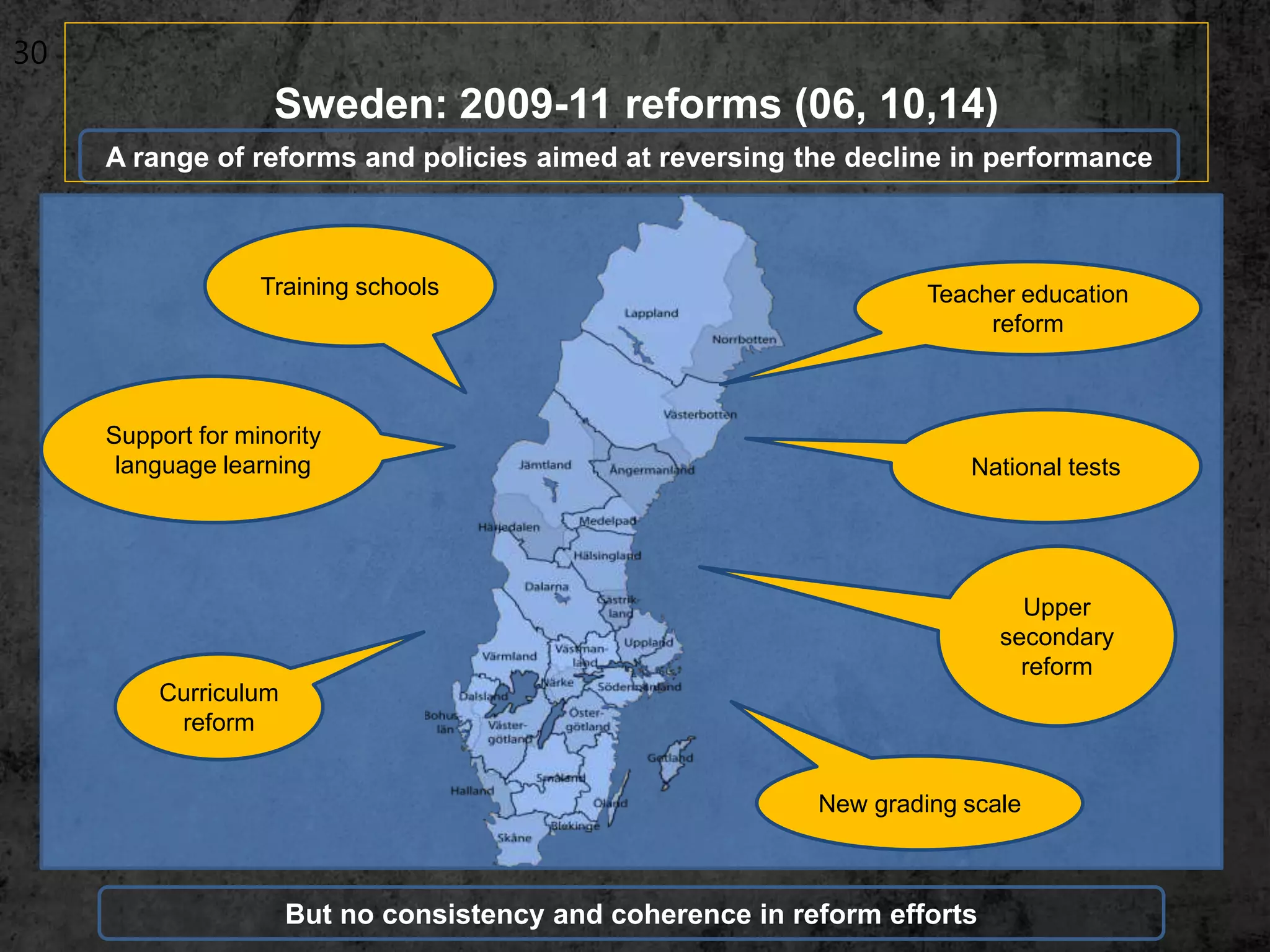
30
New grading scale
Upper
secondary
reform
National tests
Support for minority
language learning
Training schools Teacher education
reform
A range of reforms and policies aimed at reversing the decline in performance
Curriculum
reform
But no consistency and coherence in reform efforts
Sweden: 2009-11 reforms (06, 10,14)
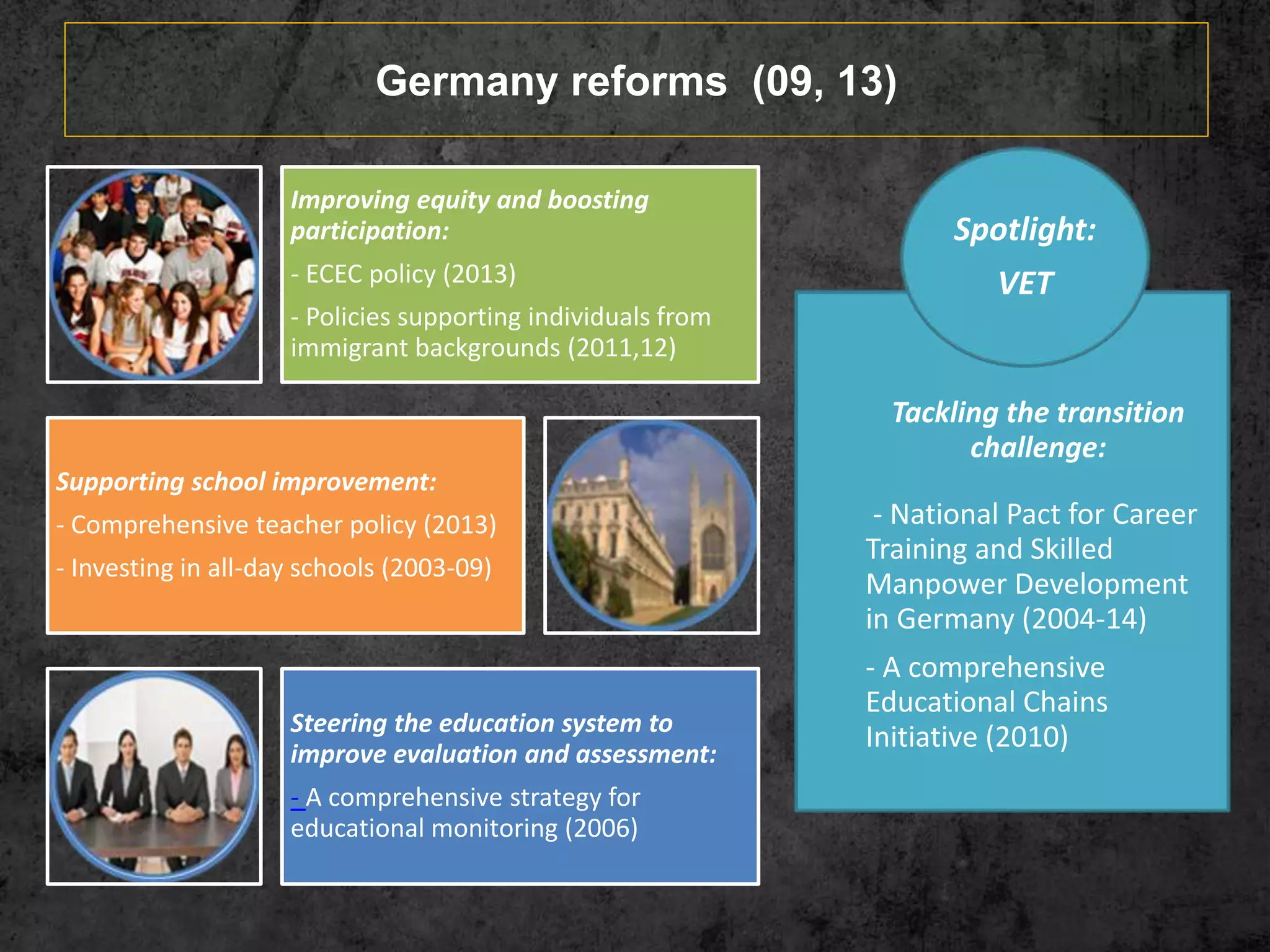
Tackling the transition
challenge:
- National Pact for Career
Training and Skilled
Manpower Development
in Germany (2004-14)
- A comprehensive
Educational Chains
Initiative (2010)
Spotlight:
VET
Improving equity and boosting
participation:
- ECEC policy (2013)
- Policies supporting individuals from
immigrant backgrounds (2011,12)
Supporting school improvement:
- Comprehensive teacher policy (2013)
- Investing in all-day schools (2003-09)
Steering the education system to
improve evaluation and assessment:
- A comprehensive strategy for
educational monitoring (2006)
Germany reforms (09, 13)
32
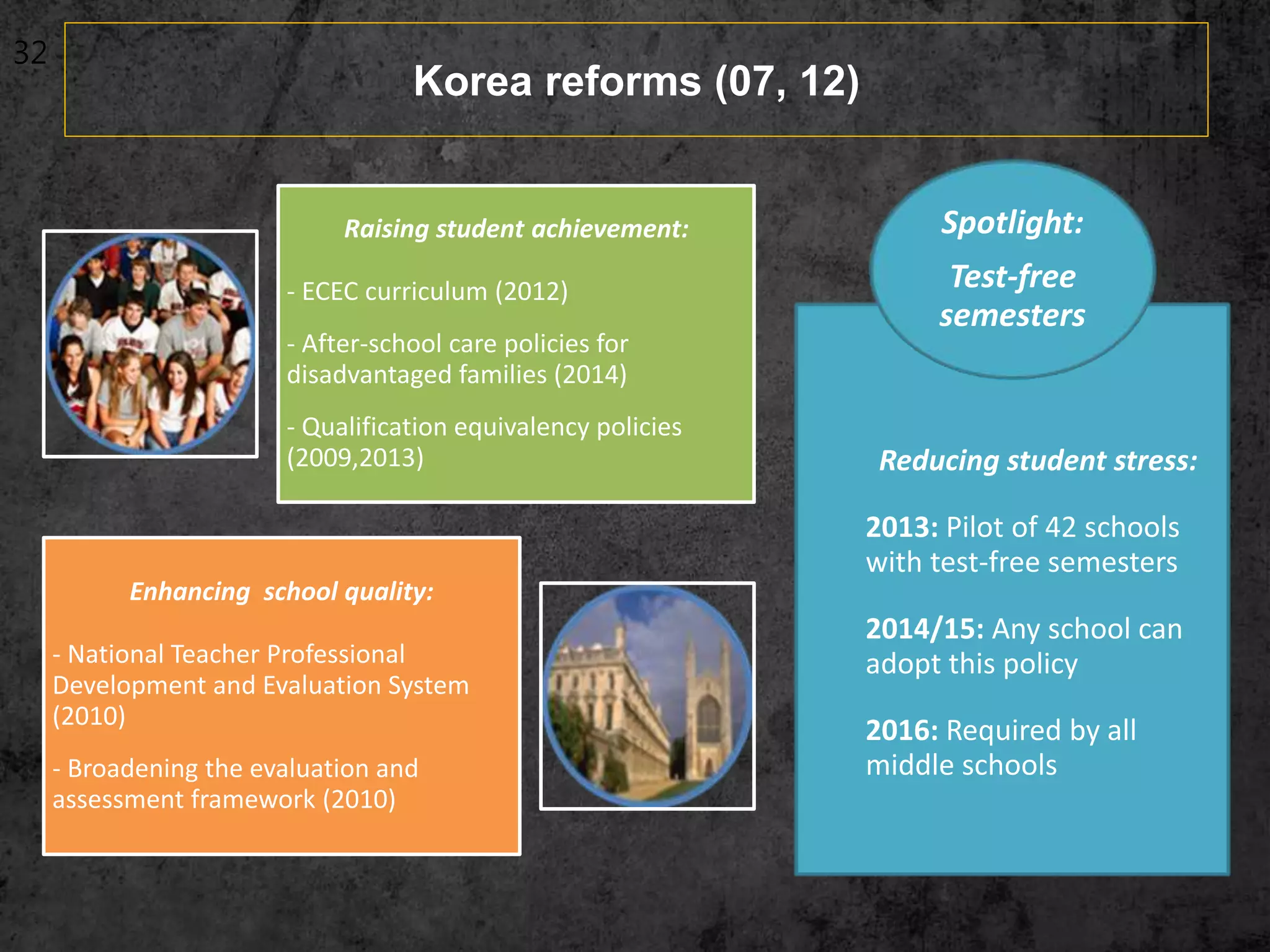
Reducing student stress:
2013: Pilot of 42 schools
with test-free semesters
2014/15: Any school can
adopt this policy
2016: Required by all
middle schools
Spotlight:
Test-free
semesters
Raising student achievement:
- ECEC curriculum (2012)
- After-school care policies for
disadvantaged families (2014)
- Qualification equivalency policies
(2009,2013)
Enhancing school quality:
- National Teacher Professional
Development and Evaluation System
(2010)
- Broadening the evaluation and
assessment framework (2010)
Korea reforms (07, 12)
33
3
3
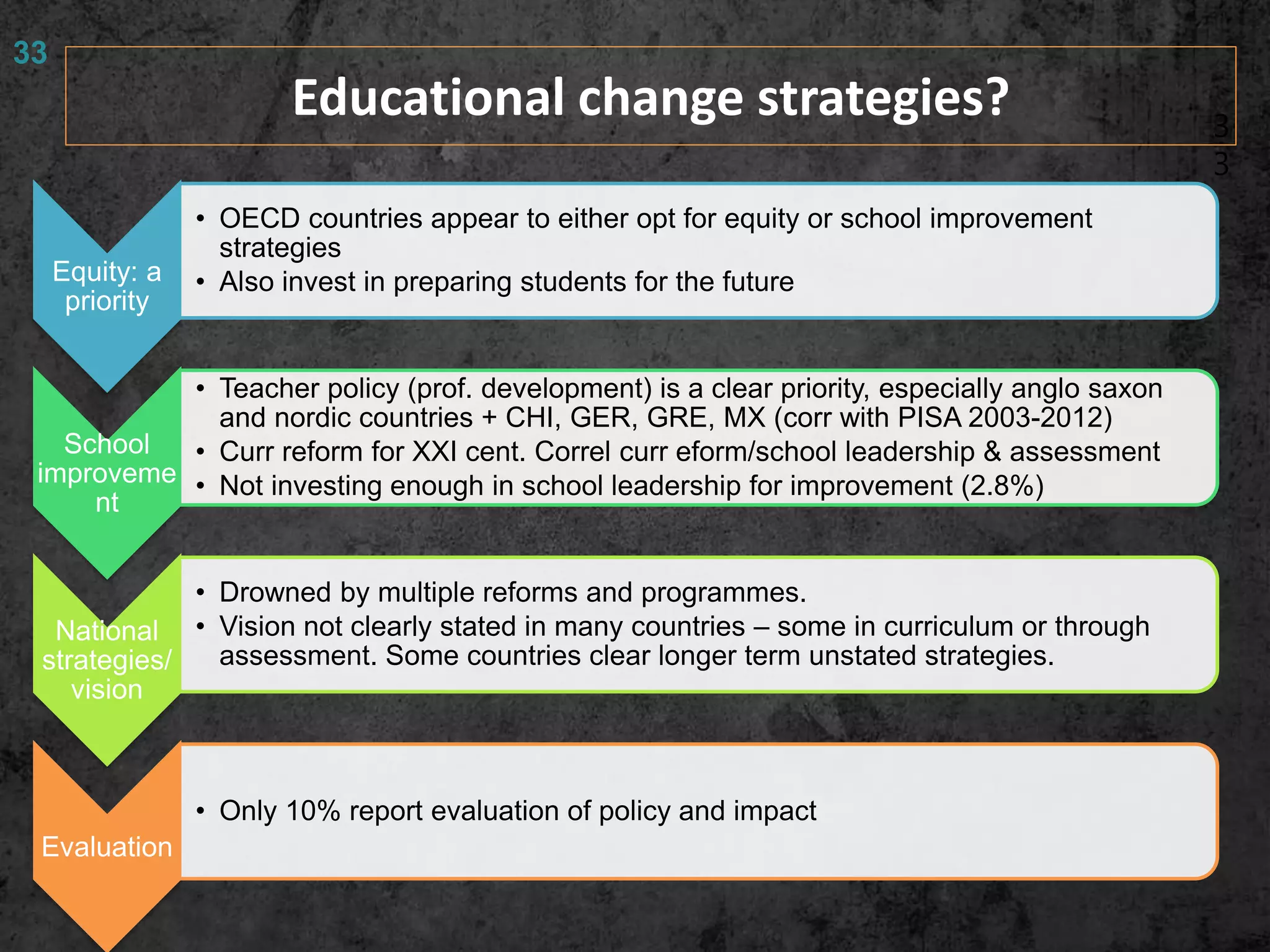
Educational change strategies?
Equity: a
priority
• OECD countries appear to either opt for equity or school improvement
strategies
• Also invest in preparing students for the future
School
improveme
nt
• Teacher policy (prof. development) is a clear priority, especially anglo saxon
and nordic countries + CHI, GER, GRE, MX (corr with PISA 2003-2012)
• Curr reform for XXI cent. Correl curr eform/school leadership & assessment
• Not investing enough in school leadership for improvement (2.8%)
National
strategies/
vision
• Drowned by multiple reforms and programmes.
• Vision not clearly stated in many countries – some in curriculum or through
assessment. Some countries clear longer term unstated strategies.
Evaluation
• Only 10% report evaluation of policy and impact
3
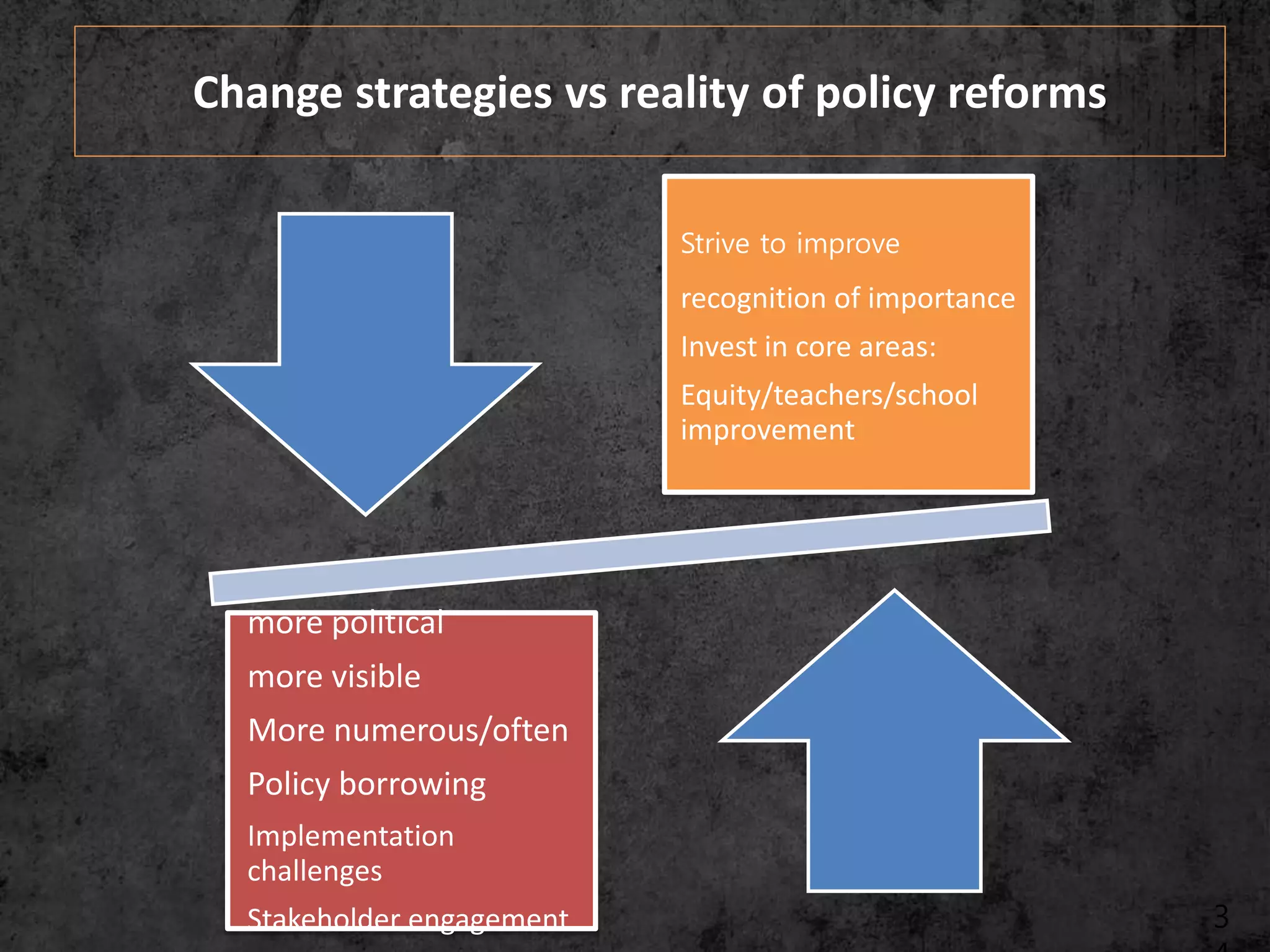
Strive to improve
recognition of importance
Invest in core areas:
Equity/teachers/school
improvement
more political
more visible
More numerous/often
Policy borrowing
Implementation
challenges
Stakeholder engagement
Change strategies vs reality of policy reforms
35
High expectations: Policy makers have clear,
ambitious, multiple objectives.
Matched with policy capacity to reach the
classrooms?
• Change strategies require more vision,
stability, clarity and investment in student
learning, doing away with distractors.
• Focus on implementation and evaluation
to ensure that they reach the classroom.
Is education policy an “art” or a “science”?
From policy making to the classroom: a far reach?
-4
-2
0
2
4
6
8
10
Israel
Turkey
Mexico
Portugal
Italy
Poland
Chile
Germany
Korea
Greece
Peru
Estonia
Switzerland
Japan
UnitedStates
Spain
Austria
UnitedKingdom
OECDaverage2003
Norway
Luxembourg
Ireland
Hungary
SlovakRepublic
Canada
France
Belgium
Netherlands
Denmark
Iceland
Australia
NewZealand
CzechRepublic
Finland
Sweden
Annualisedchangeinmathematicsperformance
36
Chile:
Subsidies for
disadvantaged
schools
Australia, N. Zealand
Support to
students
from specific
populations +
Japan: national
priorities for
education
Spain:
LOCME
Canada:
National
agreement and
commitment to
ECEC
Portugal:
School
networks;
France/Nordics:
Teacher training
reform
Annualised change in mathematics 15 year olds, PISA 2003-2012
Mathematics score-point difference associated with one calendar year
Italy: School
Evaluation;
curriculum
UK: School
improv;
tudent
funding
Finland/Nordic:
Curriculum
reform;
;teachers
Mexico:
Constitutional
Reform
Germany: common
standards;
investing in the
future
US: Common
core
No one model of success but clear change strategies are needed.
Context matters: Each education system can reach results combining
policies based on evidence and implementation processes adapted to
context and concrete challenges.
Clarify long term vision focused on student learning;
balance use data for improvement;
Invest in leadership and capacity building;
Engagement of stakeholders;
Evaluate policies for process and impact.
An international overview: can give elements and principles for
education reform.
From policy making to the classroom: between art and science
Sources for further information
www.oecd.org/edu/policyoutlook.htm
www.oecd.org/edu/equity
For further information
Beatriz Pont, beatrizpont02@gmail.com
@beatrizpont
www.oecd.org/edu/policyoutlook.htm

B pont int perspective on ed change bc boisi oct 2015

  • 1.
    Beatriz Pont Education Policy VisitingResearcher, LIEPP, Science Po October 14, 2015 20th Annual Boisi Lecture in Education & Public Policy Center for the Study of Testing, Evaluation and Education Policy An international perspective on educational change strategies for equity and quality
  • 2.
    2 From policy makingto the classroom: a far reach Purpose: Review OECD education reforms related to equity and quality to understand change strategies Sources: PISA; OECD edu policy outlook Findings: Focus on key policy areas. Volume and speed of reforms. Lack of clarity in change strategies. Gap between expectations and implementation. Conclusions: High expectations: matched with policy capacity to reach the classrooms? Need to focus on vision, implementation and evaluation of reforms.
  • 3.
    An overview ofchange and reforms in education Policies for equity and quality in education Results and conclusions: A gap between policies, expectations and capacity to reach meaningful change? An international perspective on education reforms for equity and quality
  • 4.
    4 Common core; Funding grants Subsidies for disadvantaged schools Reformsin school leadership and teachers Support to students from specific populations Setting national priorities for education New middle school reform National commitment to ECEC School improvement VET reforms Teacher training reform School evaluation reform Student funding With more than 450 reforms in 33 countries in 7 years (2008-2014) OECD countries are actively reforming education VET reforms Curriculum reforms Structure reformsTeacher and SL professionalisation Investing in the future
  • 5.
    0 10 20 30 40 50 60 70 80 Mexico Turkey Greece Hungary SlovakRepublic Sweden UnitedStates Portugal Italy Luxembourg Spain NewZealand France Norway OECDaverage2003 Iceland CzechRepublic Australia Belgium Austria Germany Ireland Denmark Netherlands Poland Canada Switzerland Finland Japan Korea % of students belowproficiency Level 2 Percentage of students below Level 2 in 2012 Percentage of students below Level 2 in 2003 Why: around 1 in 5 15-year-olds do not reach a minimum level of skills (PISA 2012) Source: OECD PISA 2012 Database.
  • 6.
    0 20 40 60 80 100 Mexico Turkey Portugal Spain Italy Iceland Chile1 NewZealand Denmark Belgium Norway OECDaverage Greece Netherlands France UnitedKingdom Ireland Luxembourg Estonia Australia Germany Hungary Austria UnitedStates Switzerland Finland Israel Sweden Canada CzechRepublic SlovakRepublic Slovenia Poland Korea % 25-34 55-64 Why:the share of those who do not complete remains high (EAG 2014) % of those who have not completed upper secondary education, 2012 Source: OECD (2014), Education at a Glance 2014: OECD Indicators, OECD Publishing, Paris, Table A1.2a.
  • 7.
    11 5 7 9 10 5 76 4 17 5 6 4 13 5 11 14 7 16 13 10 11 25 8 26 16 8 8 12 4 4 5 5 10 6 15 20 12 27 9 6 12 10 7 17 9 7 19 13 5 8 8 5 5 6 9 7 8 8 7 6 6 8 8 6 6 0 8 4 2 0 5 10 15 20 25 30 35 40 Colombia Mexico Israel Turkey UnitedKingdom Austria UnitedStates NewZealand Norway Italy Australia Canada Korea Hungary Switzerland Belgium Ireland Sweden SlovakRepublic France OECDaverage Latvia Spain Estonia Greece Portugal CzechRepublic Finland Poland Germany Netherlands Iceland Denmark Slovenia Luxembourg Unemployed Inactive Why: almost 1 in 5 is not employed or inactive (NEET) (EAG 2014) % of 20-24 unemployed or inactive, 2014 Source: OECD (2015), Education at a Glance Interim Report : Update of Employment and Education Attainment Indicators, OECD Publishing, Paris, Table 3.3. .
  • 8.
  • 9.
    USA Poland New Zealand Greece UK Estonia Finland Slovak Rep. Luxembourg Germany Austria CzechRep. France Japan Turkey Sweden Hungary Australia Israel Canada Ireland Chile Belgium Netherlands Spain Denmark Switzerland Iceland Slovenia Portugal Norway Mexico Korea Italy R² = 0.30 R² = 0.33 350 400 450 500 550 600 650 -0.5-0.3-0.10.10.30.50.70.91.11.31.5 Mathematicsperformance(scorepoints) Equity in resource allocation (index-point difference) - Less equity Why: it is not how much but how resources are allocated that matters Allocation of resources and PISA mathematics performance, PISA , 2012 Source: OECD PISA 2012.
  • 10.
    Why: reducing schoolfailure pays off School failure is expensive Limits capacity of economies to grow and innovate Damages social cohesion & mobility and is expensive: • Higher public health expend itures • Higher welfare, increased cr iminality Source: OECD (2013), PIAAC. Likelihood of positive outcomes among high iterate adults, PIAAC 2012
  • 11.
    Why: Investing inequity in education is key to growth PIKETTY (2014)  Increasing wealth inequalities (r>g) have negative consequences.  Knowledge and skills diffusion are key to productivity growth and reduction of inequality.  For greater convergence in growth, need for progressive wealth tax and invest in education and skills for the more disadvantaged. CINGANO (2014)  Income inequality has negative impact on further growth  Wider gaps in income prevent skills development among low SES and generate more inequality and prevent growth  Inequality affects growth: Undermining education opportunities for low SES children. lowering social mobility and hampering skills development.
  • 12.
    Chile Hungary Slovak Republic Portugal Luxembourg FranceNew Zealand Belgium Israel Germany TurkeyGreece Spain United Kingdom Czech Republic Denmark Slovenia Ireland Austria Switzerland Poland United States Netherlands EstoniaFinland Japan Sweden Australia Canada Iceland Norway Mexico Korea Italy 350 400 450 500 550 600 051015202530 Puntuaciónmediaenmatemáticas Porcentaje de variación en el rendimiento explicado por el índice PISA de los derechos económicos, sociales y culturales status OECD average OECD average Above average performance in mathematics literacy Above average impact of SES on performance Above average performance in math literacy Below average impact of SES on performance Below average performance Above average impact of SES on results Below average performance Above average impact of SES on results Source: OECD (2013), PISA 2012 Results: Excellence through Equity (Volume II): Giving Every Student the Chance to Succeed, Table II.1.2. It can be done: high performing systems combine equity with quality (PISA 2012)
  • 13.
    It can bedone: selected evidence on policies that can contribute to improvement : students, institutions and systems Equity and Quality Preparing students for the future School Improvement Evaluation and Assessmt Governance Funding 13 Consiste ncy
  • 14.
    Equity = Quality Policiesto achieve more equitable education systems Source: OECD 2012: Equity and Quality in Education. Invest early and through upper secondary 2. Support low performing disadvantaged schools 1. Eliminate system level obstacles to equity
  • 15.
    More equitable system level policies ECEC Australia/Cana da/Chile/Mexi co/Nordic/Fran ce/Spain Comprehensiv e education andpostpone trackingNordic /Austria/Germ any Equivalent upper secondary pathways Nordic/Alberta Manage school choice to avoid inequities Neths/Chile Make funding responsive to needs Chile/Netherla nds/Australia/ Ontario Avoid system level policies that hinder equity Source: OECD PISA 2012.
  • 16.
    Support disadvantaged studentsand schools Support disadvantaged schools General strategies IRL/FIN/AUST/ N. ZEAL/GER Supportive school climates/data H. PERF./DK/FR Quality professionals AUSTR/NOR Effective classroom strategies Parental and community engagement MX/NETH
  • 17.
    17 Among the +450 education reforms across OECD countries… Key policies implemented across OECD countries by policy lever, 2008-14 (based on countries’ self reports) 0 5 10 15 20 25 30 35 Equity and quality Preparing students for the future School improvement Evaluation and assessment Governance Funding % Students: Raising Outcomes Institutions: Enhancing quality Systems: Governing effectively
  • 18.
    0.0 0.5 1.0 1.5 2.0 2.5 3.0 3.5 Estonia Iceland Korea Turkey Norway Canada Mexico UnitedKingdom Finland Italy Sweden Japan Netherlands UnitedStates Slovenia Greece Switzerland Ireland Australia OECDaverage Poland Spain CzechRepublic Portugal Austria Denmark Chile Luxembourg Germany Belgium Israel France NewZealand Hungary SlovakRepublic Ratio Increased likelihood ofstudents in the bottom quarter of the ESCS index scoring in the bottom quarter of the mathematics performance distribution Increased likelihood of immigrant students scoring in the bottom quarter of the mathematics performance distribution OECD average UK England: Pupil premium New Zealand: Policies to support Māori/Pasifika populations (2008-13) France/Portugal: Education Priority Zones Chile: Law on Preferential Subsidies (2008) Austria: New middle school reform Germany: National Action Plan on Integration (2011) Finland: National Core Curriculum for Instruction Preparing Immigrants for Basic Education (2009) ECEC: Poland, Korea, Australia, Italy, Nordic Countries, Slovenia, United States…. Policies for equity: support disadvantaged students (9%) Source: OECD PISA 2012.
  • 19.
    0 10 20 30 40 50 60 70 80 90 100 Korea Finland Mexico Alberta… Flanders… Netherlands Australia England(UK) Israel UnitedStates Chile Average Norway Japan Denmark Poland Iceland Estonia Brazil Italy CzechRepublic Portugal Spain Sweden France SlovakRepublic Percentageofteachers Percentage of lowersecondary teachers who "agree" or "strongly agree" that teaching profession is a valued profession in society, TALIS 2014 Netherlands: Teachers’ Programme 2013-20 (2013) Australia: Institute for Teaching and School Leadership (2010) Finland: OSAAVA programme (2010-16) New Zealand: Teacher standards and Registered Teacher Criteria (2010-13) United States: Teacher Quality Partnership Programme (2012) France; Italy; Sweden Reform of teacher training programmes Korea: Evaluation system (2010) Mexico: Teacher Professional Service (2013) Policies targeting the teaching profession (14%)
  • 20.
    Reforms to supportschool improvement: national strategies and curriculum Source: OECD PISA 2012. -0.5 -0.4 -0.3 -0.2 -0.1 0 0.1 0.2 0.3 0.4 0.5 0.6 0.7 0.8 Mexico Portugal Canada Iceland UnitedStates Chile Turkey UnitedKingdom Denmark Australia Switzerland NewZealand Sweden Israel Ireland OECDaverage Spain Hungary Luxembourg Estonia Finland Belgium Korea Greece Norway Austria Netherlands Italy CzechRepublic Japan France SlovakRepublic Germany Slovenia Poland Mean index Mexico: PEC (2010-13) UK: Curriculum for Excellence (Scotland), and National Literacy and Numeracy (Wales, 2013) Sweden: New curriculum (2011) Finland: Curriculum reform (2014) Italy: Curriculum guidelines (2012) Japan: Course of Study Australia: Students First 2014 New Zealand: Student Achievement Function (2010) UK: Wales: School Improveme nt 2012 N. Ireland: ESGS 2009 Ireland: National Strategy to I mprove Literacy and Numeracy (2011) Norway: Better Learni ng Environment (2009- 14) Index of teacher-student relations index of classroom conducive to learning
  • 21.
    -1.5 -1 -0.5 0 0.5 1 1.5 Japan France Switzerland Spain Netherlands Poland Luxembourg Mexico Finland Korea Belgium Israel Estonia Denmark SlovakRepublic Norway CzechRepublic OECDaverage Iceland Ireland Hungary Portugal Chile Austria Sweden Greece Germany Italy NewZealand Slovenia Canada UnitedKingdom Australia UnitedStates Reforms for schoolleadership (2.8%) Source: OECD PISA 2012. Portugal: School Leadership Reform 2008; mandatory trai ning (2013)Mexico: Teacher Professional Service (2013) Australia: Professional Standards and p rofessional Charter 2011 Chile: Reform and Professio nal training plans (201 3) Norway: Leadership tr aining and developme nt (2009) Index of instructional leadership, PISA 2012 Italy: Initial Training (2013) Ireland: Professional Development for School Leaders & teachers (2011) Finland: Advisory Board for Pr of. Personnel (2008)
  • 22.
    22 22 Among the+ 450 education reforms across OECD countries… Key policies implemented across OECD countries by policy lever, 2008-14 (based on countries’ self reports) 0 5 10 15 20 25 30 35 Equity and quality Preparing students for the future School improvement Evaluation and assessment Governance Funding % Students: Raising Outcomes Institutions: Enhancing quality Systems: Governing effectively 0% 2% 4% 6% 8% 10% 12% 14% 16%
  • 23.
    Are countries followingcoherent educational change strategies ? 1st way • state support and professional freedom 2nd Way • competition and ed prescriptions 3rd Way • balance prof community with accountability 4th Way • national vision; prof. collaboration; engagement Fourth way: Hargreaves and Shirley Distraction 1: Appease the parents Distraction 2: Fix the infrastructure Distraction 3: Fix the students Distraction 4: Fix the schools Distraction 5: Fix the teachers Hattie: the politics of distraction Policy borrowing from “high performers” Shanghai, Singapore or Ontario?
  • 24.
    -4 -2 0 2 4 6 8 10 Israel Turkey Mexico Portugal Italy Poland Chile Germany Korea Greece Peru Estonia Switzerland Japan UnitedStates Spain Austria UnitedKingdom OECDaverage2003 Norway Luxembourg Ireland Hungary SlovakRepublic Canada France Belgium Netherlands Denmark Iceland Australia NewZealand CzechRepublic Finland Sweden Annualisedchangeinmathematicsperformance Multiple change strategiesacross OECD countries 2 Chile: Subsidies for disadvantaged schools Australia, N. Zealand Support to students from specific populations + Japan: national priorities for education Spain: LOCME Canada: National agreement and commitment to ECEC Portugal: School networks; France/Nordics: Teacher training reform Annualised change in mathematics 15 year olds, PISA 2003-2012 Mathematics score-point difference associated with one calendar year Italy: School Evaluation; curriculum UK: School improv; tudent funding Finland/Nordic: Curriculum reform; ;teachers Mexico: Constitutional Reform Germany: common standards; investing in the future US: Common core
  • 25.
  • 26.
  • 27.
    Australian reforms 2008-2014(07,10, 13) 2008 Smarter Schools National Partnership for Low Socio-economic Stat us School Communities Closing the Gap: Indigenous Early Childhood Development National Assessment Program – Literacy and Numeracy National Partnership Agreements (Smart Schools) Melbourne Declaration on Educational Goals for Young Australian s 2009 National Partnership on Youth Attainment and Transitions VET targets National targets for higher education Australian Early Development Index National Education Agreement Investing in Early Years – National Early Childhood Development S trategy National Agreement for Skills and Workforce Development National Partnership on Improving Teacher quality 2010 National Professional Standards for Teachers Aboriginal and Torres Strait Islander Education Action Plan Higher Education Participation and Partnerships Programme My School website, My Skills and My University website Review of Funding for Schooling Australian Institute for Teaching and School Leadership 2011 Australian Professional Standards for Principals Australian Qualifications Framework Skills Quality Authority Tertiary Education Quality and Standards Agency 2012 The National Quality Framework for Early Childhood Education an d Care (NQF) National Foundation Skills Strategy for Adults Advancing Quality in Higher Education The Australian Workforce and Productivity Agency My University website National Partnership Agreement on Skills Reform 2013 National Partnership Agreement on Universal Access to Early Child hood Education (replaced National Partnership on Early Childhood Education - 2008) Accreditation of Initial Teacher Education Programmes Australian Charter for the Professional Learning of Teachers and S chool Leaders Australian Teacher Performance and Development Framework New Colombo Plan Education Act 2014 Teacher Education Ministerial Advisory Group Upholding-Quality Indicators for Learning and Teaching measures Students First
  • 28.
    Irish reforms 2008-2014(07,11) Delivering Equality of Opportunity in Schools: Action Plan for Educational Inclusion (DEIS) 2005 Traveller Education Strategy 2006 Survey on Lifeskills in Primary (2009) and Post-Primary Schools (2012) 2009 Project Maths 2010 Intercultural Education Strategy 2010 Springboard programme 2011 Professional development for teachers and school leaders 2011 Initial Teacher Education Criteria and Guidelines for Programme Providers 2011 Higher education reforms 2011 National Strategy to Improve Literacy and Numeracy among Children and Young People 2011-20 2011 Increase in reading instruction 2011 National Strategy for Higher Education to 2030 2011 ICT Action Plan 2012 Standardised assessment in literacy and numeracy 2012 School Self Evaluation: Guidelines for Primary Schools 2012 School Self-Evaluation: Guidelines for Post-Primary Schools 2012 Investing in education infrastructure 2012 Third Level Bursary Scheme – scholarship scheme 2012 Action Plan for Jobs 2012 Procedures for Induction and Procedures and Criteria for Probation 2013 Education and Training Boards Act 2013 SOLAS – New National Education and Training Authority 2013
  • 29.
    29 School autonomy in wages Swedish Schools Inspectorate NationalAgency for Education Free/independent schools Shift responsibility to 290 municipalities Curriculum reform School choice High municipality/school autonomy not matched with capacity, accountability or support Sweden: 1990s reforms
  • 30.
    30 New grading scale Upper secondary reform Nationaltests Support for minority language learning Training schools Teacher education reform A range of reforms and policies aimed at reversing the decline in performance Curriculum reform But no consistency and coherence in reform efforts Sweden: 2009-11 reforms (06, 10,14)
  • 31.
    Tackling the transition challenge: -National Pact for Career Training and Skilled Manpower Development in Germany (2004-14) - A comprehensive Educational Chains Initiative (2010) Spotlight: VET Improving equity and boosting participation: - ECEC policy (2013) - Policies supporting individuals from immigrant backgrounds (2011,12) Supporting school improvement: - Comprehensive teacher policy (2013) - Investing in all-day schools (2003-09) Steering the education system to improve evaluation and assessment: - A comprehensive strategy for educational monitoring (2006) Germany reforms (09, 13)
  • 32.
    32 Reducing student stress: 2013:Pilot of 42 schools with test-free semesters 2014/15: Any school can adopt this policy 2016: Required by all middle schools Spotlight: Test-free semesters Raising student achievement: - ECEC curriculum (2012) - After-school care policies for disadvantaged families (2014) - Qualification equivalency policies (2009,2013) Enhancing school quality: - National Teacher Professional Development and Evaluation System (2010) - Broadening the evaluation and assessment framework (2010) Korea reforms (07, 12)
  • 33.
    33 3 3 Educational change strategies? Equity:a priority • OECD countries appear to either opt for equity or school improvement strategies • Also invest in preparing students for the future School improveme nt • Teacher policy (prof. development) is a clear priority, especially anglo saxon and nordic countries + CHI, GER, GRE, MX (corr with PISA 2003-2012) • Curr reform for XXI cent. Correl curr eform/school leadership & assessment • Not investing enough in school leadership for improvement (2.8%) National strategies/ vision • Drowned by multiple reforms and programmes. • Vision not clearly stated in many countries – some in curriculum or through assessment. Some countries clear longer term unstated strategies. Evaluation • Only 10% report evaluation of policy and impact
  • 34.
    3 Strive to improve recognitionof importance Invest in core areas: Equity/teachers/school improvement more political more visible More numerous/often Policy borrowing Implementation challenges Stakeholder engagement Change strategies vs reality of policy reforms
  • 35.
    35 High expectations: Policymakers have clear, ambitious, multiple objectives. Matched with policy capacity to reach the classrooms? • Change strategies require more vision, stability, clarity and investment in student learning, doing away with distractors. • Focus on implementation and evaluation to ensure that they reach the classroom. Is education policy an “art” or a “science”? From policy making to the classroom: a far reach?
  • 36.
    -4 -2 0 2 4 6 8 10 Israel Turkey Mexico Portugal Italy Poland Chile Germany Korea Greece Peru Estonia Switzerland Japan UnitedStates Spain Austria UnitedKingdom OECDaverage2003 Norway Luxembourg Ireland Hungary SlovakRepublic Canada France Belgium Netherlands Denmark Iceland Australia NewZealand CzechRepublic Finland Sweden Annualisedchangeinmathematicsperformance 36 Chile: Subsidies for disadvantaged schools Australia, N.Zealand Support to students from specific populations + Japan: national priorities for education Spain: LOCME Canada: National agreement and commitment to ECEC Portugal: School networks; France/Nordics: Teacher training reform Annualised change in mathematics 15 year olds, PISA 2003-2012 Mathematics score-point difference associated with one calendar year Italy: School Evaluation; curriculum UK: School improv; tudent funding Finland/Nordic: Curriculum reform; ;teachers Mexico: Constitutional Reform Germany: common standards; investing in the future US: Common core No one model of success but clear change strategies are needed. Context matters: Each education system can reach results combining policies based on evidence and implementation processes adapted to context and concrete challenges. Clarify long term vision focused on student learning; balance use data for improvement; Invest in leadership and capacity building; Engagement of stakeholders; Evaluate policies for process and impact. An international overview: can give elements and principles for education reform. From policy making to the classroom: between art and science
  • 37.
    Sources for furtherinformation www.oecd.org/edu/policyoutlook.htm www.oecd.org/edu/equity
  • 38.
    For further information BeatrizPont, beatrizpont02@gmail.com @beatrizpont www.oecd.org/edu/policyoutlook.htm

Editor's Notes

  • #5 The recovery from the financial crisis has been slow and national governments are working hard to tackle unemployment, address inequality and promote competitiveness. Increasingly they are turning to education in seeking to restore long-term and inclusive economic growth.
  • #12 2. The future of wealth concentration: with high r - g during 21c (r = net-of-tax rate of return, g = growth rate), then wealth inequality might reach or surpass 19c oligarchic levels; conversely, suitable institutions can allow to democratize wealth. = in slow-growth societies, the total stock of wealth accumulated in the past can naturally be very important → capital is back because low growth is back (in particular because population growth↓0) → in the long run, this can be relevant for the entire planet In all European countries (UK, France, Sweden…), wealth concentration was extremely high in 18c -19c & until WW1: about 90% of aggregate wealth for top 10% wealth holders about 60% of aggregate wealth for top 1% wealth-holders = the classic patrimonial (wealth-based) society: a minority lives off its wealth, while the rest of the populaton works (Austen, Balzac) • Today wealth concentration is still very high, but less extreme: about 60-70% for top 10%; about 20-30% for top 1% the bottom 50% still owns almost nothing (
  • #13 Achieving equity and quality in an education system is possible. Korea, Japan, the Netherlands, Finland, Canada, Estonia and Australia combine high performance and high levels of equity, as shown in the upper right quadrant of Figure 1.1. These systems manage to mitigate the impact of students’ background on mathematics performance (the percentage of variation in performance explained by the PISA index of economic, social and cultural status [ESCS]) while delivering high-quality results. Education systems that are equitable can not only redress the effect of broader social and economic inequalities, but also allow all individuals to take full advantage of education and training irrespective of their background (OECD, 2013c). At the same time, progress is possible for countries with different performance levels. Countries with lower initial levels of skills, such as Mexico, Chile, Turkey and Portugal, have improved in at least two subjects assessed in PISA (Table 1.1). Other countries with near-average or higher levels of skills, including Germany, Italy, Japan and Poland, have also made important progress in at least two domains. In some countries, both equity and performance in education have improved or remained stable. Between 2003 and 2013, Germany, Turkey and Mexico improved both their mathematics performance and equity levels, while Norway, Switzerland and the United States improved their equity levels without change in performance.
  • #14 Equity and quality: Eliminate system level policies that hinder equity and support disadvantaged students and schools. Preparing students for the future: Improve skills up to tertiary and ensure successful transitions to the labour market. School improvement: Strengthen the teaching and school leadership profession and develop positive learning environments. Evaluation and assessment: Develop an integrated evaluation and assessment framework putting students at the center. Governing effectively: Define priorities, ensure effective planning and delivery of policies, enhance local capacity to deliver. Funding: Increase efficiency and effectiveness of funding systems.
  • #17 Schools with higher proportions of disadvantaged students are at greater odds of suffering from a myriad of social and economic problems that can inhibit their learning: higher levels of unemployment and lower income in their neighbourhoods and students’ families, higher proportions of single-parent families, more health problems, higher crime rates and migration of better-qualified youth can all contribute to low educational achievement (Lupton, 2004). In addition, a higher share of disadvantaged students can have adverse effects on the organisation and processes of schools, resulting in specific educational challenges. These schools can have a charged emotional environment, with a higher proportion of students who are anxious, angry or vulnerable; and parents who may be less able to provide a stable and comfortable environment for their children. Often, students in disadvantaged schools may also have a wider range of abilities, as their prior attainment can be extremely heterogeneous. In particular the lowest achievers can have extreme learning needs and these can be difficult to meet (Lupton, 2004). Sometimes schools’ ineffectiveness stems less from the students’ socio-economic backgrounds, and more from the schools’ inadequate response to student needs, insufficient support for staff, or poor management and professional practice. Often disadvantaged schools lack the ability to attract and retain competent staff (Harris and Chapman, 2004; Muijs et al., 2004) and access to useful professional development opportunities (Leithwood, 2010). Suitable systemic support for schools is, in many cases, insufficient, and schools find themselves alone, trapped between demanding learning environments and inadequate support systems. Additionally, as will be analysed below, some system level features may further inhibit the provision of adequate educational responses to students in these schools. Because these factors affect the learning and the teaching that happens in schools, solutions have to be designed for schools and for classrooms.
  • #20 Figure 7.3
  • #24 The recovery from the financial crisis has been slow and national governments are working hard to tackle unemployment, address inequality and promote competitiveness. Increasingly they are turning to education in seeking to restore long-term and inclusive economic growth.
  • #25 The recovery from the financial crisis has been slow and national governments are working hard to tackle unemployment, address inequality and promote competitiveness. Increasingly they are turning to education in seeking to restore long-term and inclusive economic growth.
  • #30 Challenge 6: Lack of clarity and different views on education priorities at various levels of the system are diluting school improvement efforts and have led to ‘cherry-picking’ of priorities at the local level. A range of reforms and policies implemented to reverse the decline in performance, but a lack of clear education priorities and a piece meal approach to reform hinders the alignment and coherence and potential impact of various reforms and policies. Research shows there is no single model for success in implementation of education reforms. Factors such as the history of the country’s education system, institutional and political settings, existing policies, teachers’ beliefs and competences will influence how policies are interpreted and implemented in the local context. Research evidence however also shows the benefits of developing a coherent education strategy that deals with various components of the system needing improvements, over time and in a focused manner (OECD, 2010; OECD, 2011) The country has responded through a range of reforms that are aimed at reversing the negative trend in student performance and set the country on a trajectory towards educational excellence. However, more consistent and coherent efforts at the national and local level are required to redress the performance decline and make Swedish commitment to education excellence and equity a reality for schools and their students.
  • #31 Challenge 6: Lack of clarity and different views on education priorities at various levels of the system are diluting school improvement efforts and have led to ‘cherry-picking’ of priorities at the local level. A range of reforms and policies implemented to reverse the decline in performance, but a lack of clear education priorities and a piece meal approach to reform hinders the alignment and coherence and potential impact of various reforms and policies. Research shows there is no single model for success in implementation of education reforms. Factors such as the history of the country’s education system, institutional and political settings, existing policies, teachers’ beliefs and competences will influence how policies are interpreted and implemented in the local context. Research evidence however also shows the benefits of developing a coherent education strategy that deals with various components of the system needing improvements, over time and in a focused manner (OECD, 2010; OECD, 2011) The country has responded through a range of reforms that are aimed at reversing the negative trend in student performance and set the country on a trajectory towards educational excellence. However, more consistent and coherent efforts at the national and local level are required to redress the performance decline and make Swedish commitment to education excellence and equity a reality for schools and their students.
  • #32 Raising student achievement: To improve equity and boost participation and success of students from disadvantaged backgrounds – Enforceable legal entitlement to an ECEC place extended to children age 1 and 2 (2013) The National Action Plan on Integration(NAP-I) (2011) was created to improve equity and boost participation and success of students with a migration background The Recognition Act (2012) facilitates the recognition of qualifications gained aboard for the professional integration of foreigners 2. Enhancing the quality of institutions by supporting schools: The Quality Offensive in Teacher Training (2013) aims to achieve sustainable improvement in the process of teacher training, including career entry and further learning. This policy also aims to contribute to an expanded recognition of course achievements and certificates throughout the country, offering more flexibility to students and teaching postgraduates. The Federal investment programme (The Future of Education and Care (2003-09) aimed to further develop all-day schools with EUR 4 billion provided to 8 262 schools with the objective of improving quality of schools and teaching, and decoupling social background from competence acquisition. 3. Steering the education system through a common initiative: - In 2006, the Standing Conference of the Ministers of Education and Cultural Affairs of the Länder in the Federal Republic of Germany (Kultusministerkonferenz, KMK) adopted a comprehensive strategy for educational monitoring including four interconnected areas: international comparative studies of student achievement, central review of achievement of educational standards (the basis for comparison between Länder), Länder comparisons of efficiency of individual schools, and joint education reporting. They are also further developing the use of educational standards. Spotlight: A promising education policy with evidence of impact
  • #33 Korea has focused its efforts in targeting student achievement and school quality: Raising student achievement: In 2014, after-school childcare has been extended and implemented until 5 p.m. daily for all elementary students in Grades 1 and 2 whose families demonstrate their desire to receive the service. Also, children from multicultural, single-parent, or low-income families who are in need of additional care are receiving childcare service until 10 p.m. The Nuri curriculum (integrated curriculum at early childhood education and nursery, 2012) has extended its programme time by up to five hours and the government is providing support for tuition. Korea is developing a National Competency Standard (2013) to identify and standardise the competencies needed to successfully perform a job. Also, the Learning Account (2009)is a system which can accumulate and manage a person’s learning experiences, providing credits and qualifications for career development. 2. Enhancing the quality of schools: Korea launched the National Teacher Professional Development and Evaluation System (NTPDES) (2010) to improve teacher effectiveness. As part of aforementioned policy, Korea is also broadening its evaluation and assessment framework (2010) to encompass the whole education system (student assessment, school evaluation, teacher appraisal, evaluation of principals, evaluation of local education authorities, evaluation of research institutes and evaluation of educational policies). Data collection and management are provided by the National Education Information System (NEIS), the School Information Disclosure System and statistical surveys of education. Measures are being taken to link the systems so policy makers can better understand what is happening at schools rather than looking at the outcomes of educational administrative bodies. Moreover, efforts are being made to link data collection/management systems with the evaluation systems. Spotlight: A promising education policy - The government will introduced test-free semesters for lower secondary students by 2016 to reduce student stress related to tests and help them acquire life values and engage in various activities, including career search. Korea had defined 42 schools with test-free semesters by the end of 2013. In 2014/15, test-free semesters will be open to any school that wishes to adopt this policy, and will be required by all middle schools by 2016. Middle schools will only have three national test subjects (Korean/Literature, English, mathematics), and elementary schools will no longer administer achievement tests. Local education offices will aim to create simpler academic evaluations.
  • #34 The recovery from the financial crisis has been slow and national governments are working hard to tackle unemployment, address inequality and promote competitiveness. Increasingly they are turning to education in seeking to restore long-term and inclusive economic growth.
  • #37 The recovery from the financial crisis has been slow and national governments are working hard to tackle unemployment, address inequality and promote competitiveness. Increasingly they are turning to education in seeking to restore long-term and inclusive economic growth.
  • #41 The use of evaluation and assessment is increasing across OECD countries. Evaluation and assessment tools seek to achieve three objectives: 1) measure student progress; 2) evaluate performance of the key factors that improve student outcomes; and 3) provide evidence-based feedback on how to move forward. According to PISA, student assessments have increasingly been used across OECD countries between 2003 and 2012 to monitor schools’ progress, as well as to identify aspects of the curriculum to be improved. Across the OECD, a majority of 15-year-old students are in schools where the principal reported that assessment results are used to inform parents on their child’s progress, to monitor schools’ progress and to identify areas of the curriculum to improve, although this varies by country. In using data to guide improvement, countries face two challenges: balancing accountability and improvement, and ensuring the capacity of education stakeholders to develop and use evaluation.
  • #42 Across OECD countries, a number of factors have contributed to raise the importance of education policy and of developing the evidence base to support effective reforms. As the economic crisis continues to push policy makers to allocate scarce resources in an effective manner, policy makers need to have the most up to date and evidence based analysis to assist them in providing education systems that are performing as well as possible. The starting point is the increased focus on raising student outcomes across countries. “Skills transform lives and drive economies…….and skills have become the global currency of 21st century economies”. Skills affect peoples’ lives and the well being of nations not only in terms of economic growth and labour market outcomes, but also in terms of social and individual wellbeing (OECD, 2012c). And education is one of the key levers for raising knowledge and skills of our young populations. Ensuring that education and training are of high quality, and that education systems are equitable for all are key levers for improvement (OECD, 2012d). With more information, there is also a growing body of evidence that agrees on the different factors that contribute to education improvement. A number of international reports have reviewed the factors that contribute to quality education (OECD, Hattie, 2009; Fullan, 2010; Levin, 2008, 2010; Heargreaves and Shirley, 2009; Mourshed et al, 2010). While each of these reports adds its own specific focus to the quest for what make good systems perform as they do, many of them agree on the common core policy levers: teaching and teachers, high standards for all students, the wise use of data to follow student progress, capacity building of those engaged in the education process, the key role of school leadership, supporting disadvantaged students and schools and sound policy making. Many of these reports focus on high performing school systems or the analysis of the variables that make a difference in improving school outcomes. They propose ways to motivate education systems towards high performance, and highlight the importance of taking into account the specificities of governance and context to ensure success. But the evidence base is still ad hoc, and there is no systematic and comparative analysis of education policy trends. In addition, much evidence highlights the importance of contextual factors to the definition of policies and their implementation. The political or economic situation and the institutional settings of each country and its education system have a strong influence on the way policies are introduced and sustained. This implies that every policy reform can be different because of the system’s political structure, social, cultural and economic context. Reforms follow different channels in different political contexts: federal systems will have different dynamics than majoritarian or other parliamentary models (OECD, 2010g). In fact, education systems extend from local schools and independent universities to national ministries in capitals. The responsibilities of institutions and different levels of government vary from country to country, as does the relative importance and independence of non-public providers. Policy making needs to a) be aligned to the governance structure and b) take into account the respective responsibilities of different actors (Fazekas and Burns, 2012). Federal systems such as Austria, Australia, Canada, Germany or Switzerland may look for different options to steer the system, as states or provinces have responsibility for delivering education, and therefore require different types of policies or institutional arrangements for their education systems to progress. Because context is key in the process of policy design and implementation, there is no assurance that a specific policy from one country would have similar results in another: results may vary from one education system to another. The Education Policy Outlook series will review how countries respond to their own challenges based on their current realities and context. The following pages present the education policy highlights for four OECD countries to review similarities and differences. They provide food for thought and show that among high and low performers, many share similar challenges but respond differently.