Introduction to Microsoft
Azure
Microsoft Azure is a powerful cloud computing platform that provides a wide
range of services and tools for businesses of all sizes. From virtual machines
and databases to artificial intelligence and IoT solutions, Azure offers a
comprehensive suite of cloud-based services to meet the diverse needs of
modern organizations.
ya
by yasera fathima
Azure Cloud Computing Services
Infrastructure as a
Service (IaaS)
Azure provides virtual
machines, storage, and
networking, allowing you to
build and manage your own
infrastructure in the cloud.
Platform as a Service
(PaaS)
Azure's PaaS offerings include
web apps, databases, and AI
services, enabling you to focus
on building your applications
without worrying about the
underlying infrastructure.
Software as a Service
(SaaS)
Azure also offers a wide range
of SaaS applications, such as
Office 365 and Dynamics 365,
to help businesses be more
productive and efficient.
Azure Compute Services
1 Virtual Machines
Azure Virtual Machines (VMs) allow
you to run a wide range of applications
and workloads on the cloud, with
flexibility and scalability.
2 Serverless Computing
Azure Functions and Azure Logic
Apps enable serverless computing,
allowing you to run your code or
automate your workflows without
managing any infrastructure.
3 Containers
Azure's container services, such as Azure Kubernetes Service (AKS) and Azure
Container Instances, make it easy to deploy and manage containerized applications.
Azure Storage Services
Blob Storage
Azure Blob Storage is a
highly scalable object
storage solution for
storing unstructured
data, such as images,
videos, and
documents.
File Storage
Azure File Storage
provides fully managed
file shares that can be
accessed via the
industry-standard SMB
protocol.
Queue Storage
Azure Queue Storage
is a reliable message
queuing service that
enables asynchronous
communication
between application
components.
Table Storage
Azure Table Storage is
a NoSQL key-value
store that can be used
to store structured,
non-relational data.
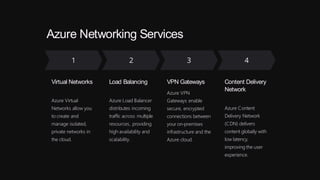
Azure Networking Services
Virtual Networks
Azure Virtual
Networks allow you
to create and
manage isolated,
private networks in
the cloud.
Load Balancing
Azure Load Balancer
distributes incoming
traffic across multiple
resources, providing
high availability and
scalability.
VPN Gateways
Azure VPN
Gateways enable
secure, encrypted
connections between
your on-premises
infrastructure and the
Azure cloud.
Content Delivery
Network
Azure Content
Delivery Network
(CDN) delivers
content globally with
low latency,
improving the user
experience.
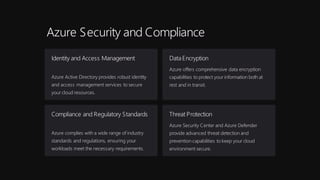
Azure Security and Compliance
Identity and Access Management
Azure Active Directory provides robust identity
and access management services to secure
your cloud resources.
DataEncryption
Azure offers comprehensive data encryption
capabilities to protect your information both at
rest and in transit.
Compliance and Regulatory Standards
Azure complies with a wide range of industry
standards and regulations, ensuring your
workloads meet the necessary requirements.
Threat Protection
Azure Security Center and Azure Defender
provide advanced threat detection and
prevention capabilities to keep your cloud
environment secure.
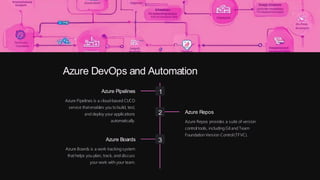
Azure DevOps and Automation
1
Azure Pipelines
Azure Pipelines is a cloud-based CI/CD
service that enables you to build, test,
and deploy your applications
automatically.
2 Azure Repos
Azure Repos provides a suite of version
control tools, including Git and Team
Foundation Version Control (TFVC).
3
Azure Boards
Azure Boards is a work tracking system
that helps you plan, track, and discuss
your work with your team.
Conclusion and Next Steps
Azure offers a comprehensive suite of cloud computing services to help businesses of all sizes succeed in the
digital age. By leveraging Azure's powerful capabilities, organizations can streamline their operations, enhance
their security, and drive innovation.
To get started with Azure, consider exploring the various services and solutions that align with your business
needs. Take advantage of Azure's documentation, tutorials, and community resources to learn more and
begin your cloud transformation journey.

azure certification training course.-pdf

  • 1.
    Introduction to Microsoft Azure MicrosoftAzure is a powerful cloud computing platform that provides a wide range of services and tools for businesses of all sizes. From virtual machines and databases to artificial intelligence and IoT solutions, Azure offers a comprehensive suite of cloud-based services to meet the diverse needs of modern organizations. ya by yasera fathima
  • 2.
    Azure Cloud ComputingServices Infrastructure as a Service (IaaS) Azure provides virtual machines, storage, and networking, allowing you to build and manage your own infrastructure in the cloud. Platform as a Service (PaaS) Azure's PaaS offerings include web apps, databases, and AI services, enabling you to focus on building your applications without worrying about the underlying infrastructure. Software as a Service (SaaS) Azure also offers a wide range of SaaS applications, such as Office 365 and Dynamics 365, to help businesses be more productive and efficient.
  • 3.
    Azure Compute Services 1Virtual Machines Azure Virtual Machines (VMs) allow you to run a wide range of applications and workloads on the cloud, with flexibility and scalability. 2 Serverless Computing Azure Functions and Azure Logic Apps enable serverless computing, allowing you to run your code or automate your workflows without managing any infrastructure. 3 Containers Azure's container services, such as Azure Kubernetes Service (AKS) and Azure Container Instances, make it easy to deploy and manage containerized applications.
  • 4.
    Azure Storage Services BlobStorage Azure Blob Storage is a highly scalable object storage solution for storing unstructured data, such as images, videos, and documents. File Storage Azure File Storage provides fully managed file shares that can be accessed via the industry-standard SMB protocol. Queue Storage Azure Queue Storage is a reliable message queuing service that enables asynchronous communication between application components. Table Storage Azure Table Storage is a NoSQL key-value store that can be used to store structured, non-relational data.
  • 5.
    Azure Networking Services VirtualNetworks Azure Virtual Networks allow you to create and manage isolated, private networks in the cloud. Load Balancing Azure Load Balancer distributes incoming traffic across multiple resources, providing high availability and scalability. VPN Gateways Azure VPN Gateways enable secure, encrypted connections between your on-premises infrastructure and the Azure cloud. Content Delivery Network Azure Content Delivery Network (CDN) delivers content globally with low latency, improving the user experience.
  • 6.
    Azure Security andCompliance Identity and Access Management Azure Active Directory provides robust identity and access management services to secure your cloud resources. DataEncryption Azure offers comprehensive data encryption capabilities to protect your information both at rest and in transit. Compliance and Regulatory Standards Azure complies with a wide range of industry standards and regulations, ensuring your workloads meet the necessary requirements. Threat Protection Azure Security Center and Azure Defender provide advanced threat detection and prevention capabilities to keep your cloud environment secure.
  • 7.
    Azure DevOps andAutomation 1 Azure Pipelines Azure Pipelines is a cloud-based CI/CD service that enables you to build, test, and deploy your applications automatically. 2 Azure Repos Azure Repos provides a suite of version control tools, including Git and Team Foundation Version Control (TFVC). 3 Azure Boards Azure Boards is a work tracking system that helps you plan, track, and discuss your work with your team.
  • 8.
    Conclusion and NextSteps Azure offers a comprehensive suite of cloud computing services to help businesses of all sizes succeed in the digital age. By leveraging Azure's powerful capabilities, organizations can streamline their operations, enhance their security, and drive innovation. To get started with Azure, consider exploring the various services and solutions that align with your business needs. Take advantage of Azure's documentation, tutorials, and community resources to learn more and begin your cloud transformation journey.