WELCOME TO
Solution Architect
Tata Consultancy Services
SANKET SAXENA
CLOUD
JOURNEY
BLOGGER
SPEAKER
Talk About
Fundamentals of Cloud Computing
Career Opportunities in Cloud Computing
Learning Path and Certifications (AWS)
Q & A Session
Take Away
Better understanding about cloud
Opportunities in cloud computing
How to achieve cloud certification
Chance to win exam vouchers
Latest technology trends
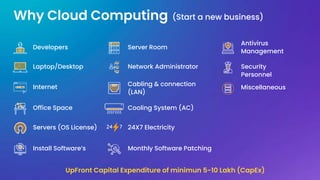
Why Cloud Computing
Office Space
24 7
Developers
Laptop/Desktop
Servers (OS License)
Server Room
Network Administrator
Cooling System (AC)
Cabling & connection
(LAN)
Install Software’s
24X7 Electricity
Monthly Software Patching
Antivirus
Management
Security
Personnel
Miscellaneous
Internet
UpFront Capital Expenditure of minimun 5-10 Lakh (CapEx)
(Start a new business)
How you manage?
Upgrade Server configuration (RAM/HDD/SSD)
Extend the number of servers
How to sale the old servers after X years of service?
How to manage the infrastucture in case of disaster?
How do you manage Data security?
MOVETOCLOUD
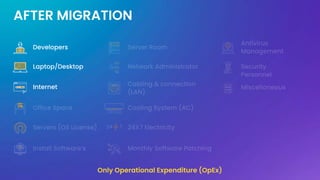
AFTER MIGRATION
Developers
Laptop/Desktop
Internet
Only Operational Expenditure (OpEx)
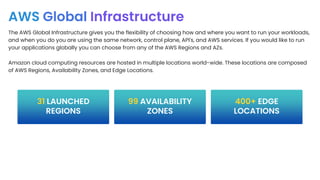
AWS Global Infrastructure
The AWS Global Infrastructure gives you the flexibility of choosing how and where you want to run your workloads,
and when you do you are using the same network, control plane, API's, and AWS services. If you would like to run
your applications globally you can choose from any of the AWS Regions and AZs.
Amazon cloud computing resources are hosted in multiple locations world-wide. These locations are composed
of AWS Regions, Availability Zones, and Edge Locations.
31 LAUNCHED
REGIONS
99 AVAILABILITY
ZONES
400+ EDGE
LOCATIONS
AWS Region
Availability
zone
DATA
CENTER
DATA
CENTER
Availability
zone
DATA
CENTER
DATA
CENTER
Availability
zone
DATA
CENTER
DATA
CENTER
AWS Region AWS Region
Availability
zone
DATA
CENTER
DATA
CENTER
Availability
zone
DATA
CENTER
DATA
CENTER
Availability
zone
DATA
CENTER
DATA
CENTER
Availability
zone
DATA
CENTER
DATA
CENTER
Availability
zone
DATA
CENTER
DATA
CENTER
Availability
zone
DATA
CENTER
DATA
CENTER
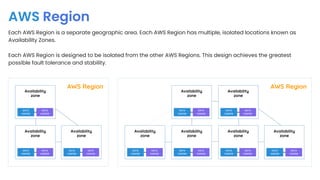
Each AWS Region is a separate geographic area. Each AWS Region has multiple, isolated locations known as
Availability Zones.
Each AWS Region is designed to be isolated from the other AWS Regions. This design achieves the greatest
possible fault tolerance and stability.
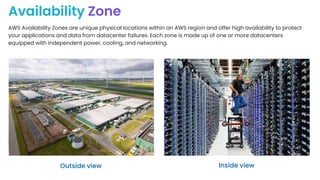
Availability Zone
AWS Availability Zones are unique physical locations within an AWS region and offer high availability to protect
your applications and data from datacenter failures. Each zone is made up of one or more datacenters
equipped with independent power, cooling, and networking.
Outside view Inside view
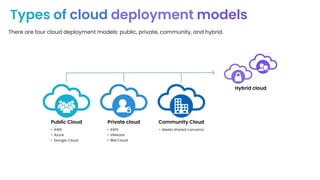
Types of cloud deployment models
Hybrid cloud
Public Cloud Private cloud Community Cloud
• AWS
• Azure
• Google Cloud
• AWS
• VMware
• IBM Cloud
• Meets shared concerns
There are four cloud deployment models: public, private, community, and hybrid.
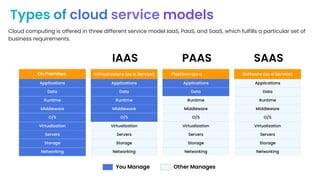
Types of cloud service models
You Manage Other Manages
On Premises Infrastructure (as a Service) Platform (as a
Service)
Software (as a Service)
Applications
Data
Runtime
Middleware
O/S
Virtualization
Servers
Storage
Networking
IAAS PAAS SAAS
Applications
Data
Runtime
Middleware
O/S
Virtualization
Servers
Storage
Networking
Applications
Data
Runtime
Middleware
O/S
Virtualization
Servers
Storage
Networking
Applications
Data
Runtime
Middleware
O/S
Virtualization
Servers
Storage
Networking
Cloud computing is offered in three different service model IaaS, PaaS, and SaaS, which fulfills a particular set of
business requirements.
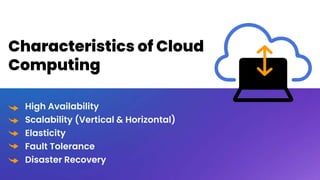
High Availability
Scalability (Vertical & Horizontal)
Elasticity
Fault Tolerance
Disaster Recovery
Characteristics of Cloud
Computing
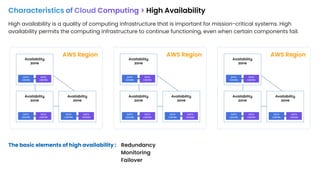
Characteristics of Cloud Computing > High Availability
Availability
zone
DATA
CENTER
DATA
CENTER
Availability
zone
DATA
CENTER
DATA
CENTER
Availability
zone
DATA
CENTER
DATA
CENTER
AWS Region
Availability
zone
DATA
CENTER
DATA
CENTER
Availability
zone
DATA
CENTER
DATA
CENTER
Availability
zone
DATA
CENTER
DATA
CENTER
AWS Region
Availability
zone
DATA
CENTER
DATA
CENTER
Availability
zone
DATA
CENTER
DATA
CENTER
Availability
zone
DATA
CENTER
DATA
CENTER
AWS Region
The basic elements of high availability : Redundancy
Monitoring
Failover
High availability is a quality of computing infrastructure that is important for mission-critical systems. High
availability permits the computing infrastructure to continue functioning, even when certain components fail.
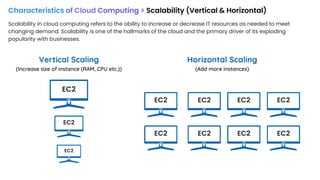
Characteristics of Cloud Computing > Scalability (Vertical & Horizontal)
Vertical Scaling
(Increase size of instance (RAM, CPU etc.))
EC2
EC2
EC2
Horizontal Scaling
(Add more instances)
EC2 EC2 EC2
EC2 EC2 EC2
EC2
EC2
Scalability in cloud computing refers to the ability to increase or decrease IT resources as needed to meet
changing demand. Scalability is one of the hallmarks of the cloud and the primary driver of its exploding
popularity with businesses.
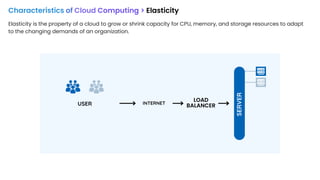
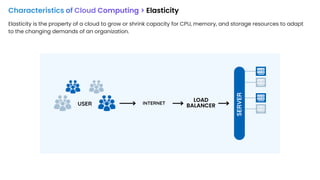
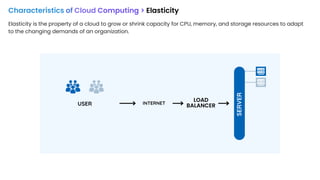
Characteristics of Cloud Computing > Elasticity
Elasticity is the property of a cloud to grow or shrink capacity for CPU, memory, and storage resources to adapt
to the changing demands of an organization.
INTERNET
USER
SERVER
LOAD
BALANCER
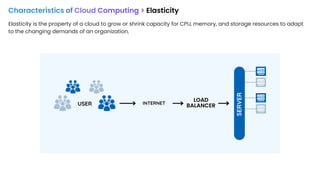
Characteristics of Cloud Computing > Elasticity
Elasticity is the property of a cloud to grow or shrink capacity for CPU, memory, and storage resources to adapt
to the changing demands of an organization.
INTERNET
USER
SERVER
LOAD
BALANCER
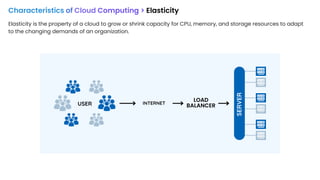
Characteristics of Cloud Computing > Elasticity
Elasticity is the property of a cloud to grow or shrink capacity for CPU, memory, and storage resources to adapt
to the changing demands of an organization.
INTERNET
USER
SERVER
LOAD
BALANCER
Characteristics of Cloud Computing > Elasticity
Elasticity is the property of a cloud to grow or shrink capacity for CPU, memory, and storage resources to adapt
to the changing demands of an organization.
INTERNET
USER
SERVER
LOAD
BALANCER
Characteristics of Cloud Computing > Elasticity
Elasticity is the property of a cloud to grow or shrink capacity for CPU, memory, and storage resources to adapt
to the changing demands of an organization.
INTERNET
USER
SERVER
LOAD
BALANCER
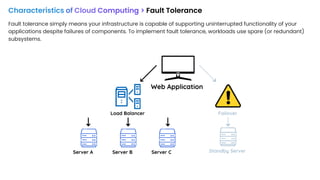
Characteristics of Cloud Computing > Fault Tolerance
Web Application
Load Balancer
Server A Server B Server C
Failover
Standby Server
Fault tolerance simply means your infrastructure is capable of supporting uninterrupted functionality of your
applications despite failures of components. To implement fault tolerance, workloads use spare (or redundant)
subsystems.
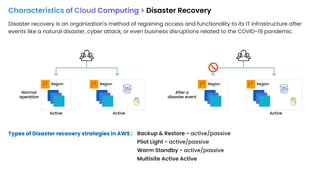
Region Region
Normal
operation
Active
Active
Characteristics of Cloud Computing > Disaster Recovery
Region Region
After a
disaster event
Active
Types of Disaster recovery strategies in AWS : Backup & Restore - active/passive
Pilot Light - active/passive
Warm Standby - active/passive
Multisite Active Active
Disaster recovery is an organization's method of regaining access and functionality to its IT infrastructure after
events like a natural disaster, cyber attack, or even business disruptions related to the COVID-19 pandemic.
Let's discuss some
AWS Services
Compute - EC2, EBS, Elastic Beanstalk, Lambda
Storage - S3, S3 Glacier, EBS, EFS
Database Services - RDS, DynamoDB
Networking - VPC, CloudFront, Route53, WAF, VPN, Firewall
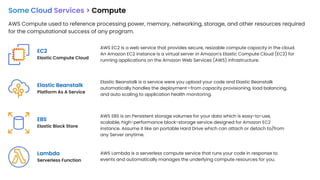
Some Cloud Services > Compute
AWS Compute used to reference processing power, memory, networking, storage, and other resources required
for the computational success of any program.
EC2
Elastic Compute Cloud
EBS
Elastic Block Store
Elastic Beanstalk
Platform As A Service
Lambda
Serverless Function
AWS EC2 is a web service that provides secure, resizable compute capacity in the cloud.
An Amazon EC2 instance is a virtual server in Amazon's Elastic Compute Cloud (EC2) for
running applications on the Amazon Web Services (AWS) infrastructure.
Elastic Beanstalk is a service were you upload your code and Elastic Beanstalk
automatically handles the deployment—from capacity provisioning, load balancing,
and auto scaling to application health monitoring.
AWS EBS is an Persistent storage volumes for your data which is easy-to-use,
scalable, high-performance block-storage service designed for Amazon EC2
instance. Assume it like an portable Hard Drive which can attach or detach to/from
any Server anytime.
AWS Lambda is a serverless compute service that runs your code in response to
events and automatically manages the underlying compute resources for you.
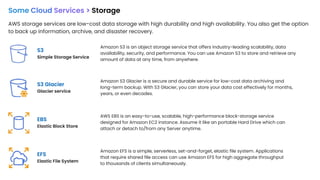
Some Cloud Services > Storage
AWS storage services are low-cost data storage with high durability and high availability. You also get the option
to back up information, archive, and disaster recovery.
S3
Simple Storage Service
EBS
Elastic Block Store
S3 Glacier
Glacier service
EFS
Elastic File System
Amazon S3 is an object storage service that offers industry-leading scalability, data
availability, security, and performance. You can use Amazon S3 to store and retrieve any
amount of data at any time, from anywhere.
Amazon S3 Glacier is a secure and durable service for low-cost data archiving and
long-term backup. With S3 Glacier, you can store your data cost effectively for months,
years, or even decades.
AWS EBS is an easy-to-use, scalable, high-performance block-storage service
designed for Amazon EC2 instance. Assume it like an portable Hard Drive which can
attach or detach to/from any Server anytime.
Amazon EFS is a simple, serverless, set-and-forget, elastic file system. Applications
that require shared file access can use Amazon EFS for high aggregate throughput
to thousands of clients simultaneously.
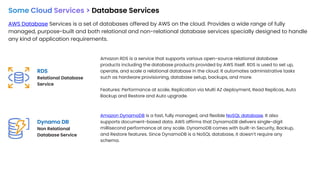
Some Cloud Services > Database Services
AWS Database Services is a set of databases offered by AWS on the cloud. Provides a wide range of fully
managed, purpose-built and both relational and non-relational database services specially designed to handle
any kind of application requirements.
RDS
Relational Database
Service
Dynamo DB
Non Relational
Database Service
Amazon RDS is a service that supports various open-source relational database
products including the database products provided by AWS itself. RDS is used to set up,
operate, and scale a relational database in the cloud. It automates administrative tasks
such as hardware provisioning, database setup, backups, and more.
Features: Performance at scale, Replication via Multi AZ deployment, Read Replicas, Auto
Backup and Restore and Auto upgrade.
Amazon DynamoDB is a fast, fully managed, and flexible NoSQL database. It also
supports document-based data. AWS affirms that DynamoDB delivers single-digit
millisecond performance at any scale. DynamoDB comes with built-in Security, Backup,
and Restore features. Since DynamoDB is a NoSQL database, it doesn’t require any
schema.
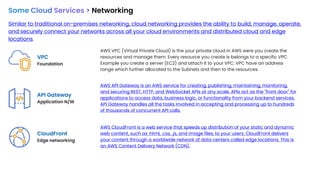
Some Cloud Services > Networking
Similar to traditional on-premises networking, cloud networking provides the ability to build, manage, operate,
and securely connect your networks across all your cloud environments and distributed cloud and edge
locations.
VPC
Foundation
API Gateway
Application N/W
AWS VPC (Virtual Private Cloud) is the your private cloud in AWS were you create the
resources and manage them. Every resource you create is belongs to a specific VPC.
Example you create a server (EC2) and attach it to your VPC. VPC have an address
range which further allocated to the Subnets and then to the resources.
AWS API Gateway is an AWS service for creating, publishing, maintaining, monitoring,
and securing REST, HTTP, and WebSocket APIs at any scale. APIs act as the "front door" for
applications to access data, business logic, or functionality from your backend services.
API Gateway handles all the tasks involved in accepting and processing up to hundreds
of thousands of concurrent API calls.
CloudFront
Edge networking
AWS CloudFront is a web service that speeds up distribution of your static and dynamic
web content, such as .html, .css, .js, and image files, to your users. CloudFront delivers
your content through a worldwide network of data centers called edge locations. This is

an AWS Content Delivery Network (CDN).
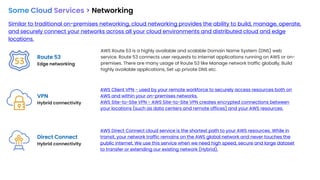
Some Cloud Services > Networking
Similar to traditional on-premises networking, cloud networking provides the ability to build, manage, operate,
and securely connect your networks across all your cloud environments and distributed cloud and edge
locations.

Route 53
Edge networking
VPN
Hybrid connectivity
AWS Route 53 is a highly available and scalable Domain Name System (DNS) web
service. Route 53 connects user requests to internet applications running on AWS or on-
premises. There are many usage of Route 53 like Manage network traffic globally, Build
highly available applications, Set up private DNS etc.
AWS Client VPN - used by your remote workforce to securely access resources both on
AWS and within your on-premises networks.
AWS Site-to-Site VPN - AWS Site-to-Site VPN creates encrypted connections between
your locations (such as data centers and remote offices) and your AWS resources.
Direct Connect
Hybrid connectivity
AWS Direct Connect cloud service is the shortest path to your AWS resources. While in
transit, your network traffic remains on the AWS global network and never touches the
public internet. We use this service when we need high speed, secure and large dataset
to transfer or extending our existing network (Hybrid).
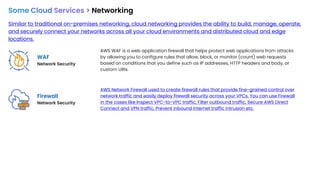
Some Cloud Services > Networking
Similar to traditional on-premises networking, cloud networking provides the ability to build, manage, operate,
and securely connect your networks across all your cloud environments and distributed cloud and edge
locations.

WAF
Network Security
Firewall
Network Security
AWS WAF is a web application firewall that helps protect web applications from attacks
by allowing you to configure rules that allow, block, or monitor (count) web requests
based on conditions that you define such as IP addresses, HTTP headers and body, or
custom URIs.
AWS Network Firewall used to create firewall rules that provide fine-grained control over
network traffic and easily deploy firewall security across your VPCs. You can use Firewall
in the cases like Inspect VPC-to-VPC traffic, Filter outbound traffic, Secure AWS Direct
Connect and VPN traffic, Prevent inbound internet traffic intrusion etc.
LIVEAWS
CONSOLETOUR
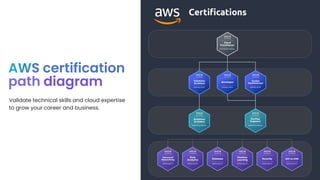
AWS certification
path diagram
Validate technical skills and cloud expertise
to grow your career and business.
How to Learn?
Below are the links which can be use for starting AWS training:
Freecodecam
p
Edureka
Udemy
AWS Training
Tutorial Dojo
Create a FREE AWS account for practice
CAREER&
OPPORTUNITIES
AWS Community Hero
Enabling Digital Transformation on ☁️
KAUSHIK MOHANRAJ
Director - Blazeclan Technologies
Microsoft Solution Expert and
Entrepreneur☁️
SUNIL SHARMA
Founder & CEO - DotStark Technologies
We are a team with a mixture of passion and
experience, filled with people who love what
they do, extremely curious and wants to know
how everything works. Most importantly we
don’t shy away from challenges.
hr@dotstark.com | +91 9773366683
www.dotstark.com
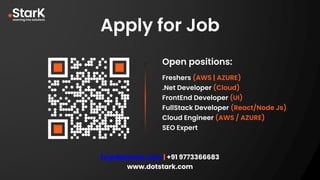
Apply for Job
Freshers (AWS | AZURE)
.Net Developer (Cloud)
FrontEnd Developer (UI)
FullStack Developer (React/Node Js)
Cloud Engineer (AWS / AZURE)
SEO Expert
Open positions:
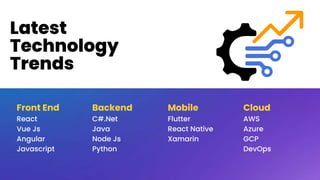
Latest
Technology
Trends
Front End
React
Vue Js
Angular
Javascript
Backend
C#.Net
Java
Node Js
Python
Mobile
Flutter
React Native
Xamarin
Cloud
AWS
Azure
GCP
DevOps
Time for Q&A
Now it's time for you to ask questions
from us and we will try to answer your
all the questions.

Scan the QR code
Ask your Question
We will Answer
Scan the QR Code
FOR ATTENDING THE SESSION

AWS Session.pptx

  • 1.
    WELCOME TO Solution Architect TataConsultancy Services SANKET SAXENA CLOUD JOURNEY BLOGGER SPEAKER
  • 2.
    Talk About Fundamentals ofCloud Computing Career Opportunities in Cloud Computing Learning Path and Certifications (AWS) Q & A Session
  • 3.
    Take Away Better understandingabout cloud Opportunities in cloud computing How to achieve cloud certification Chance to win exam vouchers Latest technology trends
  • 4.
    Why Cloud Computing OfficeSpace 24 7 Developers Laptop/Desktop Servers (OS License) Server Room Network Administrator Cooling System (AC) Cabling & connection (LAN) Install Software’s 24X7 Electricity Monthly Software Patching Antivirus Management Security Personnel Miscellaneous Internet UpFront Capital Expenditure of minimun 5-10 Lakh (CapEx) (Start a new business)
  • 5.
    How you manage? UpgradeServer configuration (RAM/HDD/SSD) Extend the number of servers How to sale the old servers after X years of service? How to manage the infrastucture in case of disaster? How do you manage Data security?
  • 6.
  • 7.
  • 8.
    AWS Global Infrastructure TheAWS Global Infrastructure gives you the flexibility of choosing how and where you want to run your workloads, and when you do you are using the same network, control plane, API's, and AWS services. If you would like to run your applications globally you can choose from any of the AWS Regions and AZs. Amazon cloud computing resources are hosted in multiple locations world-wide. These locations are composed of AWS Regions, Availability Zones, and Edge Locations. 31 LAUNCHED REGIONS 99 AVAILABILITY ZONES 400+ EDGE LOCATIONS
  • 9.
    AWS Region Availability zone DATA CENTER DATA CENTER Availability zone DATA CENTER DATA CENTER Availability zone DATA CENTER DATA CENTER AWS RegionAWS Region Availability zone DATA CENTER DATA CENTER Availability zone DATA CENTER DATA CENTER Availability zone DATA CENTER DATA CENTER Availability zone DATA CENTER DATA CENTER Availability zone DATA CENTER DATA CENTER Availability zone DATA CENTER DATA CENTER Each AWS Region is a separate geographic area. Each AWS Region has multiple, isolated locations known as Availability Zones. Each AWS Region is designed to be isolated from the other AWS Regions. This design achieves the greatest possible fault tolerance and stability.
  • 10.
    Availability Zone AWS AvailabilityZones are unique physical locations within an AWS region and offer high availability to protect your applications and data from datacenter failures. Each zone is made up of one or more datacenters equipped with independent power, cooling, and networking. Outside view Inside view
  • 11.
    Types of clouddeployment models Hybrid cloud Public Cloud Private cloud Community Cloud • AWS • Azure • Google Cloud • AWS • VMware • IBM Cloud • Meets shared concerns There are four cloud deployment models: public, private, community, and hybrid.
  • 12.
    Types of cloudservice models You Manage Other Manages On Premises Infrastructure (as a Service) Platform (as a Service) Software (as a Service) Applications Data Runtime Middleware O/S Virtualization Servers Storage Networking IAAS PAAS SAAS Applications Data Runtime Middleware O/S Virtualization Servers Storage Networking Applications Data Runtime Middleware O/S Virtualization Servers Storage Networking Applications Data Runtime Middleware O/S Virtualization Servers Storage Networking Cloud computing is offered in three different service model IaaS, PaaS, and SaaS, which fulfills a particular set of business requirements.
  • 13.
    High Availability Scalability (Vertical& Horizontal) Elasticity Fault Tolerance Disaster Recovery Characteristics of Cloud Computing
  • 14.
    Characteristics of CloudComputing > High Availability Availability zone DATA CENTER DATA CENTER Availability zone DATA CENTER DATA CENTER Availability zone DATA CENTER DATA CENTER AWS Region Availability zone DATA CENTER DATA CENTER Availability zone DATA CENTER DATA CENTER Availability zone DATA CENTER DATA CENTER AWS Region Availability zone DATA CENTER DATA CENTER Availability zone DATA CENTER DATA CENTER Availability zone DATA CENTER DATA CENTER AWS Region The basic elements of high availability : Redundancy Monitoring Failover High availability is a quality of computing infrastructure that is important for mission-critical systems. High availability permits the computing infrastructure to continue functioning, even when certain components fail.
  • 15.
    Characteristics of CloudComputing > Scalability (Vertical & Horizontal) Vertical Scaling (Increase size of instance (RAM, CPU etc.)) EC2 EC2 EC2 Horizontal Scaling (Add more instances) EC2 EC2 EC2 EC2 EC2 EC2 EC2 EC2 Scalability in cloud computing refers to the ability to increase or decrease IT resources as needed to meet changing demand. Scalability is one of the hallmarks of the cloud and the primary driver of its exploding popularity with businesses.
  • 16.
    Characteristics of CloudComputing > Elasticity Elasticity is the property of a cloud to grow or shrink capacity for CPU, memory, and storage resources to adapt to the changing demands of an organization. INTERNET USER SERVER LOAD BALANCER
  • 17.
    Characteristics of CloudComputing > Elasticity Elasticity is the property of a cloud to grow or shrink capacity for CPU, memory, and storage resources to adapt to the changing demands of an organization. INTERNET USER SERVER LOAD BALANCER
  • 18.
    Characteristics of CloudComputing > Elasticity Elasticity is the property of a cloud to grow or shrink capacity for CPU, memory, and storage resources to adapt to the changing demands of an organization. INTERNET USER SERVER LOAD BALANCER
  • 19.
    Characteristics of CloudComputing > Elasticity Elasticity is the property of a cloud to grow or shrink capacity for CPU, memory, and storage resources to adapt to the changing demands of an organization. INTERNET USER SERVER LOAD BALANCER
  • 20.
    Characteristics of CloudComputing > Elasticity Elasticity is the property of a cloud to grow or shrink capacity for CPU, memory, and storage resources to adapt to the changing demands of an organization. INTERNET USER SERVER LOAD BALANCER
  • 21.
    Characteristics of CloudComputing > Fault Tolerance Web Application Load Balancer Server A Server B Server C Failover Standby Server Fault tolerance simply means your infrastructure is capable of supporting uninterrupted functionality of your applications despite failures of components. To implement fault tolerance, workloads use spare (or redundant) subsystems.
  • 22.
    Region Region Normal operation Active Active Characteristics ofCloud Computing > Disaster Recovery Region Region After a disaster event Active Types of Disaster recovery strategies in AWS : Backup & Restore - active/passive Pilot Light - active/passive Warm Standby - active/passive Multisite Active Active Disaster recovery is an organization's method of regaining access and functionality to its IT infrastructure after events like a natural disaster, cyber attack, or even business disruptions related to the COVID-19 pandemic.
  • 23.
    Let's discuss some AWSServices Compute - EC2, EBS, Elastic Beanstalk, Lambda Storage - S3, S3 Glacier, EBS, EFS Database Services - RDS, DynamoDB Networking - VPC, CloudFront, Route53, WAF, VPN, Firewall
  • 24.
    Some Cloud Services> Compute AWS Compute used to reference processing power, memory, networking, storage, and other resources required for the computational success of any program. EC2 Elastic Compute Cloud EBS Elastic Block Store Elastic Beanstalk Platform As A Service Lambda Serverless Function AWS EC2 is a web service that provides secure, resizable compute capacity in the cloud. An Amazon EC2 instance is a virtual server in Amazon's Elastic Compute Cloud (EC2) for running applications on the Amazon Web Services (AWS) infrastructure. Elastic Beanstalk is a service were you upload your code and Elastic Beanstalk automatically handles the deployment—from capacity provisioning, load balancing, and auto scaling to application health monitoring. AWS EBS is an Persistent storage volumes for your data which is easy-to-use, scalable, high-performance block-storage service designed for Amazon EC2 instance. Assume it like an portable Hard Drive which can attach or detach to/from any Server anytime. AWS Lambda is a serverless compute service that runs your code in response to events and automatically manages the underlying compute resources for you.
  • 25.
    Some Cloud Services> Storage AWS storage services are low-cost data storage with high durability and high availability. You also get the option to back up information, archive, and disaster recovery. S3 Simple Storage Service EBS Elastic Block Store S3 Glacier Glacier service EFS Elastic File System Amazon S3 is an object storage service that offers industry-leading scalability, data availability, security, and performance. You can use Amazon S3 to store and retrieve any amount of data at any time, from anywhere. Amazon S3 Glacier is a secure and durable service for low-cost data archiving and long-term backup. With S3 Glacier, you can store your data cost effectively for months, years, or even decades. AWS EBS is an easy-to-use, scalable, high-performance block-storage service designed for Amazon EC2 instance. Assume it like an portable Hard Drive which can attach or detach to/from any Server anytime. Amazon EFS is a simple, serverless, set-and-forget, elastic file system. Applications that require shared file access can use Amazon EFS for high aggregate throughput to thousands of clients simultaneously.
  • 26.
    Some Cloud Services> Database Services AWS Database Services is a set of databases offered by AWS on the cloud. Provides a wide range of fully managed, purpose-built and both relational and non-relational database services specially designed to handle any kind of application requirements. RDS Relational Database Service Dynamo DB Non Relational Database Service Amazon RDS is a service that supports various open-source relational database products including the database products provided by AWS itself. RDS is used to set up, operate, and scale a relational database in the cloud. It automates administrative tasks such as hardware provisioning, database setup, backups, and more. Features: Performance at scale, Replication via Multi AZ deployment, Read Replicas, Auto Backup and Restore and Auto upgrade. Amazon DynamoDB is a fast, fully managed, and flexible NoSQL database. It also supports document-based data. AWS affirms that DynamoDB delivers single-digit millisecond performance at any scale. DynamoDB comes with built-in Security, Backup, and Restore features. Since DynamoDB is a NoSQL database, it doesn’t require any schema.
  • 27.
    Some Cloud Services> Networking Similar to traditional on-premises networking, cloud networking provides the ability to build, manage, operate, and securely connect your networks across all your cloud environments and distributed cloud and edge locations. VPC Foundation API Gateway Application N/W AWS VPC (Virtual Private Cloud) is the your private cloud in AWS were you create the resources and manage them. Every resource you create is belongs to a specific VPC. Example you create a server (EC2) and attach it to your VPC. VPC have an address range which further allocated to the Subnets and then to the resources. AWS API Gateway is an AWS service for creating, publishing, maintaining, monitoring, and securing REST, HTTP, and WebSocket APIs at any scale. APIs act as the "front door" for applications to access data, business logic, or functionality from your backend services. API Gateway handles all the tasks involved in accepting and processing up to hundreds of thousands of concurrent API calls. CloudFront Edge networking AWS CloudFront is a web service that speeds up distribution of your static and dynamic web content, such as .html, .css, .js, and image files, to your users. CloudFront delivers your content through a worldwide network of data centers called edge locations. This is an AWS Content Delivery Network (CDN).
  • 28.
    Some Cloud Services> Networking Similar to traditional on-premises networking, cloud networking provides the ability to build, manage, operate, and securely connect your networks across all your cloud environments and distributed cloud and edge locations. Route 53 Edge networking VPN Hybrid connectivity AWS Route 53 is a highly available and scalable Domain Name System (DNS) web service. Route 53 connects user requests to internet applications running on AWS or on- premises. There are many usage of Route 53 like Manage network traffic globally, Build highly available applications, Set up private DNS etc. AWS Client VPN - used by your remote workforce to securely access resources both on AWS and within your on-premises networks. AWS Site-to-Site VPN - AWS Site-to-Site VPN creates encrypted connections between your locations (such as data centers and remote offices) and your AWS resources. Direct Connect Hybrid connectivity AWS Direct Connect cloud service is the shortest path to your AWS resources. While in transit, your network traffic remains on the AWS global network and never touches the public internet. We use this service when we need high speed, secure and large dataset to transfer or extending our existing network (Hybrid).
  • 29.
    Some Cloud Services> Networking Similar to traditional on-premises networking, cloud networking provides the ability to build, manage, operate, and securely connect your networks across all your cloud environments and distributed cloud and edge locations. WAF Network Security Firewall Network Security AWS WAF is a web application firewall that helps protect web applications from attacks by allowing you to configure rules that allow, block, or monitor (count) web requests based on conditions that you define such as IP addresses, HTTP headers and body, or custom URIs. AWS Network Firewall used to create firewall rules that provide fine-grained control over network traffic and easily deploy firewall security across your VPCs. You can use Firewall in the cases like Inspect VPC-to-VPC traffic, Filter outbound traffic, Secure AWS Direct Connect and VPN traffic, Prevent inbound internet traffic intrusion etc.
  • 30.
  • 31.
    AWS certification path diagram Validatetechnical skills and cloud expertise to grow your career and business.
  • 32.
    How to Learn? Beloware the links which can be use for starting AWS training: Freecodecam p Edureka Udemy AWS Training Tutorial Dojo Create a FREE AWS account for practice
  • 33.
  • 34.
    AWS Community Hero EnablingDigital Transformation on ☁️ KAUSHIK MOHANRAJ Director - Blazeclan Technologies
  • 35.
    Microsoft Solution Expertand Entrepreneur☁️ SUNIL SHARMA Founder & CEO - DotStark Technologies
  • 36.
    We are ateam with a mixture of passion and experience, filled with people who love what they do, extremely curious and wants to know how everything works. Most importantly we don’t shy away from challenges.
  • 37.
    hr@dotstark.com | +919773366683 www.dotstark.com Apply for Job Freshers (AWS | AZURE) .Net Developer (Cloud) FrontEnd Developer (UI) FullStack Developer (React/Node Js) Cloud Engineer (AWS / AZURE) SEO Expert Open positions:
  • 38.
    Latest Technology Trends Front End React Vue Js Angular Javascript Backend C#.Net Java NodeJs Python Mobile Flutter React Native Xamarin Cloud AWS Azure GCP DevOps
  • 39.
    Time for Q&A Nowit's time for you to ask questions from us and we will try to answer your all the questions. Scan the QR code Ask your Question We will Answer
  • 40.
  • 41.