© 2015 Autodesk, Inc. All rights reserved
Проектирование объектов инфраструктуры
будущего
AUTODESK
Геннадий Молодецкий
© 2015 Autodesk, Inc. All rights reserved
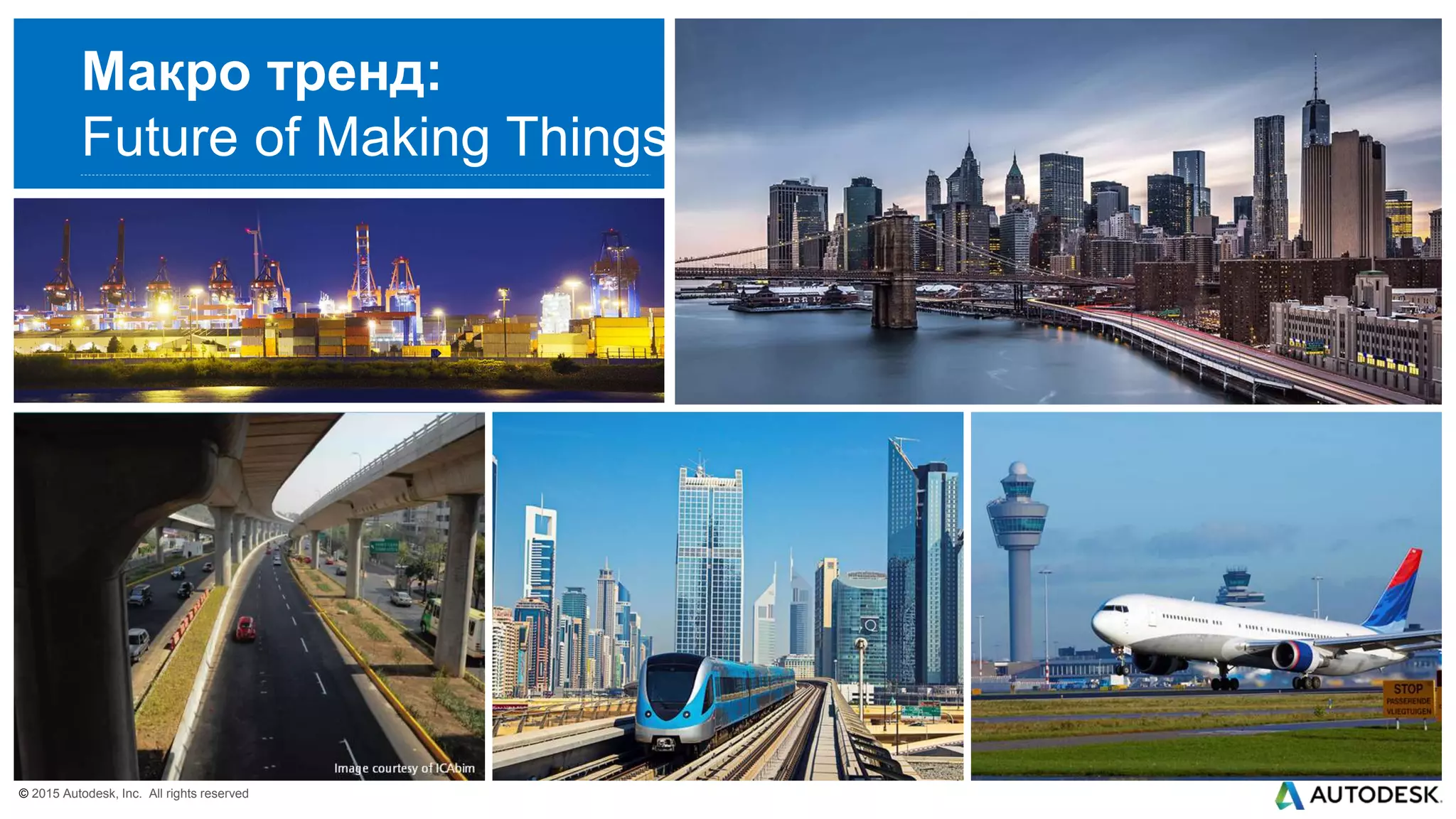
Макро тренд:
Future of Making Things
© 2015 Autodesk, Inc. All rights reserved
ПРОДУКТЫ
ПРОИЗВОДСТВО
СПРОС
Image Courtesy Parsons
Brinckerhoff
© 2015 Autodesk, Inc. All rights reserved© 2015 Autodesk, Inc. All rights reserved ПРОДУКТЫСПРОС
ПРОИЗВОДСТВО Source: U.S.
DOT
© 2015 Autodesk, Inc. All rights reserved© 2015 Autodesk, Inc. All rights reserved
Три эры технологических революций
Эра
Соединенных
систем
Дорога в
будущее
Эра
оптимизации
(модель)
2000-
сейчас
Эра
документации
(чертежи)
2D
черчение
80-е-90-е
BIM
BIM 
© 2015 Autodesk, Inc. All rights reserved© 2015 Autodesk, Inc. All rights reserved
Текущие вызовы индустрии
 Проекты становятся все крупнее
и более комплексными
 Множество одновременно
реализуемых проектов
 Понимание заказчиков
 Гибкость
Собственники
спонсоры
инженеры
строители
запросы
изменений
© 2015 Autodesk, Inc. All rights reserved© 2015 Autodesk, Inc. All rights reserved
Больше технологий
на стройплощадке
Больше комплексных проектов
Более
комплексная
эксплуатация и
обслуживание
BIM
стандарты и
мандаты
Контекстная
симуляция и
анализ
Тренд – трансформация процессов
© 2015 Autodesk, Inc. All rights reserved© 2015 Autodesk, Inc. All rights reserved
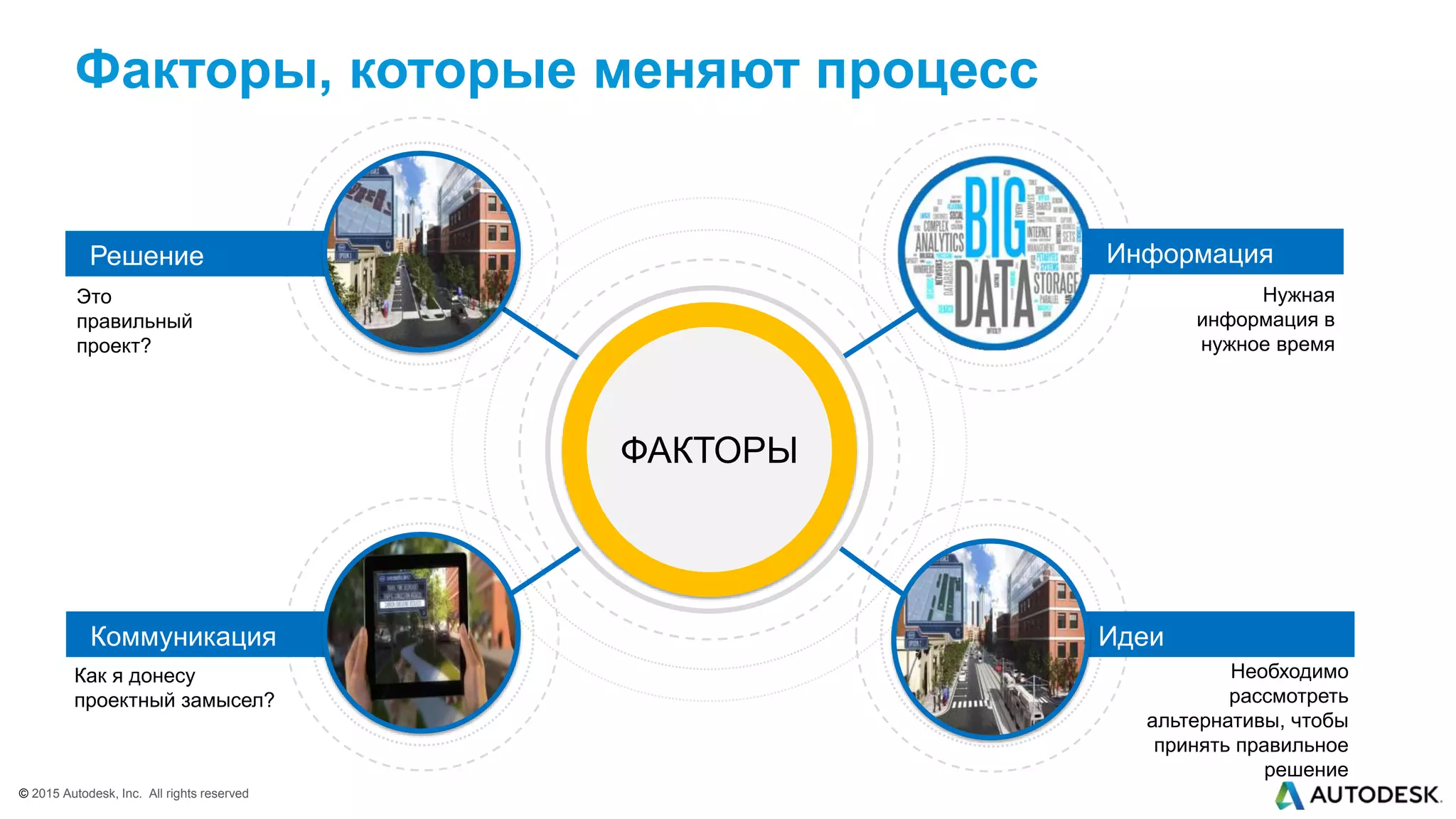
Факторы, которые меняют процесс
ФАКТОРЫ
Решение
Коммуникация Идеи
Информация
Это
правильный
проект?
Нужная
информация в
нужное время
Как я донесу
проектный замысел?
Необходимо
рассмотреть
альтернативы, чтобы
принять правильное
решение
© 2015 Autodesk, Inc. All rights reserved© 2015 Autodesk, Inc. All rights reserved
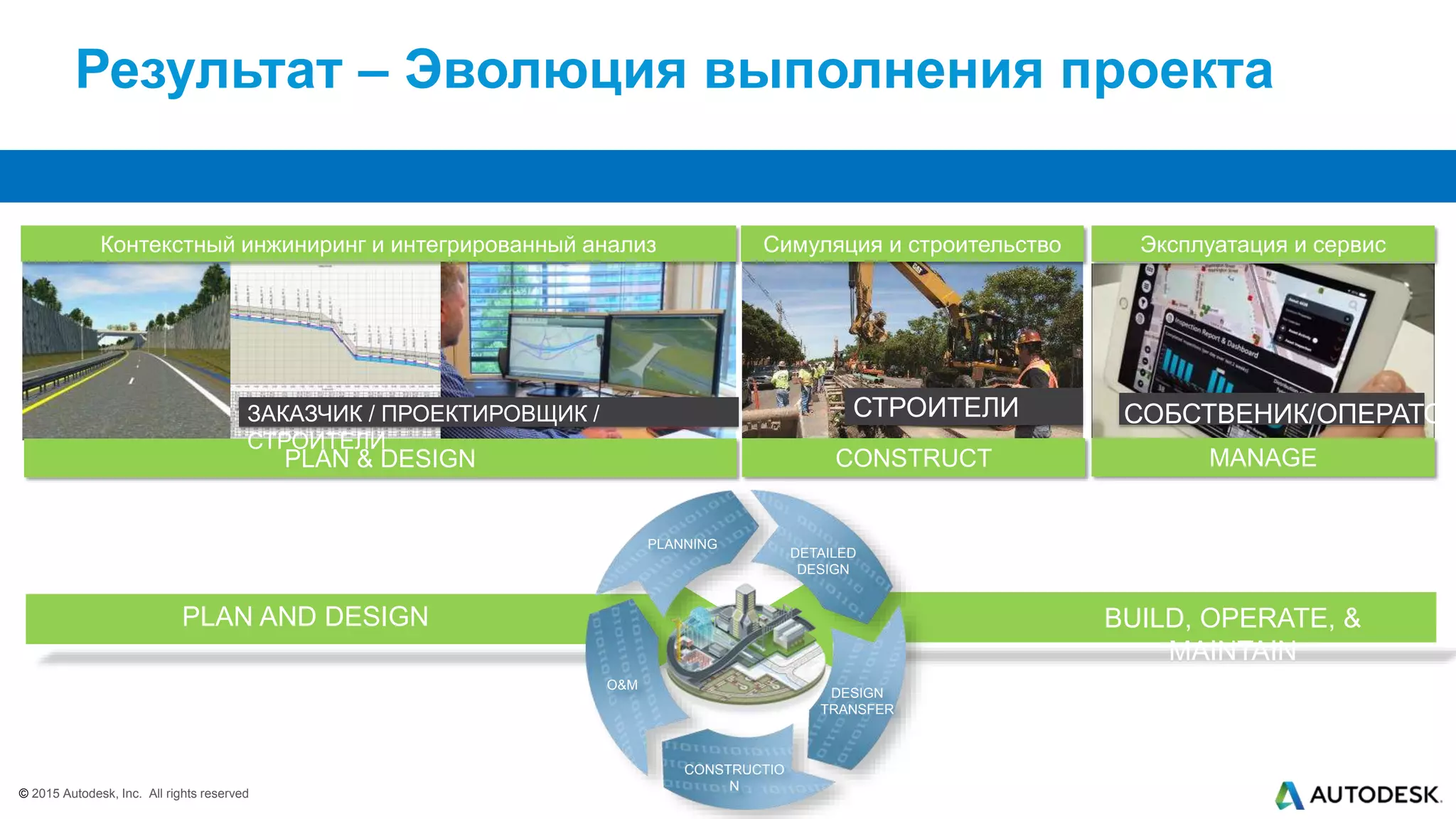
PLAN & DESIGN CONSTRUCT MANAGE
Результат – Эволюция выполнения проекта
СТРОИТЕЛИ СОБСТВЕНИК/ОПЕРАТОР
Контекстный инжиниринг и интегрированный анализ Эксплуатация и сервис
PLAN AND DESIGN BUILD, OPERATE, &
MAINTAIN
Симуляция и строительство
ЗАКАЗЧИК / ПРОЕКТИРОВЩИК /
СТРОИТЕЛИ
PLANNING
DETAILED
DESIGN
DESIGN
TRANSFER
CONSTRUCTIO
N
O&M
© 2015 Autodesk, Inc. All rights reserved© 2015 Autodesk, Inc. All rights reserved
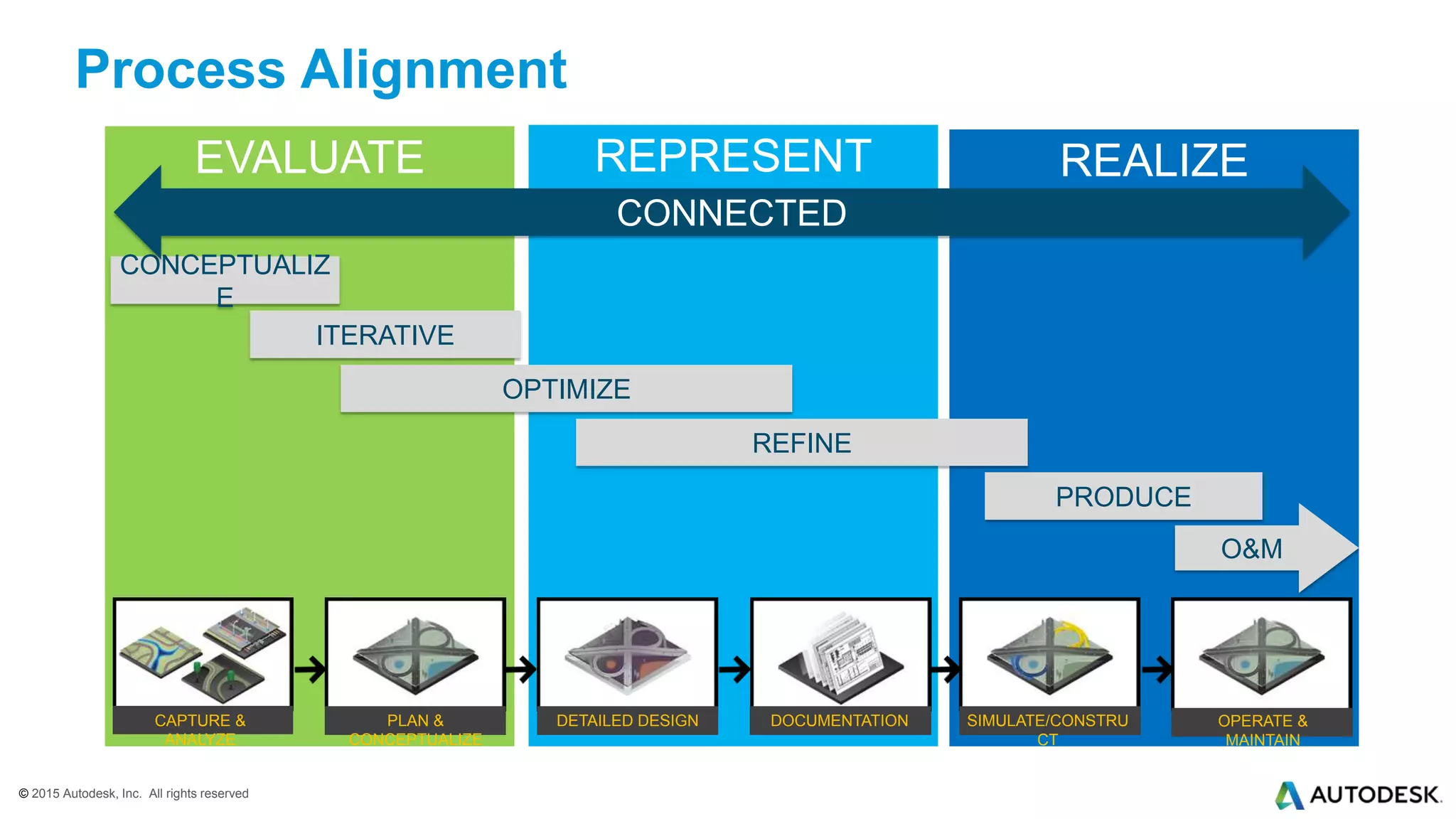
EVALUATE REPRESENT REALIZE
Process Alignment
CAPTURE &
ANALYZE
PLAN &
CONCEPTUALIZE
SIMULATE/CONSTRU
CT
DOCUMENTATION OPERATE &
MAINTAIN
DETAILED DESIGN
CONCEPTUALIZ
E
ITERATIVE
REFINE
PRODUCE
CONNECTED
OPTIMIZE
O&M
© 2015 Autodesk, Inc. All rights reserved© 2015 Autodesk, Inc. All rights reserved
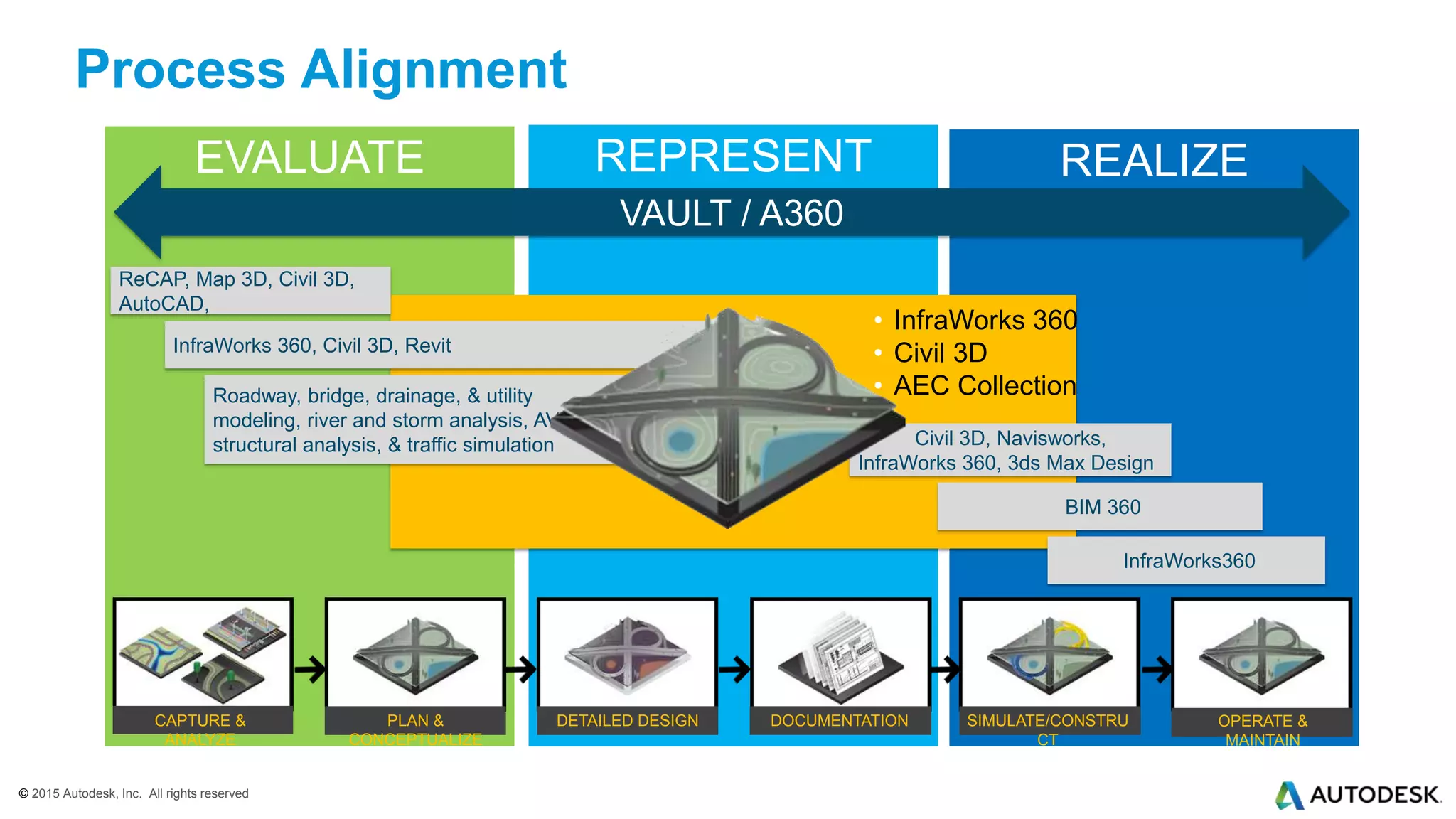
REALIZEREPRESENTEVALUATE
Process Alignment
CAPTURE &
ANALYZE
PLAN &
CONCEPTUALIZE
SIMULATE/CONSTRU
CT
DOCUMENTATION OPERATE &
MAINTAIN
DETAILED DESIGN
ReCAP, Map 3D, Civil 3D,
AutoCAD,
InfraWorks 360, Civil 3D, Revit
BIM 360
VAULT / A360
Roadway, bridge, drainage, & utility
modeling, river and storm analysis, AVT,
structural analysis, & traffic simulation
InfraWorks360
Civil 3D, Navisworks,
InfraWorks 360, 3ds Max Design
• InfraWorks 360
• Civil 3D
• AEC Collection
© 2015 Autodesk, Inc. All rights reserved
Результат - трансформация
CAPTURE &
ANALYZE
DESIGN CONCEPTS
DETAILED DESIGN DOCUMENTATION
SIMULATE/CONSTRU
CT
MANAGE
© 2015 Autodesk, Inc. All rights reserved© 2015 Autodesk, Inc. All rights reserved
Autodesk, the Autodesk logo, AutoCAD. BIM 360 Field, BIM 360 Glue, Fabrication CAMduct, FormIt, Point Layout, Revit, and Robot Structural Analysis, are registered trademarks or trademarks of Autodesk, Inc., and/or its subsidiaries and/or
affiliates in the USA and/or other countries. All other brand names, product names, or trademarks belong to their respective holders. Autodesk reserves the right to alter product and services offerings, and specifications and pricing at any time without
notice, and is not responsible for typographical or graphical errors that may appear in this document.
© 2015 Autodesk. All rights reserved
© 2015 Autodesk, Inc. All rights reserved
Pioneer examples
© 2015 Autodesk, Inc. All rights reserved© 2015 Autodesk, Inc. All rights reserved
Images courtesy Parsons Brinckerhoff
© 2015 Autodesk, Inc. All rights reserved© 2015 Autodesk, Inc. All rights reserved
Images courtesy COWI
© 2015 Autodesk, Inc. All rights reserved© 2015 Autodesk, Inc. All rights reserved
Images courtesy Kelprojektas
© 2015 Autodesk, Inc. All rights reserved© 2015 Autodesk, Inc. All rights reserved
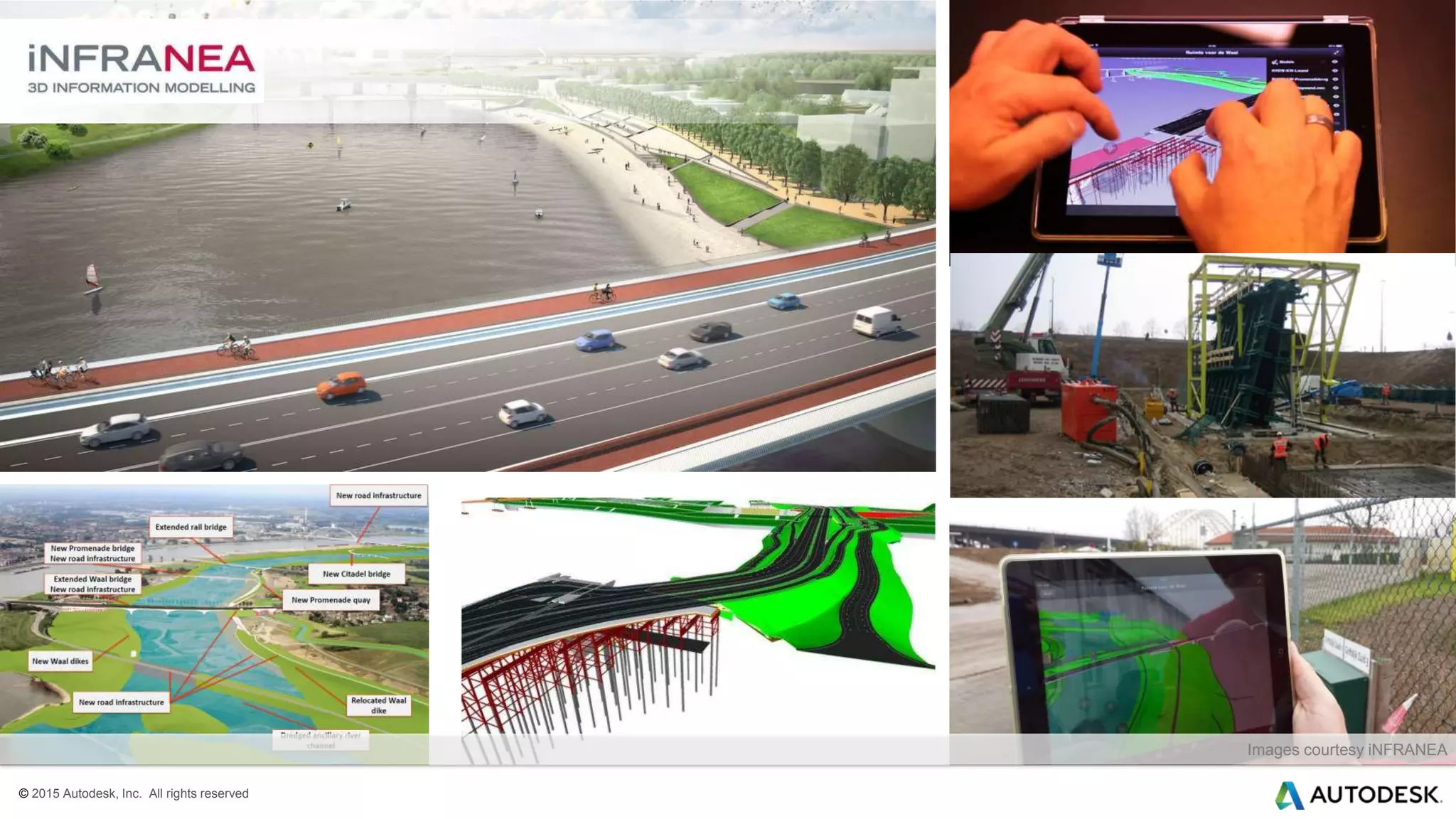
Images courtesy iNFRANEA
© 2015 Autodesk, Inc. All rights reserved© 2015 Autodesk, Inc. All rights reserved
Images courtesy Sundt Construction
© 2015 Autodesk, Inc. All rights reserved© 2015 Autodesk, Inc. All rights reserved
Images courtesy Wisconsin DOT, Gremmer & Associates and Mortenson Construction

Autodesk: Проектирование объектов инфраструктуры будущего

  • 1.
    © 2015 Autodesk,Inc. All rights reserved Проектирование объектов инфраструктуры будущего AUTODESK Геннадий Молодецкий
  • 2.
    © 2015 Autodesk,Inc. All rights reserved Макро тренд: Future of Making Things
  • 3.
    © 2015 Autodesk,Inc. All rights reserved ПРОДУКТЫ ПРОИЗВОДСТВО СПРОС Image Courtesy Parsons Brinckerhoff
  • 4.
    © 2015 Autodesk,Inc. All rights reserved© 2015 Autodesk, Inc. All rights reserved ПРОДУКТЫСПРОС ПРОИЗВОДСТВО Source: U.S. DOT
  • 5.
    © 2015 Autodesk,Inc. All rights reserved© 2015 Autodesk, Inc. All rights reserved Три эры технологических революций Эра Соединенных систем Дорога в будущее Эра оптимизации (модель) 2000- сейчас Эра документации (чертежи) 2D черчение 80-е-90-е BIM BIM 
  • 6.
    © 2015 Autodesk,Inc. All rights reserved© 2015 Autodesk, Inc. All rights reserved Текущие вызовы индустрии  Проекты становятся все крупнее и более комплексными  Множество одновременно реализуемых проектов  Понимание заказчиков  Гибкость Собственники спонсоры инженеры строители запросы изменений
  • 7.
    © 2015 Autodesk,Inc. All rights reserved© 2015 Autodesk, Inc. All rights reserved Больше технологий на стройплощадке Больше комплексных проектов Более комплексная эксплуатация и обслуживание BIM стандарты и мандаты Контекстная симуляция и анализ Тренд – трансформация процессов
  • 8.
    © 2015 Autodesk,Inc. All rights reserved© 2015 Autodesk, Inc. All rights reserved Факторы, которые меняют процесс ФАКТОРЫ Решение Коммуникация Идеи Информация Это правильный проект? Нужная информация в нужное время Как я донесу проектный замысел? Необходимо рассмотреть альтернативы, чтобы принять правильное решение
  • 9.
    © 2015 Autodesk,Inc. All rights reserved© 2015 Autodesk, Inc. All rights reserved PLAN & DESIGN CONSTRUCT MANAGE Результат – Эволюция выполнения проекта СТРОИТЕЛИ СОБСТВЕНИК/ОПЕРАТОР Контекстный инжиниринг и интегрированный анализ Эксплуатация и сервис PLAN AND DESIGN BUILD, OPERATE, & MAINTAIN Симуляция и строительство ЗАКАЗЧИК / ПРОЕКТИРОВЩИК / СТРОИТЕЛИ PLANNING DETAILED DESIGN DESIGN TRANSFER CONSTRUCTIO N O&M
  • 10.
    © 2015 Autodesk,Inc. All rights reserved© 2015 Autodesk, Inc. All rights reserved EVALUATE REPRESENT REALIZE Process Alignment CAPTURE & ANALYZE PLAN & CONCEPTUALIZE SIMULATE/CONSTRU CT DOCUMENTATION OPERATE & MAINTAIN DETAILED DESIGN CONCEPTUALIZ E ITERATIVE REFINE PRODUCE CONNECTED OPTIMIZE O&M
  • 11.
    © 2015 Autodesk,Inc. All rights reserved© 2015 Autodesk, Inc. All rights reserved REALIZEREPRESENTEVALUATE Process Alignment CAPTURE & ANALYZE PLAN & CONCEPTUALIZE SIMULATE/CONSTRU CT DOCUMENTATION OPERATE & MAINTAIN DETAILED DESIGN ReCAP, Map 3D, Civil 3D, AutoCAD, InfraWorks 360, Civil 3D, Revit BIM 360 VAULT / A360 Roadway, bridge, drainage, & utility modeling, river and storm analysis, AVT, structural analysis, & traffic simulation InfraWorks360 Civil 3D, Navisworks, InfraWorks 360, 3ds Max Design • InfraWorks 360 • Civil 3D • AEC Collection
  • 12.
    © 2015 Autodesk,Inc. All rights reserved Результат - трансформация CAPTURE & ANALYZE DESIGN CONCEPTS DETAILED DESIGN DOCUMENTATION SIMULATE/CONSTRU CT MANAGE
  • 13.
    © 2015 Autodesk,Inc. All rights reserved© 2015 Autodesk, Inc. All rights reserved Autodesk, the Autodesk logo, AutoCAD. BIM 360 Field, BIM 360 Glue, Fabrication CAMduct, FormIt, Point Layout, Revit, and Robot Structural Analysis, are registered trademarks or trademarks of Autodesk, Inc., and/or its subsidiaries and/or affiliates in the USA and/or other countries. All other brand names, product names, or trademarks belong to their respective holders. Autodesk reserves the right to alter product and services offerings, and specifications and pricing at any time without notice, and is not responsible for typographical or graphical errors that may appear in this document. © 2015 Autodesk. All rights reserved
  • 14.
    © 2015 Autodesk,Inc. All rights reserved Pioneer examples
  • 15.
    © 2015 Autodesk,Inc. All rights reserved© 2015 Autodesk, Inc. All rights reserved Images courtesy Parsons Brinckerhoff
  • 16.
    © 2015 Autodesk,Inc. All rights reserved© 2015 Autodesk, Inc. All rights reserved Images courtesy COWI
  • 17.
    © 2015 Autodesk,Inc. All rights reserved© 2015 Autodesk, Inc. All rights reserved Images courtesy Kelprojektas
  • 18.
    © 2015 Autodesk,Inc. All rights reserved© 2015 Autodesk, Inc. All rights reserved Images courtesy iNFRANEA
  • 19.
    © 2015 Autodesk,Inc. All rights reserved© 2015 Autodesk, Inc. All rights reserved Images courtesy Sundt Construction
  • 20.
    © 2015 Autodesk,Inc. All rights reserved© 2015 Autodesk, Inc. All rights reserved Images courtesy Wisconsin DOT, Gremmer & Associates and Mortenson Construction

Editor's Notes

  • #2 Hello, I’m Drew Olsen, Industry Strategy Manager for Transportation at Autodesk. Today, I would like to speak with you about the concept of “The Future of Making Things”.   In order to overcome the $48 Trillion dollar challenge being faced by the global Infrastructure industry over the next 15 years, which is nearly 60% more than what was spent over the last 15 years. [$57 T if you include Telecom], we’ll need to think and act differently.    How is Autodesk poised to help? Well according to industry studies, there is $1 Trillion dollars a year that can be saved by improving productivity.   These improvements will come in the areas of: Project selection and optimizing infrastructure portfolios Streamlining project delivery & Making the most of existing assets In this presentation we will explore how trends in technology have already begun to align to address these improvements in productivity. ***
  • #3 So why is it important to consider the future of transportation? Well, quite simply, because the Transportation challenge isn’t getting any easier. Over the next 20 years, population growth, urbanization, and economic expansion are set to push demand for transportation to unprecedented levels. As we will see, technology has already started to change the way Transportation professionals plan, design, build, and maintain the world’s Transportation Systems. And just as the demands for transportation systems are increasing so too are the demands for more innovative and interconnected workflows across the projects lifecycle At Autodesk we believe these demand driven changes will continue but at an accelerated pace. The fact is, there is no place for the past experiences and workflows of looking at Transportation systems as individual and unique from one another as we transition to the future of making things. ***
  • #4 Today, we see three major disruptions that are catalyzing a new era for Transportation systems: First we consider the means of production – how we think about and deliver transportation solutions, both intellectually and physically is changing By intellectually I mean – How we think about delivering Transportation systems is changing because of greater access to information and an enhanced ability to collaborate, communicate and share that information. All of these factors result in better, faster and more frequent information to stakeholders and decision makers. These changes will allow owners and engineers to spend more time focused on finding the ‘right’ solution instead of spending time worrying about things like remote team collaboration & checking that a design is correct. Then there is the shift in Physical construction of these systems – The technological blurring of the virtual and physical worlds are allowing a transformational shift in how transportation systems are built. Model based workflows will transform the ideas of prefabricated system components and usher in the concepts of 3D printing as it may relate to earthwork, paving and bridge construction as well as streamlining means and methods that have not yet been imagined. The second major disruption is the nature of demand – Demand itself is changing dramatically. The way customers and consumers define Transportation needs and relevance is evolving. Demands on transportation systems are larger and different than ever - both functionally as well as economically. Stakeholder & community buy in is more important than ever. Further emphasizing the need to find the “right” solution? There are more complex social, environmental, and economic issues than ever before. High demands from sustainable solutions. The public is more Transportation savvy and expect sustainable high end multi-modal systems. Increasing population density, congestion, and an aging population will present new challenges requiring multi-modal solutions. And the third disruption we are experiencing is the definition of products – We must transition from the thought that the objective of a transportation project is to produce a single asset versus the understanding of how the application of that project will affect and benefit the larger system. Transportation projects not only need to meet the larger system needs but are becoming interconnected and integrated with the environment around them. For years, roads, cars, traffic signals - cameras & detectors co-existed independently. But that's changing. Products are now part of interconnected digital systems – where these previously siloed components now work together to adjust signal timing, speed limits, even tolls based on time of day or traffic volume leveraging real-time data feeds from sensors . Expectations of a products are changing too – Just think of it, when you look at your iPhone, you expect to know things like the weather outside your door, traffic conditions AND travel times on your preferred route to work WITH alternate routes provided, how many blocks away your Uber is, or how many minutes out is your train? All high demands and expectations on our Transportation products and systems. ***
  • #5 Disruptions can be painful and costly but they can also strengthen our value proposition to be more collaborative, predictable and reliable, resulting in our improved ability to deliver greater quality and greater savings over the complete lifecycle. As an industry, we need to recognize that there will be changes ahead and be prepared to adapt and accommodate these changes to enhance our relevance and value proposition today and in the future. These disruptions being experienced in the industry are also blurring the lines between the physical and virtual worlds. This is enabling breakthroughs in the current workflows and ushering in the next era of how we plan, deign, build, and maintain transportation systems. The blurring of these lines are enabling: (Intellectual production) Those involved in the intellectual production of projects - access to and the analysis of previously disparate data inputs to provide planners, designers, & decision makers the information when it is most beneficial to the project. (Physical Production) While also providing the ability for design and construction to communicate directly via construction ready intelligent data models. (Demand) or when thinking of Demand, these changes are enabling decision makers to better predict our transportation purpose and needs. To better align with the publics transportation demands and high expectations. (Products) and finally when considering transportation products, we will see this blurring between the virtual and physical worlds accelerate. The industry is moving towards greater interconnectivity of transportation products and systems enabling the ability to tie real-world data inputs to their virtual counterparts, within the intelligent data model, to be leveraged over the systems full lifecycle. (Products – Fun Fact) To me there is no better example of the virtual & physical worlds and products becoming interconnected than the emergence of autonomous vehicle technology. Highly detailed, data rich, intelligent models of the built environment will be in high demand to feed the next era of transportation. The one thing we can be sure of is that the disruptions are all around us and are already beginning to change the way we think about and deliver transportation systems, whether we realize it or not. At Autodesk we believe these disruptions and changes will continue but at an accelerated pace. ***
  • #6 We at Autodesk understand this and we’ve been through disruptions before… In the early days of CAD, Autodesk was the disruptor in the Era of Documentation where we moved 2D drawings from drafting tables onto a computer with AutoCAD. This was the first era of disruption for the industry. And we led the way… The next disruption was the Era of Optimization which we are in today. This is about using powerful 3D models and intelligent model based workflows not just for viewing but as the basis for all project designs, using visualizations, simulations and analysis consistently to truly optimize a design before ground is ever broken. (By the way, Autodesk was not the disruptor in this era; we had to respond to it and we did so aggressively). Developing expertise in this era will open the door for you in the next era. The new era that we are entering (and leading) is called the Era of Connection. This era demands that we simultaneously take into account all of the demands & implications discussed today when developing future transportation solutions. This was not possible in the eras of documentation and optimization. Focus has still been on meeting current demands and asking “Are you building the project right?” In the Era of Connection, the role of owners, designers, and builders fundamentally changes. Building the project right is no longer good enough. In this connected era we can now answer the more important question: “Are you building the right project in the first place?” The tools being developed for this era of connection must be designed to be accessible, easy to use, and powerful.
  • #7  Today there are many challenges in the industry. Most of these challenges come from disconnected workflows due to the repetitive handoff and rework processes among siloed teams using older technologies throughout the entire lifecycle. Many of the key challenges being faced by the industry today are new and include: Larger & More Complex Projects Just as the social, environmental, and Economic pressures and requirements of transportation projects grow so do their size and complexity. These larger and more complex efforts require larger and more diversified project teams often located in many different geographic locations. Team collaboration and interdisciplinary data sharing still remains a major challenge on these every growing and complex projects. Quit simply yesterday’s workflows and technologies will not work for tomorrows complex project challenges. Interconnected Lifecycle We are finding the entire project lifecycle is becoming more interconnected than ever before.  There are several drivers of this, from alternative finance & delivery methods being utilized to drive more effective integrated delivery to the rising demand of owners to leverage crucial project data and sensors across the systems lifecycle to provide the basis for more modern operations and maintenance efforts. Project teams and their workflows will continue to become interconnected as digital and physical worlds become deeply intertwined and  converge to meet these changes and challenges in the industry. Stakeholder Understanding As projects become more complex, effectively communicating planning and design intent to the many project stakeholders, across the lifecycle, is more important than ever. Whether it be to the general public and governmental agencies during the approval process or conveying design intent to construction, our tools and workflows need to leverage the in context federation of project data and intelligent design models to more quickly communicate information and ideas and gain stakeholder understanding. Resiliency As the social, environmental and economic demands on our transportation systems increase so too does the need for them to be resilient.  Resiliency requirements will change how our engineers and decision makers consider things like: Accessibility of our transportation systems during stressor events for emergency response (social), systems that reduce the overall adverse impacts on the environment and can adapt to that changing environment (environmental), or ensuring we are achieving a high benefit to cost ratio and highest lifecycle returns when selecting preferred solutions that have taken a modular approach to upgrading over time (economic).
  • #8 So this new era of Connection drives the ability to improve productivity across the entire lifecycle of transportation systems. We are seeing the industry shift to adopting more BIM Standards & Mandates across the world. Owners demand more streamlined workflows to help maximize their investments. BIM will provide better predictability, reliability and quality in how we plan, design, deliver and operate and maintain the worlds Transportation systems. Owners & Engineers all desire a more connected design and decision making process allowing for a better understanding of how individual project dynamics interconnect with larger system needs. The industry is in need of a connected process that allows the ‘right solution’ to emerge from greater data analysis earlier in the process, including the Social, Environmental, and economics factors at play. Gone are the days of spreadsheets & computation pads with in context simulation & analysis . Time consuming design checks, simulations, & analytics become real-time with BIM workflows that take full advantage of the federated data model and the power of infinite computing in the cloud.  This real-time analysis will allow owners and engineers to spend more time focused on finding the ‘right’ solution instead of worrying if the design is correct. Intelligent model-based workflows mean a more connected construction processes and will drive efficiencies in construction planning and means & methods workflows. Construction and survey teams deciphering design intent from 2D drawings has no place in the future (nor the present for that matter). For these construction transformations and efficiencies to truly take place, design teams will be required to deliver data rich construction ready models. As the majority of an assets costs will come in its Operations and Maintenance (O&M) this raises the importance of maintaining the intelligent model based approach throughout the lifecycle. Owner / operators will require data rich models of the built environment post construction where they will then begin connecting real world, data inputs to its virtual counterparts and ultimately connecting the model to their O&M & Asset management business systems.
  • #9 There are many disruptors that will change your current processes, lets explore a few here. First we consider Information, as projects become more complex, there is a high demand for right information at the right time, from the federation of data in the planning and design phases to make more informed decisions all the way through sharing design intent to construction or delivering a data rich intelligent-model of the built environment post construction. Next, ideas need be explored quickly and in the context of the full project requirements to better understand each alternatives triple bottom line. We must better understand which alternative carries the best social, environmental, and economic outcome for the projects purpose and need. This leads us to the next disruptor, decisions can be made earlier by the federation of data and using in context simulation and analytics to determine which option is the ‘right’ solution. This includes compiling the right information and designs in a single intelligent model space (regardless of native formats) to leverage in context simulation and analysis tools for evaluating such factors as; geometrics, traffic operations, structural analysis, hydraulics and other pertinent design analytics – thus freeing up the engineers & decision makers time to focus on finding the ‘right’ solutions. Finally, effectively communicating all of the information, ideas, and decisions made over the course of a project proves critical. Obtaining stakeholder understanding is more important than ever and requires data to be available anywhere, anytime, and on the appropriate devices as we move through a projects lifecycle.
  • #10 As we have discussed here today, there are several factors driving projects to become more interconnected. There are two primary factors I would like to highlight here: The blurring of the virtual and physical worlds, through new workflows and technological changes and The merging of previously defined delivery phases through the evolution of alternative financing and delivery of projects As these two factors continue to develop and become more widely implemented, we will continue to see the responsibilities of owner, designer and builder become more interconnected across the lifecycle. In this illustration the roles of designers & contractors are expanding and crossing over these previously defined delivery phases. Click > At the end of the day this also creates competition and opportunity, as designers & contractors begin to strive to move into new areas of the project lifecycle. As I just mentioned roles and responsibilities are changing… Design teams no longer “just design & engineer” & Builders no longer “just construct” They all evolve and drive an end to end process over the entire lifecycle – enabled by a well underpinned technology connection. There has never been a better time to think about changing your process.
  • #11 Project phases have to become more connected in order for this process change to occur. At the same time, technology must become more connected in order to create the new workflows needed to do the following… EVALUATE – How projects are evaluated, selected, and planned. Tools are required to help select the ‘right’ projects as early in the process as possible and include: data federation; reality capture; rapid planning, design, and simulation & analysis tools. REPRESENT - How projects are defined, documented and memorialized for construction. This includes detailed design and analytics, intelligent model creation, and other data outputs and documentation to facilitate construction. REALIZE - How projects are translated from virtual design intent to physical reality. This includes products for delivering design intent to construction with the least amount of re-handling of data. This means design outputs and data rich models must be construction ready. (And as an extension of the Realize phase) Asset Handover and Operations & Maintenance (O&M) – How the as built condition is captured and delivered to the owner / operator. Continuing the continuity of information through construction and ultimately to the owner/operator will require a combination of design and reality capture tools. Owner / operators will require these data rich as-constructed models to leverage in the operations and maintenance phase of the lifecycle.
  • #12 Just as designers and contractors are beginning to reach across previously defined project phases so too must the design tools they use. Autodesk has developed a robust portfolio of tools which allow designers and contractors to work and interact in truly connected ways. Autodesk is the only solutions provider that offer comprehensive intelligent model based tools and workflows for both horizontal and vertical project components. From the earliest stages of planning (on the left) through operations and maintenance (on the right), We believe the data-rich, intelligent models with integrated workflows across the projects full lifecycle is the key in moving the industry to the Future of Making Things. We continue to make key investments and improvements to our foundational tools like Civil 3D, Revit, and Navisworks, to mention a few, as well as developing next generation tools like ReCAP and InfraWorks 360 - because we know solving the increasingly complex transportation challenges of the future will take more powerful and accessible tools. In summary, we have been heavily investing in connecting the BIM workflow so that our customers can produce better ideas, solutions and projects for their clients. 
  • #13 Now that you may better understand some of our product offerings and alignment with project personas and phases of the lifecycle, I want to show you a video that highlights some of the key products and tasks in addressing these complex projects and workflows. The video will show the federation of different data sources, the future of point cloud processing, conceptual design tools, parametric bridge design, and the critical interconnectivity of the data rich intelligent models across software and hardware platforms. Towards the end of the video you will see the power these intelligent models bring when communicating intent across the lifecycle any ware, anyplace, and on the appropriate devices. Video Notes: (0:00 – 0:09) We start with the concept of federated data, shown here by in the combination of land use data plus aerial and topographic data all in context of the proposed design model. (0:10 – 0:20) Next we will see where automated point cloud processing is headed with automated classification, vertical clearance recognition and how feature extraction tools will enable building models of the built environment. (0:21 – 0:46) From there we move onto conceptual design which, as can be seen here, are intuitive and easy to use. (0:47 – 1:14) From conceptual design we move into a more detailed analysis of the existing conditions as well once again federating that data in context of the design model(s) (1:15 – 1: 24) Next we get a look at where parametric bridge design is going with the ability to change bridge types and dynamically adjust pier & abutment locations all while the remainder of the bridge adjusts accordingly. (1:25 – 2:03) The key to these workflows are the interconnectivity between software platforms to seamlessly move from tool to tool as necessary. Whether it be for conceptual layout, detail design, simulation & analytics, or clash detection. The intelligent data and tools must be able to seamlessly communicate with one another. (2:04 – 2:35) As mentioned previously, communicating intent with project stakeholders is key in gaining stakeholder trust and begins in the planning phase and extends across the entire project lifecycle through construction and onto operations and maintenance. (2:36 – 3:05) These intelligent data models must be able to transcend native software and hardware devised to be made available when and where it is needed most on all appropriate devices.
  • #15 Now I want to share some examples of how these pioneers in the industry are starting to embrace these disruptions to transform their workflows in order to push toward the new era of connection.
  • #16 WSP / Parsons Brinckerhoff - Pioneers because they saw the value of using tools from other industries in infrastructure (coordination of models for clash detection and simulation across multiple disciplines on large complex projects (building & manufacturing); and use of visualization tools to communicate with stakeholders and the public (media/entertainment) . Parsons Brinckerhoff – projects shown here include. [upper left] Visualization of the Bay bridge (the new eastern span) [upper right] Tunnel in Seattle’s Alaskan Way Viaduct [lower left] I-95 Interchange in New Haven, Connecticut (construction logistics) [lower middle] Presidio Parkway, San Francisco –virtual road design and construction for stakeholder communication. [lower right] Ipswich Motorway, South East Queensland, Australia - supporting virtual modeling and construction coordination and planning to help minimize impact of traffic during construction.
  • #17 Cowi - Pioneers because they saw the value of new 3D modeling tools beyond visualization to intelligent tools that could help them improve planning, coordination and communication even before detailed design. To COWI, intelligent 3D modeling at the start of the project with data that can carry through to completion of the project with the ability to take the models to the field, to customer locations, and to remote team locations via the cloud was the ‘aha’ moment for them that this is truly BIM. Project – Norway E16 Roadway (runs between Norway and Sweden) and requires careful route planning due to many areas of unstable clay soil. One of the largest challenges is the sheer scope and length of the road: Two countries, three municipalities 32-kilometer, four-lane highway 19 bridges 20 overpasses More than 60 people on the project team Six sub-consultants and seven firms Workers distributed all across Norway Use of BIM workflows for planning, design, and customer/stakeholder collaboration.
  • #18  Kelprojektas (pronounced kelprektas) is a pioneer in Lithuania with BIM. Use Autodesk technology on rail and roadway projects in Lithuania. They are an early adopter of BIM for this country and are working to help influence and define BIM standards/mandates. Big advocate of data management tools that can help to keep all teams in remote locations, across multiple disciplines on the same page so that they can produce the best quality work possible on these projects. No mistakes, no delays as a result of project data issues – that is their goal. “Our engineers do all types of railroad projects – Stations, double tracks, multi-tracks in Lithuania and beyond. Our projects range in size from small, local construction of railroads in Lithuania and the 220 kilometers rail Baltic project across all Estonian territories. You need to create not only the good 3D BIM model for railroad, but they’re working with different disciplines like piping, bridges, electricity, roads. Each needs to have a good and smooth collaboration between all parts of the project because they are using different disciplines, different software, they’re working in different locations of our offices and smooth collaboration is very important here. My role here is to ensure that they have the best solutions, best technologies and they’re using it in the most efficient way.” — Darius Šimkūnas, Chief Programmer at Kelprojektas. They currently have 45 running projects in Vault : Examples of projects where they are incorporating data management into the workflow includes Rail Baltica (upper left) and, Via Baltica (lower left) and A4 Vilnius-Varena-Grodno (upper right, lower middle and lower left).
  • #19 iNFRANEA was pioneering the use of field tools for the BIM construction models that were originally used in Building projects. All teams had access to the construction models, and they made it part of their mission to provide these intelligent 3D models back to the as-built teams - for Room for River Waal project in The Netherlands. As the BIM lead iNFRANEA managed 10 different engineering & contractors across all elements of this project: roadways, road & rail bridges, civil land/site development, channel dredging and more) With virtual construction tools, they continually centralized and clash verified all 3D designs to identify conflicts and present those in weekly design coordination meetings. All construction data came failure-free from the BIM model and as-built surveys were used to validate the construction works. The goal of the BIM engineer was to always know the following: From what version of the various 3D-designs that BIM-model was made What conflicts or design changes were fixed What data was authorized to be used for construction (e.g. for machine control) What was generated from the BIM-model What 'objects' were updated to an as-built version and what deviations had occurred
  • #20 SUNDT is pioneering by bringing their expertise in virtual construction the from their structural teams to the infrastructure space. With virtual preconstruction they improve planning, visualization and coordination with all stakeholders. [Upper left, upper right and lower right] –Sellwood Bridge – feasibility of proposed construction for replacement bridge helped to save estimated $5-10m on this project. Used the virtual tools to communicate with the public. [Lower left] – popular bridge in Fort Worth, TX (7th Street) – curving, architectural bridge that had a lot of post-tensioning tendons and internal ducts embedded in concrete curving in 3 dimensions through the arches. Careful planning was necessary to prevent construction delays. Impossible to have confidence in just 2D drawings. Created virtual model from TxDOT 2D design and improved preconstruction planning, visualization and coordination. [lower middle] Cordes Junction Interchange in Arizona – two separate interchanges with seven bridges and several ramps to be built over live traffic. Visualizations helped to communicate with ADOT how they would keep traffic flowing. Also used automated machine guidance to help keep the project on schedule.
  • #21 But these pioneers are not just in the engineering ecosystem – or in some far reaching place. Wisconsin Department of Transportation is also a pioneer in intelligent modeling. Value of model-based workflows is evident to WisDOT.  Not only do they see value in this model-based approach, but the engineering firms that work on projects for WisDOT are finding significant improvements in the way projects are delivered. [Upper left and lower left] – Gremmer & Associates (working with WisDOT) completed a challenging design project in Wisconsin—US 41 Road Expansion. They had to design a variety of new roundabouts, and using a model-based approach helped them understand how the changes would affect the project, which helped improve collaboration with the infrastructure owner. This was the roundabout design and post construction of US41 and Witzel Avenue. The project was complex and constantly evolving and they were able to make design changes quickly helping to meet the deadlines. With dynamic modeling (intelligent modeling) they could evaluate a what-if scenarios and make the required changes within hours where typically that would have taken up to a day with their legacy software. [Upper right, lower middle and lower right] – This was WisDOT’s Mitchell Interchange that was designed and constructed with Mortenson Construction. US$1.9 billion reconstruction of the I-94 North-South freeway system to improve safety, reduce congestion, and modernize almost 35 miles of this transportation corridor from Milwaukee County to the Illinois border. Improvements included one additional lane in each direction, safer mainline, ramp and frontage roads, and modernized roadways. The project also incorporated redesigned system interchanges including the $162.5 million Mitchell Interchange, which handles over 195,000 vehicles per day and provides access to Milwaukee County General Mitchell International Airport. WisDOT had been investigating the use of BIM for virtual design and construction and decided to use it as a proof-of-concept on the Mitchell Interchange because this portion of the project posed the greatest risks and therefore had the potential for the greatest rewards to improve project budget and schedule. To aid in construction coordination, planning and delivery, a majority of the 4,572-page design plans generated with various software tools used by the design team, were converted to 3D models and linked to a construction schedule for 4D simulation.