Australian Government
Linked Data Working Group
(AGLDWG)
Dr Armin Haller
Co-Chair AGLDWG, Senior Lecturer, ANU
AUSTRALIAN GOVERNMENT LINKED DATA
WORKING GROUP
Community of Commonwealth Government experts and champions, with invited non-
voting participation of individuals, corporations and other entities.
• Established in August 2012, with strong growth in membership since the
Government released the outcomes of an inquiry on Data Availability and Use in the
Australian Government.
• No official Government mandate or related legislation, but a community of practice
that promotes and represents a series of federal Government entities who seek to
implement and use Linked Data technologies for the betterment of Australian
Government data sharing.
• Several members have signed an MoU to support the use and persistence of
linked.data.gov.au URIs.
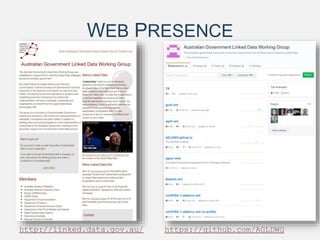
WEB PRESENCE
http://linked.data.gov.au/ https://github.com/AGLDWG
TERMS OF REFERENCE
• Establish technical guidance publishing public sector
information using Linked Data as a delivery technology
• Determine governance rules and processes for the
effective management of Australian Government Linked
Data
• Promote Linked Data across the Australian Government
• Engender the development of Linked Data infrastructure
URI GUIDELINES
• Top level reserved domain
http://{subdomain}.linked.data.gov.a
u/
• {subdomain} includes a set of 25
reserved keywords defined by AGIFT
– environment
– governance
– transport
– reference
– …
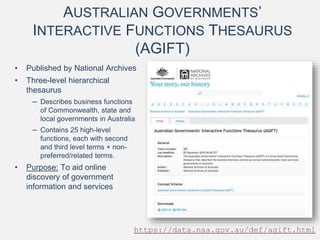
AUSTRALIAN GOVERNMENTS’
INTERACTIVE FUNCTIONS THESAURUS
(AGIFT)
• Published by National Archives
• Three-level hierarchical
thesaurus
– Describes business functions
of Commonwealth, state and
local governments in Australia
– Contains 25 high-level
functions, each with second
and third level terms + non-
preferred/related terms.
• Purpose: To aid online
discovery of government
information and services
https://data.naa.gov.au/def/agift.html
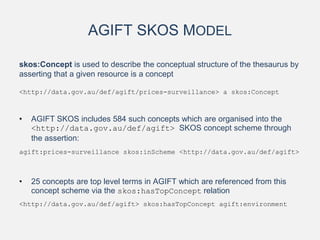
AGIFT SKOS MODEL
skos:Concept is used to describe the conceptual structure of the thesaurus by
asserting that a given resource is a concept
<http://data.gov.au/def/agift/prices-surveillance> a skos:Concept
• AGIFT SKOS includes 584 such concepts which are organised into the
<http://data.gov.au/def/agift> SKOS concept scheme through
the assertion:
agift:prices-surveillance skos:inScheme <http://data.gov.au/def/agift>
• 25 concepts are top level terms in AGIFT which are referenced from this
concept scheme via the skos:hasTopConcept relation
<http://data.gov.au/def/agift> skos:hasTopConcept agift:environment
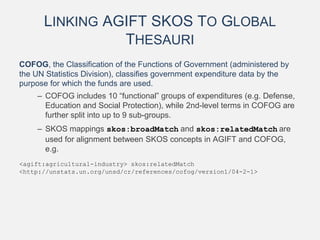
LINKING AGIFT SKOS TO GLOBAL
THESAURI
COFOG, the Classification of the Functions of Government (administered by
the UN Statistics Division), classifies government expenditure data by the
purpose for which the funds are used.
– COFOG includes 10 “functional” groups of expenditures (e.g. Defense,
Education and Social Protection), while 2nd-level terms in COFOG are
further split into up to 9 sub-groups.
– SKOS mappings skos:broadMatch and skos:relatedMatch are
used for alignment between SKOS concepts in AGIFT and COFOG,
e.g.
<agift:agricultural-industry> skos:relatedMatch
<http://unstats.un.org/unsd/cr/references/cofog/version1/04-2-1>
URI GUIDELINES
Set of general guidelines aimed at helping government stakeholders to define and
manage URIs for ‘Linked Datasets’ and the resources described within.
Overarching principles:
• Use HTTP URIs so that the Linked Dataset URI can be resolved; and
• provide at least one machine-readable representation in RDF.
General guidelines on:
• Minimum features of a Linked Dataset;
• Domain structure of a Linked Dataset;
• Recommended URI patterns;
• Recommended Publication infrastructure for Linked Datasets;
• and URI naming conventions.
https://github.com/AGLDWG/TR/blob/master/guidelines/latest.md
URI GUIDELINES
• Index of a Dataset: Identifier that names a Linked dataset and provides
metadata of the dataset.
• Real-world ‘Things’ Identifier: Physical and abstract ‘Things’ that may be
referred to in statements.
• Document Identifier: Information on the web about Real World ‘Things’
• Vocabulary identifiers (ontologies, concepts etc.): URIs for classes
and properties describing real-world things
/dataset[/{module}]*/{datasetid} → /dataset/act/schools [School Dataset Metadata]
/id/{type}/{name} → /id/school/2060 [Canberra Grammar]
/doc/{type}/{name} → /doc/school/2060 [Document about Canberra Grammar]
/def/{scheme}/{concept} → /def/school/phaseOfEducation [Class definition]
AUSTRALIAN GOVERNMENT INTEGRATED SET
OF ONTOLOGIES (AGISO)
Working Group is in the process of developing a proposal
for an integrated set of ontologies
• Currently, there are several ontologies (e.g. Dataset ontology, AGRIF)
being developed with a ‘whole of government’ focus
• AGISO aims to integrate these ontologies allowing them to be used
individually or collectively in a seamless way: as if they were one data
model
• In making this proposal, the AGLDWG steps beyond international
precedent regarding government Linked Data initiatives, in that we intend
to provide semantic modelling resources and governance, not just
guidelines and recommendations for Linked Data publication
DATASET ONTOLOGY
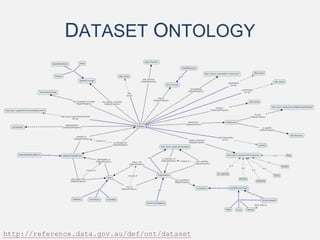
Designed to describe the characteristics of
datasets published on http://data.gov.au/
• Contains elements to describe datasets such as:
– Publication
– Update
– Origin
– Governance
– Spatial and temporal coverage
– Aspects of Organisational Custodianship
– Governance arrangements
DATASET ONTOLOGY
http://reference.data.gov.au/def/ont/dataset
AUSTRALIAN GOVERNMENT RECORDS
INTEROPERABILITY FRAMEWORK
(AGRIF)
Ontology to describe the structure, functions, and
activities of the Australian Government, providing
sufficient context for the effective use of
Government information assets.
• Contains elements to describe records such as:
– Record
– Artefact
– Event
– Policy
– Coverage
– Role
– Agent
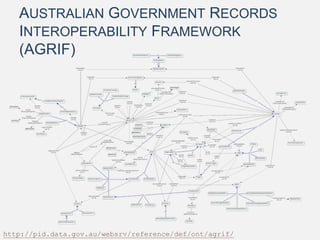
AUSTRALIAN GOVERNMENT RECORDS
INTEROPERABILITY FRAMEWORK
(AGRIF)
http://pid.data.gov.au/websrv/reference/def/ont/agrif/
EXAMPLE AGLDWG-SUPPORTED
LINKED DATA
1. Geoscience Australia Physical Sample
Repository
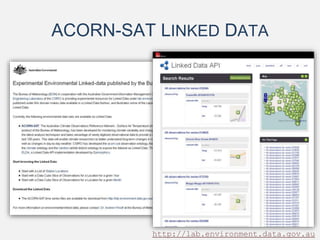
2. Bureau of Meteorology long term climate
record dataset ACORN-SAT
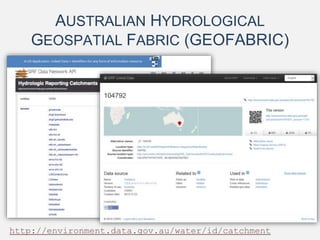
3. CSIRO Australian Hydrological Geospatial
Fabric (Geofabric)
4. PSMA Geocoded National Address File (G-
NAF)
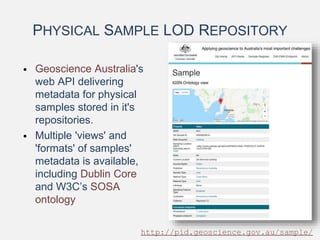
PHYSICAL SAMPLE LOD REPOSITORY
• Geoscience Australia's
web API delivering
metadata for physical
samples stored in it's
repositories.
• Multiple 'views' and
'formats' of samples'
metadata is available,
including Dublin Core
and W3C’s SOSA
ontology
http://pid.geoscience.gov.au/sample/
ACORN-SAT LINKED DATA
http://lab.environment.data.gov.au
AUSTRALIAN HYDROLOGICAL
GEOSPATIAL FABRIC (GEOFABRIC)
http://environment.data.gov.au/water/id/catchment
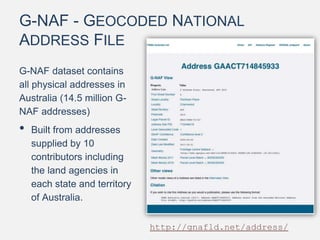
G-NAF - GEOCODED NATIONAL
ADDRESS FILE
G-NAF dataset contains
all physical addresses in
Australia (14.5 million G-
NAF addresses)
• Built from addresses
supplied by 10
contributors including
the land agencies in
each state and territory
of Australia.
http://gnafld.net/address/
QUESTIONS?
http://linked.data.gov.au
https://github.com/AGLDWG

Australian Government Linked Data Group

  • 1.
    Australian Government Linked DataWorking Group (AGLDWG) Dr Armin Haller Co-Chair AGLDWG, Senior Lecturer, ANU
  • 2.
    AUSTRALIAN GOVERNMENT LINKEDDATA WORKING GROUP Community of Commonwealth Government experts and champions, with invited non- voting participation of individuals, corporations and other entities. • Established in August 2012, with strong growth in membership since the Government released the outcomes of an inquiry on Data Availability and Use in the Australian Government. • No official Government mandate or related legislation, but a community of practice that promotes and represents a series of federal Government entities who seek to implement and use Linked Data technologies for the betterment of Australian Government data sharing. • Several members have signed an MoU to support the use and persistence of linked.data.gov.au URIs.
  • 3.
  • 4.
    TERMS OF REFERENCE •Establish technical guidance publishing public sector information using Linked Data as a delivery technology • Determine governance rules and processes for the effective management of Australian Government Linked Data • Promote Linked Data across the Australian Government • Engender the development of Linked Data infrastructure
  • 5.
    URI GUIDELINES • Toplevel reserved domain http://{subdomain}.linked.data.gov.a u/ • {subdomain} includes a set of 25 reserved keywords defined by AGIFT – environment – governance – transport – reference – …
  • 6.
    AUSTRALIAN GOVERNMENTS’ INTERACTIVE FUNCTIONSTHESAURUS (AGIFT) • Published by National Archives • Three-level hierarchical thesaurus – Describes business functions of Commonwealth, state and local governments in Australia – Contains 25 high-level functions, each with second and third level terms + non- preferred/related terms. • Purpose: To aid online discovery of government information and services https://data.naa.gov.au/def/agift.html
  • 7.
    AGIFT SKOS MODEL skos:Conceptis used to describe the conceptual structure of the thesaurus by asserting that a given resource is a concept <http://data.gov.au/def/agift/prices-surveillance> a skos:Concept • AGIFT SKOS includes 584 such concepts which are organised into the <http://data.gov.au/def/agift> SKOS concept scheme through the assertion: agift:prices-surveillance skos:inScheme <http://data.gov.au/def/agift> • 25 concepts are top level terms in AGIFT which are referenced from this concept scheme via the skos:hasTopConcept relation <http://data.gov.au/def/agift> skos:hasTopConcept agift:environment
  • 8.
    LINKING AGIFT SKOSTO GLOBAL THESAURI COFOG, the Classification of the Functions of Government (administered by the UN Statistics Division), classifies government expenditure data by the purpose for which the funds are used. – COFOG includes 10 “functional” groups of expenditures (e.g. Defense, Education and Social Protection), while 2nd-level terms in COFOG are further split into up to 9 sub-groups. – SKOS mappings skos:broadMatch and skos:relatedMatch are used for alignment between SKOS concepts in AGIFT and COFOG, e.g. <agift:agricultural-industry> skos:relatedMatch <http://unstats.un.org/unsd/cr/references/cofog/version1/04-2-1>
  • 9.
    URI GUIDELINES Set ofgeneral guidelines aimed at helping government stakeholders to define and manage URIs for ‘Linked Datasets’ and the resources described within. Overarching principles: • Use HTTP URIs so that the Linked Dataset URI can be resolved; and • provide at least one machine-readable representation in RDF. General guidelines on: • Minimum features of a Linked Dataset; • Domain structure of a Linked Dataset; • Recommended URI patterns; • Recommended Publication infrastructure for Linked Datasets; • and URI naming conventions. https://github.com/AGLDWG/TR/blob/master/guidelines/latest.md
  • 10.
    URI GUIDELINES • Indexof a Dataset: Identifier that names a Linked dataset and provides metadata of the dataset. • Real-world ‘Things’ Identifier: Physical and abstract ‘Things’ that may be referred to in statements. • Document Identifier: Information on the web about Real World ‘Things’ • Vocabulary identifiers (ontologies, concepts etc.): URIs for classes and properties describing real-world things /dataset[/{module}]*/{datasetid} → /dataset/act/schools [School Dataset Metadata] /id/{type}/{name} → /id/school/2060 [Canberra Grammar] /doc/{type}/{name} → /doc/school/2060 [Document about Canberra Grammar] /def/{scheme}/{concept} → /def/school/phaseOfEducation [Class definition]
  • 11.
    AUSTRALIAN GOVERNMENT INTEGRATEDSET OF ONTOLOGIES (AGISO) Working Group is in the process of developing a proposal for an integrated set of ontologies • Currently, there are several ontologies (e.g. Dataset ontology, AGRIF) being developed with a ‘whole of government’ focus • AGISO aims to integrate these ontologies allowing them to be used individually or collectively in a seamless way: as if they were one data model • In making this proposal, the AGLDWG steps beyond international precedent regarding government Linked Data initiatives, in that we intend to provide semantic modelling resources and governance, not just guidelines and recommendations for Linked Data publication
  • 12.
    DATASET ONTOLOGY Designed todescribe the characteristics of datasets published on http://data.gov.au/ • Contains elements to describe datasets such as: – Publication – Update – Origin – Governance – Spatial and temporal coverage – Aspects of Organisational Custodianship – Governance arrangements
  • 13.
  • 14.
    AUSTRALIAN GOVERNMENT RECORDS INTEROPERABILITYFRAMEWORK (AGRIF) Ontology to describe the structure, functions, and activities of the Australian Government, providing sufficient context for the effective use of Government information assets. • Contains elements to describe records such as: – Record – Artefact – Event – Policy – Coverage – Role – Agent
  • 15.
    AUSTRALIAN GOVERNMENT RECORDS INTEROPERABILITYFRAMEWORK (AGRIF) http://pid.data.gov.au/websrv/reference/def/ont/agrif/
  • 16.
    EXAMPLE AGLDWG-SUPPORTED LINKED DATA 1.Geoscience Australia Physical Sample Repository 2. Bureau of Meteorology long term climate record dataset ACORN-SAT 3. CSIRO Australian Hydrological Geospatial Fabric (Geofabric) 4. PSMA Geocoded National Address File (G- NAF)
  • 17.
    PHYSICAL SAMPLE LODREPOSITORY • Geoscience Australia's web API delivering metadata for physical samples stored in it's repositories. • Multiple 'views' and 'formats' of samples' metadata is available, including Dublin Core and W3C’s SOSA ontology http://pid.geoscience.gov.au/sample/
  • 18.
  • 19.
    AUSTRALIAN HYDROLOGICAL GEOSPATIAL FABRIC(GEOFABRIC) http://environment.data.gov.au/water/id/catchment
  • 20.
    G-NAF - GEOCODEDNATIONAL ADDRESS FILE G-NAF dataset contains all physical addresses in Australia (14.5 million G- NAF addresses) • Built from addresses supplied by 10 contributors including the land agencies in each state and territory of Australia. http://gnafld.net/address/
  • 21.