Module Two:
Understanding Children & Young People
& Ministry Practice
Child development
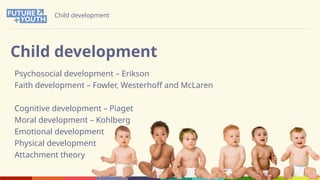
Child development
Psychosocial development – Erikson
Faith development – Fowler, Westerhoff and McLaren
Cognitive development – Piaget
Moral development – Kohlberg
Emotional development
Physical development
Attachment theory
Child development
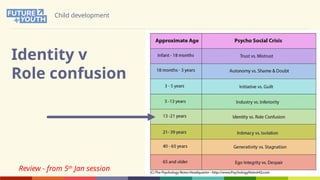
Identity v
Role confusion
Review - from 5th
Jan session
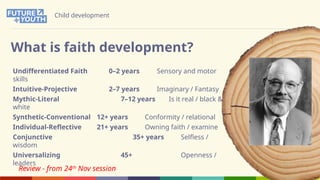
What is faith development?
Child development
Undifferentiated Faith 0–2 years Sensory and motor
skills
Intuitive-Projective 2–7 years Imaginary / Fantasy
Mythic-Literal 7–12 years Is it real / black &
white
Synthetic-Conventional 12+ years Conformity / relational
Individual-Reflective 21+ years Owning faith / examine
Conjunctive 35+ years Selfless /
wisdom
Universalizing 45+ Openness /
leaders
Review - from 24th
Nov session
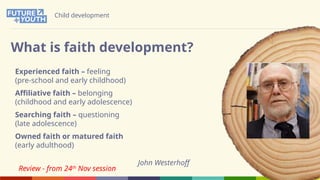
Experienced faith – feeling
(pre-school and early childhood)
Affiliative faith – belonging
(childhood and early adolescence)
Searching faith – questioning
(late adolescence)
Owned faith or matured faith
(early adulthood)
John Westerhoff
Child development
What is faith development?
Review - from 24th
Nov session
Child development
What is faith development?
Simplicity
Dualistic, authority focused, easy answers
Complexity
Pragmatic, more independent, steps and techniques
Perplexity
Sceptical, rebellious, questions, protest
Harmony
Integral, mystic focused, contemplative, love
Return to Simplicity…
Brian McLaren
Review - from 24th
Nov session
Child development
Child development
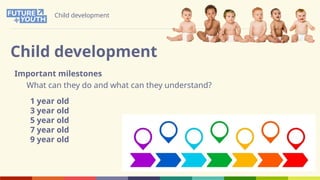
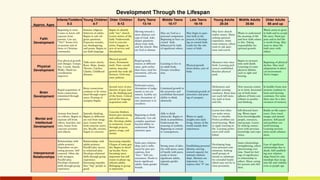
Important milestones
What can they do and what can they understand?
1 year old
3 year old
5 year old
7 year old
9 year old
Child development
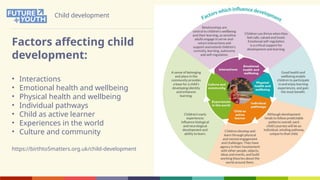
Factors affecting child
development:
• Interactions
• Emotional health and wellbeing
• Physical health and wellbeing
• Individual pathways
• Child as active learner
• Experiences in the world
• Culture and community
https://birthto5matters.org.uk/child-development
Child development
Cognitive development
Jean Piaget
Stage 1:
The sensorimotor stage - birth to age 2
Infants and toddlers acquire knowledge
through sensory experiences and manipulating
objects.
Child development
Cognitive development
Jean Piaget
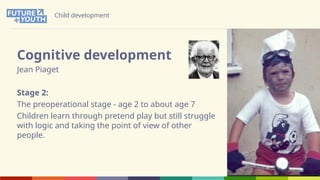
Stage 2:
The preoperational stage - age 2 to about age 7
Children learn through pretend play but still struggle
with logic and taking the point of view of other
people.
Child development
Cognitive development
Jean Piaget
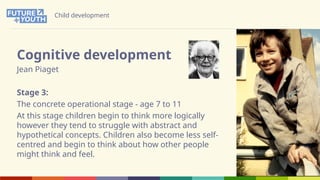
Stage 3:
The concrete operational stage - age 7 to 11
At this stage children begin to think more logically
however they tend to struggle with abstract and
hypothetical concepts. Children also become less self-
centred and begin to think about how other people
might think and feel.
Child development
Cognitive development
Jean Piaget
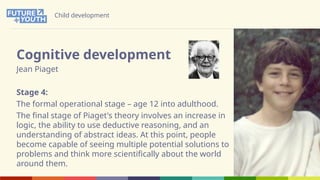
Stage 4:
The formal operational stage – age 12 into adulthood.
The final stage of Piaget's theory involves an increase in
logic, the ability to use deductive reasoning, and an
understanding of abstract ideas. At this point, people
become capable of seeing multiple potential solutions to
problems and think more scientifically about the world
around them.
Child development
Cognitive development
Jean Piaget
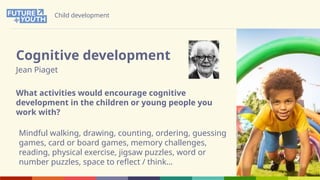
What activities would encourage cognitive
development in the children or young people you
work with?
Mindful walking, drawing, counting, ordering, guessing
games, card or board games, memory challenges,
reading, physical exercise, jigsaw puzzles, word or
number puzzles, space to reflect / think…
Child development
Moral development
Lawrence Kohlberg
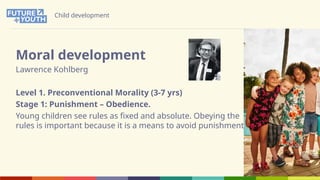
Level 1. Preconventional Morality (3-7 yrs)
Stage 1: Punishment – Obedience.
Young children see rules as fixed and absolute. Obeying the
rules is important because it is a means to avoid punishment.
Child development
Moral development
Lawrence Kohlberg
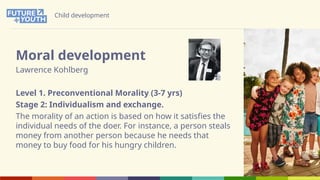
Level 1. Preconventional Morality (3-7 yrs)
Stage 2: Individualism and exchange.
The morality of an action is based on how it satisfies the
individual needs of the doer. For instance, a person steals
money from another person because he needs that
money to buy food for his hungry children.
Child development
Moral development
Lawrence Kohlberg
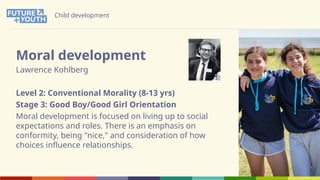
Level 2: Conventional Morality (8-13 yrs)
Stage 3: Good Boy/Good Girl Orientation
Moral development is focused on living up to social
expectations and roles. There is an emphasis on
conformity, being "nice," and consideration of how
choices influence relationships.
Child development
Moral development
Lawrence Kohlberg
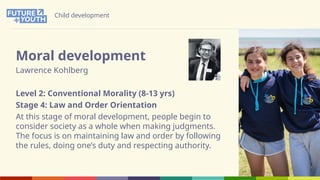
Level 2: Conventional Morality (8-13 yrs)
Stage 4: Law and Order Orientation
At this stage of moral development, people begin to
consider society as a whole when making judgments.
The focus is on maintaining law and order by following
the rules, doing one’s duty and respecting authority.
Child development
Moral development
Lawrence Kohlberg
Level 3. Postconventional Morality (adulthood)
Stage 5 : Social Contract Orientation
In this stage, the person looks at the differing values,
opinions, and beliefs of other people. Rules of law are
important for maintaining a society, but members of the
society should agree upon these standards.
Child development
Moral development
Lawrence Kohlberg
Level 3. Postconventional Morality (adulthood)
Stage 6 : Universal Ethical Principles Orientation
The final stage of moral reasoning, this orientation is
when a person considers universally accepted ethical
principles. The judgment may become innate and may
even violate the laws and rules as the person becomes
attached to his own principles of justice.
Child development
Moral development
Lawrence Kohlberg
To what extent do you see young people in the
Conventional Morality Level in your groups?
• Good boy / girl
• Law and order
Module Two:
Understanding Children & Young People
& Ministry Practice

Aurora Training - 19 Jan 2026 - Child Development

  • 1.
    Module Two: Understanding Children& Young People & Ministry Practice
  • 2.
    Child development Child development Psychosocialdevelopment – Erikson Faith development – Fowler, Westerhoff and McLaren Cognitive development – Piaget Moral development – Kohlberg Emotional development Physical development Attachment theory
  • 3.
    Child development Identity v Roleconfusion Review - from 5th Jan session
  • 4.
    What is faithdevelopment? Child development Undifferentiated Faith 0–2 years Sensory and motor skills Intuitive-Projective 2–7 years Imaginary / Fantasy Mythic-Literal 7–12 years Is it real / black & white Synthetic-Conventional 12+ years Conformity / relational Individual-Reflective 21+ years Owning faith / examine Conjunctive 35+ years Selfless / wisdom Universalizing 45+ Openness / leaders Review - from 24th Nov session
  • 5.
    Experienced faith –feeling (pre-school and early childhood) Affiliative faith – belonging (childhood and early adolescence) Searching faith – questioning (late adolescence) Owned faith or matured faith (early adulthood) John Westerhoff Child development What is faith development? Review - from 24th Nov session
  • 6.
    Child development What isfaith development? Simplicity Dualistic, authority focused, easy answers Complexity Pragmatic, more independent, steps and techniques Perplexity Sceptical, rebellious, questions, protest Harmony Integral, mystic focused, contemplative, love Return to Simplicity… Brian McLaren Review - from 24th Nov session
  • 7.
    Child development Child development Importantmilestones What can they do and what can they understand? 1 year old 3 year old 5 year old 7 year old 9 year old
  • 8.
    Child development Factors affectingchild development: • Interactions • Emotional health and wellbeing • Physical health and wellbeing • Individual pathways • Child as active learner • Experiences in the world • Culture and community https://birthto5matters.org.uk/child-development
  • 9.
    Child development Cognitive development JeanPiaget Stage 1: The sensorimotor stage - birth to age 2 Infants and toddlers acquire knowledge through sensory experiences and manipulating objects.
  • 10.
    Child development Cognitive development JeanPiaget Stage 2: The preoperational stage - age 2 to about age 7 Children learn through pretend play but still struggle with logic and taking the point of view of other people.
  • 11.
    Child development Cognitive development JeanPiaget Stage 3: The concrete operational stage - age 7 to 11 At this stage children begin to think more logically however they tend to struggle with abstract and hypothetical concepts. Children also become less self- centred and begin to think about how other people might think and feel.
  • 12.
    Child development Cognitive development JeanPiaget Stage 4: The formal operational stage – age 12 into adulthood. The final stage of Piaget's theory involves an increase in logic, the ability to use deductive reasoning, and an understanding of abstract ideas. At this point, people become capable of seeing multiple potential solutions to problems and think more scientifically about the world around them.
  • 13.
    Child development Cognitive development JeanPiaget What activities would encourage cognitive development in the children or young people you work with? Mindful walking, drawing, counting, ordering, guessing games, card or board games, memory challenges, reading, physical exercise, jigsaw puzzles, word or number puzzles, space to reflect / think…
  • 14.
    Child development Moral development LawrenceKohlberg Level 1. Preconventional Morality (3-7 yrs) Stage 1: Punishment – Obedience. Young children see rules as fixed and absolute. Obeying the rules is important because it is a means to avoid punishment.
  • 15.
    Child development Moral development LawrenceKohlberg Level 1. Preconventional Morality (3-7 yrs) Stage 2: Individualism and exchange. The morality of an action is based on how it satisfies the individual needs of the doer. For instance, a person steals money from another person because he needs that money to buy food for his hungry children.
  • 16.
    Child development Moral development LawrenceKohlberg Level 2: Conventional Morality (8-13 yrs) Stage 3: Good Boy/Good Girl Orientation Moral development is focused on living up to social expectations and roles. There is an emphasis on conformity, being "nice," and consideration of how choices influence relationships.
  • 17.
    Child development Moral development LawrenceKohlberg Level 2: Conventional Morality (8-13 yrs) Stage 4: Law and Order Orientation At this stage of moral development, people begin to consider society as a whole when making judgments. The focus is on maintaining law and order by following the rules, doing one’s duty and respecting authority.
  • 18.
    Child development Moral development LawrenceKohlberg Level 3. Postconventional Morality (adulthood) Stage 5 : Social Contract Orientation In this stage, the person looks at the differing values, opinions, and beliefs of other people. Rules of law are important for maintaining a society, but members of the society should agree upon these standards.
  • 19.
    Child development Moral development LawrenceKohlberg Level 3. Postconventional Morality (adulthood) Stage 6 : Universal Ethical Principles Orientation The final stage of moral reasoning, this orientation is when a person considers universally accepted ethical principles. The judgment may become innate and may even violate the laws and rules as the person becomes attached to his own principles of justice.
  • 20.
    Child development Moral development LawrenceKohlberg To what extent do you see young people in the Conventional Morality Level in your groups? • Good boy / girl • Law and order
  • 22.
    Module Two: Understanding Children& Young People & Ministry Practice