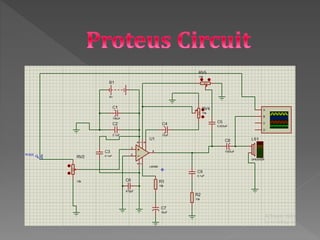
This project focuses on designing a great sounding audio
amplifier with bass boost using the LM386 IC. It’s not a
“minimal components” audio amplifier. It consists of
bunch of extra capacitors to reduce the noise, and a bass
boost control as well to make it sound even better. The
amplifier circuit aims to enhance the audio output by
providing adjustable gain control and incorporating
decoupling capacitors and RC filters to minimize noise
and distortion.
The project circuit focuses on designing a bass boost amplifier
circuit using the LM386 IC. The output power of the amplifier
depends on the supply voltage and speaker impedance, with
options ranging from 4V to 12V. The LM386 is an operational
amplifier that amplifies the audio input signal by a voltage gain
of 20 to 200. The circuit employs various techniques, such as
decoupling capacitors and RC filters, to reduce distortion and
noise. Additionally, an adjustable bass boost feature, achieved
through a 0.033µF capacitor and a 10kΩ potentiometer, enhances
the overall sound quality. The project also emphasizes the
importance of keeping wire connections and components close to
the chip for optimal performance.
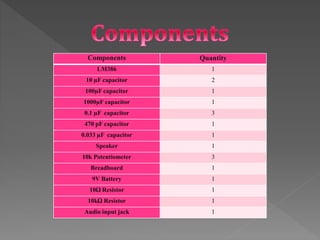
Components Quantity
LM386 1
10 µF capacitor 2
100µF capacitor 1
1000µF capacitor 1
0.1 µF capacitor 3
470 pF capacitor 1
0.033 µF capacitor 1
Speaker 1
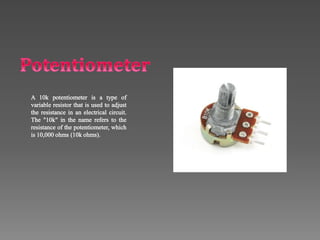
10k Potentiometer 3
Breadboard 1
9V Battery 1
10Ω Resistor 1
10kΩ Resistor 1
Audio input jack 1
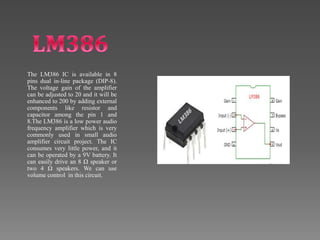
The LM386 IC is available in 8
pins dual in-line package (DIP-8).
The voltage gain of the amplifier
can be adjusted to 20 and it will be
enhanced to 200 by adding external
components like resistor and
capacitor among the pin 1 and
8.The LM386 is a low power audio
frequency amplifier which is very
commonly used in small audio
amplifier circuit project. The IC
consumes very little power, and it
can be operated by a 9V battery. It
can easily drive an 8 Ω speaker or
two 4 Ω speakers. We can use
volume control in this circuit.
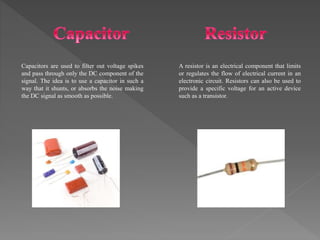
A resistor is an electrical component that limits
or regulates the flow of electrical current in an
electronic circuit. Resistors can also be used to
provide a specific voltage for an active device
such as a transistor.
Capacitors are used to filter out voltage spikes
and pass through only the DC component of the
signal. The idea is to use a capacitor in such a
way that it shunts, or absorbs the noise making
the DC signal as smooth as possible.
A battery is a device
that stores chemical
energy and converts it
to electrical energy.
Through external
circuit , the electrons
present in the battery
provides an electric
current that can be used
to do work.
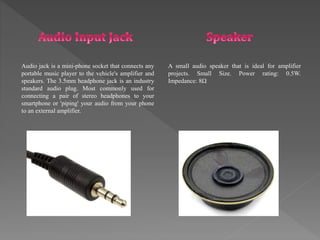
Audio jack is a mini-phone socket that connects any
portable music player to the vehicle's amplifier and
speakers. The 3.5mm headphone jack is an industry
standard audio plug. Most commonly used for
connecting a pair of stereo headphones to your
smartphone or 'piping' your audio from your phone
to an external amplifier.
A small audio speaker that is ideal for amplifier
projects. Small Size. Power rating: 0.5W.
Impedance: 8Ω
The actual output power will depend on supply voltage and speaker
impedance. The circuit consists of 9V battery for the power , but can be go
down to 4V or up to 12V. The LM386 is a type of operational amplifier
(Op-Amp) that takes an input voltage and produce an output potential
that’s tens, hundreds, or thousands of times the magnitude of the input
potential. In an amplifier circuit, the LM386 takes an audio input signal
and increases its potential from 20 to 200 times. Up to 200 Gain can be
achieved by connecting a 10 µF capacitor between pins 1 and 8. The gain
can be changed to any value between 20 and 200 by placing a resistor (or
potentiometer) in series with the capacitor. The noise in circuit can be
fix by adding decoupling capacitors and a couple RC filter. The bass boost
is basically just a low pass filter, and it removes most of the noise not
taken out by the decoupling capacitors. All you need for the bass boost
circuit is a 0.033 µF capacitor and a 10K Ohm potentiometer in series
between pins 1 and 5.
 In television sound systems.
 In FM radio amplifiers.
 For the laptop speakers.
 In battery-operated speakers.
 For audio boosting.
 In Portable Audio Devices.
 For Music Production.
 In Car Audio Systems.
 In Home Theater Systems.
In conclusion, the Audio Amplifier with Bass Boost project
utilizing the LM386 IC presents a comprehensive solution for
enhancing audio quality. With adjustable gain control,
decoupling capacitors, and a bass boost feature, this amplifier
circuit offers flexibility and noise reduction. Its versatile
applications, ranging from television sound systems to portable
audio devices and home theater systems, make it a valuable
addition to various audio enhancement scenarios. Overall, this
project provides an effective means to amplify and improve
audio output across different platforms.
Audio Amplifier with Bass Boost (PRESENTATION).pptx

Audio Amplifier with Bass Boost (PRESENTATION).pptx

  • 3.
    This project focuseson designing a great sounding audio amplifier with bass boost using the LM386 IC. It’s not a “minimal components” audio amplifier. It consists of bunch of extra capacitors to reduce the noise, and a bass boost control as well to make it sound even better. The amplifier circuit aims to enhance the audio output by providing adjustable gain control and incorporating decoupling capacitors and RC filters to minimize noise and distortion.
  • 4.
    The project circuitfocuses on designing a bass boost amplifier circuit using the LM386 IC. The output power of the amplifier depends on the supply voltage and speaker impedance, with options ranging from 4V to 12V. The LM386 is an operational amplifier that amplifies the audio input signal by a voltage gain of 20 to 200. The circuit employs various techniques, such as decoupling capacitors and RC filters, to reduce distortion and noise. Additionally, an adjustable bass boost feature, achieved through a 0.033µF capacitor and a 10kΩ potentiometer, enhances the overall sound quality. The project also emphasizes the importance of keeping wire connections and components close to the chip for optimal performance.
  • 5.
    Components Quantity LM386 1 10µF capacitor 2 100µF capacitor 1 1000µF capacitor 1 0.1 µF capacitor 3 470 pF capacitor 1 0.033 µF capacitor 1 Speaker 1 10k Potentiometer 3 Breadboard 1 9V Battery 1 10Ω Resistor 1 10kΩ Resistor 1 Audio input jack 1
  • 6.
    The LM386 ICis available in 8 pins dual in-line package (DIP-8). The voltage gain of the amplifier can be adjusted to 20 and it will be enhanced to 200 by adding external components like resistor and capacitor among the pin 1 and 8.The LM386 is a low power audio frequency amplifier which is very commonly used in small audio amplifier circuit project. The IC consumes very little power, and it can be operated by a 9V battery. It can easily drive an 8 Ω speaker or two 4 Ω speakers. We can use volume control in this circuit.
  • 8.
    A resistor isan electrical component that limits or regulates the flow of electrical current in an electronic circuit. Resistors can also be used to provide a specific voltage for an active device such as a transistor. Capacitors are used to filter out voltage spikes and pass through only the DC component of the signal. The idea is to use a capacitor in such a way that it shunts, or absorbs the noise making the DC signal as smooth as possible.
  • 9.
    A battery isa device that stores chemical energy and converts it to electrical energy. Through external circuit , the electrons present in the battery provides an electric current that can be used to do work.
  • 10.
    Audio jack isa mini-phone socket that connects any portable music player to the vehicle's amplifier and speakers. The 3.5mm headphone jack is an industry standard audio plug. Most commonly used for connecting a pair of stereo headphones to your smartphone or 'piping' your audio from your phone to an external amplifier. A small audio speaker that is ideal for amplifier projects. Small Size. Power rating: 0.5W. Impedance: 8Ω
  • 11.
    The actual outputpower will depend on supply voltage and speaker impedance. The circuit consists of 9V battery for the power , but can be go down to 4V or up to 12V. The LM386 is a type of operational amplifier (Op-Amp) that takes an input voltage and produce an output potential that’s tens, hundreds, or thousands of times the magnitude of the input potential. In an amplifier circuit, the LM386 takes an audio input signal and increases its potential from 20 to 200 times. Up to 200 Gain can be achieved by connecting a 10 µF capacitor between pins 1 and 8. The gain can be changed to any value between 20 and 200 by placing a resistor (or potentiometer) in series with the capacitor. The noise in circuit can be fix by adding decoupling capacitors and a couple RC filter. The bass boost is basically just a low pass filter, and it removes most of the noise not taken out by the decoupling capacitors. All you need for the bass boost circuit is a 0.033 µF capacitor and a 10K Ohm potentiometer in series between pins 1 and 5.
  • 14.
     In televisionsound systems.  In FM radio amplifiers.  For the laptop speakers.  In battery-operated speakers.  For audio boosting.  In Portable Audio Devices.  For Music Production.  In Car Audio Systems.  In Home Theater Systems.
  • 15.
    In conclusion, theAudio Amplifier with Bass Boost project utilizing the LM386 IC presents a comprehensive solution for enhancing audio quality. With adjustable gain control, decoupling capacitors, and a bass boost feature, this amplifier circuit offers flexibility and noise reduction. Its versatile applications, ranging from television sound systems to portable audio devices and home theater systems, make it a valuable addition to various audio enhancement scenarios. Overall, this project provides an effective means to amplify and improve audio output across different platforms.