ASSINGMENT-II
NAME: T.S.ARUNACHALAPATHY.
CLASS:II-B.COM’B’
ROLL NO:18UR63.
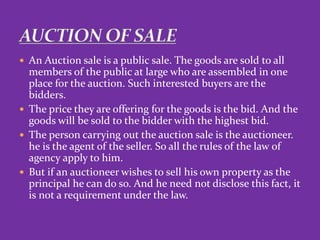
 An Auction sale is a public sale. The goods are sold to all
members of the public at large who are assembled in one
place for the auction. Such interested buyers are the
bidders.
 The price they are offering for the goods is the bid. And the
goods will be sold to the bidder with the highest bid.
 The person carrying out the auction sale is the auctioneer.
he is the agent of the seller. So all the rules of the law of
agency apply to him.
 But if an auctioneer wishes to sell his own property as the
principal he can do so. And he need not disclose this fact, it
is not a requirement under the law.
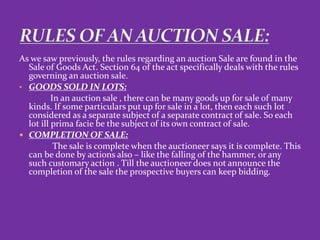
As we saw previously, the rules regarding an auction Sale are found in the
Sale of Goods Act. Section 64 of the act specifically deals with the rules
governing an auction sale.
• GOODS SOLD IN LOTS:
In an auction sale , there can be many goods up for sale of many
kinds. If some particulars put up for sale in a lot, then each such lot
considered as a separate subject of a separate contract of sale. So each
lot ill prima facie be the subject of its own contract of sale.
 COMPLETION OF SALE:
The sale is complete when the auctioneer says it is complete. This
can be done by actions also – like the falling of the hammer, or any
such customary action . Till the auctioneer does not announce the
completion of the sale the prospective buyers can keep bidding.
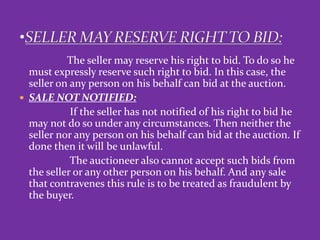
The seller may reserve his right to bid. To do so he
must expressly reserve such right to bid. In this case, the
seller on any person on his behalf can bid at the auction.
 SALE NOT NOTIFIED:
If the seller has not notified of his right to bid he
may not do so under any circumstances. Then neither the
seller nor any person on his behalf can bid at the auction. If
done then it will be unlawful.
The auctioneer also cannot accept such bids from
the seller or any other person on his behalf. And any sale
that contravenes this rule is to be treated as fraudulent by
the buyer.
An auction sale may be subject to a reserve price or
an upset price. This means the auctioneer will not sell the
goods for any price below the said reserve price.
 PRETEND BIDDING:
But if the seller or any other person appointed by
him employs pretend bidding to raise the price of the
goods, the sale is voidable at the option of the buyer. That
means the buyer can choose to honor the contract or he
can choose to void.
 NO CREDIT:
The auctioneer cannot sell the goods on credit as
per wishes. He cannot accept a bills of exchange either
unless the seller is expressly fine with it.
 Delivery has been defined by the Act as a “voluntary
transfer of possession from one person to another”.
Delivery may be made by doing anything which the
parties agree shall be treated delivery. Delivery to a
carrier is generally regarded as a delivery to the buyer.
MODES OF DELIVERY:
Delivery may be actual symbolic or constructive.
1. Actual delivery: Where the goods are physically
handed over by the seller or his authorized agent to the
buyer.
 2. Symbolic delivery: Where the goods are bulky and
incapable of actual delivery, the “mean of obtaining
possession” of goods are delivered by the seller to the buyer.
Delivery of the key of the warehouse where the goods are
stored or the bill of lading etc., are all examples of symbolic
delivery.
 3. Constructive deliver: Where a third person in possession
of goods acknowledges to hold goods on behalf of and at
the disposal of the buyer, the delivery is constructive.
 Example: A is the warehouseman of B. B gives a delivery
order to C, a buyer, asking A to deliver a certain quantity of
goods C. C goes to A with this delivery order. A agrees to
deliver goods the next day. It is a symbolic delivery of goods
because now A is holding goods on behalf of and at the
disposal of C. B cannot now stop A from delivering the
goods to C.
 1. Delivery should have the effect of putting the buyer in
possession (Sec. 33): Thus where wood of fallen trees is sold the
mere fact of buyer cutting them up will not amount to taking
possession of them until he carries them away. The buyer is able
to exercise some degree of control.
 2. The seller must deliver goods according to the contract and
where there is a condition precedent to the performance of the
contract, the seller is not bound to deliver unless the condition
precedent is satisfied unless the sale is on credit, the seller need
not be ready and willing to delivery the goods before the price is
paid.
 3. Buyer to apply for delivery: Though the seller is bound to
delivery the goods yet he need not deliver them unless the buyer
applies for delivery (Sec. 35). Thus when the seller gives notice of
the arrival of goods, it is the buyer’s duty to apply for delivery.
 4. Where the goods are with a third person: Where the
goods at the time of sale are in the possession of a third
person, there is not delivery by the seller to the buyer
unless and until such third person acknowledges to the
buyer that he holds the goods on his behalf [Sec. 36(3)].
 5. Time of delivery: Where a specified time has been
mentioned within which delivery is to be made, it must be
made within that time limit. Where however, no time is
fixed for delivery of goods, the seller is bound to deliver
them within a reasonable time.
 6. Tender of delivery: It is not however the duty of the seller
to send or carry the goods to the buyer unless the contract
of provides. His only duty is to place the goods at the
buyer’s disposal so that the buyer may remove them. But it
is essential that the goods must be in a deliverable state at
the time of delivery or tender thereof.
 7. Place of delivery: The place of delivery may be stated in
the contract and where it is so stated the goods must be
delivered during business hours on a working day. Where
no place is mentioned the goods are to be delivered at a
place at which they happen to be at the time of the contract
of sale or if the contract is with respect to future goods, at
the place at which the goods are manufactured or
produced.
 If the seller agrees, to deliver the goods to the buyer at a
place other than that where they are when sold, the buyer
must, in the absence of agreement to the country take the
risk of deterioration necessarily incident to course of
transit.
 8. Cost of delivery: The seller has to bear the cost of
delivery unless the contract otherwise provides. While the
cost of containing delivery is said to be buyer’s, the cost of
putting the goods into deliverable state must be borne by
the seller.
 9. Duty to Insure goods where goods are delivered to a carrier: Where
goods are delivered to a carrier the seller is bound to enter into a
reasonable contract on behalf of the buyer with the carrier for the safe
transmission of goods and if he fails to do so and the goods are
destroyed, the buyer may decline to treat delivery to carrier as a delivery
to him or claim damages. If the transit be by sea, the seller must inform
the buyer in time so that he may have the goods insured. If the seller
fails to do this, the goods would be at the seller’s risk during transit.
 10. When the seller is ready and willing to delivery the goods and
requests the buyer to take delivery and the buyer does not comply with
this request within a reasonable time. The buyer is liable to the seller
for.
 (i) any loss occasioned by the neglect or refusal to take delivery and
 (ii) a reasonable charge for the care and custody of the goods.
 Delivery to carrier or wharfinger (Sec.39) where the seller is authorized
or required to send the goods to the buyer, delivery of the goods to a
carrier, whether aimed by the buyer or not, for the purpose of
transmission to the buyer, or delivery of the goods to a wharfinger for
safe custody, is prima facie deemed to be a delivery of the goods to the
buyer.
AUCTION SALE AND DELIVERY OF GOODS

AUCTION SALE AND DELIVERY OF GOODS

  • 1.
  • 2.
     An Auctionsale is a public sale. The goods are sold to all members of the public at large who are assembled in one place for the auction. Such interested buyers are the bidders.  The price they are offering for the goods is the bid. And the goods will be sold to the bidder with the highest bid.  The person carrying out the auction sale is the auctioneer. he is the agent of the seller. So all the rules of the law of agency apply to him.  But if an auctioneer wishes to sell his own property as the principal he can do so. And he need not disclose this fact, it is not a requirement under the law.
  • 3.
    As we sawpreviously, the rules regarding an auction Sale are found in the Sale of Goods Act. Section 64 of the act specifically deals with the rules governing an auction sale. • GOODS SOLD IN LOTS: In an auction sale , there can be many goods up for sale of many kinds. If some particulars put up for sale in a lot, then each such lot considered as a separate subject of a separate contract of sale. So each lot ill prima facie be the subject of its own contract of sale.  COMPLETION OF SALE: The sale is complete when the auctioneer says it is complete. This can be done by actions also – like the falling of the hammer, or any such customary action . Till the auctioneer does not announce the completion of the sale the prospective buyers can keep bidding.
  • 4.
    The seller mayreserve his right to bid. To do so he must expressly reserve such right to bid. In this case, the seller on any person on his behalf can bid at the auction.  SALE NOT NOTIFIED: If the seller has not notified of his right to bid he may not do so under any circumstances. Then neither the seller nor any person on his behalf can bid at the auction. If done then it will be unlawful. The auctioneer also cannot accept such bids from the seller or any other person on his behalf. And any sale that contravenes this rule is to be treated as fraudulent by the buyer.
  • 5.
    An auction salemay be subject to a reserve price or an upset price. This means the auctioneer will not sell the goods for any price below the said reserve price.  PRETEND BIDDING: But if the seller or any other person appointed by him employs pretend bidding to raise the price of the goods, the sale is voidable at the option of the buyer. That means the buyer can choose to honor the contract or he can choose to void.  NO CREDIT: The auctioneer cannot sell the goods on credit as per wishes. He cannot accept a bills of exchange either unless the seller is expressly fine with it.
  • 6.
     Delivery hasbeen defined by the Act as a “voluntary transfer of possession from one person to another”. Delivery may be made by doing anything which the parties agree shall be treated delivery. Delivery to a carrier is generally regarded as a delivery to the buyer. MODES OF DELIVERY: Delivery may be actual symbolic or constructive. 1. Actual delivery: Where the goods are physically handed over by the seller or his authorized agent to the buyer.
  • 7.
     2. Symbolicdelivery: Where the goods are bulky and incapable of actual delivery, the “mean of obtaining possession” of goods are delivered by the seller to the buyer. Delivery of the key of the warehouse where the goods are stored or the bill of lading etc., are all examples of symbolic delivery.  3. Constructive deliver: Where a third person in possession of goods acknowledges to hold goods on behalf of and at the disposal of the buyer, the delivery is constructive.  Example: A is the warehouseman of B. B gives a delivery order to C, a buyer, asking A to deliver a certain quantity of goods C. C goes to A with this delivery order. A agrees to deliver goods the next day. It is a symbolic delivery of goods because now A is holding goods on behalf of and at the disposal of C. B cannot now stop A from delivering the goods to C.
  • 8.
     1. Deliveryshould have the effect of putting the buyer in possession (Sec. 33): Thus where wood of fallen trees is sold the mere fact of buyer cutting them up will not amount to taking possession of them until he carries them away. The buyer is able to exercise some degree of control.  2. The seller must deliver goods according to the contract and where there is a condition precedent to the performance of the contract, the seller is not bound to deliver unless the condition precedent is satisfied unless the sale is on credit, the seller need not be ready and willing to delivery the goods before the price is paid.  3. Buyer to apply for delivery: Though the seller is bound to delivery the goods yet he need not deliver them unless the buyer applies for delivery (Sec. 35). Thus when the seller gives notice of the arrival of goods, it is the buyer’s duty to apply for delivery.
  • 9.
     4. Wherethe goods are with a third person: Where the goods at the time of sale are in the possession of a third person, there is not delivery by the seller to the buyer unless and until such third person acknowledges to the buyer that he holds the goods on his behalf [Sec. 36(3)].  5. Time of delivery: Where a specified time has been mentioned within which delivery is to be made, it must be made within that time limit. Where however, no time is fixed for delivery of goods, the seller is bound to deliver them within a reasonable time.  6. Tender of delivery: It is not however the duty of the seller to send or carry the goods to the buyer unless the contract of provides. His only duty is to place the goods at the buyer’s disposal so that the buyer may remove them. But it is essential that the goods must be in a deliverable state at the time of delivery or tender thereof.
  • 10.
     7. Placeof delivery: The place of delivery may be stated in the contract and where it is so stated the goods must be delivered during business hours on a working day. Where no place is mentioned the goods are to be delivered at a place at which they happen to be at the time of the contract of sale or if the contract is with respect to future goods, at the place at which the goods are manufactured or produced.  If the seller agrees, to deliver the goods to the buyer at a place other than that where they are when sold, the buyer must, in the absence of agreement to the country take the risk of deterioration necessarily incident to course of transit.  8. Cost of delivery: The seller has to bear the cost of delivery unless the contract otherwise provides. While the cost of containing delivery is said to be buyer’s, the cost of putting the goods into deliverable state must be borne by the seller.
  • 11.
     9. Dutyto Insure goods where goods are delivered to a carrier: Where goods are delivered to a carrier the seller is bound to enter into a reasonable contract on behalf of the buyer with the carrier for the safe transmission of goods and if he fails to do so and the goods are destroyed, the buyer may decline to treat delivery to carrier as a delivery to him or claim damages. If the transit be by sea, the seller must inform the buyer in time so that he may have the goods insured. If the seller fails to do this, the goods would be at the seller’s risk during transit.  10. When the seller is ready and willing to delivery the goods and requests the buyer to take delivery and the buyer does not comply with this request within a reasonable time. The buyer is liable to the seller for.  (i) any loss occasioned by the neglect or refusal to take delivery and  (ii) a reasonable charge for the care and custody of the goods.  Delivery to carrier or wharfinger (Sec.39) where the seller is authorized or required to send the goods to the buyer, delivery of the goods to a carrier, whether aimed by the buyer or not, for the purpose of transmission to the buyer, or delivery of the goods to a wharfinger for safe custody, is prima facie deemed to be a delivery of the goods to the buyer.