



Journey 2022
Future Vision
Resolving
Digital
Dilemmas
Contents
03	Foreword
04	 Executive summary
05	 Key takeaways for
business leaders
06	 Our vision	
08	 Real-world digital
09	 From post-truth to post-digital
10	 Digital dilemmas
11	 Digital entanglement
14	 Resolving the dilemmas
17	 Toward a human-centric digital
business culture
18	 Digital meets physical
20	 Breaking the physical barrier
22	 Next-generation architectures
24	 Edge & swarm computing
26	 Perceptive media
28	 Quantum computing
30	 Cyber-securing the digital economy
32	 Business models and society
34	 Business platform economy
36	 Digital Business Continuum
38	 Circular economy
40	 The future of work
42	 Digital society
44	 Human-centric AI
46	 From data to smart services
48	 Enterprise AI – Powering the digital
value chains
50	 Advanced robotics
52	 The bridge between humans
	 and the digital world
54	 Life sciences: changing our
understanding of life
56	 Ethics in autonomous systems
58	 About the Scientific Community
59	Acknowledgements
Journey 2022 can also be viewed
through an interactive mini-site:
atos.net/journey2022
06
18
32
44
Foreword
W
elcome to Journey 2022, our vision of the evolving world of business, society
and technology. We hope it will stimulate and challenge your thinking about
the forces that will shape enterprises over the next few years.
Our Atos Scientific Community, which I personally chair, has sought for the last 10 years
to identify, define and research some of the most disruptive technologies and business
trends that are impacting our world.
In 2014 we looked ahead to 2018 in describing the 3rd
Digital Revolution which
would bring both “Agility and Fragility”. Today’s world is clearly demonstrating this
anticipated duality. In 2016 we proposed an analogy of “Digital Shockwaves” to model
the disruptions in business and technology that we expect by 2020. These originate
from four different sources: new “Business models”, new “Ways of working”, “Disruptive
technologies” and “Evolving challenges”.
The digital revolution that has already transformed our lives as consumers, has begun
to deeply transform our business world in all sectors. However, the resulting impact
will be greater because it affects the very nature of the business processes which we
have used for decades. At the same time, it is giving a predominant role to data for the
insights it brings to all kinds of business moments.
Significant breakthroughs over the last two years in areas such as artificial intelligence
(AI), the Internet of Things (IoT), edge computing, additive manufacturing and quantum
computing, will present significant opportunity choices to businesses by 2022. But we
increasingly see questions being raised by consumers and society regarding certain
technologies, business models, and approaches to data privacy. These will lead to what
we describe as Digital Dilemmas.
Digital technologies and their adoption will be progressively influenced by their
interactions with the physical world, and business outcomes will be shaped by the
balancing of tensions that we describe as Insights, Inertia and Inequality. Digital
insights reveal both opportunities and challenges for real-world business models;
digital business models will experience both restraining and sustaining inertia through
the responses they draw from society at large, and the potential inequalities arising
from technologies like AI and automation could have far reaching implications. We
see a further balancing force, characterized by Ideals, that defines the boundary of
acceptability and trust for technology and business model adoption.
At a time when “wait and see” cannot be a viable option for digital transformation, we
propose to help you understand the implications of rapidly developing business and
technology environments, by identifying digital dilemmas and resolving them in ways
that ensure appropriate decisions are made.
This document contains our future vision as well as descriptions of some specific areas
of disruption and business potential. I am sure you will find this an essential guide
to resolving the Digital Dilemmas that you will encounter in your particular areas of
operation as you journey toward 2022.
“Significant breakthroughs over the last two years in areas such
as artificial intelligence, the Internet of Things, edge computing,
additive manufacturing and quantum computing will present
significant opportunity choices to businesses by 2022.”
Thierry Breton
Chairman and CEO, Atos
T
he relentless evolution of opportunities
and challenges presented by digital
technologies, brings a corresponding
business imperative for continuous
digital transformation. But, the waves of
disruptive change and the accompanying
divergent choices they often present, can
introduce unanticipated complications and
uncertainties. We describe these as Digital
Dilemmas. Businesses that understand the
nature of these dilemmas and their options
for resolution will be the ones that flourish
on the journey to 2022 and beyond.
The digital world and physical world are
becoming increasingly interconnected
and entangled, even though the real world
“behaves” very differently from the digital
one. Ways of consuming and interacting with
digital are changing, through technologies
such as artificial intelligence, automation,
augmented reality and human-machine
interfaces – they are already raising
questions that strike at the very heart of
what it means to “be human” at both an
individual and societal level. The world in
2022 will experience a rebalancing of human
perspectives in how we interact with and
implement technology. As a consequence,
Executive
summary
humans will no longer need to become more
“machine literate”, but instead machines
will become increasingly “human literate”.
Successful business transformations are
becoming less about pure technology
capabilities and more about achieving an
appropriate equilibrium within technology
and human interactions. Indeed, according
to leading analysts, more than 40% of
business leaders see their greatest digital
transformational challenge as one of
culture and skills.
Some technologies are changing faster than
legislation and traditional business models
can handle. This forces businesses to make
both strategic and tactical choices in a
highly dynamic technical landscape. As the
potential of AI and human machine interfaces
becomes clearer, ethical considerations gain
prominence. Effective future digital business
models need to address the dilemmas arising
from the tension between “The art of the
possible” and “The art of the permissible”.
No longer is “digital by default” an appropriate
business goal to work toward.
The impact of digital technology on society
is now greater than ever and will continue to
grow. From welfare systems to employment
models, and from personal privacy to the
security of critical national infrastructure,
digital is a huge disruptor. It can be a
significant force for good in terms of driving
business efficiency and raising quality of life,
but it can also present risks in terms of unfair
business models or manipulation of individual
viewpoints. Businesses must be aware of the
underlying tensions relating to real-world /
digital-world interactions and should carefully
consider how their responses will shape
their corporate values and organization’s
DNA.
Business strategies will need to master
a continuous evolution approach to
innovation that will demand workforce
flexibility, collaborative partner ecosystems,
skills automation and sustainable resource
consumption. These perspectives will
be embodied within what we refer to as
Corporate Digital Responsibility – they will
help answer the key questions of “Could
we / Should we?” when it comes to the
implementation and exploitation of emerging
digital technologies.
Mastering the balance of real-world / digital-world tensions will support businesses in the
successful resolution of their digital transformation dilemmas.
04 Trusted partner for your Digital Journey
O
ver the next few years businesses
will be faced with a range of
dilemmas relating to the adoption
and application of digital technologies.
These dilemmas will reflect the ever-shifting
tensions between businesses, society and
individuals. They should not be viewed as
negative or “do nothing” quandaries, since
their appropriate and informed resolution
can present business leaders with
opportunities to exhibit compelling values,
and drive market differentiation.
Businesses should be sensitive to the
tensions that influence individual and societal
attitudes to the implementation of emerging
technologies. Such attitudes are not always
predictable and might at times appear
irrational. Adaptive business strategies are
required that are able to both respond to, and
influence uncertainty. They should become
more customer value driven than ever before
and should reflect multiple sources of direct
and indirect customer feedback.
The art of the possible will continue to
advance, often at a rate that exceeds
the pace at which internal business
transformation programs can respond. A
“Digital Business Continuum” approach
is essential to avoid inertia from legacy
operations acting as a constraint to
Key takeaways for
business leaders
future opportunities. Failure to resolve
transformation dilemmas will tend to
lead to introspective views that fail to see
technology as a means to an end, but instead
as something that increasingly dominates or
restricts business strategy.
New ways of working and employment
should be explored – especially ones that
encourage flexibility of workforces to
provide the opportunities to develop and
exercise new skills, and facilitate best
practice-sharing. Advances in Human
machines interfaces should be exploited to
facilitate greater levels of accessibility and
workforce diversity.
Robotics, automation and artificial
intelligence should be embraced, but in
ways that respect the culture, experience
and expertise of your workforce. Businesses
must recognize the importance of human
perspectives and values, both in employees
and in customers – failure to do so will create
tensions of inequality and ideals.
The value of data will move to another
level as ever-richer real-world insights are
gleaned from the adoption of digital twin
concepts, and the associated data analytics
and simulation capabilities. Rarely will a single
enterprise hold a monopoly on a given end-
to-end value chain — businesses should seek
to establish collaborative business platform
ecosystems that bring meaningful and
trusted exchanges of insight and hence value
— through a combination of building their
own platforms and participating in others.
The technology is already available to
develop and simulate quantum algorithms.
The early mastery of algorithm creation
holds the key to unlocking currently
intractable problems in all kind of areas
including healthcare, logistics, materials
science and financial trading. Businesses
should look to invest effort in such areas, in
order to be ready for the coming quantum
computing revolution.
We anticipate exciting and challenging
advances in the technology areas we
have researched. Not all of these will be
perceived positively by society at large.
Enterprises should carefully consider the
way their cultures and values are reflected
in the products and services they develop
and market – this will be embodied in
a new paradigm of “Corporate Digital
Responsibility” — a logical next step from
Corporate Environmental Responsibility and
Corporate Social Responsibility. As we journey
to 2022, the questions of “Could we?” and
“Should we?” must always go hand in hand.
Successfully navigating digital transformations demands a
business strategy that recognizes and responds to complex
and changing underlying tensions.
05
Journey 2022 | Resolving Digital Dilemmas
06 #Journey2022
06
Our
vision
07
Journey 2022 | Resolving Digital Dilemmas
Our
vision
I
t’s incredible to reflect on what has been
achieved through using combinations of
0 and 1. Every digital data file, software
application, microprocessor, screen
image, and even 3D printed object is, at
its core, a combination of binary encoded
representations or responses. But in the
real world, things are not necessarily as
binary or precise as we might like them to
be. The real world is not digital: it has mass,
it behaves in continuums, it’s analogue.
The human factor adds further complexity
– we have consciousness, creativity and
emotional intelligence, and do not always
respond logically.
As the world of digital becomes more
deeply embedded into our daily physical
lives, we will increasingly see the influence
of non-digital, real-world dynamics. These
include cultural, political, societal and
ethical considerations. Businesses cannot
therefore rely solely on a digital technology
perspective when seeking to develop and
protect their markets.
The ongoing digital revolution comprising
Social, Mobile, Analytics and Cloud (SMAC)
technologies is certainly transformational
in the way that digital services are delivered
and consumed. Through it, the “art of the
possible” has been reimagined in all manner
of exciting and disruptive ways. We are now
seeing the emergence of a new paradigm
characterized by the convergence of digital-,
nano-, neuro- and bio technologies.
With the advent of quantum computing,
binary bits will be complemented by
quantum bits or qubits that promise
exponential increases in some types of
compute capability (and a consequential
new wave of digital disruption). Through
nanotechnology, the manipulation of
material structures and properties at an
atomic level will usher in all manner of new
possibilities in the physical world. As we
understand more about the workings of
our own human brains, neurons become
not only an inspiration for new computing
architectures1
, but also a potential interface2
Real-world
digital
between the worlds of human and digital.
And with the continual refinements in the
way we understand and even influence
our genomes, could it be that humans
themselves will become an integral part
of the next “digital platform”? Will we see
digital technologies progress from the level
of supply, consume and inform, to one of
influencing and interacting with the very
essence of who we are?
The world in 2022 will experience a
rebalancing of human perspectives in
relation to technology implementations
and interactions. Digital solutions will be
developed with more anthropomorphic
interfaces, behaviors and even values. Voice
and sensory interfaces, artificial intelligence
(AI), advanced robotics and augmented
interactive reality will all combine to bring
digital out of the computer and into the
physical world. As a consequence, instead
of humans needing to be more “machine
literate”, machines will become increasingly
“human literate”.
1
	https://www.technologyreview.com/s/609909/intels-new-chips-are-more-brain-like-than-ever/
2
	https://www.neuralink.com/
As we journey toward 2022,
we expect to see a greater
focus on understanding
and responding to the more
human, real-world possibilities
and implications of digital and
business technologies.
08 Trusted partner for your Digital Journey
T
he situation where feelings and
opinions have greater influence than
objective facts has recently been
labelled as “Post-Truth” - however this is
not a new phenomenon. Human values,
prejudices and interpretations have always
meant that facts can be obscured by
seemingly compelling, but incorrect points
of view. What is new, thanks largely to digital
communication channels, is the rate at
which opinions are able to propagate and
gain momentum. Never before have we
had access to such a wealth of information
on any topic we choose. But which parts
are genuine and which parts are at best
misleading?
Too much information and data is as
dangerous, if not more dangerous, than too
little, particularly when data is fragmented
and apparently irrelevant. To compensate,
we consciously or sub-consciously apply
filters to the information presented to us,
often based on our own initial viewpoints and
preferences. Digital personalization tends to
exacerbate this bias by intentionally creating
digital feedback loops3
or echo chambers
that reinforce the messages we consume,
making them even more certain. “A lie told
often enough becomes the truth”.4
Despite (or perhaps because of) the
supposed precision of digital technologies,
they are able to strongly influence the
fuzziness and irrationality of real-world
behaviors. Operators of social media
platforms and digital marketplaces
know this only too well, leveraging such
psychographic techniques to maximize
levels of consumer engagement and even
subliminally manipulate their behavior.
Certain powers (commercial, political and
religious), actively exploit post-truth and
similar negative aspects of digital to achieve
their desired ends. The historically physical
activities related to warfare and geopolitical
tensions are tending to move to the cyber
realm, exploiting the paradoxical uncertainty
and opinion-reinforcing nature of certain
aspects of digital information.
For good or bad, uncertainty, probability
and opinion are increasingly becoming
defining influences in the way that digital
3
	https://washingtonmonthly.com/magazine/january-february-march-2018/how-to-fix-facebook-before-it-fixes-us/
4
	 A quote attributed to Lenin amongst others. The irony of not being able to unequivocally state the origin of such a bold statement on truth should not go unnoticed!
From post-truth
to post-digital
technologies are both perceived and
applied. For example, as the potential of AI
and human machine interfaces becomes
clearer and more ambitious, questions
of ethics and morality gain prominence.
Effective future digital business models
need to address the dilemmas arising from
a growing tension between the “art of the
possible” and the “art of the permissible”.
An understanding of how to manage
this tension will grow in importance for
enterprises, governments and individuals in
the emerging post-digital world.
Since the days of the Industrial Revolution,
there have been tensions with and
resistance to new technology, but the
perceived wider benefits have usually
outweighed the objections, leading to an
almost insatiable appetite for adoption.
We anticipate a growing uncertainty
over which technologies are deemed
appropriate and viable, and are therefore
allowed to become or remain mainstream.
No longer is it the case that “digital by
default” at all costs, is an appropriate
business maxim to work toward.
Businesses that truly
put humans (customers,
employees and citizens)
at the heart of their digital
strategies will be the ones
that flourish on the journey
to 2022 and beyond.
09
Journey 2022 | Resolving Digital Dilemmas
Our
vision
A
s the promises and expectations of
digital gain ever more momentum,
the business imperative to
respond continues unabated. However,
the relentless waves of change and
the sometimes-divergent choices they
present, are introducing unanticipated
complications and uncertainties. We refer
to these as Digital Dilemmas. They result
in positive choices to be made, where “do
nothing” is not a sustainable strategy.
At the simplest level, the dilemmas are
relatively straightforward reflections of
alternative business strategies – should I
invest in my own data platform or procure
a shared service capability? How do I deal
with my legacy infrastructure at the same
time as exploiting new technology? Being a
latecomer to DevOps, should I invest in it or
focus on NoOps, where automated platforms
manage application development lifecycles?
More complex situations result from the rate
at which certain technologies are maturing
and evolving - often outpacing the rate at
which they can be adopted in a measured
and effective way. As the boundaries of what
is digitally possible are continually stretched,
questions arise as to whether relevant
regulatory and standards frameworks can
evolve without stifling innovation.
Figure 1 - Examples of Digital Dilemmas
Digital
dilemmas
And then there are dilemmas that touch on
issues at the very heart of how human beings
engage with the world of digital - how do I deal
with the automation of my employees’ roles?
How should I balance ethics and profit, turning
core values into competitive advantage? How
can my business address the growing digital
divide between or within certain population
demographics?
There is a growing perception that despite all
the digital focus on end customer experience
and personalization, a balanced, human
perspective is somehow missing from some
digital business strategies. This is particularly
in relation to things like data privacy, employee
rights / wellbeing, and economic fairness.
Digital Dilemmas demand properly contextualized business choices - there is no “one size fits all”
solution to the digital transformation challenge.
In exploring the journey toward 2022, we are seeking to help clients identify these emerging dilemmas and offer insights as to how they can be
resolved to maximize real-world digital business potential. Digital transformation is not just about perceiving the right answers, it demands asking
the right questions - and in doing so, appropriately embrace the human dimension within our digital business strategies. Figure 1 gives some
typical examples of digital dilemmas faced by business leaders. The way that they are resolved is influenced by, and in turn shapes the DNA of an
enterprise. They do not represent binary choices, but reflect a balancing of possible outcomes.
Although many of the topics listed are not new, the challenges of dealing with them in the rapidly evolving world of digital demands different
approaches. Describing the forces that drive the new paradigm of Digital Dilemmas, allows us to properly contextualize the recommendations we
present in our Key takeaways for business leaders (page 05).
Customer engagement
People engagement
Sustainable
business models
Trust & compliance
Values & culture
Workforce sustainability
Automation
Supply chain evolution
Technology adoption
Business platform strategy
Data value exploitation
Adaptive business models
Trusted engagements
Data privacy
Regulatory compliance
Digital technologies can lead to both customer
intimacy and disintermediation. Businesses
need to determine the nature of customer
engagement they will pursue.
Lack of new skills and skill obsolescence will be
a rapidly growing challenge for businesses
unable to retrain their workforce and attract
external talent.
Traditional supply chains are being challenged
by collaborative ecosystems and marketplaces.
What is the best model for a given business?
Data Platforms will become the foundation of
most business models. Should enterprises
invest in their own capability or join others
through an API ecosystem?
Digital transformation is not an option, but is it
revolutionary or evolutionary? How can
businesses exploit disruptive technologies
without being at the bleeding edge?
If businesses fail to correctly interpret data
privacy and other regulatory constraints, then
significant opportunities will be missed.
Increasing focus on CSR, will require businesses
to decide whether to follow a basic compliance
model or embed CSR values as a core part of
their vision.
Robotic process automation becomes an
increasingly compelling alternative to wage
arbitrage through off-shoring.
Should businesses invest in an ever widening
range of emerging technologies, or focus on
excellence in proven technologies at the risk of
missing first-mover advantages?
Sharing of data insights will help maximize
business value. How can this be achieved
without compromizing data security and
intellectual property?
Peer-to-peer trustless interactions will
increasingly challenge the role and value of
trusted intermediaries.
The rate of technology change will increasingly
outpace regulation. How can businesses balance
the need to wait for standards and regulation
with the desire to lead and shape markets?
10 #Journey2022
S
trange though it may seem, at a
quantum physical level, the behavior of
real-world objects can be simultaneously
described in terms of particles and waves.
What we might think of as discrete particles
are somehow able to behave as analogue
waves. They interact, interfere and even
become entangled with other particles,
sometimes with rather surprising outcomes.
In fact, it is these very behaviors that quantum
computing technologies are seeking to
exploit.
At a quantum level, the physical universe
appears to be subject to probability,
uncertainty and interdependence, even
affected by interactions that otherwise seem
to have no direct influence. The very act of
observing or measuring a particle will cause a
change in its perceived behavior5
.
In a similar way, as digital technologies
become more deeply integrated into and
influenced by physical-world objects, we
anticipate that outcomes will sometimes be
shaped by unforeseen, unpredictable and
interdependent effects. We identify 4 key
forces or tensions that interact with each other
to determine the way that digital possibilities
are perceived and adopted in the real world.
These tensions are described using the terms
Insight, Inertia, Inequality and Ideals.
Understanding the way that these tensions are
held in balance for a given situation will help
bring clarity to resolving the Digital Dilemmas
faced by businesses.
We can represent the interacting tensions
using the model shown in Figure 2. They do
not act independently, they are entangled
with each other – for example, seeking to
unreasonably exploit certain insights from
personal data may result in perceptions of
inequality and introduce restraining inertia
into associated business models. The nature
and impact of these tensions are considered
in more detail in the following sections.
5
	https://en.wikipedia.org/wiki/Measurement_in_quantum_mechanics
Digital
entanglement
© Atos 2018 All rights reserved
Figure 2 - Real-world / Digital world tensions
Interactions between digital
technologies and the
real world are becoming
increasingly complex and
entangled.
Ideals
Insight
Inertia
Inertia
Insight
Inequality
Inequality
Digital
world
Physical
world
11
Journey 2022 | Resolving Digital Dilemmas
Our
vision
12 Trusted partner for your Digital Journey
Insight
The digital revolution has given rise to a whole new economy based
on the value of insights from data. From consumer purchasing
preferences to complex machine operational characteristics and
patient health diagnosis, data insights can be used to generate
revenue, reduce operating costs, and improve or even save lives.
As more objects (and people) become interconnected through
the Internet of Everything, the insights that can be gleaned are
seemingly limitless.
However, proving the provenance and accuracy of data is becoming
an increasing challenge. You cannot believe all that you read or watch -
so how do you discern the truth and who / what can you trust?
The internet is the go-to source of insight for most people, and
yet it is loaded with fake news, clickbait, advertising bias and
misrepresentation. Seeing is no longer believing as human speech
and body movements in online videos are dubbed and edited to give
convincing performances and messages that are completely different
to the originals. Whilst much of this may be done in the name of
humour, some is directly influencing political and even religious beliefs
- fake news morphs into fake reality. With Facebook and Twitter now
considered to be key tools in political messaging and campaigning,
an understanding of the influences behind the information that we
consume can no longer be ignored.
In such a scenario, the question of trust and truth becomes ever more
important for businesses, consumers, governments and citizens.
Artificial Intelligence may assist with the exposure of false information –
we even see such techniques being applied to the detection of forgery
of valuable paintings by analyzing the characteristics of individual
brush strokes. But at the same time AI may also be used as a source of
fake information itself – machine learning systems can even be pitted
against each other to refine digital fakes that can fool themselves.
Some enterprises are looking to create systems of trust and
immutability where there would otherwise be no trusted relationships -
as we are already seeing with the increasing interest in blockchain and
distributed ledger based applications. Even long established trusted
intermediaries like central banks and government departments
could in some way be disintermediated as peer-to-peer trusted
engagements become accepted alternatives, that offer lower cost and
“fairer” outcomes for individuals.
Inertia
Inertia is a force that resists changes in a state of motion - it sustains
movement as well as holding it back.
In the physical world, inertial constraints make it increasingly difficult
for objects with mass to accelerate further as they approach the
speed of light. In a similar way, as we continue to experience the
acceleration of digital technologies, we are reaching points where
the real world might refuse or be unable to travel at the “speed of
digital”. As examples: the exploitation of IoT data streams may be
restricted by protectionist views about data ownership and privacy;
and the automation of certain service jobs may be blocked (at least
temporarily), if the resulting economic or societal impact is considered
too damaging.
Digital Inertia will not only result from human perception, but will also
be driven by the increasing challenge of multi-speed IT. As the rate of
technological change and its adoption continues to increase, there
comes a point where the concurrent operation of multiple technology
generational-lifecycles is unsustainable. Further adoption becomes
almost counterproductive and is therefore held back.
Over recent years we have seen the rise of platform businesses that
have benefited from the relatively low inertia of multi-sided digital
networks. Enterprises like Airbnb have grown at the speed of digital
because they have successfully tapped into an existing physical asset
base belonging to others. It remains to be seen whether regulations
like GDPR and China’s Cybersecurity Law, or negative public opinions
about new / disruptive service models, will act as any kind of inertial
constraint on such businesses. Despite the polarization of views often
observed in disruptive innovations, we expect to see the market forces
of cost efficiency and perceived consumer value to ultimately act as an
effective balancing mechanism.
The global sustainability challenge and the promise of semi- or
fully autonomous, low-emission vehicles will create innovation
momentum in sustainable power generation and battery, sensor and
analytics technologies. Yet the potential risks and complications of
autonomous vehicles operating alongside driver operated ones may
well restrain the realization of the full potential of transport automation.
These challenges will, at least in part, be balanced by the pull of
business transport and delivery companies (for higher efficiencies),
governments (for safety of citizens), and citizens (for convenience and
mobility in an aging society), as well as potentially lower costs for all.
We will see a real-world inertia come into play as businesses,
individuals, communities and societies at large embrace or resist
adoption, based on their own interpretation of the associated risks
and benefits.
6
	https://www.weforum.org/agenda/2017/12/wealth-inequality-has-been-widening-for-millennia/
13
Journey 2022 | Resolving Digital Dilemmas
Ideals
We expect that one of the most influential tensions in technology
adoption that will emerge and mature over the next 5 years will be
shaped by a collective of human perspectives, values and beliefs. We
group these under the heading of “Ideals”.
The matter of ideals is often highly subjective, with cultural differences
sometimes reflecting polar-opposites of opinion. Their interpretation
and application is often ambiguous, but such fuzziness is not altogether
compatible with certain digital technologies. The classic conundrum
of an autonomous vehicle having to make a software-based moral
decision about colliding with a mother pushing a baby in a buggy or
swerving into a pavement café, will be replicated both numerically and
in complexity as technology increasingly interacts directly with our
physical lives. Should we allow digital technologies to interface directly
with our human brains? Is it acceptable to give robots the power of life
and death? To what extent should our physical lives be influenced by
technology?
We have placed Ideals at the heart of our “Real-world / Digital-world
tensions” model since it helps establish a “boundary of acceptability or
permissibility” within which the other tensions can be balanced. Move
beyond this boundary, for example by introducing unacceptable levels
of inequality, and the balance of other tensions can become unstable
- perceived unfairness in gig economy employee rights can lead to
the termination of related operating licences; inappropriate sharing
of data to gain insights can lead to regulator fines and loss of trust in
certain business models. In both these examples constraining inertia is
introduced into the system. However, use digital technologies in a way
that brings positive and value-added insights that are applied in a way
that is perceived to be fair, and sustaining inertia can result.
The highly subjective nature of the outworking of ideals, means that
it is not always possible to view their influence as a clearly defined
boundary. Outcomes can sometimes be affected in unexpected ways
when one person’s perspective of fairness may be quite different
from another’s – the boundary can be stretched in multiple directions
as a reaction to changing possibilities and perceptions. But we must
consider major technological advances against a backdrop of Ideals to
understand our individual, business and societal responses to emerging
Digital Dilemmas.
Inequality
In theory, the digital revolution should be a great leveller: using the
most basic of client devices, the Internet gives equal access to a
global wealth of knowledge and information; a start-up business
with little funding and few resources can outperform the largest of
corporate enterprises in developing disruptive technologies and
business ideas; individuals can influence a worldwide audience with
self-produced material and personal opinion. However, this global
reach also means that the size of the prize is now much bigger, with
the chances of attaining success being significantly diluted. Digital
can create exponentials and extremes which sometimes lead to an
inequality of “winner-takes-all” situations.
In many regards, inequality in the real world seems to be increasing not
decreasing6
. The gap between the rich and poor is ever widening and
levels of personal and national debt have risen to almost crisis levels in
some parts of the world. Add to this the challenge of aging populations
and the increasing pressure on healthcare and welfare systems, and it
is clear that something has to change. It would seem that digital is both
part of the solution and part of the problem – the challenge we face is
how to maximize the positives and eliminate the negatives.
In a world where data represents a valuable and tradable commodity,
digital giants are attempting to monopolize its monetization even
through controlling ownership rights of personal data assets (by various
means, including some of dubious legality, morality or legitimacy). Such
monopolies could end up owning or controlling many other businesses
and significantly influencing governments and societies. Calls for
regulation of the digital giants, enforcing open API access to certain
data types (E.g. PSD2 in Europe and UPI in India), and EU laws relating to
personal data privacy (GDPR) are all moves to avoid such anti-competitive
behavior. Nevertheless, such action could actually empower the digerati
due to their expertise in collecting and curating data.
There is also a significant question mark regarding the future workforce.
The expanding scope of jobs that are candidates for automation,
and the growing mismatch of skills availability compared to demand,
will exacerbate the inequality between those who are able to find
employment and those who aren’t. Jobs for life are already a thing of
the past and new employment models like the gig economy are raising
tough ethical and macro-economic questions.
In stark contrast to these inequality challenges, we are seeing an
increasing boldness and optimism in certain corporate leaders’ visions
and strategies, including: the colonization of Mars; realizing scalable clean
energy generation & storage; building a circular economy, and using data,
analytics and AI to find a cure for cancer and drive wellness (e.g. through
evidence-based medicine). Whether such visions will help redress the
imbalance of equality remains to be seen, but they promise technology
developments that could result in huge leaps forward in areas that
significantly influence our day to day lives.
Our
vision
Resolving
the dilemmas
Could we? / Should we?
T
he essence of digital dilemma
resolution can be summed up with
two simple questions: “Could we?” and
“Should we?” The theoretical possibilities of
what can be achieved with the application
of digital technologies must be reconciled
with an Ideals driven perspective on what is
appropriate for real-world implementation.
Some digital businesses have been able to
disrupt and outperform traditional business
models largely because of the data-driven
B2C and / or B2B added value that they
have created. The generally perceived
acceptability of the insights generated have
allowed them to operate with a balance
point that positively exploits the digital “art of
the possible”.
However, we can also clearly see “physical
world” counter-balancing or restraining
effects at play when businesses fail to
recognize or adequately respond to the
“Should we?” questions. The ideals shaped
responses of public opinion, legislation and
customer resistance can lead to the inertial
brakes being applied, as concerns over
exploitative or invasive business models
prevail.
Businesses that seek to differentiate
through the innovative application of new
technologies should ensure they excel at
balancing real-world perspectives such
as trust, openness and fairness. But they
should also recognize that shying away from
tough “Should we?” questions will lead to
an inability to fully leverage the potential of
digital.
There will not necessarily be a definitive
answer to each dilemma. Specific situations
will be resolved by the balancing force
of “Ideals”, which by its very nature may
be different across geographies, cultures
and demographics. It may be affected by
public opinions (fake or otherwise), and
will inevitably change over time as the
characteristics of digital technologies and
their application evolves.
Failure to recognize or respect the need to
balance real-world / digital-world tensions
will lead to undesirable business outcomes.
Business models that should be value-
creating, are instead considered to be
invasive, or rather than being positively
disruptive, they become exploitative. In
a similar way, real-world innovations in
digital technology that fail to deliver against
expectations, end up being viewed as
hyped.
Figure 3 shows examples of the different
ways that businesses might be perceived if
their proposed digital dilemma resolutions
are stretched beyond their customers’,
employees’ or society’s boundaries of
permissibility.
It is important to remember that the
tensions and their effects that we have
identified do not only relate to outward
(customer) facing business strategies, but
also to internal enterprise operations. This
is of particular relevance considering that
Dilemmas relating to skills and culture are
seen by more than 40% of business leaders
as one of their most significant digital
transformation challenges.
Figure 3 - Market perceptions resulting from imbalanced real-world / digital world strategies
Insight
Inertia
Inertia
Insight
Inequality
Inequality
Ideals
Insight
Inertia
Inertia
Insight
Inequality
Inequality
Ideals
Insight
Inertia
Inertia
Insight
Inequality
Inequality
Ideals
Insight
Inertia
Inertia
Insight
Inequality
Inequality
Ideals
Insight
Inertia
Inertia
Insight
Inequality
Inequality
Ideals
Insight
Inertia
Inertia
Insight
Inequality
Inequality
Ideals
Could we?
Should we?
Insular
Failure to leverage
the potential value of
digital, perhaps through
sub-optimal ecosystem
collaboration or parochial
data strategies.
Constrained
Digital potential is
constrained by legacy
technology, business
strategies or market
perceptions.
Hyped
Digital solutions fail
to deliver on their
claims of real-world
derived insights
and value.
Cautious
Concerns over nature
and application of
digital insights limit the
derivable value. Could
be regulation driven.
Exploitative
Aggressive digital
business models
lead to perceived
imbalance of benefit.
Invasive
Insufficient respect
for the potential
sensitivity of digital
insights (personal &
business).
14 #Journey2022
Shockwaves and dilemmas
The tensions we have described are a
natural progression from the 4 sources of
digital disruption identified in Journey 2020
(Business models, Ways of working, Evolving
challenges and Disruptive technologies).
The resulting “Digital Shockwaves” do not
propagate without constraint. Their impact
is influenced by the way they are entangled
with both the digital and physical worlds
and by the way the associated tensions are
resolved.
To help understand how best to deal with
the uncertainties that influence the real-
world application, adoption and acceptance
of digital technologies, the Atos Scientific
Community has researched a diverse range
of topics. They have been grouped according
to the nature of the dilemmas that they might
be associated with – these groups are directly
linked to the 4 sources of Digital Shockwave
disruption.
AI & Automation Societal impacts
Digital business models
Being human
Physical
world
Digital
world
Ideals
Insight
Inertia
Inertia
Insight
Inequality
Inequality
Ideals
Insight
Inertia
Inertia
Insight
Inequality
Inequality
Figure 4 - Digital dilemma
resolutions at the heart of real-
world disruption
Figure 5 - The nature of
digital world / physical
world interactions
© Atos 2018 All rights reserved
Clear and informed
resolution of digital
dilemmas will help
enterprises to plot a
course through the
ever changing maze
of technological,
business and cultural
disruptions.
1.	 Business models must be viewed in a way
that reflects their impact on individuals
and society, and the fairness of value they
bring;
2.	Ways of working should consider the
effect of AI, and what it means to be
human in an increasingly automated and
data-driven world;
3.	The introduction and application of new
disruptive technologies must bring a
balance between their digital potential and
how this is realized in the physical world;
4.	Emerging challenges are essentially
reflected in the interaction between
the tensions of “Insight”, “Inertia” and
“Inequality”, balanced by the perspective of
our “Ideals”.
The resolution of digital dilemmas, will
influence the future roadmaps of businesses,
governments, groups and individuals within
society. Strategic decisions must be made
about how these tensions will be balanced.
Business leaders not only need to have a
perspective on the possible answers that
emerging technologies can provide, but they
need also to be asking the right questions
about their resulting impacts.
15
Journey 2022 | Resolving Digital Dilemmas
Our
vision
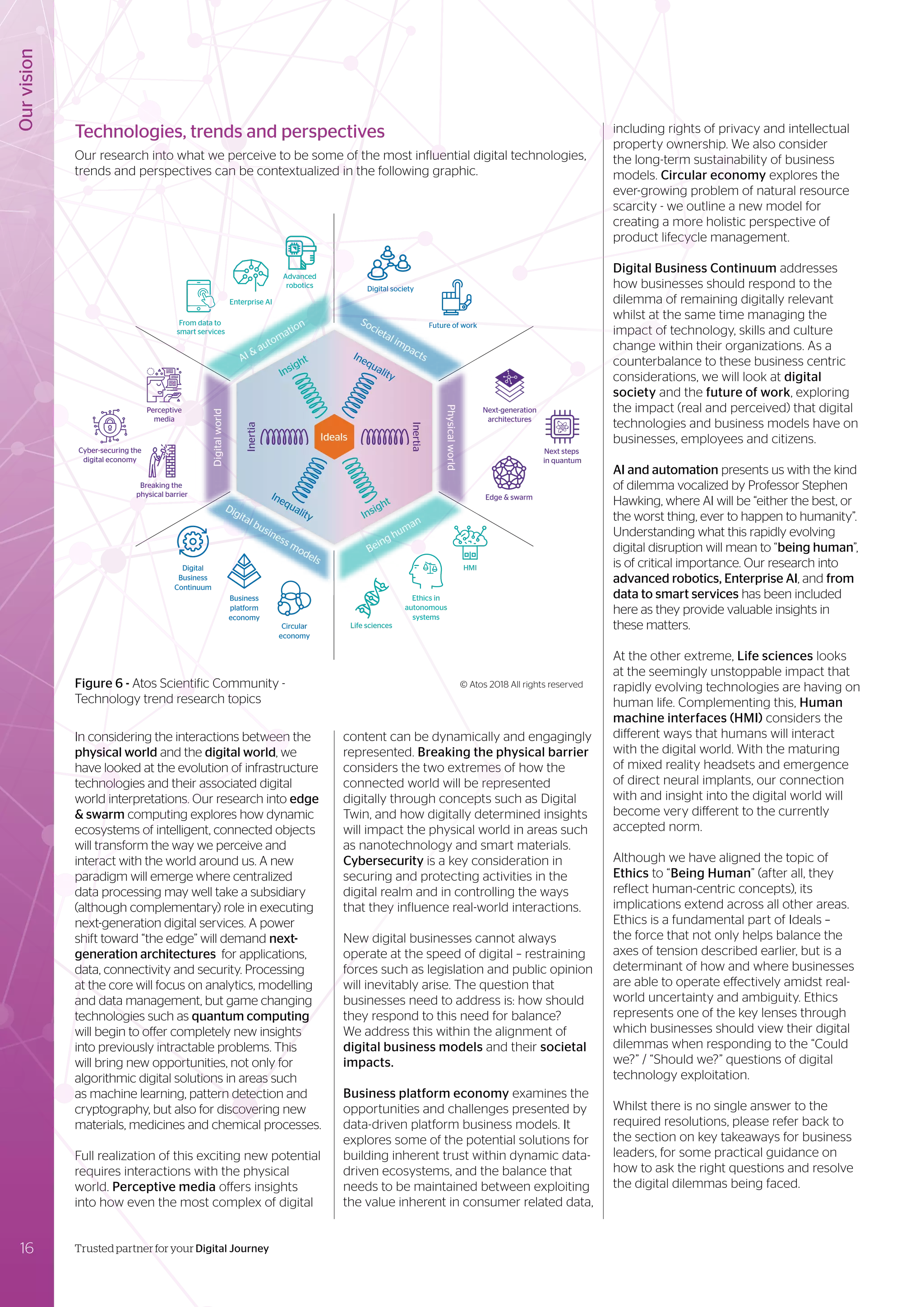
Technologies, trends and perspectives
Our research into what we perceive to be some of the most influential digital technologies,
trends and perspectives can be contextualized in the following graphic.
In considering the interactions between the
physical world and the digital world, we
have looked at the evolution of infrastructure
technologies and their associated digital
world interpretations. Our research into edge
& swarm computing explores how dynamic
ecosystems of intelligent, connected objects
will transform the way we perceive and
interact with the world around us. A new
paradigm will emerge where centralized
data processing may well take a subsidiary
(although complementary) role in executing
next-generation digital services. A power
shift toward “the edge” will demand next-
generation architectures for applications,
data, connectivity and security. Processing
at the core will focus on analytics, modelling
and data management, but game changing
technologies such as quantum computing
will begin to offer completely new insights
into previously intractable problems. This
will bring new opportunities, not only for
algorithmic digital solutions in areas such
as machine learning, pattern detection and
cryptography, but also for discovering new
materials, medicines and chemical processes.
Full realization of this exciting new potential
requires interactions with the physical
world. Perceptive media offers insights
into how even the most complex of digital
content can be dynamically and engagingly
represented. Breaking the physical barrier
considers the two extremes of how the
connected world will be represented
digitally through concepts such as Digital
Twin, and how digitally determined insights
will impact the physical world in areas such
as nanotechnology and smart materials.
Cybersecurity is a key consideration in
securing and protecting activities in the
digital realm and in controlling the ways
that they influence real-world interactions.
New digital businesses cannot always
operate at the speed of digital – restraining
forces such as legislation and public opinion
will inevitably arise. The question that
businesses need to address is: how should
they respond to this need for balance?
We address this within the alignment of
digital business models and their societal
impacts.
Business platform economy examines the
opportunities and challenges presented by
data-driven platform business models. It
explores some of the potential solutions for
building inherent trust within dynamic data-
driven ecosystems, and the balance that
needs to be maintained between exploiting
the value inherent in consumer related data,
including rights of privacy and intellectual
property ownership. We also consider
the long-term sustainability of business
models. Circular economy explores the
ever-growing problem of natural resource
scarcity - we outline a new model for
creating a more holistic perspective of
product lifecycle management.
Digital Business Continuum addresses
how businesses should respond to the
dilemma of remaining digitally relevant
whilst at the same time managing the
impact of technology, skills and culture
change within their organizations. As a
counterbalance to these business centric
considerations, we will look at digital
society and the future of work, exploring
the impact (real and perceived) that digital
technologies and business models have on
businesses, employees and citizens.
AI and automation presents us with the kind
of dilemma vocalized by Professor Stephen
Hawking, where AI will be “either the best, or
the worst thing, ever to happen to humanity”.
Understanding what this rapidly evolving
digital disruption will mean to “being human”,
is of critical importance. Our research into
advanced robotics, Enterprise AI, and from
data to smart services has been included
here as they provide valuable insights in
these matters.
At the other extreme, Life sciences looks
at the seemingly unstoppable impact that
rapidly evolving technologies are having on
human life. Complementing this, Human
machine interfaces (HMI) considers the
different ways that humans will interact
with the digital world. With the maturing
of mixed reality headsets and emergence
of direct neural implants, our connection
with and insight into the digital world will
become very different to the currently
accepted norm.
Although we have aligned the topic of
Ethics to “Being Human” (after all, they
reflect human-centric concepts), its
implications extend across all other areas.
Ethics is a fundamental part of Ideals –
the force that not only helps balance the
axes of tension described earlier, but is a
determinant of how and where businesses
are able to operate effectively amidst real-
world uncertainty and ambiguity. Ethics
represents one of the key lenses through
which businesses should view their digital
dilemmas when responding to the “Could
we?” / “Should we?” questions of digital
technology exploitation.
Whilst there is no single answer to the
required resolutions, please refer back to
the section on key takeaways for business
leaders, for some practical guidance on
how to ask the right questions and resolve
the digital dilemmas being faced.
AI & automation Societal impacts
Digital business models
Being human
Physical
world
Digital
world
From data to
smart services
Enterprise AI
Advanced
robotics
Future of work
Digital society
Next-generation
architectures
Next steps
in quantum
Edge & swarm
Life sciences
HMI
Ethics in
autonomous
systems
Digital
Business
Continuum
Business
platform
economy
Circular
economy
Breaking the
physical barrier
Perceptive
media
Ideals
Insight
Inertia
Inertia
Insight
Inequality
Inequality
Cyber-securing the
digital economy
© Atos 2018 All rights reserved
Figure 6 - Atos Scientific Community -
Technology trend research topics
16 Trusted partner for your Digital Journey
A
tendency to focus on a somewhat
utopian vision for technology that fails
to reflect a human-centric perspective,
will increasingly be seen by many as digital
dystopia. Is it really acceptable to have robot
sex slaves, or manipulate public opinion
through AI driven information bias?
Digital businesses must redress
the balance by putting more
human perspectives at the heart
of their technologies, service
interactions, commercial models
and corporate values.
Realizing such a vision will not be an easy
transition for all. We will see an entanglement
of disruptive technologies and ethical
viewpoints. Technology developments and
roadmaps will be influenced as much by
human perception as by what is theoretically
possible. The “Could we / Should we”
debate will be influenced by all manner of
forces – including geopolitical, ethical and
commercial. These will be continually shifting,
so business leaders must constantly review
their impact.
Not only do these forces influence external
perspectives of business, but also ones
of internal strategy and transformation.
Businesses undergoing digital transformation
will need to operate in a hybrid state of
legacy and digital - resulting in unanticipated
tensions and unwanted inertia in areas
such as business processes and employee
engagement. Resolving the associated
dilemmas is fundamental to successful digital
transformation programmes.
Toward a human-centric
digital business culture
Figure 7 - Toward a human-centric digital
culture
Equality
of benefit
“As is” “To be”
Openness
with trust
A human-centric response to the changing tensions of
digital transformation will help businesses to optimize
their digital potential.
17
Journey 2022 | Resolving Digital Dilemmas
20	 Breaking the physical barrier
22	 Next-generation architectures
24	 Edge & swarm computing
26	 Perceptive media
28	 Quantum computing
30	 Cyber-securing the digital economy
Digital meets
physical
As the boundaries between the digital
and physical world become increasingly
blurred, we must rethink the ways that we
perceive and interact with evolving and
emerging technologies.
18 #Journey2022
19
Journey 2022 | Resolving Digital Dilemmas
S
ince the industrial revolution, products
have been engineered to perform
specific functions, using defined
structures and particular material properties.
These products had limited ability to evolve
and adapt to external stimuli. However, the
application of digital twin technology is
creating the potential for a new generation
of adaptive products able to respond to a
range of contextualized data insights.
A digital twin is a virtual replica of a physical
system, product, production system or
service, which evolves through constant
feedback, simulation and learning from its
physical counterpart.
The progressive value that can be realized
through the application of a digital twin
approach can be summarized as:
•	 Connect & communicate to create a
‘conversational flow’ between the digital
and physical world, supported by IoT
technologies (smart sensors, actuators,
standardized communication protocols,
visual rendering, etc).
•	 Collate and build a digital representation
of the physical world, capturing relational
semantics and attributes.
•	 Cognition through fast and accurate
simulations, using real-time and historic
data to gain an understanding of the
physical usage. Analytics, machine
intelligence / learning and visualization
provide actionable insights.
•	 Automate real-world responses based
on the analysis of the digital twin to
proactively avoid problems occurring, and
to optimize usage.
By applying the principles of digital twinning
to gas turbines (for example), the life
expectancy of gas nozzles can be accurately
predicted. Through iterative design
improvements and precision 3-D printing,
the nozzle’s performance can be optimized
to reduce future operational disruptions.
Already, a range of low cost sensors and
actuators are available that make interactive
digital twins economically viable. Such
devices will evolve further with future
developments in nano-technology, and will
be progressively integrated into systems
that are built using smart materials able
to react to a range of external stimuli. A
closed communication and simulation loop
between the digital twin and the physical
system can result in a prescriptive, decision-
making system. Using high-confidence
predictions, the actionable insights from the
digital twin can be automated via signals that
translate into smart material responses.
Smart materials are able to:
•	 Receive external stimuli such as electrical
current, stress, temperature or magnetic
fields.
•	 Transform inherent properties through
the triggering of targeted physical actions
based on specific stimuli, for example
changing shape, hardness or surface
colour in response to electrical impulses.
An example use-case of smart materials
working alongside digital twin based
decision-making systems, is that of next
generation helicopter blades. Vibration
issues will be addressed through blade
material properties being altered in
response to real-time analysis of operational
conditions.
Creating a “digital thread” for
maximum value
The connectivity and feedback between
sensors and actuators through digital twins
will result in innovative business models
across product and asset lifecycles. These
will then become important enablers
for smart services. Connected sensors
will provide a wealth of information from
manufacturing and services environments,
which can be analyzed to create a “digital
thread”: a single, seamless strand of data
that informs enhancements in product
development, production and service
processes.
We will observe resulting business benefits,
including:
•	 Moving from B2B to B2C - creating
personalized products that offer
customer empowerment through mass
customization.
•	 Time to market reduction - product
creation timelines will get much shorter
because of faster and more accurate
performance feedback.
•	 Servitization - product centric models
will increasingly transition to service
based variants (delivering increased
product functionality, reducing costs
and managing increased operational
complexity).
•	 Effective asset management – data
communication with assets will enable
automated update and lifecycle
management.
A direct link between the physical system
and its digital twin will provide end-to-end
transparency through product design,
production and after-sales service processes
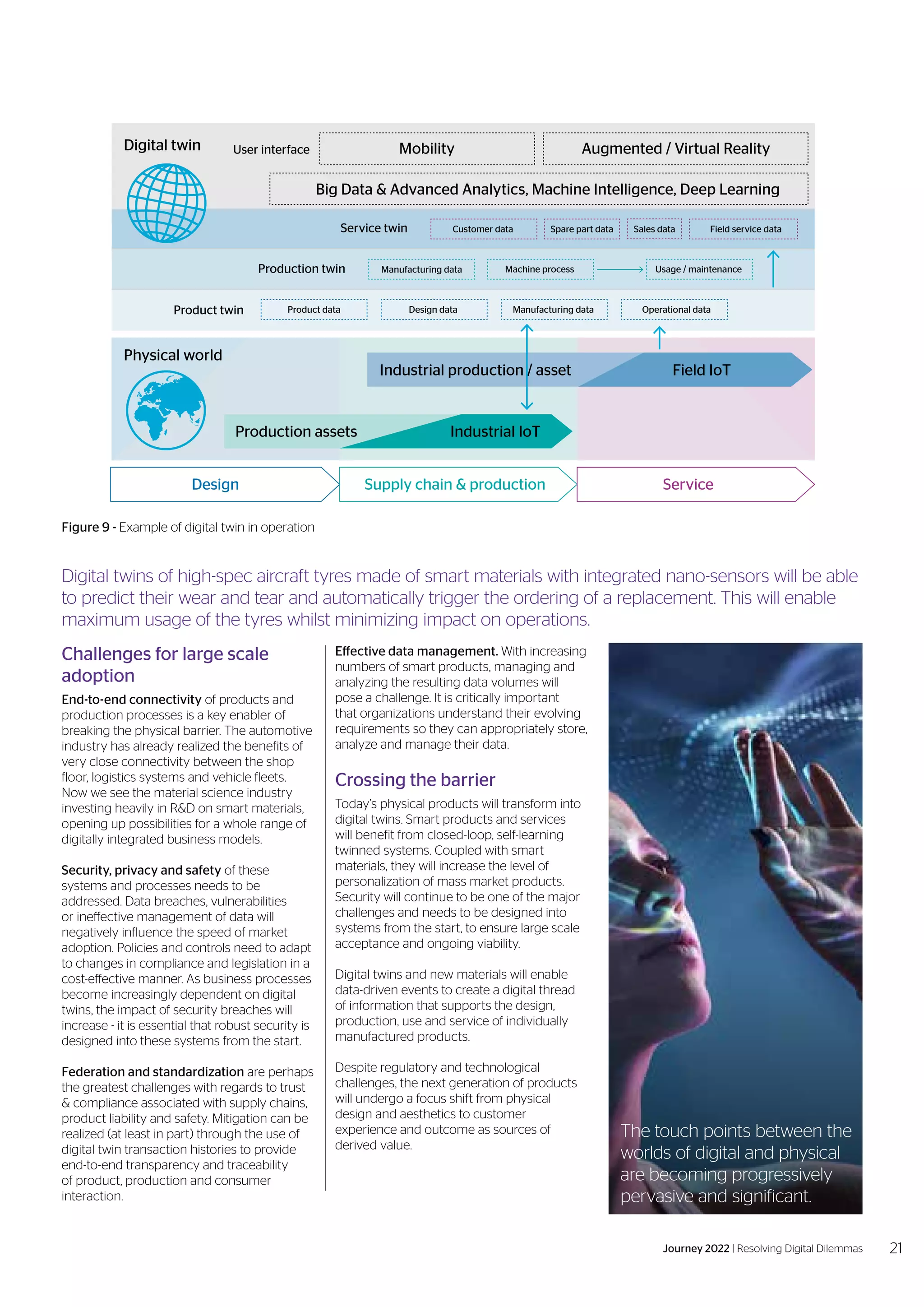
as shown in Figure 9.
Breaking the
physical barrier
Digital twins and smart materials will soon enable physical systems to change form and function
in response to their context and environment. What impact will this have on product lifecycle
management?
Digital
meets
physical
Figure 8 - Digital twin maturity levels
timeline
maturity
Automate - learning
decision, self correcting
Cognition - simulation,
diagnostic, visualization
Collate - digital twin model,
semantics of data sources & mining
Communicate - smart analytics -
product health, data correlation
Connect - Data collection, sensor network,
visual rendering
20 Trusted partner for your Digital Journey
Challenges for large scale
adoption
End-to-end connectivity of products and
production processes is a key enabler of
breaking the physical barrier. The automotive
industry has already realized the benefits of
very close connectivity between the shop
floor, logistics systems and vehicle fleets.
Now we see the material science industry
investing heavily in R&D on smart materials,
opening up possibilities for a whole range of
digitally integrated business models.
Security, privacy and safety of these
systems and processes needs to be
addressed. Data breaches, vulnerabilities
or ineffective management of data will
negatively influence the speed of market
adoption. Policies and controls need to adapt
to changes in compliance and legislation in a
cost-effective manner. As business processes
become increasingly dependent on digital
twins, the impact of security breaches will
increase - it is essential that robust security is
designed into these systems from the start.
Federation and standardization are perhaps
the greatest challenges with regards to trust
& compliance associated with supply chains,
product liability and safety. Mitigation can be
realized (at least in part) through the use of
digital twin transaction histories to provide
end-to-end transparency and traceability
of product, production and consumer
interaction.
Effective data management. With increasing
numbers of smart products, managing and
analyzing the resulting data volumes will
pose a challenge. It is critically important
that organizations understand their evolving
requirements so they can appropriately store,
analyze and manage their data.
Crossing the barrier
Today’s physical products will transform into
digital twins. Smart products and services
will benefit from closed-loop, self-learning
twinned systems. Coupled with smart
materials, they will increase the level of
personalization of mass market products.
Security will continue to be one of the major
challenges and needs to be designed into
systems from the start, to ensure large scale
acceptance and ongoing viability.
Digital twins and new materials will enable
data-driven events to create a digital thread
of information that supports the design,
production, use and service of individually
manufactured products.
Despite regulatory and technological
challenges, the next generation of products
will undergo a focus shift from physical
design and aesthetics to customer
experience and outcome as sources of
derived value.
Figure 9 - Example of digital twin in operation
Digital twins of high-spec aircraft tyres made of smart materials with integrated nano-sensors will be able
to predict their wear and tear and automatically trigger the ordering of a replacement. This will enable
maximum usage of the tyres whilst minimizing impact on operations.
Digital twin
Design Supply chain & production Service
Customer data Spare part data Sales data
Machine process
Design data
Usage / maintenance
Field service data
User interface
Manufacturing data
Product data
Service twin
Production twin
Product twin Manufacturing data Operational data
Big Data & Advanced Analytics, Machine Intelligence, Deep Learning
Mobility Augmented / Virtual Reality
Physical world
Production assets
Industrial production / asset Field IoT
Industrial IoT
The touch points between the
worlds of digital and physical
are becoming progressively
pervasive and significant.
21
Journey 2022 | Resolving Digital Dilemmas
Digital
meets
physical
Next-generation
architectures
W
ith the current trends in
digitalization and the ever-
increasing adoption of connected
objects, we are surrounded by computers
that seem to continually grow in importance
for our work and private lives.
Difficult though it is to believe the small,
micro, even nano computers we encounter
every day are the direct descendants of the
room-sized computers built in the 1950s
and 60s. For decades, the miniaturization
of transistors and integrated chips
relentlessly delivered exponential growth in
performance, only to recently hit the limits
of physics and economy. Yet the Internet of
Things and the incredible advances made
in Artificial Intelligence are demanding
performance increases of several orders of
magnitude.
This rift between what is required and
what can be delivered without significantly
increasing costs, calls for fundamental
changes in the ways that we build and
deploy computing infrastructures and
applications.
Future challenges for
computing architectures
Apart from the need to process vastly more
data, the current approaches to computer
infrastructure and application design are
facing new challenges:
•	 Compared to the traditional cost drivers
such as hardware and software, energy
expense becomes much more difficult
to reduce. Whilst cloud technology was
born out of the desire to optimize the
utilization of IT infrastructure assets,
its progress depends on an ability to
minimize impacts. Current ecological and
economic impacts, as current workloads
need to account for the energy they use
versus the value they generate from
computation.
•	 As we depend on more widely connected
applications, sensors and objects,
the security of computers and their
applications is an ever-growing concern.
We have witnessed malware attacks
disabling hospitals and factories, forcing
us to realize that digitalization brings cyber
threats very close to home. Consumers
will want to purchase increasing numbers
of IoT devices for convenience, but that
convenience brings with it the added
burden of security management.
The root cause for these challenges lies in the
adoption of the von Neumann architecture,
described in 1945, which has given birth to
the general-purpose computing model, and
led to the software industry we have today.
While this model was admired for its simplicity
and openness when computers were hard to
build and operated in isolation, the choice to
have code and data share the same memory
space has become a fundamental liability in
today’s hostile Internet. Malware and viruses
are software like any other application code,
and reliably eliminating them in the current
architecture model means giving up software
as we know it, along with its economy.
The factors that limit today’s computing require a fresh
engineering perspective. They need to evolve in response
to the societal, environmental and business demands
created by todays innovations.
22 #Journey2022
Toward next-generation
architectures
Given how deeply we are invested in the von
Neumann architecture, it is economically
unviable to embark on a clean slate approach
to building computers. Instead we must
fundamentally retain the evolutionary
approach that software enabled, but need to
accelerate it where the pressure is highest,
through the creative reuse of existing assets.
One approach to improve the efficiency and
security of IoT devices is to resist deploying
general-purpose operating systems on top of
general-purpose computers. Instead, rather
than copying a fully-featured Unix server into
a smart doll and adding a few lines of PHP or
Python to make it smile, giggle and answer
questions via the Internet, we could use a
smarter compiler, linker and image builder
to intelligently extract only those portions
of the Unix and middleware stack that are
actually required by the application. This
would significantly reduce both the attack
surface and the bot capabilities of a hijacked
Unix server, to those of a hijacked doll… which
can only giggle at the attacker. In a similar way,
technologies such as Unikernel, hardened
containers and serverless computing can
be used to help reduce operating system
resources and risks, whilst at the same
time retaining a sufficient set of services
for applications to run. This approach also
benefits server workloads.
Another way to overcome today’s limitations
of the general-purpose computing model is
to abstract and embed the most compute-
intensive parts into hardware. This approach
has already proven its value for the rendering
of computer graphics, and to ease the
computation of cryptographic primitives.
Graphical Processing Units (GPUs) are also
used to accelerate critical sections of code
in High Performance Computing (HPC) and
artificial intelligence. The key to success has
been the ability to replace libraries of general
purpose code with functionally identical
libraries using hardware accelerators so that the
cost of adapting software can be minimized.
As a prime example, the AI software stack
Tensorflow offers identical functionality on
CPUs, GPUs and custom Tensor Processing
Unit chips, but at distinct levels of performance,
price and energy efficiency. Quantum
computing will inevitably be delivered with a
mixture of general purpose CPUs, Quantum
hardware and other accelerators, which will
enable application developers to restructure
their applications to benefit from the distinct
capabilities of each specialized element.
Also of importance are the new languages,
tools and hardware that will allow the creation
of code that is inherently safe or fortified
against attacks - less von Neumann, but still
economical to use.
Complexity
Efficiency
Performance
Security &
Trust
Orchestration
New
Internets
Cross
fertilization
Building
pressure
Huge Cloud DCs
Millions
Fabric connected
Performance
THINGS
Billions
Mobile
Wide-area connected
Low power
Disruptive
leap
Maturing
All Inference
Unikernel
Uncompromisable architectures
Application specific architecture
Increased abstraction
Microservices
Value-driven computing
Specific processing units
Application specific architecture
Architecture
characteristics
Next-generation architectures
Accelerated evolution, diversification, stagnation and disruption
Few large
expensive machines
Fixed disconnected
devices
Friendly users
Benign software
Past Present Future
Business impact
Multiplying the number of systems, devices,
volume of data and computing performance
by ten or even a hundred times without
raising the cost of infrastructure, software
development, operations and energy, means
you have to change everything… while you
cannot afford to change much. Evolution
is the answer, but rapidly accelerated
evolution where the needs and benefits are
greatest. Developers and IT service providers
constantly have to rethink the way they
develop and deploy their applications and
computing platforms, inserting innovative
hardware and software solutions into
performance hot spots, as required. Future
architectures will disaggregate monolithic
components like general purpose CPUs,
operating systems and middleware, providing
the required insertion points, adding
flexibility and improving security. While
the architectural building blocks won’t be
identical in e.g. the data center/cloud and
IoT domains, cross-fertilization should occur
naturally where interactions lead to symbiotic
relationships. Evolution implies both diversity
and extinction: continuously making the
right choices and validating them becomes
more important than ever. Choosing the right
partners and alliances is essential, as levels of
market adoption are often more important
than technology perfection.
Figure 10 - Next Generation Architectures
23
Journey 2022 | Resolving Digital Dilemmas
Digital
meets
physical
Edge & swarm
computing
7
	https://atos.net/en/blog/swarm-computing-goes-around-comes-around
	https://atos.net/content/mini-sites/journey-2020/pages/disruptive-technologies/indexc028.html
8
	https://irtf.org/icnrg
9
	 Refer to Enterprise AI chapter
I
t may be considered that the growth
of the smartphone user population to
over three billion in just 10 years is an
incredible phenomenon, but this rise is set
to be dwarfed as the Internet of Everything
increasingly penetrates our daily lives.
What’s more, the expected plethora of
sensors, actuators, robots, drones, cars etc.
will not just function standalone; they will
be part of an all pervading, interconnected
network that exhibits enormous complexity,
particularly at the ‘edge’ of the ecosystem.
Edge and swarm computing7
explores how
these billions of devices are going to impact
and influence future computing systems.
Concept
A connected edge machine can be thought
of as a collection of computing resources
with diverse sensors and actuators that are
aggregated to create a cognitive loop8
. The
self-contained and self-sustaining nature of
these machines, combined with the need
for small physical footprints and low energy
consumption, requires innovative computing
and communication architectures. The true
capabilities of these machines are enabled
by swarm computing principles that allow
them to interact in distributed operational
environments. Such swarm environments
will bring enhanced collective capability and
insight, enabling a service provision shift from
‘pre-defined and fixed’ to ‘on-demand and
ad-hoc’. Applications will engage resources
which are governed as parts of different
domains, applying the concept of subsidiarity
of intelligence9
, where decisions are taken
as close as possible to the point of action.
This approach will take advantage of many
heterogeneous resources to provide a fully
service-based environment.
Within the swarm concept, orchestration is
defined across three levels:
1) Connected edge machines;
2) Computation at the edge;
3) Multi-Cloud computing environments.
By combining these three elements, a swarm
emerges opportunistically, in which collective
knowledge and intelligence is formed. This
approach provides flexibility to dynamically
switch computational resources across the
three layers, bringing the additional benefit
of improved resilience of the inevitable
additional management complexity.
24 Trusted partner for your Digital Journey
Soon, computing will no longer be restricted to traditional platforms, but will be embedded in almost
everything, and interconnected in a way that establishes an unprecedented computing continuum.
10
	 Connected Cars: From the Edge to the Cloud, https://www.iotcentral.io/blog/connected-cars-from-the-edge-to-the-cloud
11	
Information-Centric Networking Research Group, https://irtf.org/icnrg
Why do we need Edge and
swarm?
The most prominent use-cases will be in the
area of intelligent transportation. Connected
autonomous and semi-autonomous cars are
increasingly considered to be the ultimate
edge device10
. Assisted or autonomous
driving requires a wide range of different
computing elements, including sensor data
which needs to be processed and analyzed
with ultra-low latency at the edge.
In the context of smart grids, the goal
is to provide better management of the
production and distribution of otherwise
disparate renewable energy sources by
reducing losses, increasing efficiency and
optimizing the “consumption-production”
balance. Objects in smart grids will generate
vast amounts of operational data that need
to be managed, exchanged and stored. A
combination of edge and swarm computing
will be crucial to providing the envisaged level
of capability.
In the longer term, next-generation robotics
will move toward software defined robots
based on commoditized hardware. Swarm
computing can generate new opportunities
for interacting robots to gather knowledge,
share data and create cognitive services.
learning at all levels. The distribution of
reasoning across the edge and cloud allows
for the design of intelligent decentralized
architectures that can even operate under
delegation when certain parts fail.
Security
In an edge and swarm context, data will be
the most significant asset to protect. It will
be created and stored virtually everywhere,
with the result that centralized security
control will become unmanageable. Instead,
enhanced security will be a pervasive feature
for any connected object, whether that
be a system, machine, person, partner or
client. Some traditional security strategies
will remain valid though: device hardening;
IoT Vulnerability Management Solution;
asset discovery and patch management;
and edge security analytics. At the same
time new security paradigms will emerge
to enable data-centric security. We would
like to introduce the concept of “data-ridden
security” as an important new approach to
addressing security within edge and swarm
environments.
Network management
Resilience of edge and swarm computing,
especially for mission critical IoT applications,
requires new network management
approaches that are able to handle network
failures and serious overloads. Revolutionary
approaches like information centric
networking11
are changing the way data
is shared and protected over the internet
by introducing uniquely named data as a
core Internet principle. These are promising
approaches that could meet the needs of
edge and swarm computing.
Conclusion
The emergence of edge computing is
inevitable. Swarm concepts will enable
a multitude of use cases that rely on
the collective compute capabilities of
edge infrastructures and their ability to
interoperate. This new paradigm will present
serious challenges for organizations - not
only in relation to dealing with infrastructure
or technical solutions outside of the data
center, but also with being able to manage
and commit to service levels when using
complex, heterogeneous, intelligent instances
that interact across multiple geographical
locations. The only viable way to effectively
manage edge and swarm environments will
be through high levels of automation and
trust, and more efficient operational models.
Figure 11 - Swarm computing concept & research topics
Multi-Cloud
Edge Cloud
Computing continuum
Public Cloud
Private Cloud
Cloud
broker
Swarm
computing
0100
1
1
0
1
“Data-ridden security” (DRS) is a new concept which assumes that
every component which handles data (storage, networks, APIs,…)
has enough strong security controls to protect any kind of data
that it processes. It is the data itself which instructs the component
how to deal with it, according to its nature and context.
Challenges
The use cases we have identified bring specific
challenges which need to be addressed. The
anticipated swarm architecture concept is
shown in Figure 11. The key components
should be understood as follows:
P2P organization & distributed ledger
systems
In autonomous, distributed and connected
systems, P2P mesh architecture is an ideal
model for defining the communication
requirements. Validity and consistency of the
data inside and outside the edge and swarm
environment becomes critical. Maintaining
trust is crucial and could, in certain cases,
be resolved through the appropriate use of
distributed ledger technologies.
Heterogeneous architectures
Two key requirements for effective
swarm operation will be quality of service
management, and the integration of a wide
variety of devices with heterogeneous
processing architectures.
Data management
Information organization is crucial for
orchestration in both edge and swarm
environments. This makes it possible
to coherently organize intelligence and
25
Journey 2022 | Resolving Digital Dilemmas
Digital
meets
physical
T
he media of the future will revolve
around personal experiences - both
individual and collective - individually
tailored for everyone. New media
consumption patterns, new formats and
devices are changing both the media
we consume and the way we consume
it. Associated value chains and business
models are rapidly evolving, and by 2022
we will be seeing greatly enhanced bi-
directional interactivity and immersivity, and
even emotionally aware content. Media will
increasingly bridge the gap between the
physical and virtual worlds, with insights
gained from social media and user behavior,
leading to what we might call intelligent or
perceptive media.
Media distribution and related business
models, are already starting to reflect the
shift from standardized consumption toward
more bespoke experiences, and of course,
marketing and sales are mirroring these
developments. These changing media
industry trends will also have impacts
on other sectors such as retail, tourism,
education or training.
Extreme personalization can
allow for ever greater user
targeting and content that is a
perfect fit for the user in their
current context. But this also has
implications in terms of privacy
and ethics. How much can/
should media companies know
about you? How much should
they be allowed to use such
information to influence you?
Perceptive
media
Hyper-personalization
At the heart of perceptive media is
extreme or hyper-personalization,
building on the user’s desire for greater
levels of control over their own media
experiences. While not yet commonplace
in the consumption of most forms of
media, this approach is well established
in the gaming market and in social apps
such as dubmash12
or Instagram. With
content being produced, adapted and
configured on the fly, the end-user will
be able to modify certain aspects of the
content (such as audio, characters or plot
choices), to experience a story uniquely
and personally. Using a user’s social graph,
context and past behaviors will allow
the anticipation of their desires, needs
or whims to create recommendations or
compose bespoke content that match
their moods for a given moment. We will
soon be beyond the paradigm where
an artist always tells a completed story,
instead artists will create environments
where a user can experience a story in
their own way.
User context is already an important
element of some online content, using
profiles, location and navigation history
to tailor content to individual tastes or
needs. As we move toward 2022, the use
of personal and contextual information
will become standard inputs for search
and recommendation, and for the
personalization of content itself. Such
inputs might include: where we are; where
we have been; where we are going; what
we are doing; who we are with; time of
day; weather; how we are feeling; what
device we are using; and activities of our
social graph. A steadily increasing use of
AI, and psychology principles is leading
to improved performance in these areas,
helping the right choices to be made for
us to feel that an experience is completely
natural and personal.
Over the coming years, the use of new
input devices incorporating biometrics
and gestures will increase. Such devices
will not only help realize dynamic content,
adaptation and interactivity, but will
also be used for enhancing future story
lines, targeted advertising and improved
personalization.
Today
Tomorrow
Directed by the Producer
Content directed by the User
Same experience
for all
Personalized
experience
for each
Mode
selector
Content
Multi view
content
Immersive
Interactive
Collaborative
Customized
Verified
newsfeed
Certified
3rd
party
Content
orchestrator
Display
control
Figure 12 - Content creation and consumption becomes hyper-personalized
12
	https://quotes.dubsmash.com/
26 #Journey2022
Changing channel
Whilst most of what we watch and
consume today is still what we would
consider to be traditional forms of content,
even these have undergone significant
transformation – it seems that no TV show
is now complete without a social media
campaign, no action movie without its
associated game, and no game without its
own Twitch and YouTube channels. Almost
all content now incorporates cross-channel
elements, with each channel feeding off
the others. Perhaps even more significantly,
gaming is now the largest segment of
the media industry in terms of revenue.
These trends will only become more acute
heading to 2022.
Dynamic shift
But a truly monumental shift will occur in the
move to dynamic content – dynamic in the
sense of interactive; dynamic in the sense
of (re)created in real-time; or dynamic in the
sense of adaptive to user wishes, context or
actions (whether explicit or implicit). Most
of the hype in this area, has been around
augmented reality (AR), virtual reality (VR)
and 360° video, but perhaps one of the
more interesting developments is “object
based media”. Associated with this, a set of
new technologies is expected to enter the
mainstream by 2022, where production
content is divided into its component parts
(segments, including alternative narratives,
audio tracks, metadata, etc.). These parts
are later recomposed individually for each
user. This will allow much greater levels of
personalization, adaptation and interactivity,
and will create possibilities for users to
participate in the narrative process. It will
bring experiences beyond personalization,
where users actually take control of their
media experiences.
How we consume
Mobile devices have introduced the ‘anytime,
anywhere’ paradigm, not only opening up
new places and activities where content can
be consumed, but also enabling new types
of content specifically designed for certain
contexts, such as in the car or on public
transport. Driverless vehicles may further open
this new content consumption paradigm.
We can expect AR and multi-modal
experiences to become more commonplace.
By blending the physical and virtual worlds,
AR can more easily unlock a new kind of
instant, contextual slice of content, while
combining it with the reality surrounding the
user. The content isn’t just one-way but rather
becomes a sort of “conversation” between
the user and their virtual and physical
environments. We will soon see multi-modal
content e.g. live theatre or film, AR, as well as
location based entertainment – truly high end
mixed reality!
These changes in the media and content
landscape will have ramifications that go
far beyond media and entertainment. Just
as social media has changed the way we
interact in our personal lives and at work.
Beyond the media industry, the effects of
perceptive media will be felt in such diverse
areas as training and education, corporate
processes, marketing, tourism or retail - in
fact, anywhere that more personalized,
bespoke content and interactivity can
increase engagement, effectiveness and
monetization.
27
Journey 2022 | Resolving Digital Dilemmas 27
Journey 2022 | Resolving Digital Dilemmas
Led by the gaming industry, business models are evolving. Some people are willing to pay, not only
for a more powerful virtual spaceship, but even for just a flashy new paintjob for their ship. Others are
happy to allow all kinds of personal data to be monetized by third parties. Media capable of logging your
emotional responses to different scenarios could potentially be a gold mine.
Digital
meets
physical
Quantum
computing
A
t the beginning of 2018, we saw claims
for the emergence of the first quantum
supremacy computers at IBM, Intel
and Google. Delivering a capacity of 72+
qubits, they ushered in the Noise Intermediate
Scale Quantum (NISQ13
) era. This represents
a significant threshold in computing and in
how we work with computational challenges
from this day forward. For those who had little
interest in this field, the milestone came as a
surprise, since only a mere 3 years ago such
technologies were predicted to be a decade
away. In Journey 2020 we anticipated the
advances in this field when we expressed
the urgent need for quantum safe security.
In contrast, we expect that by 2022, the
public opinion of quantum technologies
will shift from ‘threat’ toward ‘opportunity’
as the technology continues to make further
unprecedented leaps forward.
Quantum hardware and software, or “quanta-
ware14
”as we like to call it, will develop with
a series of growth spurts, undoubtedly
continuing to polarize public opinion. As
today’s emulator platforms15
enable quantum
programming, and opportunities become
more concrete, we will see a surge in
increasingly beneficial business applications,
even though some significant uncertainties
remain in how quanta-ware capabilities can
be combined with practical industry use
cases. Irrespective of these uncertainties,
the hyped status and concerns around their
impact on digital security will show that
quanta-ware benefits are closer than we think.
Quanta-ware
A number of quantum software
programming languages have already been
developed, and we see hardware vendors
announcing the creation of bigger NISQ
computers, almost on a monthly basis.
However, combining quantum software
and hardware in an effective way is a
non-trivial challenge which is holding back
the realization of many practical use cases
of quantum computing, and hence its
mainstream adoption. The two aspects of
quanta-ware are developing at different
Companies are already commercially
providing such platforms in combination with
optimized classical hardware for a hybrid
delivery model.
Hybrid quanta-ware will initially be integrated
as accelerators for different kinds of
workloads, much like with the present day
use of GPUS.
Reliable quantum memory is essential for
effective processing: quanta-ware will achieve
this either by using smarter error correction
codes or by developing more stable qubits.
Addressing this problem will make it possible
to keep quantum data intact for longer,
opening the way for solutions to reusing
quantum information, and allow a whole
range of new application possibilities.
13	
“Quantum Computing in the NISQ era and beyond” – John Preskill - https://arxiv.org/abs/1801.00862
14
	 Quanta-ware is an Atos defined term to encompass quantum computing hardware and software solutions.
15
	 E.g. the Atos Quantum Learning Machine
speeds, but the point where they converge
to enable readily available and practical
(business) use cases, is expected to arrive
before 2022.
By 2022, we will have a hybrid landscape in
computing, where quantum and classical
computers will interact seamlessly. This is
necessary because real-world applications
require a combination of classical and
quantum hardware, appropriately combined
in a single platform. The challenge of
integrating our classical computing legacy
into this new hybrid computing world should
not be underestimated. These challenges will
be partially resolved by smart, hybrid (cloud
based) platforms, but we will need to avoid
being limited by traditional ways of thinking
about computing.
Maturity
Unknown possibilities
Quantum simulators
Quantum hardware
Software capabilities
Hardware capabilities
The gap
Now < 2022
Time
Figure 13 - The journey from quantum computing simulation to quantum computing practicality
The infamous RSA breaking Shor’s algorithm has 5 steps. Of these
5, only 1 requires quantum computing techniques, hence a hybrid
platform is required to make efficient use of such an algorithm.
28 Trusted partner for your Digital Journey
Quantum business
applications
The first useful applications that quanta-
ware will offer are in the field of chemical
simulations of small reactants – these promise
environmental revolutions in the chemical
domain.
Discovering solutions to problems like carbon
capture to scrub the atmosphere, and nitrogen
fixation process optimization could contribute
up to a 1% reduction in global energy
consumption. Further steps will see material
sciences providing new alloys and composites
with increased strength, reliability and lifespan,
possibly even sparking the development of
room temperature superconductors.
When logical qubits reach capacities in the
tens of thousands, quanta-ware will be used
for computationally intensive tasks like global
climate models, mitigation of global healthcare
challenges, and the breaking of established
encryption types such as those used in
blockchains and digital signatures.
Beyond 2022, quanta-ware will eventually
create solutions in Big Data and complex
analytics, but in the shorter term we expect
more immediate breakthroughs in areas
such as artificial intelligence and machine
learning. It is because of these kinds of use
cases that various world-leading companies
in aerospace, finance, IT, and automotive are
investing in such solutions.
Quanta-ware will also change how we
approach IT security; whilst on the one hand
quanta-ware causes new threats, it conversely
supplies unbreakable security models, as
described in Journey 2020.
2022 and beyond
After 2022, quantum sensing16
will give new
insights about the world, for example through
oil and gas below-noise-threshold radar
systems. We will see new protocols for time
synchronization in 5G+ networks, and we
foresee the emergence of cryptographical
networks that enable a level of functionality
and performance that is presently
unachievable.
16
	 Quantum sensing are sensors which use quantum effects. https://en.wikipedia.org/wiki/Quantum_sensor
This will be possible thanks to quanta-ware
systems that are able to act as a collective,
made up of tiny quantum memories and
quantum sensors. These will sit as different
elements of a quantum hybrid HPC set-up, or
as an entire network spreading across several
countries. Such networks (the advanced
descendants of quantum key distribution
systems), will lead to a quantum internet
with almost unimaginable possibilities. Much
like computing “in the cloud” or “at the edge”
a quantum internet will allow two distant
quantum devices to operate “as one”.
Into the unknown
By 2022 certain elements of computing will
have made the transition from classical to
quanta-ware, presenting a whole new range
of possibilities and challenges. Nevertheless,
quantum hardware and software are not yet
optimally aligned, and an understanding of how
to make them so is still in its infancy.
Though innovative companies have already
embraced the uncertainties of leveraging the
potential of quanta-ware, the question remains;
in this unpredictable ‘unknown’ do we dare
to boldly go where no computer has gone
before?
29
Journey 2022 | Resolving Digital Dilemmas
Digital
meets
physical
Robot
Technology
Society
Economy
Humans
Immersive
wearables
Cyber
biological
systems
Advanced
analytics
Swarm
computing
Homomorphic
encryption
AI
Cyber
physical
systems
Autonomous
systems
Cyber
warfare
Quantum
technologies
Hostile
governments
Blockchain
Social
media
Virtual
assistants
Smart
contracts
5G
Context-
based
Politics
Cyber
Security
S
ecurity Safety
IoT
Digital e
c
o
n
o
m
y
A
pproaches to cybersecurity
are undergoing significant
transformations, particularly as
a result of the unprecedented level of
technology interactions with human
beings, and the ever more sophisticated
innovation capabilities that are being
exploited by malicious actors. By 2022, the
cybersecurity landscape will be heavily
influenced by the challenge of efficiently
protecting the myriad of devices that we
will engage with in our day-to-day lives,
or will even have physically connected to
our bodies. Although this hyper-connected
ecosystem will generate significant
opportunities and benefits for individuals
and society in general, it will also provide a
tempting target for cyber criminals looking
to exploit broadened attack surfaces and
vulnerabilities that have wide-ranging and
critical impacts. The increasing mobility,
connectivity, flexibility and versatility of
infrastructures and devices will also add
layers of complexity to the management
and control of autonomous systems, in
making them compliant with regulatory
and ethical standards throughout a
dynamic life cycle.
Security as an enabler of
business
Cybersecurity must bring innovative
approaches to digital transformations,
and hence be considered as a business
enabler (rather than constrainer) of the
early adoption of disruptive technologies.
This requirement is largely driven by an
acceleration in the use of digital technologies
which will create unprecedented interactions
between technology and human beings
across virtually all aspects of politics,
society, and business. Global spending on
cybersecurity is anticipated to increase
significantly as the stakes of the emerging
digital economy era materialize and
grow, and businesses look to ever more
sophisticated approaches for their defensive
cybersecurity measures. Increases in threat
landscapes are prompting authorities to
introduce tougher business regulations.
For instance, GDPR imposes potential fines
of up to 4% of global revenue, depending
on severity and circumstances of a
Cyber-securing the
digital economy
cybersecurity breach. Some experts believe
that such regulation may have the effect
of further increasing cyber-attack activities,
since hackers could gain significant returns
by holding businesses to ransom in the face
of such hefty fines.
Billions of things are set to be connected
to the Internet every day (household items,
wearables, clothing etc.). These connected
devices will generate huge amounts of
online data which are all potentially subject
to exploitation. The digital attack surface
will grow massively over the next five years
- having a direct impact on organizations
to revamp and even re-invent their
cybersecurity requirements.
The growing trend for humans to be
more connected with immersive wearable
technology will tend to shift the attack
target toward individuals rather than
IT infrastructures. Such attacks will be
particularly lethal when combined with
the power of data analytics to predict and
ultimately influence individual behaviors.
Cybersecurity flaws in wearable and implants
represent a violation of personal privacy, but
more importantly, represent weaknesses
that could lead to harmful or even deadly
consequences.
Additionally, IoT is having a huge
impact on sectors such as critical
national infrastructures, healthcare and
manufacturing, where the implications of a
cyber incident could add a further dimension
of risk by affecting not only business
reputation and profitability, but also the
economy, health and safety of nations.
Figure 14 - Technology influences in cybersecurity domains
30 #Journey2022
Market trend
By 2022, wearable and mobile devices in
combination with advanced IoT devices will
be readily available as implants into human
bodies, where they will track numerous
aspect of an individual’s behavior and
wellbeing. Security practitioners will need to
deal not only with cyber physical systems
security but also with how the most critical
cyber biological systems will be secured in
the foreseeable future.
It is clear that new approaches for protecting
businesses and individuals will be required.
Classical perimeter security will not be
sufficient anymore, and true cognitive
cybersecurity will become a necessity.
Cybersecurity solutions will become self-
learning systems that make use of AI
technologies (such as machine learning, deep
learning, and reinforcement learning), data
mining and pattern recognition to predict
attackers and mimic the way security analysts
work. Such systems will acquire knowledge
from an understanding of the normal
behavior of networks, computers, devices
and humans, so that they become capable
of anticipating new problems and modelling
possible solutions. This will help solve complex
problems such as the exploitation of stolen
valid credentials by hackers. Similar to other
security techniques, AI technologies will
need to adapt to various environments (e.g.
gateways and devices), to allow them to react
in an efficient and timely way.
Additionally, a collaborative model (including
the need for sharing contextual data) will
be mandatory for surviving the evolving
cyber threat landscape, where context
information extends beyond the traditional
silos of enforcement mechanisms. Even
if some security technologies are not
currently capable of appropriately sharing
contextualized intelligence, we believe that
by 2022, we will see the orchestration of
insights and responses between security
controls and domains. The establishing of
trust is a critical requirement for fostering
collaboration, this is where technologies
like blockchain and other distributed ledger
technologies could help. However, there is
still the need to address challenges in are
such as social (cultural adoption), regulatory
(uncertain regulatory status and governance)
and technical (permissioned blockchains
and strong encryption), before solutions are
widely adopted.
Privacy and confidentiality are two of the
major current concerns that are slowing
the adoption of emerging technologies. An
additional future challenge is that of providing
more flexible and feasible crypto solutions that
go beyond the limited applicability of existing
algorithms. Clear examples in this area include:
fully homomorphic encryption that will allow
computations on encrypted information
without compromising confidentiality - it is still
unclear if this technology will ever become
truly practical, or will remain a theoretical
possibility; and quantum-safe cryptographic
systems where encryption algorithms will
have to be redesigned to protect long-term
privacy and confidentiality.
Conclusion
We have highlighted the emerging
challenges related to new massive attack
surfaces; risks to infrastructures and
individuals; and innovations in malicious
attack technology. Despite this the security
outlook, does not have to be a grim one.
Viable solutions are emerging, based on
artificial intelligence, sharing of incident
information, and seamless end-to-end
security. Industry and regulators are working
toward security and safety certification
frameworks that will help technology
consumers (businesses and individuals)
to enjoy safer products and take security-
conscious decisions about technology
choices for their companies and themselves.
Threats should not deter the deployment of
and investment in technology; cybersecurity
solutions can provide the necessary
assurance to conduct business, deliver
digital transformation processes, and enable
more safe and secure use of technology.
The hyper-connected society we will have by 2022, will drastically
impact the risk and security landscape. This will demand
a cognitive cybersecurity approach to protect individuals,
businesses and critical infrastructure.
31
Journey 2022 | Resolving Digital Dilemmas
34	 Business platform economy
36	 Digital Business Continuum
38	 Circular economy
40	 The future of work
42	 Digital society
Business
models and
society
The speed and scale of impact that
digital technologies have on businesses
and society demands a new level of
corporate responsibility that anticipates
both long and short-term implications of
enterprise strategies.
32 Trusted partner for your Digital Journey
33
Journey 2022 | Resolving Digital Dilemmas
T
he most successful companies in
the digital era17
have all been built on
platform business models18
– models
that allow multiple stakeholders to interact
with each other, creating and exchanging
digitally enabled value.
The continuing trend toward increased
business digitalization is putting many market
sectors on the verge of a new quantum leap
forward. Unprecedented increases in the
volume of electronic data, and breakthroughs
in the processing capabilities that enable the
extraction of insights from them, is fueling
the pace of change. The growing potential
of digital technologies is not only reshaping
customer expectations and engagements,
but also redefining the way that business
supply chains interact. To deliver against the
promise of this trend, the future operations of
many companies and their ecosystems are
likely to be strongly influenced by platform
interactions. Industrial data platforms will
become commonplace in B2B in the same
way as business platforms are dominating the
B2C world today.
Regulation a double-edged
sword
The speed at which innovative platform
business models have evolved has at times
outpaced developments in related regulatory
frameworks. Whilst in some instances this
has led to highly innovative and disruptive
services, in others it has led to unanticipated
side-effects that are not always perceived in a
positive light. Some of these are addressed by
market self-regulation.
In other cases, market sectors join forces to
define industrial standards, in an attempt to
catalyze the emergence of new market sub-
sectors (e.g. the automotive sector seeking
to satisfy the demands arising from the
emergence of connected and autonomous
cars). Regulators are also seeking to catch
up with digital developments e.g. Uber being
stripped of its London licence and banned
from other cities or countries, due to its lack
of corporate responsibility.
Regulation is not just acting as a constraint; it
can also be a major ally in driving a business
platform mind-set. By way of illustration,
consider the second Payment Service
Directive (PSD2) issued by the European
Union to the financial services industry. PSD2
is primarily designed to transform the way
that consumers are able to make on-line
payments using third parties, but it is also
expected to be a significant catalyst for
service disruption and innovation. Whilst core
banking platforms can still hold customer
account details, their controlling businesses
will now be required (with the customer’s
permission) to open up access to certain
data sets and process interfaces. Such data
and its inherent value will now no longer be
monopolized by a single enterprise, but must
reasonably be made available for use within a
wider innovation ecosystem.
17
	 Financial Times 500: The world’s largest companies in 2017, markets.ft.com
18
	 Platform Revolution: How Networked Markets are Transforming the Economy and How to Make Them Work for You; March 2016; Geoffrey G. Parker, Marshall W. Van
	 Alstyne, Sangeet Paul Choudary
Business platform
economy
Business
models
and
society
Data has replaced oil as the world’s
most valuable resource. Extracting and
exploiting its full potential demands
the formation of a connected and
collaborative data platform economy.
34 #Journey2022
Importance of trust
Trust can be defined as a set of principles,
rules, processes and tools that enable
participants to transact in a safe environment.
One of the major challenges with platform
businesses is that interactions can be
highly disaggregated and involve multiple
stakeholders, some of which may not have
inherent peer-to-peer trust relationships. Trust
mechanisms must be designed to address
the dilemmas that can arise when untrusted
stakeholders are involved in open digital
exchanges. Customers at all stages of the
supply chain must be able to trust the quality
of their suppliers, trust that their privacy is
guaranteed, and trust that their suppliers are
not misusing their data. In turn, producers
need to trust that customers are not abusing
the services rendered. To be successful,
platforms must offer a framework of trust that
brings control, privacy, security, compliance
and transparency.
In B2B platforms, where data can be
generated by machines and consumed
by algorithms, trust mechanisms must
have a solid technology foundation and be
able to readily scale. Emerging concepts
like Distributed Trust Technologies19
and
OceanProtocol20
are paving the way for
creating trusted ecosystems by design.
19
	 How Industry is leveraging Distributed Trust Technologies? January 2018, Joint Atos Siemens Position paper
20
	oceanprotocol.com
21
	https://www.mbaskool.com/business-concepts/finance-accounting-economics-terms/2087-shapley-value.html
22
	 Insurance-beyond-digital-the-rise-of-ecosystems-and-platforms, 2017, mckinsey.com
23
	 World Economic Forum, Digital Transformation Initiative – Unlocking B2B Platform Value, March 2017, reports.weforum.org
24
	 Refer to section page 36
Service
providers
OEM
App
providers
Customer Platform
A
Service
providers
OEM
App
providers
Customer Platform
C
Service
providers
OEM
App
providers
Customer Platform
X
Service
providers
OEM
App
providers
Customer Platform
B
Algorithms
Services
Data
Regulation
Trust
Key enabling technologies
Distributed ledger technologies and
associated smart contracts can be valuable
enablers of trusted interactions between
platform stakeholders. Being distributed
and neutral by nature, distributed ledgers
might also help the organization of otherwise
disparate business platforms into dynamic
multi-platform, cross-enterprise ecosystems.
In B2B platforms, flexible collaboration
and interaction networks are emerging.
Digital suppliers offer their services via APIs,
enabling digital customers to select suppliers
based on the service they offer and the
expected outcomes. Value creation is no
longer constrained to follow a linear chain of
predefined steps, but can result from a web
of interactions between digital stakeholders.
Despite such openness of exchange, it
remains in the interests of product and service
providers to restrict the sharing of their data,
protecting know-how and IPR. Kept privately,
data can be used to build knowledge which
might be used to offer differentiated services.
Artificial intelligence and machine learning
will play an increasing role in knowledge
extraction and value creation from privately
owned data sets.. The only data which needs
to be exchanged with third parties is the
contextual information required to enable the
expected service from the digital supplier.
To be attractive and sustainable, B2B platforms
must organize a fair distribution of created
value between the contributors. This can be
easily achieved e.g. using the Shapley value
calculation21
.
Transformation challenges
Business platform champions are leading
the way for a significant transformation in all
industries, with platform ecosystems predicted
to account for 30% of global revenues by
202522
.
The radical changes needed for implementing
a platform strategy give rise to many
challenges. Adoption of the platform economy
for incumbent businesses will require radical
changes in objectives setting, strategic
approaches and operational capabilities23
.
Enterprises need to define how to generate
value both for their business and associated
partner ecosystems.
A “Digital Business Continuum”24
mindset can
be invaluable for accommodating the ever-
evolving market conditions involved with a
platform business model.
A dominant business model
Digital transformation can no longer be
considered solely with an internal focus.
Players must adopt an adaptive digital
engagement strategy built around wider
collaboration and competition interactions.
This requires businesses to rethink
their IT systems whilst at the same time
transforming themselves to respond to
strategic challenges. Disrupting today’s
business model by opening up value pools to
competitors is, for many businesses, the only
way to survive an uncertain digital future.
Figure 15 - Collaborative data platform ecosystems
35
Journey 2022 | Resolving Digital Dilemmas
B
usinesses today already operate
amidst widespread disruption. This
disruption stems from the threats
and opportunities presented by the rapid
advancement of technology, coupled with
continuous changes in regulation and society
(where people’s expectations regarding
the consumption of goods and services
continues to evolve, and levels of access
to technology is increasing). We foresee
that in the future, rather than introducing
precision and certainty, the application of
digital technologies will instead lead to greater
imprecision and uncertainty.
The end of “one-shot”
transformations
Businesses will exist in a world that is even
more dynamic than it is today. Having rigid
long-term plans will not be viable because, by
the time they are implemented, the world will
have moved on. Instead of being beneficial,
these long-term plans will hold organizations
back, preventing them from neutralizing
threats and seizing opportunities as they
arise. We believe that, rather than thinking in
terms of a “one-shot” digital transformation,
companies will need to operate in a state of
constant flux, innovation and reinvention.
More than ever before, fast feedback loops
will be essential. At an operational level
these will require the evaluation of how well
products and services are meeting end-user
needs, and using this information to inform
future developments. At a strategic level it will
mean that business ideas will be tested and
iterated over ever shortening timescales.
“The Digital Business Continuum” is an
approach to running an organization which
enables rapid business adaptation and
extensive innovation.
25
	 The Digital Business Continuum: Enabling organizations to thrive amidst disruption, Atos Scientific Community white paper, 2017,
	https://atos.net/wp-content/uploads/2018/02/atos-the-digital-business-continuum.pdf
Digital Business
Continuum
Business
models
and
society
Disruption
Businesses operate in an increasingly uncertain environment
Unpredictability
As a result, it is no longer possible to predict outcomes with certainty
Adaptability & Innovation
Therefore a rigid long-term plan is not viable, adaptability and innovation are key
The Digital Business Continuum
An approach to running an organization to ensure it is adaptable and innovative
As shown in Figure 16, we have defined
a framework for the Digital Business
Continuum25
which places great importance
on having a strong unifying purpose. In
the context of the future workforce this
will not only be essential for attracting and
engaging new generations of talent, but will
also enable business agility and drive profit.
The framework also helps to explain what
is needed in terms of resource allocation,
leadership, governance, organization
structure, and culture.
Figure 16 - “Digital Business Continuum”
A new “Digital Business Continuum”
approach is becoming essential for
carving a sustainable path through
successive and relentless waves of digital
disruption and transformation.
36 Trusted partner for your Digital Journey
The searchlight and the radar
Organizations will also need to be highly
sensitive as to how their competitive landscape
is shifting. For this, the “Digital Business
Continuum” approach uses the metaphor
of a searchlight and a radar. Together, they
emphasize how a company must actively
search and scan for changes in its business
context by being externally focused: on its
customers, competitors, partners and suppliers.
This external focus will mean that
organizations have to efficiently harvest,
filter and prioritize ideas from a wide range
of sources (including employees, customers,
partners and suppliers), to select the ones
that will best support their unifying purpose.
The most sophisticated organizations will use
platforms underpinned by AI to enable this.
They will also create new ecosystems, and tap
into existing ones, to extend their reach.
Vigilance for threats will also be crucial. This is
an area where we foresee three pitfalls which it
will be increasingly important to avoid:
1.	 Inaccurate segmentation as the nature of
the competition fundamentally shifts.
2.	Chasing commoditization by achieving
competitiveness through cost reduction alone.
3.	Using the wrong measures to assess
performance and growth potential.
A culture to support extensive
innovation
Organizations will need to foster and nurture
innovation, both to revolutionize their
products and services, and to optimize their
internal operations. In the “Digital Business
Continuum” framework, we have recognized
that creating the right kind of organizational
culture to support innovation and adaptability
is essential. For example, rapid feedback loops
can only exist if there is a learn-fast culture (an
environment where it is more acceptable to
try something new and fail, than to never try
anything new at all).
This kind of culture, which supports the
fresh-thinking needed to innovate extensively
(as well as avoiding an external-threat blind-
spot caused by organizational arrogance),
will become mandatory for any company.
Whilst we believe that there are many ways
of enabling this fresh-thinking, we see one
of the most crucial as being diversity across
the entire organization — throughout all
teams and disciplines, and at all levels. This
diversity should ideally include gender, cultural
background, disability, ethnicity, neurology,
sexual orientation, and age. To support this
diversity, the workplace environment must
enable and celebrate differences, enabling
employees to appropriately adapt ways of
working to suit their individual needs and
requirements.
Maintaining the right organizational culture
will be a challenge that increases further as
we start to see changes in the very nature
of employment. The gig-economy is already
having an impact. In the coming years, the
rise of automation and AI will pose a further
challenge. How can the right organizational
culture be maintained with a mixed workforce
of people and machines, both collaborating
together? How will an organization’s ethos
need to evolve as the unique talents of
humans become augmented by the
strengths of AI?
Thriving amidst disruption
By assessing themselves against the
“Digital Business Continuum” framework,
organizations can identify the concrete next
steps they need to take to boost their digital
maturity. We believe that this balanced and
holistic framework provides organizations
with the key levers they need to become
more successful against their competition
in the future: enabling them to thrive amidst
ever-increasing levels of disruption and
uncertainty.
Culture
Learn fast and embrace fresh-thinking
Governance
Fostering rather than
stifling innovation
at pace
Organization
structure
Increasing automony
and flexibility
Leadership
From command-and-
control to success
enabler
Unifying purpose
Explains why the organization exists. Creates alignment and enables autonomy
Resource allocation
Allocate organizational resources based on market potential
Figure 17 - “Digital Business Continuum” framework
Responding to continually evolving digital innovation choices
demands an adaptive and flexible organizational culture.
37
Journey 2022 | Resolving Digital Dilemmas 37
Journey 2022 | Resolving Digital Dilemmas
Redesig
n
Repai
r
Industry 4.0
AI & Automation
Blockchain
Big Data, Analytics & HPC
Platforms
IoT
Manufacturing
parts
Making
products
Offering
services
Consumer
becomes user
Collection of
reusable materials
Recover energy
Reduce dumping of waste
Reduce extraction
& production of
raw materials
R
e
c
y
c
l
e
R
e
n
e
w
R
e
u
s
e
A business ideal for
sustainable economic growth
E
xpectations of social, environmental
and economic success are out of
balance. New approaches are required
to realize sustainable and equitable economic
success. The circular economy model reflects
the necessary values for protecting resources
by intentionally designing out negative
externalities. Digital technology is an enabler
and accelerator of such transformations.
Doing more with less
The planet’s natural resources can no
longer cope with the pace of consumption
associated with the linear economic model
of “take – make – dispose”. At present only
15% of waste is recycled worldwide26
. The
remaining recyclable waste is lost resource,
often dumped into the environment. In
2016, the generation of E-waste grew to
44.7 million tonnes annually, only 20% of
which was recycled27
. By 2025, we expect
to produce 2.2 billion tonnes of solid waste
per year28
.
Our population is increasing, making the
demand on resources even greater. One
way of measuring the impact of current
consumption models is “Earth overshoot
day29
” – the point in the year at which
the resources consumed exceed those
generated – in the last four decades this has
shifted from 12th
November to the 2nd
August,
getting earlier each year.
The circular economy is a solution for doing
more with less (resource), but how are we
going to embrace and perhaps even enforce
this model?
To be successful, the adoption of the
circular economy must simultaneously
meet social needs, solve environmental
concerns, minimize cost constraints and
boost economic growth - the circular
economy is not about consuming less but
consuming smarter. A good example is the
Kalundborg Symbiosis30
where public and
private enterprises in Kalundborg, Denmark,
have joined forces to buy and sell residual
resources or by-products from one another,
for mutual economic and ecologic gain.
By 2022 we could see other examples,
perhaps scaled to larger cities, or more likely
through the formation of trans-national
supply-chain / supply-cycle ecosystems. The
use of platform technologies and business
models will help create marketplaces where
residual resources or by-products can be
traded. A real-time perspective of the supply-
cycle could be created from smart materials
and devices connected to the Internet of
Things, with Kalundborg becoming a model
for Industry 4.0 around the world.
26
	Baldé, C.P., Wang, F., Kuehr, R., Huisman, J. (2015), The global e-waste monitor – 2014, United Nations
27
	 The Global E-waste Monitor 2017
28
	 World Bank, 2012
29
	https://www.overshootday.org
Circular
economy
Technology is continually extending its
reach and impact, and at the same time is
being continuously refined. If we are able to
harness the positive impacts of technology,
society will get greater value from fewer
natural resources.
Toward 2022, we expect to see far greater
levels of resource efficiency. Products will be
redesigned with a cradle-to-cradle service
concept in mind, and built with components
that can be readily recycled or re-purposed.
However, getting to this circular state will
require a number of cultural and governance
shifts.
Fighting the inertia and
getting back on track
For decades, conventional business models
have mostly delivered both societal and
economic improvements. A significant
resistance must be overcome if we are to
change them.
Business
models
and
society
Figure 18 - Cycles within the circular economy
38 #Journey2022
Digital threats to consider
Technology is an enabler in our transition
to the circular economy, but it is also a huge
consumer of the very resources we are
looking to preserve. Consumption of energy
by digital is growing at a rate of 8% per
year and is expected to consume 15% of all
electricity by 202031
.
Miniaturization of equipment and the
“invisibility” of infrastructure in the cloud
means that those organizations consuming
technology tend to be less aware of the
energy impact of their actions. The way
businesses deploy technology must take the
circular economy into consideration, from
the perspective of energy supply and cloud
services, all the way through to architectures,
applications and algorithms.
Making the transformation
happen
By 2022, regulation relating to the circular
economy will be well established. Japan32
has already acted, and policy makers such
as the European Commission are starting
to strengthen legislation in this area. Early
adopters of circular economic principles
will be at an advantage both in terms of
readiness and consumer perception. For
some businesses, being “circular” could be a
differentiator, and we are seeing this already
with Fairphone, Toast Ale, and ecosia.org.
A change of mindset across society, in
government and in business will lead to
different measures of economic success e.g.
kgCO2
e/ unit of product, or the average age of
recycled components. As businesses grapple
with increasing expectations of consumers
and new regulation33
, digital will be critical in
making the transformation happen.
Innovation from start-ups will be an excellent
source of inspiration to reinvent business
models and promote positive disruption.
Businesses will look to design, map,
organize, control and ensure consistency all
around their value-circles, to diminish their
environmental footprint. Artificial intelligence
will allow us to analyze entire ecosystems
in ways previously unimaginable, helping to
further optimize sustainable performance.
Finding economic and
environmental success
By 2022 the pressure on natural resources
will have increased, impacting risk and
profitability for most businesses. Regulation
will likely be clearer but also heavier, with
tough fines for non-compliance.
However, linear models will still have some
followers – especially where businesses find
it hard, by their very nature, to transform, or
where they simply do not recognize the sense
of urgency. Such companies will eventually be
disrupted and become irrelevant.
30	
http://www.symbiosis.dk/en/
31
	 “Lean ICT: for a digital sobriety” March 2018, The Shift Project https://theshiftproject.org/en/home/
32
	 “Basic Law for Establishing the Recycling-based Society” (BASICRECLAW)
33
	http://ec.europa.eu/environment/circular-economy/index_en.htm
Businesses will need to consider models
which help them use technology to gain
competitive advantage, whilst reducing
both economic and environment costs.
This could be an opportunity to create
new offerings, perhaps service rather
than product-based. Products made from
recycled, recyclable, low environmental
impact materials will become the norm.
In this respect, Industry 4.0 principles and
techniques can be used to analyze and
coordinate the needs and the availabilities
of each element of the system in the most
efficient way - supporting the move to a
more sustainable society. Technologies
such as 3D printing should help move
from mass international production to
more “local, personalized, and on-demand”
manufacturing, using only those raw
materials strictly necessary for production.
Although the circular transformation is
emerging all around the globe, the current
pace of change will not mitigate the huge
challenges we currently face. It is therefore
necessary to secure and accelerate the
transformation with digital technologies if
the circular economy is to become a reality.
Our finite natural resources are at risk from the relentless increase in consumption footprints.
Digital technologies can be a significant enabler of a sustainable circular economy.
39
Journey 2022 | Resolving Digital Dilemmas
Business
models
and
society
The future
of work
W
ith technology driving disruptive
change at break-neck speed,
adaptability becomes the essence of
survival. To remain competitive, employees,
organizations and society need to adapt
quickly to new models, tools, processes and
organisational structures. The “Digital Business
Continuum” introduced an approach to ensure
that organizations remain adaptable and
innovative, despite the pressures of continual
change. But what about the workforce? How is
it impacted and how is it going to keep up, stay
competitive and thrive in the digital era? How
should enterprises be preparing now for the
future of work?
In a recent “future of work” readiness
survey34
that we undertook amongst 500
CIO’s and IT executives, 3 focus areas
emerged: automation; reskilling; and a flexible
workforce. In addition, according to the survey,
organizations are increasingly investing in
programs to lower employee stress and
increase social wellbeing, to ensure change is
sustainable.
A human-centric approach –
giving wisdom to the machines
When it comes to the future of work, there is a
dystopian view held by some, where artificial
intelligence will take our jobs, ushering in
an era of high unemployment and income
insecurity, leaving only gig economy type
work assignments that offer little in terms of
fairness for workers.
But we believe that by embracing a human-
centric approach to reskilling and flexibility,
technology threats can become opportunities
to adapt, accelerating successful digital
transformations. By putting humans at the
center of business strategies, the focus moves
toward empowering the employee (supported
by continuous education), improving their
overall employee experience (by reducing
mundane tasks), and creating a better work /
life integration and balance.
Thanks to bots and AI, the technology is
already available to drive this empowerment.
Employees can leave behind repetitive tasks
and utilize their unique human skills to deliver
value to their companies. Analytics can be
used to gain insight into how people work
and collaborate, helping them to continuously
improve and embrace new ways of working.
It will be increasingly important for
organizations to involve those employees
most affected by technologies in how
they can be best used in the workplace. It
is not unheard of for large enterprises to
spend billions of dollars on the automation
of plant and processes in an attempt to
lower production costs, only to find their
costs staying the same or even increasing
- largely because they failed to look at the
human aspect of transformation. They didn’t
include the workforce in the design and
implementation of these new technologies,
and therefore they couldn’t get them to work
effectively. In Japan, companies tend to take
a very different approach toward people
and technology - it is the workers who give
wisdom to the machines. Companies like
Toyota and Honda brought in technology
incrementally, initially focusing on those jobs
that were the hardest or most dangerous
to do, where workers were happy to see
improvements through technology - they
progressed from there.
We believe that over the next 5 years, the
creation of a great employee experience will
lead the business agenda in accelerating
sustainable growth. Ethics, strong values
and a clear company purpose beyond the
top and bottom line, will steer organizations
successfully through uncertainty and
constant change.
The career continuum
From the time of the industrial age, working
life has typically consisted of 3 phases; first
you study, then you start a job and after
many years of hard work you retire. In the
(post) digital era with a multigenerational
workforce, a rising retirement age, a pension
system that is no longer adequate, and a
growing inequality between those in work
and those who are unemployed, this simple
model breaks down. Despite its weaknesses,
the gig economy highlights a requirement
for flexibility and control35
. Contract workers
want to decide when they work and for whom
they work – this can increase enjoyment and
provide the opportunity to try different careers.
Work life will turn into a multiphase journey
for the benefit of the enterprises, employees
and customers, as enterprises adapt to offer
flexibility and the opportunity for continuous
learning, in order to establish a platform for
attracting and managing talent36
.
With the rise of artificial intelligence, employee
skills will have to evolve too. No longer are
individuals expected to know a wide range
of information, facts and data, they need
the ability to ask the right questions, find
credible answers and propose new ideas.
Employees will have to bring what robots and
automation can’t deliver. As a result, there will
be an increased need for soft skills to master
complex problem solving, creative design
thinking, adaptability and social interactions.
Furthermore, managers should become real
leaders. They need to drive with ideas, coach
rather than control, and foster cooperation
toward a common purpose, guiding and
leading in a flat hierarchy with small, temporary
team structures. Organizations will have to
change their management and organizational
structure to adapt, as recognized by 60% of
CIOs in our future of work survey.
Purpose drives profit – from
shareholder to stakeholder
value
Focusing on a human-centric organization
approach goes hand in hand with aligning
around common principles. Participants make
decisions under defined rules of engagement,
collaborating to create value, and earning
the credibility to lead rather than having
“leadership” imposed from the top. Employees
perform better when their energies are
channelled toward a higher purpose37
. This
drives autonomy and empowerment, and can
speed-up decision-making.
Cultivating purpose requires the sharpening
of an organization’s sense of mission and
strengthening their employees’ social
connection. The younger generations of
workers tend to show a strong preference
to work for organizations with values that
contribute to the greater good. They challenge
the mindset of CXO’s whose main focus
is on shareholder value at the expense of
investment for the future38
.
Successful organizations should look beyond
short term financial performance. Their focus
needs to shift away from pure shareholder
value toward a better balance of responsibility
and profitability; ensuring meaningful work for
employees, making positive contributions to
society and delivering great shareholder value.
40 Trusted partner for your Digital Journey
34
	 86% of participants intentionally chose freelancing, 33% for flexibility as per https://fieldnation.com/wp-content/uploads/2017/03/The_2016_Field_Nation_Freelancer_Study_	
	R1V1__1_-2.pdf
35
	 96% committed to the success of customer’s business as per https://fieldnation.com/wp-content/uploads/2017/03/The_2016_Field_Nation_Freelancer_Study_R1V1__1_-2.pdf
36
	https://www.mckinsey.com/industries/high-tech/our-insights/managing-talent-in-a-digital-age
37
	 The Progress Principle, Teresa Amabile and Steven Kramer
38
	https://www.forbes.com/sites/stevedenning/2013/07/29/how-the-worlds-dumbest-idea-killed-the-us-economic-recovery/#5f3a3fc5dae8
Past/present Future
Career skills Adaptive, continuous learning
Office/site based Work anywhere
Fixed hours Flexible working
Long-term contracts Gig economy
Job for life Multiple employers
State/employeer welfare provision Private insurance
Jobs threatened by automation Jobs threatened by AI
Fixed cost permanent staff Variable cost of transient, project centric workforce
Hire and retain talent Talent acquired through marketplace platforms
Freelance employee augmentation Majority of workers are “contingent”
HR management for individuals Mass scale workforce management
Hierarchical structures Flat, multi-disciplinary structures
Annual performance reviews Ongoing task based appraisal and peer rating
Target of full employment Employment for everyone will be increasingly difficult
Significant welfare and education budget Universal Basic Income or Negative Income Tax
Society level
Organizational level
Employee level
Figure 19 - The changing characteristics of work
The state of work varies from one region to the other in the world, but if we look at our Western society, we note the following trends impacting us
on an individual, organizational and societal levels:
The evolution of technology in the workplace demands new models
for employment, collaboration, skills acquisition and leadership.
41
Journey 2022 | Resolving Digital Dilemmas
T
oday and in the coming years,
the technology being introduced
into our society is becoming more
impactful, intrusive, and integral to our way
of living than ever before. Advancements
are progressing beyond thinner phones
and lighter laptops, to robotics, artificial
intelligence, and mass automation.
In this sense the digital society is already
upon us, but how it progresses further is still
uncertain, and could be played out in many
ways. To mention a notable few options
described in literature39
, technologies could
bring about:
•	 An abundance of opportunities that will
be available for everyone;
•	 an upsurge of democracy and the
downfall of corruption in third world
countries;
•	 a growing economic and social divide
between the 1% extremely rich and the
rest;
•	 mass unemployment leading to universal
basic income as a necessary new
economic model.
We see the hallmarks of some of these
scenarios today in the positive and negative
outcomes that new technologies have
brought about. Social media, whilst bringing
freedom to communicate and collaborate
with the rest of the world, has also brought
trolling to the mainstream, new social
paradigms for our younger generations,
and a vehicle for propagating hatred.
Sharing of personal data, whilst bringing
customized and improved services to
the consumer, has resulted in an increase
in hacking and the collection of data for
commercial and political exploitation by
third parties. Automation drives the need
for humans to take on more creative
roles, and in doing so it may bring
unemployment to the masses and bring a
level of elitism to our societal hierarchy.
Technology, State and citizens
Here, there is an interplay between
technology and society; between companies,
governments and citizens. While companies
might strive to innovate and push the
boundaries, governments play a regulatory
role that could either encourage or constrain
digital innovation, and citizens have the
choice to resist adoption of the technology
- having their feedback amplified by social
media. This complex interplay between
parties will be a hugely influencing factor in
the progression of our digital society.
Digital divide
One of the scenarios we see playing out is
that of some citizens being left behind by
the pace of technological change, creating
a “digital divide”. In the past the digital divide
has been defined as the rift between those
who could and those who could not connect
to the online world. We feel that the digital
divide is evolving to become the divide
between those who trust and embrace new
technologies and concepts, and those who
feel discomfort, ambivalence, or even anger
toward them.
We conducted a public survey on digital
inclusion to explore the degree of comfort
that people feel toward existing and future
technologies40
. Responses were received
from a group of circa 1,500 online people
worldwide, from which we can derive insight
into the shape and scale of the digital divide
today.
The survey responses indicate four
segments that describe overall comfort
with technology: digitally enthralled (24%
of the population), digitally enticed (46%),
digitally reluctant (24%) and digitally resistant
(6%). Looking across this sample group,
we see 70% feeling excited and engaged
in technology and 30% feeling reticent or
opposed to embracing it.
39
	Diamandis & Kotler (2015), Ford (2015), Susskind (2015), Frey & Osborne(2013), Piketty (2013), Frase (2016)
40
	Blog post: atos.net/en/blog/digital-society-finding-beauty-chaos
Digital
society
Business
models
and
society
24%
Digitally enthralled
46%
Digitally enticed
24%
Digitally reluctant
6%
Digitally resistant
Digital
Inclusion
70%
Excited and engaged
in technology
30%
Reticent or opposed to
embracing technology
Figure 20 - Summary results from Atos Digital Inclusion survey (2017)
42 #Journey2022
Corporate Digital
Responsibility
Every organization should address the digital
divide in our society as a key element of their
core values. This is an important principle
which forms part of every organization’s
Corporate Digital Responsibility41
going
forward.
Organizations need to ascertain what motivates
the “digitally reluctant” and “digitally resistant”
to opt out of technological innovation. Through
designing new products and services with
consumer accessibility, perception and even
emotion, organizations can glean insights that
can be embedded into their digital strategies. It
is then important to communicate the benefit
and added value of technology to consumers
in a manner that resonates and provides
assurance, otherwise the messaging may not
have the desired impact.
However, when we further disaggregate
the data we see that a given person can be
on the ‘comfortable user’ side of the divide
for one technology, and on the ‘absolutely
appalled by the prospect alone’-side for
another. Some individuals may be early
adopters and enthusiastic users, yet express
significant concerns about the same
technology regarding its safety and security.
This digital divide is a zigzag-line, sometimes
even for a given individual.
Emotional responses to tech
There are a range of factors that often
underpin our emotions toward technology,
including:
•	 feeling alarmed about the impersonal
nature of interactions and the growth of
human isolation;
•	 an aversion to technological change or the
idea of not needing new technology, not
seeing the value of it, or a more general
fear for the unknown;
•	 trepidation about new digital crimes
portrayed in the news;
•	 distrust of large technological companies;
•	 unfamiliarity with / lack of access to
technology.
The business impact of this digital resistance
usually comes in the form of poor customer
adoption of digital products and, potentially,
a negative impact on market reputation.
The societal impact is often seen in groups
becoming cut-off from the rest of society in
both a social and economic manner. Bridging
these divides in their entirety is not feasible
and neither should it be a goal. Diversity of
opinions should be maintained and citizens
should be able to make informed choices
about how digital they become.
Corporate
Digital
Responsibility
Shareholder
value
Diversity &
Inclusion
Great Place
to Work
Support for
new Start-ups
Climate
change
Energy
saving
Community
support
Health &
wellbeing
Sustainable
supply chain
41
Blog post: atos.net/en/blog/corporate-digital-responsibility-principles-guide-progress
Figure 21 - Digital Responsibility in a corporate context
New technologies themselves may be able
to help bridge the divide. Developments in
the field of human machine interfaces for
instance can bring more frictionless and
engaging experiences, thereby removing the
barriers to adoption.
Work in progress
Our digital society is in a work in progress.
We all have an impact on its development
through the interplay between the
technologies being pushed, and society
pushing back. More than ever before,
modern technologies empower individuals to
say their piece and influence others. To make
progress toward an inclusive and equitable
digital society, organizations will need to put
a renewed focus on their Corporate Digital
Responsibility in the years leading up to 2022.
43
Journey 2022 | Resolving Digital Dilemmas
46	 From data to smart services
48	 Enterprise AI – Powering the
	 digital value chains
50	 Advanced robotics
52	 The bridge between humans
	 and the digital world
54	 Life sciences: changing our
	 understanding of life
56	 Ethics in autonomous systems
Artificial intelligence is set to become
one of the most disruptive technological
developments ever. Understanding the
associated opportunities and threats
from a human-centric perspective is key
to ensuring acceptance and delivering
maximum business benefit.
Human-
centric AI
44 Trusted partner for your Digital Journey
45
Journey 2022 | Resolving Digital Dilemmas
Thinking differently
T
he companies who are leaders in the
area of smart services think differently
about their business models - how
they sell their products and services to
customers, as well as how they make profits.
These leaders have for some time intuitively
understood that continuing to sell only
products or “standard” services will not bring
sustainable growth, and might eventually lead
to less market relevance, or even extinction.
What makes services smart?
If “services” are considered to be a
combination of activities and resources
which together bring value to an end
customer42
, smart services will extend
this concept by leveraging the advances
achieved through IoT, data analytics and
automation. The core features of smart
services are that they are capable of:
•	 Modifying their behavior based upon
context;
•	 Autonomously using other services to
complement their functionality;
•	 Acting on their own data.
What advantages do smart services bring
over data-driven services?
Data-driven services are essentially linear
in nature. Their collection and analysis of
data relating to service consumption is
typically performed offline and separated
from production processes, providing coarse
grained information based on statically
defined criteria. As such, data-driven services
tend to be static and resource orientated.
In contrast, the next generation of smart
services introduce fine grained analysis
of service consumption directly into the
production process. They will make use of
IoT and distributed computing to enable the
service to adapt itself as part of the service
delivery process. In doing so it establishes
an ecosystem which can continuously and
iteratively act on the insights that come out of
the data, fine tuning the service accordingly.
The biggest challenge in developing smart
services (apart from technology), is often
that of changing legacy business models
into ones where the data relating to the
services and the way in which the customers
experience them, become fully integrated
into the whole service delivery process
lifecycle.
The concept of continuous innovation43
provides a valuable framework for
transforming legacy processes to ones
where data about service performance, as
well as the customer experience, is collected
in real-time and used to dynamically
optimize, adapt and evolve the service. For
example: building facilities can be enabled
to automatically adapt themselves to the
specific accessibility needs of visitors; or
by combining information about crowd
movements both within the building and
its neighborhood, with weather, air quality
measurements and social media analytics,
insights can be gained about the profile and
“mood” of its visitors. Smart materials and
augmented reality techniques, might then
be used to apply this information to create a
personalized and optimized experience for
the visitors.
42
	 Goods to services continuum: https://en.wikipedia.org/wiki/Goods_and_services
43
	 Lean Start up model for continuous innovation: http://theleanstartup.com/principles
44
	Conceptualizing smart service system, D.Beverungen et al, Springer 2017
45
	 Four strategies for the age of smart services, G.Allemendinger et al., Harvard Business Review 2005
From data to
smart services
Human
centric
AI
Data
analysis
Service
creation
Service
delivery
Service
consumption
Figure 22 - Data-driven service
Data
connectivity
& intelligence
Data
insight
& services
Analyze data
Big Data
Machine
learning
Mass
customization Cloud
Mobile Other
services
Context
IoT
Extract value
Adapt behavior Gather data
Figure 23 - Smart service
46 #Journey2022
The smart service system
Central to the creation of smart services are
the connected devices (smart products)
which play either a front stage role in the
delivery of the service to consumers, or
a backstage role in the monitoring and
measuring of that service delivery (as is
typically the case for sensors and connected
measurement devices). Generically these
connected devices perform their function
as intermediaries between the service
provider(s) and the service consumers, as
part of a smart service system44
.
The essential technology elements within a
smart service system are;
•	 Fast data: the ability to initiate actions or
decisions based on events in real-time /
near real-time.
•	 Artificial intelligence: to adapt to
changing conditions choosing the best
strategy.
•	 Trusted orchestration platform: to
ensure effective, secure and reliable data
exchange.
•	 Swarm/edge computing – deep/machine
learning integration: immediate decisions
will happen at the “edge”, the rest of the
work can run in the cloud.
•	 The semantic web: ontology and semantic
graphs will be an indispensable foundation
for the interoperability of otherwise
disparate context-driven systems.
•	 Microservice architecture: enables a
more agile response to changes in the
marketplace, or entry into a new market.
This view of a smart service system provides
a helpful architectural framework to describe
the way in which service consumers and
service providers can network their resources
and activities to mutual advantage - it
forms a basis for taking smart services into
mainstream businesses.
Business models for smart
services
Whilst conceptual business models for smart
services have been around for some years45
their commercial realization has so far been
limited to the realms of start-ups and niche
players. However, customer expectations are
evolving rapidly and technology advances in
the areas of edge devices, smart materials,
networking and analytics now make the
creation of smart services an achievable goal
for mainstream businesses as well.
•	 For specialized service providers where
the overall service has a high intrinsic
value, the choice may be to go it alone by
incorporating intelligence and connectivity
directly into their own products, with a
focus on operational optimisation - the
“embedded innovator”. Alternatively, the
“solutionist” approach involves a broader
view that uses embedded technology to
create cross sell & upsell opportunities.
•	 For commodity services it may be
preferable to form partnerships where
only part of the solution is provided
within a broader network of companies.
In this case the choice may be realized
as an “aggregator” providing centralized
data collection and analysis functions for
others in the value chain. Alternatively,
the focus may be on standardization
and interconnectivity to play a role as
“synergist”.
Looking to the future, we anticipate that
by 2022 smart services will have become
an important element of the competitive
environment of most businesses. Making the
right choices about which role to play in an
interconnected and real-time web of business
relationships will be an increasingly important
element in a firm’s digital transformation
strategy.
 
Smart service system
Consumers Providers
Autonomy Control
Monitoring
Front
stage
use
Activities
Resources
Value-in-use
Activities
Resources
Value-in-use
Optimization
Back
stage
analytics
Edge
computing
Deep
& machine
learning
Semantic
web
Microservices
architecture
Trusted
orchestration
Figure 24 - Smart service system
Similar to the way antibodies are able to modify the responses of blood cells to viruses,
smart services will adjust their behavior according to their ecosystem’s operating context.
47
Journey 2022 | Resolving Digital Dilemmas
A
rtificial intelligence (AI) is posing a
critical challenge to organizations. It
is widely perceived that those who
adopt AI successfully will gain tremendous
advantages in terms of competitiveness
and efficiency; the rest will be left behind.
However, AI is probably the most hyped
of all technology trends – the magical and
impossible is being promised, whilst the
attainable and truly transformational is often
being overlooked.
What do we mean by AI
In 2018, AI manifests itself in various forms
including: image or speech recognition &
generation, decision support, and pattern
recognition applied to vast amounts of data
used to train AI algorithms using machine
learning or deep learning. This “narrow AI” is
already being extended into broader, far more
complex applications like driving vehicles,
flying drones, or self-learning complex games
– activities previously thought to be viable
only through human intelligence. At the same
time, digital assistants are starting to bring the
presence of AI to homes and workplaces for
menial tasks.
The way forward
Looking ahead, the measure of an AI-driven
enterprise will be the level of automation and
insight discovery reached through these
technologies and processes. AI will detect
early signs of upcoming events, make or
suggest decisions, and then take pre-emptive
actions both in response to changes and
new opportunities as they arise. This will
create a new form of anticipatory strategic
and operational management for the
enterprise. As this occurs, it is expected that
context awareness and strategy will continue
to be led by people, to avoid the risk that
excessively automated processes become
a constraint or source of uncertainty for
businesses.
By 2022 decision making will be the
responsibility of hybrid teams of AI systems
and people. AI will provide insights from huge
volumes or streams of data, and humans will
provide flexibility in cases of incompletely
defined or unpredictable tasks, complex
relationships with people, and cross-domain
contexts. Humans will also take a lead on
ethical aspects and cultural nuances, since
satisfactorily embedding values and ethics
into AI systems is still in its infancy. Similarly,
creative AI will not be mature by 2022, so
the spark of creativity and innovation will still
mostly be people-driven.
Pre-trained algorithms will be widely used to
minimize the involvement of subject matter
experts in making their knowledge explicit
and machine-tractable. Techniques like
transfer learning, sequence embedding or
self learning will reduce the amount of data
necessary for such algorithm creation.
Enterprise-scale AI systems
Enterprise-scale AI systems will require
the mastery of a range of technologies
and company domains. This will demand
the support of knowledge engineers
who are well-versed in both business and
domain specifics. Knowledge will need to
be extracted from company sources (text,
databases, machines, ...), as well as from
existing decision management systems
(based on production rules), enriched with
human interpretations, and marshalled
into the AI services. Primary sources for
computational knowledge are the structured
data from systems like ERP or CRM, and
unstructured documents like reports or
manuals. Such information, refined into
“semantic” data, will be the fuel for enterprise
AI applications, and will be integrated in a
knowledge graph by new cognitive services.
In addition to specific domain knowledge
requirements, B2B interactions will also face
specific performance requirements that may
be quite different to their B2C counterparts.
Enterprise intelligence
backbone
The technology and processes behind
the AI enterprise will quickly evolve into an
enterprise intelligence backbone, a kind of
“artificial nervous system” pervading every
part of the organization. Smart objects,
sensors, smartphones, laptops and other
devices will collect and circulate data and
semantic information. AI functions will follow
the principle of subsidiarity of intelligence,
where decisions are taken as close as possible
Human
centric
AI
to the point of action to avoid undesirable
latencies. HPC services will externalize
demanding ML tasks with the resulting
models being deployed at the point of use.
The evolution of networks and computing
capabilities will enable a complete spectrum
of AI processing power from edge to cloud
instances. In the case of AI for industry,
creating value from shared industrial data
will only be possible through deep learning
and advanced analytics. Such capabilities
will be enhanced by High Performance
Computing, which by 2022 will deliver exaflop
performance.
Advantages and drawbacks
AI promises great advantages for the
enterprise. It will support and drive the
transformation of the organization, thanks
to the speed and quality of insights it can
bring. It will help discover and deploy new
business models, especially distributed and
optimized ecosystem collaboration models.
It can transform human teams and their
structure, by allowing people to make better
and faster decisions, while focusing on what
they do best, thereby improving wellbeing at
work. In parallel, AI can transform operational
excellence, diminishing the usual trade-off
between accelerated innovation and solid
execution. Furthermore, by providing full
context and traceability of decisions, AI can
also improve regulatory compliance.
Of course, there are also challenges to master.
Most organizations hold data in a plethora
of fragmented silos, and need to transition
toward a ubiquitous data environment. Self-
learning systems will lead to evolutionary
AI capability in the future, so that as the
enterprise changes its AI systems will change
in unison. With all this automation, human
and machine-assisted governance in the
enterprise will become a critical function for
operational domain consistency throughout
an organization. With more automation
in mission-critical decisions and personal
data management, the advantages must
be carefully weighed against ethical and
social guidelines and regulations. Ethical
aspects of AI are so important that they are
discussed separately in another section of this
document.
Enterprise AI -
Powering the digital
value chains
48 Trusted partner for your Digital Journey
The emergence of enterprise AI
We can expect enterprise AI to emerge from different areas and use cases. In some cases, it will replace existing systems, for example, with
computer vision systems and associated intelligence replacing existing turnstiles, static access management, permission-granting or intrusion
detection systems. In other cases, AI will emerge alongside existing systems and blend with them, as in rule-based decision making or people
management systems. AI is likely to be initially introduced through proofs of concept and pilot programs, which will enable stakeholders to assess
effectiveness and manage related challenges in response to a well-defined scope. Implementations will then be extended, sometimes rapidly as
gains are attained, taking advantage of enterprise grade cloud services that scale.
Finance
Company governance
Enterprise intelligence backbone (data, knowledge, models, rules)
Knowledge integration layer
Automation Automation Automation Automation
Learning Learning Learning Learning
Rules Rules Rules Rules
Analytics Analytics Analytics Analytics
AI-Stack
AI-Stack
AI-Stack
AI-Stack
Impact Impact Impact Impact
Marketing
sales
Logistics
Procurement
Development
& production
Human
resource
(Knowledge)
Management
Figure 25 - Applications of the enterprise intelligence backbone
Figure 26 - AI integration framework within an enterprise
Management:
Reduced time spent on administrative tasks, more
focus on judgement based, added value activities.
Finance:
Application of machine learning and automation
to complex repetitive processes and anomaly
detection. Predictive AI enhances strategic role.
Sales & marketing:
Improved customer insight and engagement
workflows. Move from retrospective reporting to
proactive and pre-emptive interactions.
Production:
Move beyond task automation to the evolution
of new business models such as the mass
customization of products.
R&D:
Simulation, optimization and prediction capabilities
will accelerate new product & service development.
Workforce:
Employee role support and enhancement through
virtual agents, AI tailored learning, assignment and
acessibility programs.
Supply chains:
Improved operational risk management,
forecasting, route optimization and execution
enhancement.
Security:
Effective cyber security now demands automation
and AI to work in conjunction for threat
identification, mitigation and management.
Service and maintenance:
Predictive analytics, expert knowledge capture and
“next best action” recommendations will all serve to
improve after sales customer experience.
Strategy:
AI driven analysis of competitors, market trends
and associated strategic options will influence key
business decisions and shape future roadmaps.
49
Journey 2022 | Resolving Digital Dilemmas
Human
Centric
AI
Human
centric
AI
R
obotics is a vast technology domain
with a long history, mainly related to
factory automation. Nevertheless,
it has gained incredible momentum over
recent years, catalyzed in part by disruptive
innovations within many other related
hardware and software technologies.
More efficient compute power, ubiquitous
connectivity, smarter / more precise sensors,
and smart materials, combined with evolving
AI and machine learning techniques, are all
helping to bring robotics to a whole new
level.
Advanced robots are becoming
autonomous: able to make informed
decisions about their own actions. They
do not need to be caged off to execute
their tasks (as they typically were in
manufacturing plants), instead they will
be on the roads as autonomous cars, in
the air as drones, in workplaces as cobots
(collaborative robots) and even in human
bodies as artificial blood cells. We have
already started to observe their early
versions and prototypes today and these
give us a glimpse of both the extraordinary
potential and the significant challenges
for humanity as we seek to appropriately
incorporate robotics into the way we think,
work and live.
Being part of the physical /
digital journey
The current views that we have about robots
are changing as the new era of advanced
robotics starts to have an increasing
impact on all sectors of human activity.
They are transforming the way we work,
move, produce, consume, live, care, and
manage relationships. Over the next decade,
technology will enable robots to become
more intelligent and interconnected, filling
the gaps in end-to-end supply and value
chains with minimum human intervention.
However, the question is still open as to
whether it will be technological developments
or societal dynamics that will be the greatest
influencing factor on the future of robotics
and automation. This question is one that will
be explored and resolved over the coming
years – it will address the known constraints
in relation to the mass adoption of advanced
robotics, which include: the impact on labor
markets; ethical concerns over the acts of
autonomous robots; and human-machine
co-existence.
We believe that over the next couple of years
there will be lots of innovative but somewhat
parochial innovations in robotics solutions
and services. They will tend to be optimized
for given use cases, and built around
particular sensor / actuator capabilities and
intelligence. More general-purpose and
high mobility solutions will not become
mainstream until the current limitations
of power / battery technology and sensor
adaptability issues are addressed.
We are going to see a robotic “Cambrian”
period with, for example: robotic receptionists
welcoming people into the hotels, precision
medical robots assisting surgeons in
hospitals, nanobots analyzing tumors for
adaptive cancer therapies, pet robots as
companions for the elderly and lonely,
swarms of drones patrolling factories and
fighting forest fires, and autonomous garbage
collectors cleaning streets at night.
The manufacturing sector will benefit
from a new generation of industrial robots
that incorporate intelligent features such
as self-diagnostics, predictive analytics,
collaboration and autonomy.
Advanced
robotics
Robotics will impact all areas of our lives from intelligent
manufacturing to healthcare, education and even companionship.
50 #Journey2022
Markets
Robots
Intelligence
Stationary Swarm
Humanoid Legged
Nano Flying
Wheeled
Velocity
Intensity
Chemical
Vision
Proximity
Sound
Location
Touch
Micro
Cloud/Fog
Analytics
Backend
Sensors
A significant portion of new robotics ventures
are in the field of defense and military –
investments in this area are expected to
continue to grow steadily in the coming
years. Despite the associated controversy
and ethical concerns, autonomous or
remote-operated robots are already an
integral part of some armies.
Consumer robotics for specific functions
like entertainment, security and household
tasks are showing the highest revenue
growth. Next-generation AI-based consumer
robots will not only be targeted on physical
tasks, but we can expect robotically enabled
activities such as teaching and interacting
with family members beginning to enter
homes, with the objective of improving the
quality of life. Human machine interaction
is a domain of growing significance, since
techniques like augmented reality interfaces
or mood and behavior detection need to
develop further for consumer robots to
become truly successful.
Lastly, mobility services are one of the areas
where we are going to see the earliest and
most significant adoption. Millions of highly
autonomous cars, trucks and buses will be on
the road. Vehicle-to-vehicle communication
networks will allow cars to sense and see one
another and make properly contextualized
responses. Remote-controlled cargo ships,
aviation, and other flying objects are all on
the roadmap of many major players in the
transport and logistics business.
So what for business?
Robotics is not an isolated technology - at
its heart, robotics is a part of the Internet
of Things. Robots will be connected
to processing centers and will arrange
themselves in swarms to collaborate and
co-operate. The rise of robots will bring a
corresponding rise in related technologies
such as HPC/cloud - important for balancing
centralized processing with localized
efficiency. Cybersecurity will need to
address completely new and complex
situations relating to challenges such
as: establishing trust between mobile
communicating robots, controlling the
software updates of potentially dangerous
machines, and the possible misuse of sensor
information gathered by robots. Managed
service providers, traditionally focused on
applications and infrastructure, will need to
expand their scope of activities to robotics
management.
From a business perspective, companies must
adapt and learn how to leverage advanced
robotics to become more competitive and
adaptable. The digital transformation era
will further evolve to one where learning
to successfully apply robotics to business
activities will be crucial for the competitiveness
of companies. Enterprises will need to be
able to address multi-disciplinary areas like
machine intelligence, mechatronics, energy,
data science, ergonomics and networks, in
order to resolve the inevitable talent crunch.
The impact of robotic adoption in labor
markets can be huge. The low hanging fruit
for automation will be repetitive, physical-
activity based tasks, but other tasks such as
data processing and retrieval will be affected
too. Even in optimistic scenarios, millions
of people will be affected by automation,
however, it should not be forgotten that
every new technology comes with its own
opportunities to create new job areas that did
not exist before.
Cultures which are more open to robots are
expected to have a significant competitive
advantage in the future.
Figure 27 - The emerging advanced robotics landscape
51
Journey 2022 | Resolving Digital Dilemmas
Human
centric
AI
M
oving toward 2022, some of the most transformative and disruptive trends will relate to how humans interact with the increasingly
complex cyber world that we are creating. Interfaces are becoming more and more embedded and invisible, and engagement with
virtual entities will soon become the norm.
Evolution and revolution in human machine interfaces
Currently, we tend to interact with distinct physical computing devices such as PCs, tablets, smartphones and smartwatch type wearables.
But the boundaries between the real and cyber world will inevitably become less defined. Real world objects will be augmented with
digitally enabled sensory capabilities, leading to the next generation of wearables and IoT interfaces - we are already starting to see such
interfaces on human skin, under the skin, inside the body, even inside the brain. This progressive entanglement of the physical and digital,
raises new opportunities and questions for the design of human machine interfaces. They go beyond ergonomics and usability, to include
considerations of long-term impacts on health, wellbeing, and social interactions, as well as the challenges of ethical boundaries and controls.
The following diagram summarizes a vision for the types of new user interfaces that we see emerging and revolutionizing the way we will
interact with machines.
The bridge
between humans
and the digital world
>>>>> Toward 2022 >>>>>
>>>>> Transforming how we do business >>>>>
Senses
Actions
Output signals
Connected
objects
Digital
world
Input signals
Machines
Computers
Smartphones
Wearables
New devices
IoT
Control
Feedback
Established Hardware interface
Graphical user interface
Touch screen
Limited voice
Emerging Proximity & motion sensing
Natural language
Gesture & eyetracking
Holographic
Revolutionary Neural interfaces
Brain
Taste
Emotional
User interfaces
Augmented interactive
Reality / Invisible
Interfaces
Increased importance of
accessibility & human
centered design
Increased adoption of
wearables & IoT devices
Figure 28 - HMI - The bridges between humans and the digital world
52 Trusted partner for your Digital Journey
The importance of accessibility
& human centered design
Technology has the power to include or
exclude people; the outcomes are primarily
decided at the design stage.
People with disabilities have always been
early adopters of leading edge technologies.
Speech recognition and text-to-speech
capabilities (that are now entering the
mainstream as bots and virtual home
assistants), first saw the light of day as
assistive technologies that addressed specific
physical impairments. Design objectives
for more general-purpose human-machine
interaction will still need to focus on defined
user needs and abilities, but will also take
concepts like goals, motivation, behavior and
emotion into consideration. This is required to
ensure sustainability of the required adoption
behavioral changes, and in turn support
the long-term viability of the underlying
technology.
Upcoming design challenges
Human-to-human interaction is based
on sight, smell, taste, touch and hearing.
In addition, we have a sense of balance,
proximity, movement, pleasure and pain.
Experimenting with different combinations
of interfaces that utilize these will bring
an understanding of how we can make
human machine interactions feel more
natural. It will also allow us to determine the
level of anthropomorphism that is deemed
acceptable. As a minimum, people expect
interfaces (particularly wearables) to be
secure, ergonomic and non-obtrusive.
Technologies like touchless HMI will
transform the experiences we have today
- from interacting with gestures on a flat
screen, to a three-dimensional interface with
open air gestures. The swiping, dragging
and air-pinching movements used in smart
glass technologies, will become the norm
for all kinds of interfaces. The use of haptic
gloves to manipulate our environment,
and dynamically generate personalized
surroundings based on neural inputs, will
also become mainstream. For the designer,
this poses the challenge of dealing with
an unlimited range of movement options
(including thought patterns), in a three-
dimensional space that has no clearly defined
borders. New interaction design standards
and potentially a “gesture grammar” that can
be used across experiences, will be required.
The major challenge for holographic user
interfaces in augmented interactive reality
is that of interlinking with human actors and
physical sensors in a seamlessly integrated
way. Virtual interaction design will need
to address the problem of keeping users
engaged, through smart, non-repetitive
interactions that mimic the fluidity of human-
to-object and human-to-human interaction.
Technologies that are attached to or
intimately interact with users, such as
wearables, exoskeletons, chatbots or
collaboration bots, will apply artificial
intelligence to the data they collect, to feed
all manner of downstream services. Security
can be facilitated by continuous identity
checks based on the user’s behavioral
patterns during usage. Understanding the
appropriate context of when and how to
offer these services will be key.
The user experience designers
of the future
What do these challenges mean for the
design practice? The user experience (UX)
designers of tomorrow will embrace aspects
of both science and entertainment. One
of their key competencies will be to bring
together a whole range of perspectives from
psychology, biology, neurology, neuroscience,
material sciences, ethics, sociology and
behavioral sciences, as well as visual design
and screenwriting (for AI dialogues).
UX designers will study and observe the
impact of millions of people being connected
to technologies continuously or very
regularly, identifying the nature of collective
interactions and attitudes, and how these can
inform the design process.
Working with body signal and emotion
sensing technology to capture user feedback
during the design process will become
mainstream, as will the use of artificial
intelligence to process the collection of data,
understand patterns, highlight findings and
receive proposals on design options. This will
allow certain complex and repetitive tasks in
UX design to be automated. Knowing how to
collaborate with knowledge robots and feed
from associated digital twin insights, will be
key competences for the UX practice.
So what for business?
So, what will new ways of interacting mean
for organizations and their customers
over the coming five years? Whereas new
technology is often piloted and ringfenced
to minimize disruption, in the case of
HMI, disruptive levels of user adoption
are required. We anticipate that leading
companies will select their preferred
technologies, and will then act as industry
promotors to help them reach a tipping point
where they become peer normative.
All business functions will have to understand
the new interaction options thoroughly, as
well as the data generated and their impacts
on security and privacy. The application
of new ways of interacting will, much like
in previous IT innovation, lead to a change
in players and personnel engaged in any
given business process. Re-skilling to
learn new ways of interaction will apply to
customers, employees and vendors. Running
experiments to understand which ways of
interaction generate high enough value at
a market viable cost will be key. Companies
that get left behind, risk missing out on
optimization opportunities in the customer
experiences and efficiencies which the new
interfaces offer.
As intimacy with technology continues to
increase, so will the complexity of designing
meaningful user experiences. Human-centric
approaches are the key to deriving benefit
from emerging technologies - such as AI,
automation, robotics - using them to make
the most of what makes us human.
53
Journey 2022 | Resolving Digital Dilemmas
Human
centric
AI
T
he kind of challenges that medicine
is facing nowadays are related
to diseases whose secrets lie at
the cellular and genetic level, they are
interwoven with intricate biological
processes. Digital technologies are
indispensable for improving our
understanding of these processes and
helping humanity move wellbeing to the
next level - both by early and more accurate
detection as well as more cost-efficient,
proactive and precise treatments.
Nonetheless, advances in life sciences do
not just pose technological challenges, they
also present legal and ethical ones, all of
which must be seriously considered. Rules
and guidelines that deal with “what should
be done?” versus “what could be done?”, will
have to be defined.
Technology to unlock
biological mysteries
More and more scientists are starting to see
opportunities to improve the quality and
length of human life. However, most future
population projections show increases
that may not reflect the full potential of
these opportunities. A growing and ageing
population is already putting pressure
on world economies. Understanding and
influencing the biological processes that
cause disease and decline of health could be
one of the most important ways to stop the
ever-increasing public health expenditure.
In the coming years, efforts in medicine
will be directed at prevention, early
diagnosis, and development of new medical
treatments and procedures.
Technological innovations in life sciences,
where extraordinary breakthroughs are
expected, will play a crucial role in achieving
these goals.
Increasing computational power and new
algorithms have significantly decreased the
cost of full genome sequencing, bringing
about a much greater understanding of
underlying biological processes. This in
turn, opens the door to applying derived
insights to the challenges relating to genetic
diseases, ageing, drug testing and ultimately
precision medicine. It is the last of these
areas which we expect to gain earliest
momentum, resulting in a reduction of “one
size fits all” approaches to medication and a
consequential improvement in outcome and
undesirable side effects.
Life sciences:
changing our
understanding of life
Present-day biotechnologies (e.g. CRISPR/CAS9) allow scientists to
edit the genome of living cells and will continue to mature. Having
the technology and data platforms to understand and appropriately
modify individuals’ DNA sequences will be a game changer in public
healthcare, and opens the door for many new treatment options.
54 #Journey2022
Precision medicine, the other
side of the coin
We expect the initial impact of innovations
in life sciences to be limited by the high
costs that new treatments bring with them.
This raises tough ethical questions, as well
as question marks over their viability from a
business perspective.
Precision medicine promises to increase the
efficiency in drug development and clinical
trial processes, but it is not always clear how
these benefits should be distributed across
the different stakeholders in the healthcare
system, and ultimately across society.
Luxturna, a genetic treatment
for blindness, will cost
$850,000 per patient in the
US.
Without clear guidelines and regulations,
precision medicine has the potential to divide
humanity between those who can afford
and those who cannot. This could have
implications as serious as those relating to
having access to education or drinkable
water.
Starting the journey into the
new life sciences
In the past, obtaining knowledge about
biological processes was difficult. Lack of
data and observations, and the inherent
complexity of the problem hampered the
application of traditional scientific methods.
Data will be at the heart of the evolution to
come. The first challenge is to make use
of the data from both existing and new
information sources. Given the sensitivity of
some of the information, the way we collect,
process, standardize, annotate and protect
it will be of paramount importance. This
necessity has already been acknowledged
by governments, but there are many other
stakeholders with strong interests in the
wider health domain, whose business models
depend on access to this information.
From a technical stand point, the challenge
will be to collect and integrate data from a
variety of new sources, including the cross-
border exchange of eHealth patient data. This
will include the handling and understanding
of massive volumes of high-throughput DNA
sequencing data.
The development of the Internet of Things
and edge computing will further extend the
functionalities of today’s wearables (which
are already capable of retrieving basic
activity and health indicators), turning them
into sensors and body implants that are
fine-tuned to provide a range real-time bio-
measurements.
Technologies that help classify and link these
information sources, making them accessible
when and where needed, will further
boost the advancement of life sciences and
medicine. High Performance Computing
(and quantum computing in the mid-long
term) will be essential for this task.
Finally, although research teams will become
more adept at interpreting analytics results,
technologies should assist in significantly
improving the understanding of complex
biological processes and interactions. This
will ultimately lead to new applications in the
health domain that should improve diagnosis
accuracy and help prescribe more effective
treatments.
A business model around data
platforms
We believe that some of the challenges to be
faced are so complex that no industry can
tackle them single-handedly. We therefore
envision the emergence of life sciences
data platforms, where data, algorithms and
computational strategies can be securely
shared, distributed and promoted. They will
operate under standards and regulations
that will ensure the privacy and proper use of
information. Collaborative data ecosystems
will give rise to new and innovative types of
value-added products, services and business
models, generated around life science data
and algorithms.
Wellbeing as well as
accessibility
While innovations in life sciences improve
the quality and length of human life,
demographics are putting firm pressure on
healthcare systems to reduce their costs and
improve the wellbeing of the population.
New breakthroughs in technology allow us to
better understand biological processes and
shift focus to prevention and early diagnosis.
This enables the development of cost
efficient personalized medical treatments
and procedures, making them accessible to a
larger population.
We believe that there is a clear opportunity
to realize the potential through combining
breakthroughs in the biotechnology domain
with advances in artificial intelligence and life
sciences data platforms. Ultimately, enabling,
a reliable next-generation medicine based on
a better understanding of our human body.
Precision medicine Potential hazards
Processing and analysis
Data Mart
Source data
Environmental
All shared health
records
Genetic
material
Wearables, body
implants, sensors
Figure 29 - Data as a foundation for preventative and
precision medicine
55
Journey 2022 | Resolving Digital Dilemmas
Human
centric
AI
E
thics, the area of practical philosophy
that addresses the process,
consciousness and principles of
valuable and good human conduct, forms the
basis for rules, regulations and legislation. By
nature, these move slowly: regulation tends
to focus on what is prohibited and often only
materializes when several related incidents
have already occurred.
As technology in autonomous systems
advances unabated, an increasing number
of ethical dilemmas and grey areas emerge.
Designers of such systems are in some cases
de-facto assuming the responsibility for
guaranteeing that automated decisions are
ethically correct in the sense of what should
be done, and not just in what regulations
require.
In an enterprise context, ethical questions
go beyond a compliance focus, which is
mainly aligned to obligations rather than
consequences. Ethical considerations
in business need address how goals are
reached: in doing so they will play more and
more of a strategic role in the governance
and interplay of social and sustainable
responsibilities.
Digital systems bring three new challenges in relation to ethics:
1.		Autonomy: ICT systems need to take decisions without human intervention.
2.	Pervasiveness of ICT: people live in an “onlife” world46
, with an extremely high frequency of interactions between 	
		humans and ICT.
3.	Design of ICT: the design of autonomous systems is never ethically neutral and inevitably embeds values and bias.
46	
https://www.springer.com/la/book/9783319040929	
47
	https://ethicsinaction.ieee.org
48
	http://ieeexplore.ieee.org/document/7822928
49
	http://www.bmvi.de/SharedDocs/EN/publications/report-ethics-commission.html?nn=187598
Ethics in autonomous
systems
Choosing an appropriate path for digital exploitation is
increasingly demanding ethical perspectives and guidance.
56 Trusted partner for your Digital Journey
Ethics by design will embed
ethical principles into ICT
There is no ‘one size fits all’ in ethics.
Although it is agreed that human wellbeing
should be a primary metric, perspectives and
principles differ across cultures, and translating
this into code can be daunting. The purpose of
‘ethics by design’ is to embed ethical values
into the core of ICT. Such an approach will
play a central role in autonomous systems.
Ethics by design has common ground with
“privacy by design” and the implementation
of data protection law. For example, the Data
Protection Impact Assessment process can
be adapted to become an Ethical Impact
Assessment.
With the emergence of ethically correct ICT
and the requirements for legal compliance
and corporate social responsibility, the
challenges of ethics cannot be ignored
by organizations if they are to maintain
the trust of their stakeholders. Corporate
governance will need to evolve to include an
ICT ethical review process, perhaps through
an independent ethics advisory board that
is representative of all stakeholders. Ethical
considerations should be covered at all
levels of organizations: from the value-aware
commitment of the board, to the training and
assessment of ethical behavior for developers,
using a mix of culture, methodology and new
technologies.
Each organization will have to go through a
set of actions to implement ethics by design.
Firstly, all stakeholders will need to identify
the key values that need to be embedded
into the design of systems. For example,
Ethics will be crucial to the
success of autonomous
systems
Autonomous systems are advancing rapidly.
Physical robots (such as driverless cars) or
pure software (such as diagnostic systems,
predictive systems and personal assistants)
leverage advanced algorithms, machine
learning and artificial intelligence. They are
now being deployed into situations where they
might take unsupervised decisions with highly
ethical implications.
However, autonomous systems do not have
the consciousness or conscience of a human
to judge whether a decision is ethically good
or bad. In this context, the traditional purely
anthropocentric view of ethical behavior is
no longer valid, and must be broadened to
address other major challenges of our age,
including resource sustainability, and the
potential misuse of technology.
Social and political pressure is already
intensifying to define ethically correct
behavior with regards to the use of ICT. By
2022, we expect the emergence of new
regulations, new independent review bodies,
and new processes within organizations. We
also expect new opportunities for innovative
solutions and services that address emerging
social challenges.
Major stakeholders are already acting
to address ethical issues. Academic
researchers and professional associations are
implementing ongoing initiatives, including
IEEE47
or Cerna in France48
. Governments
are considering how to upgrade existing
regulations and create new ones. For example,
in 2017 the Ethics Commission of the German
Federal Ministry of Transport issued the first
guidelines on automated and connected
driving49
. Large organizations like the EU,
Bloomberg, Microsoft and others, are acting to
put ethical review processes in place.
For ICT companies, the need to comply with
ethical principles brings with it both risks and
opportunities:
•	 On one side, technology providers will
assume more responsibilities regarding
autonomous systems.
•	 On the other side, additional requirements
for accountability and transparency,
will emerge to enable the supervision
of autonomous systems. For example,
independent review bodies will require tools
for supervision and control.
ensuring fairness and respect for individual
rights and data sovereignty can be achieved
through transparency, not only of the logistics
of traded goods, but also of workers’ rights
throughout the supply chain.
To achieve these goals, organizations will
need to mix knowledge and approaches:
e.g. liaising with academics in the areas of
social science and philosophy, and with NGO’s
will improve the social acceptance of ICT; in
addition promoting the implementation of
regulation and standards that focus on ethical
values will facilitate more wellbeing at work.
In terms of the creation and implementation
of technology, we anticipate the emergence
of new approaches and new technologies
that are now in their infancy. These will
include mechanisms that create Explainable
AI (thereby avoiding “black box” effects)
through the instrumentation of deep learning
to analyze internal information flows and
generate associated decision trees, or develop
external ‘explanation systems’. AI tools can
also be used to help develop regulations,
by combining machine learning, complex
simulation and open data sources to anticipate
the impact of complex laws.
With the increasing pervasiveness of ICT,
ethical issues are becoming more pressing. A
set of political rules and standards is emerging
to control the impact of technologies. In this
context, organizations need to plan a credible
and acceptable digital future for themselves,
their stakeholders, and for society. While
approaches such as ethics by design and
technologies such as Explainable AI may
help, ultimately, this is about identifying and
enforcing human values.
Figure 30 - Ethics by design, an overarching methodology for human-centric AI
Ethics
by design
“Onlife”
rights
Digital platforms
regulation
Tooling for
interpretable AI
Fighting
digital bias
AI tools for
regulation making
IP protection
of AI models
Ethics
what should
be done
Law
what it is
forbidden to do
Technology
what can be done
57
Journey 2022 | Resolving Digital Dilemmas
About the
Scientific Community
I
nnovation lies at the core of Atos’
business strategy and the company has
organized itself to think one step ahead
to help its clients reinvent their growth
models. The Atos Scientific Community
brings together around 150 of the best
business technologists from across Atos.
With their rich mix of skills and backgrounds,
community members work together to
anticipate upcoming technology disruptions
and craft Atos’ vision of the future business
challenges its clients will face. By making this
vision available to its clients, and by investing
in areas related to the findings, Atos intends
to help its clients make informed decisions
as the Trusted Partner for their Digital
Journeys.
The Scientific Community are “creators of
change”, highlighting the importance of
innovation in the dynamic digital services
market and taking a proactive approach
to identify and anticipate game changing
technologies. They are mentors in the Atos
IT Challenge50
, a competition encouraging
the next generation of IT talents from
universities across the world.
Key achievements
•	 Proofs of Concept in various domains,
including wearables & connected
assistance, additive manufacturing,
blockchain, augmented interactive reality,
intelligent networked enterprise, digital
manufacturing platform, homomorphic
encryption for industry 4.0, interactive &
dynamic media. Atos Business Technology
Innovation Centers (BTIC) in Paris (France),
London (UK), Germany, India, Spain, Austria,
Netherlands, US & Thailand are used to
co-innovate solutions and transformation
strategies with clients, leveraging on
subject matter experts from across Atos
and its diverse partner network.
•	 Publication of its Journey series.
•	 Seminal and instrumental role in the
Siemens-Atos joint R&D and Innovation
investments.
•	 Partnership with key Research
Institutions including CEA in France and
Fraunhofer Institute in Germany.
•	 Key contributions to Atos Intellectual
Property (patenting & patent reviews).
•	 Providing the lighthouse for bringing
new concepts and services into the
Atos portfolio, such as Industrial Data
Platforms or quantum computing.
•	 Extensive contribution to pilot
projects that prove the business use of
breakthrough technologies and support
Atos’ clients’ digital journeys.
•	 Activities carried out or originated by the
Atos Scientific Community have resulted
in a number of awards, such as the
Digital Impact Award 2015 for City Pulse51
,
the Design for Additive Manufacturing
Challenge 201652
, the EVS C-Cast APPlied
Challenge for SMART (Sports Media
Application in Real Time)53
, the 2015
European MAKE Winner recognition
for enterprise-wide collaboration and
knowledge sharing (blueKiwi)54
and
the 2015 Cambio16 Innovation Award
for Atos’ contribution to businesses’
adaptation to the new production
models of Digital Transformation55
and
the 2017 Best Outsourcing Thought
Leadership (BOTL) Award for its work
with NS&I.
•	 3D Printing
•	 Additive Manufacturing
50
	The Atos IT Challenge promotes innovation in an open environment amongst best-in-class Universities and students as well as support young innovators in taking their
	 ideas forward. Find out more at atositchallenge.net
51
	ditss.nl/atos-wins-digital-impact-award-citypulse/
52
	additiveworld.com/News/Atos-and-cassidy-silbernagel-winners-design-for-additive-manufacturing-challenge-2016
53
	evs.com/en/news/EVS_winners_second_C-Cast_APPlied_Challenge
54
	atos.net/en-us/home/we-are/news/press-release/2015/pr-2015_11_19_01.html
55
	elcandelerotecnologico.com/2015/11/18/cambio16-galardona-a-atos-iberia-con-el-premio-a-la-innovacion-2015/
56
	atos.net/en/atos-blog/thought-leadership-white-papers
•	 Advanced Mobile Payments
•	 Analytics-driven organizations
•	 Cloud Messaging
•	 Cloud Orchestration
•	 Cloud Portability
•	 Connected Robots
•	 The Connected Train
•	 The Convergence of IT and
Operational Technology
•	 Data Analytics as a Service
•	 Digital Business Continuum
•	 Digital Preservation in the age of Cloud &
Big Data
•	 Economy of Internet Applications
•	 Enterprise DevOps
•	 The evolution of Gaming
•	 Fabric-Based Computing
•	 The Future of In Store Shopping
•	 Information Overload
•	 Internet Evolution
•	 IPv6
•	 Liquid IT
•	 Media Metamorphosis
•	 Open Innovation
•	 PaaS – Making the Most of Clouds
•	 Real Time Traffic Forecast
•	 Security for BYO Concepts
•	 Service Integration and Management
•	 Smart Fabrics
The Scientific Community regularly publishes white papers, most of which are downloadable56
:
58 #Journey2022
Acknowledgments
Editorial board
Hubert Tardieu (Co-Chair of the Scientific
Community)
John Hall (Editor in Chief)
Jose Esteban
Ganesh Jagdale
Mike Smith
Peter Vrenken
Frederik Kerling
Martin Pfeil
Key contributors
Mahmut Kafkas
Murli Mohan
Jean-Marc Cadudal
Blanca Jordan
Rodrigo Diaz
David Daly
Christopher Joynson
Ana Juan
Wolfgang Thronicke
Follow the Atos Scientific
Community on:
atos.net/scientific-
community and
#Journey2022 on Twitter
Emmanuel Wensink
Marianne Hewlett
Neil Milliken
Paul Moore
Marcel van den Bosch
Thomas Hoberg
Peter-Paul Kurstjens
Celestino Guemes
59
Journey 2022 | Resolving Digital Dilemmas
CT_180917_JM_JOURNEY2022
Atos, the Atos logo, Atos Codex, Atos Consulting, Atos Worldgrid, Bull, Canopy, equensWorldline, Unify, Worldline and Zero Email are registered
trademarks of the Atos group. September 2018. © 2018 Atos. Confidential information owned by Atos, to be used by the recipient only. This
document, or any part of it, may not be reproduced, copied, circulated and/or distributed nor quoted without prior written approval from Atos.
Atos is a global leader in digital
transformation with 120,000 employees
in 73 countries and annual revenue of
€ 13 billion. European number one in Cloud,
Cybersecurity and High-Performance
Computing, the Group provides end-to-
end Orchestrated Hybrid Cloud, Big Data,
Business Applications and Digital Workplace
solutions through its Digital Transformation
Factory, as well as transactional services
through Worldline, the European leader in
the payment industry. With its cutting-edge
technologies and industry knowledge, Atos
supports the digital transformation of its
clients across all business sectors. The Group
is the Worldwide Information Technology
Partner for the Olympic & Paralympic Games
and operates under the brands Atos, Atos
Syntel, Unify and Worldline. Atos is listed on
the CAC40 Paris stock index.
Find out more about us
atos.net
atos.net/blog
Let’s start a discussion together
About Atos

Atos dig. transformation

  • 1.
  • 2.
    Contents 03 Foreword 04 Executive summary 05 Key takeaways for business leaders 06 Our vision 08 Real-world digital 09 From post-truth to post-digital 10 Digital dilemmas 11 Digital entanglement 14 Resolving the dilemmas 17 Toward a human-centric digital business culture 18 Digital meets physical 20 Breaking the physical barrier 22 Next-generation architectures 24 Edge & swarm computing 26 Perceptive media 28 Quantum computing 30 Cyber-securing the digital economy 32 Business models and society 34 Business platform economy 36 Digital Business Continuum 38 Circular economy 40 The future of work 42 Digital society 44 Human-centric AI 46 From data to smart services 48 Enterprise AI – Powering the digital value chains 50 Advanced robotics 52 The bridge between humans and the digital world 54 Life sciences: changing our understanding of life 56 Ethics in autonomous systems 58 About the Scientific Community 59 Acknowledgements Journey 2022 can also be viewed through an interactive mini-site: atos.net/journey2022 06 18 32 44
  • 3.
    Foreword W elcome to Journey2022, our vision of the evolving world of business, society and technology. We hope it will stimulate and challenge your thinking about the forces that will shape enterprises over the next few years. Our Atos Scientific Community, which I personally chair, has sought for the last 10 years to identify, define and research some of the most disruptive technologies and business trends that are impacting our world. In 2014 we looked ahead to 2018 in describing the 3rd Digital Revolution which would bring both “Agility and Fragility”. Today’s world is clearly demonstrating this anticipated duality. In 2016 we proposed an analogy of “Digital Shockwaves” to model the disruptions in business and technology that we expect by 2020. These originate from four different sources: new “Business models”, new “Ways of working”, “Disruptive technologies” and “Evolving challenges”. The digital revolution that has already transformed our lives as consumers, has begun to deeply transform our business world in all sectors. However, the resulting impact will be greater because it affects the very nature of the business processes which we have used for decades. At the same time, it is giving a predominant role to data for the insights it brings to all kinds of business moments. Significant breakthroughs over the last two years in areas such as artificial intelligence (AI), the Internet of Things (IoT), edge computing, additive manufacturing and quantum computing, will present significant opportunity choices to businesses by 2022. But we increasingly see questions being raised by consumers and society regarding certain technologies, business models, and approaches to data privacy. These will lead to what we describe as Digital Dilemmas. Digital technologies and their adoption will be progressively influenced by their interactions with the physical world, and business outcomes will be shaped by the balancing of tensions that we describe as Insights, Inertia and Inequality. Digital insights reveal both opportunities and challenges for real-world business models; digital business models will experience both restraining and sustaining inertia through the responses they draw from society at large, and the potential inequalities arising from technologies like AI and automation could have far reaching implications. We see a further balancing force, characterized by Ideals, that defines the boundary of acceptability and trust for technology and business model adoption. At a time when “wait and see” cannot be a viable option for digital transformation, we propose to help you understand the implications of rapidly developing business and technology environments, by identifying digital dilemmas and resolving them in ways that ensure appropriate decisions are made. This document contains our future vision as well as descriptions of some specific areas of disruption and business potential. I am sure you will find this an essential guide to resolving the Digital Dilemmas that you will encounter in your particular areas of operation as you journey toward 2022. “Significant breakthroughs over the last two years in areas such as artificial intelligence, the Internet of Things, edge computing, additive manufacturing and quantum computing will present significant opportunity choices to businesses by 2022.” Thierry Breton Chairman and CEO, Atos
  • 4.
    T he relentless evolutionof opportunities and challenges presented by digital technologies, brings a corresponding business imperative for continuous digital transformation. But, the waves of disruptive change and the accompanying divergent choices they often present, can introduce unanticipated complications and uncertainties. We describe these as Digital Dilemmas. Businesses that understand the nature of these dilemmas and their options for resolution will be the ones that flourish on the journey to 2022 and beyond. The digital world and physical world are becoming increasingly interconnected and entangled, even though the real world “behaves” very differently from the digital one. Ways of consuming and interacting with digital are changing, through technologies such as artificial intelligence, automation, augmented reality and human-machine interfaces – they are already raising questions that strike at the very heart of what it means to “be human” at both an individual and societal level. The world in 2022 will experience a rebalancing of human perspectives in how we interact with and implement technology. As a consequence, Executive summary humans will no longer need to become more “machine literate”, but instead machines will become increasingly “human literate”. Successful business transformations are becoming less about pure technology capabilities and more about achieving an appropriate equilibrium within technology and human interactions. Indeed, according to leading analysts, more than 40% of business leaders see their greatest digital transformational challenge as one of culture and skills. Some technologies are changing faster than legislation and traditional business models can handle. This forces businesses to make both strategic and tactical choices in a highly dynamic technical landscape. As the potential of AI and human machine interfaces becomes clearer, ethical considerations gain prominence. Effective future digital business models need to address the dilemmas arising from the tension between “The art of the possible” and “The art of the permissible”. No longer is “digital by default” an appropriate business goal to work toward. The impact of digital technology on society is now greater than ever and will continue to grow. From welfare systems to employment models, and from personal privacy to the security of critical national infrastructure, digital is a huge disruptor. It can be a significant force for good in terms of driving business efficiency and raising quality of life, but it can also present risks in terms of unfair business models or manipulation of individual viewpoints. Businesses must be aware of the underlying tensions relating to real-world / digital-world interactions and should carefully consider how their responses will shape their corporate values and organization’s DNA. Business strategies will need to master a continuous evolution approach to innovation that will demand workforce flexibility, collaborative partner ecosystems, skills automation and sustainable resource consumption. These perspectives will be embodied within what we refer to as Corporate Digital Responsibility – they will help answer the key questions of “Could we / Should we?” when it comes to the implementation and exploitation of emerging digital technologies. Mastering the balance of real-world / digital-world tensions will support businesses in the successful resolution of their digital transformation dilemmas. 04 Trusted partner for your Digital Journey
  • 5.
    O ver the nextfew years businesses will be faced with a range of dilemmas relating to the adoption and application of digital technologies. These dilemmas will reflect the ever-shifting tensions between businesses, society and individuals. They should not be viewed as negative or “do nothing” quandaries, since their appropriate and informed resolution can present business leaders with opportunities to exhibit compelling values, and drive market differentiation. Businesses should be sensitive to the tensions that influence individual and societal attitudes to the implementation of emerging technologies. Such attitudes are not always predictable and might at times appear irrational. Adaptive business strategies are required that are able to both respond to, and influence uncertainty. They should become more customer value driven than ever before and should reflect multiple sources of direct and indirect customer feedback. The art of the possible will continue to advance, often at a rate that exceeds the pace at which internal business transformation programs can respond. A “Digital Business Continuum” approach is essential to avoid inertia from legacy operations acting as a constraint to Key takeaways for business leaders future opportunities. Failure to resolve transformation dilemmas will tend to lead to introspective views that fail to see technology as a means to an end, but instead as something that increasingly dominates or restricts business strategy. New ways of working and employment should be explored – especially ones that encourage flexibility of workforces to provide the opportunities to develop and exercise new skills, and facilitate best practice-sharing. Advances in Human machines interfaces should be exploited to facilitate greater levels of accessibility and workforce diversity. Robotics, automation and artificial intelligence should be embraced, but in ways that respect the culture, experience and expertise of your workforce. Businesses must recognize the importance of human perspectives and values, both in employees and in customers – failure to do so will create tensions of inequality and ideals. The value of data will move to another level as ever-richer real-world insights are gleaned from the adoption of digital twin concepts, and the associated data analytics and simulation capabilities. Rarely will a single enterprise hold a monopoly on a given end- to-end value chain — businesses should seek to establish collaborative business platform ecosystems that bring meaningful and trusted exchanges of insight and hence value — through a combination of building their own platforms and participating in others. The technology is already available to develop and simulate quantum algorithms. The early mastery of algorithm creation holds the key to unlocking currently intractable problems in all kind of areas including healthcare, logistics, materials science and financial trading. Businesses should look to invest effort in such areas, in order to be ready for the coming quantum computing revolution. We anticipate exciting and challenging advances in the technology areas we have researched. Not all of these will be perceived positively by society at large. Enterprises should carefully consider the way their cultures and values are reflected in the products and services they develop and market – this will be embodied in a new paradigm of “Corporate Digital Responsibility” — a logical next step from Corporate Environmental Responsibility and Corporate Social Responsibility. As we journey to 2022, the questions of “Could we?” and “Should we?” must always go hand in hand. Successfully navigating digital transformations demands a business strategy that recognizes and responds to complex and changing underlying tensions. 05 Journey 2022 | Resolving Digital Dilemmas
  • 6.
  • 7.
    07 Journey 2022 |Resolving Digital Dilemmas
  • 8.
    Our vision I t’s incredible toreflect on what has been achieved through using combinations of 0 and 1. Every digital data file, software application, microprocessor, screen image, and even 3D printed object is, at its core, a combination of binary encoded representations or responses. But in the real world, things are not necessarily as binary or precise as we might like them to be. The real world is not digital: it has mass, it behaves in continuums, it’s analogue. The human factor adds further complexity – we have consciousness, creativity and emotional intelligence, and do not always respond logically. As the world of digital becomes more deeply embedded into our daily physical lives, we will increasingly see the influence of non-digital, real-world dynamics. These include cultural, political, societal and ethical considerations. Businesses cannot therefore rely solely on a digital technology perspective when seeking to develop and protect their markets. The ongoing digital revolution comprising Social, Mobile, Analytics and Cloud (SMAC) technologies is certainly transformational in the way that digital services are delivered and consumed. Through it, the “art of the possible” has been reimagined in all manner of exciting and disruptive ways. We are now seeing the emergence of a new paradigm characterized by the convergence of digital-, nano-, neuro- and bio technologies. With the advent of quantum computing, binary bits will be complemented by quantum bits or qubits that promise exponential increases in some types of compute capability (and a consequential new wave of digital disruption). Through nanotechnology, the manipulation of material structures and properties at an atomic level will usher in all manner of new possibilities in the physical world. As we understand more about the workings of our own human brains, neurons become not only an inspiration for new computing architectures1 , but also a potential interface2 Real-world digital between the worlds of human and digital. And with the continual refinements in the way we understand and even influence our genomes, could it be that humans themselves will become an integral part of the next “digital platform”? Will we see digital technologies progress from the level of supply, consume and inform, to one of influencing and interacting with the very essence of who we are? The world in 2022 will experience a rebalancing of human perspectives in relation to technology implementations and interactions. Digital solutions will be developed with more anthropomorphic interfaces, behaviors and even values. Voice and sensory interfaces, artificial intelligence (AI), advanced robotics and augmented interactive reality will all combine to bring digital out of the computer and into the physical world. As a consequence, instead of humans needing to be more “machine literate”, machines will become increasingly “human literate”. 1 https://www.technologyreview.com/s/609909/intels-new-chips-are-more-brain-like-than-ever/ 2 https://www.neuralink.com/ As we journey toward 2022, we expect to see a greater focus on understanding and responding to the more human, real-world possibilities and implications of digital and business technologies. 08 Trusted partner for your Digital Journey
  • 9.
    T he situation wherefeelings and opinions have greater influence than objective facts has recently been labelled as “Post-Truth” - however this is not a new phenomenon. Human values, prejudices and interpretations have always meant that facts can be obscured by seemingly compelling, but incorrect points of view. What is new, thanks largely to digital communication channels, is the rate at which opinions are able to propagate and gain momentum. Never before have we had access to such a wealth of information on any topic we choose. But which parts are genuine and which parts are at best misleading? Too much information and data is as dangerous, if not more dangerous, than too little, particularly when data is fragmented and apparently irrelevant. To compensate, we consciously or sub-consciously apply filters to the information presented to us, often based on our own initial viewpoints and preferences. Digital personalization tends to exacerbate this bias by intentionally creating digital feedback loops3 or echo chambers that reinforce the messages we consume, making them even more certain. “A lie told often enough becomes the truth”.4 Despite (or perhaps because of) the supposed precision of digital technologies, they are able to strongly influence the fuzziness and irrationality of real-world behaviors. Operators of social media platforms and digital marketplaces know this only too well, leveraging such psychographic techniques to maximize levels of consumer engagement and even subliminally manipulate their behavior. Certain powers (commercial, political and religious), actively exploit post-truth and similar negative aspects of digital to achieve their desired ends. The historically physical activities related to warfare and geopolitical tensions are tending to move to the cyber realm, exploiting the paradoxical uncertainty and opinion-reinforcing nature of certain aspects of digital information. For good or bad, uncertainty, probability and opinion are increasingly becoming defining influences in the way that digital 3 https://washingtonmonthly.com/magazine/january-february-march-2018/how-to-fix-facebook-before-it-fixes-us/ 4 A quote attributed to Lenin amongst others. The irony of not being able to unequivocally state the origin of such a bold statement on truth should not go unnoticed! From post-truth to post-digital technologies are both perceived and applied. For example, as the potential of AI and human machine interfaces becomes clearer and more ambitious, questions of ethics and morality gain prominence. Effective future digital business models need to address the dilemmas arising from a growing tension between the “art of the possible” and the “art of the permissible”. An understanding of how to manage this tension will grow in importance for enterprises, governments and individuals in the emerging post-digital world. Since the days of the Industrial Revolution, there have been tensions with and resistance to new technology, but the perceived wider benefits have usually outweighed the objections, leading to an almost insatiable appetite for adoption. We anticipate a growing uncertainty over which technologies are deemed appropriate and viable, and are therefore allowed to become or remain mainstream. No longer is it the case that “digital by default” at all costs, is an appropriate business maxim to work toward. Businesses that truly put humans (customers, employees and citizens) at the heart of their digital strategies will be the ones that flourish on the journey to 2022 and beyond. 09 Journey 2022 | Resolving Digital Dilemmas
  • 10.
    Our vision A s the promisesand expectations of digital gain ever more momentum, the business imperative to respond continues unabated. However, the relentless waves of change and the sometimes-divergent choices they present, are introducing unanticipated complications and uncertainties. We refer to these as Digital Dilemmas. They result in positive choices to be made, where “do nothing” is not a sustainable strategy. At the simplest level, the dilemmas are relatively straightforward reflections of alternative business strategies – should I invest in my own data platform or procure a shared service capability? How do I deal with my legacy infrastructure at the same time as exploiting new technology? Being a latecomer to DevOps, should I invest in it or focus on NoOps, where automated platforms manage application development lifecycles? More complex situations result from the rate at which certain technologies are maturing and evolving - often outpacing the rate at which they can be adopted in a measured and effective way. As the boundaries of what is digitally possible are continually stretched, questions arise as to whether relevant regulatory and standards frameworks can evolve without stifling innovation. Figure 1 - Examples of Digital Dilemmas Digital dilemmas And then there are dilemmas that touch on issues at the very heart of how human beings engage with the world of digital - how do I deal with the automation of my employees’ roles? How should I balance ethics and profit, turning core values into competitive advantage? How can my business address the growing digital divide between or within certain population demographics? There is a growing perception that despite all the digital focus on end customer experience and personalization, a balanced, human perspective is somehow missing from some digital business strategies. This is particularly in relation to things like data privacy, employee rights / wellbeing, and economic fairness. Digital Dilemmas demand properly contextualized business choices - there is no “one size fits all” solution to the digital transformation challenge. In exploring the journey toward 2022, we are seeking to help clients identify these emerging dilemmas and offer insights as to how they can be resolved to maximize real-world digital business potential. Digital transformation is not just about perceiving the right answers, it demands asking the right questions - and in doing so, appropriately embrace the human dimension within our digital business strategies. Figure 1 gives some typical examples of digital dilemmas faced by business leaders. The way that they are resolved is influenced by, and in turn shapes the DNA of an enterprise. They do not represent binary choices, but reflect a balancing of possible outcomes. Although many of the topics listed are not new, the challenges of dealing with them in the rapidly evolving world of digital demands different approaches. Describing the forces that drive the new paradigm of Digital Dilemmas, allows us to properly contextualize the recommendations we present in our Key takeaways for business leaders (page 05). Customer engagement People engagement Sustainable business models Trust & compliance Values & culture Workforce sustainability Automation Supply chain evolution Technology adoption Business platform strategy Data value exploitation Adaptive business models Trusted engagements Data privacy Regulatory compliance Digital technologies can lead to both customer intimacy and disintermediation. Businesses need to determine the nature of customer engagement they will pursue. Lack of new skills and skill obsolescence will be a rapidly growing challenge for businesses unable to retrain their workforce and attract external talent. Traditional supply chains are being challenged by collaborative ecosystems and marketplaces. What is the best model for a given business? Data Platforms will become the foundation of most business models. Should enterprises invest in their own capability or join others through an API ecosystem? Digital transformation is not an option, but is it revolutionary or evolutionary? How can businesses exploit disruptive technologies without being at the bleeding edge? If businesses fail to correctly interpret data privacy and other regulatory constraints, then significant opportunities will be missed. Increasing focus on CSR, will require businesses to decide whether to follow a basic compliance model or embed CSR values as a core part of their vision. Robotic process automation becomes an increasingly compelling alternative to wage arbitrage through off-shoring. Should businesses invest in an ever widening range of emerging technologies, or focus on excellence in proven technologies at the risk of missing first-mover advantages? Sharing of data insights will help maximize business value. How can this be achieved without compromizing data security and intellectual property? Peer-to-peer trustless interactions will increasingly challenge the role and value of trusted intermediaries. The rate of technology change will increasingly outpace regulation. How can businesses balance the need to wait for standards and regulation with the desire to lead and shape markets? 10 #Journey2022
  • 11.
    S trange though itmay seem, at a quantum physical level, the behavior of real-world objects can be simultaneously described in terms of particles and waves. What we might think of as discrete particles are somehow able to behave as analogue waves. They interact, interfere and even become entangled with other particles, sometimes with rather surprising outcomes. In fact, it is these very behaviors that quantum computing technologies are seeking to exploit. At a quantum level, the physical universe appears to be subject to probability, uncertainty and interdependence, even affected by interactions that otherwise seem to have no direct influence. The very act of observing or measuring a particle will cause a change in its perceived behavior5 . In a similar way, as digital technologies become more deeply integrated into and influenced by physical-world objects, we anticipate that outcomes will sometimes be shaped by unforeseen, unpredictable and interdependent effects. We identify 4 key forces or tensions that interact with each other to determine the way that digital possibilities are perceived and adopted in the real world. These tensions are described using the terms Insight, Inertia, Inequality and Ideals. Understanding the way that these tensions are held in balance for a given situation will help bring clarity to resolving the Digital Dilemmas faced by businesses. We can represent the interacting tensions using the model shown in Figure 2. They do not act independently, they are entangled with each other – for example, seeking to unreasonably exploit certain insights from personal data may result in perceptions of inequality and introduce restraining inertia into associated business models. The nature and impact of these tensions are considered in more detail in the following sections. 5 https://en.wikipedia.org/wiki/Measurement_in_quantum_mechanics Digital entanglement © Atos 2018 All rights reserved Figure 2 - Real-world / Digital world tensions Interactions between digital technologies and the real world are becoming increasingly complex and entangled. Ideals Insight Inertia Inertia Insight Inequality Inequality Digital world Physical world 11 Journey 2022 | Resolving Digital Dilemmas
  • 12.
    Our vision 12 Trusted partnerfor your Digital Journey Insight The digital revolution has given rise to a whole new economy based on the value of insights from data. From consumer purchasing preferences to complex machine operational characteristics and patient health diagnosis, data insights can be used to generate revenue, reduce operating costs, and improve or even save lives. As more objects (and people) become interconnected through the Internet of Everything, the insights that can be gleaned are seemingly limitless. However, proving the provenance and accuracy of data is becoming an increasing challenge. You cannot believe all that you read or watch - so how do you discern the truth and who / what can you trust? The internet is the go-to source of insight for most people, and yet it is loaded with fake news, clickbait, advertising bias and misrepresentation. Seeing is no longer believing as human speech and body movements in online videos are dubbed and edited to give convincing performances and messages that are completely different to the originals. Whilst much of this may be done in the name of humour, some is directly influencing political and even religious beliefs - fake news morphs into fake reality. With Facebook and Twitter now considered to be key tools in political messaging and campaigning, an understanding of the influences behind the information that we consume can no longer be ignored. In such a scenario, the question of trust and truth becomes ever more important for businesses, consumers, governments and citizens. Artificial Intelligence may assist with the exposure of false information – we even see such techniques being applied to the detection of forgery of valuable paintings by analyzing the characteristics of individual brush strokes. But at the same time AI may also be used as a source of fake information itself – machine learning systems can even be pitted against each other to refine digital fakes that can fool themselves. Some enterprises are looking to create systems of trust and immutability where there would otherwise be no trusted relationships - as we are already seeing with the increasing interest in blockchain and distributed ledger based applications. Even long established trusted intermediaries like central banks and government departments could in some way be disintermediated as peer-to-peer trusted engagements become accepted alternatives, that offer lower cost and “fairer” outcomes for individuals. Inertia Inertia is a force that resists changes in a state of motion - it sustains movement as well as holding it back. In the physical world, inertial constraints make it increasingly difficult for objects with mass to accelerate further as they approach the speed of light. In a similar way, as we continue to experience the acceleration of digital technologies, we are reaching points where the real world might refuse or be unable to travel at the “speed of digital”. As examples: the exploitation of IoT data streams may be restricted by protectionist views about data ownership and privacy; and the automation of certain service jobs may be blocked (at least temporarily), if the resulting economic or societal impact is considered too damaging. Digital Inertia will not only result from human perception, but will also be driven by the increasing challenge of multi-speed IT. As the rate of technological change and its adoption continues to increase, there comes a point where the concurrent operation of multiple technology generational-lifecycles is unsustainable. Further adoption becomes almost counterproductive and is therefore held back. Over recent years we have seen the rise of platform businesses that have benefited from the relatively low inertia of multi-sided digital networks. Enterprises like Airbnb have grown at the speed of digital because they have successfully tapped into an existing physical asset base belonging to others. It remains to be seen whether regulations like GDPR and China’s Cybersecurity Law, or negative public opinions about new / disruptive service models, will act as any kind of inertial constraint on such businesses. Despite the polarization of views often observed in disruptive innovations, we expect to see the market forces of cost efficiency and perceived consumer value to ultimately act as an effective balancing mechanism. The global sustainability challenge and the promise of semi- or fully autonomous, low-emission vehicles will create innovation momentum in sustainable power generation and battery, sensor and analytics technologies. Yet the potential risks and complications of autonomous vehicles operating alongside driver operated ones may well restrain the realization of the full potential of transport automation. These challenges will, at least in part, be balanced by the pull of business transport and delivery companies (for higher efficiencies), governments (for safety of citizens), and citizens (for convenience and mobility in an aging society), as well as potentially lower costs for all. We will see a real-world inertia come into play as businesses, individuals, communities and societies at large embrace or resist adoption, based on their own interpretation of the associated risks and benefits.
  • 13.
    6 https://www.weforum.org/agenda/2017/12/wealth-inequality-has-been-widening-for-millennia/ 13 Journey 2022 |Resolving Digital Dilemmas Ideals We expect that one of the most influential tensions in technology adoption that will emerge and mature over the next 5 years will be shaped by a collective of human perspectives, values and beliefs. We group these under the heading of “Ideals”. The matter of ideals is often highly subjective, with cultural differences sometimes reflecting polar-opposites of opinion. Their interpretation and application is often ambiguous, but such fuzziness is not altogether compatible with certain digital technologies. The classic conundrum of an autonomous vehicle having to make a software-based moral decision about colliding with a mother pushing a baby in a buggy or swerving into a pavement café, will be replicated both numerically and in complexity as technology increasingly interacts directly with our physical lives. Should we allow digital technologies to interface directly with our human brains? Is it acceptable to give robots the power of life and death? To what extent should our physical lives be influenced by technology? We have placed Ideals at the heart of our “Real-world / Digital-world tensions” model since it helps establish a “boundary of acceptability or permissibility” within which the other tensions can be balanced. Move beyond this boundary, for example by introducing unacceptable levels of inequality, and the balance of other tensions can become unstable - perceived unfairness in gig economy employee rights can lead to the termination of related operating licences; inappropriate sharing of data to gain insights can lead to regulator fines and loss of trust in certain business models. In both these examples constraining inertia is introduced into the system. However, use digital technologies in a way that brings positive and value-added insights that are applied in a way that is perceived to be fair, and sustaining inertia can result. The highly subjective nature of the outworking of ideals, means that it is not always possible to view their influence as a clearly defined boundary. Outcomes can sometimes be affected in unexpected ways when one person’s perspective of fairness may be quite different from another’s – the boundary can be stretched in multiple directions as a reaction to changing possibilities and perceptions. But we must consider major technological advances against a backdrop of Ideals to understand our individual, business and societal responses to emerging Digital Dilemmas. Inequality In theory, the digital revolution should be a great leveller: using the most basic of client devices, the Internet gives equal access to a global wealth of knowledge and information; a start-up business with little funding and few resources can outperform the largest of corporate enterprises in developing disruptive technologies and business ideas; individuals can influence a worldwide audience with self-produced material and personal opinion. However, this global reach also means that the size of the prize is now much bigger, with the chances of attaining success being significantly diluted. Digital can create exponentials and extremes which sometimes lead to an inequality of “winner-takes-all” situations. In many regards, inequality in the real world seems to be increasing not decreasing6 . The gap between the rich and poor is ever widening and levels of personal and national debt have risen to almost crisis levels in some parts of the world. Add to this the challenge of aging populations and the increasing pressure on healthcare and welfare systems, and it is clear that something has to change. It would seem that digital is both part of the solution and part of the problem – the challenge we face is how to maximize the positives and eliminate the negatives. In a world where data represents a valuable and tradable commodity, digital giants are attempting to monopolize its monetization even through controlling ownership rights of personal data assets (by various means, including some of dubious legality, morality or legitimacy). Such monopolies could end up owning or controlling many other businesses and significantly influencing governments and societies. Calls for regulation of the digital giants, enforcing open API access to certain data types (E.g. PSD2 in Europe and UPI in India), and EU laws relating to personal data privacy (GDPR) are all moves to avoid such anti-competitive behavior. Nevertheless, such action could actually empower the digerati due to their expertise in collecting and curating data. There is also a significant question mark regarding the future workforce. The expanding scope of jobs that are candidates for automation, and the growing mismatch of skills availability compared to demand, will exacerbate the inequality between those who are able to find employment and those who aren’t. Jobs for life are already a thing of the past and new employment models like the gig economy are raising tough ethical and macro-economic questions. In stark contrast to these inequality challenges, we are seeing an increasing boldness and optimism in certain corporate leaders’ visions and strategies, including: the colonization of Mars; realizing scalable clean energy generation & storage; building a circular economy, and using data, analytics and AI to find a cure for cancer and drive wellness (e.g. through evidence-based medicine). Whether such visions will help redress the imbalance of equality remains to be seen, but they promise technology developments that could result in huge leaps forward in areas that significantly influence our day to day lives.
  • 14.
    Our vision Resolving the dilemmas Could we?/ Should we? T he essence of digital dilemma resolution can be summed up with two simple questions: “Could we?” and “Should we?” The theoretical possibilities of what can be achieved with the application of digital technologies must be reconciled with an Ideals driven perspective on what is appropriate for real-world implementation. Some digital businesses have been able to disrupt and outperform traditional business models largely because of the data-driven B2C and / or B2B added value that they have created. The generally perceived acceptability of the insights generated have allowed them to operate with a balance point that positively exploits the digital “art of the possible”. However, we can also clearly see “physical world” counter-balancing or restraining effects at play when businesses fail to recognize or adequately respond to the “Should we?” questions. The ideals shaped responses of public opinion, legislation and customer resistance can lead to the inertial brakes being applied, as concerns over exploitative or invasive business models prevail. Businesses that seek to differentiate through the innovative application of new technologies should ensure they excel at balancing real-world perspectives such as trust, openness and fairness. But they should also recognize that shying away from tough “Should we?” questions will lead to an inability to fully leverage the potential of digital. There will not necessarily be a definitive answer to each dilemma. Specific situations will be resolved by the balancing force of “Ideals”, which by its very nature may be different across geographies, cultures and demographics. It may be affected by public opinions (fake or otherwise), and will inevitably change over time as the characteristics of digital technologies and their application evolves. Failure to recognize or respect the need to balance real-world / digital-world tensions will lead to undesirable business outcomes. Business models that should be value- creating, are instead considered to be invasive, or rather than being positively disruptive, they become exploitative. In a similar way, real-world innovations in digital technology that fail to deliver against expectations, end up being viewed as hyped. Figure 3 shows examples of the different ways that businesses might be perceived if their proposed digital dilemma resolutions are stretched beyond their customers’, employees’ or society’s boundaries of permissibility. It is important to remember that the tensions and their effects that we have identified do not only relate to outward (customer) facing business strategies, but also to internal enterprise operations. This is of particular relevance considering that Dilemmas relating to skills and culture are seen by more than 40% of business leaders as one of their most significant digital transformation challenges. Figure 3 - Market perceptions resulting from imbalanced real-world / digital world strategies Insight Inertia Inertia Insight Inequality Inequality Ideals Insight Inertia Inertia Insight Inequality Inequality Ideals Insight Inertia Inertia Insight Inequality Inequality Ideals Insight Inertia Inertia Insight Inequality Inequality Ideals Insight Inertia Inertia Insight Inequality Inequality Ideals Insight Inertia Inertia Insight Inequality Inequality Ideals Could we? Should we? Insular Failure to leverage the potential value of digital, perhaps through sub-optimal ecosystem collaboration or parochial data strategies. Constrained Digital potential is constrained by legacy technology, business strategies or market perceptions. Hyped Digital solutions fail to deliver on their claims of real-world derived insights and value. Cautious Concerns over nature and application of digital insights limit the derivable value. Could be regulation driven. Exploitative Aggressive digital business models lead to perceived imbalance of benefit. Invasive Insufficient respect for the potential sensitivity of digital insights (personal & business). 14 #Journey2022
  • 15.
    Shockwaves and dilemmas Thetensions we have described are a natural progression from the 4 sources of digital disruption identified in Journey 2020 (Business models, Ways of working, Evolving challenges and Disruptive technologies). The resulting “Digital Shockwaves” do not propagate without constraint. Their impact is influenced by the way they are entangled with both the digital and physical worlds and by the way the associated tensions are resolved. To help understand how best to deal with the uncertainties that influence the real- world application, adoption and acceptance of digital technologies, the Atos Scientific Community has researched a diverse range of topics. They have been grouped according to the nature of the dilemmas that they might be associated with – these groups are directly linked to the 4 sources of Digital Shockwave disruption. AI & Automation Societal impacts Digital business models Being human Physical world Digital world Ideals Insight Inertia Inertia Insight Inequality Inequality Ideals Insight Inertia Inertia Insight Inequality Inequality Figure 4 - Digital dilemma resolutions at the heart of real- world disruption Figure 5 - The nature of digital world / physical world interactions © Atos 2018 All rights reserved © Atos 2018 All rights reserved Clear and informed resolution of digital dilemmas will help enterprises to plot a course through the ever changing maze of technological, business and cultural disruptions. 1. Business models must be viewed in a way that reflects their impact on individuals and society, and the fairness of value they bring; 2. Ways of working should consider the effect of AI, and what it means to be human in an increasingly automated and data-driven world; 3. The introduction and application of new disruptive technologies must bring a balance between their digital potential and how this is realized in the physical world; 4. Emerging challenges are essentially reflected in the interaction between the tensions of “Insight”, “Inertia” and “Inequality”, balanced by the perspective of our “Ideals”. The resolution of digital dilemmas, will influence the future roadmaps of businesses, governments, groups and individuals within society. Strategic decisions must be made about how these tensions will be balanced. Business leaders not only need to have a perspective on the possible answers that emerging technologies can provide, but they need also to be asking the right questions about their resulting impacts. 15 Journey 2022 | Resolving Digital Dilemmas
  • 16.
    Our vision Technologies, trends andperspectives Our research into what we perceive to be some of the most influential digital technologies, trends and perspectives can be contextualized in the following graphic. In considering the interactions between the physical world and the digital world, we have looked at the evolution of infrastructure technologies and their associated digital world interpretations. Our research into edge & swarm computing explores how dynamic ecosystems of intelligent, connected objects will transform the way we perceive and interact with the world around us. A new paradigm will emerge where centralized data processing may well take a subsidiary (although complementary) role in executing next-generation digital services. A power shift toward “the edge” will demand next- generation architectures for applications, data, connectivity and security. Processing at the core will focus on analytics, modelling and data management, but game changing technologies such as quantum computing will begin to offer completely new insights into previously intractable problems. This will bring new opportunities, not only for algorithmic digital solutions in areas such as machine learning, pattern detection and cryptography, but also for discovering new materials, medicines and chemical processes. Full realization of this exciting new potential requires interactions with the physical world. Perceptive media offers insights into how even the most complex of digital content can be dynamically and engagingly represented. Breaking the physical barrier considers the two extremes of how the connected world will be represented digitally through concepts such as Digital Twin, and how digitally determined insights will impact the physical world in areas such as nanotechnology and smart materials. Cybersecurity is a key consideration in securing and protecting activities in the digital realm and in controlling the ways that they influence real-world interactions. New digital businesses cannot always operate at the speed of digital – restraining forces such as legislation and public opinion will inevitably arise. The question that businesses need to address is: how should they respond to this need for balance? We address this within the alignment of digital business models and their societal impacts. Business platform economy examines the opportunities and challenges presented by data-driven platform business models. It explores some of the potential solutions for building inherent trust within dynamic data- driven ecosystems, and the balance that needs to be maintained between exploiting the value inherent in consumer related data, including rights of privacy and intellectual property ownership. We also consider the long-term sustainability of business models. Circular economy explores the ever-growing problem of natural resource scarcity - we outline a new model for creating a more holistic perspective of product lifecycle management. Digital Business Continuum addresses how businesses should respond to the dilemma of remaining digitally relevant whilst at the same time managing the impact of technology, skills and culture change within their organizations. As a counterbalance to these business centric considerations, we will look at digital society and the future of work, exploring the impact (real and perceived) that digital technologies and business models have on businesses, employees and citizens. AI and automation presents us with the kind of dilemma vocalized by Professor Stephen Hawking, where AI will be “either the best, or the worst thing, ever to happen to humanity”. Understanding what this rapidly evolving digital disruption will mean to “being human”, is of critical importance. Our research into advanced robotics, Enterprise AI, and from data to smart services has been included here as they provide valuable insights in these matters. At the other extreme, Life sciences looks at the seemingly unstoppable impact that rapidly evolving technologies are having on human life. Complementing this, Human machine interfaces (HMI) considers the different ways that humans will interact with the digital world. With the maturing of mixed reality headsets and emergence of direct neural implants, our connection with and insight into the digital world will become very different to the currently accepted norm. Although we have aligned the topic of Ethics to “Being Human” (after all, they reflect human-centric concepts), its implications extend across all other areas. Ethics is a fundamental part of Ideals – the force that not only helps balance the axes of tension described earlier, but is a determinant of how and where businesses are able to operate effectively amidst real- world uncertainty and ambiguity. Ethics represents one of the key lenses through which businesses should view their digital dilemmas when responding to the “Could we?” / “Should we?” questions of digital technology exploitation. Whilst there is no single answer to the required resolutions, please refer back to the section on key takeaways for business leaders, for some practical guidance on how to ask the right questions and resolve the digital dilemmas being faced. AI & automation Societal impacts Digital business models Being human Physical world Digital world From data to smart services Enterprise AI Advanced robotics Future of work Digital society Next-generation architectures Next steps in quantum Edge & swarm Life sciences HMI Ethics in autonomous systems Digital Business Continuum Business platform economy Circular economy Breaking the physical barrier Perceptive media Ideals Insight Inertia Inertia Insight Inequality Inequality Cyber-securing the digital economy © Atos 2018 All rights reserved Figure 6 - Atos Scientific Community - Technology trend research topics 16 Trusted partner for your Digital Journey
  • 17.
    A tendency to focuson a somewhat utopian vision for technology that fails to reflect a human-centric perspective, will increasingly be seen by many as digital dystopia. Is it really acceptable to have robot sex slaves, or manipulate public opinion through AI driven information bias? Digital businesses must redress the balance by putting more human perspectives at the heart of their technologies, service interactions, commercial models and corporate values. Realizing such a vision will not be an easy transition for all. We will see an entanglement of disruptive technologies and ethical viewpoints. Technology developments and roadmaps will be influenced as much by human perception as by what is theoretically possible. The “Could we / Should we” debate will be influenced by all manner of forces – including geopolitical, ethical and commercial. These will be continually shifting, so business leaders must constantly review their impact. Not only do these forces influence external perspectives of business, but also ones of internal strategy and transformation. Businesses undergoing digital transformation will need to operate in a hybrid state of legacy and digital - resulting in unanticipated tensions and unwanted inertia in areas such as business processes and employee engagement. Resolving the associated dilemmas is fundamental to successful digital transformation programmes. Toward a human-centric digital business culture Figure 7 - Toward a human-centric digital culture Equality of benefit “As is” “To be” Openness with trust A human-centric response to the changing tensions of digital transformation will help businesses to optimize their digital potential. 17 Journey 2022 | Resolving Digital Dilemmas
  • 18.
    20 Breaking thephysical barrier 22 Next-generation architectures 24 Edge & swarm computing 26 Perceptive media 28 Quantum computing 30 Cyber-securing the digital economy Digital meets physical As the boundaries between the digital and physical world become increasingly blurred, we must rethink the ways that we perceive and interact with evolving and emerging technologies. 18 #Journey2022
  • 19.
    19 Journey 2022 |Resolving Digital Dilemmas
  • 20.
    S ince the industrialrevolution, products have been engineered to perform specific functions, using defined structures and particular material properties. These products had limited ability to evolve and adapt to external stimuli. However, the application of digital twin technology is creating the potential for a new generation of adaptive products able to respond to a range of contextualized data insights. A digital twin is a virtual replica of a physical system, product, production system or service, which evolves through constant feedback, simulation and learning from its physical counterpart. The progressive value that can be realized through the application of a digital twin approach can be summarized as: • Connect & communicate to create a ‘conversational flow’ between the digital and physical world, supported by IoT technologies (smart sensors, actuators, standardized communication protocols, visual rendering, etc). • Collate and build a digital representation of the physical world, capturing relational semantics and attributes. • Cognition through fast and accurate simulations, using real-time and historic data to gain an understanding of the physical usage. Analytics, machine intelligence / learning and visualization provide actionable insights. • Automate real-world responses based on the analysis of the digital twin to proactively avoid problems occurring, and to optimize usage. By applying the principles of digital twinning to gas turbines (for example), the life expectancy of gas nozzles can be accurately predicted. Through iterative design improvements and precision 3-D printing, the nozzle’s performance can be optimized to reduce future operational disruptions. Already, a range of low cost sensors and actuators are available that make interactive digital twins economically viable. Such devices will evolve further with future developments in nano-technology, and will be progressively integrated into systems that are built using smart materials able to react to a range of external stimuli. A closed communication and simulation loop between the digital twin and the physical system can result in a prescriptive, decision- making system. Using high-confidence predictions, the actionable insights from the digital twin can be automated via signals that translate into smart material responses. Smart materials are able to: • Receive external stimuli such as electrical current, stress, temperature or magnetic fields. • Transform inherent properties through the triggering of targeted physical actions based on specific stimuli, for example changing shape, hardness or surface colour in response to electrical impulses. An example use-case of smart materials working alongside digital twin based decision-making systems, is that of next generation helicopter blades. Vibration issues will be addressed through blade material properties being altered in response to real-time analysis of operational conditions. Creating a “digital thread” for maximum value The connectivity and feedback between sensors and actuators through digital twins will result in innovative business models across product and asset lifecycles. These will then become important enablers for smart services. Connected sensors will provide a wealth of information from manufacturing and services environments, which can be analyzed to create a “digital thread”: a single, seamless strand of data that informs enhancements in product development, production and service processes. We will observe resulting business benefits, including: • Moving from B2B to B2C - creating personalized products that offer customer empowerment through mass customization. • Time to market reduction - product creation timelines will get much shorter because of faster and more accurate performance feedback. • Servitization - product centric models will increasingly transition to service based variants (delivering increased product functionality, reducing costs and managing increased operational complexity). • Effective asset management – data communication with assets will enable automated update and lifecycle management. A direct link between the physical system and its digital twin will provide end-to-end transparency through product design, production and after-sales service processes as shown in Figure 9. Breaking the physical barrier Digital twins and smart materials will soon enable physical systems to change form and function in response to their context and environment. What impact will this have on product lifecycle management? Digital meets physical Figure 8 - Digital twin maturity levels timeline maturity Automate - learning decision, self correcting Cognition - simulation, diagnostic, visualization Collate - digital twin model, semantics of data sources & mining Communicate - smart analytics - product health, data correlation Connect - Data collection, sensor network, visual rendering 20 Trusted partner for your Digital Journey
  • 21.
    Challenges for largescale adoption End-to-end connectivity of products and production processes is a key enabler of breaking the physical barrier. The automotive industry has already realized the benefits of very close connectivity between the shop floor, logistics systems and vehicle fleets. Now we see the material science industry investing heavily in R&D on smart materials, opening up possibilities for a whole range of digitally integrated business models. Security, privacy and safety of these systems and processes needs to be addressed. Data breaches, vulnerabilities or ineffective management of data will negatively influence the speed of market adoption. Policies and controls need to adapt to changes in compliance and legislation in a cost-effective manner. As business processes become increasingly dependent on digital twins, the impact of security breaches will increase - it is essential that robust security is designed into these systems from the start. Federation and standardization are perhaps the greatest challenges with regards to trust & compliance associated with supply chains, product liability and safety. Mitigation can be realized (at least in part) through the use of digital twin transaction histories to provide end-to-end transparency and traceability of product, production and consumer interaction. Effective data management. With increasing numbers of smart products, managing and analyzing the resulting data volumes will pose a challenge. It is critically important that organizations understand their evolving requirements so they can appropriately store, analyze and manage their data. Crossing the barrier Today’s physical products will transform into digital twins. Smart products and services will benefit from closed-loop, self-learning twinned systems. Coupled with smart materials, they will increase the level of personalization of mass market products. Security will continue to be one of the major challenges and needs to be designed into systems from the start, to ensure large scale acceptance and ongoing viability. Digital twins and new materials will enable data-driven events to create a digital thread of information that supports the design, production, use and service of individually manufactured products. Despite regulatory and technological challenges, the next generation of products will undergo a focus shift from physical design and aesthetics to customer experience and outcome as sources of derived value. Figure 9 - Example of digital twin in operation Digital twins of high-spec aircraft tyres made of smart materials with integrated nano-sensors will be able to predict their wear and tear and automatically trigger the ordering of a replacement. This will enable maximum usage of the tyres whilst minimizing impact on operations. Digital twin Design Supply chain & production Service Customer data Spare part data Sales data Machine process Design data Usage / maintenance Field service data User interface Manufacturing data Product data Service twin Production twin Product twin Manufacturing data Operational data Big Data & Advanced Analytics, Machine Intelligence, Deep Learning Mobility Augmented / Virtual Reality Physical world Production assets Industrial production / asset Field IoT Industrial IoT The touch points between the worlds of digital and physical are becoming progressively pervasive and significant. 21 Journey 2022 | Resolving Digital Dilemmas
  • 22.
    Digital meets physical Next-generation architectures W ith the currenttrends in digitalization and the ever- increasing adoption of connected objects, we are surrounded by computers that seem to continually grow in importance for our work and private lives. Difficult though it is to believe the small, micro, even nano computers we encounter every day are the direct descendants of the room-sized computers built in the 1950s and 60s. For decades, the miniaturization of transistors and integrated chips relentlessly delivered exponential growth in performance, only to recently hit the limits of physics and economy. Yet the Internet of Things and the incredible advances made in Artificial Intelligence are demanding performance increases of several orders of magnitude. This rift between what is required and what can be delivered without significantly increasing costs, calls for fundamental changes in the ways that we build and deploy computing infrastructures and applications. Future challenges for computing architectures Apart from the need to process vastly more data, the current approaches to computer infrastructure and application design are facing new challenges: • Compared to the traditional cost drivers such as hardware and software, energy expense becomes much more difficult to reduce. Whilst cloud technology was born out of the desire to optimize the utilization of IT infrastructure assets, its progress depends on an ability to minimize impacts. Current ecological and economic impacts, as current workloads need to account for the energy they use versus the value they generate from computation. • As we depend on more widely connected applications, sensors and objects, the security of computers and their applications is an ever-growing concern. We have witnessed malware attacks disabling hospitals and factories, forcing us to realize that digitalization brings cyber threats very close to home. Consumers will want to purchase increasing numbers of IoT devices for convenience, but that convenience brings with it the added burden of security management. The root cause for these challenges lies in the adoption of the von Neumann architecture, described in 1945, which has given birth to the general-purpose computing model, and led to the software industry we have today. While this model was admired for its simplicity and openness when computers were hard to build and operated in isolation, the choice to have code and data share the same memory space has become a fundamental liability in today’s hostile Internet. Malware and viruses are software like any other application code, and reliably eliminating them in the current architecture model means giving up software as we know it, along with its economy. The factors that limit today’s computing require a fresh engineering perspective. They need to evolve in response to the societal, environmental and business demands created by todays innovations. 22 #Journey2022
  • 23.
    Toward next-generation architectures Given howdeeply we are invested in the von Neumann architecture, it is economically unviable to embark on a clean slate approach to building computers. Instead we must fundamentally retain the evolutionary approach that software enabled, but need to accelerate it where the pressure is highest, through the creative reuse of existing assets. One approach to improve the efficiency and security of IoT devices is to resist deploying general-purpose operating systems on top of general-purpose computers. Instead, rather than copying a fully-featured Unix server into a smart doll and adding a few lines of PHP or Python to make it smile, giggle and answer questions via the Internet, we could use a smarter compiler, linker and image builder to intelligently extract only those portions of the Unix and middleware stack that are actually required by the application. This would significantly reduce both the attack surface and the bot capabilities of a hijacked Unix server, to those of a hijacked doll… which can only giggle at the attacker. In a similar way, technologies such as Unikernel, hardened containers and serverless computing can be used to help reduce operating system resources and risks, whilst at the same time retaining a sufficient set of services for applications to run. This approach also benefits server workloads. Another way to overcome today’s limitations of the general-purpose computing model is to abstract and embed the most compute- intensive parts into hardware. This approach has already proven its value for the rendering of computer graphics, and to ease the computation of cryptographic primitives. Graphical Processing Units (GPUs) are also used to accelerate critical sections of code in High Performance Computing (HPC) and artificial intelligence. The key to success has been the ability to replace libraries of general purpose code with functionally identical libraries using hardware accelerators so that the cost of adapting software can be minimized. As a prime example, the AI software stack Tensorflow offers identical functionality on CPUs, GPUs and custom Tensor Processing Unit chips, but at distinct levels of performance, price and energy efficiency. Quantum computing will inevitably be delivered with a mixture of general purpose CPUs, Quantum hardware and other accelerators, which will enable application developers to restructure their applications to benefit from the distinct capabilities of each specialized element. Also of importance are the new languages, tools and hardware that will allow the creation of code that is inherently safe or fortified against attacks - less von Neumann, but still economical to use. Complexity Efficiency Performance Security & Trust Orchestration New Internets Cross fertilization Building pressure Huge Cloud DCs Millions Fabric connected Performance THINGS Billions Mobile Wide-area connected Low power Disruptive leap Maturing All Inference Unikernel Uncompromisable architectures Application specific architecture Increased abstraction Microservices Value-driven computing Specific processing units Application specific architecture Architecture characteristics Next-generation architectures Accelerated evolution, diversification, stagnation and disruption Few large expensive machines Fixed disconnected devices Friendly users Benign software Past Present Future Business impact Multiplying the number of systems, devices, volume of data and computing performance by ten or even a hundred times without raising the cost of infrastructure, software development, operations and energy, means you have to change everything… while you cannot afford to change much. Evolution is the answer, but rapidly accelerated evolution where the needs and benefits are greatest. Developers and IT service providers constantly have to rethink the way they develop and deploy their applications and computing platforms, inserting innovative hardware and software solutions into performance hot spots, as required. Future architectures will disaggregate monolithic components like general purpose CPUs, operating systems and middleware, providing the required insertion points, adding flexibility and improving security. While the architectural building blocks won’t be identical in e.g. the data center/cloud and IoT domains, cross-fertilization should occur naturally where interactions lead to symbiotic relationships. Evolution implies both diversity and extinction: continuously making the right choices and validating them becomes more important than ever. Choosing the right partners and alliances is essential, as levels of market adoption are often more important than technology perfection. Figure 10 - Next Generation Architectures 23 Journey 2022 | Resolving Digital Dilemmas
  • 24.
    Digital meets physical Edge & swarm computing 7 https://atos.net/en/blog/swarm-computing-goes-around-comes-around https://atos.net/content/mini-sites/journey-2020/pages/disruptive-technologies/indexc028.html 8 https://irtf.org/icnrg 9 Refer to Enterprise AI chapter I t may be considered that the growth of the smartphone user population to over three billion in just 10 years is an incredible phenomenon, but this rise is set to be dwarfed as the Internet of Everything increasingly penetrates our daily lives. What’s more, the expected plethora of sensors, actuators, robots, drones, cars etc. will not just function standalone; they will be part of an all pervading, interconnected network that exhibits enormous complexity, particularly at the ‘edge’ of the ecosystem. Edge and swarm computing7 explores how these billions of devices are going to impact and influence future computing systems. Concept A connected edge machine can be thought of as a collection of computing resources with diverse sensors and actuators that are aggregated to create a cognitive loop8 . The self-contained and self-sustaining nature of these machines, combined with the need for small physical footprints and low energy consumption, requires innovative computing and communication architectures. The true capabilities of these machines are enabled by swarm computing principles that allow them to interact in distributed operational environments. Such swarm environments will bring enhanced collective capability and insight, enabling a service provision shift from ‘pre-defined and fixed’ to ‘on-demand and ad-hoc’. Applications will engage resources which are governed as parts of different domains, applying the concept of subsidiarity of intelligence9 , where decisions are taken as close as possible to the point of action. This approach will take advantage of many heterogeneous resources to provide a fully service-based environment. Within the swarm concept, orchestration is defined across three levels: 1) Connected edge machines; 2) Computation at the edge; 3) Multi-Cloud computing environments. By combining these three elements, a swarm emerges opportunistically, in which collective knowledge and intelligence is formed. This approach provides flexibility to dynamically switch computational resources across the three layers, bringing the additional benefit of improved resilience of the inevitable additional management complexity. 24 Trusted partner for your Digital Journey Soon, computing will no longer be restricted to traditional platforms, but will be embedded in almost everything, and interconnected in a way that establishes an unprecedented computing continuum.
  • 25.
    10 Connected Cars:From the Edge to the Cloud, https://www.iotcentral.io/blog/connected-cars-from-the-edge-to-the-cloud 11 Information-Centric Networking Research Group, https://irtf.org/icnrg Why do we need Edge and swarm? The most prominent use-cases will be in the area of intelligent transportation. Connected autonomous and semi-autonomous cars are increasingly considered to be the ultimate edge device10 . Assisted or autonomous driving requires a wide range of different computing elements, including sensor data which needs to be processed and analyzed with ultra-low latency at the edge. In the context of smart grids, the goal is to provide better management of the production and distribution of otherwise disparate renewable energy sources by reducing losses, increasing efficiency and optimizing the “consumption-production” balance. Objects in smart grids will generate vast amounts of operational data that need to be managed, exchanged and stored. A combination of edge and swarm computing will be crucial to providing the envisaged level of capability. In the longer term, next-generation robotics will move toward software defined robots based on commoditized hardware. Swarm computing can generate new opportunities for interacting robots to gather knowledge, share data and create cognitive services. learning at all levels. The distribution of reasoning across the edge and cloud allows for the design of intelligent decentralized architectures that can even operate under delegation when certain parts fail. Security In an edge and swarm context, data will be the most significant asset to protect. It will be created and stored virtually everywhere, with the result that centralized security control will become unmanageable. Instead, enhanced security will be a pervasive feature for any connected object, whether that be a system, machine, person, partner or client. Some traditional security strategies will remain valid though: device hardening; IoT Vulnerability Management Solution; asset discovery and patch management; and edge security analytics. At the same time new security paradigms will emerge to enable data-centric security. We would like to introduce the concept of “data-ridden security” as an important new approach to addressing security within edge and swarm environments. Network management Resilience of edge and swarm computing, especially for mission critical IoT applications, requires new network management approaches that are able to handle network failures and serious overloads. Revolutionary approaches like information centric networking11 are changing the way data is shared and protected over the internet by introducing uniquely named data as a core Internet principle. These are promising approaches that could meet the needs of edge and swarm computing. Conclusion The emergence of edge computing is inevitable. Swarm concepts will enable a multitude of use cases that rely on the collective compute capabilities of edge infrastructures and their ability to interoperate. This new paradigm will present serious challenges for organizations - not only in relation to dealing with infrastructure or technical solutions outside of the data center, but also with being able to manage and commit to service levels when using complex, heterogeneous, intelligent instances that interact across multiple geographical locations. The only viable way to effectively manage edge and swarm environments will be through high levels of automation and trust, and more efficient operational models. Figure 11 - Swarm computing concept & research topics Multi-Cloud Edge Cloud Computing continuum Public Cloud Private Cloud Cloud broker Swarm computing 0100 1 1 0 1 “Data-ridden security” (DRS) is a new concept which assumes that every component which handles data (storage, networks, APIs,…) has enough strong security controls to protect any kind of data that it processes. It is the data itself which instructs the component how to deal with it, according to its nature and context. Challenges The use cases we have identified bring specific challenges which need to be addressed. The anticipated swarm architecture concept is shown in Figure 11. The key components should be understood as follows: P2P organization & distributed ledger systems In autonomous, distributed and connected systems, P2P mesh architecture is an ideal model for defining the communication requirements. Validity and consistency of the data inside and outside the edge and swarm environment becomes critical. Maintaining trust is crucial and could, in certain cases, be resolved through the appropriate use of distributed ledger technologies. Heterogeneous architectures Two key requirements for effective swarm operation will be quality of service management, and the integration of a wide variety of devices with heterogeneous processing architectures. Data management Information organization is crucial for orchestration in both edge and swarm environments. This makes it possible to coherently organize intelligence and 25 Journey 2022 | Resolving Digital Dilemmas
  • 26.
    Digital meets physical T he media ofthe future will revolve around personal experiences - both individual and collective - individually tailored for everyone. New media consumption patterns, new formats and devices are changing both the media we consume and the way we consume it. Associated value chains and business models are rapidly evolving, and by 2022 we will be seeing greatly enhanced bi- directional interactivity and immersivity, and even emotionally aware content. Media will increasingly bridge the gap between the physical and virtual worlds, with insights gained from social media and user behavior, leading to what we might call intelligent or perceptive media. Media distribution and related business models, are already starting to reflect the shift from standardized consumption toward more bespoke experiences, and of course, marketing and sales are mirroring these developments. These changing media industry trends will also have impacts on other sectors such as retail, tourism, education or training. Extreme personalization can allow for ever greater user targeting and content that is a perfect fit for the user in their current context. But this also has implications in terms of privacy and ethics. How much can/ should media companies know about you? How much should they be allowed to use such information to influence you? Perceptive media Hyper-personalization At the heart of perceptive media is extreme or hyper-personalization, building on the user’s desire for greater levels of control over their own media experiences. While not yet commonplace in the consumption of most forms of media, this approach is well established in the gaming market and in social apps such as dubmash12 or Instagram. With content being produced, adapted and configured on the fly, the end-user will be able to modify certain aspects of the content (such as audio, characters or plot choices), to experience a story uniquely and personally. Using a user’s social graph, context and past behaviors will allow the anticipation of their desires, needs or whims to create recommendations or compose bespoke content that match their moods for a given moment. We will soon be beyond the paradigm where an artist always tells a completed story, instead artists will create environments where a user can experience a story in their own way. User context is already an important element of some online content, using profiles, location and navigation history to tailor content to individual tastes or needs. As we move toward 2022, the use of personal and contextual information will become standard inputs for search and recommendation, and for the personalization of content itself. Such inputs might include: where we are; where we have been; where we are going; what we are doing; who we are with; time of day; weather; how we are feeling; what device we are using; and activities of our social graph. A steadily increasing use of AI, and psychology principles is leading to improved performance in these areas, helping the right choices to be made for us to feel that an experience is completely natural and personal. Over the coming years, the use of new input devices incorporating biometrics and gestures will increase. Such devices will not only help realize dynamic content, adaptation and interactivity, but will also be used for enhancing future story lines, targeted advertising and improved personalization. Today Tomorrow Directed by the Producer Content directed by the User Same experience for all Personalized experience for each Mode selector Content Multi view content Immersive Interactive Collaborative Customized Verified newsfeed Certified 3rd party Content orchestrator Display control Figure 12 - Content creation and consumption becomes hyper-personalized 12 https://quotes.dubsmash.com/ 26 #Journey2022
  • 27.
    Changing channel Whilst mostof what we watch and consume today is still what we would consider to be traditional forms of content, even these have undergone significant transformation – it seems that no TV show is now complete without a social media campaign, no action movie without its associated game, and no game without its own Twitch and YouTube channels. Almost all content now incorporates cross-channel elements, with each channel feeding off the others. Perhaps even more significantly, gaming is now the largest segment of the media industry in terms of revenue. These trends will only become more acute heading to 2022. Dynamic shift But a truly monumental shift will occur in the move to dynamic content – dynamic in the sense of interactive; dynamic in the sense of (re)created in real-time; or dynamic in the sense of adaptive to user wishes, context or actions (whether explicit or implicit). Most of the hype in this area, has been around augmented reality (AR), virtual reality (VR) and 360° video, but perhaps one of the more interesting developments is “object based media”. Associated with this, a set of new technologies is expected to enter the mainstream by 2022, where production content is divided into its component parts (segments, including alternative narratives, audio tracks, metadata, etc.). These parts are later recomposed individually for each user. This will allow much greater levels of personalization, adaptation and interactivity, and will create possibilities for users to participate in the narrative process. It will bring experiences beyond personalization, where users actually take control of their media experiences. How we consume Mobile devices have introduced the ‘anytime, anywhere’ paradigm, not only opening up new places and activities where content can be consumed, but also enabling new types of content specifically designed for certain contexts, such as in the car or on public transport. Driverless vehicles may further open this new content consumption paradigm. We can expect AR and multi-modal experiences to become more commonplace. By blending the physical and virtual worlds, AR can more easily unlock a new kind of instant, contextual slice of content, while combining it with the reality surrounding the user. The content isn’t just one-way but rather becomes a sort of “conversation” between the user and their virtual and physical environments. We will soon see multi-modal content e.g. live theatre or film, AR, as well as location based entertainment – truly high end mixed reality! These changes in the media and content landscape will have ramifications that go far beyond media and entertainment. Just as social media has changed the way we interact in our personal lives and at work. Beyond the media industry, the effects of perceptive media will be felt in such diverse areas as training and education, corporate processes, marketing, tourism or retail - in fact, anywhere that more personalized, bespoke content and interactivity can increase engagement, effectiveness and monetization. 27 Journey 2022 | Resolving Digital Dilemmas 27 Journey 2022 | Resolving Digital Dilemmas Led by the gaming industry, business models are evolving. Some people are willing to pay, not only for a more powerful virtual spaceship, but even for just a flashy new paintjob for their ship. Others are happy to allow all kinds of personal data to be monetized by third parties. Media capable of logging your emotional responses to different scenarios could potentially be a gold mine.
  • 28.
    Digital meets physical Quantum computing A t the beginningof 2018, we saw claims for the emergence of the first quantum supremacy computers at IBM, Intel and Google. Delivering a capacity of 72+ qubits, they ushered in the Noise Intermediate Scale Quantum (NISQ13 ) era. This represents a significant threshold in computing and in how we work with computational challenges from this day forward. For those who had little interest in this field, the milestone came as a surprise, since only a mere 3 years ago such technologies were predicted to be a decade away. In Journey 2020 we anticipated the advances in this field when we expressed the urgent need for quantum safe security. In contrast, we expect that by 2022, the public opinion of quantum technologies will shift from ‘threat’ toward ‘opportunity’ as the technology continues to make further unprecedented leaps forward. Quantum hardware and software, or “quanta- ware14 ”as we like to call it, will develop with a series of growth spurts, undoubtedly continuing to polarize public opinion. As today’s emulator platforms15 enable quantum programming, and opportunities become more concrete, we will see a surge in increasingly beneficial business applications, even though some significant uncertainties remain in how quanta-ware capabilities can be combined with practical industry use cases. Irrespective of these uncertainties, the hyped status and concerns around their impact on digital security will show that quanta-ware benefits are closer than we think. Quanta-ware A number of quantum software programming languages have already been developed, and we see hardware vendors announcing the creation of bigger NISQ computers, almost on a monthly basis. However, combining quantum software and hardware in an effective way is a non-trivial challenge which is holding back the realization of many practical use cases of quantum computing, and hence its mainstream adoption. The two aspects of quanta-ware are developing at different Companies are already commercially providing such platforms in combination with optimized classical hardware for a hybrid delivery model. Hybrid quanta-ware will initially be integrated as accelerators for different kinds of workloads, much like with the present day use of GPUS. Reliable quantum memory is essential for effective processing: quanta-ware will achieve this either by using smarter error correction codes or by developing more stable qubits. Addressing this problem will make it possible to keep quantum data intact for longer, opening the way for solutions to reusing quantum information, and allow a whole range of new application possibilities. 13 “Quantum Computing in the NISQ era and beyond” – John Preskill - https://arxiv.org/abs/1801.00862 14 Quanta-ware is an Atos defined term to encompass quantum computing hardware and software solutions. 15 E.g. the Atos Quantum Learning Machine speeds, but the point where they converge to enable readily available and practical (business) use cases, is expected to arrive before 2022. By 2022, we will have a hybrid landscape in computing, where quantum and classical computers will interact seamlessly. This is necessary because real-world applications require a combination of classical and quantum hardware, appropriately combined in a single platform. The challenge of integrating our classical computing legacy into this new hybrid computing world should not be underestimated. These challenges will be partially resolved by smart, hybrid (cloud based) platforms, but we will need to avoid being limited by traditional ways of thinking about computing. Maturity Unknown possibilities Quantum simulators Quantum hardware Software capabilities Hardware capabilities The gap Now < 2022 Time Figure 13 - The journey from quantum computing simulation to quantum computing practicality The infamous RSA breaking Shor’s algorithm has 5 steps. Of these 5, only 1 requires quantum computing techniques, hence a hybrid platform is required to make efficient use of such an algorithm. 28 Trusted partner for your Digital Journey
  • 29.
    Quantum business applications The firstuseful applications that quanta- ware will offer are in the field of chemical simulations of small reactants – these promise environmental revolutions in the chemical domain. Discovering solutions to problems like carbon capture to scrub the atmosphere, and nitrogen fixation process optimization could contribute up to a 1% reduction in global energy consumption. Further steps will see material sciences providing new alloys and composites with increased strength, reliability and lifespan, possibly even sparking the development of room temperature superconductors. When logical qubits reach capacities in the tens of thousands, quanta-ware will be used for computationally intensive tasks like global climate models, mitigation of global healthcare challenges, and the breaking of established encryption types such as those used in blockchains and digital signatures. Beyond 2022, quanta-ware will eventually create solutions in Big Data and complex analytics, but in the shorter term we expect more immediate breakthroughs in areas such as artificial intelligence and machine learning. It is because of these kinds of use cases that various world-leading companies in aerospace, finance, IT, and automotive are investing in such solutions. Quanta-ware will also change how we approach IT security; whilst on the one hand quanta-ware causes new threats, it conversely supplies unbreakable security models, as described in Journey 2020. 2022 and beyond After 2022, quantum sensing16 will give new insights about the world, for example through oil and gas below-noise-threshold radar systems. We will see new protocols for time synchronization in 5G+ networks, and we foresee the emergence of cryptographical networks that enable a level of functionality and performance that is presently unachievable. 16 Quantum sensing are sensors which use quantum effects. https://en.wikipedia.org/wiki/Quantum_sensor This will be possible thanks to quanta-ware systems that are able to act as a collective, made up of tiny quantum memories and quantum sensors. These will sit as different elements of a quantum hybrid HPC set-up, or as an entire network spreading across several countries. Such networks (the advanced descendants of quantum key distribution systems), will lead to a quantum internet with almost unimaginable possibilities. Much like computing “in the cloud” or “at the edge” a quantum internet will allow two distant quantum devices to operate “as one”. Into the unknown By 2022 certain elements of computing will have made the transition from classical to quanta-ware, presenting a whole new range of possibilities and challenges. Nevertheless, quantum hardware and software are not yet optimally aligned, and an understanding of how to make them so is still in its infancy. Though innovative companies have already embraced the uncertainties of leveraging the potential of quanta-ware, the question remains; in this unpredictable ‘unknown’ do we dare to boldly go where no computer has gone before? 29 Journey 2022 | Resolving Digital Dilemmas
  • 30.
    Digital meets physical Robot Technology Society Economy Humans Immersive wearables Cyber biological systems Advanced analytics Swarm computing Homomorphic encryption AI Cyber physical systems Autonomous systems Cyber warfare Quantum technologies Hostile governments Blockchain Social media Virtual assistants Smart contracts 5G Context- based Politics Cyber Security S ecurity Safety IoT Digital e c o n o m y A pproachesto cybersecurity are undergoing significant transformations, particularly as a result of the unprecedented level of technology interactions with human beings, and the ever more sophisticated innovation capabilities that are being exploited by malicious actors. By 2022, the cybersecurity landscape will be heavily influenced by the challenge of efficiently protecting the myriad of devices that we will engage with in our day-to-day lives, or will even have physically connected to our bodies. Although this hyper-connected ecosystem will generate significant opportunities and benefits for individuals and society in general, it will also provide a tempting target for cyber criminals looking to exploit broadened attack surfaces and vulnerabilities that have wide-ranging and critical impacts. The increasing mobility, connectivity, flexibility and versatility of infrastructures and devices will also add layers of complexity to the management and control of autonomous systems, in making them compliant with regulatory and ethical standards throughout a dynamic life cycle. Security as an enabler of business Cybersecurity must bring innovative approaches to digital transformations, and hence be considered as a business enabler (rather than constrainer) of the early adoption of disruptive technologies. This requirement is largely driven by an acceleration in the use of digital technologies which will create unprecedented interactions between technology and human beings across virtually all aspects of politics, society, and business. Global spending on cybersecurity is anticipated to increase significantly as the stakes of the emerging digital economy era materialize and grow, and businesses look to ever more sophisticated approaches for their defensive cybersecurity measures. Increases in threat landscapes are prompting authorities to introduce tougher business regulations. For instance, GDPR imposes potential fines of up to 4% of global revenue, depending on severity and circumstances of a Cyber-securing the digital economy cybersecurity breach. Some experts believe that such regulation may have the effect of further increasing cyber-attack activities, since hackers could gain significant returns by holding businesses to ransom in the face of such hefty fines. Billions of things are set to be connected to the Internet every day (household items, wearables, clothing etc.). These connected devices will generate huge amounts of online data which are all potentially subject to exploitation. The digital attack surface will grow massively over the next five years - having a direct impact on organizations to revamp and even re-invent their cybersecurity requirements. The growing trend for humans to be more connected with immersive wearable technology will tend to shift the attack target toward individuals rather than IT infrastructures. Such attacks will be particularly lethal when combined with the power of data analytics to predict and ultimately influence individual behaviors. Cybersecurity flaws in wearable and implants represent a violation of personal privacy, but more importantly, represent weaknesses that could lead to harmful or even deadly consequences. Additionally, IoT is having a huge impact on sectors such as critical national infrastructures, healthcare and manufacturing, where the implications of a cyber incident could add a further dimension of risk by affecting not only business reputation and profitability, but also the economy, health and safety of nations. Figure 14 - Technology influences in cybersecurity domains 30 #Journey2022
  • 31.
    Market trend By 2022,wearable and mobile devices in combination with advanced IoT devices will be readily available as implants into human bodies, where they will track numerous aspect of an individual’s behavior and wellbeing. Security practitioners will need to deal not only with cyber physical systems security but also with how the most critical cyber biological systems will be secured in the foreseeable future. It is clear that new approaches for protecting businesses and individuals will be required. Classical perimeter security will not be sufficient anymore, and true cognitive cybersecurity will become a necessity. Cybersecurity solutions will become self- learning systems that make use of AI technologies (such as machine learning, deep learning, and reinforcement learning), data mining and pattern recognition to predict attackers and mimic the way security analysts work. Such systems will acquire knowledge from an understanding of the normal behavior of networks, computers, devices and humans, so that they become capable of anticipating new problems and modelling possible solutions. This will help solve complex problems such as the exploitation of stolen valid credentials by hackers. Similar to other security techniques, AI technologies will need to adapt to various environments (e.g. gateways and devices), to allow them to react in an efficient and timely way. Additionally, a collaborative model (including the need for sharing contextual data) will be mandatory for surviving the evolving cyber threat landscape, where context information extends beyond the traditional silos of enforcement mechanisms. Even if some security technologies are not currently capable of appropriately sharing contextualized intelligence, we believe that by 2022, we will see the orchestration of insights and responses between security controls and domains. The establishing of trust is a critical requirement for fostering collaboration, this is where technologies like blockchain and other distributed ledger technologies could help. However, there is still the need to address challenges in are such as social (cultural adoption), regulatory (uncertain regulatory status and governance) and technical (permissioned blockchains and strong encryption), before solutions are widely adopted. Privacy and confidentiality are two of the major current concerns that are slowing the adoption of emerging technologies. An additional future challenge is that of providing more flexible and feasible crypto solutions that go beyond the limited applicability of existing algorithms. Clear examples in this area include: fully homomorphic encryption that will allow computations on encrypted information without compromising confidentiality - it is still unclear if this technology will ever become truly practical, or will remain a theoretical possibility; and quantum-safe cryptographic systems where encryption algorithms will have to be redesigned to protect long-term privacy and confidentiality. Conclusion We have highlighted the emerging challenges related to new massive attack surfaces; risks to infrastructures and individuals; and innovations in malicious attack technology. Despite this the security outlook, does not have to be a grim one. Viable solutions are emerging, based on artificial intelligence, sharing of incident information, and seamless end-to-end security. Industry and regulators are working toward security and safety certification frameworks that will help technology consumers (businesses and individuals) to enjoy safer products and take security- conscious decisions about technology choices for their companies and themselves. Threats should not deter the deployment of and investment in technology; cybersecurity solutions can provide the necessary assurance to conduct business, deliver digital transformation processes, and enable more safe and secure use of technology. The hyper-connected society we will have by 2022, will drastically impact the risk and security landscape. This will demand a cognitive cybersecurity approach to protect individuals, businesses and critical infrastructure. 31 Journey 2022 | Resolving Digital Dilemmas
  • 32.
    34 Business platformeconomy 36 Digital Business Continuum 38 Circular economy 40 The future of work 42 Digital society Business models and society The speed and scale of impact that digital technologies have on businesses and society demands a new level of corporate responsibility that anticipates both long and short-term implications of enterprise strategies. 32 Trusted partner for your Digital Journey
  • 33.
    33 Journey 2022 |Resolving Digital Dilemmas
  • 34.
    T he most successfulcompanies in the digital era17 have all been built on platform business models18 – models that allow multiple stakeholders to interact with each other, creating and exchanging digitally enabled value. The continuing trend toward increased business digitalization is putting many market sectors on the verge of a new quantum leap forward. Unprecedented increases in the volume of electronic data, and breakthroughs in the processing capabilities that enable the extraction of insights from them, is fueling the pace of change. The growing potential of digital technologies is not only reshaping customer expectations and engagements, but also redefining the way that business supply chains interact. To deliver against the promise of this trend, the future operations of many companies and their ecosystems are likely to be strongly influenced by platform interactions. Industrial data platforms will become commonplace in B2B in the same way as business platforms are dominating the B2C world today. Regulation a double-edged sword The speed at which innovative platform business models have evolved has at times outpaced developments in related regulatory frameworks. Whilst in some instances this has led to highly innovative and disruptive services, in others it has led to unanticipated side-effects that are not always perceived in a positive light. Some of these are addressed by market self-regulation. In other cases, market sectors join forces to define industrial standards, in an attempt to catalyze the emergence of new market sub- sectors (e.g. the automotive sector seeking to satisfy the demands arising from the emergence of connected and autonomous cars). Regulators are also seeking to catch up with digital developments e.g. Uber being stripped of its London licence and banned from other cities or countries, due to its lack of corporate responsibility. Regulation is not just acting as a constraint; it can also be a major ally in driving a business platform mind-set. By way of illustration, consider the second Payment Service Directive (PSD2) issued by the European Union to the financial services industry. PSD2 is primarily designed to transform the way that consumers are able to make on-line payments using third parties, but it is also expected to be a significant catalyst for service disruption and innovation. Whilst core banking platforms can still hold customer account details, their controlling businesses will now be required (with the customer’s permission) to open up access to certain data sets and process interfaces. Such data and its inherent value will now no longer be monopolized by a single enterprise, but must reasonably be made available for use within a wider innovation ecosystem. 17 Financial Times 500: The world’s largest companies in 2017, markets.ft.com 18 Platform Revolution: How Networked Markets are Transforming the Economy and How to Make Them Work for You; March 2016; Geoffrey G. Parker, Marshall W. Van Alstyne, Sangeet Paul Choudary Business platform economy Business models and society Data has replaced oil as the world’s most valuable resource. Extracting and exploiting its full potential demands the formation of a connected and collaborative data platform economy. 34 #Journey2022
  • 35.
    Importance of trust Trustcan be defined as a set of principles, rules, processes and tools that enable participants to transact in a safe environment. One of the major challenges with platform businesses is that interactions can be highly disaggregated and involve multiple stakeholders, some of which may not have inherent peer-to-peer trust relationships. Trust mechanisms must be designed to address the dilemmas that can arise when untrusted stakeholders are involved in open digital exchanges. Customers at all stages of the supply chain must be able to trust the quality of their suppliers, trust that their privacy is guaranteed, and trust that their suppliers are not misusing their data. In turn, producers need to trust that customers are not abusing the services rendered. To be successful, platforms must offer a framework of trust that brings control, privacy, security, compliance and transparency. In B2B platforms, where data can be generated by machines and consumed by algorithms, trust mechanisms must have a solid technology foundation and be able to readily scale. Emerging concepts like Distributed Trust Technologies19 and OceanProtocol20 are paving the way for creating trusted ecosystems by design. 19 How Industry is leveraging Distributed Trust Technologies? January 2018, Joint Atos Siemens Position paper 20 oceanprotocol.com 21 https://www.mbaskool.com/business-concepts/finance-accounting-economics-terms/2087-shapley-value.html 22 Insurance-beyond-digital-the-rise-of-ecosystems-and-platforms, 2017, mckinsey.com 23 World Economic Forum, Digital Transformation Initiative – Unlocking B2B Platform Value, March 2017, reports.weforum.org 24 Refer to section page 36 Service providers OEM App providers Customer Platform A Service providers OEM App providers Customer Platform C Service providers OEM App providers Customer Platform X Service providers OEM App providers Customer Platform B Algorithms Services Data Regulation Trust Key enabling technologies Distributed ledger technologies and associated smart contracts can be valuable enablers of trusted interactions between platform stakeholders. Being distributed and neutral by nature, distributed ledgers might also help the organization of otherwise disparate business platforms into dynamic multi-platform, cross-enterprise ecosystems. In B2B platforms, flexible collaboration and interaction networks are emerging. Digital suppliers offer their services via APIs, enabling digital customers to select suppliers based on the service they offer and the expected outcomes. Value creation is no longer constrained to follow a linear chain of predefined steps, but can result from a web of interactions between digital stakeholders. Despite such openness of exchange, it remains in the interests of product and service providers to restrict the sharing of their data, protecting know-how and IPR. Kept privately, data can be used to build knowledge which might be used to offer differentiated services. Artificial intelligence and machine learning will play an increasing role in knowledge extraction and value creation from privately owned data sets.. The only data which needs to be exchanged with third parties is the contextual information required to enable the expected service from the digital supplier. To be attractive and sustainable, B2B platforms must organize a fair distribution of created value between the contributors. This can be easily achieved e.g. using the Shapley value calculation21 . Transformation challenges Business platform champions are leading the way for a significant transformation in all industries, with platform ecosystems predicted to account for 30% of global revenues by 202522 . The radical changes needed for implementing a platform strategy give rise to many challenges. Adoption of the platform economy for incumbent businesses will require radical changes in objectives setting, strategic approaches and operational capabilities23 . Enterprises need to define how to generate value both for their business and associated partner ecosystems. A “Digital Business Continuum”24 mindset can be invaluable for accommodating the ever- evolving market conditions involved with a platform business model. A dominant business model Digital transformation can no longer be considered solely with an internal focus. Players must adopt an adaptive digital engagement strategy built around wider collaboration and competition interactions. This requires businesses to rethink their IT systems whilst at the same time transforming themselves to respond to strategic challenges. Disrupting today’s business model by opening up value pools to competitors is, for many businesses, the only way to survive an uncertain digital future. Figure 15 - Collaborative data platform ecosystems 35 Journey 2022 | Resolving Digital Dilemmas
  • 36.
    B usinesses today alreadyoperate amidst widespread disruption. This disruption stems from the threats and opportunities presented by the rapid advancement of technology, coupled with continuous changes in regulation and society (where people’s expectations regarding the consumption of goods and services continues to evolve, and levels of access to technology is increasing). We foresee that in the future, rather than introducing precision and certainty, the application of digital technologies will instead lead to greater imprecision and uncertainty. The end of “one-shot” transformations Businesses will exist in a world that is even more dynamic than it is today. Having rigid long-term plans will not be viable because, by the time they are implemented, the world will have moved on. Instead of being beneficial, these long-term plans will hold organizations back, preventing them from neutralizing threats and seizing opportunities as they arise. We believe that, rather than thinking in terms of a “one-shot” digital transformation, companies will need to operate in a state of constant flux, innovation and reinvention. More than ever before, fast feedback loops will be essential. At an operational level these will require the evaluation of how well products and services are meeting end-user needs, and using this information to inform future developments. At a strategic level it will mean that business ideas will be tested and iterated over ever shortening timescales. “The Digital Business Continuum” is an approach to running an organization which enables rapid business adaptation and extensive innovation. 25 The Digital Business Continuum: Enabling organizations to thrive amidst disruption, Atos Scientific Community white paper, 2017, https://atos.net/wp-content/uploads/2018/02/atos-the-digital-business-continuum.pdf Digital Business Continuum Business models and society Disruption Businesses operate in an increasingly uncertain environment Unpredictability As a result, it is no longer possible to predict outcomes with certainty Adaptability & Innovation Therefore a rigid long-term plan is not viable, adaptability and innovation are key The Digital Business Continuum An approach to running an organization to ensure it is adaptable and innovative As shown in Figure 16, we have defined a framework for the Digital Business Continuum25 which places great importance on having a strong unifying purpose. In the context of the future workforce this will not only be essential for attracting and engaging new generations of talent, but will also enable business agility and drive profit. The framework also helps to explain what is needed in terms of resource allocation, leadership, governance, organization structure, and culture. Figure 16 - “Digital Business Continuum” A new “Digital Business Continuum” approach is becoming essential for carving a sustainable path through successive and relentless waves of digital disruption and transformation. 36 Trusted partner for your Digital Journey
  • 37.
    The searchlight andthe radar Organizations will also need to be highly sensitive as to how their competitive landscape is shifting. For this, the “Digital Business Continuum” approach uses the metaphor of a searchlight and a radar. Together, they emphasize how a company must actively search and scan for changes in its business context by being externally focused: on its customers, competitors, partners and suppliers. This external focus will mean that organizations have to efficiently harvest, filter and prioritize ideas from a wide range of sources (including employees, customers, partners and suppliers), to select the ones that will best support their unifying purpose. The most sophisticated organizations will use platforms underpinned by AI to enable this. They will also create new ecosystems, and tap into existing ones, to extend their reach. Vigilance for threats will also be crucial. This is an area where we foresee three pitfalls which it will be increasingly important to avoid: 1. Inaccurate segmentation as the nature of the competition fundamentally shifts. 2. Chasing commoditization by achieving competitiveness through cost reduction alone. 3. Using the wrong measures to assess performance and growth potential. A culture to support extensive innovation Organizations will need to foster and nurture innovation, both to revolutionize their products and services, and to optimize their internal operations. In the “Digital Business Continuum” framework, we have recognized that creating the right kind of organizational culture to support innovation and adaptability is essential. For example, rapid feedback loops can only exist if there is a learn-fast culture (an environment where it is more acceptable to try something new and fail, than to never try anything new at all). This kind of culture, which supports the fresh-thinking needed to innovate extensively (as well as avoiding an external-threat blind- spot caused by organizational arrogance), will become mandatory for any company. Whilst we believe that there are many ways of enabling this fresh-thinking, we see one of the most crucial as being diversity across the entire organization — throughout all teams and disciplines, and at all levels. This diversity should ideally include gender, cultural background, disability, ethnicity, neurology, sexual orientation, and age. To support this diversity, the workplace environment must enable and celebrate differences, enabling employees to appropriately adapt ways of working to suit their individual needs and requirements. Maintaining the right organizational culture will be a challenge that increases further as we start to see changes in the very nature of employment. The gig-economy is already having an impact. In the coming years, the rise of automation and AI will pose a further challenge. How can the right organizational culture be maintained with a mixed workforce of people and machines, both collaborating together? How will an organization’s ethos need to evolve as the unique talents of humans become augmented by the strengths of AI? Thriving amidst disruption By assessing themselves against the “Digital Business Continuum” framework, organizations can identify the concrete next steps they need to take to boost their digital maturity. We believe that this balanced and holistic framework provides organizations with the key levers they need to become more successful against their competition in the future: enabling them to thrive amidst ever-increasing levels of disruption and uncertainty. Culture Learn fast and embrace fresh-thinking Governance Fostering rather than stifling innovation at pace Organization structure Increasing automony and flexibility Leadership From command-and- control to success enabler Unifying purpose Explains why the organization exists. Creates alignment and enables autonomy Resource allocation Allocate organizational resources based on market potential Figure 17 - “Digital Business Continuum” framework Responding to continually evolving digital innovation choices demands an adaptive and flexible organizational culture. 37 Journey 2022 | Resolving Digital Dilemmas 37 Journey 2022 | Resolving Digital Dilemmas
  • 38.
    Redesig n Repai r Industry 4.0 AI &Automation Blockchain Big Data, Analytics & HPC Platforms IoT Manufacturing parts Making products Offering services Consumer becomes user Collection of reusable materials Recover energy Reduce dumping of waste Reduce extraction & production of raw materials R e c y c l e R e n e w R e u s e A business ideal for sustainable economic growth E xpectations of social, environmental and economic success are out of balance. New approaches are required to realize sustainable and equitable economic success. The circular economy model reflects the necessary values for protecting resources by intentionally designing out negative externalities. Digital technology is an enabler and accelerator of such transformations. Doing more with less The planet’s natural resources can no longer cope with the pace of consumption associated with the linear economic model of “take – make – dispose”. At present only 15% of waste is recycled worldwide26 . The remaining recyclable waste is lost resource, often dumped into the environment. In 2016, the generation of E-waste grew to 44.7 million tonnes annually, only 20% of which was recycled27 . By 2025, we expect to produce 2.2 billion tonnes of solid waste per year28 . Our population is increasing, making the demand on resources even greater. One way of measuring the impact of current consumption models is “Earth overshoot day29 ” – the point in the year at which the resources consumed exceed those generated – in the last four decades this has shifted from 12th November to the 2nd August, getting earlier each year. The circular economy is a solution for doing more with less (resource), but how are we going to embrace and perhaps even enforce this model? To be successful, the adoption of the circular economy must simultaneously meet social needs, solve environmental concerns, minimize cost constraints and boost economic growth - the circular economy is not about consuming less but consuming smarter. A good example is the Kalundborg Symbiosis30 where public and private enterprises in Kalundborg, Denmark, have joined forces to buy and sell residual resources or by-products from one another, for mutual economic and ecologic gain. By 2022 we could see other examples, perhaps scaled to larger cities, or more likely through the formation of trans-national supply-chain / supply-cycle ecosystems. The use of platform technologies and business models will help create marketplaces where residual resources or by-products can be traded. A real-time perspective of the supply- cycle could be created from smart materials and devices connected to the Internet of Things, with Kalundborg becoming a model for Industry 4.0 around the world. 26 Baldé, C.P., Wang, F., Kuehr, R., Huisman, J. (2015), The global e-waste monitor – 2014, United Nations 27 The Global E-waste Monitor 2017 28 World Bank, 2012 29 https://www.overshootday.org Circular economy Technology is continually extending its reach and impact, and at the same time is being continuously refined. If we are able to harness the positive impacts of technology, society will get greater value from fewer natural resources. Toward 2022, we expect to see far greater levels of resource efficiency. Products will be redesigned with a cradle-to-cradle service concept in mind, and built with components that can be readily recycled or re-purposed. However, getting to this circular state will require a number of cultural and governance shifts. Fighting the inertia and getting back on track For decades, conventional business models have mostly delivered both societal and economic improvements. A significant resistance must be overcome if we are to change them. Business models and society Figure 18 - Cycles within the circular economy 38 #Journey2022
  • 39.
    Digital threats toconsider Technology is an enabler in our transition to the circular economy, but it is also a huge consumer of the very resources we are looking to preserve. Consumption of energy by digital is growing at a rate of 8% per year and is expected to consume 15% of all electricity by 202031 . Miniaturization of equipment and the “invisibility” of infrastructure in the cloud means that those organizations consuming technology tend to be less aware of the energy impact of their actions. The way businesses deploy technology must take the circular economy into consideration, from the perspective of energy supply and cloud services, all the way through to architectures, applications and algorithms. Making the transformation happen By 2022, regulation relating to the circular economy will be well established. Japan32 has already acted, and policy makers such as the European Commission are starting to strengthen legislation in this area. Early adopters of circular economic principles will be at an advantage both in terms of readiness and consumer perception. For some businesses, being “circular” could be a differentiator, and we are seeing this already with Fairphone, Toast Ale, and ecosia.org. A change of mindset across society, in government and in business will lead to different measures of economic success e.g. kgCO2 e/ unit of product, or the average age of recycled components. As businesses grapple with increasing expectations of consumers and new regulation33 , digital will be critical in making the transformation happen. Innovation from start-ups will be an excellent source of inspiration to reinvent business models and promote positive disruption. Businesses will look to design, map, organize, control and ensure consistency all around their value-circles, to diminish their environmental footprint. Artificial intelligence will allow us to analyze entire ecosystems in ways previously unimaginable, helping to further optimize sustainable performance. Finding economic and environmental success By 2022 the pressure on natural resources will have increased, impacting risk and profitability for most businesses. Regulation will likely be clearer but also heavier, with tough fines for non-compliance. However, linear models will still have some followers – especially where businesses find it hard, by their very nature, to transform, or where they simply do not recognize the sense of urgency. Such companies will eventually be disrupted and become irrelevant. 30 http://www.symbiosis.dk/en/ 31 “Lean ICT: for a digital sobriety” March 2018, The Shift Project https://theshiftproject.org/en/home/ 32 “Basic Law for Establishing the Recycling-based Society” (BASICRECLAW) 33 http://ec.europa.eu/environment/circular-economy/index_en.htm Businesses will need to consider models which help them use technology to gain competitive advantage, whilst reducing both economic and environment costs. This could be an opportunity to create new offerings, perhaps service rather than product-based. Products made from recycled, recyclable, low environmental impact materials will become the norm. In this respect, Industry 4.0 principles and techniques can be used to analyze and coordinate the needs and the availabilities of each element of the system in the most efficient way - supporting the move to a more sustainable society. Technologies such as 3D printing should help move from mass international production to more “local, personalized, and on-demand” manufacturing, using only those raw materials strictly necessary for production. Although the circular transformation is emerging all around the globe, the current pace of change will not mitigate the huge challenges we currently face. It is therefore necessary to secure and accelerate the transformation with digital technologies if the circular economy is to become a reality. Our finite natural resources are at risk from the relentless increase in consumption footprints. Digital technologies can be a significant enabler of a sustainable circular economy. 39 Journey 2022 | Resolving Digital Dilemmas
  • 40.
    Business models and society The future of work W ithtechnology driving disruptive change at break-neck speed, adaptability becomes the essence of survival. To remain competitive, employees, organizations and society need to adapt quickly to new models, tools, processes and organisational structures. The “Digital Business Continuum” introduced an approach to ensure that organizations remain adaptable and innovative, despite the pressures of continual change. But what about the workforce? How is it impacted and how is it going to keep up, stay competitive and thrive in the digital era? How should enterprises be preparing now for the future of work? In a recent “future of work” readiness survey34 that we undertook amongst 500 CIO’s and IT executives, 3 focus areas emerged: automation; reskilling; and a flexible workforce. In addition, according to the survey, organizations are increasingly investing in programs to lower employee stress and increase social wellbeing, to ensure change is sustainable. A human-centric approach – giving wisdom to the machines When it comes to the future of work, there is a dystopian view held by some, where artificial intelligence will take our jobs, ushering in an era of high unemployment and income insecurity, leaving only gig economy type work assignments that offer little in terms of fairness for workers. But we believe that by embracing a human- centric approach to reskilling and flexibility, technology threats can become opportunities to adapt, accelerating successful digital transformations. By putting humans at the center of business strategies, the focus moves toward empowering the employee (supported by continuous education), improving their overall employee experience (by reducing mundane tasks), and creating a better work / life integration and balance. Thanks to bots and AI, the technology is already available to drive this empowerment. Employees can leave behind repetitive tasks and utilize their unique human skills to deliver value to their companies. Analytics can be used to gain insight into how people work and collaborate, helping them to continuously improve and embrace new ways of working. It will be increasingly important for organizations to involve those employees most affected by technologies in how they can be best used in the workplace. It is not unheard of for large enterprises to spend billions of dollars on the automation of plant and processes in an attempt to lower production costs, only to find their costs staying the same or even increasing - largely because they failed to look at the human aspect of transformation. They didn’t include the workforce in the design and implementation of these new technologies, and therefore they couldn’t get them to work effectively. In Japan, companies tend to take a very different approach toward people and technology - it is the workers who give wisdom to the machines. Companies like Toyota and Honda brought in technology incrementally, initially focusing on those jobs that were the hardest or most dangerous to do, where workers were happy to see improvements through technology - they progressed from there. We believe that over the next 5 years, the creation of a great employee experience will lead the business agenda in accelerating sustainable growth. Ethics, strong values and a clear company purpose beyond the top and bottom line, will steer organizations successfully through uncertainty and constant change. The career continuum From the time of the industrial age, working life has typically consisted of 3 phases; first you study, then you start a job and after many years of hard work you retire. In the (post) digital era with a multigenerational workforce, a rising retirement age, a pension system that is no longer adequate, and a growing inequality between those in work and those who are unemployed, this simple model breaks down. Despite its weaknesses, the gig economy highlights a requirement for flexibility and control35 . Contract workers want to decide when they work and for whom they work – this can increase enjoyment and provide the opportunity to try different careers. Work life will turn into a multiphase journey for the benefit of the enterprises, employees and customers, as enterprises adapt to offer flexibility and the opportunity for continuous learning, in order to establish a platform for attracting and managing talent36 . With the rise of artificial intelligence, employee skills will have to evolve too. No longer are individuals expected to know a wide range of information, facts and data, they need the ability to ask the right questions, find credible answers and propose new ideas. Employees will have to bring what robots and automation can’t deliver. As a result, there will be an increased need for soft skills to master complex problem solving, creative design thinking, adaptability and social interactions. Furthermore, managers should become real leaders. They need to drive with ideas, coach rather than control, and foster cooperation toward a common purpose, guiding and leading in a flat hierarchy with small, temporary team structures. Organizations will have to change their management and organizational structure to adapt, as recognized by 60% of CIOs in our future of work survey. Purpose drives profit – from shareholder to stakeholder value Focusing on a human-centric organization approach goes hand in hand with aligning around common principles. Participants make decisions under defined rules of engagement, collaborating to create value, and earning the credibility to lead rather than having “leadership” imposed from the top. Employees perform better when their energies are channelled toward a higher purpose37 . This drives autonomy and empowerment, and can speed-up decision-making. Cultivating purpose requires the sharpening of an organization’s sense of mission and strengthening their employees’ social connection. The younger generations of workers tend to show a strong preference to work for organizations with values that contribute to the greater good. They challenge the mindset of CXO’s whose main focus is on shareholder value at the expense of investment for the future38 . Successful organizations should look beyond short term financial performance. Their focus needs to shift away from pure shareholder value toward a better balance of responsibility and profitability; ensuring meaningful work for employees, making positive contributions to society and delivering great shareholder value. 40 Trusted partner for your Digital Journey
  • 41.
    34 86% ofparticipants intentionally chose freelancing, 33% for flexibility as per https://fieldnation.com/wp-content/uploads/2017/03/The_2016_Field_Nation_Freelancer_Study_ R1V1__1_-2.pdf 35 96% committed to the success of customer’s business as per https://fieldnation.com/wp-content/uploads/2017/03/The_2016_Field_Nation_Freelancer_Study_R1V1__1_-2.pdf 36 https://www.mckinsey.com/industries/high-tech/our-insights/managing-talent-in-a-digital-age 37 The Progress Principle, Teresa Amabile and Steven Kramer 38 https://www.forbes.com/sites/stevedenning/2013/07/29/how-the-worlds-dumbest-idea-killed-the-us-economic-recovery/#5f3a3fc5dae8 Past/present Future Career skills Adaptive, continuous learning Office/site based Work anywhere Fixed hours Flexible working Long-term contracts Gig economy Job for life Multiple employers State/employeer welfare provision Private insurance Jobs threatened by automation Jobs threatened by AI Fixed cost permanent staff Variable cost of transient, project centric workforce Hire and retain talent Talent acquired through marketplace platforms Freelance employee augmentation Majority of workers are “contingent” HR management for individuals Mass scale workforce management Hierarchical structures Flat, multi-disciplinary structures Annual performance reviews Ongoing task based appraisal and peer rating Target of full employment Employment for everyone will be increasingly difficult Significant welfare and education budget Universal Basic Income or Negative Income Tax Society level Organizational level Employee level Figure 19 - The changing characteristics of work The state of work varies from one region to the other in the world, but if we look at our Western society, we note the following trends impacting us on an individual, organizational and societal levels: The evolution of technology in the workplace demands new models for employment, collaboration, skills acquisition and leadership. 41 Journey 2022 | Resolving Digital Dilemmas
  • 42.
    T oday and inthe coming years, the technology being introduced into our society is becoming more impactful, intrusive, and integral to our way of living than ever before. Advancements are progressing beyond thinner phones and lighter laptops, to robotics, artificial intelligence, and mass automation. In this sense the digital society is already upon us, but how it progresses further is still uncertain, and could be played out in many ways. To mention a notable few options described in literature39 , technologies could bring about: • An abundance of opportunities that will be available for everyone; • an upsurge of democracy and the downfall of corruption in third world countries; • a growing economic and social divide between the 1% extremely rich and the rest; • mass unemployment leading to universal basic income as a necessary new economic model. We see the hallmarks of some of these scenarios today in the positive and negative outcomes that new technologies have brought about. Social media, whilst bringing freedom to communicate and collaborate with the rest of the world, has also brought trolling to the mainstream, new social paradigms for our younger generations, and a vehicle for propagating hatred. Sharing of personal data, whilst bringing customized and improved services to the consumer, has resulted in an increase in hacking and the collection of data for commercial and political exploitation by third parties. Automation drives the need for humans to take on more creative roles, and in doing so it may bring unemployment to the masses and bring a level of elitism to our societal hierarchy. Technology, State and citizens Here, there is an interplay between technology and society; between companies, governments and citizens. While companies might strive to innovate and push the boundaries, governments play a regulatory role that could either encourage or constrain digital innovation, and citizens have the choice to resist adoption of the technology - having their feedback amplified by social media. This complex interplay between parties will be a hugely influencing factor in the progression of our digital society. Digital divide One of the scenarios we see playing out is that of some citizens being left behind by the pace of technological change, creating a “digital divide”. In the past the digital divide has been defined as the rift between those who could and those who could not connect to the online world. We feel that the digital divide is evolving to become the divide between those who trust and embrace new technologies and concepts, and those who feel discomfort, ambivalence, or even anger toward them. We conducted a public survey on digital inclusion to explore the degree of comfort that people feel toward existing and future technologies40 . Responses were received from a group of circa 1,500 online people worldwide, from which we can derive insight into the shape and scale of the digital divide today. The survey responses indicate four segments that describe overall comfort with technology: digitally enthralled (24% of the population), digitally enticed (46%), digitally reluctant (24%) and digitally resistant (6%). Looking across this sample group, we see 70% feeling excited and engaged in technology and 30% feeling reticent or opposed to embracing it. 39 Diamandis & Kotler (2015), Ford (2015), Susskind (2015), Frey & Osborne(2013), Piketty (2013), Frase (2016) 40 Blog post: atos.net/en/blog/digital-society-finding-beauty-chaos Digital society Business models and society 24% Digitally enthralled 46% Digitally enticed 24% Digitally reluctant 6% Digitally resistant Digital Inclusion 70% Excited and engaged in technology 30% Reticent or opposed to embracing technology Figure 20 - Summary results from Atos Digital Inclusion survey (2017) 42 #Journey2022
  • 43.
    Corporate Digital Responsibility Every organizationshould address the digital divide in our society as a key element of their core values. This is an important principle which forms part of every organization’s Corporate Digital Responsibility41 going forward. Organizations need to ascertain what motivates the “digitally reluctant” and “digitally resistant” to opt out of technological innovation. Through designing new products and services with consumer accessibility, perception and even emotion, organizations can glean insights that can be embedded into their digital strategies. It is then important to communicate the benefit and added value of technology to consumers in a manner that resonates and provides assurance, otherwise the messaging may not have the desired impact. However, when we further disaggregate the data we see that a given person can be on the ‘comfortable user’ side of the divide for one technology, and on the ‘absolutely appalled by the prospect alone’-side for another. Some individuals may be early adopters and enthusiastic users, yet express significant concerns about the same technology regarding its safety and security. This digital divide is a zigzag-line, sometimes even for a given individual. Emotional responses to tech There are a range of factors that often underpin our emotions toward technology, including: • feeling alarmed about the impersonal nature of interactions and the growth of human isolation; • an aversion to technological change or the idea of not needing new technology, not seeing the value of it, or a more general fear for the unknown; • trepidation about new digital crimes portrayed in the news; • distrust of large technological companies; • unfamiliarity with / lack of access to technology. The business impact of this digital resistance usually comes in the form of poor customer adoption of digital products and, potentially, a negative impact on market reputation. The societal impact is often seen in groups becoming cut-off from the rest of society in both a social and economic manner. Bridging these divides in their entirety is not feasible and neither should it be a goal. Diversity of opinions should be maintained and citizens should be able to make informed choices about how digital they become. Corporate Digital Responsibility Shareholder value Diversity & Inclusion Great Place to Work Support for new Start-ups Climate change Energy saving Community support Health & wellbeing Sustainable supply chain 41 Blog post: atos.net/en/blog/corporate-digital-responsibility-principles-guide-progress Figure 21 - Digital Responsibility in a corporate context New technologies themselves may be able to help bridge the divide. Developments in the field of human machine interfaces for instance can bring more frictionless and engaging experiences, thereby removing the barriers to adoption. Work in progress Our digital society is in a work in progress. We all have an impact on its development through the interplay between the technologies being pushed, and society pushing back. More than ever before, modern technologies empower individuals to say their piece and influence others. To make progress toward an inclusive and equitable digital society, organizations will need to put a renewed focus on their Corporate Digital Responsibility in the years leading up to 2022. 43 Journey 2022 | Resolving Digital Dilemmas
  • 44.
    46 From datato smart services 48 Enterprise AI – Powering the digital value chains 50 Advanced robotics 52 The bridge between humans and the digital world 54 Life sciences: changing our understanding of life 56 Ethics in autonomous systems Artificial intelligence is set to become one of the most disruptive technological developments ever. Understanding the associated opportunities and threats from a human-centric perspective is key to ensuring acceptance and delivering maximum business benefit. Human- centric AI 44 Trusted partner for your Digital Journey
  • 45.
    45 Journey 2022 |Resolving Digital Dilemmas
  • 46.
    Thinking differently T he companieswho are leaders in the area of smart services think differently about their business models - how they sell their products and services to customers, as well as how they make profits. These leaders have for some time intuitively understood that continuing to sell only products or “standard” services will not bring sustainable growth, and might eventually lead to less market relevance, or even extinction. What makes services smart? If “services” are considered to be a combination of activities and resources which together bring value to an end customer42 , smart services will extend this concept by leveraging the advances achieved through IoT, data analytics and automation. The core features of smart services are that they are capable of: • Modifying their behavior based upon context; • Autonomously using other services to complement their functionality; • Acting on their own data. What advantages do smart services bring over data-driven services? Data-driven services are essentially linear in nature. Their collection and analysis of data relating to service consumption is typically performed offline and separated from production processes, providing coarse grained information based on statically defined criteria. As such, data-driven services tend to be static and resource orientated. In contrast, the next generation of smart services introduce fine grained analysis of service consumption directly into the production process. They will make use of IoT and distributed computing to enable the service to adapt itself as part of the service delivery process. In doing so it establishes an ecosystem which can continuously and iteratively act on the insights that come out of the data, fine tuning the service accordingly. The biggest challenge in developing smart services (apart from technology), is often that of changing legacy business models into ones where the data relating to the services and the way in which the customers experience them, become fully integrated into the whole service delivery process lifecycle. The concept of continuous innovation43 provides a valuable framework for transforming legacy processes to ones where data about service performance, as well as the customer experience, is collected in real-time and used to dynamically optimize, adapt and evolve the service. For example: building facilities can be enabled to automatically adapt themselves to the specific accessibility needs of visitors; or by combining information about crowd movements both within the building and its neighborhood, with weather, air quality measurements and social media analytics, insights can be gained about the profile and “mood” of its visitors. Smart materials and augmented reality techniques, might then be used to apply this information to create a personalized and optimized experience for the visitors. 42 Goods to services continuum: https://en.wikipedia.org/wiki/Goods_and_services 43 Lean Start up model for continuous innovation: http://theleanstartup.com/principles 44 Conceptualizing smart service system, D.Beverungen et al, Springer 2017 45 Four strategies for the age of smart services, G.Allemendinger et al., Harvard Business Review 2005 From data to smart services Human centric AI Data analysis Service creation Service delivery Service consumption Figure 22 - Data-driven service Data connectivity & intelligence Data insight & services Analyze data Big Data Machine learning Mass customization Cloud Mobile Other services Context IoT Extract value Adapt behavior Gather data Figure 23 - Smart service 46 #Journey2022
  • 47.
    The smart servicesystem Central to the creation of smart services are the connected devices (smart products) which play either a front stage role in the delivery of the service to consumers, or a backstage role in the monitoring and measuring of that service delivery (as is typically the case for sensors and connected measurement devices). Generically these connected devices perform their function as intermediaries between the service provider(s) and the service consumers, as part of a smart service system44 . The essential technology elements within a smart service system are; • Fast data: the ability to initiate actions or decisions based on events in real-time / near real-time. • Artificial intelligence: to adapt to changing conditions choosing the best strategy. • Trusted orchestration platform: to ensure effective, secure and reliable data exchange. • Swarm/edge computing – deep/machine learning integration: immediate decisions will happen at the “edge”, the rest of the work can run in the cloud. • The semantic web: ontology and semantic graphs will be an indispensable foundation for the interoperability of otherwise disparate context-driven systems. • Microservice architecture: enables a more agile response to changes in the marketplace, or entry into a new market. This view of a smart service system provides a helpful architectural framework to describe the way in which service consumers and service providers can network their resources and activities to mutual advantage - it forms a basis for taking smart services into mainstream businesses. Business models for smart services Whilst conceptual business models for smart services have been around for some years45 their commercial realization has so far been limited to the realms of start-ups and niche players. However, customer expectations are evolving rapidly and technology advances in the areas of edge devices, smart materials, networking and analytics now make the creation of smart services an achievable goal for mainstream businesses as well. • For specialized service providers where the overall service has a high intrinsic value, the choice may be to go it alone by incorporating intelligence and connectivity directly into their own products, with a focus on operational optimisation - the “embedded innovator”. Alternatively, the “solutionist” approach involves a broader view that uses embedded technology to create cross sell & upsell opportunities. • For commodity services it may be preferable to form partnerships where only part of the solution is provided within a broader network of companies. In this case the choice may be realized as an “aggregator” providing centralized data collection and analysis functions for others in the value chain. Alternatively, the focus may be on standardization and interconnectivity to play a role as “synergist”. Looking to the future, we anticipate that by 2022 smart services will have become an important element of the competitive environment of most businesses. Making the right choices about which role to play in an interconnected and real-time web of business relationships will be an increasingly important element in a firm’s digital transformation strategy.   Smart service system Consumers Providers Autonomy Control Monitoring Front stage use Activities Resources Value-in-use Activities Resources Value-in-use Optimization Back stage analytics Edge computing Deep & machine learning Semantic web Microservices architecture Trusted orchestration Figure 24 - Smart service system Similar to the way antibodies are able to modify the responses of blood cells to viruses, smart services will adjust their behavior according to their ecosystem’s operating context. 47 Journey 2022 | Resolving Digital Dilemmas
  • 48.
    A rtificial intelligence (AI)is posing a critical challenge to organizations. It is widely perceived that those who adopt AI successfully will gain tremendous advantages in terms of competitiveness and efficiency; the rest will be left behind. However, AI is probably the most hyped of all technology trends – the magical and impossible is being promised, whilst the attainable and truly transformational is often being overlooked. What do we mean by AI In 2018, AI manifests itself in various forms including: image or speech recognition & generation, decision support, and pattern recognition applied to vast amounts of data used to train AI algorithms using machine learning or deep learning. This “narrow AI” is already being extended into broader, far more complex applications like driving vehicles, flying drones, or self-learning complex games – activities previously thought to be viable only through human intelligence. At the same time, digital assistants are starting to bring the presence of AI to homes and workplaces for menial tasks. The way forward Looking ahead, the measure of an AI-driven enterprise will be the level of automation and insight discovery reached through these technologies and processes. AI will detect early signs of upcoming events, make or suggest decisions, and then take pre-emptive actions both in response to changes and new opportunities as they arise. This will create a new form of anticipatory strategic and operational management for the enterprise. As this occurs, it is expected that context awareness and strategy will continue to be led by people, to avoid the risk that excessively automated processes become a constraint or source of uncertainty for businesses. By 2022 decision making will be the responsibility of hybrid teams of AI systems and people. AI will provide insights from huge volumes or streams of data, and humans will provide flexibility in cases of incompletely defined or unpredictable tasks, complex relationships with people, and cross-domain contexts. Humans will also take a lead on ethical aspects and cultural nuances, since satisfactorily embedding values and ethics into AI systems is still in its infancy. Similarly, creative AI will not be mature by 2022, so the spark of creativity and innovation will still mostly be people-driven. Pre-trained algorithms will be widely used to minimize the involvement of subject matter experts in making their knowledge explicit and machine-tractable. Techniques like transfer learning, sequence embedding or self learning will reduce the amount of data necessary for such algorithm creation. Enterprise-scale AI systems Enterprise-scale AI systems will require the mastery of a range of technologies and company domains. This will demand the support of knowledge engineers who are well-versed in both business and domain specifics. Knowledge will need to be extracted from company sources (text, databases, machines, ...), as well as from existing decision management systems (based on production rules), enriched with human interpretations, and marshalled into the AI services. Primary sources for computational knowledge are the structured data from systems like ERP or CRM, and unstructured documents like reports or manuals. Such information, refined into “semantic” data, will be the fuel for enterprise AI applications, and will be integrated in a knowledge graph by new cognitive services. In addition to specific domain knowledge requirements, B2B interactions will also face specific performance requirements that may be quite different to their B2C counterparts. Enterprise intelligence backbone The technology and processes behind the AI enterprise will quickly evolve into an enterprise intelligence backbone, a kind of “artificial nervous system” pervading every part of the organization. Smart objects, sensors, smartphones, laptops and other devices will collect and circulate data and semantic information. AI functions will follow the principle of subsidiarity of intelligence, where decisions are taken as close as possible Human centric AI to the point of action to avoid undesirable latencies. HPC services will externalize demanding ML tasks with the resulting models being deployed at the point of use. The evolution of networks and computing capabilities will enable a complete spectrum of AI processing power from edge to cloud instances. In the case of AI for industry, creating value from shared industrial data will only be possible through deep learning and advanced analytics. Such capabilities will be enhanced by High Performance Computing, which by 2022 will deliver exaflop performance. Advantages and drawbacks AI promises great advantages for the enterprise. It will support and drive the transformation of the organization, thanks to the speed and quality of insights it can bring. It will help discover and deploy new business models, especially distributed and optimized ecosystem collaboration models. It can transform human teams and their structure, by allowing people to make better and faster decisions, while focusing on what they do best, thereby improving wellbeing at work. In parallel, AI can transform operational excellence, diminishing the usual trade-off between accelerated innovation and solid execution. Furthermore, by providing full context and traceability of decisions, AI can also improve regulatory compliance. Of course, there are also challenges to master. Most organizations hold data in a plethora of fragmented silos, and need to transition toward a ubiquitous data environment. Self- learning systems will lead to evolutionary AI capability in the future, so that as the enterprise changes its AI systems will change in unison. With all this automation, human and machine-assisted governance in the enterprise will become a critical function for operational domain consistency throughout an organization. With more automation in mission-critical decisions and personal data management, the advantages must be carefully weighed against ethical and social guidelines and regulations. Ethical aspects of AI are so important that they are discussed separately in another section of this document. Enterprise AI - Powering the digital value chains 48 Trusted partner for your Digital Journey
  • 49.
    The emergence ofenterprise AI We can expect enterprise AI to emerge from different areas and use cases. In some cases, it will replace existing systems, for example, with computer vision systems and associated intelligence replacing existing turnstiles, static access management, permission-granting or intrusion detection systems. In other cases, AI will emerge alongside existing systems and blend with them, as in rule-based decision making or people management systems. AI is likely to be initially introduced through proofs of concept and pilot programs, which will enable stakeholders to assess effectiveness and manage related challenges in response to a well-defined scope. Implementations will then be extended, sometimes rapidly as gains are attained, taking advantage of enterprise grade cloud services that scale. Finance Company governance Enterprise intelligence backbone (data, knowledge, models, rules) Knowledge integration layer Automation Automation Automation Automation Learning Learning Learning Learning Rules Rules Rules Rules Analytics Analytics Analytics Analytics AI-Stack AI-Stack AI-Stack AI-Stack Impact Impact Impact Impact Marketing sales Logistics Procurement Development & production Human resource (Knowledge) Management Figure 25 - Applications of the enterprise intelligence backbone Figure 26 - AI integration framework within an enterprise Management: Reduced time spent on administrative tasks, more focus on judgement based, added value activities. Finance: Application of machine learning and automation to complex repetitive processes and anomaly detection. Predictive AI enhances strategic role. Sales & marketing: Improved customer insight and engagement workflows. Move from retrospective reporting to proactive and pre-emptive interactions. Production: Move beyond task automation to the evolution of new business models such as the mass customization of products. R&D: Simulation, optimization and prediction capabilities will accelerate new product & service development. Workforce: Employee role support and enhancement through virtual agents, AI tailored learning, assignment and acessibility programs. Supply chains: Improved operational risk management, forecasting, route optimization and execution enhancement. Security: Effective cyber security now demands automation and AI to work in conjunction for threat identification, mitigation and management. Service and maintenance: Predictive analytics, expert knowledge capture and “next best action” recommendations will all serve to improve after sales customer experience. Strategy: AI driven analysis of competitors, market trends and associated strategic options will influence key business decisions and shape future roadmaps. 49 Journey 2022 | Resolving Digital Dilemmas
  • 50.
    Human Centric AI Human centric AI R obotics is avast technology domain with a long history, mainly related to factory automation. Nevertheless, it has gained incredible momentum over recent years, catalyzed in part by disruptive innovations within many other related hardware and software technologies. More efficient compute power, ubiquitous connectivity, smarter / more precise sensors, and smart materials, combined with evolving AI and machine learning techniques, are all helping to bring robotics to a whole new level. Advanced robots are becoming autonomous: able to make informed decisions about their own actions. They do not need to be caged off to execute their tasks (as they typically were in manufacturing plants), instead they will be on the roads as autonomous cars, in the air as drones, in workplaces as cobots (collaborative robots) and even in human bodies as artificial blood cells. We have already started to observe their early versions and prototypes today and these give us a glimpse of both the extraordinary potential and the significant challenges for humanity as we seek to appropriately incorporate robotics into the way we think, work and live. Being part of the physical / digital journey The current views that we have about robots are changing as the new era of advanced robotics starts to have an increasing impact on all sectors of human activity. They are transforming the way we work, move, produce, consume, live, care, and manage relationships. Over the next decade, technology will enable robots to become more intelligent and interconnected, filling the gaps in end-to-end supply and value chains with minimum human intervention. However, the question is still open as to whether it will be technological developments or societal dynamics that will be the greatest influencing factor on the future of robotics and automation. This question is one that will be explored and resolved over the coming years – it will address the known constraints in relation to the mass adoption of advanced robotics, which include: the impact on labor markets; ethical concerns over the acts of autonomous robots; and human-machine co-existence. We believe that over the next couple of years there will be lots of innovative but somewhat parochial innovations in robotics solutions and services. They will tend to be optimized for given use cases, and built around particular sensor / actuator capabilities and intelligence. More general-purpose and high mobility solutions will not become mainstream until the current limitations of power / battery technology and sensor adaptability issues are addressed. We are going to see a robotic “Cambrian” period with, for example: robotic receptionists welcoming people into the hotels, precision medical robots assisting surgeons in hospitals, nanobots analyzing tumors for adaptive cancer therapies, pet robots as companions for the elderly and lonely, swarms of drones patrolling factories and fighting forest fires, and autonomous garbage collectors cleaning streets at night. The manufacturing sector will benefit from a new generation of industrial robots that incorporate intelligent features such as self-diagnostics, predictive analytics, collaboration and autonomy. Advanced robotics Robotics will impact all areas of our lives from intelligent manufacturing to healthcare, education and even companionship. 50 #Journey2022
  • 51.
    Markets Robots Intelligence Stationary Swarm Humanoid Legged NanoFlying Wheeled Velocity Intensity Chemical Vision Proximity Sound Location Touch Micro Cloud/Fog Analytics Backend Sensors A significant portion of new robotics ventures are in the field of defense and military – investments in this area are expected to continue to grow steadily in the coming years. Despite the associated controversy and ethical concerns, autonomous or remote-operated robots are already an integral part of some armies. Consumer robotics for specific functions like entertainment, security and household tasks are showing the highest revenue growth. Next-generation AI-based consumer robots will not only be targeted on physical tasks, but we can expect robotically enabled activities such as teaching and interacting with family members beginning to enter homes, with the objective of improving the quality of life. Human machine interaction is a domain of growing significance, since techniques like augmented reality interfaces or mood and behavior detection need to develop further for consumer robots to become truly successful. Lastly, mobility services are one of the areas where we are going to see the earliest and most significant adoption. Millions of highly autonomous cars, trucks and buses will be on the road. Vehicle-to-vehicle communication networks will allow cars to sense and see one another and make properly contextualized responses. Remote-controlled cargo ships, aviation, and other flying objects are all on the roadmap of many major players in the transport and logistics business. So what for business? Robotics is not an isolated technology - at its heart, robotics is a part of the Internet of Things. Robots will be connected to processing centers and will arrange themselves in swarms to collaborate and co-operate. The rise of robots will bring a corresponding rise in related technologies such as HPC/cloud - important for balancing centralized processing with localized efficiency. Cybersecurity will need to address completely new and complex situations relating to challenges such as: establishing trust between mobile communicating robots, controlling the software updates of potentially dangerous machines, and the possible misuse of sensor information gathered by robots. Managed service providers, traditionally focused on applications and infrastructure, will need to expand their scope of activities to robotics management. From a business perspective, companies must adapt and learn how to leverage advanced robotics to become more competitive and adaptable. The digital transformation era will further evolve to one where learning to successfully apply robotics to business activities will be crucial for the competitiveness of companies. Enterprises will need to be able to address multi-disciplinary areas like machine intelligence, mechatronics, energy, data science, ergonomics and networks, in order to resolve the inevitable talent crunch. The impact of robotic adoption in labor markets can be huge. The low hanging fruit for automation will be repetitive, physical- activity based tasks, but other tasks such as data processing and retrieval will be affected too. Even in optimistic scenarios, millions of people will be affected by automation, however, it should not be forgotten that every new technology comes with its own opportunities to create new job areas that did not exist before. Cultures which are more open to robots are expected to have a significant competitive advantage in the future. Figure 27 - The emerging advanced robotics landscape 51 Journey 2022 | Resolving Digital Dilemmas
  • 52.
    Human centric AI M oving toward 2022,some of the most transformative and disruptive trends will relate to how humans interact with the increasingly complex cyber world that we are creating. Interfaces are becoming more and more embedded and invisible, and engagement with virtual entities will soon become the norm. Evolution and revolution in human machine interfaces Currently, we tend to interact with distinct physical computing devices such as PCs, tablets, smartphones and smartwatch type wearables. But the boundaries between the real and cyber world will inevitably become less defined. Real world objects will be augmented with digitally enabled sensory capabilities, leading to the next generation of wearables and IoT interfaces - we are already starting to see such interfaces on human skin, under the skin, inside the body, even inside the brain. This progressive entanglement of the physical and digital, raises new opportunities and questions for the design of human machine interfaces. They go beyond ergonomics and usability, to include considerations of long-term impacts on health, wellbeing, and social interactions, as well as the challenges of ethical boundaries and controls. The following diagram summarizes a vision for the types of new user interfaces that we see emerging and revolutionizing the way we will interact with machines. The bridge between humans and the digital world >>>>> Toward 2022 >>>>> >>>>> Transforming how we do business >>>>> Senses Actions Output signals Connected objects Digital world Input signals Machines Computers Smartphones Wearables New devices IoT Control Feedback Established Hardware interface Graphical user interface Touch screen Limited voice Emerging Proximity & motion sensing Natural language Gesture & eyetracking Holographic Revolutionary Neural interfaces Brain Taste Emotional User interfaces Augmented interactive Reality / Invisible Interfaces Increased importance of accessibility & human centered design Increased adoption of wearables & IoT devices Figure 28 - HMI - The bridges between humans and the digital world 52 Trusted partner for your Digital Journey
  • 53.
    The importance ofaccessibility & human centered design Technology has the power to include or exclude people; the outcomes are primarily decided at the design stage. People with disabilities have always been early adopters of leading edge technologies. Speech recognition and text-to-speech capabilities (that are now entering the mainstream as bots and virtual home assistants), first saw the light of day as assistive technologies that addressed specific physical impairments. Design objectives for more general-purpose human-machine interaction will still need to focus on defined user needs and abilities, but will also take concepts like goals, motivation, behavior and emotion into consideration. This is required to ensure sustainability of the required adoption behavioral changes, and in turn support the long-term viability of the underlying technology. Upcoming design challenges Human-to-human interaction is based on sight, smell, taste, touch and hearing. In addition, we have a sense of balance, proximity, movement, pleasure and pain. Experimenting with different combinations of interfaces that utilize these will bring an understanding of how we can make human machine interactions feel more natural. It will also allow us to determine the level of anthropomorphism that is deemed acceptable. As a minimum, people expect interfaces (particularly wearables) to be secure, ergonomic and non-obtrusive. Technologies like touchless HMI will transform the experiences we have today - from interacting with gestures on a flat screen, to a three-dimensional interface with open air gestures. The swiping, dragging and air-pinching movements used in smart glass technologies, will become the norm for all kinds of interfaces. The use of haptic gloves to manipulate our environment, and dynamically generate personalized surroundings based on neural inputs, will also become mainstream. For the designer, this poses the challenge of dealing with an unlimited range of movement options (including thought patterns), in a three- dimensional space that has no clearly defined borders. New interaction design standards and potentially a “gesture grammar” that can be used across experiences, will be required. The major challenge for holographic user interfaces in augmented interactive reality is that of interlinking with human actors and physical sensors in a seamlessly integrated way. Virtual interaction design will need to address the problem of keeping users engaged, through smart, non-repetitive interactions that mimic the fluidity of human- to-object and human-to-human interaction. Technologies that are attached to or intimately interact with users, such as wearables, exoskeletons, chatbots or collaboration bots, will apply artificial intelligence to the data they collect, to feed all manner of downstream services. Security can be facilitated by continuous identity checks based on the user’s behavioral patterns during usage. Understanding the appropriate context of when and how to offer these services will be key. The user experience designers of the future What do these challenges mean for the design practice? The user experience (UX) designers of tomorrow will embrace aspects of both science and entertainment. One of their key competencies will be to bring together a whole range of perspectives from psychology, biology, neurology, neuroscience, material sciences, ethics, sociology and behavioral sciences, as well as visual design and screenwriting (for AI dialogues). UX designers will study and observe the impact of millions of people being connected to technologies continuously or very regularly, identifying the nature of collective interactions and attitudes, and how these can inform the design process. Working with body signal and emotion sensing technology to capture user feedback during the design process will become mainstream, as will the use of artificial intelligence to process the collection of data, understand patterns, highlight findings and receive proposals on design options. This will allow certain complex and repetitive tasks in UX design to be automated. Knowing how to collaborate with knowledge robots and feed from associated digital twin insights, will be key competences for the UX practice. So what for business? So, what will new ways of interacting mean for organizations and their customers over the coming five years? Whereas new technology is often piloted and ringfenced to minimize disruption, in the case of HMI, disruptive levels of user adoption are required. We anticipate that leading companies will select their preferred technologies, and will then act as industry promotors to help them reach a tipping point where they become peer normative. All business functions will have to understand the new interaction options thoroughly, as well as the data generated and their impacts on security and privacy. The application of new ways of interacting will, much like in previous IT innovation, lead to a change in players and personnel engaged in any given business process. Re-skilling to learn new ways of interaction will apply to customers, employees and vendors. Running experiments to understand which ways of interaction generate high enough value at a market viable cost will be key. Companies that get left behind, risk missing out on optimization opportunities in the customer experiences and efficiencies which the new interfaces offer. As intimacy with technology continues to increase, so will the complexity of designing meaningful user experiences. Human-centric approaches are the key to deriving benefit from emerging technologies - such as AI, automation, robotics - using them to make the most of what makes us human. 53 Journey 2022 | Resolving Digital Dilemmas
  • 54.
    Human centric AI T he kind ofchallenges that medicine is facing nowadays are related to diseases whose secrets lie at the cellular and genetic level, they are interwoven with intricate biological processes. Digital technologies are indispensable for improving our understanding of these processes and helping humanity move wellbeing to the next level - both by early and more accurate detection as well as more cost-efficient, proactive and precise treatments. Nonetheless, advances in life sciences do not just pose technological challenges, they also present legal and ethical ones, all of which must be seriously considered. Rules and guidelines that deal with “what should be done?” versus “what could be done?”, will have to be defined. Technology to unlock biological mysteries More and more scientists are starting to see opportunities to improve the quality and length of human life. However, most future population projections show increases that may not reflect the full potential of these opportunities. A growing and ageing population is already putting pressure on world economies. Understanding and influencing the biological processes that cause disease and decline of health could be one of the most important ways to stop the ever-increasing public health expenditure. In the coming years, efforts in medicine will be directed at prevention, early diagnosis, and development of new medical treatments and procedures. Technological innovations in life sciences, where extraordinary breakthroughs are expected, will play a crucial role in achieving these goals. Increasing computational power and new algorithms have significantly decreased the cost of full genome sequencing, bringing about a much greater understanding of underlying biological processes. This in turn, opens the door to applying derived insights to the challenges relating to genetic diseases, ageing, drug testing and ultimately precision medicine. It is the last of these areas which we expect to gain earliest momentum, resulting in a reduction of “one size fits all” approaches to medication and a consequential improvement in outcome and undesirable side effects. Life sciences: changing our understanding of life Present-day biotechnologies (e.g. CRISPR/CAS9) allow scientists to edit the genome of living cells and will continue to mature. Having the technology and data platforms to understand and appropriately modify individuals’ DNA sequences will be a game changer in public healthcare, and opens the door for many new treatment options. 54 #Journey2022
  • 55.
    Precision medicine, theother side of the coin We expect the initial impact of innovations in life sciences to be limited by the high costs that new treatments bring with them. This raises tough ethical questions, as well as question marks over their viability from a business perspective. Precision medicine promises to increase the efficiency in drug development and clinical trial processes, but it is not always clear how these benefits should be distributed across the different stakeholders in the healthcare system, and ultimately across society. Luxturna, a genetic treatment for blindness, will cost $850,000 per patient in the US. Without clear guidelines and regulations, precision medicine has the potential to divide humanity between those who can afford and those who cannot. This could have implications as serious as those relating to having access to education or drinkable water. Starting the journey into the new life sciences In the past, obtaining knowledge about biological processes was difficult. Lack of data and observations, and the inherent complexity of the problem hampered the application of traditional scientific methods. Data will be at the heart of the evolution to come. The first challenge is to make use of the data from both existing and new information sources. Given the sensitivity of some of the information, the way we collect, process, standardize, annotate and protect it will be of paramount importance. This necessity has already been acknowledged by governments, but there are many other stakeholders with strong interests in the wider health domain, whose business models depend on access to this information. From a technical stand point, the challenge will be to collect and integrate data from a variety of new sources, including the cross- border exchange of eHealth patient data. This will include the handling and understanding of massive volumes of high-throughput DNA sequencing data. The development of the Internet of Things and edge computing will further extend the functionalities of today’s wearables (which are already capable of retrieving basic activity and health indicators), turning them into sensors and body implants that are fine-tuned to provide a range real-time bio- measurements. Technologies that help classify and link these information sources, making them accessible when and where needed, will further boost the advancement of life sciences and medicine. High Performance Computing (and quantum computing in the mid-long term) will be essential for this task. Finally, although research teams will become more adept at interpreting analytics results, technologies should assist in significantly improving the understanding of complex biological processes and interactions. This will ultimately lead to new applications in the health domain that should improve diagnosis accuracy and help prescribe more effective treatments. A business model around data platforms We believe that some of the challenges to be faced are so complex that no industry can tackle them single-handedly. We therefore envision the emergence of life sciences data platforms, where data, algorithms and computational strategies can be securely shared, distributed and promoted. They will operate under standards and regulations that will ensure the privacy and proper use of information. Collaborative data ecosystems will give rise to new and innovative types of value-added products, services and business models, generated around life science data and algorithms. Wellbeing as well as accessibility While innovations in life sciences improve the quality and length of human life, demographics are putting firm pressure on healthcare systems to reduce their costs and improve the wellbeing of the population. New breakthroughs in technology allow us to better understand biological processes and shift focus to prevention and early diagnosis. This enables the development of cost efficient personalized medical treatments and procedures, making them accessible to a larger population. We believe that there is a clear opportunity to realize the potential through combining breakthroughs in the biotechnology domain with advances in artificial intelligence and life sciences data platforms. Ultimately, enabling, a reliable next-generation medicine based on a better understanding of our human body. Precision medicine Potential hazards Processing and analysis Data Mart Source data Environmental All shared health records Genetic material Wearables, body implants, sensors Figure 29 - Data as a foundation for preventative and precision medicine 55 Journey 2022 | Resolving Digital Dilemmas
  • 56.
    Human centric AI E thics, the areaof practical philosophy that addresses the process, consciousness and principles of valuable and good human conduct, forms the basis for rules, regulations and legislation. By nature, these move slowly: regulation tends to focus on what is prohibited and often only materializes when several related incidents have already occurred. As technology in autonomous systems advances unabated, an increasing number of ethical dilemmas and grey areas emerge. Designers of such systems are in some cases de-facto assuming the responsibility for guaranteeing that automated decisions are ethically correct in the sense of what should be done, and not just in what regulations require. In an enterprise context, ethical questions go beyond a compliance focus, which is mainly aligned to obligations rather than consequences. Ethical considerations in business need address how goals are reached: in doing so they will play more and more of a strategic role in the governance and interplay of social and sustainable responsibilities. Digital systems bring three new challenges in relation to ethics: 1. Autonomy: ICT systems need to take decisions without human intervention. 2. Pervasiveness of ICT: people live in an “onlife” world46 , with an extremely high frequency of interactions between humans and ICT. 3. Design of ICT: the design of autonomous systems is never ethically neutral and inevitably embeds values and bias. 46 https://www.springer.com/la/book/9783319040929 47 https://ethicsinaction.ieee.org 48 http://ieeexplore.ieee.org/document/7822928 49 http://www.bmvi.de/SharedDocs/EN/publications/report-ethics-commission.html?nn=187598 Ethics in autonomous systems Choosing an appropriate path for digital exploitation is increasingly demanding ethical perspectives and guidance. 56 Trusted partner for your Digital Journey
  • 57.
    Ethics by designwill embed ethical principles into ICT There is no ‘one size fits all’ in ethics. Although it is agreed that human wellbeing should be a primary metric, perspectives and principles differ across cultures, and translating this into code can be daunting. The purpose of ‘ethics by design’ is to embed ethical values into the core of ICT. Such an approach will play a central role in autonomous systems. Ethics by design has common ground with “privacy by design” and the implementation of data protection law. For example, the Data Protection Impact Assessment process can be adapted to become an Ethical Impact Assessment. With the emergence of ethically correct ICT and the requirements for legal compliance and corporate social responsibility, the challenges of ethics cannot be ignored by organizations if they are to maintain the trust of their stakeholders. Corporate governance will need to evolve to include an ICT ethical review process, perhaps through an independent ethics advisory board that is representative of all stakeholders. Ethical considerations should be covered at all levels of organizations: from the value-aware commitment of the board, to the training and assessment of ethical behavior for developers, using a mix of culture, methodology and new technologies. Each organization will have to go through a set of actions to implement ethics by design. Firstly, all stakeholders will need to identify the key values that need to be embedded into the design of systems. For example, Ethics will be crucial to the success of autonomous systems Autonomous systems are advancing rapidly. Physical robots (such as driverless cars) or pure software (such as diagnostic systems, predictive systems and personal assistants) leverage advanced algorithms, machine learning and artificial intelligence. They are now being deployed into situations where they might take unsupervised decisions with highly ethical implications. However, autonomous systems do not have the consciousness or conscience of a human to judge whether a decision is ethically good or bad. In this context, the traditional purely anthropocentric view of ethical behavior is no longer valid, and must be broadened to address other major challenges of our age, including resource sustainability, and the potential misuse of technology. Social and political pressure is already intensifying to define ethically correct behavior with regards to the use of ICT. By 2022, we expect the emergence of new regulations, new independent review bodies, and new processes within organizations. We also expect new opportunities for innovative solutions and services that address emerging social challenges. Major stakeholders are already acting to address ethical issues. Academic researchers and professional associations are implementing ongoing initiatives, including IEEE47 or Cerna in France48 . Governments are considering how to upgrade existing regulations and create new ones. For example, in 2017 the Ethics Commission of the German Federal Ministry of Transport issued the first guidelines on automated and connected driving49 . Large organizations like the EU, Bloomberg, Microsoft and others, are acting to put ethical review processes in place. For ICT companies, the need to comply with ethical principles brings with it both risks and opportunities: • On one side, technology providers will assume more responsibilities regarding autonomous systems. • On the other side, additional requirements for accountability and transparency, will emerge to enable the supervision of autonomous systems. For example, independent review bodies will require tools for supervision and control. ensuring fairness and respect for individual rights and data sovereignty can be achieved through transparency, not only of the logistics of traded goods, but also of workers’ rights throughout the supply chain. To achieve these goals, organizations will need to mix knowledge and approaches: e.g. liaising with academics in the areas of social science and philosophy, and with NGO’s will improve the social acceptance of ICT; in addition promoting the implementation of regulation and standards that focus on ethical values will facilitate more wellbeing at work. In terms of the creation and implementation of technology, we anticipate the emergence of new approaches and new technologies that are now in their infancy. These will include mechanisms that create Explainable AI (thereby avoiding “black box” effects) through the instrumentation of deep learning to analyze internal information flows and generate associated decision trees, or develop external ‘explanation systems’. AI tools can also be used to help develop regulations, by combining machine learning, complex simulation and open data sources to anticipate the impact of complex laws. With the increasing pervasiveness of ICT, ethical issues are becoming more pressing. A set of political rules and standards is emerging to control the impact of technologies. In this context, organizations need to plan a credible and acceptable digital future for themselves, their stakeholders, and for society. While approaches such as ethics by design and technologies such as Explainable AI may help, ultimately, this is about identifying and enforcing human values. Figure 30 - Ethics by design, an overarching methodology for human-centric AI Ethics by design “Onlife” rights Digital platforms regulation Tooling for interpretable AI Fighting digital bias AI tools for regulation making IP protection of AI models Ethics what should be done Law what it is forbidden to do Technology what can be done 57 Journey 2022 | Resolving Digital Dilemmas
  • 58.
    About the Scientific Community I nnovationlies at the core of Atos’ business strategy and the company has organized itself to think one step ahead to help its clients reinvent their growth models. The Atos Scientific Community brings together around 150 of the best business technologists from across Atos. With their rich mix of skills and backgrounds, community members work together to anticipate upcoming technology disruptions and craft Atos’ vision of the future business challenges its clients will face. By making this vision available to its clients, and by investing in areas related to the findings, Atos intends to help its clients make informed decisions as the Trusted Partner for their Digital Journeys. The Scientific Community are “creators of change”, highlighting the importance of innovation in the dynamic digital services market and taking a proactive approach to identify and anticipate game changing technologies. They are mentors in the Atos IT Challenge50 , a competition encouraging the next generation of IT talents from universities across the world. Key achievements • Proofs of Concept in various domains, including wearables & connected assistance, additive manufacturing, blockchain, augmented interactive reality, intelligent networked enterprise, digital manufacturing platform, homomorphic encryption for industry 4.0, interactive & dynamic media. Atos Business Technology Innovation Centers (BTIC) in Paris (France), London (UK), Germany, India, Spain, Austria, Netherlands, US & Thailand are used to co-innovate solutions and transformation strategies with clients, leveraging on subject matter experts from across Atos and its diverse partner network. • Publication of its Journey series. • Seminal and instrumental role in the Siemens-Atos joint R&D and Innovation investments. • Partnership with key Research Institutions including CEA in France and Fraunhofer Institute in Germany. • Key contributions to Atos Intellectual Property (patenting & patent reviews). • Providing the lighthouse for bringing new concepts and services into the Atos portfolio, such as Industrial Data Platforms or quantum computing. • Extensive contribution to pilot projects that prove the business use of breakthrough technologies and support Atos’ clients’ digital journeys. • Activities carried out or originated by the Atos Scientific Community have resulted in a number of awards, such as the Digital Impact Award 2015 for City Pulse51 , the Design for Additive Manufacturing Challenge 201652 , the EVS C-Cast APPlied Challenge for SMART (Sports Media Application in Real Time)53 , the 2015 European MAKE Winner recognition for enterprise-wide collaboration and knowledge sharing (blueKiwi)54 and the 2015 Cambio16 Innovation Award for Atos’ contribution to businesses’ adaptation to the new production models of Digital Transformation55 and the 2017 Best Outsourcing Thought Leadership (BOTL) Award for its work with NS&I. • 3D Printing • Additive Manufacturing 50 The Atos IT Challenge promotes innovation in an open environment amongst best-in-class Universities and students as well as support young innovators in taking their ideas forward. Find out more at atositchallenge.net 51 ditss.nl/atos-wins-digital-impact-award-citypulse/ 52 additiveworld.com/News/Atos-and-cassidy-silbernagel-winners-design-for-additive-manufacturing-challenge-2016 53 evs.com/en/news/EVS_winners_second_C-Cast_APPlied_Challenge 54 atos.net/en-us/home/we-are/news/press-release/2015/pr-2015_11_19_01.html 55 elcandelerotecnologico.com/2015/11/18/cambio16-galardona-a-atos-iberia-con-el-premio-a-la-innovacion-2015/ 56 atos.net/en/atos-blog/thought-leadership-white-papers • Advanced Mobile Payments • Analytics-driven organizations • Cloud Messaging • Cloud Orchestration • Cloud Portability • Connected Robots • The Connected Train • The Convergence of IT and Operational Technology • Data Analytics as a Service • Digital Business Continuum • Digital Preservation in the age of Cloud & Big Data • Economy of Internet Applications • Enterprise DevOps • The evolution of Gaming • Fabric-Based Computing • The Future of In Store Shopping • Information Overload • Internet Evolution • IPv6 • Liquid IT • Media Metamorphosis • Open Innovation • PaaS – Making the Most of Clouds • Real Time Traffic Forecast • Security for BYO Concepts • Service Integration and Management • Smart Fabrics The Scientific Community regularly publishes white papers, most of which are downloadable56 : 58 #Journey2022
  • 59.
    Acknowledgments Editorial board Hubert Tardieu(Co-Chair of the Scientific Community) John Hall (Editor in Chief) Jose Esteban Ganesh Jagdale Mike Smith Peter Vrenken Frederik Kerling Martin Pfeil Key contributors Mahmut Kafkas Murli Mohan Jean-Marc Cadudal Blanca Jordan Rodrigo Diaz David Daly Christopher Joynson Ana Juan Wolfgang Thronicke Follow the Atos Scientific Community on: atos.net/scientific- community and #Journey2022 on Twitter Emmanuel Wensink Marianne Hewlett Neil Milliken Paul Moore Marcel van den Bosch Thomas Hoberg Peter-Paul Kurstjens Celestino Guemes 59 Journey 2022 | Resolving Digital Dilemmas
  • 60.
    CT_180917_JM_JOURNEY2022 Atos, the Atoslogo, Atos Codex, Atos Consulting, Atos Worldgrid, Bull, Canopy, equensWorldline, Unify, Worldline and Zero Email are registered trademarks of the Atos group. September 2018. © 2018 Atos. Confidential information owned by Atos, to be used by the recipient only. This document, or any part of it, may not be reproduced, copied, circulated and/or distributed nor quoted without prior written approval from Atos. Atos is a global leader in digital transformation with 120,000 employees in 73 countries and annual revenue of € 13 billion. European number one in Cloud, Cybersecurity and High-Performance Computing, the Group provides end-to- end Orchestrated Hybrid Cloud, Big Data, Business Applications and Digital Workplace solutions through its Digital Transformation Factory, as well as transactional services through Worldline, the European leader in the payment industry. With its cutting-edge technologies and industry knowledge, Atos supports the digital transformation of its clients across all business sectors. The Group is the Worldwide Information Technology Partner for the Olympic & Paralympic Games and operates under the brands Atos, Atos Syntel, Unify and Worldline. Atos is listed on the CAC40 Paris stock index. Find out more about us atos.net atos.net/blog Let’s start a discussion together About Atos