DIGITAL DECODED
Learnings on DigitalTransformation
based on books and own experiences
Abhilash Gopalakrishnan
1
Digitalisation
Cheaper and better technologies are leading to creation more connected
world by 2030 the number of expected connected devices is 1 trillion.The
reducing cost of new technologies leads to new applications and
opportunities to combine them in innovative ways.The combination affect
of technologies including Mobile, Cloud, Sensing, IoT, AI, to name a few are
accelerating the progress exponentially.Technology is a multiplier.
Drivers of digital investments are new efficiencies, customer experiences
and outcomes and new business models.
What is different about digital business?
Digital business is the creation of new business designs by blurring the digital
and physical worlds. In most cases. In most cases the organisation has taken
digital to the core of its products and services to deliver new type of
customer value. (Gartner)
Ref:World Economic Forum,‘DigitalTransformation Initiative’, 2018.
2
Unlocking the Value of Digitalisation
It is apparent that
1. Every product or service will be digitally remastered.
2. Anything can be digitised.
3. Precision response and control are key to value.
4. Every industry will be remastered.
Digital remasters of an industry takes place in parallel at 2 levels:
1. Change of the firms the dictate the industry directions otherwise called Masters.
2.An upgrade or reinvention of the product or service its self via new core competencies.
Products and services will be transformed. Physical products today Can be significantly
enhanced by a combination of the following digital elements like sensors, Display send indicators,
actuators and manipulators, Micro controllers, on-board analysis, memory, wireless connected
services, Remote control to name a few.
The industry boundaries are blurred by digital substitution, Every company needs to be
a technology company. New industries will emerge from the blur. Digital disorders and remaps
barriers to entry. It is important to be healthy paranoid, prepared to make take a technology
acquisitions, claim your stake in your new industry platform. It is required to be open and be at step
ahead off boundary blurring.This is the reason we look at concept of competition instead of focusing
on few competitor companies.
3
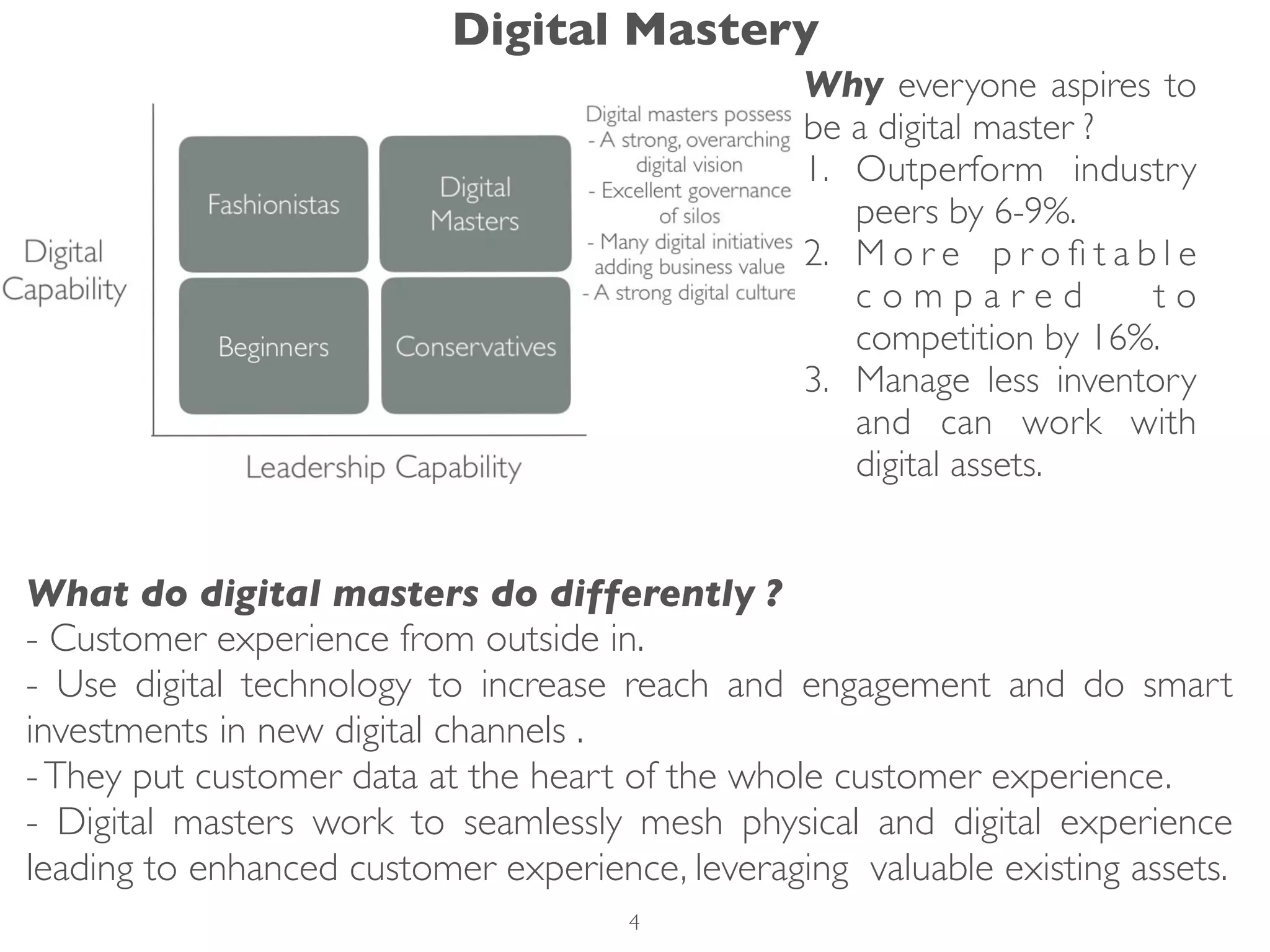
Why everyone aspires to
be a digital master ?
1. Outperform industry
peers by 6-9%.
2. M o r e p r o fi t a b l e
c o m p a r e d t o
competition by 16%.
3. Manage less inventory
and can work with
digital assets.
What do digital masters do differently ?
- Customer experience from outside in.
- Use digital technology to increase reach and engagement and do smart
investments in new digital channels .
-They put customer data at the heart of the whole customer experience.
- Digital masters work to seamlessly mesh physical and digital experience
leading to enhanced customer experience, leveraging valuable existing assets.
Digital Mastery
4
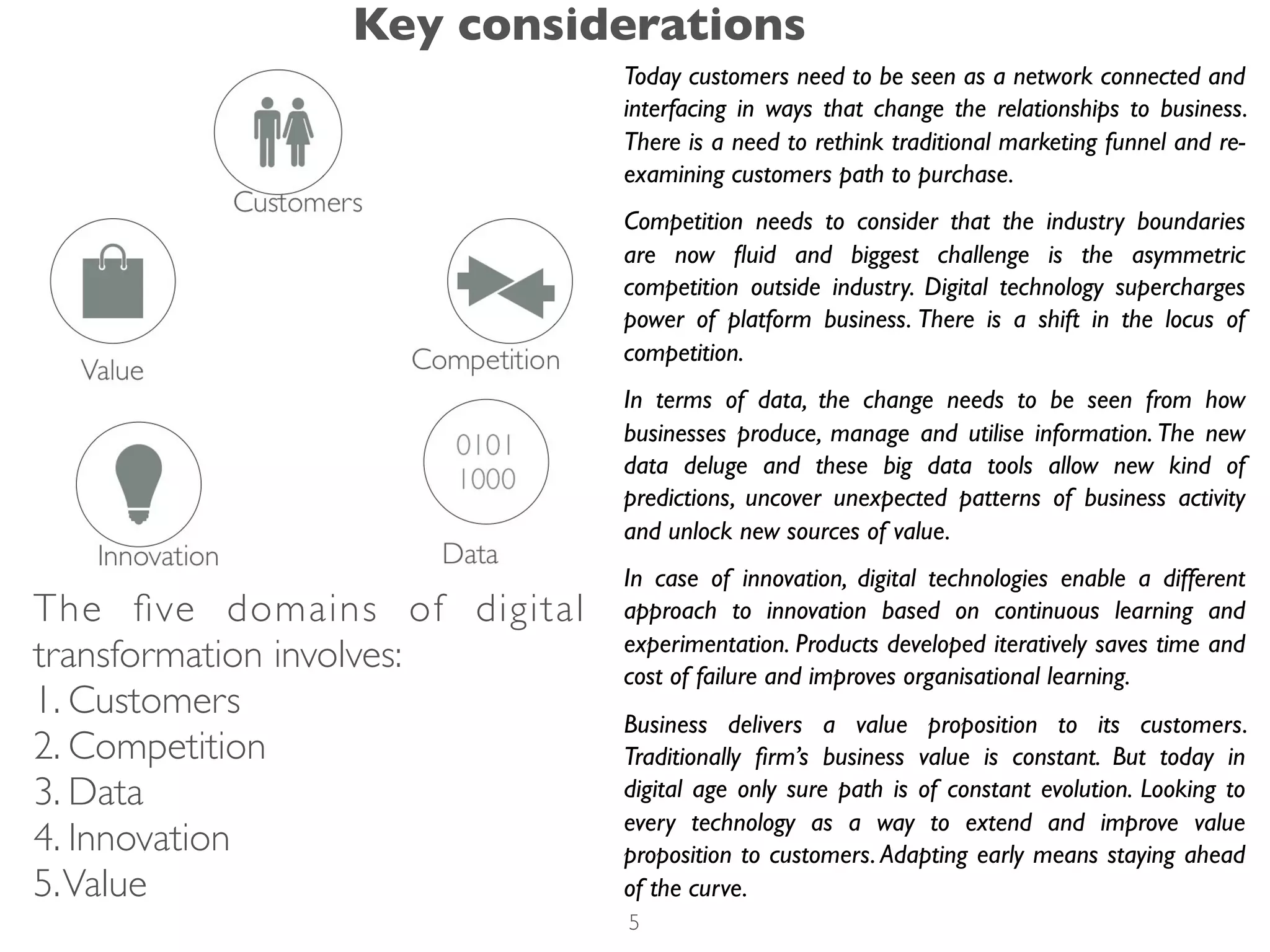
Today customers need to be seen as a network connected and
interfacing in ways that change the relationships to business.
There is a need to rethink traditional marketing funnel and re-
examining customers path to purchase.
Competition needs to consider that the industry boundaries
are now fluid and biggest challenge is the asymmetric
competition outside industry. Digital technology supercharges
power of platform business. There is a shift in the locus of
competition.
In terms of data, the change needs to be seen from how
businesses produce, manage and utilise information. The new
data deluge and these big data tools allow new kind of
predictions, uncover unexpected patterns of business activity
and unlock new sources of value.
In case of innovation, digital technologies enable a different
approach to innovation based on continuous learning and
experimentation. Products developed iteratively saves time and
cost of failure and improves organisational learning.
Business delivers a value proposition to its customers.
Traditionally firm’s business value is constant. But today in
digital age only sure path is of constant evolution. Looking to
every technology as a way to extend and improve value
proposition to customers. Adapting early means staying ahead
of the curve.
The five domains of digital
transformation involves:
1. Customers
2. Competition
3. Data
4. Innovation
5.Value
Key considerations
5
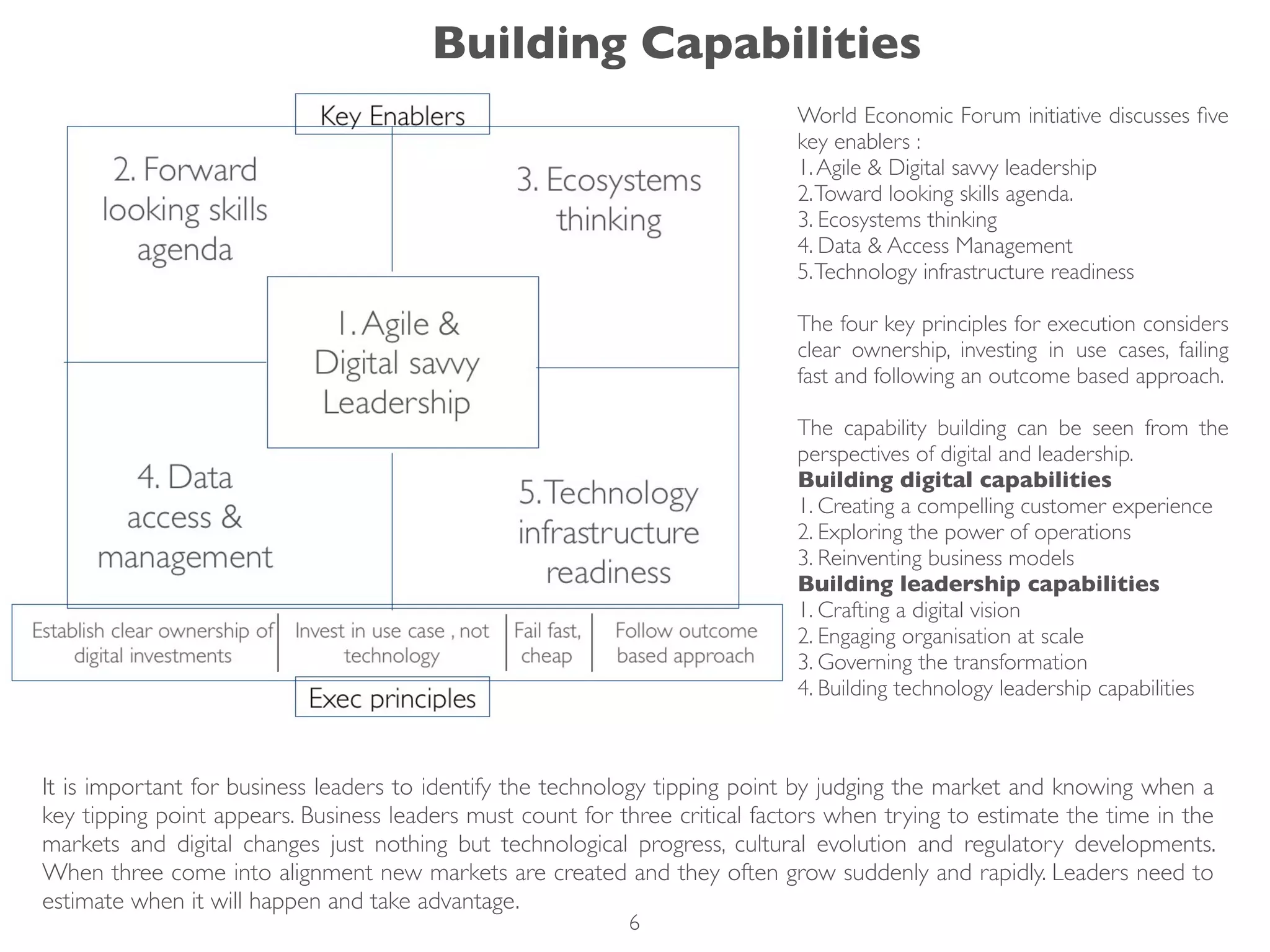
World Economic Forum initiative discusses five
key enablers :
1.Agile & Digital savvy leadership
2.Toward looking skills agenda.
3. Ecosystems thinking
4. Data & Access Management
5.Technology infrastructure readiness
The four key principles for execution considers
clear ownership, investing in use cases, failing
fast and following an outcome based approach.
The capability building can be seen from the
perspectives of digital and leadership.
Building digital capabilities
1. Creating a compelling customer experience
2. Exploring the power of operations
3. Reinventing business models
Building leadership capabilities
1. Crafting a digital vision
2. Engaging organisation at scale
3. Governing the transformation
4. Building technology leadership capabilities
It is important for business leaders to identify the technology tipping point by judging the market and knowing when a
key tipping point appears. Business leaders must count for three critical factors when trying to estimate the time in the
markets and digital changes just nothing but technological progress, cultural evolution and regulatory developments.
When three come into alignment new markets are created and they often grow suddenly and rapidly. Leaders need to
estimate when it will happen and take advantage.
Building Capabilities
6
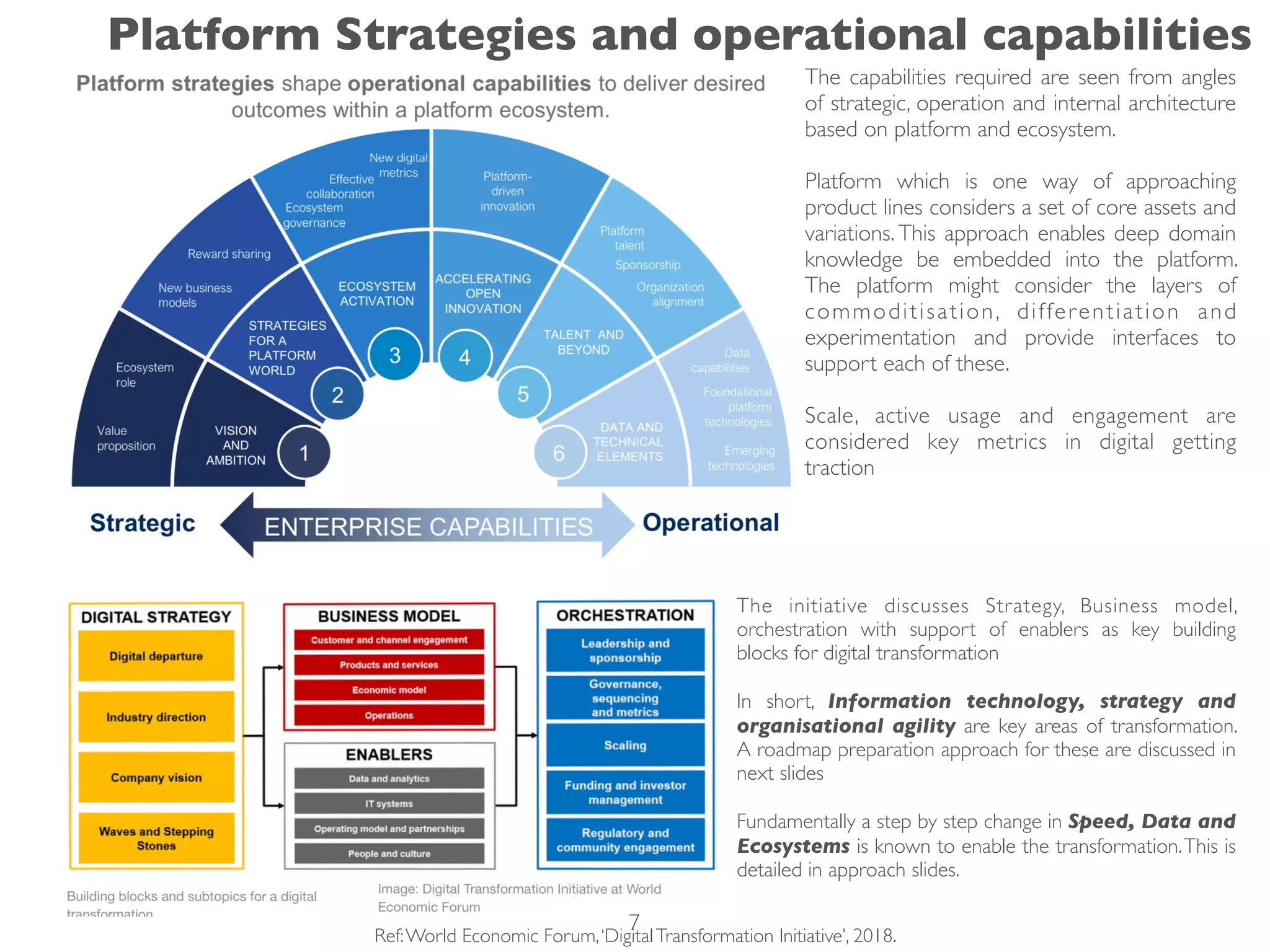
The capabilities required are seen from angles
of strategic, operation and internal architecture
based on platform and ecosystem.
Platform which is one way of approaching
product lines considers a set of core assets and
variations. This approach enables deep domain
knowledge be embedded into the platform.
The platform might consider the layers of
commoditisation, differentiation and
experimentation and provide interfaces to
support each of these.
Scale, active usage and engagement are
considered key metrics in digital getting
traction
Ref:World Economic Forum,‘DigitalTransformation Initiative’, 2018.
The initiative discusses Strategy, Business model,
orchestration with support of enablers as key building
blocks for digital transformation
In short, Information technology, strategy and
organisational agility are key areas of transformation.
A roadmap preparation approach for these are discussed in
next slides
Fundamentally a step by step change in Speed, Data and
Ecosystems is known to enable the transformation.This is
detailed in approach slides.
Platform Strategies and operational capabilities
7
INFORMATIONTECHNOLOGY
& STRATEGY
Approach to redefine information technology and strategy
8
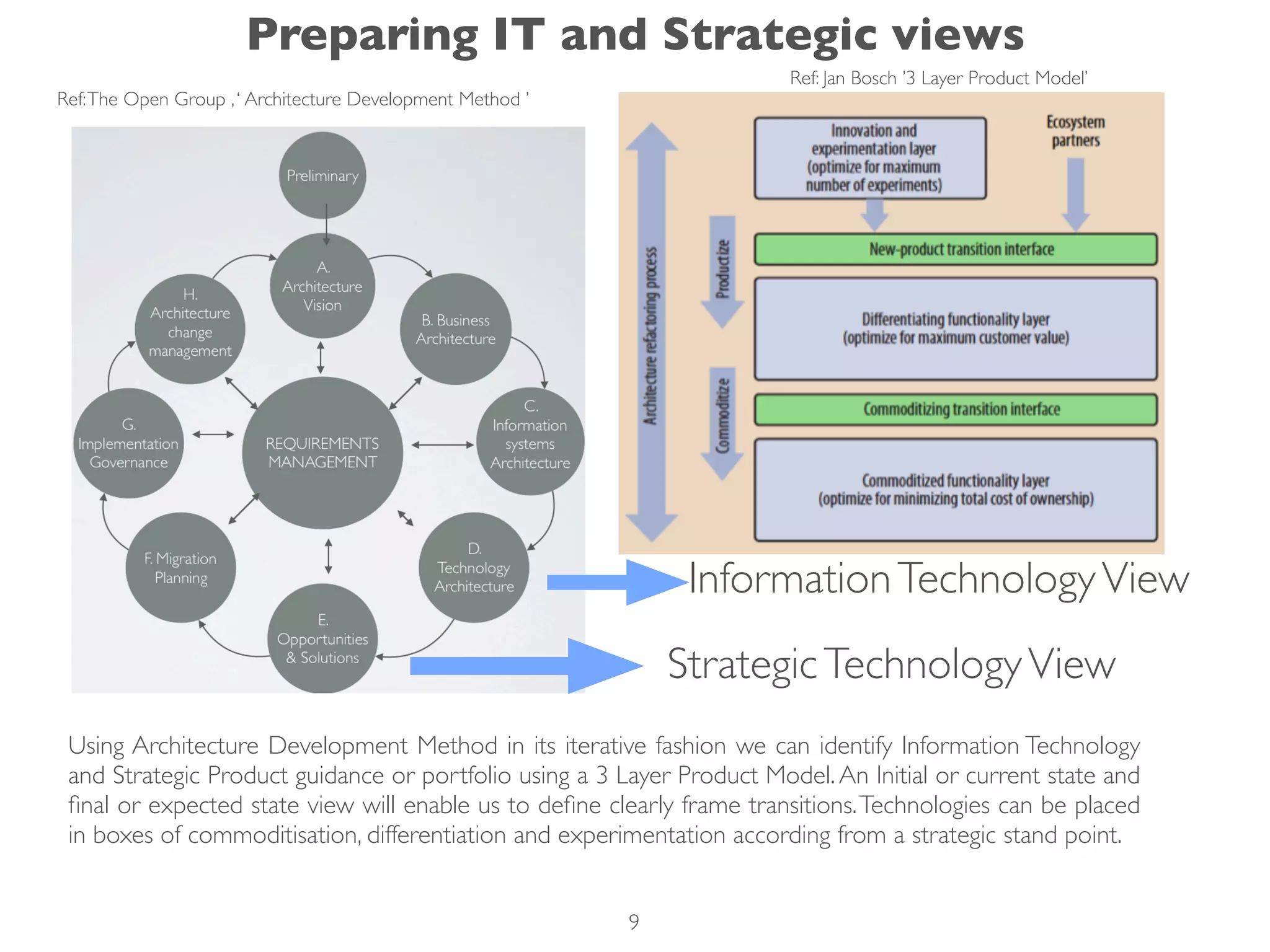
Using Architecture Development Method in its iterative fashion we can identify Information Technology
and Strategic Product guidance or portfolio using a 3 Layer Product Model.An Initial or current state and
final or expected state view will enable us to define clearly frame transitions.Technologies can be placed
in boxes of commoditisation, differentiation and experimentation according from a strategic stand point.
InformationTechnologyView
StrategicTechnologyView
Ref:The Open Group ,‘ Architecture Development Method ’
Ref: Jan Bosch ’3 Layer Product Model’
Preparing IT and Strategic views
9
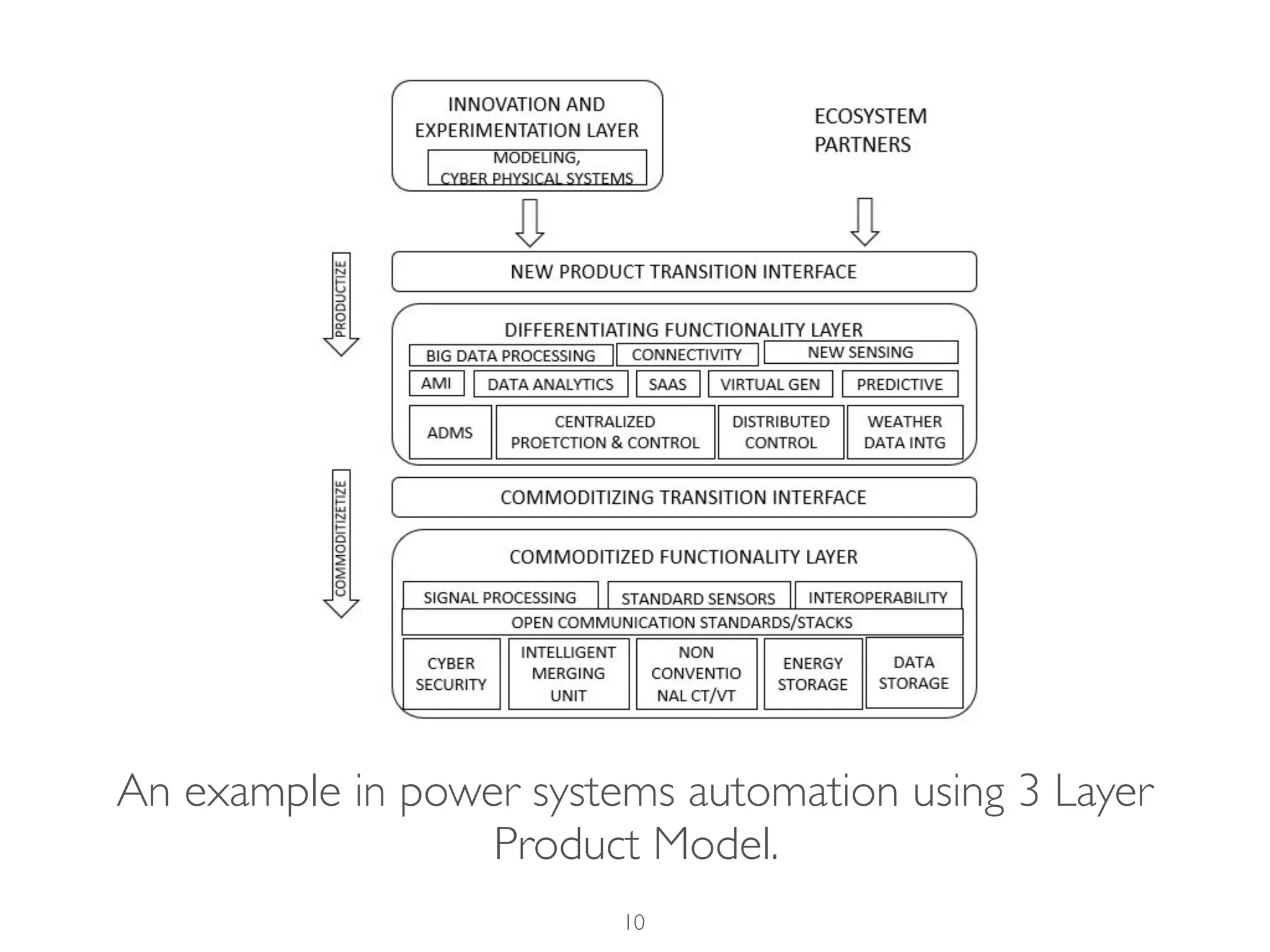
An example in power systems automation using 3 Layer
Product Model.
10
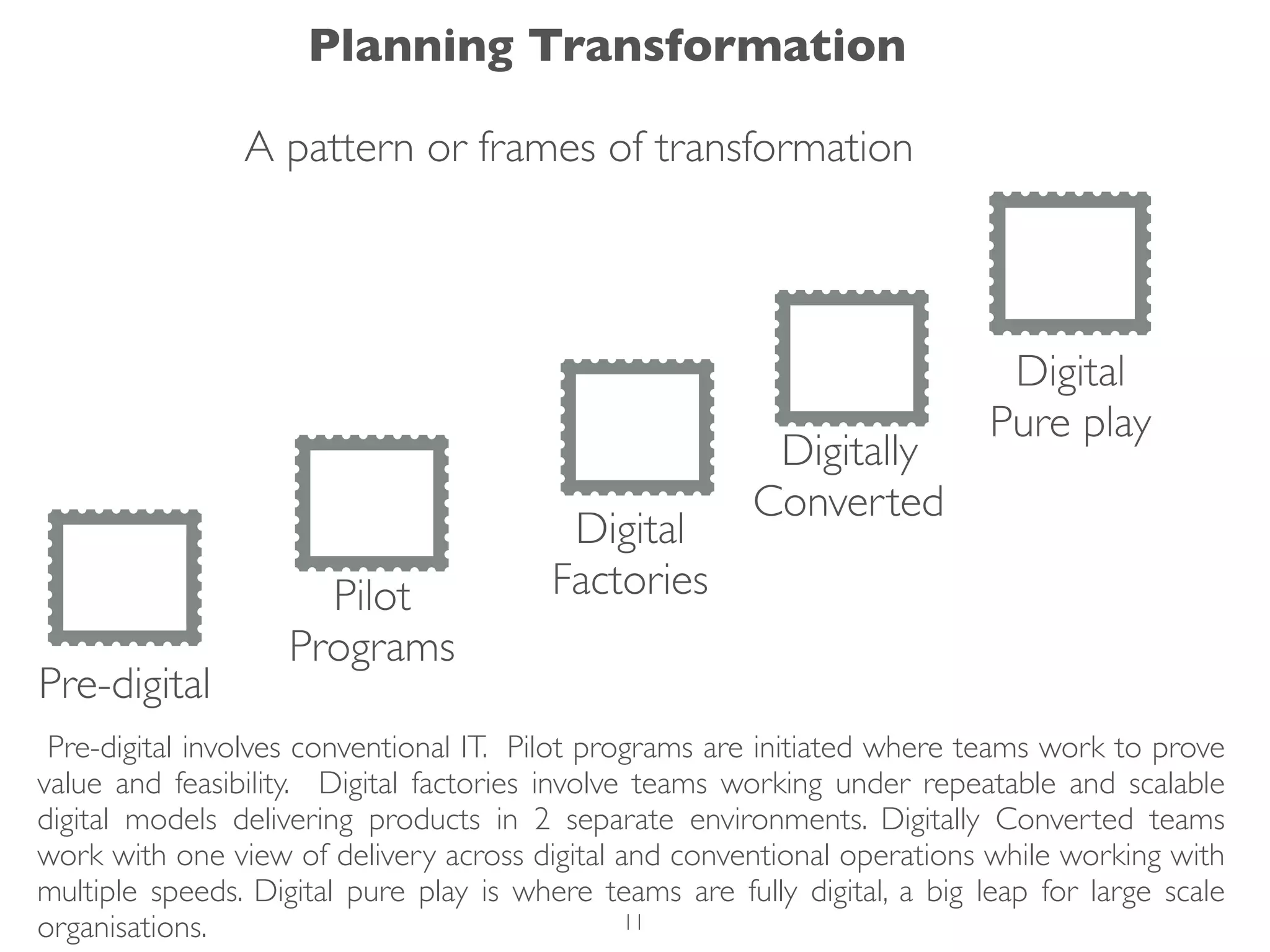
A pattern or frames of transformation
Pre-digital
Pilot
Programs
Digital
Factories
Digital
Pure play
Digitally
Converted
Pre-digital involves conventional IT. Pilot programs are initiated where teams work to prove
value and feasibility. Digital factories involve teams working under repeatable and scalable
digital models delivering products in 2 separate environments. Digitally Converted teams
work with one view of delivery across digital and conventional operations while working with
multiple speeds. Digital pure play is where teams are fully digital, a big leap for large scale
organisations.
Planning Transformation
11
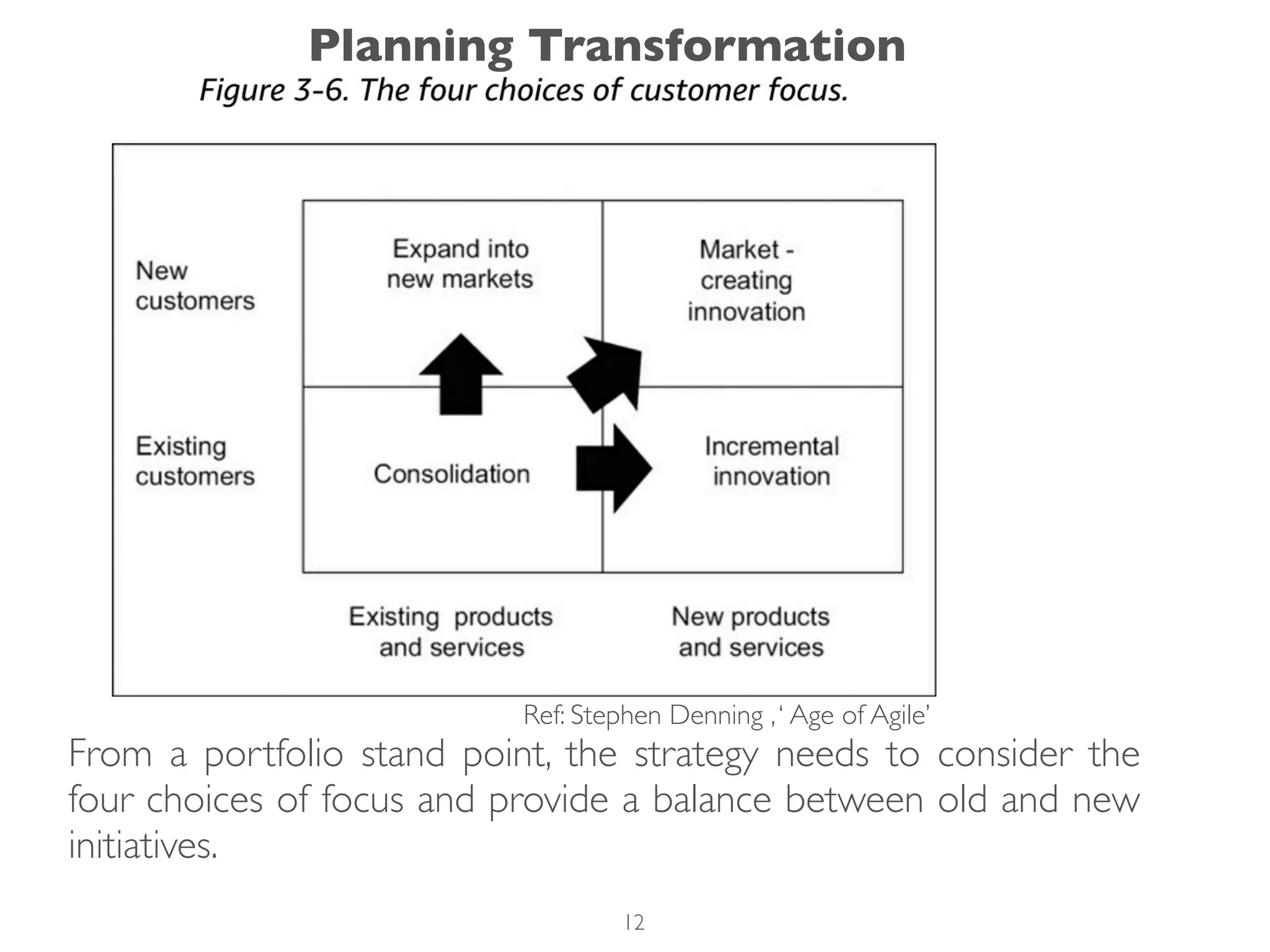
From a portfolio stand point, the strategy needs to consider the
four choices of focus and provide a balance between old and new
initiatives.
Ref: Stephen Denning ,‘ Age of Agile’
Planning Transformation
12
ORGANISATIONAL AGILITY
Staying in stealth mode
13
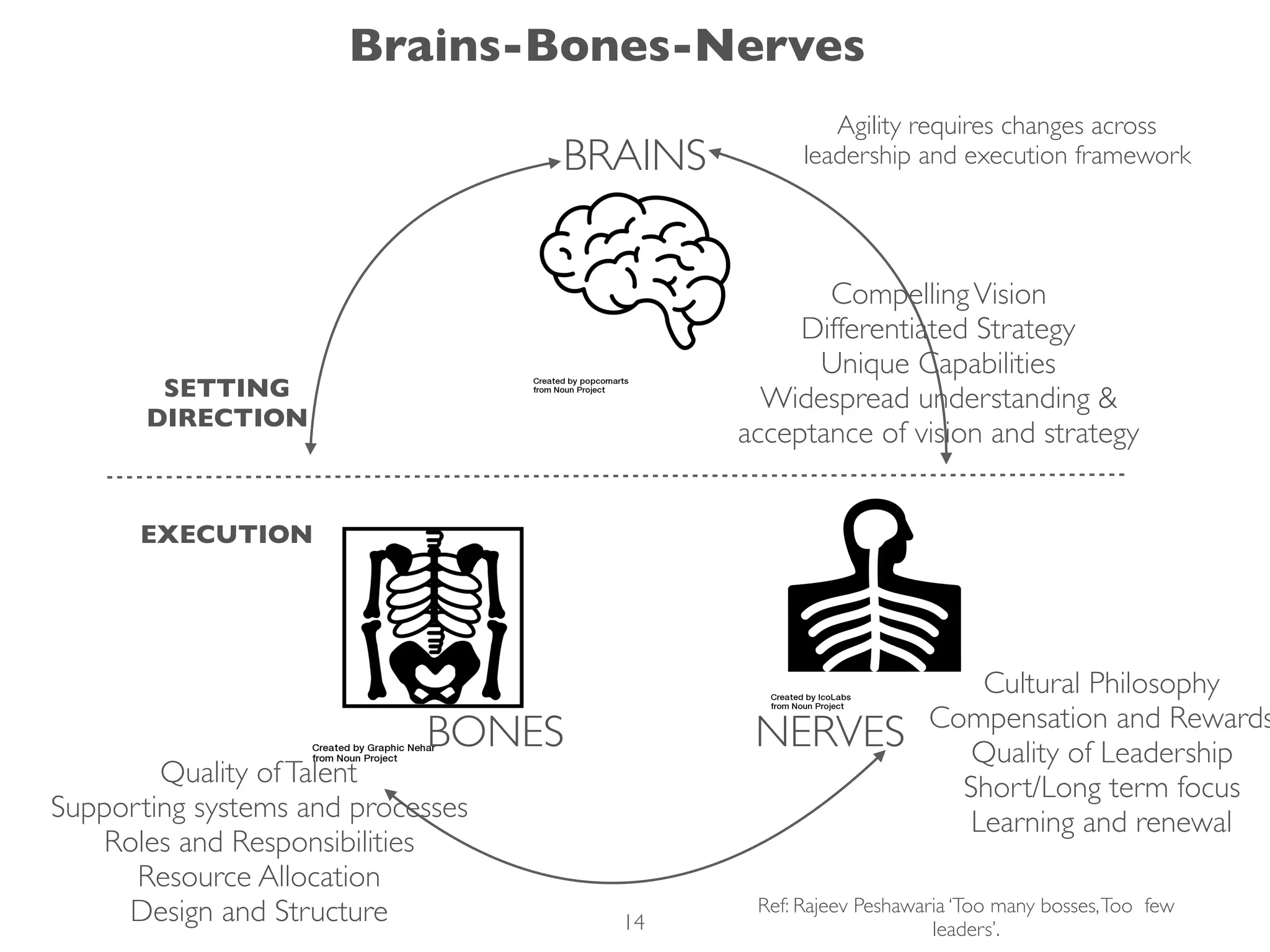
BRAINS
NERVESBONES
CompellingVision
Differentiated Strategy
Unique Capabilities
Widespread understanding &
acceptance of vision and strategy
Cultural Philosophy
Compensation and Rewards
Quality of Leadership
Short/Long term focus
Learning and renewal
Quality ofTalent
Supporting systems and processes
Roles and Responsibilities
Resource Allocation
Design and Structure
SETTING
DIRECTION
EXECUTION
Brains-Bones-Nerves
Ref: Rajeev Peshawaria ‘Too many bosses,Too few
leaders’.
Agility requires changes across
leadership and execution framework
14
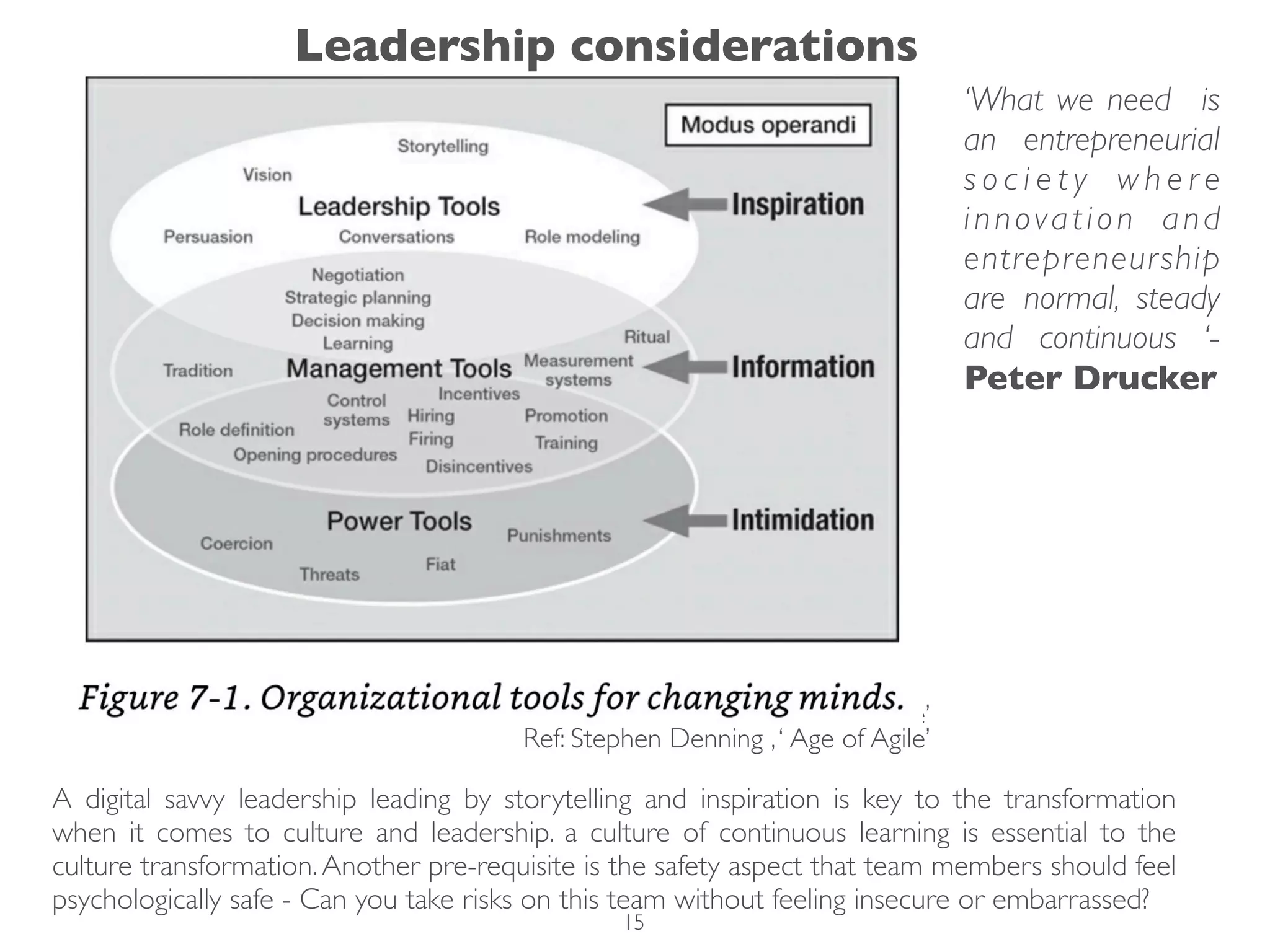
A digital savvy leadership leading by storytelling and inspiration is key to the transformation
when it comes to culture and leadership. a culture of continuous learning is essential to the
culture transformation.Another pre-requisite is the safety aspect that team members should feel
psychologically safe - Can you take risks on this team without feeling insecure or embarrassed?
Ref: Stephen Denning ,‘ Age of Agile’
‘What we need is
an entrepreneurial
s o c i e t y w h e r e
innovation and
entrepreneurship
are normal, steady
and continuous ‘-
Peter Drucker
Ref: Stephen Denning ,‘ Age of Agile’
Leadership considerations
15
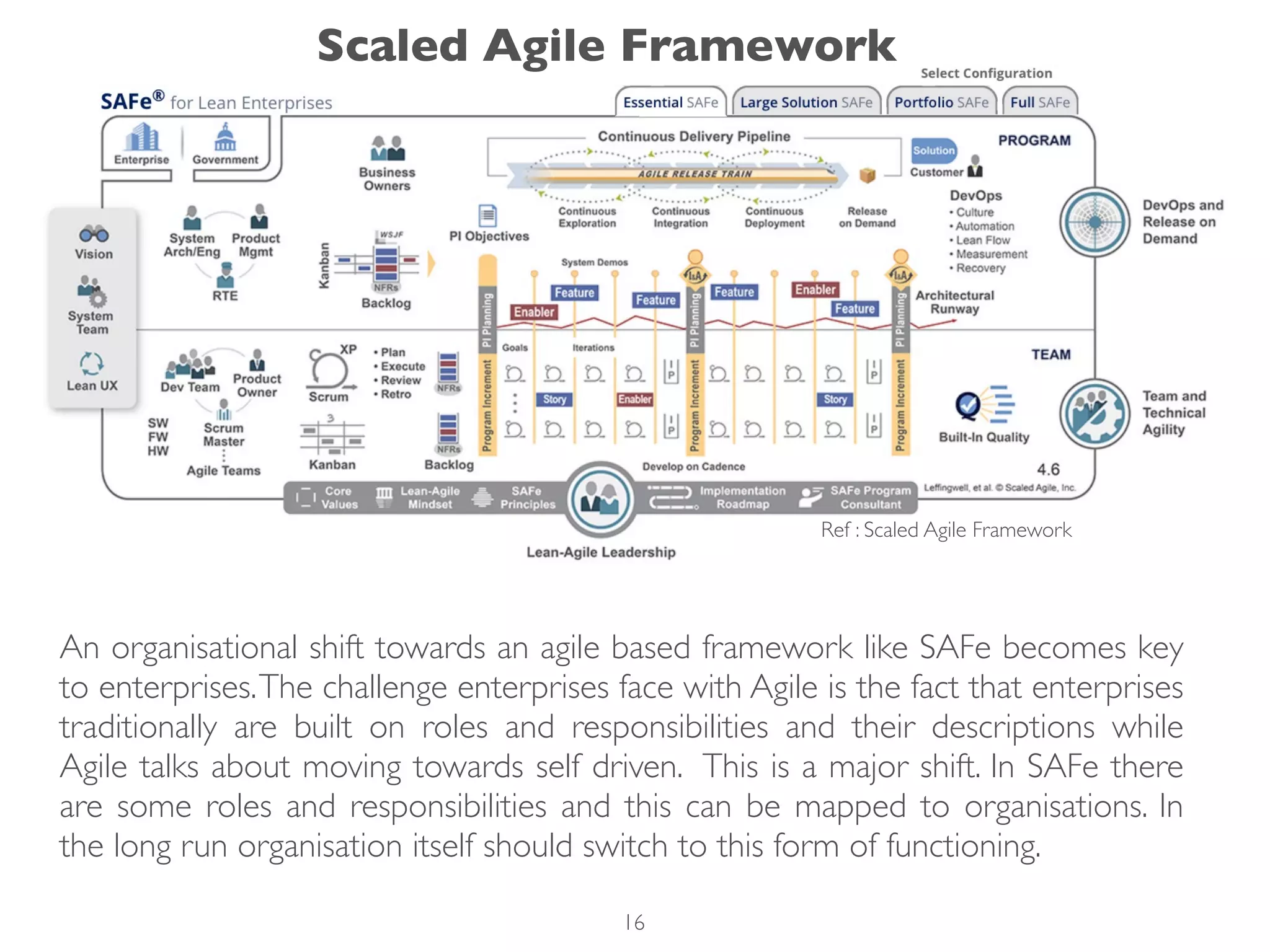
An organisational shift towards an agile based framework like SAFe becomes key
to enterprises.The challenge enterprises face with Agile is the fact that enterprises
traditionally are built on roles and responsibilities and their descriptions while
Agile talks about moving towards self driven. This is a major shift. In SAFe there
are some roles and responsibilities and this can be mapped to organisations. In
the long run organisation itself should switch to this form of functioning.
Ref: Stephen Denning ,‘ Age of Agile’Ref : Scaled Agile Framework
Scaled Agile Framework
16
APPROACH
Executing the transformation by focusing on speed, data and
ecosystems.
17
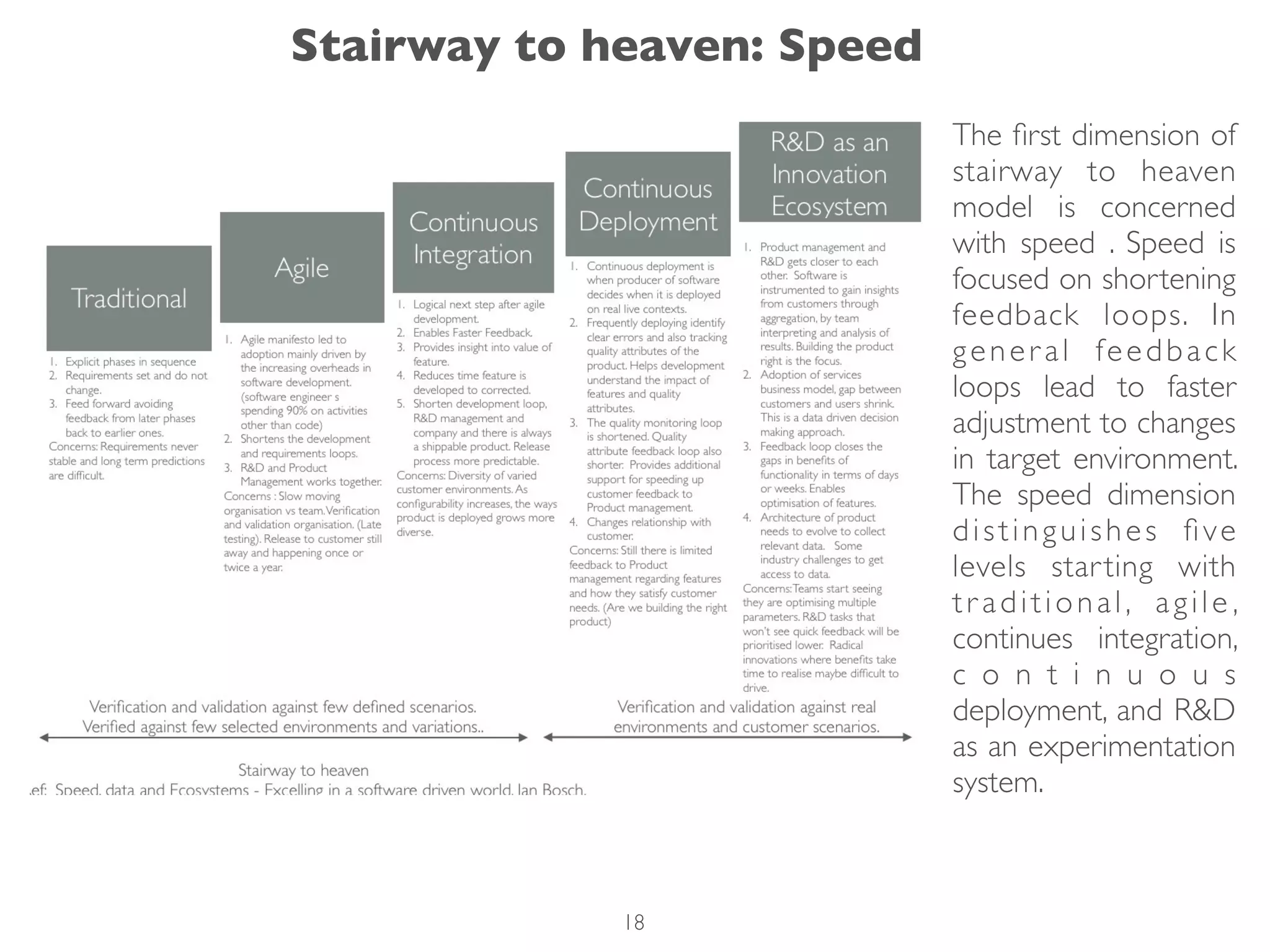
The first dimension of
stairway to heaven
model is concerned
with speed . Speed is
focused on shortening
feedback loops. In
gener al feedback
loops lead to faster
adjustment to changes
in target environment.
The speed dimension
distinguishes five
levels starting with
tr aditional, agile ,
continues integration,
c o n t i n u o u s
deployment, and R&D
as an experimentation
system.
Stairway to heaven: Speed
18
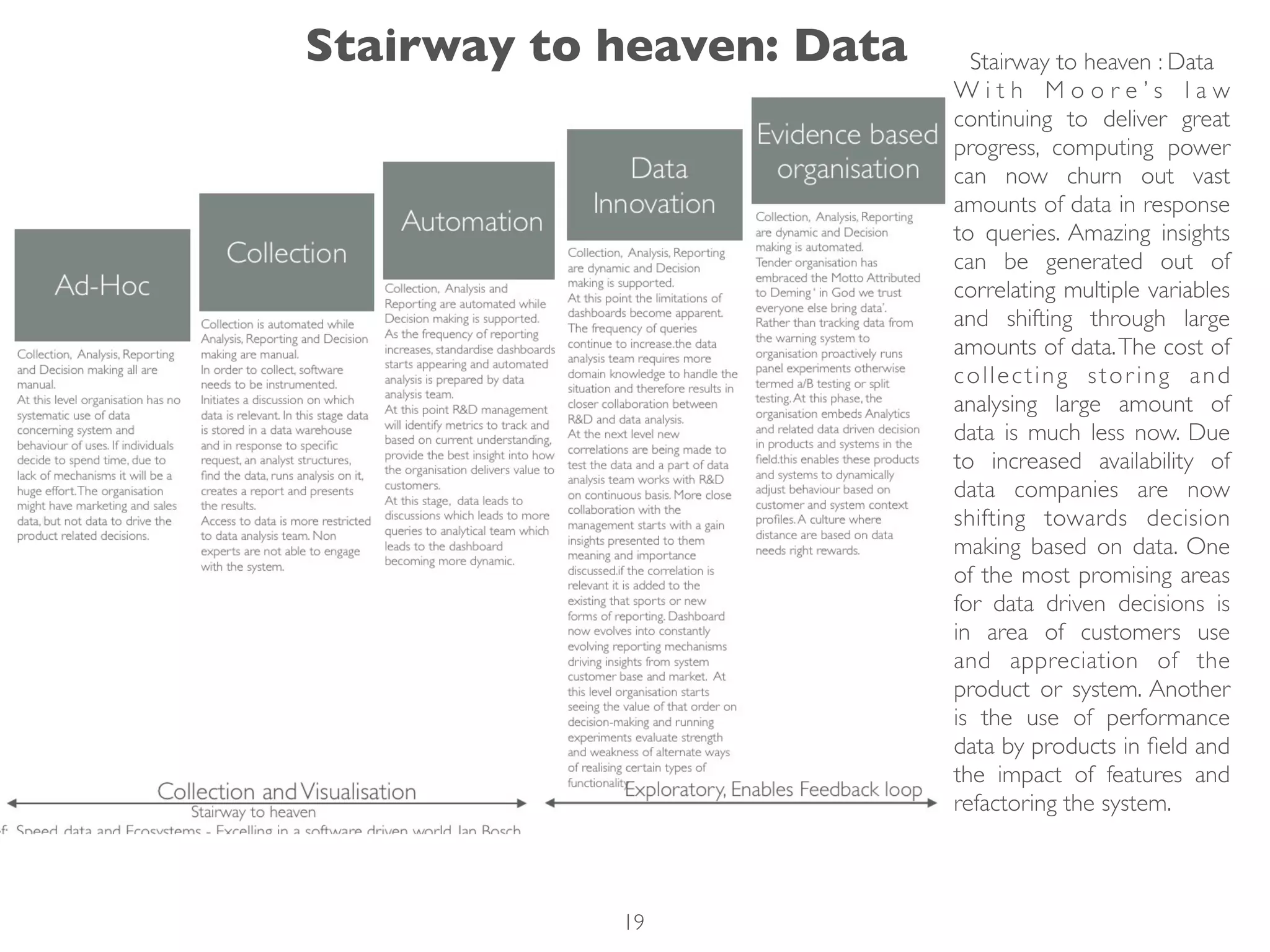
Stairway to heaven : Data
W i t h M o o r e ’ s l a w
continuing to deliver great
progress, computing power
can now churn out vast
amounts of data in response
to queries. Amazing insights
can be generated out of
correlating multiple variables
and shifting through large
amounts of data.The cost of
collecting storing and
analysing large amount of
data is much less now. Due
to increased availability of
data companies are now
shifting towards decision
making based on data. One
of the most promising areas
for data driven decisions is
in area of customers use
and appreciation of the
product or system. Another
is the use of performance
data by products in field and
the impact of features and
refactoring the system.
Stairway to heaven: Data
19
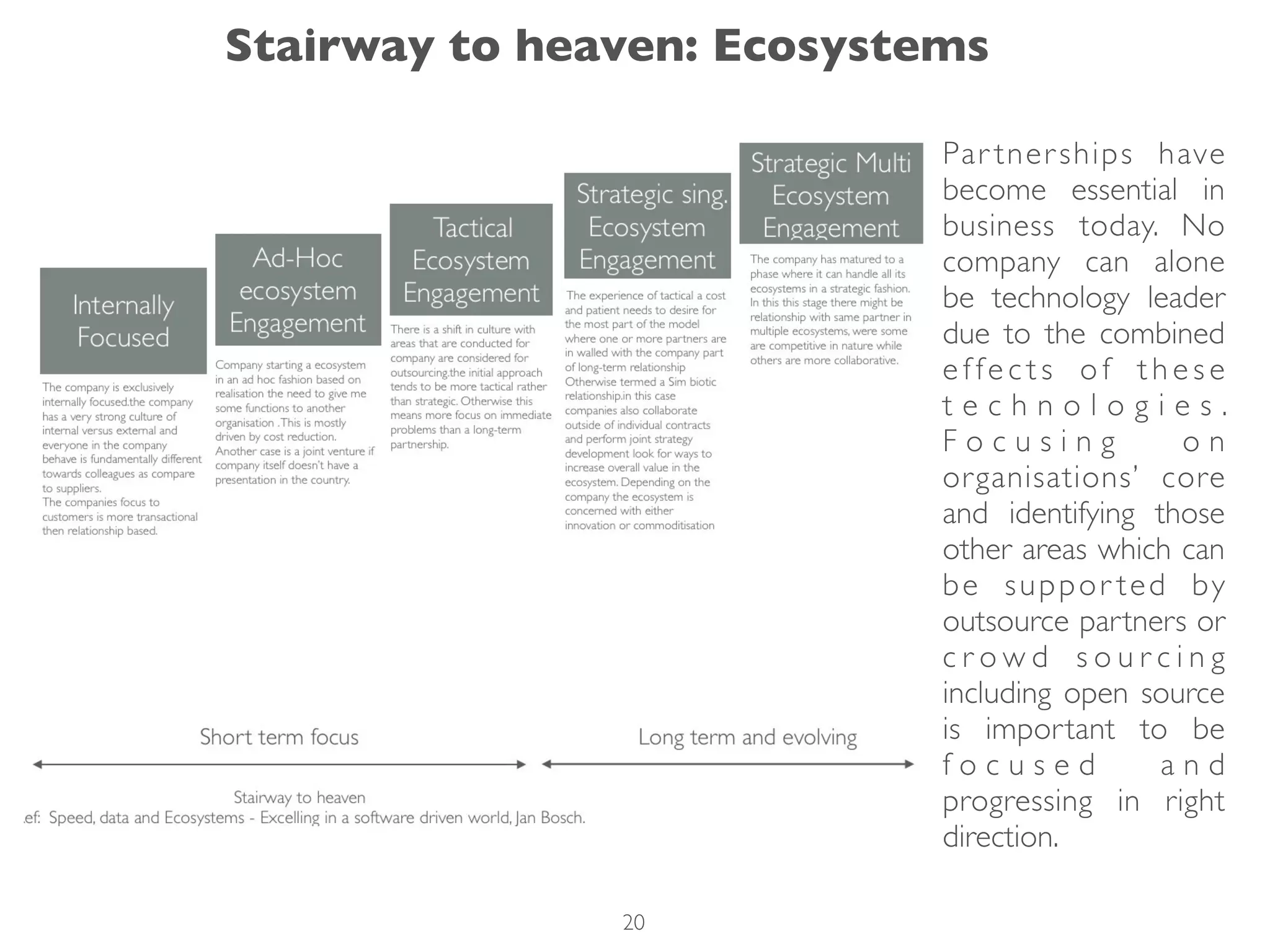
Par tnerships have
become essential in
business today. No
company can alone
be technology leader
due to the combined
e f fe c t s o f t h e s e
t e c h n o l o g i e s .
F o c u s i n g o n
organisations’ core
and identifying those
other areas which can
be suppor ted by
outsource partners or
c r o w d s o u r c i n g
including open source
is important to be
f o c u s e d a n d
progressing in right
direction.
Stairway to heaven: Ecosystems
20
VALUE LITMUSTEST
BlendingTechnology and Business
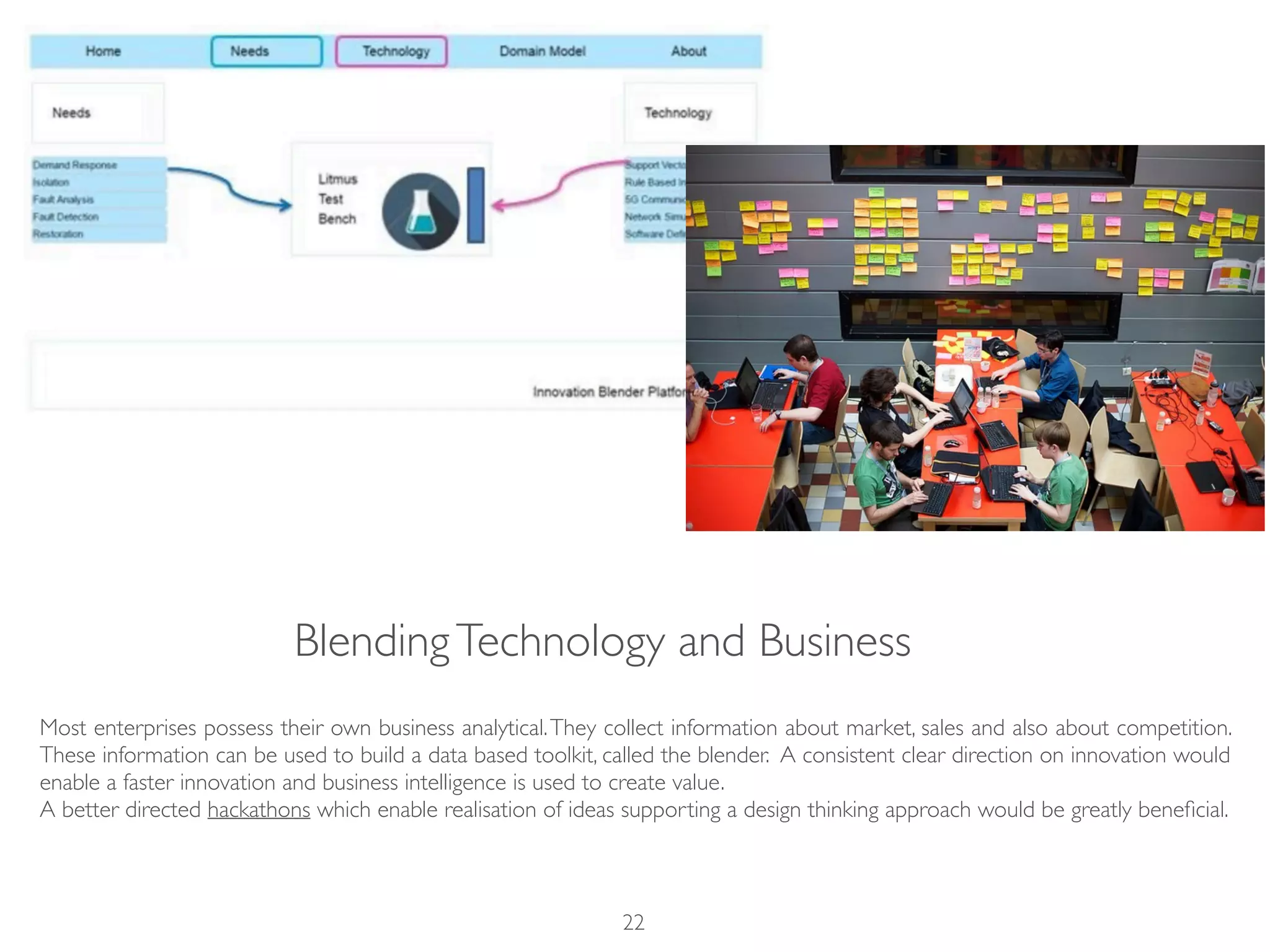
Three key accelerators for digital are the blender concept,
hackathons, Digital thread and Digital twin
21
BlendingTechnology and Business
Most enterprises possess their own business analytical.They collect information about market, sales and also about competition.
These information can be used to build a data based toolkit, called the blender. A consistent clear direction on innovation would
enable a faster innovation and business intelligence is used to create value.
A better directed hackathons which enable realisation of ideas supporting a design thinking approach would be greatly beneficial.
22
DIGITALTHREAD & DIGITAL
TWIN
Model based engineering and Cyber Physical Systems
23
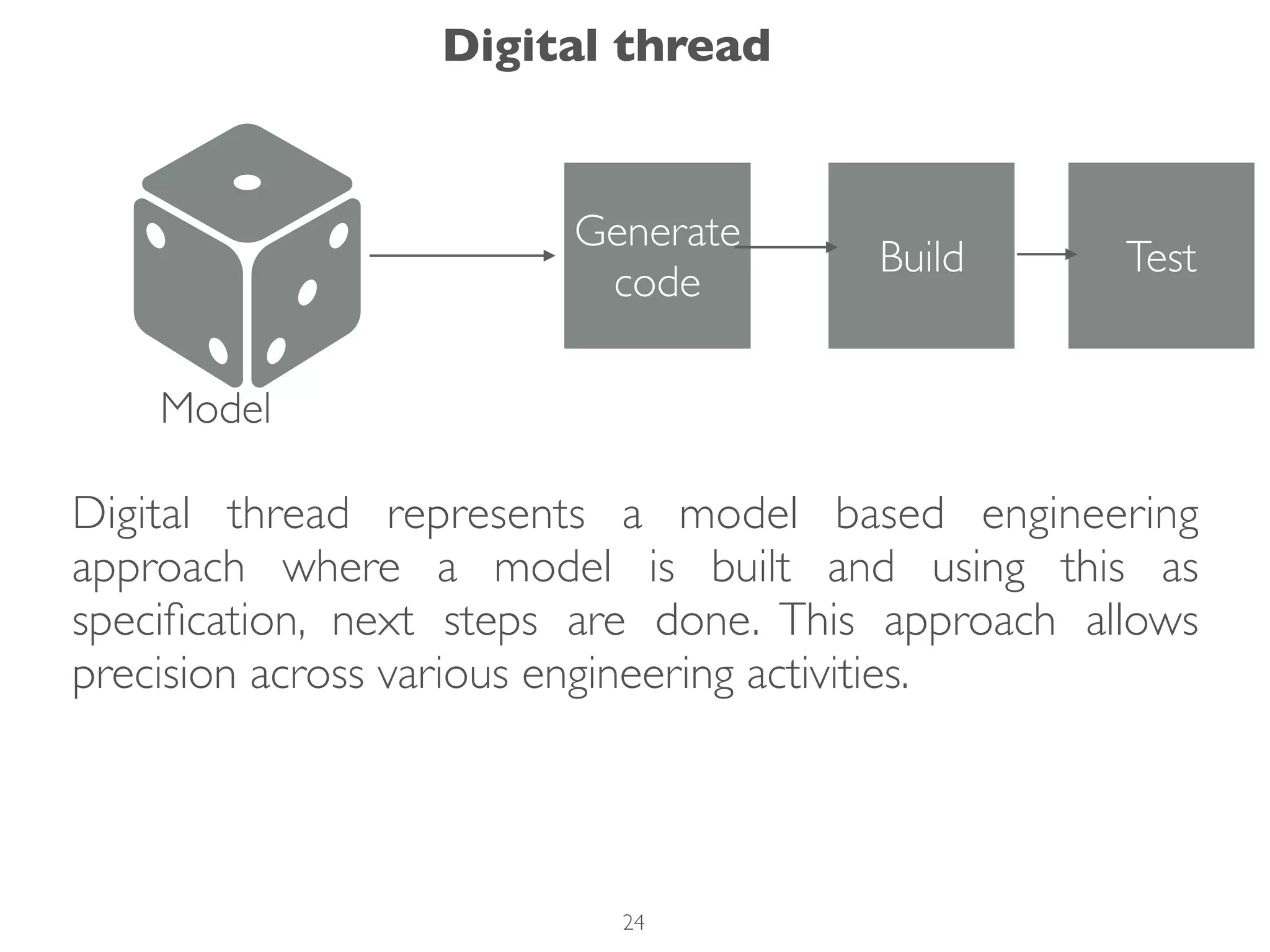
Digital thread represents a model based engineering
approach where a model is built and using this as
specification, next steps are done. This approach allows
precision across various engineering activities.
Digital thread
Model
Generate
code
Build Test
24
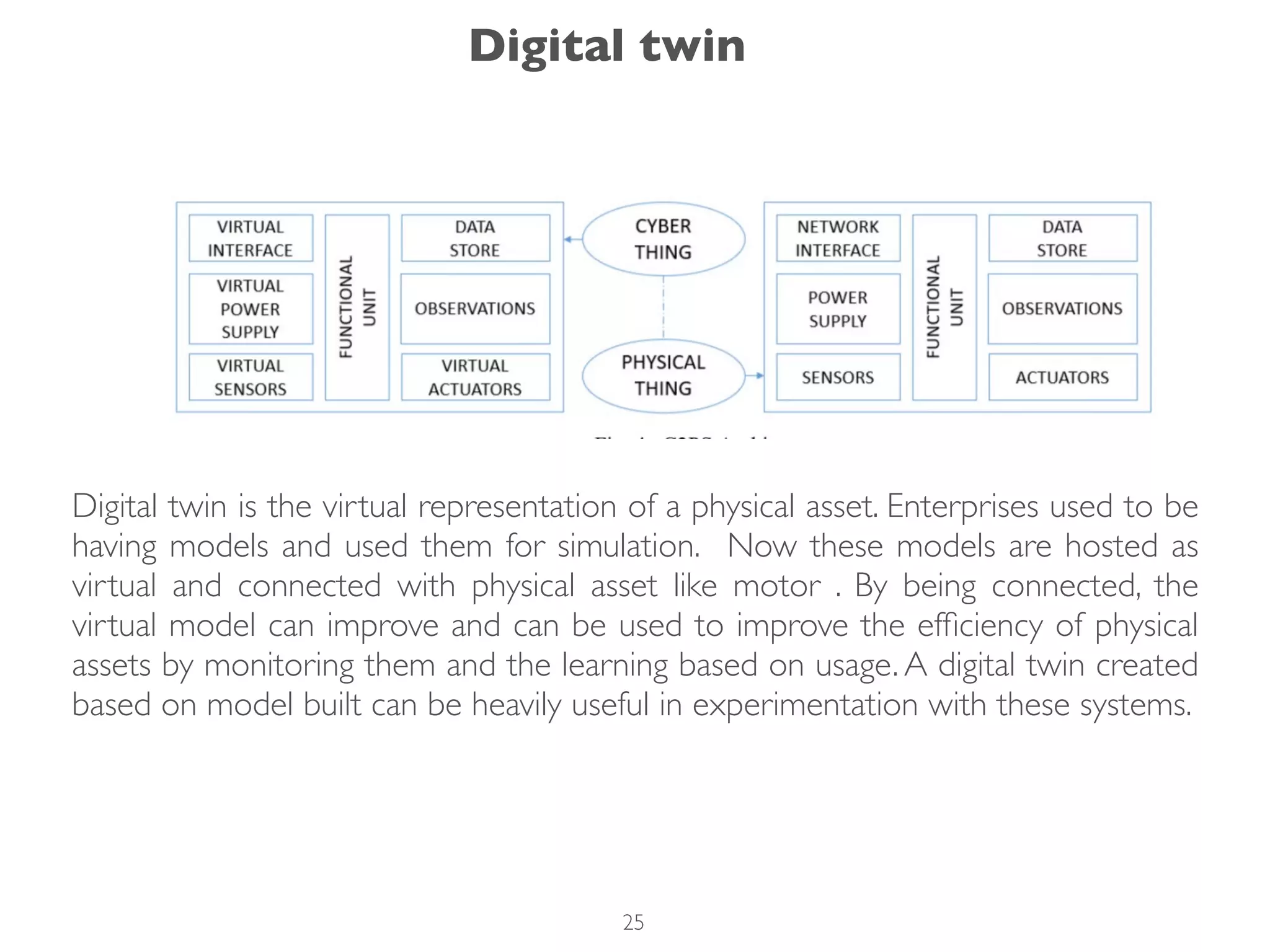
Digital twin is the virtual representation of a physical asset. Enterprises used to be
having models and used them for simulation. Now these models are hosted as
virtual and connected with physical asset like motor . By being connected, the
virtual model can improve and can be used to improve the efficiency of physical
assets by monitoring them and the learning based on usage. A digital twin created
based on model built can be heavily useful in experimentation with these systems.
Digital twin
25
REFERENCES1. World Economic Forum, DigitalTransformation Initiative, May 2018
2. Leading Digital -Turning technology into business transformation.
3. The DigitalTransformation Playbook – RethinkYour Business for the
Digital Age.
4. https://www.forbes.com/sites/jasonbloomberg/2018/04/29/digitization-
digitalization-and-digital-transformation-confuse-them-at-your-peril/
#c9a77bd2f2c7
5. Mc Kinsey,Towards an integrated operating model.
6. Digital to the Core: Remastering Leadership forYour Industry,Your
Enterprise, andYourself.
7. Stephen Denning,‘Age of Agile’.
8. Jan Bosch,‘Speed Data and Ecosystems- Excelling in a software driven
world’, CRC press.
9. Innovation Blender - A tool for technology business litmus test
10. Cyber physical systems -A tool for continuous evolution of systems
26

Digital decodedv1.3

  • 1.
    DIGITAL DECODED Learnings onDigitalTransformation based on books and own experiences Abhilash Gopalakrishnan 1
  • 2.
    Digitalisation Cheaper and bettertechnologies are leading to creation more connected world by 2030 the number of expected connected devices is 1 trillion.The reducing cost of new technologies leads to new applications and opportunities to combine them in innovative ways.The combination affect of technologies including Mobile, Cloud, Sensing, IoT, AI, to name a few are accelerating the progress exponentially.Technology is a multiplier. Drivers of digital investments are new efficiencies, customer experiences and outcomes and new business models. What is different about digital business? Digital business is the creation of new business designs by blurring the digital and physical worlds. In most cases. In most cases the organisation has taken digital to the core of its products and services to deliver new type of customer value. (Gartner) Ref:World Economic Forum,‘DigitalTransformation Initiative’, 2018. 2
  • 3.
    Unlocking the Valueof Digitalisation It is apparent that 1. Every product or service will be digitally remastered. 2. Anything can be digitised. 3. Precision response and control are key to value. 4. Every industry will be remastered. Digital remasters of an industry takes place in parallel at 2 levels: 1. Change of the firms the dictate the industry directions otherwise called Masters. 2.An upgrade or reinvention of the product or service its self via new core competencies. Products and services will be transformed. Physical products today Can be significantly enhanced by a combination of the following digital elements like sensors, Display send indicators, actuators and manipulators, Micro controllers, on-board analysis, memory, wireless connected services, Remote control to name a few. The industry boundaries are blurred by digital substitution, Every company needs to be a technology company. New industries will emerge from the blur. Digital disorders and remaps barriers to entry. It is important to be healthy paranoid, prepared to make take a technology acquisitions, claim your stake in your new industry platform. It is required to be open and be at step ahead off boundary blurring.This is the reason we look at concept of competition instead of focusing on few competitor companies. 3
  • 4.
    Why everyone aspiresto be a digital master ? 1. Outperform industry peers by 6-9%. 2. M o r e p r o fi t a b l e c o m p a r e d t o competition by 16%. 3. Manage less inventory and can work with digital assets. What do digital masters do differently ? - Customer experience from outside in. - Use digital technology to increase reach and engagement and do smart investments in new digital channels . -They put customer data at the heart of the whole customer experience. - Digital masters work to seamlessly mesh physical and digital experience leading to enhanced customer experience, leveraging valuable existing assets. Digital Mastery 4
  • 5.
    Today customers needto be seen as a network connected and interfacing in ways that change the relationships to business. There is a need to rethink traditional marketing funnel and re- examining customers path to purchase. Competition needs to consider that the industry boundaries are now fluid and biggest challenge is the asymmetric competition outside industry. Digital technology supercharges power of platform business. There is a shift in the locus of competition. In terms of data, the change needs to be seen from how businesses produce, manage and utilise information. The new data deluge and these big data tools allow new kind of predictions, uncover unexpected patterns of business activity and unlock new sources of value. In case of innovation, digital technologies enable a different approach to innovation based on continuous learning and experimentation. Products developed iteratively saves time and cost of failure and improves organisational learning. Business delivers a value proposition to its customers. Traditionally firm’s business value is constant. But today in digital age only sure path is of constant evolution. Looking to every technology as a way to extend and improve value proposition to customers. Adapting early means staying ahead of the curve. The five domains of digital transformation involves: 1. Customers 2. Competition 3. Data 4. Innovation 5.Value Key considerations 5
  • 6.
    World Economic Foruminitiative discusses five key enablers : 1.Agile & Digital savvy leadership 2.Toward looking skills agenda. 3. Ecosystems thinking 4. Data & Access Management 5.Technology infrastructure readiness The four key principles for execution considers clear ownership, investing in use cases, failing fast and following an outcome based approach. The capability building can be seen from the perspectives of digital and leadership. Building digital capabilities 1. Creating a compelling customer experience 2. Exploring the power of operations 3. Reinventing business models Building leadership capabilities 1. Crafting a digital vision 2. Engaging organisation at scale 3. Governing the transformation 4. Building technology leadership capabilities It is important for business leaders to identify the technology tipping point by judging the market and knowing when a key tipping point appears. Business leaders must count for three critical factors when trying to estimate the time in the markets and digital changes just nothing but technological progress, cultural evolution and regulatory developments. When three come into alignment new markets are created and they often grow suddenly and rapidly. Leaders need to estimate when it will happen and take advantage. Building Capabilities 6
  • 7.
    The capabilities requiredare seen from angles of strategic, operation and internal architecture based on platform and ecosystem. Platform which is one way of approaching product lines considers a set of core assets and variations. This approach enables deep domain knowledge be embedded into the platform. The platform might consider the layers of commoditisation, differentiation and experimentation and provide interfaces to support each of these. Scale, active usage and engagement are considered key metrics in digital getting traction Ref:World Economic Forum,‘DigitalTransformation Initiative’, 2018. The initiative discusses Strategy, Business model, orchestration with support of enablers as key building blocks for digital transformation In short, Information technology, strategy and organisational agility are key areas of transformation. A roadmap preparation approach for these are discussed in next slides Fundamentally a step by step change in Speed, Data and Ecosystems is known to enable the transformation.This is detailed in approach slides. Platform Strategies and operational capabilities 7
  • 8.
    INFORMATIONTECHNOLOGY & STRATEGY Approach toredefine information technology and strategy 8
  • 9.
    Using Architecture DevelopmentMethod in its iterative fashion we can identify Information Technology and Strategic Product guidance or portfolio using a 3 Layer Product Model.An Initial or current state and final or expected state view will enable us to define clearly frame transitions.Technologies can be placed in boxes of commoditisation, differentiation and experimentation according from a strategic stand point. InformationTechnologyView StrategicTechnologyView Ref:The Open Group ,‘ Architecture Development Method ’ Ref: Jan Bosch ’3 Layer Product Model’ Preparing IT and Strategic views 9
  • 10.
    An example inpower systems automation using 3 Layer Product Model. 10
  • 11.
    A pattern orframes of transformation Pre-digital Pilot Programs Digital Factories Digital Pure play Digitally Converted Pre-digital involves conventional IT. Pilot programs are initiated where teams work to prove value and feasibility. Digital factories involve teams working under repeatable and scalable digital models delivering products in 2 separate environments. Digitally Converted teams work with one view of delivery across digital and conventional operations while working with multiple speeds. Digital pure play is where teams are fully digital, a big leap for large scale organisations. Planning Transformation 11
  • 12.
    From a portfoliostand point, the strategy needs to consider the four choices of focus and provide a balance between old and new initiatives. Ref: Stephen Denning ,‘ Age of Agile’ Planning Transformation 12
  • 13.
  • 14.
    BRAINS NERVESBONES CompellingVision Differentiated Strategy Unique Capabilities Widespreadunderstanding & acceptance of vision and strategy Cultural Philosophy Compensation and Rewards Quality of Leadership Short/Long term focus Learning and renewal Quality ofTalent Supporting systems and processes Roles and Responsibilities Resource Allocation Design and Structure SETTING DIRECTION EXECUTION Brains-Bones-Nerves Ref: Rajeev Peshawaria ‘Too many bosses,Too few leaders’. Agility requires changes across leadership and execution framework 14
  • 15.
    A digital savvyleadership leading by storytelling and inspiration is key to the transformation when it comes to culture and leadership. a culture of continuous learning is essential to the culture transformation.Another pre-requisite is the safety aspect that team members should feel psychologically safe - Can you take risks on this team without feeling insecure or embarrassed? Ref: Stephen Denning ,‘ Age of Agile’ ‘What we need is an entrepreneurial s o c i e t y w h e r e innovation and entrepreneurship are normal, steady and continuous ‘- Peter Drucker Ref: Stephen Denning ,‘ Age of Agile’ Leadership considerations 15
  • 16.
    An organisational shifttowards an agile based framework like SAFe becomes key to enterprises.The challenge enterprises face with Agile is the fact that enterprises traditionally are built on roles and responsibilities and their descriptions while Agile talks about moving towards self driven. This is a major shift. In SAFe there are some roles and responsibilities and this can be mapped to organisations. In the long run organisation itself should switch to this form of functioning. Ref: Stephen Denning ,‘ Age of Agile’Ref : Scaled Agile Framework Scaled Agile Framework 16
  • 17.
    APPROACH Executing the transformationby focusing on speed, data and ecosystems. 17
  • 18.
    The first dimensionof stairway to heaven model is concerned with speed . Speed is focused on shortening feedback loops. In gener al feedback loops lead to faster adjustment to changes in target environment. The speed dimension distinguishes five levels starting with tr aditional, agile , continues integration, c o n t i n u o u s deployment, and R&D as an experimentation system. Stairway to heaven: Speed 18
  • 19.
    Stairway to heaven: Data W i t h M o o r e ’ s l a w continuing to deliver great progress, computing power can now churn out vast amounts of data in response to queries. Amazing insights can be generated out of correlating multiple variables and shifting through large amounts of data.The cost of collecting storing and analysing large amount of data is much less now. Due to increased availability of data companies are now shifting towards decision making based on data. One of the most promising areas for data driven decisions is in area of customers use and appreciation of the product or system. Another is the use of performance data by products in field and the impact of features and refactoring the system. Stairway to heaven: Data 19
  • 20.
    Par tnerships have becomeessential in business today. No company can alone be technology leader due to the combined e f fe c t s o f t h e s e t e c h n o l o g i e s . F o c u s i n g o n organisations’ core and identifying those other areas which can be suppor ted by outsource partners or c r o w d s o u r c i n g including open source is important to be f o c u s e d a n d progressing in right direction. Stairway to heaven: Ecosystems 20
  • 21.
    VALUE LITMUSTEST BlendingTechnology andBusiness Three key accelerators for digital are the blender concept, hackathons, Digital thread and Digital twin 21
  • 22.
    BlendingTechnology and Business Mostenterprises possess their own business analytical.They collect information about market, sales and also about competition. These information can be used to build a data based toolkit, called the blender. A consistent clear direction on innovation would enable a faster innovation and business intelligence is used to create value. A better directed hackathons which enable realisation of ideas supporting a design thinking approach would be greatly beneficial. 22
  • 23.
    DIGITALTHREAD & DIGITAL TWIN Modelbased engineering and Cyber Physical Systems 23
  • 24.
    Digital thread representsa model based engineering approach where a model is built and using this as specification, next steps are done. This approach allows precision across various engineering activities. Digital thread Model Generate code Build Test 24
  • 25.
    Digital twin isthe virtual representation of a physical asset. Enterprises used to be having models and used them for simulation. Now these models are hosted as virtual and connected with physical asset like motor . By being connected, the virtual model can improve and can be used to improve the efficiency of physical assets by monitoring them and the learning based on usage. A digital twin created based on model built can be heavily useful in experimentation with these systems. Digital twin 25
  • 26.
    REFERENCES1. World EconomicForum, DigitalTransformation Initiative, May 2018 2. Leading Digital -Turning technology into business transformation. 3. The DigitalTransformation Playbook – RethinkYour Business for the Digital Age. 4. https://www.forbes.com/sites/jasonbloomberg/2018/04/29/digitization- digitalization-and-digital-transformation-confuse-them-at-your-peril/ #c9a77bd2f2c7 5. Mc Kinsey,Towards an integrated operating model. 6. Digital to the Core: Remastering Leadership forYour Industry,Your Enterprise, andYourself. 7. Stephen Denning,‘Age of Agile’. 8. Jan Bosch,‘Speed Data and Ecosystems- Excelling in a software driven world’, CRC press. 9. Innovation Blender - A tool for technology business litmus test 10. Cyber physical systems -A tool for continuous evolution of systems 26