







Tech Trends 2016
Innovating in the digital era
Deloitte Consulting LLP’s Technology Consulting practice is dedicated to helping
our clients build tomorrow by solving today’s complex business problems involving
strategy, procurement, design, delivery, and assurance of technology solutions. Our
service areas include analytics and information management, delivery, cyber risk
services, and technical strategy and architecture, as well as the spectrum of digital
strategy, design, and development services offered by Deloitte Digital. Learn more
about our Technology Consulting practice on www.deloitte.com.
Contents
Introduction | 2
Right-speed IT | 4
Augmented and virtual reality go to work | 20
Internet of Things: From sensing to doing | 34
Reimagining core systems | 48
Autonomic platforms | 64
Blockchain: Democratized trust | 80
Industrialized analytics | 96
Social impact of exponential technologies | 112
Authors, contributors, and special thanks | 126
Tech Trends 2016: Innovating in the digital era
Introduction
In a business climate driven by powerful digital forces, disruption, and rapid-fire innovation,
every company is now a technology company. Whereas technology was traditionally confined
largely to operations and execution, its digital expression now informs all aspects of business, from
ideation to delivery. We witness daily how it drives product design, upends venerable business
models, and rewires competition.
The ascendance of exponential technologies to a place of strategic primacy has occurred within
a turbulent context. Globalization is driving borderless growth across established and emerging
markets. Barriers to entry are being lowered, if not demolished. In this climate, new entrants
focused on niches, specific functions, and overlooked domains can make meaningful impacts on a
global stage traditionally dominated by the world’s biggest players.
At the same time, customers are demanding evolved methods of engagement that are
personalized, contextual, and tailored for individual usability and utility. Likewise, the very nature
of employment is evolving as new skill sets become bargaining chips. Talent scarcity complicates
efforts to rethink operating and delivery models across functions and domains.
To help make sense of it all, we present Deloitte’s seventh Technology Trends report, our annual
in-depth examination of eight trends that are likely to disrupt businesses in the next 18–24 months.
From blockchain and augmented reality to the Internet of Things and the socially responsible
applications of technology, these trends embody the macro forces fueling innovation: digital,
analytics, cloud, and the changing role of IT within the enterprise. We balance our coverage of each
trend by also considering the implications of cyber risk in the areas of security, privacy, regulatory
mandates, and compliance. We intentionally examine cyber risk not as a separate topic, but as an
enterprise discipline embedded in the planning, design, and realization of each individual trend.
The theme of this year’s report is innovating in the digital era, which is inspired by the
opportunities today’s CIOs—across industries, geographies, and company sizes—have to shape
tomorrow for every corner of their organizations by transforming “business as usual.” These leaders
are in a rare position to imagine a future, and then harness innovation to build it responsibly from
the realities of today.
2
Introduction
Tech Trends features perspectives from client executives, industry and academic luminaries,
and our global network of Deloitte professionals, all exploring major trends that are helping
organizations innovate in the digital era. We also examine the roadmaps and investment priorities
of start-ups, venture capitalists, and leading technology vendors.
As you read the following chapters, we challenge you to think beyond the “what” of digital
innovation—the shiny objects, applications, and capabilities—to the “so what”—how you will
harness emerging trends, innovation, and disruption to create real business value. Viewing the
horizon through this paradigm, recognize that the precision to which we’ve all become accustomed
may no longer be a given; in the age of digital innovation, we are exploring largely uncharted
territory. Moreover, any digital transformation journey should also address the more practical
realities of today—reimagining core systems, industrializing analytics capabilities, building
autonomic platforms—which are by no means trivial.
Over the next 18–24 months, the only constant may be the specter of constant change. Amid this
turmoil, organizations that can confidently and purposefully harness technology trends will find
great opportunities to refocus, to revitalize, or even to inspire. Think beyond incremental adoption
patterns. Look not only for ways to do familiar things differently, but also to do fundamentally
different things. Launch new processes, products, and services, and seek out new ways to compete.
No matter what the scope, the time for you to act is now. Build tomorrow, starting today.
Bill Briggs
Chief technology officer
Deloitte Consulting LLP
wbriggs@deloitte.com
Twitter: @wbdthree
Janet Foutty
Chief executive officer and
chairman
Deloitte Consulting LLP
jfoutty@deloitte.com
Twitter: @janetfoutty
Craig Hodgetts
US national managing
director—Technology
Deloitte Consulting LLP
chodgetts@deloitte.com
Twitter: @craig_hodgetts
3
A long-standing phenomenon has garnered
much mindshare in recent years: the essential
tension between stability and agility in IT. On
one side are the predictability and controls
necessary to manage risk while delivering
large-scale enterprise IT with reliability,
scalability, security, and other “ilities.”1
On
the other is the push to drive discovery and
experimentation around new features, tools,
and technologies. Popular memes have
oversimplified the conflict between these
extremes, suggesting a bifurcated, either/or
proposition, while offering little guidance on
managing the unavoidable gap between the
two priorities.
There are also several unfortunate
misconceptions linked to the bimodal theory.
First, there’s the fallacy that the pivot point is
solely around speed, trading “high torque” for
scale versus “high speed” for responsiveness.
This paints traditional enterprise delivery
with the plodding caricature that plagues
many IT departments. Second, the debate
is often framed between waterfall and agile
delivery methods, as if agile techniques were
the mythical savior of digital innovation and
growth, yet inappropriate for larger enterprise-
delivery models. For most organizations,
speeding up the development process is only
part of the equation to accelerate time to value.
Leading organizations are building on the
simple two-speed IT mindset and recognizing
they must be able to support a continuum of
speeds in order to dial in the right approach
for a specific initiative, with the underlying
disciplines, capabilities, platforms, and talents
to appropriately support the actual breadth
of business needs. The speed of IT should be
as fast as possible, balancing business value,
risks, and technical feasibility. Critically, the
approach must handle the governance around
the appropriate speed as well as the inevitable
collision between teams and efforts running
at different speeds. This transmission turns out
to be the essential ingredient missing in other
constructs. It helps identify the appropriate
Right-speed IT
Living between black and white
Many IT organizations are progressing beyond the traditional single-speed
delivery models that work well for high-torque enterprise operations but
not for high-speed innovation. While some do have needs at both ends of
the speed spectrum, they often find that bridging the gap between the two
is difficult. A growing number of CIOs are building capabilities that link the
two edge points or operate along the continuum, with targeted investments
in process, technology, and talent to reengineer the business of IT, enabling
delivery at the right speed for the business.
Right-speed IT
5
treatment for a given initiative, assists in
finding solutions, and navigates what controls
are required.
Right-speed IT must address three broad
categories: procedural, architectural, and
organizational. Let’s move beyond rhetoric and
dig into each area.
Procedure beyond process
Many IT transformation prescriptions
portray delivery methodology as the hero of
the story. For this reason, bimodal is often
misinterpreted as a waterfall-versus-agile
showdown. Delivery is an important
ingredient, but upstream capabilities are
actually just as important when codifying
right-speed IT.
Consider how building reach and rigor
in the following IT capabilities may help
organizations reach the right speed for the job
at hand:
•	 Finance management: Budgeting,
prioritization, allocations, and accounting
treatments all need more flexibility than
annual appropriations, rigid planning
cycles, and depreciation schedules do.
project
program
delivery management
portfolio
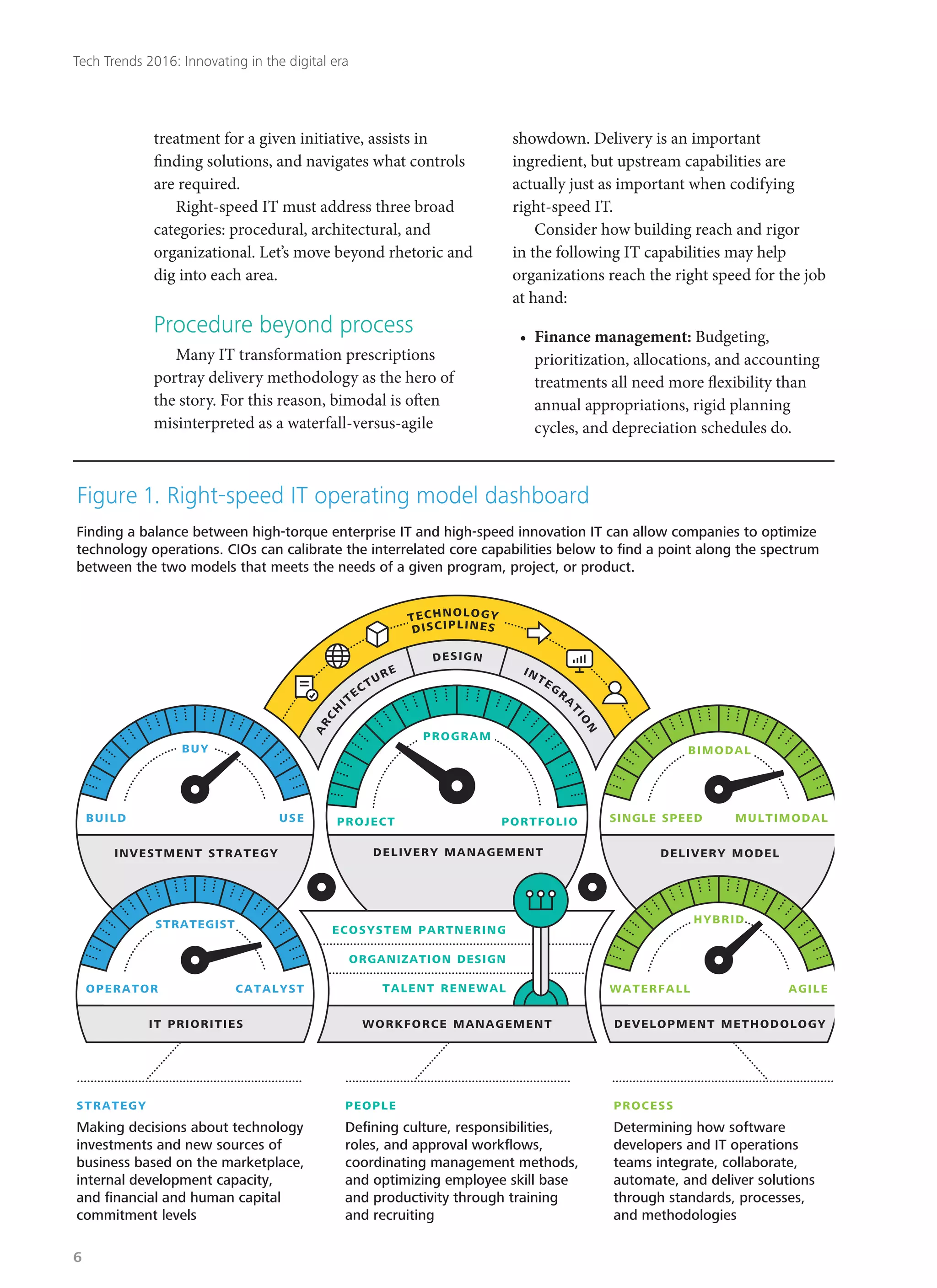
Finding a balance between high-torque enterprise IT and high-speed innovation IT can allow companies to optimize
technology operations. CIOs can calibrate the interrelated core capabilities below to find a point along the spectrum
between the two models that meets the needs of a given program, project, or product.
Figure 1. Right-speed IT operating model dashboard
investment strategy
build use
buy
operator catalyst
it priorities
strategist
delivery model
single speed multimodal
bimodal
waterfall agile
development methodology
hybrid
strategy
Making decisions about technology
investments and new sources of
business based on the marketplace,
internal development capacity,
and financial and human capital
commitment levels
process
Determining how software
developers and IT operations
teams integrate, collaborate,
automate, and deliver solutions
through standards, processes,
and methodologies
people
Defining culture, responsibilities,
roles, and approval workflows,
coordinating management methods,
and optimizing employee skill base
and productivity through training
and recruiting
workforce management
ecosystem partnering
organization design
talent renewal
technology
disciplines
arch
itecture
design
integra
tion
Tech Trends 2016: Innovating in the digital era
6
Failure to address the differences in
time-consuming finance management
processes as part of an overall right-
speeding initiative is a missed opportunity.
Addressing these differences can increase
efficiencies upstream in finance and
downstream in IT processes.
•	 Procurement and sourcing: Similarly,
multi-month RFP processes, drawn-out
vendor assessments, and sourcing strategies
focused on cost takeout are sometimes
appropriate. But they also are not the
only game in town. Codify paths to adopt
open-source solutions such as platforms,
libraries, and code-bases that could
jump-start efforts across the continuum.
Consider alternative talent pools, from
crowdsourcing to code-a-thons to academia
to externships. The underlying building
blocks need to be available so you can
shift gears to accommodate the needs of
individual initiatives.
•	 Vendor and contract management:
Revisit nondisclosures, intellectual
property protection clauses, and
traditional segmentation of provider
tiers. Consider creating new categories
of engagement that can be deployed
against efforts beyond simple fixed-scope
and traditional service-level agreements.
Encourage value-based arrangements
where vendors are compensated based
on outcomes, potentially along with
co-investment scenarios involving
joint solution development and go-to-
market arrangements beyond traditional
supplier/vendor or contractor/consultant
relationships. Revisit nondisclosures,
intellectual property protection clauses, and
traditional segmentation of provider tiers
that may unnecessarily constrain potential
partnering arrangements.
•	 Solution shaping: Beyond determining
the recommended end-to-end architecture,
ascertain the appropriate speed for a
given project or product. Offer the team
guardrails as they combine governance,
controls, delivery model, enabling
processes, and stage gates to balance
business impact, technical vision, and risk.
•	 Stakeholder communications and
expectation management: Don’t hold
back for a large periodic release. Instead,
increase the number of releases or user
previews to demonstrate progress. Gamify
testing and reward members of the user
community for providing feedback. Even
if these releases are not destined to be put
into production immediately, providing
users and stakeholders with evidence of
tangible progress can make the process
seem quicker.
•	 DevOps: Try to determine the granularity
of control points, formality of reviews, and
the appropriate level of automation that
will be needed for the effort. Right-speed
IT efforts often coincide with investments
in autonomic platforms 2
that can help
move more of IT’s underlying workload
to labor-free, seamless tasks (or at least
introduce automation to eliminate waste
in the end-to-end lifecycle). The scope
could include environment management,
requirements management, testing
automation (regression and beyond),
and configuration, build, and release
management. Importantly, that also
includes the ability to roll back deployed
solutions from production.
Architecture is destiny
Right-speed IT should also be informed
by overarching principles and programs that
form the underpinnings of responsive, fungible
IT capabilities. These are, after all, the same
principles and programs that will also inform
future architectures and applications. As such,
it is important to create an engineering culture
in IT and a product management mind-set:
Both can help IT leaders balance tradeoffs
Right-speed IT
7
of opposing constraints and find the best
solutions for problems at hand.3
Specifically,
consider focusing on three main domains:
design, master data and integration, and
building to run.
•	 Design as a discipline:4
Emphasize user
engagement and a persona-based approach
to project delivery. Regardless of speed or
mode, solutions should approach problems
from the user down, respecting but not
being constrained by systems and data
implications. Detailed behavior studies,
journey maps, user personas, storyboards,
wireframes, prototypes, and other
techniques for creating intuitive, simple
designs may not be appropriate for every
initiative. But by placing some techniques
and associated artifacts into your arsenal,
usability will be part of the DNA of
future projects.
•	 Master data and integration: Individual
projects should be expected to reuse
underlying services and data. Likewise,
designing new capabilities specifically
for eventual reuse can help expand the
library of APIs and extend the reach of data
management efforts. Though expectations
will vary based on the size and mode of
the project, adherence to existing data
and interface standards should be a
universal mandate.
•	 Building to run: Embed tools geared
toward ongoing monitoring and
maintenance of solutions. Instrumentation,
management consoles and script, and
hooks for in-line monitoring of system and
higher-level business performance should
be considered. Coverage and granularity of
controls need to be able to scale up or down
depending on the mode of delivery. But a
playbook of potential options, supported by
shared libraries and code snippets, will help
make adoption systematic.
Organizational realities
The third right-speed category involves
talent and organizational constructs. As
sometimes happens, getting the procedural and
architectural aspects right might be the easy
part. Indeed, it’s often the people side that can
be more unpredictable and harder to influence.
Changing IT’s reputation as a static, sluggish
organization to one that delivers solutions
dynamically and at the right speed requires a
purposeful focus on four key areas:
•	 Mind-set/culture: Author Nilofer Merchant
wrote, “Culture drives innovation and
whatever else you are trying to accomplish
within a company—innovation, execution,
whatever it’s going to be. And that then
drives results . . . It’s the people, the
leadership, and the ideas that are ultimately
driving the numbers and the results.”5
When
it comes to successfully increasing the
speed of the processes your IT organization
uses to deliver solutions, instilling an
engineering culture that emphasizes both
accountability and flexibility is critical. Your
employees’ mind-sets will drive them to
learn new ways of working and delivering
business value.
•	 Leadership: Culture starts with leaders,
and it is shaped by your leaders’ actions and
decisions. In right-speeding IT, the leaders
will define and reinforce the mind-set
needed to make the right decisions about
where on the “right-speeding continuum”
a specific initiative should fall. Leaders will
mentor their people to work differently
and more flexibly to both provide the
right project controls and deliver faster.
If you don’t have leaders who understand
the right-speeding strategy and goals,
and if your leaders are not driving and
supporting your people, it is unlikely you
will be successful in changing how IT
delivers solutions.
•	 Talent: Recognize that different
personalities and skill sets will be better
Tech Trends 2016: Innovating in the digital era
8
suited for different modes of right-
speed IT. Blanket assumptions around
generational dispositions are not enough
here. Rather, this situation requires a
deeper understanding of your talent pool—
each individual’s capabilities, passions,
aspirations, work styles, and attitudes.
Rotational assignments that transition
workers through project and delivery types
can help broaden employee skill sets. But
recognize that some of your people will
be best served by being given relatively
static assignments. That’s OK, assuming
there is enough demand for those types
of assignments in your overall portfolio.
Develop learning and development
programs to help acclimate the workforce
around right-speed IT nuances, as well
as to nurture new capability building and
knowledge transfer across the organization.
Consider partnering with outside entities
that have experience and expertise in
aspirational delivery modes. For example,
veteran Scrum masters or UX engineers are
invaluable as you shift to agile development
or user-centric design patterns.
•	 Organizational structure: With their
reporting models and career incentives
split between the P&Ls and their jobs, IT
workers are no strangers to highly matrixed
environments. Orienting evaluations
and formal feedback around project
objectives can help remove confusion
and align everyone working together
around common goals. Use departmental
assignments to build scale and common
standards, methods, and tools. At the
same time, eliminate barriers that could
prevent individuals from making the best
decisions, taking action immediately, and
driving project goals. Another component
of right-speed IT involves holding daily
stand-up or triage meetings in which
department and domain leads converge not
merely to hear pending design decisions
or project issues, but to take immediate
action on them. This cadence alone can
help eliminate bottlenecks and alleviate
employee frustration.
•	 Incentives: What gets measured gets
done. Rethink metrics and measurements
across the board, from project tracking
to individual performance management.
Create explicit goals that teams can
rally behind, ideally linked to product
accomplishments or business outcomes
versus tactical behaviors that address empty
organizational constructs.
Right-speed IT
9
Thinking is believing
During HP’s historic 2015 split into two
companies, Neeraj Tolmare led the end-to-
end separation of more than 1,500 of the
company’s global applications. To complete
this gargantuan task within an accelerated six-
month time frame, Tolmare’s teams worked at
different speeds, following guidelines tailored
to their individual tasks. In this model, some
teams completed tasks in a matter of hours,
while others worked for days, using a variety
of techniques and approaches, to accomplish
more complex goals. “It took teams a couple
of months to become comfortable working at
varying speeds, but eventually most did,” he
says. “They all understood there would be no
Day 2 unless we all got to Day 1.”
Tolmare is now driving efforts to transform
the digital imprint of HP Inc.—the post-
division entity that sells PCs and printers.
Part of this broad-ranging initiative involves
reinventing the way the company develops
technology products. “Our existing model
was too rigid; it could take us six months to
engineer and launch a solution,” says Tolmare,
who serves as HP Inc.’s vice president and head
of Digital Transformation & IT Applications,
Global eCommerce, P&L Management. “We
realized that if technologists are going to
have a seat at the table and participate fully in
strategic decision-making, we would need to
create a flexible, fluid product development
model that would empower them to respond to
the dynamic needs of the business.”
The development model Tolmare and his
colleagues are creating is designed to “infuse
new thinking” into development teams
accustomed to working primarily within
standard systems development lifecycle
(SDLC) models. To support the model, the
company is reskilling existing talent by helping
them to grow and diversify their individual
skillsets, as well as to become familiar with
agile techniques.
Working within the new model, teams
comprising existing and new talent along
with a functional expert—typically a system
architect who knows a specific space—are
assigned to work in pockets of fast-paced
development throughout the enterprise. In
an effort to find the right mix of skills and
abilities for each type of project and to expose
developers to different methods and tactics, the
company also regularly moves talent around,
assigning individuals to work on various
teams. “Sometimes team members struggle
with the idea that a project is no longer strictly
waterfall or agile, but a combination of the
two,” says Tolmare, “but over time we’re seeing
them adjust their thinking, and work very
differently than they have in the past.”6
Collaborating at the right speed
For integrated technology solutions
provider CDW, finding the “right speed” for its
IT organization within a dynamic environment
is more than a trend—it is a tested strategy for
success in a sector defined by near-constant
disruption. CDW has deployed a model in
which IT collaborates with the business to
develop solutions that meet its customers’
evolving needs—with each team working at
a tempo that fits each project’s specific goals
and circumstances. Some teams sprint, others
walk at a measured pace, but each is guided by
a solution framework defined not by the speed
of the delivery model, but by approaches to
architecture, security, controls, deployment,
and associated metrics.
This collaborative development strategy
has not only helped CDW turn technology
into a competitive advantage; it has informed
IT’s approach to meeting its mission, says
Jon Stevens, CDW’s senior vice president
of operations and chief information officer.
“For IT to be truly agile and responsive, our
development teams tailor their efforts to meet
Lessons from the front lines
Tech Trends 2016: Innovating in the digital era
10
the distinctive needs of each business group. In
this environment, one size does not fit all.”
For example, CDW’s e-commerce group
has organized its teams into product groups
that work in a way that reflects its approach to
business: iterative, innovative, and fast-moving.
Each team includes a business leader, product
managers, and a technology leader who,
together, continually build upon successes or
fail fast and move on to the next idea. Team
members work closely with the DevOps
team, which shepherds new products and
enhancements through security and regression
testing, and then onto a release platform.
Meanwhile, other parts of the CDW IT
organization approach development differently.
Teams supporting finance, for example, follow
a different methodology and governance
model that allow them to move at an
appropriate pace for maintaining compliance
within systems that must meet specific
regulatory requirements.
Regardless of approach, all IT efforts share
core business value drivers: revenue, lower
SG&A, higher gross profit, great customer
experience, and co-worker engagement. And
regardless of the development methodology
or processes followed, IT engages with other
groups—business, audit, and security, for
example—so stakeholders are in lockstep
and there are no surprises. These groups are
not looked at as separate departments with
process-laden boxes to check. Instead, they are
embedded across the lifecycle—from ideation
through ongoing operations.
The techniques CDW’s IT organization
deploys to help the company achieve results
continually evolve as new technologies emerge
and market dynamics shift. Yet amid this
change, the philosophy underpinning CDW’s
collaborative, flexible approach to IT remains
constant. “It’s ultimately about the partnerships
you build with the business and with your
external partners,” Stevens says. “Not too long
ago the question was, ‘How do you get a seat at
the table?’ Now, it’s about working as a team,
always thinking about how technology can
drive innovation and competitive advantage.”7
Super-regional transformation
Since its founding in 1921, State Auto
Insurance Companies has embraced the
independent agency system as the best way
to meet policyholder needs. To this day,
independent agents within the regional
underwriter’s network strive to provide highly
personalized service to customers who, in
many instances, are friends and neighbors.8
That legacy is actively being transformed by
technology. The company is building a more
competitive cost structure, launching analytics-
informed products, shifting to digital customer
engagement, and revamping the sales process.
According to State Auto CIO Greg Tacchetti,
“There’s not a single thing we’re not changing.”
Importantly, Tacchetti is charged not only
with transforming IT, but also with developing
overall business strategy. To this end, he is
working with product teams to define the
product roadmap and make sure they have the
right architecture to support it.
IT is being transformed along several
dimensions. A modular architecture
standardizes interfaces and data definitions.
Tacchetti is aligning programs to reduce
redundant effort and divergent investments
across business lines. He’s also carving out
sandboxes, tools, and platforms to allow the
business to experiment and spin up new
environments to vet ideas—scaling those that
show promise, and decommissioning those
that do not.
Also, as part of the larger transformation
effort, Tacchetti is crafting a long-term plan
to build a multi-modal IT organization.
His vision is for an IT organization that
can work across the enterprise, not only as
technologists, but also as business strategists
who can create the systems architecture
and revamped business processes needed to
increase efficiencies, lower costs of system
ownership, and make State Auto’s offerings
Right-speed IT
11
more profitable. A key part of that change is
a focus on design and usability—creating an
emphasis on end-user experience and journey
maps. This focus extends throughout IT’s value
chain: program design, product design, project
design, development, and post-go-live. Case in
point: State Auto is in the midst of a platform
transformation effort that is scheduled to go
live later this year. Its scope is much more than
replacing the core policy engine; the platform
will serve as the backbone for new products
and capabilities, including customer self-
service and an overhauled CSR experience.
Tacchetti envisions the day when 12-month
projects are a thing of the past. “A year
from now, I want to be talking about rapid
experimentation and agile techniques. We’ve
started conversations about weekly releases,” he
says. With its focus on speed and strategy, State
Auto’s IT organization is on a journey to help
drive and realize the business agenda—not just
execute on defined requirements.9
Architecture-led,
services everything
Cisco’s reputation for technology
innovation applies to its internal IT
organization, which is on an ambitious
transformation journey to digitize IT and
drive faster delivery of business outcomes.
At the same time, Cisco IT must continue
to improve operational excellence, security,
compliance, resiliency, and quality. Clearly,
this is an ambitious effort that defies simple
transformation models.
For Guillermo Diaz, Jr., senior vice
president and CIO of Cisco Systems, “There’s
only one right speed for IT: faster and more
secure.” To meet Diaz’s expectation on this
front, Cisco has transformed key capabilities,
beginning with release management.
Historically, system changes were limited to
four major and twelve smaller releases per year.
By creating a continuous delivery mind-set,
adopting agile methodology, and automating
the development process, Cisco has realized
a fivefold increase in the number of release
opportunities year over year—a staggering
achievement, albeit one Diaz and his team
view as “still not good enough.”
As part of the continuous delivery program,
the company consolidated its fragmented
approaches to agile development. Six quarters
ago, 62 percent of projects were delivered using
traditional waterfall methodologies. As of the
last fiscal quarter, over 82 percent of projects
were developed using agile; the remainder
were developed using hybrid techniques
that condense and accelerate the traditional
enterprise application development cycle.
“We’ve learned some great lessons, and we
have made great strides shifting our culture
to a mindset of innovation, visualization, and
rapid feedback. Faster IT requires a culture
of increased accountability to quality while
focusing on developer productivity with
technology and automation,” says Diaz.
Cisco continues to invest in architecture
and is working to extend its cloud footprint
by digitizing its foundational platforms for
source control, build, review, and deployment.
The company is also investing heavily to
weave APIs into the network, and to deploy
containers and middleware components
to abstract, encapsulate, and execute on its
overall vision.
Importantly, Cisco has created a continuous
delivery model on this digital foundation.
“Right-speed IT is about applying the amount
of rigor and diligence that is appropriate for
each business application,” says Diaz. For
example, high levels of rigor are needed when
working with ERP, whereas less complex
applications may not require the same level
of intensity. “We’ve implemented the digital
architecture that makes it possible for us to
move at the speed of the business while also
working appropriately with each business
applications and ensuring security,” says Diaz.
Diaz reports that since embarking on this
transformation journey, Cisco’s IT organization
has seen a 97 percent increase in project
velocity, a 92 percent improvement in quality,
Tech Trends 2016: Innovating in the digital era
12
and, notably, a 79 percent increase in timely
closure of security vulnerabilities. “We wanted
to drive agility, simplicity, and speed, but not at
the cost of ensuring our business is secure,” he
says. “Our ultimate vision is to enable business
value faster.”10
Right-speed IT
13
Ford Motor Company is building on its 112-year-old
legacy, driving new offerings in connectivity, mobility,
autonomous vehicles, and the customer experience,
along with big data and analytics. With technology-
based innovation fueling investments in new products,
services, and customer engagement models, IT is
evolving to embrace emerging technologies that could
potentially disrupt the way we design and manufacture
products or understand and engage customers.
That means investing in our 11,000-person IT
organization to better support the kind of nimble,
accelerated product exploration and development we
need to lead in our current disruptive technological
climate. We recognized early on that a continuum of
delivery models was needed, so we simplified the story
to think about IT delivery in two modes. Enterprise
mode covers mature core businesses where risk needs
to be fiercely managed—the processes for how we
design, manufacture, and service our vehicles. The
emerging mode (“Mode 2”) encompasses areas where
we are learning, experimenting, and iterating with
new technologies.
We determine the right mode of delivery by risk, not
speed. We strive to deliver every project as quickly as is
appropriate, following the same overarching process. If
projects meet certain conditions, they can take “happy
paths”—an accelerated process that abbreviates certain
requirements and controls. Our modes don’t translate
into waterfall versus agile delineations. While Mode 2
projects largely use agile, they often have interfaces
into core systems, which requires taking a hybrid
approach. And more than half of enterprise-mode
projects are now delivered with agile.
Although our transformation journey is unfolding, we
can share a few lessons we’ve learned so far. First, no
one-size-fits-all; your company’s culture influences
the speed and reach of change. Regardless of mode,
we depend on team members to exercise their
own judgment. We have a program affectionately
called “You Drive” in which we empower team
members to speak out and share ideas for improving
project outcomes.
We are also constantly looking for new ways of
working. For example, our senior IT managers are
available for an hour every day for a triage meeting.
During this hour, project teams can raise problems
and work through them with the management team.
Increasingly, senior business leaders take part in these
proceedings as well. What’s more, team interaction
and collaboration are replacing traditional siloed
mind-sets and formal processes for issue tracking
and remediation.
It is important not to underestimate the impact all of
this can have on traditional IT talent models. Will you
risk losing long-time IT employees? Maybe. Will you
find it challenging to recruit individuals with needed
development skills in a market where competition for
talent is heating up? Probably. Given the scale and
complexity of Ford’s IT ecosystem, these two prospects
occasionally keep me awake at night. But we’re making
progress. We’ve made key external hires and entered
into new partnerships in order to acquire specific skills
and experiences. We have also made a commitment to
reskill our employees, creating a program called “Power
Up” that offers opportunities to learn new skills and
recharge existing ones. We rotate our people between
emerging and enterprise projects—we can’t have two
different classes of citizens in IT, and we are very careful
not to disenfranchise our base.
Finally, I believe IT works best when driven by core
principles. At Ford, vertically focused development
sometimes had the unintended effect of emphasizing
corporate needs—which is inconsistent with our
company’s guiding principle of placing customers
at the center of everything we do. In our bimodal
approach, development is horizontal, driven foremost
by the impact any new product will have on the
customer. It is an ambitious vision, but we are learning
and making progress each day.
MY TAKE
MARCY KLEVORN
Vice president and CIO
Ford Motor Company
“...No one-size-fits-all; your
company’s culture influences the
speed and reach of change.“
Tech Trends 2016: Innovating in the digital era
14
A sophisticated understanding of risk can prove
invaluable as CIOs build new IT delivery models and
assign optimum development speeds for new initiatives.
With detailed knowledge of security, privacy, risk, and
compliance, CIOs can weave these disciplines into
the fabric of all development and operations. This
is a lofty goal, even in the most cyber-focused of
IT organizations. But it can be achieved by making
“secure by design” a part of any broader right-speed
IT transformation.
Cybersecurity can’t just be focused on compliance
and executed using dated controls and one-size-fits-
all stage gates. Right-speed IT requires
agility up, down, and across project
lifecycles—from ideation to
budgeting and from planning to
delivery. Security and privacy
concerns can undermine any
initiative, particularly those
focused on new business
opportunities or built on
emerging technologies.
But cybersecurity does
not have to impede
innovation. Indeed, leading
organizations are involving
progressive cyber professionals
throughout the development
process to evolve designs and
approaches in ways that help
balance functionality, time to value, and
underlying security, privacy, regulatory, and
compliance needs. At the same time, right-speed
concepts can be applied to cybersecurity efforts by
introducing shared platforms or tools that make it
possible to leverage, self-assess, escalate, and certify
against protocols and control points.
IT organizations can transition to a secure-by-design
mind-set in three stages:
•	Secure: Start with tactical steps to create highly
virtualized, templated stacks. This establishes a sound,
standards-based way to build cybersecurity into the
fabric of the IT environment, with infrastructure
automatically inheriting patches, configurations, and
cyber-solution elements.
•	Vigilant: Build a cohesive monitoring/threat
intelligence platform that makes it possible for
IT to establish operational baselines. Then, from
a cybersecurity standpoint, determine what
“normal” looks like for user behavior, server loads,
data exchange, access, and external connectivity.
Understanding what normal is can help IT identify
elevated risk situations when they occur and
react accordingly.
•	Resilient: Is your environment safe enough to restore
normal operations following an attack? If the answer
is “no,” you have a problem. If the answer is “I
don’t know,” you have a bigger problem. Proactively
create plans for recovering from various attack
scenarios, test them often, and be sure to
incorporate lessons learned back into
your operational plans to further
accelerate detection and reduce
impact in the future.
According to Deloitte’s 2015
global CIO survey, only 18
percent of CIOs surveyed
see cybersecurity as a top
business priority. Yet, by
the same token, 58 percent
of respondents said the
investments they are making
now in cybersecurity and data
privacy will have a significant
impact on the business within
the next two years.11
The CIO’s
challenge is to convince the entire
enterprise—from IT, to the business, and then
rippling out to the C-suite—that “secure by design”
should be treated by the business as a business priority.
This forward-looking approach to the cyber risk agenda
can be a fantastic component of the CIO’s legacy. The
board and the C-suite have cyber implications on their
minds. Progressively building cybersecurity responses
into reconstituted IT delivery and operating models
should be a part of how right-speed IT initiatives
are positioned.
When it comes to cybersecurity, there is no “going back
to normal,” no matter how much we wish we could.
The question becomes how organizations can best
understand risk, control for it to the extent possible,
and then prepare for and respond to the inevitable.
CYBER IMPLICATIONS
Right-speed IT
15
Pieces of right-speed IT are likely already
in play in many organizations. Once there, the
trick becomes bundling individual initiatives
into a more prescriptive whole, and evolving
in-flight bimodal programs to include nuanced
capabilities across more than a dualistic
spectrum. Consider how the following lessons
learned by early adopters might help you on
both fronts:
•	 Balance sheet of IT: Do you have visibility
into the various assets that make up
IT? What about programs and projects
underway and the backlog of business
needs? Beyond basic inventories, is there
strategic dispositioning of IT’s balance sheet
according to value, committed resources,
and risk? Do you have a service catalog that
delineates the capabilities being delivered
throughout IT—what they are, key
measurements, and how to engage? These
and other foundational elements of any IT
department are critical to the success of any
right-speed IT initiative. The balance sheet
and service-catalog constructs provide a
backdrop for allocating specific projects and
programs to appropriate delivery models.
•	 Cool kids syndrome: Bimodal constructs
often create a “haves” and “have nots”
caste system that divides IT workers by
area of focus and work mode. Right-speed
IT sidesteps this outcome by creating
rotational constructs and offering a wide
range of speed, platform, and delivery
methodology combinations. Even so, be
up front with your employees about the
skills that will be prized in the future. As
part of that same discussion, offer workers
opportunities to learn new skills and
develop expertise. Also, accept that not
everyone can or will want to be a part of the
right-speed journey.
•	 Distributed innovation: Everyone should
innovate, not simply to create breakthrough
new products or services, but also to drive
continuous improvement of delivery or
incremental enhancements to existing
offerings. To foster a culture of innovation,
consider creating a cadence of product
roadmap briefings with established vendor
partners, as well as discovery sessions with
venture capital firms, start-ups, incubators,
and local academic hubs. Incent teams
to explore emerging technologies and
file patents. All of these steps can make
“innovating” a key requirement of each
person’s job.
•	 Marketing: IT is historically awful at
self-promotion. Right-speed IT can help
CIOs shift their organization’s mind-set
about IT and how it engages the other
groups. To help stakeholders both inside
and outside of IT embrace this perspective,
consider launching a full-fledged marketing
campaign to bolster IT’s reputation and
drive awareness of the changes afoot.
Implement dashboards and provide full
transparency into not only the service
catalog, but also IT’s progress addressing
the business’ goals. Use KPIs focused on
business impact at the shareholder-value
level to effectively track project health and
expected return on spend.
•	 Informal collaboration: Unplanned and
impromptu interactions between team
members can bring together different
perspectives and shine new light on
problems and possible solutions. Invest in
collaboration tools that make it possible for
project teams to share ideas, brainstorm
new ones, and tap into collective wisdom.12
•	 Hold the line: Determine the appropriate
speed for any given project, and enforce
strict compliance with your decision. In the
early stages, it is easy to let project speeds
fluctuate based on paths of least resistance
or institutional inertia. Don’t let teams
follow their instincts. Hold employees
accountable for following the new IT
delivery model at all times.
Where do you start?
Tech Trends 2016: Innovating in the digital era
16
Right-speed IT is an acknowledgement that IT departments need more ammunition to organize,
interact, and deliver value to the business. Bimodal constructs often strike a chord with their
simplistic framing.13
But projects often require additional gears that meet their specific needs
and cadences. With investments in foundational and flexible procedural, architectural, and
organizational domains, right-speed IT can help turn simplistic models and philosophical
discussions into concrete value.
Bottom line
Right-speed IT
17
Authors
Mark White, Products & Solutions Ideation and Strategy principal,
Deloitte Consulting LLP
Mark White has served as US, global, and federal Consulting chief
technology officer. His clients include organizations in federal, financial
services, high-tech, telecom, and other industries. He delivers critical
business solutions in areas including solutions architecture, data analytics,
IT operations, and infrastructure design. He is a frequent speaker at
global conferences and is regularly quoted in the media discussing the
impact of technology on business and government.
Judy Pennington, Organization Transformation & Talent director,
Deloitte Consulting LLP
Judy Pennington has more than 25 years of experience working at the
intersection of people and technology. Pennington helps IT clients assess
their operating model, organization structure, processes, and workforce,
assisting them in designing solutions to increase efficiencies and
employee engagement. She focuses on IT talent management strategy/
implementation, workforce planning, IT governance, organization
structure/strategy, learning strategy, and outsourcing.
Tom Galizia, US Technology Strategy & Architecture leader,
Deloitte Consulting LLP
Tom Galizia focuses on new, enabling information technology
capabilities that can help organizations effectively navigate changing
market dynamics, deliver business strategy and transformation, and drive
efficient IT operations. Galizia has 20 years of experience working across
many industries. He specializes in industry-specific solutions, emerging
market growth, M&A diligence and integration, service delivery, global
supply chain, and leasing.
Mike Habeck, US IT Business Management practice leader,
Deloitte Consulting LLP
Mike Habeck has over 20 years of experience, both as a consultant
and in executive roles, in delivering solutions intended to optimize
and transform IT technology and operations. His deep insights and
understanding of technology, operations, and strategy help clients
envision how technology strategy, infrastructure, and IT service delivery
models can help them achieve their business goals.
Tech Trends 2016: Innovating in the digital era
18
Endnotes
1.	 Predictability, maintainability,
interoperability, capacity management
(that is, high performance), resiliency,
and flexibility, among others.
2.	 Deloitte Consulting LLP, Tech Trends
2016: Autonomic platforms, 2016.
3.	 Mark A. Campbell, “Saying goodbye
to bimodal IT,” CIO Insight, January
13, 2016, http://www.cioinsight.com/
it-management/innovation/saying-goodbye-
to-bimodal-it.html#sthash.4pPTfXvH.
dpuf, accessed January 26, 2016.
4.	 Deloitte Consulting LLP, Tech Trends
2013: Design as a discipline, 2013.
5.	 Nilofer Merchant, “Culture trumps
strategy, every time,” Harvard Business
Review, March 22, 2011, https://hbr.
org/2011/03/culture-trumps-strategy-
every, accessed January 26, 2016.
6.	 Neeraj Tolmare (vice president and head of
digital transformation & IT applications, global
eCommerce, P&L management, HP, Inc.),
interview with the authors, December 2015.
7.	 Jon Stevens (senior vice president of operations
and chief information officer, CDW),
interview with the authors, September 2015.
8.	 State Auto Insurance Companies,
https://www.stateauto.com/about/page.
aspx?id=86, accessed January 21, 2016.
9.	 Greg Tacchetti (chief information officer,
State Auto Insurance Companies), interview
with the authors, January 11, 2016.
10.	 Guillermo Diaz (CIO and senior vice
president, Cisco Systems), interview
with the authors, January 13, 2016.
11.	 Khalid Kark, Mark White, and Bill
Briggs, 2015 global CIO survey, Deloitte
University Press, November 3, 2015,
http://dupress.com/articles/global-cio-
survey/, accessed December 30, 2015.
12.	 Rob Cross, Peter Gray, Shirley Cunningham,
Mark Showers, and Robert J. Thomas,
“The collaborative organization: How to
make employee networks really work,”
MIT Sloan Management Review, October
1, 2010, http://sloanreview.mit.edu/
article/the-collaborative-organization-
how-to-make-employee-networks-really-
work/, accessed January 26, 2016.
13.	 Gartner Inc., “Gartner says CIOs need
bimodal IT to succeed in digital business,”
press release, November 10, 2014,
http://www.gartner.com/newsroom/
id/2903717, accessed January 26, 2016.
Right-speed IT
19
Until recently, augmented reality and
virtual reality (AR and VR) technologies
have served primarily as inspiration for
fiction writers and Hollywood special-effects
teams. Yet increasingly, both are finding more
practical application in the enterprise. And
while the hype surrounding each—particularly
in the realms of entertainment and gaming—
makes for good headlines, the real story in
the coming months will likely be AR and VR’s
disruptive potential to recast long-standing
business processes and tasks while opening a
door to fundamentally new experiences.
VR makes it possible for users to immerse
themselves in manufactured surroundings
that depict actual places or imaginary
worlds. Meanwhile, AR overlays contextual
information on the immediate physical
environments users see before their eyes, thus
blending digital components and experiences
with real life. Both allow us to deploy
technology in ways that would have been
previously infeasible or even impossible.
The transition from client-server and
web-based technologies to mobile has been
transformative, partly because it has made it
possible to deploy solutions at the actual point
where business takes place and decisions are
made. It also represented a long-overdue move
toward more simple, intuitive interactions:
Point-click-tab-type gave way to touch-swipe-
talk. AR and VR take this a step further by
offering experiences built around natural
modes of interaction such as posture, gesture,
and gaze, thus shifting attention from a glass
screen in our hands to the real or simulated
world around us.
Already, the disruptive impact of AR and
VR is being felt across consumer technologies
as dozens of new products enter the market.
More broadly, AR and VR are introducing
new opportunities to transform the enterprise,
Augmented and virtual
reality go to work
Seeing business through a different lens
The future of mobile is tilting increasingly toward wearables, especially as
augmented reality and virtual reality solutions hit the market. Long the
objects of sci-fi fascination, the looming potential of AR and VR technologies
lies in the enterprise with capabilities that could potentially reshape business
processes, or fundamentally recast customer experiences. While the
consumer world waits for the dominant AR and VR players to emerge, the
enterprise can fast-track adoption—and begin the process of fundamentally
reimagining how work gets done.
Augmented and virtual reality go to work
21
particularly in the areas of communication
and collaboration, training and simulation,
and field and customer service, as well as in
the reinvention of employee and customer
experiences. Device costs continue to
decline, standards are being defined, and
app ecosystems are beginning to emerge.
The combination of these influences—along
with a spate of high-profile acquisitions
that are shining klieg lights on AR and VR
possibilities—may represent a tipping point
for AR and VR’s business and technical
implications—and, more importantly, for
how we rethink the role of the individual in
the workplace.
The process of rethinking begins by
understanding the affordance of new interfaces
and interactions, and their impact on business
process and legacy enterprise technology.
Through this world view, the ways in which
companies exchange data, execute tasks, share
culture, and build the core of the business
change dramatically.
A job with a view
Momentum around virtual and augmented
reality grows with each new deployment. In
particular, noncommercial prototypes are
sparking curiosity across a wide spectrum of
applications. For example, the Los Angeles
Philharmonic immerses audiences in the
world of Beethoven.1
The British Museum
invites visitors into a Bronze Age roundhouse
containing both real and virtual artifacts of
the period.2
Psychologists at the University
of Louisville are creating exposure therapies
to help phobia patients confront and learn to
contain their fears.3
Filmmakers are crafting
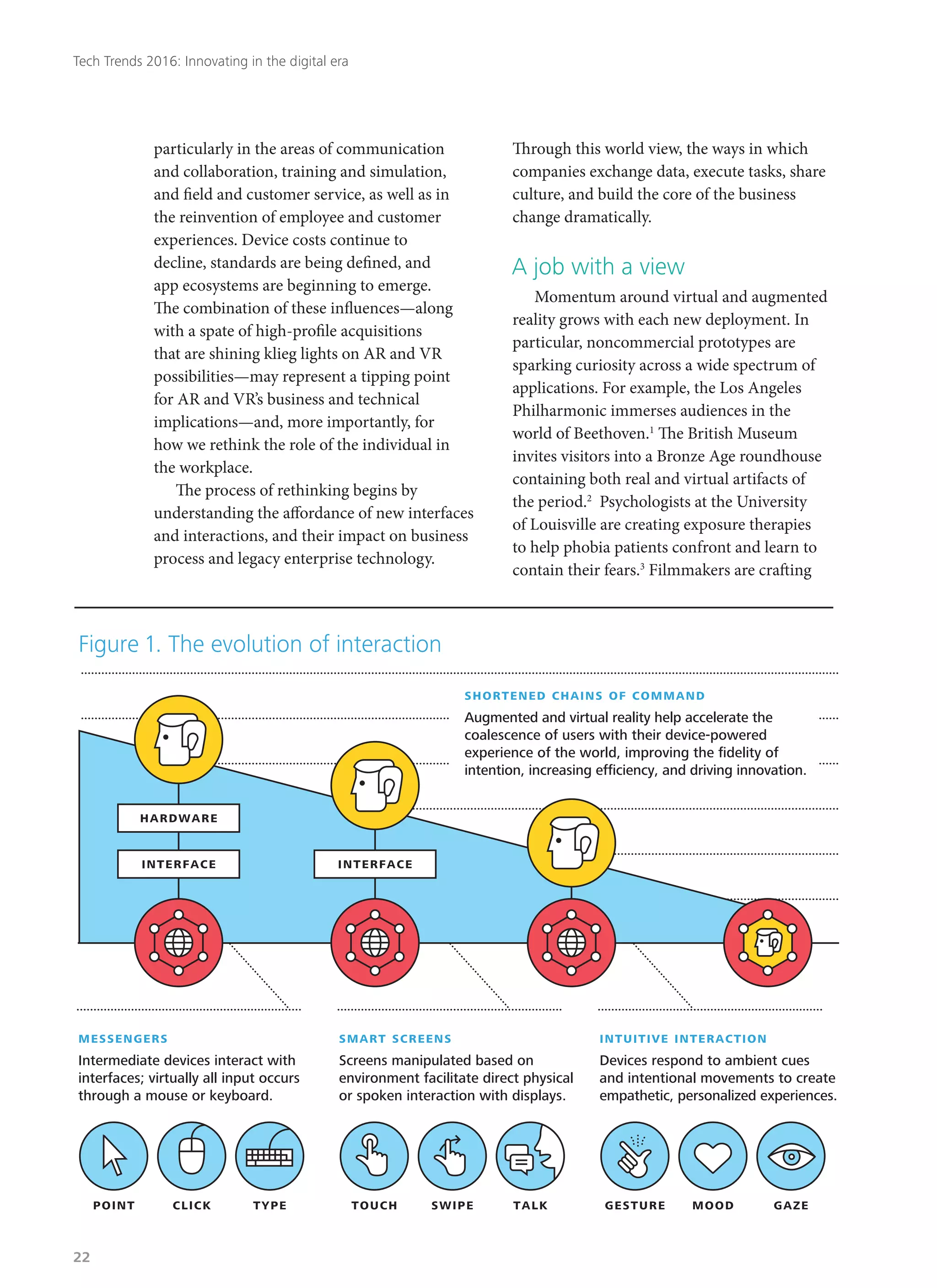
Figure 1. The evolution of interaction
shortened chains of command
Augmented and virtual reality help accelerate the
coalescence of users with their device-powered
experience of the world, improving the fidelity of
intention, increasing efficiency, and driving innovation.
messengers
Intermediate devices interact with
interfaces; virtually all input occurs
through a mouse or keyboard.
smart screens
Screens manipulated based on
environment facilitate direct physical
or spoken interaction with displays.
intuitive interaction
Devices respond to ambient cues
and intentional movements to create
empathetic, personalized experiences.
interface
hardware
interface
point click type touch swipe talk gesture mood gaze
Tech Trends 2016: Innovating in the digital era
22
first-person POV documentaries that place
viewers in the middle of a Syrian refugee camp
or an African village beset by Ebola.4
Meanwhile, businesses are taking the same
technology and interaction paradigms to new
heights across many industries, including
construction, health care, and manufacturing.
For example:
•	 Communication and collaboration:
Virtual reality and augmented reality
may soon accomplish what static and flat
mediums for knowledge exchange failed
to do: Replace real, one-to-one human
interactions. AR and VR both offer IT
opportunities to change how the business
and its employees report and share
information and take action. Marketing
managers are already using AR to view
retail shelf inventory and sales data.
Engineering teams across the globe are
deploying VR to collaborate in real time
to test and refine a single design. What’s
more, virtual reality is transforming simple
productivity tools like videoconferencing
and live chats, enabling immersive face-
to-face interactions that feature real facial
expressions, physical gestures, and subtle
nonverbal cues that are replicated in
real time.
•	 Training and simulation: AR and VR will
make it possible for IT to play an active
role in retooling high-cost training and
simulation environments, many of which
exist to rehearse critical scenarios without
the risk of real-world consequences. For
example, manufacturers can replicate
maintenance and repair scenarios in virtual
environments. In fact, by creating parallel
processes that leverage remote controls
and robotics, they may be able to remove
employees from dangerous, real-world
analogs altogether. Executive teams are
using simulated high-resolution stages to
rehearse and refine their presentation skills.
In the construction industry, commercial
developers can now walk through complete,
full-scale computer-rendered structures—
getting a sense of the width of a hallway or
the impact of detailed design decisions—
before touching shovel to dirt.
•	 Field and customer service: It is the IT
department’s responsibility to determine
how AR and VR will be used in tandem
with existing and other emerging
technologies. Therefore, CIOs can lead
efforts to redefine how field and customer
service workers approach their jobs. For
example, deploying augmented interfaces
that pair with connected devices, sensing
objects, and relational data can deliver
task-specific information to workers in the
field in context and on demand. Augmented
solutions can overlay a jet engine’s service
hours, component temperature, and service
panel details into an aircraft mechanic’s
field of vision. Likewise, virtual solutions
can immerse customer service agents in
collaborative scenarios featuring perceptive
conversations and problem-solving.
Remote experts can see what field reps
see and provide guidance as they perform
maintenance or mechanical tasks. Think
of a sportscaster explaining a replay with
diagrams superimposed on the screen; the
same technique can be used as an overlay to
the field rep’s view of the task at hand.
•	 Customer experience and interactive
marketing: AR and VR offer potential
new ways to interact with products and
services. Moreover, they offer companies
opportunities to raise awareness, promote
features, and inspire desire for their suites
of goods. Travel, hospitality, and leisure
firms are offering immersive, interactive
samplings of cruises or hotel stays that
allow potential guests to explore properties
and preview amenities virtually. Some of
these samplings go so far as to use wind
machines and olfactory stimulants to
replicate not just the sights, but also the
Augmented and virtual reality go to work
23
sounds and smells one might experience
during a day at the beach.
Shifting focus
Designing user experiences for immersive
environments is a fundamentally different
process from creating experiences for flat
screens. Immersive environments leverage
cues derived from ambient sounds or a simple
glance to drive both intentional and reflexive
movements. In both AR and VR, the clicks and
swipes that animate flat screen experiences are
replaced by spoken words, gestures, fidgeting,
grabbing, pushing, a nod, or even a blink.
Consider the notion of focus. Naturally,
people have notoriously short attention spans.
In the context of computing devices, we have
dealt with this by shrinking, reflecting, and
curving the displays. But in the context of
behavioral interaction and productivity, focus
becomes a different obstacle altogether. In
virtual or augmented environments, what
happens to objects when a user looks at them
is as important as what the other objects are
doing even when the user is not looking at
them. A gaze becomes the new hover state,
directing user intent and presenting options
not previously visible. Likewise, a gesture
(for example, the snap of a finger or the
blink of an eye) could be used to change the
perception of both time and scale, pausing
or stopping time, accelerating outcomes, or
even changing the position and relationship
of objects not bound by physical realities. This
creates an opportunity for the enterprise to
design environments that offer empathetic,
personalized responses. For example, in a
virtual environment, an avatar could act as
a performance coach that analyzes the body
language and speech patterns of individual
employees to help them enhance their
presentation skills.
Through AR and VR, organizations
can create environments that can react to
changes in posture, mood, and attention. For
example, dynamically reordering how tasks
are presented to account for a user who is
sleepy or distressed can change the relationship
between technology, behaviors, and outcomes,
and compensate for a higher cognitive load
in decision making. This, in effect, puts the
enterprise at the core of human-centered
design: design emphasizing comfort, health,
safety, happiness, productivity, and growth.
Tech Trends 2016: Innovating in the digital era
24
The AR/VR consumer
market heats up
Over the next 18 to 22 months, we expect
to see augmented reality and virtual reality
technologies transition from the science
fiction ether to the more earthly, practical
realms of business and government. However,
enthusiasts will not have to wait for solid
use cases to emerge before they can begin to
enjoy AR and VR at home. The consumer AR/
VR market is heating up as offerings from
Samsung, Microsoft, Facebook Google, HTC,
Motorola, Sony, and other leading technology
brands near completion. Likewise, start-ups
such as MagicLeap, Lensar, and NantMobile,
among others, plan to launch their own
compelling offerings in the near future.
Early use cases are focusing on familiar
consumer scenarios: gaming, video
entertainment (Hollywood, adult, and
other programming), and social media/
collaboration. Meanwhile, new product
categories are emerging that focus primarily
on the technology footprint required to make
the virtual or augmented realities tick. Some
solutions require a high-end PC to function;
some use a smartphone as the processing core.
Many are tethered to batteries, controls, or
control units, while others are truly wireless.
Several benefit from baked-in or, in some
cases, locked-in development partners to
help expand the breadth and utility of the
platform. Others are either nascent plays or
have closed-garden content models. Regardless
of the approaches, expect to hear more about
consumer augmented reality and virtual
reality devices in the coming months. Existing
products will evolve. New product categories
will emerge. Welcome to the future.
AR in construction: The next
best thing to building there
In a remote corner of west Texas, a field
technician wearing a geotagged helmet
equipped with AR technology gazes up at
a 270-foot-tall telecom tower. Using hand
gestures, he pulls a data overlay into his field of
vision containing the technical and design data
he will need to perform a thorough equipment
review on this tower.
Connecting field workers to data in this
way is one of many potential uses global
engineering and construction company Black
& Veatch envisions for AR technologies
in the near future, says Dan Kieny, B&V’s
senior vice president and CIO. “In our more
than 100 years of building critical human
infrastructure, we have seen a lot of technology
advancements, and AR has a compelling
value proposition in our industry right
now. We are looking at AR applications that
provide individual operators with data they
need to perform specific construction and
maintenance tasks remotely.”
Wearables are nothing new in the
construction industry. Workers in the field
regularly don protective goggles, vests, and
helmets, along with tool belts and other items
that help them perform specific tasks. Smart
wearables, such as augmented and virtual
reality tools, therefore, represent a natural
progression. Black & Veatch is currently
exploring applications of AR technologies such
as helping to train unskilled labor remotely
to perform highly technical tasks; providing
mobile monitoring capabilities that display
system-status details in real time; and using
smart helmets that are geotagged to provide
location-relevant information to field workers.
The company is also looking for ways
in which VR tools can be utilized to create
immersive environments, providing visibility
Lessons from the front lines
Augmented and virtual reality go to work
25
to large-scale designs. This capability could
make it possible for owners and operators
to vet design decisions and consider the
operational implications to layout, equipment
placement, and other factors that impact
maintenance. Longer term, artificial
intelligence and machine learning can help
Black & Veatch refine the information that
field workers receive, and enhance the AR
interface between people and data.
Behind the scenes, Black & Veatch is
already laying the foundation for these and
other scenarios. For example, it is deploying
sensor and beacon technologies at construction
sites to provide a backdrop of tool, supply,
and personnel data. Efforts are under way
to capture and contextualize these new data
sources for use in AR and VR experiences, as
well as to enable exploration and analysis of
hidden trends and business implications. “Data
will never be fully structured, and that’s OK,”
says Kieny, emphasizing the shift in focus from
aggregation and stewardship to harnessing
increasingly dynamic data to enhance human
interaction in a number of ways. These
include creating more intuitive interfaces with
systems and data, and enabling more engaging
dialogues with customers and partners.
According to Black & Veatch CTO Brad
Hardin, the company is initially focusing
on AR opportunities. He also sees eventual
opportunities to use VR technology in areas
like remote robotic welding and providing
security training simulations for power
plants and other vulnerable infrastructure.
“In exploring opportunities to use smart
wearables, we are ultimately trying to create
more value for the company and our clients,”
says Hardin. “But we are also trying to disrupt
our business model before we get disrupted.”5
Can virtual reality help
deliver the goods?
Even as automation increasingly disrupts
long-established operational models
throughout the parcel delivery industry,
the process of sorting packages for delivery
worldwide remains labor-intensive. At one
global package-delivery company, training
workers to operate and maintain massive
pieces of sorting equipment that can be half
a football field long traditionally required
flying them to remote training centers where
they would receive several weeks of intensive
instruction. The problem with this approach
is that many workers don’t retain learned
skills unless they use them regularly. In a
high-velocity performance environment
in which equipment must run at top speed
24/7, the inability to address all mechanical
problems quickly and efficiently can cost the
company dearly.
The organization is currently prototyping a
3D simulation solution that has been designed
to be leveraged via VR to provide virtualized
worker training on an ongoing basis, in any
location. In this solution, workers wearing
VR headsets would be immersed in a virtual
3D production environment that features
simulated versions of equipment in use. A
training program, using both visuals and
sound, would take users step by step through
detailed maintenance and repair processes.
The company envisions several ways in
which the VR training solution could be
deployed. In addition to providing just-in-
time instruction on how to perform specific
maintenance and repair tasks, it could
also embed 3D simulations into mid-level
e-learning programs for experienced workers.
So, for example, a user might click on a
prompt to bring up a new page that includes
a 3D simulation depicting how to complete a
specific task. The company could also create
VR training courses in which new hires could
learn five basic tasks in a virtual environment.
When they complete those five tasks, they can
advance to the next five, and so on, until they
complete an entire entry-level course.
Tech Trends 2016: Innovating in the digital era
26
At Vrse and its sister company, Vrse.works, we
create fully immersive 360º video and VR cinematic
experiences. But really, we tell stories. And every
story should (and does) dictate how it’s to be told.
Naturally, we’re staying up to date on all the new
advancements in technology and the great work
other people in the field are doing. But we can’t wait
around until all the bumps are smoothed out, and
neither should you.
Virtual reality as an artistic medium—and, increasingly,
as a tool for innovation in business, health care, and
other areas—is in its first growth spurt, and we’re
proud to be adding to the innovations. We create
and pioneer a lot of the technology we use, and
every progressive iteration is inspired by a storytelling
choice. We like to take on challenges and find
creative solutions. That’s how cinema got from the
proscenium wide shot to where the art form is today.
Mistakes tell us as much as successes about the future
of VR.
Our first foray into VR was the Sound and Vision
experience I did with Beck a few years back. We
wanted to reimagine the concert and create
something organic and inclusive. Traditional concerts
are a battle: The audience faces one way, the
band another; sound clashes in the middle. Video
captured this brilliantly for years, but we wanted to
try a different shape—the circle. The concert-going
experience is so round and immersive that we needed
to try our hands at a new technology if we were
going to effectively capture Beck and the musicians’
magic. The event was being billed as an experiment
in immersion, so my ultimate goal was to capture
and preserve the moment for a later broadcast in
VR. This was more than three years ago, though,
and VR mostly only existed in research labs. Luckily,
this was right around the time that Palmer Luckey
and the guys at Oculus were making waves, so we
started a conversation. The result is what the viewer
experiences in Sound and Vision: fully immersive 360º
virtual reality, captured from various perspectives,
painting the full portrait of the experience and not
just tightly squeezed snippets.
I’ve always been interested in the intersection
between emotion and technology. Studying people’s
experiences while inside VR gave me the confidence
and curiosity to bring like minds to Vrse. We’ve
found that VR, when exercised with precision, can
tap into a viewer’s sense of empathy. In short, VR is
a teleportation device. It can take you into a conflict,
instead of just showing you one. It can bring you
face to face with a child in a refugee camp or a band
on a stage, and the emotional response has been
measured to be similar to actually experiencing those
interactions. For the UN experiences we’ve created,
UNICEF has taken to the streets with VR headsets in
an effort to raise money for faraway causes. When
people on the street experienced VR, they were
twice as likely to donate. And we’re talking monthly
donations, not just one-offs.
We’re continuing to create stories in VR that mean
something to us. We’ve had the great fortune of
caring a whole lot about every experience we’ve
put out, and we want to keep that going. We
want to keep reevaluating how people experience
familiar stories.
And you? Now is the time for exploration. All previous
art forms were built on mounds of trial and error, and
VR is no different. Sometimes storytellers need to
travel down the long and winding road a hundred
times in order to find the highway.
MY TAKE
CHRIS MILK
Co-founder and director
Vrse and Vrse.works
“...We want to keep reevaluating
how people experience familiar
stories.“
Augmented and virtual reality go to work
27
Even with the “virtual” nature of augmented and virtual
reality, these two technologies introduce very real cyber
risk concerns. Though quite different, AR and VR share
several common security and privacy considerations.
The devices themselves need to be tracked, managed,
and hardened to control access to underlying data and
applications and to entitlement rights to the gear. As
they do with mobile devices and wearables, companies
should mitigate different risk scenarios involving data
and services at rest, in use, or in flight. They should
also consider adopting existing cyber protocols
from mobile-device, application, and
data management programs to
create the necessary management
and controls around AR and
VR efforts.
Controlling the associated
digital assets should be
a priority. Virtual reality
and augmented reality
introduce new and different
intellectual property that
may contain sensitive
information requiring controls
for security and privacy,
regulatory and compliance
issues, and competitive advantage.
High-definition 3D renderings of
facilities, detailed tracking of property and
equipment location and controls, and associated
beacons, sensors, and connected footprints all need
appropriate protection, from encryption and access
controls to rights and asset management. Likewise,
protecting the information being presented in an
AR/VR world and ensuring its integrity becomes
critically important. What if data appearing in a
cockpit AR display were to become compromised,
and consequently, a jet veers off course? The possible
implications could be tragic.
Yet beyond these considerations, each technology
presents its own unique cybersecurity and cyber
privacy challenges. For example, AR requires many
more data points than VR to drive content for GPS
and positioning, tagging, shared metadata, and
facial recognition. Moreover, to enhance and tailor
the augmented experience of an individual user, AR
systems may also integrate data from a host of sensors
tracking that person and from other personal sources
like health and fitness monitors. This raises a number of
security and privacy concerns about the data sources to
which individuals have access, and whether
combinations of data being aggregated
by AR may compromise personally
identifiable information (PII) or
payment card industry (PCI)
data.
With VR, when you recreate
the physical world in a
VR environment, you also
recreate its problems and
vulnerabilities. Virtual
representations of your
company’s assets may
add another layer of risk by
providing detailed blueprints to
potential weaknesses. How will
you protect these soft spots? And
what new governance approaches will
be needed to protect user identities in the
virtual world?
The flip side of the AR/VR cyber risk coin is that these
two technologies show promise as tools that may help
organizations boost their overall security and privacy
strategies. VR, for example, can be used in disaster
recovery efforts and war room simulations. Scenario
planning around incident response can be taken to
another level with experiences closely resembling real-
life events. Likewise, AR may help companies better
visualize the cyber threats they face.
CYBER IMPLICATIONS
Tech Trends 2016: Innovating in the digital era
28
The world of AR and VR should be an
extension of an organization’s digital strategy,
applying new technologies to transform
customer engagement and employee
empowerment. While AR and VR may reek
of “shiny object syndrome,” in both cases,
the underlying promise is exceptionally
grounded. AR can help to seamlessly integrate
technology with the real world; VR provides
immersive simulated environments that help
model complex, unsafe environments that
are infeasible to explore in real life. Both
can potentially create efficiencies and drive
innovation that impacts shareholder value.
As an added benefit, harnessing these tools at
the bleeding edge of consumer hype can also
help cement a CIO’s reputation in the C-suite
and throughout the enterprise as a purveyor
of futuristic solutions that are grounded in
business realities.
Consider the following points as you begin
your AR/VR journey:
•	 The time is now: The consumer market
is becoming crowded in both categories.
It will take time for dominant players to
emerge, but once they do, third-party
developers will be able to focus their efforts
on building surrounding ecosystems. For
now, companies can begin to justify their
AR/VR use cases around single purposes
with measurable impact and value. Expect
the market to evolve; as it does, companies
can then move forward on point decisions
that have self-contained positive ROI,
design to allow portability, and reevaluate
the field with each new initiative to
determine where to place the next bet.
Volatility will be the name of the game for
some time. However, this volatility may also
drive rapid feature expansion, lower price
points, and more creative arrangements
with vendors eager to partner with
leading organizations.
•	 Behind the looking glass: Designing
for AR and VR requires embracing new
patterns and perspectives along with a
wholly different design vocabulary. It also
requires new enabling tools and services to
bring the experiences to life and make them
work in the real world. High-definition 3D
image capture and mapping equipment
are emerging, accelerating developers’
abilities to recreate real-world physical
environments within new AR/VR tools.
Gaming engines are gaining a new purchase
in the enterprise, with Unreal, Unity, and
others being used to create simulations
and virtual environments for AR and
VR interaction.
•	 Side jobs: As companies deploy AR/VR
solutions, they may need to install beacons,
sensors, or even QR tags around facilities
and equipment to guide the context
of augmented scenarios, especially for
equipment on the move. Likewise, they
might also need to construct wireless and
cellular infrastructure to support AR/
VR connectivity in remote areas. Finally,
emerging middleware platforms can help
abstract device-specific interaction from the
underlying data and rules.
•	 New horizons: As many enterprises
learned during the first mobile technology
wave, systems designed around previous-
generation technology can’t simply be
ported to a new form factor. In fact, it took
years for many organizations that were
constrained by incrementalist thinking to
evolve from a “mobile maybe” to a “mobile
first” mind-set. The most compelling
examples of this transition have been
“mobile only,” centered on experiences
that would not have been possible without
smartphones and tablets. Luckily, AR and
Where do you start?
Augmented and virtual reality go to work
29
VR lend themselves to more imaginative
thinking. Begin with ambitious scenarios
that look beyond yesterday’s use cases.
Given that these tools are brand new, accept
that experimentation is not only necessary,
but essential to help everyone—IT, business
executives, and end users alike—understand
what they can do and how they should be
applied to drive value.
Tech Trends 2016: Innovating in the digital era
30
Emerging technologies that invoke futuristic, seemingly fictional realities can spark a backlash
within the enterprise. Executives raised on Gene Roddenberry, George Lucas, and Michael Crichton
may be at once curious and dubious about what augmented reality and virtual reality are and, more
importantly, how they might impact business. But know that AR and VR are here; their benefits
to the enterprise will likely outpace consumer adoption cycles, which is notable given that the
market may swell to $150 billion annually by 2020.6
It’s time to put AR and VR to work—and bring
enterprise IT back to the future.
Bottom line
Augmented and virtual reality go to work
31
Authors
Nelson Kunkel, Deloitte Digital national creative director,
Deloitte Consulting LLP
Nelson Kunkel oversees the growth of Deloitte Digital’s experience
design teams across a network of digital studios. His purpose is to
help peers and clients see the world—and their challenges—from a
different perspective. Kunkel has spent his career building brands and
solving creative problems through empathy and understanding. More
importantly, he works daily to bring divergent perspectives together,
enabling designers and companies to do their best, most creative work.
Steve Soechtig, Deloitte Digital Experience practice leader,
Deloitte Consulting LLP
Steve Soechtig has spent his career helping enterprises solve complex
business challenges with emerging technologies. With the expansion
of wearable, virtual, and IoT technologies, Soechtig is currently
helping Deloitte Digital’s clients identify opportunities to leverage
these emerging trends to further enhance their connections with their
employees and customers and improve the overall experience of their
business applications.
Jared Miniman, Deloitte Digital senior manager,
Deloitte Consulting LLP
As the user experience champion for Deloitte Digital’s public sector
practice, Jared Miniman builds richly immersive mobile apps and app
ecosystems that connect to health care benefits systems and government
business rules engines. He incorporates advanced user research and
product visioning techniques into the planning and execution of major
technology projects spanning multiple agile teams and client stakeholder
groups. Miniman’s past work in the mobile space has resulted in a US
patent and over 2 million downloads.
Chris Stauch, Deloitte Digital director, Deloitte Consulting LLP
Chris Stauch is a designer, technologist, and brand strategist helping
clients solve their most visionary business challenges through design-
led thinking and implementation. As a leader in the west region design
practice, he leads cross-functional teams in user experience, visual design,
and front-end development at Deloitte Digital, Deloitte Consulting LLP.
He brings 19 years of experience in developing brands and businesses.
Tech Trends 2016: Innovating in the digital era
32
Endnotes
1.	 David Ng, “L.A. Philharmonic’s Van Beethoven
takes virtual reality for a classical spin,” Los
Angeles Times, September 24, 2015, http://
www.latimes.com/entertainment/arts/
la-et-cm-los-angeles-phil-vr-20150924-
story.html, accessed January 16, 2016.
2.	 Maev Kennedy, “British Museum uses virtual
reality to transport visitors to the bronze
age,” Guardian, August 4, 2015, http://www.
theguardian.com/culture/2015/aug/04/
british-museum-virtual-reality-weekend-
bronze-age, accessed January 16, 2016.
3.	 Erin Carson, “10 ways virtual reality is
revolutionizing medicine and health care,”
TechRepublic, April 8, 2015, http://www.
techrepublic.com/article/10-ways-virtual-
reality-is-revolutionizing-medicine-and-
healthcare/, accessed January 16, 2016.
4.	 Scott Hartley, “The innovative technology
that’s changing the way we watch movies,”
Inc., September 1, 2015, http://www.
inc.com/scott-hartley/how-the-united-
nations-is-telling-stories-in-virtual-reality.
html, accessed January 16, 2016.
5.	 Dan Kieny (senior vice president and
CIO, Black & Veatch) and Brad Hardin
(CTO, Black & Veatch), interview
with the authors, November 2015.
6.	 Digi-Capital blog, “Augmented/virtual reality
to hit $150 billion disrupting mobile by 2020,”
April 2015, http://www.digi-capital.com/
news/2015/04/augmentedvirtual-reality-to-
hit-150-billion-disrupting-mobile-by-2020/#.
VinUMH6rSM9, accessed January 16, 2016.
Augmented and virtual reality go to work
33
Like a wildfire racing across a dry prairie,
the Internet of Things (IoT) is expanding
rapidly and relentlessly. Vehicles, machine
tools, street lights, wearables, wind turbines,
and a seemingly infinite number of other
devices are being embedded with software,
sensors, and connectivity at a breakneck
pace. Gartner, Inc. forecasts that 6.4 billion
connected things will be in use worldwide in
2016, up 30 percent from 2015, and that the
number will reach 20.8 billion by 2020. In
2016, 5.5 million new things will get connected
to network infrastructure each day.1
As IoT grows, so do the volumes of data
it generates. By some estimates, connected
devices will generate 507.5 zettabytes (ZB) of
data per year (42.3 ZB per month) by 2019, up
from 134.5 ZB per year (11.2 ZB per month)
in 2014. (A zettabyte is 1 trillion gigabytes).
Globally, the data created by IoT devices
in 2019 will be 269 times greater than the
data being transmitted to data centers from
end-user devices and 49 times higher than
total data center traffic.2
Even as businesses, government agencies,
and other pioneering organizations at the
vanguard of IoT take initial steps to implement
IoT’s component parts—sensors, devices,
software, connectivity—they run the risk of
being overwhelmed by the sheer magnitude
of the digital data generated by connected
devices. Many will focus narrowly on passive
monitoring of operational areas that have
been historically “off the grid” or visible only
through aggregated, batch-driven glimpses. To
fully explore IoT’s potential, companies should
think big, start small, and then scale fast.
Many enterprises already have unused IoT
infrastructure built into their manufacturing
machinery and IT software. We call these
dormant components “brownfields”: Like
roots, bulbs, and tubers in the soil, they
need a good “rain” and a bit of tending to
begin to thrive. Activating and connecting
Internet of Things:
From sensing to doing
Think big, start small, scale fast
Increasingly, forward-thinking organizations are focusing their Internet of
Things (IoT) initiatives less on underlying sensors, devices, and “smart” things
and more on developing bold approaches for managing data, leveraging
“brownfield” IoT infrastructure, and developing new business models.
Meanwhile, others are developing human-impact IoT use cases for boosting
food production, cutting carbon emissions, and transforming health services.
What impact will IoT have on your business and on the people around you?
Rapid prototyping can help you find out.
Internet of Things: From sensing to doing
35
these brownfield components may help
companies leapfrog some implementation
steps and give their IoT initiatives a needed
boost. In contrast, “greenfields”—enterprise
environments with no preexisting IoT
infrastructure—require basic seeding and a lot
of tending over time to yield a new crop.
The value that IoT brings lies in the
information it creates. It has powerful potential
for boosting analytics efforts. Strategically
deployed, analytics can help organizations
translate IoT’s digital data into meaningful
insights that can be used to develop new
products, offerings, and business models.
IoT can provide a line of sight into the world
outside company walls, and help strategists
and decision makers understand their
customers, products, and markets more
clearly. And IoT can drive so much more—
including opportunities to integrate and
automate business processes in ways never
before possible.
Often overlooked is IoT’s potential for
impacting human lives on a grand scale. For
example, in a world where hunger persists,
“smart farming” techniques use sensor data
focused on weather, soil conditions, and pest
control to help farmers boost crop yields.
Meteorologists are leveraging hazard mapping
and remote sensing to predict natural disasters
farther in advance and with greater accuracy.
The health care sector is actively exploring
ways in which wearables might help improve
the lives of the elderly, the chronically ill, and
others. The list goes on and will continue
to grow. We are only beginning to glimpse
the enormity of IoT’s potential for making
lives better.3
Sensing and sensibility
With so few detailed use cases, the sheer
number of IoT possibilities makes it difficult
to scope initiatives properly and achieve
momentum. Many are finding that IoT
cannot be the Internet of everything. As such,
organizations are increasingly approaching IoT
as the Internet of some things, purposefully
bounded for deliberate intent and outcomes,
and focused on specific, actionable business
processes, functions, and domains.
The time has come for organizations to
think more boldly about IoT’s possibilities
and about the strategies that can help them
realize IoT’s full disruptive potential. To date,
many IoT initiatives have focused primar-
ily on sensing—deploying and arranging the
hardware, software, and devices to collect
and transmit data. These preliminary steps
taken to refine IoT approaches and tactics are
just the beginning. The focus must shift from
sensing to doing. How do inputs from sensors
drive closed-loop adjustments and innovation
to back-, middle-, and front-office business
processes? Where can those processes become
fully automated, and where can the core be
reconfigured using feedback from connected
devices and instrumented operations? What
future IoT devices might open up new mar-
kets? To yield value, analytics-driven insights
must ultimately boost the bottom line.
One strategy involves harnessing the
information created by the IoT ecosystem to
augment worker capabilities, a process mod-
eled in the Information Value Loop. When
built to enhance an individual’s knowledge
and natural abilities and deployed seamlessly
at the point of business impact, IoT, in tandem
with advanced analytics, can help amplify
human intelligence for more effective decision-
making. For example, the ability to monitor
the vital signs of elderly patients remotely and
in real time will empower medical personnel
to make more accurate care decisions more
quickly. Even more profound, automated drug
delivery systems may be triggered to respond
to complicated signals culled from several
parts of the care network.
Likewise, companies may harness
data-driven insights to augment or
amplify operational activity in the form
of transforming business processes,
reimagining core systems and capabilities,
and automating controls. Eventually, robotic
process automation and advanced robotics
will monitor events, aggregate sensor data
Tech Trends 2016: Innovating in the digital era
36
Information gathered by the Internet of Things enables businesses to create and capture new value by providing
insight to optimize actions. Modified actions in turn give rise to new information, starting the cycle anew. Value
drivers determine how much value is created; their relevance and importance depend on the specific use case.
Figure 1. The Information Value Loop
Use of sensors
to generate data
about a physical
event or state
Gathering information
created at different
times or from different
sources
Initiating, changing,
or maintaining an
event or state
Discernment of
patterns among
data that leads to
action, descriptions,
or predictions
au
gm
entedintelligence
augm
en
ted
behavior
sensor
s
network
standards
i
nformation value drivers
magnitude
Transmission of
information from
generation to
processing location
risk
time
analyze
create
act
communica
te
ag
gregate
stages
technologies
value drivers
Source: Michael E. Raynor and Mark J. Cotteleer, “The more things change: Value creation, value capture, and the Internet of Things,” Deloitte
Review 17, July 27, 2015, http://dupress.com/articles/value-creation-value-capture-internet-of-things.
from numerous sources, and use artificial
intelligence capabilities to determine which
course of action they can take to deliver the
most desirable outcome.4
Take manufacturing, for example. At
a Siemens facility in Amberg, Germany,
machines and computers handle roughly 75
percent of the value chain autonomously,
with some 1,000 automation controllers in
operation throughout the production line.
Each part being manufactured has its own
product code, which lets machines know its
production requirements and which steps
to take next. All processes are optimized
for IT control, which keeps failure rates
to a minimum. In this facility, employees
essentially oversee production and technology
assets, handling any unexpected incidents that
may arise.5
Risks and rewards
As organizations work to integrate vast,
disparate networks of connected devices into
core systems and processes, there will likely be
new security and privacy concerns to address.
These concerns could be particularly acute
in industries like health care—which may be
aggregating, analyzing, and storing highly
personal data gleaned from sensors worn by
patients—or in manufacturing—where risks
may increase as heavy industrial equipment or
infrastructure facilities become increasingly
connected. More data, and more sensitive data,
Internet of Things: From sensing to doing
37
available across a broad network means that
risks are higher and that data breaches could
pose significant dangers to individuals and
enterprises alike.
With IoT, data security risks will very likely
go beyond embarrassing privacy leaks to,
potentially, the hacking of important public
systems. Organizations will have to determine
what information is appropriate for IoT
enablement, what potential risks the assets
and information may represent, and how they
can ensure that solutions are secure, vigilant,
and resilient.6
Similarly, as companies add additional
inputs to their IT and IoT ecosystems, they
will be challenged to create new rules that
govern how action proceeds and data is shared.
Opening up IoT ecosystems to external parties
via APIs will give rise to even more risk-related
considerations, particularly around security,
privacy, and regulatory compliance.
Acting on the information created by the
IoT—putting intelligent nodes and derived
insights to work—represents the final, and
most important, part of the IoT puzzle.
Options for achieving this vary. Centralized
efforts involve creating orchestration or
process management engines to automate
sensing, decisioning, and response across a
network. Likewise, a decentralized approach
typically focuses on automation: Rules engines
would be embedded at end points, which
would allow individual nodes to take action.
In still other scenarios, IoT applications
or visualizations could empower human
counterparts to act differently.
Ultimately, the machine age may be
upon us—decoupling our awareness of the
world from the need for a human being
to consciously observe and record what is
happening. But machine automation only sets
the stage; real impact, business or civic, will
come from bringing together the resulting data
and relevant sensors, things, and people to
allow lives to be lived better, work to be done
differently, and the rules of competition to
be rewired.
With this in mind, organizations across
sectors and geographies continue to pursue
IoT strategies, driven by the potential for new
insights and opportunities. By thinking more
boldly about these opportunities and the
impact they could have on innovation agendas,
customer engagement, and competitiveness
(both short- and long-term), companies will
likely be able to elevate their IoT strategies
beyond sensing to a more potentially beneficial
stage of doing.
Tech Trends 2016: Innovating in the digital era
38
Caterpillar embraces the
Internet of Big Things
At a remote mining region of western
Australia, the IoT’s lofty potential meets
the ground in a fleet of Caterpillar mining
trucks—each boasting a 240-ton payload—
that operate autonomously, 24 hours a day.
These giant, driverless machines are outfitted
with a variety of sensors that transmit
information on oil pressure, filters, and other
truck components via wireless connections
(such as satellite, cellular, and others) back to
Caterpillar headquarters in Peoria, IL, where
an advisor monitors the equipment’s vital signs
and can, when needed, make maintenance
recommendations to the fleet’s owner.7
Though Caterpillar has been embedding
sensors in its products for decades, only in
the last few years has the global construction
machinery and heavy equipment manufacturer
begun exploring their potential application
within the context of IoT. Today, IoT—or as
they call it at Caterpillar, the “Internet of Big
Things”—is a major strategic and technological
focus, with the company exploring ways to
mine IoT data that can then be used to develop
predictive diagnostics tools, design products,
and improve product performance.
For example, when compiled over time and
analyzed, data generated by sensors embedded
in construction-site machinery may be able
to help engineers design heavy equipment
that can accomplish more work with fewer
passes. Fewer passes translates to reduced
idle time, less operator fatigue, and lower fuel
consumption. Ultimately, operating efficiently
can help owners of Caterpillar equipment
better serve their own customers.
Importantly, this information—combined
with Caterpillar’s domain knowledge about
heavy equipment and analytics—may help the
company more accurately predict how specific
pieces of equipment will perform in different
environments and on specific types of jobs.
To this end, Caterpillar recently announced it
had entered into a technology agreement with
analytics vendor Uptake to develop a predictive
diagnostics platform to help customers
monitor and optimize the performance of their
fleets.8
Looking forward, Caterpillar expects
IoT to help redefine business processes, drive
better engagement with its customers, and
evolve its products, services, and offerings.
Expanding the horizons
of connected care
Some companies in the health care
industry—including health plans, providers,
medical device manufacturers, and software
vendors—are testing the IoT waters with a
number of sensor-driven big data initiatives
that could transform the way patients and their
providers manage acute health conditions.
One leading health care delivery system
is currently developing a suite of mobile
applications to track, record, and analyze
biometric data generated by Bluetooth-
enabled sensing devices worn by patients.
These apps, each configured to monitor
a specific medical condition, will share a
common digital platform and feature APIs
to encourage external development. Once
deployed, they will be able to analyze sensor
data and pair them with electronic medical
records and other clinical information to help
caregivers make faster—and more informed—
decisions for patients. For example, a diabetic
patient’s glucose readings would be streamed
from a monitoring device to a mobile app
on his or her phone or tablet, and then on
to an integrated big data repository. Care
coordinators would be alerted to unusual
changes in the patient’s glucose levels so
that they can take appropriate action, such
as bringing the patient into the hospital
for closer examination or adjusting his or
her medications.
Lessons from the front lines
Internet of Things: From sensing to doing
39
The organization piloted its diabetes
monitoring application with almost 40,000
diabetic patients, demonstrating the viability of
the platform. Next on the agenda: Expanding
adoption of the diabetes pilot and extending
the platform to support other conditions such
as congestive heart failure, chronic obstructive
pulmonary disease (COPD), and high blood
pressure, among others.
Living on “The Edge”
It’s morning in Amsterdam. An employee
leaves her desk, walking casually toward a
break room in the office building where she
works. As she approaches, a custom app on
her smartphone engages sensors embedded in
a coffee machine, which immediately begins
dispensing the employee’s preferred blend,
complete with the add-ins she desires. When
the employee arrives at the break room, her
custom brew is waiting.
Welcome to life in “The Edge,” a futuristic
office structure widely known as “the
world’s smartest building.”9
Completed in
2014, The Edge—which is home to Deloitte
Netherlands—is a showplace for leading-
edge deployments of green architecture
and advanced technology, including IoT
applications. The innovative, connected
lighting panels do more than sip minute
amounts of voltage—they contain some 28,000
sensors that detect motion, light, temperature,
humidity, and even carbon dioxide levels. It’s
these sensors, providing real-time data, that
make The Edge occupant-friendly.
The sensors allow facility managers to assess
how and when certain parts of the building are
being used. “In our building, IT and facilities
management are a combined function,”
explains Tim Sluiter, property manager, IT
and Workplace Services, Deloitte Netherlands.
In the short term, collected information can
be used to determine where cleaning is and
is not necessary on a given evening. Long
term, emerging patterns showing light use
in certain locales on certain days can lead to
rooms or even entire floors being closed off to
save energy.
IoT’s reach within this building extends
far beyond lighting sensors. When employees
approach The Edge’s high-tech garage, sensors
identify their vehicles and then point them to
available parking spots. Throughout the garage,
sensor-equipped LED lights brighten and dim
as drivers arrive and leave.
And that miraculous coffee app? It doubles
as a digital office administrator that can assign
daily workspaces that best fit users’ preferences
and allows them to control the brightness of
the lighting above their work surfaces and
adjust the climate of their particular areas. It
can direct people throughout the building—
reading a meeting location from one’s online
calendar, for example, and suggesting a route
to get there. Employees can even use the app
to track their progress in the on-site gym,
where some of the fitness equipment actually
feeds generated wattage into the building’s
power grid.
Sluiter stresses that personal data generated
by sensors and the app cannot be accessed by
managers or anyone else. Privacy laws ensure
that nobody can track a person’s whereabouts,
monitor how many meetings he or she has
missed, or see what times he or she is using the
garage. “This building offers the technology
to do certain things that would make tenants’
lives even easier,” Sluiter says. “But at the
same time, it’s extremely important to protect
people’s privacy and conform to the law.”
Those minimal barriers aren’t hindering
The Edge’s reputation. “Our aim was to make
The Edge the best place to work,” says Erik
Ubels, director of IT and Workplace Services,
Deloitte Netherlands. “Our meeting areas are
filling up because every client and employee
wants to experience this building. It’s not too
small yet, but the economy is growing and the
building is getting crowded. It’s possible we
made it too popular.”10
Tech Trends 2016: Innovating in the digital era
40
At Toyota, we are all about mobility. I’m not talking
just about car ownership. Mobility also includes public
transportation, ridesharing, hoverboards, walking—
anything that can get people from place A to place B
more efficiently and safely. Mobility is truly multi-modal.
Toyota sees the IoT as an enabler of mobility, and we
are moving very quickly to embrace its potential. Big
data generated by sensors located throughout our cars
will help engineers develop automobiles that think for
themselves. Likewise, Dr. Gill Pratt, the chief executive
officer of the Toyota Research Institute (TRI), and other
researchers at TRI, will leverage IoT data to advance
the science of intelligent cars as we move into the
future mobility of autonomous vehicles. Progress in
these areas will likely deliver autonomous connected
cars that are reliable, safe, and fun to drive when you
want to. The benefits that these innovations may
eventually provide to everyday drivers, drivers with
special needs, and to seniors could be life-enabling.
Toyota is no stranger to connected vehicle
technologies; Lexus began offering connected vehicles
in 2001. Today, all Lexus vehicles are connected, which
enables services like Destination Assist, which links
drivers to live agents who can provide directions for
getting from point A to point B. Lexus also offers
sensor-driven “car health” reports on current tire
pressure, oil levels, and maintenance needs.
These IoT applications are just the beginning. Cars
are mechanical products built with mechanical
processes. Sensors are so small that we can place
them virtually everywhere on cars. And what if you
extend the same sensor technologies that monitor
tires and brakes to the machines used to build vehicles
on the manufacturing floor? These sensors could
alert production leaders that there is a problem at a
particular station, and that the parts manufactured at
this station within a specific time frame will have to
be rebuilt.
As for new offerings, it’s sometimes hard for
companies to wrap their heads around the value
of data. For example, early on, everyone assumed
consumers wanted apps in cars. Very quickly, the auto
industry realized that what customers actually wanted
was for the apps on their phones to work in their cars.
Across industries and sectors, strategists, designers,
and decision makers typically believe that current
approaches and systems are just fine. It takes vision—
and a considerable amount of courage—to break with
the way things have been done for the last 100 years
and embrace some exotic technology that promises to
deliver new opportunities.
But in this era of historic technological innovation,
all companies must work aggressively to reinvent
themselves by embracing new opportunities and
compelling visions of the future. This is exactly what
Toyota is doing with IoT and mobility.
I’m a car guy. In high school, I loved working under
the hood of my car, which was the embodiment
of leading-edge technology at that point in my life.
For the last 15 years, we amateur mechanics have
been distracted by other mechanical wonders—the
kind everyone now spends their days staring at and
speaking into. That’s about to change. Connectivity
and cool new services are going to make cars come
alive. All those people who’ve developed relationships
with their smartphones are about to fall in love with
cars all over again.
MY TAKE
SANDY LOBENSTEIN
Vice president, connected vehicle technology and product planning
Toyota Motor Sales U.S.A., Inc.
“...In this era of historic
technological innovation, all
companies must work aggressively
to reinvent themselves by
embracing new opportunities and
compelling visions of the future.“
Internet of Things: From sensing to doing
41
The IoT connects critical infrastructure that has been
previously unconnected. As organizations begin
harnessing these connections to create value, they
may also add functionality to IoT networks that
will make it possible to take control of devices and
infrastructure remotely, and to automate monitoring
and decision-making within certain parameters based
on sensory data.
Make no mistake: As companies put IoT to work, the
smart, connected objects they deploy offer tremendous
opportunities for value creation and capture. Those
same objects, however, can also introduce risks—many
of them entirely new—that demand new
strategies for value protection.
For example, every new device
introduced in an IoT ecosystem
adds a new attack surface or
opportunity for malicious
attack, thus adding
additional threat vectors to
a list that already includes
protecting devices, data,
and users. Likewise, identity
spoofing—an unauthorized
source gaining access to
a device using the correct
credentials—may present
problems. And even if devices
aren’t directly compromised but
experience a hardware failure or a bug
in the code, they should be able to fail in a
safe way that doesn’t create vulnerabilities.
Moreover, the ecosystem structures that organizations
often rightfully deploy can give rise to vulnerabilities.
For example, IoT applications typically depend on the
closely coordinated actions of multiple players, from
vendors along the supply chain to clients, transport
agencies, the showroom, and end-use customers.
Vulnerabilities exist within each node and handoff
seam between sensors, devices, or players. It should
not be assumed that partners—much less customers—
have robust mechanisms in place to maintain data
confidentiality and guard against breaches.
In the face of these and other challenges, companies
can take several steps to safeguard their ecosystems:11
•	Work to define standards for interoperability:
Internally, define data and service standards to
guide consistent rollout within your organization’s
boundaries. Also consider getting involved with
consortia like the IIC12
to develop broader standards
and ease connectivity and communication.
•	Refactor with care: Retrofitting or extending
functionality of old systems may be exactly what your
IoT strategy needs. But when doing so, understand
that there may be potential security, performance,
and reliability implications, especially when pushing
legacy assets into scenarios for which they weren’t
designed. Whenever possible, use purpose-
built components for the refactoring,
engineered specifically for the
use case.
• Develop clear
responsibilities for the
players in your ecosystem:
Rather than sharing
responsibility across a
diffuse ecosystem, players
should know where their
responsibilities begin and
end, and what they are
charged with protecting.
Assessing potential risks
at each point—and making
sure stakeholders are aware of
those risks—can help make a solution
more secure.
•	Get to know your data: The quantity and variety of
data collected via IoT—and the fact that so much of
that data is now held by third parties—can make it
difficult for companies to know if their data has been
breached. When dealing with tremendous volumes
of IoT data, small, virtually unnoticeable thefts can
add up over time. Companies can address this threat
by developing a deep understanding of the data they
possess and combining this knowledge with analytics
to measure against a set “normal.” By establishing
a baseline of access and usage, IT leaders can more
readily and reliably identify possible abnormalities to
investigate further.
CYBER IMPLICATIONS
Tech Trends 2016: Innovating in the digital era
42
As IoT gains momentum, many
organizations find themselves paralyzed by the
sheer volume of vendor promises, the number
of novelty examples being imported from
the consumer realm, and by an overarching
conviction that something real and
important—yet frustratingly out of focus—is
waiting to be tapped into.
To maximize value, reduce risk, and learn
fast, those just beginning their IoT journey
should follow three innovation principles:
“Think big, start small, scale fast”:
Think big
•	 Ideate: Analyze the big ideas and use cases
in your industry. Move beyond sensing
to doing. Also, explore opportunities for
achieving greater consumer and human
impact with IoT.
Start small
•	 Take stock: Before investing in new
equipment, conduct an inventory of all the
sensors and connected devices already on
your balance sheet. Find your brownfields.
How many sit dormant—either deactivated
or pumping out potentially valuable
information into the existential equivalent
of /dev/null?
•	 Get to know the data you already have:
Many organizations have troves of raw data
they’ve never leveraged. By working with
data scientists to analyze these assets before
embarking on IoT initiatives, companies
can better understand their data’s current
value. Likewise, they may also be able to
enhance this value by selectively installing
sensors to plug data gaps.
•	 Pilot your ecosystem: Pick proven IoT
partners to quickly pilot ideas, try new
things, and learn quickly from failures.
Many aspects of IoT cannot be tested or
proven in laboratories but only with real
enterprise users and outside customers.
•	 Get into the weeds: At some point, IoT
initiatives require low-level expertise
around the underlying sensors,
connectivity, embedded components,
and ambient services required to drive
orchestration, signal detection, and
distributed rules. The difference between a
provocative “proof of concept” and a fully
baked offering lies in a host of nuanced
details: understanding the precision
and variability of underlying sensing
capabilities; MEMS sourcing, pricing,
and installation; and wireless or cellular
characteristics, among others. To fill
knowledge gaps in the short term, some
organizations leverage talent and skill sets
from other parts of the IT ecosystem.
Scale fast
•	 Adopt an agile approach: Go to market
and iterate often. One benefit of all the
investment being made in and around
IoT is that the underlying technology is
constantly improving as existing products
evolve and new categories emerge. As you
explore possible IoT strategies and use
cases, consider using lightweight prototypes
and rapid experimentation. This way, you
can factor in feasibility concerns, but you
won’t be saddled—at least for the time
being—with the burden of “enterprise”
constraints. As compelling ideas gain
momentum, you can then shape your
solution, refine the business case for it, and
explore it at scale.
•	 Enhance your talent model: Just as aircraft
manufacturers hire aeronautical engineers
to design products and software vendors
Where do you start?
Internet of Things: From sensing to doing
43
employ legions of coders with specific
skills, so too must companies pursuing
IoT strategies hire the right people for the
job. Does your IT organization currently
include talent with the hardware expertise
needed to operate and maintain thousands
of connected devices? Most don’t. Before
pursuing an IoT strategy, consider
enhancing your talent model not only to
bring in new skills from the outside, but
also to reskill current employees.
•	 Bring it home: Remotely deployed
assets and equipment often have starring
roles in IoT use cases. But call centers,
manufacturing floors, and corporate offices
also offer considerable IoT potential.
Consider how creating an “intranet of
things” might lead to improved workplace
conditions and enhanced comfort
and safety at individual work stations.
Moreover, how might reimagining
employee experiences in this way help your
company attract new employees and retain
existing ones?
Tech Trends 2016: Innovating in the digital era
44
The Internet of Things holds profound potential. It is a futuristic fantasy made real—the connected
home, connected workplace, and connected government come to life. The sheer scope of IoT carries
countless implications for business, both finite and abstract. To sidestep such distractions, focus on
solving real business problems by creating bounded business scenarios with deliberate, measurable
value. For example, how can you use IoT to get closer to customers or increase efficiency in your
manufacturing operations or supply chain? Look for hidden value in your brownfields. Move from
strategy to prototyping as quickly as possible. Only real data, actual users, and sensors that respond
with actions can demonstrate the remarkable value proposition of IoT.
Bottom line
Internet of Things: From sensing to doing
45
Authors
Andy Daecher, Technology Strategy & Architecture principal,
Deloitte Consulting LLP
Andy Daecher has worked in the high-tech industry for 25 years,
advising clients on the strategic use of technology to optimize their
businesses. He specializes in advising executives on the practical
applications of emerging technologies, the effective management of
IT organizations, and the execution of complex, transformational
technology-enabled projects.
Robert Schmid, Deloitte Digital director, Deloitte Consulting LLP
Robert has over 20 years of experience transforming global Fortune 100
and start‐up companies using new 21st-century technologies. He has
deep expertise delivering business value through innovative solutions
and effective partnerships in the areas of wearables, the Internet of
Things, social media, mobile workforce, cloud computing, merger
integration, complex integrations, ERP implementations, and off‐shoring
and outsourcing. He is a frequent author and public speaker.
Tech Trends 2016: Innovating in the digital era
46
Endnotes
1.	 Gartner Inc., “Gartner says 6.4 billion con-
nected ‘things’ will be in use in 2016, up 30
percent from 2015,” press release, November
10, 2015, http://www.gartner.com/newsroom/
id/3165317, accessed December 9, 2015.
2.	 Cisco, “Cisco Global Cloud Index: Forecast
and methodology, 2014–2019,” October
28, 2015, http://www.cisco.com/c/en/us/
solutions/collateral/service-provider/global-
cloud-index-gci/Cloud_Index_White_Paper.
html, accessed December 9, 2015.
3.	 Satish Tembad, “How the Internet of Things
can change the India we live in on its head,”
Business Insider India, September 8, 2015,
http://www.businessinsider.in/How-the-
Internet-of-Things-can-change-the-India-we-
live-in-on-its-head/articleshow/48871985.
cms, accessed February 12, 2016.
4.	 Jonathan Holdowsky, Monika Mahto, Michael
E. Raynor, and Mark J. Cotteleer, Inside
the Internet of Things, Deloitte University
Press, August 21, 2015, http://dupress.com/
articles/iot-primer-iot-technologies-
applications/, accessed December 9, 2015.
5.	 Kevin O’Marah, “The Internet of Things
will make manufacturing smarter,”
Industry Week, August 14, 2015, http://
www.industryweek.com/manufacturing-
smarter, accessed December 21, 2015.
6.	 Irfan Saif, Sean Peasley, and Arun
Perinkolam, “Safeguarding the Internet
of Things: Being secure, vigilant, and
resilient in the connected age,” Deloitte
Review 17, July 27, 2015, http://dupress.com/
articles/internet-of-things-data-security-
and-privacy/, accessed December 22, 2015.
7.	 Micah Maidenberg, “Why Caterpillar is letting
its geek flag fly,” Crain’s Chicago Business,
July 4, 2015, http://www.chicagobusiness.
com/article/20150704/ISSUE01/307049995/
why-caterpillar-is-letting-its-geek-
flag-fly, accessed January 12, 2016.
8.	 Caterpillar, “Caterpillar and Uptake to Create
Analytics Solutions,” press release, March 5,
2015, http://www.caterpillar.com/en/news/
corporate-press-releases/h/caterpillar-and-
uptake-to-create-analytics-solutions.html,
accessed January 12, 2016; Craig Brabec
(chief of analytics, Caterpillar Inc.) and Dan
Henderson (director of research and advanced
engineering, Caterpillar Inc.), interview
with the authors, December 18, 2015.
9.	 Tom Randall, “The smartest building in
the world,” Bloomberg Business, September
23, 2015, http://www.bloomberg.com/
features/2015-the-edge-the-worlds-greenest-
building/, accessed February 8, 2016.
10.	 Deloitte, 2015 Global Report, 2016, http://
www2.deloitte.com/global/en/pages/about-
deloitte/articles/global-report-2015.html.
11.	 Saif, Peasley, and Perinkolam, “Safe-
guarding the Internet of Things.”
12.	 Industrial Internet Consortium, http://www.
iiconsortium.org, accessed January 11, 2016.
Internet of Things: From sensing to doing
47
IT’s legacy is intertwined with the core
systems that often bear the same name. In a
way, the modern IT department’s raison d’être
can be traced to the origins of what is now
dubbed “legacy”—those heart-of-the-business,
foundation-of-the-mission systems that
run back-, mid-, and front-office processes.
Some include large-scale custom solutions
whose reach and complexity have sprawled
over the decades. Others have undergone
ERP transformation programs designed to
customize and extend their capabilities to meet
specific business needs. Unfortunately, the
net result of such efforts is often a tangle of
complexity and dependency that is daunting to
try to comprehend, much less unwind.
Meanwhile, core upkeep and legacy
modernization lay claim to inordinate amounts
of IT budget. Deloitte’s 2015 global CIO survey1
found that core-related expenditures are
the single biggest line item in IT investment
dollars. This leads to an internal PR problem
for the core: High cost is seen as low
value. When asked to rank the technology
investments they think will have significant
impacts on their business, survey respondents
cited analytics, digital, and cloud.
Clearly, it’s easy to overlook the fact that
these and other emerging technologies are
highly dependent on the underlying data and
processes the core enables.
Broad systems transformation involves
bringing together sales, operations, supply
chain, and service information to redefine
underlying processes and inform new
products, services, and offerings. As such,
efforts to reimagine core systems can form
the foundation upon which higher-order,
“shinier” initiatives are built. Reimagining
the core can also help companies establish
a modern baseline for improved efficiency,
efficacy, and results. With this in mind,
leading organizations are evolving their
systems roadmaps to approach the core
not as an anchor, but as a set of customer-
focused, outcome-driven building blocks that
Reimagining core systems
Modernizing the heart of the business
Core systems that drive back, mid, and front offices are often decades old,
comprising everything from the custom systems built to run the financial
services industry in the 1970s to the ERP reengineering wave of the 1990s.
Today, many roads to digital innovation lead through these “heart of the
business” applications. For this reason, organizations are now developing
strategies for reimagining their core systems that involve re-platforming,
modernizing, and revitalizing them. Transforming the bedrock of the IT
footprint to be agile, intuitive, and responsive can help meet business needs
today, while laying the foundation for tomorrow.
Reimagining core systems
49
can support the business in the digital age
and beyond.
The time is now
The pace of change and innovation in
technology is continuing to accelerate at an
exponential pace, offering ripe opportunities
to rewire the way we work and rewrite the
rules of engagement. The rate at which data
is produced by devices, sensors, and people
is accelerating—and that data is being
harnessed in real time by advanced predictive
and prescriptive analytics to expertly guide
business decisions once ruled by instinct and
intuition. Digital has unlocked new ways
of engaging customers and empowering
employees—not just making it possible for old
jobs to be done differently, but also creating
fundamentally new and different patterns of
interaction. Mobile and tablet adoption served
as a clarion for wearables, the Internet of
Things, and now augmented and virtual reality.
Competitive dynamics are also driving change.
Start-ups and companies without strong
ties to legacy systems will find themselves
increasingly able to innovate in service
delivery, unhindered by decades of technical
debt and legacy decisions.
At the same time, significant external forces
are redrawing core roadmaps. ERP vendors
have invested heavily in next-generation
offerings and are aggressively positioning
their modernized platforms as the answer to
many enterprise system challenges. Cloud
players are offering a rapidly growing catalog
of back- and mid-office solutions. At the
same time, expertise in COBOL and other
mainframe programming languages is growing
scarce as aging programmers retire—a
situation that weighs heavily in more and
more replatforming decisions.2
Against this
backdrop, a steady drumbeat of hype touting
emerging technologies casts legacy as a four-
letter word in the minds of C-suite executives
and line-of-business leaders.
All of these factors make it more important
than ever for CIOs to define a deliberate
core strategy based on the needs and goals
of the business. Start with existing business
processes. Does the core IT stack help or
hinder users with their daily tasks across
departments, processes, and workloads? How
is the strategy of each function evolving,
and what impact will those strategies have
on the core? How is the broader business
positioning itself for growth? What are the key
constraints and enablers for business growth
today? Implications for the core will no doubt
follow, but specific needs will differ depending
on plans for organic growth in existing
markets, business model innovation, mergers,
acquisitions, and divestitures, among others.
Next, examine technology-driven factors
by putting their potential impacts in a business
context. For example, translate abstract
technical debt concerns into measurable
business risks. Technical scalability can be
represented by inhibitors to growth due to
limits on the number of customers, orders,
or payments that can be transacted. Translate
reliability concerns into lost revenue or
penalties for missing SLAs due to outages or
service disruptions. Immature integration and
data disciplines can have concrete impacts
in terms of project delays—and the extent to
which they may hobble digital, analytics, and
cloud efforts.
Go big, go bold
Approach reimagining the core with
a transformational lens—it is, after all, a
chance to modernize much more than
the underlying technology. Challenge the
business to imagine how functions and
processes should and could operate based on
today’s realities, not yesterday’s constraints.
How is digital eliminating physical location
constraints in your business? What if complex
analysis could be deployed across all of your
organization’s data in an instant? Where are
business ecosystems blurring or obliterating
lines between competitors, partners, and
customers? How is cloud offering a different
way of procuring, building, integrating,
Tech Trends 2016: Innovating in the digital era
50
and assembling services into systems? Core
modernization can provide a path toward
much more than reengineering; it may
ultimately help the business reinvent itself.
Reimagining the core could also involve
more modest ambitions. For example, for
some core challenges, rote refactoring without
enhancing capabilities, or making technical
upgrades to underlying platforms without
improving process scope or performance, may
be the appropriate response. Tactical execution
can be an option, but only after thoughtful
consideration; it should not be undertaken
simply because it represents the path of least
resistance. Regardless of direction, define an
explicit strategy, create a roadmap based on a
series of manageable intermediate investments,
% of cios that anticipate
significant business impacta
technology
areas
% of cios with
high investmenta
analytics &
intelligence
In Deloitte’s 2015 global CIO survey of more than 1,200 technology leaders, respondents ranked core modernization
second to last as a technology area that will have a significant business impact in the next two years. However, in
CIOs’ investment breakdowns, core modernization has the highest percentage of high-level investment. Because other
technology efforts can depend on baked-in core modernization, it is often not perceived as strategic or impactful.
Figure 1. Impact, investment, and potential of core systems revitalization
Sources: a
Deloitte Development LLC, 2015 global CIO survey, 2015, http://dupress.com/articles/global-cio-survey, accessed November 25, 2015.
b
Deloitte Development LLC, Core renaissance: What is the new normal for legacy core systems?, Deloitte Dbriefs Technology Executives series,
October 1, 2015; Deloitte Development LLC, Core renaissance: The great systems revival, Deloitte Dbriefs Technology Executives series,
November 6, 2014.
digital (web,
mobile, social)
cloud
computing
cybersecurity
& data privacy
legacy/core
modernization
emerging
technologies
77%
75%
64%
58%
47%
28%
36%
medium low
17%
19%
18%
8%
areas for improvementb
flexibility 32%
functionality 16%
none 2%
performance 14%
usability 13%
core systems todayb
inflexible 23%
just fine 15%
strategic 9%
insufficient 13%
unintuitive 13%
Based on two-year averages of Deloitte Dbriefs webcast polls in 2014 and 2015 of more than 2,000 and 1,000 participants
respectively, businesses largely see room for improvement in core systems. High-level investment in core modernization
can transform legacy solutions into agile, intuitive, and responsive systems and drive untapped business value.
Reimagining core systems
51
and create a new IT legacy by reimagining
core systems.
The five Rs
Roadmaps for reimagining the core should
reflect business imperatives and technical
realities, balancing business priorities,
opportunities, and implementation complexity.
Approaches may range from wholesale
transformational efforts to incremental
improvements tacked on to traditional budgets
and projects. But they will likely involve one or
more of the following categories of activities:
•	 Replatform: Upgrade platforms through
technical upgrades, updates to latest
software releases, migration to modern
operating environments (virtualized
environments, cloud platforms, appliance/
engineered systems, in-memory databases,
or others), or porting code bases.
Unfortunately, these efforts are rarely “lift
and shift” and require analysis and tailored
handling of each specific workload.
•	 Revitalize: Layer on new capabilities to
enhance stable underlying core processes
and data. Efforts typically center around
usability—either new digital front-ends
to improve customer and employee
engagements, or visualization suites
to fuel data discovery and analysis.
Analytics are another common area of
focus—introducing data lakes or cognitive
techniques to better meet descriptive
reporting needs and introduce predictive
and prescriptive capabilities.
•	 Remediate: Address internal complexities
of existing core implementations. This
could involve instance consolidation and
master data reconciliation to simplify
business processes and introduce single
views of data on customers, products, the
chart of accounts, or other critical domains.
Another likely candidate is integration,
which aims to make transaction and other
business data available as APIs to systems
outside of the core and potentially to
partners, independent software vendors,
or customers for usage outside of the
organization. These new interfaces can
drive digital solutions, improve the reach
of cloud investments, and simplify the
ongoing care and maintenance of core
systems. Finally, remediation may mean
rationalizing custom extensions to packages
or simplifying the underlying code of
bespoke solutions.
•	 Replace: Introduce new solutions for parts
of the core. This may mean adopting new
products from existing vendor partners. In
some industries, it may involve revisiting
“build” versus “buy” decisions, as new
entrants may have introduced packages or
cloud services performing core processes
that previously required large-scale custom-
built solutions. Ideally, organizations will
use these pivots to revisit the business’s
needs, building new capabilities that reflect
how work should get done, not simply
replicating how work used to get done on
the old systems.
•	 Retrench: Do nothing—which can be
strategic as long as it is an intentional
choice. “Good enough” may be more than
enough, especially for non-differentiated
parts of the business. Weigh the risks,
understand the repercussions, inform
stakeholders, and focus on higher-impact
priorities.
Tech Trends 2016: Innovating in the digital era
52
Driving core transformation
The Texas Department of Motor Vehicles
(TxDMV) had a problem. The legacy
mainframe system it used to register almost
24 million vehicles annually3
was becoming,
as they say in Texas, a bit long in the tooth.
The registration and title component, built
on ADABAS/Natural database, had been
online since 1994. Its COBOL-based vehicle
identification system had been active for
almost as long. Other components were, at
best, vintage.
After years of heavy use, these systems
were becoming costly and challenging to
maintain. Their lack of agility impeded
significant business process improvements. On
the data front, users struggled to generate ad
hoc reports. The kind of advanced analytics
capabilities the agency needed to guide its
strategy and operations were nonexistent.
What’s more, the entire TxDMV system had
become vulnerable to maintenance disruption:
If IT talent with the increasingly rare skills
needed to maintain these legacy technologies
left the organization, it would be difficult to
replace them.
“It was as if our system was driving our
processes rather than the other way around,”
says Whitney Brewster, TxDMV’s executive
director. “We realized that, in order to make
the changes needed to serve our customers
better, we were going to need a more agile
system.”
In 2014, TxDMV launched a core
modernization initiative designed to update
critical systems, address technical debt, and
help extract more value from long-standing
IT investments by making them more agile.
Because they didn’t have the budget to “rip
and replace” existing infrastructure, agency
IT leaders took a different approach. Using
a set of specialized tools, they were able to
automatically refactor the code base to a new
Java-based platform that featured revamped
relational data models.
This approach offered a number of
advantages. It allowed TxDMV to transition its
legacy ADABAS, Natural, COBOL, and VSAM
applications to a more modern application
platform more quickly, with higher quality,
and at lower risk than it would have been
able to do with traditional reengineering.
End-user impacts were minimized because
the refactored system retained the functional
behavior of the legacy app while running
on a stable, modern technology platform.
According to TxDMV CIO Eric Obermier,
relatively little code remediation was required.
“We had to rewrite a couple of particularly
complex modules so the refactoring engine
could handle them, but for the most part, our
efforts were focused on creating test cases and
validating interfaces.”
Thus far, TxDMV’s efforts to reimagine its
core systems have borne welcome fruit. End
users can now develop and filter structured
reports in a modern format. Moreover, the
platform provides a stable base for adding
more functionality in the future. “Our next
step is to modernize our business processes
and increase end-user engagement to help
drive the future of the registration and titling
system. Given how much we’ve learned already,
those, along with future projects, will go much
more smoothly,” says Brewster. “This has been
a real confidence-builder for our entire team.”4
The art of self-disruption
In the highly competitive digital payments
industry, warp-speed innovation and rapidly
evolving customer expectations can quickly
render leading-edge solutions and the core
systems that support them obsolete.
To maintain a competitive edge in this
environment, PayPal, which in 2014 processed
4 billion digital payments,5
has committed to
a strategy of continuous self-disruption. Over
Lessons from the front lines
Reimagining core systems
53
the last few years, the company has undertaken
several major initiatives in its development
processes, infrastructure, and core systems
and operations.
One of the company’s more significant
undertakings involved transitioning from a
waterfall to an agile delivery methodology, an
effort that required retraining 510 development
teams spread across multiple locations in a
matter of months.6
The revamped approach
applied to both new digital platforms and
to legacy system enhancements. Though
embracing agile was a needed change, PayPal
knew the impact might be diminished if
existing infrastructure could not become
more nimble as well. So the company
decided to re-architect its back-end systems,
including transitioning its existing data center
infrastructure into a private cloud using
OpenStack cloud management software. The
net result of deploying agile delivery and
operating with a revitalized infrastructure was
accelerated product cycles that provide scalable
applications featuring up 40 percent fewer lines
of code.7
Additionally, over the last few years,
PayPal has acquired several mobile payment
technology vendors whose innovations not
only fill gaps in PayPal’s portfolio of services,
but also drive beneficial disruption within
its core systems and operations. In 2013,
PayPal acquired Chicago-based Braintree,
whose Venmo shared payments products
could potentially boost PayPal’s presence
in the mushrooming peer-to-peer (P2P)
transaction space.8
In July 2015, the company
announced the acquisition of Xoom, a digital
money transfer provider, in order to grow its
presence in the international transfers and
remittances market.9
With a multifaceted approach to
modernizing its systems and processes, PayPal
has revitalized its existing platform, added
new service capabilities, and transformed itself
into a broad-reaching “payment OS for all
transactions.”10
This approach will certainly be
tested as new firms enter the financial services
technology sector, each aiming to disrupt even
the most innovative incumbents.
All aboard! Amtrak reimagines
its core reservation system
What began in 2011 as a channel-by-
channel effort to modernize Amtrak’s
legacy reservation system has evolved into
what is now a major customer experience
transformation initiative grounded in
core revitalization.
Dubbed “EPIC,” this initiative is creating
an enterprise platform for new capabilities
that can deliver a seamless and personalized
customer experience across Amtrak.com,
mobile, call centers, in-station kiosks, and
third-party touchpoints. From a business
perspective, the EPIC platform will enable
Amtrak to respond to changing market
conditions and customer needs more quickly,
offer customers a fully integrated travel service
rather than just a train ticket, and support
distribution partners in ways that currently
overload its systems.
The EPIC transformation is built on top of
ARROW, the system at the heart of Amtrak’s
pricing, scheduling, and ticketing. Built 40
years ago, ARROW provides the foundation
for processing transactions according to
Amtrak’s complex business rules. Instead
of ripping out legacy core systems, Amtrak
is modernizing them to enable new digital
capabilities, which makes it possible for
Amtrak to maintain operational stability
throughout the transformation effort.
To achieve EPIC’s full potential, Amtrak
must first address a host of system challenges
within ARROW. The ARROW system
maintains reservation inventory and provides
data to other Amtrak systems for accounting,
billing, and analysis. Over the years, Amtrak IT
has added useful custom capabilities, including
automatic pricing, low-fare finders, and real-
time verification of credit and debit cards.11
But the customization didn’t stop there, says
Debbi Stone-Wulf, Amtrak’s vice president
of sales, distribution, and customer service.
Tech Trends 2016: Innovating in the digital era
54
“There are a lot of good things about ARROW,
but there are items we need to address.
We’ve hard-coded business rules that don’t
belong there and added many point-to-point
interfaces over the years as well. Changes take
time. Our plan is to keep the good and get rid
of the bad.”
In anticipation of a 2017 rollout, IT and
development staff are working to design
EPIC’s architecture and interfaces, and map
out a training plan for business and front-end
users. The solution includes a new services
layer that exposes ARROW’s core capabilities
and integrations to both local systems and
cloud platforms. Amtrak is also looking for
opportunities to leverage the EPIC platform
in other parts of the organization, including,
for example, bag tracking, which is currently a
largely manual process.
“This project has helped us look at modern
technology for our enterprise platform and
implement it more seamlessly across legacy
and new systems,” says Stone-Wulf. “It has also
helped us renew our focus on customers and
on what Amtrak is delivering. In the past we
would ask, ‘How does it help Amtrak?’ Now we
ask, ‘How does it help our customers?’”12
Reimagining core systems
55
As CIO of Wal-Mart Stores Inc., my top priority is
building and maintaining the technology backbone
required to meet Wal-Mart’s commitment to its
customers, both today and in the future. Given our
company’s sheer size—we operate 11,500 stores
in 28 countries—scale is a critical use case for every
technology decision we make. And this burgeoning
need for scale shows no sign of abating: In 2015, our
net sales topped $482 billion; walmart.com receives
upward of 45 million visits monthly. As for our systems,
there are probably more MIPS (million instructions
per second) on our floor than any place on Earth.
We’ve built a core landscape that combines custom-
built solutions, packaged solutions we’ve bought and
adapted, and services we subscribe to and use.
All of this makes the IT transformation effort we have
undertaken truly historic in both complexity and reach.
Over the last few years, technological innovation
has disrupted both our customers’ expectations and
those of our partners and employees. We determined
that to meet this challenge, we would modernize
our systems to better serve Wal-Mart’s core business
capabilities: supply chain, merchandizing, store
systems, point-of-sale, e-commerce, finance, and HR.
As such, in all of these areas, we are working to create
greater efficiencies and achieve higher levels of speed
and adaptability.
From the beginning, three foundational principles
have guided our efforts. First, we have grounded this
project in the basic assumption that every capability
we develop should drive an evergreen process. As
technological innovation disrupts business models and
drives customer expectations, modernization should be
a new way of working, not an all-consuming, point-
in-time event. Our goal has been to embed scope
into the roadmaps of each of our domain areas as
quickly as possible to accommodate immediate and
future needs. If we’re successful, we will never have
to take on another focused modernization program in
my lifetime.
Second, in building our case for taking on such a
far-reaching project now, we knew our ideas would
gain traction more quickly if we grounded them
in the business’s own culture of prioritization. By
focusing on enhanced functional capabilities, our
efforts to reimagine the underlying technology
became naturally aligned with the needs of the
business. Within the larger conversation about meeting
growing needs in our function areas, we deliberately
avoided distinguishing or calling out the scope of
modernization efforts. This approach has helped us
build support across the enterprise and make sure
modernization isn’t viewed as something easily or
quickly achieved.
Finally, we created strong architectural guidelines
for our modernization journey, informed by the
following tenets:
•	Get started on no-brainer improvements—areas in
which we have no regrets, with immediate mandate
to take action and do it! For example, we had
applications with kernels built around unsupported
operating systems. We just had to get rid of them.
•	Build out services-based platforms, aligned around
customer, supply chain, and our other functional
domains. Our “classic” footprint (a term I prefer to
“legacy,” which seems to put a negative emphasis
on most strategic systems) required decisions
around modernization versus transition. We ended
up with several platforms because of our scale and
complexity—unfortunately, one single platform just
isn’t technologically possible. But we are building
micro-services, then macro services, and, eventually,
entire service catalogs.
MY TAKE
KARENANN TERRELL
Executive vice president, CIO
Wal-Mart Stores Inc.
“...Our IT strategy is not (and will
never be) about reacting to the
technology trend of the moment...“
Tech Trends 2016: Innovating in the digital era
56
•	Create a single data fabric to connect the discrete
platforms. The information generated across
all touchpoints is Wal-Mart’s oil—it provides a
single, powerful view of customers, products,
suppliers, and other operations, informing decision-
making and operational efficiency while serving
as the building block for new analytics products
and offerings.
Is there a hard-and-fast calculus for determining
which approach to take for reimagining core systems?
Only to fiercely keep an eye on value. Our IT strategy
is not (and will never be) about reacting to the
technology trend of the moment. I’m sometimes
asked, “Why don’t you move everything to the
cloud?” My answer is because there’s nothing wrong
with mainframes; they will likely always play a part in
our solution stack. Moreover, there’s not enough dark
fiber in the world to meet our transaction volumes
and performance needs.
Business needs drive our embrace of big data,
advanced analytics, mobile, and other emerging
domains; we never put technology first in this
equation. With that in mind, we’re positioning our
technology assets to be the foundation for innovation
and growth, without compromising our existing core
business, and without sacrificing our core assets. I’m
confident we’re on the right path.
Reimagining core systems
57
CYBER IMPLICATIONS
Revitalizing core IT assets can introduce new cyber risks
by potentially exposing vulnerabilities or adding new
weaknesses that could be exploited. Technical debt
in nonstandard or aging assets that have not been
properly maintained, or legacy platforms that are given
exceptions or allowed to persist without appropriate
protections, allow threats that could otherwise be
reasonably mitigated to persist, and expand risk.
Accordingly, efforts to reimagine the core can
introduce both risk and opportunity. On the risk front,
remediation efforts may add new points of attack
with interfaces that inadvertently introduce issues
or raise the exposure of long-standing weaknesses.
Similarly, repurposing existing services can also create
vulnerabilities when new usage scenarios extend
beyond historical trust zones.
Yet, reimagining the core also presents opportunities
to take stock of existing vulnerabilities
and craft new cyber strategies that
address the security, control, and
privacy challenges in revitalized
hybrid—or even cloud-only—
environments. Companies can
use core-focused initiatives
as opportunities to shore
up cyber vulnerabilities;
insert forward-looking
hooks around identity,
access, asset, and
entitlement management;
and create reusable
solutions for regulatory and
compliance reporting.
We’re moving beyond
misperceptions about cloud
vulnerabilities and the supposedly universal
advantages of direct ownership in managing risk.
Some companies operating legacy IT environments
have mistakenly assumed that on-premises systems
are inherently more secure than cloud-based or hybrid
systems. Others have, in effect, decoupled security
from major core systems or relied upon basic defensive
capabilities that come with software packages. Core
revitalization initiatives offer companies an opportunity
to design security as a fundamental part of their new
technology environments. This can mean major surgery,
but in the current risk and regulatory environments,
many organizations may have no choice but to proceed.
Doing so as part of a larger core renaissance initiative
can help make the surgery less painful.
Moreover, deploying network, data, and app
configuration analysis tools during core renaissance
discovery, analysis, and migration may also provide
CIOs with greater insight into the architectural and
systemic sprawl of legacy stacks. This, in turn, can help
them fine-tune their core renaissance initiatives and
their cyber risk management strategies.
Revitalizing core systems; deploying new analytics
tools; performing open heart surgery—where will
CIOs find the budget for efforts that many agree are
now critical? Core renaissance can help on this front as
well. Revitalizing and streamlining the top and bottom
layers of legacy stacks may provide cost savings as
efficiencies increase and “care and feeding” costs are
reduced. Budget and talent resources can then be
directed toward transforming security systems and
processes. IT solutions increasingly focus either on built-
in security and privacy features or on providing easy
integration with third-party services that can
address security and privacy needs. It is
imperative that risk is integrated “by
design” as opposed to bolted-on
as an afterthought.
Approaches for addressing
vulnerabilities will vary by
company and industry, but
many are crafted around
the fundamental strategy of
identifying cyber “beacons”
that are likely to attract
threats, and then applying
the resources needed to
protect those assets that are
more valuable or that could cause
significant damage if compromised.
As last year’s cyber-attacks have shown,
customer, financial, and employee data fit
these risk categories.13
In addition to securing data and
other assets, companies should also implement the
tools and systems needed to monitor emerging threats
associated with cyber beacons and move promptly to
make necessary changes.
In the world of security and privacy there are no
impregnable defenses. There are, however, strategies,
tactics, and supporting tools that companies can
utilize to become more secure, vigilant, and resilient
in managing cyber risk. Efforts to reimagine the core
are an opportunity to begin putting those ramparts
in place.
Tech Trends 2016: Innovating in the digital era
58
Core modernization is already on many
IT leaders’ radar. In a recent Forrester survey
of software decision makers, 74 percent listed
updating/modernizing key legacy applications
as critical or high priority.14
The challenge
many of these leaders face will be to move
from an acknowledged need to an actionable
plan with a supporting business case and
roadmap. Reimagining the core could involve
gearing up for a sustained campaign of
massive scope and possible risk, potentially
one that business leaders might not be able to
understand or willing to fully support.
Yet, the fact is that CIOs no longer have a
choice. In the same way that the core drives
the business, it also drives the IT agenda.
Consider this: What if that same legacy
footprint could become the foundation for
innovation and growth and help fuel broader
transformation efforts?
The following considerations may help
bring this vision more clearly into focus:
•	 It’s a business decision: There should be
a clear business case for modernizing core
systems. Historically, business case analysis
has tended to focus primarily on cost
avoidance, thus rendering many proposed
initiatives uneconomical. It’s hard to justify
rewriting a poorly understood, complex
core legacy application based only on
the prospect of avoiding costs. However,
when companies frame the business case
in terms of lost business opportunities and
lack of agility, the real costs of technical
debt become more apparent. Even then,
however, it is important to be realistic when
projecting the extent of hidden complexity,
and how much work and budget will
be required to meet the challenges that
surround this complexity.
•	 Tools for the trade: Until recently, the
process of moving off ERP customizations
and rewriting millions of lines of custom
logic has been resource-intensive and
issue-prone to the point of being cost-
prohibitive. Why migrate that old COBOL
application when it’s cheaper to train a
few folks to maintain it? Increasingly,
however, new technologies are making
core modernization much more affordable.
For example, conversion technologies can
achieve close to 100 percent automated
conversion of old mainframe programs
to Java and modern scripting languages.
New tools are being developed to
automate the scanning and analysis of ERP
customizations, which allows engineers and
others to focus their efforts on value-added
tasks such as reinventing business processes
and user interactions.
•	 Shoes for the cobbler’s children: Leading
CIOs caution against approaching core
modernization as a project with a beginning
and an end. Instead, consider anchoring
efforts in a broader programmatic agenda.15
Keep in mind that core modernization
efforts shouldn’t be limited to data and
applications—they should also revisit
underlying infrastructure. As IT workloads
migrate to higher levels of abstraction, the
infrastructure will require deep analysis.
Shifting simultaneously to software-defined
environments and autonomic platforms16
can amplify application and data efforts.
Similarly, higher-level IT organization,
delivery, and interaction models will need
to evolve along with the refreshed core.
Consider undertaking parts of the right-
speed IT model17
in conjunction with core
modernization efforts.
•	 Honor thy legacy: Reimagining the
core has everything to do with legacy.
That legacy is entangled in a history of
investment decisions, long hours, and
careers across the organization. A portion
of your workforce’s job history (not to
Where do you start?
Reimagining core systems
59
mention job security) is embedded in
the existing footprint. As such, decisions
concerning the core can be fraught with
emotional and political baggage. As you
reimagine core systems, respect your
company’s technology heritage without
becoming beholden to it. Sidestep
subjective debates by focusing on fact-
based, data-driven discussions about
pressing business needs.
Tech Trends 2016: Innovating in the digital era
60
Legacy core systems lie at the heart of the business. In an age when every company is a technology
company, these venerable assets can continue to provide a strong foundation for the critical systems
and processes upon which growth agendas are increasingly built. But to help core systems fulfill
this latest mission, organizations should take steps to modernize the underlying technology stack,
making needed investments grounded in outcomes and business strategy. By reimagining the core
in this way, companies can extract more value from long-term assets while reinventing the business
for the digital age.
Bottom line
Reimagining core systems
61
Authors
Scott Buchholz, Systems Integration director,
Deloitte Consulting LLP
Scott Buchholz is a technology leader with 20 years of experience
in the areas of solution, enterprise, and data architecture;
program management; and IT service management. He leads
technology-enabled business transformations that range from
optimization efforts to full-lifecycle implementations.
Ben Jones, Technology principal, Deloitte Consulting LLP
With more than 20 years of process and technology consulting
experience, Ben Jones has led large, complex process and technology
projects in multiple industries, including utilities, consumer and
industrial products, and media. Jones is an experienced program
manager with demonstrated success leading all facets of business
transformation projects. He is highly regarded for his extensive
knowledge of technology strategy, project management, risk
management, and implementation methodology.
Pavel Krumkachev, Technology principal,
Deloitte Consulting LLP
Pavel Krumkachev helps clients with strategic transformations that
leverage Oracle applications and technology. He is a trusted advisor
to Fortune 500 companies in large-scale ERP implementations, post-
merger integration initiatives, and enterprise architecture projects.
Krumkachev is a knowledge leader and published author on a variety
of topics, including mergers and acquisitions, IT strategy, cloud, digital
enterprise, and XaaS.
Tech Trends 2016: Innovating in the digital era
62
Endnotes
1.	 Deloitte, 2015 global CIO survey, http://www2.
deloitte.com/uk/en/pages/technology/articles/
cio-survey.html, accessed January 19, 2016.
2.	 Sharon Florentine, “Four ways businesses
can close the legacy tech skills gap,” CIO,
October 15, 2015, http://www.cio.com/
article/2993834/staff-management/4-ways-
businesses-can-close-the-legacy-tech-skills-
gap.html, accessed January 19, 2016.
3.	 Texas Department of Motor Vehicles,
http://www.txdmv.gov/about-us, ac-
cessed October 7, 2015.
4.	 Whitney Brewster (executive director, Tx-
DMV) and Eric Obermier (CIO, TxDMV),
interview with the authors, December 14, 2015.
5.	 PayPal corporate fact sheet, https://
www.paypal.com/us/webapps/mpp/
about/, accessed October 26, 2015.
6.	 Linda Tucci, “Four pillars of PayPal’s big
bang agile transformation,” Search CIO, 2014,
http://searchcio.techtarget.com/feature/
Four-pillars-of-PayPals-big-bang-Agile-
transformation, accessed November 17, 2015.
7.	 Charles Babcock, “PayPal revamps data center
for agility,” Information Week, April 28, 2015,
http://www.informationweek.com/strategic-
cio/executive-insights-and-innovation/
paypal-revamps-data-center-for-agility/d/d-
id/1319855, accessed November 17, 2015.
8.	 Jenna Wortham, “Braintree, a payments
company, buys Venmo for $26.2 million,”
Bits Blogs, NYTimes.com, August 16, 2012,
http://bits.blogs.nytimes.com/2012/08/16/
payments-start-up-braintree-buys-venmo-for-
26-2-million/?_r=0, accessed October 26, 2015.
9.	 “PayPal to acquire Xoom,” BusinessWire,
July 1, 2015, http://www.businesswire.com/
news/home/20150701006690/en/PayPal-
Acquire-Xoom, accessed October 26, 2015.
10.	 Ingrid Luden, “PayPal’s David Marcus:
Braintree keeps its brand and ops intact;
Venmo will be used for big P2P push,”
TechCrunch, September 26, 2013, http://
techcrunch.com/2013/09/26/paypals-david-
marcus-braintree-keeps-its-brand-and-
ops-intact-venmo-will-be-used-for-big-
p2p-push/, accessed October 26, 2015.
11.	 National Railroad Passenger Corporation
Major Information Systems, https://www.
amtrak.com/ccurl/244/705/Amtrak-
Major_Information_Systems-Oct2008-2.
pdf, accessed January 12, 2016.
12.	 Debbi Stone-Wulf (vice president, sales,
distribution and customer service, Amtrak),
interview with the authors, December 15, 2015.
13.	 Paul Szoldra, “The 9 worst cyber attacks
of 2015,” Tech Insider, December 29,
2015, http://www.techinsider.io/cyberat-
tacks-2015-12, accessed February 8, 2016.
14.	 Paul D. Hamerman and Randy Heffner,
Don’t just maintain business applications,
raise business responsiveness, Forrester
Research, Inc., October 23, 2015.
15.	 Chris Murphy, “Why Wal-Mart’s CIO
calls legacy IT systems ‘classic,’” Informa-
tion Week, May 6, 2015, http://www.
informationweek.com/why-wal-marts-
cio-calls-legacy-it-systems-classic/a/d-
id/1320286, accessed January 19, 2016.
16.	 Deloitte Consulting LLP, Tech Trends
2016: Autonomic platforms, 2016.
17.	 Deloitte Consulting LLP, Tech Trends
2016: Right-speed IT, 2016.
Reimagining core systems
63
Autonomic platforms build upon and bring
together two important trends in IT: software-
defined everything’s1
climb up the tech stack,
and the overhaul of IT operating and delivery
models under the DevOps2
movement. With
more and more of IT becoming expressible as
code—from underlying infrastructure to IT
department tasks—organizations now have
a chance to apply new architecture patterns
and disciplines. In doing so, they can remove
dependencies between business outcomes and
underlying solutions, while also redeploying
IT talent from rote low-value work to the
higher-order capabilities needed to deliver
right-speed IT.3
To truly harness autonomic platforms’
potential, one must first explore its
foundational elements.
Virtualization up
The kernel of software-defined everything
(SDE) has been a rallying cry in IT for decades.
The idea is straightforward: Hardware assets
like servers, network switches, storage arrays,
and desktop facilities are expensive, difficult
to manage, and often woefully suboptimized.
Often procured and configured for single-
purpose usages, they are sized to withstand
the most extreme estimates of potential load.
Moreover, they are typically surrounded by
duplicate environments (most of them idle)
that were created to support new development
and ongoing change. In the mainframe days,
such inefficiencies were mitigated somewhat by
logical partitions—a segment of a computer’s
hardware resources that can be virtualized and
managed independently as a separate machine.
Over the years, this led to virtualization, or the
creation of software-based, logical abstractions
of underlying physical environments in which
IT assets can be shared.
Notably, virtualization shortened the time
required to provision environments; rather
than waiting months while new servers were
ordered, racked, and configured, organizations
could set up a virtual environment in a matter
of hours. Though virtualization started at the
server level, it has since expanded up, down,
Autonomic platforms
Building blocks for labor-less IT
IT may soon become a self-managing service provider without technical
limitations of capacity, performance, and scale. By adopting a “build
once, deploy anywhere” approach, retooled IT workforces—working with
new architectures built upon virtualized assets, containers, and advanced
management and monitoring tools—could seamlessly move workloads
among traditional on-premises stacks, private cloud platforms, and public
cloud services.
Autonomic platforms
65
and across the technology stack. It is now also
widely adopted for network, storage, and even
data center facilities. Virtualization alone now
accounts for more than 50 percent of all server
workloads, and is projected to account for 86
percent of workloads by the end of 2016.4
DevOps down
As virtualization was working its way
up the stack, the methods and tools for
managing IT assets and the broader “business
of IT” were undergoing a renaissance. Over
time, IT departments became saddled with
manual processes, cumbersome one-size-fits-
all software development lifecycle (SDLC)
methodologies. Or they developed “over-
the-wall engineering” mind-sets in which
individuals fulfill their own obligations with
little understanding or concern about the
needs of downstream teams. This operational
baggage has fueled tension between IT’s
development group, which pushes for speed
and experimentation with new features
and tools, and its operations organization,
which prizes stability, performance, and
predictable maintenance.
To combat organizational inefficiency as
well as any discord that has arisen among
various parts of the IT value chain, many
organizations are implementing DevOps,5
a
new way of organizing and focusing various
teams. DevOps utilizes tools and processes
to eliminate some of the waste embedded in
legacy modes for operating IT. In a way, it
also extends the software-defined-everything
mission into the workforce by instilling
abstractions and controls across the tasks
required to manage the end-to-end life cycle of
IT. Scope varies by organization, but DevOps
often concentrates on a combination of
the following:
•	 Environment management: Configuration,
provisioning, and deployment of
(increasingly virtualized) environments
•	 Requirements management: Disciplines
for tracking details and priorities of features
autonomic platforms
automatic
provisioning
dynamic
resourcing
continuous
monitoring
availability
management
Autonomic platforms combine two important IT movements:
software-defined everything across the technology stack and
DevOps operating and delivery models. Both movements are
further accelerated by robotics, process automation, and
cognitive technologies.
Figure 1. Autonomic architecture
environment
management
requirements
management
continuous
integration
release
management
incident
management
system
maintenance
enhanced devops
capabilities
containers
data
centers
storage
networks
servers
software-defined
everything
workforce
workplace
technology
sensing
fault
detection
responding
reporting
traditional
Tech Trends 2016: Innovating in the digital era
66
and specifications—both functional
and nonfunctional
•	 Continuous integration: Providing the
means to manage code updates across
multiple developers and to validate and
merge edits to resolve any conflicts, issues,
or redundant efforts
•	 Release management: Bundling and
deploying new solutions or editing existing
solutions through staging environments
into production
•	 Event/incident management: Tracking,
triage, and resolution of system bugs or
capability gaps
•	 System maintenance/monitoring:
Ongoing tracking of overall solution
performance across business and technical
attributes, including network, servers, and
storage components
•	 Production support: Managing and
monitoring application performance
in real time, including monitoring
run-time activities, batch jobs, and
application performance
•	 Business command center: Real-
time management/monitoring of
business transactions such as payment
flows, inventory bottlenecks, and
existential threats
Enter autonomic platforms
With the building blocks in place, the real
fun can begin: automating and coordinating
the interaction of these software-defined
capabilities. That’s where autonomic platforms
come in, layering in the ability to dynamically
manage resources while integrating and
orchestrating more of the end-to-end activities
required to build and run IT solutions.
When discussing the concept of
autonomics, we are really talking about
automation + robotics, or taking automation to
the next level by basing it in machine learning.
Almost all traditional IT operations are
candidates for autonomics, including anything
that’s workflow-driven, repetitive, or policy-
based and requires reconciliation between
systems. Approaches have different names:
robotic process automation (RPA), cognitive
automation, intelligent automation, and even
cognitive agents. However, their underlying
stories are similar—applying new technologies
to automate tasks and help virtual workers
handle increasingly complex workloads.
Virtualized assets are an essential part
of the autonomics picture, as are the core
DevOps capabilities listed above. Investments
in these assets can be guided by a handful of
potential scenarios:
•	 Self-configuration: Automatic provisioning
and deployment of solution stacks include
not only the underlying data center
resources and requisite server, network,
and storage requirements, but also the
automated configuration of application,
data, platform, user profile, security, and
privacy controls, and associated supporting
tools, interfaces, and connections for
immediate productivity. Importantly, efforts
should also be made to build services to
automatically decommission environments
and instances when they are longer
needed—or, perhaps more interestingly,
when they are no longer being used.
•	 Self-optimizing: Self-optimizing refers
to dynamic reallocation of resources in
which solutions move between internal
environments and workloads are shifted
to and between cloud services. The rise of
containers has been essential here, creating
an architecture that abstracts the underlying
physical and logical infrastructure, enabling
portability across environments. Note
that this “build once, deploy anywhere”
architecture also requires services to
manage containers, cloud services, and the
migration of build- and run-time assets.
Autonomic platforms
67
•	 Self-healing: DevOps asked designers to
embed instrumentation and controls for
ongoing management into their solutions,
while also investing in tools to better
monitor system performance. Autonomic
platforms take this a step further by adding
detailed availability and service-level
availability management capabilities, as
well as application, database, and network
performance management tools. These
can be used to continuously monitor
the outcome-based health of an end-to-
end solution, anticipate problems, and
proactively take steps to prevent an error,
incident, or outage.
The journey ahead
The promise of autonomic platforms (like
those of its predecessors, SDE and DevOps)
can wither in the face of circumscribed
initiatives and siloed efforts. Heavy
segmentation among infrastructure and
delivery management tool vendors does not
help either. The good news is that established
players are now introducing products that
target parts of emerging platforms and help
retrofit legacy platforms to participate in
autonomic platforms. Start-ups are aggressively
attacking this space, bolstered by their
ability to capture value through software
enablers in segments historically protected
by huge manufacturing and R&D overheads.
Multivendor landscapes are the new reality—
the arrival of an “ERP for IT” solution by a
single vendor remains years away. Yet even
without a single end-to-end solution, leading
organizations are taking holistic, programmatic
approaches to deploy and manage autonomic
platforms. These often include taking tactical
first steps to consolidate environments and
solutions and to modernize platforms—steps
that can help fund more ambitious enablement
and automation efforts.
Furthermore, autonomic platforms can act
as a Trojan horse that elevates IT’s standing
throughout the enterprise. How? By boosting
IT responsiveness and agility today and by
providing the architectural underpinnings
needed to support the next-generation
solutions and operating environments
of tomorrow.
Tech Trends 2016: Innovating in the digital era
68
Automating one step at a time
In support of the company’s ongoing digital
transformation, American Express continually
strives to enhance the way it does business to
meet changing customer needs. The financial
services company’s goal is engage new
customer groups wherever they are, whenever
they choose, using whatever device they prefer.
To this end, tech and business leaders
have challenged themselves to accelerate
their existing product development cycle.
The technology organization took up the
challenge by looking for a way to scale its
infrastructure and operations to deliver across
a large and often siloed ecosystem in new and
innovative ways. Cost and speed complaints
surfaced, with incremental plans for modest
improvements leading to one executive
observing, “We don’t need a faster horse; what
we really need is an automobile.” In response,
the group supporting the prepaid/mobile
payments platform—which serves as the
backbone for the company’s digital products—
rallied behind a “software-defined everything”
strategy—from environments and platforms to
operating and delivery models.
They first began working on reducing
cost, improving time to market, and
automating much of the prepaid/mobile
payments platform. Then, they put tools
in place that allowed developers to deploy
their solutions, from development through
production, without friction. Development
teams are now incented differently—focused
not only on speed to value, but also on
building operationally manageable code.
Such enhancements typically manifest in
important ways, from the percentage of
SCRUM scope reserved to pay down technical
debt6 to creating expectations for embedded
instrumentation for ongoing ops.
On the operations side, Amex’s technology
team adopted ITIL processes built around
controls, checkpoints, and segregation of
duties. Metrics emphasized process compliance
rather than what the process was trying
to control or its impact to the business. To
change the mind-set, infrastructure specialists
were given training to help them hone
their development skills and gain expertise
in autonomic platforms and tools. These
specialists were also charged with creating
lower-level function automation and putting
in place monitoring, maintenance, and self-
healing capabilities functions focused on
business process and activity monitoring,
not on the performance of the underlying
technology components.
Additionally, other product teams
have begun transforming the systems that
support other American Express products
and platforms. In this environment, product
development still relies upon more traditional
software engineering methods, such as
waterfall methodologies and manual testing
and deployment. Developers have begun to
tackle transformation in stages—introducing
concepts from agile development such as
regression testing, measuring legacy code
quality, and establishing foundational hooks
and automated routines for instrumentation
and maintenance. In addition, they are
working to help all team members become
more versed in agile and DevOps processes
and techniques.
Given the complexity of the existing
multivendor, multiplatform IT ecosystem
and the overarching financial regulatory
requirements, American Express is taking
a variety of approaches to automating and
integrating its IT ecosystem—rolled out in
phases over time. And while the existing team
has taken impressive leaps, the company has
also strategically inserted talent who “have
seen this movie before.” At the end of the day,
the challenge is about fostering a culture and
mind-set change—pushing a new vision for IT
and revitalizing existing technical and talent
assets to drive improved value for customers
Lessons from the front lines
Autonomic platforms
69
and to differentiate American Express from
the competition.7
Boosting productivity
with DevOps
To keep up with exploding demand for
cloud services in a marketplace defined by
rapid-fire innovation, VMware’s development
operations team had become a beehive of
activity. In 2014 alone, the company ran five
release trains in parallel and brought 150
projects to completion.
Yet, the pace of development was becoming
unsustainable. The process was beset by too
many handoffs and downtimes for code
deployments. Quality assurance (QA) was
slowing release momentum. According to
Avon Puri, VMware’s vice president of IT,
enterprise applications, and platforms, the
company’s approach to development—from
requirements to release—needed an overhaul.
“It was taking us 22 days to get a new operating
environment up and running,” he says. “Also,
because of our overhead, our projects were
becoming increasingly expensive.”
So the company launched a nine-project
pilot to explore the possibility of transitioning
from traditional development to a DevOps
model with a 70-member DevOps team, with
the aim of bringing down costs, completing
projects more quickly, and streamlining the
QA process. The pilot took a three-pronged
“people-process-technology” approach, and
focused on the following parameters: resource
efficiency, application quality, time to market,
deployment frequency, and cost savings.
The people transformation component
involved organizing key talent into a self-
contained DevOps team that would own
projects end-to-end, from design to release.
To support this team, pilot leaders took steps
to break down barriers between departments,
processes, and technologies, and to help
developers work more effectively with business
units in early planning. Notably, they also
deployed a multimodal IT working model in
which process models and phase gates were
aligned to support both traditional and nimble
IT teams. On the process front, key initiatives
included creating a continuous delivery
framework and implementing a new approach
to QA that focused more on business assurance
than quality assurance, and emphasized
automation throughout product testing.
Finally, the pilot’s technology
transformation effort involved automating
the deployment process using VMware’s own
vRealize suite, which helped address “last-
mile” integration challenges. Pilot leaders
deployed containers and created a software-
defined stack across servers, storage, and the
network to help reduce deployment complexity
and guarantee portability.
Pilot results have been impressive; Resource
efficiency improved by 30 percent, and app
quality and time to market each improved by
25 percent. Puri says that results like these
were made possible by aligning everyone—
developers, admins, and others—on one team,
and focusing them on a single system. “This
is where we get the biggest bang for the buck:
We say, ‘Here’s a feature we want, this is what it
means,’ someone writes the code, and after QA,
we put it into production.”8
Innovation foundry
In downtown Atlanta, a software engineer
shares an idea with his fellow team members
for improving a product under development.
Over the course of the morning, Scrum team
members quickly and nimbly work to include
the idea in their current sprint to refine and
test the viability of the idea, generate code,
and publish it to the code branch. Within
hours, the enhancement is committed into the
build, validated, regression-tested against a
full suite of test scenarios, dynamically merged
with updates from the rest of the team, and
packaged for deployment—all automatically.
This is just another day in the life of iLab,
Deloitte Consulting Innovation’s software
product development center, which builds
commercial-grade, cloud-based, analytics-
driven, software products designed to be
Tech Trends 2016: Innovating in the digital era
70
launched as stand-alone offerings. iLab
was born out of a need to industrialize the
intellectual property of the core consulting
practice through software creation by
dedicated product development teams, says
Casey Graves, a Deloitte Consulting LLP
principal responsible for iLab’s creative,
architecture, infrastructure, engineering, and
support areas. “Today, our goal is to develop
impactful products, based upon our consulting
intellectual property, quickly and efficiently.
That means putting the talent, tools, and agile
processes in place to realize automation’s full
potential.”
To support the pace of daily builds and
biweekly sprints, iLab has automated process
tasks wherever possible to create a nearly
seamless process flow. “Because we use agile
techniques, we are able to use continuous
integration with our products,” Graves says.
“Today we still deploy manually, but it is by
choice and we see that changing in the near
future.”
iLab’s commitment to autonomic platforms
has upstream impacts, shaping the design
and development of solutions to include
hooks and patterns that facilitate automated
DevOps. Downstream, it guides the build-
out of underlying software-defined networks
designed to optimally support product and
platform ambitions. Moreover, supporting a
truly nimble, agile process requires ensuring
that product teams are disciplined to following
the processes and have the tools, technologies,
skills they need to achieve project goals, and to
work effectively on an increasingly automated
development platform.9
Autonomic platforms
71
AIG’s motto, “Bring on tomorrow,” speaks to our
company’s bedrock belief that by delivering more
value to our 90 million insurance customers around
the world today, we can help them meet the
challenges of the future.
It also means reinventing ourselves in a market being
disrupted by new players, new business models, and
changing customer expectations. Enablement of
end-to-end digital services is everything today. Our
customers want products and services fast, simple,
and agnostic of device or channel. To deliver that
value consistently, we’re working to transform our
IT systems and processes. Our goal: to build the
flexible infrastructure and platforms needed to deliver
anytime, anywhere, on any device, around the
globe—and do it quickly.
This is not just any IT modernization initiative; the
disruptive forces bearing down on the financial
services sector are too fundamental to address with
a version upgrade or grab bag of “shiny object”
add-ons. Insurance providers, banks, and investment
firms currently face growing pressure to transform
their business models and offerings, and to engage
customers in new ways. This pressure is not coming
from within our own industry. Rather, it emanates
from digital start-ups innovating relentlessly and, in
doing so, creating an entirely new operating model
for IT organizations. I think of this as a “west coast”
style of IT: building minimally viable products and
attacking market niches at speeds that companies
with traditional “east coast” IT models dream of.
Adapting a large organization with legacy assets and
multiple mainframes in various locations around the
globe to this new model is not easy, but it is a “must
do” for us. Our goal is to be a mobile-first, cloud-first
organization at AIG. To do that, our infrastructure
must be rock solid, which is why strengthening
the network was so important. We’re investing
in a software-defined network to give us flexible
infrastructure to deploy anytime and anywhere—
region to region, country to country. These
investments also introduce delivery capabilities in the
cloud, which can help us enter new relationships and
confidently define a roadmap for sourcing critical
capabilities that are outside of AIG’s direct control.
Everything we’re doing is important for today’s
business. But it is also essential in a world where the
sensors and connected devices behind the Internet
of Things have already begun changing our industry.
Telematics is only the beginning. Data from sensors,
people, and things (“smart” or otherwise) will give
us unprecedented visibility into customer behavior,
product performance, and risk. This information
can be built into product and pricing models, and
used to fuel new offerings. The steps we are taking
to automate IT and create a flexible, modern
infrastructure will become the building blocks of this
new reality.
AIG’s transformation journey is happening against
a backdrop of historic change throughout the
insurance industry and in insurance IT. Not too long
ago, underwriters, actuaries, and IT were part of the
back office. Now, IT also operates in the middle and
front offices, and has taken a seat in the boardroom.
Likewise, the consumerization of technology has
made everyone an IT expert; executives, customers,
and everyone in between now have extremely high
expectations of technology—and of those who
manage it within organizations like ours. The bar
is high, but at the end of the day everyone is just
reinforcing why we’re here: to deliver great products
and services for our customers.
MY TAKE
JAMES GOUIN
CTO and transformation executive
AIG
“This is not just any IT
modernization initiative; the
disruptive forces bearing down
on the financial services sector are
too fundamental to address with
a version upgrade or grab bag of
“shiny object” add-ons.“
Tech Trends 2016: Innovating in the digital era
72
Risk should be a foundational consideration as
organizations create the infrastructure required to
move workloads seamlessly among traditional on-
premises stacks, private cloud platforms, and public
cloud services. Much of this infrastructure will likely be
software-defined, deeply integrated across components,
and potentially provisioned through the cloud. As such,
traditional security controls, preventive measures, and
compliance initiatives will likely be outmoded because
the technology stack they sit on top of was designed as
an open, insecure platform.
To create effective autonomic platforms within a
software-defined technology stack, key concepts
around things like access, logging and monitoring,
encryption, and asset management should be
reassessed, and, if necessary, enhanced.
There are new layers of complexity, new
degrees of volatility, and a growing
dependence on assets that may not
be fully within your control. The
risk profile expands as critical
infrastructure and sensitive
information is distributed to new
and different players.
Containers make it possible
to apply standards at the
logical abstraction layer that
can be inherited by downstream
solutions. Likewise, incorporating
autonomic capabilities within cyber-
aware stacks can help organizations
respond to threats in real time. For example,
the ability to automatically detect malware on your
network, dynamically ring-fence it, and then detonate
the malware safely (and alert firewalls and monitoring
tools to identify and block this malware in the future)
could potentially make your organization more secure,
vigilant, and resilient.
Revamped cybersecurity components should be
designed to be consistent with the broader adoption of
real-time DevOps. Autonomic platforms and software-
defined infrastructure are often not just about cost
reduction and efficiency gains; they can set the stage
for more streamlined, responsive IT capabilities, and
help address some of today’s more mundane but
persistent challenges in security operations.
Incorporating automated cyber services in the
orchestration model can free security administrators to
focus on more value-added and proactive tasks. On the
flip side, incorporating cyber into orchestration can give
rise to several challenges around cyber governance:
•	Determining what needs to stay on-premises and
what doesn’t: Every organization will have unique
considerations as it identifies the infrastructure
components that can be provisioned from external
sources, but for many the best option will likely
be a mix based on existing investments, corporate
policies, and regulatory compliance. In any scenario,
the security solutions should be seamless across on-
premises and off-premises solutions to prevent gaps
in coverage.
•	 Addressing localization and
data management policies: As
systems spread inside and
outside corporate walls, IT
organizations may need
to create a map that
illustrates the full data
supply chain and
potential vulnerabilities.
This can help guide the
development of policies
that determine how
all parties in the data
supply chain approach
data management
and security.
Growing numbers of
companies are exploring
avenues for using virtualization to
address these and other challenges while
improving security control. At VMware, one approach
leverages the emerging microsegmentation trend.
“Microsegmentation is about using virtualization as a
means to create a virtual data center where all the
machines that enable a multi-tiered service can be
connected together within a virtual network,” says Tom
Corn, senior vice president of security products. “Now
you have a construct that allows you to align your
controls with what you want to protect.”
Corn adds that with microsegmentation, it is very
difficult for an attacker to get from the initial point of
entry to high-value assets. “If someone breaks in and
has one key, that one key should not be the key to the
kingdom; we need to compartmentalize the network
such that a breach of one system is not a breach of
everything you have.”10
CYBER IMPLICATIONS
Autonomic platforms
73
Autonomic platforms typically have
humble beginnings, often emerging from
efforts to modernize pieces of the operating
environment or the SDLC. Replacing siloed,
inefficient components with siloed, optimized
components no doubt has an upside. However,
companies may achieve more compelling
results by shifting from one-offs to any of the
following integrated, orchestrated approaches:
•	 Option 1: A greenfield build-out of an
autonomic ecosystem featuring cloud,
software-defined everything, and agile
techniques. Existing workloads can be
moved to the greenfield over time, while
new workloads can start there.
•	 Option 2: Move to the new autonomic
platform world using containers. Simplify
the environment and sunset redundant or
useless components over time.
•	 Option 3: Move to the new world
application by application, realizing that
some applications will never make the
journey and will have to die on the vine.
Before we drill deeper into these and
other strategies, it is important to note that
ongoing budget pressures and rising business
expectations don’t lend themselves to far-
reaching transformation agendas—especially
those targeting IT’s behind-the-scenes
trappings. That said, operations continue to
dominate global IT budgets, accounting for
57 percent of overall spending, according
to findings from Deloitte’s 2015 global CIO
survey.11
(Interestingly, only 16 percent
of spending targets business innovation.)
Addressing inefficiencies inherent to legacy
infrastructure and IT delivery models can
likely improve operations and reduce costs.
That those same investments can also increase
agility and business responsiveness may seem
too good to be true—a self-funding vehicle
to build concrete capabilities for the IT
organization of the future.
The following can serve as starting points in
the journey to autonomic platforms:
•	 Containers: Though the hype around the
container movement is largely justified,
we remain in the early days of adoption.
IDC analyst Al Gillen estimates that fewer
than one-tenth of 1 percent of enterprise
applications are currently running in
containers. What’s more, it could be
10 years before the technology reaches
mainstream adoption and captures more
than 40 percent of the market.12
Consider
adopting a twofold strategy for exploration.
First, look at open-source and start-up
options to push emerging features and
standards. Then, tap established vendors as
they evolve their platforms and offerings
to seamlessly operate in the coming
container-driven reality.
•	 API economy:13
In some modern IT
architectures, large systems are being
broken down into more manageable pieces
known as microservices. These sub-
components exist to be reused in new and
interesting ways over time.15
For example,
organizations may be able to realize
autonomic platforms’ full potential more
quickly by deconstructing applications
into application programming interfaces
(APIs)—services that can be invoked by
other internal or external systems. These
modular, loosely coupled services, which
take advantage of self-configuration, self-
deployment, and self-healing capabilities
much more easily than do behemoth
systems with hard-wired dependencies,
help reduce complex remediation and
the amount of replatforming required
Where do you start?
Tech Trends 2016: Innovating in the digital era
74
for legacy systems to participate in
autonomic platforms.
•	 Cloudy perspective: Cloud solutions will
likely play a part in any organization’s
autonomic platform initiatives. Increasingly,
virtualized environments are being
deployed in the cloud: In 2014, 20 percent
of virtual machines were delivered through
public infrastructure-as-a-service (IaaS)
providers.16
However, don’t confuse the
means with the end. Ultimately, cloud
offerings represent a deployment option,
which may or may not be appropriate
based on the workload in question. Price
per requisite performance (factoring in
long-term implications for ongoing growth,
maintenance, and dependencies) should
drive your decision of whether to deploy a
public, private, or hybrid cloud option or
embrace an on-premises option based on
more traditional technologies.
•	 Robotics: While much of the broader
robotics dialogue focuses on advanced
robotics— drones, autonomous
transportation, and exoskeletons—
progress is also being made in the realm
of virtualized workforces. RPA, cognitive
agents, and other autonomic solutions
are advancing in both IT operations
and business process outsourcing.
Their promise encompasses more than
efficiency gains in mundane tasks such as
entering data. Indeed, the most exciting
opportunities can be found in higher-
order, higher-value applications, such as
virtual infrastructure engineers that can
proactively monitor, triage, and heal the
stack, or virtual loan specialists that help
customers fill out mortgage applications.
Autonomic platforms
75
IT has historically underinvested in the tools and processes it needs to practice its craft. Technology
advances in underlying infrastructure now offer IT an opportunity to reinvent itself with revamped
tools and approaches for managing the life cycle of IT department capabilities. By deploying
autonomic platforms, IT can eliminate waste from its balance sheet while shifting its focus from
low-level tasks to the strategic pillars of business performance.
Bottom line
Tech Trends 2016: Innovating in the digital era
76
Authors
Ranjit Bawa, US Cloud and Infrastructure leader,
Deloitte Consulting LLP
Ranjit Bawa has over 15 years of experience in large-scale
end-to-end infrastructure transformations at leading global
multinationals. He assists clients with issues around growth and
agility, technology innovation, new business models, service
quality, operational efficiency, and risk management.
Jacques de Villiers, Cloud Services director,
Deloitte Consulting LLP
Jacques de Villiers is a technologist with deep domain and cloud
experience, helping clients transition applications and infrastructure
from legacy and on-premise environments to private and public clouds.
He is also responsible for helping Deloitte Consulting LLP to define
and execute against its cloud vision and strategy, identifying partners,
technology, and trends that are affecting Deloitte’s clients.
George Collins, Deloitte Digital chief technology officer,
Deloitte Consulting LLP
George Collins has over 15 years of experience helping executives shape
technology-centric strategies, optimize business processes, and define
product and platform architectures. Collins has delivered a variety of
technology implementations, from e-commerce, CRM, and ERP to
content management and custom development projects. With global
experience, he has a broad outlook on the evolving needs of a variety of
markets.
Autonomic platforms
77
Endnotes
1.	 Deloitte Consulting LLP, Tech Trends
2015: Software-defined everything, 2015.
2.	 Deloitte Consulting LLP, Tech Trends
2014: Real-time DevOps, 2014
3.	 Deloitte Consulting LLP, Tech Trends
2016: Right-speed IT, 2016.
4.	 Kent Weaver and Jim Gallagher, “The
2015 rules of data center migration,”
Baseline, January 30, 2015, http://www.
baselinemag.com/infrastructure/the-
2015-rules-of-data-center-migration.
html, accessed January 20, 2016.
5.	 Amy DeMartine, Eveline Oehrlich and
Megan Doerr, “Brief: Join the DevOps
craze, but start with the right business case,”
Forrester Research Inc., September 24, 2015.
6.	 Deloitte Consulting LLP, Tech Trends
2014: Inspiring disruption, 2014.
7.	 Rhushabh Mehta (vice president and software
development leader, American Express)
and Bo Gorham (vice president of global
infrastructure, American Express Technology),
interview with the authors, November 2015.
8.	 Avon Puri (vice president of enterprise
applications and platforms, VMware),
interview with the authors, November 2015.
9.	 Casey Graves (principal, Deloitte
Consulting LLP), interview with
the authors, January 7, 2016.
10.	 Sean Michael Kerner, “VMware plots a
course for the future of security,” eWeek, April
20, 2015, http://www.eweek.com/security/
vmware-plots-a-course-for-the-future-of-
security.html, accessed December 29, 2015.
11.	 Deloitte, 2015 global CIO survey, http://www2.
deloitte.com/uk/en/pages/technology/articles/
cio-survey.html, accessed January 20, 2016.
Tech Trends 2016: Innovating in the digital era
78
12.	 Brandon Butler, “Why (and how) VMware
created a new type of virtualization just for
containers,” CIO, September 5, 2015, http://
www.cio.com/article/2983377/data-center/
why-and-how-vmware-created-a-new-
type-of-virtualization-just-for-containers.
html, accessed January 20, 2016.
13.	 Deloitte Consulting LLP, Tech Trends
2015: API economy, 2015.
14.	 Matt Miller, “Innovate or die: The rise of
microservices,” Wall Street Journal (CIO
Journal), October 5, 2015, http://blogs.wsj.
com/cio/2015/10/05/innovate-or-die-the-rise-
of-microservices/, accessed January 20, 2016.
15.	 Thomas J. Bittman, “Four trends
changing server virtualization decisions,”
Gartner Inc., March 5, 2015.
Autonomic platforms
79
Discussions of blockchain often begin
with bitcoin, the cryptocurrency that gained
notoriety as much for its novelty as for the
volatility of its valuation. In a fog of media
reports driven by bitcoin’s associations with
dubious use cases,1
the far-reaching potential
of blockchain—the technology underpinning
bitcoin—remained largely obscured. Yet, that is
changing. Organizations throughout the public
and private sectors have begun exploring ways
that blockchain might profoundly transform
some of their most basic operations, from
the way they execute contracts and carry out
transactions to the ways they engage customers
and more.
What is blockchain? Simply put, it is a
distributed ledger that provides a way for
information to be recorded and shared
by a community. In this community, each
member maintains his or her own copy of the
information and all members must validate
any updates collectively. The information
could represent transactions, contracts, assets,
identities, or practically anything else that
can be described in digital form. Entries are
permanent, transparent, and searchable, which
makes it possible for community members
to view transaction histories in their entirety.
Each update is a new “block” added to the
end of the “chain.” A protocol manages how
new edits or entries are initiated, validated,
recorded, and distributed. With blockchain,
cryptology replaces third-party intermediaries
as the keeper of trust, with all blockchain
participants running complex algorithms to
certify the integrity of the whole.
It seems ironic that as digital transforms
the world, one of its more promising building
blocks is a throwback to our decidedly analog
past. Blockchain is the tech-charged equivalent
of the public ledgers that were once used in
towns to record everything of importance:
the buying and selling of goods; the transfer
of property deeds; births, marriages, and
Blockchain: Democratized trust
Distributed ledgers and the future of value
Trust is a foundational element of business. Yet maintaining it—particularly
throughout a global economy that is becoming increasingly digital—
is expensive, time-consuming, and, in many cases, inefficient. Some
organizations are exploring how blockchain, the backbone behind bitcoin,
might provide a viable alternative to the current procedural, organizational,
and technological infrastructure required to create institutionalized trust.
Though these exploratory efforts are still nascent, the payoff could be
profound. Like the Internet reinvented communication, blockchain may
similarly disrupt transactions, contracts, and trust—the underpinnings of
business, government, and society.
Blockchain: Democratized trust
81
deaths; loans; election results; legal rulings;
and anything else of note. Instead of a
bearded master wielding a long-stemmed
stylus to record minuscule entries into
an oversized book, blockchain uses
advanced cryptography and distributed
programming to achieve similar results: a
secure, transparent, immutable repository
of truth, one designed to be highly
resistant to outages, manipulation, and
unnecessary complexity.
Rewiring markets
Blockchain’s ability to replace
middlemen with mathematics is precisely
why this technology matters. It can reduce
overhead costs when parties trade assets
directly with each other, or quickly prove
ownership or authorship of information—a
task that is currently next to impossible
without either a central authority or
impartial mediator. Moreover, blockchain’s
ability to guarantee authenticity across
institutional boundaries will likely help
parties think about the authenticity of
records, content, and transactions in new
ways. Consider, for example, the efficiencies
that shared ledger technology might bring
to the labyrinthine global payments market.
Or how a secure, transparent, transactional
environment might help developing
countries reduce the estimated $1.26 trillion
they lose each year to corruption, bribery,
theft, and tax evasion.2
The financial services industry
(FSI) plays an important role as today’s
institutional authority of record for
payments and remittances, the issuing
and trading of securities and trading,
and ownership of financial instruments.
It comes as no surprise, then, that
FSI organizations are aggressively
pursuing blockchain investment and
experimentation. Outside of the financial
sector, organizations across industries are
also ramping up their own blockchain
programs and exploring opportunities,
structure Each block is identified by a hash,
a 256-bit number, created using an algorithm
agreed upon by the network. A block contains
a header, a reference to the previous block’s hash,
and a group of transactions. The sequence of linked
hashes creates a secure, interdependent chain.
3
BLOCK N+1 BLOCK N+2BLOCK N
PENDING
transaction Two parties exchange data;
this could represent money, contracts, deeds,
medical records, customer details, or any
other asset that can be described in digital form.
Figure 1. Blockchain: How it works
Blockchain allows for the secure management of a shared
ledger, where transactions are verified and stored on a network
without a governing central authority. Blockchains can come
in different configurations, ranging from public, open-source
networks to private blockchains that require explicit permission
to read or write. Computer science and advanced mathematics
(in the form of cryptographic hash functions) are what make
blockchains tick, not just enabling transactions but also
protecting a blockchain's integrity and anonymity.
1
verification Depending on the network’s
parameters, the transaction is either verified
instantly or transcribed into a secured record
and placed in a queue of pending transactions. In
this case, nodes—the computers or servers in the
network—determine if the transactions are valid
based on a set of rules the network has agreed to.
2
Tech Trends 2016: Innovating in the digital era
82
with next-generation payments, loyalty
and rewards platforms, smart contracts,
asset management, and exchange scenarios
leading the charge.
Meanwhile, venture capitalists have
invested roughly $1 billion in 120
blockchain-related start-ups—half of that
investment taking place within the last
calendar year.3
Investors recognize that
the blockchain ecosystem lends itself to
different use cases and technology enablers,
from payment processors and digital
wallets to cryptocurrency exchanges and
blockchain-based platforms. Analysts at
one investment bank commented on this
trend recently, saying, “We expect venture
capital flows to accelerate in 2016 and lead
to further development of the foundational
and infrastructure services necessary to
create a fertile ‘plug and play’ ecosystem
for entrepreneurs and innovation that may
ultimately escalate enterprise adoption
from a trickle in 2016 to a multi-year boom
starting in 2017.”4
Blockchain consortiums are forming as
well. For example, R3 CEV, representing
more than 42 of the world’s largest banks,
is creating a distributed ledger platform
to power FSI’s foray into blockchain.5
The Digital Currency Group, sponsored
by MasterCard, New York Life, and
others, manages and operates a portfolio
of blockchain and cryptocurrency
investments.6
Enabling technology players
are also getting involved. The Open Ledger
Project, backed by IBM, Cisco, Intel, the
Linux Foundation, and others, has created a
standards-based, open-sourced blockchain
platform to accelerate adoption and the
development of surrounding services.7
Patterns of value
And we’re only getting started. With
new use cases emerging weekly, it’s worth
examining both the underlying benefits
of blockchain8
as well as the operational
areas in which blockchain may add little
the chain When a block is validated, the
miners that solved the puzzle are rewarded and
the block is distributed through the network.
Each node adds the block to the majority chain,
the network’s immutable and auditable blockchain.
BLOCK N
BLOCK N
validation Blocks must first be validated to
be added to the blockchain. The most accepted
form of validation for open-source blockchains
is proof of work—the solution to a mathematical
puzzle derived from the block’s header.
4
6
built-in defense If a malicious miner tries
to submit an altered block to the chain, the
hash function of that block, and all following
blocks, would change. The other nodes would
detect these changes and reject the block from
the majority chain, preventing corruption.
7
blockchain mining Miners try to “solve”
the block by making incremental changes
to one variable until the solution satisfies a
network-wide target. This is called “proof of work”
because correct answers cannot be falsified;
potential solutions must prove the appropriate
level of computing power was drained in solving.
5
Blockchain: Democratized trust
83
value. Blockchain often works best when the
following conditions are met:
•	 Transparency: Ease of sharing and visibility
are essential features of a blockchain;
lack of one or the other of these is often a
central driver of blockchain adoption. They
become particularly critical in transactions
in which more than one organization is
making blockchain entries.
•	 Trust: The immutability of blockchain
makes it nearly impossible for changes to
be made once established, which increases
confidence in data integrity and reduces
opportunities for fraud.
•	 Disintermediation: With blockchain, peer-
to-peer consensus algorithms transparently
record and verify transactions without a
third party—potentially eliminating cost,
delays, and general complexity.
•	 Collaboration: Blockchain can be
programmed to instigate specific
transactions when other transactions
are completed. This could help parties
collaborate without increasing risk on
transactions with multiple dependences, or
those authored by different parties.
•	 Security: With private and public
key cryptography part of blockchain’s
underlying protocol, transactional security
and confidentiality become virtually
unassailable. Trust zones can also be
established, including open public ledgers
and permission-based shared or private
blockchains in which participation is
limited to select entities.
Tech Trends 2016: Innovating in the digital era
84
Establishing trust in real time
With 16 million clients worldwide and
operations in 40 countries, Royal Bank of
Canada (RBC) executes large numbers of
cross-border payment transactions each day,
including bank-to-bank, business-to-business,
and peer-to-peer remittances.9
The traditional process used throughout
the banking industry to execute such
transactions can be cumbersome, often
involving multiple intermediaries, customer
fees, and lengthy reconciliation tasks.10
Recognizing an opportunity to increase
efficiency and lower operational costs, two
years ago RBC began looking for technologies
that could help it develop a new approach to
cross-border transactions.
“At that time, many people in our industry
were exploring possible uses for bitcoin,” says
Eddy Ortiz, RBC’s vice president, solution
acceleration and innovation. “As we came to
understand more about the challenges we
faced, we realized the underlying technology
powering it was what was particularly
exciting.”
RBC’s first step was understanding what
blockchain was and, importantly, was not.
Beyond technical and functional aspects,
the RBC team needed to understand the
business problems blockchain might help their
organization solve. Cross-border payments
emerged as a prime opportunity: Clearly, there
was value in the ability to settle transactions in
near-real time.
After researching numerous shared-ledger
technology options, RBC settled on Ripple,
a provider of global financial settlement
and FX market-making software solutions.
Ripple makes it possible for financial
institutions to send and receive cross-currency
payments more efficiently by connecting
banks directly to each other via distributed
financial technology. Because transactions are
immutable and carried out in real time (five
seconds), Ripple can also help mitigate fraud,
credit, FX, and counterparty risks.
Ripple and RBC are working on a limited-
production proof of concept now. As much
promise as blockchain represents, it is crucial
to validate its scalability, reliability, security,
and performance for a large-scale deployment.
RBC looks to do just that before expanding
into other areas.
Meanwhile, RBC is currently exploring
other distributed ledger use cases as well. One
option involves creating a loyalty platform11
in which the bank engages customers in
real time through a blockchain to help them
better understand the points and rewards
they are accruing as they use RBC products
and services. Likewise, customers will also
be able to engage directly with a variety of
RBC partners via the blockchain for real-time
redemption of reward points. “Our customers
will be able to see their points accrue each time
they use their RBC credit card,” says Ortiz.
“And the reward points become like liquid
cash, enabled by blockchain.”
Selling the idea within RBC of changing
long-established cross-border payment
processes with blockchain became its own
challenge. “We either oversimplified our plan
and senior leadership didn’t see the value,
or we went too technical and lost them,”
recalls Ortiz. By working with several RBC
stakeholders to refine their pitch and focus
more on the specific business problems to be
solved, Ortiz and his team got the green light
to proceed in exploring these opportunities
with Ripple and other partners.
Whether cross-border payments, rewards
programs, or more ambitious forays around
smart contracts, RBC’s exploration of
blockchain technology comes down to use
cases—the business problems that technology
can help alleviate.12
Lessons from the front lines
Blockchain: Democratized trust
85
No good deed goes unrecorded
To help stem long-standing corruption
in Honduras’ land title registry system, in
2011 the World Bank announced it would
loan the Honduran government $328 million
to digitize title files and upgrade tools and
processes.13
While subsequent efforts did help
modernize and standardize the government’s
administrative capabilities, they also made
it easier for corrupt players to hack into
central databases and illegally alter digital
land records.14
In May 2015, Factom, the organization that
manages open source software for securely
recording transactions through a distributed,
decentralized protocol, announced that it
would be working with Epigraph, a land title
software vendor, to help the government of
Honduras recreate its digital land title registry
system in a blockchain. The goal of this effort is
simple: Use blockchain technology to create a
transparent land title registry system in which
digitized records are tamper-proof.15
The system being developed addresses
existing security vulnerabilities in several ways.
First, individual land records are digitized—
“hashed” or encoded with an immutable
fingerprint—and stored permanently on
the blockchain. The system then tracks and
documents every change of ownership, every
loan made against a single piece of land, and
every contract made against mineral rights.
Users can track the entire history of a land title
instantly. They cannot, however, alter anything
currently in the system. They can use a stored
version to create a new document, but they will
not be able to recreate or replace a hash once it
is filed.
The Honduran blockchain initiative is in a
pilot program for a single city, with a system
built and capable of accepting entries. In the
coming year, project leaders plan to roll out the
pilot to additional municipalities.16
A Linq to the future
In 2014, blockchain technology made waves
as the underpinning for the cryptocurrency
bitcoin. In 2015, it’s making waves again, this
time in the financial services market.
Currently, managing the issuance and
exchange of shares in private companies is
a paper-based, manual process. This can
be cumbersome, time-consuming, and
error-prone. Private companies typically
handle sales and transfers of shares with
informal mechanisms such as manually
maintained spreadsheets. NASDAQ wants to
replace that process with a system built on
blockchain technology.
Earlier in October 2015, NASDAQ (MX
Group Inc.) rolled out Linq, a blockchain-
based platform and ledger system that manages
the buying and selling of shares of private
companies. Linq provides clients with a digital
ledger that creates a record in the blockchain of
every transfer of security among private users,
providing improved auditing and increased
transparency of ownership. Some of the first
companies on the platform include Synack,
Tango, and Vera.17
	
The experiment joins a slew of financial
industry forays into bitcoin-related technology.
While the innovation is an achievement in
and of itself, it also represents the potential
for future transformational change in the
infrastructure of financial services. If the effort
is deemed successful, NASDAQ, one of the
world’s largest stock markets, wants to adopt
blockchain technology, which could shake
up systems that have facilitated the trading of
financial assets for decades.
While a completely revamped digital
infrastructure for financial services
markets will take some time, there are
promising initiatives underway across the
world. NASDAQ is preparing to roll out
blockchain applications in Estonia, where
it owns the Tallinn Stock Exchange and the
Estonia Central Securities Depository.18
The
applications will focus on improving the
proxy voting process for companies as well
as company registration and public pension
registration, programs that NASDAQ manages
for the government of Estonia.
Tech Trends 2016: Innovating in the digital era
86
Some things should
remain private
An individual’s digital medical records are
often distributed across systems in physicians’
offices, hospitals, insurance companies, or
other organizations. As such, any one doctor
or service provider may not have access to
all of the information necessary to meet a
person’s health needs. Moreover, though these
records contain highly personal, confidential
information that should never be made
public, no single authority controls them, thus
making them vulnerable to cyber threats and
unintentional leaks.
One global manufacturer of medical
technologies is exploring how individuals
might use blockchain technology to take
control of their own medical records in a
secure “distributed medical records system”
similar to a bitcoin wallet. Though the model
under development is still a prototype, its
basic design spotlights the potential value
blockchain may soon add in the arena of
security and privacy.
Here’s how it works: A doctor notices that a
patient is due for a certain medical procedure
or test. The doctor initiates a transaction
marked with the patient’s unique digital
identity within the individual’s blockchain
wallet. Then, via email, the doctor alerts both
the patient and the relevant practitioner or
specialist who will schedule and perform the
required procedure. Upon completing the task,
the relevant practitioner will assign a proof
that the procedure has been administered to
the patient’s blockchain wallet. At the same
time, smart contract logic built into the
blockchain sends this proof to relevant third
parties. These could include organizations like
the Centers for Disease Control, which tracks
vaccination rates (among other statistics),
or the patient’s insurance carrier, which will
process payment or reimbursement. As the
holder of the blockchain key, the patient—and
only the patient—determines who else should
receive this information.
Though this limited use case focuses
exclusively on medical records, the ability
for individuals to create digital identities and
use them within distributed ledger systems
to secure and manage personal information
will likely underpin similar use cases going
forward. The ultimate benefit? In the near
future, individuals may be able to aggregate all
of their personal information—such as their
financial, medical, and purchase histories—
into one secure ledger with a single digital
identity, with full control over how and with
whom credentials will be shared.
Blockchain: Democratized trust
87
From the cover of the Economist to an eye-popping
billion dollars invested in bitcoin-related start-ups, we
are increasingly seeing companies explore business
opportunities using bitcoin and other cryptocurrencies.
The reason: This emerging technology could potentially
disrupt the way people and organizations carry out
a wide variety of transactions. For example, using
cryptocurrencies, such as bitcoin, people can transfer
money without a bank or write enforceable contracts
without a lawyer or notary. Companies could make
online payments more secure and inexpensive. In
fact, similar to the Internet, which exponentially
increased communication by reducing cost and friction
to near zero, cryptocurrencies have the potential
to exponentially increase transactions for the same
reasons. Ultimately, new entrants will adopt this
emerging technology and disrupt existing industries.
So what does this mean to your company right now?
To understand the potential of cryptocurrencies,
you should review how your company completes
transactions with customers. Money transfer is one of
the first types of transactions to think about. Identify
the brokers and middlemen who are extracting fees
from your transactions. Maybe it’s a credit card
processor or an intermediary involved in a wire
transfer. These parties—and the transaction fees they
charge—may no longer be needed when you carry
out transactions with cryptocurrencies. At its core, this
technology enables transactions between two parties
without requiring a costly middleman.
Consider other potential opportunities that are specific
to your industry. The entertainment industry might
leverage cryptocurrencies to manage event ticketing.
By issuing concert tickets on the blockchain, fans
can verify transfer of ownership from one digital
wallet to another, rather than worrying whether
the PDF of the ticket they received was sold to 10
other people. Financial services firms may be able
to streamline legal and contractual interactions with
customers. Media companies could transform their
approaches to managing digital rights as well. In 2015,
British musician Imogen Heap made headlines by
demonstrating how a song could be released on the
blockchain to manage who has the rights to listen to
the song.19
Previously, artists have been forced to use
more common proprietary digital rights management
platforms. With the blockchain, the artist will receive
his or her royalty payments sooner and you, as a
customer, actually own the song and can resell it to
others. With digital rights platforms, that’s illegal.20
The argument for embracing blockchain becomes
more urgent given the risks associated with storing
customers’ personal information. For example, to
prevent fraud, many online retailers require customers
to provide their name, home address, and other
personal information associated with their credit
card—just to make a purchase. However, these data
repositories become honeypots that, in today’s world,
increase the likelihood of a cybersecurity attack on
your company. With bitcoin, you wouldn’t need to ask
for, or worse yet, store any personal information to
complete a purchase. What’s more, developers are now
looking into using the blockchain for electronic medical
records, educational transcripts, or other personal
information stores that would benefit from better
privacy and interoperability.
Today, we are seeing how the ability to transfer
the ownership of assets directly from one party
to another—safely, efficiently, and without an
intermediary—can increase efficiency and reduce
transaction costs for pioneering companies willing to
experiment with this emerging technology. But before
you embark on this journey, download a bitcoin wallet
and try it for yourself. It might just spark a new idea for
this nascent technology.
MY TAKE
BRIAN FORDE
Director of digital currency
MIT Media Lab
“...We are seeing how the ability
to transfer the ownership of
assets directly from one party to
another—safely, efficiently, and
without an intermediary—can
increase efficiency and reduce
transaction costs for pioneering
companies willing to experiment
with this emerging technology.“
Tech Trends 2016: Innovating in the digital era
88
To a large degree, current interest in blockchain is
fueled by the security benefits this emerging technology
offers users. These benefits include, among others:
•	The immutable, distributed ledger creates trust in
bookkeeping maintained by computers. There is no
need for intermediaries to verify transactions.
•	All transactions are recorded with the
time, date, participant names, and
other information. Each node in
the network owns the same
full copy of the blockchain,
thus enhancing security.
•	Transactions are
authenticated by a
network of computer
“miners” who complete
complex mathematical
problems. When all miners
arrive at the same unique
solution, the transaction is
verified and recorded on the
“block.”
The distribution of miners means that
the system cannot be hacked by a single
source. If anyone tries to tamper with one ledger, all of
the nodes will disagree on the integrity of that ledger
and will refuse to incorporate the transaction into
the blockchain.
Though blockchain may provide certain security
advantages over more traditional transactional systems
that require intermediaries, potential risks and protocol
weaknesses that could undermine the integrity of
blockchain transactions do exist. In 2014, for example,
it was discovered that, in several instances, a single
mining pool had contributed more than 50 percent of
bitcoin’s mining. During these relatively brief periods,
the pool had unprecedented power to circumvent
the decentralization that differentiates bitcoin from
traditional currencies. For example, the group had
the ability to spend the same coins twice, reject
competing miners’ transactions, or extort higher
fees from people with large holdings.21
In a
separate 2015 incident, Interpol cyber
researchers issued an alert that it
had discovered a weakness in
a digital currency blockchain
that would allow hackers
to stuff the blockhain
with malware.22
Given that there is no
standard in place for
blockchain security, other
potential cyber issues could
emerge. For this reason, there
currently exists an overreliance
on crowdsourced policing.
Blockchain is a new technology, and
therefore discussion of its potential
weaknesses is somewhat academic. But what
if your whole financial system fell apart because of
some underlying vulnerability in blockchain that was
discovered down the road or because computing
power caught up, allowing someone to break the
system? Though you should not let fear of such
scenarios prevent your company from exploring
blockchain opportunities, as with all leading-edge
technologies, it pays to educate yourself, work with
partners on cyber issues, and remain secure, vigilant,
and resilient.
CYBER IMPLICATIONS
Blockchain: Democratized trust
89
Early adopters—largely within FSI—
are piloting blockchain in innovation labs
and by investing in technology start-ups.
Organizations across industries should
aggressively explore scenarios in which
blockchain could reinvent parts of their
operations, value chains, or business models.
They should look for ways blockchain could
help bring new efficiencies to costly, slow, or
unreliable transactions and introduce new
models for partnership and collaboration.
Are there new products and offerings that
can extend the blockchain platform? What
about designing products that leverage shared-
ledger technology? Whatever the specific
play, it is time to dig in, gain understanding
and experience, and determine if—or,
more likely, where—blockchain can help in
your organization.
Specific areas of focus may include:
•	 Education: Unlike other emerging
technologies such as mobile, analytics,
or even the cloud, blockchain can be
confusing—what it is, how it works and,
most importantly, why it matters. Moreover,
some of the earliest and most public use
cases involving bitcoin may be deemed
irrelevant or underwhelming. Concerted
education efforts are required, ideally
coupled with a disciplined approach to
innovation and a prototype demonstrating
potential use cases specific to a given
organization and industry.
•	 Embrace the ecosystem: The blockchain
community is seeing considerable
investment from established industry
institutions, technology vendors, academia,
venture capital firms, and start-ups, among
others. Now is not the time to worry about
which blockchain technologies or standards
will dominate. That said, any solutions
should include abstractions around
protocols and platform features to allow
portability should it eventually become
necessary to switch to a different standard.
•	 Partner? Perhaps: With the blockchain
ecosystem growing, to accelerate ramp-up
and adoption efforts, it may make sense
to partner with one or more vendors. But
before signing on the dotted line, try to
understand what makes a prospective
partner’s offering unique. Is the partner
willing to co-invest in solutions (or even
in proofs of concept) that will meet your
specific needs? Typical caveats apply for
tapping start-ups: understanding the
leadership team, board, VCs, funding level,
and financial viability. Whether the partner
is big or small, define the exit strategy up
front to remove hard dependencies and
imbalances in future negotiations. Given
the nature of the blockchain, partnerships
with peers and competitors might be
options as well.
•	 Know your trust zones: Public, “private”
(permission-based), or hybrid? The
implications are more pronounced than
they may immediately appear. Established
players often create permission-based,
tightly managed trust zones that basically
impose legacy thinking about what
constitutes “trust” on a new architecture.
Remember, each case will likely be
unique and thus require its own trust-
zone variation. With blockchain, the
most effective option may not always be
permission-based.
•	 Understand blockchain’s limitations:
Blockchain is not a cure-all, just as it is
not simply a glorified shared database.
The computational requirements to run
the blockchain’s consensus algorithms23
consume time and resources. The very
Where do you start?
Tech Trends 2016: Innovating in the digital era
90
features that protect blockchain against
theft and fraud could also drive overhead if
not correctly implemented. As such, high-
volume transactions with latency sensitivity
may not be ideal candidates for blockchain.
•	 Remember the miners: With bitcoin,
miners earn bitcoins for carrying out
mining tasks. In your use cases, what
economic incentives will you put in place
to entice miners to perform the mining and
recording tasks?
•	 Regulation and compliance: Here, there
are two points to consider. With blockchain
technology, progress is outpacing
regulation, which may help users gain
momentum with their blockchain initiatives
in the short term. Eventually, regulation—
and legal precedents that recognize
blockchain transactions—will almost
certainly catch up with this technology.
Public blockchains will most likely be
subject to oversight by governing bodies
similar to those overseeing various aspects
of the Internet. Private blockchains will be
managed under private agreements.
The second regulatory consideration
is more interesting. Though costly and, in
some places, inefficient, third-party clearing
houses, exchanges, government agencies, and
other central bodies play an important role
in arbitration and conflict resolution. Each
typically has authority to reverse transactions.
Existing financial industry systems had very
similar goals when they were introduced in
the 1970s24
—improve efficiency and instill
trust by overhauling outdated legacy systems
and processes. Though the technological
differences between those systems and
blockchain are enormous, regulation designed
to standardize open-ledger transactions could
prove beneficial for the financial and legal
systems as a whole, and for early adopters who
have already embraced blockchain.
Blockchain: Democratized trust
91
Business, government, and society are built on trust. Even cynics who argue for more fiscally driven
motivations only reinforce this basic point. After all, money is only a concept whose value is linked
solely to collective faith in its value as tender for debts, private or public. As such, any promise to
use modern computing principles to transform how we achieve and apply trust is disruptive—
perhaps on an historic scale. Will the eventual embrace of blockchain mean that venerable
institutions of trust disappear? That seems unlikely. It does mean, however, that very soon they may
have to transform themselves if they hope to continue participating, substantively and efficiently, in
blockchain’s brave new world.
Bottom line
Tech Trends 2016: Innovating in the digital era
92
Authors
Eric Piscini, Banking and Technology principal,
Deloitte Consulting LLP
Eric Piscini serves Deloitte’s technology and banking clients, bringing
them 20 years of experience in defining IT strategies in areas including
M&A, technology infrastructure, IT operations, e-channel strategies,
payments, and digital transformations. In addition to serving financial
institutions and banking regulators in core aspects of their technology
environment, Piscini leads the global Deloitte Cryptocurrency Center,
dc3.
Joe Guastella, US Financial Services Consulting practice leader,
Deloitte Consulting LLP
Joe Guastella leads Deloitte’s US Financial Services consulting practice
and is a member of the global Financial Services executive team. He
is responsible for service delivery in the areas of strategy, operations,
human capital, technology, and risk. Guastella has more than 25 years
of experience guiding financial services executives in the design of
strategic change management and large-scale transformations. Prior to
his global and US leadership roles, he led Deloitte’s Asia Pacific Insurance
consulting practice.
Alex Rozman, senior manager, Deloitte Financial Advisory
Services LLP
Alex Rozman is a regulatory and compliance professional who advises
clients on BSA/AML/OFAC and other regulations relating to financial
institutions, money service businesses, and emerging payments firms.
Rozman is a recognized and frequent speaker at blockchain industry
conferences and has participated in training conferences for regulators.
He has over 16 years of experience in the legal, compliance, and
regulatory aspects of the financial services industry.
Tom Nassim, Ecosystems and Exponentials leader, Deloitte
Consulting LLP
Tom Nassim has more than 15 years of consulting experience working
across the domains of strategy and innovation, with a focus on building
innovation capabilities in large, complex organizations. He works with
Deloitte Consulting LLP’s clients to help them harness the disruptive
threats and opportunities associated with exponential technological
change in the fields of digital currencies, artificial intelligence, robotics,
crowdsourcing, digital biology, and more.
Blockchain: Democratized trust
93
Endnotes
1.	 Bitcoin as a vehicle for funding terrorism: Stan
Higgins, “ISIS-linked blog: Bitcoin can fund
terrorist movement worldwide,” CoinDesk, July
7, 2014, http://www.coindesk.com/isis-bitcoin-
donations-fund-jihadist-movements, accessed
January 4, 2016; Bitcoin as the currency fueling
criminal black markets: Joshua Bearman,
“The rise and fall of the silk road,” Wired,
May, 2015, http://www.wired.com/2015/04/
silk-road-1/, accessed January 4, 2016.
2.	 Mark Prosser, “Today corrupt officials spend
your money—tomorrow blockchain will
stop them,” SingularityHUB, October 20,
2015, http://singularityhub.com/2015/10/20/
today-corrupt-officials-spend-your-
money-tomorrow-blockchain-will-stop-
them/, accessed January 4, 2016.
3.	 Deloitte analysis and CoinDesk,
“Bitcoin venture capital,” http://
www.coindesk.com/bitcoin-venture-
capital/, accessed January 4, 2016.
4.	 Spencer Bogart and Kerry Rice, “The
blockchain report: Welcome to the Internet of
value,” Needham and Company LLC, October
21, 2015, http://storj.io/TheBlockchainReport.
pdf, accessed January 4, 2016.
5.	 R3 CEV, http://r3cev.com,
accessed January 4, 2016.
6.	 Fitz Tepper, “Barry Silbert launches
digital currency group with funding from
MasterCard, others,” TechCrunch, October
27, 2015, http://techcrunch.com/2015/10/27/
barry-silbert-launches-digital-currency-
group-with-funding-from-mastercard-
others/, accessed January 4, 2016.
7.	 Prableen Pajbai, “IBM spearheads open
ledger project, which uses blockchain
technology,” NASDAQ, December 17,
2015, http://www.nasdaq.com/article/
ibm-spearheads-open-ledger-project-
which-uses-blockchain-technology-
cm555865, accessed January 4, 2016.
8.	 David Schatsky and Craig Muraskin,
Beyond bitcoin, Deloitte University Press,
December 7, 2015, http://dupress.com/
articles/trends-blockchain-bitcoin-security-
transparency/, accessed January 4, 2016.
9.	 Royal Bank of Canada, “RBC at a
glance—Q3/2015,” http://www.rbc.com/
investorrelations/pdf/rbcglance2015q3.
pdf, accessed December 15, 2015.
10.	 Nasreen Quibria, “Blockchain holds promise
for cross-border payments,” American Banker,
August 7, 2015, http://www.americanbanker.
com/bankthink/blockchain-holds-promise-
for-cross-border-payments-1075902-1.
html, accessed December 15, 2015.
11.	 Robert Barba, “Legacy systems threaten
banks more than startups: RBC head
McKay,” American Banker, November 11,
2015, http://www.americanbanker.com/
news/bank-technology/legacy-systems-
threaten-banks-more-than-startups-rbc-
head-mckay-1077775-1.html?utm_mediu
m=email&ET=americanbanker:e5519242:
3878862a:&utm_source=newsletter&utm_
campaign=daily%20pdf-nov%2012%20
2015&st=email&eid=39d31f630245c3221274
d20da0d72df7, accessed December 15, 2015.
12.	 Edison (Eddy) Ortiz (vice president,
solution acceleration and innovation,
Royal Bank of Canada), interview
with the authors, December 2015.
13.	 “World Bank loans US$32.8 million for
land titles,” Honduras Weekly, July 1, 2011,
http://www.hondurasweekly.com/money/
item/11518-world-bank-loans-us$328-million-
for-land-titles, accessed December 19, 2015.
14.	 Gertrude Chavez-Dreyfuss, “Honduras
to build land title registry using bitcoin
technology,” Reuters, May 15, 2015, https://
uk.news.yahoo.com/honduras-build-land-title-
registry-using-bitcoin-technology-162701917.
html#ca9hqrJ, accessed December 19, 2015.
15.	 Ibid.
16.	 David Johnston (chairman of the board,
Factom) and Peter Kirby (CEO, Factom),
interview with the authors, November 2015.
17.	 Samburaj Das, “NASDAQ launches Linq, a
private blockchain-powered trading platform,”
Cryptocoin News, October 28, 2015, https://
www.cryptocoinsnews.com/nasdaq-launches-
linq-a-private-blockchain-powered-trading-
platform/, accessed January 4, 2016.
18.	 John McCrank, “Nasdaq says to develop
blockchain services in Estonia,” Reuters,
November 13, 2015, http://www.reuters.com/
article/us-nasdaq-blockchain-estonia-id
USKCN0T301H20151114#sbRj4SRy3O
F9yl3I.97, accessed January 4, 2016.
Tech Trends 2016: Innovating in the digital era
94
19.	 Ian Alison, “Imogen Heap shows how smart
music contracts work using Ethereum,”
International Business Times, October
4, 2015, http://www.ibtimes.co.uk/
imogen-heap-shows-how-music-smart-
contracts-work-using-ethereum-1522331,
accessed November 19, 2015.
20.	 Mike Masnick, “ReDigi loses: You can’t
resell your MP3s (unless you sell your
whole hard drive),” Techdirt (podcast),
April 1, 2013, https://www.techdirt.com/
articles/20130401/11341622538/redigi-
loses-selling-used-mp3s-online-infringes-
first-sale-doesnt-apply-to-digital-transfers.
shtml, accessed January 26, 2016.
21.	 Cyrus Farivar, “Bitcoin pool GHash.io commits
to 40% hashrate limit after its 51% breach,” Ars
Technica, July 16, 2014, http://arstechnica.com/
security/2014/06/bitcoin-security-guarantee-
shattered-by-anonymous-miner-with-51-
network-power/, accessed December 28, 2015.
22.	 INTERPOL, “INTERPOL cyber research
identifies malware threat to virtual currencies,”
press release, March 26, 2015, http://www.
interpol.int/News-and-media/News/2015/
N2015-033, accessed December 28, 2015.
23.	 Technically, pending updates are queued and
processed by distributed nodes called miners,
who are running algorithms performing
puzzle-like hash routines that require brute-
force effort to fulfill the conditions of the
underlying rule set. Miners who successfully
announce solving the puzzle provide a
record of programmatic effort to validate
that they genuinely completed the task.
This explains why blockchain is sometimes
referred to as a “proof of work” protocol.
24.	 Steven Melendez, “The future of bitcoin
isn’t bitcoin—it’s bigger than that,” Fast
Company, October 13, 2015, http://www.
fastcompany.com/3051679/innovation-agents/
the-future-of-bitcoin-isnt-bitcoin-its-bigger-
than-that, accessed January 4, 2016.
Blockchain: Democratized trust
95
Over the past 10 years, data has risen
from an operational byproduct to a strategic
boardroom concern. Harnessing analytics
has led to new approaches to customer
engagement;1
the ability to amplify employee
skills and intelligence;2
new products, services,
and offerings; and even opportunities to
explore new business models. In these times
of talent scarcity, data scientists continue to be
particularly prized—even more today than in
2012, when Harvard Business Review declared
the data scientist role the “sexiest of the 21st
century.”3
Analytics now dominates IT agendas and
spend. In Deloitte’s 2015 global CIO survey,
which polled 1,200 IT executives, respondents
identified analytics as both a top investment
priority and the IT investment that would
deliver the greatest business impact. In a
similar survey of a broader executive audience,
59 percent of participants either included data
and analytics among the top five issues or
considered it the single most important way
to achieve a competitive advantage.4
Advances
in distributed data architecture, in-memory
processing, machine learning, visualization,
natural language processing, and cognitive
analytics have unleashed powerful tools that
can answer questions and identify valuable
patterns and insights that would have seemed
unimaginable only a few years ago. Perhaps
Ann Winblad, senior partner at technology
venture capital firm Hummer-Winblad, said it
best: “Data is the new oil.”5
Against this backdrop, it seems almost
illogical that few companies are currently
making the investments needed to harness
data and analytics at scale. Where we should
be seeing systemic capabilities, sustained
programs, and focused innovation efforts,
we see instead one-off studies, toe-in-the-
water projects, and exploratory investments.
While they may serve as starting points,
such circumscribed efforts will likely not
help companies effectively confront daunting
challenges around master data, stewardship,
and governance.
Industrialized analytics
Data is the new oil. Where are the refineries?
Data is a foundational component of digital transformation. Yet, few
organizations have invested in the dedicated talent, platforms, and processes
needed to turn information into insights. To realize data’s full potential,
some businesses are adopting new governance approaches, multitiered data
usage and management models, and innovative delivery methods to enable
repeatable results and scale. Indeed, they are treating data analysis as a
strategic discipline and investing in industrial-grade analytics.
Industrialized analytics
97
It’s time to take a new approach to
data, one in which CIOs and business
leaders deploy the talent, data usage and
management models, and infrastructure
required to enable repeatable results and scale.
By “industrializing” analytics in this way,
companies can finally lay the foundation for
an insight-driven organization6
that has the
vision, underlying technology capabilities, and
operating scale necessary to take advantage of
data’s full potential.
Thinking boldly
Beyond enabling scale and predictability of
outcome, industrializing analytics can also help
companies develop a greater understanding
of data’s possibilities and how to achieve
them. Many data efforts are descriptive and
diagnostic in nature, focusing primarily on
what happened and why things happened
the way they did. These are important points,
but they only tell part of the story. Predictive
analytics broadens the approach by answering
The taxonomy of a strong data analytics program
information acquisition & curation
Data stores support downstream processes by
providing cleansed data for value-added apps.
insights to actions
A set of tools improves control over data
accessed by the enterprise for business needs.
analytics
aware
2009–2013
analytics
applied
2013–2016
analytics as
a disruptor
2014–2018+
insight
economy
2020+
analytics
as r&d silo
1995–2009
actuarial
models
social
media
cloud
computing
crowd-
sourcing
machine
learning
cognitive
analytics
big
data
internet
of things
digital
enterprise
smart-
phones
data
scientists
While the concept of analytics has been around for a long
time, advances in data capture have made it a strategic focus.
Figure 1. The analytics journey
information to insights
Tagged logical or physical representations of
data simplify access for business users.
information delivery
The provisioning of data to end users supports
business analysis and decision making.
Tech Trends 2016: Innovating in the digital era
98
the next obvious question—“what is going
to happen?” Likewise, prescriptive analytics
takes it one step further by helping decision
makers answer the ultimate strategic question:
“What should I do?” Business executives have
been trained to limit their expectations to the
“descriptive” analytics realm. Education and
engagement may help inspire these leaders
to think more boldly about data and their
potential. It could lead them to embrace the
advanced visualization tools and cognitive
techniques they’ll need to identify useful
patterns, relationships, and insights within
data. Most importantly, it could help them
identify how those insights can be used to
drive impact and real business outcomes.
Any effort to industrialize analytics should
set forth the data agenda and delineate its
strategic aspirations. This agenda can help
define a company’s vision for data usage
and governance and anchor efforts around
key performance indicators that matter to
the business. Moreover, it can help line up
stakeholder support by clearly describing
how an overarching analytics strategy might
benefit individual groups within the enterprise.
Demos and proofs of concepts that illuminate
how analytics, dashboards, and advanced data
analysis techniques can help drive strategy
and communicate intent can be especially
powerful here.
The times they are a-changin’
In addition to thinking more boldly about
analytics’ and data’s potential, companies
should rethink their current approaches for
deploying and managing analytics. Many
data efforts follow a well-worn path: Identify
what you want to know. Build a data model.
Put the data into a data warehouse. Cleanse,
normalize, and then, finally, analyze the data.
This approach has long been sufficient to
generate passive historical reports from batch-
driven feeds of company-owned, structured,
transactional data.
Today, analyzing exploding volumes of
unstructured data from across the value
chain requires a different approach—and a
different architecture. The way businesses
should operate in today’s data-rich world is to
acquire the data first, and then figure out what
they may be able to do with it. Reordering the
process in this way can lead to new approaches
to data storage and acquisition, including
distributed data solutions, unstructured data
repositories, and data lakes. It also lends
itself to applying advanced visualization,
machine learning, and cognitive techniques
to unearth hidden patterns and relationships.
Or, in extreme cases, it makes it possible
for decisions to be made and actions taken
without human intervention—or even without
human comprehension.7
This doesn’t mean that traditional “extract,
transform, load” techniques are no longer
valid. Data warehouses, business intelligence,
and performance management tools still
have a role to play. Only now, they can be
more effective when complemented with new
capabilities and managed with an eye toward
creating repeatable enterprise platforms with
high potential reuse.
Especially important are several long-
standing “best practice” concepts that have
become mandates. Master data management—
establishing a common language for
customers, products, and other essential
domains as the foundation for analytics
efforts—is more critical than ever. Likewise,
because “anarchy doesn’t scale,”8
data
governance controls that guide consistency
and adoption of evolved platforms, operating
models, and visions remain essential. Finally,
data security and privacy considerations
are becoming more important than ever as
companies share and expose information, not
just across organizational boundaries, but with
customers and business partners as well.
Who, where, and how
The way a company organizes and
executes around analytics is a big part of the
industrialized analytics journey. The analytics
function’s size, scale, and influence will evolve
Industrialized analytics
99
over time as the business view of analytics
matures and the thirst for insight grows.
Consider how the following operating models,
tailored to accommodate industry, company,
and individual executive dynamics could
support your analytics initiatives:
•	 Centralized: Analysts reside in one
central group where they serve a variety of
functions and business units and work on
diverse projects.
•	 Consulting: Analysts work together in a
central group, but are deployed against
projects and initiatives that are funded and
owned by business units.
•	 Center of excellence: A central entity
coordinates the activities of analysts across
units throughout the organization and
builds a community to share knowledge
and best practices.
•	 Functional: Analysts are located in
functions like marketing and supply chain
where most analytical activity occurs.
•	 Dispersed: Analysts are scattered across
the organization in different functions and
business units with little coordination.
Regardless of organizational structure,
an explicit talent and development model
is essential. Look to retool your existing
workforce. Modern skill sets around R
programming and machine learning routines
require scripting and Java development
expertise. Recruit advocates from the line of
business to provide much-needed operational
and macro insights, and train them to use tools
for aggregating, exploring, and analyzing.
Challenge consultant and contractor
relationships to redirect tactical spend into
building a foundation for institutional,
industrialized analytics capabilities. Likewise,
partner with local universities to help shape
their curricula, seeding long-term workforce
development channels while potentially also
immediately tapping into eager would-be
experts through externships or one-off data
“hackathons.”
Developing creative approaches to sourcing
can help with short-term skill shortages.
For example, both established and start-up
vendors may be willing to provide talent as
part of a partnership arrangement. This may
include sharing proofs of concept, supporting
business case and planning initiatives, or
even dedicating talent to help jump-start
an initiative. Also, look at crowdsourcing
platforms to tap into experts or budding
apprentices willing to dig into real problems
on your roadmap. This approach can not
only yield fresh perspectives and, potentially,
breakthrough thinking, but can also help
establish a reliable talent pipeline. Data science
platform Kaggle alone has more than 400,000
data scientists in its network.9
The final piece of the puzzle involves
deploying talent and new organizational
models. Leading companies are adopting
Six Sigma and agile principles to guide their
analytics ambitions. Their goal is to identify,
vet, and experiment rapidly with opportunities
in a repeatable but nimble process designed
to minimize work in progress and foster
continuous improvement. This tactic helps
create the organizational memory muscle
needed to sustain industrialized analytics that
can scale and evolve while driving predictable,
repeatable results.
Tech Trends 2016: Innovating in the digital era
100
Anthem’s Rx for the
customer experience
With an enrollment of 38.6 million
members and growing, Anthem Inc. is one
of the United States’ leading health insurers
and the largest for-profit managed health
care company in the Blue Cross and Blue
Shield association.10
The company is currently exploring new
ways of using analytics to transform how it
interacts with these members and with health
care providers across the country. “We want
to leverage new sources of data to improve
the customer experience and create better
relationships with providers than we have in
the past,” says Patrick McIntyre, Anthem’s
senior vice president of health care analytics.
“Our goal is to drive to a new business model
that produces meaningful results.”
From the project’s earliest planning stages,
Anthem understood that it must approach big
data in the right way if it hoped to generate
useful insights—after all, incomplete analysis
adds no value. Therefore, beginning in 2013,
the company worked methodically to cleanse
its data, a task that continued for 18 months.
During this time, project leaders also worked
to develop an in-depth understanding of
the business needs that would drive the
transformation initiative, and to identify the
technologies that could deliver the kind of
insights the company needed and wanted.
Those 18 months were time well-spent.
In 2015, Anthem began piloting several
differentiating analytics capabilities. Applied
to medical, claim, customer service, and other
master data, these tools are already delivering
insights into members’ behaviors and attitudes.
For example, predictive analytics capabilities
drive consumer-focused analytics. Anthem
is working to understand its members not
as renewals and claims, but as individuals
seeking personalized health care experiences.
To this end, the company has built a number
of insight markers to bring together claim and
case-related information with other descriptors
of behavior and attitudes, including signals
from social and “quantified self” personal
care management sources. This information
helps Anthem support individualized wellness
programs and develop more meaningful
relationships with health care providers.
Meanwhile, Anthem is piloting a
bidirectional exchange to guide consumers
through the company’s call centers to the
appropriate level of service. Data from the
exchange and other call center functions have
been used to build out predictive models
around member dissatisfaction. Running
in near-real time, these models, working in
tandem with text mining and natural language
processing applications, will make it possible
for the company to identify members with
high levels of dissatisfaction, and proactively
reach out to those members to resolve
their issues.
Another pilot project uses analytics to
identify members with multiple health care
providers who have contacted Anthem’s call
center several times. These calls trigger an
automated process in which medical data
from providers is aggregated and made
available to call center reps, who can use this
comprehensive information to answer these
members’ questions.
To maximize its analytics investments and
to leverage big data more effectively, Anthem
recently recruited talent from outside the
health care industry, including data scientists
with a background in retail. These analysts are
helping the company think about consumers
in different ways. “Having them ask the right
questions about how consumers make health
care choices—choices made traditionally by
employers—has helped tremendously,” says
McIntyre. “We are now creating a pattern-
recognition and micro-segmentation model for
Lessons from the front lines
Industrialized analytics
101
use on our website that will help us understand
the decision-making process that like-minded
consumers use to make choices and decisions.”
McIntyre says Anthem’s analytics initiatives
will continue to gain momentum in the
coming months, and will likely hit full stride
some time in 2017.11
Singing off the same
sheet of data
In 2014, Eaton Corp., a global provider of
power management solutions, began laying the
groundwork for an industrial-scale initiative
to extend analytics capabilities across the
enterprise and reimagine the way the company
utilizes transaction, sales, and customer data.
As Tom Black, Eaton’s vice president of
enterprise information management and
business intelligence, surveyed the potential
risks and rewards of this undertaking, he
realized the key to success lay in building
and maintaining a master data set that could
serve as a single source of truth for analytics
tools enterprise-wide. “Without a solid master
data plan, we would have ended up with lot
of disjointed hypotheses and conjectures,” he
says. “In order to make analytics really sing, we
needed an enterprise view of master data.”
Yet creating a master data set in a company
this size—Eaton employs 97,000 workers and
sells its products in 175 countries12
—would
likely be no small task. “Trying to aggregate 20
years of transaction data across hundreds of
ERP systems is not easy,” Black says. “But once
we got our hands around it, we realized we had
something powerful.”
Powerful indeed. Eaton’s IT team has
consolidated many data silos and access portals
into centralized data hubs that provide access
to current and historic customer and product
data, forecasting, and deep-dive reporting
and analysis. The hubs also maintain links
to information that may be useful, but is not
feasible or necessary to centrally aggregate,
store, and maintain. This framework supports
large strategic and operational analytics
initiatives while at the same time powering
smaller, more innovative efforts. For example,
a major industrial organization could be an
original equipment manufacturer providing
parts to Eaton’s product development group
while at the same time purchasing Eaton
products for use in its own operations.
Advanced analysis of master data can reconcile
these views, which might help sales reps
identify unexplored opportunities.
To maintain its mission-critical master
data set and to improve data quality, Eaton
has established a top-down data governance
function in which business line owners, data
leads, and data stewards oversee the vetting
and validation of data. They also collaborate to
facilitate data security and to provide needed
tool sets (for example, visualization and click
view). At the user level, technology solution
engagement managers help individuals
and teams get more out of Eaton’s analytics
capabilities and coordinate their analytics
initiatives with others across the company.
Eaton recognizes the need to balance
centralized analytics efforts with empowering
the organization. In this way, the company
harnesses industrialized analytics not only
for efficiencies and new ways of working,
but to also help fuel new products, services,
and offerings.13
Pumping analytics iron
Describing the variation in analytics
capabilities across the industries in which he
has worked, Adam Braff, Zurich Insurance
Group’s global head of enterprise data,
analytics, and architecture, invokes the image
of the humble fiddler crab, a semi-terrestrial
marine creature whose male version has
one outsized claw. “Every industry has one
mature, heavily muscled limb that informs the
dominant way the organization uses analytics.
In insurance, analytics has traditionally
been about pricing, underwriting, and their
underlying actuarial models,” he says.
Tech Trends 2016: Innovating in the digital era
102
Because his industry has this mature
analytics arm, Braff sees opportunities to
look to underdeveloped analytics spaces that
include indirect channels, customer life-cycle
valuation, and operations excellence, among
other areas. In the latter, “The challenge
is identifying outliers and taking action,”
says Braff. “Once you put data together and
prioritize use cases, that’s where you can find
success.”
Zurich is on a journey to identify analytics
opportunities and then put the data resources,
systems, and skill sets in place to pursue them.
The first step is a “listening tour”—engaging
leaders from the business side to understand
the challenges they face and to explore ways
that analytics might remedy those challenges.
A dedicated “offense” team will then translate
those needs into rapid data and analytics
sprints, starting small, proving the solutions’
value, and scaling soon after.
The “defense” side, meanwhile, focuses on
foundational elements such as data quality.
Today, Zurich has decentralized analytics
organizations and data stores. By performing a
comprehensive data maturity assessment, the
company is developing a better understanding
of the quality and potential usefulness of its
data assets. Meanwhile, Zurich is assessing
how effectively different groups use data to
generate value. It will also increase data quality
measurement and accountability across all
data-intake channels so data used downstream
is of consistently high quality.
A third major step involves developing the
organization and talent needed to industrialize
analytics. In this environment, IT workers will
need three things: sufficient business sense
to ask the right questions; a background in
analytical techniques and statistical modeling
to guide approaches and vet the validity of
conclusions; and the technical knowledge to
build solutions themselves, not simply dictate
requirements for others to build. “Working
with the business side to develop these
solutions and taking their feedback is a great
way to learn how to apply analytics to business
problems,” says Braff. “That iterative process
can really help people build their skills—and
the company’s analytics muscles.”14
Industrialized analytics
103
For Cargill Inc., a leading global food processing and
agricultural commodity vendor and the largest privately
held company in the United States, industrializing
analytics is not an exploratory project in big data usage.
Rather, it is a broadly scoped, strategically grounded
effort to continue transforming the way we collect,
manage, and analyze data—and to use the insights
we glean from this analysis to improve our business
outcomes. At Cargill, we are striving to have a more
numerically curious culture, to utilize analytics in more
and more of our decisions, and to create different and
better outcomes for customers.
Cargill’s commodity trading and risk management
analytics capabilities have always been strong, but
that strength had not spread throughout all company
operations. As we continue to digitize more of our
operations, the opportunity to achieve a higher level
of analytical capability operationally is front and
center. This is not only in our production but also in
all our supporting functions. The IT team has been
transformed over the last two years, and much of
this change was made possible by outcomes and
targets derived from analytics. Our performance is
now driven more numerically. Cargill is creating a more
fully integrated way of operating by transitioning from
a “holding entity” structure—comprising 68 business
units operating on individual platforms—to a new
organizational structure (and mind-set) in which five
business divisions operate in integrated groups. This
is giving rise to different ways of operating and new
strategies for driving productivity and performance—
more numerically, and with more capability
from analytics.
As CIO, one of my jobs is to put the tools and
processes in place to help both the company and IT
better understand how they perform, or in some cases
could perform, with integrated systems. To generate
the performance insights and outcomes we want,
we took a fresh approach to data management and
analysis, starting with IT.
Cargill’s IT operation can be described as a billion-dollar
business within a $135 billion operation. We run IT
like a business, tracking income, expenses, and return
on assets. We strive to set an example for the entire
organization of how this business group uses analytics
to generate critical insights and improve performance.
To this end, we boosted our analytics capabilities,
created scorecards and key performance indicators,
and deployed dashboards to put numbers to how we
are delivering.
In using analytics to build a more numerically driven
culture, it is important to remember that bad data
yields bad insights. Improving data quality where
the work actually happens requires that leaders
drive a comprehensive cultural shift in the way
employees think about and use data and how they
take responsibility for data. Companies often address
the challenge of data quality from the other end by
spending tons of money to clean messy data after it
gets in their systems. What if you didn’t have to do
that? What if you could transform your own data
culture into one that rewards quality, tidiness, and
disciplined data management approaches? That’s
where rules help; they can support an outcome that
gets rewarded. You can hire data scientists to help
you better understand your data, but lightening their
load by cleaning the data before they begin working
with it can make a big difference. Then you can
double down on your efforts to create a culture that
prizes individuals who are mathematically curious and
more numerically driven, who frame and satisfy their
questions with data rather than anecdotes, and who
care about accuracy at the root, making sure they
know where the data enters the systems and where
the work is done.
When I talk to business executives about the
acquisitions or investments they are considering, I
often share this advice: Before moving forward, spend
a little money to train the individuals operating your
systems and share steps they can take to improve
data quality. Reward data excellence at the root. In
the end, the investment pays off: Better data quality
leads to better planning, which, in turn, leads to
better execution.
MY TAKE
JUSTIN KERSHAW
Corporate vice president and CIO
Cargill, Inc.
“It is important to remember that
bad data yields bad insights.“
Tech Trends 2016: Innovating in the digital era
104
As companies create the governance, data usage, and
management models needed to industrialize their
analytics capabilities, they should factor cyber security
and data privacy considerations into every aspect of
planning and execution. Keeping these issues top
of mind every step of the way can help heighten a
company’s awareness of potential risks to the business,
technology infrastructure, and customers.
It may also help an organization remain focused on
the entire threat picture, which includes both external
and internal threats. Effective cyber vigilance is not just
about building a moat to keep out the bad guys; in
some cases there are bad guys already inside
the moat who are acting deliberately
to compromise security and avoid
detection. Then there are legions
of otherwise innocent players
who carelessly click on an
unidentified link and end up
infecting their computers
and your company’s entire
system. Cyber analytics
plays an important role
on these and other
fronts. Analytics can help
organizations establish
baselines within networks for
“normal,” which then makes it
possible to identify behavior that
is anomalous.
Until recently, companies conducted analysis
on harmonized platforms of data. These existed in
physical data repositories that would be built and
maintained over time. In the new model, data no
longer exists in these repositories, but in massive data
lakes that offer virtualized views of both internal and
external information.
The data lake model empowers organizations and their
data scientists to conduct more in-depth analysis using
considerably larger data sets. However, it may also give
rise to several new cyber and privacy considerations:
•	In a virtual environment, not all sources are
created equal. Companies transitioning to a data
lake model should determine how best to stratify
trust, given that some sources live within the
company’s firewall and can be considered safe,
while external sources may not be. As part of this
process, companies should also develop different
approaches for handling data that have been
willfully manipulated versus those which may just be
generally unclean.
•	Derived data come with unique risk, security, and
privacy issues. By mining customer transaction data
generated over the prior three months, an
online retailer determines that one
of its customers has a medical
condition often treated with an
array of products it sells. The
company then sends this
customer coupons for the
products it believes she
might need. In the best-
case scenario, the customer
uses the coupons and
appreciates the company’s
targeted offerings. In the
worst case, the company may
have violated federal privacy
regulations for medical data.
It is impossible to know what
information analytics programs will
ultimately infer. As such, companies need
strong data governance policies to help manage
negative risk to their brand and to their customers.
These policies could set strict limits on the life cycle
of data to help prevent inaccuracies in inferences
gleaned from out-of-date information. They might
also mandate analyzing derived data for potential risks
and flagging any suspicious data to be reviewed. Just
as organizations may need an industrialized analytics
solution that is scalable and repeatable, they may also
need an analytics program operating on an enterprise
level that takes into account new approaches to
governance, multitiered data usage and management
models, and innovative delivery methods.
CYBER IMPLICATIONS
Industrialized analytics
105
The expansive reach of data and analytics’
potential makes them a challenging domain.
Ghosts abound in the machine—in legacy data
and ops, as well as in some stakeholders’ dearly
held convictions about the relative importance
of data across the business. Perhaps even more
challenging, the C-suite and other decision
makers may lack confidence in IT’s ability to
deliver crunchy, actionable business insights.
But although the deck may seem stacked
against success, the very act of attempting to
industrialize analytics can help frame these
issues, building support for streamlining
delivery and tapping analytics’ full potential.
To get the ball rolling, consider taking the
following steps:
•	 Air grievances: Though it may be
uncomfortable, it is important to get the
“state of the state” out in the open before
launching any transformation effort. Solicit
constructive feedback from all quarters
on how well existing analytics and data
needs are being met and how these needs
may change as business evolves. Address
issues and perceptions, including those
that are fact-based and those driven by
misunderstandings and bias. Learn where
inaccurate metrics or expectations are
creating challenges and where redundant
or outdated activities no longer add value.
Likewise, examine instances in which overly
simplistic models, overconfident analysts,
lack of clarity on outcomes, or inaccurate
assumptions have led to incorrect results.
The emphasis should be on lighting candles
versus cursing the darkness. Work to
build the analytics agenda while setting a
vivid baseline against which progress can
be measured.
•	 Communicate clearly and purposefully:
Don’t let analytics efforts get bogged down
in a swamp of jargon, complicated tables,
and overly indexed statistics. More often
than not, the results with the greatest
impact are those that are communicated
clearly and concisely.
•	 Revitalize the data core: Many
organizations have made long-standing
investments in multiple areas across the
industrialized analytics charter. Using
those areas to industrialize analytics
can accelerate the journey, but such
an approach can also be risky. Legacy
design choices can color your vision of
the road ahead. Likewise, the technical
debt and poor organizational constructs
that accompany legacy systems can stifle
progress and undermine project value.
•	 Educate and lead: The bigger and older
the organization, the more difficult it is
to drive a cultural change for analytic
transformation. Don’t underestimate
the need for education, communication,
learning, and reinforcement, both within
and beyond the direct analytics team.
Moreover, becoming an insights-driven
organization requires some level of buy-in
across departments and hierarchies. To this
end, senior leadership support is crucial,
but no more so than clearly articulating the
journey. Providing concrete details of what
the transformation means at an individual
level, along with examples of how early
adoption can drive tangible results, can
also help overcome wariness among staff.
Finally, though it may not be necessary
to have one executive explicitly “own” the
initiative, some organizations have created
“chief data officer” and “chief analytics
officer” positions as a means to galvanize—
and hold themselves accountable for—their
analytics ambitions.
Where do you start?
Tech Trends 2016: Innovating in the digital era
106
•	 Tailor your efforts: The results of
industrialized analytics initiatives will vary
by organization. With this in mind, project
leaders should tailor their aspirations
and roadmaps to reflect the specific
DNA of their own organization—taking
into account executive personalities and
passions as much as operational and
organizational dynamics.
•	 Rethink your talent strategies: Respect
the scarcity of talent in the data science and
analytics fields, but don’t let it be an excuse
for lack of progress. Explore vendors, start-
ups, service providers, academia, and the
crowd to bolster a nontraditional sourcing
strategy—especially as you formalize your
analytics vision and overarching strategies.
•	 Blaze new trails: Optimizing current
spend levels around the data and
information space should definitely be
a part of planning. But industrialized
analytics should be about more than
just cost containment and efficiency
gains. Discovering new ways to harness
data and activate insights could lead
to breakthroughs across domains and
functions.
Industrialized analytics
107
“Data is the only resource we’re getting more of every day,” said Christina Ho, deputy assistant
secretary at the US Department of the Treasury recently.15
Indeed, this resource is growing in both
volume and value. Properly managed, it can drive competitive advantage, separating organizations
that treat analytics as a collection of good intentions from those that industrialize it by committing
to disciplined, deliberate platforms, governance, and delivery models.
Bottom line
Tech Trends 2016: Innovating in the digital era
108
Authors
Rajeev Ronanki, Cognitive Computing and Health Care Innovation
practice leader, Deloitte Consulting LLP
Rajeev Ronanki has over 20 years of health care and information
technology experience. He leads Deloitte Consulting LLP’s cognitive
computing and health care innovation practice, focused on implementing
cognitive solutions for personalized consumer engagement, intelligent
automation, and predictive analytics. Ronanki is at the forefront of
some of the health care industry’s most strategic initiatives on cognitive
computing, analytics, and big data, and he is the author of several key
publications on these topics.
Ashish Verma, Information Management director,
Deloitte Consulting LLP
Ashish Verma has over 17 years of management consulting experience
helping Fortune 100 companies build solutions that focus on solving
complex business problems related to realizing the value of information
assets within an enterprise. He leads the Big Data Analytics and
Innovation and Architecture initiatives for Deloitte Consulting LLP,
building offerings and accelerators to improve business processes
and effectiveness.
David Pierce, Information Management director,
Deloitte Consulting LLP
David Pierce has almost 20 years of experience implementing solutions
to improve marketing and finance performance through better access
to information. He advises clients on ways to realize value from
information management by utilizing new technologies and more
effectively coordinating enterprise activity. Pierce has worked on all
elements of analytic programs, from strategy to design, implementation,
and sustainment.
Mark Shilling, Analytics & Information Management practice
leader, Deloitte Consulting LLP
Mark Shilling leverages foundational and disruptive technologies and
techniques to help clients become insight-driven organizations. Working
across all industries, he has 20 years of experience advising clients on
large-scale, global data and analytics programs, helping them drive
efficiency and effectiveness in core areas of cost reduction, operational
risk, performance management, asset efficiency, and regulatory reporting.
His technical focus spans data management, information delivery,
performance management, and advanced analytics.
Industrialized analytics
109
Endnotes
1.	 Deloitte Consulting LLP, Tech Trends
2015: Dimensional marketing, 2015.
2.	 Deloitte Consulting LLP, Tech Trends
2015: Amplified intelligence, 2015.
3.	 Thomas H. Davenport and D.J. Patil,
“Data scientist: The sexiest job of the
21st century, Harvard Business Review,
October 2012, https://hbr.org/2012/10/
data-scientist-the-sexiest-job-of-the-21st-
century/, accessed January 18, 2016.
4.	 Gil Press, “6 observations for a new survey
on the state of big data analytics,” Forbes,
September 4, 2015, http://www.forbes.com/
sites/gilpress/2015/09/04/6-observations-
from-a-new-survey-on-the-state-of-big-
data-analytics/, accessed January 18, 2016.
5.	 Perry Rotella, “Is data the new oil?,” Forbes,
April 2, 2012, http://www.forbes.com/
sites/perryrotella/2012/04/02/is-data-the-
new-oil/, accessed January 18, 2016.
6.	 Tom Davenport, “The insights-driven
organization: Management of insights is
the key,” Deloitte University Press, August
26, 2015, http://dupress.com/articles/
insight-driven-organization-insight-
management/, accessed January 18, 2016.
7.	 See examples in Tech Trends 2016:
IoT: From sensing to doing, 2016.
8.	 Terradata, “Anarchy doesn’t scale: Why
your data lake needs a government,”
Forbes, June 4, 2015, http://www.forbes.
com/sites/teradata/2015/06/04/anarchy-
doesnt-scale-why-your-data-lake-needs-a-
government/, accessed January 18, 2016.
Tech Trends 2016: Innovating in the digital era
110
9.	 Kaggle Inc., “The home of data science,” https://
www.kaggle.com/, accessed January 18, 2016.
10.	 Anthem, “Anthem reports fourth quarter
and full year 2015 results,” press release,
January 27, 2016, http://ir.antheminc.
com/phoenix.zhtml?c=130104&p=irol-
newsArticle&ID=2132574,
accessed February 1, 2016.
11.	 Patrick McIntyre (senior vice president,
health care analytics, Anthem, Inc.), interview
with the author, December 11, 2015.
12.	 Eaton Corp., “Company facts,” http://www.
eaton.com/Eaton/OurCompany/AboutUs/
index.htm, accessed November 23, 2015.
13.	 Tom Black (vice president, enterprise
information management and business
intelligence, Eaton), interview with
the author, November 2015.
14.	 Adam Braff, (executive vice president and
global head, enterprise data, analytics, and
architecture, Zurich Insurance Group),
interview with the author, January 20, 2016.
15.	 Kenneth Corbin, “Feds advance open
data roadmap despite challenges,” CIO,
September 3, 2015, http://www.cio.com/
article/2980133/government/feds-advance-
open-data-roadmap-despite-challenges.
html, accessed January 18, 2016.
Industrialized analytics
111
In the last several editions of Tech
Trends, we’ve included a special feature on
exponentials, exploring ways that the ever-
increasing pace of technological innovation
is driving an impending transformative—
and potentially disruptive—shift in the
existing business landscape. We’ve framed
“exponentials” in two ways. First, we’ve
documented the unprecedented speed and
magnitude of advancement in fields blending
science and technology—breakthroughs
progressing at a pace with or exceeding
Moore’s Law. Second, we’ve examined their
potential impact, featuring topics with the
potential to positively affect billions of lives.
Technologies such as 3D printing, artificial
intelligence, advanced robotics, virtual and
augmented reality, alternative energy systems,
biotechnology, and digital medicine evidence
a renaissance of innovation, invention,
and discovery.
This year, we’ve given several of these
exponentials their own Tech Trends chapters as
their mass adoption window has moved into
the next 18 to 24 months. At the same time,
we’re seeing leading organizations harness
emerging technologies for social good, while
others have begun examining the potential
impact exponentials may have on society,
education, health care, and the environment.
Pandora’s box
Around the globe, an emerging
entrepreneur class is accessing, adopting, and
experimenting with exponential technologies.
Social impact of
exponential technologies
Corporate social responsibility 2.0
As strategic discussions increasingly focus on how business can evolve
and capitalize on new innovation, it is important to recognize the
enhanced role companies should play in the responsible use of disruptive
technologies. Their challenge will be finding ways to design and architect
models for driving transformative change and positive social impact—both
for philanthropic good and for more commercial purposes. Harnessing
exponentials for social impact can help build markets, drive adoption, and
light a powerful beacon for attracting and retaining top talent. Beyond
that, organizations should consider the ethics and morality of applying
exponential technologies—beyond traditional risk concerns of security,
privacy, regulatory, compliance, safety, and quality.
Social impact of exponential technologies
113
This phenomenon is presenting a wide array
of opportunities and risks for market leaders,
emerging players, and everyone in between.
Organizations across sectors and geographies
are now focusing on the potentially disruptive
opportunities looming on the horizon. Clearly,
“The times they are a-changing.”
Yet at the same time, these forward-
thinking organizations are also encountering
opportunities to look beyond the purely
commercial implications of exponentials.
The same forces driving innovation and
growth in the commercial sector can also
drive transformational change on a social
level. Humanity’s grandest challenges in
education, health care, climate change, and
even civil rights can all be viewed through
a different lens as disruptive technologies
energize creative problem-solving. What
responsibility do companies have to expand
Exponential technologies have the potential to create large-scale business model and social disruption. In order for
companies to manage externalities and create value from this disruption, they should examine how they can best
proceed with research and development not only responsibly, but as a catalyst for social change.
A Deloitte study examining the social impact practices of the 2014 Fortune 500 global public companies revealed four
business archetypes. These archetypes help companies better understand where their social impact strategies stand and
how they compare to their peers’, so they can be intentional about maximizing value for their business and society at large.
Figure 1. Corporate archetypes around social impact
Source: Deloitte Development LLC, Driving corporate growth through social impact: Four corporate archetypes to maximize your social impact,
2015, http://www2.deloitte.com/content/dam/Deloitte/us/Documents/strategy/us-strategy-operations-social-impact-corporate-archetypes.pdf,
accessed December 17, 2015.
10%
20%
30%
40%
50%
Social impact
emphasizes risk
mitigation and
short-term
value.
Social impact
is siloed within
firm and driven
by external
factors.
Social impact
is part of firm
strategy and
used to explore
markets.
Social impact
is embedded in
processes and
business
offerings.
11%
shareholder
maximizer
53%
corporate
contributor
33%
impact
integrator
3%
social
innovator
profit first social first
Tech Trends 2016: Innovating in the digital era
114
their reach beyond their own walls, and to help
leverage exponentials to drive greater good
in society? Moreover, how will business and
society address the ethical and moral questions
around unequal access to new innovations and,
more broadly, how these new innovations will
be used?
“With great power comes
great responsibility”
This famous quote has been credited to an
array of luminaries, from Stan Lee, the writer
of Spider-Man, to Franklin D. Roosevelt, and
even Winston Churchill; the first literary
record of this phrase appears to be attributed
to Francois-Marie Arouet, also known as
Voltaire.1
Regardless of its original source, in
the context of exponentials, this phrase takes
on an entirely new meaning.
Technology is a universal ingredient across
exponentials. This puts the CIO and IT in a
unique position to help build awareness of the
potential social impacts and opportunities of
exponential technology initiatives. This can
be a natural extension of the CIO’s broader
agenda around innovation and risk. But it may
also help CIOs define their legacies, promote
their personal brands to the CEO and the
board, and instill a new sense of purpose in the
IT organization.
Dr. Peter Diamandis has said, “The
world’s biggest problems are the world’s
biggest business opportunities. Want to be a
billionaire? Impact a billion people!”2
He is
right. The technology needed for organizations
to catalyze significant positive social
change—while at the same time pursuing
commercial ambitions—has never been
more accessible. The world needs problem-
solvers, and customers and employees are
becoming increasingly aware of this fact each
day. Organizations that identify innovative
and creative methods to incorporate a social
impact mission into their business strategies
will likely be recognized and acknowledged,
which could also translate into real growth
and longevity.
Over the last 10 years, there has been a
noticeable shift in the way public companies
think about social impact as a strategic driver
of value. Today, some companies are beginning
to adopt a social impact mind-set to build
differentiated products, explore new markets,
secure a sustainable supply chain, attract
and retain Millennial talent, and transform
contentious regulatory relationships, among
other tasks. In short, social impact is slowly
evolving from a pure public relations play to an
important part of corporate strategy to protect
and create value.
A recent Deloitte study of the social impact
practices of the Fortune 5003
found that 11
percent of organizations had made minimal
investment in social impact programs; another
53 percent had invested modestly in programs
focused on charitable donations and volunteer
work. The study found that only 33 percent
of companies could be considered “impact
integrators”: organizations that have made
driving the types of change we’re describing
here central to their business strategies
and goals.
This suggests there is considerable white
space for companies to target with programs.
The financial services industry, for example,
might explore new ways for blockchain
to democratize banking, enable micro-
transactions, and simplify philanthropic
donations. The consumer food industry could
potentially leverage biotechnology to change
the health benefits profile and affordability of
their products. The entertainment industry
might partner with educational leaders to
leverage advances in augmented and virtual
reality to revolutionize learning and education.
By supporting the maker movement and
exploring new ways to leverage 3D printing,
manufacturers could help provide affordable
housing and basic necessities to the world’s
underserved populations. Hospitals and the
health care industry have opportunities to use
digital medicine to reinvent and democratize
prevention, diagnosis, and treatment.
Social impact of exponential technologies
115
Social good is good business
Globalization is raising the stakes around
social impact. Even companies with a strong
market presence are working to expand
their reach into additional segments and
countries, including second-tier markets
and rural areas. Here, grand challenges exist:
poverty, inadequate sanitation, water quality,
and failures in the social infrastructure of
housing, education, and health care. Resource
constraints and environmental challenges
loom, including energy costs, water quality,
and pollution.
In these markets, solving fundamental
social needs can lead to commercial
opportunities, but it can also challenge
business operations. Growing businesses
need capable employees, reliable suppliers,
a well-governed economy, and consumers
with the means and confidence to buy. Dr.
Judith Rodin, president of the Rockefeller
Foundation, has said, “In much of the world,
markets must be built before they can be
served. Forward-looking business leaders
who embrace this reality make explicit
commitments to enter new global markets
both as economic opportunity zones as well
as community spaces requiring nurturing and
support.”4
Applying advanced technology can
expedite the journey and amplify the effect.
From using artificial intelligence and cloud
computing to run advanced analytics studies
of clean water5
to deploying drones to deliver
food and medicine to villages isolated after
natural disasters,6
real progress is being made,
to exponential effect.
Purpose, mission, and talent
Social impact initiatives are also helping
create talent beacons in the market as
employees become more socially conscious.
Sound HR and business strategies should
consider the expectations of talent and
consumer pools as a whole, and with a
particular focus on Millennials.
There has been a convergence between
“social impact” and “innovation,” largely
driven by Millennials, who account for $1
trillion of current US consumer spending.7
As widely reported, Millennials’ decision-
making processes are often influenced by a
desire to have a larger purpose in life. This has
made corporate social responsibility (CSR) an
imperative and not an option.
CSR increasingly plays a huge role in
shaping brand perception. According to
one study of corporate social impact, when
companies support social and environmental
issues, Millennials respond with increased
trust and loyalty, and are more likely to buy
those companies’ products.8
Even more
pointedly, in a recent survey of Millennials,
more than 50 percent of 13- to 25-year-old
respondents said they would refuse to work for
an irresponsible corporation.9
But it’s not just about Millennials. A
study by the Society for Human Resource
Management found that 55 percent of
companies with strong sustainability programs
had better morale, 43 percent had more
efficient business processes and a stronger
public image, and 38 percent experienced
higher employee loyalty.10
Social impact
crosses generational bounds, and it can be
a differentiating play in the war on talent—
especially in the hyper-competitive battle for
the IT worker of the future.11
Tech Trends 2016: Innovating in the digital era
116
A virtual field trip of dreams
“At Google, innovation follows a natural
order in which leading-edge engineering is
applied in pursuit of a technology’s potential,
not its near-term commercial viability,” says
Jonathan Rochelle, product manager for
Google Education.
This approach is providing Rochelle with
the resources and creative leeway he needs to
pursue his latest social impact project: Google
Expeditions, a virtual reality platform built for
the classroom. While its long-term ambitions
are far-reaching, the first iteration takes aim at
improving an educational mainstay: the field
trip. Rochelle and his team are working with
teachers and content partners from around
the world to create more than 150 tours that
will immerse students in new experiences and
learning environments. Students are free to
explore distant locales without ever leaving
their desks. They can easily follow their
teacher’s lead—at least as long as the guided
tour holds their interest. Factoids, notes,
educational videos, and anything else that
will help knowledge stick are also available to
help kids dig deeper and learn more. And field
trips are only the first frontier. Care to study
shark anatomy? Immerse yourself in a virtual
viewing tank for five minutes to study one up
close. Organic chemistry? Become an explorer
of the molecular machinations that make us
who we are. Potential lies across the entire
academic curriculum.
Expeditions was born during a hackathon
in which two engineers blended VR concepts
from the Google Cardboard viewer with
document-sharing capabilities from the
company’s classroom application. The result
was an app that made it possible for one leader
to guide multiple people on a virtual journey.
Their first iteration featured two panoramas:
one a tour of the Taj Mahal, and the other
a view from space. “When we tried this out
for the first time, we realized we were onto
something unique: a virtual reality solution
that delivers freedom for students and some
basic level of control for teachers,” says
Rochelle. “I’ve never seen such immediate
buy-in and agreement on the potential for a
product. Everyone who tries it immediately
gets excited.”
Expedition is still in early days as a pioneer
program. Engineers are working to streamline
the process for creating immersive panoramas,
which currently requires syncing an array
of 16 GoPro cameras. Likewise, Rochelle
and his team are testing the beta product
in classrooms where teachers and students
take it for a trial run and provide feedback.
“We are not educators, but we want to be
sure that educators guide the development of
this product,” says Rochelle, who adds that
before Expeditions is available more broadly,
hundreds of thousands of teachers and
students from 10 countries will have tested it.
Expeditions is a feather in the Google VR
development team’s cap. But, says Rochelle,
it is also proof that VR innovations can
move forward without an immediately viable
business model. “My goal is to take incredible
technologies and make them useful for
educators. If they work in that capacity, they
will likely eventually work in other capacities,
too.”12
Set phasers to wellness
As a general rule, unmet consumer
need drives innovation. Unfortunately, this
rule doesn’t always apply to the health care
industry. In an age of tech-enabled individual
empowerment, patients often have few
opportunities to receive medical care without
going to a clinic or hospital—a limitation that
can create inefficiencies and drive up prices.
To help address this challenge, in
2012 Qualcomm Life, Inc., a subsidiary
Lessons from the front lines
Social impact of exponential technologies
117
of Qualcomm Incorporated, focused on
wireless health solutions. Working through
its philanthropic arm, the Qualcomm
Foundation, and in collaboration with
the XPRIZE Foundation, Qualcomm Life
launched the Qualcomm Tricorder XPRIZE,
a global competition in which teams compete
to develop a portable, wireless device that
accurately diagnoses a set of diseases,
independent of a health care professional
or facility, and provides a positive user
experience. At the end of the five-year
competition, the team with the best design
and diagnostic performance will pocket a cool
$10 million.13
According to Rick Valencia, senior vice
president and general manager at Qualcomm
Life, the decision to support this competition
was driven by Qualcomm’s commitment
to promoting innovation in health care.
“Trying to address challenges in an area like
diagnostics is not easy. But we strongly believe
that mobile technology has a role to play in
that effort,” he says.
Inspired by a prop and concept from
the Star Trek series, devices are expected to
accurately diagnose 13 health conditions (12
diseases as well as the absence of conditions).
They should also continuously monitor vital
signs in real time, independent of a health care
worker or facility, and in a way that provides
a compelling consumer experience. The only
design limitation is that the device must weigh
under five pounds.
The Qualcomm Tricorder XPRIZE
competition is currently underway. An
initial field of roughly 300 entrants has been
narrowed to seven finalists hailing from North
America, Europe, and Asia. The finalists
represent a wide array of backgrounds: a
medical doctor with a PhD in engineering;
two brothers who run their own medical
device company; and a group of students
from Johns Hopkins University. In the coming
months, finalists will deliver at least 30 new
prototypes that will be tested for consumer
use. The winning design will be announced in
early 2017.14
Best foot forward
Since 2006, shoe seller TOMS has
pioneered new approaches for harnessing the
power of business and digital technologies to
help others. Through its One for One program,
every customer purchase made on TOMS.
com helps provide shoes, eye care, water, safe
birth, and bullying prevention services to
people in need around the world. The company
also collaborates with a network of “giving
partners”—locally staffed and led social and
charitable organizations with a long-term
commitment to the regions in which they
operate. Through these and other efforts,
TOMS has, to date, given away roughly 10
million pairs of shoes and helped restore sight
to more than 200,000 people.15
To grow its global network of giving
partners and to enhance the online customer
experience, TOMS built an e-commerce
platform that supports additional TOMS sites
in almost a dozen countries. The platform was
designed with a scalable architecture to launch
new sites rapidly, allowing TOMS to build
online marketplaces that reflect the culture and
shopping preferences of local constituencies.
It also incorporates, among other features,
responsive design capabilities, which enable
the site to immediately recognize the type of
device a customer is using and automatically
adjust format, content, and performance
accordingly. This is particularly useful in
regions where feature phones dominate.
TOMS sites around the world now deliver
a highly visual, personalized customer
experience built on relevant content,
helpful recommendations, and a faster,
easier check-out process. Additionally, the
company’s business users now have better
control over the customer experience, since
they have the ability to target promotions,
personalize content, customize search results
Tech Trends 2016: Innovating in the digital era
118
and recommendations, and update product
information across multiple sites on the fly.
Notably, this solution provides a separate
platform that small, local merchants who
share TOMS’ philanthropic vision—and who
might not have an e-commerce platform
of their own—can use to market products
designed and manufactured in their own
regions. The “Marketplace” platform, which is
fully integrated into the TOMS e-commerce
site, today features a wide variety of textiles,
jewelry, houseware, and other items produced
locally—and now, thanks to TOMS, marketed
and sold worldwide.
Open Bionics offers
a helping hand
Aware that staggering development costs
had put prosthetics beyond the reach of many
hand amputees, Joel Gibbard, an engineering
major studying robotics, launched a project
at his university to develop a low-cost robotic
prosthetic. Within a year, he had built a
working robotic prosthetic using a 3D printer.
Following graduation, Gibbard accepted a
job with a global engineering and technology
firm. Yet despite the opportunities this
position presented, he couldn’t stop thinking
about his university project and the amputees
everywhere who desperately needed
prosthetics. Gibbard soon quit his new job,
moved back in with his parents, and used all of
his savings to buy a 3D printer.16
Today, Gibbard is CEO of Open Bionics,
a UK startup that is using open-source
3D printing software, robotic sensors, and
financial capital from crowdfunding efforts
to create a bionic hand that is less costly to
produce than some others on the market.
Instead of months and hundreds of thousands
of dollars, it takes Open Bionics days and
thousands of dollars to build a robotic
prosthetic, which means that its prosthetics
are more accessible to amputees across the
developing world. What’s more, Open Bionics’
prosthetic hands match more expensive
prosthetics in terms of functionality, but are
lighter and custom-made, and thus often more
comfortable for the wearer.
Open Bionics’ efforts are attracting
attention worldwide—notoriety that has
brought in additional funding and sparked
potentially beneficial partnerships. Recently,
the company took home a $200,000 prize for a
second-place win in Intel’s “Make it Wearable”
challenge.17
Likewise, in 2015, Open Bionics
was accepted into Disney Accelerator powered
by Techstars, a program designed to accelerate
the growth of start-up companies from around
the world. As part of this program, Gibbard
and his team will create prosthetic hands and
arms for kids—patterned after designs inspired
by their favorite Disney characters.18
To date, Open Bionics engineers have
worked on 10 prototypes, and they are
currently developing an eleventh. Though
the company’s products—all of which are
open source—are not currently available
for sale, Gibbard estimates they should be
commercially available within a year.19
Social impact of exponential technologies
119
In the book Abundance: The Future is Better Than
You Think,20
there is a picture drawn of a future in
which all 9 billion people on planet Earth have access
to clean water, food, energy, health care, education,
and everything else necessary to achieve a first-world
standard of living. This feat is achieved thanks to
exponential technologies and innovation. Yet questions
remain: Will “abundance” be equally distributed?
When will it be achieved? Will all nations and their
populations, and all segments of society have equal
access to this abundance at once? It’s worth pausing
for a moment to contemplate these questions and the
related social impacts.
The pace of invention and innovation is accelerating
rapidly. The dematerialization, demonetization, and
democratization of technology could potentially
lead to a new definition of “haves” and “have-nots.”
During the next couple of decades, there may well
be turbulence during a period of “pre-abundance” in
which the impact of exponential technologies will be
unevenly distributed, thus resulting in a new paradigm
shift as to the notion of human inequality and
class division.
Exponential technologies such as artificial intelligence,
robotics, and 3D printing will lead to massive
transformation in the workforce and job displacement.
Add the impact of other exponential technologies,
such as infinite computing power, the Internet of
Things, and synthetic biology, and we are arguably
heading toward a future in which we will have the
knowledge and capabilities to make the “impossible”
possible. In the early stages of the exponential curve,
there will be a window of time in which the economics
of a breakthrough for some innovations can only be
afforded by either those who have the knowledge,
or those who can afford to purchase what that
knowledge produces. Such powerful capabilities may
leave some segments of the population behind as
other “super-haves” accelerate rapidly.
At what point do these scenarios create animosity,
anxiety, envy, and jealousy between those with
the knowledge and the means versus those
who do not? What roles and responsibilities do
governments, business leaders, and society at
large have in this precarious pre-abundance period
to facilitate the democratized access to these
transformative technologies?
As exponentially accelerating technologies transition
us toward an era of abundance, we need a new breed
of leadership that can monitor and help minimize the
potential for this growing divide. This new breed of
technologically literate leaders will be needed in order
to provide the education and knowledge to reassure
and guide societies during a potentially very unstable
period of disruptive change.
Our traditional “linear” institutions and leaders,
religious and governmental, tend not to support rapid
change and often seem wired to preserve the status
quo, sometimes even at the expense of the trust of
the people they serve. Tomorrow’s leaders will need
to navigate these difficult transitions to help build a
bridge to abundance. From luminary entrepreneurs
to global CEOs to outspoken social visionaries, these
leaders will individually and collectively need to rethink
and reinvent today’s social contracts and social norms.
Where will these forward-thinking leaders come from?
Our history teaches us that these types of leaders are
rare, and often underappreciated at first glance. In this
coming era of disruption, one thing is for certain: A
new generation of “exponential” leadership is needed,
and all parts of society will be required to participate.
OUR TAKE
MARCUS SHINGLES	 DR. PETER DIAMANDIS
CEO				 Founder and executive chairman, XPRIZE Foundation
XPRIZE Foundation		 Co-founder and executive chairman, Singularity University
“We are arguably heading toward
a future in which we will have
the knowledge and capabilities to
make the “impossible” possible.“
Tech Trends 2016: Innovating in the digital era
120
In the current political climate, Oscar Wilde’s adage
“No good deed goes unpunished” still resonates. As we
see frequently in both the domestic and international
arenas, one group’s pursuit of the social good can
offend the sensibilities of others, leading to social
media outrage, protests, and threatened boycotts.
Unfortunately, the consequences of social, political,
or philanthropic activities can extend beyond boycott
threats: Organizations identifying themselves with
a particular social or political cause may also make
themselves beacons for hackers bent on punishing
them for their activism. For example, in 2011, French
nuclear power generator EDF was fined €1.5 million
by a Paris court for hacking into the computers of
environmental group Greenpeace. Greenpeace
had opposed EDF’s plan to construct a
new generation of nuclear reactors
in France.21
As companies examine
opportunities for using
technology to promote the
common good, they should
factor in potential impacts—
both positive and negative—of
pursuing a particular course of
action. They should also consider
the full range of cyber threats
they face, including “bad actor”
events, as well as those involving
well-intentioned employees who are
oblivious to cybersecurity considerations.
Finally, companies can explore opportunities
for making their technologies and cyber expertise
available to like-minded groups who share their social
or philanthropic goals.
To understand more clearly how cybersecurity could
impact your company’s social agenda, consider the
following questions:
•	How could getting involved affect your
company’s cyber beacon? While organizations
may have a good handle on the cyber threats
their core business faces, they may not have as
detailed an understanding of the cyber threats they
could face as they expand into the arena of social
responsibility. How might a company’s involvement
with certain causes or organizations potentially
attract the attention of hackers? Beyond concerns
over a politically driven reaction by hackers to an
official social policy, how might having numerous
employees use company systems to engage with
social or philanthropic organizations on, for instance,
a crowdsourcing platform outside your firewall alter
your company’s risk profile? While social engagement
likely presents no more risk than any other
engagement with external entities, companies should
take steps to include these and other scenarios in
their existing cybersecurity, cyber privacy, and cyber
risk policies.
•	How might sharing technology assets with others
impact cyber risk? By encapsulating assets and
services as APIs, a global technology vendor
shares the code for a potentially
transformational product with
the world. Through this act
of generosity, the company
may change the lives of
millions. But it may also
offer bad actors a new
point of entry into its
systems. As the open
sourcing of assets
for social and other
reasons becomes more
common, organizations
considering this option
should thoroughly examine
how making previously
confidential information widely
available could potentially open
up new risk avenues. They should then
weigh the potential positives against cyber-
related negatives to determine if this is the best
strategy for achieving its social goals.
•	Cyber expertise as a gift? Think about it. As
discussed in the last two editions of Tech Trends,
cybersecurity is itself an exponential. As your
organization establishes its cybersecurity and
cyber risk programs, how could you work with
organizations that lack the resources in these areas to
develop their own programs? Using your experience
and tools to help a nonprofit tackle some of the same
cyber risk challenges your own company faces could
be one of the most beneficial contributions your
company can make.
CYBER IMPLICATIONS
Social impact of exponential technologies
121
Social impact is a big topic, extending far
beyond the realm of IT. However, defining
the role that exponential technologies play
in corporate social impact programs is the
responsibility of IT executives, particularly the
CIO. Why? Because the convergence of R&D
and social investments can lead to adoption
of new products and offerings. It can also
serve as a backdrop for experimenting with
technologies before applying them to core
business concerns. Given the sheer number of
considerations and opportunities, formulating
an actionable social impact plan that lays
out a clear vision for the use of exponential
technologies can be challenging.
Here are some potential places to start:
•	 Frugal innovation: Business strategies may
call for achieving growth by addressing
the needs of poor and aspirational market
segments, which often requires offering
more sustainable, affordable products.
Rather than stripping existing products
of features, shift your focus to leveraging
exponential forces to invent something
that is affordable and fills a basic need.
For example, GE developed a portable
ultrasound machine for China that not
only decreased infant mortality rates, but
created a new product category that led to
widespread adoption.22
•	 Ecosystems: In their social impact efforts,
organizations will likely be partnering not
just with competitors, but with NGOs and
the public sector. Whereas once businesses
and nonprofits viewed each other largely as
antagonists, they are increasingly finding
opportunities to bring complementary
knowledge, experience, and skills to bear on
social problems. Meanwhile, government
can also play an important role as an anchor
buyer, coordinator, and implementation
partner for market-based solutions.
•	 Mind-set change: Making the business
case for solving social needs requires a
change in mind-set and new ways of doing
business. Addressing the specific needs
of underserved consumers, the social
challenges facing local suppliers, and the
limits of infrastructure and education
requires a sustained commitment to serve a
particular market. This might also require
longer-term planning horizons, changes
in the product development process, new
forms of collaboration, and innovative
business models.
•	 Power to the people: Challenge your
stakeholders to help inform your social
impact agenda. Hold company-wide
contests to surface ideas from around
the globe. Crowdsource concepts from
customers, partners, and other interested
third parties. Organize hackathons to
quickly form teams and refine raw thinking
into high-level designs, business cases,
and roadmaps. The more people engage
in social impact programs, the more
beneficial the programs will likely become
to everyone involved.
•	 Ethics architecture: Make it the
responsibility of teams working with
artificial intelligence, robotics, 3D printing,
and other exponentials to consider both
the ethics and unintended consequences
of these technologies. Building risk
intelligence across IT is a leading practice,
but it needs to evolve beyond security,
privacy, safety, quality, and regulatory
concerns. It should also include thoughtful
exploration of potential social and ethical
impacts and, as needed, mitigations for
those impacts.
Where do you start?
Tech Trends 2016: Innovating in the digital era
122
By exploring how disruptive and relatively cheap emerging technologies can be optimized for both
social and business gains, business and technology leaders may be able to help solve the world’s
grandest challenges—and build new markets along the way. Beyond helping to attract dedicated
customers, suppliers, and employees, social impact programs also present a unique opportunity for
leaders to build a legacy of lasting value for their companies, and potentially for the world.
Bottom line
Social impact of exponential technologies
123
Authors
Marcus Shingles, Deloitte Consulting LLP
CEO, XPRIZE Foundation
Former Deloitte Consulting Innovation leader
Marcus Shingles is a former principal with Deloitte Consulting
LLP and leader of DC Innovation, in which role he worked with
corporate executive teams to better understand and plan for the
opportunities and threats of disruptive innovation driven by exponential
technologies. Shingles is now the CEO of The XPRIZE Foundation, a
nonprofit leader in designing and implementing models that utilize
gamification, crowd-sourcing, incentive competitions, and exponential
technologies to solve the world’s greatest social challenges.
Bill Briggs, US chief technology officer, Deloitte Consulting LLP
Bill Briggs is a strategist with deep implementation experience, helping
clients anticipate the impact of new and emerging technologies on
their business in the future and get there from the realities of today. As
Deloitte Consulting LLP’s chief technology officer, Briggs is responsible
for helping to define the vision for Deloitte Consulting LLP’s technology
services, identifying and communicating technology trends affecting
clients’ businesses, and shaping the strategy for Deloitte Consulting LLP’s
emerging services and offerings.
Jerry O’Dwyer, US Social Impact practice leader,
Deloitte Consulting LLP
Jerry O’Dwyer helps clients across the public, private, and social sectors
become a catalytic force to meet urgent societal challenges. He has
significant experience advising Fortune 500 clients on procurement
transformation and sustainable supply chain and operations practices,
including efforts to reduce material, energy, water, and waste to improve
resilience and mitigate risks.
Tech Trends 2016: Innovating in the digital era
124
Endnotes
1.	 Wiki Answers, “Who said that with great
power comes great responsibility?,” http://
wiki.answers.com/Q/Who_said_that_with_
great_power_comes_great_responsibility,
accessed January 14, 2016.
2.	 Peter Diamandis, “Think big” (video,
0:58), Singularity University, https://
exponential.singularityu.org/finance/
want-to-be-a-billionaire-impact-a-billion-
people, accessed January 19, 2016.
3.	 Deloitte Consulting LLP, Driving corporate
growth through social impact, 2015, http://
www2.deloitte.com/content/dam/Deloitte/us/
Documents/strategy/us-strategy-operations-
social-impact-corporate-archetypes.pdf.
4.	 Deloitte Consulting LLP, Business Trends 2014:
Business and social impact, Deloitte University
Press, March 31, 2014, http://dupress.com/
articles/bus-trends-2014-business-social-
impact/, accessed January 14, 2016.
5.	 Samantha Klein, “The POWER of
crowdsourcing,” IBM, July 16, 2015,
https://www.ibm.com/blogs/social-
business/2015/07/16/the-power-of-
crowdsourcing/, accessed January 14, 2016.
6.	 Tim Smedley, “Drones’ new mission: Saving
lives in developing countries,” Guardian,
January 9, 2015, http://www.theguardian.com/
sustainable-business/2015/jan/09/drones-
tech-natural-disasters-medical-developing-
countries, accessed January 14, 2016.
7.	 Sarah Cahan, “Perceptions, Millennials
and CSR: How to engage the new leaders
of tomorrow,” Cone Communications,
http://www.conecomm.com/csr-and-
millennials, accessed January 14, 2016.
8.	 Ibid.
9.	 Jeanne Meister, “Corporate social
responsibility: A lever for employee
attraction and engagement,” Forbes, June
7, 2012, http://www.forbes.com/sites/
jeannemeister/2012/06/07/corporate-social-
responsibility-a-lever-for-employee-attraction-
engagement/, accessed January 14, 2016.
10.	 Susanne Gargiulo, “Why everyone
wants to work for the good guys,” CNN,
November 7, 2012, http://www.cnn.
com/2012/11/07/business/global-office-csr-
volunteer/, accessed January 14, 2016.
11.	 Deloitte Consulting LLP, Tech Trends
2015: IT worker of the future, 2015.
12.	 Jonathan Rochelle (product manager,
Google Education), interview with
the authors, January 15, 2016.
13.	 Qualcomm, “Qualcomm Tricorder
XPRIZE,” http://tricorder.xprize.
org/, accessed December 18, 2015.
14.	 Rick Valencia (senior vice-president and
general manager, Qualcomm Life), interview
with the authors, December 2015.
15.	 TOMS, “About TOMS,” http://www.
toms.com/about-toms#companyInfo,
accessed January 13, 2016.
16.	 James Dyson Foundation, “Open Bionics,”
http://www.jamesdysonaward.org/projects/
open-bionics/, accessed January 13, 2016.
17.	 Open Bionics, “Open Bionics big win from
Intel,” press release, November 4, 2015, http://
www.openbionics.com/blog/open-bionics-big-
win-from-intel, accessed January 13, 2016.
18.	 Sarah Buhr, “Open Bionics creates Disney-
inspired bionic hands for amputee kids,”
TechCrunch, October 9, 2015, http://
techcrunch.com/2015/10/09/open-bionics-
creates-disney-inspired-bionic-hands-for-
amputee-kids/, accessed January 13, 2016.
19.	 Michelle Star, “3D-printed robotic
prosthetic wins 2015 UK James Dyson
Award,” CNET, August 25, 2015, http://
www.cnet.com/news/3d-printed-robotic-
prosthetic-wins-uk-james-dyson-
award/, accessed January 13, 2016.
20.	 Peter Diamandis and Steven Kotler,
Abundance: The Future is Better Than You
Think (New York; Free Press, 2012).
21.	 Thierry Leveque, “EDF fined for hacking into
Greenpeace computers,” Reuters, November
11, 2011, http://www.reuters.com/article/
us-edf-spying-f-idUSTRE7AA34920111111,
accessed January 3, 2016.
22.	 Jeffrey Immelt et al., “How GE is
disrupting itself,” Harvard Business Review,
October 2009, http://www.fast-bridge.
net/wp-content/uploads/resources/
How%20GE%20Is%20Disrupting%20
Itself.pdf, accessed January 14, 2016.
Social impact of exponential technologies
125
Bill Briggs
Chief Technology Officer
Deloitte Consulting LLP
wbriggs@deloitte.com
Twitter: @wbdthree
Authors
Right-speed IT
Mark White
Deloitte Consulting LLP
Products & Solutions Ideation and Strategy
principal
mawhite@deloitte.com
Judy Pennington
Deloitte Consulting LLP
Organization Transformation & Talent director
jupennington@deloitte.com
Tom Galizia
Deloitte Consulting LLP
US Technology Strategy & Architecture leader
tgalizia@deloitte.com
Mike Habeck
Deloitte Consulting LLP
US IT Business Management practice leader
mhabeck@deloitte.com
Augmented and virtual reality
go to work
Nelson Kunkel
Deloitte Consulting LLP
Deloitte Digital national creative director
nkunkel@deloitte.com
Steve Soechtig
Deloitte Consulting LLP
Deloitte Digital Experience practice leader
ssoechtig@deloitte.com
Jared Miniman
Deloitte Consulting LLP
Deloitte Digital senior manager
jminiman@deloitte.com
Chris Stauch
Deloitte Consulting LLP
Deloitte Digital director
cstauch@deloitte.com
Internet of Things: From sensing
to doing
Andy Daecher
Deloitte Consulting LLP
Technology Strategy & Architecture principal
adaecher@deloitte.com
Robert Schmid
Deloitte Consulting LLP
Deloitte Digital director
roschmid@deloitte.com
Reimagining core systems
Scott Buchholz
Deloitte Consulting LLP
Systems Integration director
sbuchholz@deloitte.com
Ben Jones
Deloitte Consulting LLP
Technology principal
bejones@deloitte.com
Pavel Krumkachev
Deloitte Consulting LLP
Technology principal
pkrumkachev@deloitte.com
Autonomic platforms
Ranjit Bawa
Deloitte Consulting LLP
US Cloud and Infrastructure leader
rbawa@deloitte.com
Tech Trends 2016: Innovating in the digital era
126
Jacques de Villiers
Deloitte Consulting LLP
Cloud Services director
jadevilliers@deloitte.com
George Collins
Deloitte Consulting LLP
Deloitte Digital chief technology officer
georgecollins@deloitte.com
Blockchain: Democratized trust
Eric Piscini
Deloitte Consulting LLP
Banking and Technology principal
episcini@deloitte.com
Joe Guastella
Deloitte Consulting LLP
US Financial Services Consulting practice
leader
jguastella@deloitte.com
Alex Rozman
Deloitte Financial Advisory Services LLP
Senior manager
arozman@deloitte.com
Tom Nassim
Deloitte Consulting LLP
Ecosystems and Exponentials leader
tnassim@deloitte.com
Industrialized analytics
Rajeev Ronanki
Deloitte Consulting LLP
Cognitive Computing and Health Care
Innovation practice leader
rronanki@deloitte.com
Ashish Verma
Deloitte Consulting LLP
Information Management director
asverma@deloitte.com
David Pierce
Deloitte Consulting LLP
Information Management director
dapierce@deloitte.com
Mark Shilling
Deloitte Consulting LLP
Analytics & Information Management practice
leader
mshilling@deloitte.com
Social impact of exponential
technologies
Marcus Shingles
Deloitte Consulting LLP
CEO, XPRIZE Foundation
Former Deloitte Consulting Innovation leader
mshingles@deloitte.com
Bill Briggs
Deloitte Consulting LLP
US chief technology officer
wbriggs@deloitte.com
Jerry O’Dwyer
Deloitte Consulting LLP
US Social Impact practice leader
jodwyer@deloitte.com
Cyber implications
Irfan Saif
Deloitte & Touche LLP
US Advisory leader, Technology
isaif@deloitte.com
Ed Powers
Deloitte & Touche LLP
US national managing principal, Cyber Risk
epowers@deloitte.com
Authors, contributors, and special thanks
127
Karen Ambari, Zachary Aron, Doug Bade, Elizabeth Baggett, Andre Barneveld Binkhuysen, Alan
Brady, Matthew Budman, Amy Bergstrom, Lynne Calligaro, Ram Chandel, Ami Chitwood, Joseph
Cody, Larry Danielson, Alejandro Danylyszyn, Alex Dea, Tony Demarinis, Tim Dickey, Karen
Edelman, Scott Fasnacht, Mark Frank, Tom Friedman, Kathy Goria, Trevor Gee, Doug Gish,
Jeff Glueck, Casey Graves, Cary Harr, Masa Hasegawa, Erica Holley, Alexis Hui, Lisa Iliff, Ryan
Jones, Alexandra Kawecki, Carolyn Kenny, Shehryar Khan, Bruce Laco, Simon Lapscher, Daniel
Ledger, Steven Lemelin, Andrew Luedke, Lisa Maine, Karen Mazer, Belinda McConnell, John
Mennel, Marlin Metzger, Dottie Morris, Shelly Mortimer, Ashwin Patil, Alison Paul, Ann Perrin,
Jay Petersen, Arun Prasad, Turner Roach, Jim Rose, Bill Schick, Omer Sohail, Quinn Solomon,
Matthew Spoke, Mark Stern, Terry Stuart, Rupinder Sura-Collins, John Tweardy, Vishveshwara
Vasa, Joe Vitale, Jon Warshawsky, Nate Wong, Rajender Y
Leads: Thomas Carroll, Brian Cusick, Alex Dea, Ashish Kumar, Karthik Kumar, Paridhi Nadarajan,
Jaclyn Saito, Jenny Zheng
Team members: Nidhi Arora, Daniel Austria, Jasjit Bal, Jackie Barr, Daniel Beckerman, Christine
Bennett, Gokul Bhaghavantha Rao, Annas Bin Adil, Arushi Bisen, Rachel Bruns, Eric Chau, Maya
Chehab, Alice Chien, Kate Christian, Aaron Chu, Adam Corn, Sean Cremins, Jiten Dajee, Michael
Davis, Kevin Denny, Meghan Elliott, Aminah Fawad, Alex Feiszli, Inez Foong, Omar Garada,
Prakhar Goel, Tracy Harden, Lilian Hoang, Jaimie Hsu, Seimi Huang, Yili Jiang, Meredith Johnson,
Jay Joshi, Jasneet Kanwar, Solomon Kassa, Brooke Kennedy, Mohsin Khan, Siqi Kong, Varun
Kumar, Sagar Lathia, Teddy Lefkof, Connie Li, Luke Liu, Alyssa Long, Rachel Malkin, Ryan Malone,
J.R. Mauricio, Lea Ann Mawler, Justin McAuliff, David Melnick, Joshua Monks, John Mueller,
Manish Narula, Talia O’Brien, Ankit Patel, Ellie Peck, Akshai Prakash, Lee Reed, Andrea Reiner,
Tammara Ross, Joey Scammerhorn, Shaleen Shankar, Hugh Shepherd, William Shepherdson,
Brittney Shkil, Andrea Shome, Kyriakos Sotos, Kit Swain, Ryan Sword, Jake Therianos, Maria
Thomas, Michael Thomas, Varun Tilva, Mike Turco, Meera Valliath, Cody Westphal, Jessica Wiley,
Jaclyn Williams, Christopher Yun
Contributors
Research team
Tech Trends 2016: Innovating in the digital era
128
Mariahna Moore for leading us through the first salvos of Tech Trending with your amazing poise,
passion, and drive; for doing such a phenomenal job making sure the team was able to do the
unthinkable (get to the finish line without you); and most importantly, for giving the OCTO the
cutest and most important deliverable of the year. This one’s for Cameron.
Cyndi Switzer for somehow continuing to raise your game, bringing your inimitable energy,
expertise, and follow-through to make the impossible seem effortless, and for being the yin to
the OCTO’s yang from the very beginning. Congratulations on the new frontier, but you’ll be
sorely missed.
Dana Kublin for not just your amazing creativity and design wizardry, but for stepping up your
game on every front this year—serving as creative lead, project manager, and product owner for so
many moving parts.
Maria Gutierrez for impossibly exceeding ridiculously high expectations, leading us into new,
exciting, and precedent-setting directions. You have become a truly indispensable part of the team,
and a huge part of the new heights we’re aspiring to.
Doug McWhirter for working miracles time and again, delivering on our promises to turn brief
conversations into blindingly insightful and witty prose. Beyond your skills with pen/keyboard,
your editorial judgment is so appreciated—serving as our bellwether to tell not just a complete
story, but an interesting one.
Jenni Marple for not just jumping into the storm in its craziest hour, but grabbing the helm and
masterfully leading us to “go live.” Your grace, humor, and fierce leadership are a huge addition to
the team—which quite simply would not have gotten to the finish line without your tireless efforts.
Expect continued great things as the OCTO charter is expanded.
Shelby Baker, Leslie Barron, Lauren Eisdorfer, Torchy Franklin, Ellen Kauffman, and Owais
Khan for the fantastic impact made in your first year of Tech Trending—from the phenomenal
effort leading our unbelievable volunteer army to your vast contributions researching, shaping,
writing, marketing, and refining the content. What an honor to work with such a fabulous team.
Matt Lennert, Junko Kaji, Troy Bishop, Emily Koteff Moreano, and the tremendous DU Press
team. Your professionalism, collaborative spirit, and vision continue to help us take the report to
new heights.
Finally, thanks to Stuart Fano for your triumphant return to the fray, delivering another brilliant
app. We’re so glad to have you back in action. And bonus points for bringing Dominic Conde into
the action, who helped so much with our interactive experience.
Special thanks
Authors, contributors, and special thanks
129
About Deloitte University Press
Deloitte University Press publishes original articles, reports and periodicals that provide insights for businesses, the public sector and
NGOs. Our goal is to draw upon research and experience from throughout our professional services organization, and that of coauthors in
academia and business, to advance the conversation on a broad spectrum of topics of interest to executives and government leaders.
Deloitte University Press is an imprint of Deloitte Development LLC.
This publication contains general information only, and none of Deloitte Touche Tohmatsu Limited, its member firms, or its and their
affiliates are, by means of this publication, rendering accounting, business, financial, investment, legal, tax, or other professional advice
or services. This publication is not a substitute for such professional advice or services, nor should it be used as a basis for any decision or
action that may affect your finances or your business. Before making any decision or taking any action that may affect your finances or
your business, you should consult a qualified professional adviser.
None of Deloitte Touche Tohmatsu Limited, its member firms, or its and their respective affiliates shall be responsible for any loss
whatsoever sustained by any person who relies on this publication.
About Deloitte
Deloitte refers to one or more of Deloitte Touche Tohmatsu Limited, a UK private company limited by guarantee, and its network of
member firms, each of which is a legally separate and independent entity. Please see www.deloitte.com/about for a detailed description
of the legal structure of Deloitte Touche Tohmatsu Limited and its member firms. Please see www.deloitte.com/us/about for a detailed
description of the legal structure of Deloitte LLP and its subsidiaries. Certain services may not be available to attest clients under the rules
and regulations of public accounting.
Copyright © 2016 Deloitte Development LLC. All rights reserved.
Member of Deloitte Touche Tohmatsu Limited
Follow @DU_Press
Sign up for Deloitte University Press updates at www.dupress.com.
Learn more
Follow @DeloitteOnTech
www.deloitte.com/us/techtrends2016

Deloitte University Press - Tech trends2016

  • 1.
    Tech Trends 2016 Innovatingin the digital era
  • 2.
    Deloitte Consulting LLP’sTechnology Consulting practice is dedicated to helping our clients build tomorrow by solving today’s complex business problems involving strategy, procurement, design, delivery, and assurance of technology solutions. Our service areas include analytics and information management, delivery, cyber risk services, and technical strategy and architecture, as well as the spectrum of digital strategy, design, and development services offered by Deloitte Digital. Learn more about our Technology Consulting practice on www.deloitte.com.
  • 3.
    Contents Introduction | 2 Right-speed IT | 4 Augmented andvirtual reality go to work | 20 Internet of Things: From sensing to doing | 34 Reimagining core systems | 48 Autonomic platforms | 64 Blockchain: Democratized trust | 80 Industrialized analytics | 96 Social impact of exponential technologies | 112 Authors, contributors, and special thanks | 126
  • 4.
    Tech Trends 2016:Innovating in the digital era Introduction In a business climate driven by powerful digital forces, disruption, and rapid-fire innovation, every company is now a technology company. Whereas technology was traditionally confined largely to operations and execution, its digital expression now informs all aspects of business, from ideation to delivery. We witness daily how it drives product design, upends venerable business models, and rewires competition. The ascendance of exponential technologies to a place of strategic primacy has occurred within a turbulent context. Globalization is driving borderless growth across established and emerging markets. Barriers to entry are being lowered, if not demolished. In this climate, new entrants focused on niches, specific functions, and overlooked domains can make meaningful impacts on a global stage traditionally dominated by the world’s biggest players. At the same time, customers are demanding evolved methods of engagement that are personalized, contextual, and tailored for individual usability and utility. Likewise, the very nature of employment is evolving as new skill sets become bargaining chips. Talent scarcity complicates efforts to rethink operating and delivery models across functions and domains. To help make sense of it all, we present Deloitte’s seventh Technology Trends report, our annual in-depth examination of eight trends that are likely to disrupt businesses in the next 18–24 months. From blockchain and augmented reality to the Internet of Things and the socially responsible applications of technology, these trends embody the macro forces fueling innovation: digital, analytics, cloud, and the changing role of IT within the enterprise. We balance our coverage of each trend by also considering the implications of cyber risk in the areas of security, privacy, regulatory mandates, and compliance. We intentionally examine cyber risk not as a separate topic, but as an enterprise discipline embedded in the planning, design, and realization of each individual trend. The theme of this year’s report is innovating in the digital era, which is inspired by the opportunities today’s CIOs—across industries, geographies, and company sizes—have to shape tomorrow for every corner of their organizations by transforming “business as usual.” These leaders are in a rare position to imagine a future, and then harness innovation to build it responsibly from the realities of today. 2
  • 5.
    Introduction Tech Trends featuresperspectives from client executives, industry and academic luminaries, and our global network of Deloitte professionals, all exploring major trends that are helping organizations innovate in the digital era. We also examine the roadmaps and investment priorities of start-ups, venture capitalists, and leading technology vendors. As you read the following chapters, we challenge you to think beyond the “what” of digital innovation—the shiny objects, applications, and capabilities—to the “so what”—how you will harness emerging trends, innovation, and disruption to create real business value. Viewing the horizon through this paradigm, recognize that the precision to which we’ve all become accustomed may no longer be a given; in the age of digital innovation, we are exploring largely uncharted territory. Moreover, any digital transformation journey should also address the more practical realities of today—reimagining core systems, industrializing analytics capabilities, building autonomic platforms—which are by no means trivial. Over the next 18–24 months, the only constant may be the specter of constant change. Amid this turmoil, organizations that can confidently and purposefully harness technology trends will find great opportunities to refocus, to revitalize, or even to inspire. Think beyond incremental adoption patterns. Look not only for ways to do familiar things differently, but also to do fundamentally different things. Launch new processes, products, and services, and seek out new ways to compete. No matter what the scope, the time for you to act is now. Build tomorrow, starting today. Bill Briggs Chief technology officer Deloitte Consulting LLP wbriggs@deloitte.com Twitter: @wbdthree Janet Foutty Chief executive officer and chairman Deloitte Consulting LLP jfoutty@deloitte.com Twitter: @janetfoutty Craig Hodgetts US national managing director—Technology Deloitte Consulting LLP chodgetts@deloitte.com Twitter: @craig_hodgetts 3
  • 7.
    A long-standing phenomenonhas garnered much mindshare in recent years: the essential tension between stability and agility in IT. On one side are the predictability and controls necessary to manage risk while delivering large-scale enterprise IT with reliability, scalability, security, and other “ilities.”1 On the other is the push to drive discovery and experimentation around new features, tools, and technologies. Popular memes have oversimplified the conflict between these extremes, suggesting a bifurcated, either/or proposition, while offering little guidance on managing the unavoidable gap between the two priorities. There are also several unfortunate misconceptions linked to the bimodal theory. First, there’s the fallacy that the pivot point is solely around speed, trading “high torque” for scale versus “high speed” for responsiveness. This paints traditional enterprise delivery with the plodding caricature that plagues many IT departments. Second, the debate is often framed between waterfall and agile delivery methods, as if agile techniques were the mythical savior of digital innovation and growth, yet inappropriate for larger enterprise- delivery models. For most organizations, speeding up the development process is only part of the equation to accelerate time to value. Leading organizations are building on the simple two-speed IT mindset and recognizing they must be able to support a continuum of speeds in order to dial in the right approach for a specific initiative, with the underlying disciplines, capabilities, platforms, and talents to appropriately support the actual breadth of business needs. The speed of IT should be as fast as possible, balancing business value, risks, and technical feasibility. Critically, the approach must handle the governance around the appropriate speed as well as the inevitable collision between teams and efforts running at different speeds. This transmission turns out to be the essential ingredient missing in other constructs. It helps identify the appropriate Right-speed IT Living between black and white Many IT organizations are progressing beyond the traditional single-speed delivery models that work well for high-torque enterprise operations but not for high-speed innovation. While some do have needs at both ends of the speed spectrum, they often find that bridging the gap between the two is difficult. A growing number of CIOs are building capabilities that link the two edge points or operate along the continuum, with targeted investments in process, technology, and talent to reengineer the business of IT, enabling delivery at the right speed for the business. Right-speed IT 5
  • 8.
    treatment for agiven initiative, assists in finding solutions, and navigates what controls are required. Right-speed IT must address three broad categories: procedural, architectural, and organizational. Let’s move beyond rhetoric and dig into each area. Procedure beyond process Many IT transformation prescriptions portray delivery methodology as the hero of the story. For this reason, bimodal is often misinterpreted as a waterfall-versus-agile showdown. Delivery is an important ingredient, but upstream capabilities are actually just as important when codifying right-speed IT. Consider how building reach and rigor in the following IT capabilities may help organizations reach the right speed for the job at hand: • Finance management: Budgeting, prioritization, allocations, and accounting treatments all need more flexibility than annual appropriations, rigid planning cycles, and depreciation schedules do. project program delivery management portfolio Finding a balance between high-torque enterprise IT and high-speed innovation IT can allow companies to optimize technology operations. CIOs can calibrate the interrelated core capabilities below to find a point along the spectrum between the two models that meets the needs of a given program, project, or product. Figure 1. Right-speed IT operating model dashboard investment strategy build use buy operator catalyst it priorities strategist delivery model single speed multimodal bimodal waterfall agile development methodology hybrid strategy Making decisions about technology investments and new sources of business based on the marketplace, internal development capacity, and financial and human capital commitment levels process Determining how software developers and IT operations teams integrate, collaborate, automate, and deliver solutions through standards, processes, and methodologies people Defining culture, responsibilities, roles, and approval workflows, coordinating management methods, and optimizing employee skill base and productivity through training and recruiting workforce management ecosystem partnering organization design talent renewal technology disciplines arch itecture design integra tion Tech Trends 2016: Innovating in the digital era 6
  • 9.
    Failure to addressthe differences in time-consuming finance management processes as part of an overall right- speeding initiative is a missed opportunity. Addressing these differences can increase efficiencies upstream in finance and downstream in IT processes. • Procurement and sourcing: Similarly, multi-month RFP processes, drawn-out vendor assessments, and sourcing strategies focused on cost takeout are sometimes appropriate. But they also are not the only game in town. Codify paths to adopt open-source solutions such as platforms, libraries, and code-bases that could jump-start efforts across the continuum. Consider alternative talent pools, from crowdsourcing to code-a-thons to academia to externships. The underlying building blocks need to be available so you can shift gears to accommodate the needs of individual initiatives. • Vendor and contract management: Revisit nondisclosures, intellectual property protection clauses, and traditional segmentation of provider tiers. Consider creating new categories of engagement that can be deployed against efforts beyond simple fixed-scope and traditional service-level agreements. Encourage value-based arrangements where vendors are compensated based on outcomes, potentially along with co-investment scenarios involving joint solution development and go-to- market arrangements beyond traditional supplier/vendor or contractor/consultant relationships. Revisit nondisclosures, intellectual property protection clauses, and traditional segmentation of provider tiers that may unnecessarily constrain potential partnering arrangements. • Solution shaping: Beyond determining the recommended end-to-end architecture, ascertain the appropriate speed for a given project or product. Offer the team guardrails as they combine governance, controls, delivery model, enabling processes, and stage gates to balance business impact, technical vision, and risk. • Stakeholder communications and expectation management: Don’t hold back for a large periodic release. Instead, increase the number of releases or user previews to demonstrate progress. Gamify testing and reward members of the user community for providing feedback. Even if these releases are not destined to be put into production immediately, providing users and stakeholders with evidence of tangible progress can make the process seem quicker. • DevOps: Try to determine the granularity of control points, formality of reviews, and the appropriate level of automation that will be needed for the effort. Right-speed IT efforts often coincide with investments in autonomic platforms 2 that can help move more of IT’s underlying workload to labor-free, seamless tasks (or at least introduce automation to eliminate waste in the end-to-end lifecycle). The scope could include environment management, requirements management, testing automation (regression and beyond), and configuration, build, and release management. Importantly, that also includes the ability to roll back deployed solutions from production. Architecture is destiny Right-speed IT should also be informed by overarching principles and programs that form the underpinnings of responsive, fungible IT capabilities. These are, after all, the same principles and programs that will also inform future architectures and applications. As such, it is important to create an engineering culture in IT and a product management mind-set: Both can help IT leaders balance tradeoffs Right-speed IT 7
  • 10.
    of opposing constraintsand find the best solutions for problems at hand.3 Specifically, consider focusing on three main domains: design, master data and integration, and building to run. • Design as a discipline:4 Emphasize user engagement and a persona-based approach to project delivery. Regardless of speed or mode, solutions should approach problems from the user down, respecting but not being constrained by systems and data implications. Detailed behavior studies, journey maps, user personas, storyboards, wireframes, prototypes, and other techniques for creating intuitive, simple designs may not be appropriate for every initiative. But by placing some techniques and associated artifacts into your arsenal, usability will be part of the DNA of future projects. • Master data and integration: Individual projects should be expected to reuse underlying services and data. Likewise, designing new capabilities specifically for eventual reuse can help expand the library of APIs and extend the reach of data management efforts. Though expectations will vary based on the size and mode of the project, adherence to existing data and interface standards should be a universal mandate. • Building to run: Embed tools geared toward ongoing monitoring and maintenance of solutions. Instrumentation, management consoles and script, and hooks for in-line monitoring of system and higher-level business performance should be considered. Coverage and granularity of controls need to be able to scale up or down depending on the mode of delivery. But a playbook of potential options, supported by shared libraries and code snippets, will help make adoption systematic. Organizational realities The third right-speed category involves talent and organizational constructs. As sometimes happens, getting the procedural and architectural aspects right might be the easy part. Indeed, it’s often the people side that can be more unpredictable and harder to influence. Changing IT’s reputation as a static, sluggish organization to one that delivers solutions dynamically and at the right speed requires a purposeful focus on four key areas: • Mind-set/culture: Author Nilofer Merchant wrote, “Culture drives innovation and whatever else you are trying to accomplish within a company—innovation, execution, whatever it’s going to be. And that then drives results . . . It’s the people, the leadership, and the ideas that are ultimately driving the numbers and the results.”5 When it comes to successfully increasing the speed of the processes your IT organization uses to deliver solutions, instilling an engineering culture that emphasizes both accountability and flexibility is critical. Your employees’ mind-sets will drive them to learn new ways of working and delivering business value. • Leadership: Culture starts with leaders, and it is shaped by your leaders’ actions and decisions. In right-speeding IT, the leaders will define and reinforce the mind-set needed to make the right decisions about where on the “right-speeding continuum” a specific initiative should fall. Leaders will mentor their people to work differently and more flexibly to both provide the right project controls and deliver faster. If you don’t have leaders who understand the right-speeding strategy and goals, and if your leaders are not driving and supporting your people, it is unlikely you will be successful in changing how IT delivers solutions. • Talent: Recognize that different personalities and skill sets will be better Tech Trends 2016: Innovating in the digital era 8
  • 11.
    suited for differentmodes of right- speed IT. Blanket assumptions around generational dispositions are not enough here. Rather, this situation requires a deeper understanding of your talent pool— each individual’s capabilities, passions, aspirations, work styles, and attitudes. Rotational assignments that transition workers through project and delivery types can help broaden employee skill sets. But recognize that some of your people will be best served by being given relatively static assignments. That’s OK, assuming there is enough demand for those types of assignments in your overall portfolio. Develop learning and development programs to help acclimate the workforce around right-speed IT nuances, as well as to nurture new capability building and knowledge transfer across the organization. Consider partnering with outside entities that have experience and expertise in aspirational delivery modes. For example, veteran Scrum masters or UX engineers are invaluable as you shift to agile development or user-centric design patterns. • Organizational structure: With their reporting models and career incentives split between the P&Ls and their jobs, IT workers are no strangers to highly matrixed environments. Orienting evaluations and formal feedback around project objectives can help remove confusion and align everyone working together around common goals. Use departmental assignments to build scale and common standards, methods, and tools. At the same time, eliminate barriers that could prevent individuals from making the best decisions, taking action immediately, and driving project goals. Another component of right-speed IT involves holding daily stand-up or triage meetings in which department and domain leads converge not merely to hear pending design decisions or project issues, but to take immediate action on them. This cadence alone can help eliminate bottlenecks and alleviate employee frustration. • Incentives: What gets measured gets done. Rethink metrics and measurements across the board, from project tracking to individual performance management. Create explicit goals that teams can rally behind, ideally linked to product accomplishments or business outcomes versus tactical behaviors that address empty organizational constructs. Right-speed IT 9
  • 12.
    Thinking is believing DuringHP’s historic 2015 split into two companies, Neeraj Tolmare led the end-to- end separation of more than 1,500 of the company’s global applications. To complete this gargantuan task within an accelerated six- month time frame, Tolmare’s teams worked at different speeds, following guidelines tailored to their individual tasks. In this model, some teams completed tasks in a matter of hours, while others worked for days, using a variety of techniques and approaches, to accomplish more complex goals. “It took teams a couple of months to become comfortable working at varying speeds, but eventually most did,” he says. “They all understood there would be no Day 2 unless we all got to Day 1.” Tolmare is now driving efforts to transform the digital imprint of HP Inc.—the post- division entity that sells PCs and printers. Part of this broad-ranging initiative involves reinventing the way the company develops technology products. “Our existing model was too rigid; it could take us six months to engineer and launch a solution,” says Tolmare, who serves as HP Inc.’s vice president and head of Digital Transformation & IT Applications, Global eCommerce, P&L Management. “We realized that if technologists are going to have a seat at the table and participate fully in strategic decision-making, we would need to create a flexible, fluid product development model that would empower them to respond to the dynamic needs of the business.” The development model Tolmare and his colleagues are creating is designed to “infuse new thinking” into development teams accustomed to working primarily within standard systems development lifecycle (SDLC) models. To support the model, the company is reskilling existing talent by helping them to grow and diversify their individual skillsets, as well as to become familiar with agile techniques. Working within the new model, teams comprising existing and new talent along with a functional expert—typically a system architect who knows a specific space—are assigned to work in pockets of fast-paced development throughout the enterprise. In an effort to find the right mix of skills and abilities for each type of project and to expose developers to different methods and tactics, the company also regularly moves talent around, assigning individuals to work on various teams. “Sometimes team members struggle with the idea that a project is no longer strictly waterfall or agile, but a combination of the two,” says Tolmare, “but over time we’re seeing them adjust their thinking, and work very differently than they have in the past.”6 Collaborating at the right speed For integrated technology solutions provider CDW, finding the “right speed” for its IT organization within a dynamic environment is more than a trend—it is a tested strategy for success in a sector defined by near-constant disruption. CDW has deployed a model in which IT collaborates with the business to develop solutions that meet its customers’ evolving needs—with each team working at a tempo that fits each project’s specific goals and circumstances. Some teams sprint, others walk at a measured pace, but each is guided by a solution framework defined not by the speed of the delivery model, but by approaches to architecture, security, controls, deployment, and associated metrics. This collaborative development strategy has not only helped CDW turn technology into a competitive advantage; it has informed IT’s approach to meeting its mission, says Jon Stevens, CDW’s senior vice president of operations and chief information officer. “For IT to be truly agile and responsive, our development teams tailor their efforts to meet Lessons from the front lines Tech Trends 2016: Innovating in the digital era 10
  • 13.
    the distinctive needsof each business group. In this environment, one size does not fit all.” For example, CDW’s e-commerce group has organized its teams into product groups that work in a way that reflects its approach to business: iterative, innovative, and fast-moving. Each team includes a business leader, product managers, and a technology leader who, together, continually build upon successes or fail fast and move on to the next idea. Team members work closely with the DevOps team, which shepherds new products and enhancements through security and regression testing, and then onto a release platform. Meanwhile, other parts of the CDW IT organization approach development differently. Teams supporting finance, for example, follow a different methodology and governance model that allow them to move at an appropriate pace for maintaining compliance within systems that must meet specific regulatory requirements. Regardless of approach, all IT efforts share core business value drivers: revenue, lower SG&A, higher gross profit, great customer experience, and co-worker engagement. And regardless of the development methodology or processes followed, IT engages with other groups—business, audit, and security, for example—so stakeholders are in lockstep and there are no surprises. These groups are not looked at as separate departments with process-laden boxes to check. Instead, they are embedded across the lifecycle—from ideation through ongoing operations. The techniques CDW’s IT organization deploys to help the company achieve results continually evolve as new technologies emerge and market dynamics shift. Yet amid this change, the philosophy underpinning CDW’s collaborative, flexible approach to IT remains constant. “It’s ultimately about the partnerships you build with the business and with your external partners,” Stevens says. “Not too long ago the question was, ‘How do you get a seat at the table?’ Now, it’s about working as a team, always thinking about how technology can drive innovation and competitive advantage.”7 Super-regional transformation Since its founding in 1921, State Auto Insurance Companies has embraced the independent agency system as the best way to meet policyholder needs. To this day, independent agents within the regional underwriter’s network strive to provide highly personalized service to customers who, in many instances, are friends and neighbors.8 That legacy is actively being transformed by technology. The company is building a more competitive cost structure, launching analytics- informed products, shifting to digital customer engagement, and revamping the sales process. According to State Auto CIO Greg Tacchetti, “There’s not a single thing we’re not changing.” Importantly, Tacchetti is charged not only with transforming IT, but also with developing overall business strategy. To this end, he is working with product teams to define the product roadmap and make sure they have the right architecture to support it. IT is being transformed along several dimensions. A modular architecture standardizes interfaces and data definitions. Tacchetti is aligning programs to reduce redundant effort and divergent investments across business lines. He’s also carving out sandboxes, tools, and platforms to allow the business to experiment and spin up new environments to vet ideas—scaling those that show promise, and decommissioning those that do not. Also, as part of the larger transformation effort, Tacchetti is crafting a long-term plan to build a multi-modal IT organization. His vision is for an IT organization that can work across the enterprise, not only as technologists, but also as business strategists who can create the systems architecture and revamped business processes needed to increase efficiencies, lower costs of system ownership, and make State Auto’s offerings Right-speed IT 11
  • 14.
    more profitable. Akey part of that change is a focus on design and usability—creating an emphasis on end-user experience and journey maps. This focus extends throughout IT’s value chain: program design, product design, project design, development, and post-go-live. Case in point: State Auto is in the midst of a platform transformation effort that is scheduled to go live later this year. Its scope is much more than replacing the core policy engine; the platform will serve as the backbone for new products and capabilities, including customer self- service and an overhauled CSR experience. Tacchetti envisions the day when 12-month projects are a thing of the past. “A year from now, I want to be talking about rapid experimentation and agile techniques. We’ve started conversations about weekly releases,” he says. With its focus on speed and strategy, State Auto’s IT organization is on a journey to help drive and realize the business agenda—not just execute on defined requirements.9 Architecture-led, services everything Cisco’s reputation for technology innovation applies to its internal IT organization, which is on an ambitious transformation journey to digitize IT and drive faster delivery of business outcomes. At the same time, Cisco IT must continue to improve operational excellence, security, compliance, resiliency, and quality. Clearly, this is an ambitious effort that defies simple transformation models. For Guillermo Diaz, Jr., senior vice president and CIO of Cisco Systems, “There’s only one right speed for IT: faster and more secure.” To meet Diaz’s expectation on this front, Cisco has transformed key capabilities, beginning with release management. Historically, system changes were limited to four major and twelve smaller releases per year. By creating a continuous delivery mind-set, adopting agile methodology, and automating the development process, Cisco has realized a fivefold increase in the number of release opportunities year over year—a staggering achievement, albeit one Diaz and his team view as “still not good enough.” As part of the continuous delivery program, the company consolidated its fragmented approaches to agile development. Six quarters ago, 62 percent of projects were delivered using traditional waterfall methodologies. As of the last fiscal quarter, over 82 percent of projects were developed using agile; the remainder were developed using hybrid techniques that condense and accelerate the traditional enterprise application development cycle. “We’ve learned some great lessons, and we have made great strides shifting our culture to a mindset of innovation, visualization, and rapid feedback. Faster IT requires a culture of increased accountability to quality while focusing on developer productivity with technology and automation,” says Diaz. Cisco continues to invest in architecture and is working to extend its cloud footprint by digitizing its foundational platforms for source control, build, review, and deployment. The company is also investing heavily to weave APIs into the network, and to deploy containers and middleware components to abstract, encapsulate, and execute on its overall vision. Importantly, Cisco has created a continuous delivery model on this digital foundation. “Right-speed IT is about applying the amount of rigor and diligence that is appropriate for each business application,” says Diaz. For example, high levels of rigor are needed when working with ERP, whereas less complex applications may not require the same level of intensity. “We’ve implemented the digital architecture that makes it possible for us to move at the speed of the business while also working appropriately with each business applications and ensuring security,” says Diaz. Diaz reports that since embarking on this transformation journey, Cisco’s IT organization has seen a 97 percent increase in project velocity, a 92 percent improvement in quality, Tech Trends 2016: Innovating in the digital era 12
  • 15.
    and, notably, a79 percent increase in timely closure of security vulnerabilities. “We wanted to drive agility, simplicity, and speed, but not at the cost of ensuring our business is secure,” he says. “Our ultimate vision is to enable business value faster.”10 Right-speed IT 13
  • 16.
    Ford Motor Companyis building on its 112-year-old legacy, driving new offerings in connectivity, mobility, autonomous vehicles, and the customer experience, along with big data and analytics. With technology- based innovation fueling investments in new products, services, and customer engagement models, IT is evolving to embrace emerging technologies that could potentially disrupt the way we design and manufacture products or understand and engage customers. That means investing in our 11,000-person IT organization to better support the kind of nimble, accelerated product exploration and development we need to lead in our current disruptive technological climate. We recognized early on that a continuum of delivery models was needed, so we simplified the story to think about IT delivery in two modes. Enterprise mode covers mature core businesses where risk needs to be fiercely managed—the processes for how we design, manufacture, and service our vehicles. The emerging mode (“Mode 2”) encompasses areas where we are learning, experimenting, and iterating with new technologies. We determine the right mode of delivery by risk, not speed. We strive to deliver every project as quickly as is appropriate, following the same overarching process. If projects meet certain conditions, they can take “happy paths”—an accelerated process that abbreviates certain requirements and controls. Our modes don’t translate into waterfall versus agile delineations. While Mode 2 projects largely use agile, they often have interfaces into core systems, which requires taking a hybrid approach. And more than half of enterprise-mode projects are now delivered with agile. Although our transformation journey is unfolding, we can share a few lessons we’ve learned so far. First, no one-size-fits-all; your company’s culture influences the speed and reach of change. Regardless of mode, we depend on team members to exercise their own judgment. We have a program affectionately called “You Drive” in which we empower team members to speak out and share ideas for improving project outcomes. We are also constantly looking for new ways of working. For example, our senior IT managers are available for an hour every day for a triage meeting. During this hour, project teams can raise problems and work through them with the management team. Increasingly, senior business leaders take part in these proceedings as well. What’s more, team interaction and collaboration are replacing traditional siloed mind-sets and formal processes for issue tracking and remediation. It is important not to underestimate the impact all of this can have on traditional IT talent models. Will you risk losing long-time IT employees? Maybe. Will you find it challenging to recruit individuals with needed development skills in a market where competition for talent is heating up? Probably. Given the scale and complexity of Ford’s IT ecosystem, these two prospects occasionally keep me awake at night. But we’re making progress. We’ve made key external hires and entered into new partnerships in order to acquire specific skills and experiences. We have also made a commitment to reskill our employees, creating a program called “Power Up” that offers opportunities to learn new skills and recharge existing ones. We rotate our people between emerging and enterprise projects—we can’t have two different classes of citizens in IT, and we are very careful not to disenfranchise our base. Finally, I believe IT works best when driven by core principles. At Ford, vertically focused development sometimes had the unintended effect of emphasizing corporate needs—which is inconsistent with our company’s guiding principle of placing customers at the center of everything we do. In our bimodal approach, development is horizontal, driven foremost by the impact any new product will have on the customer. It is an ambitious vision, but we are learning and making progress each day. MY TAKE MARCY KLEVORN Vice president and CIO Ford Motor Company “...No one-size-fits-all; your company’s culture influences the speed and reach of change.“ Tech Trends 2016: Innovating in the digital era 14
  • 17.
    A sophisticated understandingof risk can prove invaluable as CIOs build new IT delivery models and assign optimum development speeds for new initiatives. With detailed knowledge of security, privacy, risk, and compliance, CIOs can weave these disciplines into the fabric of all development and operations. This is a lofty goal, even in the most cyber-focused of IT organizations. But it can be achieved by making “secure by design” a part of any broader right-speed IT transformation. Cybersecurity can’t just be focused on compliance and executed using dated controls and one-size-fits- all stage gates. Right-speed IT requires agility up, down, and across project lifecycles—from ideation to budgeting and from planning to delivery. Security and privacy concerns can undermine any initiative, particularly those focused on new business opportunities or built on emerging technologies. But cybersecurity does not have to impede innovation. Indeed, leading organizations are involving progressive cyber professionals throughout the development process to evolve designs and approaches in ways that help balance functionality, time to value, and underlying security, privacy, regulatory, and compliance needs. At the same time, right-speed concepts can be applied to cybersecurity efforts by introducing shared platforms or tools that make it possible to leverage, self-assess, escalate, and certify against protocols and control points. IT organizations can transition to a secure-by-design mind-set in three stages: • Secure: Start with tactical steps to create highly virtualized, templated stacks. This establishes a sound, standards-based way to build cybersecurity into the fabric of the IT environment, with infrastructure automatically inheriting patches, configurations, and cyber-solution elements. • Vigilant: Build a cohesive monitoring/threat intelligence platform that makes it possible for IT to establish operational baselines. Then, from a cybersecurity standpoint, determine what “normal” looks like for user behavior, server loads, data exchange, access, and external connectivity. Understanding what normal is can help IT identify elevated risk situations when they occur and react accordingly. • Resilient: Is your environment safe enough to restore normal operations following an attack? If the answer is “no,” you have a problem. If the answer is “I don’t know,” you have a bigger problem. Proactively create plans for recovering from various attack scenarios, test them often, and be sure to incorporate lessons learned back into your operational plans to further accelerate detection and reduce impact in the future. According to Deloitte’s 2015 global CIO survey, only 18 percent of CIOs surveyed see cybersecurity as a top business priority. Yet, by the same token, 58 percent of respondents said the investments they are making now in cybersecurity and data privacy will have a significant impact on the business within the next two years.11 The CIO’s challenge is to convince the entire enterprise—from IT, to the business, and then rippling out to the C-suite—that “secure by design” should be treated by the business as a business priority. This forward-looking approach to the cyber risk agenda can be a fantastic component of the CIO’s legacy. The board and the C-suite have cyber implications on their minds. Progressively building cybersecurity responses into reconstituted IT delivery and operating models should be a part of how right-speed IT initiatives are positioned. When it comes to cybersecurity, there is no “going back to normal,” no matter how much we wish we could. The question becomes how organizations can best understand risk, control for it to the extent possible, and then prepare for and respond to the inevitable. CYBER IMPLICATIONS Right-speed IT 15
  • 18.
    Pieces of right-speedIT are likely already in play in many organizations. Once there, the trick becomes bundling individual initiatives into a more prescriptive whole, and evolving in-flight bimodal programs to include nuanced capabilities across more than a dualistic spectrum. Consider how the following lessons learned by early adopters might help you on both fronts: • Balance sheet of IT: Do you have visibility into the various assets that make up IT? What about programs and projects underway and the backlog of business needs? Beyond basic inventories, is there strategic dispositioning of IT’s balance sheet according to value, committed resources, and risk? Do you have a service catalog that delineates the capabilities being delivered throughout IT—what they are, key measurements, and how to engage? These and other foundational elements of any IT department are critical to the success of any right-speed IT initiative. The balance sheet and service-catalog constructs provide a backdrop for allocating specific projects and programs to appropriate delivery models. • Cool kids syndrome: Bimodal constructs often create a “haves” and “have nots” caste system that divides IT workers by area of focus and work mode. Right-speed IT sidesteps this outcome by creating rotational constructs and offering a wide range of speed, platform, and delivery methodology combinations. Even so, be up front with your employees about the skills that will be prized in the future. As part of that same discussion, offer workers opportunities to learn new skills and develop expertise. Also, accept that not everyone can or will want to be a part of the right-speed journey. • Distributed innovation: Everyone should innovate, not simply to create breakthrough new products or services, but also to drive continuous improvement of delivery or incremental enhancements to existing offerings. To foster a culture of innovation, consider creating a cadence of product roadmap briefings with established vendor partners, as well as discovery sessions with venture capital firms, start-ups, incubators, and local academic hubs. Incent teams to explore emerging technologies and file patents. All of these steps can make “innovating” a key requirement of each person’s job. • Marketing: IT is historically awful at self-promotion. Right-speed IT can help CIOs shift their organization’s mind-set about IT and how it engages the other groups. To help stakeholders both inside and outside of IT embrace this perspective, consider launching a full-fledged marketing campaign to bolster IT’s reputation and drive awareness of the changes afoot. Implement dashboards and provide full transparency into not only the service catalog, but also IT’s progress addressing the business’ goals. Use KPIs focused on business impact at the shareholder-value level to effectively track project health and expected return on spend. • Informal collaboration: Unplanned and impromptu interactions between team members can bring together different perspectives and shine new light on problems and possible solutions. Invest in collaboration tools that make it possible for project teams to share ideas, brainstorm new ones, and tap into collective wisdom.12 • Hold the line: Determine the appropriate speed for any given project, and enforce strict compliance with your decision. In the early stages, it is easy to let project speeds fluctuate based on paths of least resistance or institutional inertia. Don’t let teams follow their instincts. Hold employees accountable for following the new IT delivery model at all times. Where do you start? Tech Trends 2016: Innovating in the digital era 16
  • 19.
    Right-speed IT isan acknowledgement that IT departments need more ammunition to organize, interact, and deliver value to the business. Bimodal constructs often strike a chord with their simplistic framing.13 But projects often require additional gears that meet their specific needs and cadences. With investments in foundational and flexible procedural, architectural, and organizational domains, right-speed IT can help turn simplistic models and philosophical discussions into concrete value. Bottom line Right-speed IT 17
  • 20.
    Authors Mark White, Products& Solutions Ideation and Strategy principal, Deloitte Consulting LLP Mark White has served as US, global, and federal Consulting chief technology officer. His clients include organizations in federal, financial services, high-tech, telecom, and other industries. He delivers critical business solutions in areas including solutions architecture, data analytics, IT operations, and infrastructure design. He is a frequent speaker at global conferences and is regularly quoted in the media discussing the impact of technology on business and government. Judy Pennington, Organization Transformation & Talent director, Deloitte Consulting LLP Judy Pennington has more than 25 years of experience working at the intersection of people and technology. Pennington helps IT clients assess their operating model, organization structure, processes, and workforce, assisting them in designing solutions to increase efficiencies and employee engagement. She focuses on IT talent management strategy/ implementation, workforce planning, IT governance, organization structure/strategy, learning strategy, and outsourcing. Tom Galizia, US Technology Strategy & Architecture leader, Deloitte Consulting LLP Tom Galizia focuses on new, enabling information technology capabilities that can help organizations effectively navigate changing market dynamics, deliver business strategy and transformation, and drive efficient IT operations. Galizia has 20 years of experience working across many industries. He specializes in industry-specific solutions, emerging market growth, M&A diligence and integration, service delivery, global supply chain, and leasing. Mike Habeck, US IT Business Management practice leader, Deloitte Consulting LLP Mike Habeck has over 20 years of experience, both as a consultant and in executive roles, in delivering solutions intended to optimize and transform IT technology and operations. His deep insights and understanding of technology, operations, and strategy help clients envision how technology strategy, infrastructure, and IT service delivery models can help them achieve their business goals. Tech Trends 2016: Innovating in the digital era 18
  • 21.
    Endnotes 1. Predictability, maintainability, interoperability,capacity management (that is, high performance), resiliency, and flexibility, among others. 2. Deloitte Consulting LLP, Tech Trends 2016: Autonomic platforms, 2016. 3. Mark A. Campbell, “Saying goodbye to bimodal IT,” CIO Insight, January 13, 2016, http://www.cioinsight.com/ it-management/innovation/saying-goodbye- to-bimodal-it.html#sthash.4pPTfXvH. dpuf, accessed January 26, 2016. 4. Deloitte Consulting LLP, Tech Trends 2013: Design as a discipline, 2013. 5. Nilofer Merchant, “Culture trumps strategy, every time,” Harvard Business Review, March 22, 2011, https://hbr. org/2011/03/culture-trumps-strategy- every, accessed January 26, 2016. 6. Neeraj Tolmare (vice president and head of digital transformation & IT applications, global eCommerce, P&L management, HP, Inc.), interview with the authors, December 2015. 7. Jon Stevens (senior vice president of operations and chief information officer, CDW), interview with the authors, September 2015. 8. State Auto Insurance Companies, https://www.stateauto.com/about/page. aspx?id=86, accessed January 21, 2016. 9. Greg Tacchetti (chief information officer, State Auto Insurance Companies), interview with the authors, January 11, 2016. 10. Guillermo Diaz (CIO and senior vice president, Cisco Systems), interview with the authors, January 13, 2016. 11. Khalid Kark, Mark White, and Bill Briggs, 2015 global CIO survey, Deloitte University Press, November 3, 2015, http://dupress.com/articles/global-cio- survey/, accessed December 30, 2015. 12. Rob Cross, Peter Gray, Shirley Cunningham, Mark Showers, and Robert J. Thomas, “The collaborative organization: How to make employee networks really work,” MIT Sloan Management Review, October 1, 2010, http://sloanreview.mit.edu/ article/the-collaborative-organization- how-to-make-employee-networks-really- work/, accessed January 26, 2016. 13. Gartner Inc., “Gartner says CIOs need bimodal IT to succeed in digital business,” press release, November 10, 2014, http://www.gartner.com/newsroom/ id/2903717, accessed January 26, 2016. Right-speed IT 19
  • 23.
    Until recently, augmentedreality and virtual reality (AR and VR) technologies have served primarily as inspiration for fiction writers and Hollywood special-effects teams. Yet increasingly, both are finding more practical application in the enterprise. And while the hype surrounding each—particularly in the realms of entertainment and gaming— makes for good headlines, the real story in the coming months will likely be AR and VR’s disruptive potential to recast long-standing business processes and tasks while opening a door to fundamentally new experiences. VR makes it possible for users to immerse themselves in manufactured surroundings that depict actual places or imaginary worlds. Meanwhile, AR overlays contextual information on the immediate physical environments users see before their eyes, thus blending digital components and experiences with real life. Both allow us to deploy technology in ways that would have been previously infeasible or even impossible. The transition from client-server and web-based technologies to mobile has been transformative, partly because it has made it possible to deploy solutions at the actual point where business takes place and decisions are made. It also represented a long-overdue move toward more simple, intuitive interactions: Point-click-tab-type gave way to touch-swipe- talk. AR and VR take this a step further by offering experiences built around natural modes of interaction such as posture, gesture, and gaze, thus shifting attention from a glass screen in our hands to the real or simulated world around us. Already, the disruptive impact of AR and VR is being felt across consumer technologies as dozens of new products enter the market. More broadly, AR and VR are introducing new opportunities to transform the enterprise, Augmented and virtual reality go to work Seeing business through a different lens The future of mobile is tilting increasingly toward wearables, especially as augmented reality and virtual reality solutions hit the market. Long the objects of sci-fi fascination, the looming potential of AR and VR technologies lies in the enterprise with capabilities that could potentially reshape business processes, or fundamentally recast customer experiences. While the consumer world waits for the dominant AR and VR players to emerge, the enterprise can fast-track adoption—and begin the process of fundamentally reimagining how work gets done. Augmented and virtual reality go to work 21
  • 24.
    particularly in theareas of communication and collaboration, training and simulation, and field and customer service, as well as in the reinvention of employee and customer experiences. Device costs continue to decline, standards are being defined, and app ecosystems are beginning to emerge. The combination of these influences—along with a spate of high-profile acquisitions that are shining klieg lights on AR and VR possibilities—may represent a tipping point for AR and VR’s business and technical implications—and, more importantly, for how we rethink the role of the individual in the workplace. The process of rethinking begins by understanding the affordance of new interfaces and interactions, and their impact on business process and legacy enterprise technology. Through this world view, the ways in which companies exchange data, execute tasks, share culture, and build the core of the business change dramatically. A job with a view Momentum around virtual and augmented reality grows with each new deployment. In particular, noncommercial prototypes are sparking curiosity across a wide spectrum of applications. For example, the Los Angeles Philharmonic immerses audiences in the world of Beethoven.1 The British Museum invites visitors into a Bronze Age roundhouse containing both real and virtual artifacts of the period.2 Psychologists at the University of Louisville are creating exposure therapies to help phobia patients confront and learn to contain their fears.3 Filmmakers are crafting Figure 1. The evolution of interaction shortened chains of command Augmented and virtual reality help accelerate the coalescence of users with their device-powered experience of the world, improving the fidelity of intention, increasing efficiency, and driving innovation. messengers Intermediate devices interact with interfaces; virtually all input occurs through a mouse or keyboard. smart screens Screens manipulated based on environment facilitate direct physical or spoken interaction with displays. intuitive interaction Devices respond to ambient cues and intentional movements to create empathetic, personalized experiences. interface hardware interface point click type touch swipe talk gesture mood gaze Tech Trends 2016: Innovating in the digital era 22
  • 25.
    first-person POV documentariesthat place viewers in the middle of a Syrian refugee camp or an African village beset by Ebola.4 Meanwhile, businesses are taking the same technology and interaction paradigms to new heights across many industries, including construction, health care, and manufacturing. For example: • Communication and collaboration: Virtual reality and augmented reality may soon accomplish what static and flat mediums for knowledge exchange failed to do: Replace real, one-to-one human interactions. AR and VR both offer IT opportunities to change how the business and its employees report and share information and take action. Marketing managers are already using AR to view retail shelf inventory and sales data. Engineering teams across the globe are deploying VR to collaborate in real time to test and refine a single design. What’s more, virtual reality is transforming simple productivity tools like videoconferencing and live chats, enabling immersive face- to-face interactions that feature real facial expressions, physical gestures, and subtle nonverbal cues that are replicated in real time. • Training and simulation: AR and VR will make it possible for IT to play an active role in retooling high-cost training and simulation environments, many of which exist to rehearse critical scenarios without the risk of real-world consequences. For example, manufacturers can replicate maintenance and repair scenarios in virtual environments. In fact, by creating parallel processes that leverage remote controls and robotics, they may be able to remove employees from dangerous, real-world analogs altogether. Executive teams are using simulated high-resolution stages to rehearse and refine their presentation skills. In the construction industry, commercial developers can now walk through complete, full-scale computer-rendered structures— getting a sense of the width of a hallway or the impact of detailed design decisions— before touching shovel to dirt. • Field and customer service: It is the IT department’s responsibility to determine how AR and VR will be used in tandem with existing and other emerging technologies. Therefore, CIOs can lead efforts to redefine how field and customer service workers approach their jobs. For example, deploying augmented interfaces that pair with connected devices, sensing objects, and relational data can deliver task-specific information to workers in the field in context and on demand. Augmented solutions can overlay a jet engine’s service hours, component temperature, and service panel details into an aircraft mechanic’s field of vision. Likewise, virtual solutions can immerse customer service agents in collaborative scenarios featuring perceptive conversations and problem-solving. Remote experts can see what field reps see and provide guidance as they perform maintenance or mechanical tasks. Think of a sportscaster explaining a replay with diagrams superimposed on the screen; the same technique can be used as an overlay to the field rep’s view of the task at hand. • Customer experience and interactive marketing: AR and VR offer potential new ways to interact with products and services. Moreover, they offer companies opportunities to raise awareness, promote features, and inspire desire for their suites of goods. Travel, hospitality, and leisure firms are offering immersive, interactive samplings of cruises or hotel stays that allow potential guests to explore properties and preview amenities virtually. Some of these samplings go so far as to use wind machines and olfactory stimulants to replicate not just the sights, but also the Augmented and virtual reality go to work 23
  • 26.
    sounds and smellsone might experience during a day at the beach. Shifting focus Designing user experiences for immersive environments is a fundamentally different process from creating experiences for flat screens. Immersive environments leverage cues derived from ambient sounds or a simple glance to drive both intentional and reflexive movements. In both AR and VR, the clicks and swipes that animate flat screen experiences are replaced by spoken words, gestures, fidgeting, grabbing, pushing, a nod, or even a blink. Consider the notion of focus. Naturally, people have notoriously short attention spans. In the context of computing devices, we have dealt with this by shrinking, reflecting, and curving the displays. But in the context of behavioral interaction and productivity, focus becomes a different obstacle altogether. In virtual or augmented environments, what happens to objects when a user looks at them is as important as what the other objects are doing even when the user is not looking at them. A gaze becomes the new hover state, directing user intent and presenting options not previously visible. Likewise, a gesture (for example, the snap of a finger or the blink of an eye) could be used to change the perception of both time and scale, pausing or stopping time, accelerating outcomes, or even changing the position and relationship of objects not bound by physical realities. This creates an opportunity for the enterprise to design environments that offer empathetic, personalized responses. For example, in a virtual environment, an avatar could act as a performance coach that analyzes the body language and speech patterns of individual employees to help them enhance their presentation skills. Through AR and VR, organizations can create environments that can react to changes in posture, mood, and attention. For example, dynamically reordering how tasks are presented to account for a user who is sleepy or distressed can change the relationship between technology, behaviors, and outcomes, and compensate for a higher cognitive load in decision making. This, in effect, puts the enterprise at the core of human-centered design: design emphasizing comfort, health, safety, happiness, productivity, and growth. Tech Trends 2016: Innovating in the digital era 24
  • 27.
    The AR/VR consumer marketheats up Over the next 18 to 22 months, we expect to see augmented reality and virtual reality technologies transition from the science fiction ether to the more earthly, practical realms of business and government. However, enthusiasts will not have to wait for solid use cases to emerge before they can begin to enjoy AR and VR at home. The consumer AR/ VR market is heating up as offerings from Samsung, Microsoft, Facebook Google, HTC, Motorola, Sony, and other leading technology brands near completion. Likewise, start-ups such as MagicLeap, Lensar, and NantMobile, among others, plan to launch their own compelling offerings in the near future. Early use cases are focusing on familiar consumer scenarios: gaming, video entertainment (Hollywood, adult, and other programming), and social media/ collaboration. Meanwhile, new product categories are emerging that focus primarily on the technology footprint required to make the virtual or augmented realities tick. Some solutions require a high-end PC to function; some use a smartphone as the processing core. Many are tethered to batteries, controls, or control units, while others are truly wireless. Several benefit from baked-in or, in some cases, locked-in development partners to help expand the breadth and utility of the platform. Others are either nascent plays or have closed-garden content models. Regardless of the approaches, expect to hear more about consumer augmented reality and virtual reality devices in the coming months. Existing products will evolve. New product categories will emerge. Welcome to the future. AR in construction: The next best thing to building there In a remote corner of west Texas, a field technician wearing a geotagged helmet equipped with AR technology gazes up at a 270-foot-tall telecom tower. Using hand gestures, he pulls a data overlay into his field of vision containing the technical and design data he will need to perform a thorough equipment review on this tower. Connecting field workers to data in this way is one of many potential uses global engineering and construction company Black & Veatch envisions for AR technologies in the near future, says Dan Kieny, B&V’s senior vice president and CIO. “In our more than 100 years of building critical human infrastructure, we have seen a lot of technology advancements, and AR has a compelling value proposition in our industry right now. We are looking at AR applications that provide individual operators with data they need to perform specific construction and maintenance tasks remotely.” Wearables are nothing new in the construction industry. Workers in the field regularly don protective goggles, vests, and helmets, along with tool belts and other items that help them perform specific tasks. Smart wearables, such as augmented and virtual reality tools, therefore, represent a natural progression. Black & Veatch is currently exploring applications of AR technologies such as helping to train unskilled labor remotely to perform highly technical tasks; providing mobile monitoring capabilities that display system-status details in real time; and using smart helmets that are geotagged to provide location-relevant information to field workers. The company is also looking for ways in which VR tools can be utilized to create immersive environments, providing visibility Lessons from the front lines Augmented and virtual reality go to work 25
  • 28.
    to large-scale designs.This capability could make it possible for owners and operators to vet design decisions and consider the operational implications to layout, equipment placement, and other factors that impact maintenance. Longer term, artificial intelligence and machine learning can help Black & Veatch refine the information that field workers receive, and enhance the AR interface between people and data. Behind the scenes, Black & Veatch is already laying the foundation for these and other scenarios. For example, it is deploying sensor and beacon technologies at construction sites to provide a backdrop of tool, supply, and personnel data. Efforts are under way to capture and contextualize these new data sources for use in AR and VR experiences, as well as to enable exploration and analysis of hidden trends and business implications. “Data will never be fully structured, and that’s OK,” says Kieny, emphasizing the shift in focus from aggregation and stewardship to harnessing increasingly dynamic data to enhance human interaction in a number of ways. These include creating more intuitive interfaces with systems and data, and enabling more engaging dialogues with customers and partners. According to Black & Veatch CTO Brad Hardin, the company is initially focusing on AR opportunities. He also sees eventual opportunities to use VR technology in areas like remote robotic welding and providing security training simulations for power plants and other vulnerable infrastructure. “In exploring opportunities to use smart wearables, we are ultimately trying to create more value for the company and our clients,” says Hardin. “But we are also trying to disrupt our business model before we get disrupted.”5 Can virtual reality help deliver the goods? Even as automation increasingly disrupts long-established operational models throughout the parcel delivery industry, the process of sorting packages for delivery worldwide remains labor-intensive. At one global package-delivery company, training workers to operate and maintain massive pieces of sorting equipment that can be half a football field long traditionally required flying them to remote training centers where they would receive several weeks of intensive instruction. The problem with this approach is that many workers don’t retain learned skills unless they use them regularly. In a high-velocity performance environment in which equipment must run at top speed 24/7, the inability to address all mechanical problems quickly and efficiently can cost the company dearly. The organization is currently prototyping a 3D simulation solution that has been designed to be leveraged via VR to provide virtualized worker training on an ongoing basis, in any location. In this solution, workers wearing VR headsets would be immersed in a virtual 3D production environment that features simulated versions of equipment in use. A training program, using both visuals and sound, would take users step by step through detailed maintenance and repair processes. The company envisions several ways in which the VR training solution could be deployed. In addition to providing just-in- time instruction on how to perform specific maintenance and repair tasks, it could also embed 3D simulations into mid-level e-learning programs for experienced workers. So, for example, a user might click on a prompt to bring up a new page that includes a 3D simulation depicting how to complete a specific task. The company could also create VR training courses in which new hires could learn five basic tasks in a virtual environment. When they complete those five tasks, they can advance to the next five, and so on, until they complete an entire entry-level course. Tech Trends 2016: Innovating in the digital era 26
  • 29.
    At Vrse andits sister company, Vrse.works, we create fully immersive 360º video and VR cinematic experiences. But really, we tell stories. And every story should (and does) dictate how it’s to be told. Naturally, we’re staying up to date on all the new advancements in technology and the great work other people in the field are doing. But we can’t wait around until all the bumps are smoothed out, and neither should you. Virtual reality as an artistic medium—and, increasingly, as a tool for innovation in business, health care, and other areas—is in its first growth spurt, and we’re proud to be adding to the innovations. We create and pioneer a lot of the technology we use, and every progressive iteration is inspired by a storytelling choice. We like to take on challenges and find creative solutions. That’s how cinema got from the proscenium wide shot to where the art form is today. Mistakes tell us as much as successes about the future of VR. Our first foray into VR was the Sound and Vision experience I did with Beck a few years back. We wanted to reimagine the concert and create something organic and inclusive. Traditional concerts are a battle: The audience faces one way, the band another; sound clashes in the middle. Video captured this brilliantly for years, but we wanted to try a different shape—the circle. The concert-going experience is so round and immersive that we needed to try our hands at a new technology if we were going to effectively capture Beck and the musicians’ magic. The event was being billed as an experiment in immersion, so my ultimate goal was to capture and preserve the moment for a later broadcast in VR. This was more than three years ago, though, and VR mostly only existed in research labs. Luckily, this was right around the time that Palmer Luckey and the guys at Oculus were making waves, so we started a conversation. The result is what the viewer experiences in Sound and Vision: fully immersive 360º virtual reality, captured from various perspectives, painting the full portrait of the experience and not just tightly squeezed snippets. I’ve always been interested in the intersection between emotion and technology. Studying people’s experiences while inside VR gave me the confidence and curiosity to bring like minds to Vrse. We’ve found that VR, when exercised with precision, can tap into a viewer’s sense of empathy. In short, VR is a teleportation device. It can take you into a conflict, instead of just showing you one. It can bring you face to face with a child in a refugee camp or a band on a stage, and the emotional response has been measured to be similar to actually experiencing those interactions. For the UN experiences we’ve created, UNICEF has taken to the streets with VR headsets in an effort to raise money for faraway causes. When people on the street experienced VR, they were twice as likely to donate. And we’re talking monthly donations, not just one-offs. We’re continuing to create stories in VR that mean something to us. We’ve had the great fortune of caring a whole lot about every experience we’ve put out, and we want to keep that going. We want to keep reevaluating how people experience familiar stories. And you? Now is the time for exploration. All previous art forms were built on mounds of trial and error, and VR is no different. Sometimes storytellers need to travel down the long and winding road a hundred times in order to find the highway. MY TAKE CHRIS MILK Co-founder and director Vrse and Vrse.works “...We want to keep reevaluating how people experience familiar stories.“ Augmented and virtual reality go to work 27
  • 30.
    Even with the“virtual” nature of augmented and virtual reality, these two technologies introduce very real cyber risk concerns. Though quite different, AR and VR share several common security and privacy considerations. The devices themselves need to be tracked, managed, and hardened to control access to underlying data and applications and to entitlement rights to the gear. As they do with mobile devices and wearables, companies should mitigate different risk scenarios involving data and services at rest, in use, or in flight. They should also consider adopting existing cyber protocols from mobile-device, application, and data management programs to create the necessary management and controls around AR and VR efforts. Controlling the associated digital assets should be a priority. Virtual reality and augmented reality introduce new and different intellectual property that may contain sensitive information requiring controls for security and privacy, regulatory and compliance issues, and competitive advantage. High-definition 3D renderings of facilities, detailed tracking of property and equipment location and controls, and associated beacons, sensors, and connected footprints all need appropriate protection, from encryption and access controls to rights and asset management. Likewise, protecting the information being presented in an AR/VR world and ensuring its integrity becomes critically important. What if data appearing in a cockpit AR display were to become compromised, and consequently, a jet veers off course? The possible implications could be tragic. Yet beyond these considerations, each technology presents its own unique cybersecurity and cyber privacy challenges. For example, AR requires many more data points than VR to drive content for GPS and positioning, tagging, shared metadata, and facial recognition. Moreover, to enhance and tailor the augmented experience of an individual user, AR systems may also integrate data from a host of sensors tracking that person and from other personal sources like health and fitness monitors. This raises a number of security and privacy concerns about the data sources to which individuals have access, and whether combinations of data being aggregated by AR may compromise personally identifiable information (PII) or payment card industry (PCI) data. With VR, when you recreate the physical world in a VR environment, you also recreate its problems and vulnerabilities. Virtual representations of your company’s assets may add another layer of risk by providing detailed blueprints to potential weaknesses. How will you protect these soft spots? And what new governance approaches will be needed to protect user identities in the virtual world? The flip side of the AR/VR cyber risk coin is that these two technologies show promise as tools that may help organizations boost their overall security and privacy strategies. VR, for example, can be used in disaster recovery efforts and war room simulations. Scenario planning around incident response can be taken to another level with experiences closely resembling real- life events. Likewise, AR may help companies better visualize the cyber threats they face. CYBER IMPLICATIONS Tech Trends 2016: Innovating in the digital era 28
  • 31.
    The world ofAR and VR should be an extension of an organization’s digital strategy, applying new technologies to transform customer engagement and employee empowerment. While AR and VR may reek of “shiny object syndrome,” in both cases, the underlying promise is exceptionally grounded. AR can help to seamlessly integrate technology with the real world; VR provides immersive simulated environments that help model complex, unsafe environments that are infeasible to explore in real life. Both can potentially create efficiencies and drive innovation that impacts shareholder value. As an added benefit, harnessing these tools at the bleeding edge of consumer hype can also help cement a CIO’s reputation in the C-suite and throughout the enterprise as a purveyor of futuristic solutions that are grounded in business realities. Consider the following points as you begin your AR/VR journey: • The time is now: The consumer market is becoming crowded in both categories. It will take time for dominant players to emerge, but once they do, third-party developers will be able to focus their efforts on building surrounding ecosystems. For now, companies can begin to justify their AR/VR use cases around single purposes with measurable impact and value. Expect the market to evolve; as it does, companies can then move forward on point decisions that have self-contained positive ROI, design to allow portability, and reevaluate the field with each new initiative to determine where to place the next bet. Volatility will be the name of the game for some time. However, this volatility may also drive rapid feature expansion, lower price points, and more creative arrangements with vendors eager to partner with leading organizations. • Behind the looking glass: Designing for AR and VR requires embracing new patterns and perspectives along with a wholly different design vocabulary. It also requires new enabling tools and services to bring the experiences to life and make them work in the real world. High-definition 3D image capture and mapping equipment are emerging, accelerating developers’ abilities to recreate real-world physical environments within new AR/VR tools. Gaming engines are gaining a new purchase in the enterprise, with Unreal, Unity, and others being used to create simulations and virtual environments for AR and VR interaction. • Side jobs: As companies deploy AR/VR solutions, they may need to install beacons, sensors, or even QR tags around facilities and equipment to guide the context of augmented scenarios, especially for equipment on the move. Likewise, they might also need to construct wireless and cellular infrastructure to support AR/ VR connectivity in remote areas. Finally, emerging middleware platforms can help abstract device-specific interaction from the underlying data and rules. • New horizons: As many enterprises learned during the first mobile technology wave, systems designed around previous- generation technology can’t simply be ported to a new form factor. In fact, it took years for many organizations that were constrained by incrementalist thinking to evolve from a “mobile maybe” to a “mobile first” mind-set. The most compelling examples of this transition have been “mobile only,” centered on experiences that would not have been possible without smartphones and tablets. Luckily, AR and Where do you start? Augmented and virtual reality go to work 29
  • 32.
    VR lend themselvesto more imaginative thinking. Begin with ambitious scenarios that look beyond yesterday’s use cases. Given that these tools are brand new, accept that experimentation is not only necessary, but essential to help everyone—IT, business executives, and end users alike—understand what they can do and how they should be applied to drive value. Tech Trends 2016: Innovating in the digital era 30
  • 33.
    Emerging technologies thatinvoke futuristic, seemingly fictional realities can spark a backlash within the enterprise. Executives raised on Gene Roddenberry, George Lucas, and Michael Crichton may be at once curious and dubious about what augmented reality and virtual reality are and, more importantly, how they might impact business. But know that AR and VR are here; their benefits to the enterprise will likely outpace consumer adoption cycles, which is notable given that the market may swell to $150 billion annually by 2020.6 It’s time to put AR and VR to work—and bring enterprise IT back to the future. Bottom line Augmented and virtual reality go to work 31
  • 34.
    Authors Nelson Kunkel, DeloitteDigital national creative director, Deloitte Consulting LLP Nelson Kunkel oversees the growth of Deloitte Digital’s experience design teams across a network of digital studios. His purpose is to help peers and clients see the world—and their challenges—from a different perspective. Kunkel has spent his career building brands and solving creative problems through empathy and understanding. More importantly, he works daily to bring divergent perspectives together, enabling designers and companies to do their best, most creative work. Steve Soechtig, Deloitte Digital Experience practice leader, Deloitte Consulting LLP Steve Soechtig has spent his career helping enterprises solve complex business challenges with emerging technologies. With the expansion of wearable, virtual, and IoT technologies, Soechtig is currently helping Deloitte Digital’s clients identify opportunities to leverage these emerging trends to further enhance their connections with their employees and customers and improve the overall experience of their business applications. Jared Miniman, Deloitte Digital senior manager, Deloitte Consulting LLP As the user experience champion for Deloitte Digital’s public sector practice, Jared Miniman builds richly immersive mobile apps and app ecosystems that connect to health care benefits systems and government business rules engines. He incorporates advanced user research and product visioning techniques into the planning and execution of major technology projects spanning multiple agile teams and client stakeholder groups. Miniman’s past work in the mobile space has resulted in a US patent and over 2 million downloads. Chris Stauch, Deloitte Digital director, Deloitte Consulting LLP Chris Stauch is a designer, technologist, and brand strategist helping clients solve their most visionary business challenges through design- led thinking and implementation. As a leader in the west region design practice, he leads cross-functional teams in user experience, visual design, and front-end development at Deloitte Digital, Deloitte Consulting LLP. He brings 19 years of experience in developing brands and businesses. Tech Trends 2016: Innovating in the digital era 32
  • 35.
    Endnotes 1. David Ng,“L.A. Philharmonic’s Van Beethoven takes virtual reality for a classical spin,” Los Angeles Times, September 24, 2015, http:// www.latimes.com/entertainment/arts/ la-et-cm-los-angeles-phil-vr-20150924- story.html, accessed January 16, 2016. 2. Maev Kennedy, “British Museum uses virtual reality to transport visitors to the bronze age,” Guardian, August 4, 2015, http://www. theguardian.com/culture/2015/aug/04/ british-museum-virtual-reality-weekend- bronze-age, accessed January 16, 2016. 3. Erin Carson, “10 ways virtual reality is revolutionizing medicine and health care,” TechRepublic, April 8, 2015, http://www. techrepublic.com/article/10-ways-virtual- reality-is-revolutionizing-medicine-and- healthcare/, accessed January 16, 2016. 4. Scott Hartley, “The innovative technology that’s changing the way we watch movies,” Inc., September 1, 2015, http://www. inc.com/scott-hartley/how-the-united- nations-is-telling-stories-in-virtual-reality. html, accessed January 16, 2016. 5. Dan Kieny (senior vice president and CIO, Black & Veatch) and Brad Hardin (CTO, Black & Veatch), interview with the authors, November 2015. 6. Digi-Capital blog, “Augmented/virtual reality to hit $150 billion disrupting mobile by 2020,” April 2015, http://www.digi-capital.com/ news/2015/04/augmentedvirtual-reality-to- hit-150-billion-disrupting-mobile-by-2020/#. VinUMH6rSM9, accessed January 16, 2016. Augmented and virtual reality go to work 33
  • 37.
    Like a wildfireracing across a dry prairie, the Internet of Things (IoT) is expanding rapidly and relentlessly. Vehicles, machine tools, street lights, wearables, wind turbines, and a seemingly infinite number of other devices are being embedded with software, sensors, and connectivity at a breakneck pace. Gartner, Inc. forecasts that 6.4 billion connected things will be in use worldwide in 2016, up 30 percent from 2015, and that the number will reach 20.8 billion by 2020. In 2016, 5.5 million new things will get connected to network infrastructure each day.1 As IoT grows, so do the volumes of data it generates. By some estimates, connected devices will generate 507.5 zettabytes (ZB) of data per year (42.3 ZB per month) by 2019, up from 134.5 ZB per year (11.2 ZB per month) in 2014. (A zettabyte is 1 trillion gigabytes). Globally, the data created by IoT devices in 2019 will be 269 times greater than the data being transmitted to data centers from end-user devices and 49 times higher than total data center traffic.2 Even as businesses, government agencies, and other pioneering organizations at the vanguard of IoT take initial steps to implement IoT’s component parts—sensors, devices, software, connectivity—they run the risk of being overwhelmed by the sheer magnitude of the digital data generated by connected devices. Many will focus narrowly on passive monitoring of operational areas that have been historically “off the grid” or visible only through aggregated, batch-driven glimpses. To fully explore IoT’s potential, companies should think big, start small, and then scale fast. Many enterprises already have unused IoT infrastructure built into their manufacturing machinery and IT software. We call these dormant components “brownfields”: Like roots, bulbs, and tubers in the soil, they need a good “rain” and a bit of tending to begin to thrive. Activating and connecting Internet of Things: From sensing to doing Think big, start small, scale fast Increasingly, forward-thinking organizations are focusing their Internet of Things (IoT) initiatives less on underlying sensors, devices, and “smart” things and more on developing bold approaches for managing data, leveraging “brownfield” IoT infrastructure, and developing new business models. Meanwhile, others are developing human-impact IoT use cases for boosting food production, cutting carbon emissions, and transforming health services. What impact will IoT have on your business and on the people around you? Rapid prototyping can help you find out. Internet of Things: From sensing to doing 35
  • 38.
    these brownfield componentsmay help companies leapfrog some implementation steps and give their IoT initiatives a needed boost. In contrast, “greenfields”—enterprise environments with no preexisting IoT infrastructure—require basic seeding and a lot of tending over time to yield a new crop. The value that IoT brings lies in the information it creates. It has powerful potential for boosting analytics efforts. Strategically deployed, analytics can help organizations translate IoT’s digital data into meaningful insights that can be used to develop new products, offerings, and business models. IoT can provide a line of sight into the world outside company walls, and help strategists and decision makers understand their customers, products, and markets more clearly. And IoT can drive so much more— including opportunities to integrate and automate business processes in ways never before possible. Often overlooked is IoT’s potential for impacting human lives on a grand scale. For example, in a world where hunger persists, “smart farming” techniques use sensor data focused on weather, soil conditions, and pest control to help farmers boost crop yields. Meteorologists are leveraging hazard mapping and remote sensing to predict natural disasters farther in advance and with greater accuracy. The health care sector is actively exploring ways in which wearables might help improve the lives of the elderly, the chronically ill, and others. The list goes on and will continue to grow. We are only beginning to glimpse the enormity of IoT’s potential for making lives better.3 Sensing and sensibility With so few detailed use cases, the sheer number of IoT possibilities makes it difficult to scope initiatives properly and achieve momentum. Many are finding that IoT cannot be the Internet of everything. As such, organizations are increasingly approaching IoT as the Internet of some things, purposefully bounded for deliberate intent and outcomes, and focused on specific, actionable business processes, functions, and domains. The time has come for organizations to think more boldly about IoT’s possibilities and about the strategies that can help them realize IoT’s full disruptive potential. To date, many IoT initiatives have focused primar- ily on sensing—deploying and arranging the hardware, software, and devices to collect and transmit data. These preliminary steps taken to refine IoT approaches and tactics are just the beginning. The focus must shift from sensing to doing. How do inputs from sensors drive closed-loop adjustments and innovation to back-, middle-, and front-office business processes? Where can those processes become fully automated, and where can the core be reconfigured using feedback from connected devices and instrumented operations? What future IoT devices might open up new mar- kets? To yield value, analytics-driven insights must ultimately boost the bottom line. One strategy involves harnessing the information created by the IoT ecosystem to augment worker capabilities, a process mod- eled in the Information Value Loop. When built to enhance an individual’s knowledge and natural abilities and deployed seamlessly at the point of business impact, IoT, in tandem with advanced analytics, can help amplify human intelligence for more effective decision- making. For example, the ability to monitor the vital signs of elderly patients remotely and in real time will empower medical personnel to make more accurate care decisions more quickly. Even more profound, automated drug delivery systems may be triggered to respond to complicated signals culled from several parts of the care network. Likewise, companies may harness data-driven insights to augment or amplify operational activity in the form of transforming business processes, reimagining core systems and capabilities, and automating controls. Eventually, robotic process automation and advanced robotics will monitor events, aggregate sensor data Tech Trends 2016: Innovating in the digital era 36
  • 39.
    Information gathered bythe Internet of Things enables businesses to create and capture new value by providing insight to optimize actions. Modified actions in turn give rise to new information, starting the cycle anew. Value drivers determine how much value is created; their relevance and importance depend on the specific use case. Figure 1. The Information Value Loop Use of sensors to generate data about a physical event or state Gathering information created at different times or from different sources Initiating, changing, or maintaining an event or state Discernment of patterns among data that leads to action, descriptions, or predictions au gm entedintelligence augm en ted behavior sensor s network standards i nformation value drivers magnitude Transmission of information from generation to processing location risk time analyze create act communica te ag gregate stages technologies value drivers Source: Michael E. Raynor and Mark J. Cotteleer, “The more things change: Value creation, value capture, and the Internet of Things,” Deloitte Review 17, July 27, 2015, http://dupress.com/articles/value-creation-value-capture-internet-of-things. from numerous sources, and use artificial intelligence capabilities to determine which course of action they can take to deliver the most desirable outcome.4 Take manufacturing, for example. At a Siemens facility in Amberg, Germany, machines and computers handle roughly 75 percent of the value chain autonomously, with some 1,000 automation controllers in operation throughout the production line. Each part being manufactured has its own product code, which lets machines know its production requirements and which steps to take next. All processes are optimized for IT control, which keeps failure rates to a minimum. In this facility, employees essentially oversee production and technology assets, handling any unexpected incidents that may arise.5 Risks and rewards As organizations work to integrate vast, disparate networks of connected devices into core systems and processes, there will likely be new security and privacy concerns to address. These concerns could be particularly acute in industries like health care—which may be aggregating, analyzing, and storing highly personal data gleaned from sensors worn by patients—or in manufacturing—where risks may increase as heavy industrial equipment or infrastructure facilities become increasingly connected. More data, and more sensitive data, Internet of Things: From sensing to doing 37
  • 40.
    available across abroad network means that risks are higher and that data breaches could pose significant dangers to individuals and enterprises alike. With IoT, data security risks will very likely go beyond embarrassing privacy leaks to, potentially, the hacking of important public systems. Organizations will have to determine what information is appropriate for IoT enablement, what potential risks the assets and information may represent, and how they can ensure that solutions are secure, vigilant, and resilient.6 Similarly, as companies add additional inputs to their IT and IoT ecosystems, they will be challenged to create new rules that govern how action proceeds and data is shared. Opening up IoT ecosystems to external parties via APIs will give rise to even more risk-related considerations, particularly around security, privacy, and regulatory compliance. Acting on the information created by the IoT—putting intelligent nodes and derived insights to work—represents the final, and most important, part of the IoT puzzle. Options for achieving this vary. Centralized efforts involve creating orchestration or process management engines to automate sensing, decisioning, and response across a network. Likewise, a decentralized approach typically focuses on automation: Rules engines would be embedded at end points, which would allow individual nodes to take action. In still other scenarios, IoT applications or visualizations could empower human counterparts to act differently. Ultimately, the machine age may be upon us—decoupling our awareness of the world from the need for a human being to consciously observe and record what is happening. But machine automation only sets the stage; real impact, business or civic, will come from bringing together the resulting data and relevant sensors, things, and people to allow lives to be lived better, work to be done differently, and the rules of competition to be rewired. With this in mind, organizations across sectors and geographies continue to pursue IoT strategies, driven by the potential for new insights and opportunities. By thinking more boldly about these opportunities and the impact they could have on innovation agendas, customer engagement, and competitiveness (both short- and long-term), companies will likely be able to elevate their IoT strategies beyond sensing to a more potentially beneficial stage of doing. Tech Trends 2016: Innovating in the digital era 38
  • 41.
    Caterpillar embraces the Internetof Big Things At a remote mining region of western Australia, the IoT’s lofty potential meets the ground in a fleet of Caterpillar mining trucks—each boasting a 240-ton payload— that operate autonomously, 24 hours a day. These giant, driverless machines are outfitted with a variety of sensors that transmit information on oil pressure, filters, and other truck components via wireless connections (such as satellite, cellular, and others) back to Caterpillar headquarters in Peoria, IL, where an advisor monitors the equipment’s vital signs and can, when needed, make maintenance recommendations to the fleet’s owner.7 Though Caterpillar has been embedding sensors in its products for decades, only in the last few years has the global construction machinery and heavy equipment manufacturer begun exploring their potential application within the context of IoT. Today, IoT—or as they call it at Caterpillar, the “Internet of Big Things”—is a major strategic and technological focus, with the company exploring ways to mine IoT data that can then be used to develop predictive diagnostics tools, design products, and improve product performance. For example, when compiled over time and analyzed, data generated by sensors embedded in construction-site machinery may be able to help engineers design heavy equipment that can accomplish more work with fewer passes. Fewer passes translates to reduced idle time, less operator fatigue, and lower fuel consumption. Ultimately, operating efficiently can help owners of Caterpillar equipment better serve their own customers. Importantly, this information—combined with Caterpillar’s domain knowledge about heavy equipment and analytics—may help the company more accurately predict how specific pieces of equipment will perform in different environments and on specific types of jobs. To this end, Caterpillar recently announced it had entered into a technology agreement with analytics vendor Uptake to develop a predictive diagnostics platform to help customers monitor and optimize the performance of their fleets.8 Looking forward, Caterpillar expects IoT to help redefine business processes, drive better engagement with its customers, and evolve its products, services, and offerings. Expanding the horizons of connected care Some companies in the health care industry—including health plans, providers, medical device manufacturers, and software vendors—are testing the IoT waters with a number of sensor-driven big data initiatives that could transform the way patients and their providers manage acute health conditions. One leading health care delivery system is currently developing a suite of mobile applications to track, record, and analyze biometric data generated by Bluetooth- enabled sensing devices worn by patients. These apps, each configured to monitor a specific medical condition, will share a common digital platform and feature APIs to encourage external development. Once deployed, they will be able to analyze sensor data and pair them with electronic medical records and other clinical information to help caregivers make faster—and more informed— decisions for patients. For example, a diabetic patient’s glucose readings would be streamed from a monitoring device to a mobile app on his or her phone or tablet, and then on to an integrated big data repository. Care coordinators would be alerted to unusual changes in the patient’s glucose levels so that they can take appropriate action, such as bringing the patient into the hospital for closer examination or adjusting his or her medications. Lessons from the front lines Internet of Things: From sensing to doing 39
  • 42.
    The organization pilotedits diabetes monitoring application with almost 40,000 diabetic patients, demonstrating the viability of the platform. Next on the agenda: Expanding adoption of the diabetes pilot and extending the platform to support other conditions such as congestive heart failure, chronic obstructive pulmonary disease (COPD), and high blood pressure, among others. Living on “The Edge” It’s morning in Amsterdam. An employee leaves her desk, walking casually toward a break room in the office building where she works. As she approaches, a custom app on her smartphone engages sensors embedded in a coffee machine, which immediately begins dispensing the employee’s preferred blend, complete with the add-ins she desires. When the employee arrives at the break room, her custom brew is waiting. Welcome to life in “The Edge,” a futuristic office structure widely known as “the world’s smartest building.”9 Completed in 2014, The Edge—which is home to Deloitte Netherlands—is a showplace for leading- edge deployments of green architecture and advanced technology, including IoT applications. The innovative, connected lighting panels do more than sip minute amounts of voltage—they contain some 28,000 sensors that detect motion, light, temperature, humidity, and even carbon dioxide levels. It’s these sensors, providing real-time data, that make The Edge occupant-friendly. The sensors allow facility managers to assess how and when certain parts of the building are being used. “In our building, IT and facilities management are a combined function,” explains Tim Sluiter, property manager, IT and Workplace Services, Deloitte Netherlands. In the short term, collected information can be used to determine where cleaning is and is not necessary on a given evening. Long term, emerging patterns showing light use in certain locales on certain days can lead to rooms or even entire floors being closed off to save energy. IoT’s reach within this building extends far beyond lighting sensors. When employees approach The Edge’s high-tech garage, sensors identify their vehicles and then point them to available parking spots. Throughout the garage, sensor-equipped LED lights brighten and dim as drivers arrive and leave. And that miraculous coffee app? It doubles as a digital office administrator that can assign daily workspaces that best fit users’ preferences and allows them to control the brightness of the lighting above their work surfaces and adjust the climate of their particular areas. It can direct people throughout the building— reading a meeting location from one’s online calendar, for example, and suggesting a route to get there. Employees can even use the app to track their progress in the on-site gym, where some of the fitness equipment actually feeds generated wattage into the building’s power grid. Sluiter stresses that personal data generated by sensors and the app cannot be accessed by managers or anyone else. Privacy laws ensure that nobody can track a person’s whereabouts, monitor how many meetings he or she has missed, or see what times he or she is using the garage. “This building offers the technology to do certain things that would make tenants’ lives even easier,” Sluiter says. “But at the same time, it’s extremely important to protect people’s privacy and conform to the law.” Those minimal barriers aren’t hindering The Edge’s reputation. “Our aim was to make The Edge the best place to work,” says Erik Ubels, director of IT and Workplace Services, Deloitte Netherlands. “Our meeting areas are filling up because every client and employee wants to experience this building. It’s not too small yet, but the economy is growing and the building is getting crowded. It’s possible we made it too popular.”10 Tech Trends 2016: Innovating in the digital era 40
  • 43.
    At Toyota, weare all about mobility. I’m not talking just about car ownership. Mobility also includes public transportation, ridesharing, hoverboards, walking— anything that can get people from place A to place B more efficiently and safely. Mobility is truly multi-modal. Toyota sees the IoT as an enabler of mobility, and we are moving very quickly to embrace its potential. Big data generated by sensors located throughout our cars will help engineers develop automobiles that think for themselves. Likewise, Dr. Gill Pratt, the chief executive officer of the Toyota Research Institute (TRI), and other researchers at TRI, will leverage IoT data to advance the science of intelligent cars as we move into the future mobility of autonomous vehicles. Progress in these areas will likely deliver autonomous connected cars that are reliable, safe, and fun to drive when you want to. The benefits that these innovations may eventually provide to everyday drivers, drivers with special needs, and to seniors could be life-enabling. Toyota is no stranger to connected vehicle technologies; Lexus began offering connected vehicles in 2001. Today, all Lexus vehicles are connected, which enables services like Destination Assist, which links drivers to live agents who can provide directions for getting from point A to point B. Lexus also offers sensor-driven “car health” reports on current tire pressure, oil levels, and maintenance needs. These IoT applications are just the beginning. Cars are mechanical products built with mechanical processes. Sensors are so small that we can place them virtually everywhere on cars. And what if you extend the same sensor technologies that monitor tires and brakes to the machines used to build vehicles on the manufacturing floor? These sensors could alert production leaders that there is a problem at a particular station, and that the parts manufactured at this station within a specific time frame will have to be rebuilt. As for new offerings, it’s sometimes hard for companies to wrap their heads around the value of data. For example, early on, everyone assumed consumers wanted apps in cars. Very quickly, the auto industry realized that what customers actually wanted was for the apps on their phones to work in their cars. Across industries and sectors, strategists, designers, and decision makers typically believe that current approaches and systems are just fine. It takes vision— and a considerable amount of courage—to break with the way things have been done for the last 100 years and embrace some exotic technology that promises to deliver new opportunities. But in this era of historic technological innovation, all companies must work aggressively to reinvent themselves by embracing new opportunities and compelling visions of the future. This is exactly what Toyota is doing with IoT and mobility. I’m a car guy. In high school, I loved working under the hood of my car, which was the embodiment of leading-edge technology at that point in my life. For the last 15 years, we amateur mechanics have been distracted by other mechanical wonders—the kind everyone now spends their days staring at and speaking into. That’s about to change. Connectivity and cool new services are going to make cars come alive. All those people who’ve developed relationships with their smartphones are about to fall in love with cars all over again. MY TAKE SANDY LOBENSTEIN Vice president, connected vehicle technology and product planning Toyota Motor Sales U.S.A., Inc. “...In this era of historic technological innovation, all companies must work aggressively to reinvent themselves by embracing new opportunities and compelling visions of the future.“ Internet of Things: From sensing to doing 41
  • 44.
    The IoT connectscritical infrastructure that has been previously unconnected. As organizations begin harnessing these connections to create value, they may also add functionality to IoT networks that will make it possible to take control of devices and infrastructure remotely, and to automate monitoring and decision-making within certain parameters based on sensory data. Make no mistake: As companies put IoT to work, the smart, connected objects they deploy offer tremendous opportunities for value creation and capture. Those same objects, however, can also introduce risks—many of them entirely new—that demand new strategies for value protection. For example, every new device introduced in an IoT ecosystem adds a new attack surface or opportunity for malicious attack, thus adding additional threat vectors to a list that already includes protecting devices, data, and users. Likewise, identity spoofing—an unauthorized source gaining access to a device using the correct credentials—may present problems. And even if devices aren’t directly compromised but experience a hardware failure or a bug in the code, they should be able to fail in a safe way that doesn’t create vulnerabilities. Moreover, the ecosystem structures that organizations often rightfully deploy can give rise to vulnerabilities. For example, IoT applications typically depend on the closely coordinated actions of multiple players, from vendors along the supply chain to clients, transport agencies, the showroom, and end-use customers. Vulnerabilities exist within each node and handoff seam between sensors, devices, or players. It should not be assumed that partners—much less customers— have robust mechanisms in place to maintain data confidentiality and guard against breaches. In the face of these and other challenges, companies can take several steps to safeguard their ecosystems:11 • Work to define standards for interoperability: Internally, define data and service standards to guide consistent rollout within your organization’s boundaries. Also consider getting involved with consortia like the IIC12 to develop broader standards and ease connectivity and communication. • Refactor with care: Retrofitting or extending functionality of old systems may be exactly what your IoT strategy needs. But when doing so, understand that there may be potential security, performance, and reliability implications, especially when pushing legacy assets into scenarios for which they weren’t designed. Whenever possible, use purpose- built components for the refactoring, engineered specifically for the use case. • Develop clear responsibilities for the players in your ecosystem: Rather than sharing responsibility across a diffuse ecosystem, players should know where their responsibilities begin and end, and what they are charged with protecting. Assessing potential risks at each point—and making sure stakeholders are aware of those risks—can help make a solution more secure. • Get to know your data: The quantity and variety of data collected via IoT—and the fact that so much of that data is now held by third parties—can make it difficult for companies to know if their data has been breached. When dealing with tremendous volumes of IoT data, small, virtually unnoticeable thefts can add up over time. Companies can address this threat by developing a deep understanding of the data they possess and combining this knowledge with analytics to measure against a set “normal.” By establishing a baseline of access and usage, IT leaders can more readily and reliably identify possible abnormalities to investigate further. CYBER IMPLICATIONS Tech Trends 2016: Innovating in the digital era 42
  • 45.
    As IoT gainsmomentum, many organizations find themselves paralyzed by the sheer volume of vendor promises, the number of novelty examples being imported from the consumer realm, and by an overarching conviction that something real and important—yet frustratingly out of focus—is waiting to be tapped into. To maximize value, reduce risk, and learn fast, those just beginning their IoT journey should follow three innovation principles: “Think big, start small, scale fast”: Think big • Ideate: Analyze the big ideas and use cases in your industry. Move beyond sensing to doing. Also, explore opportunities for achieving greater consumer and human impact with IoT. Start small • Take stock: Before investing in new equipment, conduct an inventory of all the sensors and connected devices already on your balance sheet. Find your brownfields. How many sit dormant—either deactivated or pumping out potentially valuable information into the existential equivalent of /dev/null? • Get to know the data you already have: Many organizations have troves of raw data they’ve never leveraged. By working with data scientists to analyze these assets before embarking on IoT initiatives, companies can better understand their data’s current value. Likewise, they may also be able to enhance this value by selectively installing sensors to plug data gaps. • Pilot your ecosystem: Pick proven IoT partners to quickly pilot ideas, try new things, and learn quickly from failures. Many aspects of IoT cannot be tested or proven in laboratories but only with real enterprise users and outside customers. • Get into the weeds: At some point, IoT initiatives require low-level expertise around the underlying sensors, connectivity, embedded components, and ambient services required to drive orchestration, signal detection, and distributed rules. The difference between a provocative “proof of concept” and a fully baked offering lies in a host of nuanced details: understanding the precision and variability of underlying sensing capabilities; MEMS sourcing, pricing, and installation; and wireless or cellular characteristics, among others. To fill knowledge gaps in the short term, some organizations leverage talent and skill sets from other parts of the IT ecosystem. Scale fast • Adopt an agile approach: Go to market and iterate often. One benefit of all the investment being made in and around IoT is that the underlying technology is constantly improving as existing products evolve and new categories emerge. As you explore possible IoT strategies and use cases, consider using lightweight prototypes and rapid experimentation. This way, you can factor in feasibility concerns, but you won’t be saddled—at least for the time being—with the burden of “enterprise” constraints. As compelling ideas gain momentum, you can then shape your solution, refine the business case for it, and explore it at scale. • Enhance your talent model: Just as aircraft manufacturers hire aeronautical engineers to design products and software vendors Where do you start? Internet of Things: From sensing to doing 43
  • 46.
    employ legions ofcoders with specific skills, so too must companies pursuing IoT strategies hire the right people for the job. Does your IT organization currently include talent with the hardware expertise needed to operate and maintain thousands of connected devices? Most don’t. Before pursuing an IoT strategy, consider enhancing your talent model not only to bring in new skills from the outside, but also to reskill current employees. • Bring it home: Remotely deployed assets and equipment often have starring roles in IoT use cases. But call centers, manufacturing floors, and corporate offices also offer considerable IoT potential. Consider how creating an “intranet of things” might lead to improved workplace conditions and enhanced comfort and safety at individual work stations. Moreover, how might reimagining employee experiences in this way help your company attract new employees and retain existing ones? Tech Trends 2016: Innovating in the digital era 44
  • 47.
    The Internet ofThings holds profound potential. It is a futuristic fantasy made real—the connected home, connected workplace, and connected government come to life. The sheer scope of IoT carries countless implications for business, both finite and abstract. To sidestep such distractions, focus on solving real business problems by creating bounded business scenarios with deliberate, measurable value. For example, how can you use IoT to get closer to customers or increase efficiency in your manufacturing operations or supply chain? Look for hidden value in your brownfields. Move from strategy to prototyping as quickly as possible. Only real data, actual users, and sensors that respond with actions can demonstrate the remarkable value proposition of IoT. Bottom line Internet of Things: From sensing to doing 45
  • 48.
    Authors Andy Daecher, TechnologyStrategy & Architecture principal, Deloitte Consulting LLP Andy Daecher has worked in the high-tech industry for 25 years, advising clients on the strategic use of technology to optimize their businesses. He specializes in advising executives on the practical applications of emerging technologies, the effective management of IT organizations, and the execution of complex, transformational technology-enabled projects. Robert Schmid, Deloitte Digital director, Deloitte Consulting LLP Robert has over 20 years of experience transforming global Fortune 100 and start‐up companies using new 21st-century technologies. He has deep expertise delivering business value through innovative solutions and effective partnerships in the areas of wearables, the Internet of Things, social media, mobile workforce, cloud computing, merger integration, complex integrations, ERP implementations, and off‐shoring and outsourcing. He is a frequent author and public speaker. Tech Trends 2016: Innovating in the digital era 46
  • 49.
    Endnotes 1. Gartner Inc.,“Gartner says 6.4 billion con- nected ‘things’ will be in use in 2016, up 30 percent from 2015,” press release, November 10, 2015, http://www.gartner.com/newsroom/ id/3165317, accessed December 9, 2015. 2. Cisco, “Cisco Global Cloud Index: Forecast and methodology, 2014–2019,” October 28, 2015, http://www.cisco.com/c/en/us/ solutions/collateral/service-provider/global- cloud-index-gci/Cloud_Index_White_Paper. html, accessed December 9, 2015. 3. Satish Tembad, “How the Internet of Things can change the India we live in on its head,” Business Insider India, September 8, 2015, http://www.businessinsider.in/How-the- Internet-of-Things-can-change-the-India-we- live-in-on-its-head/articleshow/48871985. cms, accessed February 12, 2016. 4. Jonathan Holdowsky, Monika Mahto, Michael E. Raynor, and Mark J. Cotteleer, Inside the Internet of Things, Deloitte University Press, August 21, 2015, http://dupress.com/ articles/iot-primer-iot-technologies- applications/, accessed December 9, 2015. 5. Kevin O’Marah, “The Internet of Things will make manufacturing smarter,” Industry Week, August 14, 2015, http:// www.industryweek.com/manufacturing- smarter, accessed December 21, 2015. 6. Irfan Saif, Sean Peasley, and Arun Perinkolam, “Safeguarding the Internet of Things: Being secure, vigilant, and resilient in the connected age,” Deloitte Review 17, July 27, 2015, http://dupress.com/ articles/internet-of-things-data-security- and-privacy/, accessed December 22, 2015. 7. Micah Maidenberg, “Why Caterpillar is letting its geek flag fly,” Crain’s Chicago Business, July 4, 2015, http://www.chicagobusiness. com/article/20150704/ISSUE01/307049995/ why-caterpillar-is-letting-its-geek- flag-fly, accessed January 12, 2016. 8. Caterpillar, “Caterpillar and Uptake to Create Analytics Solutions,” press release, March 5, 2015, http://www.caterpillar.com/en/news/ corporate-press-releases/h/caterpillar-and- uptake-to-create-analytics-solutions.html, accessed January 12, 2016; Craig Brabec (chief of analytics, Caterpillar Inc.) and Dan Henderson (director of research and advanced engineering, Caterpillar Inc.), interview with the authors, December 18, 2015. 9. Tom Randall, “The smartest building in the world,” Bloomberg Business, September 23, 2015, http://www.bloomberg.com/ features/2015-the-edge-the-worlds-greenest- building/, accessed February 8, 2016. 10. Deloitte, 2015 Global Report, 2016, http:// www2.deloitte.com/global/en/pages/about- deloitte/articles/global-report-2015.html. 11. Saif, Peasley, and Perinkolam, “Safe- guarding the Internet of Things.” 12. Industrial Internet Consortium, http://www. iiconsortium.org, accessed January 11, 2016. Internet of Things: From sensing to doing 47
  • 51.
    IT’s legacy isintertwined with the core systems that often bear the same name. In a way, the modern IT department’s raison d’être can be traced to the origins of what is now dubbed “legacy”—those heart-of-the-business, foundation-of-the-mission systems that run back-, mid-, and front-office processes. Some include large-scale custom solutions whose reach and complexity have sprawled over the decades. Others have undergone ERP transformation programs designed to customize and extend their capabilities to meet specific business needs. Unfortunately, the net result of such efforts is often a tangle of complexity and dependency that is daunting to try to comprehend, much less unwind. Meanwhile, core upkeep and legacy modernization lay claim to inordinate amounts of IT budget. Deloitte’s 2015 global CIO survey1 found that core-related expenditures are the single biggest line item in IT investment dollars. This leads to an internal PR problem for the core: High cost is seen as low value. When asked to rank the technology investments they think will have significant impacts on their business, survey respondents cited analytics, digital, and cloud. Clearly, it’s easy to overlook the fact that these and other emerging technologies are highly dependent on the underlying data and processes the core enables. Broad systems transformation involves bringing together sales, operations, supply chain, and service information to redefine underlying processes and inform new products, services, and offerings. As such, efforts to reimagine core systems can form the foundation upon which higher-order, “shinier” initiatives are built. Reimagining the core can also help companies establish a modern baseline for improved efficiency, efficacy, and results. With this in mind, leading organizations are evolving their systems roadmaps to approach the core not as an anchor, but as a set of customer- focused, outcome-driven building blocks that Reimagining core systems Modernizing the heart of the business Core systems that drive back, mid, and front offices are often decades old, comprising everything from the custom systems built to run the financial services industry in the 1970s to the ERP reengineering wave of the 1990s. Today, many roads to digital innovation lead through these “heart of the business” applications. For this reason, organizations are now developing strategies for reimagining their core systems that involve re-platforming, modernizing, and revitalizing them. Transforming the bedrock of the IT footprint to be agile, intuitive, and responsive can help meet business needs today, while laying the foundation for tomorrow. Reimagining core systems 49
  • 52.
    can support thebusiness in the digital age and beyond. The time is now The pace of change and innovation in technology is continuing to accelerate at an exponential pace, offering ripe opportunities to rewire the way we work and rewrite the rules of engagement. The rate at which data is produced by devices, sensors, and people is accelerating—and that data is being harnessed in real time by advanced predictive and prescriptive analytics to expertly guide business decisions once ruled by instinct and intuition. Digital has unlocked new ways of engaging customers and empowering employees—not just making it possible for old jobs to be done differently, but also creating fundamentally new and different patterns of interaction. Mobile and tablet adoption served as a clarion for wearables, the Internet of Things, and now augmented and virtual reality. Competitive dynamics are also driving change. Start-ups and companies without strong ties to legacy systems will find themselves increasingly able to innovate in service delivery, unhindered by decades of technical debt and legacy decisions. At the same time, significant external forces are redrawing core roadmaps. ERP vendors have invested heavily in next-generation offerings and are aggressively positioning their modernized platforms as the answer to many enterprise system challenges. Cloud players are offering a rapidly growing catalog of back- and mid-office solutions. At the same time, expertise in COBOL and other mainframe programming languages is growing scarce as aging programmers retire—a situation that weighs heavily in more and more replatforming decisions.2 Against this backdrop, a steady drumbeat of hype touting emerging technologies casts legacy as a four- letter word in the minds of C-suite executives and line-of-business leaders. All of these factors make it more important than ever for CIOs to define a deliberate core strategy based on the needs and goals of the business. Start with existing business processes. Does the core IT stack help or hinder users with their daily tasks across departments, processes, and workloads? How is the strategy of each function evolving, and what impact will those strategies have on the core? How is the broader business positioning itself for growth? What are the key constraints and enablers for business growth today? Implications for the core will no doubt follow, but specific needs will differ depending on plans for organic growth in existing markets, business model innovation, mergers, acquisitions, and divestitures, among others. Next, examine technology-driven factors by putting their potential impacts in a business context. For example, translate abstract technical debt concerns into measurable business risks. Technical scalability can be represented by inhibitors to growth due to limits on the number of customers, orders, or payments that can be transacted. Translate reliability concerns into lost revenue or penalties for missing SLAs due to outages or service disruptions. Immature integration and data disciplines can have concrete impacts in terms of project delays—and the extent to which they may hobble digital, analytics, and cloud efforts. Go big, go bold Approach reimagining the core with a transformational lens—it is, after all, a chance to modernize much more than the underlying technology. Challenge the business to imagine how functions and processes should and could operate based on today’s realities, not yesterday’s constraints. How is digital eliminating physical location constraints in your business? What if complex analysis could be deployed across all of your organization’s data in an instant? Where are business ecosystems blurring or obliterating lines between competitors, partners, and customers? How is cloud offering a different way of procuring, building, integrating, Tech Trends 2016: Innovating in the digital era 50
  • 53.
    and assembling servicesinto systems? Core modernization can provide a path toward much more than reengineering; it may ultimately help the business reinvent itself. Reimagining the core could also involve more modest ambitions. For example, for some core challenges, rote refactoring without enhancing capabilities, or making technical upgrades to underlying platforms without improving process scope or performance, may be the appropriate response. Tactical execution can be an option, but only after thoughtful consideration; it should not be undertaken simply because it represents the path of least resistance. Regardless of direction, define an explicit strategy, create a roadmap based on a series of manageable intermediate investments, % of cios that anticipate significant business impacta technology areas % of cios with high investmenta analytics & intelligence In Deloitte’s 2015 global CIO survey of more than 1,200 technology leaders, respondents ranked core modernization second to last as a technology area that will have a significant business impact in the next two years. However, in CIOs’ investment breakdowns, core modernization has the highest percentage of high-level investment. Because other technology efforts can depend on baked-in core modernization, it is often not perceived as strategic or impactful. Figure 1. Impact, investment, and potential of core systems revitalization Sources: a Deloitte Development LLC, 2015 global CIO survey, 2015, http://dupress.com/articles/global-cio-survey, accessed November 25, 2015. b Deloitte Development LLC, Core renaissance: What is the new normal for legacy core systems?, Deloitte Dbriefs Technology Executives series, October 1, 2015; Deloitte Development LLC, Core renaissance: The great systems revival, Deloitte Dbriefs Technology Executives series, November 6, 2014. digital (web, mobile, social) cloud computing cybersecurity & data privacy legacy/core modernization emerging technologies 77% 75% 64% 58% 47% 28% 36% medium low 17% 19% 18% 8% areas for improvementb flexibility 32% functionality 16% none 2% performance 14% usability 13% core systems todayb inflexible 23% just fine 15% strategic 9% insufficient 13% unintuitive 13% Based on two-year averages of Deloitte Dbriefs webcast polls in 2014 and 2015 of more than 2,000 and 1,000 participants respectively, businesses largely see room for improvement in core systems. High-level investment in core modernization can transform legacy solutions into agile, intuitive, and responsive systems and drive untapped business value. Reimagining core systems 51
  • 54.
    and create anew IT legacy by reimagining core systems. The five Rs Roadmaps for reimagining the core should reflect business imperatives and technical realities, balancing business priorities, opportunities, and implementation complexity. Approaches may range from wholesale transformational efforts to incremental improvements tacked on to traditional budgets and projects. But they will likely involve one or more of the following categories of activities: • Replatform: Upgrade platforms through technical upgrades, updates to latest software releases, migration to modern operating environments (virtualized environments, cloud platforms, appliance/ engineered systems, in-memory databases, or others), or porting code bases. Unfortunately, these efforts are rarely “lift and shift” and require analysis and tailored handling of each specific workload. • Revitalize: Layer on new capabilities to enhance stable underlying core processes and data. Efforts typically center around usability—either new digital front-ends to improve customer and employee engagements, or visualization suites to fuel data discovery and analysis. Analytics are another common area of focus—introducing data lakes or cognitive techniques to better meet descriptive reporting needs and introduce predictive and prescriptive capabilities. • Remediate: Address internal complexities of existing core implementations. This could involve instance consolidation and master data reconciliation to simplify business processes and introduce single views of data on customers, products, the chart of accounts, or other critical domains. Another likely candidate is integration, which aims to make transaction and other business data available as APIs to systems outside of the core and potentially to partners, independent software vendors, or customers for usage outside of the organization. These new interfaces can drive digital solutions, improve the reach of cloud investments, and simplify the ongoing care and maintenance of core systems. Finally, remediation may mean rationalizing custom extensions to packages or simplifying the underlying code of bespoke solutions. • Replace: Introduce new solutions for parts of the core. This may mean adopting new products from existing vendor partners. In some industries, it may involve revisiting “build” versus “buy” decisions, as new entrants may have introduced packages or cloud services performing core processes that previously required large-scale custom- built solutions. Ideally, organizations will use these pivots to revisit the business’s needs, building new capabilities that reflect how work should get done, not simply replicating how work used to get done on the old systems. • Retrench: Do nothing—which can be strategic as long as it is an intentional choice. “Good enough” may be more than enough, especially for non-differentiated parts of the business. Weigh the risks, understand the repercussions, inform stakeholders, and focus on higher-impact priorities. Tech Trends 2016: Innovating in the digital era 52
  • 55.
    Driving core transformation TheTexas Department of Motor Vehicles (TxDMV) had a problem. The legacy mainframe system it used to register almost 24 million vehicles annually3 was becoming, as they say in Texas, a bit long in the tooth. The registration and title component, built on ADABAS/Natural database, had been online since 1994. Its COBOL-based vehicle identification system had been active for almost as long. Other components were, at best, vintage. After years of heavy use, these systems were becoming costly and challenging to maintain. Their lack of agility impeded significant business process improvements. On the data front, users struggled to generate ad hoc reports. The kind of advanced analytics capabilities the agency needed to guide its strategy and operations were nonexistent. What’s more, the entire TxDMV system had become vulnerable to maintenance disruption: If IT talent with the increasingly rare skills needed to maintain these legacy technologies left the organization, it would be difficult to replace them. “It was as if our system was driving our processes rather than the other way around,” says Whitney Brewster, TxDMV’s executive director. “We realized that, in order to make the changes needed to serve our customers better, we were going to need a more agile system.” In 2014, TxDMV launched a core modernization initiative designed to update critical systems, address technical debt, and help extract more value from long-standing IT investments by making them more agile. Because they didn’t have the budget to “rip and replace” existing infrastructure, agency IT leaders took a different approach. Using a set of specialized tools, they were able to automatically refactor the code base to a new Java-based platform that featured revamped relational data models. This approach offered a number of advantages. It allowed TxDMV to transition its legacy ADABAS, Natural, COBOL, and VSAM applications to a more modern application platform more quickly, with higher quality, and at lower risk than it would have been able to do with traditional reengineering. End-user impacts were minimized because the refactored system retained the functional behavior of the legacy app while running on a stable, modern technology platform. According to TxDMV CIO Eric Obermier, relatively little code remediation was required. “We had to rewrite a couple of particularly complex modules so the refactoring engine could handle them, but for the most part, our efforts were focused on creating test cases and validating interfaces.” Thus far, TxDMV’s efforts to reimagine its core systems have borne welcome fruit. End users can now develop and filter structured reports in a modern format. Moreover, the platform provides a stable base for adding more functionality in the future. “Our next step is to modernize our business processes and increase end-user engagement to help drive the future of the registration and titling system. Given how much we’ve learned already, those, along with future projects, will go much more smoothly,” says Brewster. “This has been a real confidence-builder for our entire team.”4 The art of self-disruption In the highly competitive digital payments industry, warp-speed innovation and rapidly evolving customer expectations can quickly render leading-edge solutions and the core systems that support them obsolete. To maintain a competitive edge in this environment, PayPal, which in 2014 processed 4 billion digital payments,5 has committed to a strategy of continuous self-disruption. Over Lessons from the front lines Reimagining core systems 53
  • 56.
    the last fewyears, the company has undertaken several major initiatives in its development processes, infrastructure, and core systems and operations. One of the company’s more significant undertakings involved transitioning from a waterfall to an agile delivery methodology, an effort that required retraining 510 development teams spread across multiple locations in a matter of months.6 The revamped approach applied to both new digital platforms and to legacy system enhancements. Though embracing agile was a needed change, PayPal knew the impact might be diminished if existing infrastructure could not become more nimble as well. So the company decided to re-architect its back-end systems, including transitioning its existing data center infrastructure into a private cloud using OpenStack cloud management software. The net result of deploying agile delivery and operating with a revitalized infrastructure was accelerated product cycles that provide scalable applications featuring up 40 percent fewer lines of code.7 Additionally, over the last few years, PayPal has acquired several mobile payment technology vendors whose innovations not only fill gaps in PayPal’s portfolio of services, but also drive beneficial disruption within its core systems and operations. In 2013, PayPal acquired Chicago-based Braintree, whose Venmo shared payments products could potentially boost PayPal’s presence in the mushrooming peer-to-peer (P2P) transaction space.8 In July 2015, the company announced the acquisition of Xoom, a digital money transfer provider, in order to grow its presence in the international transfers and remittances market.9 With a multifaceted approach to modernizing its systems and processes, PayPal has revitalized its existing platform, added new service capabilities, and transformed itself into a broad-reaching “payment OS for all transactions.”10 This approach will certainly be tested as new firms enter the financial services technology sector, each aiming to disrupt even the most innovative incumbents. All aboard! Amtrak reimagines its core reservation system What began in 2011 as a channel-by- channel effort to modernize Amtrak’s legacy reservation system has evolved into what is now a major customer experience transformation initiative grounded in core revitalization. Dubbed “EPIC,” this initiative is creating an enterprise platform for new capabilities that can deliver a seamless and personalized customer experience across Amtrak.com, mobile, call centers, in-station kiosks, and third-party touchpoints. From a business perspective, the EPIC platform will enable Amtrak to respond to changing market conditions and customer needs more quickly, offer customers a fully integrated travel service rather than just a train ticket, and support distribution partners in ways that currently overload its systems. The EPIC transformation is built on top of ARROW, the system at the heart of Amtrak’s pricing, scheduling, and ticketing. Built 40 years ago, ARROW provides the foundation for processing transactions according to Amtrak’s complex business rules. Instead of ripping out legacy core systems, Amtrak is modernizing them to enable new digital capabilities, which makes it possible for Amtrak to maintain operational stability throughout the transformation effort. To achieve EPIC’s full potential, Amtrak must first address a host of system challenges within ARROW. The ARROW system maintains reservation inventory and provides data to other Amtrak systems for accounting, billing, and analysis. Over the years, Amtrak IT has added useful custom capabilities, including automatic pricing, low-fare finders, and real- time verification of credit and debit cards.11 But the customization didn’t stop there, says Debbi Stone-Wulf, Amtrak’s vice president of sales, distribution, and customer service. Tech Trends 2016: Innovating in the digital era 54
  • 57.
    “There are alot of good things about ARROW, but there are items we need to address. We’ve hard-coded business rules that don’t belong there and added many point-to-point interfaces over the years as well. Changes take time. Our plan is to keep the good and get rid of the bad.” In anticipation of a 2017 rollout, IT and development staff are working to design EPIC’s architecture and interfaces, and map out a training plan for business and front-end users. The solution includes a new services layer that exposes ARROW’s core capabilities and integrations to both local systems and cloud platforms. Amtrak is also looking for opportunities to leverage the EPIC platform in other parts of the organization, including, for example, bag tracking, which is currently a largely manual process. “This project has helped us look at modern technology for our enterprise platform and implement it more seamlessly across legacy and new systems,” says Stone-Wulf. “It has also helped us renew our focus on customers and on what Amtrak is delivering. In the past we would ask, ‘How does it help Amtrak?’ Now we ask, ‘How does it help our customers?’”12 Reimagining core systems 55
  • 58.
    As CIO ofWal-Mart Stores Inc., my top priority is building and maintaining the technology backbone required to meet Wal-Mart’s commitment to its customers, both today and in the future. Given our company’s sheer size—we operate 11,500 stores in 28 countries—scale is a critical use case for every technology decision we make. And this burgeoning need for scale shows no sign of abating: In 2015, our net sales topped $482 billion; walmart.com receives upward of 45 million visits monthly. As for our systems, there are probably more MIPS (million instructions per second) on our floor than any place on Earth. We’ve built a core landscape that combines custom- built solutions, packaged solutions we’ve bought and adapted, and services we subscribe to and use. All of this makes the IT transformation effort we have undertaken truly historic in both complexity and reach. Over the last few years, technological innovation has disrupted both our customers’ expectations and those of our partners and employees. We determined that to meet this challenge, we would modernize our systems to better serve Wal-Mart’s core business capabilities: supply chain, merchandizing, store systems, point-of-sale, e-commerce, finance, and HR. As such, in all of these areas, we are working to create greater efficiencies and achieve higher levels of speed and adaptability. From the beginning, three foundational principles have guided our efforts. First, we have grounded this project in the basic assumption that every capability we develop should drive an evergreen process. As technological innovation disrupts business models and drives customer expectations, modernization should be a new way of working, not an all-consuming, point- in-time event. Our goal has been to embed scope into the roadmaps of each of our domain areas as quickly as possible to accommodate immediate and future needs. If we’re successful, we will never have to take on another focused modernization program in my lifetime. Second, in building our case for taking on such a far-reaching project now, we knew our ideas would gain traction more quickly if we grounded them in the business’s own culture of prioritization. By focusing on enhanced functional capabilities, our efforts to reimagine the underlying technology became naturally aligned with the needs of the business. Within the larger conversation about meeting growing needs in our function areas, we deliberately avoided distinguishing or calling out the scope of modernization efforts. This approach has helped us build support across the enterprise and make sure modernization isn’t viewed as something easily or quickly achieved. Finally, we created strong architectural guidelines for our modernization journey, informed by the following tenets: • Get started on no-brainer improvements—areas in which we have no regrets, with immediate mandate to take action and do it! For example, we had applications with kernels built around unsupported operating systems. We just had to get rid of them. • Build out services-based platforms, aligned around customer, supply chain, and our other functional domains. Our “classic” footprint (a term I prefer to “legacy,” which seems to put a negative emphasis on most strategic systems) required decisions around modernization versus transition. We ended up with several platforms because of our scale and complexity—unfortunately, one single platform just isn’t technologically possible. But we are building micro-services, then macro services, and, eventually, entire service catalogs. MY TAKE KARENANN TERRELL Executive vice president, CIO Wal-Mart Stores Inc. “...Our IT strategy is not (and will never be) about reacting to the technology trend of the moment...“ Tech Trends 2016: Innovating in the digital era 56
  • 59.
    • Create a singledata fabric to connect the discrete platforms. The information generated across all touchpoints is Wal-Mart’s oil—it provides a single, powerful view of customers, products, suppliers, and other operations, informing decision- making and operational efficiency while serving as the building block for new analytics products and offerings. Is there a hard-and-fast calculus for determining which approach to take for reimagining core systems? Only to fiercely keep an eye on value. Our IT strategy is not (and will never be) about reacting to the technology trend of the moment. I’m sometimes asked, “Why don’t you move everything to the cloud?” My answer is because there’s nothing wrong with mainframes; they will likely always play a part in our solution stack. Moreover, there’s not enough dark fiber in the world to meet our transaction volumes and performance needs. Business needs drive our embrace of big data, advanced analytics, mobile, and other emerging domains; we never put technology first in this equation. With that in mind, we’re positioning our technology assets to be the foundation for innovation and growth, without compromising our existing core business, and without sacrificing our core assets. I’m confident we’re on the right path. Reimagining core systems 57
  • 60.
    CYBER IMPLICATIONS Revitalizing coreIT assets can introduce new cyber risks by potentially exposing vulnerabilities or adding new weaknesses that could be exploited. Technical debt in nonstandard or aging assets that have not been properly maintained, or legacy platforms that are given exceptions or allowed to persist without appropriate protections, allow threats that could otherwise be reasonably mitigated to persist, and expand risk. Accordingly, efforts to reimagine the core can introduce both risk and opportunity. On the risk front, remediation efforts may add new points of attack with interfaces that inadvertently introduce issues or raise the exposure of long-standing weaknesses. Similarly, repurposing existing services can also create vulnerabilities when new usage scenarios extend beyond historical trust zones. Yet, reimagining the core also presents opportunities to take stock of existing vulnerabilities and craft new cyber strategies that address the security, control, and privacy challenges in revitalized hybrid—or even cloud-only— environments. Companies can use core-focused initiatives as opportunities to shore up cyber vulnerabilities; insert forward-looking hooks around identity, access, asset, and entitlement management; and create reusable solutions for regulatory and compliance reporting. We’re moving beyond misperceptions about cloud vulnerabilities and the supposedly universal advantages of direct ownership in managing risk. Some companies operating legacy IT environments have mistakenly assumed that on-premises systems are inherently more secure than cloud-based or hybrid systems. Others have, in effect, decoupled security from major core systems or relied upon basic defensive capabilities that come with software packages. Core revitalization initiatives offer companies an opportunity to design security as a fundamental part of their new technology environments. This can mean major surgery, but in the current risk and regulatory environments, many organizations may have no choice but to proceed. Doing so as part of a larger core renaissance initiative can help make the surgery less painful. Moreover, deploying network, data, and app configuration analysis tools during core renaissance discovery, analysis, and migration may also provide CIOs with greater insight into the architectural and systemic sprawl of legacy stacks. This, in turn, can help them fine-tune their core renaissance initiatives and their cyber risk management strategies. Revitalizing core systems; deploying new analytics tools; performing open heart surgery—where will CIOs find the budget for efforts that many agree are now critical? Core renaissance can help on this front as well. Revitalizing and streamlining the top and bottom layers of legacy stacks may provide cost savings as efficiencies increase and “care and feeding” costs are reduced. Budget and talent resources can then be directed toward transforming security systems and processes. IT solutions increasingly focus either on built- in security and privacy features or on providing easy integration with third-party services that can address security and privacy needs. It is imperative that risk is integrated “by design” as opposed to bolted-on as an afterthought. Approaches for addressing vulnerabilities will vary by company and industry, but many are crafted around the fundamental strategy of identifying cyber “beacons” that are likely to attract threats, and then applying the resources needed to protect those assets that are more valuable or that could cause significant damage if compromised. As last year’s cyber-attacks have shown, customer, financial, and employee data fit these risk categories.13 In addition to securing data and other assets, companies should also implement the tools and systems needed to monitor emerging threats associated with cyber beacons and move promptly to make necessary changes. In the world of security and privacy there are no impregnable defenses. There are, however, strategies, tactics, and supporting tools that companies can utilize to become more secure, vigilant, and resilient in managing cyber risk. Efforts to reimagine the core are an opportunity to begin putting those ramparts in place. Tech Trends 2016: Innovating in the digital era 58
  • 61.
    Core modernization isalready on many IT leaders’ radar. In a recent Forrester survey of software decision makers, 74 percent listed updating/modernizing key legacy applications as critical or high priority.14 The challenge many of these leaders face will be to move from an acknowledged need to an actionable plan with a supporting business case and roadmap. Reimagining the core could involve gearing up for a sustained campaign of massive scope and possible risk, potentially one that business leaders might not be able to understand or willing to fully support. Yet, the fact is that CIOs no longer have a choice. In the same way that the core drives the business, it also drives the IT agenda. Consider this: What if that same legacy footprint could become the foundation for innovation and growth and help fuel broader transformation efforts? The following considerations may help bring this vision more clearly into focus: • It’s a business decision: There should be a clear business case for modernizing core systems. Historically, business case analysis has tended to focus primarily on cost avoidance, thus rendering many proposed initiatives uneconomical. It’s hard to justify rewriting a poorly understood, complex core legacy application based only on the prospect of avoiding costs. However, when companies frame the business case in terms of lost business opportunities and lack of agility, the real costs of technical debt become more apparent. Even then, however, it is important to be realistic when projecting the extent of hidden complexity, and how much work and budget will be required to meet the challenges that surround this complexity. • Tools for the trade: Until recently, the process of moving off ERP customizations and rewriting millions of lines of custom logic has been resource-intensive and issue-prone to the point of being cost- prohibitive. Why migrate that old COBOL application when it’s cheaper to train a few folks to maintain it? Increasingly, however, new technologies are making core modernization much more affordable. For example, conversion technologies can achieve close to 100 percent automated conversion of old mainframe programs to Java and modern scripting languages. New tools are being developed to automate the scanning and analysis of ERP customizations, which allows engineers and others to focus their efforts on value-added tasks such as reinventing business processes and user interactions. • Shoes for the cobbler’s children: Leading CIOs caution against approaching core modernization as a project with a beginning and an end. Instead, consider anchoring efforts in a broader programmatic agenda.15 Keep in mind that core modernization efforts shouldn’t be limited to data and applications—they should also revisit underlying infrastructure. As IT workloads migrate to higher levels of abstraction, the infrastructure will require deep analysis. Shifting simultaneously to software-defined environments and autonomic platforms16 can amplify application and data efforts. Similarly, higher-level IT organization, delivery, and interaction models will need to evolve along with the refreshed core. Consider undertaking parts of the right- speed IT model17 in conjunction with core modernization efforts. • Honor thy legacy: Reimagining the core has everything to do with legacy. That legacy is entangled in a history of investment decisions, long hours, and careers across the organization. A portion of your workforce’s job history (not to Where do you start? Reimagining core systems 59
  • 62.
    mention job security)is embedded in the existing footprint. As such, decisions concerning the core can be fraught with emotional and political baggage. As you reimagine core systems, respect your company’s technology heritage without becoming beholden to it. Sidestep subjective debates by focusing on fact- based, data-driven discussions about pressing business needs. Tech Trends 2016: Innovating in the digital era 60
  • 63.
    Legacy core systemslie at the heart of the business. In an age when every company is a technology company, these venerable assets can continue to provide a strong foundation for the critical systems and processes upon which growth agendas are increasingly built. But to help core systems fulfill this latest mission, organizations should take steps to modernize the underlying technology stack, making needed investments grounded in outcomes and business strategy. By reimagining the core in this way, companies can extract more value from long-term assets while reinventing the business for the digital age. Bottom line Reimagining core systems 61
  • 64.
    Authors Scott Buchholz, SystemsIntegration director, Deloitte Consulting LLP Scott Buchholz is a technology leader with 20 years of experience in the areas of solution, enterprise, and data architecture; program management; and IT service management. He leads technology-enabled business transformations that range from optimization efforts to full-lifecycle implementations. Ben Jones, Technology principal, Deloitte Consulting LLP With more than 20 years of process and technology consulting experience, Ben Jones has led large, complex process and technology projects in multiple industries, including utilities, consumer and industrial products, and media. Jones is an experienced program manager with demonstrated success leading all facets of business transformation projects. He is highly regarded for his extensive knowledge of technology strategy, project management, risk management, and implementation methodology. Pavel Krumkachev, Technology principal, Deloitte Consulting LLP Pavel Krumkachev helps clients with strategic transformations that leverage Oracle applications and technology. He is a trusted advisor to Fortune 500 companies in large-scale ERP implementations, post- merger integration initiatives, and enterprise architecture projects. Krumkachev is a knowledge leader and published author on a variety of topics, including mergers and acquisitions, IT strategy, cloud, digital enterprise, and XaaS. Tech Trends 2016: Innovating in the digital era 62
  • 65.
    Endnotes 1. Deloitte, 2015global CIO survey, http://www2. deloitte.com/uk/en/pages/technology/articles/ cio-survey.html, accessed January 19, 2016. 2. Sharon Florentine, “Four ways businesses can close the legacy tech skills gap,” CIO, October 15, 2015, http://www.cio.com/ article/2993834/staff-management/4-ways- businesses-can-close-the-legacy-tech-skills- gap.html, accessed January 19, 2016. 3. Texas Department of Motor Vehicles, http://www.txdmv.gov/about-us, ac- cessed October 7, 2015. 4. Whitney Brewster (executive director, Tx- DMV) and Eric Obermier (CIO, TxDMV), interview with the authors, December 14, 2015. 5. PayPal corporate fact sheet, https:// www.paypal.com/us/webapps/mpp/ about/, accessed October 26, 2015. 6. Linda Tucci, “Four pillars of PayPal’s big bang agile transformation,” Search CIO, 2014, http://searchcio.techtarget.com/feature/ Four-pillars-of-PayPals-big-bang-Agile- transformation, accessed November 17, 2015. 7. Charles Babcock, “PayPal revamps data center for agility,” Information Week, April 28, 2015, http://www.informationweek.com/strategic- cio/executive-insights-and-innovation/ paypal-revamps-data-center-for-agility/d/d- id/1319855, accessed November 17, 2015. 8. Jenna Wortham, “Braintree, a payments company, buys Venmo for $26.2 million,” Bits Blogs, NYTimes.com, August 16, 2012, http://bits.blogs.nytimes.com/2012/08/16/ payments-start-up-braintree-buys-venmo-for- 26-2-million/?_r=0, accessed October 26, 2015. 9. “PayPal to acquire Xoom,” BusinessWire, July 1, 2015, http://www.businesswire.com/ news/home/20150701006690/en/PayPal- Acquire-Xoom, accessed October 26, 2015. 10. Ingrid Luden, “PayPal’s David Marcus: Braintree keeps its brand and ops intact; Venmo will be used for big P2P push,” TechCrunch, September 26, 2013, http:// techcrunch.com/2013/09/26/paypals-david- marcus-braintree-keeps-its-brand-and- ops-intact-venmo-will-be-used-for-big- p2p-push/, accessed October 26, 2015. 11. National Railroad Passenger Corporation Major Information Systems, https://www. amtrak.com/ccurl/244/705/Amtrak- Major_Information_Systems-Oct2008-2. pdf, accessed January 12, 2016. 12. Debbi Stone-Wulf (vice president, sales, distribution and customer service, Amtrak), interview with the authors, December 15, 2015. 13. Paul Szoldra, “The 9 worst cyber attacks of 2015,” Tech Insider, December 29, 2015, http://www.techinsider.io/cyberat- tacks-2015-12, accessed February 8, 2016. 14. Paul D. Hamerman and Randy Heffner, Don’t just maintain business applications, raise business responsiveness, Forrester Research, Inc., October 23, 2015. 15. Chris Murphy, “Why Wal-Mart’s CIO calls legacy IT systems ‘classic,’” Informa- tion Week, May 6, 2015, http://www. informationweek.com/why-wal-marts- cio-calls-legacy-it-systems-classic/a/d- id/1320286, accessed January 19, 2016. 16. Deloitte Consulting LLP, Tech Trends 2016: Autonomic platforms, 2016. 17. Deloitte Consulting LLP, Tech Trends 2016: Right-speed IT, 2016. Reimagining core systems 63
  • 67.
    Autonomic platforms buildupon and bring together two important trends in IT: software- defined everything’s1 climb up the tech stack, and the overhaul of IT operating and delivery models under the DevOps2 movement. With more and more of IT becoming expressible as code—from underlying infrastructure to IT department tasks—organizations now have a chance to apply new architecture patterns and disciplines. In doing so, they can remove dependencies between business outcomes and underlying solutions, while also redeploying IT talent from rote low-value work to the higher-order capabilities needed to deliver right-speed IT.3 To truly harness autonomic platforms’ potential, one must first explore its foundational elements. Virtualization up The kernel of software-defined everything (SDE) has been a rallying cry in IT for decades. The idea is straightforward: Hardware assets like servers, network switches, storage arrays, and desktop facilities are expensive, difficult to manage, and often woefully suboptimized. Often procured and configured for single- purpose usages, they are sized to withstand the most extreme estimates of potential load. Moreover, they are typically surrounded by duplicate environments (most of them idle) that were created to support new development and ongoing change. In the mainframe days, such inefficiencies were mitigated somewhat by logical partitions—a segment of a computer’s hardware resources that can be virtualized and managed independently as a separate machine. Over the years, this led to virtualization, or the creation of software-based, logical abstractions of underlying physical environments in which IT assets can be shared. Notably, virtualization shortened the time required to provision environments; rather than waiting months while new servers were ordered, racked, and configured, organizations could set up a virtual environment in a matter of hours. Though virtualization started at the server level, it has since expanded up, down, Autonomic platforms Building blocks for labor-less IT IT may soon become a self-managing service provider without technical limitations of capacity, performance, and scale. By adopting a “build once, deploy anywhere” approach, retooled IT workforces—working with new architectures built upon virtualized assets, containers, and advanced management and monitoring tools—could seamlessly move workloads among traditional on-premises stacks, private cloud platforms, and public cloud services. Autonomic platforms 65
  • 68.
    and across thetechnology stack. It is now also widely adopted for network, storage, and even data center facilities. Virtualization alone now accounts for more than 50 percent of all server workloads, and is projected to account for 86 percent of workloads by the end of 2016.4 DevOps down As virtualization was working its way up the stack, the methods and tools for managing IT assets and the broader “business of IT” were undergoing a renaissance. Over time, IT departments became saddled with manual processes, cumbersome one-size-fits- all software development lifecycle (SDLC) methodologies. Or they developed “over- the-wall engineering” mind-sets in which individuals fulfill their own obligations with little understanding or concern about the needs of downstream teams. This operational baggage has fueled tension between IT’s development group, which pushes for speed and experimentation with new features and tools, and its operations organization, which prizes stability, performance, and predictable maintenance. To combat organizational inefficiency as well as any discord that has arisen among various parts of the IT value chain, many organizations are implementing DevOps,5 a new way of organizing and focusing various teams. DevOps utilizes tools and processes to eliminate some of the waste embedded in legacy modes for operating IT. In a way, it also extends the software-defined-everything mission into the workforce by instilling abstractions and controls across the tasks required to manage the end-to-end life cycle of IT. Scope varies by organization, but DevOps often concentrates on a combination of the following: • Environment management: Configuration, provisioning, and deployment of (increasingly virtualized) environments • Requirements management: Disciplines for tracking details and priorities of features autonomic platforms automatic provisioning dynamic resourcing continuous monitoring availability management Autonomic platforms combine two important IT movements: software-defined everything across the technology stack and DevOps operating and delivery models. Both movements are further accelerated by robotics, process automation, and cognitive technologies. Figure 1. Autonomic architecture environment management requirements management continuous integration release management incident management system maintenance enhanced devops capabilities containers data centers storage networks servers software-defined everything workforce workplace technology sensing fault detection responding reporting traditional Tech Trends 2016: Innovating in the digital era 66
  • 69.
    and specifications—both functional andnonfunctional • Continuous integration: Providing the means to manage code updates across multiple developers and to validate and merge edits to resolve any conflicts, issues, or redundant efforts • Release management: Bundling and deploying new solutions or editing existing solutions through staging environments into production • Event/incident management: Tracking, triage, and resolution of system bugs or capability gaps • System maintenance/monitoring: Ongoing tracking of overall solution performance across business and technical attributes, including network, servers, and storage components • Production support: Managing and monitoring application performance in real time, including monitoring run-time activities, batch jobs, and application performance • Business command center: Real- time management/monitoring of business transactions such as payment flows, inventory bottlenecks, and existential threats Enter autonomic platforms With the building blocks in place, the real fun can begin: automating and coordinating the interaction of these software-defined capabilities. That’s where autonomic platforms come in, layering in the ability to dynamically manage resources while integrating and orchestrating more of the end-to-end activities required to build and run IT solutions. When discussing the concept of autonomics, we are really talking about automation + robotics, or taking automation to the next level by basing it in machine learning. Almost all traditional IT operations are candidates for autonomics, including anything that’s workflow-driven, repetitive, or policy- based and requires reconciliation between systems. Approaches have different names: robotic process automation (RPA), cognitive automation, intelligent automation, and even cognitive agents. However, their underlying stories are similar—applying new technologies to automate tasks and help virtual workers handle increasingly complex workloads. Virtualized assets are an essential part of the autonomics picture, as are the core DevOps capabilities listed above. Investments in these assets can be guided by a handful of potential scenarios: • Self-configuration: Automatic provisioning and deployment of solution stacks include not only the underlying data center resources and requisite server, network, and storage requirements, but also the automated configuration of application, data, platform, user profile, security, and privacy controls, and associated supporting tools, interfaces, and connections for immediate productivity. Importantly, efforts should also be made to build services to automatically decommission environments and instances when they are longer needed—or, perhaps more interestingly, when they are no longer being used. • Self-optimizing: Self-optimizing refers to dynamic reallocation of resources in which solutions move between internal environments and workloads are shifted to and between cloud services. The rise of containers has been essential here, creating an architecture that abstracts the underlying physical and logical infrastructure, enabling portability across environments. Note that this “build once, deploy anywhere” architecture also requires services to manage containers, cloud services, and the migration of build- and run-time assets. Autonomic platforms 67
  • 70.
    • Self-healing: DevOpsasked designers to embed instrumentation and controls for ongoing management into their solutions, while also investing in tools to better monitor system performance. Autonomic platforms take this a step further by adding detailed availability and service-level availability management capabilities, as well as application, database, and network performance management tools. These can be used to continuously monitor the outcome-based health of an end-to- end solution, anticipate problems, and proactively take steps to prevent an error, incident, or outage. The journey ahead The promise of autonomic platforms (like those of its predecessors, SDE and DevOps) can wither in the face of circumscribed initiatives and siloed efforts. Heavy segmentation among infrastructure and delivery management tool vendors does not help either. The good news is that established players are now introducing products that target parts of emerging platforms and help retrofit legacy platforms to participate in autonomic platforms. Start-ups are aggressively attacking this space, bolstered by their ability to capture value through software enablers in segments historically protected by huge manufacturing and R&D overheads. Multivendor landscapes are the new reality— the arrival of an “ERP for IT” solution by a single vendor remains years away. Yet even without a single end-to-end solution, leading organizations are taking holistic, programmatic approaches to deploy and manage autonomic platforms. These often include taking tactical first steps to consolidate environments and solutions and to modernize platforms—steps that can help fund more ambitious enablement and automation efforts. Furthermore, autonomic platforms can act as a Trojan horse that elevates IT’s standing throughout the enterprise. How? By boosting IT responsiveness and agility today and by providing the architectural underpinnings needed to support the next-generation solutions and operating environments of tomorrow. Tech Trends 2016: Innovating in the digital era 68
  • 71.
    Automating one stepat a time In support of the company’s ongoing digital transformation, American Express continually strives to enhance the way it does business to meet changing customer needs. The financial services company’s goal is engage new customer groups wherever they are, whenever they choose, using whatever device they prefer. To this end, tech and business leaders have challenged themselves to accelerate their existing product development cycle. The technology organization took up the challenge by looking for a way to scale its infrastructure and operations to deliver across a large and often siloed ecosystem in new and innovative ways. Cost and speed complaints surfaced, with incremental plans for modest improvements leading to one executive observing, “We don’t need a faster horse; what we really need is an automobile.” In response, the group supporting the prepaid/mobile payments platform—which serves as the backbone for the company’s digital products— rallied behind a “software-defined everything” strategy—from environments and platforms to operating and delivery models. They first began working on reducing cost, improving time to market, and automating much of the prepaid/mobile payments platform. Then, they put tools in place that allowed developers to deploy their solutions, from development through production, without friction. Development teams are now incented differently—focused not only on speed to value, but also on building operationally manageable code. Such enhancements typically manifest in important ways, from the percentage of SCRUM scope reserved to pay down technical debt6 to creating expectations for embedded instrumentation for ongoing ops. On the operations side, Amex’s technology team adopted ITIL processes built around controls, checkpoints, and segregation of duties. Metrics emphasized process compliance rather than what the process was trying to control or its impact to the business. To change the mind-set, infrastructure specialists were given training to help them hone their development skills and gain expertise in autonomic platforms and tools. These specialists were also charged with creating lower-level function automation and putting in place monitoring, maintenance, and self- healing capabilities functions focused on business process and activity monitoring, not on the performance of the underlying technology components. Additionally, other product teams have begun transforming the systems that support other American Express products and platforms. In this environment, product development still relies upon more traditional software engineering methods, such as waterfall methodologies and manual testing and deployment. Developers have begun to tackle transformation in stages—introducing concepts from agile development such as regression testing, measuring legacy code quality, and establishing foundational hooks and automated routines for instrumentation and maintenance. In addition, they are working to help all team members become more versed in agile and DevOps processes and techniques. Given the complexity of the existing multivendor, multiplatform IT ecosystem and the overarching financial regulatory requirements, American Express is taking a variety of approaches to automating and integrating its IT ecosystem—rolled out in phases over time. And while the existing team has taken impressive leaps, the company has also strategically inserted talent who “have seen this movie before.” At the end of the day, the challenge is about fostering a culture and mind-set change—pushing a new vision for IT and revitalizing existing technical and talent assets to drive improved value for customers Lessons from the front lines Autonomic platforms 69
  • 72.
    and to differentiateAmerican Express from the competition.7 Boosting productivity with DevOps To keep up with exploding demand for cloud services in a marketplace defined by rapid-fire innovation, VMware’s development operations team had become a beehive of activity. In 2014 alone, the company ran five release trains in parallel and brought 150 projects to completion. Yet, the pace of development was becoming unsustainable. The process was beset by too many handoffs and downtimes for code deployments. Quality assurance (QA) was slowing release momentum. According to Avon Puri, VMware’s vice president of IT, enterprise applications, and platforms, the company’s approach to development—from requirements to release—needed an overhaul. “It was taking us 22 days to get a new operating environment up and running,” he says. “Also, because of our overhead, our projects were becoming increasingly expensive.” So the company launched a nine-project pilot to explore the possibility of transitioning from traditional development to a DevOps model with a 70-member DevOps team, with the aim of bringing down costs, completing projects more quickly, and streamlining the QA process. The pilot took a three-pronged “people-process-technology” approach, and focused on the following parameters: resource efficiency, application quality, time to market, deployment frequency, and cost savings. The people transformation component involved organizing key talent into a self- contained DevOps team that would own projects end-to-end, from design to release. To support this team, pilot leaders took steps to break down barriers between departments, processes, and technologies, and to help developers work more effectively with business units in early planning. Notably, they also deployed a multimodal IT working model in which process models and phase gates were aligned to support both traditional and nimble IT teams. On the process front, key initiatives included creating a continuous delivery framework and implementing a new approach to QA that focused more on business assurance than quality assurance, and emphasized automation throughout product testing. Finally, the pilot’s technology transformation effort involved automating the deployment process using VMware’s own vRealize suite, which helped address “last- mile” integration challenges. Pilot leaders deployed containers and created a software- defined stack across servers, storage, and the network to help reduce deployment complexity and guarantee portability. Pilot results have been impressive; Resource efficiency improved by 30 percent, and app quality and time to market each improved by 25 percent. Puri says that results like these were made possible by aligning everyone— developers, admins, and others—on one team, and focusing them on a single system. “This is where we get the biggest bang for the buck: We say, ‘Here’s a feature we want, this is what it means,’ someone writes the code, and after QA, we put it into production.”8 Innovation foundry In downtown Atlanta, a software engineer shares an idea with his fellow team members for improving a product under development. Over the course of the morning, Scrum team members quickly and nimbly work to include the idea in their current sprint to refine and test the viability of the idea, generate code, and publish it to the code branch. Within hours, the enhancement is committed into the build, validated, regression-tested against a full suite of test scenarios, dynamically merged with updates from the rest of the team, and packaged for deployment—all automatically. This is just another day in the life of iLab, Deloitte Consulting Innovation’s software product development center, which builds commercial-grade, cloud-based, analytics- driven, software products designed to be Tech Trends 2016: Innovating in the digital era 70
  • 73.
    launched as stand-aloneofferings. iLab was born out of a need to industrialize the intellectual property of the core consulting practice through software creation by dedicated product development teams, says Casey Graves, a Deloitte Consulting LLP principal responsible for iLab’s creative, architecture, infrastructure, engineering, and support areas. “Today, our goal is to develop impactful products, based upon our consulting intellectual property, quickly and efficiently. That means putting the talent, tools, and agile processes in place to realize automation’s full potential.” To support the pace of daily builds and biweekly sprints, iLab has automated process tasks wherever possible to create a nearly seamless process flow. “Because we use agile techniques, we are able to use continuous integration with our products,” Graves says. “Today we still deploy manually, but it is by choice and we see that changing in the near future.” iLab’s commitment to autonomic platforms has upstream impacts, shaping the design and development of solutions to include hooks and patterns that facilitate automated DevOps. Downstream, it guides the build- out of underlying software-defined networks designed to optimally support product and platform ambitions. Moreover, supporting a truly nimble, agile process requires ensuring that product teams are disciplined to following the processes and have the tools, technologies, skills they need to achieve project goals, and to work effectively on an increasingly automated development platform.9 Autonomic platforms 71
  • 74.
    AIG’s motto, “Bringon tomorrow,” speaks to our company’s bedrock belief that by delivering more value to our 90 million insurance customers around the world today, we can help them meet the challenges of the future. It also means reinventing ourselves in a market being disrupted by new players, new business models, and changing customer expectations. Enablement of end-to-end digital services is everything today. Our customers want products and services fast, simple, and agnostic of device or channel. To deliver that value consistently, we’re working to transform our IT systems and processes. Our goal: to build the flexible infrastructure and platforms needed to deliver anytime, anywhere, on any device, around the globe—and do it quickly. This is not just any IT modernization initiative; the disruptive forces bearing down on the financial services sector are too fundamental to address with a version upgrade or grab bag of “shiny object” add-ons. Insurance providers, banks, and investment firms currently face growing pressure to transform their business models and offerings, and to engage customers in new ways. This pressure is not coming from within our own industry. Rather, it emanates from digital start-ups innovating relentlessly and, in doing so, creating an entirely new operating model for IT organizations. I think of this as a “west coast” style of IT: building minimally viable products and attacking market niches at speeds that companies with traditional “east coast” IT models dream of. Adapting a large organization with legacy assets and multiple mainframes in various locations around the globe to this new model is not easy, but it is a “must do” for us. Our goal is to be a mobile-first, cloud-first organization at AIG. To do that, our infrastructure must be rock solid, which is why strengthening the network was so important. We’re investing in a software-defined network to give us flexible infrastructure to deploy anytime and anywhere— region to region, country to country. These investments also introduce delivery capabilities in the cloud, which can help us enter new relationships and confidently define a roadmap for sourcing critical capabilities that are outside of AIG’s direct control. Everything we’re doing is important for today’s business. But it is also essential in a world where the sensors and connected devices behind the Internet of Things have already begun changing our industry. Telematics is only the beginning. Data from sensors, people, and things (“smart” or otherwise) will give us unprecedented visibility into customer behavior, product performance, and risk. This information can be built into product and pricing models, and used to fuel new offerings. The steps we are taking to automate IT and create a flexible, modern infrastructure will become the building blocks of this new reality. AIG’s transformation journey is happening against a backdrop of historic change throughout the insurance industry and in insurance IT. Not too long ago, underwriters, actuaries, and IT were part of the back office. Now, IT also operates in the middle and front offices, and has taken a seat in the boardroom. Likewise, the consumerization of technology has made everyone an IT expert; executives, customers, and everyone in between now have extremely high expectations of technology—and of those who manage it within organizations like ours. The bar is high, but at the end of the day everyone is just reinforcing why we’re here: to deliver great products and services for our customers. MY TAKE JAMES GOUIN CTO and transformation executive AIG “This is not just any IT modernization initiative; the disruptive forces bearing down on the financial services sector are too fundamental to address with a version upgrade or grab bag of “shiny object” add-ons.“ Tech Trends 2016: Innovating in the digital era 72
  • 75.
    Risk should bea foundational consideration as organizations create the infrastructure required to move workloads seamlessly among traditional on- premises stacks, private cloud platforms, and public cloud services. Much of this infrastructure will likely be software-defined, deeply integrated across components, and potentially provisioned through the cloud. As such, traditional security controls, preventive measures, and compliance initiatives will likely be outmoded because the technology stack they sit on top of was designed as an open, insecure platform. To create effective autonomic platforms within a software-defined technology stack, key concepts around things like access, logging and monitoring, encryption, and asset management should be reassessed, and, if necessary, enhanced. There are new layers of complexity, new degrees of volatility, and a growing dependence on assets that may not be fully within your control. The risk profile expands as critical infrastructure and sensitive information is distributed to new and different players. Containers make it possible to apply standards at the logical abstraction layer that can be inherited by downstream solutions. Likewise, incorporating autonomic capabilities within cyber- aware stacks can help organizations respond to threats in real time. For example, the ability to automatically detect malware on your network, dynamically ring-fence it, and then detonate the malware safely (and alert firewalls and monitoring tools to identify and block this malware in the future) could potentially make your organization more secure, vigilant, and resilient. Revamped cybersecurity components should be designed to be consistent with the broader adoption of real-time DevOps. Autonomic platforms and software- defined infrastructure are often not just about cost reduction and efficiency gains; they can set the stage for more streamlined, responsive IT capabilities, and help address some of today’s more mundane but persistent challenges in security operations. Incorporating automated cyber services in the orchestration model can free security administrators to focus on more value-added and proactive tasks. On the flip side, incorporating cyber into orchestration can give rise to several challenges around cyber governance: • Determining what needs to stay on-premises and what doesn’t: Every organization will have unique considerations as it identifies the infrastructure components that can be provisioned from external sources, but for many the best option will likely be a mix based on existing investments, corporate policies, and regulatory compliance. In any scenario, the security solutions should be seamless across on- premises and off-premises solutions to prevent gaps in coverage. • Addressing localization and data management policies: As systems spread inside and outside corporate walls, IT organizations may need to create a map that illustrates the full data supply chain and potential vulnerabilities. This can help guide the development of policies that determine how all parties in the data supply chain approach data management and security. Growing numbers of companies are exploring avenues for using virtualization to address these and other challenges while improving security control. At VMware, one approach leverages the emerging microsegmentation trend. “Microsegmentation is about using virtualization as a means to create a virtual data center where all the machines that enable a multi-tiered service can be connected together within a virtual network,” says Tom Corn, senior vice president of security products. “Now you have a construct that allows you to align your controls with what you want to protect.” Corn adds that with microsegmentation, it is very difficult for an attacker to get from the initial point of entry to high-value assets. “If someone breaks in and has one key, that one key should not be the key to the kingdom; we need to compartmentalize the network such that a breach of one system is not a breach of everything you have.”10 CYBER IMPLICATIONS Autonomic platforms 73
  • 76.
    Autonomic platforms typicallyhave humble beginnings, often emerging from efforts to modernize pieces of the operating environment or the SDLC. Replacing siloed, inefficient components with siloed, optimized components no doubt has an upside. However, companies may achieve more compelling results by shifting from one-offs to any of the following integrated, orchestrated approaches: • Option 1: A greenfield build-out of an autonomic ecosystem featuring cloud, software-defined everything, and agile techniques. Existing workloads can be moved to the greenfield over time, while new workloads can start there. • Option 2: Move to the new autonomic platform world using containers. Simplify the environment and sunset redundant or useless components over time. • Option 3: Move to the new world application by application, realizing that some applications will never make the journey and will have to die on the vine. Before we drill deeper into these and other strategies, it is important to note that ongoing budget pressures and rising business expectations don’t lend themselves to far- reaching transformation agendas—especially those targeting IT’s behind-the-scenes trappings. That said, operations continue to dominate global IT budgets, accounting for 57 percent of overall spending, according to findings from Deloitte’s 2015 global CIO survey.11 (Interestingly, only 16 percent of spending targets business innovation.) Addressing inefficiencies inherent to legacy infrastructure and IT delivery models can likely improve operations and reduce costs. That those same investments can also increase agility and business responsiveness may seem too good to be true—a self-funding vehicle to build concrete capabilities for the IT organization of the future. The following can serve as starting points in the journey to autonomic platforms: • Containers: Though the hype around the container movement is largely justified, we remain in the early days of adoption. IDC analyst Al Gillen estimates that fewer than one-tenth of 1 percent of enterprise applications are currently running in containers. What’s more, it could be 10 years before the technology reaches mainstream adoption and captures more than 40 percent of the market.12 Consider adopting a twofold strategy for exploration. First, look at open-source and start-up options to push emerging features and standards. Then, tap established vendors as they evolve their platforms and offerings to seamlessly operate in the coming container-driven reality. • API economy:13 In some modern IT architectures, large systems are being broken down into more manageable pieces known as microservices. These sub- components exist to be reused in new and interesting ways over time.15 For example, organizations may be able to realize autonomic platforms’ full potential more quickly by deconstructing applications into application programming interfaces (APIs)—services that can be invoked by other internal or external systems. These modular, loosely coupled services, which take advantage of self-configuration, self- deployment, and self-healing capabilities much more easily than do behemoth systems with hard-wired dependencies, help reduce complex remediation and the amount of replatforming required Where do you start? Tech Trends 2016: Innovating in the digital era 74
  • 77.
    for legacy systemsto participate in autonomic platforms. • Cloudy perspective: Cloud solutions will likely play a part in any organization’s autonomic platform initiatives. Increasingly, virtualized environments are being deployed in the cloud: In 2014, 20 percent of virtual machines were delivered through public infrastructure-as-a-service (IaaS) providers.16 However, don’t confuse the means with the end. Ultimately, cloud offerings represent a deployment option, which may or may not be appropriate based on the workload in question. Price per requisite performance (factoring in long-term implications for ongoing growth, maintenance, and dependencies) should drive your decision of whether to deploy a public, private, or hybrid cloud option or embrace an on-premises option based on more traditional technologies. • Robotics: While much of the broader robotics dialogue focuses on advanced robotics— drones, autonomous transportation, and exoskeletons— progress is also being made in the realm of virtualized workforces. RPA, cognitive agents, and other autonomic solutions are advancing in both IT operations and business process outsourcing. Their promise encompasses more than efficiency gains in mundane tasks such as entering data. Indeed, the most exciting opportunities can be found in higher- order, higher-value applications, such as virtual infrastructure engineers that can proactively monitor, triage, and heal the stack, or virtual loan specialists that help customers fill out mortgage applications. Autonomic platforms 75
  • 78.
    IT has historicallyunderinvested in the tools and processes it needs to practice its craft. Technology advances in underlying infrastructure now offer IT an opportunity to reinvent itself with revamped tools and approaches for managing the life cycle of IT department capabilities. By deploying autonomic platforms, IT can eliminate waste from its balance sheet while shifting its focus from low-level tasks to the strategic pillars of business performance. Bottom line Tech Trends 2016: Innovating in the digital era 76
  • 79.
    Authors Ranjit Bawa, USCloud and Infrastructure leader, Deloitte Consulting LLP Ranjit Bawa has over 15 years of experience in large-scale end-to-end infrastructure transformations at leading global multinationals. He assists clients with issues around growth and agility, technology innovation, new business models, service quality, operational efficiency, and risk management. Jacques de Villiers, Cloud Services director, Deloitte Consulting LLP Jacques de Villiers is a technologist with deep domain and cloud experience, helping clients transition applications and infrastructure from legacy and on-premise environments to private and public clouds. He is also responsible for helping Deloitte Consulting LLP to define and execute against its cloud vision and strategy, identifying partners, technology, and trends that are affecting Deloitte’s clients. George Collins, Deloitte Digital chief technology officer, Deloitte Consulting LLP George Collins has over 15 years of experience helping executives shape technology-centric strategies, optimize business processes, and define product and platform architectures. Collins has delivered a variety of technology implementations, from e-commerce, CRM, and ERP to content management and custom development projects. With global experience, he has a broad outlook on the evolving needs of a variety of markets. Autonomic platforms 77
  • 80.
    Endnotes 1. Deloitte ConsultingLLP, Tech Trends 2015: Software-defined everything, 2015. 2. Deloitte Consulting LLP, Tech Trends 2014: Real-time DevOps, 2014 3. Deloitte Consulting LLP, Tech Trends 2016: Right-speed IT, 2016. 4. Kent Weaver and Jim Gallagher, “The 2015 rules of data center migration,” Baseline, January 30, 2015, http://www. baselinemag.com/infrastructure/the- 2015-rules-of-data-center-migration. html, accessed January 20, 2016. 5. Amy DeMartine, Eveline Oehrlich and Megan Doerr, “Brief: Join the DevOps craze, but start with the right business case,” Forrester Research Inc., September 24, 2015. 6. Deloitte Consulting LLP, Tech Trends 2014: Inspiring disruption, 2014. 7. Rhushabh Mehta (vice president and software development leader, American Express) and Bo Gorham (vice president of global infrastructure, American Express Technology), interview with the authors, November 2015. 8. Avon Puri (vice president of enterprise applications and platforms, VMware), interview with the authors, November 2015. 9. Casey Graves (principal, Deloitte Consulting LLP), interview with the authors, January 7, 2016. 10. Sean Michael Kerner, “VMware plots a course for the future of security,” eWeek, April 20, 2015, http://www.eweek.com/security/ vmware-plots-a-course-for-the-future-of- security.html, accessed December 29, 2015. 11. Deloitte, 2015 global CIO survey, http://www2. deloitte.com/uk/en/pages/technology/articles/ cio-survey.html, accessed January 20, 2016. Tech Trends 2016: Innovating in the digital era 78
  • 81.
    12. Brandon Butler,“Why (and how) VMware created a new type of virtualization just for containers,” CIO, September 5, 2015, http:// www.cio.com/article/2983377/data-center/ why-and-how-vmware-created-a-new- type-of-virtualization-just-for-containers. html, accessed January 20, 2016. 13. Deloitte Consulting LLP, Tech Trends 2015: API economy, 2015. 14. Matt Miller, “Innovate or die: The rise of microservices,” Wall Street Journal (CIO Journal), October 5, 2015, http://blogs.wsj. com/cio/2015/10/05/innovate-or-die-the-rise- of-microservices/, accessed January 20, 2016. 15. Thomas J. Bittman, “Four trends changing server virtualization decisions,” Gartner Inc., March 5, 2015. Autonomic platforms 79
  • 83.
    Discussions of blockchainoften begin with bitcoin, the cryptocurrency that gained notoriety as much for its novelty as for the volatility of its valuation. In a fog of media reports driven by bitcoin’s associations with dubious use cases,1 the far-reaching potential of blockchain—the technology underpinning bitcoin—remained largely obscured. Yet, that is changing. Organizations throughout the public and private sectors have begun exploring ways that blockchain might profoundly transform some of their most basic operations, from the way they execute contracts and carry out transactions to the ways they engage customers and more. What is blockchain? Simply put, it is a distributed ledger that provides a way for information to be recorded and shared by a community. In this community, each member maintains his or her own copy of the information and all members must validate any updates collectively. The information could represent transactions, contracts, assets, identities, or practically anything else that can be described in digital form. Entries are permanent, transparent, and searchable, which makes it possible for community members to view transaction histories in their entirety. Each update is a new “block” added to the end of the “chain.” A protocol manages how new edits or entries are initiated, validated, recorded, and distributed. With blockchain, cryptology replaces third-party intermediaries as the keeper of trust, with all blockchain participants running complex algorithms to certify the integrity of the whole. It seems ironic that as digital transforms the world, one of its more promising building blocks is a throwback to our decidedly analog past. Blockchain is the tech-charged equivalent of the public ledgers that were once used in towns to record everything of importance: the buying and selling of goods; the transfer of property deeds; births, marriages, and Blockchain: Democratized trust Distributed ledgers and the future of value Trust is a foundational element of business. Yet maintaining it—particularly throughout a global economy that is becoming increasingly digital— is expensive, time-consuming, and, in many cases, inefficient. Some organizations are exploring how blockchain, the backbone behind bitcoin, might provide a viable alternative to the current procedural, organizational, and technological infrastructure required to create institutionalized trust. Though these exploratory efforts are still nascent, the payoff could be profound. Like the Internet reinvented communication, blockchain may similarly disrupt transactions, contracts, and trust—the underpinnings of business, government, and society. Blockchain: Democratized trust 81
  • 84.
    deaths; loans; electionresults; legal rulings; and anything else of note. Instead of a bearded master wielding a long-stemmed stylus to record minuscule entries into an oversized book, blockchain uses advanced cryptography and distributed programming to achieve similar results: a secure, transparent, immutable repository of truth, one designed to be highly resistant to outages, manipulation, and unnecessary complexity. Rewiring markets Blockchain’s ability to replace middlemen with mathematics is precisely why this technology matters. It can reduce overhead costs when parties trade assets directly with each other, or quickly prove ownership or authorship of information—a task that is currently next to impossible without either a central authority or impartial mediator. Moreover, blockchain’s ability to guarantee authenticity across institutional boundaries will likely help parties think about the authenticity of records, content, and transactions in new ways. Consider, for example, the efficiencies that shared ledger technology might bring to the labyrinthine global payments market. Or how a secure, transparent, transactional environment might help developing countries reduce the estimated $1.26 trillion they lose each year to corruption, bribery, theft, and tax evasion.2 The financial services industry (FSI) plays an important role as today’s institutional authority of record for payments and remittances, the issuing and trading of securities and trading, and ownership of financial instruments. It comes as no surprise, then, that FSI organizations are aggressively pursuing blockchain investment and experimentation. Outside of the financial sector, organizations across industries are also ramping up their own blockchain programs and exploring opportunities, structure Each block is identified by a hash, a 256-bit number, created using an algorithm agreed upon by the network. A block contains a header, a reference to the previous block’s hash, and a group of transactions. The sequence of linked hashes creates a secure, interdependent chain. 3 BLOCK N+1 BLOCK N+2BLOCK N PENDING transaction Two parties exchange data; this could represent money, contracts, deeds, medical records, customer details, or any other asset that can be described in digital form. Figure 1. Blockchain: How it works Blockchain allows for the secure management of a shared ledger, where transactions are verified and stored on a network without a governing central authority. Blockchains can come in different configurations, ranging from public, open-source networks to private blockchains that require explicit permission to read or write. Computer science and advanced mathematics (in the form of cryptographic hash functions) are what make blockchains tick, not just enabling transactions but also protecting a blockchain's integrity and anonymity. 1 verification Depending on the network’s parameters, the transaction is either verified instantly or transcribed into a secured record and placed in a queue of pending transactions. In this case, nodes—the computers or servers in the network—determine if the transactions are valid based on a set of rules the network has agreed to. 2 Tech Trends 2016: Innovating in the digital era 82
  • 85.
    with next-generation payments,loyalty and rewards platforms, smart contracts, asset management, and exchange scenarios leading the charge. Meanwhile, venture capitalists have invested roughly $1 billion in 120 blockchain-related start-ups—half of that investment taking place within the last calendar year.3 Investors recognize that the blockchain ecosystem lends itself to different use cases and technology enablers, from payment processors and digital wallets to cryptocurrency exchanges and blockchain-based platforms. Analysts at one investment bank commented on this trend recently, saying, “We expect venture capital flows to accelerate in 2016 and lead to further development of the foundational and infrastructure services necessary to create a fertile ‘plug and play’ ecosystem for entrepreneurs and innovation that may ultimately escalate enterprise adoption from a trickle in 2016 to a multi-year boom starting in 2017.”4 Blockchain consortiums are forming as well. For example, R3 CEV, representing more than 42 of the world’s largest banks, is creating a distributed ledger platform to power FSI’s foray into blockchain.5 The Digital Currency Group, sponsored by MasterCard, New York Life, and others, manages and operates a portfolio of blockchain and cryptocurrency investments.6 Enabling technology players are also getting involved. The Open Ledger Project, backed by IBM, Cisco, Intel, the Linux Foundation, and others, has created a standards-based, open-sourced blockchain platform to accelerate adoption and the development of surrounding services.7 Patterns of value And we’re only getting started. With new use cases emerging weekly, it’s worth examining both the underlying benefits of blockchain8 as well as the operational areas in which blockchain may add little the chain When a block is validated, the miners that solved the puzzle are rewarded and the block is distributed through the network. Each node adds the block to the majority chain, the network’s immutable and auditable blockchain. BLOCK N BLOCK N validation Blocks must first be validated to be added to the blockchain. The most accepted form of validation for open-source blockchains is proof of work—the solution to a mathematical puzzle derived from the block’s header. 4 6 built-in defense If a malicious miner tries to submit an altered block to the chain, the hash function of that block, and all following blocks, would change. The other nodes would detect these changes and reject the block from the majority chain, preventing corruption. 7 blockchain mining Miners try to “solve” the block by making incremental changes to one variable until the solution satisfies a network-wide target. This is called “proof of work” because correct answers cannot be falsified; potential solutions must prove the appropriate level of computing power was drained in solving. 5 Blockchain: Democratized trust 83
  • 86.
    value. Blockchain oftenworks best when the following conditions are met: • Transparency: Ease of sharing and visibility are essential features of a blockchain; lack of one or the other of these is often a central driver of blockchain adoption. They become particularly critical in transactions in which more than one organization is making blockchain entries. • Trust: The immutability of blockchain makes it nearly impossible for changes to be made once established, which increases confidence in data integrity and reduces opportunities for fraud. • Disintermediation: With blockchain, peer- to-peer consensus algorithms transparently record and verify transactions without a third party—potentially eliminating cost, delays, and general complexity. • Collaboration: Blockchain can be programmed to instigate specific transactions when other transactions are completed. This could help parties collaborate without increasing risk on transactions with multiple dependences, or those authored by different parties. • Security: With private and public key cryptography part of blockchain’s underlying protocol, transactional security and confidentiality become virtually unassailable. Trust zones can also be established, including open public ledgers and permission-based shared or private blockchains in which participation is limited to select entities. Tech Trends 2016: Innovating in the digital era 84
  • 87.
    Establishing trust inreal time With 16 million clients worldwide and operations in 40 countries, Royal Bank of Canada (RBC) executes large numbers of cross-border payment transactions each day, including bank-to-bank, business-to-business, and peer-to-peer remittances.9 The traditional process used throughout the banking industry to execute such transactions can be cumbersome, often involving multiple intermediaries, customer fees, and lengthy reconciliation tasks.10 Recognizing an opportunity to increase efficiency and lower operational costs, two years ago RBC began looking for technologies that could help it develop a new approach to cross-border transactions. “At that time, many people in our industry were exploring possible uses for bitcoin,” says Eddy Ortiz, RBC’s vice president, solution acceleration and innovation. “As we came to understand more about the challenges we faced, we realized the underlying technology powering it was what was particularly exciting.” RBC’s first step was understanding what blockchain was and, importantly, was not. Beyond technical and functional aspects, the RBC team needed to understand the business problems blockchain might help their organization solve. Cross-border payments emerged as a prime opportunity: Clearly, there was value in the ability to settle transactions in near-real time. After researching numerous shared-ledger technology options, RBC settled on Ripple, a provider of global financial settlement and FX market-making software solutions. Ripple makes it possible for financial institutions to send and receive cross-currency payments more efficiently by connecting banks directly to each other via distributed financial technology. Because transactions are immutable and carried out in real time (five seconds), Ripple can also help mitigate fraud, credit, FX, and counterparty risks. Ripple and RBC are working on a limited- production proof of concept now. As much promise as blockchain represents, it is crucial to validate its scalability, reliability, security, and performance for a large-scale deployment. RBC looks to do just that before expanding into other areas. Meanwhile, RBC is currently exploring other distributed ledger use cases as well. One option involves creating a loyalty platform11 in which the bank engages customers in real time through a blockchain to help them better understand the points and rewards they are accruing as they use RBC products and services. Likewise, customers will also be able to engage directly with a variety of RBC partners via the blockchain for real-time redemption of reward points. “Our customers will be able to see their points accrue each time they use their RBC credit card,” says Ortiz. “And the reward points become like liquid cash, enabled by blockchain.” Selling the idea within RBC of changing long-established cross-border payment processes with blockchain became its own challenge. “We either oversimplified our plan and senior leadership didn’t see the value, or we went too technical and lost them,” recalls Ortiz. By working with several RBC stakeholders to refine their pitch and focus more on the specific business problems to be solved, Ortiz and his team got the green light to proceed in exploring these opportunities with Ripple and other partners. Whether cross-border payments, rewards programs, or more ambitious forays around smart contracts, RBC’s exploration of blockchain technology comes down to use cases—the business problems that technology can help alleviate.12 Lessons from the front lines Blockchain: Democratized trust 85
  • 88.
    No good deedgoes unrecorded To help stem long-standing corruption in Honduras’ land title registry system, in 2011 the World Bank announced it would loan the Honduran government $328 million to digitize title files and upgrade tools and processes.13 While subsequent efforts did help modernize and standardize the government’s administrative capabilities, they also made it easier for corrupt players to hack into central databases and illegally alter digital land records.14 In May 2015, Factom, the organization that manages open source software for securely recording transactions through a distributed, decentralized protocol, announced that it would be working with Epigraph, a land title software vendor, to help the government of Honduras recreate its digital land title registry system in a blockchain. The goal of this effort is simple: Use blockchain technology to create a transparent land title registry system in which digitized records are tamper-proof.15 The system being developed addresses existing security vulnerabilities in several ways. First, individual land records are digitized— “hashed” or encoded with an immutable fingerprint—and stored permanently on the blockchain. The system then tracks and documents every change of ownership, every loan made against a single piece of land, and every contract made against mineral rights. Users can track the entire history of a land title instantly. They cannot, however, alter anything currently in the system. They can use a stored version to create a new document, but they will not be able to recreate or replace a hash once it is filed. The Honduran blockchain initiative is in a pilot program for a single city, with a system built and capable of accepting entries. In the coming year, project leaders plan to roll out the pilot to additional municipalities.16 A Linq to the future In 2014, blockchain technology made waves as the underpinning for the cryptocurrency bitcoin. In 2015, it’s making waves again, this time in the financial services market. Currently, managing the issuance and exchange of shares in private companies is a paper-based, manual process. This can be cumbersome, time-consuming, and error-prone. Private companies typically handle sales and transfers of shares with informal mechanisms such as manually maintained spreadsheets. NASDAQ wants to replace that process with a system built on blockchain technology. Earlier in October 2015, NASDAQ (MX Group Inc.) rolled out Linq, a blockchain- based platform and ledger system that manages the buying and selling of shares of private companies. Linq provides clients with a digital ledger that creates a record in the blockchain of every transfer of security among private users, providing improved auditing and increased transparency of ownership. Some of the first companies on the platform include Synack, Tango, and Vera.17 The experiment joins a slew of financial industry forays into bitcoin-related technology. While the innovation is an achievement in and of itself, it also represents the potential for future transformational change in the infrastructure of financial services. If the effort is deemed successful, NASDAQ, one of the world’s largest stock markets, wants to adopt blockchain technology, which could shake up systems that have facilitated the trading of financial assets for decades. While a completely revamped digital infrastructure for financial services markets will take some time, there are promising initiatives underway across the world. NASDAQ is preparing to roll out blockchain applications in Estonia, where it owns the Tallinn Stock Exchange and the Estonia Central Securities Depository.18 The applications will focus on improving the proxy voting process for companies as well as company registration and public pension registration, programs that NASDAQ manages for the government of Estonia. Tech Trends 2016: Innovating in the digital era 86
  • 89.
    Some things should remainprivate An individual’s digital medical records are often distributed across systems in physicians’ offices, hospitals, insurance companies, or other organizations. As such, any one doctor or service provider may not have access to all of the information necessary to meet a person’s health needs. Moreover, though these records contain highly personal, confidential information that should never be made public, no single authority controls them, thus making them vulnerable to cyber threats and unintentional leaks. One global manufacturer of medical technologies is exploring how individuals might use blockchain technology to take control of their own medical records in a secure “distributed medical records system” similar to a bitcoin wallet. Though the model under development is still a prototype, its basic design spotlights the potential value blockchain may soon add in the arena of security and privacy. Here’s how it works: A doctor notices that a patient is due for a certain medical procedure or test. The doctor initiates a transaction marked with the patient’s unique digital identity within the individual’s blockchain wallet. Then, via email, the doctor alerts both the patient and the relevant practitioner or specialist who will schedule and perform the required procedure. Upon completing the task, the relevant practitioner will assign a proof that the procedure has been administered to the patient’s blockchain wallet. At the same time, smart contract logic built into the blockchain sends this proof to relevant third parties. These could include organizations like the Centers for Disease Control, which tracks vaccination rates (among other statistics), or the patient’s insurance carrier, which will process payment or reimbursement. As the holder of the blockchain key, the patient—and only the patient—determines who else should receive this information. Though this limited use case focuses exclusively on medical records, the ability for individuals to create digital identities and use them within distributed ledger systems to secure and manage personal information will likely underpin similar use cases going forward. The ultimate benefit? In the near future, individuals may be able to aggregate all of their personal information—such as their financial, medical, and purchase histories— into one secure ledger with a single digital identity, with full control over how and with whom credentials will be shared. Blockchain: Democratized trust 87
  • 90.
    From the coverof the Economist to an eye-popping billion dollars invested in bitcoin-related start-ups, we are increasingly seeing companies explore business opportunities using bitcoin and other cryptocurrencies. The reason: This emerging technology could potentially disrupt the way people and organizations carry out a wide variety of transactions. For example, using cryptocurrencies, such as bitcoin, people can transfer money without a bank or write enforceable contracts without a lawyer or notary. Companies could make online payments more secure and inexpensive. In fact, similar to the Internet, which exponentially increased communication by reducing cost and friction to near zero, cryptocurrencies have the potential to exponentially increase transactions for the same reasons. Ultimately, new entrants will adopt this emerging technology and disrupt existing industries. So what does this mean to your company right now? To understand the potential of cryptocurrencies, you should review how your company completes transactions with customers. Money transfer is one of the first types of transactions to think about. Identify the brokers and middlemen who are extracting fees from your transactions. Maybe it’s a credit card processor or an intermediary involved in a wire transfer. These parties—and the transaction fees they charge—may no longer be needed when you carry out transactions with cryptocurrencies. At its core, this technology enables transactions between two parties without requiring a costly middleman. Consider other potential opportunities that are specific to your industry. The entertainment industry might leverage cryptocurrencies to manage event ticketing. By issuing concert tickets on the blockchain, fans can verify transfer of ownership from one digital wallet to another, rather than worrying whether the PDF of the ticket they received was sold to 10 other people. Financial services firms may be able to streamline legal and contractual interactions with customers. Media companies could transform their approaches to managing digital rights as well. In 2015, British musician Imogen Heap made headlines by demonstrating how a song could be released on the blockchain to manage who has the rights to listen to the song.19 Previously, artists have been forced to use more common proprietary digital rights management platforms. With the blockchain, the artist will receive his or her royalty payments sooner and you, as a customer, actually own the song and can resell it to others. With digital rights platforms, that’s illegal.20 The argument for embracing blockchain becomes more urgent given the risks associated with storing customers’ personal information. For example, to prevent fraud, many online retailers require customers to provide their name, home address, and other personal information associated with their credit card—just to make a purchase. However, these data repositories become honeypots that, in today’s world, increase the likelihood of a cybersecurity attack on your company. With bitcoin, you wouldn’t need to ask for, or worse yet, store any personal information to complete a purchase. What’s more, developers are now looking into using the blockchain for electronic medical records, educational transcripts, or other personal information stores that would benefit from better privacy and interoperability. Today, we are seeing how the ability to transfer the ownership of assets directly from one party to another—safely, efficiently, and without an intermediary—can increase efficiency and reduce transaction costs for pioneering companies willing to experiment with this emerging technology. But before you embark on this journey, download a bitcoin wallet and try it for yourself. It might just spark a new idea for this nascent technology. MY TAKE BRIAN FORDE Director of digital currency MIT Media Lab “...We are seeing how the ability to transfer the ownership of assets directly from one party to another—safely, efficiently, and without an intermediary—can increase efficiency and reduce transaction costs for pioneering companies willing to experiment with this emerging technology.“ Tech Trends 2016: Innovating in the digital era 88
  • 91.
    To a largedegree, current interest in blockchain is fueled by the security benefits this emerging technology offers users. These benefits include, among others: • The immutable, distributed ledger creates trust in bookkeeping maintained by computers. There is no need for intermediaries to verify transactions. • All transactions are recorded with the time, date, participant names, and other information. Each node in the network owns the same full copy of the blockchain, thus enhancing security. • Transactions are authenticated by a network of computer “miners” who complete complex mathematical problems. When all miners arrive at the same unique solution, the transaction is verified and recorded on the “block.” The distribution of miners means that the system cannot be hacked by a single source. If anyone tries to tamper with one ledger, all of the nodes will disagree on the integrity of that ledger and will refuse to incorporate the transaction into the blockchain. Though blockchain may provide certain security advantages over more traditional transactional systems that require intermediaries, potential risks and protocol weaknesses that could undermine the integrity of blockchain transactions do exist. In 2014, for example, it was discovered that, in several instances, a single mining pool had contributed more than 50 percent of bitcoin’s mining. During these relatively brief periods, the pool had unprecedented power to circumvent the decentralization that differentiates bitcoin from traditional currencies. For example, the group had the ability to spend the same coins twice, reject competing miners’ transactions, or extort higher fees from people with large holdings.21 In a separate 2015 incident, Interpol cyber researchers issued an alert that it had discovered a weakness in a digital currency blockchain that would allow hackers to stuff the blockhain with malware.22 Given that there is no standard in place for blockchain security, other potential cyber issues could emerge. For this reason, there currently exists an overreliance on crowdsourced policing. Blockchain is a new technology, and therefore discussion of its potential weaknesses is somewhat academic. But what if your whole financial system fell apart because of some underlying vulnerability in blockchain that was discovered down the road or because computing power caught up, allowing someone to break the system? Though you should not let fear of such scenarios prevent your company from exploring blockchain opportunities, as with all leading-edge technologies, it pays to educate yourself, work with partners on cyber issues, and remain secure, vigilant, and resilient. CYBER IMPLICATIONS Blockchain: Democratized trust 89
  • 92.
    Early adopters—largely withinFSI— are piloting blockchain in innovation labs and by investing in technology start-ups. Organizations across industries should aggressively explore scenarios in which blockchain could reinvent parts of their operations, value chains, or business models. They should look for ways blockchain could help bring new efficiencies to costly, slow, or unreliable transactions and introduce new models for partnership and collaboration. Are there new products and offerings that can extend the blockchain platform? What about designing products that leverage shared- ledger technology? Whatever the specific play, it is time to dig in, gain understanding and experience, and determine if—or, more likely, where—blockchain can help in your organization. Specific areas of focus may include: • Education: Unlike other emerging technologies such as mobile, analytics, or even the cloud, blockchain can be confusing—what it is, how it works and, most importantly, why it matters. Moreover, some of the earliest and most public use cases involving bitcoin may be deemed irrelevant or underwhelming. Concerted education efforts are required, ideally coupled with a disciplined approach to innovation and a prototype demonstrating potential use cases specific to a given organization and industry. • Embrace the ecosystem: The blockchain community is seeing considerable investment from established industry institutions, technology vendors, academia, venture capital firms, and start-ups, among others. Now is not the time to worry about which blockchain technologies or standards will dominate. That said, any solutions should include abstractions around protocols and platform features to allow portability should it eventually become necessary to switch to a different standard. • Partner? Perhaps: With the blockchain ecosystem growing, to accelerate ramp-up and adoption efforts, it may make sense to partner with one or more vendors. But before signing on the dotted line, try to understand what makes a prospective partner’s offering unique. Is the partner willing to co-invest in solutions (or even in proofs of concept) that will meet your specific needs? Typical caveats apply for tapping start-ups: understanding the leadership team, board, VCs, funding level, and financial viability. Whether the partner is big or small, define the exit strategy up front to remove hard dependencies and imbalances in future negotiations. Given the nature of the blockchain, partnerships with peers and competitors might be options as well. • Know your trust zones: Public, “private” (permission-based), or hybrid? The implications are more pronounced than they may immediately appear. Established players often create permission-based, tightly managed trust zones that basically impose legacy thinking about what constitutes “trust” on a new architecture. Remember, each case will likely be unique and thus require its own trust- zone variation. With blockchain, the most effective option may not always be permission-based. • Understand blockchain’s limitations: Blockchain is not a cure-all, just as it is not simply a glorified shared database. The computational requirements to run the blockchain’s consensus algorithms23 consume time and resources. The very Where do you start? Tech Trends 2016: Innovating in the digital era 90
  • 93.
    features that protectblockchain against theft and fraud could also drive overhead if not correctly implemented. As such, high- volume transactions with latency sensitivity may not be ideal candidates for blockchain. • Remember the miners: With bitcoin, miners earn bitcoins for carrying out mining tasks. In your use cases, what economic incentives will you put in place to entice miners to perform the mining and recording tasks? • Regulation and compliance: Here, there are two points to consider. With blockchain technology, progress is outpacing regulation, which may help users gain momentum with their blockchain initiatives in the short term. Eventually, regulation— and legal precedents that recognize blockchain transactions—will almost certainly catch up with this technology. Public blockchains will most likely be subject to oversight by governing bodies similar to those overseeing various aspects of the Internet. Private blockchains will be managed under private agreements. The second regulatory consideration is more interesting. Though costly and, in some places, inefficient, third-party clearing houses, exchanges, government agencies, and other central bodies play an important role in arbitration and conflict resolution. Each typically has authority to reverse transactions. Existing financial industry systems had very similar goals when they were introduced in the 1970s24 —improve efficiency and instill trust by overhauling outdated legacy systems and processes. Though the technological differences between those systems and blockchain are enormous, regulation designed to standardize open-ledger transactions could prove beneficial for the financial and legal systems as a whole, and for early adopters who have already embraced blockchain. Blockchain: Democratized trust 91
  • 94.
    Business, government, andsociety are built on trust. Even cynics who argue for more fiscally driven motivations only reinforce this basic point. After all, money is only a concept whose value is linked solely to collective faith in its value as tender for debts, private or public. As such, any promise to use modern computing principles to transform how we achieve and apply trust is disruptive— perhaps on an historic scale. Will the eventual embrace of blockchain mean that venerable institutions of trust disappear? That seems unlikely. It does mean, however, that very soon they may have to transform themselves if they hope to continue participating, substantively and efficiently, in blockchain’s brave new world. Bottom line Tech Trends 2016: Innovating in the digital era 92
  • 95.
    Authors Eric Piscini, Bankingand Technology principal, Deloitte Consulting LLP Eric Piscini serves Deloitte’s technology and banking clients, bringing them 20 years of experience in defining IT strategies in areas including M&A, technology infrastructure, IT operations, e-channel strategies, payments, and digital transformations. In addition to serving financial institutions and banking regulators in core aspects of their technology environment, Piscini leads the global Deloitte Cryptocurrency Center, dc3. Joe Guastella, US Financial Services Consulting practice leader, Deloitte Consulting LLP Joe Guastella leads Deloitte’s US Financial Services consulting practice and is a member of the global Financial Services executive team. He is responsible for service delivery in the areas of strategy, operations, human capital, technology, and risk. Guastella has more than 25 years of experience guiding financial services executives in the design of strategic change management and large-scale transformations. Prior to his global and US leadership roles, he led Deloitte’s Asia Pacific Insurance consulting practice. Alex Rozman, senior manager, Deloitte Financial Advisory Services LLP Alex Rozman is a regulatory and compliance professional who advises clients on BSA/AML/OFAC and other regulations relating to financial institutions, money service businesses, and emerging payments firms. Rozman is a recognized and frequent speaker at blockchain industry conferences and has participated in training conferences for regulators. He has over 16 years of experience in the legal, compliance, and regulatory aspects of the financial services industry. Tom Nassim, Ecosystems and Exponentials leader, Deloitte Consulting LLP Tom Nassim has more than 15 years of consulting experience working across the domains of strategy and innovation, with a focus on building innovation capabilities in large, complex organizations. He works with Deloitte Consulting LLP’s clients to help them harness the disruptive threats and opportunities associated with exponential technological change in the fields of digital currencies, artificial intelligence, robotics, crowdsourcing, digital biology, and more. Blockchain: Democratized trust 93
  • 96.
    Endnotes 1. Bitcoin asa vehicle for funding terrorism: Stan Higgins, “ISIS-linked blog: Bitcoin can fund terrorist movement worldwide,” CoinDesk, July 7, 2014, http://www.coindesk.com/isis-bitcoin- donations-fund-jihadist-movements, accessed January 4, 2016; Bitcoin as the currency fueling criminal black markets: Joshua Bearman, “The rise and fall of the silk road,” Wired, May, 2015, http://www.wired.com/2015/04/ silk-road-1/, accessed January 4, 2016. 2. Mark Prosser, “Today corrupt officials spend your money—tomorrow blockchain will stop them,” SingularityHUB, October 20, 2015, http://singularityhub.com/2015/10/20/ today-corrupt-officials-spend-your- money-tomorrow-blockchain-will-stop- them/, accessed January 4, 2016. 3. Deloitte analysis and CoinDesk, “Bitcoin venture capital,” http:// www.coindesk.com/bitcoin-venture- capital/, accessed January 4, 2016. 4. Spencer Bogart and Kerry Rice, “The blockchain report: Welcome to the Internet of value,” Needham and Company LLC, October 21, 2015, http://storj.io/TheBlockchainReport. pdf, accessed January 4, 2016. 5. R3 CEV, http://r3cev.com, accessed January 4, 2016. 6. Fitz Tepper, “Barry Silbert launches digital currency group with funding from MasterCard, others,” TechCrunch, October 27, 2015, http://techcrunch.com/2015/10/27/ barry-silbert-launches-digital-currency- group-with-funding-from-mastercard- others/, accessed January 4, 2016. 7. Prableen Pajbai, “IBM spearheads open ledger project, which uses blockchain technology,” NASDAQ, December 17, 2015, http://www.nasdaq.com/article/ ibm-spearheads-open-ledger-project- which-uses-blockchain-technology- cm555865, accessed January 4, 2016. 8. David Schatsky and Craig Muraskin, Beyond bitcoin, Deloitte University Press, December 7, 2015, http://dupress.com/ articles/trends-blockchain-bitcoin-security- transparency/, accessed January 4, 2016. 9. Royal Bank of Canada, “RBC at a glance—Q3/2015,” http://www.rbc.com/ investorrelations/pdf/rbcglance2015q3. pdf, accessed December 15, 2015. 10. Nasreen Quibria, “Blockchain holds promise for cross-border payments,” American Banker, August 7, 2015, http://www.americanbanker. com/bankthink/blockchain-holds-promise- for-cross-border-payments-1075902-1. html, accessed December 15, 2015. 11. Robert Barba, “Legacy systems threaten banks more than startups: RBC head McKay,” American Banker, November 11, 2015, http://www.americanbanker.com/ news/bank-technology/legacy-systems- threaten-banks-more-than-startups-rbc- head-mckay-1077775-1.html?utm_mediu m=email&ET=americanbanker:e5519242: 3878862a:&utm_source=newsletter&utm_ campaign=daily%20pdf-nov%2012%20 2015&st=email&eid=39d31f630245c3221274 d20da0d72df7, accessed December 15, 2015. 12. Edison (Eddy) Ortiz (vice president, solution acceleration and innovation, Royal Bank of Canada), interview with the authors, December 2015. 13. “World Bank loans US$32.8 million for land titles,” Honduras Weekly, July 1, 2011, http://www.hondurasweekly.com/money/ item/11518-world-bank-loans-us$328-million- for-land-titles, accessed December 19, 2015. 14. Gertrude Chavez-Dreyfuss, “Honduras to build land title registry using bitcoin technology,” Reuters, May 15, 2015, https:// uk.news.yahoo.com/honduras-build-land-title- registry-using-bitcoin-technology-162701917. html#ca9hqrJ, accessed December 19, 2015. 15. Ibid. 16. David Johnston (chairman of the board, Factom) and Peter Kirby (CEO, Factom), interview with the authors, November 2015. 17. Samburaj Das, “NASDAQ launches Linq, a private blockchain-powered trading platform,” Cryptocoin News, October 28, 2015, https:// www.cryptocoinsnews.com/nasdaq-launches- linq-a-private-blockchain-powered-trading- platform/, accessed January 4, 2016. 18. John McCrank, “Nasdaq says to develop blockchain services in Estonia,” Reuters, November 13, 2015, http://www.reuters.com/ article/us-nasdaq-blockchain-estonia-id USKCN0T301H20151114#sbRj4SRy3O F9yl3I.97, accessed January 4, 2016. Tech Trends 2016: Innovating in the digital era 94
  • 97.
    19. Ian Alison,“Imogen Heap shows how smart music contracts work using Ethereum,” International Business Times, October 4, 2015, http://www.ibtimes.co.uk/ imogen-heap-shows-how-music-smart- contracts-work-using-ethereum-1522331, accessed November 19, 2015. 20. Mike Masnick, “ReDigi loses: You can’t resell your MP3s (unless you sell your whole hard drive),” Techdirt (podcast), April 1, 2013, https://www.techdirt.com/ articles/20130401/11341622538/redigi- loses-selling-used-mp3s-online-infringes- first-sale-doesnt-apply-to-digital-transfers. shtml, accessed January 26, 2016. 21. Cyrus Farivar, “Bitcoin pool GHash.io commits to 40% hashrate limit after its 51% breach,” Ars Technica, July 16, 2014, http://arstechnica.com/ security/2014/06/bitcoin-security-guarantee- shattered-by-anonymous-miner-with-51- network-power/, accessed December 28, 2015. 22. INTERPOL, “INTERPOL cyber research identifies malware threat to virtual currencies,” press release, March 26, 2015, http://www. interpol.int/News-and-media/News/2015/ N2015-033, accessed December 28, 2015. 23. Technically, pending updates are queued and processed by distributed nodes called miners, who are running algorithms performing puzzle-like hash routines that require brute- force effort to fulfill the conditions of the underlying rule set. Miners who successfully announce solving the puzzle provide a record of programmatic effort to validate that they genuinely completed the task. This explains why blockchain is sometimes referred to as a “proof of work” protocol. 24. Steven Melendez, “The future of bitcoin isn’t bitcoin—it’s bigger than that,” Fast Company, October 13, 2015, http://www. fastcompany.com/3051679/innovation-agents/ the-future-of-bitcoin-isnt-bitcoin-its-bigger- than-that, accessed January 4, 2016. Blockchain: Democratized trust 95
  • 99.
    Over the past10 years, data has risen from an operational byproduct to a strategic boardroom concern. Harnessing analytics has led to new approaches to customer engagement;1 the ability to amplify employee skills and intelligence;2 new products, services, and offerings; and even opportunities to explore new business models. In these times of talent scarcity, data scientists continue to be particularly prized—even more today than in 2012, when Harvard Business Review declared the data scientist role the “sexiest of the 21st century.”3 Analytics now dominates IT agendas and spend. In Deloitte’s 2015 global CIO survey, which polled 1,200 IT executives, respondents identified analytics as both a top investment priority and the IT investment that would deliver the greatest business impact. In a similar survey of a broader executive audience, 59 percent of participants either included data and analytics among the top five issues or considered it the single most important way to achieve a competitive advantage.4 Advances in distributed data architecture, in-memory processing, machine learning, visualization, natural language processing, and cognitive analytics have unleashed powerful tools that can answer questions and identify valuable patterns and insights that would have seemed unimaginable only a few years ago. Perhaps Ann Winblad, senior partner at technology venture capital firm Hummer-Winblad, said it best: “Data is the new oil.”5 Against this backdrop, it seems almost illogical that few companies are currently making the investments needed to harness data and analytics at scale. Where we should be seeing systemic capabilities, sustained programs, and focused innovation efforts, we see instead one-off studies, toe-in-the- water projects, and exploratory investments. While they may serve as starting points, such circumscribed efforts will likely not help companies effectively confront daunting challenges around master data, stewardship, and governance. Industrialized analytics Data is the new oil. Where are the refineries? Data is a foundational component of digital transformation. Yet, few organizations have invested in the dedicated talent, platforms, and processes needed to turn information into insights. To realize data’s full potential, some businesses are adopting new governance approaches, multitiered data usage and management models, and innovative delivery methods to enable repeatable results and scale. Indeed, they are treating data analysis as a strategic discipline and investing in industrial-grade analytics. Industrialized analytics 97
  • 100.
    It’s time totake a new approach to data, one in which CIOs and business leaders deploy the talent, data usage and management models, and infrastructure required to enable repeatable results and scale. By “industrializing” analytics in this way, companies can finally lay the foundation for an insight-driven organization6 that has the vision, underlying technology capabilities, and operating scale necessary to take advantage of data’s full potential. Thinking boldly Beyond enabling scale and predictability of outcome, industrializing analytics can also help companies develop a greater understanding of data’s possibilities and how to achieve them. Many data efforts are descriptive and diagnostic in nature, focusing primarily on what happened and why things happened the way they did. These are important points, but they only tell part of the story. Predictive analytics broadens the approach by answering The taxonomy of a strong data analytics program information acquisition & curation Data stores support downstream processes by providing cleansed data for value-added apps. insights to actions A set of tools improves control over data accessed by the enterprise for business needs. analytics aware 2009–2013 analytics applied 2013–2016 analytics as a disruptor 2014–2018+ insight economy 2020+ analytics as r&d silo 1995–2009 actuarial models social media cloud computing crowd- sourcing machine learning cognitive analytics big data internet of things digital enterprise smart- phones data scientists While the concept of analytics has been around for a long time, advances in data capture have made it a strategic focus. Figure 1. The analytics journey information to insights Tagged logical or physical representations of data simplify access for business users. information delivery The provisioning of data to end users supports business analysis and decision making. Tech Trends 2016: Innovating in the digital era 98
  • 101.
    the next obviousquestion—“what is going to happen?” Likewise, prescriptive analytics takes it one step further by helping decision makers answer the ultimate strategic question: “What should I do?” Business executives have been trained to limit their expectations to the “descriptive” analytics realm. Education and engagement may help inspire these leaders to think more boldly about data and their potential. It could lead them to embrace the advanced visualization tools and cognitive techniques they’ll need to identify useful patterns, relationships, and insights within data. Most importantly, it could help them identify how those insights can be used to drive impact and real business outcomes. Any effort to industrialize analytics should set forth the data agenda and delineate its strategic aspirations. This agenda can help define a company’s vision for data usage and governance and anchor efforts around key performance indicators that matter to the business. Moreover, it can help line up stakeholder support by clearly describing how an overarching analytics strategy might benefit individual groups within the enterprise. Demos and proofs of concepts that illuminate how analytics, dashboards, and advanced data analysis techniques can help drive strategy and communicate intent can be especially powerful here. The times they are a-changin’ In addition to thinking more boldly about analytics’ and data’s potential, companies should rethink their current approaches for deploying and managing analytics. Many data efforts follow a well-worn path: Identify what you want to know. Build a data model. Put the data into a data warehouse. Cleanse, normalize, and then, finally, analyze the data. This approach has long been sufficient to generate passive historical reports from batch- driven feeds of company-owned, structured, transactional data. Today, analyzing exploding volumes of unstructured data from across the value chain requires a different approach—and a different architecture. The way businesses should operate in today’s data-rich world is to acquire the data first, and then figure out what they may be able to do with it. Reordering the process in this way can lead to new approaches to data storage and acquisition, including distributed data solutions, unstructured data repositories, and data lakes. It also lends itself to applying advanced visualization, machine learning, and cognitive techniques to unearth hidden patterns and relationships. Or, in extreme cases, it makes it possible for decisions to be made and actions taken without human intervention—or even without human comprehension.7 This doesn’t mean that traditional “extract, transform, load” techniques are no longer valid. Data warehouses, business intelligence, and performance management tools still have a role to play. Only now, they can be more effective when complemented with new capabilities and managed with an eye toward creating repeatable enterprise platforms with high potential reuse. Especially important are several long- standing “best practice” concepts that have become mandates. Master data management— establishing a common language for customers, products, and other essential domains as the foundation for analytics efforts—is more critical than ever. Likewise, because “anarchy doesn’t scale,”8 data governance controls that guide consistency and adoption of evolved platforms, operating models, and visions remain essential. Finally, data security and privacy considerations are becoming more important than ever as companies share and expose information, not just across organizational boundaries, but with customers and business partners as well. Who, where, and how The way a company organizes and executes around analytics is a big part of the industrialized analytics journey. The analytics function’s size, scale, and influence will evolve Industrialized analytics 99
  • 102.
    over time asthe business view of analytics matures and the thirst for insight grows. Consider how the following operating models, tailored to accommodate industry, company, and individual executive dynamics could support your analytics initiatives: • Centralized: Analysts reside in one central group where they serve a variety of functions and business units and work on diverse projects. • Consulting: Analysts work together in a central group, but are deployed against projects and initiatives that are funded and owned by business units. • Center of excellence: A central entity coordinates the activities of analysts across units throughout the organization and builds a community to share knowledge and best practices. • Functional: Analysts are located in functions like marketing and supply chain where most analytical activity occurs. • Dispersed: Analysts are scattered across the organization in different functions and business units with little coordination. Regardless of organizational structure, an explicit talent and development model is essential. Look to retool your existing workforce. Modern skill sets around R programming and machine learning routines require scripting and Java development expertise. Recruit advocates from the line of business to provide much-needed operational and macro insights, and train them to use tools for aggregating, exploring, and analyzing. Challenge consultant and contractor relationships to redirect tactical spend into building a foundation for institutional, industrialized analytics capabilities. Likewise, partner with local universities to help shape their curricula, seeding long-term workforce development channels while potentially also immediately tapping into eager would-be experts through externships or one-off data “hackathons.” Developing creative approaches to sourcing can help with short-term skill shortages. For example, both established and start-up vendors may be willing to provide talent as part of a partnership arrangement. This may include sharing proofs of concept, supporting business case and planning initiatives, or even dedicating talent to help jump-start an initiative. Also, look at crowdsourcing platforms to tap into experts or budding apprentices willing to dig into real problems on your roadmap. This approach can not only yield fresh perspectives and, potentially, breakthrough thinking, but can also help establish a reliable talent pipeline. Data science platform Kaggle alone has more than 400,000 data scientists in its network.9 The final piece of the puzzle involves deploying talent and new organizational models. Leading companies are adopting Six Sigma and agile principles to guide their analytics ambitions. Their goal is to identify, vet, and experiment rapidly with opportunities in a repeatable but nimble process designed to minimize work in progress and foster continuous improvement. This tactic helps create the organizational memory muscle needed to sustain industrialized analytics that can scale and evolve while driving predictable, repeatable results. Tech Trends 2016: Innovating in the digital era 100
  • 103.
    Anthem’s Rx forthe customer experience With an enrollment of 38.6 million members and growing, Anthem Inc. is one of the United States’ leading health insurers and the largest for-profit managed health care company in the Blue Cross and Blue Shield association.10 The company is currently exploring new ways of using analytics to transform how it interacts with these members and with health care providers across the country. “We want to leverage new sources of data to improve the customer experience and create better relationships with providers than we have in the past,” says Patrick McIntyre, Anthem’s senior vice president of health care analytics. “Our goal is to drive to a new business model that produces meaningful results.” From the project’s earliest planning stages, Anthem understood that it must approach big data in the right way if it hoped to generate useful insights—after all, incomplete analysis adds no value. Therefore, beginning in 2013, the company worked methodically to cleanse its data, a task that continued for 18 months. During this time, project leaders also worked to develop an in-depth understanding of the business needs that would drive the transformation initiative, and to identify the technologies that could deliver the kind of insights the company needed and wanted. Those 18 months were time well-spent. In 2015, Anthem began piloting several differentiating analytics capabilities. Applied to medical, claim, customer service, and other master data, these tools are already delivering insights into members’ behaviors and attitudes. For example, predictive analytics capabilities drive consumer-focused analytics. Anthem is working to understand its members not as renewals and claims, but as individuals seeking personalized health care experiences. To this end, the company has built a number of insight markers to bring together claim and case-related information with other descriptors of behavior and attitudes, including signals from social and “quantified self” personal care management sources. This information helps Anthem support individualized wellness programs and develop more meaningful relationships with health care providers. Meanwhile, Anthem is piloting a bidirectional exchange to guide consumers through the company’s call centers to the appropriate level of service. Data from the exchange and other call center functions have been used to build out predictive models around member dissatisfaction. Running in near-real time, these models, working in tandem with text mining and natural language processing applications, will make it possible for the company to identify members with high levels of dissatisfaction, and proactively reach out to those members to resolve their issues. Another pilot project uses analytics to identify members with multiple health care providers who have contacted Anthem’s call center several times. These calls trigger an automated process in which medical data from providers is aggregated and made available to call center reps, who can use this comprehensive information to answer these members’ questions. To maximize its analytics investments and to leverage big data more effectively, Anthem recently recruited talent from outside the health care industry, including data scientists with a background in retail. These analysts are helping the company think about consumers in different ways. “Having them ask the right questions about how consumers make health care choices—choices made traditionally by employers—has helped tremendously,” says McIntyre. “We are now creating a pattern- recognition and micro-segmentation model for Lessons from the front lines Industrialized analytics 101
  • 104.
    use on ourwebsite that will help us understand the decision-making process that like-minded consumers use to make choices and decisions.” McIntyre says Anthem’s analytics initiatives will continue to gain momentum in the coming months, and will likely hit full stride some time in 2017.11 Singing off the same sheet of data In 2014, Eaton Corp., a global provider of power management solutions, began laying the groundwork for an industrial-scale initiative to extend analytics capabilities across the enterprise and reimagine the way the company utilizes transaction, sales, and customer data. As Tom Black, Eaton’s vice president of enterprise information management and business intelligence, surveyed the potential risks and rewards of this undertaking, he realized the key to success lay in building and maintaining a master data set that could serve as a single source of truth for analytics tools enterprise-wide. “Without a solid master data plan, we would have ended up with lot of disjointed hypotheses and conjectures,” he says. “In order to make analytics really sing, we needed an enterprise view of master data.” Yet creating a master data set in a company this size—Eaton employs 97,000 workers and sells its products in 175 countries12 —would likely be no small task. “Trying to aggregate 20 years of transaction data across hundreds of ERP systems is not easy,” Black says. “But once we got our hands around it, we realized we had something powerful.” Powerful indeed. Eaton’s IT team has consolidated many data silos and access portals into centralized data hubs that provide access to current and historic customer and product data, forecasting, and deep-dive reporting and analysis. The hubs also maintain links to information that may be useful, but is not feasible or necessary to centrally aggregate, store, and maintain. This framework supports large strategic and operational analytics initiatives while at the same time powering smaller, more innovative efforts. For example, a major industrial organization could be an original equipment manufacturer providing parts to Eaton’s product development group while at the same time purchasing Eaton products for use in its own operations. Advanced analysis of master data can reconcile these views, which might help sales reps identify unexplored opportunities. To maintain its mission-critical master data set and to improve data quality, Eaton has established a top-down data governance function in which business line owners, data leads, and data stewards oversee the vetting and validation of data. They also collaborate to facilitate data security and to provide needed tool sets (for example, visualization and click view). At the user level, technology solution engagement managers help individuals and teams get more out of Eaton’s analytics capabilities and coordinate their analytics initiatives with others across the company. Eaton recognizes the need to balance centralized analytics efforts with empowering the organization. In this way, the company harnesses industrialized analytics not only for efficiencies and new ways of working, but to also help fuel new products, services, and offerings.13 Pumping analytics iron Describing the variation in analytics capabilities across the industries in which he has worked, Adam Braff, Zurich Insurance Group’s global head of enterprise data, analytics, and architecture, invokes the image of the humble fiddler crab, a semi-terrestrial marine creature whose male version has one outsized claw. “Every industry has one mature, heavily muscled limb that informs the dominant way the organization uses analytics. In insurance, analytics has traditionally been about pricing, underwriting, and their underlying actuarial models,” he says. Tech Trends 2016: Innovating in the digital era 102
  • 105.
    Because his industryhas this mature analytics arm, Braff sees opportunities to look to underdeveloped analytics spaces that include indirect channels, customer life-cycle valuation, and operations excellence, among other areas. In the latter, “The challenge is identifying outliers and taking action,” says Braff. “Once you put data together and prioritize use cases, that’s where you can find success.” Zurich is on a journey to identify analytics opportunities and then put the data resources, systems, and skill sets in place to pursue them. The first step is a “listening tour”—engaging leaders from the business side to understand the challenges they face and to explore ways that analytics might remedy those challenges. A dedicated “offense” team will then translate those needs into rapid data and analytics sprints, starting small, proving the solutions’ value, and scaling soon after. The “defense” side, meanwhile, focuses on foundational elements such as data quality. Today, Zurich has decentralized analytics organizations and data stores. By performing a comprehensive data maturity assessment, the company is developing a better understanding of the quality and potential usefulness of its data assets. Meanwhile, Zurich is assessing how effectively different groups use data to generate value. It will also increase data quality measurement and accountability across all data-intake channels so data used downstream is of consistently high quality. A third major step involves developing the organization and talent needed to industrialize analytics. In this environment, IT workers will need three things: sufficient business sense to ask the right questions; a background in analytical techniques and statistical modeling to guide approaches and vet the validity of conclusions; and the technical knowledge to build solutions themselves, not simply dictate requirements for others to build. “Working with the business side to develop these solutions and taking their feedback is a great way to learn how to apply analytics to business problems,” says Braff. “That iterative process can really help people build their skills—and the company’s analytics muscles.”14 Industrialized analytics 103
  • 106.
    For Cargill Inc.,a leading global food processing and agricultural commodity vendor and the largest privately held company in the United States, industrializing analytics is not an exploratory project in big data usage. Rather, it is a broadly scoped, strategically grounded effort to continue transforming the way we collect, manage, and analyze data—and to use the insights we glean from this analysis to improve our business outcomes. At Cargill, we are striving to have a more numerically curious culture, to utilize analytics in more and more of our decisions, and to create different and better outcomes for customers. Cargill’s commodity trading and risk management analytics capabilities have always been strong, but that strength had not spread throughout all company operations. As we continue to digitize more of our operations, the opportunity to achieve a higher level of analytical capability operationally is front and center. This is not only in our production but also in all our supporting functions. The IT team has been transformed over the last two years, and much of this change was made possible by outcomes and targets derived from analytics. Our performance is now driven more numerically. Cargill is creating a more fully integrated way of operating by transitioning from a “holding entity” structure—comprising 68 business units operating on individual platforms—to a new organizational structure (and mind-set) in which five business divisions operate in integrated groups. This is giving rise to different ways of operating and new strategies for driving productivity and performance— more numerically, and with more capability from analytics. As CIO, one of my jobs is to put the tools and processes in place to help both the company and IT better understand how they perform, or in some cases could perform, with integrated systems. To generate the performance insights and outcomes we want, we took a fresh approach to data management and analysis, starting with IT. Cargill’s IT operation can be described as a billion-dollar business within a $135 billion operation. We run IT like a business, tracking income, expenses, and return on assets. We strive to set an example for the entire organization of how this business group uses analytics to generate critical insights and improve performance. To this end, we boosted our analytics capabilities, created scorecards and key performance indicators, and deployed dashboards to put numbers to how we are delivering. In using analytics to build a more numerically driven culture, it is important to remember that bad data yields bad insights. Improving data quality where the work actually happens requires that leaders drive a comprehensive cultural shift in the way employees think about and use data and how they take responsibility for data. Companies often address the challenge of data quality from the other end by spending tons of money to clean messy data after it gets in their systems. What if you didn’t have to do that? What if you could transform your own data culture into one that rewards quality, tidiness, and disciplined data management approaches? That’s where rules help; they can support an outcome that gets rewarded. You can hire data scientists to help you better understand your data, but lightening their load by cleaning the data before they begin working with it can make a big difference. Then you can double down on your efforts to create a culture that prizes individuals who are mathematically curious and more numerically driven, who frame and satisfy their questions with data rather than anecdotes, and who care about accuracy at the root, making sure they know where the data enters the systems and where the work is done. When I talk to business executives about the acquisitions or investments they are considering, I often share this advice: Before moving forward, spend a little money to train the individuals operating your systems and share steps they can take to improve data quality. Reward data excellence at the root. In the end, the investment pays off: Better data quality leads to better planning, which, in turn, leads to better execution. MY TAKE JUSTIN KERSHAW Corporate vice president and CIO Cargill, Inc. “It is important to remember that bad data yields bad insights.“ Tech Trends 2016: Innovating in the digital era 104
  • 107.
    As companies createthe governance, data usage, and management models needed to industrialize their analytics capabilities, they should factor cyber security and data privacy considerations into every aspect of planning and execution. Keeping these issues top of mind every step of the way can help heighten a company’s awareness of potential risks to the business, technology infrastructure, and customers. It may also help an organization remain focused on the entire threat picture, which includes both external and internal threats. Effective cyber vigilance is not just about building a moat to keep out the bad guys; in some cases there are bad guys already inside the moat who are acting deliberately to compromise security and avoid detection. Then there are legions of otherwise innocent players who carelessly click on an unidentified link and end up infecting their computers and your company’s entire system. Cyber analytics plays an important role on these and other fronts. Analytics can help organizations establish baselines within networks for “normal,” which then makes it possible to identify behavior that is anomalous. Until recently, companies conducted analysis on harmonized platforms of data. These existed in physical data repositories that would be built and maintained over time. In the new model, data no longer exists in these repositories, but in massive data lakes that offer virtualized views of both internal and external information. The data lake model empowers organizations and their data scientists to conduct more in-depth analysis using considerably larger data sets. However, it may also give rise to several new cyber and privacy considerations: • In a virtual environment, not all sources are created equal. Companies transitioning to a data lake model should determine how best to stratify trust, given that some sources live within the company’s firewall and can be considered safe, while external sources may not be. As part of this process, companies should also develop different approaches for handling data that have been willfully manipulated versus those which may just be generally unclean. • Derived data come with unique risk, security, and privacy issues. By mining customer transaction data generated over the prior three months, an online retailer determines that one of its customers has a medical condition often treated with an array of products it sells. The company then sends this customer coupons for the products it believes she might need. In the best- case scenario, the customer uses the coupons and appreciates the company’s targeted offerings. In the worst case, the company may have violated federal privacy regulations for medical data. It is impossible to know what information analytics programs will ultimately infer. As such, companies need strong data governance policies to help manage negative risk to their brand and to their customers. These policies could set strict limits on the life cycle of data to help prevent inaccuracies in inferences gleaned from out-of-date information. They might also mandate analyzing derived data for potential risks and flagging any suspicious data to be reviewed. Just as organizations may need an industrialized analytics solution that is scalable and repeatable, they may also need an analytics program operating on an enterprise level that takes into account new approaches to governance, multitiered data usage and management models, and innovative delivery methods. CYBER IMPLICATIONS Industrialized analytics 105
  • 108.
    The expansive reachof data and analytics’ potential makes them a challenging domain. Ghosts abound in the machine—in legacy data and ops, as well as in some stakeholders’ dearly held convictions about the relative importance of data across the business. Perhaps even more challenging, the C-suite and other decision makers may lack confidence in IT’s ability to deliver crunchy, actionable business insights. But although the deck may seem stacked against success, the very act of attempting to industrialize analytics can help frame these issues, building support for streamlining delivery and tapping analytics’ full potential. To get the ball rolling, consider taking the following steps: • Air grievances: Though it may be uncomfortable, it is important to get the “state of the state” out in the open before launching any transformation effort. Solicit constructive feedback from all quarters on how well existing analytics and data needs are being met and how these needs may change as business evolves. Address issues and perceptions, including those that are fact-based and those driven by misunderstandings and bias. Learn where inaccurate metrics or expectations are creating challenges and where redundant or outdated activities no longer add value. Likewise, examine instances in which overly simplistic models, overconfident analysts, lack of clarity on outcomes, or inaccurate assumptions have led to incorrect results. The emphasis should be on lighting candles versus cursing the darkness. Work to build the analytics agenda while setting a vivid baseline against which progress can be measured. • Communicate clearly and purposefully: Don’t let analytics efforts get bogged down in a swamp of jargon, complicated tables, and overly indexed statistics. More often than not, the results with the greatest impact are those that are communicated clearly and concisely. • Revitalize the data core: Many organizations have made long-standing investments in multiple areas across the industrialized analytics charter. Using those areas to industrialize analytics can accelerate the journey, but such an approach can also be risky. Legacy design choices can color your vision of the road ahead. Likewise, the technical debt and poor organizational constructs that accompany legacy systems can stifle progress and undermine project value. • Educate and lead: The bigger and older the organization, the more difficult it is to drive a cultural change for analytic transformation. Don’t underestimate the need for education, communication, learning, and reinforcement, both within and beyond the direct analytics team. Moreover, becoming an insights-driven organization requires some level of buy-in across departments and hierarchies. To this end, senior leadership support is crucial, but no more so than clearly articulating the journey. Providing concrete details of what the transformation means at an individual level, along with examples of how early adoption can drive tangible results, can also help overcome wariness among staff. Finally, though it may not be necessary to have one executive explicitly “own” the initiative, some organizations have created “chief data officer” and “chief analytics officer” positions as a means to galvanize— and hold themselves accountable for—their analytics ambitions. Where do you start? Tech Trends 2016: Innovating in the digital era 106
  • 109.
    • Tailor yourefforts: The results of industrialized analytics initiatives will vary by organization. With this in mind, project leaders should tailor their aspirations and roadmaps to reflect the specific DNA of their own organization—taking into account executive personalities and passions as much as operational and organizational dynamics. • Rethink your talent strategies: Respect the scarcity of talent in the data science and analytics fields, but don’t let it be an excuse for lack of progress. Explore vendors, start- ups, service providers, academia, and the crowd to bolster a nontraditional sourcing strategy—especially as you formalize your analytics vision and overarching strategies. • Blaze new trails: Optimizing current spend levels around the data and information space should definitely be a part of planning. But industrialized analytics should be about more than just cost containment and efficiency gains. Discovering new ways to harness data and activate insights could lead to breakthroughs across domains and functions. Industrialized analytics 107
  • 110.
    “Data is theonly resource we’re getting more of every day,” said Christina Ho, deputy assistant secretary at the US Department of the Treasury recently.15 Indeed, this resource is growing in both volume and value. Properly managed, it can drive competitive advantage, separating organizations that treat analytics as a collection of good intentions from those that industrialize it by committing to disciplined, deliberate platforms, governance, and delivery models. Bottom line Tech Trends 2016: Innovating in the digital era 108
  • 111.
    Authors Rajeev Ronanki, CognitiveComputing and Health Care Innovation practice leader, Deloitte Consulting LLP Rajeev Ronanki has over 20 years of health care and information technology experience. He leads Deloitte Consulting LLP’s cognitive computing and health care innovation practice, focused on implementing cognitive solutions for personalized consumer engagement, intelligent automation, and predictive analytics. Ronanki is at the forefront of some of the health care industry’s most strategic initiatives on cognitive computing, analytics, and big data, and he is the author of several key publications on these topics. Ashish Verma, Information Management director, Deloitte Consulting LLP Ashish Verma has over 17 years of management consulting experience helping Fortune 100 companies build solutions that focus on solving complex business problems related to realizing the value of information assets within an enterprise. He leads the Big Data Analytics and Innovation and Architecture initiatives for Deloitte Consulting LLP, building offerings and accelerators to improve business processes and effectiveness. David Pierce, Information Management director, Deloitte Consulting LLP David Pierce has almost 20 years of experience implementing solutions to improve marketing and finance performance through better access to information. He advises clients on ways to realize value from information management by utilizing new technologies and more effectively coordinating enterprise activity. Pierce has worked on all elements of analytic programs, from strategy to design, implementation, and sustainment. Mark Shilling, Analytics & Information Management practice leader, Deloitte Consulting LLP Mark Shilling leverages foundational and disruptive technologies and techniques to help clients become insight-driven organizations. Working across all industries, he has 20 years of experience advising clients on large-scale, global data and analytics programs, helping them drive efficiency and effectiveness in core areas of cost reduction, operational risk, performance management, asset efficiency, and regulatory reporting. His technical focus spans data management, information delivery, performance management, and advanced analytics. Industrialized analytics 109
  • 112.
    Endnotes 1. Deloitte ConsultingLLP, Tech Trends 2015: Dimensional marketing, 2015. 2. Deloitte Consulting LLP, Tech Trends 2015: Amplified intelligence, 2015. 3. Thomas H. Davenport and D.J. Patil, “Data scientist: The sexiest job of the 21st century, Harvard Business Review, October 2012, https://hbr.org/2012/10/ data-scientist-the-sexiest-job-of-the-21st- century/, accessed January 18, 2016. 4. Gil Press, “6 observations for a new survey on the state of big data analytics,” Forbes, September 4, 2015, http://www.forbes.com/ sites/gilpress/2015/09/04/6-observations- from-a-new-survey-on-the-state-of-big- data-analytics/, accessed January 18, 2016. 5. Perry Rotella, “Is data the new oil?,” Forbes, April 2, 2012, http://www.forbes.com/ sites/perryrotella/2012/04/02/is-data-the- new-oil/, accessed January 18, 2016. 6. Tom Davenport, “The insights-driven organization: Management of insights is the key,” Deloitte University Press, August 26, 2015, http://dupress.com/articles/ insight-driven-organization-insight- management/, accessed January 18, 2016. 7. See examples in Tech Trends 2016: IoT: From sensing to doing, 2016. 8. Terradata, “Anarchy doesn’t scale: Why your data lake needs a government,” Forbes, June 4, 2015, http://www.forbes. com/sites/teradata/2015/06/04/anarchy- doesnt-scale-why-your-data-lake-needs-a- government/, accessed January 18, 2016. Tech Trends 2016: Innovating in the digital era 110
  • 113.
    9. Kaggle Inc.,“The home of data science,” https:// www.kaggle.com/, accessed January 18, 2016. 10. Anthem, “Anthem reports fourth quarter and full year 2015 results,” press release, January 27, 2016, http://ir.antheminc. com/phoenix.zhtml?c=130104&p=irol- newsArticle&ID=2132574, accessed February 1, 2016. 11. Patrick McIntyre (senior vice president, health care analytics, Anthem, Inc.), interview with the author, December 11, 2015. 12. Eaton Corp., “Company facts,” http://www. eaton.com/Eaton/OurCompany/AboutUs/ index.htm, accessed November 23, 2015. 13. Tom Black (vice president, enterprise information management and business intelligence, Eaton), interview with the author, November 2015. 14. Adam Braff, (executive vice president and global head, enterprise data, analytics, and architecture, Zurich Insurance Group), interview with the author, January 20, 2016. 15. Kenneth Corbin, “Feds advance open data roadmap despite challenges,” CIO, September 3, 2015, http://www.cio.com/ article/2980133/government/feds-advance- open-data-roadmap-despite-challenges. html, accessed January 18, 2016. Industrialized analytics 111
  • 115.
    In the lastseveral editions of Tech Trends, we’ve included a special feature on exponentials, exploring ways that the ever- increasing pace of technological innovation is driving an impending transformative— and potentially disruptive—shift in the existing business landscape. We’ve framed “exponentials” in two ways. First, we’ve documented the unprecedented speed and magnitude of advancement in fields blending science and technology—breakthroughs progressing at a pace with or exceeding Moore’s Law. Second, we’ve examined their potential impact, featuring topics with the potential to positively affect billions of lives. Technologies such as 3D printing, artificial intelligence, advanced robotics, virtual and augmented reality, alternative energy systems, biotechnology, and digital medicine evidence a renaissance of innovation, invention, and discovery. This year, we’ve given several of these exponentials their own Tech Trends chapters as their mass adoption window has moved into the next 18 to 24 months. At the same time, we’re seeing leading organizations harness emerging technologies for social good, while others have begun examining the potential impact exponentials may have on society, education, health care, and the environment. Pandora’s box Around the globe, an emerging entrepreneur class is accessing, adopting, and experimenting with exponential technologies. Social impact of exponential technologies Corporate social responsibility 2.0 As strategic discussions increasingly focus on how business can evolve and capitalize on new innovation, it is important to recognize the enhanced role companies should play in the responsible use of disruptive technologies. Their challenge will be finding ways to design and architect models for driving transformative change and positive social impact—both for philanthropic good and for more commercial purposes. Harnessing exponentials for social impact can help build markets, drive adoption, and light a powerful beacon for attracting and retaining top talent. Beyond that, organizations should consider the ethics and morality of applying exponential technologies—beyond traditional risk concerns of security, privacy, regulatory, compliance, safety, and quality. Social impact of exponential technologies 113
  • 116.
    This phenomenon ispresenting a wide array of opportunities and risks for market leaders, emerging players, and everyone in between. Organizations across sectors and geographies are now focusing on the potentially disruptive opportunities looming on the horizon. Clearly, “The times they are a-changing.” Yet at the same time, these forward- thinking organizations are also encountering opportunities to look beyond the purely commercial implications of exponentials. The same forces driving innovation and growth in the commercial sector can also drive transformational change on a social level. Humanity’s grandest challenges in education, health care, climate change, and even civil rights can all be viewed through a different lens as disruptive technologies energize creative problem-solving. What responsibility do companies have to expand Exponential technologies have the potential to create large-scale business model and social disruption. In order for companies to manage externalities and create value from this disruption, they should examine how they can best proceed with research and development not only responsibly, but as a catalyst for social change. A Deloitte study examining the social impact practices of the 2014 Fortune 500 global public companies revealed four business archetypes. These archetypes help companies better understand where their social impact strategies stand and how they compare to their peers’, so they can be intentional about maximizing value for their business and society at large. Figure 1. Corporate archetypes around social impact Source: Deloitte Development LLC, Driving corporate growth through social impact: Four corporate archetypes to maximize your social impact, 2015, http://www2.deloitte.com/content/dam/Deloitte/us/Documents/strategy/us-strategy-operations-social-impact-corporate-archetypes.pdf, accessed December 17, 2015. 10% 20% 30% 40% 50% Social impact emphasizes risk mitigation and short-term value. Social impact is siloed within firm and driven by external factors. Social impact is part of firm strategy and used to explore markets. Social impact is embedded in processes and business offerings. 11% shareholder maximizer 53% corporate contributor 33% impact integrator 3% social innovator profit first social first Tech Trends 2016: Innovating in the digital era 114
  • 117.
    their reach beyondtheir own walls, and to help leverage exponentials to drive greater good in society? Moreover, how will business and society address the ethical and moral questions around unequal access to new innovations and, more broadly, how these new innovations will be used? “With great power comes great responsibility” This famous quote has been credited to an array of luminaries, from Stan Lee, the writer of Spider-Man, to Franklin D. Roosevelt, and even Winston Churchill; the first literary record of this phrase appears to be attributed to Francois-Marie Arouet, also known as Voltaire.1 Regardless of its original source, in the context of exponentials, this phrase takes on an entirely new meaning. Technology is a universal ingredient across exponentials. This puts the CIO and IT in a unique position to help build awareness of the potential social impacts and opportunities of exponential technology initiatives. This can be a natural extension of the CIO’s broader agenda around innovation and risk. But it may also help CIOs define their legacies, promote their personal brands to the CEO and the board, and instill a new sense of purpose in the IT organization. Dr. Peter Diamandis has said, “The world’s biggest problems are the world’s biggest business opportunities. Want to be a billionaire? Impact a billion people!”2 He is right. The technology needed for organizations to catalyze significant positive social change—while at the same time pursuing commercial ambitions—has never been more accessible. The world needs problem- solvers, and customers and employees are becoming increasingly aware of this fact each day. Organizations that identify innovative and creative methods to incorporate a social impact mission into their business strategies will likely be recognized and acknowledged, which could also translate into real growth and longevity. Over the last 10 years, there has been a noticeable shift in the way public companies think about social impact as a strategic driver of value. Today, some companies are beginning to adopt a social impact mind-set to build differentiated products, explore new markets, secure a sustainable supply chain, attract and retain Millennial talent, and transform contentious regulatory relationships, among other tasks. In short, social impact is slowly evolving from a pure public relations play to an important part of corporate strategy to protect and create value. A recent Deloitte study of the social impact practices of the Fortune 5003 found that 11 percent of organizations had made minimal investment in social impact programs; another 53 percent had invested modestly in programs focused on charitable donations and volunteer work. The study found that only 33 percent of companies could be considered “impact integrators”: organizations that have made driving the types of change we’re describing here central to their business strategies and goals. This suggests there is considerable white space for companies to target with programs. The financial services industry, for example, might explore new ways for blockchain to democratize banking, enable micro- transactions, and simplify philanthropic donations. The consumer food industry could potentially leverage biotechnology to change the health benefits profile and affordability of their products. The entertainment industry might partner with educational leaders to leverage advances in augmented and virtual reality to revolutionize learning and education. By supporting the maker movement and exploring new ways to leverage 3D printing, manufacturers could help provide affordable housing and basic necessities to the world’s underserved populations. Hospitals and the health care industry have opportunities to use digital medicine to reinvent and democratize prevention, diagnosis, and treatment. Social impact of exponential technologies 115
  • 118.
    Social good isgood business Globalization is raising the stakes around social impact. Even companies with a strong market presence are working to expand their reach into additional segments and countries, including second-tier markets and rural areas. Here, grand challenges exist: poverty, inadequate sanitation, water quality, and failures in the social infrastructure of housing, education, and health care. Resource constraints and environmental challenges loom, including energy costs, water quality, and pollution. In these markets, solving fundamental social needs can lead to commercial opportunities, but it can also challenge business operations. Growing businesses need capable employees, reliable suppliers, a well-governed economy, and consumers with the means and confidence to buy. Dr. Judith Rodin, president of the Rockefeller Foundation, has said, “In much of the world, markets must be built before they can be served. Forward-looking business leaders who embrace this reality make explicit commitments to enter new global markets both as economic opportunity zones as well as community spaces requiring nurturing and support.”4 Applying advanced technology can expedite the journey and amplify the effect. From using artificial intelligence and cloud computing to run advanced analytics studies of clean water5 to deploying drones to deliver food and medicine to villages isolated after natural disasters,6 real progress is being made, to exponential effect. Purpose, mission, and talent Social impact initiatives are also helping create talent beacons in the market as employees become more socially conscious. Sound HR and business strategies should consider the expectations of talent and consumer pools as a whole, and with a particular focus on Millennials. There has been a convergence between “social impact” and “innovation,” largely driven by Millennials, who account for $1 trillion of current US consumer spending.7 As widely reported, Millennials’ decision- making processes are often influenced by a desire to have a larger purpose in life. This has made corporate social responsibility (CSR) an imperative and not an option. CSR increasingly plays a huge role in shaping brand perception. According to one study of corporate social impact, when companies support social and environmental issues, Millennials respond with increased trust and loyalty, and are more likely to buy those companies’ products.8 Even more pointedly, in a recent survey of Millennials, more than 50 percent of 13- to 25-year-old respondents said they would refuse to work for an irresponsible corporation.9 But it’s not just about Millennials. A study by the Society for Human Resource Management found that 55 percent of companies with strong sustainability programs had better morale, 43 percent had more efficient business processes and a stronger public image, and 38 percent experienced higher employee loyalty.10 Social impact crosses generational bounds, and it can be a differentiating play in the war on talent— especially in the hyper-competitive battle for the IT worker of the future.11 Tech Trends 2016: Innovating in the digital era 116
  • 119.
    A virtual fieldtrip of dreams “At Google, innovation follows a natural order in which leading-edge engineering is applied in pursuit of a technology’s potential, not its near-term commercial viability,” says Jonathan Rochelle, product manager for Google Education. This approach is providing Rochelle with the resources and creative leeway he needs to pursue his latest social impact project: Google Expeditions, a virtual reality platform built for the classroom. While its long-term ambitions are far-reaching, the first iteration takes aim at improving an educational mainstay: the field trip. Rochelle and his team are working with teachers and content partners from around the world to create more than 150 tours that will immerse students in new experiences and learning environments. Students are free to explore distant locales without ever leaving their desks. They can easily follow their teacher’s lead—at least as long as the guided tour holds their interest. Factoids, notes, educational videos, and anything else that will help knowledge stick are also available to help kids dig deeper and learn more. And field trips are only the first frontier. Care to study shark anatomy? Immerse yourself in a virtual viewing tank for five minutes to study one up close. Organic chemistry? Become an explorer of the molecular machinations that make us who we are. Potential lies across the entire academic curriculum. Expeditions was born during a hackathon in which two engineers blended VR concepts from the Google Cardboard viewer with document-sharing capabilities from the company’s classroom application. The result was an app that made it possible for one leader to guide multiple people on a virtual journey. Their first iteration featured two panoramas: one a tour of the Taj Mahal, and the other a view from space. “When we tried this out for the first time, we realized we were onto something unique: a virtual reality solution that delivers freedom for students and some basic level of control for teachers,” says Rochelle. “I’ve never seen such immediate buy-in and agreement on the potential for a product. Everyone who tries it immediately gets excited.” Expedition is still in early days as a pioneer program. Engineers are working to streamline the process for creating immersive panoramas, which currently requires syncing an array of 16 GoPro cameras. Likewise, Rochelle and his team are testing the beta product in classrooms where teachers and students take it for a trial run and provide feedback. “We are not educators, but we want to be sure that educators guide the development of this product,” says Rochelle, who adds that before Expeditions is available more broadly, hundreds of thousands of teachers and students from 10 countries will have tested it. Expeditions is a feather in the Google VR development team’s cap. But, says Rochelle, it is also proof that VR innovations can move forward without an immediately viable business model. “My goal is to take incredible technologies and make them useful for educators. If they work in that capacity, they will likely eventually work in other capacities, too.”12 Set phasers to wellness As a general rule, unmet consumer need drives innovation. Unfortunately, this rule doesn’t always apply to the health care industry. In an age of tech-enabled individual empowerment, patients often have few opportunities to receive medical care without going to a clinic or hospital—a limitation that can create inefficiencies and drive up prices. To help address this challenge, in 2012 Qualcomm Life, Inc., a subsidiary Lessons from the front lines Social impact of exponential technologies 117
  • 120.
    of Qualcomm Incorporated,focused on wireless health solutions. Working through its philanthropic arm, the Qualcomm Foundation, and in collaboration with the XPRIZE Foundation, Qualcomm Life launched the Qualcomm Tricorder XPRIZE, a global competition in which teams compete to develop a portable, wireless device that accurately diagnoses a set of diseases, independent of a health care professional or facility, and provides a positive user experience. At the end of the five-year competition, the team with the best design and diagnostic performance will pocket a cool $10 million.13 According to Rick Valencia, senior vice president and general manager at Qualcomm Life, the decision to support this competition was driven by Qualcomm’s commitment to promoting innovation in health care. “Trying to address challenges in an area like diagnostics is not easy. But we strongly believe that mobile technology has a role to play in that effort,” he says. Inspired by a prop and concept from the Star Trek series, devices are expected to accurately diagnose 13 health conditions (12 diseases as well as the absence of conditions). They should also continuously monitor vital signs in real time, independent of a health care worker or facility, and in a way that provides a compelling consumer experience. The only design limitation is that the device must weigh under five pounds. The Qualcomm Tricorder XPRIZE competition is currently underway. An initial field of roughly 300 entrants has been narrowed to seven finalists hailing from North America, Europe, and Asia. The finalists represent a wide array of backgrounds: a medical doctor with a PhD in engineering; two brothers who run their own medical device company; and a group of students from Johns Hopkins University. In the coming months, finalists will deliver at least 30 new prototypes that will be tested for consumer use. The winning design will be announced in early 2017.14 Best foot forward Since 2006, shoe seller TOMS has pioneered new approaches for harnessing the power of business and digital technologies to help others. Through its One for One program, every customer purchase made on TOMS. com helps provide shoes, eye care, water, safe birth, and bullying prevention services to people in need around the world. The company also collaborates with a network of “giving partners”—locally staffed and led social and charitable organizations with a long-term commitment to the regions in which they operate. Through these and other efforts, TOMS has, to date, given away roughly 10 million pairs of shoes and helped restore sight to more than 200,000 people.15 To grow its global network of giving partners and to enhance the online customer experience, TOMS built an e-commerce platform that supports additional TOMS sites in almost a dozen countries. The platform was designed with a scalable architecture to launch new sites rapidly, allowing TOMS to build online marketplaces that reflect the culture and shopping preferences of local constituencies. It also incorporates, among other features, responsive design capabilities, which enable the site to immediately recognize the type of device a customer is using and automatically adjust format, content, and performance accordingly. This is particularly useful in regions where feature phones dominate. TOMS sites around the world now deliver a highly visual, personalized customer experience built on relevant content, helpful recommendations, and a faster, easier check-out process. Additionally, the company’s business users now have better control over the customer experience, since they have the ability to target promotions, personalize content, customize search results Tech Trends 2016: Innovating in the digital era 118
  • 121.
    and recommendations, andupdate product information across multiple sites on the fly. Notably, this solution provides a separate platform that small, local merchants who share TOMS’ philanthropic vision—and who might not have an e-commerce platform of their own—can use to market products designed and manufactured in their own regions. The “Marketplace” platform, which is fully integrated into the TOMS e-commerce site, today features a wide variety of textiles, jewelry, houseware, and other items produced locally—and now, thanks to TOMS, marketed and sold worldwide. Open Bionics offers a helping hand Aware that staggering development costs had put prosthetics beyond the reach of many hand amputees, Joel Gibbard, an engineering major studying robotics, launched a project at his university to develop a low-cost robotic prosthetic. Within a year, he had built a working robotic prosthetic using a 3D printer. Following graduation, Gibbard accepted a job with a global engineering and technology firm. Yet despite the opportunities this position presented, he couldn’t stop thinking about his university project and the amputees everywhere who desperately needed prosthetics. Gibbard soon quit his new job, moved back in with his parents, and used all of his savings to buy a 3D printer.16 Today, Gibbard is CEO of Open Bionics, a UK startup that is using open-source 3D printing software, robotic sensors, and financial capital from crowdfunding efforts to create a bionic hand that is less costly to produce than some others on the market. Instead of months and hundreds of thousands of dollars, it takes Open Bionics days and thousands of dollars to build a robotic prosthetic, which means that its prosthetics are more accessible to amputees across the developing world. What’s more, Open Bionics’ prosthetic hands match more expensive prosthetics in terms of functionality, but are lighter and custom-made, and thus often more comfortable for the wearer. Open Bionics’ efforts are attracting attention worldwide—notoriety that has brought in additional funding and sparked potentially beneficial partnerships. Recently, the company took home a $200,000 prize for a second-place win in Intel’s “Make it Wearable” challenge.17 Likewise, in 2015, Open Bionics was accepted into Disney Accelerator powered by Techstars, a program designed to accelerate the growth of start-up companies from around the world. As part of this program, Gibbard and his team will create prosthetic hands and arms for kids—patterned after designs inspired by their favorite Disney characters.18 To date, Open Bionics engineers have worked on 10 prototypes, and they are currently developing an eleventh. Though the company’s products—all of which are open source—are not currently available for sale, Gibbard estimates they should be commercially available within a year.19 Social impact of exponential technologies 119
  • 122.
    In the bookAbundance: The Future is Better Than You Think,20 there is a picture drawn of a future in which all 9 billion people on planet Earth have access to clean water, food, energy, health care, education, and everything else necessary to achieve a first-world standard of living. This feat is achieved thanks to exponential technologies and innovation. Yet questions remain: Will “abundance” be equally distributed? When will it be achieved? Will all nations and their populations, and all segments of society have equal access to this abundance at once? It’s worth pausing for a moment to contemplate these questions and the related social impacts. The pace of invention and innovation is accelerating rapidly. The dematerialization, demonetization, and democratization of technology could potentially lead to a new definition of “haves” and “have-nots.” During the next couple of decades, there may well be turbulence during a period of “pre-abundance” in which the impact of exponential technologies will be unevenly distributed, thus resulting in a new paradigm shift as to the notion of human inequality and class division. Exponential technologies such as artificial intelligence, robotics, and 3D printing will lead to massive transformation in the workforce and job displacement. Add the impact of other exponential technologies, such as infinite computing power, the Internet of Things, and synthetic biology, and we are arguably heading toward a future in which we will have the knowledge and capabilities to make the “impossible” possible. In the early stages of the exponential curve, there will be a window of time in which the economics of a breakthrough for some innovations can only be afforded by either those who have the knowledge, or those who can afford to purchase what that knowledge produces. Such powerful capabilities may leave some segments of the population behind as other “super-haves” accelerate rapidly. At what point do these scenarios create animosity, anxiety, envy, and jealousy between those with the knowledge and the means versus those who do not? What roles and responsibilities do governments, business leaders, and society at large have in this precarious pre-abundance period to facilitate the democratized access to these transformative technologies? As exponentially accelerating technologies transition us toward an era of abundance, we need a new breed of leadership that can monitor and help minimize the potential for this growing divide. This new breed of technologically literate leaders will be needed in order to provide the education and knowledge to reassure and guide societies during a potentially very unstable period of disruptive change. Our traditional “linear” institutions and leaders, religious and governmental, tend not to support rapid change and often seem wired to preserve the status quo, sometimes even at the expense of the trust of the people they serve. Tomorrow’s leaders will need to navigate these difficult transitions to help build a bridge to abundance. From luminary entrepreneurs to global CEOs to outspoken social visionaries, these leaders will individually and collectively need to rethink and reinvent today’s social contracts and social norms. Where will these forward-thinking leaders come from? Our history teaches us that these types of leaders are rare, and often underappreciated at first glance. In this coming era of disruption, one thing is for certain: A new generation of “exponential” leadership is needed, and all parts of society will be required to participate. OUR TAKE MARCUS SHINGLES DR. PETER DIAMANDIS CEO Founder and executive chairman, XPRIZE Foundation XPRIZE Foundation Co-founder and executive chairman, Singularity University “We are arguably heading toward a future in which we will have the knowledge and capabilities to make the “impossible” possible.“ Tech Trends 2016: Innovating in the digital era 120
  • 123.
    In the currentpolitical climate, Oscar Wilde’s adage “No good deed goes unpunished” still resonates. As we see frequently in both the domestic and international arenas, one group’s pursuit of the social good can offend the sensibilities of others, leading to social media outrage, protests, and threatened boycotts. Unfortunately, the consequences of social, political, or philanthropic activities can extend beyond boycott threats: Organizations identifying themselves with a particular social or political cause may also make themselves beacons for hackers bent on punishing them for their activism. For example, in 2011, French nuclear power generator EDF was fined €1.5 million by a Paris court for hacking into the computers of environmental group Greenpeace. Greenpeace had opposed EDF’s plan to construct a new generation of nuclear reactors in France.21 As companies examine opportunities for using technology to promote the common good, they should factor in potential impacts— both positive and negative—of pursuing a particular course of action. They should also consider the full range of cyber threats they face, including “bad actor” events, as well as those involving well-intentioned employees who are oblivious to cybersecurity considerations. Finally, companies can explore opportunities for making their technologies and cyber expertise available to like-minded groups who share their social or philanthropic goals. To understand more clearly how cybersecurity could impact your company’s social agenda, consider the following questions: • How could getting involved affect your company’s cyber beacon? While organizations may have a good handle on the cyber threats their core business faces, they may not have as detailed an understanding of the cyber threats they could face as they expand into the arena of social responsibility. How might a company’s involvement with certain causes or organizations potentially attract the attention of hackers? Beyond concerns over a politically driven reaction by hackers to an official social policy, how might having numerous employees use company systems to engage with social or philanthropic organizations on, for instance, a crowdsourcing platform outside your firewall alter your company’s risk profile? While social engagement likely presents no more risk than any other engagement with external entities, companies should take steps to include these and other scenarios in their existing cybersecurity, cyber privacy, and cyber risk policies. • How might sharing technology assets with others impact cyber risk? By encapsulating assets and services as APIs, a global technology vendor shares the code for a potentially transformational product with the world. Through this act of generosity, the company may change the lives of millions. But it may also offer bad actors a new point of entry into its systems. As the open sourcing of assets for social and other reasons becomes more common, organizations considering this option should thoroughly examine how making previously confidential information widely available could potentially open up new risk avenues. They should then weigh the potential positives against cyber- related negatives to determine if this is the best strategy for achieving its social goals. • Cyber expertise as a gift? Think about it. As discussed in the last two editions of Tech Trends, cybersecurity is itself an exponential. As your organization establishes its cybersecurity and cyber risk programs, how could you work with organizations that lack the resources in these areas to develop their own programs? Using your experience and tools to help a nonprofit tackle some of the same cyber risk challenges your own company faces could be one of the most beneficial contributions your company can make. CYBER IMPLICATIONS Social impact of exponential technologies 121
  • 124.
    Social impact isa big topic, extending far beyond the realm of IT. However, defining the role that exponential technologies play in corporate social impact programs is the responsibility of IT executives, particularly the CIO. Why? Because the convergence of R&D and social investments can lead to adoption of new products and offerings. It can also serve as a backdrop for experimenting with technologies before applying them to core business concerns. Given the sheer number of considerations and opportunities, formulating an actionable social impact plan that lays out a clear vision for the use of exponential technologies can be challenging. Here are some potential places to start: • Frugal innovation: Business strategies may call for achieving growth by addressing the needs of poor and aspirational market segments, which often requires offering more sustainable, affordable products. Rather than stripping existing products of features, shift your focus to leveraging exponential forces to invent something that is affordable and fills a basic need. For example, GE developed a portable ultrasound machine for China that not only decreased infant mortality rates, but created a new product category that led to widespread adoption.22 • Ecosystems: In their social impact efforts, organizations will likely be partnering not just with competitors, but with NGOs and the public sector. Whereas once businesses and nonprofits viewed each other largely as antagonists, they are increasingly finding opportunities to bring complementary knowledge, experience, and skills to bear on social problems. Meanwhile, government can also play an important role as an anchor buyer, coordinator, and implementation partner for market-based solutions. • Mind-set change: Making the business case for solving social needs requires a change in mind-set and new ways of doing business. Addressing the specific needs of underserved consumers, the social challenges facing local suppliers, and the limits of infrastructure and education requires a sustained commitment to serve a particular market. This might also require longer-term planning horizons, changes in the product development process, new forms of collaboration, and innovative business models. • Power to the people: Challenge your stakeholders to help inform your social impact agenda. Hold company-wide contests to surface ideas from around the globe. Crowdsource concepts from customers, partners, and other interested third parties. Organize hackathons to quickly form teams and refine raw thinking into high-level designs, business cases, and roadmaps. The more people engage in social impact programs, the more beneficial the programs will likely become to everyone involved. • Ethics architecture: Make it the responsibility of teams working with artificial intelligence, robotics, 3D printing, and other exponentials to consider both the ethics and unintended consequences of these technologies. Building risk intelligence across IT is a leading practice, but it needs to evolve beyond security, privacy, safety, quality, and regulatory concerns. It should also include thoughtful exploration of potential social and ethical impacts and, as needed, mitigations for those impacts. Where do you start? Tech Trends 2016: Innovating in the digital era 122
  • 125.
    By exploring howdisruptive and relatively cheap emerging technologies can be optimized for both social and business gains, business and technology leaders may be able to help solve the world’s grandest challenges—and build new markets along the way. Beyond helping to attract dedicated customers, suppliers, and employees, social impact programs also present a unique opportunity for leaders to build a legacy of lasting value for their companies, and potentially for the world. Bottom line Social impact of exponential technologies 123
  • 126.
    Authors Marcus Shingles, DeloitteConsulting LLP CEO, XPRIZE Foundation Former Deloitte Consulting Innovation leader Marcus Shingles is a former principal with Deloitte Consulting LLP and leader of DC Innovation, in which role he worked with corporate executive teams to better understand and plan for the opportunities and threats of disruptive innovation driven by exponential technologies. Shingles is now the CEO of The XPRIZE Foundation, a nonprofit leader in designing and implementing models that utilize gamification, crowd-sourcing, incentive competitions, and exponential technologies to solve the world’s greatest social challenges. Bill Briggs, US chief technology officer, Deloitte Consulting LLP Bill Briggs is a strategist with deep implementation experience, helping clients anticipate the impact of new and emerging technologies on their business in the future and get there from the realities of today. As Deloitte Consulting LLP’s chief technology officer, Briggs is responsible for helping to define the vision for Deloitte Consulting LLP’s technology services, identifying and communicating technology trends affecting clients’ businesses, and shaping the strategy for Deloitte Consulting LLP’s emerging services and offerings. Jerry O’Dwyer, US Social Impact practice leader, Deloitte Consulting LLP Jerry O’Dwyer helps clients across the public, private, and social sectors become a catalytic force to meet urgent societal challenges. He has significant experience advising Fortune 500 clients on procurement transformation and sustainable supply chain and operations practices, including efforts to reduce material, energy, water, and waste to improve resilience and mitigate risks. Tech Trends 2016: Innovating in the digital era 124
  • 127.
    Endnotes 1. Wiki Answers,“Who said that with great power comes great responsibility?,” http:// wiki.answers.com/Q/Who_said_that_with_ great_power_comes_great_responsibility, accessed January 14, 2016. 2. Peter Diamandis, “Think big” (video, 0:58), Singularity University, https:// exponential.singularityu.org/finance/ want-to-be-a-billionaire-impact-a-billion- people, accessed January 19, 2016. 3. Deloitte Consulting LLP, Driving corporate growth through social impact, 2015, http:// www2.deloitte.com/content/dam/Deloitte/us/ Documents/strategy/us-strategy-operations- social-impact-corporate-archetypes.pdf. 4. Deloitte Consulting LLP, Business Trends 2014: Business and social impact, Deloitte University Press, March 31, 2014, http://dupress.com/ articles/bus-trends-2014-business-social- impact/, accessed January 14, 2016. 5. Samantha Klein, “The POWER of crowdsourcing,” IBM, July 16, 2015, https://www.ibm.com/blogs/social- business/2015/07/16/the-power-of- crowdsourcing/, accessed January 14, 2016. 6. Tim Smedley, “Drones’ new mission: Saving lives in developing countries,” Guardian, January 9, 2015, http://www.theguardian.com/ sustainable-business/2015/jan/09/drones- tech-natural-disasters-medical-developing- countries, accessed January 14, 2016. 7. Sarah Cahan, “Perceptions, Millennials and CSR: How to engage the new leaders of tomorrow,” Cone Communications, http://www.conecomm.com/csr-and- millennials, accessed January 14, 2016. 8. Ibid. 9. Jeanne Meister, “Corporate social responsibility: A lever for employee attraction and engagement,” Forbes, June 7, 2012, http://www.forbes.com/sites/ jeannemeister/2012/06/07/corporate-social- responsibility-a-lever-for-employee-attraction- engagement/, accessed January 14, 2016. 10. Susanne Gargiulo, “Why everyone wants to work for the good guys,” CNN, November 7, 2012, http://www.cnn. com/2012/11/07/business/global-office-csr- volunteer/, accessed January 14, 2016. 11. Deloitte Consulting LLP, Tech Trends 2015: IT worker of the future, 2015. 12. Jonathan Rochelle (product manager, Google Education), interview with the authors, January 15, 2016. 13. Qualcomm, “Qualcomm Tricorder XPRIZE,” http://tricorder.xprize. org/, accessed December 18, 2015. 14. Rick Valencia (senior vice-president and general manager, Qualcomm Life), interview with the authors, December 2015. 15. TOMS, “About TOMS,” http://www. toms.com/about-toms#companyInfo, accessed January 13, 2016. 16. James Dyson Foundation, “Open Bionics,” http://www.jamesdysonaward.org/projects/ open-bionics/, accessed January 13, 2016. 17. Open Bionics, “Open Bionics big win from Intel,” press release, November 4, 2015, http:// www.openbionics.com/blog/open-bionics-big- win-from-intel, accessed January 13, 2016. 18. Sarah Buhr, “Open Bionics creates Disney- inspired bionic hands for amputee kids,” TechCrunch, October 9, 2015, http:// techcrunch.com/2015/10/09/open-bionics- creates-disney-inspired-bionic-hands-for- amputee-kids/, accessed January 13, 2016. 19. Michelle Star, “3D-printed robotic prosthetic wins 2015 UK James Dyson Award,” CNET, August 25, 2015, http:// www.cnet.com/news/3d-printed-robotic- prosthetic-wins-uk-james-dyson- award/, accessed January 13, 2016. 20. Peter Diamandis and Steven Kotler, Abundance: The Future is Better Than You Think (New York; Free Press, 2012). 21. Thierry Leveque, “EDF fined for hacking into Greenpeace computers,” Reuters, November 11, 2011, http://www.reuters.com/article/ us-edf-spying-f-idUSTRE7AA34920111111, accessed January 3, 2016. 22. Jeffrey Immelt et al., “How GE is disrupting itself,” Harvard Business Review, October 2009, http://www.fast-bridge. net/wp-content/uploads/resources/ How%20GE%20Is%20Disrupting%20 Itself.pdf, accessed January 14, 2016. Social impact of exponential technologies 125
  • 128.
    Bill Briggs Chief TechnologyOfficer Deloitte Consulting LLP wbriggs@deloitte.com Twitter: @wbdthree Authors Right-speed IT Mark White Deloitte Consulting LLP Products & Solutions Ideation and Strategy principal mawhite@deloitte.com Judy Pennington Deloitte Consulting LLP Organization Transformation & Talent director jupennington@deloitte.com Tom Galizia Deloitte Consulting LLP US Technology Strategy & Architecture leader tgalizia@deloitte.com Mike Habeck Deloitte Consulting LLP US IT Business Management practice leader mhabeck@deloitte.com Augmented and virtual reality go to work Nelson Kunkel Deloitte Consulting LLP Deloitte Digital national creative director nkunkel@deloitte.com Steve Soechtig Deloitte Consulting LLP Deloitte Digital Experience practice leader ssoechtig@deloitte.com Jared Miniman Deloitte Consulting LLP Deloitte Digital senior manager jminiman@deloitte.com Chris Stauch Deloitte Consulting LLP Deloitte Digital director cstauch@deloitte.com Internet of Things: From sensing to doing Andy Daecher Deloitte Consulting LLP Technology Strategy & Architecture principal adaecher@deloitte.com Robert Schmid Deloitte Consulting LLP Deloitte Digital director roschmid@deloitte.com Reimagining core systems Scott Buchholz Deloitte Consulting LLP Systems Integration director sbuchholz@deloitte.com Ben Jones Deloitte Consulting LLP Technology principal bejones@deloitte.com Pavel Krumkachev Deloitte Consulting LLP Technology principal pkrumkachev@deloitte.com Autonomic platforms Ranjit Bawa Deloitte Consulting LLP US Cloud and Infrastructure leader rbawa@deloitte.com Tech Trends 2016: Innovating in the digital era 126
  • 129.
    Jacques de Villiers DeloitteConsulting LLP Cloud Services director jadevilliers@deloitte.com George Collins Deloitte Consulting LLP Deloitte Digital chief technology officer georgecollins@deloitte.com Blockchain: Democratized trust Eric Piscini Deloitte Consulting LLP Banking and Technology principal episcini@deloitte.com Joe Guastella Deloitte Consulting LLP US Financial Services Consulting practice leader jguastella@deloitte.com Alex Rozman Deloitte Financial Advisory Services LLP Senior manager arozman@deloitte.com Tom Nassim Deloitte Consulting LLP Ecosystems and Exponentials leader tnassim@deloitte.com Industrialized analytics Rajeev Ronanki Deloitte Consulting LLP Cognitive Computing and Health Care Innovation practice leader rronanki@deloitte.com Ashish Verma Deloitte Consulting LLP Information Management director asverma@deloitte.com David Pierce Deloitte Consulting LLP Information Management director dapierce@deloitte.com Mark Shilling Deloitte Consulting LLP Analytics & Information Management practice leader mshilling@deloitte.com Social impact of exponential technologies Marcus Shingles Deloitte Consulting LLP CEO, XPRIZE Foundation Former Deloitte Consulting Innovation leader mshingles@deloitte.com Bill Briggs Deloitte Consulting LLP US chief technology officer wbriggs@deloitte.com Jerry O’Dwyer Deloitte Consulting LLP US Social Impact practice leader jodwyer@deloitte.com Cyber implications Irfan Saif Deloitte & Touche LLP US Advisory leader, Technology isaif@deloitte.com Ed Powers Deloitte & Touche LLP US national managing principal, Cyber Risk epowers@deloitte.com Authors, contributors, and special thanks 127
  • 130.
    Karen Ambari, ZacharyAron, Doug Bade, Elizabeth Baggett, Andre Barneveld Binkhuysen, Alan Brady, Matthew Budman, Amy Bergstrom, Lynne Calligaro, Ram Chandel, Ami Chitwood, Joseph Cody, Larry Danielson, Alejandro Danylyszyn, Alex Dea, Tony Demarinis, Tim Dickey, Karen Edelman, Scott Fasnacht, Mark Frank, Tom Friedman, Kathy Goria, Trevor Gee, Doug Gish, Jeff Glueck, Casey Graves, Cary Harr, Masa Hasegawa, Erica Holley, Alexis Hui, Lisa Iliff, Ryan Jones, Alexandra Kawecki, Carolyn Kenny, Shehryar Khan, Bruce Laco, Simon Lapscher, Daniel Ledger, Steven Lemelin, Andrew Luedke, Lisa Maine, Karen Mazer, Belinda McConnell, John Mennel, Marlin Metzger, Dottie Morris, Shelly Mortimer, Ashwin Patil, Alison Paul, Ann Perrin, Jay Petersen, Arun Prasad, Turner Roach, Jim Rose, Bill Schick, Omer Sohail, Quinn Solomon, Matthew Spoke, Mark Stern, Terry Stuart, Rupinder Sura-Collins, John Tweardy, Vishveshwara Vasa, Joe Vitale, Jon Warshawsky, Nate Wong, Rajender Y Leads: Thomas Carroll, Brian Cusick, Alex Dea, Ashish Kumar, Karthik Kumar, Paridhi Nadarajan, Jaclyn Saito, Jenny Zheng Team members: Nidhi Arora, Daniel Austria, Jasjit Bal, Jackie Barr, Daniel Beckerman, Christine Bennett, Gokul Bhaghavantha Rao, Annas Bin Adil, Arushi Bisen, Rachel Bruns, Eric Chau, Maya Chehab, Alice Chien, Kate Christian, Aaron Chu, Adam Corn, Sean Cremins, Jiten Dajee, Michael Davis, Kevin Denny, Meghan Elliott, Aminah Fawad, Alex Feiszli, Inez Foong, Omar Garada, Prakhar Goel, Tracy Harden, Lilian Hoang, Jaimie Hsu, Seimi Huang, Yili Jiang, Meredith Johnson, Jay Joshi, Jasneet Kanwar, Solomon Kassa, Brooke Kennedy, Mohsin Khan, Siqi Kong, Varun Kumar, Sagar Lathia, Teddy Lefkof, Connie Li, Luke Liu, Alyssa Long, Rachel Malkin, Ryan Malone, J.R. Mauricio, Lea Ann Mawler, Justin McAuliff, David Melnick, Joshua Monks, John Mueller, Manish Narula, Talia O’Brien, Ankit Patel, Ellie Peck, Akshai Prakash, Lee Reed, Andrea Reiner, Tammara Ross, Joey Scammerhorn, Shaleen Shankar, Hugh Shepherd, William Shepherdson, Brittney Shkil, Andrea Shome, Kyriakos Sotos, Kit Swain, Ryan Sword, Jake Therianos, Maria Thomas, Michael Thomas, Varun Tilva, Mike Turco, Meera Valliath, Cody Westphal, Jessica Wiley, Jaclyn Williams, Christopher Yun Contributors Research team Tech Trends 2016: Innovating in the digital era 128
  • 131.
    Mariahna Moore forleading us through the first salvos of Tech Trending with your amazing poise, passion, and drive; for doing such a phenomenal job making sure the team was able to do the unthinkable (get to the finish line without you); and most importantly, for giving the OCTO the cutest and most important deliverable of the year. This one’s for Cameron. Cyndi Switzer for somehow continuing to raise your game, bringing your inimitable energy, expertise, and follow-through to make the impossible seem effortless, and for being the yin to the OCTO’s yang from the very beginning. Congratulations on the new frontier, but you’ll be sorely missed. Dana Kublin for not just your amazing creativity and design wizardry, but for stepping up your game on every front this year—serving as creative lead, project manager, and product owner for so many moving parts. Maria Gutierrez for impossibly exceeding ridiculously high expectations, leading us into new, exciting, and precedent-setting directions. You have become a truly indispensable part of the team, and a huge part of the new heights we’re aspiring to. Doug McWhirter for working miracles time and again, delivering on our promises to turn brief conversations into blindingly insightful and witty prose. Beyond your skills with pen/keyboard, your editorial judgment is so appreciated—serving as our bellwether to tell not just a complete story, but an interesting one. Jenni Marple for not just jumping into the storm in its craziest hour, but grabbing the helm and masterfully leading us to “go live.” Your grace, humor, and fierce leadership are a huge addition to the team—which quite simply would not have gotten to the finish line without your tireless efforts. Expect continued great things as the OCTO charter is expanded. Shelby Baker, Leslie Barron, Lauren Eisdorfer, Torchy Franklin, Ellen Kauffman, and Owais Khan for the fantastic impact made in your first year of Tech Trending—from the phenomenal effort leading our unbelievable volunteer army to your vast contributions researching, shaping, writing, marketing, and refining the content. What an honor to work with such a fabulous team. Matt Lennert, Junko Kaji, Troy Bishop, Emily Koteff Moreano, and the tremendous DU Press team. Your professionalism, collaborative spirit, and vision continue to help us take the report to new heights. Finally, thanks to Stuart Fano for your triumphant return to the fray, delivering another brilliant app. We’re so glad to have you back in action. And bonus points for bringing Dominic Conde into the action, who helped so much with our interactive experience. Special thanks Authors, contributors, and special thanks 129
  • 134.
    About Deloitte UniversityPress Deloitte University Press publishes original articles, reports and periodicals that provide insights for businesses, the public sector and NGOs. Our goal is to draw upon research and experience from throughout our professional services organization, and that of coauthors in academia and business, to advance the conversation on a broad spectrum of topics of interest to executives and government leaders. Deloitte University Press is an imprint of Deloitte Development LLC. This publication contains general information only, and none of Deloitte Touche Tohmatsu Limited, its member firms, or its and their affiliates are, by means of this publication, rendering accounting, business, financial, investment, legal, tax, or other professional advice or services. This publication is not a substitute for such professional advice or services, nor should it be used as a basis for any decision or action that may affect your finances or your business. Before making any decision or taking any action that may affect your finances or your business, you should consult a qualified professional adviser. None of Deloitte Touche Tohmatsu Limited, its member firms, or its and their respective affiliates shall be responsible for any loss whatsoever sustained by any person who relies on this publication. About Deloitte Deloitte refers to one or more of Deloitte Touche Tohmatsu Limited, a UK private company limited by guarantee, and its network of member firms, each of which is a legally separate and independent entity. Please see www.deloitte.com/about for a detailed description of the legal structure of Deloitte Touche Tohmatsu Limited and its member firms. Please see www.deloitte.com/us/about for a detailed description of the legal structure of Deloitte LLP and its subsidiaries. Certain services may not be available to attest clients under the rules and regulations of public accounting. Copyright © 2016 Deloitte Development LLC. All rights reserved. Member of Deloitte Touche Tohmatsu Limited Follow @DU_Press Sign up for Deloitte University Press updates at www.dupress.com. Learn more Follow @DeloitteOnTech www.deloitte.com/us/techtrends2016