N
A
H
P
I
T
D
O
J
M
N O M
K T
Y
L P E A U D
O M A P E N
O R B T
Y
X
FACT OR BLUFF
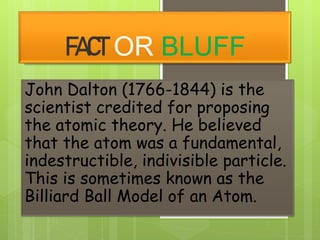
John Dalton (1766-1844) is the
scientist credited for proposing
the atomic theory. He believed
that the atom was a fundamental,
indestructible, indivisible particle.
This is sometimes known as the
Billiard Ball Model of an Atom.
FACT OR BLUFF
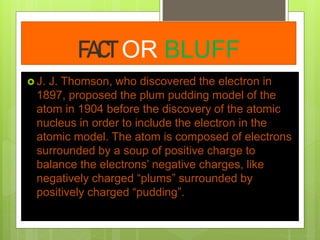
 J. J. Thomson, who discovered the electron in
1897, proposed the plum pudding model of the
atom in 1904 before the discovery of the atomic
nucleus in order to include the electron in the
atomic model. The atom is composed of electrons
surrounded by a soup of positive charge to
balance the electrons’ negative charges, like
negatively charged “plums” surrounded by
positively charged “pudding”.
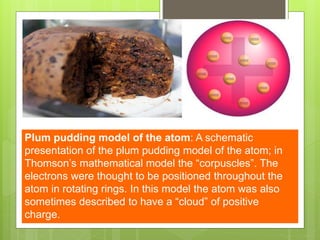
Plum pudding model of the atom: A schematic
presentation of the plum pudding model of the atom; in
Thomson’s mathematical model the “corpuscles”. The
electrons were thought to be positioned throughout the
atom in rotating rings. In this model the atom was also
sometimes described to have a “cloud” of positive
charge.
FACT OR BLUFF
According to Rutherford’s 1911
analysis, that J. J. Thomson’s so-
called “plum pudding model” of the
atom was correct.
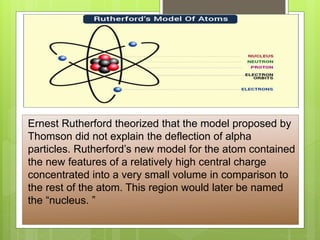
Ernest Rutherford theorized that the model proposed by
Thomson did not explain the deflection of alpha
particles. Rutherford’s new model for the atom contained
the new features of a relatively high central charge
concentrated into a very small volume in comparison to
the rest of the atom. This region would later be named
the “nucleus. ”
FACT OR BLUFF
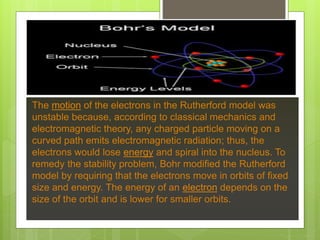
In 1913, Bohr proposed his
quantized shell model of the
atom to explain how electrons
can have stable orbits around the
nucleus.
The motion of the electrons in the Rutherford model was
unstable because, according to classical mechanics and
electromagnetic theory, any charged particle moving on a
curved path emits electromagnetic radiation; thus, the
electrons would lose energy and spiral into the nucleus. To
remedy the stability problem, Bohr modified the Rutherford
model by requiring that the electrons move in orbits of fixed
size and energy. The energy of an electron depends on the
size of the orbit and is lower for smaller orbits.
https://chem.libretexts.org/Textbook_Maps/
Physical_and_Theoretical_Chemistry_Text
book_Maps/Supplemental_Modules_(Phys
ical_and_Theoretical_Chemistry)/Atomic_T
heory/Atomic_Theory
https://www.ck12.org/c/physical-
science/daltons-atomic-
theory/lesson/Daltons-Atomic-Theory-MS-
PS/
https://courses.lumenlearning.com/boundle
ss-physics/chapter/the-early-atom/

atoms ppt.pptx