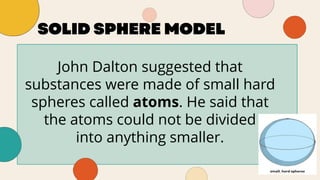
John Dalton suggested that
substances were made of small hard
spheres called atoms. He said that
the atoms could not be divided
into anything smaller.
New substances were formed
by the addition of other atoms
and the rearrangement of
those atoms.
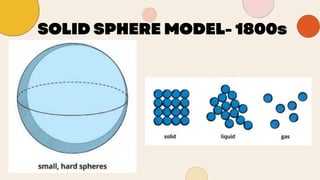
Dalton’s ideas are still useful today.
Scientists use a model similar to the
solid sphere model to describe the
particle arrangement in solids,
liquids and gases.
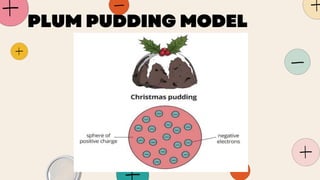
While carrying out extensive experiments, J J
Thomson discovered the electron. He modified
the solid sphere model of the atom to a sphere
of positive charge with negatively charged
electrons embedded within it. This was named
the plum pudding model, referencing the
currants scattered throughout a Christmas
pudding.
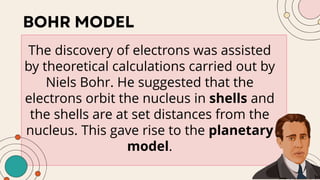
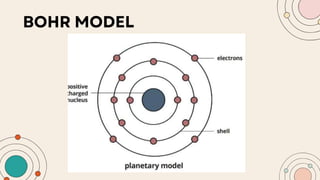
The discovery of electrons was assisted
by theoretical calculations carried out by
Niels Bohr. He suggested that the
electrons orbit the nucleus in shells and
the shells are at set distances from the
nucleus. This gave rise to the planetary
model.
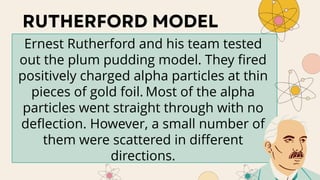
Ernest Rutherford and his team tested
out the plum pudding model. They fired
positively charged alpha particles at thin
pieces of gold foil. Most of the alpha
particles went straight through with no
deflection. However, a small number of
them were scattered in different
directions.
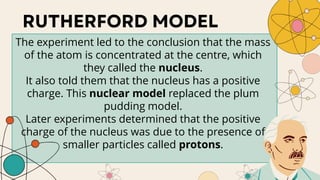
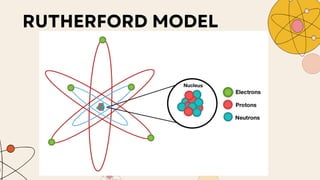
The experiment led to the conclusion that the mass
of the atom is concentrated at the centre, which
they called the nucleus.
It also told them that the nucleus has a positive
charge. This nuclear model replaced the plum
pudding model.
Later experiments determined that the positive
charge of the nucleus was due to the presence of
smaller particles called protons.
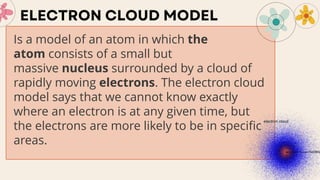
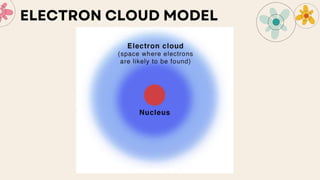
Is a model of an atom in which the
atom consists of a small but
massive nucleus surrounded by a cloud of
rapidly moving electrons. The electron cloud
model says that we cannot know exactly
where an electron is at any given time, but
the electrons are more likely to be in specific
areas.
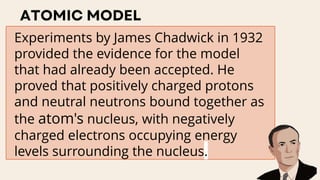
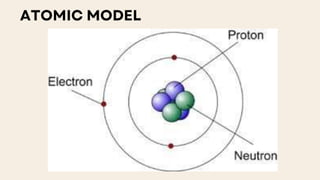
Experiments by James Chadwick in 1932
provided the evidence for the model
that had already been accepted. He
proved that positively charged protons
and neutral neutrons bound together as
the atom's nucleus, with negatively
charged electrons occupying energy
levels surrounding the nucleus.
Grade 7 Lesson 1 Introduction to scienctific models

Grade 7 Lesson 1 Introduction to scienctific models

  • 9.
    John Dalton suggestedthat substances were made of small hard spheres called atoms. He said that the atoms could not be divided into anything smaller.
  • 10.
    New substances wereformed by the addition of other atoms and the rearrangement of those atoms.
  • 11.
    Dalton’s ideas arestill useful today. Scientists use a model similar to the solid sphere model to describe the particle arrangement in solids, liquids and gases.
  • 13.
    While carrying outextensive experiments, J J Thomson discovered the electron. He modified the solid sphere model of the atom to a sphere of positive charge with negatively charged electrons embedded within it. This was named the plum pudding model, referencing the currants scattered throughout a Christmas pudding.
  • 15.
    The discovery ofelectrons was assisted by theoretical calculations carried out by Niels Bohr. He suggested that the electrons orbit the nucleus in shells and the shells are at set distances from the nucleus. This gave rise to the planetary model.
  • 18.
    Ernest Rutherford andhis team tested out the plum pudding model. They fired positively charged alpha particles at thin pieces of gold foil. Most of the alpha particles went straight through with no deflection. However, a small number of them were scattered in different directions.
  • 19.
    The experiment ledto the conclusion that the mass of the atom is concentrated at the centre, which they called the nucleus. It also told them that the nucleus has a positive charge. This nuclear model replaced the plum pudding model. Later experiments determined that the positive charge of the nucleus was due to the presence of smaller particles called protons.
  • 21.
    Is a modelof an atom in which the atom consists of a small but massive nucleus surrounded by a cloud of rapidly moving electrons. The electron cloud model says that we cannot know exactly where an electron is at any given time, but the electrons are more likely to be in specific areas.
  • 23.
    Experiments by JamesChadwick in 1932 provided the evidence for the model that had already been accepted. He proved that positively charged protons and neutral neutrons bound together as the atom's nucleus, with negatively charged electrons occupying energy levels surrounding the nucleus.