Assisting ESL Students Become Better Readers through
Schema Theory Applications
Submitted by
Abir Aboutaha
Northcentral University
Prescott Valley, AZ
1ATESL PD Session 2016
Workshop Outline
ATESL PD Session 2016 2
•The Concept of Schema Theory
•Schema and Jean piaget's Theory
of Cognitive Development
•Schema Theory and Reading Skill
•Types of Schemata
•Schema Theory and Models of Reading
Process
•Activating & Building the Schemata
•Schema Theory Application on Reading
Activities
•Schema Theory Limitations
•Group activities
•References
The Concept of Schema Theory
•The schema theory was one of the leading
cognitive learning theories.
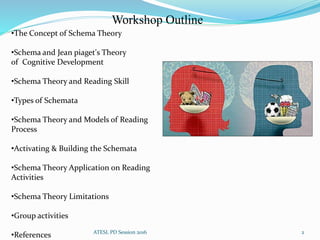
•It was first introduced by Frederic Bartlett in
1932 as a part of his theory.
•Bartlett (1932) defined schema as “the reflection
or active organization of people’s past
experiences.”
•Bartlett's theory confirmed that our
understanding of the world is formed by a
network of abstract mental structures which
represent one's understanding of the world.
3ATESL PD Session 2016
The Concept of Schema Theory
• According to Rumelhart (1980), Schema entails an
internal knowledge structure
• New information is compared to the existing
cognitive structure called "schema"
• Schema will be combined, extended, or adjusted to
accommodate new information
4ATESL PD Session 2016
Schema and Jean piaget's Theory of Cognitive
Development
 Schema is the mental representations of a set of ideas and actions,
which we use to understand and acquire new knowledge.
 Schema goes through the following processes:
Assimilation: The process of taking in information into our
previously existing schemas.
Accommodation: Involves alternating existing ideas or schema as
a result of new information or new experiences.
Equilibration: A mechanism that helps children in achieving a
balance between assimilation and accommodation.
(Piaget, 1928)
5ATESL PD Session 2016
Schema theory and Reading Skills
 "Schema theory is based on the notion that past
experiences lead to the creation of mental frameworks that
help us make sense of new experiences” (Nunan, 1999,
p.201)
 The reader's background knowledge and experiences play
an essential role in the reading comprehension.
 The written text does not carry meaning by itself.
6ATESL PD Session 2016
Schema theory and Reading Skills
 The text provides directions for the readers to assist them
in retrieving or constructing knowledge from their own
existing knowledge (prior knowledge and the previously
acquired knowledge structure called schemata) (Barlett,
1932).
 Comprehending a reading text demands an interactive
process between the readers' background knowledge and
the text.
7ATESL PD Session 2016
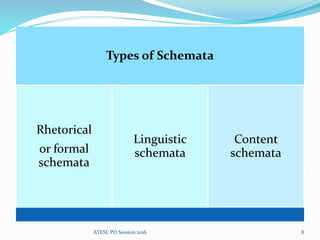
Types of Schemata
Rhetorical
or formal
schemata
Linguistic
schemata
Content
schemata
8ATESL PD Session 2016
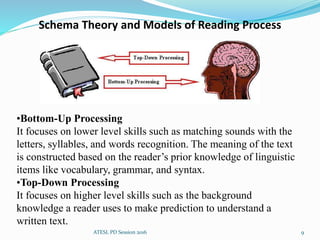
Schema Theory and Models of Reading Process
•Bottom-Up Processing
It focuses on lower level skills such as matching sounds with the
letters, syllables, and words recognition. The meaning of the text
is constructed based on the reader’s prior knowledge of linguistic
items like vocabulary, grammar, and syntax.
•Top-Down Processing
It focuses on higher level skills such as the background
knowledge a reader uses to make prediction to understand a
written text.
9ATESL PD Session 2016
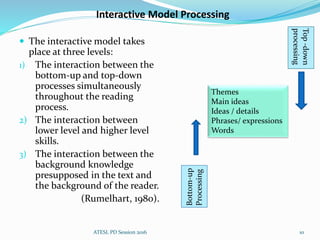
Interactive Model Processing
 The interactive model takes
place at three levels:
1) The interaction between the
bottom-up and top-down
processes simultaneously
throughout the reading
process.
2) The interaction between
lower level and higher level
skills.
3) The interaction between the
background knowledge
presupposed in the text and
the background of the reader.
(Rumelhart, 1980).
ATESL PD Session 2016 10
Top-down
processing
Bottom-up
Processing
Themes
Main ideas
Ideas / details
Phrases/ expressions
Words
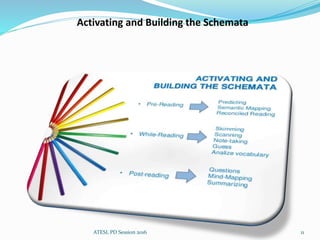
Activating and Building the Schemata
ATESL PD Session 2016 11
Schema Theory Application on Reading Activities
1) “Pre-reading activities” enable ESL learners to:
 Bring themselves to the text (new concepts, processes,
skills).
 Predict and activate schema, i.e. what learners already know
(prior knowledge and experiences).
 Make connections, predictions, inferences, pose questions,
etc.
 Motivate learners' interest and engagement.
 Use Multiple intelligence (MI).
 Build background knowledge
ATESL PD Session 2016 12
Schema Theory Application on Reading Activities
2) “During-reading activities” enable learners to:
 Bring the text (concept) to themselves by applying reading
strategies such as skimming and scanning
 Make meaningful connections.
 Pose critical questions
 Make guessing & inferences
 Visualize what students are reading and draw a clear mental
picture of the text
 Note changes in thoughts, feelings, and understandings.
ATESL PD Session 2016 13
Schema Theory Application on Reading Activities
3) "Post-Reading activities" enable the learners to:
Summarize the content in a few sentences
Discuss critically and pose questions
Become critically aware of how effective their thinking is to
gain deeper connections to themselves, other texts/concepts
and the external world.
Integrate new information with the existing knowledge
Extend schema and build background knowledge
Express new understanding and catch the missing parts of
the mental picture.
ATESL PD Session 2016 14
Schema Theory Limitations
Despite the popularity of schema theory application on the
reading skill, the opponents of the theory criticized it for
its limitations (Hudson, 1982; Carrell & Wallace in
Carrell, 1988).
 ESL learners may get the meaning without successfully
utilizing "syntactic, semantic or discourse constrains"
(Hudson, 1982, p.186).
 The overuse of schema theory may lead to the neglect of
other language areas and skills (Eskey, 1988).
ATESL PD Session 2016 15
Schema Theory Limitations
 Goodman in Carrell and Eisterhold (1983) described the reading
process as a "psycholinguistic guessing game" in which proficient
readers minimize their dependence on the linguistic items by
incorporating background knowledge to make guessing and
predictions about the text.
 The lack of prior knowledge contributes considerably to the
problems in reading comprehension.
ATESL PD Session 2016 16
References
 Barlett, F.C. (1932). Remembering: A Study in Experimental
and Social Psychology. London: New Psychological
Linguistics. Shanghai: Shanghai Foreign Education
Publication.
 Carrell, P.L. & Eisterhold, J.C. (1983). Schema Theory and
ESL Reading Pedagogy, in Carrell, P.L., Devine, J.
&Eskey, D.E. (eds.) (1988) Interactive Approaches to
Second Language Reading. Cambridge: CUP.
 Eskey, D.E. (1988). Holding in the Bottom: An Interactive
Approach to the language problems of second language
readers, in Carrell, P.L., Devine, J. &Eskey, D.E. (eds.)
(1988) Interactive Approaches to Second Language
Reading. Cambridge: CUP.
ATESL PD Session 2016 17
References
 Hudson, T. (1982). The Effects of Induced Schemata on the
Short Circuit in L2 Reading: Non-decoding Factors in
L2 Reading Performance, in Carrell, P.L., Devine, J.
&Eskey, D.E. (eds.) (1988) Interactive Approaches to
Second Language Reading. Cambridge: CUP.
 Nunan, D. (1999). Second Language Teaching and Learning.
Boston: Heinle &Heinemann.
 Piaget, J. (1928). The Child's Conception of the World.
London: Routledge and Kegan Paul.
 Rumelhart, D. (1980). Schemata: The building Blocks
Cognition, in R. J. Spiro, B.C. Bruce & W. F. Brewer.
(Eds.), Theoretical Issues in Reading Comprehension.
Hillsdale, NJ: Erlbaum.
ATESL PD Session 2016 18

ATESL Pd workshop 2016

  • 1.
    Assisting ESL StudentsBecome Better Readers through Schema Theory Applications Submitted by Abir Aboutaha Northcentral University Prescott Valley, AZ 1ATESL PD Session 2016
  • 2.
    Workshop Outline ATESL PDSession 2016 2 •The Concept of Schema Theory •Schema and Jean piaget's Theory of Cognitive Development •Schema Theory and Reading Skill •Types of Schemata •Schema Theory and Models of Reading Process •Activating & Building the Schemata •Schema Theory Application on Reading Activities •Schema Theory Limitations •Group activities •References
  • 3.
    The Concept ofSchema Theory •The schema theory was one of the leading cognitive learning theories. •It was first introduced by Frederic Bartlett in 1932 as a part of his theory. •Bartlett (1932) defined schema as “the reflection or active organization of people’s past experiences.” •Bartlett's theory confirmed that our understanding of the world is formed by a network of abstract mental structures which represent one's understanding of the world. 3ATESL PD Session 2016
  • 4.
    The Concept ofSchema Theory • According to Rumelhart (1980), Schema entails an internal knowledge structure • New information is compared to the existing cognitive structure called "schema" • Schema will be combined, extended, or adjusted to accommodate new information 4ATESL PD Session 2016
  • 5.
    Schema and Jeanpiaget's Theory of Cognitive Development  Schema is the mental representations of a set of ideas and actions, which we use to understand and acquire new knowledge.  Schema goes through the following processes: Assimilation: The process of taking in information into our previously existing schemas. Accommodation: Involves alternating existing ideas or schema as a result of new information or new experiences. Equilibration: A mechanism that helps children in achieving a balance between assimilation and accommodation. (Piaget, 1928) 5ATESL PD Session 2016
  • 6.
    Schema theory andReading Skills  "Schema theory is based on the notion that past experiences lead to the creation of mental frameworks that help us make sense of new experiences” (Nunan, 1999, p.201)  The reader's background knowledge and experiences play an essential role in the reading comprehension.  The written text does not carry meaning by itself. 6ATESL PD Session 2016
  • 7.
    Schema theory andReading Skills  The text provides directions for the readers to assist them in retrieving or constructing knowledge from their own existing knowledge (prior knowledge and the previously acquired knowledge structure called schemata) (Barlett, 1932).  Comprehending a reading text demands an interactive process between the readers' background knowledge and the text. 7ATESL PD Session 2016
  • 8.
    Types of Schemata Rhetorical orformal schemata Linguistic schemata Content schemata 8ATESL PD Session 2016
  • 9.
    Schema Theory andModels of Reading Process •Bottom-Up Processing It focuses on lower level skills such as matching sounds with the letters, syllables, and words recognition. The meaning of the text is constructed based on the reader’s prior knowledge of linguistic items like vocabulary, grammar, and syntax. •Top-Down Processing It focuses on higher level skills such as the background knowledge a reader uses to make prediction to understand a written text. 9ATESL PD Session 2016
  • 10.
    Interactive Model Processing The interactive model takes place at three levels: 1) The interaction between the bottom-up and top-down processes simultaneously throughout the reading process. 2) The interaction between lower level and higher level skills. 3) The interaction between the background knowledge presupposed in the text and the background of the reader. (Rumelhart, 1980). ATESL PD Session 2016 10 Top-down processing Bottom-up Processing Themes Main ideas Ideas / details Phrases/ expressions Words
  • 11.
    Activating and Buildingthe Schemata ATESL PD Session 2016 11
  • 12.
    Schema Theory Applicationon Reading Activities 1) “Pre-reading activities” enable ESL learners to:  Bring themselves to the text (new concepts, processes, skills).  Predict and activate schema, i.e. what learners already know (prior knowledge and experiences).  Make connections, predictions, inferences, pose questions, etc.  Motivate learners' interest and engagement.  Use Multiple intelligence (MI).  Build background knowledge ATESL PD Session 2016 12
  • 13.
    Schema Theory Applicationon Reading Activities 2) “During-reading activities” enable learners to:  Bring the text (concept) to themselves by applying reading strategies such as skimming and scanning  Make meaningful connections.  Pose critical questions  Make guessing & inferences  Visualize what students are reading and draw a clear mental picture of the text  Note changes in thoughts, feelings, and understandings. ATESL PD Session 2016 13
  • 14.
    Schema Theory Applicationon Reading Activities 3) "Post-Reading activities" enable the learners to: Summarize the content in a few sentences Discuss critically and pose questions Become critically aware of how effective their thinking is to gain deeper connections to themselves, other texts/concepts and the external world. Integrate new information with the existing knowledge Extend schema and build background knowledge Express new understanding and catch the missing parts of the mental picture. ATESL PD Session 2016 14
  • 15.
    Schema Theory Limitations Despitethe popularity of schema theory application on the reading skill, the opponents of the theory criticized it for its limitations (Hudson, 1982; Carrell & Wallace in Carrell, 1988).  ESL learners may get the meaning without successfully utilizing "syntactic, semantic or discourse constrains" (Hudson, 1982, p.186).  The overuse of schema theory may lead to the neglect of other language areas and skills (Eskey, 1988). ATESL PD Session 2016 15
  • 16.
    Schema Theory Limitations Goodman in Carrell and Eisterhold (1983) described the reading process as a "psycholinguistic guessing game" in which proficient readers minimize their dependence on the linguistic items by incorporating background knowledge to make guessing and predictions about the text.  The lack of prior knowledge contributes considerably to the problems in reading comprehension. ATESL PD Session 2016 16
  • 17.
    References  Barlett, F.C.(1932). Remembering: A Study in Experimental and Social Psychology. London: New Psychological Linguistics. Shanghai: Shanghai Foreign Education Publication.  Carrell, P.L. & Eisterhold, J.C. (1983). Schema Theory and ESL Reading Pedagogy, in Carrell, P.L., Devine, J. &Eskey, D.E. (eds.) (1988) Interactive Approaches to Second Language Reading. Cambridge: CUP.  Eskey, D.E. (1988). Holding in the Bottom: An Interactive Approach to the language problems of second language readers, in Carrell, P.L., Devine, J. &Eskey, D.E. (eds.) (1988) Interactive Approaches to Second Language Reading. Cambridge: CUP. ATESL PD Session 2016 17
  • 18.
    References  Hudson, T.(1982). The Effects of Induced Schemata on the Short Circuit in L2 Reading: Non-decoding Factors in L2 Reading Performance, in Carrell, P.L., Devine, J. &Eskey, D.E. (eds.) (1988) Interactive Approaches to Second Language Reading. Cambridge: CUP.  Nunan, D. (1999). Second Language Teaching and Learning. Boston: Heinle &Heinemann.  Piaget, J. (1928). The Child's Conception of the World. London: Routledge and Kegan Paul.  Rumelhart, D. (1980). Schemata: The building Blocks Cognition, in R. J. Spiro, B.C. Bruce & W. F. Brewer. (Eds.), Theoretical Issues in Reading Comprehension. Hillsdale, NJ: Erlbaum. ATESL PD Session 2016 18

Editor's Notes

  • #4 -Frederic Bartlett is a British psychologist and the first professor of experimental psychology at the University of Cambridge.
  • #5 -According to the concept of schema theory, past reactions and experiences lead to the construction of mental frameworks that help us construct new knowledge and make sense of new experiences (Bartlett, 1932; Nunan, 1999). -
  • #6 -Jean Piaget is a Swiss psychologist and genetic epistemologist. He is famous for his theory of cognitive development. -Schema example: My child first develops a schema for a horse. She knows that a horse is a large animal with four legs, hair and a tail. When she encounters a cow for the first time, she may call it a horse. It fits with her schema for the characteristics of the horse as a large animal with hair, four legs, and a tail. In this case, I have to tell her that this is a different animal called a cow, so she will modify her existing schema for a horse and create a new schema for a cow. -The processes through which schemas are adjusted or changed are known as assimilation and accommodation. 
  • #8 -Schema enables the learners to make predictions for more successful interaction that results in successful interpretations of the written text.
  • #9 Formal schemata refers to the structure and literary types of a text. The reader uses his/her schematic representations of the text such as short stories, poems, novels, newspaper articles, and academic articles to help understand the information in the text. For example, the formal schemata for a short story is the underlying structure that consists of a setting, characters, plot, and a reaction. Of course different genres have different structure. Carrell (1984) pointed out that the knowledge of what type of the text is can facilitate reading comprehension; however, the lack of such kind of knowledge will to some extent, hinder the readers’ understanding of the written text. Nevertheless, Carrell (1984) pointed out that formal schemata offer less power in the reading comprehension compared with the linguistic and content schemata. -Linguistic schemata refer to the reader’s linguistic knowledge of grammar, vocabulary, idioms, and expressions. Linguistic schemata play a substantial role in comprehending the text. Without linguistic schemata, the reader could not decode and understand the text. In other words, the effective decoding skills are vey important for the comprehensive understanding of the text. - Content schemata refer to the reader’s background knowledge of the content area of the written text (Carrell & Eisterhold, 1983). Content schemata are largely culture-specific.
  • #10 -Top-down model emphasizes the importance of schemata, and the readers’ prior knowledge contribution to the text. Schema theory attempts to describe the efficiency of prior knowledge as it affects the reader’s comprehension of the text. According to this model, the reader uses his/her prediction of meaning by using context clues and combining them with background knowledge.
  • #12 -After selecting a reading text, the following three stages of activities are typically used to activate and build students' schemata. -While schema activation and building can occur in all three stages, the pre-reading stage deserves a special attention since it is here where student's schemata will be achieved.