At Your Service Service Oriented Computing from
an EU Perspective Cooperative Information
Systems 1st Edition Elisabetta Di Nitto download
pdf
https://ebookultra.com/download/at-your-service-service-oriented-
computing-from-an-eu-perspective-cooperative-information-systems-1st-
edition-elisabetta-di-nitto/
Discover thousands of ebooks and textbooks at ebookultra.com
download your favorites today!
Here are some recommended products for you. Click the link to
download, or explore more at ebookultra.com
Service Oriented Enterprises 1st Edition Setrag Khoshafian
https://ebookultra.com/download/service-oriented-enterprises-1st-
edition-setrag-khoshafian/
Next Generation SOA A Real World Guide to Modern Service
Oriented Computing 1st Edition Thomas Erl
https://ebookultra.com/download/next-generation-soa-a-real-world-
guide-to-modern-service-oriented-computing-1st-edition-thomas-erl/
Engineering reliable service oriented architecture
managing complexity and service level agreements 1st
Edition Nikola Milanovic
https://ebookultra.com/download/engineering-reliable-service-oriented-
architecture-managing-complexity-and-service-level-agreements-1st-
edition-nikola-milanovic/
Achieving Service Oriented Architecture Applying an
Enterprise Architecture Approach 1st Edition Rick Sweeney
https://ebookultra.com/download/achieving-service-oriented-
architecture-applying-an-enterprise-architecture-approach-1st-edition-
rick-sweeney/
Programming WCF Services 4th Edition Design and Build
Maintainable Service Oriented Systems Juval Lowy
https://ebookultra.com/download/programming-wcf-services-4th-edition-
design-and-build-maintainable-service-oriented-systems-juval-lowy/
Service Oriented Distributed Knowledge Discovery 1st
Edition Domenico Talia
https://ebookultra.com/download/service-oriented-distributed-
knowledge-discovery-1st-edition-domenico-talia/
Backyard Beekeeping ANR 135 PUBLICATION 2004 EDITION
Alabama Cooperative Extension Service
https://ebookultra.com/download/backyard-beekeeping-
anr-135-publication-2004-edition-alabama-cooperative-extension-
service/
Trust and Reputation for Service Oriented Environments
Elizabeth Chang
https://ebookultra.com/download/trust-and-reputation-for-service-
oriented-environments-elizabeth-chang/
Service Computing Concept Method and Technology 1st
Edition Zhaohui Wu
https://ebookultra.com/download/service-computing-concept-method-and-
technology-1st-edition-zhaohui-wu/
At Your Service Service Oriented Computing from an EU
Perspective Cooperative Information Systems 1st Edition
Elisabetta Di Nitto Digital Instant Download
Author(s): Elisabetta Di Nitto, Anne-Marie Sassen, Paolo Traverso, Arian
Zwegers
ISBN(s): 9780262042536, 0262042533
Edition: 1
File Details: PDF, 8.49 MB
Year: 2009
Language: english
AT YOUR SERVICE
SERVICE-ORIENTED COMPUTING
FROM AN EU PERSPECTIVE
Elisabetta Di Nitto, Anne-Marie Sassen, Paolo Traverso, and Arian Zwegers
EDITED BY
At Your Service
Cooperative Information Systems
Michael Papazoglou, Joachim W. Schmidt, and John Mylopoulos, editors
Advances in Object-Oriented Data Modeling, Michael P. Papazoglou, Stefano
Spaccapietra, and Zahir Tari, editors
Workflow Management: Models, Methods, and Systems, Wil van der Aalst and Kees Max
van Hee
A Semantic Web Primer, Grigoris Antoniou and Frank van Harmelen
Meta-Modeling for Method Engineering, Manfred Jeusfeld, Matthias Jarke, and John
Mylopoulos, editors
Aligning Modern Business Processes and Legacy Systems: A Component-Based
Perspective, Willem-Jan van den Heuvel
A Semantic Web Primer, second edition, Grigoris Antoniou and Frank van Harmelen
Service-Oriented Computing, Dimitrios Georgakopoulos and Michael P. Papazoglou,
editors
At Your Service: Service-Oriented Computing from an EU Perspective, Elisabetta Di
Nitto, Anne-Marie Sassen, Paolo Traverso, and Arian Zwegers, editors
At Your Service
Service-Oriented Computing from an EU Perspective
edited by Elisabetta Di Nitto, Anne-Marie Sassen, Paolo Traverso, and Arian Zwegers
The MIT Press
Cambridge, Massachusetts
London, England
6 2009 Massachusetts Institute of Technology
All rights reserved. No part of this book may be reproduced in any form by any electronic or mechanical means
(including photocopying, recording, or information storage and retrieval) without permission in writing from the
publisher.
For information about special quantity discounts, please email special_sales@mitpress.mit.edu
This book was set in Times New Roman and Syntax on 3B2 by Asco Typesetters, Hong Kong.
Printed and bound in the United States of America.
Library of Congress Cataloging-in-Publication Data
At your service : service-oriented computing from an EU perspective / edited by Elisabetta Di Nitto . . . [et al].
p. cm. — (Cooperative information systems)
Presents results of collaborative research projects of the European Community’s Information Society
Technologies Programme about service-oriented computing.
Includes bibliographical references and index.
ISBN 978-0-262-04253-6 (hardcover : alk. paper) 1. Web services—Research—Europe. 2. Internetworking
(Telecommunication) 3. Application program interfaces (Computer software) 4. Business enterprises—
Computer networks. I. Di Nitto, Elisabetta. II. Information Society Technologies Programme.
TK5105.88813.A85 2009
006.70
6—dc22 2008027498
10 9 8 7 6 5 4 3 2 1
Contents
Foreword by Viviane Reding ix
Preface xi
1 Introduction 1
Elisabetta Di Nitto, Anne-Marie Sassen, Paolo Traverso, and Arian Zwegers
2 BIONETS: Bio-Inspired Paradigms for Service Provisioning in Pervasive Computing
Environments 13
Imrich Chlamtac, Daniele Miorandi, Stephan Steglich, Ilja Radusch, David Linner, Jyrki
Huusko, and Janne Lahti
3 Service Discovery in Pervasive Computing Environments 43
Sonia Ben Mokhtar, Nikolaos Georgantas, Valérie Issarny, Pierre-Guillaume Raverdy, and
Marco Autili
4 Unified Discovery and Composition of Heterogeneous Services: The SODIUM
Approach 67
Aphrodite Tsalgatidou, George Athanasopoulos, Michael Pantazoglou, Arne J. Berre, Cesare
Pautasso, Roy Grønmo, and Hjørdis Hoff
5 Compositional Service Engineering Using Semantic Interfaces 101
Jacqueline Floch, Richard T. Sanders, and Rolv Bræk
6 Developing Self-Adaptive Mobile Applications and Services with Separation-of-Concerns
129
Nearchos Paspallis, Frank Eliassen, Svein Hallsteinsen, and George A. Papadopoulos
7 Sensoria: Engineering for Service-Oriented Overlay Computers 159
Martin Wirsing, Laura Bocchi, Allan Clark, José Luiz Fiadeiro, Stephen Gilmore, Matthias
Hölzl, Nora Koch, Philip Mayer, Rosario Pugliese, and Andreas Schroeder
8 ASTRO: Supporting the Composition of Distributed Business Processes in the E-Government
Domain 183
Marco Pistore, Pietro Braghieri, Piergiorgio Bertoli, Antonio Biscaglia, Annapaola Marconi,
Stefano Pintarelli, and Michele Trainotti
9 WS-DIAMOND: Web Services—DIAgnosability, MONitoring and Diagnosis 213
Luca Console, Danilo Ardagna, Liliana Ardissono, Stefano Bocconi, Cinzia Cappiello, Marie-
Odile Cordier, Philippe Dague, Khalil Drira, Johann Eder, Gerhard Friedrich, Mariagrazia
Fugini, Roberto Furnari, Anna Goy, Karim Guennoun, Andreas Hess, Volodymyr Ivanchenko,
Xavier Le Guillou, Marek Lehmann, Jürgen Mangler, Yingmin Li, Tarek Melliti, Stefano
Modafferi, Enrico Mussi, Yannick Pencolé, Giovanna Petrone, Barbara Pernici, Claudia
Picardi, Xavier Pucel, Sophie Robin, Laurence Rozé, Marino Segnan, Amirreza Tahamtan,
Annette Ten Tejie, Daniele Theseider Dupré, Louise Travé-Massuyès, Frank Van Harmelen,
Thierry Vidal, and Audine Subias
10 SeCSE—Service-centric System Engineering: An Overview 241
Massimiliano Di Penta, Leire Bastida, Alberto Sillitti, Luciano Baresi, Neil Maiden, Matteo
Melideo, Marcel Tilly, George Spanoudakis, Jesus Gorroñogoitia Cruz, John Hutchinson, and
Gianluca Ripa
11 User-centric Service Creation and Execution 273
Antonio Sánchez, Carlos Baladrón, Javier Aguiar, Belén Carro, Laurent-Walter Goix, Jürgen
Sienel, Isabel Ordás, Rubén Trapero, and Alejandro Bascuñana
12 INFRAWEBS—A Framework for Semantic Service Engineering 299
Gennady Agre, Tomás Pariente Lobo, Zlatina Marinova, Joahim Nern, Andras Micsik, Andrei
Boyanov, Tatiana Atanasova, James Scicluna, José-Manuel López-Cobo, and Elpida Tzafestas
13 Enabling Data, Information, and Process Integration with Semantic Web Services: From a
New Technology Infrastructure to a Compelling Demonstrator 327
Alessio Gugliotta, John Domingue, Vlad Tanasescu, Leticia Gutiérrez Vilları́as, Rob Davies,
Mary Rowlatt, Marc Richardson, and Sandra Stinčić
14 AMIGO: Interoperable Semantic Services for the Smart Home Environment 357
Nikolaos Georgantas, Julia Kantorovitch, Ioanna Roussaki, Valérie Issarny, Jarmo Kalaoja,
Ioannis Papaioannou, and Dimitrios Tsesmetzis
15 Security and Dependability in the Evolving Service-centric Architectures 387
Aljosa Pasic, Daniel Serrano, Pedro Soria-Rodriguez, James Clarke, Pedro Carvalho, and
Antonio Maña
vi Contents
16 GridTrust—A Usage Control-Based Trust and Security Framework for Service-Based Grids
407
Philippe Massonet, Alvaro Arenas, Fabio Martinelli, Paolo Mori, and Bruno Crispo
17 Security-by-Contract (SDC) for Software and Services of Mobile Systems 429
Nicola Dragoni, Fabio Martinelli, Fabio Massacci, Paolo Mori, Christian Schaefer, Thomas
Walter, and Eric Vetillard
18 The ATHENA Framework for Cross-Organizational Business Processes 457
Matthias Born, Ulrike Greiner, Sonia Lippe, Rainer Ruggaber, Timo Kahl, Jörg Ziemann, and
Frank-Walter Jäkel
19 Dependability in Service-Oriented Systems 489
Johannes Osrael, Lorenz Froihofer, Piotr Karwaczyński, Jaka Močnik, and Karl M. Goeschka
20 Consolidating Research Results: The Industrial Perspective of NESSI 517
Stefano de Panfilis
21 S-Cube: The Network of Excellence on Software Services and Systems 523
Mike P. Papazoglou and Klaus Pohl
About the Authors 531
Index 557
Contents vii
Random documents with unrelated
content Scribd suggests to you:
The Project Gutenberg eBook of A Fortnight at the
Front
This ebook is for the use of anyone anywhere in the United States
and most other parts of the world at no cost and with almost no
restrictions whatsoever. You may copy it, give it away or re-use it
under the terms of the Project Gutenberg License included with this
ebook or online at www.gutenberg.org. If you are not located in the
United States, you will have to check the laws of the country where
you are located before using this eBook.
Title: A Fortnight at the Front
Author: Henry Russell Wakefield
Release date: February 11, 2020 [eBook #61370]
Most recently updated: October 17, 2024
Language: English
Credits: Produced by Al Haines
*** START OF THE PROJECT GUTENBERG EBOOK A FORTNIGHT AT
THE FRONT ***
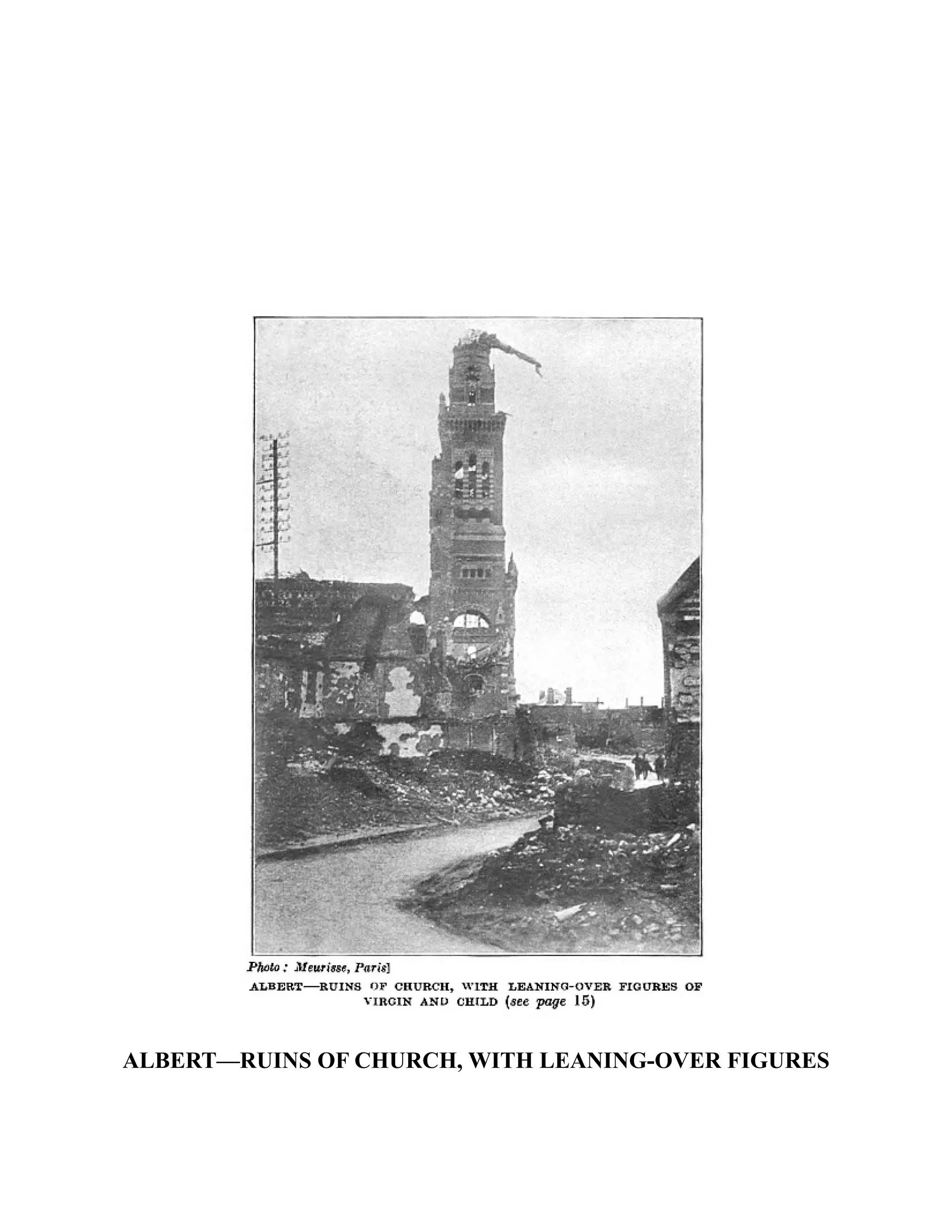
ALBERT—RUINS OF CHURCH, WITH LEANING-OVER FIGURES
OF
VIRGIN AND CHILD (see page 15)
A FORTNIGHT AT
THE FRONT
BY THE
RT. REV. H. RUSSELL WAKEFIELD
BISHOP OF BIRMINGHAM
WITH ILLUSTRATIONS
LONGMANS, GREEN AND CO.
39 PATERNOSTER ROW, LONDON
FOURTH AVENUE & 80TH STREET, NEW YORK
BOMBAY, CALCUTTA, AND MADRAS
1915
All rights reserved
A FORTNIGHT AT THE FRONT
A CURE FOR PESSIMISM
Whether any one has the right to make any statement with regard to
something which has only been studied for a short time is questionable, and,
therefore, I do not pretend to any dogmatic utterance, but I wish simply to
state the effect produced upon me by my time abroad. My experience goes
from thirty-five yards from the German trenches right back to the most
southern and westerly of our bases. Bearing in mind that through the
courtesy of Headquarters I have been able to see everything under the most
comfortable and time-saving circumstances, it must be admitted that though
my view may have been superficial, it certainly was comprehensive. I had
the satisfaction of being able to give a kind word and a blessing even where
one was asked not to speak too loud in case our enemies should overhear; I
held confirmations in several places, and addressed troops, both wounded
and strong and hearty, on many occasions.
The first thing which struck me was the great courtesy and consideration
of everybody who was concerned with our visit. That the authorities at
Headquarters who were working, as I know, both early and late, must have
felt that one was a very unnecessary addition to their troubles is, I should
fancy, unquestionable; yet not only did they never show it, on the contrary,
they worked every day to make our visit easy and delightful. I know that the
Lord Mayor of Birmingham, who spent nearly a week with me, feels this as
warmly as myself, and it shows the wonderful calm of an Englishman that
we were both so kindly treated, though we added in no way to the happiness
or usefulness of anybody. What I have said with regard to the Staff at
Headquarters applies also to all those who had to do with us at all the
various centres.
The next thing which struck me was the way in which the British have, as
it were, taken possession of the whole of that area for which our people are
responsible. You go through village after village, and the ubiquitous person
is our soldier. He appears out of farm buildings, he leans over gates, holding
difficult conversation, not only with the young maidens of the village, but
with dear old ladies who can be seen taking a motherly interest in him. In the
towns he pervades the whole place. Always bright and cheerful, and yet
conscious of his responsibility, our khaki-clad young fellow maintains his
good character and earns the respect of the people. I asked a French
Archbishop and also a French Bishop, the jurisdiction of both of whom is
within our area, if they were satisfied with the behaviour of our men, and on
each occasion the answer was that they were beyond reproach. We do not
seem to be visitors in France, but we almost appear to have taken root there.
The buildings we are putting up, the railway extensions we are making, the
way in which we have turned bare spaces into towns, all these things make
one feel as if we were permanent institutions and not birds of passage. It is
not altogether wonderful that some of the more ignorant French people
should say that they do not believe we are ever going away; whilst on the
other hand, some French officers told me that their confidence in our
alliance had become immensely greater because we had done everything in
such a stable manner, one man going so far as to say to me that he
considered one of the surest signs of our determination to see this war
through was that so many of our officers had taken houses for three years
certain. It is only just to add in regard to a large number of the buildings we
have put up that they can be taken down, carried away and be put up over
here with practically no difficulty. Another impression produced upon me
was one of increasing respect for the adaptability of the Englishman. It
shows itself in innumerable military ways which I hardly have the right to
mention, but one may be permitted the general observation that there is no
kind of obstacle which we do not seem to surmount and even sometimes to
turn to an advantage. What we have done in turning to good use even some
extraordinary effects of shell fire upon buildings made me more than
astonished; perhaps I may be allowed one instance. Somewhere in France
there was a railway station and near it an estaminet; both, as far as one could
judge, were destroyed, with the exception of a portion of a chimney. By
some miraculous means which I cannot describe, one went along all kinds of
underground places, then up some steps and into what I believe was a
portion of the chimney, and from there through a crevice one was able to see
a good deal of the German lines quite close by. When one came out again,
one could not in the least tell where it was that one had been. To take a less
warlike instance of our power of getting over difficulties: a certain officers'
mess is established in a French farm which a few months ago had a duck
pond which gave forth an odour which was both unpleasant and unsavoury.
Consequent, I believe, upon the enthusiasm of a particular major, within four
months the pond was empty, the ground was levelled, the seeds were sown,
and when I was there the pond had become quite a respectable lawn-tennis
ground. It is safe to say that one's gardener would have expected to have four
years instead of four months for such an operation.
I may give, perhaps, another instance of this special quality of the
Britisher. The Artists' Corps went out to France for ordinary duties; they
have now become an Officers' Training Corps, and an enormous percentage
of them are holding commissions in every kind of regiment.
Not only so, but they are largely instrumental in carrying on a kind of
Sandhurst on French soil; they are, I believe, influential in the management
of a bomb school, and last, but not least, they have a band in which the
soldiers rejoice, and of which I wish there were many more at the Front.
I am personally greatly indebted to the Artists; first, because a very
charming officer of their number was placed in charge of me for a
considerable time and bore with me in patience; secondly, because I found
such a hearty welcome from them at their mess and so many friends amongst
their number; thirdly, because they turned up so well at the Parade Service at
which I was the preacher!
The next thing which struck me was the calm in the trenches. Over here
in England we seem to live in a continual change of feeling. We get the
account of some engagement in which we are successful, and immediately
we conclude the war is going to be over to-morrow, and people who are
wont to go abroad for a holiday think it is time they went to Messrs. Cook's
office to see about their tickets. But on the way they see the placard of an
evening paper which tells of some minor disaster to our Forces, and then
they return home, they call together the family and they tell them that the
future means either the destruction of the country or twenty years of misery
and poverty; the bulk of the misfortune, of course, being sure to rest upon
their own individual shoulders. It is refreshing to get away from this
atmosphere and to go into the trenches where everybody is doing his bit of
work, content with somewhat unpleasant circumstances so long as through
him England is served. Whenever, in future, I am inclined towards a fit of
pessimism, I shall shut my eyes in order to see once again, with the vision of
the spirit, a stalwart Britisher of the Worcester Regiment, not very far from
the German lines, on a certain afternoon, when a most appalling
thunderstorm was raging and some German shells were falling. He was
munching the thickest slice of bread and jam that I have ever seen, and
looking with a mild contempt at the intruding figure of an unknown padre
whom a considerable number of his comrades were greeting because they
recognised in him their Bishop. He put down now and again his refreshment
in order to do some bit of work, but he was just as calm and collected as if
he had been in his Worcestershire village and not in the trenches.
That which carries our men through so many difficulties is another thing
which impressed me—namely, their unfailing sense of humour; a humour
which is never really hurtful even when exercised upon some one deserving
of satire. When he christens a road along which there are a couple of miles
of Army Service carts "Lorry Park," when he finds every kind of strange
anglicising for Flemish or French words, we know that he is not only having
some fun for himself, but also providing amusement for those who come
after him. The same humour shines out when he is in hard case. A chaplain
told me that he had been addressing informally some wounded men who had
just arrived from the trenches. He was expatiating upon the glories of the
Victoria Cross because he noticed some of the men came from a regiment
one of whose number had recently received that coveted distinction.
Suddenly his eloquence was disturbed by a voice proceeding from a man,
both of whose feet were swathed in bandages, who remarked, "Never mind
the Victoria Cross, give me the Victoria 'Bus!" Obviously the soldier's sense
of humour was conquering his pain, and his remark made the rest of the
party forget their sufferings for a short time. The only excuse that I can find
for the fluctuating feelings of the people at home is the remarkable way in
which they minister to Tommy's love of fun. He has every kind of quaint
name for the people in "Blighty"—the name which, though derived, I
believe, from an Eastern word denoting home, nevertheless expresses
something of the attitude noticeable at certain periods, both in people and
Press in England, and which appeals through its appropriateness to the
humour of our soldiers. But at the same time there is a wonderful
thankfulness shown in the face of officers and men when the time arrives for
the short spell of leave. The old country and the friends left behind there are,
after all, the things closest to the hearts of our men.
The next thing upon which I would comment is the great mutual respect
between ourselves and the French. Every time I asked any of our people
what they thought of our Allies the answer was one of unhesitating
commendation, whilst in the same way when I spoke to French officers or
men, they expressed themselves in terms of absolute trust in our nation and
her statesmen and soldiers. As one who saw the French during the war of
1870, when—being a boy—I was very susceptible to impressions, I can
hardly express the difference I notice between the nation then and now. In
the former war there was excitement, impulsiveness, over-confidence, want
of ballast; to-day there is quietude, earnestness, and withal, assurance of
eventual victory. More than once I journeyed through a considerable part of
the French lines, and I assert with confidence that the Army of France at the
present time is incomparably superior to that which she placed in the field in
1870. As to her civilians, I only saw women, children, and old men; I did
not, in all my thousand miles of travel, discover a single able-bodied person
of military age out of uniform.
The harvest, a very good one, was in full swing. Every family was out in
the fields, all doing something towards the in-gathering. I have a picture now
before my eyes of seven people, all undoubtedly coming from the same
house, working away hard, whilst at the tail end of the procession appeared
what might have been the great-grandpapa, no longer capable of bending
down for harvesting, but who, nevertheless, had his piece of work in
carrying about the baby, who, of course, could not be left behind alone in the
house. The whole nation is doing its utmost; can we quite honestly say the
same of England?
VERMELLES—THE CASTLE RUINS
Another subject which was constantly commented upon and appreciated
at the Front was the thoroughness with which the Germans had done and
were doing everything. It was a matter of genuine regret with our people that
they could not be as wholehearted as they would wish to be in appreciation
of our enemies, in consequence of the way in which they had sullied the fair
fame of noble warfare. If there is one thing a soldier wishes to do more than
another it is to be able to speak with respect and admiration of his opponent,
and, unfortunately, what the German would have gained by his magnificent
methodical thoroughness, he has lost through his dishonourable and brutal
conduct of the war. At the same time, it should be fairly stated that in the
judgment of those to whom I spoke the destruction of churches by our foes
has not been so wanton as is sometimes put before us. It was suggested to
me that in all probability the church was often destroyed for the same reason
as a high chimney, because it formed an excellent observation post.
Before I leave the subject of the men at the Front, one of their constant
questions must be noted, which was whether they might expect as much
keenness on the part of our civilian population as was being shown by those
under arms. "We are doing our bit, but we shall need increased, even greatly
increased, assistance; I suppose we can be sure of getting it." Those words
still ring in my ears.
WITHIN RANGE OF FIRE
Perhaps it would be of interest to give a little account, without, of course,
mentioning names, of the events of one or two days when a visit was paid to
the trenches. On one occasion after motoring through towns that are a
household word, both at home and with our Allies, towns which have seen
the Germans in them and then driven out of them, places where the buildings
are practically level with the ground, the limit for vehicular traffic is reached
and one goes forward on foot. Soon you reach a cutting in the ground and
you begin to walk along a trench. You turn now and again either to right or
left, seeing sign-posts telling sometimes in comic language and sometimes
only by number the name, as it were, of the underground street; you then rise
a little and find yourself walking in the inside of houses so shattered that you
cannot tell much about what they originally were until you are told that they
formed a street in a little overgrown village of which nothing is left, and the
last inhabitant of which was the station-master, who refused to leave though
there was neither train, station nor house for himself left, because so long as
he remained on the spot he could claim his pay. Forcible measures had at last
to be used to secure his departure. Where you are walking you are yourself
hidden from the enemy, but are within the range of their fire. You are taken
up to an observation post, where one of your companions incautiously takes
out a white pocket-handkerchief and is hurriedly told to put it back in his
pocket. You come down again and you proceed cautiously along trenches.
Now and again shells pass over, and your careful guide looks to see in what
direction they are falling, as, though he is quite unconcerned for himself, he
knows that he is responsible for the safety of the troublesome visitor. You are
told to keep your head down and not to show, for the moment at any rate,
any desire to view the landscape. Soldiers are dotted about here and there, all
of them ready to give a kindly greeting, and then at last you reach a point
where you are told not to speak loudly because practically only a few yards
away is the enemy, who, were he to hear conversation, might think it worth
while to throw over a hand grenade. What looks like a tiny bit of glass at the
end of a short stick is there before you, and you are asked to look into it;
when you do the enemies' trenches are visible to you. Beyond an occasional
ping against a sandbag, you have heard nothing to note the existence of rifle
fire, except that the men you have passed have got these weapons to hand.
You tell the men at the advanced posts how proud their country is of them,
how thankful you are to have seen them, how you pray that God may bring
them back safe to their homes; you get rid of all cigars or cigarettes you may
have upon you, wishing that you had thousands more, and then you return
home, varying perhaps the route through the communication trenches.
On another occasion our way took us through a town which is absolutely
razed to the ground and is still under shell fire. There I saw two soldiers busy
with spades, and I asked what kind of fortification they were putting up, to
which, with a broad grin, one replied that they were looking for souvenirs.
He was kind enough to give me a complete German cartridge case, for which
he refused to take any remuneration. Going on a little farther in this town,
we went down some steps and found ourselves in an underground club full
of soldiers, who were having a hot meal, were reading papers and playing
games, everything being presided over by perhaps the most magnetic person
I met on my travels, a young Chaplain to the Forces, who would not wish his
name to be mentioned, though there is probably no one out at the Front who
will not know to whom I refer. When we went from this place towards the
more advanced trenches, I was taken along a road which looked perfectly
harmless, when suddenly a stalwart Scotchman told my companion and
myself that we must get off it at once as it was a favourite target for German
Maxims. Never was General more obediently submitted to than was this, I
believe, private soldier. It was on this occasion that we had tea in the dug-out
of the Colonel, who bears a name distinguished in English naval, military
and sporting life. A characteristic of the German trenches which I noticed on
this and other occasions, was that their sandbags seemed to be generally
white in colour, at any rate in those of the first line. Leaving the trench on
this particular day, we had to go through an almost alarming thunderstorm,
which in the course of half an hour made a sea of mud of the place which
had been quite dry before. It was curious to notice how petty the sound of
the guns appeared as compared with the artillery of heaven.
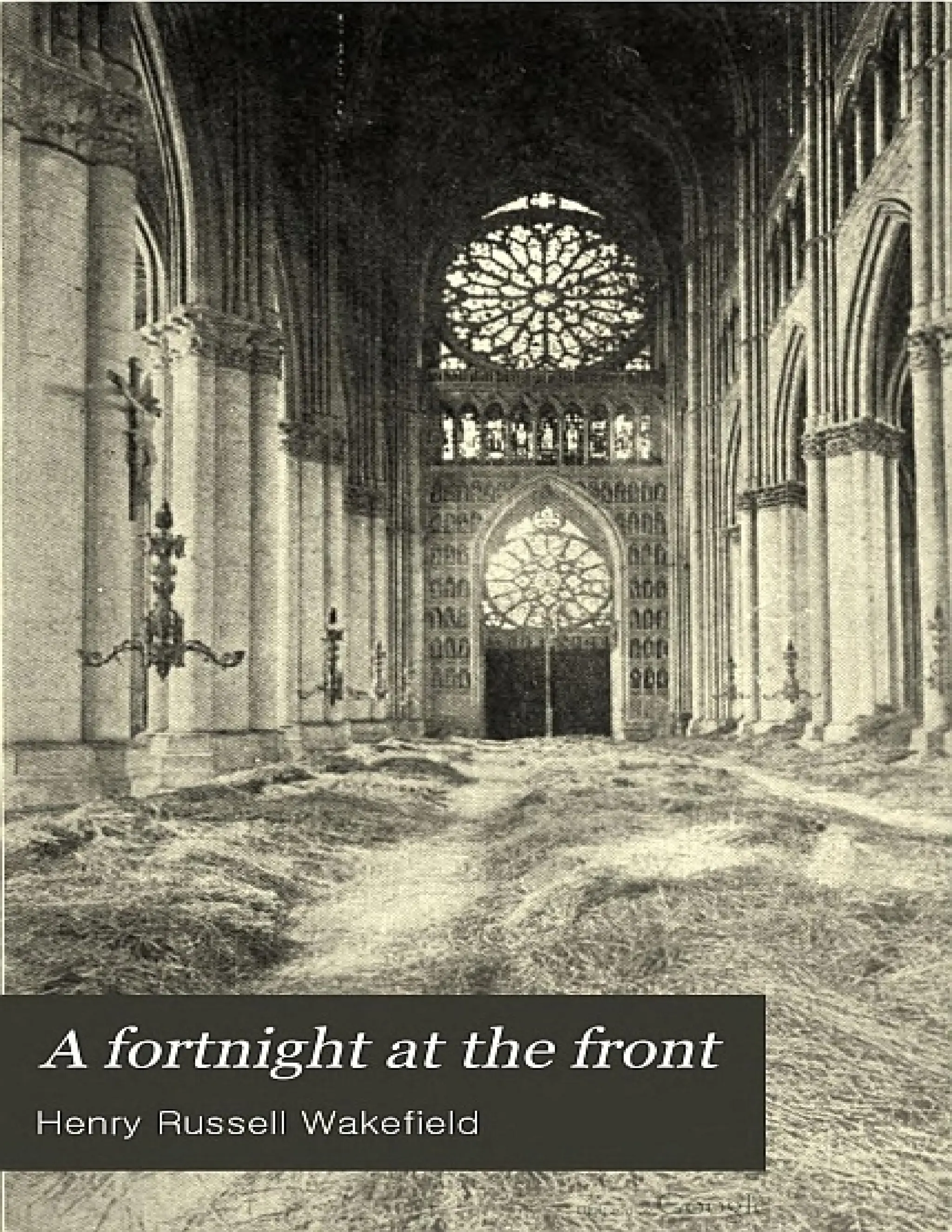
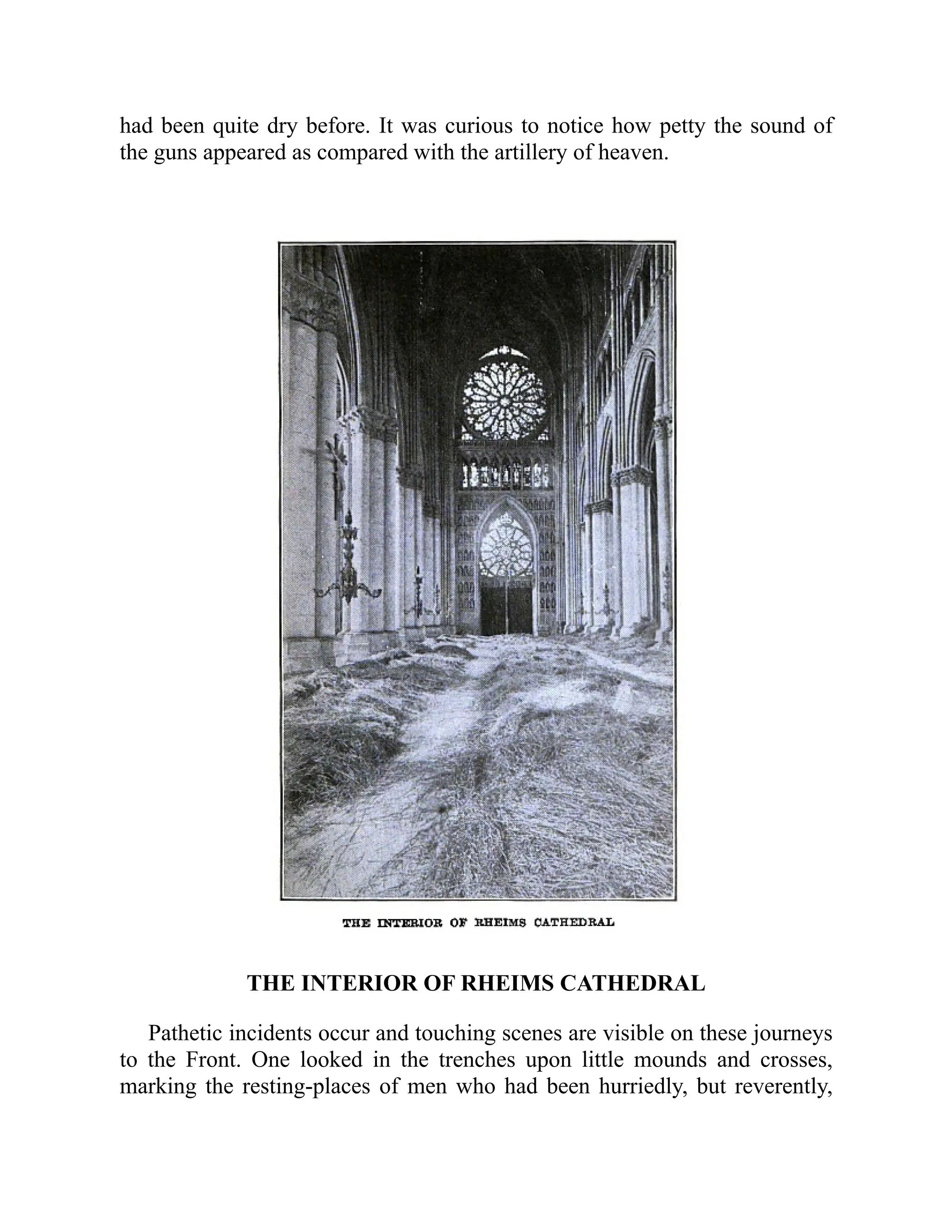
THE INTERIOR OF RHEIMS CATHEDRAL
Pathetic incidents occur and touching scenes are visible on these journeys
to the Front. One looked in the trenches upon little mounds and crosses,
marking the resting-places of men who had been hurriedly, but reverently,
buried. There they are side by side with their living comrades, who are doing
their work whilst their brothers sleep. Dotted all about the country are little
cemeteries, which tell of devotion unto death, and which remind one of all
the sorrow this war has caused. It is strange to see how religious emblems
appear to have been strong against shell. Constantly you would see a church
almost totally destroyed and yet the crucifix untouched, and who will ever
forget that sight which can be seen for miles around, of the tower which has
been almost shattered to pieces and yet the statue of the Virgin and Child,
which was near the top of it, though bent over completely at right angles,
still remains, as it were blessing and protecting the whole neighbourhood.
This leads to the consideration of the religious condition of our troops as
affected, first, by the churches and worshippers of France, and, secondly, by
their own experience in this war. More than one mentioned the pleasure felt
at the sight of the little wayside shrines which they passed on their march.
Others commented upon the large numbers of people they saw flocking to
their early communion, and many expressed a hope that permission might be
secured for parade services to be held in the naves of the various parish
churches during the winter time, when the cold is great and when it is almost
impossible to secure any suitable building other than the churches for
worship. Negotiations have been going on upon this matter, and some of the
French ecclesiastics are not unfavourable, but a difficulty which is
prominent to the minds of some of the French Bishops arises out of the
recent separation of Church and State. There is a considerable party in
France anxious to secure the ecclesiastical buildings for different sects, and
even in some cases for secular purposes. It is felt, therefore, that a precedent
might be made of a dangerous character were permission to be given to our
troops to have services in these sacred buildings. We may, however, be quite
confident that those responsible for the spiritual care of our soldiers in
France will deal with this whole question wisely and tactfully. It does seem
strange that men who are fighting for the liberties and rights of France, and
whose religion is, after all, not antagonistic to the faith of the people of that
country, may not have the shelter of the less sacred part of a parish church in
order to offer up their prayers to Almighty God. It is when one gets face to
face with such circumstances as these that the pettiness of religious strife
strikes one with force. Is it just possible that out of this great conflict there
may arise a stronger desire for religious unity than the world has ever yet
known?
What his experience of war is doing for the soldier in regard to religion is
remarkable. It would have been possible that the sight of humanity striving
to the death and inflicting horrible suffering might have made our young
fellows despair of Christianity. They might have argued that it was of no
avail to teach the religion of Jesus when no effect was produced upon
international conduct; but they have been able to look more deeply into
matters and to realise that not Divine intention was at fault, but human
refusal to follow true teaching. They have been able to see God through the
cloud of smoke raised by shot and shell, and the Presence of the Divine has
not been obscured by the horrors of war. Conscious of the seriousness of the
work in which they are engaged, feeling every moment the nearness of
eternity, our soldiers have in no craven spirit, but with a due remembrance of
their relationship to God and to eternity, turned to religion as a stay in the
hour of conflict. What struck one very much was the desire for the
understanding of a few central truths, and the evident keenness for big
dogmatic statements as to great matters. There was some impatience shown
when small details were pressed too strongly, and when terms were used
familiar to the theologian, but absolutely incomprehensible to a plain,
simple, God-fearing officer or private. It sounds almost an impertinence to
speak of the devotion of the chaplains at the Front, but I am bound, after
having mixed with a large number of them, to express the deep thankfulness
one feels to the padre for all that he is doing. The young men who are now
for the first time seeing service as clergy associated with troops, are
exceptionally fortunate in the leadership they get from the Army chaplains of
long standing. There is something about work with the soldier which
intensifies the humanity of any one working for his spiritual welfare.
HOPES FOR THE FUTURE
It would neither be right nor in good taste to mention any names of
chaplains, but one may instance the kind of work which one saw them doing.
I have already referred to the dug-out club in a destroyed town. I may go on
to tell of one who on his bicycle, sometimes late at night, would go away
from the centre where he was stationed to outlying districts for the purpose
of giving lantern lectures to our troops. When last I saw him he was
arranging to give this particular entertainment to a number of our Indian
wounded. This chaplain was the life and soul of a great parade service held
in a square in one of the French towns, where, by his voice and his
enthusiasm, he made the whole service go with fervour and effect. I
remember how, on this occasion, numbers of French people came up to me
and told me that they were certain that this outward acknowledgment by our
soldiers of their devotion to God would be helpful to the spirituality of the
whole town. The chaplains abroad have to be business men as well as clergy.
The arrangements for services and other matters take up a considerable
amount of time. At one base there are about thirty places to arrange for every
Sunday, and in these thirty places over sixty services are held. It is no light
matter for the Senior Chaplain to see that week by week everything is in
order. This particular instance is not an isolated one, and is taken simply at
random. Now that there is a Bishop as Deputy Chaplain of the Forces in
France, everything should go on in a perfectly satisfactory manner and with
great advantage to the chaplains themselves.
SPECIMEN OF SERVICE LIST OF ONE OF
OUR BASES AT THE FRONT
DIVINE SERVICES—SUNDAY, AUGUST 22, 1915.
H.C.=Holy Communion, P.S.=Parade Service, E.S.=Evening Service.
CHURCH OF ENGLAND.
B. Details.
8 a.m., H.C. in Orderly Room.
10.46 a.m., P.S. in Y.M.C.A. Hut No. 1.
Reinforcement Camps.
6.30 and 7.30 a.m., H.C. in C.A. Hut.
11.30 a.m., P.S. (open air, weather permitting) at Y.M.C.A.
Hut No. 2 for all Divisions.
If Wet.
10 a.m., P.S. (9, 12, 14 Divisions), C.A. Hut.
11 a.m., P.S. (16, 17, 18 Divisions), C.A. Hut.
11.30 a.m., P.S. (19, 20, 37, 61 Divisions) in Y.M.C.A. Hut
No. 2.
7 p.m., E.S., C.A. Hut.
No. 18 General Hospital.
6.30, 8.16, and 11.30 a.m., H.C., Church Tent.
11 a.m., P.S., Church Tent.
6 p.m., E.S., Church Tent.
No. 1 Canadian Hospital.
6 a.m., H.C., Recreation Tent.
8 a.m., H.C., Nurses Tent.
9.16 a.m., P.S., Recreation Tent.
Liverpool Merchants, St. Johns and Allied Forces Hospital.
7 a.m., H.C., Officers Recreation Tent, L.M.M. Hospital.
6.30 p.m., E.S., Officers Recreation Tent, L.M.M. Hospital.
10.30 a.m., P.S., Ward B. 25 in 23 General Hospital.
No. 3 Canadian Hospital.
6.46 a.m., H.C.
10.30 a.m., P.S.
6 p.m., E.S.
22 General Hospital.
6.16 and 7 a.m., H.C.
11.16 a.m., P.S.
6.30 p.m., E.S.
Convalescent Camp and Isolation Hospital.
6.30 and 8.15 a.m., H.C. in Church Tent, 18 General Hospital.
10 a.m., P.S., Tipperary Hut.
Detention Camp.
10.30 a.m., P.S.
Army Service Corps.
6 p.m., Open Air Service.
23 General Hospital.
6.30 a.m., H.C.
10.30 a.m., P.S. in Ward B. 25.
6.30 p.m., E.S. in Ward B. 25.
24 General Hospital.
6.30 and 8 a.m., H.C.
10.45 a.m., P.S. in Y.M.C.A. Hut 1.
5.30 p.m., E.S. in A 35.
26 General Hospital.
7.30 a.m., H.C., in Ward 15.
10.46 a.m., P.S., Y.M.C.A. Hut.
6.30 p.m., E.S. in 23 General Hospital, Ward 25.
Reserve Parks.
No. 32, P.S., 12.16 p.m.
Nos. 10 and 11, E.S., 6.30 p.m.
20 and 25 General Hospital.
6 and 7 a.m., H.C. in Church Hut of No. 20.
12.15 p.m., P.S. in Y.M.C.A. Hut.
Westminster Hospital.
7 a.m., H.C., English Church.
7.30 a.m. and 12 noon, H.C.
11 a.m., P.S.
6.15 p.m., E.S.
No. 2 Canadian Hospital.
7.30 a.m., H.C.
10 a.m., P.S.
7.30 p.m., Ward Service.
PRESBYTERIAN.
Reinforcement Camps.
9.30 a.m., P.S. (15 and 51 Divisions), Y.M.C.A. Hut 2.
10.30 a.m., P.S. (other Divisions), Y.M.C.A. Hut 2.
6.30 p.m., E.S., all Units, Y.M.C.A. Hut 2.
No. 1 Canadian Hospital.
10 a.m., P.S. in Recreation Tent for all Hospitals except
18 General.
Presbyterian and Nonconformists.
11 a.m., P.S., Y.M.C.A. Hut.
6 p.m., E.S., Church Tent, 25 General Hospital.
7.46 p.m., E.S., Y.M.C.A. Hut.
ROMAN CATHOLIC.
For all Reinforcements, Camps and Base Details, etc.
9.30 a.m., P.S. in Parish Church.
6 p.m., E.S. in Parish Church.
9 a.m., P.S. in Ward 25, 23 General Hospital
7.15 a.m., Holy Mass with Communion in Ward B. 25, 23
General Hospital, for all Hospitals except 18 General
and No. 1 Canadian.
No. 1 Canadian Hospital.
10 a.m., P.S. in Officers MOM Tent.
WESLEYAN AND OTHER NONCONFORMISTS.
All Hospitals, Convalescent Camp and Details.
9.30 a.m., P.S., Y.M.C.A. Hut 1, for all Divisions.
11 a.m., P.S. in S.C.A. Hut.
See Presbyterian Notices.
Evening Services in C.A., Y.M.C.A. and S.C.A. Huts.
WILL UNITS PLEASE COPY ORDERS REFERRING TO
THEMSELVES?
I come now to say a word as to the care given to the bodies of our men.
The hospitals from the trenches up to the base are admirable, and the
appliances are of the most modern description. I shall not soon forget how in
one place I saw for the first time the travelling X-ray caravan. It seemed very
strange to be in the hospital whilst the photograph was taken and then to go
out in the road and see the machine which did the work. What a convenience
this must be in these clearing hospitals can well be imagined. One cannot
mention all the splendid stationary and other hospitals over which one was
shown by officials with untiring patience and courtesy. The pride which our
fellow-citizens from the Dominions beyond the seas take in the fitting up
and working of their hospitals is quite extraordinary, and the same spirit
animates the private individuals who have their own large institutions in
hotels, casinos, and such-like places that they have taken over. I am not sure
that I was not more struck with the splendid arrangements made by the
Liverpool merchants for our wounded than by anything else of this kind.
There is also what one may call a Convalescent Home for the tired soldier,
weary in body, in mind and nerve, which, thanks to the man at the head,
seems to be very effective. We all know how the strain of the Front tells
upon our soldiers, and especially upon the younger men. They come back to
this excellent Home by the thousand; they are kept until really restored, and
then they go back cheerful and ready for duty. The last thing before they
return is a little service in the chapel, which I had the honour on one
occasion to take. It was interesting when paying a visit to another hospital to
find that it had been formerly a school, and that as the whole building had
not been taken over some of the classes were still being held. I intruded into
the schoolroom and gave a talk to the young people about the Alliance.
Although I must refrain most reluctantly from saying anything about the
great military personages whom I met in France, and with whom I was so
greatly impressed, I may perhaps refer to two French persons of distinction,
in no way connected with the war, whom I was privileged to meet. First
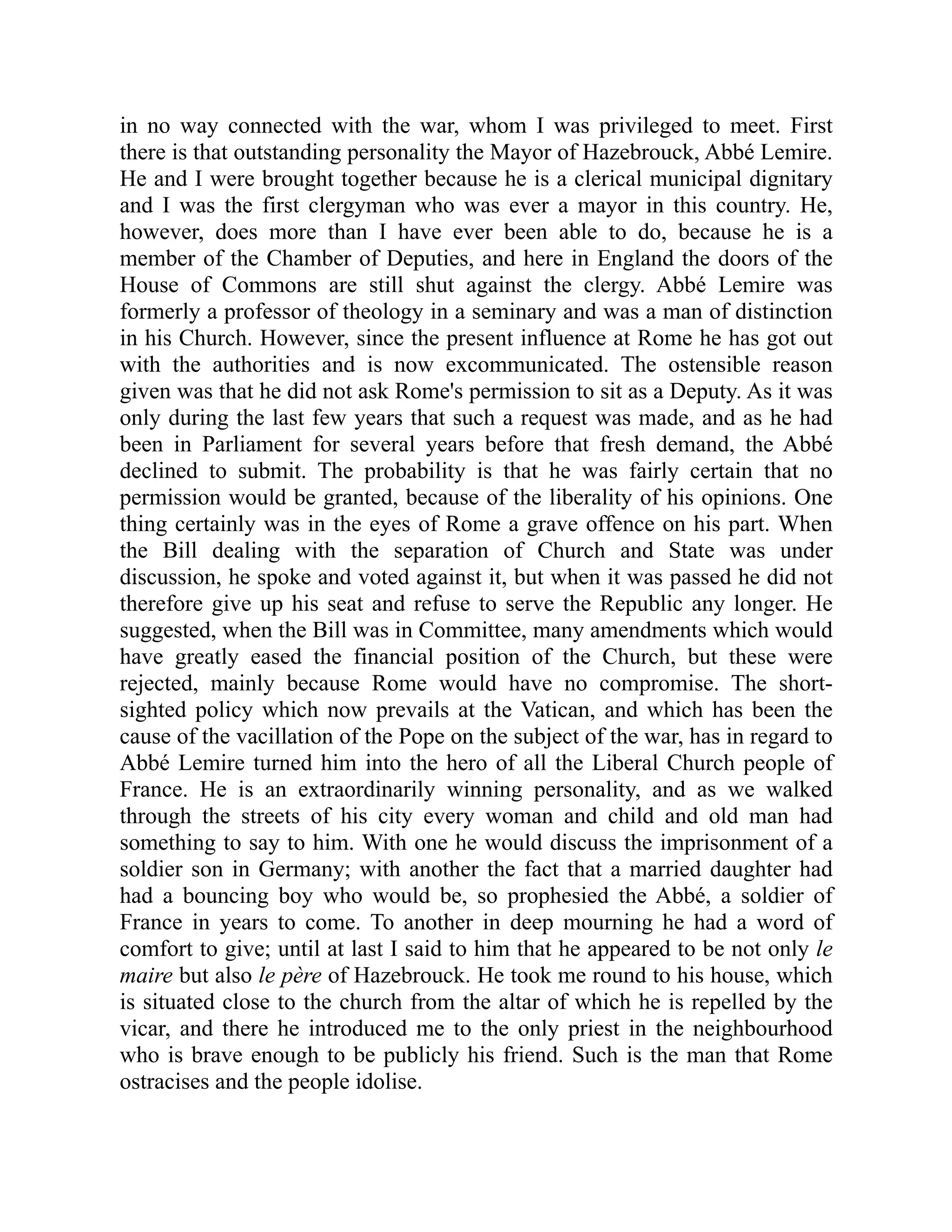
there is that outstanding personality the Mayor of Hazebrouck, Abbé Lemire.
He and I were brought together because he is a clerical municipal dignitary
and I was the first clergyman who was ever a mayor in this country. He,
however, does more than I have ever been able to do, because he is a
member of the Chamber of Deputies, and here in England the doors of the
House of Commons are still shut against the clergy. Abbé Lemire was
formerly a professor of theology in a seminary and was a man of distinction
in his Church. However, since the present influence at Rome he has got out
with the authorities and is now excommunicated. The ostensible reason
given was that he did not ask Rome's permission to sit as a Deputy. As it was
only during the last few years that such a request was made, and as he had
been in Parliament for several years before that fresh demand, the Abbé
declined to submit. The probability is that he was fairly certain that no
permission would be granted, because of the liberality of his opinions. One
thing certainly was in the eyes of Rome a grave offence on his part. When
the Bill dealing with the separation of Church and State was under
discussion, he spoke and voted against it, but when it was passed he did not
therefore give up his seat and refuse to serve the Republic any longer. He
suggested, when the Bill was in Committee, many amendments which would
have greatly eased the financial position of the Church, but these were
rejected, mainly because Rome would have no compromise. The short-
sighted policy which now prevails at the Vatican, and which has been the
cause of the vacillation of the Pope on the subject of the war, has in regard to
Abbé Lemire turned him into the hero of all the Liberal Church people of
France. He is an extraordinarily winning personality, and as we walked
through the streets of his city every woman and child and old man had
something to say to him. With one he would discuss the imprisonment of a
soldier son in Germany; with another the fact that a married daughter had
had a bouncing boy who would be, so prophesied the Abbé, a soldier of
France in years to come. To another in deep mourning he had a word of
comfort to give; until at last I said to him that he appeared to be not only le
maire but also le père of Hazebrouck. He took me round to his house, which
is situated close to the church from the altar of which he is repelled by the
vicar, and there he introduced me to the only priest in the neighbourhood
who is brave enough to be publicly his friend. Such is the man that Rome
ostracises and the people idolise.
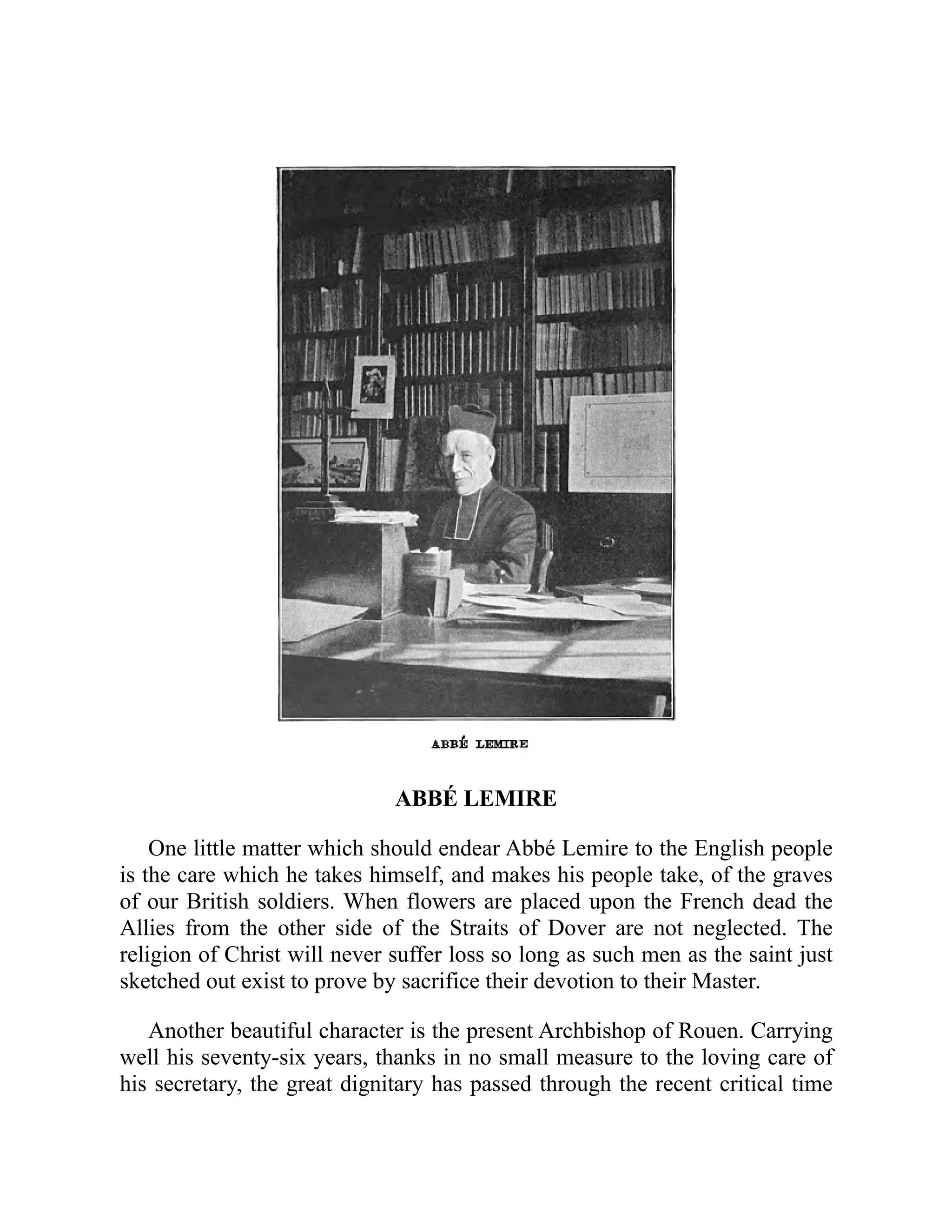
ABBÉ LEMIRE
One little matter which should endear Abbé Lemire to the English people
is the care which he takes himself, and makes his people take, of the graves
of our British soldiers. When flowers are placed upon the French dead the
Allies from the other side of the Straits of Dover are not neglected. The
religion of Christ will never suffer loss so long as such men as the saint just
sketched out exist to prove by sacrifice their devotion to their Master.
Another beautiful character is the present Archbishop of Rouen. Carrying
well his seventy-six years, thanks in no small measure to the loving care of
his secretary, the great dignitary has passed through the recent critical time
Welcome to our website – the ideal destination for book lovers and
knowledge seekers. With a mission to inspire endlessly, we offer a
vast collection of books, ranging from classic literary works to
specialized publications, self-development books, and children's
literature. Each book is a new journey of discovery, expanding
knowledge and enriching the soul of the reade
Our website is not just a platform for buying books, but a bridge
connecting readers to the timeless values of culture and wisdom. With
an elegant, user-friendly interface and an intelligent search system,
we are committed to providing a quick and convenient shopping
experience. Additionally, our special promotions and home delivery
services ensure that you save time and fully enjoy the joy of reading.
Let us accompany you on the journey of exploring knowledge and
personal growth!
ebookultra.com

At Your Service Service Oriented Computing from an EU Perspective Cooperative Information Systems 1st Edition Elisabetta Di Nitto


  • 1.
    At Your ServiceService Oriented Computing from an EU Perspective Cooperative Information Systems 1st Edition Elisabetta Di Nitto download pdf https://ebookultra.com/download/at-your-service-service-oriented- computing-from-an-eu-perspective-cooperative-information-systems-1st- edition-elisabetta-di-nitto/ Discover thousands of ebooks and textbooks at ebookultra.com download your favorites today!

  • 2.
    Here are somerecommended products for you. Click the link to download, or explore more at ebookultra.com Service Oriented Enterprises 1st Edition Setrag Khoshafian https://ebookultra.com/download/service-oriented-enterprises-1st- edition-setrag-khoshafian/ Next Generation SOA A Real World Guide to Modern Service Oriented Computing 1st Edition Thomas Erl https://ebookultra.com/download/next-generation-soa-a-real-world- guide-to-modern-service-oriented-computing-1st-edition-thomas-erl/ Engineering reliable service oriented architecture managing complexity and service level agreements 1st Edition Nikola Milanovic https://ebookultra.com/download/engineering-reliable-service-oriented- architecture-managing-complexity-and-service-level-agreements-1st- edition-nikola-milanovic/ Achieving Service Oriented Architecture Applying an Enterprise Architecture Approach 1st Edition Rick Sweeney https://ebookultra.com/download/achieving-service-oriented- architecture-applying-an-enterprise-architecture-approach-1st-edition- rick-sweeney/
  • 3.
    Programming WCF Services4th Edition Design and Build Maintainable Service Oriented Systems Juval Lowy https://ebookultra.com/download/programming-wcf-services-4th-edition- design-and-build-maintainable-service-oriented-systems-juval-lowy/ Service Oriented Distributed Knowledge Discovery 1st Edition Domenico Talia https://ebookultra.com/download/service-oriented-distributed- knowledge-discovery-1st-edition-domenico-talia/ Backyard Beekeeping ANR 135 PUBLICATION 2004 EDITION Alabama Cooperative Extension Service https://ebookultra.com/download/backyard-beekeeping- anr-135-publication-2004-edition-alabama-cooperative-extension- service/ Trust and Reputation for Service Oriented Environments Elizabeth Chang https://ebookultra.com/download/trust-and-reputation-for-service- oriented-environments-elizabeth-chang/ Service Computing Concept Method and Technology 1st Edition Zhaohui Wu https://ebookultra.com/download/service-computing-concept-method-and- technology-1st-edition-zhaohui-wu/
  • 5.
    At Your ServiceService Oriented Computing from an EU Perspective Cooperative Information Systems 1st Edition Elisabetta Di Nitto Digital Instant Download Author(s): Elisabetta Di Nitto, Anne-Marie Sassen, Paolo Traverso, Arian Zwegers ISBN(s): 9780262042536, 0262042533 Edition: 1 File Details: PDF, 8.49 MB Year: 2009 Language: english

  • 6.
    AT YOUR SERVICE SERVICE-ORIENTEDCOMPUTING FROM AN EU PERSPECTIVE Elisabetta Di Nitto, Anne-Marie Sassen, Paolo Traverso, and Arian Zwegers EDITED BY
  • 7.
  • 8.
    Cooperative Information Systems MichaelPapazoglou, Joachim W. Schmidt, and John Mylopoulos, editors Advances in Object-Oriented Data Modeling, Michael P. Papazoglou, Stefano Spaccapietra, and Zahir Tari, editors Workflow Management: Models, Methods, and Systems, Wil van der Aalst and Kees Max van Hee A Semantic Web Primer, Grigoris Antoniou and Frank van Harmelen Meta-Modeling for Method Engineering, Manfred Jeusfeld, Matthias Jarke, and John Mylopoulos, editors Aligning Modern Business Processes and Legacy Systems: A Component-Based Perspective, Willem-Jan van den Heuvel A Semantic Web Primer, second edition, Grigoris Antoniou and Frank van Harmelen Service-Oriented Computing, Dimitrios Georgakopoulos and Michael P. Papazoglou, editors At Your Service: Service-Oriented Computing from an EU Perspective, Elisabetta Di Nitto, Anne-Marie Sassen, Paolo Traverso, and Arian Zwegers, editors
  • 9.
    At Your Service Service-OrientedComputing from an EU Perspective edited by Elisabetta Di Nitto, Anne-Marie Sassen, Paolo Traverso, and Arian Zwegers The MIT Press Cambridge, Massachusetts London, England
  • 10.
    6 2009 MassachusettsInstitute of Technology All rights reserved. No part of this book may be reproduced in any form by any electronic or mechanical means (including photocopying, recording, or information storage and retrieval) without permission in writing from the publisher. For information about special quantity discounts, please email special_sales@mitpress.mit.edu This book was set in Times New Roman and Syntax on 3B2 by Asco Typesetters, Hong Kong. Printed and bound in the United States of America. Library of Congress Cataloging-in-Publication Data At your service : service-oriented computing from an EU perspective / edited by Elisabetta Di Nitto . . . [et al]. p. cm. — (Cooperative information systems) Presents results of collaborative research projects of the European Community’s Information Society Technologies Programme about service-oriented computing. Includes bibliographical references and index. ISBN 978-0-262-04253-6 (hardcover : alk. paper) 1. Web services—Research—Europe. 2. Internetworking (Telecommunication) 3. Application program interfaces (Computer software) 4. Business enterprises— Computer networks. I. Di Nitto, Elisabetta. II. Information Society Technologies Programme. TK5105.88813.A85 2009 006.70 6—dc22 2008027498 10 9 8 7 6 5 4 3 2 1
  • 11.
    Contents Foreword by VivianeReding ix Preface xi 1 Introduction 1 Elisabetta Di Nitto, Anne-Marie Sassen, Paolo Traverso, and Arian Zwegers 2 BIONETS: Bio-Inspired Paradigms for Service Provisioning in Pervasive Computing Environments 13 Imrich Chlamtac, Daniele Miorandi, Stephan Steglich, Ilja Radusch, David Linner, Jyrki Huusko, and Janne Lahti 3 Service Discovery in Pervasive Computing Environments 43 Sonia Ben Mokhtar, Nikolaos Georgantas, Valérie Issarny, Pierre-Guillaume Raverdy, and Marco Autili 4 Unified Discovery and Composition of Heterogeneous Services: The SODIUM Approach 67 Aphrodite Tsalgatidou, George Athanasopoulos, Michael Pantazoglou, Arne J. Berre, Cesare Pautasso, Roy Grønmo, and Hjørdis Hoff 5 Compositional Service Engineering Using Semantic Interfaces 101 Jacqueline Floch, Richard T. Sanders, and Rolv Bræk 6 Developing Self-Adaptive Mobile Applications and Services with Separation-of-Concerns 129 Nearchos Paspallis, Frank Eliassen, Svein Hallsteinsen, and George A. Papadopoulos 7 Sensoria: Engineering for Service-Oriented Overlay Computers 159 Martin Wirsing, Laura Bocchi, Allan Clark, José Luiz Fiadeiro, Stephen Gilmore, Matthias Hölzl, Nora Koch, Philip Mayer, Rosario Pugliese, and Andreas Schroeder
  • 12.
    8 ASTRO: Supportingthe Composition of Distributed Business Processes in the E-Government Domain 183 Marco Pistore, Pietro Braghieri, Piergiorgio Bertoli, Antonio Biscaglia, Annapaola Marconi, Stefano Pintarelli, and Michele Trainotti 9 WS-DIAMOND: Web Services—DIAgnosability, MONitoring and Diagnosis 213 Luca Console, Danilo Ardagna, Liliana Ardissono, Stefano Bocconi, Cinzia Cappiello, Marie- Odile Cordier, Philippe Dague, Khalil Drira, Johann Eder, Gerhard Friedrich, Mariagrazia Fugini, Roberto Furnari, Anna Goy, Karim Guennoun, Andreas Hess, Volodymyr Ivanchenko, Xavier Le Guillou, Marek Lehmann, Jürgen Mangler, Yingmin Li, Tarek Melliti, Stefano Modafferi, Enrico Mussi, Yannick Pencolé, Giovanna Petrone, Barbara Pernici, Claudia Picardi, Xavier Pucel, Sophie Robin, Laurence Rozé, Marino Segnan, Amirreza Tahamtan, Annette Ten Tejie, Daniele Theseider Dupré, Louise Travé-Massuyès, Frank Van Harmelen, Thierry Vidal, and Audine Subias 10 SeCSE—Service-centric System Engineering: An Overview 241 Massimiliano Di Penta, Leire Bastida, Alberto Sillitti, Luciano Baresi, Neil Maiden, Matteo Melideo, Marcel Tilly, George Spanoudakis, Jesus Gorroñogoitia Cruz, John Hutchinson, and Gianluca Ripa 11 User-centric Service Creation and Execution 273 Antonio Sánchez, Carlos Baladrón, Javier Aguiar, Belén Carro, Laurent-Walter Goix, Jürgen Sienel, Isabel Ordás, Rubén Trapero, and Alejandro Bascuñana 12 INFRAWEBS—A Framework for Semantic Service Engineering 299 Gennady Agre, Tomás Pariente Lobo, Zlatina Marinova, Joahim Nern, Andras Micsik, Andrei Boyanov, Tatiana Atanasova, James Scicluna, José-Manuel López-Cobo, and Elpida Tzafestas 13 Enabling Data, Information, and Process Integration with Semantic Web Services: From a New Technology Infrastructure to a Compelling Demonstrator 327 Alessio Gugliotta, John Domingue, Vlad Tanasescu, Leticia Gutiérrez Vilları́as, Rob Davies, Mary Rowlatt, Marc Richardson, and Sandra Stinčić 14 AMIGO: Interoperable Semantic Services for the Smart Home Environment 357 Nikolaos Georgantas, Julia Kantorovitch, Ioanna Roussaki, Valérie Issarny, Jarmo Kalaoja, Ioannis Papaioannou, and Dimitrios Tsesmetzis 15 Security and Dependability in the Evolving Service-centric Architectures 387 Aljosa Pasic, Daniel Serrano, Pedro Soria-Rodriguez, James Clarke, Pedro Carvalho, and Antonio Maña vi Contents
  • 13.
    16 GridTrust—A UsageControl-Based Trust and Security Framework for Service-Based Grids 407 Philippe Massonet, Alvaro Arenas, Fabio Martinelli, Paolo Mori, and Bruno Crispo 17 Security-by-Contract (SDC) for Software and Services of Mobile Systems 429 Nicola Dragoni, Fabio Martinelli, Fabio Massacci, Paolo Mori, Christian Schaefer, Thomas Walter, and Eric Vetillard 18 The ATHENA Framework for Cross-Organizational Business Processes 457 Matthias Born, Ulrike Greiner, Sonia Lippe, Rainer Ruggaber, Timo Kahl, Jörg Ziemann, and Frank-Walter Jäkel 19 Dependability in Service-Oriented Systems 489 Johannes Osrael, Lorenz Froihofer, Piotr Karwaczyński, Jaka Močnik, and Karl M. Goeschka 20 Consolidating Research Results: The Industrial Perspective of NESSI 517 Stefano de Panfilis 21 S-Cube: The Network of Excellence on Software Services and Systems 523 Mike P. Papazoglou and Klaus Pohl About the Authors 531 Index 557 Contents vii
  • 15.
    Random documents withunrelated content Scribd suggests to you:
  • 19.
    The Project GutenbergeBook of A Fortnight at the Front
  • 20.
    This ebook isfor the use of anyone anywhere in the United States and most other parts of the world at no cost and with almost no restrictions whatsoever. You may copy it, give it away or re-use it under the terms of the Project Gutenberg License included with this ebook or online at www.gutenberg.org. If you are not located in the United States, you will have to check the laws of the country where you are located before using this eBook. Title: A Fortnight at the Front Author: Henry Russell Wakefield Release date: February 11, 2020 [eBook #61370] Most recently updated: October 17, 2024 Language: English Credits: Produced by Al Haines *** START OF THE PROJECT GUTENBERG EBOOK A FORTNIGHT AT THE FRONT ***
  • 21.
    ALBERT—RUINS OF CHURCH,WITH LEANING-OVER FIGURES
  • 22.
    OF VIRGIN AND CHILD(see page 15) A FORTNIGHT AT THE FRONT BY THE RT. REV. H. RUSSELL WAKEFIELD BISHOP OF BIRMINGHAM WITH ILLUSTRATIONS LONGMANS, GREEN AND CO. 39 PATERNOSTER ROW, LONDON FOURTH AVENUE & 80TH STREET, NEW YORK BOMBAY, CALCUTTA, AND MADRAS 1915 All rights reserved
  • 23.
    A FORTNIGHT ATTHE FRONT A CURE FOR PESSIMISM Whether any one has the right to make any statement with regard to something which has only been studied for a short time is questionable, and, therefore, I do not pretend to any dogmatic utterance, but I wish simply to state the effect produced upon me by my time abroad. My experience goes from thirty-five yards from the German trenches right back to the most southern and westerly of our bases. Bearing in mind that through the courtesy of Headquarters I have been able to see everything under the most comfortable and time-saving circumstances, it must be admitted that though my view may have been superficial, it certainly was comprehensive. I had the satisfaction of being able to give a kind word and a blessing even where one was asked not to speak too loud in case our enemies should overhear; I held confirmations in several places, and addressed troops, both wounded and strong and hearty, on many occasions. The first thing which struck me was the great courtesy and consideration of everybody who was concerned with our visit. That the authorities at Headquarters who were working, as I know, both early and late, must have felt that one was a very unnecessary addition to their troubles is, I should fancy, unquestionable; yet not only did they never show it, on the contrary, they worked every day to make our visit easy and delightful. I know that the Lord Mayor of Birmingham, who spent nearly a week with me, feels this as warmly as myself, and it shows the wonderful calm of an Englishman that we were both so kindly treated, though we added in no way to the happiness or usefulness of anybody. What I have said with regard to the Staff at
  • 24.
    Headquarters applies alsoto all those who had to do with us at all the various centres. The next thing which struck me was the way in which the British have, as it were, taken possession of the whole of that area for which our people are responsible. You go through village after village, and the ubiquitous person is our soldier. He appears out of farm buildings, he leans over gates, holding difficult conversation, not only with the young maidens of the village, but with dear old ladies who can be seen taking a motherly interest in him. In the towns he pervades the whole place. Always bright and cheerful, and yet conscious of his responsibility, our khaki-clad young fellow maintains his good character and earns the respect of the people. I asked a French Archbishop and also a French Bishop, the jurisdiction of both of whom is within our area, if they were satisfied with the behaviour of our men, and on each occasion the answer was that they were beyond reproach. We do not seem to be visitors in France, but we almost appear to have taken root there. The buildings we are putting up, the railway extensions we are making, the way in which we have turned bare spaces into towns, all these things make one feel as if we were permanent institutions and not birds of passage. It is not altogether wonderful that some of the more ignorant French people should say that they do not believe we are ever going away; whilst on the other hand, some French officers told me that their confidence in our alliance had become immensely greater because we had done everything in such a stable manner, one man going so far as to say to me that he considered one of the surest signs of our determination to see this war through was that so many of our officers had taken houses for three years certain. It is only just to add in regard to a large number of the buildings we have put up that they can be taken down, carried away and be put up over here with practically no difficulty. Another impression produced upon me was one of increasing respect for the adaptability of the Englishman. It shows itself in innumerable military ways which I hardly have the right to mention, but one may be permitted the general observation that there is no kind of obstacle which we do not seem to surmount and even sometimes to turn to an advantage. What we have done in turning to good use even some extraordinary effects of shell fire upon buildings made me more than astonished; perhaps I may be allowed one instance. Somewhere in France there was a railway station and near it an estaminet; both, as far as one could judge, were destroyed, with the exception of a portion of a chimney. By
  • 25.
    some miraculous meanswhich I cannot describe, one went along all kinds of underground places, then up some steps and into what I believe was a portion of the chimney, and from there through a crevice one was able to see a good deal of the German lines quite close by. When one came out again, one could not in the least tell where it was that one had been. To take a less warlike instance of our power of getting over difficulties: a certain officers' mess is established in a French farm which a few months ago had a duck pond which gave forth an odour which was both unpleasant and unsavoury. Consequent, I believe, upon the enthusiasm of a particular major, within four months the pond was empty, the ground was levelled, the seeds were sown, and when I was there the pond had become quite a respectable lawn-tennis ground. It is safe to say that one's gardener would have expected to have four years instead of four months for such an operation. I may give, perhaps, another instance of this special quality of the Britisher. The Artists' Corps went out to France for ordinary duties; they have now become an Officers' Training Corps, and an enormous percentage of them are holding commissions in every kind of regiment. Not only so, but they are largely instrumental in carrying on a kind of Sandhurst on French soil; they are, I believe, influential in the management of a bomb school, and last, but not least, they have a band in which the soldiers rejoice, and of which I wish there were many more at the Front. I am personally greatly indebted to the Artists; first, because a very charming officer of their number was placed in charge of me for a considerable time and bore with me in patience; secondly, because I found such a hearty welcome from them at their mess and so many friends amongst their number; thirdly, because they turned up so well at the Parade Service at which I was the preacher! The next thing which struck me was the calm in the trenches. Over here in England we seem to live in a continual change of feeling. We get the account of some engagement in which we are successful, and immediately we conclude the war is going to be over to-morrow, and people who are wont to go abroad for a holiday think it is time they went to Messrs. Cook's office to see about their tickets. But on the way they see the placard of an evening paper which tells of some minor disaster to our Forces, and then
  • 26.
    they return home,they call together the family and they tell them that the future means either the destruction of the country or twenty years of misery and poverty; the bulk of the misfortune, of course, being sure to rest upon their own individual shoulders. It is refreshing to get away from this atmosphere and to go into the trenches where everybody is doing his bit of work, content with somewhat unpleasant circumstances so long as through him England is served. Whenever, in future, I am inclined towards a fit of pessimism, I shall shut my eyes in order to see once again, with the vision of the spirit, a stalwart Britisher of the Worcester Regiment, not very far from the German lines, on a certain afternoon, when a most appalling thunderstorm was raging and some German shells were falling. He was munching the thickest slice of bread and jam that I have ever seen, and looking with a mild contempt at the intruding figure of an unknown padre whom a considerable number of his comrades were greeting because they recognised in him their Bishop. He put down now and again his refreshment in order to do some bit of work, but he was just as calm and collected as if he had been in his Worcestershire village and not in the trenches. That which carries our men through so many difficulties is another thing which impressed me—namely, their unfailing sense of humour; a humour which is never really hurtful even when exercised upon some one deserving of satire. When he christens a road along which there are a couple of miles of Army Service carts "Lorry Park," when he finds every kind of strange anglicising for Flemish or French words, we know that he is not only having some fun for himself, but also providing amusement for those who come after him. The same humour shines out when he is in hard case. A chaplain told me that he had been addressing informally some wounded men who had just arrived from the trenches. He was expatiating upon the glories of the Victoria Cross because he noticed some of the men came from a regiment one of whose number had recently received that coveted distinction. Suddenly his eloquence was disturbed by a voice proceeding from a man, both of whose feet were swathed in bandages, who remarked, "Never mind the Victoria Cross, give me the Victoria 'Bus!" Obviously the soldier's sense of humour was conquering his pain, and his remark made the rest of the party forget their sufferings for a short time. The only excuse that I can find for the fluctuating feelings of the people at home is the remarkable way in which they minister to Tommy's love of fun. He has every kind of quaint name for the people in "Blighty"—the name which, though derived, I
  • 27.
    believe, from anEastern word denoting home, nevertheless expresses something of the attitude noticeable at certain periods, both in people and Press in England, and which appeals through its appropriateness to the humour of our soldiers. But at the same time there is a wonderful thankfulness shown in the face of officers and men when the time arrives for the short spell of leave. The old country and the friends left behind there are, after all, the things closest to the hearts of our men. The next thing upon which I would comment is the great mutual respect between ourselves and the French. Every time I asked any of our people what they thought of our Allies the answer was one of unhesitating commendation, whilst in the same way when I spoke to French officers or men, they expressed themselves in terms of absolute trust in our nation and her statesmen and soldiers. As one who saw the French during the war of 1870, when—being a boy—I was very susceptible to impressions, I can hardly express the difference I notice between the nation then and now. In the former war there was excitement, impulsiveness, over-confidence, want of ballast; to-day there is quietude, earnestness, and withal, assurance of eventual victory. More than once I journeyed through a considerable part of the French lines, and I assert with confidence that the Army of France at the present time is incomparably superior to that which she placed in the field in 1870. As to her civilians, I only saw women, children, and old men; I did not, in all my thousand miles of travel, discover a single able-bodied person of military age out of uniform. The harvest, a very good one, was in full swing. Every family was out in the fields, all doing something towards the in-gathering. I have a picture now before my eyes of seven people, all undoubtedly coming from the same house, working away hard, whilst at the tail end of the procession appeared what might have been the great-grandpapa, no longer capable of bending down for harvesting, but who, nevertheless, had his piece of work in carrying about the baby, who, of course, could not be left behind alone in the house. The whole nation is doing its utmost; can we quite honestly say the same of England?
  • 28.
    VERMELLES—THE CASTLE RUINS Anothersubject which was constantly commented upon and appreciated at the Front was the thoroughness with which the Germans had done and were doing everything. It was a matter of genuine regret with our people that they could not be as wholehearted as they would wish to be in appreciation of our enemies, in consequence of the way in which they had sullied the fair fame of noble warfare. If there is one thing a soldier wishes to do more than another it is to be able to speak with respect and admiration of his opponent, and, unfortunately, what the German would have gained by his magnificent methodical thoroughness, he has lost through his dishonourable and brutal conduct of the war. At the same time, it should be fairly stated that in the judgment of those to whom I spoke the destruction of churches by our foes has not been so wanton as is sometimes put before us. It was suggested to me that in all probability the church was often destroyed for the same reason as a high chimney, because it formed an excellent observation post.
  • 29.
    Before I leavethe subject of the men at the Front, one of their constant questions must be noted, which was whether they might expect as much keenness on the part of our civilian population as was being shown by those under arms. "We are doing our bit, but we shall need increased, even greatly increased, assistance; I suppose we can be sure of getting it." Those words still ring in my ears. WITHIN RANGE OF FIRE Perhaps it would be of interest to give a little account, without, of course, mentioning names, of the events of one or two days when a visit was paid to the trenches. On one occasion after motoring through towns that are a household word, both at home and with our Allies, towns which have seen the Germans in them and then driven out of them, places where the buildings are practically level with the ground, the limit for vehicular traffic is reached and one goes forward on foot. Soon you reach a cutting in the ground and you begin to walk along a trench. You turn now and again either to right or left, seeing sign-posts telling sometimes in comic language and sometimes only by number the name, as it were, of the underground street; you then rise a little and find yourself walking in the inside of houses so shattered that you cannot tell much about what they originally were until you are told that they formed a street in a little overgrown village of which nothing is left, and the last inhabitant of which was the station-master, who refused to leave though there was neither train, station nor house for himself left, because so long as he remained on the spot he could claim his pay. Forcible measures had at last to be used to secure his departure. Where you are walking you are yourself hidden from the enemy, but are within the range of their fire. You are taken up to an observation post, where one of your companions incautiously takes out a white pocket-handkerchief and is hurriedly told to put it back in his pocket. You come down again and you proceed cautiously along trenches. Now and again shells pass over, and your careful guide looks to see in what direction they are falling, as, though he is quite unconcerned for himself, he knows that he is responsible for the safety of the troublesome visitor. You are told to keep your head down and not to show, for the moment at any rate,
  • 30.
    any desire toview the landscape. Soldiers are dotted about here and there, all of them ready to give a kindly greeting, and then at last you reach a point where you are told not to speak loudly because practically only a few yards away is the enemy, who, were he to hear conversation, might think it worth while to throw over a hand grenade. What looks like a tiny bit of glass at the end of a short stick is there before you, and you are asked to look into it; when you do the enemies' trenches are visible to you. Beyond an occasional ping against a sandbag, you have heard nothing to note the existence of rifle fire, except that the men you have passed have got these weapons to hand. You tell the men at the advanced posts how proud their country is of them, how thankful you are to have seen them, how you pray that God may bring them back safe to their homes; you get rid of all cigars or cigarettes you may have upon you, wishing that you had thousands more, and then you return home, varying perhaps the route through the communication trenches. On another occasion our way took us through a town which is absolutely razed to the ground and is still under shell fire. There I saw two soldiers busy with spades, and I asked what kind of fortification they were putting up, to which, with a broad grin, one replied that they were looking for souvenirs. He was kind enough to give me a complete German cartridge case, for which he refused to take any remuneration. Going on a little farther in this town, we went down some steps and found ourselves in an underground club full of soldiers, who were having a hot meal, were reading papers and playing games, everything being presided over by perhaps the most magnetic person I met on my travels, a young Chaplain to the Forces, who would not wish his name to be mentioned, though there is probably no one out at the Front who will not know to whom I refer. When we went from this place towards the more advanced trenches, I was taken along a road which looked perfectly harmless, when suddenly a stalwart Scotchman told my companion and myself that we must get off it at once as it was a favourite target for German Maxims. Never was General more obediently submitted to than was this, I believe, private soldier. It was on this occasion that we had tea in the dug-out of the Colonel, who bears a name distinguished in English naval, military and sporting life. A characteristic of the German trenches which I noticed on this and other occasions, was that their sandbags seemed to be generally white in colour, at any rate in those of the first line. Leaving the trench on this particular day, we had to go through an almost alarming thunderstorm, which in the course of half an hour made a sea of mud of the place which
  • 31.
    had been quitedry before. It was curious to notice how petty the sound of the guns appeared as compared with the artillery of heaven. THE INTERIOR OF RHEIMS CATHEDRAL Pathetic incidents occur and touching scenes are visible on these journeys to the Front. One looked in the trenches upon little mounds and crosses, marking the resting-places of men who had been hurriedly, but reverently,
  • 32.
    buried. There theyare side by side with their living comrades, who are doing their work whilst their brothers sleep. Dotted all about the country are little cemeteries, which tell of devotion unto death, and which remind one of all the sorrow this war has caused. It is strange to see how religious emblems appear to have been strong against shell. Constantly you would see a church almost totally destroyed and yet the crucifix untouched, and who will ever forget that sight which can be seen for miles around, of the tower which has been almost shattered to pieces and yet the statue of the Virgin and Child, which was near the top of it, though bent over completely at right angles, still remains, as it were blessing and protecting the whole neighbourhood. This leads to the consideration of the religious condition of our troops as affected, first, by the churches and worshippers of France, and, secondly, by their own experience in this war. More than one mentioned the pleasure felt at the sight of the little wayside shrines which they passed on their march. Others commented upon the large numbers of people they saw flocking to their early communion, and many expressed a hope that permission might be secured for parade services to be held in the naves of the various parish churches during the winter time, when the cold is great and when it is almost impossible to secure any suitable building other than the churches for worship. Negotiations have been going on upon this matter, and some of the French ecclesiastics are not unfavourable, but a difficulty which is prominent to the minds of some of the French Bishops arises out of the recent separation of Church and State. There is a considerable party in France anxious to secure the ecclesiastical buildings for different sects, and even in some cases for secular purposes. It is felt, therefore, that a precedent might be made of a dangerous character were permission to be given to our troops to have services in these sacred buildings. We may, however, be quite confident that those responsible for the spiritual care of our soldiers in France will deal with this whole question wisely and tactfully. It does seem strange that men who are fighting for the liberties and rights of France, and whose religion is, after all, not antagonistic to the faith of the people of that country, may not have the shelter of the less sacred part of a parish church in order to offer up their prayers to Almighty God. It is when one gets face to face with such circumstances as these that the pettiness of religious strife strikes one with force. Is it just possible that out of this great conflict there may arise a stronger desire for religious unity than the world has ever yet known?
  • 33.
    What his experienceof war is doing for the soldier in regard to religion is remarkable. It would have been possible that the sight of humanity striving to the death and inflicting horrible suffering might have made our young fellows despair of Christianity. They might have argued that it was of no avail to teach the religion of Jesus when no effect was produced upon international conduct; but they have been able to look more deeply into matters and to realise that not Divine intention was at fault, but human refusal to follow true teaching. They have been able to see God through the cloud of smoke raised by shot and shell, and the Presence of the Divine has not been obscured by the horrors of war. Conscious of the seriousness of the work in which they are engaged, feeling every moment the nearness of eternity, our soldiers have in no craven spirit, but with a due remembrance of their relationship to God and to eternity, turned to religion as a stay in the hour of conflict. What struck one very much was the desire for the understanding of a few central truths, and the evident keenness for big dogmatic statements as to great matters. There was some impatience shown when small details were pressed too strongly, and when terms were used familiar to the theologian, but absolutely incomprehensible to a plain, simple, God-fearing officer or private. It sounds almost an impertinence to speak of the devotion of the chaplains at the Front, but I am bound, after having mixed with a large number of them, to express the deep thankfulness one feels to the padre for all that he is doing. The young men who are now for the first time seeing service as clergy associated with troops, are exceptionally fortunate in the leadership they get from the Army chaplains of long standing. There is something about work with the soldier which intensifies the humanity of any one working for his spiritual welfare. HOPES FOR THE FUTURE It would neither be right nor in good taste to mention any names of chaplains, but one may instance the kind of work which one saw them doing. I have already referred to the dug-out club in a destroyed town. I may go on to tell of one who on his bicycle, sometimes late at night, would go away from the centre where he was stationed to outlying districts for the purpose
  • 34.
    of giving lanternlectures to our troops. When last I saw him he was arranging to give this particular entertainment to a number of our Indian wounded. This chaplain was the life and soul of a great parade service held in a square in one of the French towns, where, by his voice and his enthusiasm, he made the whole service go with fervour and effect. I remember how, on this occasion, numbers of French people came up to me and told me that they were certain that this outward acknowledgment by our soldiers of their devotion to God would be helpful to the spirituality of the whole town. The chaplains abroad have to be business men as well as clergy. The arrangements for services and other matters take up a considerable amount of time. At one base there are about thirty places to arrange for every Sunday, and in these thirty places over sixty services are held. It is no light matter for the Senior Chaplain to see that week by week everything is in order. This particular instance is not an isolated one, and is taken simply at random. Now that there is a Bishop as Deputy Chaplain of the Forces in France, everything should go on in a perfectly satisfactory manner and with great advantage to the chaplains themselves. SPECIMEN OF SERVICE LIST OF ONE OF OUR BASES AT THE FRONT DIVINE SERVICES—SUNDAY, AUGUST 22, 1915. H.C.=Holy Communion, P.S.=Parade Service, E.S.=Evening Service. CHURCH OF ENGLAND. B. Details. 8 a.m., H.C. in Orderly Room. 10.46 a.m., P.S. in Y.M.C.A. Hut No. 1. Reinforcement Camps. 6.30 and 7.30 a.m., H.C. in C.A. Hut. 11.30 a.m., P.S. (open air, weather permitting) at Y.M.C.A. Hut No. 2 for all Divisions.
  • 35.
    If Wet. 10 a.m.,P.S. (9, 12, 14 Divisions), C.A. Hut. 11 a.m., P.S. (16, 17, 18 Divisions), C.A. Hut. 11.30 a.m., P.S. (19, 20, 37, 61 Divisions) in Y.M.C.A. Hut No. 2. 7 p.m., E.S., C.A. Hut. No. 18 General Hospital. 6.30, 8.16, and 11.30 a.m., H.C., Church Tent. 11 a.m., P.S., Church Tent. 6 p.m., E.S., Church Tent. No. 1 Canadian Hospital. 6 a.m., H.C., Recreation Tent. 8 a.m., H.C., Nurses Tent. 9.16 a.m., P.S., Recreation Tent. Liverpool Merchants, St. Johns and Allied Forces Hospital. 7 a.m., H.C., Officers Recreation Tent, L.M.M. Hospital. 6.30 p.m., E.S., Officers Recreation Tent, L.M.M. Hospital. 10.30 a.m., P.S., Ward B. 25 in 23 General Hospital. No. 3 Canadian Hospital. 6.46 a.m., H.C. 10.30 a.m., P.S. 6 p.m., E.S. 22 General Hospital. 6.16 and 7 a.m., H.C. 11.16 a.m., P.S. 6.30 p.m., E.S. Convalescent Camp and Isolation Hospital. 6.30 and 8.15 a.m., H.C. in Church Tent, 18 General Hospital. 10 a.m., P.S., Tipperary Hut. Detention Camp. 10.30 a.m., P.S.
  • 36.
    Army Service Corps. 6p.m., Open Air Service. 23 General Hospital. 6.30 a.m., H.C. 10.30 a.m., P.S. in Ward B. 25. 6.30 p.m., E.S. in Ward B. 25. 24 General Hospital. 6.30 and 8 a.m., H.C. 10.45 a.m., P.S. in Y.M.C.A. Hut 1. 5.30 p.m., E.S. in A 35. 26 General Hospital. 7.30 a.m., H.C., in Ward 15. 10.46 a.m., P.S., Y.M.C.A. Hut. 6.30 p.m., E.S. in 23 General Hospital, Ward 25. Reserve Parks. No. 32, P.S., 12.16 p.m. Nos. 10 and 11, E.S., 6.30 p.m. 20 and 25 General Hospital. 6 and 7 a.m., H.C. in Church Hut of No. 20. 12.15 p.m., P.S. in Y.M.C.A. Hut. Westminster Hospital. 7 a.m., H.C., English Church. 7.30 a.m. and 12 noon, H.C. 11 a.m., P.S. 6.15 p.m., E.S. No. 2 Canadian Hospital. 7.30 a.m., H.C. 10 a.m., P.S. 7.30 p.m., Ward Service.
  • 37.
    PRESBYTERIAN. Reinforcement Camps. 9.30 a.m.,P.S. (15 and 51 Divisions), Y.M.C.A. Hut 2. 10.30 a.m., P.S. (other Divisions), Y.M.C.A. Hut 2. 6.30 p.m., E.S., all Units, Y.M.C.A. Hut 2. No. 1 Canadian Hospital. 10 a.m., P.S. in Recreation Tent for all Hospitals except 18 General. Presbyterian and Nonconformists. 11 a.m., P.S., Y.M.C.A. Hut. 6 p.m., E.S., Church Tent, 25 General Hospital. 7.46 p.m., E.S., Y.M.C.A. Hut. ROMAN CATHOLIC. For all Reinforcements, Camps and Base Details, etc. 9.30 a.m., P.S. in Parish Church. 6 p.m., E.S. in Parish Church. 9 a.m., P.S. in Ward 25, 23 General Hospital 7.15 a.m., Holy Mass with Communion in Ward B. 25, 23 General Hospital, for all Hospitals except 18 General and No. 1 Canadian. No. 1 Canadian Hospital. 10 a.m., P.S. in Officers MOM Tent. WESLEYAN AND OTHER NONCONFORMISTS. All Hospitals, Convalescent Camp and Details. 9.30 a.m., P.S., Y.M.C.A. Hut 1, for all Divisions. 11 a.m., P.S. in S.C.A. Hut.
  • 38.
    See Presbyterian Notices. EveningServices in C.A., Y.M.C.A. and S.C.A. Huts. WILL UNITS PLEASE COPY ORDERS REFERRING TO THEMSELVES? I come now to say a word as to the care given to the bodies of our men. The hospitals from the trenches up to the base are admirable, and the appliances are of the most modern description. I shall not soon forget how in one place I saw for the first time the travelling X-ray caravan. It seemed very strange to be in the hospital whilst the photograph was taken and then to go out in the road and see the machine which did the work. What a convenience this must be in these clearing hospitals can well be imagined. One cannot mention all the splendid stationary and other hospitals over which one was shown by officials with untiring patience and courtesy. The pride which our fellow-citizens from the Dominions beyond the seas take in the fitting up and working of their hospitals is quite extraordinary, and the same spirit animates the private individuals who have their own large institutions in hotels, casinos, and such-like places that they have taken over. I am not sure that I was not more struck with the splendid arrangements made by the Liverpool merchants for our wounded than by anything else of this kind. There is also what one may call a Convalescent Home for the tired soldier, weary in body, in mind and nerve, which, thanks to the man at the head, seems to be very effective. We all know how the strain of the Front tells upon our soldiers, and especially upon the younger men. They come back to this excellent Home by the thousand; they are kept until really restored, and then they go back cheerful and ready for duty. The last thing before they return is a little service in the chapel, which I had the honour on one occasion to take. It was interesting when paying a visit to another hospital to find that it had been formerly a school, and that as the whole building had not been taken over some of the classes were still being held. I intruded into the schoolroom and gave a talk to the young people about the Alliance. Although I must refrain most reluctantly from saying anything about the great military personages whom I met in France, and with whom I was so greatly impressed, I may perhaps refer to two French persons of distinction,
  • 39.
    in no wayconnected with the war, whom I was privileged to meet. First there is that outstanding personality the Mayor of Hazebrouck, Abbé Lemire. He and I were brought together because he is a clerical municipal dignitary and I was the first clergyman who was ever a mayor in this country. He, however, does more than I have ever been able to do, because he is a member of the Chamber of Deputies, and here in England the doors of the House of Commons are still shut against the clergy. Abbé Lemire was formerly a professor of theology in a seminary and was a man of distinction in his Church. However, since the present influence at Rome he has got out with the authorities and is now excommunicated. The ostensible reason given was that he did not ask Rome's permission to sit as a Deputy. As it was only during the last few years that such a request was made, and as he had been in Parliament for several years before that fresh demand, the Abbé declined to submit. The probability is that he was fairly certain that no permission would be granted, because of the liberality of his opinions. One thing certainly was in the eyes of Rome a grave offence on his part. When the Bill dealing with the separation of Church and State was under discussion, he spoke and voted against it, but when it was passed he did not therefore give up his seat and refuse to serve the Republic any longer. He suggested, when the Bill was in Committee, many amendments which would have greatly eased the financial position of the Church, but these were rejected, mainly because Rome would have no compromise. The short- sighted policy which now prevails at the Vatican, and which has been the cause of the vacillation of the Pope on the subject of the war, has in regard to Abbé Lemire turned him into the hero of all the Liberal Church people of France. He is an extraordinarily winning personality, and as we walked through the streets of his city every woman and child and old man had something to say to him. With one he would discuss the imprisonment of a soldier son in Germany; with another the fact that a married daughter had had a bouncing boy who would be, so prophesied the Abbé, a soldier of France in years to come. To another in deep mourning he had a word of comfort to give; until at last I said to him that he appeared to be not only le maire but also le père of Hazebrouck. He took me round to his house, which is situated close to the church from the altar of which he is repelled by the vicar, and there he introduced me to the only priest in the neighbourhood who is brave enough to be publicly his friend. Such is the man that Rome ostracises and the people idolise.
  • 40.
    ABBÉ LEMIRE One littlematter which should endear Abbé Lemire to the English people is the care which he takes himself, and makes his people take, of the graves of our British soldiers. When flowers are placed upon the French dead the Allies from the other side of the Straits of Dover are not neglected. The religion of Christ will never suffer loss so long as such men as the saint just sketched out exist to prove by sacrifice their devotion to their Master. Another beautiful character is the present Archbishop of Rouen. Carrying well his seventy-six years, thanks in no small measure to the loving care of his secretary, the great dignitary has passed through the recent critical time
  • 41.
    Welcome to ourwebsite – the ideal destination for book lovers and knowledge seekers. With a mission to inspire endlessly, we offer a vast collection of books, ranging from classic literary works to specialized publications, self-development books, and children's literature. Each book is a new journey of discovery, expanding knowledge and enriching the soul of the reade Our website is not just a platform for buying books, but a bridge connecting readers to the timeless values of culture and wisdom. With an elegant, user-friendly interface and an intelligent search system, we are committed to providing a quick and convenient shopping experience. Additionally, our special promotions and home delivery services ensure that you save time and fully enjoy the joy of reading. Let us accompany you on the journey of exploring knowledge and personal growth! ebookultra.com