Mark Goldstein, International Research Center
markg@researchedge.com, http://www.researchedge.com/
See SlideShare at http://www.slideshare.net/markgirc
© 2019 - International Research Center
Arizona Chapter
2019 Blockchain Speaker Series
Blockchain and
Energy Policy Forum
Wednesday, January 16, 2019
http://events.asucollegeoflaw.com/blockchain/energy-policy/
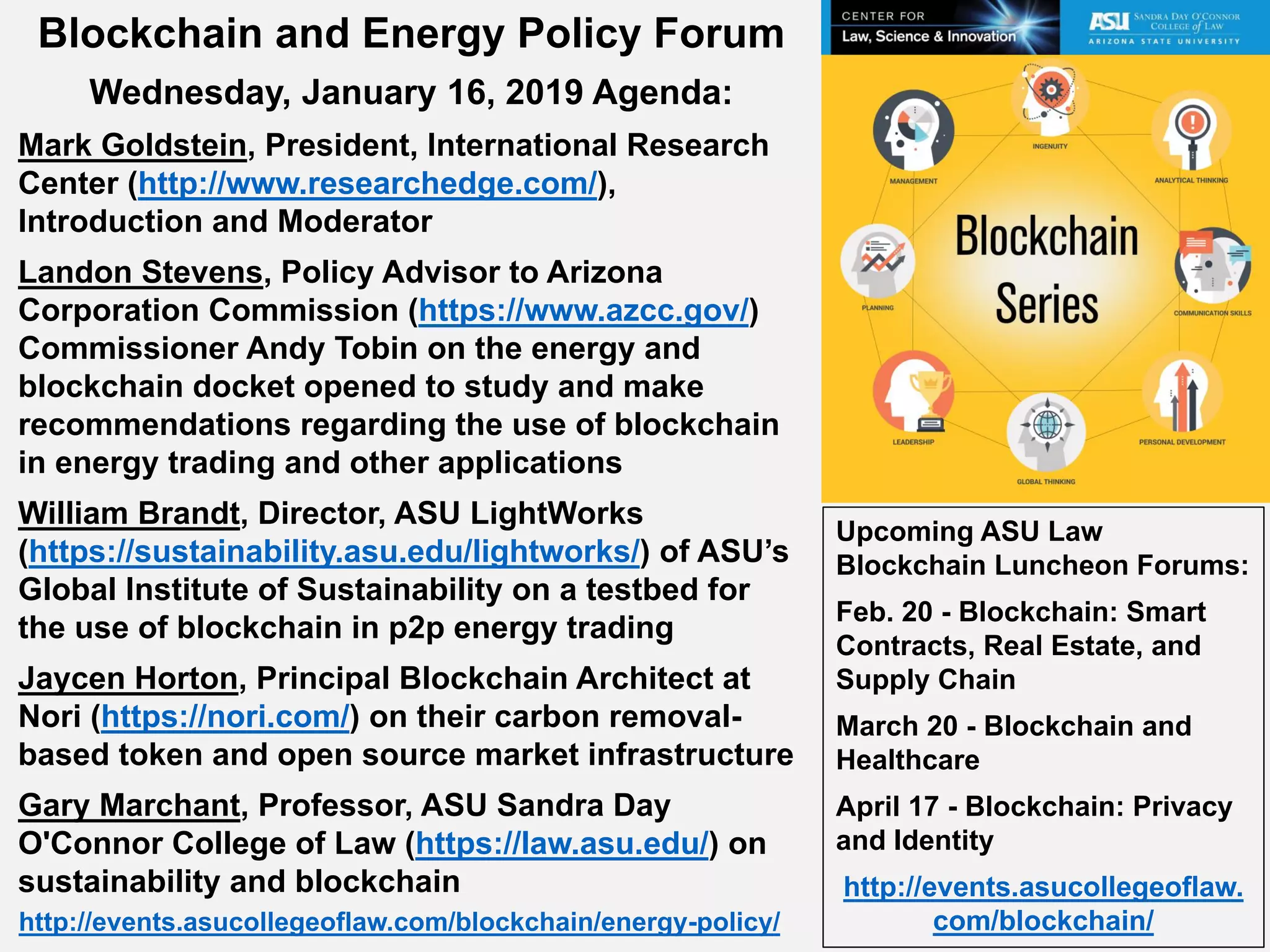
Blockchain and Energy Policy Forum
Wednesday, January 16, 2019 Agenda:
Mark Goldstein, President, International Research
Center (http://www.researchedge.com/),
Introduction and Moderator
Landon Stevens, Policy Advisor to Arizona
Corporation Commission (https://www.azcc.gov/)
Commissioner Andy Tobin on the energy and
blockchain docket opened to study and make
recommendations regarding the use of blockchain
in energy trading and other applications
William Brandt, Director, ASU LightWorks
(https://sustainability.asu.edu/lightworks/) of ASU’s
Global Institute of Sustainability on a testbed for
the use of blockchain in p2p energy trading
Jaycen Horton, Principal Blockchain Architect at
Nori (https://nori.com/) on their carbon removal-
based token and open source market infrastructure
Gary Marchant, Professor, ASU Sandra Day
O'Connor College of Law (https://law.asu.edu/) on
sustainability and blockchain
http://events.asucollegeoflaw.com/blockchain/energy-policy/
Upcoming ASU Law
Blockchain Luncheon Forums:
Feb. 20 - Blockchain: Smart
Contracts, Real Estate, and
Supply Chain
March 20 - Blockchain and
Healthcare
April 17 - Blockchain: Privacy
and Identity
http://events.asucollegeoflaw.
com/blockchain/
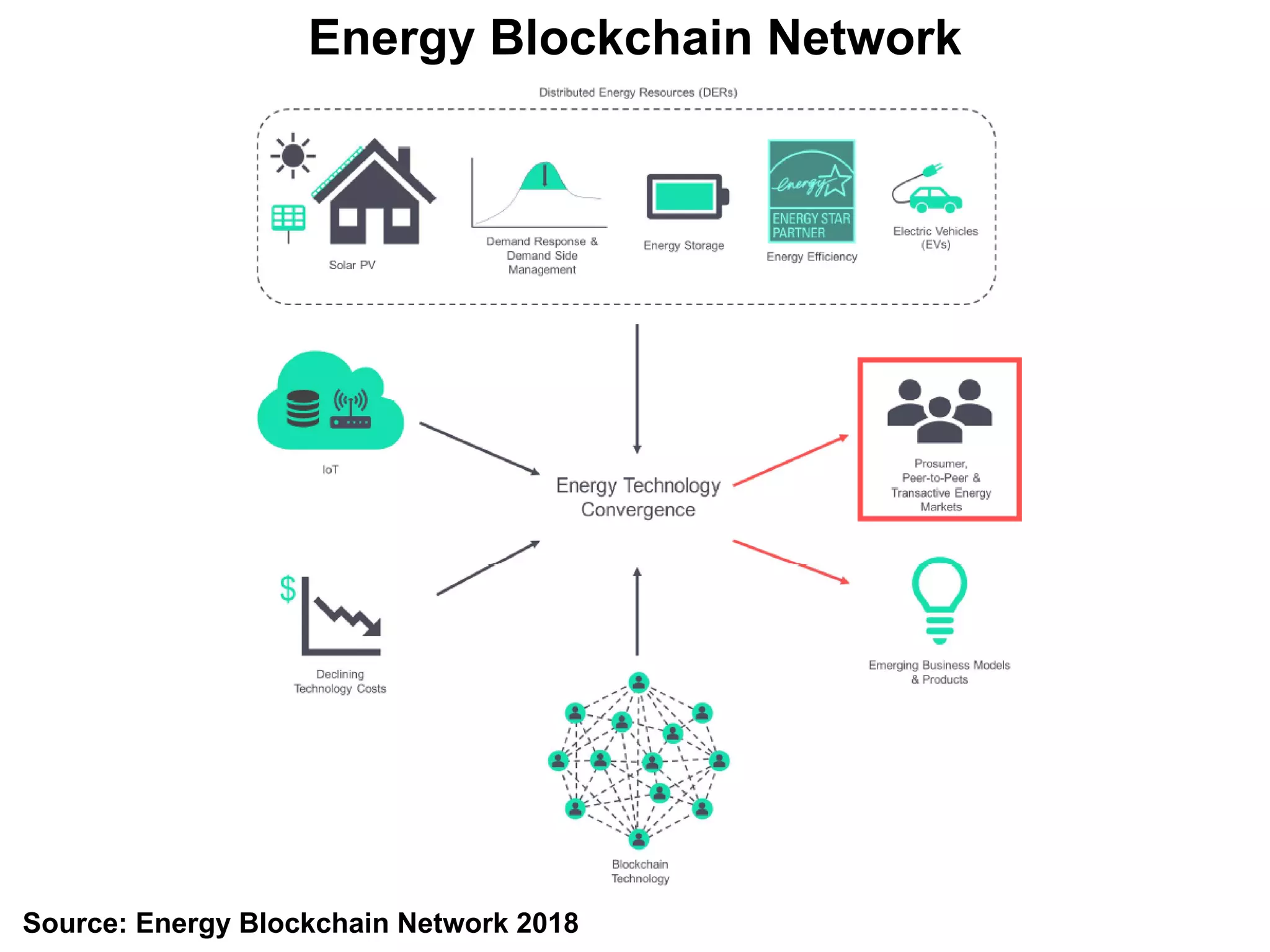
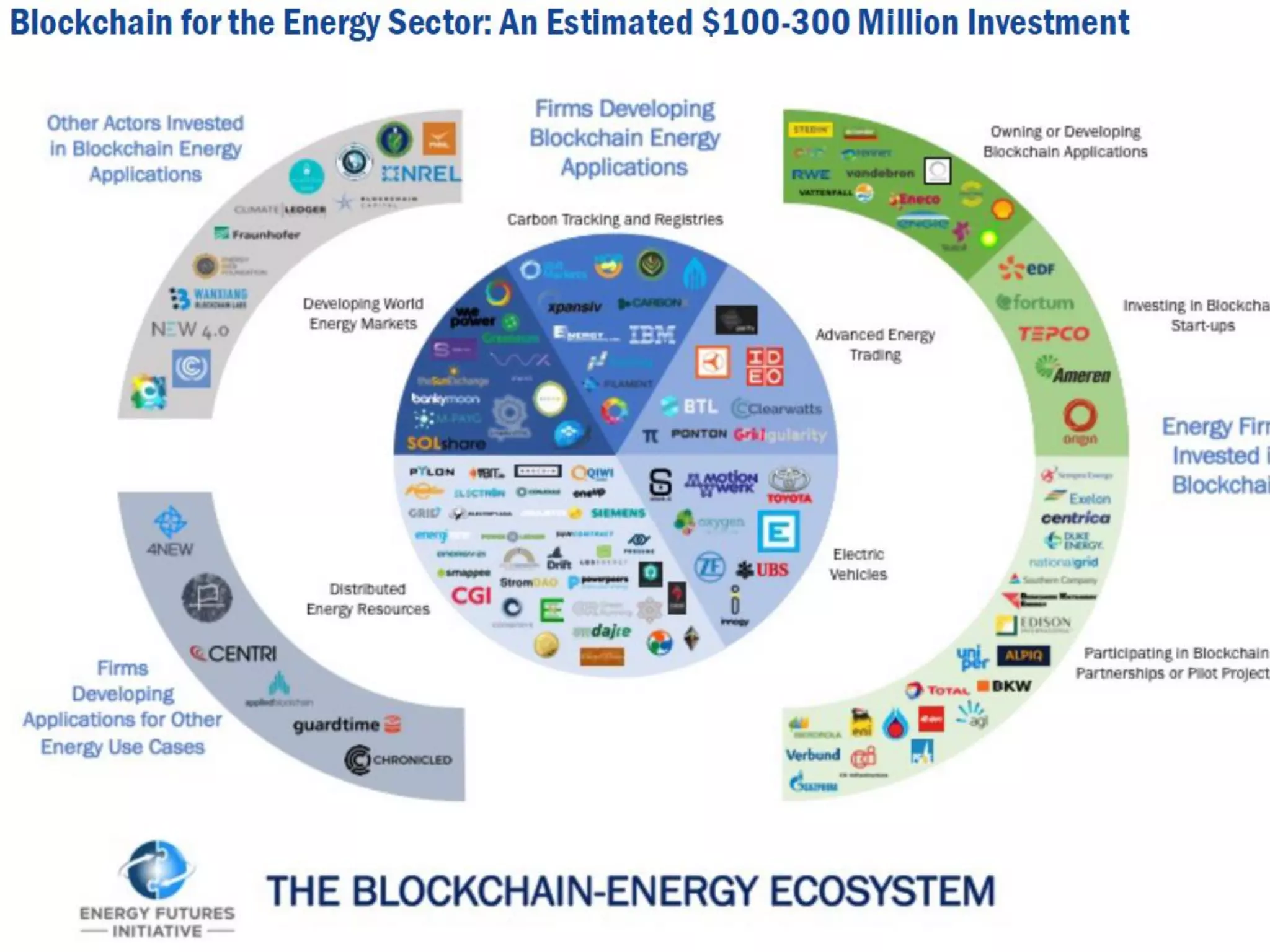
Energy Blockchain Network
Source: Energy Blockchain Network 2018
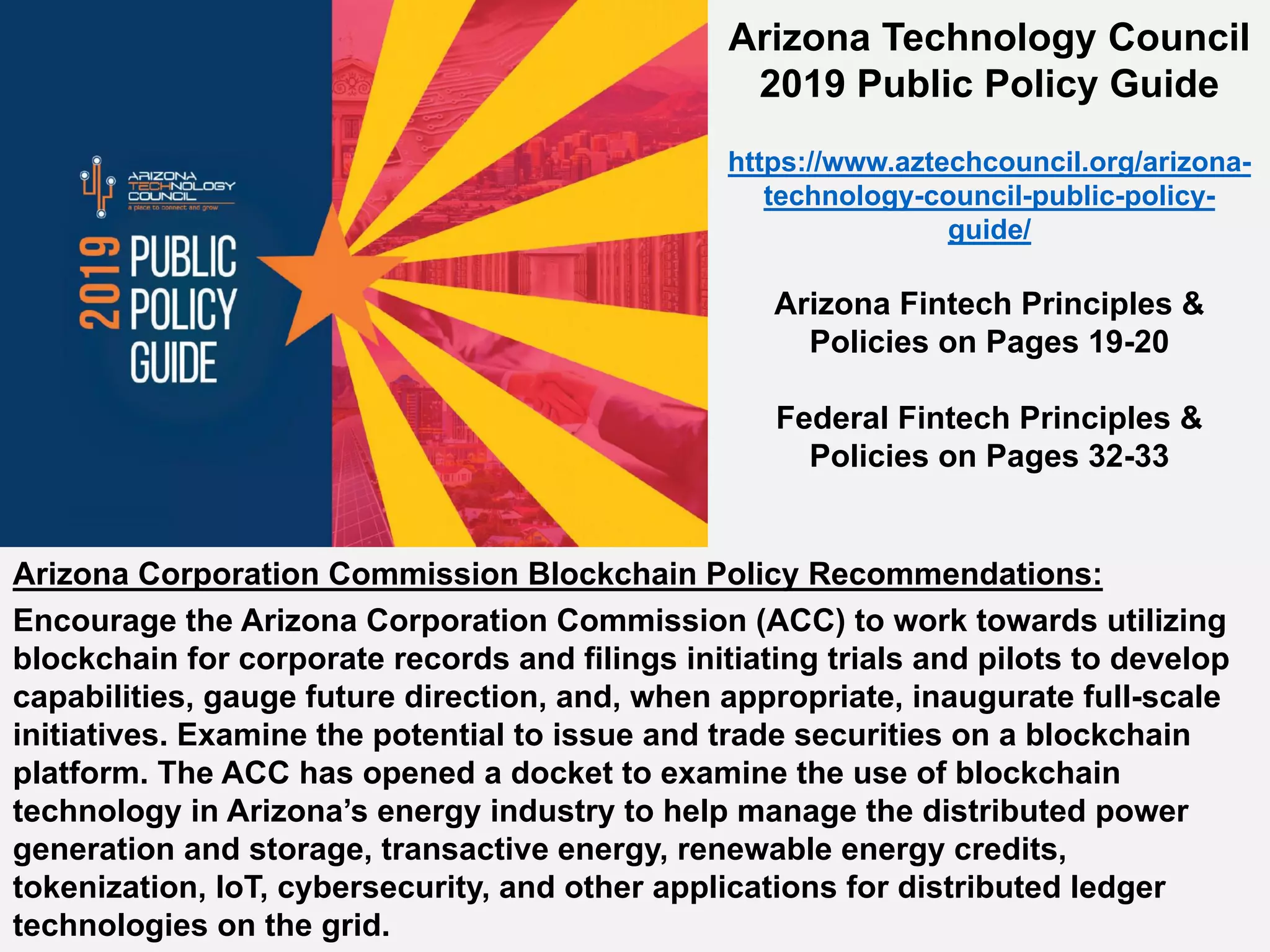
Arizona Corporation Commission Blockchain Policy Recommendations:
Encourage the Arizona Corporation Commission (ACC) to work towards utilizing
blockchain for corporate records and filings initiating trials and pilots to develop
capabilities, gauge future direction, and, when appropriate, inaugurate full-scale
initiatives. Examine the potential to issue and trade securities on a blockchain
platform. The ACC has opened a docket to examine the use of blockchain
technology in Arizona’s energy industry to help manage the distributed power
generation and storage, transactive energy, renewable energy credits,
tokenization, IoT, cybersecurity, and other applications for distributed ledger
technologies on the grid.
Arizona Technology Council
2019 Public Policy Guide
https://www.aztechcouncil.org/arizona-
technology-council-public-policy-
guide/
Arizona Fintech Principles &
Policies on Pages 19-20
Federal Fintech Principles &
Policies on Pages 32-33
Arizona Technology Council (AZTC) Public Policy Guide 2019
(https://www.aztechcouncil.org/arizona-technology-council-public-policy-guide/)
State Section: Financial Technology (Fintech)
Principles
Arizona’s financial technology (FinTech) sector is among the most promising and fastest growing in our
technology community. There’s a broad and robust FinTech community here with a diverse range of products
and services that have the potential of disruption for traditional financial services companies. Arizona has
shown leadership in breaking down regulatory barriers with the potential to inhibit FinTech innovation and
emerging business models and should continue to cultivate a FinTech-friendly environment. Our goal is to help
drive state regulatory reform to allow use of virtual currency that meets the needs of Arizona’s FinTech sector
where innovations primarily rely on virtual currency. Arizona must provide a robust, streamlined supervisory
experience for virtual currency and non-bank firms that is transparent, provides a level playing field for
businesses that doesn’t favor larger players over small ones, and appropriately protects consumers from
harm. The following recommended paths target several areas in need of reform.
Positions
Digital Signatures and Smart Contracts – Traditional paper contracts can be quite inefficient and prone to
fraud, which is why digital "smart contracts" tied to immutable blockchains are emerging as an alternative.
Arizona lawmaker previously passed HB2417, the nation’s groundbreaking legislation that amended the
Arizona Electronic Transactions Act to include digital signatures recorded on a blockchain. This enshrined their
validity and enforceability for records or contracts. In the most recent session, the Legislature passed HB2603,
refining and improving the handling of any electronic record and electronic signature related to a transaction.
This regulatory innovation and clarity has helped Arizona emerge as a choice location for blockchain
companies that develop applications based on smart contracts. Ensure there are not regulatory burdens
implemented and update statutes as needed with new, emerging technologies.
FinTech Regulatory Sandbox – Fintech startups are particularly disadvantaged by the difficulties and costs of
complying with conventional state money transmission licensing regimens. Legislation was passed in the 2018
session to create the nation’s first state-level regulatory sandbox allowing limited access to Arizona’s market
for testing innovative financial products or services without first obtaining full state licensure or other required
authorization. Innovative initiatives now are allowed to germinate through creation of an “on ramp” or
regulatory “sandbox” with exceptions to licensing rules for new companies based on low volumes or limited
business activities that pose a lower risk to consumers
The sandbox and the innovations that emerge will help position Arizona as an innovative hub for financial
technology, as well as prove lighter regulation and consumer protection can coexist. The Council will work to
publicize the sandbox to help attract new participants and leverage successful outcomes while supporting
further efforts of the Arizona Attorney General’s Office and Legislature to evolve and improve the program
over time. For example, expansion of the sandbox to allow selective insurance offerings and other financial
products and services that can benefit from technological innovation already closely regulated.
Money Transmission Licensing (MTL) Regulation – Consider legislation on the application of Arizona MTL law
to digital tokens in concert with federal guidance and in cooperation with other states. The application of state
MTL regulation should not hinge on the use of fiat currency to purchase a token. Instead, the sale of a digital
token for fiat currency should be treated no differently than the sale of any other commodity. A number of
states have acted to include or exclude cryptocurrencies or virtual currencies in their MTL laws using broad
definitions that essentially include all digital tokens. In essence, this regulates the technology, not how it's
used. Also, many tokenized projects currently may have a central issuer or administrator but will become a
decentralized, user-run platform once operational, complicating the application of MTL and other state
regulations. Pending federal actions regarding the Division of Financial Institutions should be closely tracked as
they clarify treatment of the wide array of digital tokens, optimizing Arizona’s complimentary state MTL
regulation alongside federal evolution.
Regulatory Reciprocity Between States – The Council will work with other states and national organizations in
establishing common multistate MTL and virtual money regulation and licensure that would ensure legal and
regulatory reciprocity between participating jurisdictions. Companies involved in virtual currency activities are
multi-jurisdictional by nature. Any artificial restraints on their ability to operate without regard to geographical
boundary within the U.S. adversely impacts the significant cost-effectiveness and efficiencies that their
business models offer to other businesses and consumers.
Arizona Corporation Commission (ACC) – Encourage the ACC to work towards utilizing blockchain for
corporate records and filings initiating trials and pilots to develop capabilities, gauge future direction, and,
when appropriate, inaugurate full-scale initiatives. Examine the potential to issue and trade securities on a
blockchain platform. The ACC has opened a docket to examine the use of blockchain technology in Arizona’s
energy industry to help manage the distributed power generation and storage, transactive energy, renewable
energy credits, tokenization, IoT, cybersecurity, and other applications for distributed ledger technologies on
the grid.
State Government Records – Examine utilizing blockchain by the Arizona executive branch for the
management and storage of state government records for cost, efficiency and security considerations;
initiating trials and pilots to develop capabilities; gauging future direction; and, when appropriate,
inaugurating full-scale initiatives. Offer leadership and assistance to Arizona’s counties in digitizing,
normalizing and consolidating property records following best practices, and ensuring compatibility with other
jurisdictions and open data protocols.
Decentralized Corporate Structures – Examine decentralized corporate structures that authorize this new
form of business entity and provide clarity and liability protections for participants. Decentralized projects,
including those operated via blockchain networks, do not necessarily fit within traditional state corporate
structures. As with many regulations that impose auditing/reporting/record-keeping responsibilities on a
central entity, corporate structures generally contemplate a central entity (corporation), or an individual or
small group of managers (LLC, LLP, etc.). Decentralized projects don't fit this mold. However, decentralized
project participants such as blockchain node operators likely constitute a common law partnership and could
be exposed personally to liability.
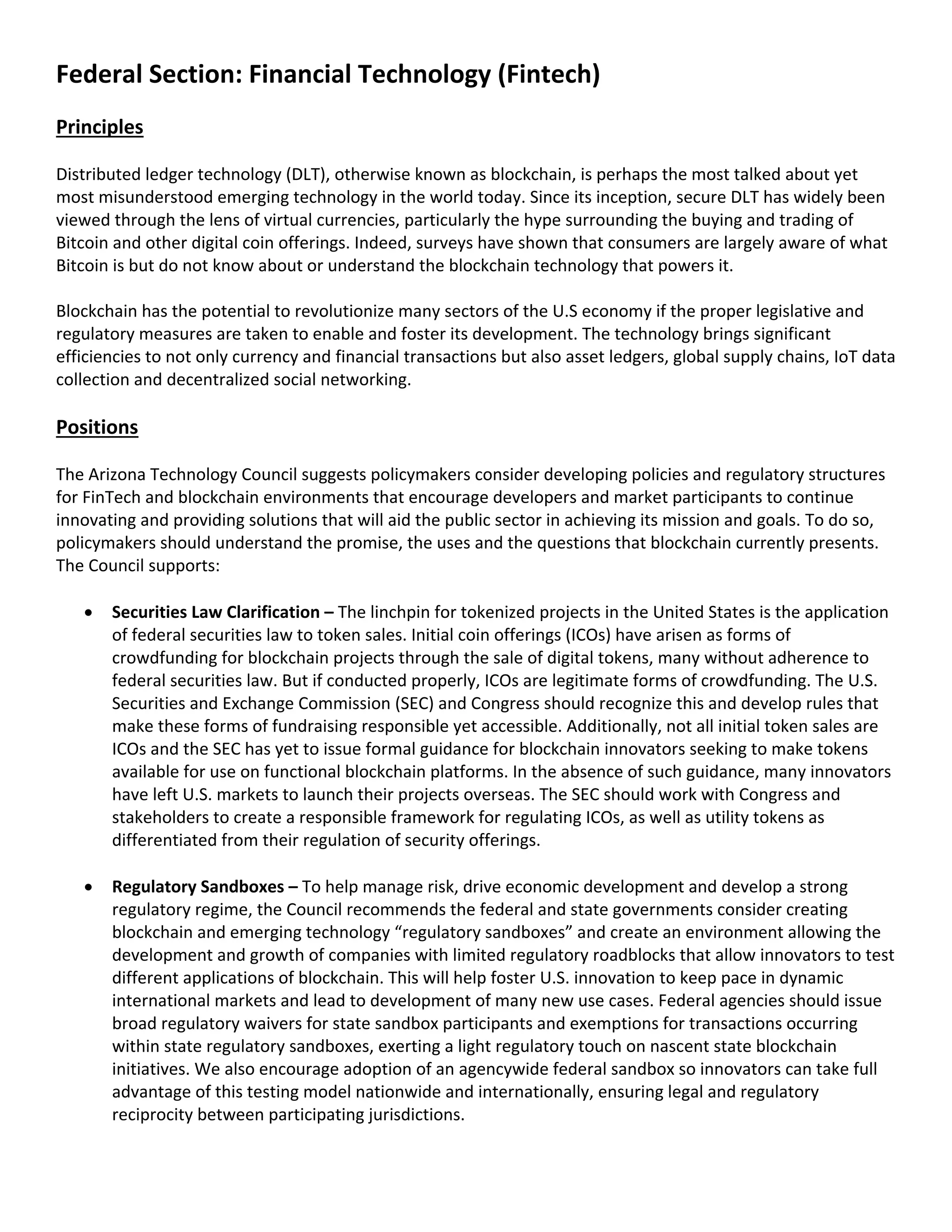
Federal Section: Financial Technology (Fintech)
Principles
Distributed ledger technology (DLT), otherwise known as blockchain, is perhaps the most talked about yet
most misunderstood emerging technology in the world today. Since its inception, secure DLT has widely been
viewed through the lens of virtual currencies, particularly the hype surrounding the buying and trading of
Bitcoin and other digital coin offerings. Indeed, surveys have shown that consumers are largely aware of what
Bitcoin is but do not know about or understand the blockchain technology that powers it.
Blockchain has the potential to revolutionize many sectors of the U.S economy if the proper legislative and
regulatory measures are taken to enable and foster its development. The technology brings significant
efficiencies to not only currency and financial transactions but also asset ledgers, global supply chains, IoT data
collection and decentralized social networking.
Positions
The Arizona Technology Council suggests policymakers consider developing policies and regulatory structures
for FinTech and blockchain environments that encourage developers and market participants to continue
innovating and providing solutions that will aid the public sector in achieving its mission and goals. To do so,
policymakers should understand the promise, the uses and the questions that blockchain currently presents.
The Council supports:
• Securities Law Clarification – The linchpin for tokenized projects in the United States is the application
of federal securities law to token sales. Initial coin offerings (ICOs) have arisen as forms of
crowdfunding for blockchain projects through the sale of digital tokens, many without adherence to
federal securities law. But if conducted properly, ICOs are legitimate forms of crowdfunding. The U.S.
Securities and Exchange Commission (SEC) and Congress should recognize this and develop rules that
make these forms of fundraising responsible yet accessible. Additionally, not all initial token sales are
ICOs and the SEC has yet to issue formal guidance for blockchain innovators seeking to make tokens
available for use on functional blockchain platforms. In the absence of such guidance, many innovators
have left U.S. markets to launch their projects overseas. The SEC should work with Congress and
stakeholders to create a responsible framework for regulating ICOs, as well as utility tokens as
differentiated from their regulation of security offerings.
• Regulatory Sandboxes – To help manage risk, drive economic development and develop a strong
regulatory regime, the Council recommends the federal and state governments consider creating
blockchain and emerging technology “regulatory sandboxes” and create an environment allowing the
development and growth of companies with limited regulatory roadblocks that allow innovators to test
different applications of blockchain. This will help foster U.S. innovation to keep pace in dynamic
international markets and lead to development of many new use cases. Federal agencies should issue
broad regulatory waivers for state sandbox participants and exemptions for transactions occurring
within state regulatory sandboxes, exerting a light regulatory touch on nascent state blockchain
initiatives. We also encourage adoption of an agencywide federal sandbox so innovators can take full
advantage of this testing model nationwide and internationally, ensuring legal and regulatory
reciprocity between participating jurisdictions.
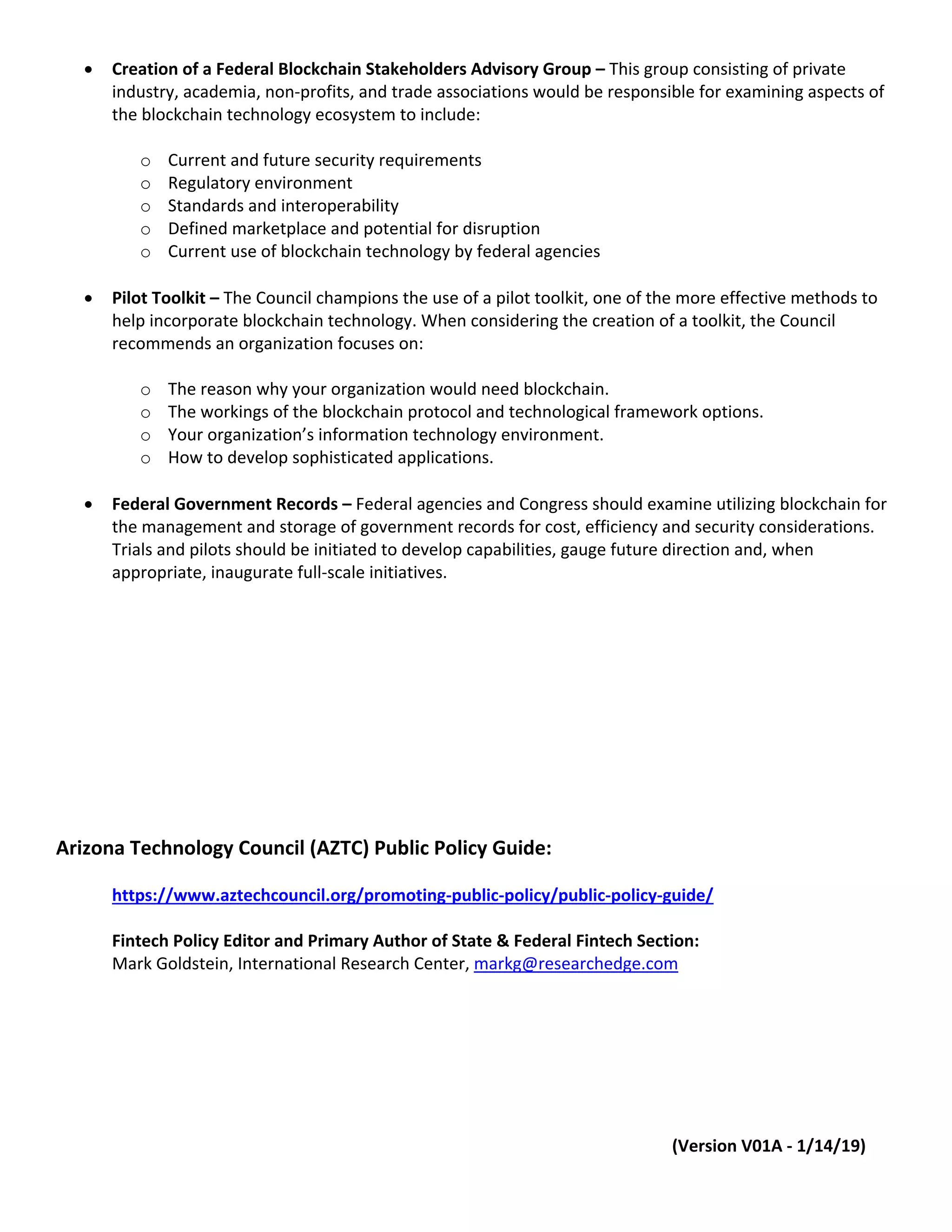
• Creation of a Federal Blockchain Stakeholders Advisory Group – This group consisting of private
industry, academia, non-profits, and trade associations would be responsible for examining aspects of
the blockchain technology ecosystem to include:
o Current and future security requirements
o Regulatory environment
o Standards and interoperability
o Defined marketplace and potential for disruption
o Current use of blockchain technology by federal agencies
• Pilot Toolkit – The Council champions the use of a pilot toolkit, one of the more effective methods to
help incorporate blockchain technology. When considering the creation of a toolkit, the Council
recommends an organization focuses on:
o The reason why your organization would need blockchain.
o The workings of the blockchain protocol and technological framework options.
o Your organization’s information technology environment.
o How to develop sophisticated applications.
• Federal Government Records – Federal agencies and Congress should examine utilizing blockchain for
the management and storage of government records for cost, efficiency and security considerations.
Trials and pilots should be initiated to develop capabilities, gauge future direction and, when
appropriate, inaugurate full-scale initiatives.
Arizona Technology Council (AZTC) Public Policy Guide:
https://www.aztechcouncil.org/promoting-public-policy/public-policy-guide/
Fintech Policy Editor and Primary Author of State & Federal Fintech Section:
Mark Goldstein, International Research Center, markg@researchedge.com
(Version V01A - 1/14/19)

ASU Law Blockchain & Energy Policy Introduction & AZTC Fintech Policy 1/16/19

  • 1.
    Mark Goldstein, InternationalResearch Center markg@researchedge.com, http://www.researchedge.com/ See SlideShare at http://www.slideshare.net/markgirc © 2019 - International Research Center Arizona Chapter 2019 Blockchain Speaker Series Blockchain and Energy Policy Forum Wednesday, January 16, 2019 http://events.asucollegeoflaw.com/blockchain/energy-policy/
  • 2.
    Blockchain and EnergyPolicy Forum Wednesday, January 16, 2019 Agenda: Mark Goldstein, President, International Research Center (http://www.researchedge.com/), Introduction and Moderator Landon Stevens, Policy Advisor to Arizona Corporation Commission (https://www.azcc.gov/) Commissioner Andy Tobin on the energy and blockchain docket opened to study and make recommendations regarding the use of blockchain in energy trading and other applications William Brandt, Director, ASU LightWorks (https://sustainability.asu.edu/lightworks/) of ASU’s Global Institute of Sustainability on a testbed for the use of blockchain in p2p energy trading Jaycen Horton, Principal Blockchain Architect at Nori (https://nori.com/) on their carbon removal- based token and open source market infrastructure Gary Marchant, Professor, ASU Sandra Day O'Connor College of Law (https://law.asu.edu/) on sustainability and blockchain http://events.asucollegeoflaw.com/blockchain/energy-policy/ Upcoming ASU Law Blockchain Luncheon Forums: Feb. 20 - Blockchain: Smart Contracts, Real Estate, and Supply Chain March 20 - Blockchain and Healthcare April 17 - Blockchain: Privacy and Identity http://events.asucollegeoflaw. com/blockchain/
  • 5.
    Energy Blockchain Network Source:Energy Blockchain Network 2018
  • 7.
    Arizona Corporation CommissionBlockchain Policy Recommendations: Encourage the Arizona Corporation Commission (ACC) to work towards utilizing blockchain for corporate records and filings initiating trials and pilots to develop capabilities, gauge future direction, and, when appropriate, inaugurate full-scale initiatives. Examine the potential to issue and trade securities on a blockchain platform. The ACC has opened a docket to examine the use of blockchain technology in Arizona’s energy industry to help manage the distributed power generation and storage, transactive energy, renewable energy credits, tokenization, IoT, cybersecurity, and other applications for distributed ledger technologies on the grid. Arizona Technology Council 2019 Public Policy Guide https://www.aztechcouncil.org/arizona- technology-council-public-policy- guide/ Arizona Fintech Principles & Policies on Pages 19-20 Federal Fintech Principles & Policies on Pages 32-33
  • 8.
    Arizona Technology Council(AZTC) Public Policy Guide 2019 (https://www.aztechcouncil.org/arizona-technology-council-public-policy-guide/) State Section: Financial Technology (Fintech) Principles Arizona’s financial technology (FinTech) sector is among the most promising and fastest growing in our technology community. There’s a broad and robust FinTech community here with a diverse range of products and services that have the potential of disruption for traditional financial services companies. Arizona has shown leadership in breaking down regulatory barriers with the potential to inhibit FinTech innovation and emerging business models and should continue to cultivate a FinTech-friendly environment. Our goal is to help drive state regulatory reform to allow use of virtual currency that meets the needs of Arizona’s FinTech sector where innovations primarily rely on virtual currency. Arizona must provide a robust, streamlined supervisory experience for virtual currency and non-bank firms that is transparent, provides a level playing field for businesses that doesn’t favor larger players over small ones, and appropriately protects consumers from harm. The following recommended paths target several areas in need of reform. Positions Digital Signatures and Smart Contracts – Traditional paper contracts can be quite inefficient and prone to fraud, which is why digital "smart contracts" tied to immutable blockchains are emerging as an alternative. Arizona lawmaker previously passed HB2417, the nation’s groundbreaking legislation that amended the Arizona Electronic Transactions Act to include digital signatures recorded on a blockchain. This enshrined their validity and enforceability for records or contracts. In the most recent session, the Legislature passed HB2603, refining and improving the handling of any electronic record and electronic signature related to a transaction. This regulatory innovation and clarity has helped Arizona emerge as a choice location for blockchain companies that develop applications based on smart contracts. Ensure there are not regulatory burdens implemented and update statutes as needed with new, emerging technologies. FinTech Regulatory Sandbox – Fintech startups are particularly disadvantaged by the difficulties and costs of complying with conventional state money transmission licensing regimens. Legislation was passed in the 2018 session to create the nation’s first state-level regulatory sandbox allowing limited access to Arizona’s market for testing innovative financial products or services without first obtaining full state licensure or other required authorization. Innovative initiatives now are allowed to germinate through creation of an “on ramp” or regulatory “sandbox” with exceptions to licensing rules for new companies based on low volumes or limited business activities that pose a lower risk to consumers The sandbox and the innovations that emerge will help position Arizona as an innovative hub for financial technology, as well as prove lighter regulation and consumer protection can coexist. The Council will work to publicize the sandbox to help attract new participants and leverage successful outcomes while supporting further efforts of the Arizona Attorney General’s Office and Legislature to evolve and improve the program over time. For example, expansion of the sandbox to allow selective insurance offerings and other financial products and services that can benefit from technological innovation already closely regulated.
  • 9.
    Money Transmission Licensing(MTL) Regulation – Consider legislation on the application of Arizona MTL law to digital tokens in concert with federal guidance and in cooperation with other states. The application of state MTL regulation should not hinge on the use of fiat currency to purchase a token. Instead, the sale of a digital token for fiat currency should be treated no differently than the sale of any other commodity. A number of states have acted to include or exclude cryptocurrencies or virtual currencies in their MTL laws using broad definitions that essentially include all digital tokens. In essence, this regulates the technology, not how it's used. Also, many tokenized projects currently may have a central issuer or administrator but will become a decentralized, user-run platform once operational, complicating the application of MTL and other state regulations. Pending federal actions regarding the Division of Financial Institutions should be closely tracked as they clarify treatment of the wide array of digital tokens, optimizing Arizona’s complimentary state MTL regulation alongside federal evolution. Regulatory Reciprocity Between States – The Council will work with other states and national organizations in establishing common multistate MTL and virtual money regulation and licensure that would ensure legal and regulatory reciprocity between participating jurisdictions. Companies involved in virtual currency activities are multi-jurisdictional by nature. Any artificial restraints on their ability to operate without regard to geographical boundary within the U.S. adversely impacts the significant cost-effectiveness and efficiencies that their business models offer to other businesses and consumers. Arizona Corporation Commission (ACC) – Encourage the ACC to work towards utilizing blockchain for corporate records and filings initiating trials and pilots to develop capabilities, gauge future direction, and, when appropriate, inaugurate full-scale initiatives. Examine the potential to issue and trade securities on a blockchain platform. The ACC has opened a docket to examine the use of blockchain technology in Arizona’s energy industry to help manage the distributed power generation and storage, transactive energy, renewable energy credits, tokenization, IoT, cybersecurity, and other applications for distributed ledger technologies on the grid. State Government Records – Examine utilizing blockchain by the Arizona executive branch for the management and storage of state government records for cost, efficiency and security considerations; initiating trials and pilots to develop capabilities; gauging future direction; and, when appropriate, inaugurating full-scale initiatives. Offer leadership and assistance to Arizona’s counties in digitizing, normalizing and consolidating property records following best practices, and ensuring compatibility with other jurisdictions and open data protocols. Decentralized Corporate Structures – Examine decentralized corporate structures that authorize this new form of business entity and provide clarity and liability protections for participants. Decentralized projects, including those operated via blockchain networks, do not necessarily fit within traditional state corporate structures. As with many regulations that impose auditing/reporting/record-keeping responsibilities on a central entity, corporate structures generally contemplate a central entity (corporation), or an individual or small group of managers (LLC, LLP, etc.). Decentralized projects don't fit this mold. However, decentralized project participants such as blockchain node operators likely constitute a common law partnership and could be exposed personally to liability.
  • 10.
    Federal Section: FinancialTechnology (Fintech) Principles Distributed ledger technology (DLT), otherwise known as blockchain, is perhaps the most talked about yet most misunderstood emerging technology in the world today. Since its inception, secure DLT has widely been viewed through the lens of virtual currencies, particularly the hype surrounding the buying and trading of Bitcoin and other digital coin offerings. Indeed, surveys have shown that consumers are largely aware of what Bitcoin is but do not know about or understand the blockchain technology that powers it. Blockchain has the potential to revolutionize many sectors of the U.S economy if the proper legislative and regulatory measures are taken to enable and foster its development. The technology brings significant efficiencies to not only currency and financial transactions but also asset ledgers, global supply chains, IoT data collection and decentralized social networking. Positions The Arizona Technology Council suggests policymakers consider developing policies and regulatory structures for FinTech and blockchain environments that encourage developers and market participants to continue innovating and providing solutions that will aid the public sector in achieving its mission and goals. To do so, policymakers should understand the promise, the uses and the questions that blockchain currently presents. The Council supports: • Securities Law Clarification – The linchpin for tokenized projects in the United States is the application of federal securities law to token sales. Initial coin offerings (ICOs) have arisen as forms of crowdfunding for blockchain projects through the sale of digital tokens, many without adherence to federal securities law. But if conducted properly, ICOs are legitimate forms of crowdfunding. The U.S. Securities and Exchange Commission (SEC) and Congress should recognize this and develop rules that make these forms of fundraising responsible yet accessible. Additionally, not all initial token sales are ICOs and the SEC has yet to issue formal guidance for blockchain innovators seeking to make tokens available for use on functional blockchain platforms. In the absence of such guidance, many innovators have left U.S. markets to launch their projects overseas. The SEC should work with Congress and stakeholders to create a responsible framework for regulating ICOs, as well as utility tokens as differentiated from their regulation of security offerings. • Regulatory Sandboxes – To help manage risk, drive economic development and develop a strong regulatory regime, the Council recommends the federal and state governments consider creating blockchain and emerging technology “regulatory sandboxes” and create an environment allowing the development and growth of companies with limited regulatory roadblocks that allow innovators to test different applications of blockchain. This will help foster U.S. innovation to keep pace in dynamic international markets and lead to development of many new use cases. Federal agencies should issue broad regulatory waivers for state sandbox participants and exemptions for transactions occurring within state regulatory sandboxes, exerting a light regulatory touch on nascent state blockchain initiatives. We also encourage adoption of an agencywide federal sandbox so innovators can take full advantage of this testing model nationwide and internationally, ensuring legal and regulatory reciprocity between participating jurisdictions.
  • 11.
    • Creation ofa Federal Blockchain Stakeholders Advisory Group – This group consisting of private industry, academia, non-profits, and trade associations would be responsible for examining aspects of the blockchain technology ecosystem to include: o Current and future security requirements o Regulatory environment o Standards and interoperability o Defined marketplace and potential for disruption o Current use of blockchain technology by federal agencies • Pilot Toolkit – The Council champions the use of a pilot toolkit, one of the more effective methods to help incorporate blockchain technology. When considering the creation of a toolkit, the Council recommends an organization focuses on: o The reason why your organization would need blockchain. o The workings of the blockchain protocol and technological framework options. o Your organization’s information technology environment. o How to develop sophisticated applications. • Federal Government Records – Federal agencies and Congress should examine utilizing blockchain for the management and storage of government records for cost, efficiency and security considerations. Trials and pilots should be initiated to develop capabilities, gauge future direction and, when appropriate, inaugurate full-scale initiatives. Arizona Technology Council (AZTC) Public Policy Guide: https://www.aztechcouncil.org/promoting-public-policy/public-policy-guide/ Fintech Policy Editor and Primary Author of State & Federal Fintech Section: Mark Goldstein, International Research Center, markg@researchedge.com (Version V01A - 1/14/19)