
ASTRONOMY DATABASES

Presented by Kalpita Potawad
M.L.I.Sc
2012-2013
Astronomy databases

• NASA (National Aeronautics and Space
 Administration)

• ads (Astrophysics Data System)


• MAST (MIKULSKI ARCHIVE FOR SPACE
 TELESCOPES)

• SETI (Search for Extraterrestrial Intelligence)
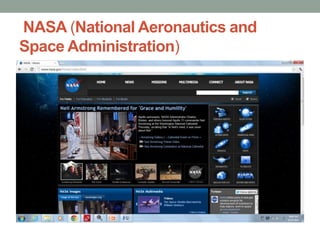
NASA (National Aeronautics and
Space Administration)
About NASA
• The website address is www.nasa.gov

• The National Aeronautics and Space Administration (NASA) is
 the agency of the United States government that is responsible for the
 nation's civilian space program and for aeronautics and
 aerospace research.

• NASA is conducting an array of science missions that will seek new
 knowledge and understanding of Earth, the solar system and the
 universe.

• NASA conducts its work in three principal organizations, called
  mission directorates:
• Aeronautics
• Human Exploration and Operations
• Science
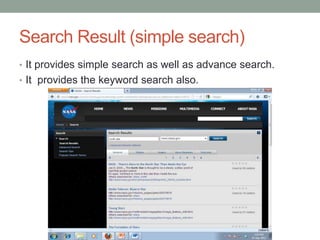
Search Result (simple search)
• It provides simple search as well as advance search.
• It provides the keyword search also.
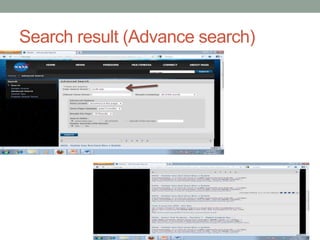
Search result (Advance search)
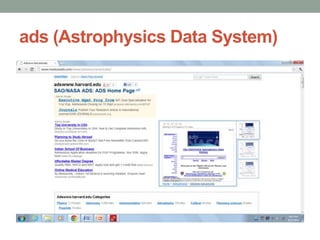
ads (Astrophysics Data System)

• The Astrophysics Data System (usually referred to as ADS),
 developed by the National Aeronautics and Space
 Administration (NASA), is an online database of over eight
 million astronomy and physics papers from both peer reviewed
 and non-peer reviewed sources.

• ADS is a powerful research tool and has had a significant
 impact on the efficiency of astronomical research since it was
 launched in 1992.

• Use of ADS is almost universal among astronomers worldwide,
 and therefore ADS usage statistics can be used to analyze
 global trends in astronomical research.
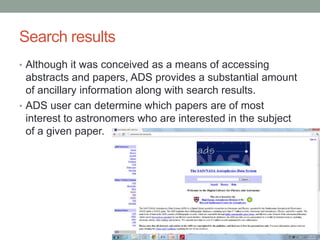
Search results
• Although it was conceived as a means of accessing
  abstracts and papers, ADS provides a substantial amount
  of ancillary information along with search results.
• ADS user can determine which papers are of most
  interest to astronomers who are interested in the subject
  of a given paper.
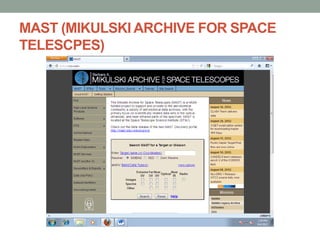
MAST (MIKULSKI ARCHIVE FOR SPACE
TELESCPES)
About MAST
• MAST supports a variety of astronomical data archives,
 with a primary focus on scientifically related data sets in
 the optical, ultraviolet, and near-infrared parts of the
 spectrum.

• See http://archive.stsci.edu/missions.html for a full list of
 the mission, survey, and catalog data distributed by
 MAST. MAST is a component of NASA's distributed
 Space Science Data Services (SSDS).

• MAST archives a variety of spectral and image data with a
 range of data characteristics.
Getting Started
• MAST Tutorial


• MAST Interfaces


• Finding Data


• Data Archive and Distribution Service (DADS)
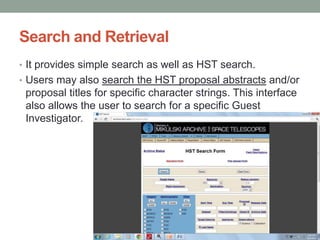
Search and Retrieval
• It provides simple search as well as HST search.
• Users may also search the HST proposal abstracts and/or
 proposal titles for specific character strings. This interface
 also allows the user to search for a specific Guest
 Investigator.
SETI (Search for Extraterrestrial
Intelligence)
About SETI
• SETI (Search for Extraterrestrial Intelligence) is a
 scientific area whose goal is to detect intelligent life
 outside Earth. One approach, known as radio SETI, uses
 radio telescopes to listen for narrow-bandwidth radio
 signals from space.

• SETI@home was released to the public on May 17,
 1999, making it the second large-scale use of distributed
 computing over the Internet for research purposes.
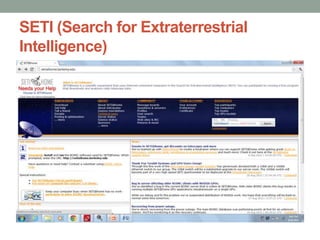
Search results
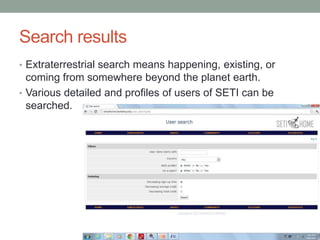
• Extraterrestrial search means happening, existing, or
  coming from somewhere beyond the planet earth.
• Various detailed and profiles of users of SETI can be
  searched.
Reference
• http://adswww.harvard.edu/


• http://archive.stsci.edu/


• http://www.nasa.gov/


• http://setiathome.berkeley.edu/
Astronomy databases ppt

Astronomy databases ppt

  • 1.
    ASTRONOMY DATABASES Presented byKalpita Potawad M.L.I.Sc 2012-2013
  • 2.
    Astronomy databases • NASA(National Aeronautics and Space Administration) • ads (Astrophysics Data System) • MAST (MIKULSKI ARCHIVE FOR SPACE TELESCOPES) • SETI (Search for Extraterrestrial Intelligence)
  • 3.
    NASA (National Aeronauticsand Space Administration)
  • 4.
    About NASA • Thewebsite address is www.nasa.gov • The National Aeronautics and Space Administration (NASA) is the agency of the United States government that is responsible for the nation's civilian space program and for aeronautics and aerospace research. • NASA is conducting an array of science missions that will seek new knowledge and understanding of Earth, the solar system and the universe. • NASA conducts its work in three principal organizations, called mission directorates: • Aeronautics • Human Exploration and Operations • Science
  • 5.
    Search Result (simplesearch) • It provides simple search as well as advance search. • It provides the keyword search also.
  • 6.
  • 7.
  • 8.
    ads (Astrophysics DataSystem) • The Astrophysics Data System (usually referred to as ADS), developed by the National Aeronautics and Space Administration (NASA), is an online database of over eight million astronomy and physics papers from both peer reviewed and non-peer reviewed sources. • ADS is a powerful research tool and has had a significant impact on the efficiency of astronomical research since it was launched in 1992. • Use of ADS is almost universal among astronomers worldwide, and therefore ADS usage statistics can be used to analyze global trends in astronomical research.
  • 9.
    Search results • Althoughit was conceived as a means of accessing abstracts and papers, ADS provides a substantial amount of ancillary information along with search results. • ADS user can determine which papers are of most interest to astronomers who are interested in the subject of a given paper.
  • 10.
    MAST (MIKULSKI ARCHIVEFOR SPACE TELESCPES)
  • 11.
    About MAST • MASTsupports a variety of astronomical data archives, with a primary focus on scientifically related data sets in the optical, ultraviolet, and near-infrared parts of the spectrum. • See http://archive.stsci.edu/missions.html for a full list of the mission, survey, and catalog data distributed by MAST. MAST is a component of NASA's distributed Space Science Data Services (SSDS). • MAST archives a variety of spectral and image data with a range of data characteristics.
  • 12.
    Getting Started • MASTTutorial • MAST Interfaces • Finding Data • Data Archive and Distribution Service (DADS)
  • 13.
    Search and Retrieval •It provides simple search as well as HST search. • Users may also search the HST proposal abstracts and/or proposal titles for specific character strings. This interface also allows the user to search for a specific Guest Investigator.
  • 14.
    SETI (Search forExtraterrestrial Intelligence)
  • 15.
    About SETI • SETI(Search for Extraterrestrial Intelligence) is a scientific area whose goal is to detect intelligent life outside Earth. One approach, known as radio SETI, uses radio telescopes to listen for narrow-bandwidth radio signals from space. • SETI@home was released to the public on May 17, 1999, making it the second large-scale use of distributed computing over the Internet for research purposes.
  • 16.
    Search results • Extraterrestrialsearch means happening, existing, or coming from somewhere beyond the planet earth. • Various detailed and profiles of users of SETI can be searched.
  • 17.
    Reference • http://adswww.harvard.edu/ • http://archive.stsci.edu/ •http://www.nasa.gov/ • http://setiathome.berkeley.edu/