page 1
America’s Premier
Stained Glass Studi0®
& ®
®
A Resource Guide
for Your Stained
Glass Project
Table of Contents
Forward and Mission Statement 3
A Brief History of Associated Crafts®
& 

Willet Hauser Architectural Glass®
3
Fundraising Approaches and Resources 4
Do-It-Yourself Survey 7
Protecting Your Stained Glass Asset 9
Selecting a Studio 11
Repair and Restoration 15
Frame Repair and Painting 22
New Frames and Ventilators 23
New Windows 26
Protective Covering 32
Selling Pre-Owned Stained Glass 37
Glossary 39

page 2
America’s Premier
Stained Glass Studi0®
& ®
®
Forward
We at Associated Crafts®
& Willet Hauser Architectural Glass®
have more than a
century of experience serving clients. Through the years, we have often found
that the majority of client staff members had little or no knowledge of stained
glass windows. We believe that many clients would have made better decisions
regarding how to care and preserve their valuable assets had they possessed the
basic knowledge of these beautifully crafted items.
It is our pleasure to provide you with this informative manual in hopes that you gain
a better understanding of stained glass windows and have a resource to turn to
when it is time to make decisions regarding your own windows. For more
information on stained glass windows or to receive information on our studio,
please visit our web site at www.stained-glass-window.us.
Our Mission Statement
Associated Crafts®
& Willet Hauser Architectural Glass®
is dedicated to the
preservation of America’s stained glass heritage. We believe that through education,
we can raise awareness and ultimately preserve these valuable works of art.
Brief History of
Associated Crafts® &
Willet Hauser
Architectural Glass®
For over thirty years, John D. Phillips has worked in the stained glass industry. He
was first introduced to the craft from his father John W. Phillips and has had a
passion for it ever since.
page 3
In addition to working in his father’s studio, he consulted for other large studios
regarding production, sales and software. John Phillips Jr. is dedicated to raising
awareness of historic stained glass windows and their preservation.
In 1997 John and his wife, Mary, founded their company, Associated Crafts®
. After
growing that business for over 20 years establishing a stellar reputation in the
industry, they purchased the century old studio Willet Hauser Architectural Glass®
.
The entire Associated Crafts®
& Willet Hauser Architectural Glass®
staff
contributed to the contents and experiences expressed in this guide.
Fundraising
Over the generations people have built clients with elaborate architecture featuring
beautiful stained glass windows. As with all buildings, time takes its toll on these
grand structures and they require constant maintenance to maintain their splendor.
Unfortunately the populations that support these houses of worship are also
changing and often the support needed is not in place to complete the required
maintenance. Clients often find they have to be creative in order to meet their
financial needs.
Following are a few approaches others have taken to raise money to facilitate their
stained glass restoration projects as well as some resources that we can provide.
Adopt A Window
Several clients have taken the window-by-window approach. They take the overall
cost of a project and break it down by square foot per window to establish a cost
of repair for each window. Once this cost is established, the client then offers
sponsorship of each window to its members.
An interested member or group of members then pledges the amount to cover the
work of that particular window. Often the client will present the donor or group of
donors with a plaque acknowledging their gift.
page 4
There are also instances in which the client will approximate these costs per window
to achieve more donations to also apply to less glamorous projects such as roofing
or air-conditioning work. This approach has been very successful in raising money
for many different maintenance projects by using the visual appeal of stained glass.
Associated Crafts®
& Willet Hauser Architectural Glass®
provides a “donor cost” in
each proposal to use for its fundraising.
Specialty Items
Some clients have worked with specialty companies to purchase miscellaneous
items in bulk at a discounted price. The members then offer these items to the
public at a retail price, taking the proceeds for use toward the project. Associated
Crafts®
& Willet Hauser Architectural Glass®
produce a “Life of Christ” in Stained
Glass Adult Coloring book complete with coloring pencils and built in sharpener to
fit this need.
Staging
Another approach is the staging method. In this instance, a client selects a
contractor and requests his bid to be broken down to address each specific area.
The client then performs each section as they acquire the funds. This works well
for active clients that receive regular pledge income. The only disadvantage
generally is it costs more to have a company do the work in different stages as there
is no quantity discount because the company has to contend with extra set up and
mobilization costs.
Bank Loans
In some situations, clients have taken out loans to facilitate the completion of
projects with the knowledge that this will inspire growth and support from their
members to pay off these loans. We have seen many clients take this approach and
often when projects are completed, the members are inspired and the client
receives increased monthly pledges to sanctify the loans. Some clients have gone as
far as to ask their members to commit to additional monthly payments.
page 5
Specialty Loans
There has also been a growing trend of specialty lenders that specifically fund
clients. This has received both positive and negative results. It is best to talk to
several lenders and read the fine print. Be sure there are no pre-payment penalties.
Some companies, such as Associated Crafts®
& Willet Hauser Architectural Glass®
may offer in-house financing. Generally, this is a great option but be sure you
understand the terms and that this is something your membership can support.
State, Federal, and Private Historical Grants
Years ago many clients would solicit historical grant help but it unfortunately rarely
panned out.
However, in the recent five or six years, more and more of these grants have come
to fruition for several historic clients. The application often requires a great deal of
work and has stringent guidelines.
The agency is usually concerned that the client is requesting a project that is to help
the building maintain its historical significance. It is very important that you select a
quality company that is versed in historic restoration and preservation. The correct
studio can be very advantageous in helping a client secure a grant while choosing
the incorrect studio can make it impossible.
Fundraising Tools
We recommend selecting a studio whose staff is prepared to assist you in your
fundraising efforts.
Our team has tools and expertise to help you raise funds for your client through
through online and community marketing. Our team can help you get started with
a fundraising consultation review and support your staff with the tools to make it
happen.
page 6
Do-It-Yourself Survey
Unfortunately many stained glass studios, including ours, receive frantic calls from
clients whose windows are at critical stages of deterioration, and the client has
avoided or not understood the problems that occurred until it reached catastrophic
levels.
Associated Crafts®
& Willet Hauser Architectural Glass®
has designed the following
guide for you to assess each of your stained glass windows. We have provided you
with a format that you can submit to Associated Crafts®
& Willet Hauser
Architectural Glass®
for review. When completed, this survey can also serve as
documentation of each window, which can be very helpful with insurance claims or
reproduction in the case of loss.
Before starting, gather the following items:
• 25’ tape measure
• Paper and pencil
• Digital camera
• Note cards (or other paper)
Observe
Start at the first window. On a piece of paper, number the window (important), give
a brief description and measure the window, rounding off to the nearest half foot.
Provide a Description
You need to identify each window visually. Use the name of the scene (i.e.,
Gethsemane or Communion) or the name found in a memorial plate (i.e., In
Honor of John Smith). Another option is to use the area of the client to identify a
window (i.e. large balcony window and large altar window). It is also very helpful to
draw a simple building sketch to identify the windows’ locations.
page 7
Measure
Round off all measurements to the nearest half-foot. For example, wood that is 32”
should be rounded up to three feet. Write the width measurement followed by the
height measurement. On large windows, you can measure half the distance and
then double it.
Interior Observations:
• How many pieces of broken out (not cracked) glass are there?
• Do you see any bowed, sagging, or bulging areas?
• Do you see any light leaks and if so, how many?
• Do you see any evidence of leakage?
• Are there any loose or missing brace bars?
• Do the ventilators open and close freely?
Exterior Observations:
• Is the window covered?
• Is the frame made of wood, steel, aluminum or stone?
• Is the protective covering vented?
• Is the window frame in need of painting?
• Do you see any rotten wood? Is the protective covering clear?
• Is the protective covering broken?
• Is there any evidence of the protective covering leaking?
Take Photographs
It is best to take simple digital photos. For interior photos, do not use a flash.
• Take your note card and observe window number one.
• Write the number 1 on the note card, place the card in the right hand
corner of the window and take the picture.
• Once you take the photo, review it to make sure it is clear.
• Be sure the index card with the number can be seen clearly in the photo.
• Take exterior photos of each window using the note cards /paper (do
this the same way you did for the interior photos).
• For inaccessible windows, hold the appropriate card number in front of
you so you can see the card number and window in the picture.
page 8
Repeat the above steps for each window. Window two would be the number 2 on
the next card and then 3 etcetera, etcetera…
Submit Documentation
You can either scan, fax or email the document(s) to (888)801-9551 and e-mail the
photographs to info@willethauser.com. A company representative will review and
contact you.
Protecting Your 

Stained Glass Asset
For many client members, there is an emotional attachment to the stained glass
windows in their places of worship. Members often pass on stories and memories
related to the windows. However, few realize that for many clients, the stained glass
is their largest material asset and part of their heritage.
Appraisals and Insurance
Like individuals, many clients rely on their insurance agent to guide them on their
coverage. For some, this approach has been devastating as traditional insurance
agents often don’t understand the value of historic windows. After a catastrophic
event, some stained glass studios have assisted in the repair and heard complaints
about the coverage that was in place.
Nothing is more disheartening than to see a client suffer a loss and then find out
their coverage is inadequate. To prevent this from happening to your client, it is
best to get a comprehensive appraisal by a qualified stained glass studio. Many
studios or consultants charge a nominal fee for this service. Associated Crafts®
&
Willet Hauser Architectural Glass®
will generally provide this service free with the
assistance of client personnel.
page 9
Online Appraisal Service
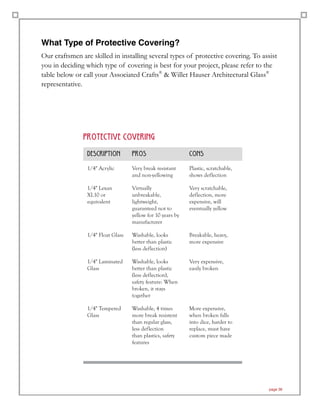
Associated Crafts®
& Willet Hauser Architectural Glass®
have developed an online
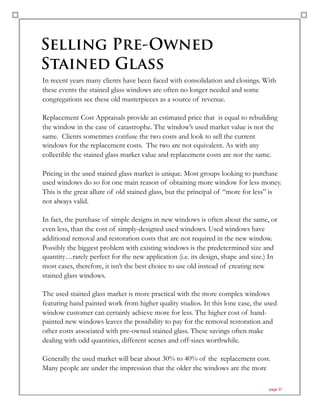
appraisal tool, where a client can submit photos of their stained glass windows to
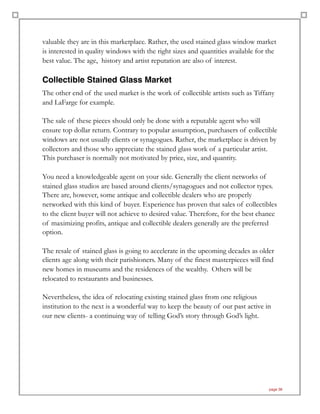
obtain a free estimated replacement cost of each stained glass window. Having a
correct appraisal value for your stained glass windows is critical for the fine arts
section of your client’s insurance policy. When you use the online appraisal service,
the stained glass window photos are also safely housed in our database as an
additional backup should your client ever be hit by disaster. This tool can be
accessed at www.associatedcrafts.com or www.willethauser.com.
Once the appraisal is complete, you should review your coverage with your
insurance provider to verify the windows are covered appropriately.
Documentation
Do a simple documentation of your windows. Take an overall photo of each
window and then a close up of each section to show the detail. It is also important
to measure the window opening, rounding off to the nearest half foot.
In case of catastrophes such as tornados, hurricanes, fires, or vandalism, stained
glass panels or entire windows can be destroyed. Having documentation of your
windows would be essential in their restoration. It is a good idea to store this
information in multiple electronic locations as well as the paper version in a safe
deposit box or fireproof file.
Maintenance
Some studios have restored projects left undone for years simply because the
members did not know where to go for help. It is best to select a quality studio to
provide you with a condition report.
Most studios will provide this report free of charge. If possible, have several
companies prepare the report so you will have various opinions and perspectives
on your windows.
For those who want to know if they should add protective covering, we at
Associated Crafts®
& Willet Hauser Architectural Glass®
always say, “Yes”! In most
page 10
cases, windows which have been properly protected are in much better shape than
unprotected windows.
The covering protects the windows from the elements as well as vandalism.
Remember to let your insurance company know that your windows are protected
and request a discount on your premiums. Please read the chapter on Protective
Covering for further understanding.
Assess each window so that you can catch small problems before they become
large ones. Please share this information with as many as possible. The more
people that are aware and educated about this craft, the better their stained glass
windows will be protected and preserved.
Selecting a Studio
Everyone wants to know the magical formula to select the correct stained glass
studio to complete his or her project. While a studio cannot do this for you, there
are ways to sort through the information and make a quality selection.
A common question that the clergy will ask a stained glass studio is “How do I get
an apples to apples bid?” Stained glass is extremely specialized. Often, others
outside the industry do not know the terms and jargon. This is what inspired us to
write this manual.
The other aspect of this industry is the lack of regulation. The industry consists of
many smaller companies started by craftsmen and artists who took a hobby and
changed it into a career. This is certainly admirable but these individuals often do
not have the knowledge of all the facets of the business or of stained glass and
construction. Professional studios often compete with specifications written by
amateur companies. This is why we diligently work to educate our clients. Often a
simple understanding of terms and jargon will allow the client to understand the
correct scope of work.
Some studios specialize in a certain type of work. For example, a studio that creates
a number of new windows will often bid an onsite restoration project as a
complete re-lead because this scope of work fits into their business operations
page 11
more easily. An on-site restoration project may be impossible since they do not
have the expertise or the manpower to complete the work that may best serve the
client. A studio that does not do new windows may not recommend re-leading
when needed as it cannot be easily completed at their facilities.
Both studios make a strong case for their approach but we are left with a confused
committee.
The following is a guide to help you find a studio that passes these guidelines and
most importantly, to help you and your committee through this learning curve.
1. Have they been in business for more than ten years?

If they have this suggests that they are doing something right to maintain
operations as with most businesses. You can verify this information by using
state records or checking Dunn & Bradstreet. Remember that sometimes people
report information incorrectly, so be very direct and ask the potential studio to
explain any items that are not clear. Be aware that some companies have used
variations of names to avoid creditors.
2. Ask the studio to send references over a five-year period of business. Obviously, companies
generally provide only positive references, so it is important to request at least 10
references and check state websites regarding contracting in the states in which
they are licensed. Pick several references and contact these customers. We
suggest you contact the most recent client committees, as it may be hard to talk
with someone familiar with the project from several years ago. Ask the contact
the following questions:
a) Did the company complete the job on time?
b) Did the company and job supervisor communicate with you during the
project?
c) Did the crew clean up well and work around your services, etc.?
page 12
d) Did the company complete the contract in a skillful manner?
e) Overall, were you satisfied with the project?
f) What type of work did they do? (repair, re-lead, covering, etc.)
From their answers, you should get some idea of consistency and those
consistencies should give you an idea of the company’s work and operations.
Stained glass restoration normally does not require state licensing but some states
do require certain licensing in order to operate in their state.
It is important that you ask each reference what type of work was performed. This
ensures that the studio has the skills to provide the client with an unbiased scope
of work based on what the client needs instead of what the studio needs to sell.
Clients often are confused by the terminology different studios use. Please ask for
an explanation of each specification so you can fully understand and correctly
compare each studio.
As with most purchases, you want to have a comfort level with the staff of that
studio. They should be knowledgeable, eager to help and patient with your
questions. Good communication is vital to the success of any project.
Contract
Be sure each proposal or contract clearly itemizes each service per window. All
materials should be specified and spec sheets provided as available. It is also a good
idea to request solid deadlines of completion. Make sure the payment terms are
detailed and specific and should not be paid ahead! Be sure each stage is fully
completed and you are satisfied before authorizing payment.
page 13
Guarantees
All consumers are looking for a solution to their problem and want that solution to
be guaranteed for as long as possible. In the stained glass industry, guarantees can
range from zero to 20 years and can cover the entire project or just the
workmanship.
In some cases, smaller studios make guarantees that they cannot fulfill because they
are not around long enough to honor their guarantee. The best guarantee is to have
the work completed correctly in the first place. Make sure the proper products are
used and that the company performed all work in a quality manner. There is little
need for a guarantee if the project they completed is done correctly. This material
and installation really does not have a high failure rate.
Many clients often assume that any leakage problems are a result of the stained
glass. Try to avoid having false hopes, as even uncovered stained glass windows are
very rarely the cause of water infiltration into a building. Unfortunately, many
contractors take the easy way out and blame it on the windows instead of actually
water testing to determine the source of leakage. This situation often leaves client
members disappointed to find they spent money to recover the windows to prevent
the leakage only to find the source of the leak was actually something else.
In summary, a five to ten year guarantee against any defective workmanship is
proper. A client can also protect itself by inspecting stages of the project prior to
final payment. Most importantly, do not fail to check out the company you are
contracting. Their record and references will speak volumes about them.
As a client leader, others have put their confidence in you and in your abilities and
stewardship. Honor their confidence by doing your homework! Remember you get
what you pay for and you pay for what you get. Your valuable stained glass
windows are no exception!
page 14
Repair and Restoration
The actual work to stained glass is broken down into two categories: repair and
restoration (re-leading). Often a combination of the two may be required.
Repair: refers to onsite repair work such as broken glass replacement, bulge
reduction, and securing of loose braces, etc.
Restoration: refers to the process of re-leading. Each window is moved and
taken apart piece by piece and then reassembled using new lead and bracing. This
process is usually done after the windows have been transported to the studio.
Deciding which scope of repair work to do on the stained glass windows can be a
confusing decision for any committee. This information should assist you in
making the correct selection for your particular client.
Over the past 40 years, there has been an abundance of self-proclaimed experts
promoting highly sophisticated restoration to stained glass windows. These expert
consultants have marketed their services well and raised the awareness of the
importance of quality restoration, especially on great works of art like those by
Tiffany and LaFarge. Unfortunately, these consultants have not promoted a
complete look at restoration; one that would be applicable for most situations
presented in America’s clients today.
A client should hire a studio that can educate them on the pros and cons of each
scope of work for their client. With this information and knowing their personal
obstacles such as growth, budget or relocation, they can make a responsible
decision.
Many bidders do not have the rounded skill set to offer their clients a choice. They
simply skew their view to reflect what they have to sell instead of what the client
needs.
For example, Associated Crafts®
& Willet Hauser Architectural Glass®
recently
called on a client that had 20-year-old stained glass windows that a competitor
page 15
recommended an expensive complete re-lead. This was not necessary. The client
maintained and protected these windows without having to undertake a huge fund
drive. In this case, the competitor did not sell the covering and on-site repairs that
the client needed. Instead of withdrawing from the project, they tried to sell the
client something they did not need.
Under normal conditions, stained glass windows should be re-leaded when they
reach around 100 years old. However, this is only a rule of thumb and
circumstances could change this number.
To determine if a panel is in need of re-leading, you can make a few observations.
Lead, like all metal, will oxidize and appear to have a white powdery look. If this
oxidation is constant and heavy, the deterioration might be great.
The joints where lead comes together on each work is finished and secured by
soldering. Due to solder and lead moving at a different rate, there is fatigue that
becomes evident by tearing of the lead next to the soldered areas. If you find this
to be a majority situation, you might consider re-leading.
Another test is to scratch the lead, which should be soft and pliable. However, if it
tears, it has probably gone through its life cycle. Obviously, the best way to
determine the need for re-leading is to hire a qualified professional who can
perform both methods of testing and inspect the stained glass on a regular basis.
Associated Crafts®
& Willet Hauser Architectural Glass®
provides this service and
will explain our findings.
In years gone by, there were several companies that serviced clients all over, doing
on-site repairs and protective covering installation. These companies had no regard
to damages that came from their haphazard skills. On-site restoration as a whole,
took a big hit from these companies due to problems discovered 20 years later due
to poor craftsmanship and many earned a bad reputation. Quality companies with
skilled craftsmen use successful techniques that properly restore these historic
pieces.
As with re-leading, it is important to find a studio that is experienced with both
methods to help determine the best method for your client.
page 16
The following is a list of some common repairs done on-site. Also listed are
important points that should help you recognize a knowledgeable stained glass
consultant from one who is not.
Broken or Cracked Glass
To keep the originality intact of a historic window, we recommend replacing only
the broken but not cracked glass. View replacement as a last resort. Cracked pieces
that are not missing areas are to be either supported by Dutchman, sealed with
epoxy, or edge glued (in re-leading). These repairs will support and secure the
original piece.
Perfect matching of replacement pieces can be difficult and not always possible.
However, a knowledgeable studio can acquire a large spectrum of glass from
manufacturers or inventories. Be sure to insist your craftsmen provide you with a
close match. Do not settle for something noticeably different. We can use little
techniques to provide swatches that blend to give you a quality restoration. Test the
craftsmen and ask them what they can do if an exact match is not possible.
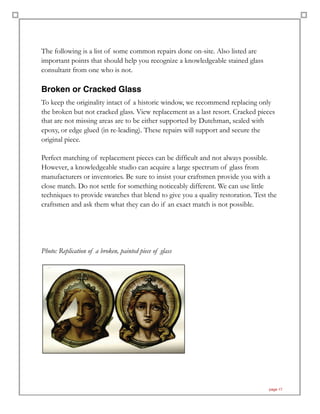
Photo: Replication of a broken, painted piece of glass
page 17
Bulging
Another common problem is the bowing or sagging of an area of stained glass.
Due to years of exposure, gravity, heat build-up, settling and improper bracing,
bulging occurs in most stained glass.
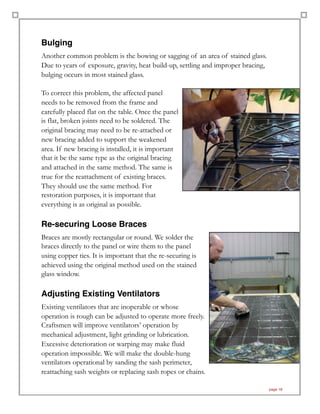
To correct this problem, the affected panel
needs to be removed from the frame and
carefully placed flat on the table. Once the panel
is flat, broken joints need to be soldered. The
original bracing may need to be re-attached or
new bracing added to support the weakened
area. If new bracing is installed, it is important
that it be the same type as the original bracing
and attached in the same method. The same is
true for the reattachment of existing braces.
They should use the same method. For
restoration purposes, it is important that
everything is as original as possible.
Re-securing Loose Braces
Braces are mostly rectangular or round. We solder the
braces directly to the panel or wire them to the panel
using copper ties. It is important that the re-securing is
achieved using the original method used on the stained
glass window.
Adjusting Existing Ventilators
Existing ventilators that are inoperable or whose
operation is rough can be adjusted to operate more freely.
Craftsmen will improve ventilators’ operation by
mechanical adjustment, light grinding or lubrication.
Excessive deterioration or warping may make fluid
operation impossible. We will make the double-hung
ventilators operational by sanding the sash perimeter,
reattaching sash weights or replacing sash ropes or chains.

page 18
Cleaning the Interior of Stained Glass
Stained glass gets dirty from years of exposure to dust, pollution and candles. You
can clean these windows but there is the need for some precautions especially
around painted pieces that may not be stable. You can clean the interior surface of
the stained glass window by spraying a special liquid cleaning solution on the
stained glass window and then wiping the solution off with a soft cloth. Although
craftsmen are very thorough in their cleaning procedures, it is impossible to remove
heavy lime deposits or paint over spray with this cleaning method. A craftsman can
provide other cleaning methods to address these concerns; however, this is usually
bid differently. Windows with painted glass need to be tested for stability. The
craftsman should be able to determine the correct cleaning method to ensure
quality results.
Re-cementing
Years of exposure to elements and heat will dry and reduce the cement compound
in a stained glass window. It is important to rejuvenate this cement on the exterior,
and to strengthen and waterproof the window. To perform this service on the
interior is too messy.
The exterior surface of the stained glass window will have a specially formulated
cement compound brushed underneath the lead flanges. Re-cementing will
strengthen and weatherproof the window by replacing the original cement
compound, which has loosened or fallen out over the years. This process also does
an excellent job of cleaning the window.
Be sure that the studio explains each service in detail in your contract and that your
studio consultant can answer your questions regarding any services to be
performed.
page 19
Historic
Restoration or 

Re-leading
Overview
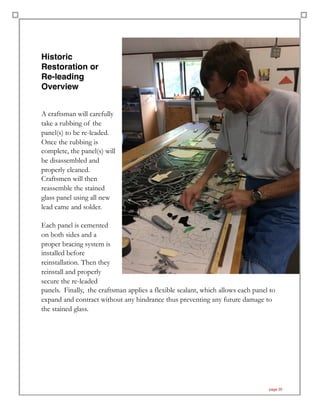
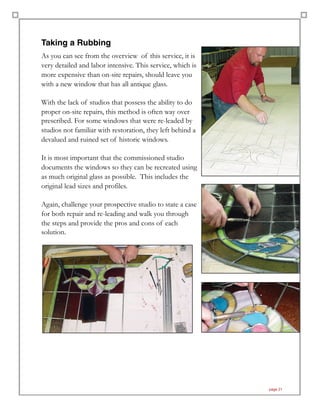
A craftsman will carefully
take a rubbing of the
panel(s) to be re-leaded.
Once the rubbing is
complete, the panel(s) will
be disassembled and
properly cleaned.
Craftsmen will then
reassemble the stained
glass panel using all new
lead came and solder.
Each panel is cemented
on both sides and a
proper bracing system is
installed before
reinstallation. Then they
reinstall and properly
secure the re-leaded
panels. Finally, the craftsman applies a flexible sealant, which allows each panel to
expand and contract without any hindrance thus preventing any future damage to
the stained glass.
page 20
Taking a Rubbing
As you can see from the overview of this service, it is
very detailed and labor intensive. This service, which is
more expensive than on-site repairs, should leave you
with a new window that has all antique glass.
With the lack of studios that possess the ability to do
proper on-site repairs, this method is often way over
prescribed. For some windows that were re-leaded by
studios not familiar with restoration, they left behind a
devalued and ruined set of historic windows.
It is most important that the commissioned studio
documents the windows so they can be recreated using
as much original glass as possible. This includes the
original lead sizes and profiles.
Again, challenge your prospective studio to state a case
for both repair and re-leading and walk you through
the steps and provide the pros and cons of each
solution.
page 21
Frame Repair and
Repainting
One of the most requested services is the repair and maintenance of stained glass
frames. Often companies provide this service peripherally but this is a very
important service. Frequently studios refer to wood frames but this also includes
steel.
Without a quality repair, there cannot be a quality paint job. Without a quality paint
job, you cannot have a quality window project. Keep in mind that this is a very
visible portion of the overall stained glass project. Make sure your studio is skilled
in this aspect of the project.
Preparation
The most important aspects of the project are material and preparations. Use only
high-quality paints.
Most often preparations are simply scraping all loose areas of existing paint. Seal all
holes and cracks with long-lasting acrylic latex. Then apply two finish coats of
high-quality paint. It is important to use quality brands such as Sherwin Williams or
Pratt and Lambert. There is no such a thing as a bargain when it comes to paint
costs.
It is important to apply painting on the frame and not the surrounding substrate or
the stained glass. This is the difference between an amateur application and that of
a professional.
Steel Frames
Use rust inhibitive primers and paints and be sure to prepare the surface properly,
as suggested by the product’s manufacturer.
page 22
Epoxy Consolidator
An epoxy sealer/primer that has been expressly manufactured for the repair of
deteriorated wood will be applied to the millwork. The epoxy consolidator
permeates the wood to create a strong bond arresting fungi/bacterial growth. This
is a wood treatment and not intended for wood repair. This consolidator is
intended to cover bare wood areas only.
Millwork or Frame Repair
A craftsman should repair or replace the damaged millwork if contracted. The
craftsmen will remove all or part of the damaged millwork and blend new material
or similar type and profile into the damaged areas. The repair piece will be secured,
puttied and finished. If the millwork is beyond the contracted scope of work, the
studio should inform the client.
Often Associated Crafts®
& Willet Hauser Architectural Glass®
will make an
allowance for millwork repair since the actual fair bid cannot be determined until
we access the windows.
In many cases when a company bids for millwork prior to access, they assume
more work will be needed and usually end up over charging the client. However,
bids taken after access tend to be more accurate and fair. Sometimes a company
will quote a pre-determined time and material rate, including it in the contract, to
handle this extra work.
New Frames and
Ventilators
New window clients usually request the installation of new frames and ventilators,
but studios also receive requests for these services in some remodels.
page 23
Most frequently studios construct new frames out of aluminum. They use it since it
is maintenance free and generally less expensive than using wood or steel.
The following is a list and description of some commonly used products within the
stained glass industry:
Aluminum Ventilators
This is a special custom-fit ventilation unit used to replace existing vents or can be
used for new construction to provide ventilation. The new ventilators provide a
weatherproof seal and fluid operation. They also use these vents in some repair
projects when a client needs to add ventilation or replace a damaged ventilator. The
one drawback to aluminum vents is that they are expensive and often require the
studio to cut down the existing windows to fit this large profile. This is important
in cases where there are high-quality historic windows. Studios use the new
ventilators in both single and double-glazed profiles.
Double-glazed: This frame is designed to house both the stained glass as well as
the protective covering.
Single-glazed: This frame holds only one glazing material.
Steel Ventilators
Studios generally used these ventilators in restoration projects since most windows
that have ventilators use steel. This allows the studio to replace a deteriorated vent
with one of a similar profile to restore the window to its original condition.
New Aluminum Frames
Each new frame is custom fit and made of high-quality aluminum. The new frames
are secured with clipped or welded joints. Each frame provides an excellent glazing
situation with snap-on beads to secure each glazing material and a dead air space to
allow proper insulation. Frames come in three standard colors: white, bronze, and
putty. The standard frame finish is baked-on enamel, which will not peel or fade.
Once installed they will be virtually maintenance free.
page 24
Associated Crafts®
& Willet Hauser Architectural Glass®
uses three types of
frames:
Double-glazed: This frame is designed to house both the stained glass and the
protective covering.
Single-glazed: This frame holds only one glazing material.
Thermo-barrier: These frames will hold both the stained glass as well as the
protective covering. This framing has a built-in plastic barrier,
which slows down the transfer of heat or cold to the inside of the frame, virtually
eliminating condensation on the interior of the frame.
Wood Frame
On rare occasions clients will ask or we will propose to replace entire frames.
Generally, clients request this in restoration projects so that the studio can match
the historical framing. Studios also use them in high-end new installations, when
the client wants to use wood to create a particular look.
Steel Frame
This is used for restoration projects to keep the frame original.
Azek Frames
Frames are created from Azek®
solid vinyl. This frame has a limited lifetime
warranty against manufacturing defects, rot, corrosion, cracking, excessive swelling,
splitting, delamination and yellowing. This unique product allows the client to enjoy
a product that has the versatility and beauty of wood with limited maintenance and
will not rot.
page 25
New Windows
There are several different types of art glass used for stained glass projects today.
Faceted Glass
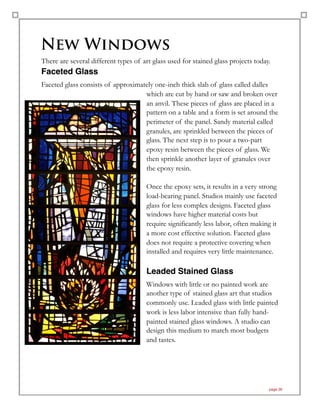
Faceted glass consists of approximately one-inch thick slab of glass called dalles
which are cut by hand or saw and broken over
an anvil. These pieces of glass are placed in a
pattern on a table and a form is set around the
perimeter of the panel. Sandy material called
granules, are sprinkled between the pieces of
glass. The next step is to pour a two-part
epoxy resin between the pieces of glass. We
then sprinkle another layer of granules over
the epoxy resin.
Once the epoxy sets, it results in a very strong
load-bearing panel. Studios mainly use faceted
glass for less complex designs. Faceted glass
windows have higher material costs but
require significantly less labor, often making it
a more cost effective solution. Faceted glass
does not require a protective covering when
installed and requires very little maintenance.
Leaded Stained Glass
Windows with little or no painted work are
another type of stained glass art that studios
commonly use. Leaded glass with little painted
work is less labor intensive than fully hand-
painted stained glass windows. A studio can
design this medium to match most budgets
and tastes.
page 26
Fully Hand-Painted Stained Glass Windows
These are constructed the same as all leaded glass except that an artist will hand
paint each piece of stained glass then fire the piece in a kiln to adhere the paint to
the glass. Painting allows the artist to create levels of detail not possible with the
other new window methods. This process is very time consuming; requires a very
talented artist; and is a more costly method than the others.
Whether you are constructing a new building or renovating an old one, keeping
within a budget is always a concern. It is important to select a stained glass studio
that has the versatility to present a variety of designs that are fitting to the client’s
architecture and symbolic desires. Correctly designed windows can be achieved
using any of the different types of stained glass available and your client should be
given examples of each.
Many quality studios will present prior examples of work that may not be specific
to your project. They will usually ask that you hire their company first before
providing specific renderings for the
client. It is up to the client committee
to decide after interviews and
reviewing prior examples as well as
conducting background checks, if the
studios they are considering are
competent.
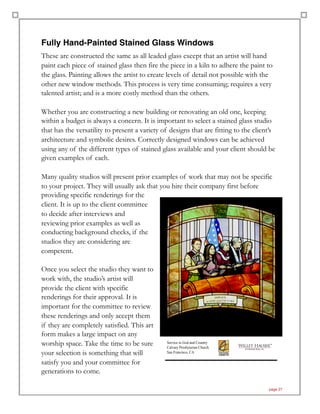
Once you select the studio they want to
work with, the studio’s artist will
provide the client with specific
renderings for their approval. It is
important for the committee to review
these renderings and only accept them
if they are completely satisfied. This art
form makes a large impact on any
worship space. Take the time to be sure
your selection is something that will
satisfy you and your committee for
generations to come.
page 27
The executing artist is gifted and experienced and you need to allow them to
complete the creation with some freedom of selection. Too often a great artist was
handicapped due to the many influences by the committee. This can hamper the
overall project.
It is important to consider a stained glass studio that is versed in all areas of stained
glass. For example, a stained glass studio that performs many restoration projects
has great insight to the construction, bracing and installation of new windows.
Through restoration experience, they have learned what works best long-term and
what does not. Unfortunately, some beautiful new window creations that have been
braced and installed improperly caused expensive repairs for the client long before
it is appropriate.
Step by Step: Leaded & Painted Construction
The stained glass studio and its staff will meet with the committee to discuss the
theme, design and coloring schemes of their client’s project. The studio’s artist will
then develop a thumbnail sketch or rendering for each window. The studio presents
this rendering to the committee for their approval. Once approved, the studio turns
the rendering into a full-scale cartoon which is a full-size drawing depicting every
piece of glass and lead came they will use. This drawing will be the exact size of the
window. This cartoon will not represent color but will show the proportion of the
design. This is a good checking point for the client prior to construction.
After the full-scale rendering is complete, the artist will select the glass the studio
will use. The artist then codes each piece of glass selected onto the cartoon. The
stained glass craftsman will then cut each type of glass to match the cartoon. If
the windows are to be painted, the craftsman will return the painted pieces to the
artist, who then hand paints each piece and fires it in a kiln so the paint will
permanently adhere to the stained glass.
page 28
!
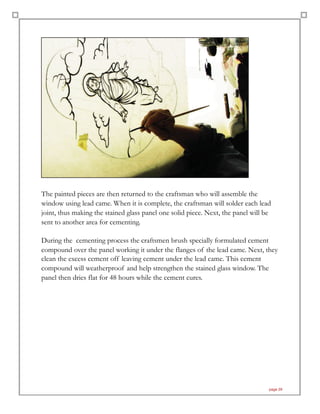
The painted pieces are then returned to the craftsman who will assemble the
window using lead came. When it is complete, the craftsman will solder each lead
joint, thus making the stained glass panel one solid piece. Next, the panel will be
sent to another area for cementing.
During the cementing process the craftsmen brush specially formulated cement
compound over the panel working it under the flanges of the lead came. Next, they
clean the excess cement off leaving cement under the lead came. This cement
compound will weatherproof and help strengthen the stained glass window. The
panel then dries flat for 48 hours while the cement cures.
page 29
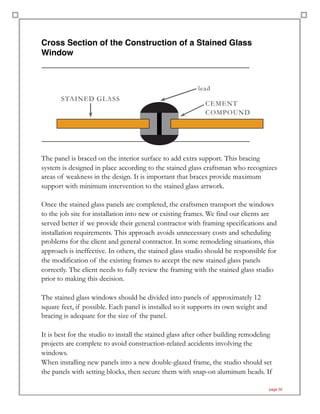
Cross Section of the Construction of a Stained Glass
Window
!
!
The panel is braced on the interior surface to add extra support. This bracing
system is designed in place according to the stained glass craftsman who recognizes
areas of weakness in the design. It is important that braces provide maximum
support with minimum intervention to the stained glass artwork.
Once the stained glass panels are completed, the craftsmen transport the windows
to the job site for installation into new or existing frames. We find our clients are
served better if we provide their general contractor with framing specifications and
installation requirements. This approach avoids unnecessary costs and scheduling
problems for the client and general contractor. In some remodeling situations, this
approach is ineffective. In others, the stained glass studio should be responsible for
the modification of the existing frames to accept the new stained glass panels
correctly. The client needs to fully review the framing with the stained glass studio
prior to making this decision.
The stained glass windows should be divided into panels of approximately 12
square feet, if possible. Each panel is installed so it supports its own weight and
bracing is adequate for the size of the panel.
It is best for the studio to install the stained glass after other building remodeling
projects are complete to avoid construction-related accidents involving the
windows.
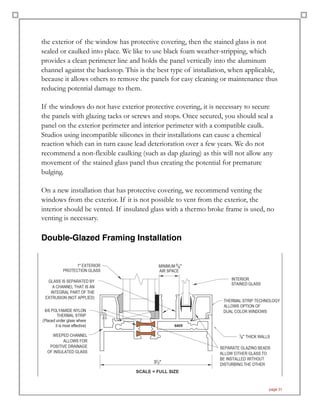
When installing new panels into a new double-glazed frame, the studio should set
the panels with setting blocks, then secure them with snap-on aluminum beads. If
page 30
lead
STAINED GLASS
CEMENT
COMPOUND
the exterior of the window has protective covering, then the stained glass is not
sealed or caulked into place. We like to use black foam weather-stripping, which
provides a clean perimeter line and holds the panel vertically into the aluminum
channel against the backstop. This is the best type of installation, when applicable,
because it allows others to remove the panels for easy cleaning or maintenance thus
reducing potential damage to them.
If the windows do not have exterior protective covering, it is necessary to secure
the panels with glazing tacks or screws and stops. Once secured, you should seal a
panel on the exterior perimeter and interior perimeter with a compatible caulk.
Studios using incompatible silicones in their installations can cause a chemical
reaction which can in turn cause lead deterioration over a few years. We do not
recommend a non-flexible caulking (such as dap glazing) as this will not allow any
movement of the stained glass panel thus creating the potential for premature
bulging.
On a new installation that has protective covering, we recommend venting the
windows from the exterior. If it is not possible to vent from the exterior, the
interior should be vented. If insulated glass with a thermo broke frame is used, no
venting is necessary.
Double-Glazed Framing Installation
page 31
Protective Covering
Just think how wonderful it would be once your stained glass windows were
installed or restored if they simply stayed in pristine condition.
That would mean little heat or air conditioning loss through them, no vandalism, or
element damage. Unfortunately, that is not going to happen and that is why you
need to preserve them by properly by installing protective glazing.
Proper installation includes sufficient dead air space, venting, choice of material,
frame and millwork repair, type and setting of divider bars, as well as application of
the correct type of sealant.
Things to Avoid
Unfortunately, regular glazing company installers do not understand installation
from the perspective of stained glass. A glass house rarely performs a proper
installation versus a stained glass studio. The pricing may be appealing but
improper installation can create more damage than protection.
Sealant
The sealant must be a non-acidic cure or it will not react with the lead correctly and
will quickly deteriorate it. Sealants must be able to adhere to a variety of surfaces,
including metal, glass, plastic and masonry. For years, companies sealed plastics
with straight silicone, not realizing that within a year, the seal would break, allowing
water to penetrate the covering systems. This leakage continued for years, creating
severe damage to the windows and their frames.
Non-vented Installation
Some in the industry today advocate for not using any venting in their protective
covering installations. However, the majority of studios recommend venting.
The only non-vented installation we consider is if there is a thermo barrier frame
and a sealed protective unit of insulated glass.
page 32
Venting decreases heat build-up and promotes airflow that helps dry and reduces
the potential for condensation. With quality vents and innovative installation
techniques, the installation is attractive.
As a rule of thumb, venting should be installed at the bottom and top to create
airflow from bottom to top. The venting position of a protective glazing system is
important, so be sure to address all areas.
We use an in-frame proprietary system called Klearflo®
. This system is a
customizable system that allows us to address the specific needs of the window.
Bending
The main draw back to the installation of protective covering has always been its
lack of appeal. Many studios’ installations have not been visually attractive.
To correct this lack of appeal, some in the industry bend the divider bars to closely
match the existing millwork. This provides the client with an improved look on the
exterior of the building. Associated Crafts®
& Willet Hauser Architectural Glass®
recommends this process in all applications. It is a specialized process and requires
a skilled studio competent in exterior glazing.
The following is a description of protective covering items:
Screened vent plug: An Associated Crafts®
& Willet Hauser Architectural
Glass®
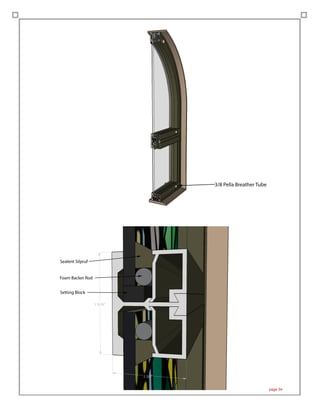
specialist will install a 3/8” breather tube or 1” screened louvers, depending
on the glazing situation.
Non-corrosive anchors: The type of existing substrate determines the type of
anchoring we use. When attaching to wood, we use stainless steel wood screws.
When attaching to masonry, we use Tap-Con®
fasteners. In situations where
attachment to the side of the opening is needed instead of the rear, as shown in the
detail, we simply change the position of the fasteners from the back rail of the
frame to the side rail of the framing.
page 33
page 34
Sealant: It is important to use a silicone-based, non-acidic cure caulk that will
adhere to a variety of substrates such as wood, steel, glass, plastic, aluminum and
masonry. Associated Crafts®
& Willet Hauser Architectural Glass®
recommends the
use of either GE Silpruf®
or Dow Corning 795 sealant. These two sealants are the
only ones we have found that meet all the necessary requirements. The sealant also
comes in colors that will match the aluminum framing color.
Backer rod: This round foam material serves two purposes. First, it spaces the
glazing material evenly against the back of the framing channel. Secondly, it helps
create the perfect hourglass profile of the sealant joint. The hourglass profile
maximizes the expansion and contraction movements of the sealant while allowing
the strongest seal possible.
Glazing material: This may be one of several materials used in the industry
such as XL Lexan, acrylic, float glass, tempered and laminated glass. Materials are
generally 1/4” thick.
Setting block: This is a rubber block designed to hold the weight of the glazing
material and prevent surface contact with the aluminum framing. This is especially
important when using glass.
Panning or cladding: This is the process of wrapping exposed wood with flat
aluminum coil stock to make the surface maintenance free. Associated Crafts®
&
Willet Hauser Architectural Glass®
specialists will custom fit and bend this material
to closely match the contour of the existing millwork being covered. This process
is not standard in the glazing system and only used as specified.
T-Bar: A T-shaped aluminum bar that divides glazing panels and transfers the
weight of the panels to the jambs.
Perimeter bar: An F-shaped aluminum bar that is used at the perimeter of the
application where it is only necessary to receive a glazing panel from one side.
page 35
What Type of Protective Covering?
Our craftsmen are skilled in installing several types of protective covering. To assist
you in deciding which type of covering is best for your project, please refer to the
table below or call your Associated Crafts®
& Willet Hauser Architectural Glass®
representative.
page 36
PR0TECTIVE C0VERING
descripti0n pr0s c0ns
1/4" Acrylic Very break resistant
and non-yellowing
Plastic, scratchable,
shows deflection
1/4" Lexan
XL10 or
equivalent
Virtually
unbreakable,
lightweight,
guaranteed not to
yellow for 10 years by
manufacturer
Very scratchable,
deflection, more
expensive, will
eventually yellow
1/4" Float Glass Washable, looks
better than plastic
(less deflection)
Breakable, heavy,
more expensive
1/4" Laminated
Glass
Washable, looks
better than plastic
(less deflection),
safety feature: When
broken, it stays
together
Very expensive,
easily broken
1/4" Tempered
Glass
Washable, 4 times
more break resistent
than regular glass,
less deflection
than plastics, safety
features
More expensive,
when broken falls
into dice, harder to
replace, must have
custom piece made
Selling Pre-Owned
Stained Glass
In recent years many clients have been faced with consolidation and closings. With
these events the stained glass windows are often no longer needed and some
congregations see these old masterpieces as a source of revenue.
Replacement Cost Appraisals provide an estimated price that is equal to rebuilding
the window in the case of catastrophe. The window’s used market value is not the
same. Clients sometimes confuse the two costs and look to sell the current
windows for the replacement costs. The two are not equivalent. As with any
collectible the stained glass market value and replacement costs are not the same.
Pricing in the used stained glass market is unique. Most groups looking to purchase
used windows do so for one main reason of obtaining more window for less money.
This is the great allure of old stained glass, but the principal of “more for less” is
not always valid.
In fact, the purchase of simple designs in new windows is often about the same, or
even less, than the cost of simply-designed used windows. Used windows have
additional removal and restoration costs that are not required in the new window.
Possibly the biggest problem with existing windows is the predetermined size and
quantity…rarely perfect for the new application (i.e. its design, shape and size.) In
most cases, therefore, it isn’t the best choice to use old instead of creating new
stained glass windows.
The used stained glass market is more practical with the more complex windows
featuring hand painted work from higher quality studios. In this lone case, the used
window customer can certainly achieve more for less. The higher cost of hand-
painted new windows leaves the possibility to pay for the removal restoration and
other costs associated with pre-owned stained glass. These savings often make
dealing with odd quantities, different scenes and off-sizes worthwhile.
Generally the used market will bear about 30% to 40% of the replacement cost.
Many people are under the impression that the older the windows are the more
page 37
valuable they are in this marketplace. Rather, the used stained glass window market
is interested in quality windows with the right sizes and quantities available for the
best value. The age, history and artist reputation are also of interest.
Collectible Stained Glass Market
The other end of the used market is the work of collectible artists such as Tiffany
and LaFarge for example.
The sale of these pieces should only be done with a reputable agent who will
ensure top dollar return. Contrary to popular assumption, purchasers of collectible
windows are not usually clients or synagogues. Rather, the marketplace is driven by
collectors and those who appreciate the stained glass work of a particular artist.
This purchaser is normally not motivated by price, size, and quantity.
You need a knowledgeable agent on your side. Generally the client networks of
stained glass studios are based around clients/synagogues and not collector types.
There are, however, some antique and collectible dealers who are properly
networked with this kind of buyer. Experience has proven that sales of collectibles
to the client buyer will not achieve to desired value. Therefore, for the best chance
of maximizing profits, antique and collectible dealers generally are the preferred
option.
The resale of stained glass is going to accelerate in the upcoming decades as older
clients age along with their parishioners. Many of the finest masterpieces will find
new homes in museums and the residences of the wealthy. Others will be
relocated to restaurants and businesses.
Nevertheless, the idea of relocating existing stained glass from one religious
institution to the next is a wonderful way to keep the beauty of our past active in
our new clients- a continuing way of telling God’s story through God’s light.
page 38
Glossary
Acrylic: 1/4 inch thick polyacrylic glazing sheet. Acrylic is 60 times more break-
resistant than glass of the same thickness.
Brace Bars: A reinforcing bar (usually flat or round in shape) that is used to
support the stained glass panel thus preventing bulging. Most often these braces
are installed in the interior of stained glass windows.
Broken Painted and Stained Glass Replacement: Maintaining the
originality is a high priority but in some cases, replacing the glass is the only choice.
Generally, a window needs to be replaced if a piece of glass has a hole in it, is
completely broken out or has multiple cracks.
Bulging: A bulge is a section of the window that has become so weak that the
lead and the glass bow in or out. If this condition is allowed to remain unchecked,
it will break the glass and the lead joints. Eventually the whole section is in danger
of falling out.
Cartoon: The full-scale drawing for a window or panel, from which the
individual pieces of a stained-glass window are sized to cut. The cartoon is also
used as a guide when the window is leaded up.
Cement: A special liquid compound used to weatherproof new windows. It is
also used to maintain old windows (re-cementing).
Clear Penetrating Epoxy Sealer (CPES): An epoxy sealer that is used on
rotting wood. CPES impregnates the wood rather than coating it, arresting fungi
and bacteria growth. CPES creates a stronger yet flexible piece of wood that
fungus will not penetrate.
Cracked Glass (Repairing): Maintaining originality is an important part of a
proper restoration. Glass that is stable with no missing pieces is considered cracked
not broken.
page 39
Dalles: A thick slab of cast stained glass that is cut or broken and cemented into
a panel with an epoxy adhesive matrix.
Faceted Glass: Faceted glass windows are constructed from 1” thick slabs of
stained glass called dalles. Dalles are cut to fit the artist’s cartoon using a glass
cutter, a chipping hammer and an anvil. In some cases a special saw is used on
intricate cuts. After all these pieces of glass are cut a sand material called granules
are sprinkled between the pieces of glass. Once the granules are spread, a liquid
epoxy resin is poured between the pieces of glass. Finally granules are spread over
the top of the epoxy. Given time to set up, the epoxy will harden leaving a very
durable and strong art glass panel.
Insulated Glass: Two sheets of glass joined together by a spacer. Insulated
glass acts as a barrier against internal and external noise as well as the elements.
Jamb: The upright surface forming the side of a window.
Laminated Glass: A clear plastic sheet laminated between two sheets of glass
(i.e. a car windshield).
Lead Came: The grooved metal that surrounds each piece or glass in the
window to hold the glass in place and to complement the design of the window.
Leaded Glass: Refers to any combination of glass design, which is fabricated
using a web of lead came. Each new stained glass window is built using all new
lead came. The size and type of lead came is chosen on the basis of design and
structural requirements.
Lexan (XL): Polycarbonate sheet that is virtually unbreakable and lightweight.
This product has been specially coated to avoid yellowing and is effective for high
vandalism areas and for protection of valuable windows.
Matrix: Opaque material used as a cement to hold the glass in place in a faceted
panel.
page 40
New Aluminum Frames: Each new frame is custom fit and made of high
quality aluminum. The new frames are secured with clipped or welded joints. Each
frame provides an excellent glazing situation with snap on beads to secure each
glazing material and a dead air space to allow proper insulation. Frames come in
four standard colors: white, bronze, aluminum, and limestone. The standard frame
finish is baked on enamel that will not peel or fade. The installation of these
frames will allow you to enjoy a quality installation that will be virtually
maintenance free.
Three Types of Frames:
Double-glazed: This frame is designed to house both the stained glass
and the protective covering.
Single-glazed: This frame holds only one glazing material.
Thermos Barrier: These frames will hold both the stained glass and the
protective covering. This framing has a built-in plastic barrier, which slows
down the transfer of heat or cold to the inside of the frame, virtually
eliminating condensation on the interior of the frame.
Painted Glass: Painted glass is stained glass that is painted and fired in a kiln to
a temperature of 1,200 degrees enabling the paint to fuse into the glass.
Panning or Cladding: It is the process of wrapping exposed wood with flat
aluminum coil stock to make one maintenance free surface.
Perimeter Bar: An F-shaped metal bar, usually composed of aluminum, which
serves as the perimeter frame for protective glazing.
Plate Glass: Machine-made glass that has been ground and polished so that it is
free of flaws and distortions. It is usually at least 1/4 inch thick and is used
primarily for bevels, mirrors and large store windows. Until the early twentieth
century, polished plate was optically much clearer than standard window glass.
page 41
Plexiglas (1/4): ¼-inch thick poly-acrylic glazing sheet. Plexiglas is 60 times
more break-resistant than glass.
Re-cementing: The exterior surface of the stained glass window will have a
specially formulated cement compound brushed underneath the lead flanges. Re-
cementing will strengthen and weatherproof the window by replacing the original
cement compound, which has loosened or fallen out over the years. This process
also does an excellent job of cleaning the window.
Rendering: A thumbnail sketch. This is usually a color sketch of the proposed
window(s).
Re-securing Loose Braces: Loose brace bars will be re-secured by either re-
soldering the broken joint or installing a new wire tie. Braces that are damaged or
bent will be replaced with a new steel brace.
Re-leading: Craftsmen will carefully take a rubbing of the panel(s) to be re-
leaded. Once the rubbing is complete, the panel(s) will be disassembled piece-by-
piece and properly cleaned. Craftsmen will then reassemble the stained glass panel
using all new lead came and solder. Each panel will be cemented on both sides and
a proper bracing system installed before reinstallation. The re-leaded panels will be
reinstalled and properly secured. A flexible sealant will be applied allowing each
panel to expand and contract without hindrance thus preventing any future damage
to the stained glass.
Sash: The window frame.
Silpruf®
: A silicone-based caulk made by General Electric. This sealant adheres to
many different surfaces making it an ideal caulk for our installation. This is a non-
acidic care product.
Solder: A mixture of tin and lead, which for glass workers is manufactured to
melt around 400 degrees Fahrenheit. After leading up, all the cames of a window
are joined with a thin layer of solder (this is referred to as sweating the lead joints).
page 42
Stained Glass: Traditionally, leaded mosaic windows of colored glass that have
also been painted and fired, with or without the additional application of silver
stain. The term has come to represent any mosaic window, with or without paint
or stain, composed of glass that is colored or clear.
T-Bar: A T-shaped steel or aluminum bar that divides the stained glass or exterior
glazing panels and transfers the weight of the panels to the jambs.
Ventilators Aluminum: Special custom-fit ventilation units to replace detached
vents or in new construction, these provide a weatherproof seal and fluid
operation.
Venting of Protective Covering: This venting system is necessary to reduce
heat build-up and reduce potential for condensation, thus preserving the stained
glass windows. It is either 3/8” breather tube or 1” screened louvers, depending
on glazing situation.
page 43
Associated Crafts®
& 

Willet Hauser Architectural Glass®
1685 Wilkie Dr., Winona, MN 55987
800-533-3960
www.associatedcrafts.com or www.willethauser.com
Copyright© 2017 by Associated Crafts®
& Willet Hauser Architectural Glass®
All Rights Reserved. No part of this guide may be reproduced or transmitted in
any form or by any means, electronic or mechanical, including photographing,
recording, or by any information storage and retrieval system, now or in the
future, without permission in writing from the publisher.
page 44
America’s Premier
Stained Glass Studi0®
& ®
®

Associated Crafts & Willet Hauser Project Guide

  • 1.
    page 1 America’s Premier StainedGlass Studi0® & ® ® A Resource Guide for Your Stained Glass Project
  • 2.
    Table of Contents Forwardand Mission Statement 3 A Brief History of Associated Crafts® & 
 Willet Hauser Architectural Glass® 3 Fundraising Approaches and Resources 4 Do-It-Yourself Survey 7 Protecting Your Stained Glass Asset 9 Selecting a Studio 11 Repair and Restoration 15 Frame Repair and Painting 22 New Frames and Ventilators 23 New Windows 26 Protective Covering 32 Selling Pre-Owned Stained Glass 37 Glossary 39
 page 2 America’s Premier Stained Glass Studi0® & ® ®
  • 3.
    Forward We at AssociatedCrafts® & Willet Hauser Architectural Glass® have more than a century of experience serving clients. Through the years, we have often found that the majority of client staff members had little or no knowledge of stained glass windows. We believe that many clients would have made better decisions regarding how to care and preserve their valuable assets had they possessed the basic knowledge of these beautifully crafted items. It is our pleasure to provide you with this informative manual in hopes that you gain a better understanding of stained glass windows and have a resource to turn to when it is time to make decisions regarding your own windows. For more information on stained glass windows or to receive information on our studio, please visit our web site at www.stained-glass-window.us. Our Mission Statement Associated Crafts® & Willet Hauser Architectural Glass® is dedicated to the preservation of America’s stained glass heritage. We believe that through education, we can raise awareness and ultimately preserve these valuable works of art. Brief History of Associated Crafts® & Willet Hauser Architectural Glass® For over thirty years, John D. Phillips has worked in the stained glass industry. He was first introduced to the craft from his father John W. Phillips and has had a passion for it ever since. page 3
  • 4.
    In addition toworking in his father’s studio, he consulted for other large studios regarding production, sales and software. John Phillips Jr. is dedicated to raising awareness of historic stained glass windows and their preservation. In 1997 John and his wife, Mary, founded their company, Associated Crafts® . After growing that business for over 20 years establishing a stellar reputation in the industry, they purchased the century old studio Willet Hauser Architectural Glass® . The entire Associated Crafts® & Willet Hauser Architectural Glass® staff contributed to the contents and experiences expressed in this guide. Fundraising Over the generations people have built clients with elaborate architecture featuring beautiful stained glass windows. As with all buildings, time takes its toll on these grand structures and they require constant maintenance to maintain their splendor. Unfortunately the populations that support these houses of worship are also changing and often the support needed is not in place to complete the required maintenance. Clients often find they have to be creative in order to meet their financial needs. Following are a few approaches others have taken to raise money to facilitate their stained glass restoration projects as well as some resources that we can provide. Adopt A Window Several clients have taken the window-by-window approach. They take the overall cost of a project and break it down by square foot per window to establish a cost of repair for each window. Once this cost is established, the client then offers sponsorship of each window to its members. An interested member or group of members then pledges the amount to cover the work of that particular window. Often the client will present the donor or group of donors with a plaque acknowledging their gift. page 4
  • 5.
    There are alsoinstances in which the client will approximate these costs per window to achieve more donations to also apply to less glamorous projects such as roofing or air-conditioning work. This approach has been very successful in raising money for many different maintenance projects by using the visual appeal of stained glass. Associated Crafts® & Willet Hauser Architectural Glass® provides a “donor cost” in each proposal to use for its fundraising. Specialty Items Some clients have worked with specialty companies to purchase miscellaneous items in bulk at a discounted price. The members then offer these items to the public at a retail price, taking the proceeds for use toward the project. Associated Crafts® & Willet Hauser Architectural Glass® produce a “Life of Christ” in Stained Glass Adult Coloring book complete with coloring pencils and built in sharpener to fit this need. Staging Another approach is the staging method. In this instance, a client selects a contractor and requests his bid to be broken down to address each specific area. The client then performs each section as they acquire the funds. This works well for active clients that receive regular pledge income. The only disadvantage generally is it costs more to have a company do the work in different stages as there is no quantity discount because the company has to contend with extra set up and mobilization costs. Bank Loans In some situations, clients have taken out loans to facilitate the completion of projects with the knowledge that this will inspire growth and support from their members to pay off these loans. We have seen many clients take this approach and often when projects are completed, the members are inspired and the client receives increased monthly pledges to sanctify the loans. Some clients have gone as far as to ask their members to commit to additional monthly payments. page 5
  • 6.
    Specialty Loans There hasalso been a growing trend of specialty lenders that specifically fund clients. This has received both positive and negative results. It is best to talk to several lenders and read the fine print. Be sure there are no pre-payment penalties. Some companies, such as Associated Crafts® & Willet Hauser Architectural Glass® may offer in-house financing. Generally, this is a great option but be sure you understand the terms and that this is something your membership can support. State, Federal, and Private Historical Grants Years ago many clients would solicit historical grant help but it unfortunately rarely panned out. However, in the recent five or six years, more and more of these grants have come to fruition for several historic clients. The application often requires a great deal of work and has stringent guidelines. The agency is usually concerned that the client is requesting a project that is to help the building maintain its historical significance. It is very important that you select a quality company that is versed in historic restoration and preservation. The correct studio can be very advantageous in helping a client secure a grant while choosing the incorrect studio can make it impossible. Fundraising Tools We recommend selecting a studio whose staff is prepared to assist you in your fundraising efforts. Our team has tools and expertise to help you raise funds for your client through through online and community marketing. Our team can help you get started with a fundraising consultation review and support your staff with the tools to make it happen. page 6
  • 7.
    Do-It-Yourself Survey Unfortunately manystained glass studios, including ours, receive frantic calls from clients whose windows are at critical stages of deterioration, and the client has avoided or not understood the problems that occurred until it reached catastrophic levels. Associated Crafts® & Willet Hauser Architectural Glass® has designed the following guide for you to assess each of your stained glass windows. We have provided you with a format that you can submit to Associated Crafts® & Willet Hauser Architectural Glass® for review. When completed, this survey can also serve as documentation of each window, which can be very helpful with insurance claims or reproduction in the case of loss. Before starting, gather the following items: • 25’ tape measure • Paper and pencil • Digital camera • Note cards (or other paper) Observe Start at the first window. On a piece of paper, number the window (important), give a brief description and measure the window, rounding off to the nearest half foot. Provide a Description You need to identify each window visually. Use the name of the scene (i.e., Gethsemane or Communion) or the name found in a memorial plate (i.e., In Honor of John Smith). Another option is to use the area of the client to identify a window (i.e. large balcony window and large altar window). It is also very helpful to draw a simple building sketch to identify the windows’ locations. page 7
  • 8.
    Measure Round off allmeasurements to the nearest half-foot. For example, wood that is 32” should be rounded up to three feet. Write the width measurement followed by the height measurement. On large windows, you can measure half the distance and then double it. Interior Observations: • How many pieces of broken out (not cracked) glass are there? • Do you see any bowed, sagging, or bulging areas? • Do you see any light leaks and if so, how many? • Do you see any evidence of leakage? • Are there any loose or missing brace bars? • Do the ventilators open and close freely? Exterior Observations: • Is the window covered? • Is the frame made of wood, steel, aluminum or stone? • Is the protective covering vented? • Is the window frame in need of painting? • Do you see any rotten wood? Is the protective covering clear? • Is the protective covering broken? • Is there any evidence of the protective covering leaking? Take Photographs It is best to take simple digital photos. For interior photos, do not use a flash. • Take your note card and observe window number one. • Write the number 1 on the note card, place the card in the right hand corner of the window and take the picture. • Once you take the photo, review it to make sure it is clear. • Be sure the index card with the number can be seen clearly in the photo. • Take exterior photos of each window using the note cards /paper (do this the same way you did for the interior photos). • For inaccessible windows, hold the appropriate card number in front of you so you can see the card number and window in the picture. page 8
  • 9.
    Repeat the abovesteps for each window. Window two would be the number 2 on the next card and then 3 etcetera, etcetera… Submit Documentation You can either scan, fax or email the document(s) to (888)801-9551 and e-mail the photographs to info@willethauser.com. A company representative will review and contact you. Protecting Your 
 Stained Glass Asset For many client members, there is an emotional attachment to the stained glass windows in their places of worship. Members often pass on stories and memories related to the windows. However, few realize that for many clients, the stained glass is their largest material asset and part of their heritage. Appraisals and Insurance Like individuals, many clients rely on their insurance agent to guide them on their coverage. For some, this approach has been devastating as traditional insurance agents often don’t understand the value of historic windows. After a catastrophic event, some stained glass studios have assisted in the repair and heard complaints about the coverage that was in place. Nothing is more disheartening than to see a client suffer a loss and then find out their coverage is inadequate. To prevent this from happening to your client, it is best to get a comprehensive appraisal by a qualified stained glass studio. Many studios or consultants charge a nominal fee for this service. Associated Crafts® & Willet Hauser Architectural Glass® will generally provide this service free with the assistance of client personnel. page 9
  • 10.
    Online Appraisal Service AssociatedCrafts® & Willet Hauser Architectural Glass® have developed an online appraisal tool, where a client can submit photos of their stained glass windows to obtain a free estimated replacement cost of each stained glass window. Having a correct appraisal value for your stained glass windows is critical for the fine arts section of your client’s insurance policy. When you use the online appraisal service, the stained glass window photos are also safely housed in our database as an additional backup should your client ever be hit by disaster. This tool can be accessed at www.associatedcrafts.com or www.willethauser.com. Once the appraisal is complete, you should review your coverage with your insurance provider to verify the windows are covered appropriately. Documentation Do a simple documentation of your windows. Take an overall photo of each window and then a close up of each section to show the detail. It is also important to measure the window opening, rounding off to the nearest half foot. In case of catastrophes such as tornados, hurricanes, fires, or vandalism, stained glass panels or entire windows can be destroyed. Having documentation of your windows would be essential in their restoration. It is a good idea to store this information in multiple electronic locations as well as the paper version in a safe deposit box or fireproof file. Maintenance Some studios have restored projects left undone for years simply because the members did not know where to go for help. It is best to select a quality studio to provide you with a condition report. Most studios will provide this report free of charge. If possible, have several companies prepare the report so you will have various opinions and perspectives on your windows. For those who want to know if they should add protective covering, we at Associated Crafts® & Willet Hauser Architectural Glass® always say, “Yes”! In most page 10
  • 11.
    cases, windows whichhave been properly protected are in much better shape than unprotected windows. The covering protects the windows from the elements as well as vandalism. Remember to let your insurance company know that your windows are protected and request a discount on your premiums. Please read the chapter on Protective Covering for further understanding. Assess each window so that you can catch small problems before they become large ones. Please share this information with as many as possible. The more people that are aware and educated about this craft, the better their stained glass windows will be protected and preserved. Selecting a Studio Everyone wants to know the magical formula to select the correct stained glass studio to complete his or her project. While a studio cannot do this for you, there are ways to sort through the information and make a quality selection. A common question that the clergy will ask a stained glass studio is “How do I get an apples to apples bid?” Stained glass is extremely specialized. Often, others outside the industry do not know the terms and jargon. This is what inspired us to write this manual. The other aspect of this industry is the lack of regulation. The industry consists of many smaller companies started by craftsmen and artists who took a hobby and changed it into a career. This is certainly admirable but these individuals often do not have the knowledge of all the facets of the business or of stained glass and construction. Professional studios often compete with specifications written by amateur companies. This is why we diligently work to educate our clients. Often a simple understanding of terms and jargon will allow the client to understand the correct scope of work. Some studios specialize in a certain type of work. For example, a studio that creates a number of new windows will often bid an onsite restoration project as a complete re-lead because this scope of work fits into their business operations page 11
  • 12.
    more easily. Anon-site restoration project may be impossible since they do not have the expertise or the manpower to complete the work that may best serve the client. A studio that does not do new windows may not recommend re-leading when needed as it cannot be easily completed at their facilities. Both studios make a strong case for their approach but we are left with a confused committee. The following is a guide to help you find a studio that passes these guidelines and most importantly, to help you and your committee through this learning curve. 1. Have they been in business for more than ten years?
 If they have this suggests that they are doing something right to maintain operations as with most businesses. You can verify this information by using state records or checking Dunn & Bradstreet. Remember that sometimes people report information incorrectly, so be very direct and ask the potential studio to explain any items that are not clear. Be aware that some companies have used variations of names to avoid creditors. 2. Ask the studio to send references over a five-year period of business. Obviously, companies generally provide only positive references, so it is important to request at least 10 references and check state websites regarding contracting in the states in which they are licensed. Pick several references and contact these customers. We suggest you contact the most recent client committees, as it may be hard to talk with someone familiar with the project from several years ago. Ask the contact the following questions: a) Did the company complete the job on time? b) Did the company and job supervisor communicate with you during the project? c) Did the crew clean up well and work around your services, etc.? page 12
  • 13.
    d) Did thecompany complete the contract in a skillful manner? e) Overall, were you satisfied with the project? f) What type of work did they do? (repair, re-lead, covering, etc.) From their answers, you should get some idea of consistency and those consistencies should give you an idea of the company’s work and operations. Stained glass restoration normally does not require state licensing but some states do require certain licensing in order to operate in their state. It is important that you ask each reference what type of work was performed. This ensures that the studio has the skills to provide the client with an unbiased scope of work based on what the client needs instead of what the studio needs to sell. Clients often are confused by the terminology different studios use. Please ask for an explanation of each specification so you can fully understand and correctly compare each studio. As with most purchases, you want to have a comfort level with the staff of that studio. They should be knowledgeable, eager to help and patient with your questions. Good communication is vital to the success of any project. Contract Be sure each proposal or contract clearly itemizes each service per window. All materials should be specified and spec sheets provided as available. It is also a good idea to request solid deadlines of completion. Make sure the payment terms are detailed and specific and should not be paid ahead! Be sure each stage is fully completed and you are satisfied before authorizing payment. page 13
  • 14.
    Guarantees All consumers arelooking for a solution to their problem and want that solution to be guaranteed for as long as possible. In the stained glass industry, guarantees can range from zero to 20 years and can cover the entire project or just the workmanship. In some cases, smaller studios make guarantees that they cannot fulfill because they are not around long enough to honor their guarantee. The best guarantee is to have the work completed correctly in the first place. Make sure the proper products are used and that the company performed all work in a quality manner. There is little need for a guarantee if the project they completed is done correctly. This material and installation really does not have a high failure rate. Many clients often assume that any leakage problems are a result of the stained glass. Try to avoid having false hopes, as even uncovered stained glass windows are very rarely the cause of water infiltration into a building. Unfortunately, many contractors take the easy way out and blame it on the windows instead of actually water testing to determine the source of leakage. This situation often leaves client members disappointed to find they spent money to recover the windows to prevent the leakage only to find the source of the leak was actually something else. In summary, a five to ten year guarantee against any defective workmanship is proper. A client can also protect itself by inspecting stages of the project prior to final payment. Most importantly, do not fail to check out the company you are contracting. Their record and references will speak volumes about them. As a client leader, others have put their confidence in you and in your abilities and stewardship. Honor their confidence by doing your homework! Remember you get what you pay for and you pay for what you get. Your valuable stained glass windows are no exception! page 14
  • 15.
    Repair and Restoration Theactual work to stained glass is broken down into two categories: repair and restoration (re-leading). Often a combination of the two may be required. Repair: refers to onsite repair work such as broken glass replacement, bulge reduction, and securing of loose braces, etc. Restoration: refers to the process of re-leading. Each window is moved and taken apart piece by piece and then reassembled using new lead and bracing. This process is usually done after the windows have been transported to the studio. Deciding which scope of repair work to do on the stained glass windows can be a confusing decision for any committee. This information should assist you in making the correct selection for your particular client. Over the past 40 years, there has been an abundance of self-proclaimed experts promoting highly sophisticated restoration to stained glass windows. These expert consultants have marketed their services well and raised the awareness of the importance of quality restoration, especially on great works of art like those by Tiffany and LaFarge. Unfortunately, these consultants have not promoted a complete look at restoration; one that would be applicable for most situations presented in America’s clients today. A client should hire a studio that can educate them on the pros and cons of each scope of work for their client. With this information and knowing their personal obstacles such as growth, budget or relocation, they can make a responsible decision. Many bidders do not have the rounded skill set to offer their clients a choice. They simply skew their view to reflect what they have to sell instead of what the client needs. For example, Associated Crafts® & Willet Hauser Architectural Glass® recently called on a client that had 20-year-old stained glass windows that a competitor page 15
  • 16.
    recommended an expensivecomplete re-lead. This was not necessary. The client maintained and protected these windows without having to undertake a huge fund drive. In this case, the competitor did not sell the covering and on-site repairs that the client needed. Instead of withdrawing from the project, they tried to sell the client something they did not need. Under normal conditions, stained glass windows should be re-leaded when they reach around 100 years old. However, this is only a rule of thumb and circumstances could change this number. To determine if a panel is in need of re-leading, you can make a few observations. Lead, like all metal, will oxidize and appear to have a white powdery look. If this oxidation is constant and heavy, the deterioration might be great. The joints where lead comes together on each work is finished and secured by soldering. Due to solder and lead moving at a different rate, there is fatigue that becomes evident by tearing of the lead next to the soldered areas. If you find this to be a majority situation, you might consider re-leading. Another test is to scratch the lead, which should be soft and pliable. However, if it tears, it has probably gone through its life cycle. Obviously, the best way to determine the need for re-leading is to hire a qualified professional who can perform both methods of testing and inspect the stained glass on a regular basis. Associated Crafts® & Willet Hauser Architectural Glass® provides this service and will explain our findings. In years gone by, there were several companies that serviced clients all over, doing on-site repairs and protective covering installation. These companies had no regard to damages that came from their haphazard skills. On-site restoration as a whole, took a big hit from these companies due to problems discovered 20 years later due to poor craftsmanship and many earned a bad reputation. Quality companies with skilled craftsmen use successful techniques that properly restore these historic pieces. As with re-leading, it is important to find a studio that is experienced with both methods to help determine the best method for your client. page 16
  • 17.
    The following isa list of some common repairs done on-site. Also listed are important points that should help you recognize a knowledgeable stained glass consultant from one who is not. Broken or Cracked Glass To keep the originality intact of a historic window, we recommend replacing only the broken but not cracked glass. View replacement as a last resort. Cracked pieces that are not missing areas are to be either supported by Dutchman, sealed with epoxy, or edge glued (in re-leading). These repairs will support and secure the original piece. Perfect matching of replacement pieces can be difficult and not always possible. However, a knowledgeable studio can acquire a large spectrum of glass from manufacturers or inventories. Be sure to insist your craftsmen provide you with a close match. Do not settle for something noticeably different. We can use little techniques to provide swatches that blend to give you a quality restoration. Test the craftsmen and ask them what they can do if an exact match is not possible. Photo: Replication of a broken, painted piece of glass page 17
  • 18.
    Bulging Another common problemis the bowing or sagging of an area of stained glass. Due to years of exposure, gravity, heat build-up, settling and improper bracing, bulging occurs in most stained glass. To correct this problem, the affected panel needs to be removed from the frame and carefully placed flat on the table. Once the panel is flat, broken joints need to be soldered. The original bracing may need to be re-attached or new bracing added to support the weakened area. If new bracing is installed, it is important that it be the same type as the original bracing and attached in the same method. The same is true for the reattachment of existing braces. They should use the same method. For restoration purposes, it is important that everything is as original as possible. Re-securing Loose Braces Braces are mostly rectangular or round. We solder the braces directly to the panel or wire them to the panel using copper ties. It is important that the re-securing is achieved using the original method used on the stained glass window. Adjusting Existing Ventilators Existing ventilators that are inoperable or whose operation is rough can be adjusted to operate more freely. Craftsmen will improve ventilators’ operation by mechanical adjustment, light grinding or lubrication. Excessive deterioration or warping may make fluid operation impossible. We will make the double-hung ventilators operational by sanding the sash perimeter, reattaching sash weights or replacing sash ropes or chains.
 page 18
  • 19.
    Cleaning the Interiorof Stained Glass Stained glass gets dirty from years of exposure to dust, pollution and candles. You can clean these windows but there is the need for some precautions especially around painted pieces that may not be stable. You can clean the interior surface of the stained glass window by spraying a special liquid cleaning solution on the stained glass window and then wiping the solution off with a soft cloth. Although craftsmen are very thorough in their cleaning procedures, it is impossible to remove heavy lime deposits or paint over spray with this cleaning method. A craftsman can provide other cleaning methods to address these concerns; however, this is usually bid differently. Windows with painted glass need to be tested for stability. The craftsman should be able to determine the correct cleaning method to ensure quality results. Re-cementing Years of exposure to elements and heat will dry and reduce the cement compound in a stained glass window. It is important to rejuvenate this cement on the exterior, and to strengthen and waterproof the window. To perform this service on the interior is too messy. The exterior surface of the stained glass window will have a specially formulated cement compound brushed underneath the lead flanges. Re-cementing will strengthen and weatherproof the window by replacing the original cement compound, which has loosened or fallen out over the years. This process also does an excellent job of cleaning the window. Be sure that the studio explains each service in detail in your contract and that your studio consultant can answer your questions regarding any services to be performed. page 19
  • 20.
    Historic Restoration or 
 Re-leading Overview Acraftsman will carefully take a rubbing of the panel(s) to be re-leaded. Once the rubbing is complete, the panel(s) will be disassembled and properly cleaned. Craftsmen will then reassemble the stained glass panel using all new lead came and solder. Each panel is cemented on both sides and a proper bracing system is installed before reinstallation. Then they reinstall and properly secure the re-leaded panels. Finally, the craftsman applies a flexible sealant, which allows each panel to expand and contract without any hindrance thus preventing any future damage to the stained glass. page 20
  • 21.
    Taking a Rubbing Asyou can see from the overview of this service, it is very detailed and labor intensive. This service, which is more expensive than on-site repairs, should leave you with a new window that has all antique glass. With the lack of studios that possess the ability to do proper on-site repairs, this method is often way over prescribed. For some windows that were re-leaded by studios not familiar with restoration, they left behind a devalued and ruined set of historic windows. It is most important that the commissioned studio documents the windows so they can be recreated using as much original glass as possible. This includes the original lead sizes and profiles. Again, challenge your prospective studio to state a case for both repair and re-leading and walk you through the steps and provide the pros and cons of each solution. page 21
  • 22.
    Frame Repair and Repainting Oneof the most requested services is the repair and maintenance of stained glass frames. Often companies provide this service peripherally but this is a very important service. Frequently studios refer to wood frames but this also includes steel. Without a quality repair, there cannot be a quality paint job. Without a quality paint job, you cannot have a quality window project. Keep in mind that this is a very visible portion of the overall stained glass project. Make sure your studio is skilled in this aspect of the project. Preparation The most important aspects of the project are material and preparations. Use only high-quality paints. Most often preparations are simply scraping all loose areas of existing paint. Seal all holes and cracks with long-lasting acrylic latex. Then apply two finish coats of high-quality paint. It is important to use quality brands such as Sherwin Williams or Pratt and Lambert. There is no such a thing as a bargain when it comes to paint costs. It is important to apply painting on the frame and not the surrounding substrate or the stained glass. This is the difference between an amateur application and that of a professional. Steel Frames Use rust inhibitive primers and paints and be sure to prepare the surface properly, as suggested by the product’s manufacturer. page 22
  • 23.
    Epoxy Consolidator An epoxysealer/primer that has been expressly manufactured for the repair of deteriorated wood will be applied to the millwork. The epoxy consolidator permeates the wood to create a strong bond arresting fungi/bacterial growth. This is a wood treatment and not intended for wood repair. This consolidator is intended to cover bare wood areas only. Millwork or Frame Repair A craftsman should repair or replace the damaged millwork if contracted. The craftsmen will remove all or part of the damaged millwork and blend new material or similar type and profile into the damaged areas. The repair piece will be secured, puttied and finished. If the millwork is beyond the contracted scope of work, the studio should inform the client. Often Associated Crafts® & Willet Hauser Architectural Glass® will make an allowance for millwork repair since the actual fair bid cannot be determined until we access the windows. In many cases when a company bids for millwork prior to access, they assume more work will be needed and usually end up over charging the client. However, bids taken after access tend to be more accurate and fair. Sometimes a company will quote a pre-determined time and material rate, including it in the contract, to handle this extra work. New Frames and Ventilators New window clients usually request the installation of new frames and ventilators, but studios also receive requests for these services in some remodels. page 23
  • 24.
    Most frequently studiosconstruct new frames out of aluminum. They use it since it is maintenance free and generally less expensive than using wood or steel. The following is a list and description of some commonly used products within the stained glass industry: Aluminum Ventilators This is a special custom-fit ventilation unit used to replace existing vents or can be used for new construction to provide ventilation. The new ventilators provide a weatherproof seal and fluid operation. They also use these vents in some repair projects when a client needs to add ventilation or replace a damaged ventilator. The one drawback to aluminum vents is that they are expensive and often require the studio to cut down the existing windows to fit this large profile. This is important in cases where there are high-quality historic windows. Studios use the new ventilators in both single and double-glazed profiles. Double-glazed: This frame is designed to house both the stained glass as well as the protective covering. Single-glazed: This frame holds only one glazing material. Steel Ventilators Studios generally used these ventilators in restoration projects since most windows that have ventilators use steel. This allows the studio to replace a deteriorated vent with one of a similar profile to restore the window to its original condition. New Aluminum Frames Each new frame is custom fit and made of high-quality aluminum. The new frames are secured with clipped or welded joints. Each frame provides an excellent glazing situation with snap-on beads to secure each glazing material and a dead air space to allow proper insulation. Frames come in three standard colors: white, bronze, and putty. The standard frame finish is baked-on enamel, which will not peel or fade. Once installed they will be virtually maintenance free. page 24
  • 25.
    Associated Crafts® & WilletHauser Architectural Glass® uses three types of frames: Double-glazed: This frame is designed to house both the stained glass and the protective covering. Single-glazed: This frame holds only one glazing material. Thermo-barrier: These frames will hold both the stained glass as well as the protective covering. This framing has a built-in plastic barrier, which slows down the transfer of heat or cold to the inside of the frame, virtually eliminating condensation on the interior of the frame. Wood Frame On rare occasions clients will ask or we will propose to replace entire frames. Generally, clients request this in restoration projects so that the studio can match the historical framing. Studios also use them in high-end new installations, when the client wants to use wood to create a particular look. Steel Frame This is used for restoration projects to keep the frame original. Azek Frames Frames are created from Azek® solid vinyl. This frame has a limited lifetime warranty against manufacturing defects, rot, corrosion, cracking, excessive swelling, splitting, delamination and yellowing. This unique product allows the client to enjoy a product that has the versatility and beauty of wood with limited maintenance and will not rot. page 25
  • 26.
    New Windows There areseveral different types of art glass used for stained glass projects today. Faceted Glass Faceted glass consists of approximately one-inch thick slab of glass called dalles which are cut by hand or saw and broken over an anvil. These pieces of glass are placed in a pattern on a table and a form is set around the perimeter of the panel. Sandy material called granules, are sprinkled between the pieces of glass. The next step is to pour a two-part epoxy resin between the pieces of glass. We then sprinkle another layer of granules over the epoxy resin. Once the epoxy sets, it results in a very strong load-bearing panel. Studios mainly use faceted glass for less complex designs. Faceted glass windows have higher material costs but require significantly less labor, often making it a more cost effective solution. Faceted glass does not require a protective covering when installed and requires very little maintenance. Leaded Stained Glass Windows with little or no painted work are another type of stained glass art that studios commonly use. Leaded glass with little painted work is less labor intensive than fully hand- painted stained glass windows. A studio can design this medium to match most budgets and tastes. page 26
  • 27.
    Fully Hand-Painted StainedGlass Windows These are constructed the same as all leaded glass except that an artist will hand paint each piece of stained glass then fire the piece in a kiln to adhere the paint to the glass. Painting allows the artist to create levels of detail not possible with the other new window methods. This process is very time consuming; requires a very talented artist; and is a more costly method than the others. Whether you are constructing a new building or renovating an old one, keeping within a budget is always a concern. It is important to select a stained glass studio that has the versatility to present a variety of designs that are fitting to the client’s architecture and symbolic desires. Correctly designed windows can be achieved using any of the different types of stained glass available and your client should be given examples of each. Many quality studios will present prior examples of work that may not be specific to your project. They will usually ask that you hire their company first before providing specific renderings for the client. It is up to the client committee to decide after interviews and reviewing prior examples as well as conducting background checks, if the studios they are considering are competent. Once you select the studio they want to work with, the studio’s artist will provide the client with specific renderings for their approval. It is important for the committee to review these renderings and only accept them if they are completely satisfied. This art form makes a large impact on any worship space. Take the time to be sure your selection is something that will satisfy you and your committee for generations to come. page 27
  • 28.
    The executing artistis gifted and experienced and you need to allow them to complete the creation with some freedom of selection. Too often a great artist was handicapped due to the many influences by the committee. This can hamper the overall project. It is important to consider a stained glass studio that is versed in all areas of stained glass. For example, a stained glass studio that performs many restoration projects has great insight to the construction, bracing and installation of new windows. Through restoration experience, they have learned what works best long-term and what does not. Unfortunately, some beautiful new window creations that have been braced and installed improperly caused expensive repairs for the client long before it is appropriate. Step by Step: Leaded & Painted Construction The stained glass studio and its staff will meet with the committee to discuss the theme, design and coloring schemes of their client’s project. The studio’s artist will then develop a thumbnail sketch or rendering for each window. The studio presents this rendering to the committee for their approval. Once approved, the studio turns the rendering into a full-scale cartoon which is a full-size drawing depicting every piece of glass and lead came they will use. This drawing will be the exact size of the window. This cartoon will not represent color but will show the proportion of the design. This is a good checking point for the client prior to construction. After the full-scale rendering is complete, the artist will select the glass the studio will use. The artist then codes each piece of glass selected onto the cartoon. The stained glass craftsman will then cut each type of glass to match the cartoon. If the windows are to be painted, the craftsman will return the painted pieces to the artist, who then hand paints each piece and fires it in a kiln so the paint will permanently adhere to the stained glass. page 28
  • 29.
    ! The painted piecesare then returned to the craftsman who will assemble the window using lead came. When it is complete, the craftsman will solder each lead joint, thus making the stained glass panel one solid piece. Next, the panel will be sent to another area for cementing. During the cementing process the craftsmen brush specially formulated cement compound over the panel working it under the flanges of the lead came. Next, they clean the excess cement off leaving cement under the lead came. This cement compound will weatherproof and help strengthen the stained glass window. The panel then dries flat for 48 hours while the cement cures. page 29
  • 30.
    Cross Section ofthe Construction of a Stained Glass Window ! ! The panel is braced on the interior surface to add extra support. This bracing system is designed in place according to the stained glass craftsman who recognizes areas of weakness in the design. It is important that braces provide maximum support with minimum intervention to the stained glass artwork. Once the stained glass panels are completed, the craftsmen transport the windows to the job site for installation into new or existing frames. We find our clients are served better if we provide their general contractor with framing specifications and installation requirements. This approach avoids unnecessary costs and scheduling problems for the client and general contractor. In some remodeling situations, this approach is ineffective. In others, the stained glass studio should be responsible for the modification of the existing frames to accept the new stained glass panels correctly. The client needs to fully review the framing with the stained glass studio prior to making this decision. The stained glass windows should be divided into panels of approximately 12 square feet, if possible. Each panel is installed so it supports its own weight and bracing is adequate for the size of the panel. It is best for the studio to install the stained glass after other building remodeling projects are complete to avoid construction-related accidents involving the windows. When installing new panels into a new double-glazed frame, the studio should set the panels with setting blocks, then secure them with snap-on aluminum beads. If page 30 lead STAINED GLASS CEMENT COMPOUND
  • 31.
    the exterior ofthe window has protective covering, then the stained glass is not sealed or caulked into place. We like to use black foam weather-stripping, which provides a clean perimeter line and holds the panel vertically into the aluminum channel against the backstop. This is the best type of installation, when applicable, because it allows others to remove the panels for easy cleaning or maintenance thus reducing potential damage to them. If the windows do not have exterior protective covering, it is necessary to secure the panels with glazing tacks or screws and stops. Once secured, you should seal a panel on the exterior perimeter and interior perimeter with a compatible caulk. Studios using incompatible silicones in their installations can cause a chemical reaction which can in turn cause lead deterioration over a few years. We do not recommend a non-flexible caulking (such as dap glazing) as this will not allow any movement of the stained glass panel thus creating the potential for premature bulging. On a new installation that has protective covering, we recommend venting the windows from the exterior. If it is not possible to vent from the exterior, the interior should be vented. If insulated glass with a thermo broke frame is used, no venting is necessary. Double-Glazed Framing Installation page 31
  • 32.
    Protective Covering Just thinkhow wonderful it would be once your stained glass windows were installed or restored if they simply stayed in pristine condition. That would mean little heat or air conditioning loss through them, no vandalism, or element damage. Unfortunately, that is not going to happen and that is why you need to preserve them by properly by installing protective glazing. Proper installation includes sufficient dead air space, venting, choice of material, frame and millwork repair, type and setting of divider bars, as well as application of the correct type of sealant. Things to Avoid Unfortunately, regular glazing company installers do not understand installation from the perspective of stained glass. A glass house rarely performs a proper installation versus a stained glass studio. The pricing may be appealing but improper installation can create more damage than protection. Sealant The sealant must be a non-acidic cure or it will not react with the lead correctly and will quickly deteriorate it. Sealants must be able to adhere to a variety of surfaces, including metal, glass, plastic and masonry. For years, companies sealed plastics with straight silicone, not realizing that within a year, the seal would break, allowing water to penetrate the covering systems. This leakage continued for years, creating severe damage to the windows and their frames. Non-vented Installation Some in the industry today advocate for not using any venting in their protective covering installations. However, the majority of studios recommend venting. The only non-vented installation we consider is if there is a thermo barrier frame and a sealed protective unit of insulated glass. page 32
  • 33.
    Venting decreases heatbuild-up and promotes airflow that helps dry and reduces the potential for condensation. With quality vents and innovative installation techniques, the installation is attractive. As a rule of thumb, venting should be installed at the bottom and top to create airflow from bottom to top. The venting position of a protective glazing system is important, so be sure to address all areas. We use an in-frame proprietary system called Klearflo® . This system is a customizable system that allows us to address the specific needs of the window. Bending The main draw back to the installation of protective covering has always been its lack of appeal. Many studios’ installations have not been visually attractive. To correct this lack of appeal, some in the industry bend the divider bars to closely match the existing millwork. This provides the client with an improved look on the exterior of the building. Associated Crafts® & Willet Hauser Architectural Glass® recommends this process in all applications. It is a specialized process and requires a skilled studio competent in exterior glazing. The following is a description of protective covering items: Screened vent plug: An Associated Crafts® & Willet Hauser Architectural Glass® specialist will install a 3/8” breather tube or 1” screened louvers, depending on the glazing situation. Non-corrosive anchors: The type of existing substrate determines the type of anchoring we use. When attaching to wood, we use stainless steel wood screws. When attaching to masonry, we use Tap-Con® fasteners. In situations where attachment to the side of the opening is needed instead of the rear, as shown in the detail, we simply change the position of the fasteners from the back rail of the frame to the side rail of the framing. page 33
  • 34.
  • 35.
    Sealant: It isimportant to use a silicone-based, non-acidic cure caulk that will adhere to a variety of substrates such as wood, steel, glass, plastic, aluminum and masonry. Associated Crafts® & Willet Hauser Architectural Glass® recommends the use of either GE Silpruf® or Dow Corning 795 sealant. These two sealants are the only ones we have found that meet all the necessary requirements. The sealant also comes in colors that will match the aluminum framing color. Backer rod: This round foam material serves two purposes. First, it spaces the glazing material evenly against the back of the framing channel. Secondly, it helps create the perfect hourglass profile of the sealant joint. The hourglass profile maximizes the expansion and contraction movements of the sealant while allowing the strongest seal possible. Glazing material: This may be one of several materials used in the industry such as XL Lexan, acrylic, float glass, tempered and laminated glass. Materials are generally 1/4” thick. Setting block: This is a rubber block designed to hold the weight of the glazing material and prevent surface contact with the aluminum framing. This is especially important when using glass. Panning or cladding: This is the process of wrapping exposed wood with flat aluminum coil stock to make the surface maintenance free. Associated Crafts® & Willet Hauser Architectural Glass® specialists will custom fit and bend this material to closely match the contour of the existing millwork being covered. This process is not standard in the glazing system and only used as specified. T-Bar: A T-shaped aluminum bar that divides glazing panels and transfers the weight of the panels to the jambs. Perimeter bar: An F-shaped aluminum bar that is used at the perimeter of the application where it is only necessary to receive a glazing panel from one side. page 35
  • 36.
    What Type ofProtective Covering? Our craftsmen are skilled in installing several types of protective covering. To assist you in deciding which type of covering is best for your project, please refer to the table below or call your Associated Crafts® & Willet Hauser Architectural Glass® representative. page 36 PR0TECTIVE C0VERING descripti0n pr0s c0ns 1/4" Acrylic Very break resistant and non-yellowing Plastic, scratchable, shows deflection 1/4" Lexan XL10 or equivalent Virtually unbreakable, lightweight, guaranteed not to yellow for 10 years by manufacturer Very scratchable, deflection, more expensive, will eventually yellow 1/4" Float Glass Washable, looks better than plastic (less deflection) Breakable, heavy, more expensive 1/4" Laminated Glass Washable, looks better than plastic (less deflection), safety feature: When broken, it stays together Very expensive, easily broken 1/4" Tempered Glass Washable, 4 times more break resistent than regular glass, less deflection than plastics, safety features More expensive, when broken falls into dice, harder to replace, must have custom piece made
  • 37.
    Selling Pre-Owned Stained Glass Inrecent years many clients have been faced with consolidation and closings. With these events the stained glass windows are often no longer needed and some congregations see these old masterpieces as a source of revenue. Replacement Cost Appraisals provide an estimated price that is equal to rebuilding the window in the case of catastrophe. The window’s used market value is not the same. Clients sometimes confuse the two costs and look to sell the current windows for the replacement costs. The two are not equivalent. As with any collectible the stained glass market value and replacement costs are not the same. Pricing in the used stained glass market is unique. Most groups looking to purchase used windows do so for one main reason of obtaining more window for less money. This is the great allure of old stained glass, but the principal of “more for less” is not always valid. In fact, the purchase of simple designs in new windows is often about the same, or even less, than the cost of simply-designed used windows. Used windows have additional removal and restoration costs that are not required in the new window. Possibly the biggest problem with existing windows is the predetermined size and quantity…rarely perfect for the new application (i.e. its design, shape and size.) In most cases, therefore, it isn’t the best choice to use old instead of creating new stained glass windows. The used stained glass market is more practical with the more complex windows featuring hand painted work from higher quality studios. In this lone case, the used window customer can certainly achieve more for less. The higher cost of hand- painted new windows leaves the possibility to pay for the removal restoration and other costs associated with pre-owned stained glass. These savings often make dealing with odd quantities, different scenes and off-sizes worthwhile. Generally the used market will bear about 30% to 40% of the replacement cost. Many people are under the impression that the older the windows are the more page 37
  • 38.
    valuable they arein this marketplace. Rather, the used stained glass window market is interested in quality windows with the right sizes and quantities available for the best value. The age, history and artist reputation are also of interest. Collectible Stained Glass Market The other end of the used market is the work of collectible artists such as Tiffany and LaFarge for example. The sale of these pieces should only be done with a reputable agent who will ensure top dollar return. Contrary to popular assumption, purchasers of collectible windows are not usually clients or synagogues. Rather, the marketplace is driven by collectors and those who appreciate the stained glass work of a particular artist. This purchaser is normally not motivated by price, size, and quantity. You need a knowledgeable agent on your side. Generally the client networks of stained glass studios are based around clients/synagogues and not collector types. There are, however, some antique and collectible dealers who are properly networked with this kind of buyer. Experience has proven that sales of collectibles to the client buyer will not achieve to desired value. Therefore, for the best chance of maximizing profits, antique and collectible dealers generally are the preferred option. The resale of stained glass is going to accelerate in the upcoming decades as older clients age along with their parishioners. Many of the finest masterpieces will find new homes in museums and the residences of the wealthy. Others will be relocated to restaurants and businesses. Nevertheless, the idea of relocating existing stained glass from one religious institution to the next is a wonderful way to keep the beauty of our past active in our new clients- a continuing way of telling God’s story through God’s light. page 38
  • 39.
    Glossary Acrylic: 1/4 inchthick polyacrylic glazing sheet. Acrylic is 60 times more break- resistant than glass of the same thickness. Brace Bars: A reinforcing bar (usually flat or round in shape) that is used to support the stained glass panel thus preventing bulging. Most often these braces are installed in the interior of stained glass windows. Broken Painted and Stained Glass Replacement: Maintaining the originality is a high priority but in some cases, replacing the glass is the only choice. Generally, a window needs to be replaced if a piece of glass has a hole in it, is completely broken out or has multiple cracks. Bulging: A bulge is a section of the window that has become so weak that the lead and the glass bow in or out. If this condition is allowed to remain unchecked, it will break the glass and the lead joints. Eventually the whole section is in danger of falling out. Cartoon: The full-scale drawing for a window or panel, from which the individual pieces of a stained-glass window are sized to cut. The cartoon is also used as a guide when the window is leaded up. Cement: A special liquid compound used to weatherproof new windows. It is also used to maintain old windows (re-cementing). Clear Penetrating Epoxy Sealer (CPES): An epoxy sealer that is used on rotting wood. CPES impregnates the wood rather than coating it, arresting fungi and bacteria growth. CPES creates a stronger yet flexible piece of wood that fungus will not penetrate. Cracked Glass (Repairing): Maintaining originality is an important part of a proper restoration. Glass that is stable with no missing pieces is considered cracked not broken. page 39
  • 40.
    Dalles: A thickslab of cast stained glass that is cut or broken and cemented into a panel with an epoxy adhesive matrix. Faceted Glass: Faceted glass windows are constructed from 1” thick slabs of stained glass called dalles. Dalles are cut to fit the artist’s cartoon using a glass cutter, a chipping hammer and an anvil. In some cases a special saw is used on intricate cuts. After all these pieces of glass are cut a sand material called granules are sprinkled between the pieces of glass. Once the granules are spread, a liquid epoxy resin is poured between the pieces of glass. Finally granules are spread over the top of the epoxy. Given time to set up, the epoxy will harden leaving a very durable and strong art glass panel. Insulated Glass: Two sheets of glass joined together by a spacer. Insulated glass acts as a barrier against internal and external noise as well as the elements. Jamb: The upright surface forming the side of a window. Laminated Glass: A clear plastic sheet laminated between two sheets of glass (i.e. a car windshield). Lead Came: The grooved metal that surrounds each piece or glass in the window to hold the glass in place and to complement the design of the window. Leaded Glass: Refers to any combination of glass design, which is fabricated using a web of lead came. Each new stained glass window is built using all new lead came. The size and type of lead came is chosen on the basis of design and structural requirements. Lexan (XL): Polycarbonate sheet that is virtually unbreakable and lightweight. This product has been specially coated to avoid yellowing and is effective for high vandalism areas and for protection of valuable windows. Matrix: Opaque material used as a cement to hold the glass in place in a faceted panel. page 40
  • 41.
    New Aluminum Frames:Each new frame is custom fit and made of high quality aluminum. The new frames are secured with clipped or welded joints. Each frame provides an excellent glazing situation with snap on beads to secure each glazing material and a dead air space to allow proper insulation. Frames come in four standard colors: white, bronze, aluminum, and limestone. The standard frame finish is baked on enamel that will not peel or fade. The installation of these frames will allow you to enjoy a quality installation that will be virtually maintenance free. Three Types of Frames: Double-glazed: This frame is designed to house both the stained glass and the protective covering. Single-glazed: This frame holds only one glazing material. Thermos Barrier: These frames will hold both the stained glass and the protective covering. This framing has a built-in plastic barrier, which slows down the transfer of heat or cold to the inside of the frame, virtually eliminating condensation on the interior of the frame. Painted Glass: Painted glass is stained glass that is painted and fired in a kiln to a temperature of 1,200 degrees enabling the paint to fuse into the glass. Panning or Cladding: It is the process of wrapping exposed wood with flat aluminum coil stock to make one maintenance free surface. Perimeter Bar: An F-shaped metal bar, usually composed of aluminum, which serves as the perimeter frame for protective glazing. Plate Glass: Machine-made glass that has been ground and polished so that it is free of flaws and distortions. It is usually at least 1/4 inch thick and is used primarily for bevels, mirrors and large store windows. Until the early twentieth century, polished plate was optically much clearer than standard window glass. page 41
  • 42.
    Plexiglas (1/4): ¼-inchthick poly-acrylic glazing sheet. Plexiglas is 60 times more break-resistant than glass. Re-cementing: The exterior surface of the stained glass window will have a specially formulated cement compound brushed underneath the lead flanges. Re- cementing will strengthen and weatherproof the window by replacing the original cement compound, which has loosened or fallen out over the years. This process also does an excellent job of cleaning the window. Rendering: A thumbnail sketch. This is usually a color sketch of the proposed window(s). Re-securing Loose Braces: Loose brace bars will be re-secured by either re- soldering the broken joint or installing a new wire tie. Braces that are damaged or bent will be replaced with a new steel brace. Re-leading: Craftsmen will carefully take a rubbing of the panel(s) to be re- leaded. Once the rubbing is complete, the panel(s) will be disassembled piece-by- piece and properly cleaned. Craftsmen will then reassemble the stained glass panel using all new lead came and solder. Each panel will be cemented on both sides and a proper bracing system installed before reinstallation. The re-leaded panels will be reinstalled and properly secured. A flexible sealant will be applied allowing each panel to expand and contract without hindrance thus preventing any future damage to the stained glass. Sash: The window frame. Silpruf® : A silicone-based caulk made by General Electric. This sealant adheres to many different surfaces making it an ideal caulk for our installation. This is a non- acidic care product. Solder: A mixture of tin and lead, which for glass workers is manufactured to melt around 400 degrees Fahrenheit. After leading up, all the cames of a window are joined with a thin layer of solder (this is referred to as sweating the lead joints). page 42
  • 43.
    Stained Glass: Traditionally,leaded mosaic windows of colored glass that have also been painted and fired, with or without the additional application of silver stain. The term has come to represent any mosaic window, with or without paint or stain, composed of glass that is colored or clear. T-Bar: A T-shaped steel or aluminum bar that divides the stained glass or exterior glazing panels and transfers the weight of the panels to the jambs. Ventilators Aluminum: Special custom-fit ventilation units to replace detached vents or in new construction, these provide a weatherproof seal and fluid operation. Venting of Protective Covering: This venting system is necessary to reduce heat build-up and reduce potential for condensation, thus preserving the stained glass windows. It is either 3/8” breather tube or 1” screened louvers, depending on glazing situation. page 43
  • 44.
    Associated Crafts® & 
 WilletHauser Architectural Glass® 1685 Wilkie Dr., Winona, MN 55987 800-533-3960 www.associatedcrafts.com or www.willethauser.com Copyright© 2017 by Associated Crafts® & Willet Hauser Architectural Glass® All Rights Reserved. No part of this guide may be reproduced or transmitted in any form or by any means, electronic or mechanical, including photographing, recording, or by any information storage and retrieval system, now or in the future, without permission in writing from the publisher. page 44 America’s Premier Stained Glass Studi0® & ® ®