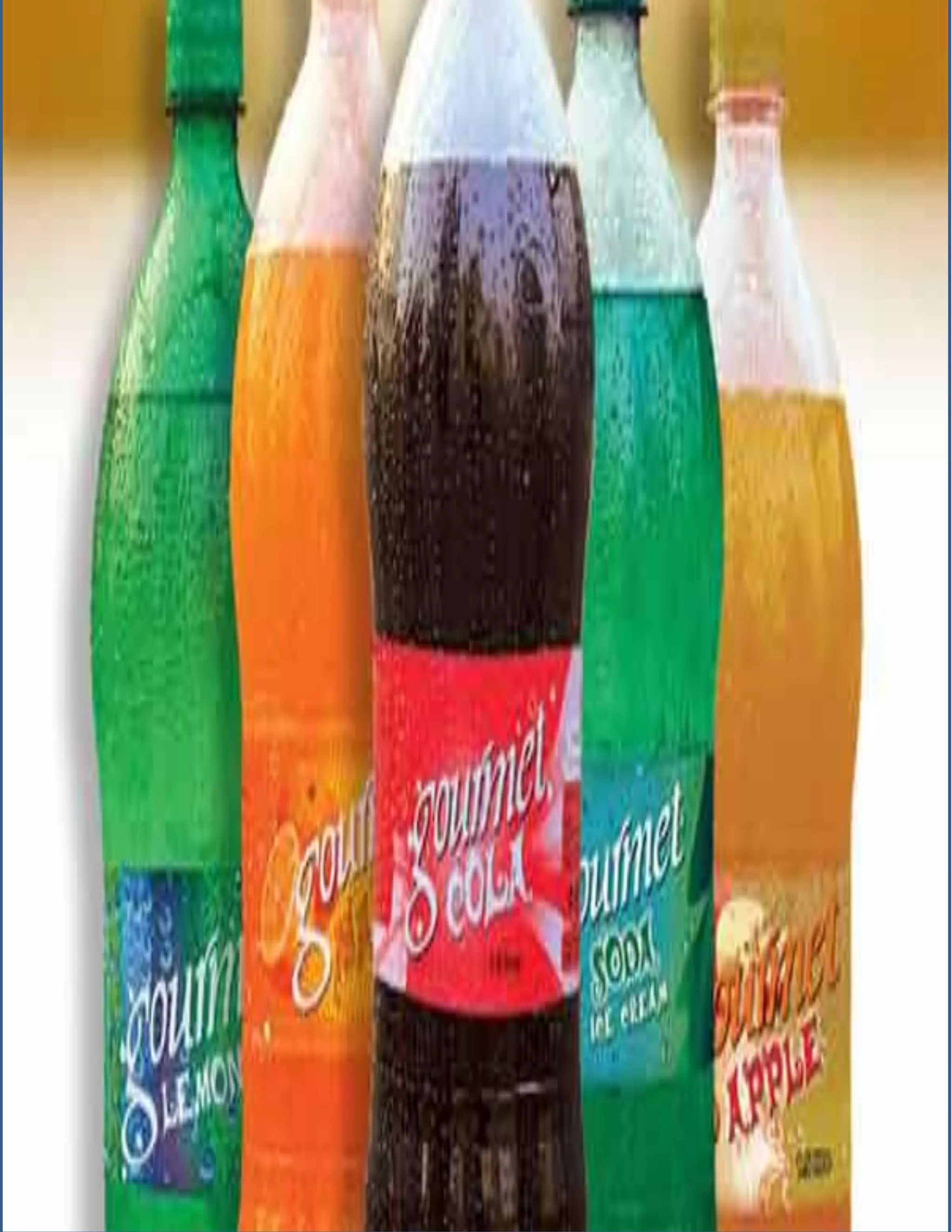
GOURMET
Principle of Marketing
Assignment N0 # 3
Submitted to Prof Khizar Hayat
Submitted by Marina Akram
Submission date 20th January2016
Introduction
Coca-Cola
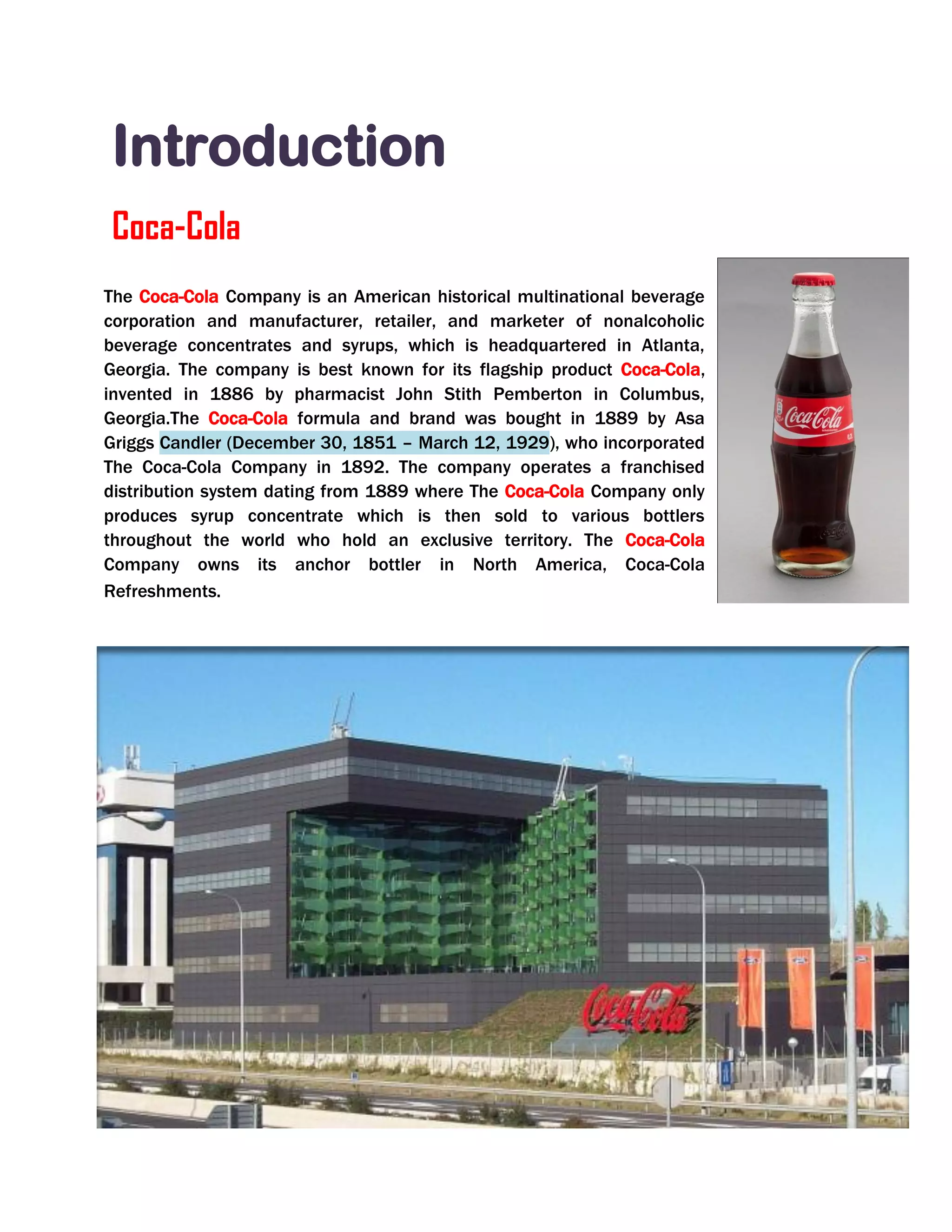
The Coca-Cola Company is an American historical multinational beverage
corporation and manufacturer, retailer, and marketer of nonalcoholic
beverage concentrates and syrups, which is headquartered in Atlanta,
Georgia. The company is best known for its flagship product Coca-Cola,
invented in 1886 by pharmacist John Stith Pemberton in Columbus,
Georgia.The Coca-Cola formula and brand was bought in 1889 by Asa
Griggs Candler (December 30, 1851 – March 12, 1929), who incorporated
The Coca-Cola Company in 1892. The company operates a franchised
distribution system dating from 1889 where The Coca-Cola Company only
produces syrup concentrate which is then sold to various bottlers
throughout the world who hold an exclusive territory. The Coca-Cola
Company owns its anchor bottler in North America, Coca-Cola
Refreshments.
Advertising Strategies
Coca-Cola might be one of the best-known brands in the world today. However, that wasn't
always the case. When the company first started in 1886, it used coupons for free drinks
to raise interest in the product. In 1892, marketer Asa Candler finalized the purchase of
Coca-Cola from inventor Dr. John Pemberton. Candler's original advertising budget was
$11,000. He used items such as calendars, soda fountain urns, painted wall signs,
napkins, pencils and clocks to advertise Coca-Cola. The first celebrity to ever endorse Coca-
Cola was music hall performer Hilda Clark in 1900. Since then, numerous celebrities such
as Joan Crawford, Ray Charles,
Coca-Cola purchased space in national magazines for the first time in 1904. By 1911, the
company's advertising budget had skyrocketed to more than $1 million. In the 1920s,
Coca-Cola added outdoor billboards and radio program sponsorships into its advertising
mix. The famous Coca-Cola Christmas advertising campaigns began in 1931 with
illustrations of St. Nicholas drinking Coca-Cola. The first television commercial for Coca-
Cola premiered on Thanksgiving Day in 1950. One of the most memorable Coca-Cola TV
commercials was 1993's "Northern Lights," which marked the debut of the Coca-Cola polar
bears. Not all of Coca-Cola's marketing ideas have been hits. In 1985, in an effort to
compete with Pepsi, the company decided to change the formula for Coke for the first time
in 99 years. The new drink was called "New Coke." The reaction to the new flavor was
overwhelmingly negative, and Coca-Cola went back to the original recipe in just 79 days.
Joe Tripodi, chief marketing and commercial officer for Coca-Cola, said the company had
more than $4 billion for its marketing budget in 2011. The major spending paid off as
Coca-Cola was named Marketer of the Year in 2011 by AdAge.
On May 8, 2012, Coca-Cola Company celebrated its 126th anniversary. With
a history that spans more than a century, it is no surprise that the brand has
seen many changes since it first began. From selling nine drinks a day at
Jacobs' Pharmacy in Atlanta, Georgia to selling about 19,400 beverages
every second around the world, here is how the Coca-Cola Company has
changed over the years and how the evolution has affected its business.
Evolution of the Coca-Cola
Brand
Packaging
Coca-Cola was only served as a fountain drink until 1899 when Candler sold the U.S.
bottling rights to Benjamin F. Thomas and Joseph B. Whitehead for $1. The Coca-Cola
contour bottle went into production in 1916. The unique shape of the bottle was designed
to distinguish Coca-Cola from its imitators. The 6.5 ounce contour bottle was the only
packaging Coca-Cola used until 1955 when the king-sized package was introduced.
Consumers had the option to purchase Coke in 10-, 12-, 16- and 26-ounce bottles in
addition to the standard 6.5-ounce bottle. In 1960, Coca-Cola introduced 12-ounce steel
cans to make its drinks more portable.
Coca-Cola went green in 2009 with 100% recyclable bottles made partially from plant-
based materials. In 2011, Coca-Cola's seasonal holiday packaging was met with disdain by
consumers. For the first time, regular Coke was put in white cans that customers said
looked similar to the silver Diet Coke cans. The white cans were supposed to stay on
shelves until February 2012, but were discontinued in December 2011 in favor of the
classic red cans. In October 2012, Coca-Cola announced that it would stop production of
6.5-ounce glass bottles because they are no longer profitable,
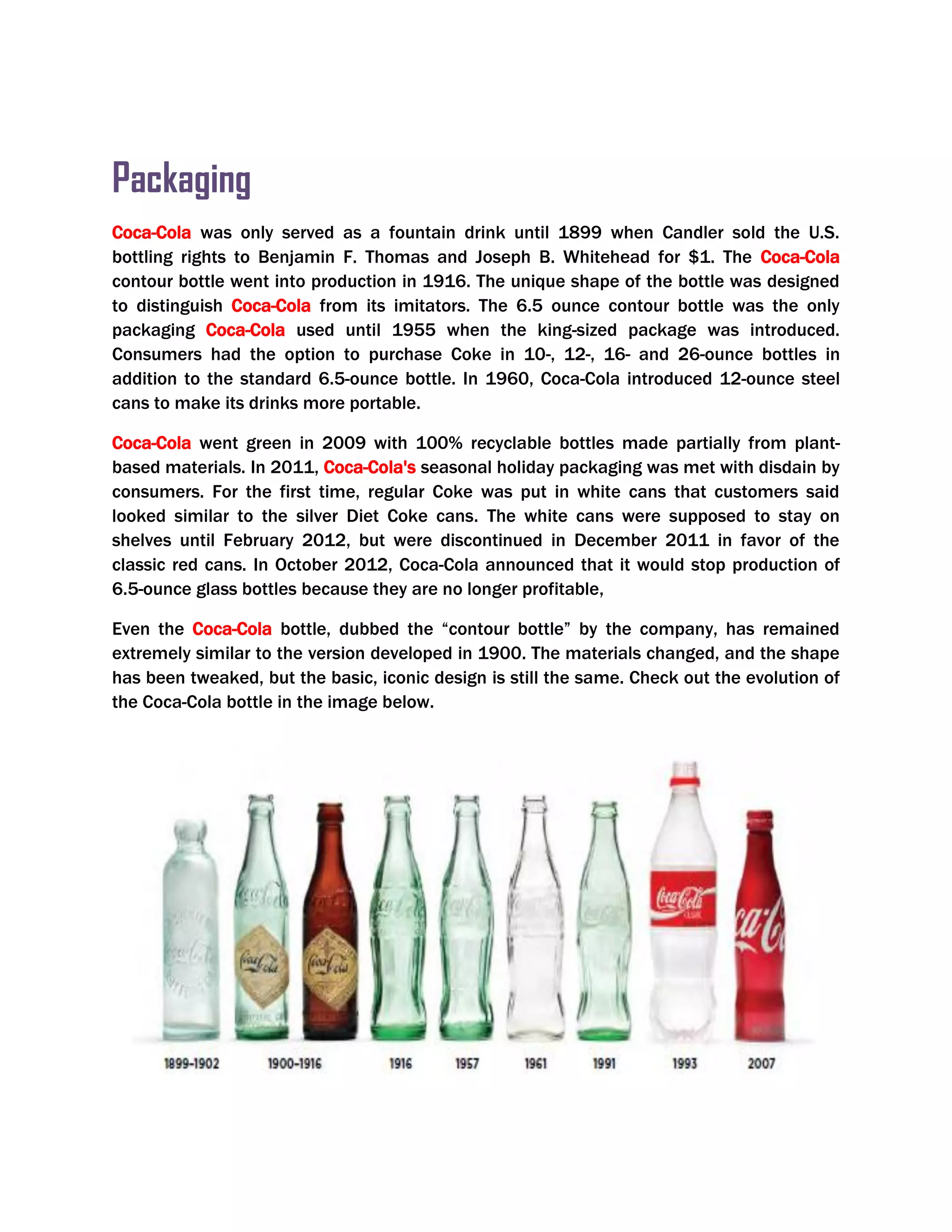
Even the Coca-Cola bottle, dubbed the ―contour bottle‖ by the company, has remained
extremely similar to the version developed in 1900. The materials changed, and the shape
has been tweaked, but the basic, iconic design is still the same. Check out the evolution of
the Coca-Cola bottle in the image below.
Logos
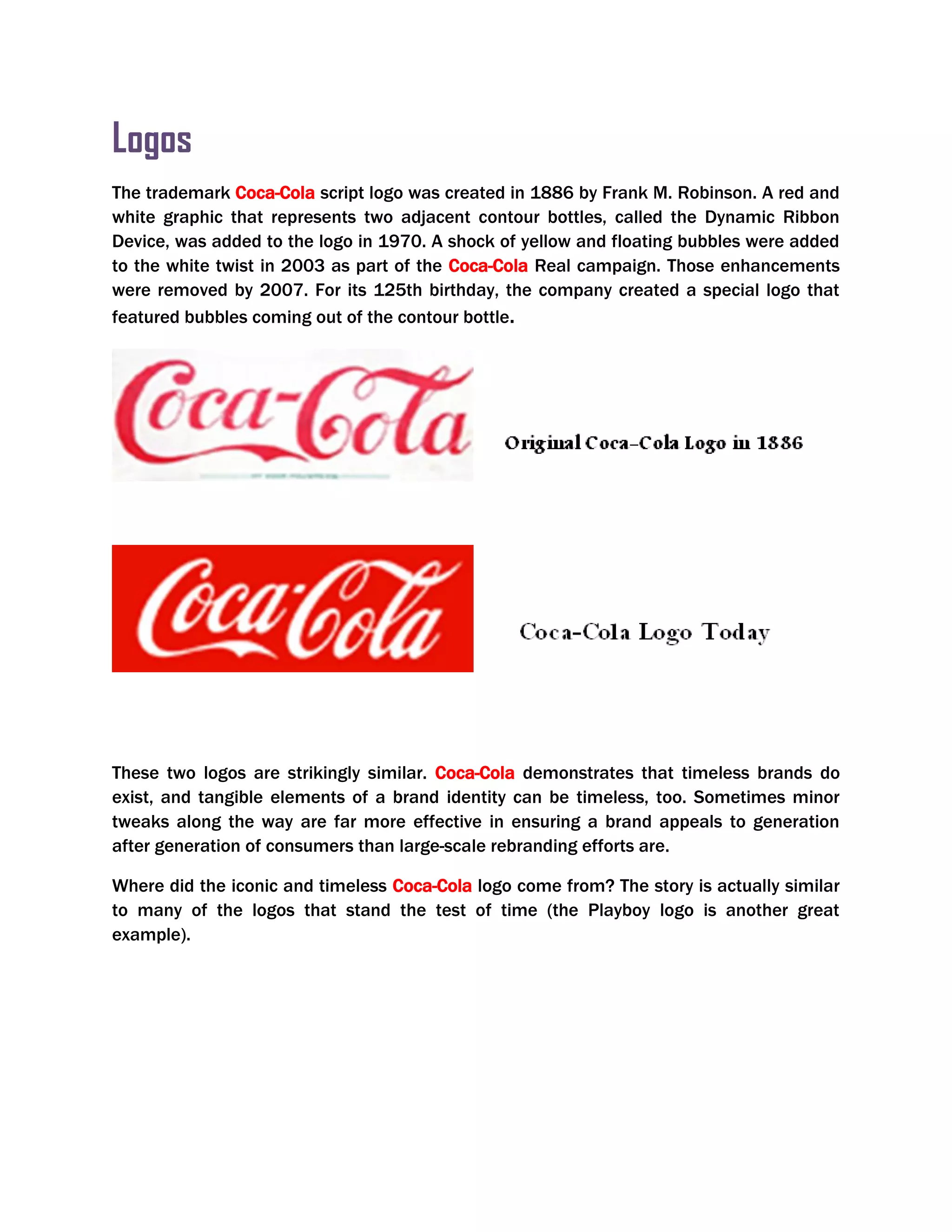
The trademark Coca-Cola script logo was created in 1886 by Frank M. Robinson. A red and
white graphic that represents two adjacent contour bottles, called the Dynamic Ribbon
Device, was added to the logo in 1970. A shock of yellow and floating bubbles were added
to the white twist in 2003 as part of the Coca-Cola Real campaign. Those enhancements
were removed by 2007. For its 125th birthday, the company created a special logo that
featured bubbles coming out of the contour bottle.
These two logos are strikingly similar. Coca-Cola demonstrates that timeless brands do
exist, and tangible elements of a brand identity can be timeless, too. Sometimes minor
tweaks along the way are far more effective in ensuring a brand appeals to generation
after generation of consumers than large-scale rebranding efforts are.
Where did the iconic and timeless Coca-Cola logo come from? The story is actually similar
to many of the logos that stand the test of time (the Playboy logo is another great
example).
Discuss how Coca-Cola has evolved over the years. Identify ways that
Coca-Cola can continue to evolve to meet changing consumer needs and
wants?
Product managers should do more than simply ride along with or defend their mature
products—a good offense is the best defense. Companies should consider three strategies:
modifying the market, product, and marketing mix. In modifying the market , the company
tries to increase the consumption of the current product. It may look for new users and
new market segments. For example, Coca-Cola promotes drinking the cola in the morning
for the caffeine jolt. Of course, Coca-Cola has been successful in satisfying the desires of
new markets around the globe. The company might also try modifying the product —
changing characteristics such as quality, features, style, or packaging to attract new users
and to inspire more usage. Coca-Cola has produced many new variations on the cola to
include fruit-flavored colas and diet colas. The company also has changed packaging with
respect to size and material over the years. However, not all of their changes have been
successful, such as New Coke that was launched in the 1980s. Although 20-ounce plastic
bottles invigorated Coke’s U.S. sales in the past, the company is now testing replacing the
20-ounce bottle with 16-ounce and 24-ounce bottles. Finally, the company can try
modifying the marketing mix —improving sales by changing one or more marketing mix
elements. Coca-Cola can cut prices to attract new users and competitors’ customers, and it
can launch new advertising and promotional campaigns, which it has done several times
during the life of this brand.
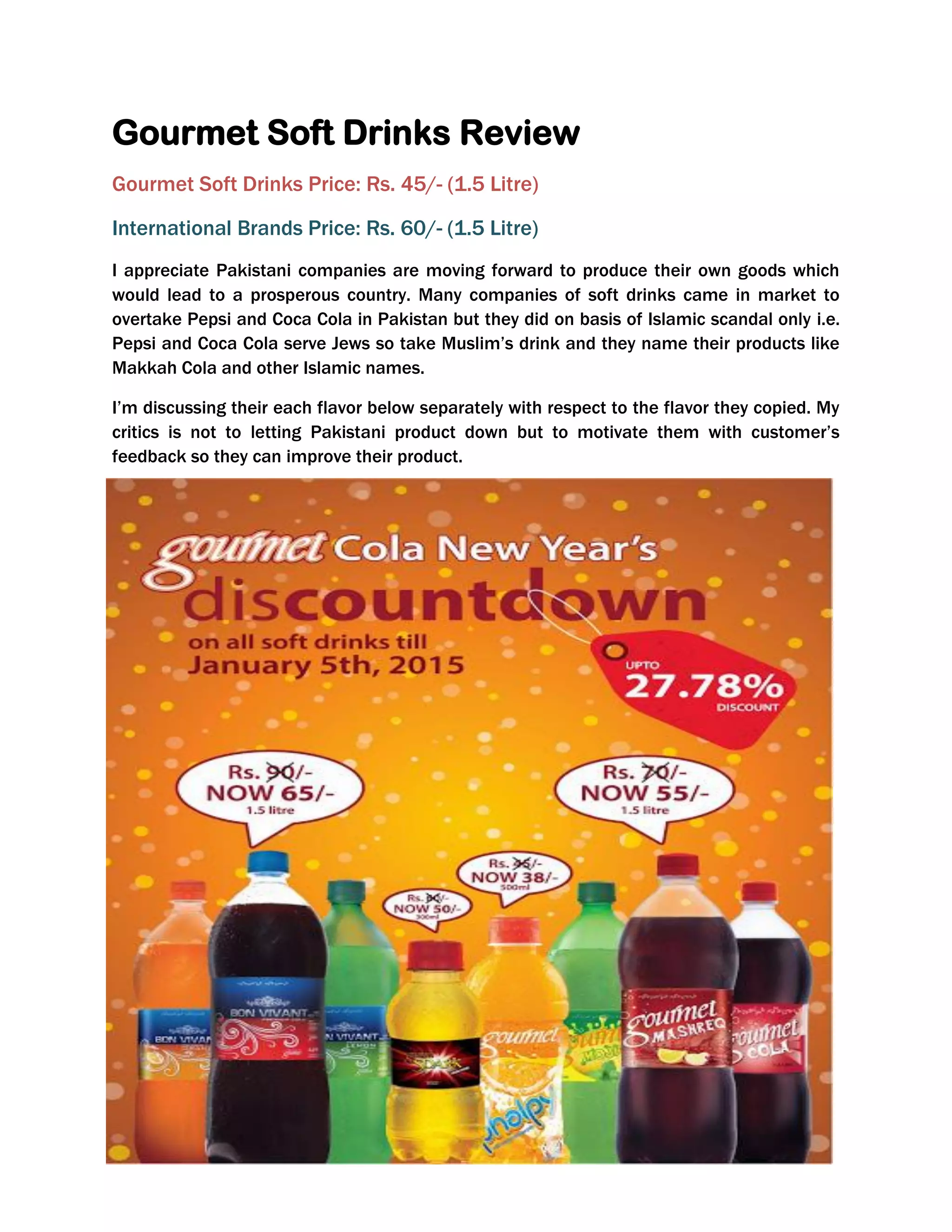
Gourmet Soft Drinks Review
Gourmet Soft Drinks Price: Rs. 45/- (1.5 Litre)
International Brands Price: Rs. 60/- (1.5 Litre)
I appreciate Pakistani companies are moving forward to produce their own goods which
would lead to a prosperous country. Many companies of soft drinks came in market to
overtake Pepsi and Coca Cola in Pakistan but they did on basis of Islamic scandal only i.e.
Pepsi and Coca Cola serve Jews so take Muslim’s drink and they name their products like
Makkah Cola and other Islamic names.
I’m discussing their each flavor below separately with respect to the flavor they copied. My
critics is not to letting Pakistani product down but to motivate them with customer’s
feedback so they can improve their product.
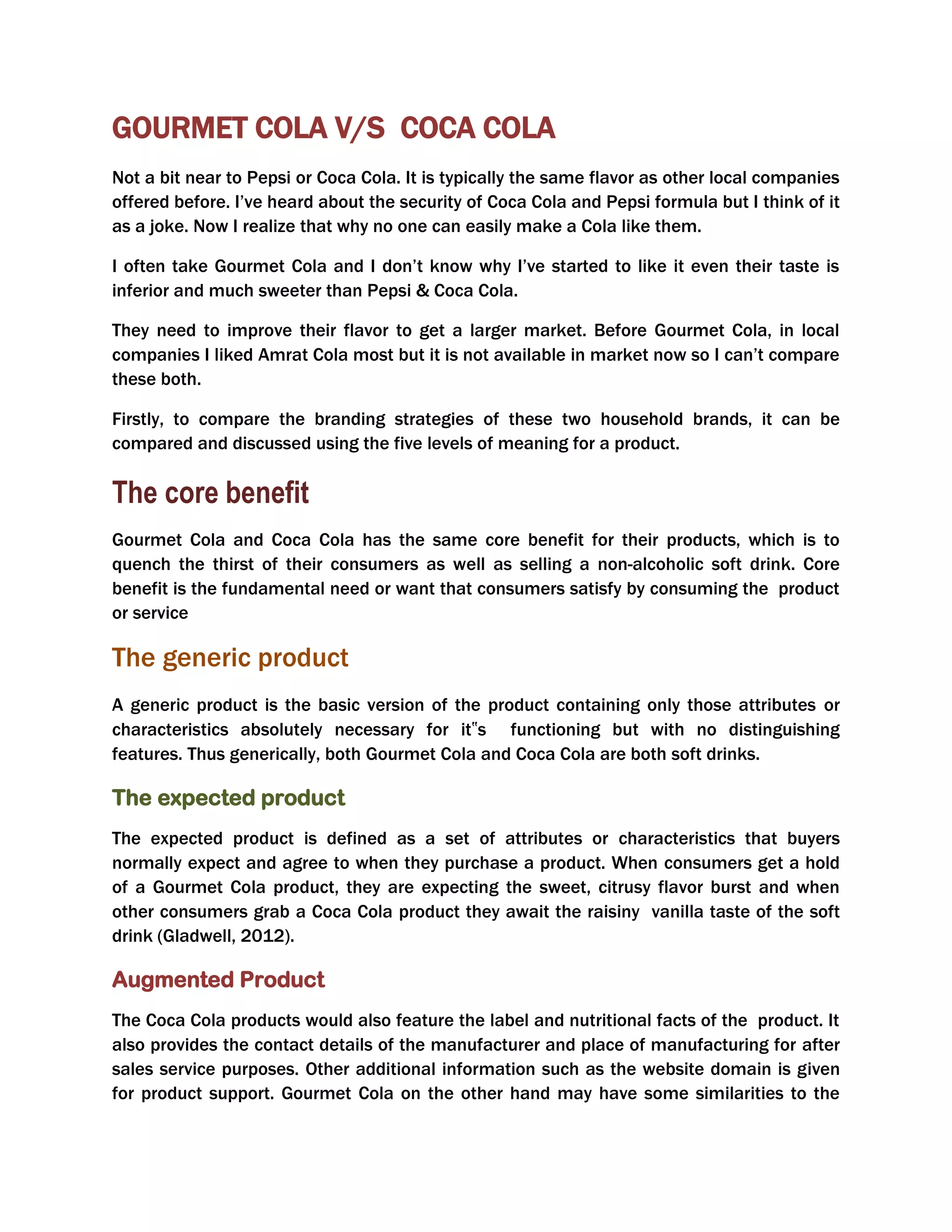
GOURMET COLA V/S COCA COLA
Not a bit near to Pepsi or Coca Cola. It is typically the same flavor as other local companies
offered before. I’ve heard about the security of Coca Cola and Pepsi formula but I think of it
as a joke. Now I realize that why no one can easily make a Cola like them.
I often take Gourmet Cola and I don’t know why I’ve started to like it even their taste is
inferior and much sweeter than Pepsi & Coca Cola.
They need to improve their flavor to get a larger market. Before Gourmet Cola, in local
companies I liked Amrat Cola most but it is not available in market now so I can’t compare
these both.
Firstly, to compare the branding strategies of these two household brands, it can be
compared and discussed using the five levels of meaning for a product.
The core benefit
Gourmet Cola and Coca Cola has the same core benefit for their products, which is to
quench the thirst of their consumers as well as selling a non-alcoholic soft drink. Core
benefit is the fundamental need or want that consumers satisfy by consuming the product
or service
The generic product
A generic product is the basic version of the product containing only those attributes or
characteristics absolutely necessary for it‟s functioning but with no distinguishing
features. Thus generically, both Gourmet Cola and Coca Cola are both soft drinks.
The expected product
The expected product is defined as a set of attributes or characteristics that buyers
normally expect and agree to when they purchase a product. When consumers get a hold
of a Gourmet Cola product, they are expecting the sweet, citrusy flavor burst and when
other consumers grab a Coca Cola product they await the raisiny vanilla taste of the soft
drink (Gladwell, 2012).
Augmented Product
The Coca Cola products would also feature the label and nutritional facts of the product. It
also provides the contact details of the manufacturer and place of manufacturing for after
sales service purposes. Other additional information such as the website domain is given
for product support. Gourmet Cola on the other hand may have some similarities to the
coca cola product. Pepsi Cola has a great customer support as they offer easy accessibility
and fast response as well as Gourmet Cola‟s availability for contact if an issue occurs.
Potential product
Potential product is including all the augmentations and transformations that product
might ultimately undergo in the future .
As for Coca Cola, they pledge to help their consumers be active and make informed
nutritional choices . Coca Cola is offering array of products that would be hydrating and
fitting for their individual needs and lifestyle that offers low and no calorie beverages and
regular calorie beverages packaged in smaller portions. This solution was made to address
the global problem of obesity as reported by World Health Organization statistics. Coca
Cola believes that the impact of obesity on the health of the consumer affects the health of
their business thus they became more concerned with the public health. A lot of
researchers and health advocates blame the consumption of sugar-sweetened beverages
as the cause of obesity.
Gourmet Cola is also affected by the global issue of obesity and is taking an initiative to
help curb the situation. Gormet Cola is looking at lowering their salt, sugar and saturated
fats that is in their food and beverage products. The company will also increase whole
grains, fruits, vegetables, nuts and low-fat dairy incorporated in their food products. They
are also looking at being environmentally conscious, for example the fully compostable
chip bag that will decompose entirely in 14 weeks .
Assignment

Assignment

  • 1.
  • 2.
    Principle of Marketing AssignmentN0 # 3 Submitted to Prof Khizar Hayat Submitted by Marina Akram Submission date 20th January2016
  • 4.
    Introduction Coca-Cola The Coca-Cola Companyis an American historical multinational beverage corporation and manufacturer, retailer, and marketer of nonalcoholic beverage concentrates and syrups, which is headquartered in Atlanta, Georgia. The company is best known for its flagship product Coca-Cola, invented in 1886 by pharmacist John Stith Pemberton in Columbus, Georgia.The Coca-Cola formula and brand was bought in 1889 by Asa Griggs Candler (December 30, 1851 – March 12, 1929), who incorporated The Coca-Cola Company in 1892. The company operates a franchised distribution system dating from 1889 where The Coca-Cola Company only produces syrup concentrate which is then sold to various bottlers throughout the world who hold an exclusive territory. The Coca-Cola Company owns its anchor bottler in North America, Coca-Cola Refreshments.
  • 5.
    Advertising Strategies Coca-Cola mightbe one of the best-known brands in the world today. However, that wasn't always the case. When the company first started in 1886, it used coupons for free drinks to raise interest in the product. In 1892, marketer Asa Candler finalized the purchase of Coca-Cola from inventor Dr. John Pemberton. Candler's original advertising budget was $11,000. He used items such as calendars, soda fountain urns, painted wall signs, napkins, pencils and clocks to advertise Coca-Cola. The first celebrity to ever endorse Coca- Cola was music hall performer Hilda Clark in 1900. Since then, numerous celebrities such as Joan Crawford, Ray Charles, Coca-Cola purchased space in national magazines for the first time in 1904. By 1911, the company's advertising budget had skyrocketed to more than $1 million. In the 1920s, Coca-Cola added outdoor billboards and radio program sponsorships into its advertising mix. The famous Coca-Cola Christmas advertising campaigns began in 1931 with illustrations of St. Nicholas drinking Coca-Cola. The first television commercial for Coca- Cola premiered on Thanksgiving Day in 1950. One of the most memorable Coca-Cola TV commercials was 1993's "Northern Lights," which marked the debut of the Coca-Cola polar bears. Not all of Coca-Cola's marketing ideas have been hits. In 1985, in an effort to compete with Pepsi, the company decided to change the formula for Coke for the first time in 99 years. The new drink was called "New Coke." The reaction to the new flavor was overwhelmingly negative, and Coca-Cola went back to the original recipe in just 79 days. Joe Tripodi, chief marketing and commercial officer for Coca-Cola, said the company had more than $4 billion for its marketing budget in 2011. The major spending paid off as Coca-Cola was named Marketer of the Year in 2011 by AdAge. On May 8, 2012, Coca-Cola Company celebrated its 126th anniversary. With a history that spans more than a century, it is no surprise that the brand has seen many changes since it first began. From selling nine drinks a day at Jacobs' Pharmacy in Atlanta, Georgia to selling about 19,400 beverages every second around the world, here is how the Coca-Cola Company has changed over the years and how the evolution has affected its business. Evolution of the Coca-Cola Brand
  • 6.
    Packaging Coca-Cola was onlyserved as a fountain drink until 1899 when Candler sold the U.S. bottling rights to Benjamin F. Thomas and Joseph B. Whitehead for $1. The Coca-Cola contour bottle went into production in 1916. The unique shape of the bottle was designed to distinguish Coca-Cola from its imitators. The 6.5 ounce contour bottle was the only packaging Coca-Cola used until 1955 when the king-sized package was introduced. Consumers had the option to purchase Coke in 10-, 12-, 16- and 26-ounce bottles in addition to the standard 6.5-ounce bottle. In 1960, Coca-Cola introduced 12-ounce steel cans to make its drinks more portable. Coca-Cola went green in 2009 with 100% recyclable bottles made partially from plant- based materials. In 2011, Coca-Cola's seasonal holiday packaging was met with disdain by consumers. For the first time, regular Coke was put in white cans that customers said looked similar to the silver Diet Coke cans. The white cans were supposed to stay on shelves until February 2012, but were discontinued in December 2011 in favor of the classic red cans. In October 2012, Coca-Cola announced that it would stop production of 6.5-ounce glass bottles because they are no longer profitable, Even the Coca-Cola bottle, dubbed the ―contour bottle‖ by the company, has remained extremely similar to the version developed in 1900. The materials changed, and the shape has been tweaked, but the basic, iconic design is still the same. Check out the evolution of the Coca-Cola bottle in the image below.
  • 7.
    Logos The trademark Coca-Colascript logo was created in 1886 by Frank M. Robinson. A red and white graphic that represents two adjacent contour bottles, called the Dynamic Ribbon Device, was added to the logo in 1970. A shock of yellow and floating bubbles were added to the white twist in 2003 as part of the Coca-Cola Real campaign. Those enhancements were removed by 2007. For its 125th birthday, the company created a special logo that featured bubbles coming out of the contour bottle. These two logos are strikingly similar. Coca-Cola demonstrates that timeless brands do exist, and tangible elements of a brand identity can be timeless, too. Sometimes minor tweaks along the way are far more effective in ensuring a brand appeals to generation after generation of consumers than large-scale rebranding efforts are. Where did the iconic and timeless Coca-Cola logo come from? The story is actually similar to many of the logos that stand the test of time (the Playboy logo is another great example).
  • 8.
    Discuss how Coca-Colahas evolved over the years. Identify ways that Coca-Cola can continue to evolve to meet changing consumer needs and wants? Product managers should do more than simply ride along with or defend their mature products—a good offense is the best defense. Companies should consider three strategies: modifying the market, product, and marketing mix. In modifying the market , the company tries to increase the consumption of the current product. It may look for new users and new market segments. For example, Coca-Cola promotes drinking the cola in the morning for the caffeine jolt. Of course, Coca-Cola has been successful in satisfying the desires of new markets around the globe. The company might also try modifying the product — changing characteristics such as quality, features, style, or packaging to attract new users and to inspire more usage. Coca-Cola has produced many new variations on the cola to include fruit-flavored colas and diet colas. The company also has changed packaging with respect to size and material over the years. However, not all of their changes have been successful, such as New Coke that was launched in the 1980s. Although 20-ounce plastic bottles invigorated Coke’s U.S. sales in the past, the company is now testing replacing the 20-ounce bottle with 16-ounce and 24-ounce bottles. Finally, the company can try modifying the marketing mix —improving sales by changing one or more marketing mix elements. Coca-Cola can cut prices to attract new users and competitors’ customers, and it can launch new advertising and promotional campaigns, which it has done several times during the life of this brand.
  • 10.
    Gourmet Soft DrinksReview Gourmet Soft Drinks Price: Rs. 45/- (1.5 Litre) International Brands Price: Rs. 60/- (1.5 Litre) I appreciate Pakistani companies are moving forward to produce their own goods which would lead to a prosperous country. Many companies of soft drinks came in market to overtake Pepsi and Coca Cola in Pakistan but they did on basis of Islamic scandal only i.e. Pepsi and Coca Cola serve Jews so take Muslim’s drink and they name their products like Makkah Cola and other Islamic names. I’m discussing their each flavor below separately with respect to the flavor they copied. My critics is not to letting Pakistani product down but to motivate them with customer’s feedback so they can improve their product.
  • 11.
    GOURMET COLA V/SCOCA COLA Not a bit near to Pepsi or Coca Cola. It is typically the same flavor as other local companies offered before. I’ve heard about the security of Coca Cola and Pepsi formula but I think of it as a joke. Now I realize that why no one can easily make a Cola like them. I often take Gourmet Cola and I don’t know why I’ve started to like it even their taste is inferior and much sweeter than Pepsi & Coca Cola. They need to improve their flavor to get a larger market. Before Gourmet Cola, in local companies I liked Amrat Cola most but it is not available in market now so I can’t compare these both. Firstly, to compare the branding strategies of these two household brands, it can be compared and discussed using the five levels of meaning for a product. The core benefit Gourmet Cola and Coca Cola has the same core benefit for their products, which is to quench the thirst of their consumers as well as selling a non-alcoholic soft drink. Core benefit is the fundamental need or want that consumers satisfy by consuming the product or service The generic product A generic product is the basic version of the product containing only those attributes or characteristics absolutely necessary for it‟s functioning but with no distinguishing features. Thus generically, both Gourmet Cola and Coca Cola are both soft drinks. The expected product The expected product is defined as a set of attributes or characteristics that buyers normally expect and agree to when they purchase a product. When consumers get a hold of a Gourmet Cola product, they are expecting the sweet, citrusy flavor burst and when other consumers grab a Coca Cola product they await the raisiny vanilla taste of the soft drink (Gladwell, 2012). Augmented Product The Coca Cola products would also feature the label and nutritional facts of the product. It also provides the contact details of the manufacturer and place of manufacturing for after sales service purposes. Other additional information such as the website domain is given for product support. Gourmet Cola on the other hand may have some similarities to the
  • 12.
    coca cola product.Pepsi Cola has a great customer support as they offer easy accessibility and fast response as well as Gourmet Cola‟s availability for contact if an issue occurs. Potential product Potential product is including all the augmentations and transformations that product might ultimately undergo in the future . As for Coca Cola, they pledge to help their consumers be active and make informed nutritional choices . Coca Cola is offering array of products that would be hydrating and fitting for their individual needs and lifestyle that offers low and no calorie beverages and regular calorie beverages packaged in smaller portions. This solution was made to address the global problem of obesity as reported by World Health Organization statistics. Coca Cola believes that the impact of obesity on the health of the consumer affects the health of their business thus they became more concerned with the public health. A lot of researchers and health advocates blame the consumption of sugar-sweetened beverages as the cause of obesity. Gourmet Cola is also affected by the global issue of obesity and is taking an initiative to help curb the situation. Gormet Cola is looking at lowering their salt, sugar and saturated fats that is in their food and beverage products. The company will also increase whole grains, fruits, vegetables, nuts and low-fat dairy incorporated in their food products. They are also looking at being environmentally conscious, for example the fully compostable chip bag that will decompose entirely in 14 weeks .