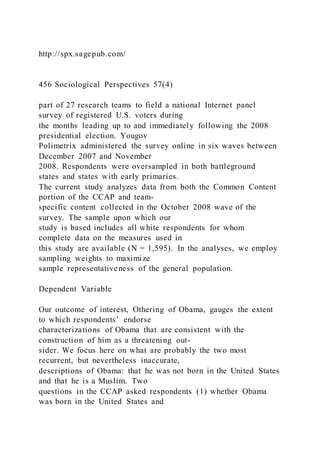
Assignment 3: Research Questions & Variables
You will identify a research topic, explain your research idea,
construct possible research questions (1 or 2 questions),
determine which variables you could potentially use for your
research paper (you will need to have 1 dependent variable and
3 independent variables), and state your hypotheses. You will
have to give your future survey (Assignment 4) to friends or
family, so think about what you will be able to ask them and
what information they will be able to provide. We will not
survey or interview vulnerable populations (anyone under 18,
prisoners, etc.). It is okay if your idea is still a work-in-
progress!
Sociological Perspectives
2014, Vol. 57(4) 450 –469
© The Author(s) 2014
Reprints and permissions:
sagepub.com/journalsPermissions.nav
DOI: 10.1177/0731121414536140
spx.sagepub.com
Social Production of Difference
Othering Obama: Racial Attitudes
and Dubious Beliefs about the
Nation’s First Black President
Daniel Tope1, Justin T. Pickett2, Ryon J. Cobb3,
and Jonathan Dirlam4
Abstract
The literature on descriptive representation indicates that the
election of black political leaders
may prompt white enmity. We assess this claim by examining
the relationship between whites’
racial attitudes and their likelihood of othering Barack Obama
by labeling him as a Muslim and/or
a noncitizen interloper. The findings reveal that both symbolic
racial resentment and traditional
racial attitudes are associated with othering Obama. In addition,
the results reveal that the
relationship between racial resentment and othering is
substantially mediated by the use of
seemingly nonracist frames based on emotional reactions and
negative expectations about an
Obama presidency. Conversely, much of the effect of belief in
traditional antiblack stereotypes
was transmitted directly to othering Obama without the use of
justificatory frames. Despite
claims of racial progress, our findings suggest that racial
sentiments—both overt and symbolic—
continue to play a major role in politics.
Keywords
Barack Obama, descriptive representation, racial resentment
The extent to which racial attitudes shape contemporary politics
continues to be the subject of
fierce scholarly debate (e.g., Hutchings and Valentino 2004;
Sears, Sidanius, and Bobo 2000). In
particular, analysts have focused on the distinction between
symbolic and overt forms of racial
prejudice (Huddy and Feldman 2009). An important theme in
the race literature has been that
because the normative racial discourse changed from the Jim
Crow to the post–civil rights era,
racial language has become more subtle and opaque (Bobo,
Kluegel, and Smith 1997; Bonilla-
Silva 2010). Accordingly, race analysts have come to focus
largely on symbolic forms of racism,
such as racial resentment (Sears and Henry 2005). Yet some
suggest that old fashioned overt
racism persists and thus should not be discounted (Huddy and
Feldman 2009).
1Florida State University, Tallahassee, FL, USA
2University at Albany, State University of New York, Albany,
NY, USA
3University of Southern California, Los Angeles, CA, USA
4Ohio State University, Columbus, OH, USA
Corresponding Author:
Daniel Tope, Department of Sociology, Florida State
University, 429 Bellamy Building, Tallahassee, FL 32306-2270,
USA.
Email: [email protected]
536140 SPXXXX10.1177/0731121414536140Sociological
PerspectivesTope et al.
research-article2014
at FLORIDA STATE UNIV LIBRARY on June 3,
2016spx.sagepub.comDownloaded from
mailto:[email protected]
http://spx.sagepub.com/
Tope et al. 451
The election of the United States’ first black president provides
a unique opportunity to con-
tribute to this debate. Barack Obama’s rise elicited considerable
enthusiasm and hope among his
supporters. Some commentators went so far as to suggest his
election might signal the dawn of a
postracial era where racial barriers had largely subsided for
black Americans (e.g., Thernstrom
2008). Indeed, some research has indicated that Obama
represented a counter to black stereo-
types and thereby helped to diminish prejudice among some
whites (Columb and Plant 2011;
Welch and Sigelman 2011).
Despite these findings, other studies revealed that Obama’s
election provoked racial fears for
some individuals. For example, a 2009 poll indicated that 65
percent of Republicans thought
Obama’s policies would privilege blacks over whites (The
Economist 2009). Another study
showed that about 30 percent of whites were troubled by the
very idea of an Obama presidency
(Redlawsk, Tolbert, and Franko 2010). In addition, David
Redlawsk et al. (2010:9) found that
“the likelihood of feeling troubled by Obama as the first Black
president is very high for those
white voters who explicitly express a belief that Obama’s
policies will advantage Black
people.”
The extant literature suggests that racial attitudes shape whites’
views of black political can-
didates and elected officials (Block 2011; Citrin, Green, and
Sears 1990; Tesler and Sears 2010).
Notwithstanding reported declines in overt racism (e.g.,
Schuman et al. 1997), whites are less
likely to associate minority politicians with Americanness
(Devos and Banaji 2005). One study
revealed that many individuals were more apt to associate
United Kingdom Prime Minister Tony
Blair with Americanness than they were Barack Obama (Devos,
Ma, and Gaffud 2008). Related
research has shown that antiblack attitudes predict whites’
policy opinions (Hutchings and
Valentino 2004; Krysan 2000) and foster unfavorable views
about legislation attributed to Obama
(Knowles, Lowery, and Schaumberg 2010).
In light of the foregoing, it is likely that racial attitudes shape a
range of beliefs about President
Obama. While much has been written on evaluations of
candidates and presidents, much less
systematic research has addressed individuals’ adoption of
particular frames used to “other”
political actors. Since he became a presidential candidate in
2008, conspiratorial assertions about
Barack Obama rapidly spread. Chief among the Obama
conspiracies have been (1) that he is
secretly a Muslim and (2) that he is not eligible to be the
president because he was not born in the
United States. Despite contrary evidence, these
characterizations persist.
Othering refers to the general process of demarcating an out-
group and thereby reaffirming
in-group membership (Schwalbe et al. 2000). In particular, it
involves efforts to label individuals
as members of potentially threatening out-groups. Othering is
present in all systems of inequality
(e.g., race, gender, class). For that reason, such expressions
need not be grounded in ethnocen-
trism. Yet in the present case, othering seems to be a symbolic
expression of ethnocentrism likely
shaped in part by contemporary implicit and explicit racial
discourse (Bonilla-Silva 2010). As
such, the othering themes addressed herein may be part of a
broader culture of ethnocentrism as
elaborated by Donald R. Kinder and Cindy D. Kam (2010; also
see Kam and Kinder 2012).
In what follows, we assess whether racial attitudes determine
individuals’ propensity to label
Obama as a Muslim and/or a noncitizen. Our focus on othering
is particularly apposite in light of
scholarly arguments that many of Obama’s detractors view him
“not merely as a racial threat, but
as a racist threat”—a potential menace to the racial order
(Barreto et al. 2011; Enck-Wanzer
2011:26). Moreover, we contrast both symbolic and overt racial
attitudes and their relationship to
othering Obama and examine the degree to which the
relationship between racial attitudes and
othering is mediated by several intervening factors.
Obama as Other
Owing in large part to the media campaigns waged against him,
notions of Barack Obama’s
“otherness” in terms of both race and religion are commonplace.
In 2008, prominent media
at FLORIDA STATE UNIV LIBRARY on June 3,
2016spx.sagepub.comDownloaded from
http://spx.sagepub.com/
452 Sociological Perspectives 57(4)
pundits, celebrities, and members of Congress engaged in
discussions commonly characterized
as Birtherism—the salacious idea that Barack Obama is not a
U.S. citizen and is thereby ineli-
gible to serve as president (Berlet 2010; Enck-Wanzer 2011;
Hughey 2012). This sensational
rumor swirled in the popular media and persisted well beyond
the presidential campaign. Indeed,
by April 2010, a national poll revealed that 80 percent of
respondents had heard these conspirato-
rial stories and roughly a quarter of respondents believed them
(Harris Polls 2010). And in 2012,
several state governments debated removing Obama from their
presidential election ballots
because of his supposed invalid citizenship status. Despite
Obama’s repeated assertions of legal
citizenship and the availability of his verified certificate of live
birth, the Birther conspiracy
continued.
A second prominent rumor—with clear ethnic overtones—about
Barack Obama also per-
sisted. This widely disseminated story suggested that despite his
repeated identification as
Christian, his regular attendance at a Christian church, and
having his daughters baptized at that
church, Obama was secretly a Muslim. This is particularly
notable in light of the extreme anti-
Muslim sentiments that have emerged in the United States in the
years following the World Trade
Center bombing. Kam and Kinder (2012:334), for instance,
reported that the 2008 American
National Election Study showed that white Americans had more
negative feelings toward
Muslims than toward all but three of the other 24 groups
examined illegal immigrants, homo-
sexuals, and atheists (see also Kalkan, Layman, and Uslaner
2009; Panagopoulos 2006; Tesler
2011). A 2010 Pew Research Center survey found that about 18
percent of the population believed
that Obama was a Muslim. In addition, a study by Barry A.
Hollander (2010) showed that politi-
cal conservatives who were not black, had lower levels of
education, and subscribed to biblical
literalism were likely to subscribe to the Obama as Muslim
rumor (also see Block and Onwunli
2010). Attempts to mark political opponents as “other” are
certainly not new. Yet, the Muslim
charge at a time when the United States was at war in the
Middle East and with the 9/11 terrorist
attacks still in recent memory struck a particularly othering
conspiratorial tone.
The persistence of the aforesaid dubious frames about the
president is remarkable, especially
given that similar beliefs have not emerged in relation to other
presidents in contemporary times.
An investigation into the determinants of these beliefs is
warranted. In light of Barack Obama’s
status as the first black president, it is conceivable that the
othering themes directed at him are
related to racial attitudes (Enck-Wanzer 2011).
Theoretical Background and Prior Research
Although numerous theoretical formulations exist to describe
the contours of racial politics, our
focus is on what is known as black descriptive representation—
the presence of black elected
officials (Reeves 1997). In particular, we are interested in white
responses to these officials.
When subordinate groups gain power or are perceived to do so,
they are often viewed as a politi-
cal threat by dominant group members (Blalock 1967; Blumer
1958). Studies suggest that many
whites view increased black political representation as
endangering their interests (Barreto,
Segura, and Woods 2004; Block 2011; Lublin 1997; Scherer and
Curry 2010; for an alternative
account, see Hajnal 2007).1 It thus follows that a black
president likely constitutes a substantial
symbolic threat for some whites. For our purposes, the key
questions then become (1) whether
racial attitudes shape whites’ articulation of the perceived other
embodied in Barack Obama, and
if so, (2) whether symbolic and explicit prejudice have similar
effects.
Symbolic Prejudice: Racial Resentment
Scholarship on contemporary racial attitudes focuses largely on
“symbolic” racial prejudice. This
literature argues that because the United States’ evolving racial
norms increasingly forbid the
at FLORIDA STATE UNIV LIBRARY on June 3,
2016spx.sagepub.comDownloaded from
http://spx.sagepub.com/
Tope et al. 453
expression of blatant racism, whites use subtler methods to
express racial enmity (Kinder and
Sanders 1996; Sears and Henry 2005; Sears et al. 2000).
Although symbolic racism has been cast
in numerous forms, we focus on racial resentment which is one
of the leading conceptual frame-
works. Racial resentment is conveyed through white contempt
toward black calls for social
change as well as against policies that may serve to ameliorate
racial inequality (Bobo et al. 1997;
Henry and Sears 2002).
Racial resentment may be defined as a refined form of prejudice
that merges whites’ belief in
traditional values such as the protestant work ethic with whites’
negative feelings about blacks.
The idea that blacks fail to get ahead in society because they do
not try hard enough and fre-
quently take what they have not earned are key components of
this belief system (Kinder and
Sanders 1996). Racial resentment has proven a reliable
determinant of resistance to a range of
policies such as affirmative action, school busing, child saving
initiatives, and social spending
(Pickett, Chiricos, and Gertz 2014; Sears et al. 2000).2 Indeed,
research has shown that symbolic
racism is typically more strongly associated with racial policy
(e.g., affirmative action) resistance
than traditional forms of racism, such as beliefs in innate black
inferiority (Krysan 2000; Sears et
al. 2000).3
Racial attitudes have also been shown to have a powerful
influence on whites’ political candi-
date preferences. For instance, related research on black
descriptive representation suggests that
the election of black officials may enhance perceived levels of
economic and/or political threat
posed by blacks (e.g., Sears, Citrin, and Kosterman 1987;
Terkildsen 1993). Indeed, findings
reveal that black descriptive representation can negatively
influence white political attitudes and
participation (Barreto et al. 2004; Orey 2001; Scherer and Curry
2010; but see Hajnal 2007). In
addition, Lublin (1997) suggested that the election of black
officials can prompt white political
backlash.
The theories underlying this literature have taken on somewhat
different forms and arrived at
varying conclusions. Nevertheless, a substantial literature
suggests that increases in black politi-
cal power should amplify white resentment of blacks and
prompt white animus or resistance
(Hajnal 2001; Lublin and Tate 1995). Nicholas Valentino and
Ted Brader (2011), for example,
showed that among many whites, Obama’s election, by reducing
perceived racial discrimination,
increased racial resentment and antiblack affect. It should thus
not be surprising that Michael
Tesler and David Sears (2010:5) reported that with respect to
the 2008 election, “Public opinion
and voting behavior . . . were considerably more polarized by
racial attitudes than at any other
time on record.” Accordingly, we hypothesize that the presence
of an African American president
should result in a positive association between racial resentment
and othering Barack Obama
(Hypothesis 1).
Symbolic racism provides for the same racialized outcomes —
discrimination, opposition to
policies for reducing inequality—as traditional forms of
prejudice. However, what is unique
about symbolic prejudice is that its connection to such ends is
primarily indirect through ostensi-
bly race-neutral beliefs. Stated differently, symbolic prejudice
allows individuals to justify—
both to themselves and to others—their support/opposition to
policies that have clear racial
consequences without ever openly endorsing a racist ideology
(Kinder and Sanders 1996; Sears
et al. 2000). For racially resentful persons, the underlying
motivation for racialized policy prefer-
ences can be portrayed as stemming from principled beliefs
rather than racial concerns. Supporting
this contention, research on contemporary racetalk argues that
racial language is mostly subtle
and outwardly nonracial (Hill 2008; Myers 2005). Moreover,
and crucial for our study, the litera-
ture reveals that whites frequentl y deploy an array of ostensibly
nonracist rhetorical frames and
stories to sanitize their expressed beliefs (Bonilla-Silva 2010).
This pattern is evident in both
popular and political discourse.
Changes in acceptable language have diminished conduits for
the political expression of tra-
ditional overt racism. In the absence of such an outlet,
seemingly nonracist frames often supplant
at FLORIDA STATE UNIV LIBRARY on June 3,
2016spx.sagepub.comDownloaded from
http://spx.sagepub.com/
454 Sociological Perspectives 57(4)
traditional racism. Therefore, political discourse even on
explicitly racial policies (such as affir-
mative action), for instance, have come to revolve around issues
such as deservingness and work
ethic rather than race per se (Mendelberg 2001; Winter 2008).
Stated more explicitly, whites may
have principled opposition to a particular policy, political
official, or candidate but those who
subscribe to contemporary symbolic racial norms often engage
in the construction of seemingly
nonracist justifications lest they appear to have offensive racial
motives (Brandt and Reyna
2012). Yet it is crucial to note that the extant literature
emphasizes that the use of such frames are
not necessarily grounded in intentional deception. Rather, the
use of nonracist frames and justifi-
cations has become a customary aspect of the structure of
contemporary racial discourse (Bonilla-
Silva 2010). It follows that if the just described logic of
racetalk is correct, then racial
sentiments—whether intentional or not—should often be
channeled or partially explained
through alternative frames. That is, to abide by discursive racial
norms, whites should often use
seemingly nonracist justifications or stories to buttress views
that could be perceived as racially
biased—such as othering a member of a racial/ethnic minority
group.
Two particular frames have drawn our interest. First, there has
been increased interest in the
role of emotions in political research (e.g., Goodwin, Jasper,
and Polletta 2001). Emotions are
wrapped up in the stories individuals construct to understand
their lives (Smith and Ellsworth
1985). Moreover, research on racial resentment has often
suggested a role for emotions even
when they were not directly measured. Paul Sniderman,
Gretchen Crosby, and William Howell
(2000) noted that racial views are saturated with emotions. And
David Sears (1988:70) argued
that racial resentment is related to “fear, . . . anger, distaste,
disgust, contempt, apprehension,
unease, or dislike.” In addition, findings by Jennifer S. Lerner
and Larissa Z. Tiedens (2006)
illustrate that confidence about a source of threat or targets of
blame results in anger (see also
Banks and Valentino 2012; Tesler 2013). And another study
found that priming anger in respon-
dents led them to rate out-groups more negatively (DeSteno et
al. 2004). Frames that are infused
with seemingly nonracist emotional appeals—especially anger—
are thus a likely candidate link-
ing racial resentment with othering. We therefore propose that
expressing anger about things
Barack Obama has done likely mediates the relationship
between racial resentment and othering
(Hypothesis 2).
Second, some frames adopted by whites may be cast as general
perspectives on race relations.
This storyline is evident in research showing how dominant
group members project racial moti-
vations onto minority group members. Eduardo Bonilla-Silva
(2002, 2010) elaborated on this
perspective arguing that some whites declare that the behavior
of minorities, as opposed to
whites, is laden with racial motivations. Accordingly, prior
research has shown that white inter-
view respondents are more apt to see racialized behavior among
blacks than whites and argue
that the racial (or even racist) behavior of minorities is at the
root of social distance between
racial and ethnic groups. Bonilla-Silva argues that this
professed concern for race relations serves
an exculpatory function for whites imbuing them with racial
innocence. We thus propose that
subscribing to the frame that Obama will favor blacks or
instigate poorer race relations will medi-
ate the relationship between racial resentment and propensity to
other Obama (Hypothesis 3). We
present our conceptual mediation model for symbolic prejudice
in Figure 1.4
Explicit Prejudice: Traditional Racism
While the bulk of recent research on racial attitudes focuses on
subtle resentment, more tradi-
tional racial stereotypes, such as beliefs in innate black
deficiencies, remain politically important.
Research suggests that while whites have become less likely to
voice blatant racial stereotypes
(Schuman et al. 1997), many still harbor what might be called
traditional prejudices or what has
sometimes been labeled traditional or old fashioned racism
(Tesler 2013). Multiple studies have
shown the continued political and policy relevance of
traditional racism (Cribbs and Austin 2010;
at FLORIDA STATE UNIV LIBRARY on June 3,
2016spx.sagepub.comDownloaded from
http://spx.sagepub.com/
Tope et al. 455
Huddy and Feldman 2009; Perkins 2009; Kinder and
Mendelberg 1995; Pickett and Chiricos
2012). For instance, research by Mark Peffley, Jon Hurwitz, and
Paul M. Sniderman (1997:30–
31) suggests that whites subscribing to racial stereotypes are
more likely to “judge Blacks more
harshly than similarly described whites in the areas of welfare
and crime policy.” Martin Gilens
(1995) found that whites’ traditional racism was a determinant
of opposition to social spending.
Furthermore, a recent study argues that antiblack racism
“appears to have been an important
component of the 2008 election, considerably reducing Obama’s
share of the vote” (Pasek et al.
2009:982).
Traditional antiblack racism has important implications for
white Americans’ political prefer-
ences in the Obama era. Indeed, Michael Tesler (2013:121)
found that traditional racism influ-
enced by “Obama’s rise to prominence” was a major predictor
of partisan candidate preferences.
Corresponding research by Leonie Huddy and Stanley Feldman
(2009) found that traditional
overt racial attitudes were linked with a disinclination to
support Barack Obama in the 2008
Democratic Primary. It is thus conceivable that traditional
racism would diminish support for
Barack Obama on multiple fronts given that adherents to this
traditionalist view would likely
oppose a president from a group they deem inferior. We
therefore propose that individuals evinc-
ing higher levels of traditional racism should have a greater
propensity to label Barack Obama as
a Muslim and/or noncitizen other (Hypothesis 4). Here the use
of frames should be less salient,
and thus the relationship between traditional prejudice and
othering should be more direct. Stated
differently, whites who are overtly racist should have little need
to express their racial enmity
through seemingly nonracist frames. Hence, the use of framing
should be a much less common
feature in the case of traditional as opposed to symbolic racial
attitudes. Our conceptual model
for the relationship between traditional racism and othering is
presented in Figure 2.
Method
To test our hypotheses, we draw on data from the 2007 to 2008
Cooperative Campaign Analysis
Project (CCAP; Jackman and Vavreck 2009). That project
involved a collaborative effort on the
OtheringExplicit
Prejudice
Figure 2. Conceptual direct effect model.
Racial
Resentment
Negative
Expectations
Frame
Negative
Emotions
Frame
Othering
Figure 1. Conceptual mediation model.
at FLORIDA STATE UNIV LIBRARY on June 3,
2016spx.sagepub.comDownloaded from
http://spx.sagepub.com/
456 Sociological Perspectives 57(4)
part of 27 research teams to field a national Internet panel
survey of registered U.S. voters during
the months leading up to and immediately following the 2008
presidential election. Yougov
Polimetrix administered the survey online in six waves between
December 2007 and November
2008. Respondents were oversampled in both battleground
states and states with early primaries.
The current study analyzes data from both the Common Content
portion of the CCAP and team-
specific content collected in the October 2008 wave of the
survey. The sample upon which our
study is based includes all white respondents for whom
complete data on the measures used in
this study are available (N = 1,595). In the analyses, we employ
sampling weights to maximize
sample representativeness of the general population.
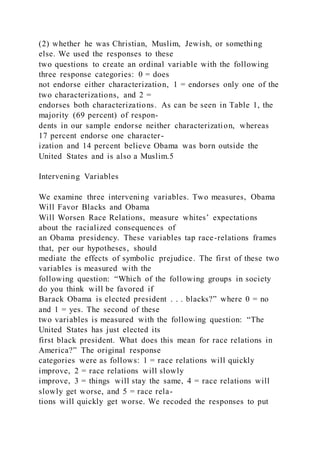
Dependent Variable
Our outcome of interest, Othering of Obama, gauges the extent
to which respondents’ endorse
characterizations of Obama that are consistent with the
construction of him as a threatening out-
sider. We focus here on what are probably the two most
recurrent, but nevertheless inaccurate,
descriptions of Obama: that he was not born in the United States
and that he is a Muslim. Two
questions in the CCAP asked respondents (1) whether Obama
was born in the United States and
(2) whether he was Christian, Muslim, Jewish, or something
else. We used the responses to these
two questions to create an ordinal variable with the following
three response categories: 0 = does
not endorse either characterization, 1 = endorses only one of the
two characterizations, and 2 =
endorses both characterizations. As can be seen in Table 1, the
majority (69 percent) of respon-
dents in our sample endorse neither characterization, whereas
17 percent endorse one character-
ization and 14 percent believe Obama was born outside the
United States and is also a Muslim.5
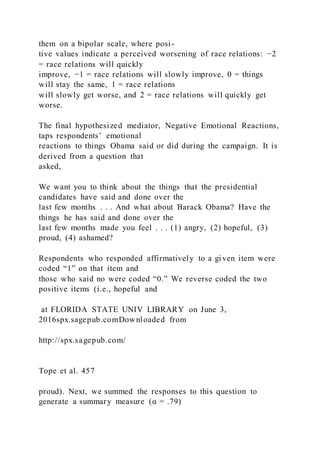
Intervening Variables
We examine three intervening variables. Two measures, Obama
Will Favor Blacks and Obama
Will Worsen Race Relations, measure whites’ expectations
about the racialized consequences of
an Obama presidency. These variables tap race-relations frames
that, per our hypotheses, should
mediate the effects of symbolic prejudice. The first of these two
variables is measured with the
following question: “Which of the following groups in society
do you think will be favored if
Barack Obama is elected president . . . blacks?” where 0 = no
and 1 = yes. The second of these
two variables is measured with the following question: “The
United States has just elected its
first black president. What does this mean for race relations in
America?” The original response
categories were as follows: 1 = race relations will quickly
improve, 2 = race relations will slowly
improve, 3 = things will stay the same, 4 = race relations will
slowly get worse, and 5 = race rela-
tions will quickly get worse. We recoded the responses to put
them on a bipolar scale, where posi-
tive values indicate a perceived worsening of race relations: −2
= race relations will quickly
improve, −1 = race relations will slowly improve, 0 = things
will stay the same, 1 = race relations
will slowly get worse, and 2 = race relations will quickly get
worse.
The final hypothesized mediator, Negative Emotional Reactions,
taps respondents’ emotional
reactions to things Obama said or did during the campaign. It is
derived from a question that
asked,
We want you to think about the things that the presidential
candidates have said and done over the
last few months . . . And what about Barack Obama? Have the
things he has said and done over the
last few months made you feel . . . (1) angry, (2) hopeful, (3)
proud, (4) ashamed?
Respondents who responded affirmatively to a given item were
coded “1” on that item and
those who said no were coded “0.” We reverse coded the two
positive items (i.e., hopeful and
at FLORIDA STATE UNIV LIBRARY on June 3,
2016spx.sagepub.comDownloaded from
http://spx.sagepub.com/
Tope et al. 457
proud). Next, we summed the responses to this question to
generate a summary measure (α = .79)
with values that ranged from 0 to 4, where 0 = not angry,
hopeful, proud, and not ashamed, and
4 = angry, unhopeful, not proud, and ashamed.6
Independent Variables
We focus on the effects of two key independent variables that
constitute distinct forms of racial
prejudice. The first, Racial Resentment, is an indicator of what
scholars describe as symbolic or
modern racism (Kinder and Sanders 1996; Kinder and Sears
1981; McConahay 1986). In the
CCAP, the following four-item question was asked in three
separate waves (March, September,
and October):
Please tell us how strongly you agree or disagree with the
following statements: (1) Generations of
slavery and discrimination have created conditions that make it
difficult for African Americans to
work their way out of the lower class; (2) Many other minority
groups have overcome prejudice and
worked their way up. African Americans should do the same
without any special favors; (3) Over the
past few years, African Americans have gotten less than they
deserve; (4) It’s really a matter of some
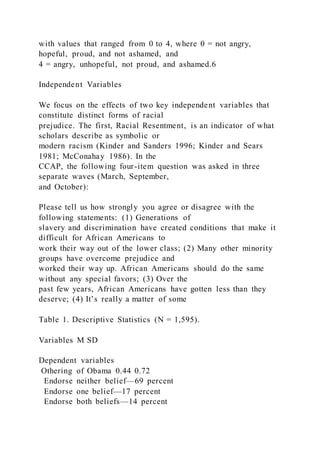
Table 1. Descriptive Statistics (N = 1,595).
Variables M SD
Dependent variables
Othering of Obama 0.44 0.72
Endorse neither belief—69 percent
Endorse one belief—17 percent
Endorse both beliefs—14 percent
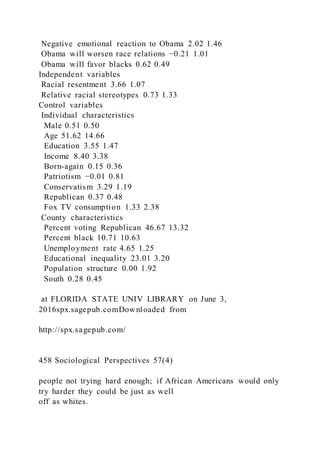
Negative emotional reaction to Obama 2.02 1.46
Obama will worsen race relations −0.21 1.01
Obama will favor blacks 0.62 0.49
Independent variables
Racial resentment 3.66 1.07
Relative racial stereotypes 0.73 1.33
Control variables
Individual characteristics
Male 0.51 0.50
Age 51.62 14.66
Education 3.55 1.47
Income 8.40 3.38
Born-again 0.15 0.36
Patriotism −0.01 0.81
Conservatism 3.29 1.19
Republican 0.37 0.48
Fox TV consumption 1.33 2.38
County characteristics
Percent voting Republican 46.67 13.32
Percent black 10.71 10.63
Unemployment rate 4.65 1.25
Educational inequality 23.01 3.20
Population structure 0.00 1.92
South 0.28 0.45
at FLORIDA STATE UNIV LIBRARY on June 3,
2016spx.sagepub.comDownloaded from
http://spx.sagepub.com/
458 Sociological Perspectives 57(4)
people not trying hard enough; if African Americans would only
try harder they could be just as well
off as whites.
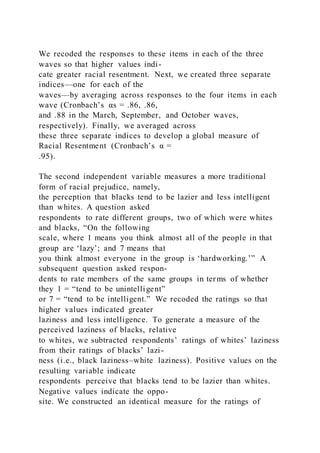
We recoded the responses to these items in each of the three
waves so that higher values indi-
cate greater racial resentment. Next, we created three separate
indices—one for each of the
waves—by averaging across responses to the four items in each
wave (Cronbach’s αs = .86, .86,
and .88 in the March, September, and October waves,
respectively). Finally, we averaged across
these three separate indices to develop a global measure of
Racial Resentment (Cronbach’s α =
.95).
The second independent variable measures a more traditional
form of racial prejudice, namely,
the perception that blacks tend to be lazier and less intelligent
than whites. A question asked
respondents to rate different groups, two of which were whites
and blacks, “On the following
scale, where 1 means you think almost all of the people in that
group are ‘lazy’; and 7 means that
you think almost everyone in the group is ‘hardworking.’” A
subsequent question asked respon-
dents to rate members of the same groups in terms of whether
they 1 = “tend to be unintelligent”
or 7 = “tend to be intelligent.” We recoded the ratings so that
higher values indicated greater
laziness and less intelligence. To generate a measure of the
perceived laziness of blacks, relative
to whites, we subtracted respondents’ ratings of whites’ laziness
from their ratings of blacks’ lazi-
ness (i.e., black laziness–white laziness). Positive values on the
resulting variable indicate
respondents perceive that blacks tend to be lazier than whites.
Negative values indicate the oppo-
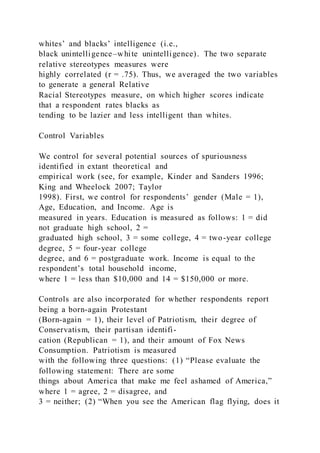
site. We constructed an identical measure for the ratings of
whites’ and blacks’ intelligence (i.e.,
black unintelligence–white unintelligence). The two separate
relative stereotypes measures were
highly correlated (r = .75). Thus, we averaged the two variables
to generate a general Relative
Racial Stereotypes measure, on which higher scores indicate
that a respondent rates blacks as
tending to be lazier and less intelligent than whites.
Control Variables
We control for several potential sources of spuriousness
identified in extant theoretical and
empirical work (see, for example, Kinder and Sanders 1996;
King and Wheelock 2007; Taylor
1998). First, we control for respondents’ gender (Male = 1),
Age, Education, and Income. Age is
measured in years. Education is measured as follows: 1 = did
not graduate high school, 2 =
graduated high school, 3 = some college, 4 = two-year college
degree, 5 = four-year college
degree, and 6 = postgraduate work. Income is equal to the
respondent’s total household income,
where 1 = less than $10,000 and 14 = $150,000 or more.
Controls are also incorporated for whether respondents report
being a born-again Protestant
(Born-again = 1), their level of Patriotism, their degree of
Conservatism, their partisan identifi-
cation (Republican = 1), and their amount of Fox News
Consumption. Patriotism is measured
with the following three questions: (1) “Please evaluate the
following statement: There are some
things about America that make me feel ashamed of America,”
where 1 = agree, 2 = disagree, and
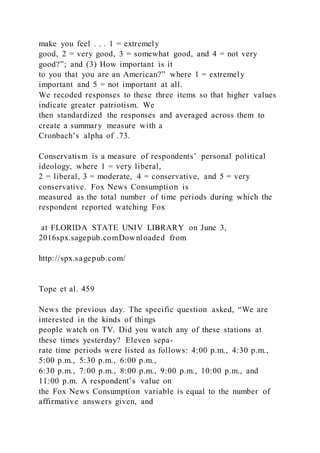
3 = neither; (2) “When you see the American flag flying, does it
make you feel . . . 1 = extremely
good, 2 = very good, 3 = somewhat good, and 4 = not very
good?”; and (3) How important is it
to you that you are an American?” where 1 = extremely
important and 5 = not important at all.
We recoded responses to these three items so that higher values
indicate greater patriotism. We
then standardized the responses and averaged across them to
create a summary measure with a
Cronbach’s alpha of .73.
Conservatism is a measure of respondents’ personal political
ideology, where 1 = very liberal,
2 = liberal, 3 = moderate, 4 = conservative, and 5 = very
conservative. Fox News Consumption is
measured as the total number of time periods during which the
respondent reported watching Fox
at FLORIDA STATE UNIV LIBRARY on June 3,
2016spx.sagepub.comDownloaded from
http://spx.sagepub.com/
Tope et al. 459
News the previous day. The specific question asked, “We are
interested in the kinds of things
people watch on TV. Did you watch any of these stations at
these times yesterday? Eleven sepa-
rate time periods were listed as follows: 4:00 p.m., 4:30 p.m.,
5:00 p.m., 5:30 p.m., 6:00 p.m.,
6:30 p.m., 7:00 p.m., 8:00 p.m., 9:00 p.m., 10:00 p.m., and
11:00 p.m. A respondent’s value on
the Fox News Consumption variable is equal to the number of
affirmative answers given, and
thus can range from 0 to 11.
Finally, because context shapes racial attitudes and political
values (McVeigh 1999; Oliver
and Mendelberg 2000; Taylor 1998), we control for the
characteristics of the counties in which
the respondents reside.7 Percent Voting Republican is an
indicator of the local political climate.
It is equal to the percentage of the county population that voted
for John McCain in the 2008
presidential election. Percent Black is the percentage of black
residents in the county, as recorded
in the 2010 U.S. Census. Unemployment Rate is a variable that
gauges local economic condi-
tions. It is equal to the average unemployment rate in the county
in 2007. Educational Inequality
was estimated using county-level census data to calculate the
coefficient of variation as a mea-
sure of inequality across school years. Follow ing Rory McVeigh
(2004), school years were com-
piled into seven categories, and the midpoint of these categories
were used to estimate the
coefficient of variation with 19 years assumed to be the
midpoint in the last open-ended cate-
gory.8 Population Structure is an indicator of the size and
density of the local population. It is a
composite index created by summing standardized, log
transformed versions of the county popu-
lation size and county population density in 2010. We also
control for residence in a southern
state (South = 1). Table 1 lists the descriptive statistics for all
of the measures described above.
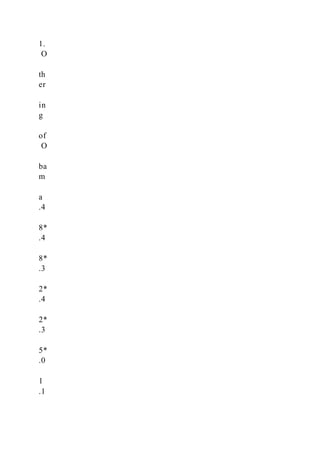
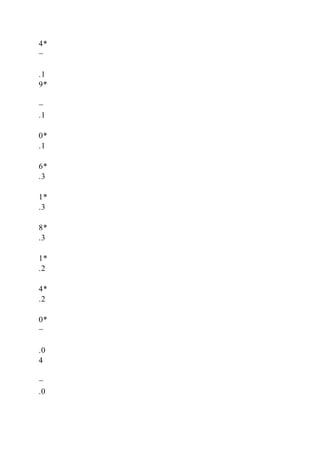
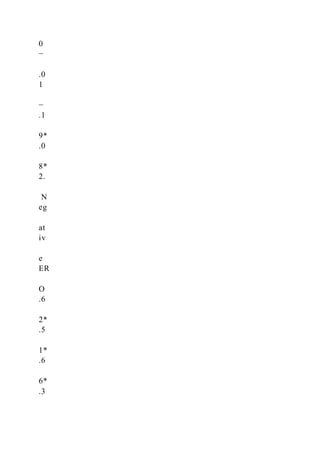
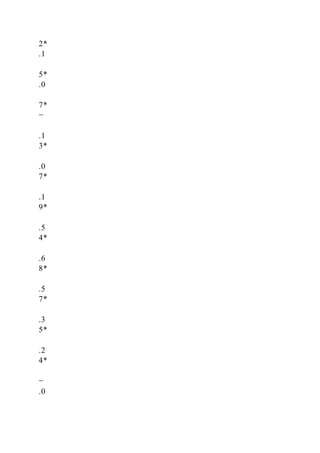
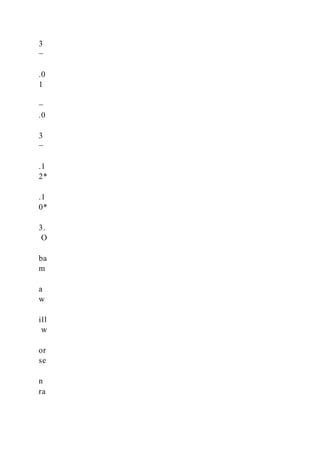
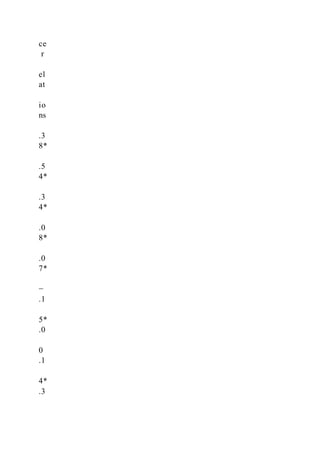
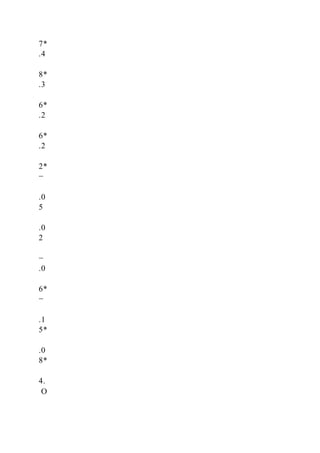
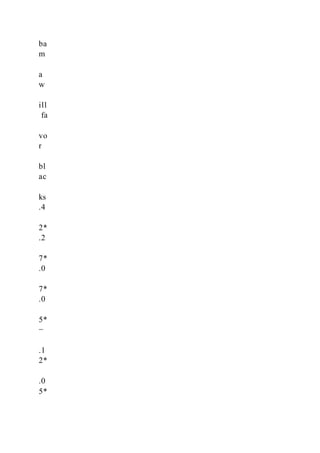
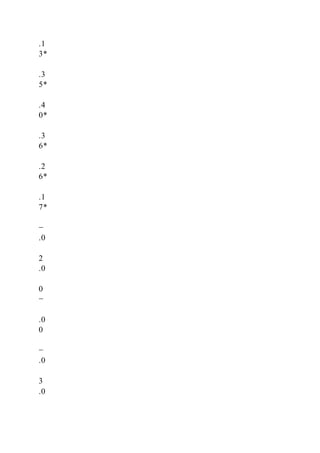
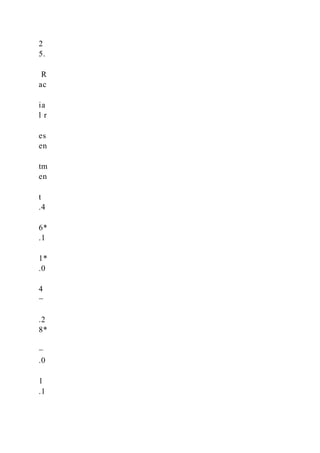
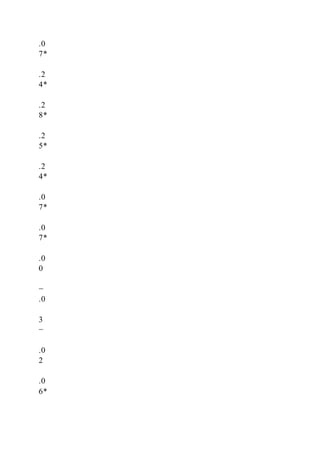
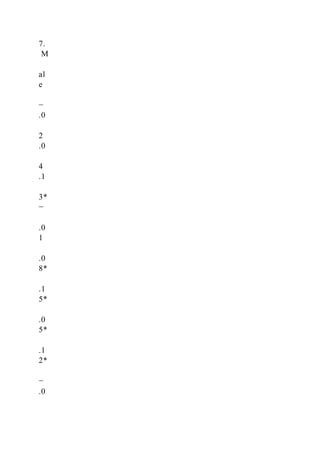
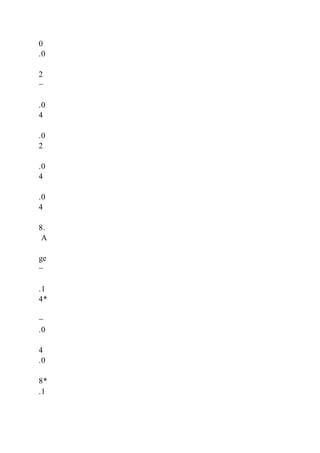
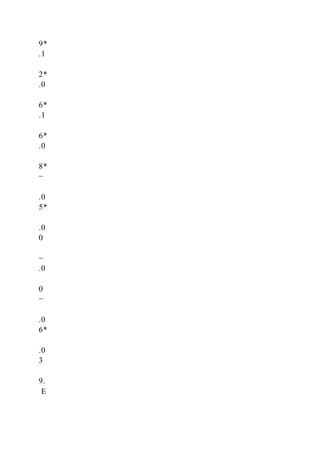
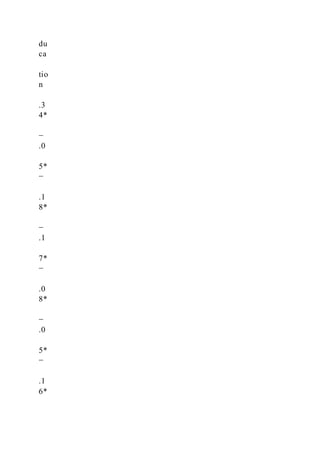
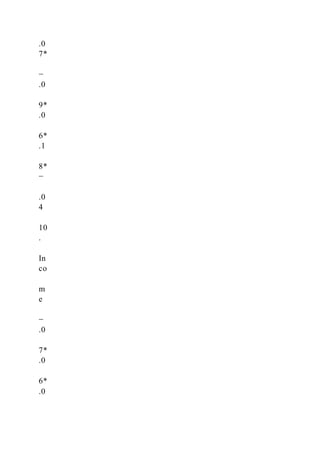
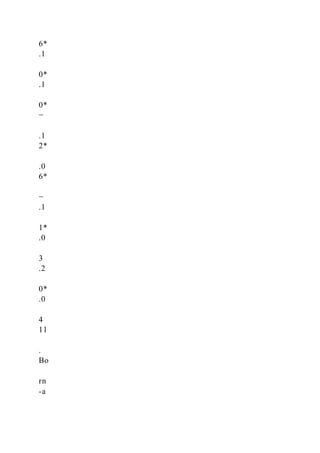
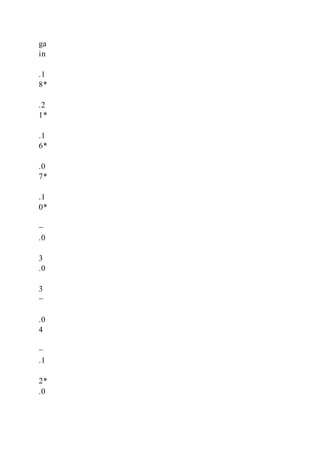
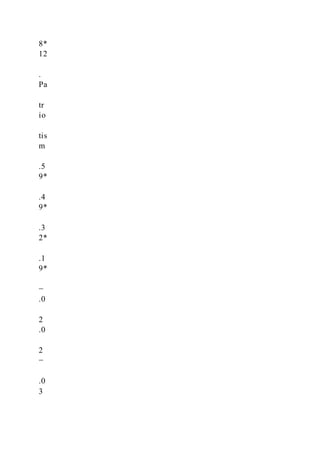
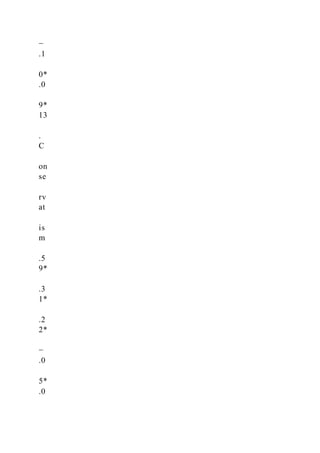
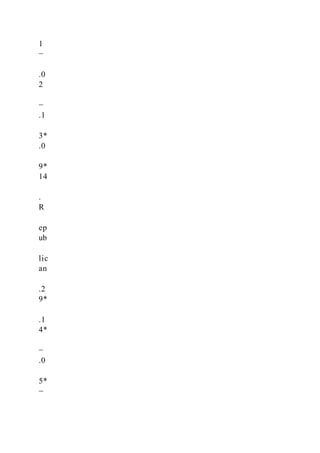
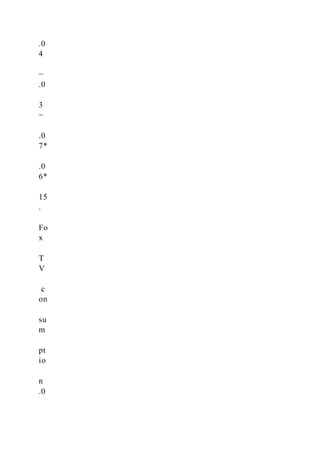
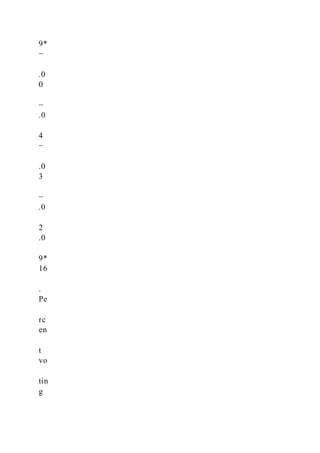
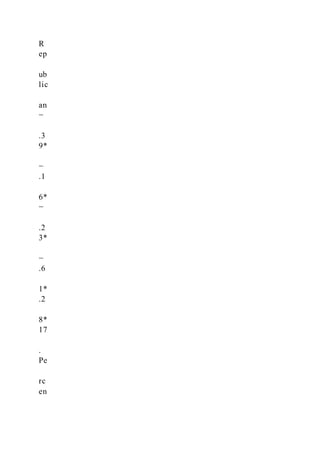
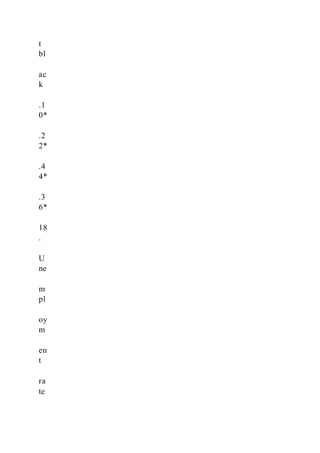
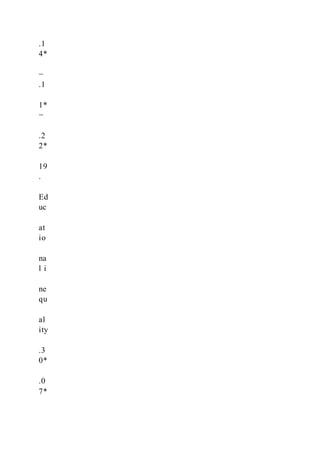
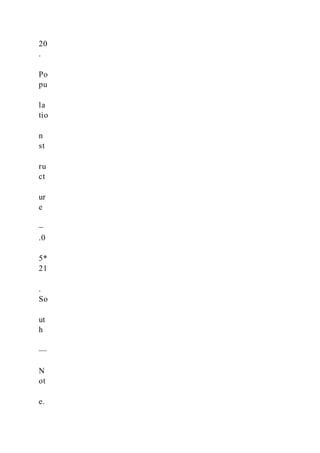
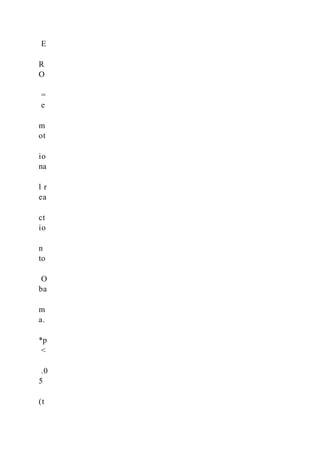
Table 2 displays the bivariate correlations between these
variables.
Analytic Strategy
Recall that our outcome measure is the Othering of Obama. This
measure is ordinal with three
response categories. We therefore use ordinal logistic
regression. In addition, an examination of
the variance inflation factors (VIFs) indicates that
multicollinearity is not a concern in our mod-
els. In what follows, the analyses (1) assess whether our two
measures of racial prejudice predict
“othering” beliefs about Obama, namely, that he was born
outside the United States and is a
Muslim and (2) examine the extent to which the hypothesized
intervening variables carry the
effect of the independent variables on the dependent variable.
Results
Theories from the black descriptive representation literature
suggest that whites may react nega-
tively to the presence of black elected officials. In addition, the
literature on contemporary racial
discourse suggests that whites often voice seemingly nonracist
frames when making statements
about racial/ethnic minorities. We bring these themes together
and test our hypotheses about
racial attitudes and mediating factors in Table 3.
Table 3 presents the regression results for the ordinal logistic
regression predicting whites’
othering of Obama. They show the estimated effects of the two
measures of racial prejudice, net
of the controls, on the degree to which whites endorse
“othering” beliefs about Obama.
Specifically, these estimates contrast the log odds of being in a
higher category on the outcome
variable—endorsing one belief rather than none and endorsing
both beliefs rather than only
one—with the log odds of falling in a lower category. In light of
our theoretical discussion of
possible distinctions between those who express racial
resentment and those who express tradi-
tional racism, we address this contrast when discussing each
model.
at FLORIDA STATE UNIV LIBRARY on June 3,
2016spx.sagepub.comDownloaded from
http://spx.sagepub.com/
460
T
ab
le
2
.
Bi
va
ri
at
e
C
or
re
la
tio
ns
fo
r
th
e
V
ar
ia
bl
es
U
se
d
in
t
he
A
na
ly
si
s.
V
ar
ia
bl
es
2
3
4
5
6
7
8
9
10
11
12
13
14
15
16
17
18
19
20
21
1.
O
th
er
in
g
of
O
ba
m
a
.4
8*
.4
8*
.3
2*
.4
2*
.3
5*
.0
1
.1
4*
−
.1
9*
−
.1
0*
.1
6*
.3
1*
.3
8*
.3
1*
.2
4*
.2
0*
−
.0
4
−
.0
0
−
.0
1
−
.1
9*
.0
8*
2.
N
eg
at
iv
e
ER
O
.6
2*
.5
1*
.6
6*
.3
2*
.1
5*
.0
7*
−
.1
3*
.0
7*
.1
9*
.5
4*
.6
8*
.5
7*
.3
5*
.2
4*
−
.0
3
−
.0
1
−
.0
3
−
.1
2*
.1
0*
3.
O
ba
m
a
w
ill
w
or
se
n
ra
ce
r
el
at
io
ns
.3
8*
.5
4*
.3
4*
.0
8*
.0
7*
−
.1
5*
.0
0
.1
4*
.3
7*
.4
8*
.3
6*
.2
6*
.2
2*
−
.0
5
.0
2
−
.0
6*
−
.1
5*
.0
8*
4.
O
ba
m
a
w
ill
fa
vo
r
bl
ac
ks
.4
2*
.2
7*
.0
7*
.0
5*
−
.1
2*
.0
5*
.1
3*
.3
5*
.4
0*
.3
6*
.2
6*
.1
7*
−
.0
2
.0
0
−
.0
0
−
.0
3
.0
2
5.
R
ac
ia
l r
es
en
tm
en
t
.4
6*
.1
1*
.0
4
−
.2
8*
−
.0
1
.1
8*
.5
6*
.6
1*
.4
5*
.3
1*
.2
5*
−
.0
4
.0
2
−
.0
7*
−
.1
5*
.1
0*
6.
R
el
at
iv
e
ra
ci
al
s
te
re
ot
yp
es
.1
3*
.0
3
−
.1
2*
.0
2
.0
7*
.2
4*
.2
8*
.2
5*
.2
4*
.0
7*
.0
7*
.0
0
−
.0
3
−
.0
2
.0
6*
7.
M
al
e
−
.0
2
.0
4
.1
3*
−
.0
1
.0
8*
.1
5*
.0
5*
.1
2*
−
.0
0
.0
2
−
.0
4
.0
2
.0
4
.0
4
8.
A
ge
−
.1
4*
−
.0
4
.0
8*
.1
9*
.1
2*
.0
6*
.1
6*
.0
8*
−
.0
5*
.0
0
−
.0
0
−
.0
6*
.0
3
9.
E
du
ca
tio
n
.3
4*
−
.0
5*
−
.1
8*
−
.1
7*
−
.0
8*
−
.0
5*
−
.1
6*
.0
7*
−
.0
9*
.0
6*
.1
8*
−
.0
4
10
.
In
co
m
e
−
.0
7*
.0
6*
.0
6*
.1
0*
.1
0*
−
.1
2*
.0
6*
−
.1
1*
.0
3
.2
0*
.0
4
11
.
Bo
rn
-a
ga
in
.1
8*
.2
1*
.1
6*
.0
7*
.1
0*
−
.0
3
.0
3
−
.0
4
−
.1
2*
.0
8*
12
.
Pa
tr
io
tis
m
.5
9*
.4
9*
.3
2*
.1
9*
−
.0
2
.0
2
−
.0
3
−
.1
0*
.0
9*
13
.
C
on
se
rv
at
is
m
.5
9*
.3
1*
.2
2*
−
.0
5*
.0
1
−
.0
2
−
.1
3*
.0
9*
14
.
R
ep
ub
lic
an
.2
9*
.1
4*
−
.0
5*
−
.0
4
−
.0
3
−
.0
7*
.0
6*
15
.
Fo
x
T
V
c
on
su
m
pt
io
n
.0
9*
−
.0
0
−
.0
4
−
.0
3
−
.0
2
.0
9*
16
.
Pe
rc
en
t
vo
tin
g
R
ep
ub
lic
an
−
.3
9*
−
.1
6*
−
.2
3*
−
.6
1*
.2
8*
17
.
Pe
rc
en
t
bl
ac
k
.1
0*
.2
2*
.4
4*
.3
6*
18
.
U
ne
m
pl
oy
m
en
t
ra
te
.1
4*
−
.1
1*
−
.2
2*
19
.
Ed
uc
at
io
na
l i
ne
qu
al
ity
.3
0*
.0
7*
20
.
Po
pu
la
tio
n
st
ru
ct
ur
e
−
.0
5*
21
.
So
ut
h
—
N
ot
e.
E
R
O
=
e
m
ot
io
na
l r
ea
ct
io
n
to
O
ba
m
a.
*p
<
.0
5
(t
w
o-
ta
ile
d)
.
at FLORIDA STATE UNIV LIBRARY on June 3,
2016spx.sagepub.comDownloaded from
http://spx.sagepub.com/
Tope et al. 461
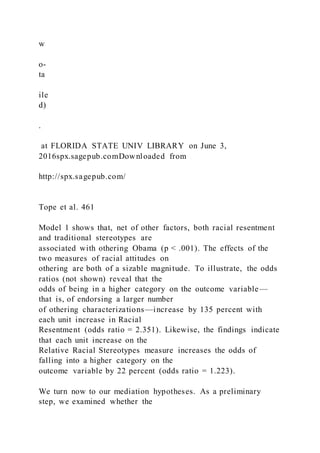
Model 1 shows that, net of other factors, both racial resentment
and traditional stereotypes are
associated with othering Obama (p < .001). The effects of the
two measures of racial attitudes on
othering are both of a sizable magnitude. To illustrate, the odds
ratios (not shown) reveal that the
odds of being in a higher category on the outcome variable—
that is, of endorsing a larger number
of othering characterizations—increase by 135 percent with
each unit increase in Racial
Resentment (odds ratio = 2.351). Likewise, the findings indicate
that each unit increase on the
Relative Racial Stereotypes measure increases the odds of
falling into a higher category on the
outcome variable by 22 percent (odds ratio = 1.223).
We turn now to our mediation hypotheses. As a preliminary
step, we examined whether the
measures of symbolic and explicit prejudice were associated
with whites’ perceptions of the
racialized consequences of an Obama presidency and whites’
emotional reactions to things
Obama has said and done. These models are shown in the
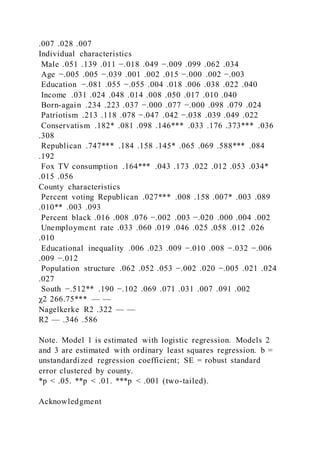
appendix. They show that Racial
Resentment is significantly related to all three mediators,
whereas Relative Racial Stereotypes is
only associated with expectations about the racialized
consequences of an Obama presidency.
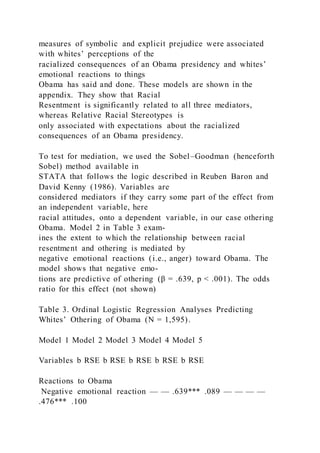
To test for mediation, we used the Sobel–Goodman (henceforth
Sobel) method available in
STATA that follows the logic described in Reuben Baron and
David Kenny (1986). Variables are
considered mediators if they carry some part of the effect from
an independent variable, here
racial attitudes, onto a dependent variable, in our case othering
Obama. Model 2 in Table 3 exam-
ines the extent to which the relationship between racial
resentment and othering is mediated by
negative emotional reactions (i.e., anger) toward Obama. The
model shows that negative emo-
tions are predictive of othering (β = .639, p < .001). The odds
ratio for this effect (not shown)
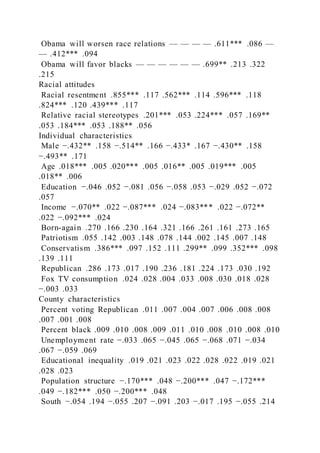
Table 3. Ordinal Logistic Regression Analyses Predicting
Whites’ Othering of Obama (N = 1,595).
Model 1 Model 2 Model 3 Model 4 Model 5
Variables b RSE b RSE b RSE b RSE b RSE
Reactions to Obama
Negative emotional reaction — — .639*** .089 — — — —
.476*** .100
Obama will worsen race relations — — — — .611*** .086 —
— .412*** .094
Obama will favor blacks — — — — — — .699** .213 .322
.215
Racial attitudes
Racial resentment .855*** .117 .562*** .114 .596*** .118
.824*** .120 .439*** .117
Relative racial stereotypes .201*** .053 .224*** .057 .169**
.053 .184*** .053 .188** .056
Individual characteristics
Male −.432** .158 −.514** .166 −.433* .167 −.430** .158
−.493** .171
Age .018*** .005 .020*** .005 .016** .005 .019*** .005
.018** .006
Education −.046 .052 −.081 .056 −.058 .053 −.029 .052 −.072
.057
Income −.070** .022 −.087*** .024 −.083*** .022 −.072**
.022 −.092*** .024
Born-again .270 .166 .230 .164 .321 .166 .261 .161 .273 .165
Patriotism .055 .142 .003 .148 .078 .144 .002 .145 .007 .148
Conservatism .386*** .097 .152 .111 .299** .099 .352*** .098
.139 .111
Republican .286 .173 .017 .190 .236 .181 .224 .173 .030 .192
Fox TV consumption .024 .028 .004 .033 .008 .030 .018 .028
−.003 .033
County characteristics
Percent voting Republican .011 .007 .004 .007 .006 .008 .008
.007 .001 .008
Percent black .009 .010 .008 .009 .011 .010 .008 .010 .008 .010
Unemployment rate −.033 .065 −.045 .065 −.068 .071 −.034
.067 −.059 .069
Educational inequality .019 .021 .023 .022 .028 .022 .019 .021
.028 .023
Population structure −.170*** .048 −.200*** .047 −.172***
.049 −.182*** .050 −.200*** .048
South −.054 .194 −.055 .207 −.091 .203 −.017 .195 −.055 .214
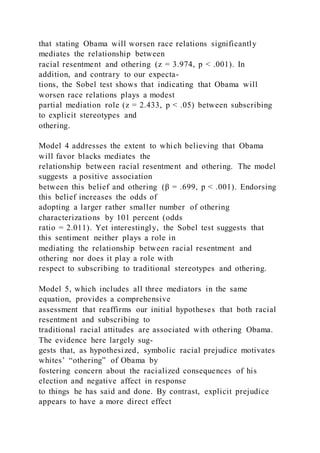
Nagelkerke R2 .355 .405 .395 .365 .423
Note. b = unstandardized regression coefficient; RSE = robust
standard error clustered by county.
*p < .05. **p < .01. ***p < .001 (two-tailed).
at FLORIDA STATE UNIV LIBRARY on June 3,
2016spx.sagepub.comDownloaded from
http://spx.sagepub.com/
462 Sociological Perspectives 57(4)
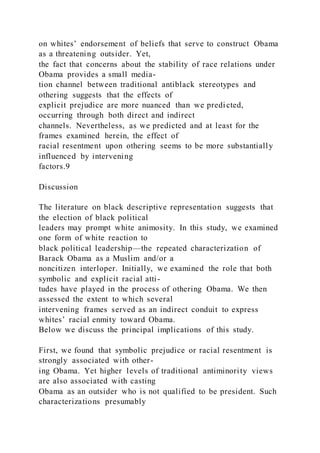
reveals that each unit increase in negative emotions increases
the odds of endorsing a larger
rather than smaller number of othering characterizations about
Obama by 89 percent (odds
ratio = 1.894). And the Sobel test shows that emotions
significantly mediate the relationship
between racial resentment and othering (z = 3.97, p < .001).
Also, as we suspected, the mediation
test shows that negative emotions did not play mediating role
between belief in explicit stereo-
types and othering.
Model 3 examines the mediating potential of believing that
Obama will worsen race rela-
tions. The model shows that all else equal, this belief is
significantly predictive of othering
(β = .611, p < .001). A one-unit increase in the Obama Will
Worsen Race Relations variable is
associated with an 84 percent increase in the odds of endorsing
a larger rather smaller number
of such characterizations (odds ratio = 1.843). Supporting our
hypothesis, the Sobel test reveals
that stating Obama will worsen race relations significantly
mediates the relationship between
racial resentment and othering (z = 3.974, p < .001). In
addition, and contrary to our expecta-
tions, the Sobel test shows that indicating that Obama will
worsen race relations plays a modest
partial mediation role (z = 2.433, p < .05) between subscribing
to explicit stereotypes and
othering.
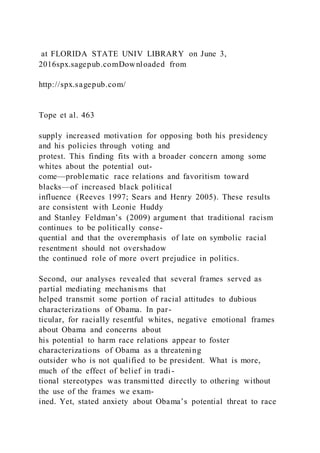
Model 4 addresses the extent to which believing that Obama
will favor blacks mediates the
relationship between racial resentment and othering. The model
suggests a positive association
between this belief and othering (β = .699, p < .001). Endorsing
this belief increases the odds of
adopting a larger rather smaller number of othering
characterizations by 101 percent (odds
ratio = 2.011). Yet interestingly, the Sobel test suggests that
this sentiment neither plays a role in
mediating the relationship between racial resentment and
othering nor does it play a role with
respect to subscribing to traditional stereotypes and othering.
Model 5, which includes all three mediators in the same
equation, provides a comprehensive
assessment that reaffirms our initial hypotheses that both racial
resentment and subscribing to
traditional racial attitudes are associated with othering Obama.
The evidence here largely sug-
gests that, as hypothesized, symbolic racial prejudice motivates
whites’ “othering” of Obama by
fostering concern about the racialized consequences of his
election and negative affect in response
to things he has said and done. By contrast, explicit prejudice
appears to have a more direct effect
on whites’ endorsement of beliefs that serve to construct Obama
as a threatening outsider. Yet,
the fact that concerns about the stability of race relations under
Obama provides a small media-
tion channel between traditional antiblack stereotypes and
othering suggests that the effects of
explicit prejudice are more nuanced than we predicted,
occurring through both direct and indirect
channels. Nevertheless, as we predicted and at least for the
frames examined herein, the effect of
racial resentment upon othering seems to be more substantially
influenced by intervening
factors.9
Discussion
The literature on black descriptive representation suggests that
the election of black political
leaders may prompt white animosity. In this study, we examined
one form of white reaction to
black political leadership—the repeated characterization of
Barack Obama as a Muslim and/or a
noncitizen interloper. Initially, we examined the role that both
symbolic and explicit racial atti-
tudes have played in the process of othering Obama. We then
assessed the extent to which several
intervening frames served as an indirect conduit to express
whites’ racial enmity toward Obama.
Below we discuss the principal implications of this study.
First, we found that symbolic prejudice or racial resentment is
strongly associated with other-
ing Obama. Yet higher levels of traditional antiminority views
are also associated with casting
Obama as an outsider who is not qualified to be president. Such
characterizations presumably
at FLORIDA STATE UNIV LIBRARY on June 3,
2016spx.sagepub.comDownloaded from
http://spx.sagepub.com/
Tope et al. 463
supply increased motivation for opposing both his presidency
and his policies through voting and
protest. This finding fits with a broader concern among some
whites about the potential out-
come—problematic race relations and favoritism toward
blacks—of increased black political
influence (Reeves 1997; Sears and Henry 2005). These results
are consistent with Leonie Huddy
and Stanley Feldman’s (2009) argument that traditional racism
continues to be politically conse-
quential and that the overemphasis of late on symbolic racial
resentment should not overshadow
the continued role of more overt prejudice in politics.
Second, our analyses revealed that several frames served as
partial mediating mechanisms that
helped transmit some portion of racial attitudes to dubious
characterizations of Obama. In par-
ticular, for racially resentful whites, negative emotional frames
about Obama and concerns about
his potential to harm race relations appear to foster
characterizations of Obama as a threatening
outsider who is not qualified to be president. What is more,
much of the effect of belief in tradi-
tional stereotypes was transmitted directly to othering without
the use of the frames we exam-
ined. Yet, stated anxiety about Obama’s potential threat to race
relations served as a modest
partial mediator between belief in traditional stereotypes and
othering Obama. Hence, while our
results with respect to mediation were somewhat mixed, they
largely supported our contention
that subtle racial resentment is often linked to seemingly
nonracist frames that can serve to sani-
tize what might appear to be racially biased views. Conversely,
those evincing traditional stereo-
typical views seem less likely to rely on seemingly nonracist
frames when casting Barack Obama
as a Muslim or noncitizen.
Together, our findings suggest three important avenues for
additional inquiry. First,
research is needed that evaluates whether, as would be expected
on the basis of group threat
theory (see Blalock 1967), the adoption of “othering” beliefs
about Obama in fact translated
into more intense behavioral mobilization (e.g., voting and
campaign donations) against his
presidency in the 2008 and 2012 elections. Second, given the
evidence that racism may have
diminished among some segments of the population during the
course of Obama’s campaign
and presidency (Goldman 2012), future investigations should
explore whether views on
Obama’s citizenship and religion have been similarly dynamic.
Finally, studies are needed
that explore whether the relationships observed herein between
general racial attitudes, spe-
cific emotional and cognitive reactions to public figures, and
threat-oriented beliefs about
specific individuals are observed for other minority politicians,
such as black mayors or
senators.
Some argue that the United States has progressed from its
overtly racialized past (Schuman et
al. 1997). Yet, like other analysts (e.g., Hutchings and
Valentino 2004, we contend that racial
sentiments—both overt and symbolic—continue to play a major
role in politics and in evalua-
tions of prominent political figures. The symbolism of Obama
as the United States’ first black
president makes racial sentiments one of the most important
forces that shape how he is per-
ceived by whites. These findings complement and extend related
research that suggests that
racial attitudes shape candidate evaluations and policy
preferences (e.g., Lewis-Beck and Tien
2008, 2009).
Finally, some research shows that black politicians with
moderate race-neutral positions, who
also gain strong job performance records, are ultimately de-
racialized (e.g., Hajnal 2007). Yet for
Obama, it remains to be seen whether this is a possibility at
least in the near term. At this point,
such a positive outcome seems unlikely for a figure that has
been so thoroughly and persistently
othered and whose very presence has elicited visceral threat-
oriented responses among some citi-
zens. Indeed, in light of the United States’ rapidly shifti ng
demographics and Tesler and Sears’
(2010:9) caution that “the election of Barack Obama may well
have been the watershed to another
of America’s periodic hyperracial political eras,” we should
expect that racial and ethnic forces
will shape U.S. politics for the foreseeable future.
at FLORIDA STATE UNIV LIBRARY on June 3,
2016spx.sagepub.comDownloaded from
http://spx.sagepub.com/
464 Sociological Perspectives 57(4)
Appendix
Analyses of the Effects of Racial Attitudes on Whites’ Beliefs
about an Obama Presidency and Emotional
Reactions to Things Obama Has Done (N = 1,595).
Model 1: Obama will favor
blacks
Model 2: Obama will
worsen race relations
Model 3: Negative
emotional reactions
Variables b SE
Standard
coefficient b SE
Standard
coefficient b SE
Standard
coefficient
Racial attitudes
Racial resentment .307** .088 .145 .311*** .032 .330 .458***
.043 .334
Relative racial stereotypes .215** .073 .133 .075** .029 .104
.007 .028 .007
Individual characteristics
Male .051 .139 .011 −.018 .049 −.009 .099 .062 .034
Age −.005 .005 −.039 .001 .002 .015 −.000 .002 −.003
Education −.081 .055 −.055 .004 .018 .006 .038 .022 .040
Income .031 .024 .048 .014 .008 .050 .017 .010 .040
Born-again .234 .223 .037 −.000 .077 −.000 .098 .079 .024
Patriotism .213 .118 .078 −.047 .042 −.038 .039 .049 .022
Conservatism .182* .081 .098 .146*** .033 .176 .373*** .036
.308
Republican .747*** .184 .158 .145* .065 .069 .588*** .084
.192
Fox TV consumption .164*** .043 .173 .022 .012 .053 .034*
.015 .056
County characteristics
Percent voting Republican .027*** .008 .158 .007* .003 .089
.010** .003 .093
Percent black .016 .008 .076 −.002 .003 −.020 .000 .004 .002
Unemployment rate .033 .060 .019 .046 .025 .058 .012 .026
.010
Educational inequality .006 .023 .009 −.010 .008 −.032 −.006
.009 −.012
Population structure .062 .052 .053 −.002 .020 −.005 .021 .024
.027
South −.512** .190 −.102 .069 .071 .031 .007 .091 .002
χ2 266.75*** — —
Nagelkerke R2 .322 — —
R2 — .346 .586
Note. Model 1 is estimated with logistic regression. Models 2
and 3 are estimated with ordinary least squares regression. b =
unstandardized regression coefficient; SE = robust standard
error clustered by county.
*p < .05. **p < .01. ***p < .001 (two-tailed).
Acknowledgment
The authors thank the editor(s) and reviewers for their
feedback, Terrence Hill for advice on mediation
analysis, and Hernan Ramirez for comments on a prior draft.
Declaration of Conflicting Interests
The author(s) declared no potential conflicts of interest with
respect to the research, authorship, and/or
publication of this article.
Funding
The author(s) received no financial support for the research,
authorship, and/or publication of this article.
Notes
1. Studies by Zoltan Hajnal (2001, 2007) provide important
exceptions. He examines the relationship
between white racial attitudes and black mayors. His
“information hypothesis” suggests that fear of
and a general lack of information about black candidates can
prompt white resistance. But because
at FLORIDA STATE UNIV LIBRARY on June 3,
2016spx.sagepub.comDownloaded from
http://spx.sagepub.com/
Tope et al. 465
mayors must be responsive to a broad constituency, whites learn
that the presence of a black mayor is
not to their detriment. This new information, Hajnal argues,
provides actual experience with a black
incumbent that can diminish racial fears and stereotypes (also
see Columb and Plant 2011).
2. Our study is subject to the criticisms evident in the broader
literature on racial resentment. The ongo-
ing debate suggests that symbolic forms of racism may overlap
with conservative political ideology
(Peffley, Hurwitz, and Sniderman 1997). Yet more recent
research suggests that racial resentment is a
unique measure in its own right apart from conservatism and
views about the appropriate role of the
state (Tarman and Sears 2005; Valentino and Sears 2005).
3. Some may be concerned that symbolic racism is not much
different from traditional racism. While
these measures tend to be correlated, extant theory and research
suggest that they are distinct. White
support for symbolic racism is much greater than support for
traditional racism. Fewer than 10 percent
of whites openly subscribe to traditional racism (Henry and
Sears 2002; Kinder and Sanders 1996).
In addition, factor analyses have shown that traditional racism
and symbolic racism constitute two
separate dimensions of racial attitudes (Sears and Henry 2005;
also see Sears, van Laar, Carillo, and
Kosterman1997).
4. We use the terms “intervening variable” and “mediator”
interchangeably.
5. There is the possibility that respondents may voice but not
actually believe these characterizations of
Obama. Nevertheless, we suggest there is value in using
responses to these survey items to test theories
that link racial attitudes to othering.
6. We cannot rule out the possibility that our mediators might
constitute additional measures of racial
resentment. Yet we have no theoretical reason for assuming that
this is the case. Indeed, there is a sub-
stantial literature focused on the theoretical and empirical
uniqueness of measures of racial resentment
(Kinder and Sanders 1996; Sears and Henry 2003).
7. The Cooperative Campaign Analysis Project (CCAP) data
include respondents’ ZIP codes but not their
specific county of residence. We thus used the ZIP codes to
match respondents to counties. A minority
of the ZIP codes crossed county lines. In these cases, we
matched respondents to the primary county
for that ZIP code—that is, the county that included the largest
proportion of the ZIP code.
8. The coefficient of variation was estimated with a STATA
program “ineqdeco” that can be used to cal-
culate inequality.
9. Endogeneity is a potential concern in our analyses. Moreover,
because our data are cross-sectional, we
must rely on theory to draw inferences about the direction of the
predicted and observed effects.
References
Banks, Antoine and Nicholas Valentino. 2012. “Emotional
Substrates of White Racial Attitudes.” American
Journal of Political Science 56:286–97.
Baron Reuben, and David Kenny. 1986. “The Moderator-
Mediator Variable Distinction in Social
Psychological Research: Conceptual, Strategic, and Statistical
Considerations.” Journal of Personality
and Social Psychology 51:1173–82.
Barreto, Matt, Betsy Cooper, Benjamin Gonzalez, Christopher
Parker, and Christopher Towler. 2011. “The
Tea Party in the Age of Obama: Mainstream Conservatism or
Out-Group Anxiety?” Political Power
and Social Theory 22:105–37.
Barreto, Matt, Gary Segura, and Nathan Woods. 2004. “The
Effects of Overlapping Majority-Minority
Districts on Latino Turnout.” American Political Science
Review 98:65–75.
Berlet, Chip. 2010. “Reframing Resentments in the Tea Party
Movement: How Right-Wing Populists Use
Demonization, Scapegoating, and Conspiracy Theories to
Justify Apocalyptic Aggression.” Paper pre-
sented at Center for the Comparative Study of Right-Wing
Movements, October 22, University of
California, Berkeley, CA.
Blalock, Hubert. 1967. Toward a Theory of Minority-Group
Relations. New York: Wiley.
Block, Ray, Jr. 2011. “Backing Barack because He’s Black:
Racially Motivated Voting in the 2008
Election.” Social Science Quarterly 92:423–46.
Block, Ray, Jr. and Chinonye Onwunli. 2010. “Managing
Monikers: The Role of Name Presentation in the
2008 Election.” Presidential Studies Quarterly 40:464–81.
Blumer, Herbert. 1958. “Race Prejudice as a Sense of Group
Position.” The Pacific Sociological Review
1:3–7.
at FLORIDA STATE UNIV LIBRARY on June 3,
2016spx.sagepub.comDownloaded from
http://spx.sagepub.com/
466 Sociological Perspectives 57(4)
Bobo, Lawrence, James Kluegal, and Ryan Smith. 1997.
“Laissez-Faire Racism: The Crystallization of
a Kinder, Gentler, Antiblack Ideology.” Pp. 15–42 in Racial
Attitudes in the 1990s: Continuity and
Change, edited by Steven A. Tuch and Jack K. Martin.
Westport, CT: Praeger.
Bonilla-Silva, Eduardo. 2002. “The Linguistics of Color-Blind
Racism: How to Talk Nasty about Blacks
without Sounding ‘Racist.’” Critical Sociology 28:41–64.
Bonilla-Silva, Eduardo. 2010. Racism without Racists: Color-
Blind Racism and Racial Inequality in
Contemporary America. 3rd ed. New York: Rowman &
Littlefield.
Brandt, Mark and Christine Reyna. 2012. “The Functions of
Symbolic Racism.” Social Justice Research
25:41–60.
Citrin, Jack, Donald Philip Green, and David O. Sears. 1990.
“White Reactions to Black Candidates: When
Does Race Matter?” Public Opinion Quarterly 54(1):74–96.
Columb, Corey and E. Ashby Plant. 2011. “Revisiting the
Obama Effect: Exposure to Obama Reduces
Implicit Prejudice.” Journal of Experimental Social Psychology
74:499–501.
Cribbs, Sarah and D. Mark Austin. 2010. “Enduring Pictures in
Our Heads: The Continuance of
Authoritarianism and Racial Stereotyping.” Journal of Black
Studies 42:334–59.
DeSteno, David, Nilanjana Dasgupta, Monica Y. Bartlett, and
Aida Cajdric. 2004. “Prejudice from Thin
Air: The Effect of Emotion on Automatic Intergroup Attitudes.”
Psychological Science 15:319–24.
Devos, Thierry and Mahzarin Banaji. 2005. “American =
White?” Journal of Personality and Social
Psychology 88:447–66.
Devos, Thierry, Debbie Ma, and Travis Gaffud. 2008. “Is
Barack Obama American Enough to Be the Next
President? The Role of Ethnicity and National Identity in
American Politics.” Poster presented at the
IXth Annual Meeting of the Society for Personality and Social
Psychology, February, Albuquerque,
NM.
Enck-Wanzer, Darrel. 2011. “Barack Obama, the Tea Party, and
the Threat of Race: On Racial Neoliberalism
and Born Again Racism.” Communication, Culture & Critique
4:23–30.
Gilens, Martin. 1995. “Racial Attitudes and Opposition to
Welfare.” Journal of Politics 57:994–1014.
Goldman, Seth K. 2012. “Effects of the 2008 Obama
Presidential Campaign on White Racial Prejudice.”
Public Opinion Quarterly 76:663–87.
Goodwin, Jeff, James Jasper, and Francesca Polletta. 2001.
Passionate Politics: Emotions and Social
Movements. Chicago, IL: University of Chicago Press.
Hajnal, Zoltan. 2001. “White Residents, Black Incumbents, and
a Declining Racial Divide.” American
Political Science Review 95:603–17.
Hajnal, Zoltan. 2007. Changing White Attitudes toward Black
Political Leadership. New York: Cambridge
University Press.
Harris Polls. 2010. March 24.
http://www.harrisinteractive.com/NewsRoom/HarrisPolls/tabid/
447/ctl/
ReadCustom%20Default/mid/1508/ArticleId/223/Default.aspx
Henry, P. J. and David Sears. 2002. “The Symbolic Racism
2000 Scale.” Political Psychology 23:253–83.
Hill, Jane H. 2008. The Everyday Language of White Racism.
Hoboken, NJ: Wiley-Blackwell.
Hollander, Barry A. 2010. “Persistence in the Perception of
Barack Obama as a Muslim in the 2008
Presidential Campaign.” Journal of Media and Religion 9:55–
66.
Huddy, Leonie and Stanley Feldman. 2009. “On Assessing the
Political Effects of Racial Prejudice.”
Annual Review of Political Science 12:423–47.
Hughey, Matthew W. 2012. “Show Me Your Papers! Obama’s
Birth and the Whiteness of Belonging.”
Qualitative Sociology 35:163–81.
Hutchings, Vincent and Nicholas Valentino. 2004. “The
Centrality of Race in American Politics.” Annual
Review of Political Science 7:383–408.
Jackman, Simon and Lynn Vavreck. 2009. The 2008
Cooperative Campaign Analysis Project, Release 2.1.
Palo Alto, CA: YouGov/Polimetrix [producer and distributor].
Kalkan, Kerem Ozan, Geofrey Layman, and Eric Uslaner. 2009.
“Bands of Others? Attitudes toward
Muslims in Contemporary American Society.” Journal of
Politics 71(3):1–16.
Kam, Cindy and Donald Kinder. 2012. “Ethnocentrism as a
Short-Term Force in the 2008 American
Presidential Election.” American Journal of Political Science
56:326–40.
Kinder, Donald R. and Cindy D. Kam. 2010. Us against Them:
Ethnocentric Foundations of American
Opinion. Chicago, IL: University of Chicago Press.
at FLORIDA STATE UNIV LIBRARY on June 3,
2016spx.sagepub.comDownloaded from
http://www.harrisinteractive.com/NewsRoom/HarrisPolls/tabid/
447/ctl/ReadCustom%20Default/mid/1508/ArticleId/223/Default
.aspx
http://www.harrisinteractive.com/NewsRoom/HarrisPolls/tabi d/
447/ctl/ReadCustom%20Default/mid/1508/ArticleId/223/Default
.aspx
http://spx.sagepub.com/
Tope et al. 467
Kinder, Donald R. and Tali Mendelberg. 1995. “Cracks in
American Apartheid: The Political Impact of
Prejudice among Desegregated Whites.” Journal of Politics
57:402–24.
Kinder, Donald R. and Lynn Sanders. 1996. Divided by Color:
Racial Politics and Democratic Ideals.
Chicago, IL: University of Chicago Press.
Kinder, Donald R. and David Sears. 1981. “Prejudice and
Politics: Symbolic Racism versus Racial Threats
to the Good Life.” Journal of Personality and Social Psychology
40:414–31.
King, Ryan and Darren Wheelock. 2007. “Group Threat and
Social Control: Race, Perceptions of Minorities
and the Desire to Punish.” Social Forces 85:1255–80.
Knowles, Eric, Brian Lowery, and Rebecca Schaumberg. 2010.
“Racial Prejudice Predicts Opposition to
Obama and his Health Care Reform Plan.” Journal of
Experimental Social Psychology 46:420–23.
Krysan, Maria. 2000. “Prejudice, Politics and Public Opinion:
Understanding the Sources of Racial Policy
Attitudes.” Annual Review of Sociology 26:135–68.
Lerner, Jennifer S. and Larissa Z. Tiedens. 2006. “Portrait of
the Angry Decision Maker: How Appraisal
Tendencies Shape Anger’s Influence on Cognition.” Journal of
Behavioral Decision Making 19:115–
37.
Lewis-Beck, Michael S. and Charles Tien. 2008. “The Job of
President and the Jobs Model Forecast: Obama
for ’08?” PS: Political Science & Politics 41:687–90.
Lewis-Beck, Michael S. and Charles Tien. 2009. “Race Blunts
the Economic Effect: The 2008 Obama
Forecast.” PS: Political Science & Politics 42:687–90.
Lublin, David. 1997. The Paradox of Representation: Racial
Gerrymandering and Minority Interests in
Congress. Princeton, N.J.: Princeton University Press.
Lublin, David and Katherine Tate. 1995. “Racial Group
Competition in Urban Elections.” Pp. pp. 245-61
in Classifying by Race, edited by Paul G. Peterson. Princeton,
NJ: Princeton University Press.
McConahay, John B. 1986. “Modern Racism, Ambivalence, and
the Modern Racism Scale.” Pp. 91-125 in
Prejudice, Discrimination, and Racism, edited by John Dovidio
and Samuel Gaertner. Orlando, FL:
Academic Press.
McVeigh, Rory. 1999. “Structural Incentives for Conservative
Mobilization: Power Devaluation and the
Rise of the Ku Klux Klan, 1915-1925.” Social Forces 77:1461–
96.
McVeigh, Rory. 2004. “Structural Ignorance and Organized
Racism in the United States.” Social Forces
82:895–936.
Mendelberg, Tali. 2001. The Race Card: Campaign Strategy,
Implicit Messages and the Norm of Equality.
Princeton, NJ: Princeton University Press.
Myers, Kristen. 2005. Racetalk. Lanham, MD: Rowman &
Littlefield.
Oliver, J. Eric and Tali Mendelberg. 2000. “Reconsidering the
Environmental Determinants of White Racial
Attitudes.” American Journal of Political Science 44:574–89.
Orey, Byron. 2001. “A New Racial Threat in the New South? (A
Conditional) Yes.” American Review of
Politics 22:233–55.
Panagopoulos, Costas. 2006. “The Polls-Trends: Arab and
Muslim Americans and Islam in the Aftermath
of 9/11.” Public Opinion Quarterly 70:608–24.
Pasek, Josh, Alexander Tahk, Yphtach Lelkes, Jon Krosnick, B.
Keith Payne, Omair Akhtar, and Trevor
Thompson. 2009. “Determinants of Turnout and Candidate
Choice in the 2008 U.S. Presidential
Election.” Public Opinion Quarterly 73:943–94.
Peffley, Mark, Jon Hurwitz, and Paul M. Sniderman. 1997.
“Racial Stereotypes and Whites’ Political Views
of Blacks in the Context of Welfare and Crime.” American
Journal of Political Science 41:30–60.
Pew Research Center. 2010. Religion, Politics and the
President: Growing Number of Americans Say
Obama Is a Muslim. Retrieved May 12, 2014
(http://www.pewforum.org/uploadedFiles/Topics/
Issues/Politics_and_Elections/growingnumber-full-report.pdf).
Pickett, Justin T. and Ted Chiricos. 2012. “Controlling Other
People’s Children: Racialized Views of
Delinquency and Whites’ Punitive Attitudes toward Juvenile
Offenders.” Criminology 50:673–710.
Pickett, Justin T., Ted Chiricos, and Marc Gertz. 2014. “The
Racial Foundations of Whites’ Support for
Child Saving.” Social Science Research 44:44–59.
Redlawsk, David, Caroline Tolbert, and William Franko. 2010.
“Voters, Emotions, and Race in 2008:
Obama as the First Black President.” Political Research
Quarterly 63(4):875–89.
Reeves, Keith. 1997. Voting Hopes or Fears?: White Voters,
Black Candidates, and Racial Politics in
America. New York: Oxford University Press.
at FLORIDA STATE UNIV LIBRARY on June 3,
2016spx.sagepub.comDownloaded from
http://www.pewforum.org/uploadedFiles/Topics/Issues/Politics_
and_Elections/growingnumber-full-report.pdf
http://www.pewforum.org/uploadedFiles/Topics/Issues/Politics_
and_Elections/growingnumber-full-report.pdf
http://spx.sagepub.com/
468 Sociological Perspectives 57(4)
Scherer, Nancy and Brett Curry. 2010. Does Descriptive Race
Representation Enhance Institutional
Legitimacy? The Case of the U.S. Courts. Journal of Politics
72:90–104.
Schuman, Howard, Charlotte Steeh, Lawrence Bobo, and Maria
Krysan. 1997. Racial Attitudes in America:
Trends and Interpretations. Rev. ed. Cambridge, MA: Harvard
University Press.
Schwalbe, Michael, Sandra Godwin, Daphne Holden, Douglas
Schrock, Shealy Thompson, and Michele
Wolkomir. 2000. “Generic Processes in the Reproduction of
Inequality: An Interactionist Analysis.”
Social Forces 79:419–52.
Sears, David. 1988. “Symbolic Racism.” Pp.53-84 in
Eliminating Racism: Profiles in Controversy, edited
by Phyllis Katz and Dalmas Taylor. New York: Plenum Press.
Sears, David, Jack Citrin, and Richard Kosterman. 1987. “Jesse
Jackson and the Southern White Electorate
in 1984.” Pp. 209–225 in Blacks in Southern Politics, edited by
L. W. Moreland, R. P. Steed, and T.
A. Baker. New York: Praeger.
Sears, David and P. J. Henry. 2003. “The Origins of Symbolic
Racism.” Journal of Personality and Social
Psychology 85:259–275.
Sears, David and P. J. Henry. 2005. “Over Thirty Years Later: A
Contemporary Look at Symbolic Racism
and Its Critics.” Advances in Experimental Social Psychology
37:95–150.
Sears, David, Jim Sidanius, and Lawrence Bobo, eds. 2000.
Racialized Politics: The Debate about Racism
in America. Chicago, IL: University of Chicago Press.
Sears, David, Colette Van Laar, Mary Carillo, and Rick
Kosterman. 1997. “Is it really Racism?: The Origins
of White Americans’ Opposition to Race-Targeted Policies.”
Public Opinion Quarterly 61: 16-53.
Smith, Craig and Ellsworth, Phoebe. 1985. “Patterns of
Cognitive Appraisal in Emotion.” Journal of
Personality and Social Psychology 48:813-838.
Sniderman, Paul, Gretchen Crosby, and William Howell. 2000.
“The Politics of Race.” Pp.236-279 in
Racialized Politics: The Debate about Racism in America,
edited by David Sears, Jim Sidanius, and
Lawrence Bobo. Chicago, IL: University of Chicago Press.
Tarman, Christopher and David Sears. 2005. “The
Conceptualization and Measurement of Symbolic
Racism.” Journal of Politics 67:731–61.
Taylor, Marylee C. 1998. “How White Attitudes Vary with the
Racial Composition of Local Populations:
Numbers Count.” American Sociological Review 63:512–35.
Terkildsen, Nayda. 1993. “When White Voters Evaluate Black
Candidates: The Processing Implications
of Candidate Skin Color, Prejudice, and Self-Monitoring.”
American Journal of Political Science
37:1032–53.
Tesler, Michael. 2011. “President Obama and the Novel
Influence of Anti-Muslim Sentiments in the
2010 Midterm Elections.” Paper presented at the 2011 Meeting
of the American Political Science
Association, Seattle, WA.
Tesler, Michael. 2013. “The Return of Old Fashioned Racism to
White Americans’ Partisan Preferences in
the Early Obama Era.” Journal of Politics 75(1):110–23.
Tesler, Michael and David Sears. 2010. Obama’s Race: The
2008 Election and the Dream of a Post-Racial
America. Chicago, IL: University of Chicago Press.
The Economist. 2009. Retrieved May 12, 2014
(http://media.economist.com/media/pdf/Tabs20090819.pdf).
Thernstrom, Abagail. 2008. “Great Black Hope? The Reality of
President-Elect Obama.” National Review
Online, November 6. http://www.therns trom.com/pdf/11-6-
08%20NRO%20Symposium.pdf
Valentino, Nicholas and Ted Brader. 2011. “The Sword’s Other
Edge: Perceptions of Discrimination and
Racial Policy Opinion After Obama.” Public Opinion Quarterly
75:201–26.
Valentino, Nicholas and David Sears. 2005. “The Old Times
There Are Not Forgotten: Race and Partisan
Alignment in the Contemporary South.” American Journal of
Political Science 49:672–88.
Welch, Susan and Lee Sigelman. 2011. “The ‘Obama Effect’
and White Racial Attitudes.” The ANNALS of
the American Academy of Political and Social Science 634:207–
20.
Winter, Nicholas. 2008. Dangerous Frames: How Ideas about
Race and Gender Shape Public Opinion.
Chicago, IL: University of Chicago Press.
Author Biographies
Daniel Tope, PhD, is an associate professor of sociology at
Florida State University. His research focuses
on politics, race, and work. His current projects address the role
of racial attitudes in politics as well as the
determinants of state variations in social and economic policy.
at FLORIDA STATE UNIV LIBRARY on June 3,
2016spx.sagepub.comDownloaded from
http://media.economist.com/media/pdf/Tabs20090819.pdf
http://www.thernstrom.com/pdf/11-6-
08%20NRO%20Symposium.pdf
http://spx.sagepub.com/
Tope et al. 469
Justin T. Pickett, PhD, is an assistant professor in the School of
Criminal Justice at the University at
Albany, The State University of New York (SUNY). His
research interests center broadly on public opinion
about criminal justice. He is currently comparing different
methods for measuring ambiguity in risk percep-
tions and examining the role of intergroup contact as a
determinant of Israeli Jews’ views about conciliatory
solutions to the Israeli–Palestinian Conflict.
Ryon J. Cobb, PhD, is a postdoctoral scholar at the Roybal
Institute on Aging at the University of Southern
California. His research interests are in minority health and
aging, social epidemiology, social psychology,
and race and ethnic relations.
Jonathan Dirlam, MA, is a doctoral student in sociology at Ohio
State University. His interests are in
crime, deviance, health, and research methods.
at FLORIDA STATE UNIV LIBRARY on June 3,
2016spx.sagepub.comDownloaded from
http://spx.sagepub.com/
2
OLIVER STRUNK: 'THE ELEMENTS OF STYLE' (4th edition)
First published in 1935, Copyright © Oliver Strunk
Last Revision: © William Strunk Jr. and Edward A. Tenney,
2000
Earlier editions: © Macmillan Publishing Co., Inc., 1959, 1972
Copyright © 2000, 1979, ALLYN & BACON, 'A Pearson
Education Company'
Introduction - © E. B. White, 1979 & 'The New Yorker
Magazine', 1957
Foreword by Roger Angell, Afterward by Charles Osgood,
Glossary prepared by Robert DiYanni
ISBN 0-205-30902-X (paperback), ISBN 0-205-31342-6
(casebound).
________
Machine-readable version and checking: O. Dag
E-mail: [email protected]
URL: http://orwell.ru/library/others/style/
Last modified on April, 2003.
3
The Elements of Style
Oliver Strunk
Contents
FOREWORD ix
INTRODUCTION xiii
I. ELEMENTARY RULES OF USAGE 1
1. Form the possessive singular of nouns by adding 's. 1
2. In a series of three or more terms with a single conjunction,
use a comma after each
term except the last. 2
3. Enclose parenthetic expressions between commas. 2
4. Place a comma before a conjunction introducing an
independent clause. 5
5. Do not join independent clauses with a comma. 5
6. Do not break sentences in two. 7
7. Use a colon after an independent clause to introduce a list of
particulars, an appositive,
an amplification, or an illustrative quotation. 7
8. Use a dash to set off an abrupt break or interruption and to
announce a long appositive
or summary. 9
9. The number of the subject determines the number of the verb.
9
10. Use the proper case of pronoun. 11
11. A participial phrase at the beginning of a sentence must
refer to the grammatical
subject. 13
II. ELEMENTARY PRINCIPLES OF COMPOSITION 15
12. Choose a suitable design and hold to it. 15
13. Make the paragraph the unit of composition. 15
14. Use the active voice. 18
15. Put statements in positive form. 19
16. Use definite, specific, concrete language. 21
4
17. Omit needless words. 23
18. Avoid a succession of loose sentences. 25
19. Express coordinate ideas in similar form. 26
20. Keep related words together. 28
21. In summaries, keep to one tense. 31
22. Place the emphatic words of a sentence at the end. 32
III. A FEW MATTERS OF FORM 34
IV. WORDS AND EXPRESSIONS COMMONLY MISUSED 39
V. AN APPROACH TO STYLE (With a List of Reminders) 66
1. Place yourself in the background. 70
2. Write in a way that comes naturally. 70
3. Work from a suitable design. 70
4. Write with nouns and verbs. 71
5. Revise and rewrite. 72
6. Do not overwrite. 72
7. Do not overstate. 73
8. Avoid the use of qualifiers. 73
9. Do not affect a breezy manner. 73
10. Use orthodox spelling. 74
11. Do not explain too much. 75
12. Do not construct awkward adverbs. 75
13. Make sure the reader knows who is speaking. 76
14. Avoid fancy words. 76
15. Do not use dialect unless your ear is good. 78
16. Be clear. 79
17. Do not inject opinion. 79
18. Use figures of speech sparingly. 80
19. Do not take shortcuts at the cost of clarity. 80
20. Avoid foreign languages. 81
21. Prefer the standard to the offbeat. 81
AFTERWORD 87
GLOSSARY 89
INDEX 97
5
Foreword*
THE FIRST writer I watched at work was my stepfather, E. B.
White. Each Tuesday
morning, he would close his study door and sit down to write
the "Notes and Comment"
page for The New Yorker. The task was familiar to him — he
was required to file a few
hundred words of editorial or personal commentary on some
topic in or out of the news
that week — but the sounds of his typewriter from his room
came in hesitant bursts, with
long silences in between. Hours went by. Summoned at last for
lunch, he was silent and
preoccupied, and soon excused himself to get back to the job.
When the copy went off at
last, in the afternoon RFD pouch — we were in Maine, a day's
mail away from New
York — he rarely seemed satisfied. "It isn't good enough," he
said sometimes. "I wish it
were better."
Writing is hard, even for authors who do it all the time. Less
frequent practitioners — the
job applicant; the business executive with an annual report to
get out; the high school
senior with a Faulkner assignment; the graduate-school student
with her thesis proposal;
the writer of a letter of condolence — often get stuck in an
awkward passage or find a
muddle on their screens, and then blame themselves. What
should be easy and flowing
looks tangled or feeble or overblown — not what was meant at
all. What's wrong with me,
each one thinks. Why can't I get this right?
It was this recurring question, put to himself, that must have
inspired White to revive and
add to a textbook by an English professor of his, Will Strunk
Jr., that he had first read in
college, and to get it published. The result, this quiet book, has
been in print for forty years,
and has offered more than ten million writers a helping hand.
White knew that a
compendium of specific tips — about singular and plural verbs,
parentheses, the "that" —
"which" scuffle, and many others — could clear up a
recalcitrant sentence or subclause
when quickly reconsulted, and that the larger principles needed
to be kept in plain sight,
like a wall sampler.
How simple they look, set down here in White's last chapter:
"Write in a way that comes
naturally," "Revise and rewrite," "Do not explain too much,"
and the rest; above all, the
cleansing, clarion "Be clear." How often I have turned to them,
in the book or in my mind,
while trying to start or unblock or revise some piece of my own
writing! They help — they
really do. They work. They are the way.
E. B. White's prose is celebrated for its ease and clarity — just
think of Charlotte's Web —
but maintaining this standard required endless attention. When
the new issue of The New
6
Yorker turned up in Maine, I sometimes saw him reading his
"Comment" piece over to
himself, with only a slightly different expression than the one
he'd worn on the day it went
off. Well, O.K., he seemed to be saying. At least I got the
elements right.
This edition has been modestly updated, with word processors
and air conditioners making
their first appearance among White's references, and with a
light redistribution of genders
to permit a feminine pronoun or female farmer to take their
places among the males who
once innocently served him. Sylvia Plath has knocked Keats out
of the box, and I notice
that "America" has become "this country" in a sample text, to
forestall a subsequent and
possibly demeaning "she" in the same paragraph. What is not
here is anything about E-
mail — the rules-free, lower-case flow that cheerfully keeps us
in touch these days. E-mail
is conversation, and it may be replacing the sweet and endless
talking we once sustained
(and tucked away) within the informal letter. But we are all
writers and readers as well as
communicators, with the need at times to please and satisfy
ourselves (as White put it)
with the clear and almost perfect thought.
Roger Angell
7
Introduction*
AT THE close of the first World War, when I was a student at
Cornell, I took a course
called English 8. My professor was William Strunk Jr. A
textbook required for the course
was a slim volume called The Elements of Style, whose author
was the professor himself.
The year was 1919. The book was known on the campus in those
days as "the little book,"
with the stress on the word "little." It had been privately printed
by the author.
(* E. B. White wrote this introduction for the 1979 edition.)
I passed the course, graduated from the university, and forgot
the book but not the
professor. Some thirty-eight years later, the book bobbed up
again in my life when
Macmillan commissioned me to revise it for the college market
and the general trade.
Meantime, Professor Strunk had died.
The Elements of Style, when I reexamined it in 1957, seemed to
me to contain rich
deposits of gold. It was Will Strunk's parvum opus, his attempt
to cut the vast tangle of
English rhetoric down to size and write its rules and principles
on the head of a pin. Will
himself had hung the tag "little" on the book; he referred to it
sardonically and with secret
pride as "the little book," always giving the word "little" a
special twist, as though he were
putting a spin on a ball. In its original form, it was a forty-three
page summation of the case
for cleanliness, accuracy, and brevity in the use of English.
Today, fifty-two years later, its
vigor is unimpaired, and for sheer pith I think it probably sets a
record that is not likely to
be broken. Even after I got through tampering with it, it was
still a tiny thing, a barely
tarnished gem. Seven rules of usage, eleven principles of
composition, a few matters of
form, and a list of words and expressions commonly misused —
that was the sum and
substance of Professor Strunk's work. Somewhat audaciously,
and in an attempt to give
my publisher his money's worth, I added a chapter called "An
Approach to Style," setting
forth my own prejudices, my notions of error, my articles of
faith. This chapter (Chapter V)
is addressed particularly to those who feel that English prose
composition is not only a
necessary skill but a sensible pursuit as well — a way to spend
one's days. I think
Professor Strunk would not object to that.
A second edition of the book was published in 1972. I have now
completed a third revision.
Chapter IV has been refurbished with words and expressions of
a recent vintage; four
rules of usage have been added to Chapter I. Fresh examples
have been added to some
of the rules and principles, amplification has reared its head in a
few places in the text
8
where I felt an assault could successfully be made on the
bastions of its brevity, and in
general the book has received a thorough overhaul — to correct
errors, delete
bewhiskered entries, and enliven the argument.
Professor Strunk was a positive man. His book contains rules of
grammar phrased as
direct orders. In the main I have not tried to soften his
commands, or modify his
pronouncements, or remove the special objects of his scorn. I
have tried, instead, to
preserve the flavor of his discontent while slightly enlarging the
scope of the discussion.
The Elements of Style does not pretend to survey the whole
field. Rather it proposes to
give in brief space the principal requirements of plain English
style. It concentrates on
fundamentals: the rules of usage and principles of composition
most commonly violated.
The reader will soon discover that these rules and principles are
in the form of sharp
commands, Sergeant Strunk snapping orders to his platoon. "Do
not join independent
clauses with a comma." (Rule 5.) "Do not break sentences in
two." (Rule 6.) "Use the
active voice." (Rule 14.) "Omit needless words." (Rule 17.)
"Avoid a succession of loose
sentences." (Rule 18.) "In summaries, keep to one tense." (Rule
21.) Each rule or principle
is followed by a short hortatory essay, and usually the
exhortation is followed by, or
interlarded with, examples in parallel columns — the true vs.
the false, the right vs. the
wrong, the timid vs. the bold, the ragged vs. the trim. From
every line there peers out at
me the puckish face of my professor, his short hair parted neatly
in the middle and combed
down over his forehead, his eyes blinking incessantly behind
steel-rimmed spectacles as
though he had just emerged into strong light, his lips nibbling
each other like nervous
horses, his smile shuttling to and fro under a carefully edged
mustache.
"Omit needless words!" cries the author on page 23, and into
that imperative Will Strunk
really put his heart and soul. In the days when I was sitting in
his class, he omitted so
many needless words, and omitted them so forcibly and with
such eagerness and obvious
relish, that he often seemed in the position of having
shortchanged himself — a man left
with nothing more to say yet with time to fill, a radio prophet
who had out-distanced the
clock. Will Strunk got out of this predicament by a simple trick:
he uttered every sentence
three times. When he delivered his oration on brevity to the
class, he leaned forward over
his desk, grasped his coat lapels in his hands, and, in a husky,
conspiratorial voice, said,
"Rule Seventeen. Omit needless words! Omit needless words!
Omit needless words!"
He was a memorable man, friendly and funny. Under the
remembered sting of his kindly
lash, I have been trying to omit needless words since 1919, and
although there are still
9
many words that cry for omission and the huge task will never
be accomplished, it is
exciting to me to reread the masterly Strunkian elaboration of
this noble theme. It goes:
Vigorous writing is concise. A sentence should contain no
unnecessary
words, a paragraph no unnecessary sentences, for the same
reason that a
drawing should have no unnecessary lines and a machine no
unnecessary
parts. This requires not that the writer make all sentences short
or avoid all
detail and treat subjects only in outline, but that every word
tell.
There you have a short, valuable essay on the nature and beauty
of brevity — fifty-nine
words that could change the world. Having recovered from his
adventure in prolixity (fifty-
nine words were a lot of words in the tight world of William
Strunk Jr.), the professor
proceeds to give a few quick lessons in pruning. Students learn
to cut the dead-wood from
"this is a subject that," reducing it to "this subject," a saving of
three words. They learn to
trim "used for fuel purposes" down to "used for fuel." They
learn that they are being
chatterboxes when they say "the question as to whether" and
that they should just say
"whether" — a saving of four words out of a possible five.
The professor devotes a special paragraph to the vile expression
the fact that, a phrase
that causes him to quiver with revulsion. The expression, he
says, should be "revised out
of every sentence in which it occurs." But a shadow of gloom
seems to hang over the page,
and you feel that he knows how hopeless his cause is. I suppose
I have written the fact
that a thousand times in the heat of composition, revised it out
maybe five hundred times
in the cool aftermath. To be batting only .500 this late in the
season, to fail half the time to
connect with this fat pitch, saddens me, for it seems a betrayal
of the man who showed me
how to swing at it and made the swinging seem worthwhile.
I treasure The Elements of Style for its sharp advice, but I
treasure it even more for the
audacity and self-confidence of its author. Will knew where he
stood. He was so sure of
where he stood, and made his position so clear and so plausible,
that his peculiar stance
has continued to invigorate me — and, I am sure, thousands of
other ex-students —
during the years that have intervened since our first encounter.
He had a number of likes
and dislikes that were almost as whimsical as the choice of a
necktie, yet he made them
seem utterly convincing. He disliked the word forceful and
advised us to use forcible
instead. He felt that the word clever was greatly overused: "It is
best restricted to ingenuity
displayed in small matters." He despised the expression student
body, which he termed
gruesome, and made a special trip downtown to the Alumni
News office one day to protest
10
the expression and suggest that studentry be substituted — a
coinage of his own, which
he felt was similar to citizenry. I am told that the News editor
was so charmed by the visit,
if not by the word, that he ordered the student body buried,
never to rise again. Studentry
has taken its place. It's not much of an improvement, but it does
sound less cadaverous,
and it made Will Strunk quite happy.
Some years ago, when the heir to the throne of England was a
child, I noticed a headline
in the Times about Bonnie Prince Charlie: "CHARLES'
TONSILS OUT." Immediately Rule
1 leapt to mind.
1. Form the possessive singular of nouns by adding 's. Follow
this rule whatever the final
consonant. Thus write,
Charles's friend
Burns's poems
the witch's malice
Clearly, Will Strunk had foreseen, as far back as 1918, the
dangerous tonsillectomy of a
prince, in which the surgeon removes the tonsils and the Times
copy desk removes the
final s. He started his book with it. I commend Rule 1 to the
Times, and I trust that
Charles's throat, not Charles' throat, is in fine shape today.
Style rules of this sort are, of course, somewhat a matter of
individual preference, and
even the established rules of grammar are open to challenge.
Professor Strunk, although
one of the most inflexible and choosy of men, was quick to
acknowledge the fallacy of
inflexibility and the danger of doctrine. "It is an old
observation," he wrote, "that the best
writers sometimes disregard the rules of rhetoric. When they do
so, however, the reader
will usually find in the sentence some compensating merit,
attained at the cost of the
violation. Unless he is certain of doing as well, he will probably
do best to follow the rules."
It is encouraging to see how perfectly a book, even a dusty rule
book, perpetuates and
extends the spirit of a man. Will Strunk loved the clear, the
brief, the bold, and his book is
clear, brief, bold. Boldness is perhaps its chief distinguishing
mark. On page 26, explaining
one of his parallels, he says, "The lefthand version gives the
impression that the writer is
undecided or timid, apparently unable or afraid to choose one
form of expression and hold
to it." And his original Rule 11 was "Make definite assertions."
That was Will all over. He
scorned the vague, the tame, the colorless, the irresolute. He
felt it was worse to be
irresolute than to be wrong. I remember a day in class when he
leaned far forward, in his
11
characteristic pose — the pose of a man about to impart a secret
— and croaked, "If you
don't know how to pronounce a word, say it loud! If you don't
know how to pronounce a
word, say it loud!" This comical piece of advice struck me as
sound at the time, and I still
respect it. Why compound ignorance with inaudibility? Why run
and hide?
All through The Elements of Style one finds evidences of the
author's deep sympathy for
the reader. Will felt that the reader was in serious trouble most
of the time, floundering in a
swamp, and that it was the duty of anyone attempting to write
English to drain this swamp
quickly and get the reader up on dry ground, or at least to throw
a rope. In revising the text,
I have tried to hold steadily in mind this belief of his, this
concern for the bewildered reader.
In the English classes of today, "the little book" is surrounded
by longer, lower
textbooks — books with permissive steering and automatic
transitions. Perhaps the book
has become something of a curiosity. To me, it still seems to
maintain its original poise,
standing, in a drafty time, erect, resolute, and assured. I still
find the Strunkian wisdom a
comfort, the Strunkian humor a delight, and the Strunkian
attitude toward right-and- wrong
a blessing undisguised.
1979
12
The Elements of Style
I
Elementary Rules of Usage
1. Form the possessive singular of nouns by adding 's.
Follow this rule whatever the final consonant. Thus write,
Charles's friend
Burns's poems
the witch's malice
Exceptions are the possessives of ancient proper names ending
in -es and -is, the
possessive Jesus', and such forms as for conscience' sake, for
righteousness' sake. But
such forms as Moses' Laws, Isis' temple are commonly replaced
by
the laws of Moses
the temple of Isis
The pronominal possessives hers, its, theirs, yours, and ours
have no apostrophe.
Indefinite pronouns, however, use the apostrophe to show
possession.
one's rights
somebody else's umbrella
A common error is to write it's for its, or vice versa. The first is
a contraction, meaning "it
is." The second is a possessive.
It's a wise dog that scratches its own fleas.
13
2. In a series of three or more terms with a single conjunction,
use a comma
after each term except the last.
Thus write,
red, white, and blue gold, silver, or copper
He opened the letter, read it, and made a note of its contents.
This comma is often referred to as the "serial" comma. In the
names of business firms the
last comma is usually omitted. Follow the usage of the
individual firm.
Little, Brown and Company Donaldson, Lufkin & Jenrette
3. Enclose parenthetic expressions between commas.
The best way to see a country, unless you are pressed for time,
is to travel
on foot.
This rule is difficult to apply; it is frequently hard to decide
whether a single word, such as
however, or a brief phrase is or is not parenthetic. If the
interruption to the flow of the
sentence is but slight, the commas may be safely omitted. But
whether the interruption is
slight or considerable, never omit one comma and leave the
other. There is no defense for
such punctuation as
Marjories husband, Colonel Nelson paid us a visit yesterday.
or
My brother you will be pleased to hear, is now in perfect health.
Dates usually contain parenthetic words or figures. Punctuate as
follows:
February to July, 1992
April 6, 1986
Wednesday, November 14, 1990
14
Note that it is customary to omit the comma in
6 April 1988
The last form is an excellent way to write a date; the figures are
separated by a word and
are, for that reason, quickly grasped.
A name or a title in direct address is parenthetic.
If, Sir, you refuse, I cannot predict what will happen.
Well, Susan, this is a fine mess you are in.
The abbreviations etc., i.e., and e.g., the abbreviations for
academic degrees, and titles
that follow a name are parenthetic and should be punctuated
accordingly.
Letters, packages, etc., should go here.
Horace Fulsome, Ph.D., presided.
Rachel Simonds, Attorney
The Reverend Harry Lang, S.J.
No comma, however, should separate a noun from a restrictive
term of identification.
Billy the Kid
The novelist Jane Austen
William the Conqueror
The poet Sappho
Although Junior, with its abbreviation Jr., has commonly been
regarded as parenthetic,
logic suggests that it is, in fact, restrictive and therefore not in
need of a comma.
James Wright Jr.
15
Nonrestrictive relative clauses are parenthetic, as are similar
clauses introduced by
conjunctions indicating time or place. Commas are therefore
needed. A nonrestrictive
clause is one that does not serve to identify or define the
antecedent noun.
The audience, which had at first been indifferent, became more
and more
interested.
In 1769, when Napoleon was born, Corsica had but recently
been acquired
by France.
Nether Stowey, where Coleridge wrote The Rime of the Ancient
Mariner, is a
few miles from Bridgewater.
In these sentences, the clauses introduced by which, when, and
where are nonrestrictive;
they do not limit or define, they merely add something. In the
first example, the clause
introduced by which does not serve to tell which of several
possible audiences is meant;
the reader presumably knows that already. The clause adds,
parenthetically, a statement
supplementing that in the main clause. Each of the three
sentences is a combination of
two statements that might have been made independently.
The audience was at first indifferent. Later it became more and
more
interested.
Napoleon was born in 1769. At that time Corsica had but
recently been
acquired by France.
Coleridge wrote The Rime of the Ancient Mariner at Nether
Stowey. Nether
Stowey is a few miles from Bridgewater.
Restrictive clauses, by contrast, are not parenthetic and are not
set off by commas. Thus,
People who live in glass houses shouldn't throw stones.
Here the clause introduced by who does serve to tell which
people are meant; the
sentence, unlike the sentences above, cannot be split into two
independent statements.
The same principle of comma use applies to participial phrases
and to appositives.
People sitting in the rear couldn't hear, (restrictive)
16
Uncle Bert, being slightly deaf, moved forward, (non-
restrictive)
My cousin Bob is a talented harpist, (restrictive)
Our oldest daughter, Mary, sings, (nonrestrictive)
When the main clause of a sentence is preceded by a phrase or a
subordinate clause, use
a comma to set off these elements.
Partly by hard fighting, partly by diplomatic skill, they enlarged
their
dominions to the east and rose to royal rank with the possession
of Sicily.
4. Place a comma before a conjunction introducing an
independent clause.
The early records of the city have disappeared, and the story of
its first years can no
longer be reconstructed.
The situation is perilous, but there is still one chance of escape.
Two-part sentences of which the second member is introduced
by as (in the sense of
"because"), for, or, nor, or while (in the sense of "and at the
same time") likewise require a
comma before the conjunction.
If a dependent clause, or an introductory phrase requiring to be
set off by a comma,
precedes the second independent clause, no comma is needed
after the conjunction.
The situation is perilous, but if we are prepared to act promptly,
there is still one chance of
escape.
When the subject is the same for both clauses and is expressed
only once, a comma is
useful if the connective is but. When the connective is and, the
comma should be omitted if
the relation between the two statements is close or immediate.
I have heard the arguments, but am still unconvinced.
He has had several years' experience and is thoroughly
competent.
5. Do not join independent clauses with a comma.
If two or more clauses grammatically complete and not joined
by a conjunction are to form
a single compound sentence, the proper mark of punctuation is a
semicolon.
Mary Shelley's works are entertaining; they are full of engaging
ideas.
17
It is nearly half past five; we cannot reach town before dark.
It is, of course, equally correct to write each of these as two
sentences, replacing the
semicolons with periods.
Mary Shelley's works are entertaining. They are full of
engaging ideas.
It is nearly half past five. We cannot reach town before dark.
If a conjunction is inserted, the proper mark is a comma. (Rule
4.)
Mary Shelley's works are entertaining, for they are full of
engaging ideas.
It is nearly half past five, and we cannot reach town before
dark.
A comparison of the three forms given above will show clearly
the advantage of the first. It
is, at least in the examples given, better than the second form
because it suggests the
close relationship between the two statements in a way that the
second does not attempt,
and better than the third because it is briefer and therefore more
forcible. Indeed, this
simple method of indicating relationship between statements is
one of the most useful
devices of composition. The relationship, as above, is
commonly one of cause and
consequence.
Note that if the second clause is preceded by an adverb, such as
accordingly, besides,
then, therefore, or thus, and not by a conjunction, the semicolon
is still required.
I had never been in the place before; besides, it was dark as a
tomb.
An exception to the semicolon rule is worth noting here. A
comma is preferable when the
clauses are very short and alike in form, or when the tone of the
sentence is easy and
conversational.
Man proposes, God disposes.
The gates swung apart, the bridge fell, the portcullis was drawn
up.
I hardly knew him, he was so changed.
Here today, gone tomorrow.
18
6. Do not break sentences in two.
In other words, do not use periods for commas.
I met them on a Cunard liner many years ago. Coming home
from Liverpool
to New York.
She was an interesting talker. A woman who had traveled all
over the world
and lived in half a dozen countries.
In both these examples, the first period should be replaced by a
comma and the following
word begun with a small letter.
It is permissible to make an emphatic word or expression serve
the purpose of a sentence
and to punctuate it accordingly:
Again and again he called out. No reply.
The writer must, however, be certain that the emphasis is
warranted, lest a clipped
sentence seem merely a blunder in syntax or in punctuation.
Generally speaking, the place
for broken sentences is in dialogue, when a character happens to
speak in a clipped or
fragmentary way.
Rules 3, 4, 5, and 6 cover the most important principles that
govern punctuation. They
should be so thoroughly mastered that their application becomes
second nature.
7. Use a colon after an independent clause to introduce a list of
particulars, an
appositive, an amplification, or an illustrative quotation.
A colon tells the reader that what follows is closely related to
the preceding clause. The
colon has more effect than the comma, less power to separate
than the semicolon, and
more formality than the dash. It usually follows an independent
clause and should not
separate a verb from its complement or a preposition from its
object. The examples in the
lefthand column, below, are wrong; they should be rewritten as
in the righthand column.
Your dedicated whittler requires: a knife, a piece of wood, and a
back porch.
Understanding is that penetrating quality of knowledge that
grows from:
theory, practice, conviction, assertion, error, and humiliation.
19
Your dedicated whittler requires three props: a knife, a piece of
wood, and a
back porch.
Understanding is that penetrating quality of knowledge that
grows from
theory, practice, conviction, assertion, error, and humiliation.
Join two independent clauses with a colon if the second
interprets or amplifies the first.
But even so, there was a directness and dispatch about animal
burial: there
was no stopover in the undertaker's foul parlor, no wreath or
spray.
A colon may introduce a quotation that supports or contributes
to the preceding clause.
The squalor of the streets reminded her of a line from Oscar
Wilde: "We are
all in the gutter, but some of us are looking at the stars."
The colon also has certain functions of form: to follow the
salutation of a formal letter, to
separate hour from minute in a notation of time, and to separate
the title of a work from its
subtitle or a Bible chapter from a verse.
Dear Mr. Montague:
departs at 10:48 P.M.
Practical Calligraphy: An Introduction to Italic Script
Nehemiah 11:7
8. Use a dash to set off an abrupt break or interruption and to
announce a long
appositive or summary.
A dash is a mark of separation stronger than a comma, less
formal than a colon, and more
relaxed than parentheses.
His first thought on getting out of bed — if he had any thought
at all — was to
get back in again.
The rear axle began to make a noise — a grinding, chattering,
teeth-gritting
rasp.
20
The increasing reluctance of the sun to rise, the extra nip in the
breeze, the
patter of shed leaves dropping — all the evidences of fall
drifting into winter
were clearer each day.
Use a dash only when a more common mark of punctuation
seems inadequate.
Her father's suspicions proved well-
founded — it was not Edward she cared
for — it was San Francisco.
Her father's suspicions proved well-
founded. It was not Edward she cared for, it
was San Francisco.
Violence — the kind you see on
television — is not honestly violent — there
lies its harm.
Violence, the kind you see on television, is
not honestly violent. There lies its harm.
9. The number of the subject determines the number of the verb.
Words that intervene between subject and verb do not affect the
number of the verb.
The bittersweet flavor of youth — its trials,
its joys, its adventures, its challenges — are
not soon forgotten.
The bittersweet flavor of youth — its trials,
its joys, its adventures, its challenges — is
not soon forgotten.
A common blunder is the use of a singular verb form in a
relative clause following "one
of..." or a similar expression when the relative is the subject.
One of the ablest scientists who has attacked
this problem
One of the ablest scientists who have
attacked this problem
One of those people who is never ready on
time
One of those people who are never ready on
time
Use a singular verb form after each, either, everyone,
everybody, neither, nobody,
someone.
Everybody thinks he has a unique sense of humor.
Although both clocks strike cheerfully, neither keeps good time.
With none, use the singular verb when the word means "no one"
or "not one."
None of us are perfect.
None of us is perfect.
A plural verb is commonly used when none suggests more than
one thing or person.
21
None are so fallible as those who are sure they're right.
A compound subject formed of two or more nouns joined by and
almost always requires a
plural verb.
The walrus and the carpenter were walking close at hand.
But certain compounds, often cliches, are so inseparable they
are considered a unit and
so take a singular verb, as do compound subjects qualified by
each or every.
The long and the short of it is ...
Bread and butter was all she served.
Give and take is essential to a happy household.
Every window, picture, and mirror was smashed.
A singular subject remains singular even if other nouns are
connected to it by with, as well
as, in addition to, except, together with, and no less than.
His speech as well as his manner is objectionable.
A linking verb agrees with the number of its subject.
What is wanted is a few more pairs of hands.
The trouble with truth is its many varieties.
Some nouns that appear to be plural are usually construed as
singular and given a
singular verb.
Politics is an art, not a science.
The Republican Headquarters is on this side of the tracks.
But
The general's quarters are across the river.
22
In these cases the writer must simply learn the idioms. The
contents of a book is singular.
The contents of a jar may be either singular or plural, depending
on what's in the jar — jam
or marbles.
10. Use the proper case of pronoun.
The personal pronouns, as well as the pronoun who, change
form as they function as
subject or object.
Will Jane or he be hired, do you think?
The culprit, it turned out, was he.
We heavy eaters would rather walk than ride.
Who knocks?
Give this work to whoever looks idle.
In the last example, whoever is the subject of looks idle; the
object of the preposition to is
the entire clause whoever looks idle. When who introduces a
subordinate clause, its case
depends on its function in that clause.
Virgil Soames is the candidate whom we
think will win.
Virgil Soames is the candidate who we
think will win. [We think he will win.]
Virgil Soames is the candidate who we hope
to elect.
Virgil Soames is the candidate whom we
hope to elect. [We hope to elect him.]
A pronoun in a comparison is nominative if it is the subject of a
stated or understood verb.
Sandy writes better than I. (Than I write.)
In general, avoid "understood" verbs by supplying them.
I think Horace admires Jessica more than I. I think Horace
admires Jessica more than I
do.
Polly loves cake more than me. Polly loves cake more than she
loves me.
The objective case is correct in the following examples.
The ranger offered Shirley and him some advice on campsites.
23
They came to meet the Baldwins and us.
Let's talk it over between us, then, you and me.
Whom should I ask?
A group of us taxpayers protested.
Us in the last example is in apposition to taxpayers, the object
of the preposition of. The
wording, although grammatically defensible, is rarely apt. "A
group of us protested as
taxpayers" is better, if not exactly equivalent.
Use the simple personal pronoun as a subject.
Blake and myself stayed home. Blake and I stayed home.
Howard and yourself brought the lunch, I
thought.
Howard and you brought the lunch, I
thought.
The possessive case of pronouns is used to show ownership. It
has two forms: the
adjectival modifier, your hat, and the noun form, a hat of yours.
The dog has buried one of your gloves and one of mine in the
flower bed.
Gerunds usually require the possessive case.
Mother objected to our driving on the icy roads.
A present participle as a verbal, on the other hand, takes the
objective case.
They heard him singing in the shower.
The difference between a verbal participle and a gerund is not
always obvious, but note
what is really said in each of the following.
Do you mind me asking a question?
Do you mind my asking a question?
In the first sentence, the queried objection is to me, as opposed
to other members of the
group, asking a question. In the second example, the issue is
whether a question may be
asked at all.
24
11. A participial phrase at the beginning of a sentence must
refer to the
grammatical subject.
Walking slowly down the road, he saw a woman accompanied
by two
children.
The word walking refers to the subject of the sentence, not to
the woman. To make it refer
to the woman, the writer must recast the sentence.
He saw a woman, accompanied by two children, walking slowly
down the
road.
Participial phrases preceded by a conjunction or by a
preposition, nouns in apposition,
adjectives, and adjective phrases come under the same rule if
they begin the sentence.
On arriving in Chicago, his friends met him
at the station.
On arriving in Chicago, he was met at the
station by his friends.
A soldier of proved valor, they entrusted
him with the defense of the city.
A soldier of proved valor, he was entrusted
with the defense of the city.
Young and inexperienced, the task seemed
easy to me.
Young and inexperienced, I thought the task
easy.
Without a friend to counsel him, the
temptation proved irresistible.
Without a friend to counsel him, he found
the temptation irresistible.
Sentences violating Rule 11 are often ludicrous:
Being in a dilapidated condition, I was able to buy the house
very cheap.
Wondering irresolutely what to do next, the clock struck twelve.
25
II
Elementary Principles of Composition
12. Choose a suitable design and hold to it.
A basic structural design underlies every kind of writing.
Writers will in part follow this
design, in part deviate from it, according to their skills, their
needs, and the unexpected
events that accompany the act of composition. Writing, to be
effective, must follow closely
the thoughts of the writer, but not necessarily in the order in
which those thoughts occur.
This calls for a scheme of procedure. In some cases, the best
design is no design, as with
a love letter, which is simply an outpouring, or with a casual
essay, which is a ramble. But
in most cases, planning must be a deliberate prelude to writing.
The first principle of
composition, therefore, is to foresee or determine the shape of
what is to come and pursue
that shape.
A sonnet is built on a fourteen-line frame, each line containing
five feet. Hence, sonneteers
know exactly where they are headed, although they may not
know how to get there. Most
forms of composition are less clearly defined, more flexible, but
all have skeletons to which
the writer will bring the flesh and the blood. The more clearly
the writer perceives the
shape, the better are the chances of success.
13. Make the paragraph the unit of composition.
The paragraph is a convenient unit; it serves all forms of
literary work. As long as it holds
together, a paragraph may be of any length — a single, short
sentence or a passage of
great duration.
If the subject on which you are writing is of slight extent, or if
you intend to treat it briefly,
there may be no need to divide it into topics. Thus, a brief
description, a brief book review,
a brief account of a single incident, a narrative merely outlining
an action, the setting forth
of a single idea — any one of these is best written in a single
paragraph. After the
paragraph has been written, examine it to see whether division
will improve it.
Ordinarily, however, a subject requires division into topics,
each of which should be dealt
with in a paragraph. The object of treating each topic in a
paragraph by itself is, of course,
26
to aid the reader. The beginning of each paragraph is a signal
that a new step in the
development of the subject has been reached.
As a rule, single sentences should not be written or printed as
paragraphs. An exception
may be made of sentences of transition, indicating the relation
between the parts of an
exposition or argument
In dialogue, each speech, even if only a single word, is usually
a paragraph by itself; that is,
a new paragraph begins with each change of speaker. The
application of this rule when
dialogue and narrative are combined is best learned from
examples in well-edited works of
fiction. Sometimes a writer, seeking to create an effect of rapid
talk or for some other
reason, will elect not to set off each speech in a separate
paragraph and instead will run
speeches together. The common practice, however, and the one
that serves best in most
instances, is to give each speech a paragraph of its own.
As a rule, begin each paragraph either with a sentence that
suggests the topic or with a
sentence that helps the transition. If a paragraph forms part of a
larger composition, its
relation to what precedes, or its function as a part of the whole,
may need to be expressed.
This can sometimes be done by a mere word or phrase (again,
therefore, for the same
reason) in the first sentence. Sometimes, however, it is
expedient to get into the topic
slowly, by way of a sentence or two of introduction or
transition.
In narration and description, the paragraph sometimes begins
with a concise,
comprehensive statement serving to hold together the details
that follow.
The breeze served us admirably.
The campaign opened with a series of reverses.
The next ten or twelve pages were filled with a curious set of
entries.
But when this device, or any device, is too often used, it
becomes a mannerism. More
commonly, the opening sentence simply indicates by its subject
the direction the
paragraph is to take.
At length I thought I might return toward the stockade.
He picked up the heavy lamp from the table and began to
explore.
Another flight of steps, and they emerged on the roof.
27
In animated narrative, the paragraphs are likely to be short and
without any semblance of
a topic sentence, the writer rushing headlong, event following
event in rapid succession.
The break between such paragraphs merely serves the purpose
of a rhetorical pause,
throwing into prominence some detail of the action.
In general, remember that paragraphing calls for a good eye as
well as a logical mind.
Enormous blocks of print look formidable to readers, who are
often reluctant to tackle them.
Therefore, breaking long paragraphs in two, even if it is not
necessary to do so for sense,
meaning, or logical development, is often a visual help. But
remember, too, that firing off
many short paragraphs in quick succession can be distracting.
Paragraph breaks used
only for show read like the writing of commerce or of display
advertising. Moderation and a
sense of order should be the main considerations in
paragraphing.
14. Use the active voice.
The active voice is usually more direct and vigorous than the
passive:
I shall always remember my first visit to Boston.
This is much better than
My first visit to Boston will always be remembered by me.
The latter sentence is less direct, less bold, and less concise. If
the writer tries to make it
more concise by omitting "by me,"
My first visit to Boston will always be remembered,
it becomes indefinite: is it the writer or some undisclosed
person or the world at large that
will always remember this visit?
This rule does not, of course, mean that the writer should
entirely discard the passive
voice, which is frequently convenient and sometimes necessary.
The dramatists of the Restoration are little esteemed today.
Modern readers have little esteem for the dramatists of the
Restoration.
The first would be the preferred form in a paragraph on the
dramatists of the Restoration,
the second in a paragraph on the tastes of modern readers. The
need to make a particular
28
word the subject of the sentence will often, as in these
examples, determine which voice is
to be used.
The habitual use of the active voice, however, makes for
forcible writing. This is true not
only in narrative concerned principally with action but in
writing of any kind. Many a tame
sentence of description or exposition can be made lively and
emphatic by substituting a
transitive in the active voice for some such perfunctory
expression as there is or could be
heard.
There were a great number of dead leaves
lying on the ground.
Dead leaves covered the ground.
At dawn the crowing of a rooster could be
heard.
The cock's crow came with dawn.
The reason he left college was that his
health became impaired.
Failing health compelled him to leave
college.
It was not long before she was very sorry
that she had said what she had.
She soon repented her words.
Note, in the examples above, that when a sentence is made
stronger, it usually becomes
shorter. Thus, brevity is a by-product of vigor.
15. Put statements in positive form.
Make definite assertions. Avoid tame, colorless, hesitating,
noncommittal language. Use
the word not as a means of denial or in antithesis, never as a
means of evasion.
He was not very often on time. He usually came late.
She did not think that studying Latin was a
sensible way to use one's time.
She thought the study of Latin a waste of
time.
The Taming of the Shrew is rather weak in
spots. Shakespeare does not portray
Katharine as a very admirable character, nor
does Bianca remain long in memory as an
important character in Shakespeare's works.
The women in The Taming of the Shrew are
unattractive. Katharine is disagreeable,
Bianca insignificant.
The last example, before correction, is indefinite as well as
negative. The corrected
version, consequently, is simply a guess at the writer's
intention.
All three examples show the weakness inherent in the word not.
Consciously or
unconsciously, the reader is dissatisfied with being told only
what is not; the reader wishes
to be told what is. Hence, as a rule, it is better to express even a
negative in positive form.
29
not honest dishonest
not important trifling
did not remember forgot
did not pay any attention to ignored
did not have much confidence in distrusted
Placing negative and positive in opposition makes for a stronger
structure.
Not charity, but simple justice.
Not that I loved Caesar less, but that I loved Rome more.
Ask not what your country can do for you — ask what you can
do for your
country.
Negative words other than not are usually strong.
Her loveliness I never knew / Until she smiled on me.
Statements qualified with unnecessary auxiliaries or
conditionals sound irresolute.
If you would let us know the time of your
arrival, we would be happy to arrange your
transportation from the airport.
If you will let us know the time of your
arrival, we shall be happy to arrange your
transportation from the airport.
Applicants can make a good impression by
being neat and punctual.
Applicants will make a good impression if
they are neat and punctual.
Plath may be ranked among those modem
poets who died young.
Plath was one of those modern poets who
died young.
If your every sentence admits a doubt, your writing will lack
authority. Save the auxiliaries
would, should, could, may, might, and can for situations
involving real uncertainty.
16. Use definite, specific, concrete language.
Prefer the specific to the general, the definite to the vague, the
concrete to the abstract.
A period of unfavorable weather set in. It rained every day for a
week.
He showed satisfaction as he took
possession of his well-earned reward.
He grinned as he pocketed the coin.
If those who have studied the art of writing are in accord on any
one point, it is this: the
surest way to arouse and hold the readers attention is by being
specific, definite, and
30
concrete. The greatest writers — Homer, Dante, Shakespeare —
are effective largely
because they deal in particulars and report the details that
matter. Their words call up
pictures.
Jean Stafford, to cite a more modern author, demonstrates in her
short story "In the Zoo"
how prose is made vivid by the use of words that evoke images
and sensations:
... Daisy and I in time found asylum in a small menagerie down
by the
railroad tracks. It belonged to a gentle alcoholic ne'er-do- well,
who did
nothing all day long but drink bathtub gin in rickeys and play
solitaire and
smile to himself and talk to his animals. He had a little, stunted
red vixen and
a deodorized skunk, a parrot from Tahiti that spoke Parisian
French, a
woebegone coyote, and two capuchin monkeys, so serious and
humanized,
so small and sad and sweet, and so religious-looking with their
tonsured
heads that it was impossible not to think their gibberish was
really an ordered
language with a grammar that someday some philologist would
understand.
Gran knew about our visits to Mr. Murphy and she did not
object, for it gave
her keen pleasure to excoriate him when we came home. His
vice was not a
matter of guesswork; it was an established fact that he was hal f-
seas over
from dawn till midnight. "With the black Irish," said Gran, "the
taste for drink
is taken in with the mother's milk and is never mastered. Oh, I
know all about
those promises to join the temperance movement and not to
touch another
drop. The way to Hell is paved with good intentions."*
(* Excerpt from "In the Zoo" from Bad Characters by Jean
Stafford. Copyright © 1964 by Jean Stafford.
Copyright renewed © 1992 by Nora Cosgrove. Reprinted by
permission of Farrar, Straus & Giroux, Inc. Also
copyright © 1969 by Jean Stafford; reprinted by permission of
Curtis Brown, Ltd.)
If the experiences of Walter Mitty, of Molly Bloom, of Rabbit
Angstrom have seemed for
the moment real to countless readers, if in reading Faulkner we
have almost the sense of
inhabiting Yoknapatawpha County during the decline of the
South, it is because the details
used are definite, the terms concrete. It is not that every detail
is given — that would be
impossible, as well as to no purpose — but that all the
significant details are given, and
with such accuracy and vigor that readers, in imagination, can
project themselves into the
scene.
31
In exposition and in argument, the writer must likewise never
lose hold of the concrete;
and even when dealing with general principles, the writer must
furnish particular instances
of their application.
In his Philosophy of Style, Herbert Spencer gives two sentences
to illustrate how the
vague and general can be turned into the vivid and particular:
In proportion as the manners, customs, and
amusements of a nation are cruel and
barbarous, the regulations of its penal code
will be severe.
In proportion as men delight in battles,
bullfights, and combats of gladiators, will
they punish by hanging, burning, and the
rack.
To show what happens when strong writing is deprived of its
vigor, George Orwell once
took a passage from the Bible and drained it of its blood. On the
left, below, is Orwell's
translation; on the right, the verse from Ecclesiastes (King
James Version).
Objective consideration of contemporary
phenomena compels the conclusion that
success or failure in competitive activities
exhibits no tendency to be commensurate
with innate capacity, but that a considerable
element of the unpredictable must inevitably
be taken into account.
I returned, and saw under the sun, that the
race is not to the swift, nor the battle to the
strong, neither yet bread to the wise, nor yet
riches to men of understanding, nor yet
favor to men of skill; but time and chance
happeneth to them all.
17. Omit needless words.
Vigorous writing is concise. A sentence should contain no
unnecessary words, a
paragraph no unnecessary sentences, for the same reason that a
drawing should have no
unnecessary lines and a machine no unnecessary parts. This
requires not that the writer
make all sentences short, or avoid all detail and treat subjects
only in outline, but that
every word tell.
Many expressions in common use violate this principle.
the question as to whether whether (the question whether)
there is no doubt but that no doubt (doubtless)
used for fuel purposes used for fuel
he is a man who he
in a hasty manner hastily
this is a subject that this subject
Her story is a strange one. Her story is strange.
the reason why is that because
32
The fact that is an especially debilitating expression. It should
be revised out of every
sentence in which it occurs.
owing to the fact that since (because)
in spite of the fact that though (although)
call your attention to the fact that remind you (notify you)
I was unaware of the fact that I was unaware that (did not know)
the fact that he had not succeeded his failure
the fact that I had arrived my arrival
See also the words case, character, nature in Chapter IV. Who
is, which was, and the like
are often superfluous.
His cousin, who is a member of the same
firm
His cousin, a member of the same firm
Trafalgar, which was Nelson's last battle Trafalgar, Nelson's
last battle
As the active voice is more concise than the passive, and a
positive statement more
concise than a negative one, many of the examples given under
Rules 14 and 15 illustrate
this rule as well.
A common way to fall into wordiness is to present a single
complex idea, step by step, in a
series of sentences that might to advantage be combined into
one.
Macbeth was very ambitious. This led him
to wish to become king of Scotland. The
witches told him that this wish of his would
come true. The king of Scotland at this time
was Duncan. Encouraged by his wife,
Macbeth murdered Duncan. He was thus
enabled to succeed Duncan as king. (51
words)
Encouraged by his wife, Macbeth achieved
his ambition and realized the prediction of
the witches by murdering Duncan and
becoming king of Scotland in his place. (26
words)
18. Avoid a succession of loose sentences.
This rule refers especially to loose sentences of a particular
type: those consisting of two
clauses, the second introduced by a conjunction or relative. A
writer may err by making
sentences too compact and periodic. An occasional loose
sentence prevents the style
from becoming too formal and gives the reader a certain relief.
Consequently, loose
sentences are common in easy, unstudied writing. The danger is
that there may be too
many of them.
33
An unskilled writer will sometimes construct a whole paragraph
of sentences of this kind,
using as connectives and, but, and, less frequently, who, which,
when, where, and while,
these last in nonrestrictive senses. (See Rule 3.)
The third concert of the subscription series was given last
evening, and a
large audience was in attendance. Mr. Edward Appleton was the
soloist, and
the Boston Symphony Orchestra furnished the instrumental
music. The
former showed himself to be an artist of the first rank, while the
latter proved
itself fully deserving of its high reputation. The interest aroused
by the series
has been very gratifying to the Committee, and it is planned to
give a similar
series annually hereafter. The fourth concert will be given on
Tuesday, May
10, when an equally attractive program will be presented.
Apart from its triteness and emptiness, the paragraph above is
bad because of the
structure of its sentences, with their mechanical symmetr y and
singsong. Compare these
sentences from the chapter "What I Believe" in E. M. Forster's
Two Cheers for Democracy:
I believe in aristocracy, though — if that is the right word, and
if a democrat
may use it. Not an aristocracy of power, based upon rank and
influence, but
an aristocracy of the sensitive, the considerate and the plucky.
Its members
are to be found in all nations and classes, and all through the
ages, and
there is a secret understanding between them when they meet.
They
represent the true human tradition, the one permanent victory of
our queer
race over cruelty and chaos. Thousands of them perish in
obscurity, a few
are great names. They are sensitive for others as well as for
themselves,
they are considerate without being fussy, their pluck is not
swankiness but
the power to endure, and they can take a joke.*
(* Excerpt from "What I Believe" in Two Cheers for
Democracy, copyright 1939 and renewed 1967 by E. M.
Forster, reprinted by permission of Harcourt, Inc. Also, by
permission of The Provost and Scholars of King's
College, Cambridge, and The Society of Authors as the literary
representatives of the E. M. Forster Estate.)
A writer who has written a series of loose sentences should
recast enough of them to
remove the monotony, replacing them with simple sentences,
sentences of two clauses
joined by a semicolon, periodic sentences of two clauses, or
sentences (loose or periodic)
of three clauses — whichever best represent the real relations of
the thought.
34
19. Express coordinate ideas in similar form.
This principle, that of parallel construction, requires that
expressions similar in content and
function be outwardly similar. The likeness of form enables the
reader to recognize more
readily the likeness of content and function. The familiar
Beatitudes exemplify the virtue of
parallel construction.
Blessed are the poor in spirit: for theirs is the kingdom of
heaven.
Blessed are they that mourn: for they shall be comforted.
Blessed are the meek: for they shall inherit the earth.
Blessed are they which do hunger and thirst after righteousness:
for they
shall be filled.
The unskilled writer often violates this principle, mistakenly
believing in the value of
constantly varying the form of expression. When repeating a
statement to emphasize it,
the writer may need to vary its form. Otherwise, the writer
should follow the principle of
parallel construction.
Formerly, science was taught by the
textbook method, while now the laboratory
method is employed.
Formerly, science was taught by the
textbook method; now it is taught by the
laboratory method.
The lefthand version gives the impression that the writer is
undecided or timid, apparently
unable or afraid to choose one form of expression and hold to it.
The righthand version
shows that the writer has at least made a choice and abided by
it.
By this principle, an article or a preposition applying to all the
members of a series must
either be used only before the first term or else be repeated
before each term.
the French, the Italians, Spanish, and
Portuguese
the French, the Italians, the Spanish, and the
Portuguese
in spring, summer, or in winter in spring, summer, or winter (in
spring, in
summer, or in winter)
Some words require a particular preposition in certain idiomatic
uses. When such words
are joined in a compound construction, all the appropriate
prepositions must be included,
unless they are the same.
35
His speech was marked by disagreement
and scorn for his opponent's position.
His speech was marked by disagreement
with and scorn for his opponent's position.
Correlative expressions (both, and; not, but; not only, but also;
either, or; first, second,
third; and the like) should be followed by the same grammatical
construction. Many
violations of this rule can be corrected by rearranging the
sentence.
It was both a long ceremony and very
tedious.
The ceremony was both long and tedious.
A time not for words but action. A time not for words but for
action.
Either you must grant his request or incur
his ill will.
You must either grant his request or incur
his ill will.
My objections are, first, the injustice of the
measure; second, that it is unconstitutional.
My objections are, first, that the measure is
unjust; second, that it is unconstitutional.
It may be asked, what if you need to express a rather large
number of similar ideas — say,
twenty? Must you write twenty consecutive sentences of the
same pattern? On closer
examination, you will probably find that the difficulty is
imaginary — that these twenty ideas
can be classified in groups, and that you need apply the
principle only within each group.
Otherwise, it is best to avoid the difficulty by putting
statements in the form of a table.
20. Keep related words together.
The position of the words in a sentence is the principal means
of showing their relationship.
Confusion and ambiguity result when words are badly placed.
The writer must, therefore,
bring together the words and groups of words that are related in
thought and keep apart
those that are not so related.
He noticed a large stain in the rug that was
right in the center.
He noticed a large stain right in the center of
the rug.
You can call your mother in London and tell
her all about George's taking you out to
dinner for just two dollars.
For just two dollars you can call your
mother in London and tell her all about
George's taking you out to dinner.
New York's first commercial human-sperm
bank opened Friday with semen samples
from eighteen men frozen in a stainless steel
tank.
New York's first commercial human- sperm
bank opened Friday when semen samples
were taken from eighteen men. The samples
were then frozen and stored in a stainless
steel tank.
In the lefthand version of the first example, the reader has no
way of knowing whether the
stain was in the center of the rug or the rug was in the center of
the room. In the lefthand
36
version of the second example, the reader may well wonder
which cost two dollars — the
phone call or the dinner. In the lefthand version of the third
example, the reader's heart
goes out to those eighteen poor fellows frozen in a steel tank.
The subject of a sentence and the principal verb should not, as a
rule, be separated by a
phrase or clause that can be transferred to the beginning.
Toni Morrison, in Beloved, writes about
characters who have escaped from slavery
but are haunted by its heritage.
In Beloved, Toni Morrison writes about
characters who have escaped from slavery
but are haunted by its heritage.
A dog, if you fail to discipline him,
becomes a household pest.
Unless disciplined, a dog becomes a
household pest.
Interposing a phrase or a clause, as in the lefthand examples
above, interrupts the flow of
the main clause. This interruption, however, is not usually
bothersome when the flow is
checked only by a relative clause or by an expression in
apposition. Sometimes, in
periodic sentences, the interruption is a deliberate device for
creating suspense. (See
examples under Rule 22.)
The relative pronoun should come, in most instances,
immediately after its antecedent.
There was a stir in the audience that
suggested disapproval.
A stir that suggested disapproval swept the
audience.
He wrote three articles about his adventures
in Spain, which were published in Harper's
Magazine.
He published three articles in Harper's
Magazine about his adventures in Spain.
This is a portrait of Benjamin Harrison, who
became President in 1889. He was the
grandson of William Henry Harrison.
This is a portrait of Benjamin Harrison,
grandson of William Henry Harrison, who
became President in 1889.
If the antecedent consists of a group of words, the relative
comes at the end of the group,
unless this would cause ambiguity.
The Superintendent of the Chicago Division, who
No ambiguity results from the above. But
A proposal to amend the Sherman Act, which has been variously
judged
leaves the reader wondering whether it is the proposal or the
Act that has been variously
judged. The relative clause must be moved forward, to read, "A
proposal, which has been
variously judged, to amend the Sherman Act...." Similarly
37
The grandson of William Henry Harrison,
who
William Henry Harrison's grandson,
Benjamin Harrison, who
A noun in apposition may come between antecedent and
relative, because in such a
combination no real ambiguity can arise.
The Duke of York, his brother, who was regarded with hostility
by the Whigs
Modifiers should come, if possible, next to the words they
modify. If several expressions
modify the same word, they should be arranged so that no
wrong relation is suggested.
All the members were not present. Not all the members were
present.
She only found two mistakes. She found only two mistakes.
The director said he hoped all members
would give generously to the Fund at a
meeting of the committee yesterday.
At a meeting of the committee yesterday,
the director said he hoped all members
would give generously to the Fund.
Major R. E. Joyce will give a lecture on
Tuesday evening in Bailey Hall, to which
the public is invited on "My Experiences in
Mesopotamia" at 8:00 P.M.
On Tuesday evening at eight, Major R. E.
Joyce will give a lecture in Bailey Hall on
"My Experiences in Mesopotamia." The
public is invited.
Note, in the last lefthand example, how swiftly meaning departs
when words are wrongly
juxtaposed.
21. In summaries, keep to one tense.
In summarizing the action of a drama, use the present tense. In
summarizing a poem,
story, or novel, also use the present, though you may use the
past if it seems more natural
to do so. If the summary is in the present tense, antecedent
action should be expressed by
the perfect; if in the past, by the past perfect.
Chance prevents Friar John from delivering Friar Lawrence's
letter to Romeo.
Meanwhile, owing to her father's arbitrary change of the day set
for her
wedding, Juliet has been compelled to drink the potion on
Tuesday night,
with the result that Balthasar informs Romeo of her supposed
death before
Friar Lawrence learns of the nondelivery of the letter.
But whichever tense is used in the summary, a past tense in
indirect discourse or in
indirect question remains unchanged.
38
The Friar confesses that it was he who married them.
Apart from the exceptions noted, the writer should use the same
tense throughout. Shifting
from one tense to another gives the appearance of uncertainty
and irresolution.
In presenting the statements or the thought of someone else, as
in summarizing an essay
or reporting a speech, do not overwork such expressions as "he
said," "she stated," "the
speaker added," "the speaker then went on to say," "the author
also thinks." Indicate
clearly at the outset, once for all, that what follows is summary,
and then waste no words
in repeating the notification.
In notebooks, in newspapers, in handbooks of literature,
summaries of one kind or another
may be indispensable, and for children in primary schools
retelling a story in their own
words is a useful exercise. But in the criticism or interpretation
of literature, be careful to
avoid dropping into summary. It may be necessary to devote one
or two sentences to
indicating the subject, or the opening situation, of the work
being discussed, or to cite
numerous details to illustrate its qualities. But you should aim
at writing an orderly
discussion supported by evidence, not a summary with
occasional comment. Similarly, if
the scope of the discussion includes a number of works, as a
rule it is better not to take
them up singly in chronological order but to aim from the
beginning at establishing general
conclusions.
22. Place the emphatic words of a sentence at the end.
The proper place in the sentence for the word or group of words
that the writer desires to
make most prominent is usually the end.
Humanity has hardly advanced in fortitude
since that time, though it has advanced in
many other ways.
Since that time, humanity has advanced in
many ways, but it has hardly advanced in
fortitude.
This steel is principally used for making
razors, because of its hardness.
Because of its hardness, this steel is used
principally for making razors.
The word or group of words entitled to this position of
prominence is usually the logical
predicate — that is, the new element in the sentence, as it is in
the second example. The
effectiveness of the periodic sentence arises from the
prominence it gives to the main
statement.
Four centuries ago, Christopher Columbus, one of the Italian
mariners whom
the decline of their own republics had put at the service of the
world and of
39
adventure, seeking for Spain a westward passage to the Indies to
offset the
achievement of Portuguese discoverers, lighted on America.
With these hopes and in this belief I would urge you, laying
aside all
hindrance, thrusting away all private aims, to devote yourself
unswervingly
and unflinchingly to the vigorous and successful prosecution of
this war.
The other prominent position in the sentence is the beginning.
Any element in the
sentence other than the subject becomes emphatic when placed
first.
Deceit or treachery she could never forgive.
Vast and rude, fretted by the action of nearly three thousand
years, the
fragments of this architecture may often seem, at first sight, like
works of
nature.
Home is the sailor.
A subject coming first in its sentence may be emphatic, but
hardly by its position alone. In
the sentence
Great kings worshiped at his shrine
the emphasis upon kings arises largely from its meaning and
from the context. To receive
special emphasis, the subject of a sentence must take the
position of the predicate.
Through the middle of the valley flowed a winding stream.
The principle that the proper place for what is to be made most
prominent is the end
applies equally to the words of a sentence, to the sentences of a
paragraph, and to the
paragraphs of a composition.
40
III
A Few Matters of Form
Colloquialisms. If you use a colloquialism or a slang word or
phrase, simply use it; do not
draw attention to it by enclosing it in quotation marks. To do so
is to put on airs, as though
you were inviting the reader to join you in a select society of
those who know better.
Exclamations. Do not attempt to emphasize simple statements
by using a mark of
exclamation.
It was a wonderful show! It was a wonderful show.
The exclamation mark is to be reserved for use after true
exclamations or commands.
What a wonderful show!
Halt!
Headings. If a manuscript is to be submitted for publication,
leave plenty of space at the
top of page 1. The editor will need this space to write directions
to the compositor. Place
the heading, or title, at least a fourth of the way down the page.
Leave a blank line, or its
equivalent in space, after the heading. On succeeding pages,
begin near the top, but not
so near as to give a crowded appearance. Omit the period after a
title or heading. A
question mark or an exclamation point may be used if the
heading calls for it.
Hyphen. When two or more words are combined to form a
compound adjective, a hyphen
is usually required.
"He belonged to the leisure class and enjoyed leisure-class
pursuits." "She
entered her boat in the round-the-island race."
Do not use a hyphen between words that can better be written as
one word: water-fowl,
waterfowl. Common sense will aid you in the decision, but a
dictionary is more reliable.
The steady evolution of the language seems to favor union: two
words eventually become
one, usually after a period of hyphenation.
bed chamber bed-chamber bedchamber
wild life wild-life wildlife
bell boy bell-boy bellboy
41
The hyphen can play tricks on the unwary, as it did in
Chattanooga when two newspapers
merged — the News and the Free Press. Someone introduced a
hyphen into the merger,
and the paper became The Chattanooga News-Free Press, which
sounds as though the
paper were news-free, or devoid of news. Obviously, we ask too
much of a hyphen when
we ask it to cast its spell over words it does not adjoin.
Margins. Keep righthand and lefthand margins roughly the same
width. Exception: If a
great deal of annotating or editing is anticipated, the lefthand
margin should be roomy
enough to accommodate this work.
Numerals. Do not spell out dates or other serial numbers. Write
them in figures or in
Roman notation, as appropriate.
August 9, 1988 Part XII
Rule 3 352d Infantry
Exception: When they occur in dialogue, most dates and
numbers are best spelled out.
"I arrived home on August ninth."
"In the year 1990, I turned twenty-one."
"Read Chapter Twelve."
Parentheses. A sentence containing an expression in parentheses
is punctuated outside
the last mark of parenthesis exactly as if the parenthetical
expression were absent. The
expression within the marks is punctuated as if it stood by
itself, except that the final stop
is omitted unless it is a question mark or an exclamation point.
I went to her house yesterday (my third attempt to see her), but
she had left
town.
He declares (and why should we doubt his good faith?) that he
is now certain
of success.
(When a wholly detached expression or sentence is
parenthesized, the final stop comes
before the last mark of parenthesis.)
Quotations. Formal quotations cited as documentary evidence
are introduced by a colon
and enclosed in quotation marks.
42
The United States Coast Pilot has this to say of the place:
"Bracy Cove, 0.5
mile eastward of Bear Island, is exposed to southeast winds, has
a rocky and
uneven bottom, and is unfit for anchorage."
A quotation grammatically in apposition or the direct object of
a verb is preceded by a
comma and enclosed in quotation marks.
I am reminded of the advice of my neighbor, "Never worry
about your heart
till it stops beating."
Mark Twain says, "A classic is something that everybody wants
to have read
and nobody wants to read."
When a quotation is followed by an attributive phrase, the
comma is enclosed within the
quotation marks.
"I can't attend," she said.
Typographical usage dictates that the comma be inside the
marks, though logically it often
seems not to belong there.
"The Fish," "Poetry," and "The Monkeys" are in Marianne
Moore's Selected
Poems.
When quotations of an entire line, or more, of either verse or
prose are to be distinguished
typographically from text matter, as are the quotations in this
book, begin on a fresh line
and indent. Quotation marks should not be used unless they
appear in the original, as in
dialogue.
Wordsworth's enthusiasm for the French Revolution was at first
unbounded:
Bliss was it in that dawn to be alive,
But to be young was very heaven!
Quotations introduced by that are indirect discourse and not
enclosed in quotation marks.
Keats declares that beauty is truth, truth beauty.
Dickinson states that a coffin is a small domain.
43
Proverbial expressions and familiar phrases of literary origin
require no quotation marks.
These are the times that try men's souls.
He lives far from the madding crowd.
References. In scholarly work requiring exact references,
abbreviate titles that occur
frequently, giving the full forms in an alphabetical list at the
end. As a general practice,
give the references in parentheses or in footnotes, not in the
body of the sentence. Omit
the words act, scene, line, book, volume, page, except when
referring to only one of them.
Punctuate as indicated below.
in the second scene of the third act in III.ii (Better still, simply
insert m.ii in
parentheses at the proper place in the
sentence.)
After the killing of Polonius, Hamlet is placed under guard
(IV.ii.14).
2 Samuel i: 17-27
Othello II.iii. 264-267, III.iii. 155-161
Syllabication. When a word must be divided at the end of a l ine,
consult a dictionary to
learn the syllables between which division should be made. The
student will do well to
examine the syllable division in a number of pages of any
carefully printed book.
Titles. For the titles of literary works, scholarly usage prefers
italics with capitalized initials.
The usage of editors and publishers varies, some using italics
with capitalized initials,
others using Roman with capitalized initials and with or without
quotation marks. Use
italics (indicated in manuscript by underscoring) except in
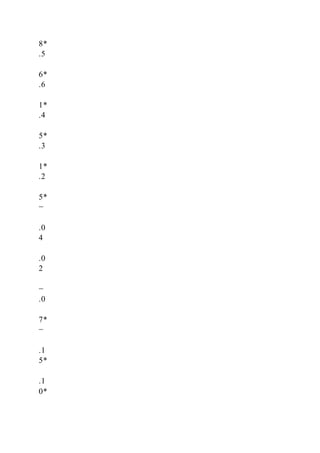
writing for a periodical that
follows a different practice. Omit initial A or The from titles
when you place the possessive
before them.
A Tale of Two Cities; Dickens's Tale of Two Cities.
The Age of Innocence; Wharton's Age of Innocence.
44
IV
Words and Expressions Commonly Misused
MANY of the words and expressions listed here are not so much
bad English as bad style,
the commonplaces of careless writing. As illustrated under
Feature, the proper correction
is likely to be not the replacement of one word or set of words
by another but the
replacement of vague generality by definite statement.
The shape of our language is not rigid; in questions of usage we
have no lawgiver whose
word is final. Students whose curiosity is aroused by the
interpretations that follow, or
whose doubts are raised, will wish to pursue their investigations
further. Books useful in
such pursuits are Merriam Webster's Collegiate Dictionary,
Tenth Edition; The American
Heritage Dictionary of the English Language, Third Edition;
Webster's Third New
International Dictionary; The New Fowler's Modern English
Usage, Third Edition, edited by
R. W. Burchfield; Modern American Usage: A Guide by Wilson
Follett and Erik Wensberg;
and The Careful Writer by Theodore M. Bernstein.
Aggravate. Irritate. The first means "to add to" an already
troublesome or vexing matter or
condition. The second means "to vex" or "to annoy" or "to
chafe."
All right. Idiomatic in familiar speech as a detached phrase in
the sense "Agreed," or "Go
ahead," or "O.K." Properly written as two words — all right.
Allude. Do not confuse with elude. You allude to a book; you
elude a pursuer. Note, too,
that allude is not synonymous with refer. An allusion is an
indirect mention, a reference is
a specific one.
Allusion. Easily confused with illusion. The first means "an
indirect reference"; the second
means "an unreal image" or "a false impression."
Alternate. Alternative. The words are not always
interchangeable as nouns or adjectives.
The first means every other one in a series; the second, one of
two possibilities. As the
other one of a series of two, an alternate may stand for "a
substitute," but an alternative,
although used in a similar sense, connotes a matter of choice
that is never present with
alternate.
As the flooded road left them no alternative, they took the
alternate route.
Among. Between. When more than two things or persons are
involved, among is usually
called for: "The money was divided among the four players."
When, however, more than
45
two are involved but each is considered individually, between is
preferred: "an agreement
between the six heirs."
And / or. A device, or shortcut, that damages a sentence and
often leads to confusion or
ambiguity.
First of all, would an honor system
successfully cut down on the amount of
stealing and/or cheating?
First of all, would an honor system reduce
the incidence of stealing or cheating or
both?
Anticipate. Use expect in the sense of simple expectation.
I anticipated that he would look older. I expected that he would
look older.
My brother anticipated the upturn in the
market.
My brother expected the upturn in the
market.
In the second example, the word anticipated is ambiguous. It
could mean simply that the
brother believed the upturn would occur, or it could mean that
he acted in advance of the
expected upturn — by buying stock, perhaps.
Anybody. In the sense of "any person," not to be written as two
words. Any body means
"any corpse," or "any human form," or "any group." The rule
holds equally for everybody,
nobody, and somebody.
Anyone. In the sense of "anybody," written as one word. Any
one means "any single
person" or "any single thing."
As good or better than. Expressions of this type should be
corrected by rearranging the
sentences.
My opinion is as good or better than his. My opinion is as good
as his, or better (if not
better).
As to whether. Whether is sufficient.
As yet. Yet nearly always is as good, if not better.
No agreement has been reached as yet. No agreement has yet
been reached.
The chief exception is at the beginning of a sentence, where yet
means something
different.
Yet (or despite everything) he has not succeeded.
As yet (or so far) he has not succeeded.
Being. Not appropriate after regard ... as.
He is regarded as being the best dancer in
the club
He is regarded as the best dancer in the club.
46
But. Unnecessary after doubt and help.
I have no doubt but that I have no doubt that
He could not help but see that He could not help seeing that
The too-frequent use of but as a conjunction leads to the fault
discussed under Rule 18. A
loose sentence formed with but can usually be converted into a
periodic sentence formed
with although.
Particularly awkward is one but closely following another, thus
making a contrast to a
contrast, or a reservation to a reservation. This is easily
corrected by rearrangement.
Our country had vast resources but seemed
almost wholly unprepared for war. But
within a year it had created an army of four
million.
Our country seemed almost wholly
unprepared for war, but it had vast
resources. Within a year it had created an
army of four million.
Can. Means "am (is, are) able." Not to be used as a substitute
for may.
Care less. The dismissive "I couldn't care less" is often used
with the shortened "not"
mistakenly (and mysteriously) omitted: "I could care less." The
error destroys the meaning
of the sentence and is careless indeed.
Case. Often unnecessary.
In many cases, the rooms lacked air
conditioning.
Many of the rooms lacked air conditioning.
It has rarely been the case that any mistake
has been made.
Few mistakes have been made.
Certainly. Used indiscriminately by some speakers, much as
others use very, in an attempt
to intensify any and every statement. A mannerism of this kind,
bad in speech, is even
worse in writing.
Character. Often simply redundant, used from a mere habit of
wordiness.
acts of a hostile character hostile acts
Claim. (verb). With object-noun, means "lay claim to." May be
used with a dependent
clause if this sense is clearly intended: "She claimed that she
was the sole heir." (But even
here claimed to be would be better.) Not to be used as a
substitute for declare, maintain,
or charge.
He claimed he knew how. He declared he knew how.
Clever. Note that the word means one thing when applied to
people, another when applied
to horses. A clever horse is a good-natured one, not an
ingenious one.
Compare. To compare to is to point out or imply resemblances
between objects regarded
as essentially of a different order; to compare with is mainly to
point out differences
47
between objects regarded as essentially of the same order. Thus,
life has been compared
to a pilgrimage, to a drama, to a battle; Congress may be
compared with the British
Parliament. Paris has been compared to ancient Athens; it may
be compared with modern
London.
Comprise. Literally, "embrace": A zoo comprises mammals,
reptiles, and birds (because it
"embraces," or "includes," them). But animals do not comprise
("embrace") a zoo — they
constitute a zoo.
Consider. Not followed by as when it means "believe to be."
I consider him as competent. I consider him competent.
When considered means "examined" or "discussed," it is
followed by as:
The lecturer considered Eisenhower first as soldier and second
as
administrator.
Contact. As a transitive verb, the word is vague and self-
important. Do not contact people;
get in touch with them, look them up, phone them, find them, or
meet them.
Cope. An intransitive verb used with with. In formal writing,
one doesn't "cope," one "copes
with" something or somebody.
I knew they'd cope. (jocular) I knew they would cope with the
situation.
Currently. In the sense of now with a verb in the present tense,
currently is usually
redundant; emphasis is better achieved through a more precise
reference to time.
We are currently reviewing your application. We are at this
moment reviewing your
application.
Data. Like strata, phenomena, and media, data is a plural and is
best used with a plural
verb. The word, however, is slowly gaining acceptance as a
singular.
The data is misleading. These data are misleading.
Different than. Here logic supports established usage: one thing
differs from another,
hence, different from. Or, other than, unlike.
Disinterested. Means "impartial." Do not confuse it with
uninterested, which means "not
interested in."
Let a disinterested person judge our dispute, (an impartial
person)
This man is obviously uninterested in our dispute, (couldn't care
less)
48
Divided into. Not to be misused for composed of. The line is
sometimes difficult to draw;
doubtless plays are divided into acts, but poems are composed
of stanzas. An apple,
halved, is divided into sections, but an apple is composed of
seeds, flesh, and skin.
Due to. Loosely used for through, because of, or owing to, in
adverbial phrases.
He lost the first game due to carelessness. He lost the first game
because of
carelessness.
In correct use, synonymous with attributable to: "The accident
was due to bad weather";
"losses due to preventable fires."
Each and every one. Pitchman's jargon. Avoid, except in
dialogue.
It should be a lesson to each and every one
of us.
It should be a lesson to every one of us (to us
all).
Effect. As a noun, means "result"; as a verb, means "to bring
about," "to accomplish" (not
to be confused with affect, which means "to influence").
As a noun, often loosely used in perfunctory writing about
fashions, music, painting, and
other arts: "a Southwestern effect"; "effects in pale green";
"very delicate effects"; "subtle
effects"; "a charming effect was produced." The writer who has
a definite meaning to
express will not take refuge in such vagueness.
Enormity. Use only in the sense of "monstrous wickedness."
Misleading, if not wrong,
when used to express bigness.
Enthuse. An annoying verb growing out of the noun enthusiasm.
Not recommended.
She was enthused about her new car. She was enthusiastic about
her new car.
She enthused about her new car. She talked enthusiastically
(expressed
enthusiasm) about her new car.
Etc. Literally, "and other things"; sometimes loosely used to
mean "and other persons."
The phrase is equivalent to and the rest, and so forth, and hence
is not to be used if one of
these would be insufficient — that is, if the reader would be left
in doubt as to any
important particulars. Least open to objection when it represents
the last terms of a list
already given almost in full, or immaterial words at the end of a
quotation.
At the end of a list introduced by such as, for example, or any
similar expression, etc. is
incorrect. In formal writing, etc. is a misfit. An item important
enough to call for etc. is
probably important enough to be named.
Fact. Use this word only of matters capable of direct
verification, not of matters of
judgment. That a particular event happened on a given date and
that lead melts at a
certain temperature are facts. But such conclusions as that
Napoleon was the greatest of
49
modern generals or that the climate of California is delightful,
however defensible they may
be, are not properly called facts.
Facility. Why must jails, hospitals, and schools suddenly
become "facilities"?
Parents complained bitterly about the fire
hazard in the wooden facility.
Parents complained bitterly about the fire
hazard in the wooden schoolhouse.
He has been appointed warden of the new
facility.
He has been appointed warden of the new
prison.
Factor. A hackneyed word; the expressions of which it is a part
can usually be replaced by
something more direct and idiomatic.
Her superior training was the great factor in
her winning the match.
She won the match by being better trained.
Air power is becoming an increasingly
important factor in deciding battles.
Air power is playing a larger and larger part
in deciding battles.
Farther. Further. The two words are commonly interchanged,
but there is a distinction
worth observing: farther serves best as a distance word, further
as a time or quantity word.
You chase a ball farther than the other fellow; you pursue a
subject further.
Feature. Another hackneyed word; like factor, it usually adds
nothing to the sentence in
which it occurs.
A feature of the entertainment especially
worthy of mention was the singing of
Allison Jones.
(Better use the same number of words to tell
what Allison Jones sang and how she sang
it.)
As a verb, in the sense of "offer as a special attraction," it is to
be avoided.
Finalize. A pompous, ambiguous verb. (See Chapter V,
Reminder 21.)
Fix. Colloquial in America for arrange, prepare, mend. The
usage is well established. But
bear in mind that this verb is from figere: "to make firm," "to
place definitely." These are the
preferred meanings of the word.
Flammable. An oddity, chiefly useful in saving lives. The
common word meaning
"combustible" is inflammable. But some people are thrown off
by the in- and think
inflammable means "not combustible." For this reason, trucks
carrying gasoline or
explosives are now marked FLAMMABLE. Unless you are
operating such a truck and hence
are concerned with the safety of children and illiterates, use
inflammable.
Folk. A collective noun, equivalent to people. Use the singular
form only. Folks, in the
sense of "parents," "family," "those present," is colloquial and
too folksy for formal writing.
Her folks arrived by the afternoon train. Her father and mother
arrived by the
afternoon train.
50
Fortuitous. Limited to what happens by chance. Not to be used
for fortunate or lucky.
Get. The colloquial have got for have should not be used in
writing. The preferable form of
the participle is got, not gotten.
He has not got any sense. He has no sense.
They returned without having gotten any. They returned without
having got any.
Gratuitous. Means "unearned," or "unwarranted."
The insult seemed gratuitous, (undeserved)
He is a man who. A common type of redundant expression; see
Rule 17.
He is a man who is very ambitious. He is very ambitious.
Vermont is a state that attracts visitors
because of its winter sports.
Vermont attracts visitors because of its
winter sports.
Hopefully. This once-useful adverb meaning "with hope" has
been distorted and is now
widely used to mean "I hope" or "it is to be hoped." Such use is
not merely wrong, it is silly.
To say, "Hopefully I'll leave on the noon plane" is to talk
nonsense. Do you mean you'll
leave on the noon plane in a hopeful frame of mind? Or do you
mean you hope you'll leave
on the noon plane? Whichever you mean, you haven't said it
clearly. Although the word in
its new, free-floating capacity may be pleasurable and even
useful to many, it offends the
ear of many others, who do not like to see words dulled or
eroded, particularly when the
erosion leads to ambiguity, softness, or nonsense.
However. Avoid starting a sentence with however when the
meaning is "nevertheless."
The word usually serves better when not in first position.
The roads were almost impassable.
However, we at last succeeded in reaching
camp.
The roads were almost impassable. At last,
however, we succeeded in reaching camp.
When however comes first, it means "in whatever way" or "to
whatever extent."
However you advise him, he will probably do as he thinks best.
However discouraging the prospect, they never lost heart.
Illusion. See allusion.
Imply. Infer. Not interchangeable. Something implied is
something suggested or indicated,
though not expressed. Something inferred is something deduced
from evidence at hand.
51
Farming implies early rising.
Since she was a farmer, we inferred that she got up early.
Importantly. Avoid by rephrasing.
More importantly, he paid for the damages. What's more, he
paid for the damages.
With the breeze freshening, he altered
course to pass inside the island. More
importantly, as things turned out, he tucked
in a reef.
With the breeze freshening, he altered
course to pass inside the island. More
important, as things turned out, he tucked in
a reef.
In regard to. Often wrongly written in regards to. But as regards
is correct, and means the
same thing.
In the last analysis. A bankrupt expression.
Inside of. Inside. The of following inside is correct in the
adverbial meaning "in less than."
In other meanings, of is unnecessary.
Inside of five minutes I'll be inside the bank.
Insightful. The word is a suspicious overstatement for
"perceptive." If it is to be used at all,
it should be used for instances of remarkably penetrating vision.
Usually, it crops up
merely to inflate the commonplace.
That was an insightful remark you made. That was a perceptive
remark you made.
In terms of. A piece of padding usually best omitted.
The job was unattractive in terms of salary. The salary made the
job unattractive.
Interesting. An unconvincing word; avoid it as a means of
introduction. Instead of
announcing that what you are about to tell is interesting, make
it so.
An interesting story is told of (Tell the story without preamble.)
In connection with the forthcoming visit of
Mr. B. to America, it is interesting to recall
that he
Mr. B., who will soon visit America
Also to be avoided in introduction is the word funny. Nothing
becomes funny by being
labeled so.
Irregardless. Should be regardless. The error results from
failure to see the negative in -
less and from a desire to get it in as a prefix, suggested by such
words as irregular,
irresponsible, and, perhaps especially, irrespective.
52
-ize. Do not coin verbs by adding this tempting suffix. Many
good and useful verbs do end
in -ize: summarize, fraternize, harmonize, fertilize. But there is
a growing list of
abominations: containerize, prioritize, finalize, to name three.
Be suspicious of -ize; let
your ear and your eye guide you. Never tack -ize onto a noun to
create a verb. Usually you
will discover that a useful verb already exists. Why say "utilize"
when there is the simple,
unpretentious word use?
Kind of. Except in familiar style, not to be used as a substitute
for rather or something like.
Restrict it to its literal sense: "Amber is a kind of fossil resin";
"I dislike that kind of
publicity." The same holds true for sort of.
Lay. A transitive verb. Except in slang ("Let it lay"), do not
misuse it for the intransitive verb
lie. The hen, or the play, lays an egg; the llama lies down. The
playwright went home and
lay down.
lie, lay, lain, lying
lay, laid, laid, laying
Leave. Not to be misused for let.
Leave it stand the way it is. Let it stand the way it is.
Leave go of that rope! Let go of that rope!
Less. Should not be misused for fewer.
They had less workers than in the previous
campaign.
They had fewer workers than in the
previous campaign.
Less refers to quantity, fewer to number. "His troubles are less
than mine" means "His
troubles are not so great as mine." "His troubles are fewer than
mine" means "His troubles
are not so numerous as mine."
Like. Not to be used for the conjunction as. Like governs nouns
and pronouns; before
phrases and clauses the equivalent word is as.
We spent the evening like in the old days. We spent the evening
as in the old days.
Chloë smells good, like a baby should. Chloë smells good, as a
baby should.
The use of like for as has its defenders; they argue that any
usage that achieves currency
becomes valid automatically. This, they say, is the way the
language is formed. It is and it
isn't. An expression sometimes merely enjoys a vogue, much as
an article of apparel does.
Like has long been widely misused by the illiterate; lately it has
been taken up by the
53
knowing and the well- informed, who find it catchy, or
liberating, and who use it as though
they were slumming. If every word or device that achieved
currency were immediately
authenticated, simply on the ground of popularity, the language
would be as chaotic as a
ball game with no foul lines. For the student, perhaps the most
useful thing to know about
like is that most carefully edited publications regard its use
before phrases and clauses as
simple error.
Line. Along these lines. Line in the sense of "course of
procedure, conduct, thought" is
allowable but has been so overworked, particularly in the phrase
along these lines, that a
writer who aims at freshness or originality had better discard it
entirely.
Mr. B. also spoke along the same lines. Mr. B. also spoke to the
same effect.
She is studying along the line of French
literature.
She is studying French literature.
Literal. Literally. Often incorrectly used in support of
exaggeration or violent metaphor.
a literal flood of abuse a flood of abuse
literally dead with fatigue almost dead with fatigue
Loan. A noun. As a verb, prefer lend.
Lend me your ears.
the loan of your ears
Meaningful. A bankrupt adjective. Choose another, or rephrase.
His was a meaningful contribution. His contribution counted
heavily.
We are instituting many meaningful
changes in the curriculum.
We are improving the curriculum in many
ways.
Memento. Often incorrectly written momento.
Most. Not to be used for almost in formal composition.
most everybody almost everybody
most all the time almost all the time
Nature. Often simply redundant, used like character.
acts of a hostile nature hostile acts
Nature should be avoided in such vague expressions as "a lover
of nature," "poems about
nature." Unless more specific statements follow, the reader
cannot tell whether the poems
54
have to do with natural scenery, rural life, the sunset, the
untracked wilderness, or the
habits of squirrels.
Nauseous. Nauseated. The first means "sickening to
contemplate"; the second means
"sick at the stomach." Do not, therefore, say, "I feel nauseous,"
unless you are sure you
have that effect on others.
Nice. A shaggy, all-purpose word, to be used sparingly in
formal composition. "I had a nice
time." "It was nice weather." "She was so nice to her mother."
The meanings are indistinct.
Nice is most useful in the sense of "precise" or "delicate": "a
nice distinction."
Nor. Often used wrongly for or after negative expressions.
He cannot eat nor sleep. He cannot eat or sleep.
He can neither eat nor sleep.
He cannot eat nor can he sleep.
Noun used as verb. Many nouns have lately been pressed into
service as verbs. Not all
are bad, but all are suspect.
Be prepared for kisses when you gift your
girlfriend with this merry scent.
Be prepared for kisses when you give your
girlfriend this merry scent.
The candidate hosted a dinner for fifty of
her workers.
The candidate gave a dinner for fifty of her
workers.
The meeting was chaired by Mr. Oglethorp. Mr. Oglethorp was
chair of the meeting.
She headquarters in Newark. She has headquarters in Newark.
The theater troupe debuted last fall. The theatre troupe made its
debut last fall.
Offputting. Ongoing. Newfound adjectives, to be avoided
because they are inexact and
clumsy. Ongoing is a mix of "continuing" and "active" and is
usually superfluous.
He devoted all his spare time to the ongoing
program for aid to the elderly.
He devoted all his spare time to the program
for aid to the elderly.
Offputting might mean "objectionable," "disconcerting,"
"distasteful." Select instead a word
whose meaning is clear. As a simple test, transform the
participles to verbs. It is possible
to upset something. But to offput? To ongo?
One. In the sense of "a person," not to be followed by his or
her.
One must watch his step. One must watch one's step.
(You must watch your step.)
55
One of the most. Avoid this feeble formula. "One of the most
exciting developments of
modern science is ..."; "Switzerland is one of the most beautiful
countries of Europe."
There is nothing wrong with the grammar; the formula is simply
threadbare.
-oriented. A clumsy, pretentious device, much in vogue. Find a
better way of indicating
orientation or alignment or direction.
It was a manufacturing-oriented company. It was a company
chiefly concerned with
manufacturing.
Many of the skits are situation-oriented. Many of the skits rely
on situation.
Partially. Not always interchangeable with partly. Best used in
the sense of "to a certain
degree," when speaking of a condition or state: "I'm partiall y
resigned to it." Partly carries
the idea of a part as distinct from the whole — usually a
physical object.
The log was partially submerged. The log was partly
submerged.
She was partially in and partially out. She was partly in and
partly out.
She was part in, part out.
Participle for verbal noun.
There was little prospect of the Senate
accepting even this compromise.
There was little prospect of the Senate's
accepting even this compromise.
In the lefthand column, accepting is a present participle; in the
righthand column, it is a
verbal noun (gerund). The construction shown in the lefthand
column is occasionally found,
and has its defenders. Yet it is easy to see that the second
sentence has to do not with a
prospect of the Senate but with a prospect of accepting.
Any sentence in which the use of the possessive is awkward or
impossible should of
course be recast.
In the event of a reconsideration of the
whole matters becoming necessary
If it should become necessary to reconsider
the whole matter
There was great dissatisfaction with the
decision of the arbitrators being favorable to
the company.
There was great dissatisfaction with the
arbitrators' decision in favor of the
company.
People. A word with many meanings. (The American Heritage
Dictionary, Third Edition,
gives nine.) The people is a political term, not to be confused
with the public. From the
people comes political support or opposition; from the public
comes artistic appreciation or
commercial patronage.
56
The word people is best not used with words of number, in
place of persons. If of "six
people" five went away, how many people would be left?
Answer: one people.
Personalize. A pretentious word, often carrying bad advice. Do
not personalize your prose;
simply make it good and keep it clean. See Chapter V,
Reminder 1.
a highly personalized affair a highly personal affair
Personalize your stationery. Design a letterhead.
Personally. Often unnecessary.
Personally, I thought it was a good book. I thought it a good
book.
Possess. Often used because to the writer it sounds more
impressive than have or own.
Such usage is not incorrect but is to be guarded against.
She possessed great courage. She had great courage (was very
brave).
He was the fortunate possessor of He was lucky enough to own
Presently. Has two meanings: "in a short while" and "currently."
Because of this ambiguity
it is best restricted to the first meaning: "She'll be here
presently" ("soon," or "in a short
time").
Prestigious. Often an adjective of last resort. It's in the
dictionary, but that doesn't mean
you have to use it.
Refer. See allude.
Regretful. Sometimes carelessly used for regrettable: "The
mixup was due to a regretful
breakdown in communications."
Relate. Not to be used intransitively to suggest rapport.
I relate well to Janet. Janet and I see things the same way.
Janet and I have a lot in common.
Respective. Respectively. These words may usually be omitted
with advantage.
Works of fiction are listed under the names
of their respective authors.
Works of fiction are listed under the names
of their authors.
The mile run and the two-mile run were
won by Jones and Cummings respectively.
The mile run was won by Jones, the two-
mile run by Cummings.
Secondly, thirdly, etc. Unless you are prepared to begin with
firstly and defend it (which will
be difficult), do not prettify numbers with -ly. Modern usage
prefers second, third, and so
on.
57
Shall. Will. In formal writing, the future tense requires shall for
the first person, will for the
second and third. The formula to express the speaker's belief
regarding a future action or
state is I shall; I will expresses determination or consent. A
swimmer in distress cries, "I
shall drown; no one will save me!" A suicide puts it the other
way: "I will drown; no one
shall save me!" In relaxed speech, however, the words shall and
will are seldom used
precisely; our ear guides us or fails to guide us, as the case may
be, and we are quite
likely to drown when we want to survive and survive when we
want to drown.
So. Avoid, in writing, the use of so as an intensifier: "so good";
"so warm"; "so delightful."
Sort of. See kind of.
Split infinitive. There is precedent from the fourteenth century
down for interposing an
adverb between to and the infinitive it governs, but the
construction should be avoided
unless the writer wishes to place unusual stress on the adverb.
to diligently inquire to inquire diligently
For another side to the split infinitive, see Chapter V, Reminder
14.
State. Not to be used as a mere substitute for say, remark.
Restrict it to the sense of
"express fully or clearly": "He refused to state his objections."
Student body. Nine times out of ten a needless and awkward
expression, meaning no
more than the simple word students.
a member of the student body a student
popular with the student body liked by the students
Than. Any sentence with than (to express comparison) should be
examined to make sure
no essential words are missing.
I'm probably closer to my mother than my
father. (Ambiguous.)
I'm probably closer to my mother than to
my father.
I'm probably closer to my mother than my
father is.
It looked more like a cormorant than a
heron.
It looked more like a cormorant than like a
heron.
Thanking you in advance. This sounds as if the writer meant, "It
will not be worth my while
to write to you again." In making your request, write "Will you
please," or "I shall be
obliged." Then, later, if you feel moved to do so, or if the
circumstances call for it, write a
letter of acknowledgment.
58
That. Which. That is the defining, or restrictive, pronoun, which
the nondefining, or
nonrestrictive. (See Rule 3.)
The lawn mower that is broken is in the garage. (Tells which
one.)
The lawn mower, which is broken, is in the garage. (Adds a fact
about the
only mower in question.)
The use of which for that is common in written and spoken
language ("Let us now go even
unto Bethlehem, and see this thing which is come to pass.").
Occasionally which seems
preferable to that, as in the sentence from the Bible. But it
would be a convenience to all if
these two pronouns were used with precision. Careful writers,
watchful for small
conveniences, go which-hunting, remove the defining whiches,
and by so doing improve
their work.
The foreseeable future. A cliche, and a fuzzy one. How much of
the future is foreseeable?
Ten minutes? Ten years? Any of it? By whom is it foreseeable?
Seers? Experts?
Everybody?
The truth. is.... The fact is.... A bad beginning for a sentence. If
you feel you are possessed
of the truth, or of the fact, simply state it. Do not give it
advance billing.
They. He or She. Do not use they when the antecedent is a
distributive expression such as
each, each one, everybody, every one, many a man. Use the
singular pronoun.
Every one of us knows they are fallible. Every one of us knows
he is fallible.
Everyone in the community, whether they
are a member of the Association or not, is
invited to attend.
Everyone in the community, whether he is a
member of the Association or not, is invited
to attend.
A similar fault is the use of the plural pronoun with the
antecedent anybody, somebody,
someone, the intention being either to avoid the awkward he or
she or to avoid committing
oneself to one or the other. Some bashful speakers even say, "A
friend of mine told me
that they...."
The use of he as a pronoun for nouns embracing both genders is
a simple, practical
convention rooted in the beginnings of the English language.
Currently, however, many
writers find the use of the generic he or his to rename indefinite
antecedents limiting or
offensive. Substituting he or she in its place is the logical thing
to do if it works. But it often
doesn't work, if only because repetition makes it sound boring
or silly.
59
Consider these strategies to avoid an awkward overuse of he or
she or an unintentional
emphasis on the masculine:
Use the plural rather than the singular.
The writer must address his readers'
concerns.
Writers must address their readers'
concerns.
Eliminate the pronoun altogether.
The writer must address his readers'
concerns.
The writer must address readers' concerns.
Substitute the second person for the third person.
The writer must address his readers'
concerns.
As a writer, you must address your readers'
concerns.
No one need fear to use he if common sense supports it. If you
think she is a handy
substitute for he, try it and see what happens. Alternatively, put
all controversial nouns in
the plural and avoid the choice of sex altogether, although you
may find your prose
sounding general and diffuse as a result.
This. The pronoun this, referring to the complete sense of a
preceding sentence or clause,
can't always carry the load and so may produce an imprecise
statement.
Visiting dignitaries watched yesterday as
ground was broken for the new high-energy
physics laboratory with a blowout safety
wall. This is the first visible evidence of the
university's plans for modernization and
expansion.
Visiting dignitaries watched yesterday as
ground was broken for the new high-energy
physics laboratory with a blowout safety
wall. The ceremony afforded the first visible
evidence of the university's plans for
modernization and expansion.
In the lefthand example above, this does not immediately make
clear what the first visible
evidence is.
Thrust. This showy noun, suggestive of power, hinting of sex, is
the darling of executives,
politicos, and speech-writers. Use it sparingly. Save it for
specific application.
Our reorganization plan has a tremendous
thrust.
The piston has a five-inch thrust.
The thrust of his letter was that he was
working more hours than he'd bargained for.
The point he made in his letter was that he
was working more hours than he'd
bargained for.
Tortuous. Torturous. A winding road is tortuous, a painful
ordeal is torturous. Both words
carry the idea of "twist," the twist having been a form of
torture.
Transpire. Not to be used in the sense of "happen," "come to
pass." Many writers so use it
(usually when groping toward imagined elegance), but their
usage finds little support in the
60
Latin "breathe across or through." It is correct, however, in the
sense of "become known."
"Eventually, the grim account of his villainy transpired"
(literally, "leaked through or out").
Try. Takes the infinitive: "try to mend it," not "try and mend
it." Students of the language
will argue that try and has won through and become idiom.
Indeed it has, and it is relaxed
and acceptable. But try to is precise, and when you are writing
formal prose, try and write
try to.
Type. Not a synonym for kind of. The examples below are
common vulgarisms.
that type employee that kind of employee
I dislike that type publicity. I dislike that kind of publicity.
small, homelike hotels a new type plane
a new type plane a plane of a new design (new kind)
Unique. Means "without like or equal." Hence, there can be no
degrees of uniqueness.
It was the most unique coffee maker on the
market.
It was a unique coffee maker.
The balancing act was very unique. The balancing act was
unique.
Of all the spiders, the one that lives in a
bubble under water is the most unique.
Among spiders, the one that lives in a
bubble under water is unique.
Utilize. Prefer use.
I utilized the facilities. I used the toilet.
He utilized the dishwasher. He used the dishwasher.
Verbal. Sometimes means "word for word" and in this sense
may refer to something
expressed in writing. Oral (from Latin os, "mouth") limits the
meaning to what is transmitted
by speech. Oral agreement is more precise than verbal
agreement.
Very. Use this word sparingly. Where emphasis is necessary,
use words strong in
themselves.
While. Avoid the indiscriminate use of this word for and, but,
and although. Many writers
use it frequently as a substitute for and or but, either from a
mere desire to vary the
connective or from doubt about which of the two connectives is
more appropriate. In this
use it is best replaced by a semicolon.
The office and salesrooms are on the ground
floor, while the rest of the building is used
for manufacturing.
The office and salesrooms are on the ground
floor; the rest of the building is used for
manufacturing.
61
Its use as a virtual equivalent of although is allowable in
sentences where this leads to no
ambiguity or absurdity.
While I admire his energy, I wish it were employed in a better
cause.
This is entirely correct, as shown by the paraphrase
I admire his energy; at the same time, I wish it were employed
in a better
cause.
Compare:
While the temperature reaches 90 or 95 degrees in the daytime,
the nights
are often chilly.
The paraphrase shows why the use of while is incorrect:
The temperature reaches 90 or 95 degrees in the daytime; at the
same time
the nights are often chilly.
In general, the writer will do well to use while only with strict
literalness, in the sense of
"during the time that."
-wise. Not to be used indiscriminately as a pseudosuffix:
taxwise, pricewise, marriagewise,
prosewise, saltwater taffy-wise. Chiefly useful when it means
"in the manner of: clockwise.
There is not a noun in the language to which -wise cannot be
added if the spirit moves one
to add it. The sober writer will abstain from the use of this wild
additive.
Worth while. Overworked as a term of vague approval and (with
not) of disapproval.
Strictly applicable only to actions: "Is it worth while to
telegraph?"
His books are not worth while. His books are not worth reading
(are not worth one's while to read;
do not repay reading).
The adjective worthwhile (one word) is acceptable but
emaciated. Use a stronger word.
a worthwhile project a promising (useful, valuable, exciting)
project
Would. Commonly used to express habitual or repeated action.
("He would get up early
and prepare his own breakfast before he went to work.") But
when the idea of habit or
62
repetition is expressed, in such phrases as once a year, every
day, each Sunday, the past
tense, without would, is usually sufficient, and, from its brevity,
more emphatic.
Once a year he would visit the old mansion. Once a year he
visited the old mansion.
In narrative writing, always indicate the transition from the
general to the particular — that
is, from sentences that merely state a general habit to those that
express the action of a
specific day or period. Failure to indicate the change will cause
confusion.
Townsend would get up early and prepare his own breakfast. If
the day was
cold, he filled the stove and had a warm fire burning before he
left the house.
On his way out to the garage, he noticed that there were
footprints in the
new-fallen snow on the porch.
The reader is lost, having received no signal that Townsend has
changed from a mere
man of habit to a man who has seen a particular thing on a
particular day.
Townsend would get up early and prepare his own breakfast. If
the day was
cold, he filled the stove and had a warm fire burning before he
left the house.
One morning in January, on his way out to the garage, he
noticed footprints
in the new-fallen snow on the porch.
63
V
An Approach to Style
(With a List of Reminders)
UP TO this point, the book has been concerned with what is
correct, or acceptable, in the
use of English. In this final chapter, we approach style in its
broader meaning: style in the
sense of what is distinguished and distinguishing. Here we leave
solid ground. Who can
confidently say what ignites a certain combination of words,
causing them to explode in the
mind? Who knows why certain notes in music are capable of
stirring the listener deeply,
though the same notes slightly rearranged are impotent? These
are high mysteries, and
this chapter is a mystery story, thinly disguised. There is no
satisfactory explanation of
style, no infallible guide to good writing, no assurance that a
person who thinks clearly will
be able to write clearly, no key that unlocks the door, no
inflexible rule by which writers
may shape their course. Writers will often find themselves
steering by stars that are
disturbingly in motion.
The preceding chapters contain instructions drawn from
established English usage; this
one contains advice drawn from a writer's experience of writing.
Since the book is a rule
book, these cautionary remarks, these subtly dangerous hints,
are presented in the form of
rules, but they are, in essence, mere gentle reminders: they state
what most of us know
and at times forget.
Style is an increment in writing. When we speak of Fitzgerald's
style, we don't mean his
command of the relative pronoun, we mean the sound his words
make on paper. All
writers, by the way they use the language, reveal something of
their spirits, their habits,
their capacities, and their biases. This is inevitable as well as
enjoyable. All writing is
communication; creative writing is communication through
revelation — it is the Self
escaping into the open. No writer long remains incognito.
If you doubt that style is something of a mystery, try rewriting a
familiar sentence and see
what happens. Any much-quoted sentence will do. Suppose we
take "These are the times
that try men's souls." Here we have eight short, easy words,
forming a simple declarative
sentence. The sentence contains no flashy ingredient such as
"Damn the torpedoes!" and
the words, as you see, are ordinary. Yet in that arrangement,
they have shown great
durability; the sentence is into its third century. Now compar e a
few variations:
64
Times like these try men's souls.
How trying it is to live in these times!
These are trying times for men's souls.
Soulwise, these are trying times.
It seems unlikely that Thomas Paine could have made his
sentiment stick if he had
couched it in any of these forms. But why not? No fault of
grammar can be detected in
them, and in every case the meaning is clear. Each version is
correct, and each, for some
reason that we can't readily put our finger on, is marked for
oblivion. We could, of course,
talk about "rhythm" and "cadence," but the talk would be vague
and unconvincing. We
could declare soulwise to be a silly word, inappropriate to the
occasion; but even that won't
do — it does not answer the main question. Are we even sure
soulwise is silly? If
otherwise is a serviceable word, what's the matter with
soulwise?
Here is another sentence, this one by a later Tom. It is not a
famous sentence, although its
author (Thomas Wolfe) is well known. "Quick are the mouths of
earth, and quick the teeth
that fed upon this loveliness." The sentence would not take a
prize for clarity, and
rhetorically it is at the opposite pole from "These are the
times." Try it in a different form,
without the inversions:
The mouths of earth are quick, and the teeth that fed upon this
loveliness are
quick, too.
The author's meaning is still intact, but not his overpowering
emotion. What was poetical
and sensuous has become prosy and wooden; instead of the
secret sounds of beauty, we
are left with the simple crunch of mastication. (Whether Mr.
Wolfe was guilty of overwriting
is, of course, another question — one that is not pertinent here.)
With some writers, style not only reveals the spirit of the man
but reveals his identity, as
surely as would his fingerprints. Here, following, are two brief
passages from the works of
two American novelists. The subject in each case is languor. In
both, the words used are
ordinary, and there is nothing eccentric about the construction.
He did not still feel weak, he was merely luxuriating in that
supremely gutful
lassitude of convalescence in which time, hurry, doing, did not
exist, the
accumulating seconds and minutes and hours to which in its
well state the
65
body is slave both waking and sleeping, now reversed and time
now the lip-
server and mendicant to the body's pleasure instead of the body
thrall to
time's headlong course.
Manuel drank his brandy. He felt sleepy himself. It was too hot
to go out into
the town. Besides there was nothing to do. He wanted to see
Zurito. He
would go to sleep while he waited.
Anyone acquainted with Faulkner and Hemingway will have
recognized them in these
passages and perceived which was which. How different are
their languors!
Or take two American poets, stopping at evening. One stops by
woods, the other by
laughing flesh.
My little horse must think it queer
To stop without a farmhouse near
Between the woods and frozen lake
The darkest evening of the year.*
(* From "Stopping by Woods on a Snowy Evening" from The
Poetry of Robert Frost, edited by Edward
Connery Lathem. Copyright 1923, © 1969 by Henry Holt and
Company, LLC. Reprinted by permission of
Henry Holt and Company, LLC.)
I have perceived that to be with those I like is enough,
To stop in company with the rest at evening is enough,
To be surrounded by beautiful, curious, breathing,
laughing flesh is enough ...
Because of the characteristic styles, there is little question
about identity here, and if the
situations were reversed, with Whitman stopping by woods and
Frost by laughing flesh
(not one of his regularly scheduled stops), the reader would
know who was who.
Young writers often suppose that style is a garnish for the meat
of prose, a sauce by which
a dull dish is made palatable. Style has no such separate entity;
it is nondetachable,
unfilterable. The beginner should approach style warily,
realizing that it is an expression of
self, and should turn resolutely away from all devices that are
popularly believed to
indicate style — all mannerisms, tricks, adornments. The
approach to style is by way of
plainness, simplicity, orderliness, sincerity.
66
Writing is, for most, laborious and slow. The mind travels faster
than the pen; consequently,
writing becomes a question of learning to make occasional wing
shots, bringing down the
bird of thought as it flashes by. A writer is a gunner, sometimes
waiting in the blind for
something to come in, sometimes roaming the countryside
hoping to scare something up.
Like other gunners, the writer must cultivate patience, working
many covers to bring down
one partridge. Here, following, are some suggestions and
cautionary hints that may help
the beginner find the way to a satisfactory style.
1. Place yourself in the background.
Write in a way that draws the reader's attention to the sense and
substance of the writing,
rather than to the mood and temper of the author. If the writing
is solid and good, the mood
and temper of the writer will eventually be revealed and not at
the expense of the work.
Therefore, the first piece of advice is this: to achieve style,
begin by affecting none — that
is, place yourself in the background. A careful and honest writer
does not need to worry
about style. As you become proficient in the use of language,
your style will emerge,
because you yourself will emerge, and when this happens you
will find it increasingly easy
to break through the barriers that separate you from other
minds, other hearts — which is,
of course, the purpose of writing, as well as its principal
reward. Fortunately, the act of
composition, or creation, disciplines the mind; writing is one
way to go about thinking, and
the practice and habit of writing not only drain the mind but
supply it, too.
2. Write in a way that comes naturally.
Write in a way that comes easily and naturally to you, using
words and phrases that come
readily to hand. But do not assume that because you have acted
naturally your product is
without flaw.
The use of language begins with imitation. The infant imitates
the sounds made by its
parents; the child imitates first the spoken language, then the
stuff of books. The imitative
life continues long after the writer is secure in the language, for
it is almost impossible to
avoid imitating what one admires. Never imitate consciously,
but do not worry about being
an imitator; take pains instead to admire what is good. Then
when you write in a way that
comes naturally, you will echo the halloos that bear repeating.
3. Work from a suitable design.
67
Before beginning to compose something, gauge the nature and
extent of the enterprise
and work from a suitable design. (See Chapter II, Rule 12.)
Design informs even the
simplest structure, whether of brick and steel or of prose. You
raise a pup tent from one
sort of vision, a cathedral from another. This does not mean that
you must sit with a
blueprint always in front of you, merely that you had best
anticipate what you are getting
into. To compose a laundry list, you can work directly from the
pile of soiled garments,
ticking them off one by one. But to write a biography, you will
need at least a rough
scheme; you cannot plunge in blindly and start ticking off fact
after fact about your subject,
lest you miss the forest for the trees and there be no end to your
labors.
Sometimes, of course, impulse and emotion are more
compelling than design. If you are
deeply troubled and are composing a letter appealing for mercy
or for love, you had best
not attempt to organize your emotions; the prose will have a
better chance if the emotions
are left in disarray — which you'll probably have to do anyway,
since feelings do not
usually lend themselves to rearrangement. But even the kind of
writing that is essentially
adventurous and impetuous will on examination be found to
have a secret plan: Columbus
didn't just sail, he sailed west, and the New World took shape
from this simple and, we
now think, sensible design.
4. Write with nouns and verbs.
Write with nouns and verbs, not with adjectives and adverbs.
The adjective hasn't been
built that can pull a weak or inaccurate noun out of a tight
place. This is not to disparage
adjectives and adverbs; they are indispensable parts of speech.
Occasionally they surprise
us with their power, as in
Up the airy mountain,
Down the rushy glen,
We daren't go a-hunting
For fear of little men ...
The nouns mountain and glen are accurate enough, but had the
mountain not become airy,
the glen rushy, William Ailing-ham might never have got off
the ground with his poem. In
general, however, it is nouns and verbs, not their assistants, that
give good writing its
toughness and color.
68
5. Revise and rewrite.
Revising is part of writing. Few writers are so expert that they
can produce what they are
after on the first try. Quite often you will discover, on
examining the completed work, that
there are serious flaws in the arrangement of the material,
calling for transpositions. When
this is the case, a word processor can save you time and labor as
you rearrange the
manuscript. You can select material on your screen and move it
to a more appropriate
spot, or, if you cannot find the right spot, you can move the
material to the end of the
manuscript until you decide whether to delete it. Some writers
find that working with a
printed copy of the manuscript helps them to visualize the
process of change; others prefer
to revise entirely on screen. Above all, do not be afraid to
experiment with what you have
written. Save both the original and the revised versions; you can
always use the computer
to restore the manuscript to its original condition, should that
course seem best.
Remember, it is no sign of weakness or defeat that your
manuscript ends up in need of
major surgery. This is a common occurrence in all writing, and
among the best writers.
6. Do not overwrite.
Rich, ornate prose is hard to digest, generally unwholesome,
and sometimes nauseating.
If the sickly-sweet word, the overblown phrase are your natural
form of expression, as is
sometimes the case, you will have to compensate for it by a
show of vigor, and by writing
something as meritorious as the Song of Songs, which is
Solomon's.
When writing with a computer, you must guard against
wordiness. The click and flow of a
word processor can be seductive, and you may find yourself
adding a few unnecessary
words or even a whole passage just to experience the pleasure
of running your fingers
over the keyboard and watching your words appear on the
screen. It is always a good idea
to reread your writing later and ruthlessly delete the excess.
7. Do not overstate.
When you overstate, readers will be instantly on guard, and
everything that has preceded
your overstatement as well as everything that follows it will be
suspect in their minds
because they have lost confidence in your judgment or your
poise. Overstatement is one
of the common faults. A single overstatement, wherever or
however it occurs, diminishes
the whole, and a single carefree superlative has the power to
destroy, for readers, the
object of your enthusiasm.
69
8. Avoid the use of qualifiers.
Rather, very, little, pretty — these are the leeches that infest the
pond of prose, sucking
the blood of words. The constant use of the adjective little
(except to indicate size) is
particularly debilitating; we should all try to do a little better,
we should all be very watchful
of this rule, for it is a rather important one, and we are pretty
sure to violate it now and then.
9. Do not affect a breezy manner.
The volume of writing is enormous, these days, and much of it
has a sort of windiness
about it, almost as though the author were in a state of euphoria.
"Spontaneous me," sang
Whitman, and, in his innocence, let loose the hordes of
uninspired scribblers who would
one day confuse spontaneity with genius.
The breezy style is often the work of an egocentric, the person
who imagines that
everything that comes to mind is of general interest and that
uninhibited prose creates high
spirits and carries the day. Open any alumni magazine, turn to
the class notes, and you
are quite likely to encounter old Spontaneous Me at work — an
aging collegian who writes
something like this:
Well, guys, here I am again dishing the dirt about your
disorderly classmates,
after pa$$ing a weekend in the Big Apple trying to catch the
Columbia hoops
tilt and then a cab-ride from hell through the West Side casbah.
And
speaking of news, howzabout tossing a few primo items this
way?
This is an extreme example, but the same wind blows, at lesser
velocities, across vast
expanses of journalistic prose. The author in this case has
managed in two sentences to
commit most of the unpardonable sins: he obviously has nothing
to say, he is showing off
and directing the attention of the reader to himself, he is using
slang with neither
provocation nor ingenuity, he adopts a patronizing air by
throwing in the word primo, he is
humorless (though full of fun), dull, and empty. He has not
done his work. Compare his
opening remarks with the following — a plunge directly into the
news:
Clyde Crawford, who stroked the varsity shell in 1958, is
swinging an oar
again after a lapse of forty years. Clyde resigned last spring as
executive
sales manager of the Indiana Flotex Company and is now a
gondolier in
Venice.
70
This, although conventional, is compact, informative,
unpretentious. The writer has dug up
an item of news and presented it in a straightforward manner.
What the first writer tried to
accomplish by cutting rhetorical capers and by breeziness, the
second writer managed to
achieve by good reporting, by keeping a tight rein on his
material, and by staying out of the
act.
10. Use orthodox spelling.
In ordinary composition, use orthodox spelling. Do not write
nite for night, thru for through,
pleez for please, unless you plan to introduce a complete system
of simplified spelling and
are prepared to take the consequences.
In the original edition of The Elements of Style, there was a
chapter on spelling. In it, the
author had this to say:
The spelling of English words is not fixed and invariable, nor
does it depend
on any other authority than general agreement. At the present
day there is
practically unanimous agreement as to the spelling of most
words.... At any
given moment, however, a relatively small number of words
may be spelled
in more than one way. Gradually, as a rule, one of these forms
comes to be
generally preferred, and the less customary form comes to look
obsolete and
is discarded. From time to time new forms, mostly
simplifications, are
introduced by innovators, and either win their place or die of
neglect.
The practical objection to unaccepted and oversimplified
spellings is the
disfavor with which they are received by the reader. They
distract his
attention and exhaust his patience. He reads the form though
automatically,
without thought of its needless complexity; he reads the
abbreviation tho and
mentally supplies the missing letters, at the cost of a fraction of
his attention.
The writer has defeated his own purpose.
The language manages somehow to keep pace with events. A
word that has taken hold in
our century is thru-way; it was born of necessity and is
apparently here to stay. In
combination with way, thru is more serviceable than through; it
is a high-speed word for
readers who are going sixty-five. Throughway would be too
long to fit on a road sign, too
slow to serve the speeding eye. It is conceivable that because of
our thruways, through will
eventually become thru — after many more thousands of miles
of travel.
71
11. Do not explain too much.
It is seldom advisable to tell all. Be sparing, for instance, in the
use of adverbs after "he
said," "she replied," and the like: "he said consolingly"; "she
replied grumblingly." Let the
conversation itself disclose the speaker's manner or condition.
Dialogue heavily weighted
with adverbs after the attributive verb is cluttery and annoying.
Inexperienced writers not
only overwork their adverbs but load their attributives with
explanatory verbs: "he
consoled," "she congratulated." They do this, apparently, in the
belief that the word said is
always in need of support, or because they have been told to do
it by experts in the art of
bad writing.
12. Do not construct awkward adverbs.
Adverbs are easy to build. Take an adjective or a participle, add
-ly, and behold! you have
an adverb. But you'd probably be better off without it. Do not
write tangledly. The word
itself is a tangle. Do not even write tiredly. Nobody says
tangledly and not many people
say tiredly. Words that are not used orally are seldom the ones
to put on paper.
He climbed tiredly to bed. He climbed wearily to bed.
The lamp cord lay tangledly beneath her
chair.
The lamp cord lay in tangles beneath her
chair.
Do not dress words up by adding -ly to them, as though putting
a hat on a horse.
overly over
muchly much
thusly thus
13. Make sure the reader knows who is speaking.
Dialogue is a total loss unless you indicate who the speaker is.
In long dialogue passages
containing no attributives, the reader may become lost and be
compelled to go back and
reread in order to puzzle the thing out. Obscurity is an
imposition on the reader, to say
nothing of its damage to the work.
In dialogue, make sure that your attributives do not awkwardly
interrupt a spoken sentence.
Place them where the break would come naturally in speech —
that is, where the speaker
72
would pause for emphasis, or take a breath. The best test for
locating an attributive is to
speak the sentence aloud.
"Now, my boy, we shall see," he said, "how
well you have learned your lesson."
"Now, my boy," he said, "we shall see how
well you have learned your lesson."
"What's more, they would never," she
added, "consent to the plan."
"What's more," she added, "they would
never consent to the plan."
14. Avoid fancy words.
Avoid the elaborate, the pretentious, the coy, and the cute. Do
not be tempted by a twenty-
dollar word when there is a ten-center handy, ready and able.
Anglo-Saxon is a livelier
tongue than Latin, so use Anglo-Saxon words. In this, as in so
many matters pertaining to
style, one's ear must be one's guide: gut is a lustier noun than
intestine, but the two words
are not interchangeable, because gut is often inappropriate,
being too coarse for the
context. Never call a stomach a tummy without good reason.
If you admire fancy words, if every sky is beauteous, every
blonde curvaceous, every
intelligent child prodigious, if you are tickled by
discombobulate, you will have a bad time
with Reminder 14. What is wrong, you ask, with beauteous? No
one knows, for sure.
There is nothing wrong, really, with any word — all are good,
but some are better than
others. A matter of ear, a matter of reading the books that
sharpen the ear.
The line between the fancy and the plain, between the atrocious
and the felicitous, is
sometimes alarmingly fine. The opening phrase of the
Gettysburg address is close to the
line, at least by our standards today, and Mr. Lincoln,
knowingly or unknowingly, was
flirting with disaster when he wrote "Four score and seven years
ago." The President could
have got into his sentence with plain "Eighty-seven" — a saving
of two words and less of a
strain on the listeners' powers of multiplication. But Lincoln's
ear must have told him to go
ahead with four score and seven. By doing so, he achieved
cadence while skirting the
edge of fanciness. Suppose he had blundered over the line and
written, "In the year of our
Lord seventeen hundred and seventy-six." His speech would
have sustained a heavy blow.
Or suppose he had settled for "Eighty-seven." In that case he
would have got into his
introductory sentence too quickly; the timing would have been
bad.
The question of ear is vital. Only the writer whose ear is
reliable is in a position to use bad
grammar deliberately; this writer knows for sure when a
colloquialism is better than formal
phrasing and is able to sustain the work at a level of good taste.
So cock your ear. Years
ago, students were warned not to end a sentence with a
preposition; time, of course, has
73
softened that rigid decree. Not only is the preposition
acceptable at the end, sometimes it
is more effective in that spot than anywhere else. "A cl aw
hammer, not an ax, was the tool
he murdered her with." This is preferable to "A claw hammer,
not an ax, was the tool with
which he murdered her." Why? Because it sounds more violent,
more like murder. A
matter of ear.
And would you write "The worst tennis player around here is I"
or "The worst tennis player
around here is me"? The first is good grammar, the second is
good judgment — although
the me might not do in all contexts.
The split infinitive is another trick of rhetoric in which the ear
must be quicker than the
handbook. Some infinitives seem to improve on being split, just
as a stick of round
stovewood does. "I cannot bring myself to really like the
fellow." The sentence is relaxed,
the meaning is clear, the violation is harmless and scarcely
perceptible. Put the other way,
the sentence becomes stiff, needlessly formal. A matter of ear.
There are times when the ear not only guides us through
difficult situations but also saves
us from minor or major embarrassments of prose. The ear, for
example, must decide when
to omit that from a sentence, when to retain it. "She knew she
could do it" is preferable to
"She knew that she could do it" — simpler and just as clear. But
in many cases the that is
needed. "He felt that his big nose, which was sunburned, made
him look ridiculous." Omit
the that and you have "He felt his big nose...."
15. Do not use dialect unless your ear is good.
Do not attempt to use dialect unless you are a devoted student
of the tongue you hope to
reproduce. If you use dialect, be consistent. The reader will
become impatient or confused
upon finding two or more versions of the same word or
expression. In dialect it is
necessary to spell phonetically, or at least ingeniously, to
capture unusual inflections. Take,
for example, the word once. It often appears in dialect writing
as oncet, but oncet looks as
though it should be pronounced "onset." A better spelling would
be wunst. But if you write
it oncet once, write it that way throughout. The best dialect
writers, by and large, are
economical of their talents; they use the minimum, not the
maximum, of deviation from the
norm, thus sparing their readers as well as convincing them.
74
16. Be clear.
Clarity is not the prize in writing, nor is it always the principal
mark of a good style. There
are occasions when obscurity serves a literary yearning, if not a
literary purpose, and there
are writers whose mien is more overcast than clear. But since
writing is communication,
clarity can only be a virtue. And although there is no substitute
for merit in writing, clarity
comes closest to being one. Even to a writer who is being
intentionally obscure or wild of
tongue we can say, "Be obscure clearly! Be wild of tongue in a
way we can understand!"
Even to writers of market letters, telling us (but not telling us)
which securities are
promising, we can say, "Be cagey plainly! Be elliptical in a
straightforward fashion!"
Clarity, clarity, clarity. When you become hopelessly mired in a
sentence, it is best to start
fresh; do not try to fight your way through against the terrible
odds of syntax. Usually what
is wrong is that the construction has become too involved at
some point; the sentence
needs to be broken apart and replaced by two or more shorter
sentences.
Muddiness is not merely a disturber of prose, it is also a
destroyer of life, of hope: death on
the highway caused by a badly worded road sign, heartbreak
among lovers caused by a
misplaced phrase in a well-intentioned letter, anguish of a
traveler expecting to be met at a
railroad station and not being met because of a slipshod
telegram. Think of the tragedies
that are rooted in ambiguity, and be clear! When you say
something, make sure you have
said it. The chances of your having said it are only fair.
17. Do not inject opinion.
Unless there is a good reason for its being there, do not inject
opinion into a piece of
writing. We all have opinions about almost everything, and the
temptation to toss them in
is great. To air one's views gratuitously, however, is to imply
that the demand for them is
brisk, which may not be the case, and which, in any event, may
not be relevant to the
discussion. Opinions scattered indiscriminately about leave the
mark of egotism on a work.
Similarly, to air one's views at an improper time may be in bad
taste. If you have received
a letter inviting you to speak at the dedication of a new cat
hospital, and you hate cats,
your reply, declining the invitation, does not necessarily have to
cover the full range of your
emotions. You must make it clear that you will not attend, but
you do not have to let fly at
cats. The writer of the letter asked a civil question; attack cats,
then, only if you can do so
with good humor, good taste, and in such a way that your
answer will be courteous as well
as responsive. Since you are out of sympathy with cats, you may
quite properly give this
75
as a reason for not appearing at the dedicatory ceremonies of a
cat hospital. But bear in
mind that your opinion of cats was not sought, only your
services as a speaker. Try to
keep things straight.
18. Use figures of speech sparingly.
The simile is a common device and a useful one, but similes
coming in rapid fire, one right
on top of another, are more distracting than illuminating.
Readers need time to catch their
breath; they can't be expected to compare everything with
something else, and no relief in
sight.
When you use metaphor, do not mix it up. That is, don't start by
calling something a
swordfish and end by calling it an hourglass.
19. Do not take shortcuts at the cost of clarity.
Do not use initials for the names of organizations or movements
unless you are certain the
initials will be readily understood. Write things out. Not
everyone knows that MADD means
Mothers Against Drunk Driving, and even if everyone did, there
are babies being born
every minute who will someday encounter the name for the first
time. They deserve to see
the words, not simply the initials. A good rule is to start your
article by writing out names in
full, and then, later, when your readers have got their bearings,
to shorten them.
Many shortcuts are self-defeating; they waste the reader's time
instead of conserving it.
There are all sorts of rhetorical stratagems and devices that
attract writers who hope to be
pithy, but most of them are simply bothersome. The longest way
round is usually the
shortest way home, and the one truly reliable shortcut in writing
is to choose words that
are strong and surefooted to carry readers on their way.
20. Avoid foreign languages.
The writer will occasionally find it convenient or necessary to
borrow from other languages.
Some writers, however, from sheer exuberance or a desire to
show off, sprinkle their work
liberally with foreign expressions, with no regard for the
reader's comfort. It is a bad habit.
Write in English.
76
21. Prefer the standard to the offbeat.
Young writers will be drawn at every turn toward eccentricities
in language. They will hear
the beat of new vocabularies, the exciting rhythms of special
segments of their society,
each speaking a language of its own. All of us come under the
spell of these unsettling
drums; the problem for beginners is to listen to them, learn the
words, feel the vibrations,
and not be carried away.
Youths invariably speak to other youths in a tongue of their own
devising: they renovate
the language with a wild vigor, as they would a basement
apartment. By the time this
paragraph sees print, psyched, nerd, ripoff, dude, geek, and
funky will be the words of
yesteryear, and we will be fielding more recent ones that have
come bouncing into our
speech — some of them into our dictionary as well. A new word
is always up for survival.
Many do survive. Others grow stale and disappear. Most are, at
least in their infancy, more
appropriate to conversation than to composition.
Today, the language of advertising enjoys an enormous
circulation. With its deliberate
infractions of grammatical rules and its crossbreeding of the
parts of speech, it profoundly
influences the tongues and pens of children and adults. Your
new kitchen range is so
revolutionary it obsoletes all other ranges. Your counter top is
beautiful because it is
accessorized with gold-plated faucets. Your cigarette tastes
good like a cigarette should.
And, like the man says, you will want to try one. You will also,
in all probability, want to try
writing that way, using that language. You do so at your peril,
for it is the language of
mutilation.
Advertisers are quite understandably interested in what they call
"attention getting." The
man photographed must have lost an eye or grown a pink beard,
or he must have three
arms or be sitting wrong-end-to on a horse. This technique is
proper in its place, which is
the world of selling, but the young writer had best not adopt the
device of mutilation in
ordinary composition, whose purpose is to engage, not paralyze,
the readers senses. Buy
the gold-plated faucets if you will, but do not accessorize your
prose. To use the language
well, do not begin by hacking it to bits; accept the whole body
of it, cherish its classic form,
its variety, and its richness.
Another segment of society that has constructed a language of
its own is business. People
in business say that toner cartridges are in short supply, that
they have updated the next
shipment of these cartridges, and that they will finalize their
recommendations at the next
meeting of the board. They are speaking a language familiar and
dear to them. Its
portentous nouns and verbs invest ordinary events with high
adventure; executives walk
77
among toner cartridges, caparisoned like knights. We should
tolerate them — every
person of spirit wants to ride a white horse. The only question
is whether business
vocabulary is helpful to ordinary prose. Usually, the same ideas
can be expressed less
formidably, if one makes the effort. A good many of the special
words of business seem
designed more to express the user's dreams than to express a
precise meaning. Not all
such words, of course, can be dismissed summarily; indeed, no
word in the language can
be dismissed offhand by anyone who has a healthy curiosity.
Update isn't a bad word; in
the right setting it is useful. In the wrong setting, though, it is
destructive, and the trouble
with adopting coinages too quickly is that they will bedevil one
by insinuating themselves
where they do not belong. This may sound like rhetorical
snobbery, or plain stuffiness; but
you will discover, in the course of your work, that the setting of
a word is just as restrictive
as the setting of a jewel. The general rule here is to prefer the
standard. Finalize, for
instance, is not standard; it is special, and it is a peculiarly
fuzzy and silly word. Does it
mean "terminate," or does it mean "put into final form"? One
can't be sure, really, what it
means, and one gets the impression that the person using it
doesn't know, either, and
doesn't want to know.
The special vocabularies of the law, of the military, of
government are familiar to most of
us. Even the world of criticism has a modest pouch of private
words (luminous, taut),
whose only virtue is that they are exceptionally nimble and can
escape from the garden of
meaning over the wall. Of these critical words, Wolcott Gibbs
once wrote, "... they are
detached from the language and inflated like little balloons."
The young writer should learn
to spot them — words that at first glance seem freighted with
delicious meaning but that
soon burst in air, leaving nothing but a memory of bright sound.
The language is perpetually in flux: it is a living stream,
shifting, changing, receiving new
strength from a thousand tributaries, losing old forms in the
backwaters of time. To
suggest that a young writer not swim in the main stream of this
turbulence would be foolish
indeed, and such is not the intent of these cautionary remarks.
The intent is to suggest that
in choosing between the formal and the informal, the regular
and the offbeat, the general
and the special, the orthodox and the heretical, the beginner err
on the side of
conservatism, on the side of established usage. No idiom is
taboo, no accent forbidden;
there is simply a better chance of doing well if the writer holds
a steady course, enters the
stream of English quietly, and does not thrash about.
"But," you may ask, "what if it comes natural to me to
experiment rather than conform?
What if I am a pioneer, or even a genius?" Answer: then be one.
But do not forget that
78
what may seem like pioneering may be merely evasion, or
laziness — the disinclination to
submit to discipline. Writing good standard English is no cinch,
and before you have
managed it you will have encountered enough rough country to
satisfy even the most
adventurous spirit.
Style takes its final shape more from attitudes of mind than
from principles of composition,
for, as an elderly practitioner once remarked, "Writing is an act
of faith, not a trick of
grammar." This moral observation would have no place in a rule
book were it not that style
is the writer, and therefore what you are, rather than what you
know, will at last determine
your style. If you write, you must believe — in the truth and
worth of the scrawl, in the
ability of the reader to receive and decode the message. No one
can write decently who is
distrustful of the reader's intelligence, or whose attitude is
patronizing.
Many references have been made in this book to "the reader,"
who has been much in the
news. It is now necessary to warn you that your concern for the
reader must be pure: you
must sympathize with the reader's plight (most readers are in
trouble about half the time)
but never seek to know the reader's wants. Your whole duty as a
writer is to please and
satisfy yourself, and the true writer always plays to an audience
of one. Start sniffing the
air, or glancing at the Trend Machine, and you are as good as
dead, although you may
make a nice living.
Full of belief, sustained and elevated by the power of purpose,
armed with the rules of
grammar, you are ready for exposure. At this point, you may
well pattern yourself on the
fully exposed cow of Robert Louis Stevenson's rhyme. This
friendly and commendable
animal, you may recall, was "blown by all the winds that pass
/And wet with all the
showers." And so must you as a young writer be. In our modern
idiom, we would say that
you must get wet all over. Mr. Stevenson, working in a plainer
style, said it with felicity, and
suddenly one cow, out of so many, received the gift of
immortality. Like the steadfast writer,
she is at home in the wind and the rain; and, thanks to one
moment of felicity, she will live
on and on and on.
1935
T H E E N D
________
Thank you John.
E-mail: [email protected]
79
mailto:[email protected]
Afterword
WILL STRUNK and E. B. White were unique collaborators.
Unlike Gilbert and Sullivan, or
Woodward and Bernstein, they worked separately and decades
apart.
We have no way of knowing whether Professor Strunk took
particular notice of Elwyn
Brooks White, a student of his at Cornell University in 1919.
Neither teacher nor pupil
could have realized that their names would be linked as they
now are. Nor could they have
imagined that thirty-eight years after they met, White would
take this little gem of a
textbook that Strunk had written for his students, polish it,
expand it, and transform it into a
classic.
E. B. White shared Strunk's sympathy for the reader. To
Strunk's do's and don'ts he added
passages about the power of words and the clear expression of
thoughts and feelings. To
the nuts and bolts of grammar he added a rhetorical dimension.
The editors of this edition have followed in White's footsteps,
once again providing fresh
examples and modernizing usage where appropriate. The
Elements of Style is still a little
book, small enough and important enough to carry in your
pocket, as I carry mine. It has
helped me to write better. I believe it can do the same for you.
Charles Osgood
80
Glossary
adjectival modifier A word, phrase, or clause that acts as an
adjective in qualifying the
meaning of a noun or pronoun, Your country; a turn-of-the-
century style; people who are
always late.
adjective A word that modifies, quantifies, or otherwise
describes a noun or pronoun.
Drizzly November; midnight dreary; only requirement.
adverb A word that modifies or otherwise qualifies a verb, an
adjective, or another adverb.
Gestures gracefully; exceptionally quiet engine.
adverbial phrase A phrase that functions as an adverb. (See
phrase.) Landon laughs with
abandon.
agreement The correspondence of a verb with its subject in
person and number (Karen
goes to Cal Tech; her sisters go to UCLA), and of a pronoun
with its antecedent in person,
number, and gender (As soon as Karen finished the exam, she
picked up her books and
left the room).
antecedent The noun to which a pronoun refers. A pronoun and
its antecedent must agree
in person, number, and gender. Michael and his teammates
moved off campus.
appositive A noun or noun phrase that renames or adds
identifying information to a noun it
immediately follows. His brother, an accountant with Arthur
Andersen, was recently
promoted.
articles The words a, an, and the, which signal or introduce
nouns. The definite article the
refers to a particular item: the report. The indefinite articles a
and an refer to a general item
or one not already mentioned: an apple.
auxiliary verb A verb that combines with the main verb to show
differences in tense,
person, and voice. The most common auxiliaries are forms of
be, do, and have. I am going;
we did not go; they have gone. (See also modal auxiliaries. )
case The form of a noun or pronoun that reflects its grammatical
function in a sentence as
subject (they), object (them), or possessor (their). She gave her
employees a raise that
pleased them greatly.
clause A group of related words that contains a subject and
predicate. Moths swarm
around a burning candle. While she was taking the test, Karen
muttered to herself.
81
colloquialism A word or expression appropriate to informal
conversation but not usually
suitable for academic or business writing. They wanted to get
even (instead of they wanted
to retaliate).
complement A word or phrase (especially a noun or adjective)
that completes the
predicate. Subject complements complete linking verbs and
rename or describe the
subject: Martha is my neighbor. She seems shy. Object
complements complete transitive
verbs by describing or renaming the direct object: They found
the play exciting. Robert
considers Mary a wonderful wife.
compound sentence Two or more independent clauses joined by
a coordinating
conjunction, a correlative conjunction, or a semicolon. Caesar
conquered Gaul, but
Alexander the Great conquered the world.
compound subject Two or more simple subjects joined by a
coordinating or correlative
conjunction. Hemingway and Fitzgerald had little in common.
conjunction A word that joins words, phrases, clauses, or
sentences. The coordinating
conjunctions, and, but, or, nor, yet, so, for, join grammatically
equivalent elements.
Correlative conjunctions ( both, and; either, or; neither, nor)
join the same kinds of
elements.
contraction A shortened form of a word or group of words: can't
for cannot; they're for they
are.
correlative expression See conjunction.
dependent clause A group of words that includes a subject and
verb but is subordinate to
an independent clause in a sentence. Dependent clauses begin
with either a subordinating
conjunction, such as if, because, since, or a relative pronoun,
such as who, which, that.
When it gets dark, we'll find a restaurant that has music.
direct object A noun or pronoun that receives the action of a
transitive verb. Pearson
publishes books.
gerund The -ing form of a verb that functions as a noun: Hiking
is good exercise. She was
praised for her playing.
indefinite pronoun A pronoun that refers to an unspecified
person (anybody) or thing
(something).
independent clause A group of words with a subject and verb
that can stand alone as a
sentence. Raccoons steal food.
indirect object A noun or pronoun that indicates to whom or for
whom, to what or for what
the action of a transitive verb is performed. I asked her a
question. Ed gave the door a kick.
82
infinitive/split infinitive In the present tense, a verb phrase
consisting of to followed by the
base form of the verb (to write). A split infinitive occurs when
one or more words separate
to and the verb (to boldly go).
intransitive verb A verb that does not take a direct object. His
nerve failed.
linking verb A verb that joins the subject of a sentence to its
complement. Professor
Chapman is a philosophy teacher. They were ecstatic.
loose sentence A sentence that begins with the main idea and
then attaches modifiers,
qualifiers, and additional details: He was determined to
succeed, with or without the
promotion he was hoping for and in spite of the difficulties he
was confronting at every turn.
main clause An independent clause, which can stand alone as a
grammatically complete
sentence. Grammarians quibble.
modal auxiliaries Any of the verbs that combine with the main
verb to express necessity
(must), obligation (should), permission (may), probability
(might), possibility (could), ability
(can), or tentativeness (would). Mary might wash the car.
modifier A word or phrase that qualifies, describes, or limits the
meaning of a word, phrase,
or clause. Frayed ribbon, dancing flowers, worldly wisdom.
nominative pronoun A pronoun that functions as a subject or a
subject complement: I, we,
you, he, she, it, they, who.
nonrestrictive modifier A phrase or clause that does not limit or
restrict the essential
meaning of the element it modifies. My youngest niece, who
lives in Ann Arbor, is a
magazine editor.
noun A word that names a person, place, thing, or idea. Most
nouns have a plural form
and a possessive form. Carol; the park; the cup; democracy.
number A feature of nouns, pronouns, and a few verbs, referring
to singular or plural. A
subject and its corresponding verb must be consistent in
number; a pronoun should agree
in number with its antecedent. A solo flute plays; two oboes
join in.
object The noun or pronoun that completes a prepositional
phrase or the meaning of a
transitive verb. (See also direct object, indirect object, and
preposition.) Frost offered his
audience a poetic performance they would likely never forget.
participial phrase A present or past participle with
accompanying modifiers, objects, or
complements. The buzzards, circling with sinister
determination, squawked loudly.
participle A verbal that functions as an adjective. Present
participles end in -ing (brimming);
past participles typically end in -d or -ed (injured) or -en
(broken) but may appear in other
forms (brought, been, gone).
83
periodic sentence A sentence that expresses the main idea at the
end. With or without
their parents' consent, and whether or not they receive the
assignment relocation they
requested, they are determined to get married.
phrase A group of related words that functions as a unit but
lacks a subject, a verb, or both.
Without the resources to continue.
possessive The case of nouns and pronouns that indicates
ownership or possession
(Harold's, ours, mine).
predicate The verb and its related words in a clause or sentence.
The predicate expresses
what the subject does, experiences, or is. Birds fly. The
partygoers celebrated wildly for a
long time.
preposition A word that relates its object (a noun, pronoun, or -
ing verb form) to another
word in the sentence. She is the leader of our group. We opened
the door by picking the
lock. She went out the window.
prepositional phrase A group of words consisting of a
preposition, its object, and any of the
object's modifiers. Georgia on my mind.
principal verb The predicating verb in a main clause or
sentence.
pronominal possessive Possessive pronouns such as hers, its,
and theirs.
proper noun The name of a particular person (Frank Sinatra),
place (Boston), or thing
(Moby Dick). Proper nouns are capitalized. Common nouns
name classes of people
(singers), places (cities), or things (books) and are not
capitalized.
relative clause A clause introduced by a relative pronoun, such
as who, which, that, or by a
relative adverb, such as where, when, why.
relative pronoun A pronoun that connects a dependent clause to
a main clause in a
sentence: who, whom, whose, which, that, what, whoever,
whomever, whichever, and
whatever.
restrictive term, element, clause A phrase or clause that limits
the essential meaning of the
sentence element it modifies or identifies. Professional athletes
who perform exceptionally
should earn stratospheric salaries. Since there are no commas
before and after the
italicized clause, the italicized clause is restrictive and suggests
that only those athletes
who perform exceptionally are entitled to such salaries. If
commas were added before who
and after exceptionally, the clause would be nonrestrictive and
would suggest that all
professional athletes should receive stratospheric salaries.
sentence fragment A group of words that is not grammatically a
complete sentence but is
punctuated as one: Because it mattered greatly.
84
subject The noun or pronoun that indicates what a sentence is
about, and which the
principal verb of a sentence elaborates. The new Steven
Spielberg movie is a box office hit.
subordinate clause A clause dependent on the main clause in a
sentence. After we finish
our work, we will go out for dinner.
syntax The order or arrangement of words in a sentence. Syntax
may exhibit parallelism (I
came, I saw, I conquered), inversion ( Whose woods these are I
think I know), or other
formal characteristics.
tense The time of a verb's action or state of being, such as past,
present, or future. Saw,
see, will see.
transition A word or group of words that aids coherence in
writing by showing the
connections between ideas. William Carlos Williams was
influenced by the poetry of Walt
Whitman. Moreover, Williams's emphasis on the present and the
immediacy of the
ordinary represented a rejection of the poetic stance and style of
his contemporary T. S.
Eliot. In addition, Williams's poetry ....
transitive verb A verb that requires a direct object to complete
its meaning: They washed
their new car. An intransitive verb does not require an object to
complete its meaning: The
audience laughed. Many verbs can be both: The wind blew
furiously. My car blew a gasket.
verb A word or group of words that expresses the action or
indicates the state of being of
the subject. Verbs activate sentences.
verbal A verb form that functions in a sentence as a noun, an
adjective, or an adverb
rather than as a principal verb. Thinking can be fun. An
embroidered handkerchief. (See
also gerund, infinitive, and participle.)
voice The attribute of a verb that indicates whether its subject is
active (Janet played the
guitar) or passive (The guitar was played by Janet).
Prepared by Robert DiYanni
85
Index
a/an
in parallel construction 27
in titles 38
abbreviations
punctuation of 3
and writing style 80-81
accordingly, semicolon with 6
active voice 18-19
adjectival modifier 12
adjective(s)
compound, hyphen in 34-35
and writing style 71
adverb(s) 6
awkward 75-76
sparing use of 75
adverbial phrase 44
advertising, language of 81-82
affect vs. effect 45
aggravate vs. irritate 39
agreement, subject-verb 9-11
all right 39
Allingham, William 71
allude 40
86
allusion vs. illusion 40
almost vs. most 53
along these lines 52
alternate vs. alternative 40
among vs. between 40
and
comma before 5, 6
loose sentences with 25
parallelism with 27
subjects joined by 10
while as substitute for 63
and/or, misuse of 40
Anglo-Saxon vs. Latin 77
antecedent(s)
position in sentence 29-30
anticipate vs. expect 40-41
anybody
vs. any body 41
pronoun after 60
anyone vs. any one 41
apostrophe, use of 1
appositive
introductory 13
position in sentence 30
pronoun as 12
punctuation of 4-5, 9
87
article(s)
in parallel construction 27
in titles 38
as
comma before 5
vs. like 51-52, 82
as good or better than 41
as regards 49
as to whether 41
as well as, subjects joined by 10
as yet 41
attributives, in dialogue 31, 75, 76
auxiliary verb(s) 20
modal 20
being, misuse of 41, 56
besides, semicolon with 6
between vs. among 40
both ... and, parallelism with 27
breezy style 73-74
brevity. See concise writing
business, language of 82-83
business firms, names of 2
but
comma before 5
loose sentences with 25
use of 41-42
88
while as substitute for 63
can
vs. may 42
sparing use of 20
care less, misuse of 42
case
of pronouns 11-13
case (noun), misuse of 42
certainly 42
character, misuse of 42
claim (verb) 42-43
clarity in writing 79
clause(s)
punctuation of 3-7
restrictive vs. nonrestrictive 3-5, 59
clever 43
colloquialism(s) 34
colon, use of 7-8
comma(s)
with abbreviations 3
in compound sentence 6-7
before conjunction 5, 6
in dates 2-3
with parenthetical expressions 2-5
89
vs. period 7
with quotations 36
serial 2
compare to vs. compare with 43
comparisons
case of pronoun in 12
than in 59
complement
inverted position of 33
in periodic sentence 32
composed of vs. divided into 44
composition, principles of 15-33
compound adjective, hyphen in 34-35
compound sentence
comma in 6-7
semicolon in 5-6
compound subject
verb form after 10
comprise 43
concise writing 23-24
active voice and 18-19
positive statements and 19-20
concrete language 21-23
90
conditional verbs 20
conjunction(s)
comma with 5, 6
loose sentences with 25
parallelism with 27
consider vs. considered as 43
contact (verb) 43
contraction vs. possessive 1
coordinating conjunctions
comma with 5, 6
loose sentences with 25
cope with 44
correlative conjunctions
comma with 5
parallelism with 27
could, sparing use of 20
currently, misuse of 44
dash, use of 9
data 44
dates
numerals vs. words for 35
punctuation of 2-3
degrees (academic), punctuation of 3
dependent clause
91
punctuation of 5
design 15, 70-71
details, reporting 21-22
dialect 78-79
dialogue
adverbs in 75
attributives in 31, 75, 76
dates and numbers in 35
paragraphing of 16
sentence fragment in 7
tense in 31
different than, misuse of 44
direct address, name or title in 3
direct object 36
disinterested vs. uninterested 44
divided into vs. composed of 44
due to 44-45
each
pronoun after 60
verb form after 10
each and every one 45
eccentric vs. standard language 81-84
effect vs. affect 45
e.g., punctuation of 3
either, verb form after 10
either... or, parallel construction with 27
92
elude vs. allude 40
emphatic word/expression
position in sentence 32-33
as sentence fragment 7
enormity 45
enthuse, misuse of 45
enumeration, comma in 2
etc. 45-46
punctuation of 3
every, compound subject qualified by 10
everybody
vs. every body 41
pronoun after 60
verb form after 10
everyone
pronoun after 60
verb form after 10
except, subjects joined by 10
exclamations 34
expect vs. anticipate 40-41
facility 46
fact 46
(the) fact is ... 60
(the) fact that 24
factor 46
fancy words, avoiding 76-78
93
farther vs. further 46
Faulkner, William 68
feature 47
fewer vs. less 51
figures of speech 80
finalize 47, 82, 83
first..., second..., third, parallelism with 27
firstly ... , secondly ... , thirdly, misuse of 57
fix (verb) 47
flammable 47
folk 47
for, comma before 5, 6
for conscience' sake 1
foreign words 81
form, principles of 34-38
Forster, E. M., 25-26
fortuitous 47
Frost, Robert 68-69
funny 50
further vs. farther 46
gerund
vs. participle 13, 55-56
possessive case with 12
get 48
Gibbs, Wolcott 83
gratuitous 48
have got 48
he is a man who 48
he or she, avoiding 60-61
he said, in dialogue 31, 75, 76
headings 34
Hemingway, Ernest 68
94
hopefully 48
however 48-49
hyphen 34-35
I vs. myself 12
i.e., punctuation of 3
illusion vs. allusion 40
imitation, in writing 70
imply vs. infer 49
importantly, misuse of 49
in addition to, subjects joined by 10
in regard to 49
in terms of 50
in the last analysis 4
indefinite pronouns
possessive case of 1
independent clause(s)
colon after 7-8
comma before conjunction introducing 5
comma separating 6-7
semicolon separating 5-6
indirect discourse, tense in 31
indirect object 89
infer vs. imply 49
infinitive
split 58, 78
inside of 49
insightful 50
interesting, 50
95
intransitive verb 44, 51
introductory phrase
participial 13-14
punctuation of 5
irregardless, misuse of 50
irritate vs. aggravate 39
it's vs. its 1
-ize 50
Jr., punctuation of 3
kind of 51, 62
Latin vs. Anglo-Saxon 77
lay 51
leave vs. let 51
lend vs. loan 52
less vs. fewer 51
let vs. leave 51
lie vs. lay 51
like vs. as 51-52, 82
Lincoln, Abraham 77
linking verb(s)
agreement with subject 11
literal/literally 52
little 73
loan vs. lend 52
logical predicate 32
loose sentence(s) 25-26
-ly, awkward use of 75-76
main clause
96
punctuation of 5-7
statement supplementing 4
mannerisms 17, 42
margins 35
may
vs. can 42
sparing use of 20
meaningful 53
memento 53
metaphor, use of 80
might, sparing use of 20
modal auxiliaries
sparing use of 20
modifier(s)
adjectival 12
position of 30-31
most vs. almost 53
myself vs. I 12
names (of firms), comma in 2
names (of persons) in direct address 3
possessive case of 1
nature 53
nauseous vs. nauseated 53
needless words, omitting 23-24
negative statements, avoiding 19-20
neither, verb form after 10
97
nice 53
no less than, subjects joined by 10
nobody
vs. no body 41
verb form after 10
nominative pronoun 12
none, verb form after 10
nonrestrictive clause 59
punctuation of 3-5
nor
comma before 5
vs. or 53-54
not, misuse of 19-20
not... but, parallel construction with 27
not only ... but also, parallel construction with 27
noun(s)
in apposition. See appositive
possessive case of 1
used as verb 54
and writing style 71-72
number
of verb 9-11
numerals 35
object
98
direct 36
indirect 89
pronoun as 11, 12
object complements
inverted position of 33
in periodic sentence 32
offputting 54
one 54-55
one of, verb form after 9-10
one of the most 55
ongoing 54
opinion, injecting in writing 79-80
or
in and/or 40
comma before 5
vs. nor 53-54
oral vs. verbal 63
-oriented 55
Orwell, George 22-23
overstatement 73
overwriting 72
Paine, Thomas 67
paragraphs 15-17
parallel construction 26-28
parentheses 36
references in 37
99
parenthetical expressions 2-5
partially vs. partly 55
participial phrase
introductory 13-14
punctuation of 4-5
participle
as verbal 13, 55-56
passive voice 18
past tense, in indirect discourse 31
people 56
period vs. comma 7
periodic sentence
effectiveness of 32
vs. loose sentence 25, 26
personal pronouns
case of 11-13
after each/every 60
personalize 56
personally 56
persons 56
phrase
adverbial 44
participial 4-5, 13-14
prepositional 13-14
100
positive statements 19-20
possess 56-57
possessive
apostrophe in 1
with gerund 12
with participle 55-56
pronominal 1
of pronouns 12
before titles 38
predicate
logical 32
preposition(s)
at end of sentence 77-78
in parallel construction 27
prepositional phrase
at beginning of sentence 13-14
present participle, as verbal 13, 55-56
present tense, in summaries 31
presently 57
prestigious 57
pretty 73
principal verb 29
pronominal possessive 1
pronoun(s)
antecedent of 29, 60
101
case of 11-13
after each/every 60
indefinite 1
nominative 12
relative 29
proper nouns
in direct address 3
possessive case of 1
proverbial expressions 37
qualifiers, avoiding 73
quotation(s) 36-37
colon introducing 8
quotation marks
for colloquialisms 34
punctuation with 36
rather 73
refer vs. allude 40
references 37
regard... as 41
regretful vs. regrettable 57
relate, misuse of 57
relative clause
following one of 9-10
position in sentence 30
102
punctuation of 4
relative pronoun
position in sentence 29
repeated action, expressing 64-65
respective/respectively 57
restrictive clause 59
punctuation of 4-5
restrictive term of identification 3
revising 72
-'s, use of 1
said, in dialogue 31, 75, 76
secondly, misuse of 57
semicolon
in compound sentence 5-6
while replaced by 63
sentence fragment 7
sentence structure 28-31
emphatic 32-33
prepositions in 77-78
serial comma 2
shall vs. will 58
should, sparing use of 20
similes, use of 80
so 58
somebody
pronoun after 60
103
vs. some body 41
someone
pronoun after 60
verb form after 10
sort of 51
specific language 16-23
spelling 74-75
Spencer, Herbert 22
split infinitive 58, 78
Stafford, Jean 21-22
standard English 83-84
state (verb) 58
Stevenson, Robert Louis 84-85
structural design 15, 70-71
student body 58
style 66-69, 84-85
guidelines for 70-84
subject(s)
agreement with verb 9-11
compound 10
emphatic position of 33
position in sentence 29
pronoun as 11-12
subject complements
inverted position of 33
104
subordinate clause
punctuation of 5
summaries 31-32
superfluous words/phrases 23-24, 72
syllabication 38
syntax 28-31
inversion 32-33
parallelism 26-28
tense
in summaries 31-32
than
case of pronoun after 12
use of 59
thanking you in advance 59
that
omitting 78
quotations introduced by 37
redundant use of 48
vs. which 59
the
in parallel construction 27
in titles 38
the fact is ... 60
105
the fact that 24
the foreseeable future 59
the truth is ... 60
then, semicolon with 6
there is/are, substituting 18-19
therefore, semicolon with 6
they vs. he/she 60-61
thirdly, misuse of 57
this, ambiguous reference 61
thrust 61
thus, semicolon with 6
time, notation of 8
titles (of persons), punctuation of 3
titles (of works) 8, 38
together with, subjects joined by 10
tortuous vs. torturous 62
transition
sentences of 16-17
transitive verb(s) 44, 51
and vigorous writing 18-19
transpire 62
(the) truth is ... 60
try to vs. try and 62
type vs. kind of 62
uninterested vs. disinterested 44
unique 62
update 82, 83
us, as appositive 12
utilize vs. use 63
verb(s)
106
agreement with subject 9-11
auxiliary 20
coining with -ize 50
intransitive 44, 51
linking 11
position in sentence 29
principal 29
transitive 18-19
used as noun 54
and writing style 71-72
verbal(s)
gerund as 12, 55-56
participle as 13, 55-56
verbal vs. oral 63
very 63, 73
voice, active 18-19
when
clause introduced by 4
in loose sentences 25
where
clause introduced by 4
in loose sentences 25
107
which
ambiguity in use of 30
clause introduced by 4
in loose sentences 25
vs. that 59
which was 24
while
comma before 5
in loose sentences 25
use of 63-64
Whitman, Walt 69
who
clause introduced by 4
following one of 9-10
in loose sentences 25
redundant use of 48
vs. whom 4
who is 24
will vs. shall 58
-wise 64, 67
with, subjects joined by 10
Wolfe, Thomas 67-68
word division 38
word order 28-31
108
for emphasis 32-33
wordiness, avoiding 23-24, 72
worth while/worthwhile 64
would
for repeated action 64-65
sparing use of 20
writing
benefits of 70
difficulties with 69
ear for 77-78
principles of 15-33
style of 66-85
yet 41
you vs. yourself 12
109
The Elements of Style Oliver Strunk Contents Foreword*
Introduction* The Elements of Style I Elementary Rules of
Usage 1. Form the possessive singular of nouns by adding 's. 2.
In a series of three or more terms with a single conjunction, use
a comma after each term except the last. 3. Enclose parenthetic
expressions between commas. 4. Place a comma before a
conjunction introducing an independent clause. 5. Do not join
independent clauses with a comma. 6. Do not break sentences in
two. 7. Use a colon after an independent clause to introduce a
list of particulars, an appositive, an amplification, or an
illustrative quotation. 8. Use a dash to set off an abrupt break or
interruption and to announce a long appositive or summary. 9.
The number of the subject determines the number of the verb.
10. Use the proper case of pronoun. 11. A participial phrase at
the beginning of a sentence must refer to the grammati cal
subject. II Elementary Principles of Composition 12. Choose a
suitable design and hold to it. 13. Make the paragraph the unit
of composition. 14. Use the active voice. 15. Put statements in
positive form. 16. Use definite, specific, concrete language. 17.
Omit needless words. 18. Avoid a succession of loose sentences.
19. Express coordinate ideas in similar form. 20. Keep related
words together. 21. In summaries, keep to one tense. 22. Place
the emphatic words of a sentence at the end. III A Few Matters
of Form IV Words and Expressions Commonly Misused V An
Approach to Style (With a List of Reminders) 1. Place yourself
in the background. 2. Write in a way that comes naturally. 3.
Work from a suitable design. 4. Write with nouns and verbs. 5.
Revise and rewrite. 6. Do not overwrite. 7. Do not overstate. 8.
Avoid the use of qualifiers. 9. Do not affect a breezy manner.
10. Use orthodox spelling. 11. Do not explain too much. 12. Do
not construct awkward adverbs. 13. Make sure the reader knows
who is speaking. 14. Avoid fancy words. 15. Do not use dialect
unless your ear is good. 16. Be clear. 17. Do not inject opinion.
18. Use figures of speech sparingly. 19. Do not take shortcuts at
the cost of clarity. 20. Avoid foreign languages. 21. Prefer the
standard to the offbeat. Afterword Glossary Index
Qualitative, Quantitative, & Mixed Methods of Inquiry
Chapter 4
Mixed-Methods
Quantitative research methods emphasize the production of
precise and generalizable statistical findings
Qualitative research methods more likely to tap deeper
meanings of human experience and generate theoretically richer
observations not easily reduced to numbers
Researchers should match the tools they use with research
questions & conditions
Mixed-methods research refers to the use of combination of
quantitative and qualitative research methods within the same
study
Reasons for using Mixed-Methods
Three broad reasons:
To use one set of methods to illustrate cases or provide numbers
for the findings of the other set
To use one set to initiate ideas or techniques that later can be
pursued by the other set
To see if the two sets of findings corroborate each other
Advanced Mixed-Methods Designs
Intervention Mixed-Methods Design
Merging a qualitative inquiry with a quantitative evaluation of
an intervention’s outcome
Social Justice Mixed-Methods Design
Uses various methods based on a social justice theory, with goal
of call for action
Multiphase Mixed-Methods Design
Uses several mixed-method projects implemented in multiple
phases over time in longitudinal study
Figure 4.4
image2.png
image3.png
image4.png
image5.png
image6.png
image7.png

Assignment 3 Research Questions & VariablesYou will identify

  • 1.
    Assignment 3: ResearchQuestions & Variables You will identify a research topic, explain your research idea, construct possible research questions (1 or 2 questions), determine which variables you could potentially use for your research paper (you will need to have 1 dependent variable and 3 independent variables), and state your hypotheses. You will have to give your future survey (Assignment 4) to friends or family, so think about what you will be able to ask them and what information they will be able to provide. We will not survey or interview vulnerable populations (anyone under 18, prisoners, etc.). It is okay if your idea is still a work-in- progress! Sociological Perspectives 2014, Vol. 57(4) 450 –469 © The Author(s) 2014 Reprints and permissions: sagepub.com/journalsPermissions.nav DOI: 10.1177/0731121414536140 spx.sagepub.com Social Production of Difference Othering Obama: Racial Attitudes and Dubious Beliefs about the Nation’s First Black President
  • 2.
    Daniel Tope1, JustinT. Pickett2, Ryon J. Cobb3, and Jonathan Dirlam4 Abstract The literature on descriptive representation indicates that the election of black political leaders may prompt white enmity. We assess this claim by examining the relationship between whites’ racial attitudes and their likelihood of othering Barack Obama by labeling him as a Muslim and/or a noncitizen interloper. The findings reveal that both symbolic racial resentment and traditional racial attitudes are associated with othering Obama. In addition, the results reveal that the relationship between racial resentment and othering is substantially mediated by the use of seemingly nonracist frames based on emotional reactions and negative expectations about an Obama presidency. Conversely, much of the effect of belief in traditional antiblack stereotypes was transmitted directly to othering Obama without the use of justificatory frames. Despite claims of racial progress, our findings suggest that racial sentiments—both overt and symbolic— continue to play a major role in politics. Keywords Barack Obama, descriptive representation, racial resentment The extent to which racial attitudes shape contemporary politics continues to be the subject of fierce scholarly debate (e.g., Hutchings and Valentino 2004; Sears, Sidanius, and Bobo 2000). In particular, analysts have focused on the distinction between symbolic and overt forms of racial prejudice (Huddy and Feldman 2009). An important theme in
  • 3.
    the race literaturehas been that because the normative racial discourse changed from the Jim Crow to the post–civil rights era, racial language has become more subtle and opaque (Bobo, Kluegel, and Smith 1997; Bonilla- Silva 2010). Accordingly, race analysts have come to focus largely on symbolic forms of racism, such as racial resentment (Sears and Henry 2005). Yet some suggest that old fashioned overt racism persists and thus should not be discounted (Huddy and Feldman 2009). 1Florida State University, Tallahassee, FL, USA 2University at Albany, State University of New York, Albany, NY, USA 3University of Southern California, Los Angeles, CA, USA 4Ohio State University, Columbus, OH, USA Corresponding Author: Daniel Tope, Department of Sociology, Florida State University, 429 Bellamy Building, Tallahassee, FL 32306-2270, USA. Email: [email protected] 536140 SPXXXX10.1177/0731121414536140Sociological PerspectivesTope et al. research-article2014 at FLORIDA STATE UNIV LIBRARY on June 3, 2016spx.sagepub.comDownloaded from mailto:[email protected] http://spx.sagepub.com/ Tope et al. 451
  • 4.
    The election ofthe United States’ first black president provides a unique opportunity to con- tribute to this debate. Barack Obama’s rise elicited considerable enthusiasm and hope among his supporters. Some commentators went so far as to suggest his election might signal the dawn of a postracial era where racial barriers had largely subsided for black Americans (e.g., Thernstrom 2008). Indeed, some research has indicated that Obama represented a counter to black stereo- types and thereby helped to diminish prejudice among some whites (Columb and Plant 2011; Welch and Sigelman 2011). Despite these findings, other studies revealed that Obama’s election provoked racial fears for some individuals. For example, a 2009 poll indicated that 65 percent of Republicans thought Obama’s policies would privilege blacks over whites (The Economist 2009). Another study showed that about 30 percent of whites were troubled by the very idea of an Obama presidency (Redlawsk, Tolbert, and Franko 2010). In addition, David Redlawsk et al. (2010:9) found that “the likelihood of feeling troubled by Obama as the first Black president is very high for those white voters who explicitly express a belief that Obama’s policies will advantage Black people.” The extant literature suggests that racial attitudes shape whites’ views of black political can- didates and elected officials (Block 2011; Citrin, Green, and Sears 1990; Tesler and Sears 2010). Notwithstanding reported declines in overt racism (e.g., Schuman et al. 1997), whites are less
  • 5.
    likely to associateminority politicians with Americanness (Devos and Banaji 2005). One study revealed that many individuals were more apt to associate United Kingdom Prime Minister Tony Blair with Americanness than they were Barack Obama (Devos, Ma, and Gaffud 2008). Related research has shown that antiblack attitudes predict whites’ policy opinions (Hutchings and Valentino 2004; Krysan 2000) and foster unfavorable views about legislation attributed to Obama (Knowles, Lowery, and Schaumberg 2010). In light of the foregoing, it is likely that racial attitudes shape a range of beliefs about President Obama. While much has been written on evaluations of candidates and presidents, much less systematic research has addressed individuals’ adoption of particular frames used to “other” political actors. Since he became a presidential candidate in 2008, conspiratorial assertions about Barack Obama rapidly spread. Chief among the Obama conspiracies have been (1) that he is secretly a Muslim and (2) that he is not eligible to be the president because he was not born in the United States. Despite contrary evidence, these characterizations persist. Othering refers to the general process of demarcating an out- group and thereby reaffirming in-group membership (Schwalbe et al. 2000). In particular, it involves efforts to label individuals as members of potentially threatening out-groups. Othering is present in all systems of inequality (e.g., race, gender, class). For that reason, such expressions need not be grounded in ethnocen- trism. Yet in the present case, othering seems to be a symbolic
  • 6.
    expression of ethnocentrismlikely shaped in part by contemporary implicit and explicit racial discourse (Bonilla-Silva 2010). As such, the othering themes addressed herein may be part of a broader culture of ethnocentrism as elaborated by Donald R. Kinder and Cindy D. Kam (2010; also see Kam and Kinder 2012). In what follows, we assess whether racial attitudes determine individuals’ propensity to label Obama as a Muslim and/or a noncitizen. Our focus on othering is particularly apposite in light of scholarly arguments that many of Obama’s detractors view him “not merely as a racial threat, but as a racist threat”—a potential menace to the racial order (Barreto et al. 2011; Enck-Wanzer 2011:26). Moreover, we contrast both symbolic and overt racial attitudes and their relationship to othering Obama and examine the degree to which the relationship between racial attitudes and othering is mediated by several intervening factors. Obama as Other Owing in large part to the media campaigns waged against him, notions of Barack Obama’s “otherness” in terms of both race and religion are commonplace. In 2008, prominent media at FLORIDA STATE UNIV LIBRARY on June 3, 2016spx.sagepub.comDownloaded from http://spx.sagepub.com/ 452 Sociological Perspectives 57(4)
  • 7.
    pundits, celebrities, andmembers of Congress engaged in discussions commonly characterized as Birtherism—the salacious idea that Barack Obama is not a U.S. citizen and is thereby ineli- gible to serve as president (Berlet 2010; Enck-Wanzer 2011; Hughey 2012). This sensational rumor swirled in the popular media and persisted well beyond the presidential campaign. Indeed, by April 2010, a national poll revealed that 80 percent of respondents had heard these conspirato- rial stories and roughly a quarter of respondents believed them (Harris Polls 2010). And in 2012, several state governments debated removing Obama from their presidential election ballots because of his supposed invalid citizenship status. Despite Obama’s repeated assertions of legal citizenship and the availability of his verified certificate of live birth, the Birther conspiracy continued. A second prominent rumor—with clear ethnic overtones—about Barack Obama also per- sisted. This widely disseminated story suggested that despite his repeated identification as Christian, his regular attendance at a Christian church, and having his daughters baptized at that church, Obama was secretly a Muslim. This is particularly notable in light of the extreme anti- Muslim sentiments that have emerged in the United States in the years following the World Trade Center bombing. Kam and Kinder (2012:334), for instance, reported that the 2008 American National Election Study showed that white Americans had more negative feelings toward Muslims than toward all but three of the other 24 groups
  • 8.
    examined illegal immigrants,homo- sexuals, and atheists (see also Kalkan, Layman, and Uslaner 2009; Panagopoulos 2006; Tesler 2011). A 2010 Pew Research Center survey found that about 18 percent of the population believed that Obama was a Muslim. In addition, a study by Barry A. Hollander (2010) showed that politi- cal conservatives who were not black, had lower levels of education, and subscribed to biblical literalism were likely to subscribe to the Obama as Muslim rumor (also see Block and Onwunli 2010). Attempts to mark political opponents as “other” are certainly not new. Yet, the Muslim charge at a time when the United States was at war in the Middle East and with the 9/11 terrorist attacks still in recent memory struck a particularly othering conspiratorial tone. The persistence of the aforesaid dubious frames about the president is remarkable, especially given that similar beliefs have not emerged in relation to other presidents in contemporary times. An investigation into the determinants of these beliefs is warranted. In light of Barack Obama’s status as the first black president, it is conceivable that the othering themes directed at him are related to racial attitudes (Enck-Wanzer 2011). Theoretical Background and Prior Research Although numerous theoretical formulations exist to describe the contours of racial politics, our focus is on what is known as black descriptive representation— the presence of black elected officials (Reeves 1997). In particular, we are interested in white responses to these officials.
  • 9.
    When subordinate groupsgain power or are perceived to do so, they are often viewed as a politi- cal threat by dominant group members (Blalock 1967; Blumer 1958). Studies suggest that many whites view increased black political representation as endangering their interests (Barreto, Segura, and Woods 2004; Block 2011; Lublin 1997; Scherer and Curry 2010; for an alternative account, see Hajnal 2007).1 It thus follows that a black president likely constitutes a substantial symbolic threat for some whites. For our purposes, the key questions then become (1) whether racial attitudes shape whites’ articulation of the perceived other embodied in Barack Obama, and if so, (2) whether symbolic and explicit prejudice have similar effects. Symbolic Prejudice: Racial Resentment Scholarship on contemporary racial attitudes focuses largely on “symbolic” racial prejudice. This literature argues that because the United States’ evolving racial norms increasingly forbid the at FLORIDA STATE UNIV LIBRARY on June 3, 2016spx.sagepub.comDownloaded from http://spx.sagepub.com/ Tope et al. 453 expression of blatant racism, whites use subtler methods to express racial enmity (Kinder and Sanders 1996; Sears and Henry 2005; Sears et al. 2000). Although symbolic racism has been cast
  • 10.
    in numerous forms,we focus on racial resentment which is one of the leading conceptual frame- works. Racial resentment is conveyed through white contempt toward black calls for social change as well as against policies that may serve to ameliorate racial inequality (Bobo et al. 1997; Henry and Sears 2002). Racial resentment may be defined as a refined form of prejudice that merges whites’ belief in traditional values such as the protestant work ethic with whites’ negative feelings about blacks. The idea that blacks fail to get ahead in society because they do not try hard enough and fre- quently take what they have not earned are key components of this belief system (Kinder and Sanders 1996). Racial resentment has proven a reliable determinant of resistance to a range of policies such as affirmative action, school busing, child saving initiatives, and social spending (Pickett, Chiricos, and Gertz 2014; Sears et al. 2000).2 Indeed, research has shown that symbolic racism is typically more strongly associated with racial policy (e.g., affirmative action) resistance than traditional forms of racism, such as beliefs in innate black inferiority (Krysan 2000; Sears et al. 2000).3 Racial attitudes have also been shown to have a powerful influence on whites’ political candi- date preferences. For instance, related research on black descriptive representation suggests that the election of black officials may enhance perceived levels of economic and/or political threat posed by blacks (e.g., Sears, Citrin, and Kosterman 1987; Terkildsen 1993). Indeed, findings
  • 11.
    reveal that blackdescriptive representation can negatively influence white political attitudes and participation (Barreto et al. 2004; Orey 2001; Scherer and Curry 2010; but see Hajnal 2007). In addition, Lublin (1997) suggested that the election of black officials can prompt white political backlash. The theories underlying this literature have taken on somewhat different forms and arrived at varying conclusions. Nevertheless, a substantial literature suggests that increases in black politi- cal power should amplify white resentment of blacks and prompt white animus or resistance (Hajnal 2001; Lublin and Tate 1995). Nicholas Valentino and Ted Brader (2011), for example, showed that among many whites, Obama’s election, by reducing perceived racial discrimination, increased racial resentment and antiblack affect. It should thus not be surprising that Michael Tesler and David Sears (2010:5) reported that with respect to the 2008 election, “Public opinion and voting behavior . . . were considerably more polarized by racial attitudes than at any other time on record.” Accordingly, we hypothesize that the presence of an African American president should result in a positive association between racial resentment and othering Barack Obama (Hypothesis 1). Symbolic racism provides for the same racialized outcomes — discrimination, opposition to policies for reducing inequality—as traditional forms of prejudice. However, what is unique about symbolic prejudice is that its connection to such ends is primarily indirect through ostensi-
  • 12.
    bly race-neutral beliefs.Stated differently, symbolic prejudice allows individuals to justify— both to themselves and to others—their support/opposition to policies that have clear racial consequences without ever openly endorsing a racist ideology (Kinder and Sanders 1996; Sears et al. 2000). For racially resentful persons, the underlying motivation for racialized policy prefer- ences can be portrayed as stemming from principled beliefs rather than racial concerns. Supporting this contention, research on contemporary racetalk argues that racial language is mostly subtle and outwardly nonracial (Hill 2008; Myers 2005). Moreover, and crucial for our study, the litera- ture reveals that whites frequentl y deploy an array of ostensibly nonracist rhetorical frames and stories to sanitize their expressed beliefs (Bonilla-Silva 2010). This pattern is evident in both popular and political discourse. Changes in acceptable language have diminished conduits for the political expression of tra- ditional overt racism. In the absence of such an outlet, seemingly nonracist frames often supplant at FLORIDA STATE UNIV LIBRARY on June 3, 2016spx.sagepub.comDownloaded from http://spx.sagepub.com/ 454 Sociological Perspectives 57(4) traditional racism. Therefore, political discourse even on explicitly racial policies (such as affir- mative action), for instance, have come to revolve around issues
  • 13.
    such as deservingnessand work ethic rather than race per se (Mendelberg 2001; Winter 2008). Stated more explicitly, whites may have principled opposition to a particular policy, political official, or candidate but those who subscribe to contemporary symbolic racial norms often engage in the construction of seemingly nonracist justifications lest they appear to have offensive racial motives (Brandt and Reyna 2012). Yet it is crucial to note that the extant literature emphasizes that the use of such frames are not necessarily grounded in intentional deception. Rather, the use of nonracist frames and justifi- cations has become a customary aspect of the structure of contemporary racial discourse (Bonilla- Silva 2010). It follows that if the just described logic of racetalk is correct, then racial sentiments—whether intentional or not—should often be channeled or partially explained through alternative frames. That is, to abide by discursive racial norms, whites should often use seemingly nonracist justifications or stories to buttress views that could be perceived as racially biased—such as othering a member of a racial/ethnic minority group. Two particular frames have drawn our interest. First, there has been increased interest in the role of emotions in political research (e.g., Goodwin, Jasper, and Polletta 2001). Emotions are wrapped up in the stories individuals construct to understand their lives (Smith and Ellsworth 1985). Moreover, research on racial resentment has often suggested a role for emotions even when they were not directly measured. Paul Sniderman, Gretchen Crosby, and William Howell
  • 14.
    (2000) noted thatracial views are saturated with emotions. And David Sears (1988:70) argued that racial resentment is related to “fear, . . . anger, distaste, disgust, contempt, apprehension, unease, or dislike.” In addition, findings by Jennifer S. Lerner and Larissa Z. Tiedens (2006) illustrate that confidence about a source of threat or targets of blame results in anger (see also Banks and Valentino 2012; Tesler 2013). And another study found that priming anger in respon- dents led them to rate out-groups more negatively (DeSteno et al. 2004). Frames that are infused with seemingly nonracist emotional appeals—especially anger— are thus a likely candidate link- ing racial resentment with othering. We therefore propose that expressing anger about things Barack Obama has done likely mediates the relationship between racial resentment and othering (Hypothesis 2). Second, some frames adopted by whites may be cast as general perspectives on race relations. This storyline is evident in research showing how dominant group members project racial moti- vations onto minority group members. Eduardo Bonilla-Silva (2002, 2010) elaborated on this perspective arguing that some whites declare that the behavior of minorities, as opposed to whites, is laden with racial motivations. Accordingly, prior research has shown that white inter- view respondents are more apt to see racialized behavior among blacks than whites and argue that the racial (or even racist) behavior of minorities is at the root of social distance between racial and ethnic groups. Bonilla-Silva argues that this professed concern for race relations serves
  • 15.
    an exculpatory functionfor whites imbuing them with racial innocence. We thus propose that subscribing to the frame that Obama will favor blacks or instigate poorer race relations will medi- ate the relationship between racial resentment and propensity to other Obama (Hypothesis 3). We present our conceptual mediation model for symbolic prejudice in Figure 1.4 Explicit Prejudice: Traditional Racism While the bulk of recent research on racial attitudes focuses on subtle resentment, more tradi- tional racial stereotypes, such as beliefs in innate black deficiencies, remain politically important. Research suggests that while whites have become less likely to voice blatant racial stereotypes (Schuman et al. 1997), many still harbor what might be called traditional prejudices or what has sometimes been labeled traditional or old fashioned racism (Tesler 2013). Multiple studies have shown the continued political and policy relevance of traditional racism (Cribbs and Austin 2010; at FLORIDA STATE UNIV LIBRARY on June 3, 2016spx.sagepub.comDownloaded from http://spx.sagepub.com/ Tope et al. 455 Huddy and Feldman 2009; Perkins 2009; Kinder and Mendelberg 1995; Pickett and Chiricos 2012). For instance, research by Mark Peffley, Jon Hurwitz, and Paul M. Sniderman (1997:30–
  • 16.
    31) suggests thatwhites subscribing to racial stereotypes are more likely to “judge Blacks more harshly than similarly described whites in the areas of welfare and crime policy.” Martin Gilens (1995) found that whites’ traditional racism was a determinant of opposition to social spending. Furthermore, a recent study argues that antiblack racism “appears to have been an important component of the 2008 election, considerably reducing Obama’s share of the vote” (Pasek et al. 2009:982). Traditional antiblack racism has important implications for white Americans’ political prefer- ences in the Obama era. Indeed, Michael Tesler (2013:121) found that traditional racism influ- enced by “Obama’s rise to prominence” was a major predictor of partisan candidate preferences. Corresponding research by Leonie Huddy and Stanley Feldman (2009) found that traditional overt racial attitudes were linked with a disinclination to support Barack Obama in the 2008 Democratic Primary. It is thus conceivable that traditional racism would diminish support for Barack Obama on multiple fronts given that adherents to this traditionalist view would likely oppose a president from a group they deem inferior. We therefore propose that individuals evinc- ing higher levels of traditional racism should have a greater propensity to label Barack Obama as a Muslim and/or noncitizen other (Hypothesis 4). Here the use of frames should be less salient, and thus the relationship between traditional prejudice and othering should be more direct. Stated differently, whites who are overtly racist should have little need to express their racial enmity
  • 17.
    through seemingly nonracistframes. Hence, the use of framing should be a much less common feature in the case of traditional as opposed to symbolic racial attitudes. Our conceptual model for the relationship between traditional racism and othering is presented in Figure 2. Method To test our hypotheses, we draw on data from the 2007 to 2008 Cooperative Campaign Analysis Project (CCAP; Jackman and Vavreck 2009). That project involved a collaborative effort on the OtheringExplicit Prejudice Figure 2. Conceptual direct effect model. Racial Resentment Negative Expectations Frame Negative Emotions Frame Othering Figure 1. Conceptual mediation model. at FLORIDA STATE UNIV LIBRARY on June 3, 2016spx.sagepub.comDownloaded from
  • 18.
    http://spx.sagepub.com/ 456 Sociological Perspectives57(4) part of 27 research teams to field a national Internet panel survey of registered U.S. voters during the months leading up to and immediately following the 2008 presidential election. Yougov Polimetrix administered the survey online in six waves between December 2007 and November 2008. Respondents were oversampled in both battleground states and states with early primaries. The current study analyzes data from both the Common Content portion of the CCAP and team- specific content collected in the October 2008 wave of the survey. The sample upon which our study is based includes all white respondents for whom complete data on the measures used in this study are available (N = 1,595). In the analyses, we employ sampling weights to maximize sample representativeness of the general population. Dependent Variable Our outcome of interest, Othering of Obama, gauges the extent to which respondents’ endorse characterizations of Obama that are consistent with the construction of him as a threatening out- sider. We focus here on what are probably the two most recurrent, but nevertheless inaccurate, descriptions of Obama: that he was not born in the United States and that he is a Muslim. Two questions in the CCAP asked respondents (1) whether Obama was born in the United States and
  • 19.
    (2) whether hewas Christian, Muslim, Jewish, or something else. We used the responses to these two questions to create an ordinal variable with the following three response categories: 0 = does not endorse either characterization, 1 = endorses only one of the two characterizations, and 2 = endorses both characterizations. As can be seen in Table 1, the majority (69 percent) of respon- dents in our sample endorse neither characterization, whereas 17 percent endorse one character- ization and 14 percent believe Obama was born outside the United States and is also a Muslim.5 Intervening Variables We examine three intervening variables. Two measures, Obama Will Favor Blacks and Obama Will Worsen Race Relations, measure whites’ expectations about the racialized consequences of an Obama presidency. These variables tap race-relations frames that, per our hypotheses, should mediate the effects of symbolic prejudice. The first of these two variables is measured with the following question: “Which of the following groups in society do you think will be favored if Barack Obama is elected president . . . blacks?” where 0 = no and 1 = yes. The second of these two variables is measured with the following question: “The United States has just elected its first black president. What does this mean for race relations in America?” The original response categories were as follows: 1 = race relations will quickly improve, 2 = race relations will slowly improve, 3 = things will stay the same, 4 = race relations will slowly get worse, and 5 = race rela- tions will quickly get worse. We recoded the responses to put
  • 20.
    them on abipolar scale, where posi- tive values indicate a perceived worsening of race relations: −2 = race relations will quickly improve, −1 = race relations will slowly improve, 0 = things will stay the same, 1 = race relations will slowly get worse, and 2 = race relations will quickly get worse. The final hypothesized mediator, Negative Emotional Reactions, taps respondents’ emotional reactions to things Obama said or did during the campaign. It is derived from a question that asked, We want you to think about the things that the presidential candidates have said and done over the last few months . . . And what about Barack Obama? Have the things he has said and done over the last few months made you feel . . . (1) angry, (2) hopeful, (3) proud, (4) ashamed? Respondents who responded affirmatively to a given item were coded “1” on that item and those who said no were coded “0.” We reverse coded the two positive items (i.e., hopeful and at FLORIDA STATE UNIV LIBRARY on June 3, 2016spx.sagepub.comDownloaded from http://spx.sagepub.com/ Tope et al. 457 proud). Next, we summed the responses to this question to generate a summary measure (α = .79)
  • 21.
    with values thatranged from 0 to 4, where 0 = not angry, hopeful, proud, and not ashamed, and 4 = angry, unhopeful, not proud, and ashamed.6 Independent Variables We focus on the effects of two key independent variables that constitute distinct forms of racial prejudice. The first, Racial Resentment, is an indicator of what scholars describe as symbolic or modern racism (Kinder and Sanders 1996; Kinder and Sears 1981; McConahay 1986). In the CCAP, the following four-item question was asked in three separate waves (March, September, and October): Please tell us how strongly you agree or disagree with the following statements: (1) Generations of slavery and discrimination have created conditions that make it difficult for African Americans to work their way out of the lower class; (2) Many other minority groups have overcome prejudice and worked their way up. African Americans should do the same without any special favors; (3) Over the past few years, African Americans have gotten less than they deserve; (4) It’s really a matter of some Table 1. Descriptive Statistics (N = 1,595). Variables M SD Dependent variables Othering of Obama 0.44 0.72 Endorse neither belief—69 percent Endorse one belief—17 percent Endorse both beliefs—14 percent
  • 22.
    Negative emotional reactionto Obama 2.02 1.46 Obama will worsen race relations −0.21 1.01 Obama will favor blacks 0.62 0.49 Independent variables Racial resentment 3.66 1.07 Relative racial stereotypes 0.73 1.33 Control variables Individual characteristics Male 0.51 0.50 Age 51.62 14.66 Education 3.55 1.47 Income 8.40 3.38 Born-again 0.15 0.36 Patriotism −0.01 0.81 Conservatism 3.29 1.19 Republican 0.37 0.48 Fox TV consumption 1.33 2.38 County characteristics Percent voting Republican 46.67 13.32 Percent black 10.71 10.63 Unemployment rate 4.65 1.25 Educational inequality 23.01 3.20 Population structure 0.00 1.92 South 0.28 0.45 at FLORIDA STATE UNIV LIBRARY on June 3, 2016spx.sagepub.comDownloaded from http://spx.sagepub.com/ 458 Sociological Perspectives 57(4) people not trying hard enough; if African Americans would only try harder they could be just as well off as whites.
  • 23.
    We recoded theresponses to these items in each of the three waves so that higher values indi- cate greater racial resentment. Next, we created three separate indices—one for each of the waves—by averaging across responses to the four items in each wave (Cronbach’s αs = .86, .86, and .88 in the March, September, and October waves, respectively). Finally, we averaged across these three separate indices to develop a global measure of Racial Resentment (Cronbach’s α = .95). The second independent variable measures a more traditional form of racial prejudice, namely, the perception that blacks tend to be lazier and less intelligent than whites. A question asked respondents to rate different groups, two of which were whites and blacks, “On the following scale, where 1 means you think almost all of the people in that group are ‘lazy’; and 7 means that you think almost everyone in the group is ‘hardworking.’” A subsequent question asked respon- dents to rate members of the same groups in terms of whether they 1 = “tend to be unintelligent” or 7 = “tend to be intelligent.” We recoded the ratings so that higher values indicated greater laziness and less intelligence. To generate a measure of the perceived laziness of blacks, relative to whites, we subtracted respondents’ ratings of whites’ laziness from their ratings of blacks’ lazi- ness (i.e., black laziness–white laziness). Positive values on the resulting variable indicate respondents perceive that blacks tend to be lazier than whites. Negative values indicate the oppo- site. We constructed an identical measure for the ratings of
  • 24.
    whites’ and blacks’intelligence (i.e., black unintelligence–white unintelligence). The two separate relative stereotypes measures were highly correlated (r = .75). Thus, we averaged the two variables to generate a general Relative Racial Stereotypes measure, on which higher scores indicate that a respondent rates blacks as tending to be lazier and less intelligent than whites. Control Variables We control for several potential sources of spuriousness identified in extant theoretical and empirical work (see, for example, Kinder and Sanders 1996; King and Wheelock 2007; Taylor 1998). First, we control for respondents’ gender (Male = 1), Age, Education, and Income. Age is measured in years. Education is measured as follows: 1 = did not graduate high school, 2 = graduated high school, 3 = some college, 4 = two-year college degree, 5 = four-year college degree, and 6 = postgraduate work. Income is equal to the respondent’s total household income, where 1 = less than $10,000 and 14 = $150,000 or more. Controls are also incorporated for whether respondents report being a born-again Protestant (Born-again = 1), their level of Patriotism, their degree of Conservatism, their partisan identifi- cation (Republican = 1), and their amount of Fox News Consumption. Patriotism is measured with the following three questions: (1) “Please evaluate the following statement: There are some things about America that make me feel ashamed of America,” where 1 = agree, 2 = disagree, and 3 = neither; (2) “When you see the American flag flying, does it
  • 25.
    make you feel. . . 1 = extremely good, 2 = very good, 3 = somewhat good, and 4 = not very good?”; and (3) How important is it to you that you are an American?” where 1 = extremely important and 5 = not important at all. We recoded responses to these three items so that higher values indicate greater patriotism. We then standardized the responses and averaged across them to create a summary measure with a Cronbach’s alpha of .73. Conservatism is a measure of respondents’ personal political ideology, where 1 = very liberal, 2 = liberal, 3 = moderate, 4 = conservative, and 5 = very conservative. Fox News Consumption is measured as the total number of time periods during which the respondent reported watching Fox at FLORIDA STATE UNIV LIBRARY on June 3, 2016spx.sagepub.comDownloaded from http://spx.sagepub.com/ Tope et al. 459 News the previous day. The specific question asked, “We are interested in the kinds of things people watch on TV. Did you watch any of these stations at these times yesterday? Eleven sepa- rate time periods were listed as follows: 4:00 p.m., 4:30 p.m., 5:00 p.m., 5:30 p.m., 6:00 p.m., 6:30 p.m., 7:00 p.m., 8:00 p.m., 9:00 p.m., 10:00 p.m., and 11:00 p.m. A respondent’s value on the Fox News Consumption variable is equal to the number of affirmative answers given, and
  • 26.
    thus can rangefrom 0 to 11. Finally, because context shapes racial attitudes and political values (McVeigh 1999; Oliver and Mendelberg 2000; Taylor 1998), we control for the characteristics of the counties in which the respondents reside.7 Percent Voting Republican is an indicator of the local political climate. It is equal to the percentage of the county population that voted for John McCain in the 2008 presidential election. Percent Black is the percentage of black residents in the county, as recorded in the 2010 U.S. Census. Unemployment Rate is a variable that gauges local economic condi- tions. It is equal to the average unemployment rate in the county in 2007. Educational Inequality was estimated using county-level census data to calculate the coefficient of variation as a mea- sure of inequality across school years. Follow ing Rory McVeigh (2004), school years were com- piled into seven categories, and the midpoint of these categories were used to estimate the coefficient of variation with 19 years assumed to be the midpoint in the last open-ended cate- gory.8 Population Structure is an indicator of the size and density of the local population. It is a composite index created by summing standardized, log transformed versions of the county popu- lation size and county population density in 2010. We also control for residence in a southern state (South = 1). Table 1 lists the descriptive statistics for all of the measures described above. Table 2 displays the bivariate correlations between these variables. Analytic Strategy
  • 27.
    Recall that ouroutcome measure is the Othering of Obama. This measure is ordinal with three response categories. We therefore use ordinal logistic regression. In addition, an examination of the variance inflation factors (VIFs) indicates that multicollinearity is not a concern in our mod- els. In what follows, the analyses (1) assess whether our two measures of racial prejudice predict “othering” beliefs about Obama, namely, that he was born outside the United States and is a Muslim and (2) examine the extent to which the hypothesized intervening variables carry the effect of the independent variables on the dependent variable. Results Theories from the black descriptive representation literature suggest that whites may react nega- tively to the presence of black elected officials. In addition, the literature on contemporary racial discourse suggests that whites often voice seemingly nonracist frames when making statements about racial/ethnic minorities. We bring these themes together and test our hypotheses about racial attitudes and mediating factors in Table 3. Table 3 presents the regression results for the ordinal logistic regression predicting whites’ othering of Obama. They show the estimated effects of the two measures of racial prejudice, net of the controls, on the degree to which whites endorse “othering” beliefs about Obama. Specifically, these estimates contrast the log odds of being in a higher category on the outcome variable—endorsing one belief rather than none and endorsing
  • 28.
    both beliefs ratherthan only one—with the log odds of falling in a lower category. In light of our theoretical discussion of possible distinctions between those who express racial resentment and those who express tradi- tional racism, we address this contrast when discussing each model. at FLORIDA STATE UNIV LIBRARY on June 3, 2016spx.sagepub.comDownloaded from http://spx.sagepub.com/ 460 T ab le 2 . Bi va ri at e C or re la
  • 29.
  • 30.
  • 31.
  • 32.
  • 33.
  • 34.
  • 35.
  • 36.
  • 37.
  • 38.
  • 39.
  • 40.
  • 41.
  • 42.
  • 43.
  • 44.
  • 45.
  • 46.
  • 47.
  • 48.
  • 49.
  • 50.
  • 51.
  • 52.
  • 53.
  • 54.
  • 55.
  • 56.
  • 57.
  • 58.
  • 59.
  • 60.
  • 61.
    w o- ta ile d) . at FLORIDA STATEUNIV LIBRARY on June 3, 2016spx.sagepub.comDownloaded from http://spx.sagepub.com/ Tope et al. 461 Model 1 shows that, net of other factors, both racial resentment and traditional stereotypes are associated with othering Obama (p < .001). The effects of the two measures of racial attitudes on othering are both of a sizable magnitude. To illustrate, the odds ratios (not shown) reveal that the odds of being in a higher category on the outcome variable— that is, of endorsing a larger number of othering characterizations—increase by 135 percent with each unit increase in Racial Resentment (odds ratio = 2.351). Likewise, the findings indicate that each unit increase on the Relative Racial Stereotypes measure increases the odds of falling into a higher category on the outcome variable by 22 percent (odds ratio = 1.223). We turn now to our mediation hypotheses. As a preliminary step, we examined whether the
  • 62.
    measures of symbolicand explicit prejudice were associated with whites’ perceptions of the racialized consequences of an Obama presidency and whites’ emotional reactions to things Obama has said and done. These models are shown in the appendix. They show that Racial Resentment is significantly related to all three mediators, whereas Relative Racial Stereotypes is only associated with expectations about the racialized consequences of an Obama presidency. To test for mediation, we used the Sobel–Goodman (henceforth Sobel) method available in STATA that follows the logic described in Reuben Baron and David Kenny (1986). Variables are considered mediators if they carry some part of the effect from an independent variable, here racial attitudes, onto a dependent variable, in our case othering Obama. Model 2 in Table 3 exam- ines the extent to which the relationship between racial resentment and othering is mediated by negative emotional reactions (i.e., anger) toward Obama. The model shows that negative emo- tions are predictive of othering (β = .639, p < .001). The odds ratio for this effect (not shown) Table 3. Ordinal Logistic Regression Analyses Predicting Whites’ Othering of Obama (N = 1,595). Model 1 Model 2 Model 3 Model 4 Model 5 Variables b RSE b RSE b RSE b RSE b RSE Reactions to Obama Negative emotional reaction — — .639*** .089 — — — — .476*** .100
  • 63.
    Obama will worsenrace relations — — — — .611*** .086 — — .412*** .094 Obama will favor blacks — — — — — — .699** .213 .322 .215 Racial attitudes Racial resentment .855*** .117 .562*** .114 .596*** .118 .824*** .120 .439*** .117 Relative racial stereotypes .201*** .053 .224*** .057 .169** .053 .184*** .053 .188** .056 Individual characteristics Male −.432** .158 −.514** .166 −.433* .167 −.430** .158 −.493** .171 Age .018*** .005 .020*** .005 .016** .005 .019*** .005 .018** .006 Education −.046 .052 −.081 .056 −.058 .053 −.029 .052 −.072 .057 Income −.070** .022 −.087*** .024 −.083*** .022 −.072** .022 −.092*** .024 Born-again .270 .166 .230 .164 .321 .166 .261 .161 .273 .165 Patriotism .055 .142 .003 .148 .078 .144 .002 .145 .007 .148 Conservatism .386*** .097 .152 .111 .299** .099 .352*** .098 .139 .111 Republican .286 .173 .017 .190 .236 .181 .224 .173 .030 .192 Fox TV consumption .024 .028 .004 .033 .008 .030 .018 .028 −.003 .033 County characteristics Percent voting Republican .011 .007 .004 .007 .006 .008 .008 .007 .001 .008 Percent black .009 .010 .008 .009 .011 .010 .008 .010 .008 .010 Unemployment rate −.033 .065 −.045 .065 −.068 .071 −.034 .067 −.059 .069 Educational inequality .019 .021 .023 .022 .028 .022 .019 .021 .028 .023 Population structure −.170*** .048 −.200*** .047 −.172*** .049 −.182*** .050 −.200*** .048 South −.054 .194 −.055 .207 −.091 .203 −.017 .195 −.055 .214
  • 64.
    Nagelkerke R2 .355.405 .395 .365 .423 Note. b = unstandardized regression coefficient; RSE = robust standard error clustered by county. *p < .05. **p < .01. ***p < .001 (two-tailed). at FLORIDA STATE UNIV LIBRARY on June 3, 2016spx.sagepub.comDownloaded from http://spx.sagepub.com/ 462 Sociological Perspectives 57(4) reveals that each unit increase in negative emotions increases the odds of endorsing a larger rather than smaller number of othering characterizations about Obama by 89 percent (odds ratio = 1.894). And the Sobel test shows that emotions significantly mediate the relationship between racial resentment and othering (z = 3.97, p < .001). Also, as we suspected, the mediation test shows that negative emotions did not play mediating role between belief in explicit stereo- types and othering. Model 3 examines the mediating potential of believing that Obama will worsen race rela- tions. The model shows that all else equal, this belief is significantly predictive of othering (β = .611, p < .001). A one-unit increase in the Obama Will Worsen Race Relations variable is associated with an 84 percent increase in the odds of endorsing a larger rather smaller number of such characterizations (odds ratio = 1.843). Supporting our hypothesis, the Sobel test reveals
  • 65.
    that stating Obamawill worsen race relations significantly mediates the relationship between racial resentment and othering (z = 3.974, p < .001). In addition, and contrary to our expecta- tions, the Sobel test shows that indicating that Obama will worsen race relations plays a modest partial mediation role (z = 2.433, p < .05) between subscribing to explicit stereotypes and othering. Model 4 addresses the extent to which believing that Obama will favor blacks mediates the relationship between racial resentment and othering. The model suggests a positive association between this belief and othering (β = .699, p < .001). Endorsing this belief increases the odds of adopting a larger rather smaller number of othering characterizations by 101 percent (odds ratio = 2.011). Yet interestingly, the Sobel test suggests that this sentiment neither plays a role in mediating the relationship between racial resentment and othering nor does it play a role with respect to subscribing to traditional stereotypes and othering. Model 5, which includes all three mediators in the same equation, provides a comprehensive assessment that reaffirms our initial hypotheses that both racial resentment and subscribing to traditional racial attitudes are associated with othering Obama. The evidence here largely sug- gests that, as hypothesized, symbolic racial prejudice motivates whites’ “othering” of Obama by fostering concern about the racialized consequences of his election and negative affect in response to things he has said and done. By contrast, explicit prejudice appears to have a more direct effect
  • 66.
    on whites’ endorsementof beliefs that serve to construct Obama as a threatening outsider. Yet, the fact that concerns about the stability of race relations under Obama provides a small media- tion channel between traditional antiblack stereotypes and othering suggests that the effects of explicit prejudice are more nuanced than we predicted, occurring through both direct and indirect channels. Nevertheless, as we predicted and at least for the frames examined herein, the effect of racial resentment upon othering seems to be more substantially influenced by intervening factors.9 Discussion The literature on black descriptive representation suggests that the election of black political leaders may prompt white animosity. In this study, we examined one form of white reaction to black political leadership—the repeated characterization of Barack Obama as a Muslim and/or a noncitizen interloper. Initially, we examined the role that both symbolic and explicit racial atti- tudes have played in the process of othering Obama. We then assessed the extent to which several intervening frames served as an indirect conduit to express whites’ racial enmity toward Obama. Below we discuss the principal implications of this study. First, we found that symbolic prejudice or racial resentment is strongly associated with other- ing Obama. Yet higher levels of traditional antiminority views are also associated with casting Obama as an outsider who is not qualified to be president. Such characterizations presumably
  • 67.
    at FLORIDA STATEUNIV LIBRARY on June 3, 2016spx.sagepub.comDownloaded from http://spx.sagepub.com/ Tope et al. 463 supply increased motivation for opposing both his presidency and his policies through voting and protest. This finding fits with a broader concern among some whites about the potential out- come—problematic race relations and favoritism toward blacks—of increased black political influence (Reeves 1997; Sears and Henry 2005). These results are consistent with Leonie Huddy and Stanley Feldman’s (2009) argument that traditional racism continues to be politically conse- quential and that the overemphasis of late on symbolic racial resentment should not overshadow the continued role of more overt prejudice in politics. Second, our analyses revealed that several frames served as partial mediating mechanisms that helped transmit some portion of racial attitudes to dubious characterizations of Obama. In par- ticular, for racially resentful whites, negative emotional frames about Obama and concerns about his potential to harm race relations appear to foster characterizations of Obama as a threatening outsider who is not qualified to be president. What is more, much of the effect of belief in tradi- tional stereotypes was transmitted directly to othering without the use of the frames we exam- ined. Yet, stated anxiety about Obama’s potential threat to race
  • 68.
    relations served asa modest partial mediator between belief in traditional stereotypes and othering Obama. Hence, while our results with respect to mediation were somewhat mixed, they largely supported our contention that subtle racial resentment is often linked to seemingly nonracist frames that can serve to sani- tize what might appear to be racially biased views. Conversely, those evincing traditional stereo- typical views seem less likely to rely on seemingly nonracist frames when casting Barack Obama as a Muslim or noncitizen. Together, our findings suggest three important avenues for additional inquiry. First, research is needed that evaluates whether, as would be expected on the basis of group threat theory (see Blalock 1967), the adoption of “othering” beliefs about Obama in fact translated into more intense behavioral mobilization (e.g., voting and campaign donations) against his presidency in the 2008 and 2012 elections. Second, given the evidence that racism may have diminished among some segments of the population during the course of Obama’s campaign and presidency (Goldman 2012), future investigations should explore whether views on Obama’s citizenship and religion have been similarly dynamic. Finally, studies are needed that explore whether the relationships observed herein between general racial attitudes, spe- cific emotional and cognitive reactions to public figures, and threat-oriented beliefs about specific individuals are observed for other minority politicians, such as black mayors or senators.
  • 69.
    Some argue thatthe United States has progressed from its overtly racialized past (Schuman et al. 1997). Yet, like other analysts (e.g., Hutchings and Valentino 2004, we contend that racial sentiments—both overt and symbolic—continue to play a major role in politics and in evalua- tions of prominent political figures. The symbolism of Obama as the United States’ first black president makes racial sentiments one of the most important forces that shape how he is per- ceived by whites. These findings complement and extend related research that suggests that racial attitudes shape candidate evaluations and policy preferences (e.g., Lewis-Beck and Tien 2008, 2009). Finally, some research shows that black politicians with moderate race-neutral positions, who also gain strong job performance records, are ultimately de- racialized (e.g., Hajnal 2007). Yet for Obama, it remains to be seen whether this is a possibility at least in the near term. At this point, such a positive outcome seems unlikely for a figure that has been so thoroughly and persistently othered and whose very presence has elicited visceral threat- oriented responses among some citi- zens. Indeed, in light of the United States’ rapidly shifti ng demographics and Tesler and Sears’ (2010:9) caution that “the election of Barack Obama may well have been the watershed to another of America’s periodic hyperracial political eras,” we should expect that racial and ethnic forces will shape U.S. politics for the foreseeable future. at FLORIDA STATE UNIV LIBRARY on June 3,
  • 70.
    2016spx.sagepub.comDownloaded from http://spx.sagepub.com/ 464 SociologicalPerspectives 57(4) Appendix Analyses of the Effects of Racial Attitudes on Whites’ Beliefs about an Obama Presidency and Emotional Reactions to Things Obama Has Done (N = 1,595). Model 1: Obama will favor blacks Model 2: Obama will worsen race relations Model 3: Negative emotional reactions Variables b SE Standard coefficient b SE Standard coefficient b SE Standard coefficient Racial attitudes Racial resentment .307** .088 .145 .311*** .032 .330 .458*** .043 .334 Relative racial stereotypes .215** .073 .133 .075** .029 .104
  • 71.
    .007 .028 .007 Individualcharacteristics Male .051 .139 .011 −.018 .049 −.009 .099 .062 .034 Age −.005 .005 −.039 .001 .002 .015 −.000 .002 −.003 Education −.081 .055 −.055 .004 .018 .006 .038 .022 .040 Income .031 .024 .048 .014 .008 .050 .017 .010 .040 Born-again .234 .223 .037 −.000 .077 −.000 .098 .079 .024 Patriotism .213 .118 .078 −.047 .042 −.038 .039 .049 .022 Conservatism .182* .081 .098 .146*** .033 .176 .373*** .036 .308 Republican .747*** .184 .158 .145* .065 .069 .588*** .084 .192 Fox TV consumption .164*** .043 .173 .022 .012 .053 .034* .015 .056 County characteristics Percent voting Republican .027*** .008 .158 .007* .003 .089 .010** .003 .093 Percent black .016 .008 .076 −.002 .003 −.020 .000 .004 .002 Unemployment rate .033 .060 .019 .046 .025 .058 .012 .026 .010 Educational inequality .006 .023 .009 −.010 .008 −.032 −.006 .009 −.012 Population structure .062 .052 .053 −.002 .020 −.005 .021 .024 .027 South −.512** .190 −.102 .069 .071 .031 .007 .091 .002 χ2 266.75*** — — Nagelkerke R2 .322 — — R2 — .346 .586 Note. Model 1 is estimated with logistic regression. Models 2 and 3 are estimated with ordinary least squares regression. b = unstandardized regression coefficient; SE = robust standard error clustered by county. *p < .05. **p < .01. ***p < .001 (two-tailed). Acknowledgment
  • 72.
    The authors thankthe editor(s) and reviewers for their feedback, Terrence Hill for advice on mediation analysis, and Hernan Ramirez for comments on a prior draft. Declaration of Conflicting Interests The author(s) declared no potential conflicts of interest with respect to the research, authorship, and/or publication of this article. Funding The author(s) received no financial support for the research, authorship, and/or publication of this article. Notes 1. Studies by Zoltan Hajnal (2001, 2007) provide important exceptions. He examines the relationship between white racial attitudes and black mayors. His “information hypothesis” suggests that fear of and a general lack of information about black candidates can prompt white resistance. But because at FLORIDA STATE UNIV LIBRARY on June 3, 2016spx.sagepub.comDownloaded from http://spx.sagepub.com/ Tope et al. 465 mayors must be responsive to a broad constituency, whites learn that the presence of a black mayor is not to their detriment. This new information, Hajnal argues,
  • 73.
    provides actual experiencewith a black incumbent that can diminish racial fears and stereotypes (also see Columb and Plant 2011). 2. Our study is subject to the criticisms evident in the broader literature on racial resentment. The ongo- ing debate suggests that symbolic forms of racism may overlap with conservative political ideology (Peffley, Hurwitz, and Sniderman 1997). Yet more recent research suggests that racial resentment is a unique measure in its own right apart from conservatism and views about the appropriate role of the state (Tarman and Sears 2005; Valentino and Sears 2005). 3. Some may be concerned that symbolic racism is not much different from traditional racism. While these measures tend to be correlated, extant theory and research suggest that they are distinct. White support for symbolic racism is much greater than support for traditional racism. Fewer than 10 percent of whites openly subscribe to traditional racism (Henry and Sears 2002; Kinder and Sanders 1996). In addition, factor analyses have shown that traditional racism and symbolic racism constitute two separate dimensions of racial attitudes (Sears and Henry 2005; also see Sears, van Laar, Carillo, and Kosterman1997). 4. We use the terms “intervening variable” and “mediator” interchangeably. 5. There is the possibility that respondents may voice but not actually believe these characterizations of Obama. Nevertheless, we suggest there is value in using responses to these survey items to test theories that link racial attitudes to othering.
  • 74.
    6. We cannotrule out the possibility that our mediators might constitute additional measures of racial resentment. Yet we have no theoretical reason for assuming that this is the case. Indeed, there is a sub- stantial literature focused on the theoretical and empirical uniqueness of measures of racial resentment (Kinder and Sanders 1996; Sears and Henry 2003). 7. The Cooperative Campaign Analysis Project (CCAP) data include respondents’ ZIP codes but not their specific county of residence. We thus used the ZIP codes to match respondents to counties. A minority of the ZIP codes crossed county lines. In these cases, we matched respondents to the primary county for that ZIP code—that is, the county that included the largest proportion of the ZIP code. 8. The coefficient of variation was estimated with a STATA program “ineqdeco” that can be used to cal- culate inequality. 9. Endogeneity is a potential concern in our analyses. Moreover, because our data are cross-sectional, we must rely on theory to draw inferences about the direction of the predicted and observed effects. References Banks, Antoine and Nicholas Valentino. 2012. “Emotional Substrates of White Racial Attitudes.” American Journal of Political Science 56:286–97. Baron Reuben, and David Kenny. 1986. “The Moderator- Mediator Variable Distinction in Social
  • 75.
    Psychological Research: Conceptual,Strategic, and Statistical Considerations.” Journal of Personality and Social Psychology 51:1173–82. Barreto, Matt, Betsy Cooper, Benjamin Gonzalez, Christopher Parker, and Christopher Towler. 2011. “The Tea Party in the Age of Obama: Mainstream Conservatism or Out-Group Anxiety?” Political Power and Social Theory 22:105–37. Barreto, Matt, Gary Segura, and Nathan Woods. 2004. “The Effects of Overlapping Majority-Minority Districts on Latino Turnout.” American Political Science Review 98:65–75. Berlet, Chip. 2010. “Reframing Resentments in the Tea Party Movement: How Right-Wing Populists Use Demonization, Scapegoating, and Conspiracy Theories to Justify Apocalyptic Aggression.” Paper pre- sented at Center for the Comparative Study of Right-Wing Movements, October 22, University of California, Berkeley, CA. Blalock, Hubert. 1967. Toward a Theory of Minority-Group Relations. New York: Wiley. Block, Ray, Jr. 2011. “Backing Barack because He’s Black: Racially Motivated Voting in the 2008 Election.” Social Science Quarterly 92:423–46. Block, Ray, Jr. and Chinonye Onwunli. 2010. “Managing Monikers: The Role of Name Presentation in the 2008 Election.” Presidential Studies Quarterly 40:464–81. Blumer, Herbert. 1958. “Race Prejudice as a Sense of Group Position.” The Pacific Sociological Review
  • 76.
    1:3–7. at FLORIDA STATEUNIV LIBRARY on June 3, 2016spx.sagepub.comDownloaded from http://spx.sagepub.com/ 466 Sociological Perspectives 57(4) Bobo, Lawrence, James Kluegal, and Ryan Smith. 1997. “Laissez-Faire Racism: The Crystallization of a Kinder, Gentler, Antiblack Ideology.” Pp. 15–42 in Racial Attitudes in the 1990s: Continuity and Change, edited by Steven A. Tuch and Jack K. Martin. Westport, CT: Praeger. Bonilla-Silva, Eduardo. 2002. “The Linguistics of Color-Blind Racism: How to Talk Nasty about Blacks without Sounding ‘Racist.’” Critical Sociology 28:41–64. Bonilla-Silva, Eduardo. 2010. Racism without Racists: Color- Blind Racism and Racial Inequality in Contemporary America. 3rd ed. New York: Rowman & Littlefield. Brandt, Mark and Christine Reyna. 2012. “The Functions of Symbolic Racism.” Social Justice Research 25:41–60. Citrin, Jack, Donald Philip Green, and David O. Sears. 1990. “White Reactions to Black Candidates: When Does Race Matter?” Public Opinion Quarterly 54(1):74–96. Columb, Corey and E. Ashby Plant. 2011. “Revisiting the Obama Effect: Exposure to Obama Reduces
  • 77.
    Implicit Prejudice.” Journalof Experimental Social Psychology 74:499–501. Cribbs, Sarah and D. Mark Austin. 2010. “Enduring Pictures in Our Heads: The Continuance of Authoritarianism and Racial Stereotyping.” Journal of Black Studies 42:334–59. DeSteno, David, Nilanjana Dasgupta, Monica Y. Bartlett, and Aida Cajdric. 2004. “Prejudice from Thin Air: The Effect of Emotion on Automatic Intergroup Attitudes.” Psychological Science 15:319–24. Devos, Thierry and Mahzarin Banaji. 2005. “American = White?” Journal of Personality and Social Psychology 88:447–66. Devos, Thierry, Debbie Ma, and Travis Gaffud. 2008. “Is Barack Obama American Enough to Be the Next President? The Role of Ethnicity and National Identity in American Politics.” Poster presented at the IXth Annual Meeting of the Society for Personality and Social Psychology, February, Albuquerque, NM. Enck-Wanzer, Darrel. 2011. “Barack Obama, the Tea Party, and the Threat of Race: On Racial Neoliberalism and Born Again Racism.” Communication, Culture & Critique 4:23–30. Gilens, Martin. 1995. “Racial Attitudes and Opposition to Welfare.” Journal of Politics 57:994–1014. Goldman, Seth K. 2012. “Effects of the 2008 Obama Presidential Campaign on White Racial Prejudice.” Public Opinion Quarterly 76:663–87.
  • 78.
    Goodwin, Jeff, JamesJasper, and Francesca Polletta. 2001. Passionate Politics: Emotions and Social Movements. Chicago, IL: University of Chicago Press. Hajnal, Zoltan. 2001. “White Residents, Black Incumbents, and a Declining Racial Divide.” American Political Science Review 95:603–17. Hajnal, Zoltan. 2007. Changing White Attitudes toward Black Political Leadership. New York: Cambridge University Press. Harris Polls. 2010. March 24. http://www.harrisinteractive.com/NewsRoom/HarrisPolls/tabid/ 447/ctl/ ReadCustom%20Default/mid/1508/ArticleId/223/Default.aspx Henry, P. J. and David Sears. 2002. “The Symbolic Racism 2000 Scale.” Political Psychology 23:253–83. Hill, Jane H. 2008. The Everyday Language of White Racism. Hoboken, NJ: Wiley-Blackwell. Hollander, Barry A. 2010. “Persistence in the Perception of Barack Obama as a Muslim in the 2008 Presidential Campaign.” Journal of Media and Religion 9:55– 66. Huddy, Leonie and Stanley Feldman. 2009. “On Assessing the Political Effects of Racial Prejudice.” Annual Review of Political Science 12:423–47. Hughey, Matthew W. 2012. “Show Me Your Papers! Obama’s Birth and the Whiteness of Belonging.” Qualitative Sociology 35:163–81. Hutchings, Vincent and Nicholas Valentino. 2004. “The Centrality of Race in American Politics.” Annual
  • 79.
    Review of PoliticalScience 7:383–408. Jackman, Simon and Lynn Vavreck. 2009. The 2008 Cooperative Campaign Analysis Project, Release 2.1. Palo Alto, CA: YouGov/Polimetrix [producer and distributor]. Kalkan, Kerem Ozan, Geofrey Layman, and Eric Uslaner. 2009. “Bands of Others? Attitudes toward Muslims in Contemporary American Society.” Journal of Politics 71(3):1–16. Kam, Cindy and Donald Kinder. 2012. “Ethnocentrism as a Short-Term Force in the 2008 American Presidential Election.” American Journal of Political Science 56:326–40. Kinder, Donald R. and Cindy D. Kam. 2010. Us against Them: Ethnocentric Foundations of American Opinion. Chicago, IL: University of Chicago Press. at FLORIDA STATE UNIV LIBRARY on June 3, 2016spx.sagepub.comDownloaded from http://www.harrisinteractive.com/NewsRoom/HarrisPolls/tabid/ 447/ctl/ReadCustom%20Default/mid/1508/ArticleId/223/Default .aspx http://www.harrisinteractive.com/NewsRoom/HarrisPolls/tabi d/ 447/ctl/ReadCustom%20Default/mid/1508/ArticleId/223/Default .aspx http://spx.sagepub.com/ Tope et al. 467 Kinder, Donald R. and Tali Mendelberg. 1995. “Cracks in
  • 80.
    American Apartheid: ThePolitical Impact of Prejudice among Desegregated Whites.” Journal of Politics 57:402–24. Kinder, Donald R. and Lynn Sanders. 1996. Divided by Color: Racial Politics and Democratic Ideals. Chicago, IL: University of Chicago Press. Kinder, Donald R. and David Sears. 1981. “Prejudice and Politics: Symbolic Racism versus Racial Threats to the Good Life.” Journal of Personality and Social Psychology 40:414–31. King, Ryan and Darren Wheelock. 2007. “Group Threat and Social Control: Race, Perceptions of Minorities and the Desire to Punish.” Social Forces 85:1255–80. Knowles, Eric, Brian Lowery, and Rebecca Schaumberg. 2010. “Racial Prejudice Predicts Opposition to Obama and his Health Care Reform Plan.” Journal of Experimental Social Psychology 46:420–23. Krysan, Maria. 2000. “Prejudice, Politics and Public Opinion: Understanding the Sources of Racial Policy Attitudes.” Annual Review of Sociology 26:135–68. Lerner, Jennifer S. and Larissa Z. Tiedens. 2006. “Portrait of the Angry Decision Maker: How Appraisal Tendencies Shape Anger’s Influence on Cognition.” Journal of Behavioral Decision Making 19:115– 37. Lewis-Beck, Michael S. and Charles Tien. 2008. “The Job of President and the Jobs Model Forecast: Obama for ’08?” PS: Political Science & Politics 41:687–90.
  • 81.
    Lewis-Beck, Michael S.and Charles Tien. 2009. “Race Blunts the Economic Effect: The 2008 Obama Forecast.” PS: Political Science & Politics 42:687–90. Lublin, David. 1997. The Paradox of Representation: Racial Gerrymandering and Minority Interests in Congress. Princeton, N.J.: Princeton University Press. Lublin, David and Katherine Tate. 1995. “Racial Group Competition in Urban Elections.” Pp. pp. 245-61 in Classifying by Race, edited by Paul G. Peterson. Princeton, NJ: Princeton University Press. McConahay, John B. 1986. “Modern Racism, Ambivalence, and the Modern Racism Scale.” Pp. 91-125 in Prejudice, Discrimination, and Racism, edited by John Dovidio and Samuel Gaertner. Orlando, FL: Academic Press. McVeigh, Rory. 1999. “Structural Incentives for Conservative Mobilization: Power Devaluation and the Rise of the Ku Klux Klan, 1915-1925.” Social Forces 77:1461– 96. McVeigh, Rory. 2004. “Structural Ignorance and Organized Racism in the United States.” Social Forces 82:895–936. Mendelberg, Tali. 2001. The Race Card: Campaign Strategy, Implicit Messages and the Norm of Equality. Princeton, NJ: Princeton University Press. Myers, Kristen. 2005. Racetalk. Lanham, MD: Rowman & Littlefield. Oliver, J. Eric and Tali Mendelberg. 2000. “Reconsidering the Environmental Determinants of White Racial
  • 82.
    Attitudes.” American Journalof Political Science 44:574–89. Orey, Byron. 2001. “A New Racial Threat in the New South? (A Conditional) Yes.” American Review of Politics 22:233–55. Panagopoulos, Costas. 2006. “The Polls-Trends: Arab and Muslim Americans and Islam in the Aftermath of 9/11.” Public Opinion Quarterly 70:608–24. Pasek, Josh, Alexander Tahk, Yphtach Lelkes, Jon Krosnick, B. Keith Payne, Omair Akhtar, and Trevor Thompson. 2009. “Determinants of Turnout and Candidate Choice in the 2008 U.S. Presidential Election.” Public Opinion Quarterly 73:943–94. Peffley, Mark, Jon Hurwitz, and Paul M. Sniderman. 1997. “Racial Stereotypes and Whites’ Political Views of Blacks in the Context of Welfare and Crime.” American Journal of Political Science 41:30–60. Pew Research Center. 2010. Religion, Politics and the President: Growing Number of Americans Say Obama Is a Muslim. Retrieved May 12, 2014 (http://www.pewforum.org/uploadedFiles/Topics/ Issues/Politics_and_Elections/growingnumber-full-report.pdf). Pickett, Justin T. and Ted Chiricos. 2012. “Controlling Other People’s Children: Racialized Views of Delinquency and Whites’ Punitive Attitudes toward Juvenile Offenders.” Criminology 50:673–710. Pickett, Justin T., Ted Chiricos, and Marc Gertz. 2014. “The Racial Foundations of Whites’ Support for Child Saving.” Social Science Research 44:44–59.
  • 83.
    Redlawsk, David, CarolineTolbert, and William Franko. 2010. “Voters, Emotions, and Race in 2008: Obama as the First Black President.” Political Research Quarterly 63(4):875–89. Reeves, Keith. 1997. Voting Hopes or Fears?: White Voters, Black Candidates, and Racial Politics in America. New York: Oxford University Press. at FLORIDA STATE UNIV LIBRARY on June 3, 2016spx.sagepub.comDownloaded from http://www.pewforum.org/uploadedFiles/Topics/Issues/Politics_ and_Elections/growingnumber-full-report.pdf http://www.pewforum.org/uploadedFiles/Topics/Issues/Politics_ and_Elections/growingnumber-full-report.pdf http://spx.sagepub.com/ 468 Sociological Perspectives 57(4) Scherer, Nancy and Brett Curry. 2010. Does Descriptive Race Representation Enhance Institutional Legitimacy? The Case of the U.S. Courts. Journal of Politics 72:90–104. Schuman, Howard, Charlotte Steeh, Lawrence Bobo, and Maria Krysan. 1997. Racial Attitudes in America: Trends and Interpretations. Rev. ed. Cambridge, MA: Harvard University Press. Schwalbe, Michael, Sandra Godwin, Daphne Holden, Douglas Schrock, Shealy Thompson, and Michele Wolkomir. 2000. “Generic Processes in the Reproduction of Inequality: An Interactionist Analysis.”
  • 84.
    Social Forces 79:419–52. Sears,David. 1988. “Symbolic Racism.” Pp.53-84 in Eliminating Racism: Profiles in Controversy, edited by Phyllis Katz and Dalmas Taylor. New York: Plenum Press. Sears, David, Jack Citrin, and Richard Kosterman. 1987. “Jesse Jackson and the Southern White Electorate in 1984.” Pp. 209–225 in Blacks in Southern Politics, edited by L. W. Moreland, R. P. Steed, and T. A. Baker. New York: Praeger. Sears, David and P. J. Henry. 2003. “The Origins of Symbolic Racism.” Journal of Personality and Social Psychology 85:259–275. Sears, David and P. J. Henry. 2005. “Over Thirty Years Later: A Contemporary Look at Symbolic Racism and Its Critics.” Advances in Experimental Social Psychology 37:95–150. Sears, David, Jim Sidanius, and Lawrence Bobo, eds. 2000. Racialized Politics: The Debate about Racism in America. Chicago, IL: University of Chicago Press. Sears, David, Colette Van Laar, Mary Carillo, and Rick Kosterman. 1997. “Is it really Racism?: The Origins of White Americans’ Opposition to Race-Targeted Policies.” Public Opinion Quarterly 61: 16-53. Smith, Craig and Ellsworth, Phoebe. 1985. “Patterns of Cognitive Appraisal in Emotion.” Journal of Personality and Social Psychology 48:813-838. Sniderman, Paul, Gretchen Crosby, and William Howell. 2000. “The Politics of Race.” Pp.236-279 in
  • 85.
    Racialized Politics: TheDebate about Racism in America, edited by David Sears, Jim Sidanius, and Lawrence Bobo. Chicago, IL: University of Chicago Press. Tarman, Christopher and David Sears. 2005. “The Conceptualization and Measurement of Symbolic Racism.” Journal of Politics 67:731–61. Taylor, Marylee C. 1998. “How White Attitudes Vary with the Racial Composition of Local Populations: Numbers Count.” American Sociological Review 63:512–35. Terkildsen, Nayda. 1993. “When White Voters Evaluate Black Candidates: The Processing Implications of Candidate Skin Color, Prejudice, and Self-Monitoring.” American Journal of Political Science 37:1032–53. Tesler, Michael. 2011. “President Obama and the Novel Influence of Anti-Muslim Sentiments in the 2010 Midterm Elections.” Paper presented at the 2011 Meeting of the American Political Science Association, Seattle, WA. Tesler, Michael. 2013. “The Return of Old Fashioned Racism to White Americans’ Partisan Preferences in the Early Obama Era.” Journal of Politics 75(1):110–23. Tesler, Michael and David Sears. 2010. Obama’s Race: The 2008 Election and the Dream of a Post-Racial America. Chicago, IL: University of Chicago Press. The Economist. 2009. Retrieved May 12, 2014 (http://media.economist.com/media/pdf/Tabs20090819.pdf). Thernstrom, Abagail. 2008. “Great Black Hope? The Reality of President-Elect Obama.” National Review
  • 86.
    Online, November 6.http://www.therns trom.com/pdf/11-6- 08%20NRO%20Symposium.pdf Valentino, Nicholas and Ted Brader. 2011. “The Sword’s Other Edge: Perceptions of Discrimination and Racial Policy Opinion After Obama.” Public Opinion Quarterly 75:201–26. Valentino, Nicholas and David Sears. 2005. “The Old Times There Are Not Forgotten: Race and Partisan Alignment in the Contemporary South.” American Journal of Political Science 49:672–88. Welch, Susan and Lee Sigelman. 2011. “The ‘Obama Effect’ and White Racial Attitudes.” The ANNALS of the American Academy of Political and Social Science 634:207– 20. Winter, Nicholas. 2008. Dangerous Frames: How Ideas about Race and Gender Shape Public Opinion. Chicago, IL: University of Chicago Press. Author Biographies Daniel Tope, PhD, is an associate professor of sociology at Florida State University. His research focuses on politics, race, and work. His current projects address the role of racial attitudes in politics as well as the determinants of state variations in social and economic policy. at FLORIDA STATE UNIV LIBRARY on June 3, 2016spx.sagepub.comDownloaded from http://media.economist.com/media/pdf/Tabs20090819.pdf http://www.thernstrom.com/pdf/11-6-
  • 87.
    08%20NRO%20Symposium.pdf http://spx.sagepub.com/ Tope et al.469 Justin T. Pickett, PhD, is an assistant professor in the School of Criminal Justice at the University at Albany, The State University of New York (SUNY). His research interests center broadly on public opinion about criminal justice. He is currently comparing different methods for measuring ambiguity in risk percep- tions and examining the role of intergroup contact as a determinant of Israeli Jews’ views about conciliatory solutions to the Israeli–Palestinian Conflict. Ryon J. Cobb, PhD, is a postdoctoral scholar at the Roybal Institute on Aging at the University of Southern California. His research interests are in minority health and aging, social epidemiology, social psychology, and race and ethnic relations. Jonathan Dirlam, MA, is a doctoral student in sociology at Ohio State University. His interests are in crime, deviance, health, and research methods. at FLORIDA STATE UNIV LIBRARY on June 3, 2016spx.sagepub.comDownloaded from http://spx.sagepub.com/
  • 88.
    2 OLIVER STRUNK: 'THEELEMENTS OF STYLE' (4th edition) First published in 1935, Copyright © Oliver Strunk Last Revision: © William Strunk Jr. and Edward A. Tenney, 2000 Earlier editions: © Macmillan Publishing Co., Inc., 1959, 1972 Copyright © 2000, 1979, ALLYN & BACON, 'A Pearson Education Company' Introduction - © E. B. White, 1979 & 'The New Yorker Magazine', 1957 Foreword by Roger Angell, Afterward by Charles Osgood, Glossary prepared by Robert DiYanni ISBN 0-205-30902-X (paperback), ISBN 0-205-31342-6 (casebound). ________ Machine-readable version and checking: O. Dag E-mail: [email protected] URL: http://orwell.ru/library/others/style/ Last modified on April, 2003. 3 The Elements of Style
  • 89.
    Oliver Strunk Contents FOREWORD ix INTRODUCTIONxiii I. ELEMENTARY RULES OF USAGE 1 1. Form the possessive singular of nouns by adding 's. 1 2. In a series of three or more terms with a single conjunction, use a comma after each term except the last. 2 3. Enclose parenthetic expressions between commas. 2 4. Place a comma before a conjunction introducing an independent clause. 5 5. Do not join independent clauses with a comma. 5 6. Do not break sentences in two. 7 7. Use a colon after an independent clause to introduce a list of particulars, an appositive, an amplification, or an illustrative quotation. 7 8. Use a dash to set off an abrupt break or interruption and to announce a long appositive or summary. 9 9. The number of the subject determines the number of the verb. 9 10. Use the proper case of pronoun. 11 11. A participial phrase at the beginning of a sentence must refer to the grammatical subject. 13 II. ELEMENTARY PRINCIPLES OF COMPOSITION 15 12. Choose a suitable design and hold to it. 15 13. Make the paragraph the unit of composition. 15 14. Use the active voice. 18 15. Put statements in positive form. 19 16. Use definite, specific, concrete language. 21
  • 90.
    4 17. Omit needlesswords. 23 18. Avoid a succession of loose sentences. 25 19. Express coordinate ideas in similar form. 26 20. Keep related words together. 28 21. In summaries, keep to one tense. 31 22. Place the emphatic words of a sentence at the end. 32 III. A FEW MATTERS OF FORM 34 IV. WORDS AND EXPRESSIONS COMMONLY MISUSED 39 V. AN APPROACH TO STYLE (With a List of Reminders) 66 1. Place yourself in the background. 70 2. Write in a way that comes naturally. 70 3. Work from a suitable design. 70 4. Write with nouns and verbs. 71 5. Revise and rewrite. 72 6. Do not overwrite. 72 7. Do not overstate. 73 8. Avoid the use of qualifiers. 73 9. Do not affect a breezy manner. 73 10. Use orthodox spelling. 74 11. Do not explain too much. 75 12. Do not construct awkward adverbs. 75 13. Make sure the reader knows who is speaking. 76 14. Avoid fancy words. 76 15. Do not use dialect unless your ear is good. 78 16. Be clear. 79 17. Do not inject opinion. 79 18. Use figures of speech sparingly. 80 19. Do not take shortcuts at the cost of clarity. 80 20. Avoid foreign languages. 81 21. Prefer the standard to the offbeat. 81 AFTERWORD 87 GLOSSARY 89
  • 91.
    INDEX 97 5 Foreword* THE FIRSTwriter I watched at work was my stepfather, E. B. White. Each Tuesday morning, he would close his study door and sit down to write the "Notes and Comment" page for The New Yorker. The task was familiar to him — he was required to file a few hundred words of editorial or personal commentary on some topic in or out of the news that week — but the sounds of his typewriter from his room came in hesitant bursts, with long silences in between. Hours went by. Summoned at last for lunch, he was silent and preoccupied, and soon excused himself to get back to the job. When the copy went off at last, in the afternoon RFD pouch — we were in Maine, a day's mail away from New York — he rarely seemed satisfied. "It isn't good enough," he said sometimes. "I wish it were better." Writing is hard, even for authors who do it all the time. Less frequent practitioners — the job applicant; the business executive with an annual report to get out; the high school senior with a Faulkner assignment; the graduate-school student with her thesis proposal; the writer of a letter of condolence — often get stuck in an
  • 92.
    awkward passage orfind a muddle on their screens, and then blame themselves. What should be easy and flowing looks tangled or feeble or overblown — not what was meant at all. What's wrong with me, each one thinks. Why can't I get this right? It was this recurring question, put to himself, that must have inspired White to revive and add to a textbook by an English professor of his, Will Strunk Jr., that he had first read in college, and to get it published. The result, this quiet book, has been in print for forty years, and has offered more than ten million writers a helping hand. White knew that a compendium of specific tips — about singular and plural verbs, parentheses, the "that" — "which" scuffle, and many others — could clear up a recalcitrant sentence or subclause when quickly reconsulted, and that the larger principles needed to be kept in plain sight, like a wall sampler. How simple they look, set down here in White's last chapter: "Write in a way that comes naturally," "Revise and rewrite," "Do not explain too much," and the rest; above all, the cleansing, clarion "Be clear." How often I have turned to them, in the book or in my mind, while trying to start or unblock or revise some piece of my own writing! They help — they really do. They work. They are the way. E. B. White's prose is celebrated for its ease and clarity — just think of Charlotte's Web — but maintaining this standard required endless attention. When the new issue of The New 6
  • 93.
    Yorker turned upin Maine, I sometimes saw him reading his "Comment" piece over to himself, with only a slightly different expression than the one he'd worn on the day it went off. Well, O.K., he seemed to be saying. At least I got the elements right. This edition has been modestly updated, with word processors and air conditioners making their first appearance among White's references, and with a light redistribution of genders to permit a feminine pronoun or female farmer to take their places among the males who once innocently served him. Sylvia Plath has knocked Keats out of the box, and I notice that "America" has become "this country" in a sample text, to forestall a subsequent and possibly demeaning "she" in the same paragraph. What is not here is anything about E- mail — the rules-free, lower-case flow that cheerfully keeps us in touch these days. E-mail is conversation, and it may be replacing the sweet and endless talking we once sustained (and tucked away) within the informal letter. But we are all writers and readers as well as communicators, with the need at times to please and satisfy ourselves (as White put it) with the clear and almost perfect thought. Roger Angell 7
  • 94.
    Introduction* AT THE closeof the first World War, when I was a student at Cornell, I took a course called English 8. My professor was William Strunk Jr. A textbook required for the course was a slim volume called The Elements of Style, whose author was the professor himself. The year was 1919. The book was known on the campus in those days as "the little book," with the stress on the word "little." It had been privately printed by the author. (* E. B. White wrote this introduction for the 1979 edition.) I passed the course, graduated from the university, and forgot the book but not the professor. Some thirty-eight years later, the book bobbed up again in my life when Macmillan commissioned me to revise it for the college market and the general trade. Meantime, Professor Strunk had died. The Elements of Style, when I reexamined it in 1957, seemed to me to contain rich deposits of gold. It was Will Strunk's parvum opus, his attempt to cut the vast tangle of English rhetoric down to size and write its rules and principles on the head of a pin. Will himself had hung the tag "little" on the book; he referred to it sardonically and with secret pride as "the little book," always giving the word "little" a special twist, as though he were putting a spin on a ball. In its original form, it was a forty-three page summation of the case for cleanliness, accuracy, and brevity in the use of English.
  • 95.
    Today, fifty-two yearslater, its vigor is unimpaired, and for sheer pith I think it probably sets a record that is not likely to be broken. Even after I got through tampering with it, it was still a tiny thing, a barely tarnished gem. Seven rules of usage, eleven principles of composition, a few matters of form, and a list of words and expressions commonly misused — that was the sum and substance of Professor Strunk's work. Somewhat audaciously, and in an attempt to give my publisher his money's worth, I added a chapter called "An Approach to Style," setting forth my own prejudices, my notions of error, my articles of faith. This chapter (Chapter V) is addressed particularly to those who feel that English prose composition is not only a necessary skill but a sensible pursuit as well — a way to spend one's days. I think Professor Strunk would not object to that. A second edition of the book was published in 1972. I have now completed a third revision. Chapter IV has been refurbished with words and expressions of a recent vintage; four rules of usage have been added to Chapter I. Fresh examples have been added to some of the rules and principles, amplification has reared its head in a few places in the text 8 where I felt an assault could successfully be made on the bastions of its brevity, and in general the book has received a thorough overhaul — to correct
  • 96.
    errors, delete bewhiskered entries,and enliven the argument. Professor Strunk was a positive man. His book contains rules of grammar phrased as direct orders. In the main I have not tried to soften his commands, or modify his pronouncements, or remove the special objects of his scorn. I have tried, instead, to preserve the flavor of his discontent while slightly enlarging the scope of the discussion. The Elements of Style does not pretend to survey the whole field. Rather it proposes to give in brief space the principal requirements of plain English style. It concentrates on fundamentals: the rules of usage and principles of composition most commonly violated. The reader will soon discover that these rules and principles are in the form of sharp commands, Sergeant Strunk snapping orders to his platoon. "Do not join independent clauses with a comma." (Rule 5.) "Do not break sentences in two." (Rule 6.) "Use the active voice." (Rule 14.) "Omit needless words." (Rule 17.) "Avoid a succession of loose sentences." (Rule 18.) "In summaries, keep to one tense." (Rule 21.) Each rule or principle is followed by a short hortatory essay, and usually the exhortation is followed by, or interlarded with, examples in parallel columns — the true vs. the false, the right vs. the wrong, the timid vs. the bold, the ragged vs. the trim. From every line there peers out at me the puckish face of my professor, his short hair parted neatly in the middle and combed down over his forehead, his eyes blinking incessantly behind steel-rimmed spectacles as
  • 97.
    though he hadjust emerged into strong light, his lips nibbling each other like nervous horses, his smile shuttling to and fro under a carefully edged mustache. "Omit needless words!" cries the author on page 23, and into that imperative Will Strunk really put his heart and soul. In the days when I was sitting in his class, he omitted so many needless words, and omitted them so forcibly and with such eagerness and obvious relish, that he often seemed in the position of having shortchanged himself — a man left with nothing more to say yet with time to fill, a radio prophet who had out-distanced the clock. Will Strunk got out of this predicament by a simple trick: he uttered every sentence three times. When he delivered his oration on brevity to the class, he leaned forward over his desk, grasped his coat lapels in his hands, and, in a husky, conspiratorial voice, said, "Rule Seventeen. Omit needless words! Omit needless words! Omit needless words!" He was a memorable man, friendly and funny. Under the remembered sting of his kindly lash, I have been trying to omit needless words since 1919, and although there are still 9 many words that cry for omission and the huge task will never be accomplished, it is exciting to me to reread the masterly Strunkian elaboration of this noble theme. It goes:
  • 98.
    Vigorous writing isconcise. A sentence should contain no unnecessary words, a paragraph no unnecessary sentences, for the same reason that a drawing should have no unnecessary lines and a machine no unnecessary parts. This requires not that the writer make all sentences short or avoid all detail and treat subjects only in outline, but that every word tell. There you have a short, valuable essay on the nature and beauty of brevity — fifty-nine words that could change the world. Having recovered from his adventure in prolixity (fifty- nine words were a lot of words in the tight world of William Strunk Jr.), the professor proceeds to give a few quick lessons in pruning. Students learn to cut the dead-wood from "this is a subject that," reducing it to "this subject," a saving of three words. They learn to trim "used for fuel purposes" down to "used for fuel." They learn that they are being chatterboxes when they say "the question as to whether" and that they should just say "whether" — a saving of four words out of a possible five. The professor devotes a special paragraph to the vile expression the fact that, a phrase that causes him to quiver with revulsion. The expression, he says, should be "revised out of every sentence in which it occurs." But a shadow of gloom seems to hang over the page, and you feel that he knows how hopeless his cause is. I suppose I have written the fact that a thousand times in the heat of composition, revised it out maybe five hundred times
  • 99.
    in the coolaftermath. To be batting only .500 this late in the season, to fail half the time to connect with this fat pitch, saddens me, for it seems a betrayal of the man who showed me how to swing at it and made the swinging seem worthwhile. I treasure The Elements of Style for its sharp advice, but I treasure it even more for the audacity and self-confidence of its author. Will knew where he stood. He was so sure of where he stood, and made his position so clear and so plausible, that his peculiar stance has continued to invigorate me — and, I am sure, thousands of other ex-students — during the years that have intervened since our first encounter. He had a number of likes and dislikes that were almost as whimsical as the choice of a necktie, yet he made them seem utterly convincing. He disliked the word forceful and advised us to use forcible instead. He felt that the word clever was greatly overused: "It is best restricted to ingenuity displayed in small matters." He despised the expression student body, which he termed gruesome, and made a special trip downtown to the Alumni News office one day to protest 10 the expression and suggest that studentry be substituted — a coinage of his own, which he felt was similar to citizenry. I am told that the News editor was so charmed by the visit, if not by the word, that he ordered the student body buried, never to rise again. Studentry
  • 100.
    has taken itsplace. It's not much of an improvement, but it does sound less cadaverous, and it made Will Strunk quite happy. Some years ago, when the heir to the throne of England was a child, I noticed a headline in the Times about Bonnie Prince Charlie: "CHARLES' TONSILS OUT." Immediately Rule 1 leapt to mind. 1. Form the possessive singular of nouns by adding 's. Follow this rule whatever the final consonant. Thus write, Charles's friend Burns's poems the witch's malice Clearly, Will Strunk had foreseen, as far back as 1918, the dangerous tonsillectomy of a prince, in which the surgeon removes the tonsils and the Times copy desk removes the final s. He started his book with it. I commend Rule 1 to the Times, and I trust that Charles's throat, not Charles' throat, is in fine shape today. Style rules of this sort are, of course, somewhat a matter of individual preference, and even the established rules of grammar are open to challenge. Professor Strunk, although one of the most inflexible and choosy of men, was quick to acknowledge the fallacy of inflexibility and the danger of doctrine. "It is an old observation," he wrote, "that the best writers sometimes disregard the rules of rhetoric. When they do so, however, the reader will usually find in the sentence some compensating merit,
  • 101.
    attained at thecost of the violation. Unless he is certain of doing as well, he will probably do best to follow the rules." It is encouraging to see how perfectly a book, even a dusty rule book, perpetuates and extends the spirit of a man. Will Strunk loved the clear, the brief, the bold, and his book is clear, brief, bold. Boldness is perhaps its chief distinguishing mark. On page 26, explaining one of his parallels, he says, "The lefthand version gives the impression that the writer is undecided or timid, apparently unable or afraid to choose one form of expression and hold to it." And his original Rule 11 was "Make definite assertions." That was Will all over. He scorned the vague, the tame, the colorless, the irresolute. He felt it was worse to be irresolute than to be wrong. I remember a day in class when he leaned far forward, in his 11 characteristic pose — the pose of a man about to impart a secret — and croaked, "If you don't know how to pronounce a word, say it loud! If you don't know how to pronounce a word, say it loud!" This comical piece of advice struck me as sound at the time, and I still respect it. Why compound ignorance with inaudibility? Why run and hide? All through The Elements of Style one finds evidences of the author's deep sympathy for the reader. Will felt that the reader was in serious trouble most of the time, floundering in a
  • 102.
    swamp, and thatit was the duty of anyone attempting to write English to drain this swamp quickly and get the reader up on dry ground, or at least to throw a rope. In revising the text, I have tried to hold steadily in mind this belief of his, this concern for the bewildered reader. In the English classes of today, "the little book" is surrounded by longer, lower textbooks — books with permissive steering and automatic transitions. Perhaps the book has become something of a curiosity. To me, it still seems to maintain its original poise, standing, in a drafty time, erect, resolute, and assured. I still find the Strunkian wisdom a comfort, the Strunkian humor a delight, and the Strunkian attitude toward right-and- wrong a blessing undisguised. 1979 12 The Elements of Style I Elementary Rules of Usage 1. Form the possessive singular of nouns by adding 's. Follow this rule whatever the final consonant. Thus write,
  • 103.
    Charles's friend Burns's poems thewitch's malice Exceptions are the possessives of ancient proper names ending in -es and -is, the possessive Jesus', and such forms as for conscience' sake, for righteousness' sake. But such forms as Moses' Laws, Isis' temple are commonly replaced by the laws of Moses the temple of Isis The pronominal possessives hers, its, theirs, yours, and ours have no apostrophe. Indefinite pronouns, however, use the apostrophe to show possession. one's rights somebody else's umbrella A common error is to write it's for its, or vice versa. The first is a contraction, meaning "it is." The second is a possessive. It's a wise dog that scratches its own fleas. 13
  • 104.
    2. In aseries of three or more terms with a single conjunction, use a comma after each term except the last. Thus write, red, white, and blue gold, silver, or copper He opened the letter, read it, and made a note of its contents. This comma is often referred to as the "serial" comma. In the names of business firms the last comma is usually omitted. Follow the usage of the individual firm. Little, Brown and Company Donaldson, Lufkin & Jenrette 3. Enclose parenthetic expressions between commas. The best way to see a country, unless you are pressed for time, is to travel on foot. This rule is difficult to apply; it is frequently hard to decide whether a single word, such as however, or a brief phrase is or is not parenthetic. If the interruption to the flow of the sentence is but slight, the commas may be safely omitted. But whether the interruption is slight or considerable, never omit one comma and leave the other. There is no defense for such punctuation as Marjories husband, Colonel Nelson paid us a visit yesterday. or
  • 105.
    My brother youwill be pleased to hear, is now in perfect health. Dates usually contain parenthetic words or figures. Punctuate as follows: February to July, 1992 April 6, 1986 Wednesday, November 14, 1990 14 Note that it is customary to omit the comma in 6 April 1988 The last form is an excellent way to write a date; the figures are separated by a word and are, for that reason, quickly grasped. A name or a title in direct address is parenthetic. If, Sir, you refuse, I cannot predict what will happen. Well, Susan, this is a fine mess you are in. The abbreviations etc., i.e., and e.g., the abbreviations for academic degrees, and titles that follow a name are parenthetic and should be punctuated accordingly. Letters, packages, etc., should go here.
  • 106.
    Horace Fulsome, Ph.D.,presided. Rachel Simonds, Attorney The Reverend Harry Lang, S.J. No comma, however, should separate a noun from a restrictive term of identification. Billy the Kid The novelist Jane Austen William the Conqueror The poet Sappho Although Junior, with its abbreviation Jr., has commonly been regarded as parenthetic, logic suggests that it is, in fact, restrictive and therefore not in need of a comma. James Wright Jr. 15 Nonrestrictive relative clauses are parenthetic, as are similar clauses introduced by conjunctions indicating time or place. Commas are therefore needed. A nonrestrictive clause is one that does not serve to identify or define the antecedent noun. The audience, which had at first been indifferent, became more
  • 107.
    and more interested. In 1769,when Napoleon was born, Corsica had but recently been acquired by France. Nether Stowey, where Coleridge wrote The Rime of the Ancient Mariner, is a few miles from Bridgewater. In these sentences, the clauses introduced by which, when, and where are nonrestrictive; they do not limit or define, they merely add something. In the first example, the clause introduced by which does not serve to tell which of several possible audiences is meant; the reader presumably knows that already. The clause adds, parenthetically, a statement supplementing that in the main clause. Each of the three sentences is a combination of two statements that might have been made independently. The audience was at first indifferent. Later it became more and more interested. Napoleon was born in 1769. At that time Corsica had but recently been acquired by France. Coleridge wrote The Rime of the Ancient Mariner at Nether Stowey. Nether Stowey is a few miles from Bridgewater. Restrictive clauses, by contrast, are not parenthetic and are not
  • 108.
    set off bycommas. Thus, People who live in glass houses shouldn't throw stones. Here the clause introduced by who does serve to tell which people are meant; the sentence, unlike the sentences above, cannot be split into two independent statements. The same principle of comma use applies to participial phrases and to appositives. People sitting in the rear couldn't hear, (restrictive) 16 Uncle Bert, being slightly deaf, moved forward, (non- restrictive) My cousin Bob is a talented harpist, (restrictive) Our oldest daughter, Mary, sings, (nonrestrictive) When the main clause of a sentence is preceded by a phrase or a subordinate clause, use a comma to set off these elements. Partly by hard fighting, partly by diplomatic skill, they enlarged their dominions to the east and rose to royal rank with the possession of Sicily. 4. Place a comma before a conjunction introducing an independent clause.
  • 109.
    The early recordsof the city have disappeared, and the story of its first years can no longer be reconstructed. The situation is perilous, but there is still one chance of escape. Two-part sentences of which the second member is introduced by as (in the sense of "because"), for, or, nor, or while (in the sense of "and at the same time") likewise require a comma before the conjunction. If a dependent clause, or an introductory phrase requiring to be set off by a comma, precedes the second independent clause, no comma is needed after the conjunction. The situation is perilous, but if we are prepared to act promptly, there is still one chance of escape. When the subject is the same for both clauses and is expressed only once, a comma is useful if the connective is but. When the connective is and, the comma should be omitted if the relation between the two statements is close or immediate. I have heard the arguments, but am still unconvinced. He has had several years' experience and is thoroughly competent. 5. Do not join independent clauses with a comma. If two or more clauses grammatically complete and not joined by a conjunction are to form a single compound sentence, the proper mark of punctuation is a semicolon. Mary Shelley's works are entertaining; they are full of engaging ideas.
  • 110.
    17 It is nearlyhalf past five; we cannot reach town before dark. It is, of course, equally correct to write each of these as two sentences, replacing the semicolons with periods. Mary Shelley's works are entertaining. They are full of engaging ideas. It is nearly half past five. We cannot reach town before dark. If a conjunction is inserted, the proper mark is a comma. (Rule 4.) Mary Shelley's works are entertaining, for they are full of engaging ideas. It is nearly half past five, and we cannot reach town before dark. A comparison of the three forms given above will show clearly the advantage of the first. It is, at least in the examples given, better than the second form because it suggests the close relationship between the two statements in a way that the second does not attempt, and better than the third because it is briefer and therefore more forcible. Indeed, this simple method of indicating relationship between statements is one of the most useful devices of composition. The relationship, as above, is
  • 111.
    commonly one ofcause and consequence. Note that if the second clause is preceded by an adverb, such as accordingly, besides, then, therefore, or thus, and not by a conjunction, the semicolon is still required. I had never been in the place before; besides, it was dark as a tomb. An exception to the semicolon rule is worth noting here. A comma is preferable when the clauses are very short and alike in form, or when the tone of the sentence is easy and conversational. Man proposes, God disposes. The gates swung apart, the bridge fell, the portcullis was drawn up. I hardly knew him, he was so changed. Here today, gone tomorrow. 18 6. Do not break sentences in two. In other words, do not use periods for commas. I met them on a Cunard liner many years ago. Coming home from Liverpool to New York.
  • 112.
    She was aninteresting talker. A woman who had traveled all over the world and lived in half a dozen countries. In both these examples, the first period should be replaced by a comma and the following word begun with a small letter. It is permissible to make an emphatic word or expression serve the purpose of a sentence and to punctuate it accordingly: Again and again he called out. No reply. The writer must, however, be certain that the emphasis is warranted, lest a clipped sentence seem merely a blunder in syntax or in punctuation. Generally speaking, the place for broken sentences is in dialogue, when a character happens to speak in a clipped or fragmentary way. Rules 3, 4, 5, and 6 cover the most important principles that govern punctuation. They should be so thoroughly mastered that their application becomes second nature. 7. Use a colon after an independent clause to introduce a list of particulars, an appositive, an amplification, or an illustrative quotation. A colon tells the reader that what follows is closely related to the preceding clause. The colon has more effect than the comma, less power to separate than the semicolon, and more formality than the dash. It usually follows an independent clause and should not
  • 113.
    separate a verbfrom its complement or a preposition from its object. The examples in the lefthand column, below, are wrong; they should be rewritten as in the righthand column. Your dedicated whittler requires: a knife, a piece of wood, and a back porch. Understanding is that penetrating quality of knowledge that grows from: theory, practice, conviction, assertion, error, and humiliation. 19 Your dedicated whittler requires three props: a knife, a piece of wood, and a back porch. Understanding is that penetrating quality of knowledge that grows from theory, practice, conviction, assertion, error, and humiliation. Join two independent clauses with a colon if the second interprets or amplifies the first. But even so, there was a directness and dispatch about animal burial: there was no stopover in the undertaker's foul parlor, no wreath or spray. A colon may introduce a quotation that supports or contributes to the preceding clause. The squalor of the streets reminded her of a line from Oscar
  • 114.
    Wilde: "We are allin the gutter, but some of us are looking at the stars." The colon also has certain functions of form: to follow the salutation of a formal letter, to separate hour from minute in a notation of time, and to separate the title of a work from its subtitle or a Bible chapter from a verse. Dear Mr. Montague: departs at 10:48 P.M. Practical Calligraphy: An Introduction to Italic Script Nehemiah 11:7 8. Use a dash to set off an abrupt break or interruption and to announce a long appositive or summary. A dash is a mark of separation stronger than a comma, less formal than a colon, and more relaxed than parentheses. His first thought on getting out of bed — if he had any thought at all — was to get back in again. The rear axle began to make a noise — a grinding, chattering, teeth-gritting rasp. 20
  • 115.
    The increasing reluctanceof the sun to rise, the extra nip in the breeze, the patter of shed leaves dropping — all the evidences of fall drifting into winter were clearer each day. Use a dash only when a more common mark of punctuation seems inadequate. Her father's suspicions proved well- founded — it was not Edward she cared for — it was San Francisco. Her father's suspicions proved well- founded. It was not Edward she cared for, it was San Francisco. Violence — the kind you see on television — is not honestly violent — there lies its harm. Violence, the kind you see on television, is not honestly violent. There lies its harm. 9. The number of the subject determines the number of the verb. Words that intervene between subject and verb do not affect the number of the verb. The bittersweet flavor of youth — its trials, its joys, its adventures, its challenges — are not soon forgotten. The bittersweet flavor of youth — its trials, its joys, its adventures, its challenges — is
  • 116.
    not soon forgotten. Acommon blunder is the use of a singular verb form in a relative clause following "one of..." or a similar expression when the relative is the subject. One of the ablest scientists who has attacked this problem One of the ablest scientists who have attacked this problem One of those people who is never ready on time One of those people who are never ready on time Use a singular verb form after each, either, everyone, everybody, neither, nobody, someone. Everybody thinks he has a unique sense of humor. Although both clocks strike cheerfully, neither keeps good time. With none, use the singular verb when the word means "no one" or "not one." None of us are perfect. None of us is perfect. A plural verb is commonly used when none suggests more than one thing or person.
  • 117.
    21 None are sofallible as those who are sure they're right. A compound subject formed of two or more nouns joined by and almost always requires a plural verb. The walrus and the carpenter were walking close at hand. But certain compounds, often cliches, are so inseparable they are considered a unit and so take a singular verb, as do compound subjects qualified by each or every. The long and the short of it is ... Bread and butter was all she served. Give and take is essential to a happy household. Every window, picture, and mirror was smashed. A singular subject remains singular even if other nouns are connected to it by with, as well as, in addition to, except, together with, and no less than. His speech as well as his manner is objectionable. A linking verb agrees with the number of its subject. What is wanted is a few more pairs of hands. The trouble with truth is its many varieties.
  • 118.
    Some nouns thatappear to be plural are usually construed as singular and given a singular verb. Politics is an art, not a science. The Republican Headquarters is on this side of the tracks. But The general's quarters are across the river. 22 In these cases the writer must simply learn the idioms. The contents of a book is singular. The contents of a jar may be either singular or plural, depending on what's in the jar — jam or marbles. 10. Use the proper case of pronoun. The personal pronouns, as well as the pronoun who, change form as they function as subject or object. Will Jane or he be hired, do you think? The culprit, it turned out, was he. We heavy eaters would rather walk than ride. Who knocks?
  • 119.
    Give this workto whoever looks idle. In the last example, whoever is the subject of looks idle; the object of the preposition to is the entire clause whoever looks idle. When who introduces a subordinate clause, its case depends on its function in that clause. Virgil Soames is the candidate whom we think will win. Virgil Soames is the candidate who we think will win. [We think he will win.] Virgil Soames is the candidate who we hope to elect. Virgil Soames is the candidate whom we hope to elect. [We hope to elect him.] A pronoun in a comparison is nominative if it is the subject of a stated or understood verb. Sandy writes better than I. (Than I write.) In general, avoid "understood" verbs by supplying them. I think Horace admires Jessica more than I. I think Horace admires Jessica more than I do. Polly loves cake more than me. Polly loves cake more than she loves me. The objective case is correct in the following examples.
  • 120.
    The ranger offeredShirley and him some advice on campsites. 23 They came to meet the Baldwins and us. Let's talk it over between us, then, you and me. Whom should I ask? A group of us taxpayers protested. Us in the last example is in apposition to taxpayers, the object of the preposition of. The wording, although grammatically defensible, is rarely apt. "A group of us protested as taxpayers" is better, if not exactly equivalent. Use the simple personal pronoun as a subject. Blake and myself stayed home. Blake and I stayed home. Howard and yourself brought the lunch, I thought. Howard and you brought the lunch, I thought. The possessive case of pronouns is used to show ownership. It has two forms: the adjectival modifier, your hat, and the noun form, a hat of yours. The dog has buried one of your gloves and one of mine in the flower bed.
  • 121.
    Gerunds usually requirethe possessive case. Mother objected to our driving on the icy roads. A present participle as a verbal, on the other hand, takes the objective case. They heard him singing in the shower. The difference between a verbal participle and a gerund is not always obvious, but note what is really said in each of the following. Do you mind me asking a question? Do you mind my asking a question? In the first sentence, the queried objection is to me, as opposed to other members of the group, asking a question. In the second example, the issue is whether a question may be asked at all. 24 11. A participial phrase at the beginning of a sentence must refer to the grammatical subject. Walking slowly down the road, he saw a woman accompanied by two children. The word walking refers to the subject of the sentence, not to
  • 122.
    the woman. Tomake it refer to the woman, the writer must recast the sentence. He saw a woman, accompanied by two children, walking slowly down the road. Participial phrases preceded by a conjunction or by a preposition, nouns in apposition, adjectives, and adjective phrases come under the same rule if they begin the sentence. On arriving in Chicago, his friends met him at the station. On arriving in Chicago, he was met at the station by his friends. A soldier of proved valor, they entrusted him with the defense of the city. A soldier of proved valor, he was entrusted with the defense of the city. Young and inexperienced, the task seemed easy to me. Young and inexperienced, I thought the task easy. Without a friend to counsel him, the temptation proved irresistible. Without a friend to counsel him, he found the temptation irresistible.
  • 123.
    Sentences violating Rule11 are often ludicrous: Being in a dilapidated condition, I was able to buy the house very cheap. Wondering irresolutely what to do next, the clock struck twelve. 25 II Elementary Principles of Composition 12. Choose a suitable design and hold to it. A basic structural design underlies every kind of writing. Writers will in part follow this design, in part deviate from it, according to their skills, their needs, and the unexpected events that accompany the act of composition. Writing, to be effective, must follow closely the thoughts of the writer, but not necessarily in the order in which those thoughts occur. This calls for a scheme of procedure. In some cases, the best design is no design, as with a love letter, which is simply an outpouring, or with a casual essay, which is a ramble. But in most cases, planning must be a deliberate prelude to writing. The first principle of composition, therefore, is to foresee or determine the shape of what is to come and pursue that shape. A sonnet is built on a fourteen-line frame, each line containing
  • 124.
    five feet. Hence,sonneteers know exactly where they are headed, although they may not know how to get there. Most forms of composition are less clearly defined, more flexible, but all have skeletons to which the writer will bring the flesh and the blood. The more clearly the writer perceives the shape, the better are the chances of success. 13. Make the paragraph the unit of composition. The paragraph is a convenient unit; it serves all forms of literary work. As long as it holds together, a paragraph may be of any length — a single, short sentence or a passage of great duration. If the subject on which you are writing is of slight extent, or if you intend to treat it briefly, there may be no need to divide it into topics. Thus, a brief description, a brief book review, a brief account of a single incident, a narrative merely outlining an action, the setting forth of a single idea — any one of these is best written in a single paragraph. After the paragraph has been written, examine it to see whether division will improve it. Ordinarily, however, a subject requires division into topics, each of which should be dealt with in a paragraph. The object of treating each topic in a paragraph by itself is, of course, 26 to aid the reader. The beginning of each paragraph is a signal
  • 125.
    that a newstep in the development of the subject has been reached. As a rule, single sentences should not be written or printed as paragraphs. An exception may be made of sentences of transition, indicating the relation between the parts of an exposition or argument In dialogue, each speech, even if only a single word, is usually a paragraph by itself; that is, a new paragraph begins with each change of speaker. The application of this rule when dialogue and narrative are combined is best learned from examples in well-edited works of fiction. Sometimes a writer, seeking to create an effect of rapid talk or for some other reason, will elect not to set off each speech in a separate paragraph and instead will run speeches together. The common practice, however, and the one that serves best in most instances, is to give each speech a paragraph of its own. As a rule, begin each paragraph either with a sentence that suggests the topic or with a sentence that helps the transition. If a paragraph forms part of a larger composition, its relation to what precedes, or its function as a part of the whole, may need to be expressed. This can sometimes be done by a mere word or phrase (again, therefore, for the same reason) in the first sentence. Sometimes, however, it is expedient to get into the topic slowly, by way of a sentence or two of introduction or transition. In narration and description, the paragraph sometimes begins with a concise, comprehensive statement serving to hold together the details that follow.
  • 126.
    The breeze servedus admirably. The campaign opened with a series of reverses. The next ten or twelve pages were filled with a curious set of entries. But when this device, or any device, is too often used, it becomes a mannerism. More commonly, the opening sentence simply indicates by its subject the direction the paragraph is to take. At length I thought I might return toward the stockade. He picked up the heavy lamp from the table and began to explore. Another flight of steps, and they emerged on the roof. 27 In animated narrative, the paragraphs are likely to be short and without any semblance of a topic sentence, the writer rushing headlong, event following event in rapid succession. The break between such paragraphs merely serves the purpose of a rhetorical pause, throwing into prominence some detail of the action. In general, remember that paragraphing calls for a good eye as well as a logical mind. Enormous blocks of print look formidable to readers, who are often reluctant to tackle them.
  • 127.
    Therefore, breaking longparagraphs in two, even if it is not necessary to do so for sense, meaning, or logical development, is often a visual help. But remember, too, that firing off many short paragraphs in quick succession can be distracting. Paragraph breaks used only for show read like the writing of commerce or of display advertising. Moderation and a sense of order should be the main considerations in paragraphing. 14. Use the active voice. The active voice is usually more direct and vigorous than the passive: I shall always remember my first visit to Boston. This is much better than My first visit to Boston will always be remembered by me. The latter sentence is less direct, less bold, and less concise. If the writer tries to make it more concise by omitting "by me," My first visit to Boston will always be remembered, it becomes indefinite: is it the writer or some undisclosed person or the world at large that will always remember this visit? This rule does not, of course, mean that the writer should entirely discard the passive voice, which is frequently convenient and sometimes necessary. The dramatists of the Restoration are little esteemed today.
  • 128.
    Modern readers havelittle esteem for the dramatists of the Restoration. The first would be the preferred form in a paragraph on the dramatists of the Restoration, the second in a paragraph on the tastes of modern readers. The need to make a particular 28 word the subject of the sentence will often, as in these examples, determine which voice is to be used. The habitual use of the active voice, however, makes for forcible writing. This is true not only in narrative concerned principally with action but in writing of any kind. Many a tame sentence of description or exposition can be made lively and emphatic by substituting a transitive in the active voice for some such perfunctory expression as there is or could be heard. There were a great number of dead leaves lying on the ground. Dead leaves covered the ground. At dawn the crowing of a rooster could be heard. The cock's crow came with dawn.
  • 129.
    The reason heleft college was that his health became impaired. Failing health compelled him to leave college. It was not long before she was very sorry that she had said what she had. She soon repented her words. Note, in the examples above, that when a sentence is made stronger, it usually becomes shorter. Thus, brevity is a by-product of vigor. 15. Put statements in positive form. Make definite assertions. Avoid tame, colorless, hesitating, noncommittal language. Use the word not as a means of denial or in antithesis, never as a means of evasion. He was not very often on time. He usually came late. She did not think that studying Latin was a sensible way to use one's time. She thought the study of Latin a waste of time. The Taming of the Shrew is rather weak in spots. Shakespeare does not portray Katharine as a very admirable character, nor does Bianca remain long in memory as an important character in Shakespeare's works.
  • 130.
    The women inThe Taming of the Shrew are unattractive. Katharine is disagreeable, Bianca insignificant. The last example, before correction, is indefinite as well as negative. The corrected version, consequently, is simply a guess at the writer's intention. All three examples show the weakness inherent in the word not. Consciously or unconsciously, the reader is dissatisfied with being told only what is not; the reader wishes to be told what is. Hence, as a rule, it is better to express even a negative in positive form. 29 not honest dishonest not important trifling did not remember forgot did not pay any attention to ignored did not have much confidence in distrusted Placing negative and positive in opposition makes for a stronger structure. Not charity, but simple justice. Not that I loved Caesar less, but that I loved Rome more.
  • 131.
    Ask not whatyour country can do for you — ask what you can do for your country. Negative words other than not are usually strong. Her loveliness I never knew / Until she smiled on me. Statements qualified with unnecessary auxiliaries or conditionals sound irresolute. If you would let us know the time of your arrival, we would be happy to arrange your transportation from the airport. If you will let us know the time of your arrival, we shall be happy to arrange your transportation from the airport. Applicants can make a good impression by being neat and punctual. Applicants will make a good impression if they are neat and punctual. Plath may be ranked among those modem poets who died young. Plath was one of those modern poets who died young. If your every sentence admits a doubt, your writing will lack authority. Save the auxiliaries would, should, could, may, might, and can for situations involving real uncertainty.
  • 132.
    16. Use definite,specific, concrete language. Prefer the specific to the general, the definite to the vague, the concrete to the abstract. A period of unfavorable weather set in. It rained every day for a week. He showed satisfaction as he took possession of his well-earned reward. He grinned as he pocketed the coin. If those who have studied the art of writing are in accord on any one point, it is this: the surest way to arouse and hold the readers attention is by being specific, definite, and 30 concrete. The greatest writers — Homer, Dante, Shakespeare — are effective largely because they deal in particulars and report the details that matter. Their words call up pictures. Jean Stafford, to cite a more modern author, demonstrates in her short story "In the Zoo" how prose is made vivid by the use of words that evoke images and sensations: ... Daisy and I in time found asylum in a small menagerie down by the railroad tracks. It belonged to a gentle alcoholic ne'er-do- well,
  • 133.
    who did nothing allday long but drink bathtub gin in rickeys and play solitaire and smile to himself and talk to his animals. He had a little, stunted red vixen and a deodorized skunk, a parrot from Tahiti that spoke Parisian French, a woebegone coyote, and two capuchin monkeys, so serious and humanized, so small and sad and sweet, and so religious-looking with their tonsured heads that it was impossible not to think their gibberish was really an ordered language with a grammar that someday some philologist would understand. Gran knew about our visits to Mr. Murphy and she did not object, for it gave her keen pleasure to excoriate him when we came home. His vice was not a matter of guesswork; it was an established fact that he was hal f- seas over from dawn till midnight. "With the black Irish," said Gran, "the taste for drink is taken in with the mother's milk and is never mastered. Oh, I know all about those promises to join the temperance movement and not to touch another drop. The way to Hell is paved with good intentions."* (* Excerpt from "In the Zoo" from Bad Characters by Jean Stafford. Copyright © 1964 by Jean Stafford. Copyright renewed © 1992 by Nora Cosgrove. Reprinted by permission of Farrar, Straus & Giroux, Inc. Also copyright © 1969 by Jean Stafford; reprinted by permission of Curtis Brown, Ltd.)
  • 134.
    If the experiencesof Walter Mitty, of Molly Bloom, of Rabbit Angstrom have seemed for the moment real to countless readers, if in reading Faulkner we have almost the sense of inhabiting Yoknapatawpha County during the decline of the South, it is because the details used are definite, the terms concrete. It is not that every detail is given — that would be impossible, as well as to no purpose — but that all the significant details are given, and with such accuracy and vigor that readers, in imagination, can project themselves into the scene. 31 In exposition and in argument, the writer must likewise never lose hold of the concrete; and even when dealing with general principles, the writer must furnish particular instances of their application. In his Philosophy of Style, Herbert Spencer gives two sentences to illustrate how the vague and general can be turned into the vivid and particular: In proportion as the manners, customs, and amusements of a nation are cruel and barbarous, the regulations of its penal code will be severe. In proportion as men delight in battles, bullfights, and combats of gladiators, will they punish by hanging, burning, and the rack.
  • 135.
    To show whathappens when strong writing is deprived of its vigor, George Orwell once took a passage from the Bible and drained it of its blood. On the left, below, is Orwell's translation; on the right, the verse from Ecclesiastes (King James Version). Objective consideration of contemporary phenomena compels the conclusion that success or failure in competitive activities exhibits no tendency to be commensurate with innate capacity, but that a considerable element of the unpredictable must inevitably be taken into account. I returned, and saw under the sun, that the race is not to the swift, nor the battle to the strong, neither yet bread to the wise, nor yet riches to men of understanding, nor yet favor to men of skill; but time and chance happeneth to them all. 17. Omit needless words. Vigorous writing is concise. A sentence should contain no unnecessary words, a paragraph no unnecessary sentences, for the same reason that a drawing should have no unnecessary lines and a machine no unnecessary parts. This requires not that the writer make all sentences short, or avoid all detail and treat subjects only in outline, but that every word tell. Many expressions in common use violate this principle.
  • 136.
    the question asto whether whether (the question whether) there is no doubt but that no doubt (doubtless) used for fuel purposes used for fuel he is a man who he in a hasty manner hastily this is a subject that this subject Her story is a strange one. Her story is strange. the reason why is that because 32 The fact that is an especially debilitating expression. It should be revised out of every sentence in which it occurs. owing to the fact that since (because) in spite of the fact that though (although) call your attention to the fact that remind you (notify you) I was unaware of the fact that I was unaware that (did not know) the fact that he had not succeeded his failure the fact that I had arrived my arrival
  • 137.
    See also thewords case, character, nature in Chapter IV. Who is, which was, and the like are often superfluous. His cousin, who is a member of the same firm His cousin, a member of the same firm Trafalgar, which was Nelson's last battle Trafalgar, Nelson's last battle As the active voice is more concise than the passive, and a positive statement more concise than a negative one, many of the examples given under Rules 14 and 15 illustrate this rule as well. A common way to fall into wordiness is to present a single complex idea, step by step, in a series of sentences that might to advantage be combined into one. Macbeth was very ambitious. This led him to wish to become king of Scotland. The witches told him that this wish of his would come true. The king of Scotland at this time was Duncan. Encouraged by his wife, Macbeth murdered Duncan. He was thus enabled to succeed Duncan as king. (51 words) Encouraged by his wife, Macbeth achieved his ambition and realized the prediction of the witches by murdering Duncan and becoming king of Scotland in his place. (26 words)
  • 138.
    18. Avoid asuccession of loose sentences. This rule refers especially to loose sentences of a particular type: those consisting of two clauses, the second introduced by a conjunction or relative. A writer may err by making sentences too compact and periodic. An occasional loose sentence prevents the style from becoming too formal and gives the reader a certain relief. Consequently, loose sentences are common in easy, unstudied writing. The danger is that there may be too many of them. 33 An unskilled writer will sometimes construct a whole paragraph of sentences of this kind, using as connectives and, but, and, less frequently, who, which, when, where, and while, these last in nonrestrictive senses. (See Rule 3.) The third concert of the subscription series was given last evening, and a large audience was in attendance. Mr. Edward Appleton was the soloist, and the Boston Symphony Orchestra furnished the instrumental music. The former showed himself to be an artist of the first rank, while the latter proved itself fully deserving of its high reputation. The interest aroused by the series has been very gratifying to the Committee, and it is planned to
  • 139.
    give a similar seriesannually hereafter. The fourth concert will be given on Tuesday, May 10, when an equally attractive program will be presented. Apart from its triteness and emptiness, the paragraph above is bad because of the structure of its sentences, with their mechanical symmetr y and singsong. Compare these sentences from the chapter "What I Believe" in E. M. Forster's Two Cheers for Democracy: I believe in aristocracy, though — if that is the right word, and if a democrat may use it. Not an aristocracy of power, based upon rank and influence, but an aristocracy of the sensitive, the considerate and the plucky. Its members are to be found in all nations and classes, and all through the ages, and there is a secret understanding between them when they meet. They represent the true human tradition, the one permanent victory of our queer race over cruelty and chaos. Thousands of them perish in obscurity, a few are great names. They are sensitive for others as well as for themselves, they are considerate without being fussy, their pluck is not swankiness but the power to endure, and they can take a joke.* (* Excerpt from "What I Believe" in Two Cheers for Democracy, copyright 1939 and renewed 1967 by E. M. Forster, reprinted by permission of Harcourt, Inc. Also, by permission of The Provost and Scholars of King's
  • 140.
    College, Cambridge, andThe Society of Authors as the literary representatives of the E. M. Forster Estate.) A writer who has written a series of loose sentences should recast enough of them to remove the monotony, replacing them with simple sentences, sentences of two clauses joined by a semicolon, periodic sentences of two clauses, or sentences (loose or periodic) of three clauses — whichever best represent the real relations of the thought. 34 19. Express coordinate ideas in similar form. This principle, that of parallel construction, requires that expressions similar in content and function be outwardly similar. The likeness of form enables the reader to recognize more readily the likeness of content and function. The familiar Beatitudes exemplify the virtue of parallel construction. Blessed are the poor in spirit: for theirs is the kingdom of heaven. Blessed are they that mourn: for they shall be comforted. Blessed are the meek: for they shall inherit the earth. Blessed are they which do hunger and thirst after righteousness: for they shall be filled.
  • 141.
    The unskilled writeroften violates this principle, mistakenly believing in the value of constantly varying the form of expression. When repeating a statement to emphasize it, the writer may need to vary its form. Otherwise, the writer should follow the principle of parallel construction. Formerly, science was taught by the textbook method, while now the laboratory method is employed. Formerly, science was taught by the textbook method; now it is taught by the laboratory method. The lefthand version gives the impression that the writer is undecided or timid, apparently unable or afraid to choose one form of expression and hold to it. The righthand version shows that the writer has at least made a choice and abided by it. By this principle, an article or a preposition applying to all the members of a series must either be used only before the first term or else be repeated before each term. the French, the Italians, Spanish, and Portuguese the French, the Italians, the Spanish, and the Portuguese in spring, summer, or in winter in spring, summer, or winter (in spring, in summer, or in winter)
  • 142.
    Some words requirea particular preposition in certain idiomatic uses. When such words are joined in a compound construction, all the appropriate prepositions must be included, unless they are the same. 35 His speech was marked by disagreement and scorn for his opponent's position. His speech was marked by disagreement with and scorn for his opponent's position. Correlative expressions (both, and; not, but; not only, but also; either, or; first, second, third; and the like) should be followed by the same grammatical construction. Many violations of this rule can be corrected by rearranging the sentence. It was both a long ceremony and very tedious. The ceremony was both long and tedious. A time not for words but action. A time not for words but for action. Either you must grant his request or incur his ill will.
  • 143.
    You must eithergrant his request or incur his ill will. My objections are, first, the injustice of the measure; second, that it is unconstitutional. My objections are, first, that the measure is unjust; second, that it is unconstitutional. It may be asked, what if you need to express a rather large number of similar ideas — say, twenty? Must you write twenty consecutive sentences of the same pattern? On closer examination, you will probably find that the difficulty is imaginary — that these twenty ideas can be classified in groups, and that you need apply the principle only within each group. Otherwise, it is best to avoid the difficulty by putting statements in the form of a table. 20. Keep related words together. The position of the words in a sentence is the principal means of showing their relationship. Confusion and ambiguity result when words are badly placed. The writer must, therefore, bring together the words and groups of words that are related in thought and keep apart those that are not so related. He noticed a large stain in the rug that was right in the center. He noticed a large stain right in the center of the rug.
  • 144.
    You can callyour mother in London and tell her all about George's taking you out to dinner for just two dollars. For just two dollars you can call your mother in London and tell her all about George's taking you out to dinner. New York's first commercial human-sperm bank opened Friday with semen samples from eighteen men frozen in a stainless steel tank. New York's first commercial human- sperm bank opened Friday when semen samples were taken from eighteen men. The samples were then frozen and stored in a stainless steel tank. In the lefthand version of the first example, the reader has no way of knowing whether the stain was in the center of the rug or the rug was in the center of the room. In the lefthand 36 version of the second example, the reader may well wonder which cost two dollars — the phone call or the dinner. In the lefthand version of the third example, the reader's heart goes out to those eighteen poor fellows frozen in a steel tank. The subject of a sentence and the principal verb should not, as a rule, be separated by a phrase or clause that can be transferred to the beginning.
  • 145.
    Toni Morrison, inBeloved, writes about characters who have escaped from slavery but are haunted by its heritage. In Beloved, Toni Morrison writes about characters who have escaped from slavery but are haunted by its heritage. A dog, if you fail to discipline him, becomes a household pest. Unless disciplined, a dog becomes a household pest. Interposing a phrase or a clause, as in the lefthand examples above, interrupts the flow of the main clause. This interruption, however, is not usually bothersome when the flow is checked only by a relative clause or by an expression in apposition. Sometimes, in periodic sentences, the interruption is a deliberate device for creating suspense. (See examples under Rule 22.) The relative pronoun should come, in most instances, immediately after its antecedent. There was a stir in the audience that suggested disapproval. A stir that suggested disapproval swept the audience. He wrote three articles about his adventures in Spain, which were published in Harper's Magazine.
  • 146.
    He published threearticles in Harper's Magazine about his adventures in Spain. This is a portrait of Benjamin Harrison, who became President in 1889. He was the grandson of William Henry Harrison. This is a portrait of Benjamin Harrison, grandson of William Henry Harrison, who became President in 1889. If the antecedent consists of a group of words, the relative comes at the end of the group, unless this would cause ambiguity. The Superintendent of the Chicago Division, who No ambiguity results from the above. But A proposal to amend the Sherman Act, which has been variously judged leaves the reader wondering whether it is the proposal or the Act that has been variously judged. The relative clause must be moved forward, to read, "A proposal, which has been variously judged, to amend the Sherman Act...." Similarly 37 The grandson of William Henry Harrison, who
  • 147.
    William Henry Harrison'sgrandson, Benjamin Harrison, who A noun in apposition may come between antecedent and relative, because in such a combination no real ambiguity can arise. The Duke of York, his brother, who was regarded with hostility by the Whigs Modifiers should come, if possible, next to the words they modify. If several expressions modify the same word, they should be arranged so that no wrong relation is suggested. All the members were not present. Not all the members were present. She only found two mistakes. She found only two mistakes. The director said he hoped all members would give generously to the Fund at a meeting of the committee yesterday. At a meeting of the committee yesterday, the director said he hoped all members would give generously to the Fund. Major R. E. Joyce will give a lecture on Tuesday evening in Bailey Hall, to which the public is invited on "My Experiences in Mesopotamia" at 8:00 P.M. On Tuesday evening at eight, Major R. E. Joyce will give a lecture in Bailey Hall on "My Experiences in Mesopotamia." The
  • 148.
    public is invited. Note,in the last lefthand example, how swiftly meaning departs when words are wrongly juxtaposed. 21. In summaries, keep to one tense. In summarizing the action of a drama, use the present tense. In summarizing a poem, story, or novel, also use the present, though you may use the past if it seems more natural to do so. If the summary is in the present tense, antecedent action should be expressed by the perfect; if in the past, by the past perfect. Chance prevents Friar John from delivering Friar Lawrence's letter to Romeo. Meanwhile, owing to her father's arbitrary change of the day set for her wedding, Juliet has been compelled to drink the potion on Tuesday night, with the result that Balthasar informs Romeo of her supposed death before Friar Lawrence learns of the nondelivery of the letter. But whichever tense is used in the summary, a past tense in indirect discourse or in indirect question remains unchanged. 38 The Friar confesses that it was he who married them.
  • 149.
    Apart from theexceptions noted, the writer should use the same tense throughout. Shifting from one tense to another gives the appearance of uncertainty and irresolution. In presenting the statements or the thought of someone else, as in summarizing an essay or reporting a speech, do not overwork such expressions as "he said," "she stated," "the speaker added," "the speaker then went on to say," "the author also thinks." Indicate clearly at the outset, once for all, that what follows is summary, and then waste no words in repeating the notification. In notebooks, in newspapers, in handbooks of literature, summaries of one kind or another may be indispensable, and for children in primary schools retelling a story in their own words is a useful exercise. But in the criticism or interpretation of literature, be careful to avoid dropping into summary. It may be necessary to devote one or two sentences to indicating the subject, or the opening situation, of the work being discussed, or to cite numerous details to illustrate its qualities. But you should aim at writing an orderly discussion supported by evidence, not a summary with occasional comment. Similarly, if the scope of the discussion includes a number of works, as a rule it is better not to take them up singly in chronological order but to aim from the beginning at establishing general conclusions. 22. Place the emphatic words of a sentence at the end. The proper place in the sentence for the word or group of words
  • 150.
    that the writerdesires to make most prominent is usually the end. Humanity has hardly advanced in fortitude since that time, though it has advanced in many other ways. Since that time, humanity has advanced in many ways, but it has hardly advanced in fortitude. This steel is principally used for making razors, because of its hardness. Because of its hardness, this steel is used principally for making razors. The word or group of words entitled to this position of prominence is usually the logical predicate — that is, the new element in the sentence, as it is in the second example. The effectiveness of the periodic sentence arises from the prominence it gives to the main statement. Four centuries ago, Christopher Columbus, one of the Italian mariners whom the decline of their own republics had put at the service of the world and of 39 adventure, seeking for Spain a westward passage to the Indies to offset the
  • 151.
    achievement of Portuguesediscoverers, lighted on America. With these hopes and in this belief I would urge you, laying aside all hindrance, thrusting away all private aims, to devote yourself unswervingly and unflinchingly to the vigorous and successful prosecution of this war. The other prominent position in the sentence is the beginning. Any element in the sentence other than the subject becomes emphatic when placed first. Deceit or treachery she could never forgive. Vast and rude, fretted by the action of nearly three thousand years, the fragments of this architecture may often seem, at first sight, like works of nature. Home is the sailor. A subject coming first in its sentence may be emphatic, but hardly by its position alone. In the sentence Great kings worshiped at his shrine the emphasis upon kings arises largely from its meaning and from the context. To receive special emphasis, the subject of a sentence must take the position of the predicate. Through the middle of the valley flowed a winding stream.
  • 152.
    The principle thatthe proper place for what is to be made most prominent is the end applies equally to the words of a sentence, to the sentences of a paragraph, and to the paragraphs of a composition. 40 III A Few Matters of Form Colloquialisms. If you use a colloquialism or a slang word or phrase, simply use it; do not draw attention to it by enclosing it in quotation marks. To do so is to put on airs, as though you were inviting the reader to join you in a select society of those who know better. Exclamations. Do not attempt to emphasize simple statements by using a mark of exclamation. It was a wonderful show! It was a wonderful show. The exclamation mark is to be reserved for use after true exclamations or commands. What a wonderful show! Halt! Headings. If a manuscript is to be submitted for publication,
  • 153.
    leave plenty ofspace at the top of page 1. The editor will need this space to write directions to the compositor. Place the heading, or title, at least a fourth of the way down the page. Leave a blank line, or its equivalent in space, after the heading. On succeeding pages, begin near the top, but not so near as to give a crowded appearance. Omit the period after a title or heading. A question mark or an exclamation point may be used if the heading calls for it. Hyphen. When two or more words are combined to form a compound adjective, a hyphen is usually required. "He belonged to the leisure class and enjoyed leisure-class pursuits." "She entered her boat in the round-the-island race." Do not use a hyphen between words that can better be written as one word: water-fowl, waterfowl. Common sense will aid you in the decision, but a dictionary is more reliable. The steady evolution of the language seems to favor union: two words eventually become one, usually after a period of hyphenation. bed chamber bed-chamber bedchamber wild life wild-life wildlife bell boy bell-boy bellboy 41
  • 154.
    The hyphen canplay tricks on the unwary, as it did in Chattanooga when two newspapers merged — the News and the Free Press. Someone introduced a hyphen into the merger, and the paper became The Chattanooga News-Free Press, which sounds as though the paper were news-free, or devoid of news. Obviously, we ask too much of a hyphen when we ask it to cast its spell over words it does not adjoin. Margins. Keep righthand and lefthand margins roughly the same width. Exception: If a great deal of annotating or editing is anticipated, the lefthand margin should be roomy enough to accommodate this work. Numerals. Do not spell out dates or other serial numbers. Write them in figures or in Roman notation, as appropriate. August 9, 1988 Part XII Rule 3 352d Infantry Exception: When they occur in dialogue, most dates and numbers are best spelled out. "I arrived home on August ninth." "In the year 1990, I turned twenty-one." "Read Chapter Twelve." Parentheses. A sentence containing an expression in parentheses is punctuated outside the last mark of parenthesis exactly as if the parenthetical expression were absent. The
  • 155.
    expression within themarks is punctuated as if it stood by itself, except that the final stop is omitted unless it is a question mark or an exclamation point. I went to her house yesterday (my third attempt to see her), but she had left town. He declares (and why should we doubt his good faith?) that he is now certain of success. (When a wholly detached expression or sentence is parenthesized, the final stop comes before the last mark of parenthesis.) Quotations. Formal quotations cited as documentary evidence are introduced by a colon and enclosed in quotation marks. 42 The United States Coast Pilot has this to say of the place: "Bracy Cove, 0.5 mile eastward of Bear Island, is exposed to southeast winds, has a rocky and uneven bottom, and is unfit for anchorage." A quotation grammatically in apposition or the direct object of a verb is preceded by a comma and enclosed in quotation marks. I am reminded of the advice of my neighbor, "Never worry about your heart till it stops beating."
  • 156.
    Mark Twain says,"A classic is something that everybody wants to have read and nobody wants to read." When a quotation is followed by an attributive phrase, the comma is enclosed within the quotation marks. "I can't attend," she said. Typographical usage dictates that the comma be inside the marks, though logically it often seems not to belong there. "The Fish," "Poetry," and "The Monkeys" are in Marianne Moore's Selected Poems. When quotations of an entire line, or more, of either verse or prose are to be distinguished typographically from text matter, as are the quotations in this book, begin on a fresh line and indent. Quotation marks should not be used unless they appear in the original, as in dialogue. Wordsworth's enthusiasm for the French Revolution was at first unbounded: Bliss was it in that dawn to be alive, But to be young was very heaven! Quotations introduced by that are indirect discourse and not enclosed in quotation marks.
  • 157.
    Keats declares thatbeauty is truth, truth beauty. Dickinson states that a coffin is a small domain. 43 Proverbial expressions and familiar phrases of literary origin require no quotation marks. These are the times that try men's souls. He lives far from the madding crowd. References. In scholarly work requiring exact references, abbreviate titles that occur frequently, giving the full forms in an alphabetical list at the end. As a general practice, give the references in parentheses or in footnotes, not in the body of the sentence. Omit the words act, scene, line, book, volume, page, except when referring to only one of them. Punctuate as indicated below. in the second scene of the third act in III.ii (Better still, simply insert m.ii in parentheses at the proper place in the sentence.) After the killing of Polonius, Hamlet is placed under guard (IV.ii.14). 2 Samuel i: 17-27 Othello II.iii. 264-267, III.iii. 155-161
  • 158.
    Syllabication. When aword must be divided at the end of a l ine, consult a dictionary to learn the syllables between which division should be made. The student will do well to examine the syllable division in a number of pages of any carefully printed book. Titles. For the titles of literary works, scholarly usage prefers italics with capitalized initials. The usage of editors and publishers varies, some using italics with capitalized initials, others using Roman with capitalized initials and with or without quotation marks. Use italics (indicated in manuscript by underscoring) except in writing for a periodical that follows a different practice. Omit initial A or The from titles when you place the possessive before them. A Tale of Two Cities; Dickens's Tale of Two Cities. The Age of Innocence; Wharton's Age of Innocence. 44 IV Words and Expressions Commonly Misused MANY of the words and expressions listed here are not so much bad English as bad style, the commonplaces of careless writing. As illustrated under
  • 159.
    Feature, the propercorrection is likely to be not the replacement of one word or set of words by another but the replacement of vague generality by definite statement. The shape of our language is not rigid; in questions of usage we have no lawgiver whose word is final. Students whose curiosity is aroused by the interpretations that follow, or whose doubts are raised, will wish to pursue their investigations further. Books useful in such pursuits are Merriam Webster's Collegiate Dictionary, Tenth Edition; The American Heritage Dictionary of the English Language, Third Edition; Webster's Third New International Dictionary; The New Fowler's Modern English Usage, Third Edition, edited by R. W. Burchfield; Modern American Usage: A Guide by Wilson Follett and Erik Wensberg; and The Careful Writer by Theodore M. Bernstein. Aggravate. Irritate. The first means "to add to" an already troublesome or vexing matter or condition. The second means "to vex" or "to annoy" or "to chafe." All right. Idiomatic in familiar speech as a detached phrase in the sense "Agreed," or "Go ahead," or "O.K." Properly written as two words — all right. Allude. Do not confuse with elude. You allude to a book; you elude a pursuer. Note, too, that allude is not synonymous with refer. An allusion is an indirect mention, a reference is a specific one. Allusion. Easily confused with illusion. The first means "an indirect reference"; the second means "an unreal image" or "a false impression." Alternate. Alternative. The words are not always interchangeable as nouns or adjectives.
  • 160.
    The first meansevery other one in a series; the second, one of two possibilities. As the other one of a series of two, an alternate may stand for "a substitute," but an alternative, although used in a similar sense, connotes a matter of choice that is never present with alternate. As the flooded road left them no alternative, they took the alternate route. Among. Between. When more than two things or persons are involved, among is usually called for: "The money was divided among the four players." When, however, more than 45 two are involved but each is considered individually, between is preferred: "an agreement between the six heirs." And / or. A device, or shortcut, that damages a sentence and often leads to confusion or ambiguity. First of all, would an honor system successfully cut down on the amount of stealing and/or cheating? First of all, would an honor system reduce the incidence of stealing or cheating or both? Anticipate. Use expect in the sense of simple expectation. I anticipated that he would look older. I expected that he would
  • 161.
    look older. My brotheranticipated the upturn in the market. My brother expected the upturn in the market. In the second example, the word anticipated is ambiguous. It could mean simply that the brother believed the upturn would occur, or it could mean that he acted in advance of the expected upturn — by buying stock, perhaps. Anybody. In the sense of "any person," not to be written as two words. Any body means "any corpse," or "any human form," or "any group." The rule holds equally for everybody, nobody, and somebody. Anyone. In the sense of "anybody," written as one word. Any one means "any single person" or "any single thing." As good or better than. Expressions of this type should be corrected by rearranging the sentences. My opinion is as good or better than his. My opinion is as good as his, or better (if not better). As to whether. Whether is sufficient. As yet. Yet nearly always is as good, if not better. No agreement has been reached as yet. No agreement has yet been reached. The chief exception is at the beginning of a sentence, where yet
  • 162.
    means something different. Yet (ordespite everything) he has not succeeded. As yet (or so far) he has not succeeded. Being. Not appropriate after regard ... as. He is regarded as being the best dancer in the club He is regarded as the best dancer in the club. 46 But. Unnecessary after doubt and help. I have no doubt but that I have no doubt that He could not help but see that He could not help seeing that The too-frequent use of but as a conjunction leads to the fault discussed under Rule 18. A loose sentence formed with but can usually be converted into a periodic sentence formed with although. Particularly awkward is one but closely following another, thus making a contrast to a contrast, or a reservation to a reservation. This is easily corrected by rearrangement. Our country had vast resources but seemed almost wholly unprepared for war. But
  • 163.
    within a yearit had created an army of four million. Our country seemed almost wholly unprepared for war, but it had vast resources. Within a year it had created an army of four million. Can. Means "am (is, are) able." Not to be used as a substitute for may. Care less. The dismissive "I couldn't care less" is often used with the shortened "not" mistakenly (and mysteriously) omitted: "I could care less." The error destroys the meaning of the sentence and is careless indeed. Case. Often unnecessary. In many cases, the rooms lacked air conditioning. Many of the rooms lacked air conditioning. It has rarely been the case that any mistake has been made. Few mistakes have been made. Certainly. Used indiscriminately by some speakers, much as others use very, in an attempt to intensify any and every statement. A mannerism of this kind, bad in speech, is even worse in writing. Character. Often simply redundant, used from a mere habit of wordiness. acts of a hostile character hostile acts
  • 164.
    Claim. (verb). Withobject-noun, means "lay claim to." May be used with a dependent clause if this sense is clearly intended: "She claimed that she was the sole heir." (But even here claimed to be would be better.) Not to be used as a substitute for declare, maintain, or charge. He claimed he knew how. He declared he knew how. Clever. Note that the word means one thing when applied to people, another when applied to horses. A clever horse is a good-natured one, not an ingenious one. Compare. To compare to is to point out or imply resemblances between objects regarded as essentially of a different order; to compare with is mainly to point out differences 47 between objects regarded as essentially of the same order. Thus, life has been compared to a pilgrimage, to a drama, to a battle; Congress may be compared with the British Parliament. Paris has been compared to ancient Athens; it may be compared with modern London. Comprise. Literally, "embrace": A zoo comprises mammals, reptiles, and birds (because it "embraces," or "includes," them). But animals do not comprise ("embrace") a zoo — they constitute a zoo.
  • 165.
    Consider. Not followedby as when it means "believe to be." I consider him as competent. I consider him competent. When considered means "examined" or "discussed," it is followed by as: The lecturer considered Eisenhower first as soldier and second as administrator. Contact. As a transitive verb, the word is vague and self- important. Do not contact people; get in touch with them, look them up, phone them, find them, or meet them. Cope. An intransitive verb used with with. In formal writing, one doesn't "cope," one "copes with" something or somebody. I knew they'd cope. (jocular) I knew they would cope with the situation. Currently. In the sense of now with a verb in the present tense, currently is usually redundant; emphasis is better achieved through a more precise reference to time. We are currently reviewing your application. We are at this moment reviewing your application. Data. Like strata, phenomena, and media, data is a plural and is best used with a plural verb. The word, however, is slowly gaining acceptance as a singular.
  • 166.
    The data ismisleading. These data are misleading. Different than. Here logic supports established usage: one thing differs from another, hence, different from. Or, other than, unlike. Disinterested. Means "impartial." Do not confuse it with uninterested, which means "not interested in." Let a disinterested person judge our dispute, (an impartial person) This man is obviously uninterested in our dispute, (couldn't care less) 48 Divided into. Not to be misused for composed of. The line is sometimes difficult to draw; doubtless plays are divided into acts, but poems are composed of stanzas. An apple, halved, is divided into sections, but an apple is composed of seeds, flesh, and skin. Due to. Loosely used for through, because of, or owing to, in adverbial phrases. He lost the first game due to carelessness. He lost the first game because of carelessness. In correct use, synonymous with attributable to: "The accident was due to bad weather"; "losses due to preventable fires." Each and every one. Pitchman's jargon. Avoid, except in
  • 167.
    dialogue. It should bea lesson to each and every one of us. It should be a lesson to every one of us (to us all). Effect. As a noun, means "result"; as a verb, means "to bring about," "to accomplish" (not to be confused with affect, which means "to influence"). As a noun, often loosely used in perfunctory writing about fashions, music, painting, and other arts: "a Southwestern effect"; "effects in pale green"; "very delicate effects"; "subtle effects"; "a charming effect was produced." The writer who has a definite meaning to express will not take refuge in such vagueness. Enormity. Use only in the sense of "monstrous wickedness." Misleading, if not wrong, when used to express bigness. Enthuse. An annoying verb growing out of the noun enthusiasm. Not recommended. She was enthused about her new car. She was enthusiastic about her new car. She enthused about her new car. She talked enthusiastically (expressed enthusiasm) about her new car. Etc. Literally, "and other things"; sometimes loosely used to mean "and other persons." The phrase is equivalent to and the rest, and so forth, and hence is not to be used if one of these would be insufficient — that is, if the reader would be left
  • 168.
    in doubt asto any important particulars. Least open to objection when it represents the last terms of a list already given almost in full, or immaterial words at the end of a quotation. At the end of a list introduced by such as, for example, or any similar expression, etc. is incorrect. In formal writing, etc. is a misfit. An item important enough to call for etc. is probably important enough to be named. Fact. Use this word only of matters capable of direct verification, not of matters of judgment. That a particular event happened on a given date and that lead melts at a certain temperature are facts. But such conclusions as that Napoleon was the greatest of 49 modern generals or that the climate of California is delightful, however defensible they may be, are not properly called facts. Facility. Why must jails, hospitals, and schools suddenly become "facilities"? Parents complained bitterly about the fire hazard in the wooden facility. Parents complained bitterly about the fire hazard in the wooden schoolhouse. He has been appointed warden of the new facility.
  • 169.
    He has beenappointed warden of the new prison. Factor. A hackneyed word; the expressions of which it is a part can usually be replaced by something more direct and idiomatic. Her superior training was the great factor in her winning the match. She won the match by being better trained. Air power is becoming an increasingly important factor in deciding battles. Air power is playing a larger and larger part in deciding battles. Farther. Further. The two words are commonly interchanged, but there is a distinction worth observing: farther serves best as a distance word, further as a time or quantity word. You chase a ball farther than the other fellow; you pursue a subject further. Feature. Another hackneyed word; like factor, it usually adds nothing to the sentence in which it occurs. A feature of the entertainment especially worthy of mention was the singing of Allison Jones. (Better use the same number of words to tell what Allison Jones sang and how she sang it.)
  • 170.
    As a verb,in the sense of "offer as a special attraction," it is to be avoided. Finalize. A pompous, ambiguous verb. (See Chapter V, Reminder 21.) Fix. Colloquial in America for arrange, prepare, mend. The usage is well established. But bear in mind that this verb is from figere: "to make firm," "to place definitely." These are the preferred meanings of the word. Flammable. An oddity, chiefly useful in saving lives. The common word meaning "combustible" is inflammable. But some people are thrown off by the in- and think inflammable means "not combustible." For this reason, trucks carrying gasoline or explosives are now marked FLAMMABLE. Unless you are operating such a truck and hence are concerned with the safety of children and illiterates, use inflammable. Folk. A collective noun, equivalent to people. Use the singular form only. Folks, in the sense of "parents," "family," "those present," is colloquial and too folksy for formal writing. Her folks arrived by the afternoon train. Her father and mother arrived by the afternoon train. 50 Fortuitous. Limited to what happens by chance. Not to be used for fortunate or lucky. Get. The colloquial have got for have should not be used in writing. The preferable form of
  • 171.
    the participle isgot, not gotten. He has not got any sense. He has no sense. They returned without having gotten any. They returned without having got any. Gratuitous. Means "unearned," or "unwarranted." The insult seemed gratuitous, (undeserved) He is a man who. A common type of redundant expression; see Rule 17. He is a man who is very ambitious. He is very ambitious. Vermont is a state that attracts visitors because of its winter sports. Vermont attracts visitors because of its winter sports. Hopefully. This once-useful adverb meaning "with hope" has been distorted and is now widely used to mean "I hope" or "it is to be hoped." Such use is not merely wrong, it is silly. To say, "Hopefully I'll leave on the noon plane" is to talk nonsense. Do you mean you'll leave on the noon plane in a hopeful frame of mind? Or do you mean you hope you'll leave on the noon plane? Whichever you mean, you haven't said it clearly. Although the word in its new, free-floating capacity may be pleasurable and even useful to many, it offends the ear of many others, who do not like to see words dulled or eroded, particularly when the
  • 172.
    erosion leads toambiguity, softness, or nonsense. However. Avoid starting a sentence with however when the meaning is "nevertheless." The word usually serves better when not in first position. The roads were almost impassable. However, we at last succeeded in reaching camp. The roads were almost impassable. At last, however, we succeeded in reaching camp. When however comes first, it means "in whatever way" or "to whatever extent." However you advise him, he will probably do as he thinks best. However discouraging the prospect, they never lost heart. Illusion. See allusion. Imply. Infer. Not interchangeable. Something implied is something suggested or indicated, though not expressed. Something inferred is something deduced from evidence at hand. 51 Farming implies early rising. Since she was a farmer, we inferred that she got up early. Importantly. Avoid by rephrasing. More importantly, he paid for the damages. What's more, he
  • 173.
    paid for thedamages. With the breeze freshening, he altered course to pass inside the island. More importantly, as things turned out, he tucked in a reef. With the breeze freshening, he altered course to pass inside the island. More important, as things turned out, he tucked in a reef. In regard to. Often wrongly written in regards to. But as regards is correct, and means the same thing. In the last analysis. A bankrupt expression. Inside of. Inside. The of following inside is correct in the adverbial meaning "in less than." In other meanings, of is unnecessary. Inside of five minutes I'll be inside the bank. Insightful. The word is a suspicious overstatement for "perceptive." If it is to be used at all, it should be used for instances of remarkably penetrating vision. Usually, it crops up merely to inflate the commonplace. That was an insightful remark you made. That was a perceptive remark you made. In terms of. A piece of padding usually best omitted. The job was unattractive in terms of salary. The salary made the job unattractive.
  • 174.
    Interesting. An unconvincingword; avoid it as a means of introduction. Instead of announcing that what you are about to tell is interesting, make it so. An interesting story is told of (Tell the story without preamble.) In connection with the forthcoming visit of Mr. B. to America, it is interesting to recall that he Mr. B., who will soon visit America Also to be avoided in introduction is the word funny. Nothing becomes funny by being labeled so. Irregardless. Should be regardless. The error results from failure to see the negative in - less and from a desire to get it in as a prefix, suggested by such words as irregular, irresponsible, and, perhaps especially, irrespective. 52 -ize. Do not coin verbs by adding this tempting suffix. Many good and useful verbs do end in -ize: summarize, fraternize, harmonize, fertilize. But there is a growing list of abominations: containerize, prioritize, finalize, to name three. Be suspicious of -ize; let your ear and your eye guide you. Never tack -ize onto a noun to create a verb. Usually you will discover that a useful verb already exists. Why say "utilize" when there is the simple,
  • 175.
    unpretentious word use? Kindof. Except in familiar style, not to be used as a substitute for rather or something like. Restrict it to its literal sense: "Amber is a kind of fossil resin"; "I dislike that kind of publicity." The same holds true for sort of. Lay. A transitive verb. Except in slang ("Let it lay"), do not misuse it for the intransitive verb lie. The hen, or the play, lays an egg; the llama lies down. The playwright went home and lay down. lie, lay, lain, lying lay, laid, laid, laying Leave. Not to be misused for let. Leave it stand the way it is. Let it stand the way it is. Leave go of that rope! Let go of that rope! Less. Should not be misused for fewer. They had less workers than in the previous campaign. They had fewer workers than in the previous campaign. Less refers to quantity, fewer to number. "His troubles are less than mine" means "His troubles are not so great as mine." "His troubles are fewer than mine" means "His troubles are not so numerous as mine." Like. Not to be used for the conjunction as. Like governs nouns
  • 176.
    and pronouns; before phrasesand clauses the equivalent word is as. We spent the evening like in the old days. We spent the evening as in the old days. Chloë smells good, like a baby should. Chloë smells good, as a baby should. The use of like for as has its defenders; they argue that any usage that achieves currency becomes valid automatically. This, they say, is the way the language is formed. It is and it isn't. An expression sometimes merely enjoys a vogue, much as an article of apparel does. Like has long been widely misused by the illiterate; lately it has been taken up by the 53 knowing and the well- informed, who find it catchy, or liberating, and who use it as though they were slumming. If every word or device that achieved currency were immediately authenticated, simply on the ground of popularity, the language would be as chaotic as a ball game with no foul lines. For the student, perhaps the most useful thing to know about like is that most carefully edited publications regard its use before phrases and clauses as simple error. Line. Along these lines. Line in the sense of "course of procedure, conduct, thought" is allowable but has been so overworked, particularly in the phrase
  • 177.
    along these lines,that a writer who aims at freshness or originality had better discard it entirely. Mr. B. also spoke along the same lines. Mr. B. also spoke to the same effect. She is studying along the line of French literature. She is studying French literature. Literal. Literally. Often incorrectly used in support of exaggeration or violent metaphor. a literal flood of abuse a flood of abuse literally dead with fatigue almost dead with fatigue Loan. A noun. As a verb, prefer lend. Lend me your ears. the loan of your ears Meaningful. A bankrupt adjective. Choose another, or rephrase. His was a meaningful contribution. His contribution counted heavily. We are instituting many meaningful changes in the curriculum. We are improving the curriculum in many ways.
  • 178.
    Memento. Often incorrectlywritten momento. Most. Not to be used for almost in formal composition. most everybody almost everybody most all the time almost all the time Nature. Often simply redundant, used like character. acts of a hostile nature hostile acts Nature should be avoided in such vague expressions as "a lover of nature," "poems about nature." Unless more specific statements follow, the reader cannot tell whether the poems 54 have to do with natural scenery, rural life, the sunset, the untracked wilderness, or the habits of squirrels. Nauseous. Nauseated. The first means "sickening to contemplate"; the second means "sick at the stomach." Do not, therefore, say, "I feel nauseous," unless you are sure you have that effect on others. Nice. A shaggy, all-purpose word, to be used sparingly in formal composition. "I had a nice time." "It was nice weather." "She was so nice to her mother." The meanings are indistinct. Nice is most useful in the sense of "precise" or "delicate": "a nice distinction." Nor. Often used wrongly for or after negative expressions.
  • 179.
    He cannot eatnor sleep. He cannot eat or sleep. He can neither eat nor sleep. He cannot eat nor can he sleep. Noun used as verb. Many nouns have lately been pressed into service as verbs. Not all are bad, but all are suspect. Be prepared for kisses when you gift your girlfriend with this merry scent. Be prepared for kisses when you give your girlfriend this merry scent. The candidate hosted a dinner for fifty of her workers. The candidate gave a dinner for fifty of her workers. The meeting was chaired by Mr. Oglethorp. Mr. Oglethorp was chair of the meeting. She headquarters in Newark. She has headquarters in Newark. The theater troupe debuted last fall. The theatre troupe made its debut last fall. Offputting. Ongoing. Newfound adjectives, to be avoided because they are inexact and clumsy. Ongoing is a mix of "continuing" and "active" and is usually superfluous. He devoted all his spare time to the ongoing
  • 180.
    program for aidto the elderly. He devoted all his spare time to the program for aid to the elderly. Offputting might mean "objectionable," "disconcerting," "distasteful." Select instead a word whose meaning is clear. As a simple test, transform the participles to verbs. It is possible to upset something. But to offput? To ongo? One. In the sense of "a person," not to be followed by his or her. One must watch his step. One must watch one's step. (You must watch your step.) 55 One of the most. Avoid this feeble formula. "One of the most exciting developments of modern science is ..."; "Switzerland is one of the most beautiful countries of Europe." There is nothing wrong with the grammar; the formula is simply threadbare. -oriented. A clumsy, pretentious device, much in vogue. Find a better way of indicating orientation or alignment or direction. It was a manufacturing-oriented company. It was a company chiefly concerned with manufacturing. Many of the skits are situation-oriented. Many of the skits rely on situation.
  • 181.
    Partially. Not alwaysinterchangeable with partly. Best used in the sense of "to a certain degree," when speaking of a condition or state: "I'm partiall y resigned to it." Partly carries the idea of a part as distinct from the whole — usually a physical object. The log was partially submerged. The log was partly submerged. She was partially in and partially out. She was partly in and partly out. She was part in, part out. Participle for verbal noun. There was little prospect of the Senate accepting even this compromise. There was little prospect of the Senate's accepting even this compromise. In the lefthand column, accepting is a present participle; in the righthand column, it is a verbal noun (gerund). The construction shown in the lefthand column is occasionally found, and has its defenders. Yet it is easy to see that the second sentence has to do not with a prospect of the Senate but with a prospect of accepting. Any sentence in which the use of the possessive is awkward or impossible should of course be recast. In the event of a reconsideration of the
  • 182.
    whole matters becomingnecessary If it should become necessary to reconsider the whole matter There was great dissatisfaction with the decision of the arbitrators being favorable to the company. There was great dissatisfaction with the arbitrators' decision in favor of the company. People. A word with many meanings. (The American Heritage Dictionary, Third Edition, gives nine.) The people is a political term, not to be confused with the public. From the people comes political support or opposition; from the public comes artistic appreciation or commercial patronage. 56 The word people is best not used with words of number, in place of persons. If of "six people" five went away, how many people would be left? Answer: one people. Personalize. A pretentious word, often carrying bad advice. Do not personalize your prose; simply make it good and keep it clean. See Chapter V, Reminder 1. a highly personalized affair a highly personal affair
  • 183.
    Personalize your stationery.Design a letterhead. Personally. Often unnecessary. Personally, I thought it was a good book. I thought it a good book. Possess. Often used because to the writer it sounds more impressive than have or own. Such usage is not incorrect but is to be guarded against. She possessed great courage. She had great courage (was very brave). He was the fortunate possessor of He was lucky enough to own Presently. Has two meanings: "in a short while" and "currently." Because of this ambiguity it is best restricted to the first meaning: "She'll be here presently" ("soon," or "in a short time"). Prestigious. Often an adjective of last resort. It's in the dictionary, but that doesn't mean you have to use it. Refer. See allude. Regretful. Sometimes carelessly used for regrettable: "The mixup was due to a regretful breakdown in communications." Relate. Not to be used intransitively to suggest rapport. I relate well to Janet. Janet and I see things the same way. Janet and I have a lot in common. Respective. Respectively. These words may usually be omitted with advantage.
  • 184.
    Works of fictionare listed under the names of their respective authors. Works of fiction are listed under the names of their authors. The mile run and the two-mile run were won by Jones and Cummings respectively. The mile run was won by Jones, the two- mile run by Cummings. Secondly, thirdly, etc. Unless you are prepared to begin with firstly and defend it (which will be difficult), do not prettify numbers with -ly. Modern usage prefers second, third, and so on. 57 Shall. Will. In formal writing, the future tense requires shall for the first person, will for the second and third. The formula to express the speaker's belief regarding a future action or state is I shall; I will expresses determination or consent. A swimmer in distress cries, "I shall drown; no one will save me!" A suicide puts it the other way: "I will drown; no one shall save me!" In relaxed speech, however, the words shall and will are seldom used precisely; our ear guides us or fails to guide us, as the case may be, and we are quite likely to drown when we want to survive and survive when we
  • 185.
    want to drown. So.Avoid, in writing, the use of so as an intensifier: "so good"; "so warm"; "so delightful." Sort of. See kind of. Split infinitive. There is precedent from the fourteenth century down for interposing an adverb between to and the infinitive it governs, but the construction should be avoided unless the writer wishes to place unusual stress on the adverb. to diligently inquire to inquire diligently For another side to the split infinitive, see Chapter V, Reminder 14. State. Not to be used as a mere substitute for say, remark. Restrict it to the sense of "express fully or clearly": "He refused to state his objections." Student body. Nine times out of ten a needless and awkward expression, meaning no more than the simple word students. a member of the student body a student popular with the student body liked by the students Than. Any sentence with than (to express comparison) should be examined to make sure no essential words are missing. I'm probably closer to my mother than my father. (Ambiguous.) I'm probably closer to my mother than to my father. I'm probably closer to my mother than my
  • 186.
    father is. It lookedmore like a cormorant than a heron. It looked more like a cormorant than like a heron. Thanking you in advance. This sounds as if the writer meant, "It will not be worth my while to write to you again." In making your request, write "Will you please," or "I shall be obliged." Then, later, if you feel moved to do so, or if the circumstances call for it, write a letter of acknowledgment. 58 That. Which. That is the defining, or restrictive, pronoun, which the nondefining, or nonrestrictive. (See Rule 3.) The lawn mower that is broken is in the garage. (Tells which one.) The lawn mower, which is broken, is in the garage. (Adds a fact about the only mower in question.) The use of which for that is common in written and spoken language ("Let us now go even unto Bethlehem, and see this thing which is come to pass."). Occasionally which seems preferable to that, as in the sentence from the Bible. But it
  • 187.
    would be aconvenience to all if these two pronouns were used with precision. Careful writers, watchful for small conveniences, go which-hunting, remove the defining whiches, and by so doing improve their work. The foreseeable future. A cliche, and a fuzzy one. How much of the future is foreseeable? Ten minutes? Ten years? Any of it? By whom is it foreseeable? Seers? Experts? Everybody? The truth. is.... The fact is.... A bad beginning for a sentence. If you feel you are possessed of the truth, or of the fact, simply state it. Do not give it advance billing. They. He or She. Do not use they when the antecedent is a distributive expression such as each, each one, everybody, every one, many a man. Use the singular pronoun. Every one of us knows they are fallible. Every one of us knows he is fallible. Everyone in the community, whether they are a member of the Association or not, is invited to attend. Everyone in the community, whether he is a member of the Association or not, is invited to attend. A similar fault is the use of the plural pronoun with the antecedent anybody, somebody, someone, the intention being either to avoid the awkward he or she or to avoid committing oneself to one or the other. Some bashful speakers even say, "A
  • 188.
    friend of minetold me that they...." The use of he as a pronoun for nouns embracing both genders is a simple, practical convention rooted in the beginnings of the English language. Currently, however, many writers find the use of the generic he or his to rename indefinite antecedents limiting or offensive. Substituting he or she in its place is the logical thing to do if it works. But it often doesn't work, if only because repetition makes it sound boring or silly. 59 Consider these strategies to avoid an awkward overuse of he or she or an unintentional emphasis on the masculine: Use the plural rather than the singular. The writer must address his readers' concerns. Writers must address their readers' concerns. Eliminate the pronoun altogether. The writer must address his readers' concerns. The writer must address readers' concerns. Substitute the second person for the third person.
  • 189.
    The writer mustaddress his readers' concerns. As a writer, you must address your readers' concerns. No one need fear to use he if common sense supports it. If you think she is a handy substitute for he, try it and see what happens. Alternatively, put all controversial nouns in the plural and avoid the choice of sex altogether, although you may find your prose sounding general and diffuse as a result. This. The pronoun this, referring to the complete sense of a preceding sentence or clause, can't always carry the load and so may produce an imprecise statement. Visiting dignitaries watched yesterday as ground was broken for the new high-energy physics laboratory with a blowout safety wall. This is the first visible evidence of the university's plans for modernization and expansion. Visiting dignitaries watched yesterday as ground was broken for the new high-energy physics laboratory with a blowout safety wall. The ceremony afforded the first visible evidence of the university's plans for modernization and expansion. In the lefthand example above, this does not immediately make clear what the first visible evidence is.
  • 190.
    Thrust. This showynoun, suggestive of power, hinting of sex, is the darling of executives, politicos, and speech-writers. Use it sparingly. Save it for specific application. Our reorganization plan has a tremendous thrust. The piston has a five-inch thrust. The thrust of his letter was that he was working more hours than he'd bargained for. The point he made in his letter was that he was working more hours than he'd bargained for. Tortuous. Torturous. A winding road is tortuous, a painful ordeal is torturous. Both words carry the idea of "twist," the twist having been a form of torture. Transpire. Not to be used in the sense of "happen," "come to pass." Many writers so use it (usually when groping toward imagined elegance), but their usage finds little support in the 60 Latin "breathe across or through." It is correct, however, in the sense of "become known." "Eventually, the grim account of his villainy transpired" (literally, "leaked through or out"). Try. Takes the infinitive: "try to mend it," not "try and mend it." Students of the language
  • 191.
    will argue thattry and has won through and become idiom. Indeed it has, and it is relaxed and acceptable. But try to is precise, and when you are writing formal prose, try and write try to. Type. Not a synonym for kind of. The examples below are common vulgarisms. that type employee that kind of employee I dislike that type publicity. I dislike that kind of publicity. small, homelike hotels a new type plane a new type plane a plane of a new design (new kind) Unique. Means "without like or equal." Hence, there can be no degrees of uniqueness. It was the most unique coffee maker on the market. It was a unique coffee maker. The balancing act was very unique. The balancing act was unique. Of all the spiders, the one that lives in a bubble under water is the most unique. Among spiders, the one that lives in a bubble under water is unique. Utilize. Prefer use. I utilized the facilities. I used the toilet.
  • 192.
    He utilized thedishwasher. He used the dishwasher. Verbal. Sometimes means "word for word" and in this sense may refer to something expressed in writing. Oral (from Latin os, "mouth") limits the meaning to what is transmitted by speech. Oral agreement is more precise than verbal agreement. Very. Use this word sparingly. Where emphasis is necessary, use words strong in themselves. While. Avoid the indiscriminate use of this word for and, but, and although. Many writers use it frequently as a substitute for and or but, either from a mere desire to vary the connective or from doubt about which of the two connectives is more appropriate. In this use it is best replaced by a semicolon. The office and salesrooms are on the ground floor, while the rest of the building is used for manufacturing. The office and salesrooms are on the ground floor; the rest of the building is used for manufacturing. 61 Its use as a virtual equivalent of although is allowable in sentences where this leads to no ambiguity or absurdity.
  • 193.
    While I admirehis energy, I wish it were employed in a better cause. This is entirely correct, as shown by the paraphrase I admire his energy; at the same time, I wish it were employed in a better cause. Compare: While the temperature reaches 90 or 95 degrees in the daytime, the nights are often chilly. The paraphrase shows why the use of while is incorrect: The temperature reaches 90 or 95 degrees in the daytime; at the same time the nights are often chilly. In general, the writer will do well to use while only with strict literalness, in the sense of "during the time that." -wise. Not to be used indiscriminately as a pseudosuffix: taxwise, pricewise, marriagewise, prosewise, saltwater taffy-wise. Chiefly useful when it means "in the manner of: clockwise. There is not a noun in the language to which -wise cannot be added if the spirit moves one to add it. The sober writer will abstain from the use of this wild additive. Worth while. Overworked as a term of vague approval and (with not) of disapproval. Strictly applicable only to actions: "Is it worth while to telegraph?"
  • 194.
    His books arenot worth while. His books are not worth reading (are not worth one's while to read; do not repay reading). The adjective worthwhile (one word) is acceptable but emaciated. Use a stronger word. a worthwhile project a promising (useful, valuable, exciting) project Would. Commonly used to express habitual or repeated action. ("He would get up early and prepare his own breakfast before he went to work.") But when the idea of habit or 62 repetition is expressed, in such phrases as once a year, every day, each Sunday, the past tense, without would, is usually sufficient, and, from its brevity, more emphatic. Once a year he would visit the old mansion. Once a year he visited the old mansion. In narrative writing, always indicate the transition from the general to the particular — that is, from sentences that merely state a general habit to those that express the action of a specific day or period. Failure to indicate the change will cause confusion. Townsend would get up early and prepare his own breakfast. If
  • 195.
    the day was cold,he filled the stove and had a warm fire burning before he left the house. On his way out to the garage, he noticed that there were footprints in the new-fallen snow on the porch. The reader is lost, having received no signal that Townsend has changed from a mere man of habit to a man who has seen a particular thing on a particular day. Townsend would get up early and prepare his own breakfast. If the day was cold, he filled the stove and had a warm fire burning before he left the house. One morning in January, on his way out to the garage, he noticed footprints in the new-fallen snow on the porch. 63 V An Approach to Style (With a List of Reminders) UP TO this point, the book has been concerned with what is correct, or acceptable, in the use of English. In this final chapter, we approach style in its broader meaning: style in the sense of what is distinguished and distinguishing. Here we leave
  • 196.
    solid ground. Whocan confidently say what ignites a certain combination of words, causing them to explode in the mind? Who knows why certain notes in music are capable of stirring the listener deeply, though the same notes slightly rearranged are impotent? These are high mysteries, and this chapter is a mystery story, thinly disguised. There is no satisfactory explanation of style, no infallible guide to good writing, no assurance that a person who thinks clearly will be able to write clearly, no key that unlocks the door, no inflexible rule by which writers may shape their course. Writers will often find themselves steering by stars that are disturbingly in motion. The preceding chapters contain instructions drawn from established English usage; this one contains advice drawn from a writer's experience of writing. Since the book is a rule book, these cautionary remarks, these subtly dangerous hints, are presented in the form of rules, but they are, in essence, mere gentle reminders: they state what most of us know and at times forget. Style is an increment in writing. When we speak of Fitzgerald's style, we don't mean his command of the relative pronoun, we mean the sound his words make on paper. All writers, by the way they use the language, reveal something of their spirits, their habits, their capacities, and their biases. This is inevitable as well as enjoyable. All writing is communication; creative writing is communication through revelation — it is the Self escaping into the open. No writer long remains incognito.
  • 197.
    If you doubtthat style is something of a mystery, try rewriting a familiar sentence and see what happens. Any much-quoted sentence will do. Suppose we take "These are the times that try men's souls." Here we have eight short, easy words, forming a simple declarative sentence. The sentence contains no flashy ingredient such as "Damn the torpedoes!" and the words, as you see, are ordinary. Yet in that arrangement, they have shown great durability; the sentence is into its third century. Now compar e a few variations: 64 Times like these try men's souls. How trying it is to live in these times! These are trying times for men's souls. Soulwise, these are trying times. It seems unlikely that Thomas Paine could have made his sentiment stick if he had couched it in any of these forms. But why not? No fault of grammar can be detected in them, and in every case the meaning is clear. Each version is correct, and each, for some reason that we can't readily put our finger on, is marked for oblivion. We could, of course, talk about "rhythm" and "cadence," but the talk would be vague and unconvincing. We could declare soulwise to be a silly word, inappropriate to the
  • 198.
    occasion; but eventhat won't do — it does not answer the main question. Are we even sure soulwise is silly? If otherwise is a serviceable word, what's the matter with soulwise? Here is another sentence, this one by a later Tom. It is not a famous sentence, although its author (Thomas Wolfe) is well known. "Quick are the mouths of earth, and quick the teeth that fed upon this loveliness." The sentence would not take a prize for clarity, and rhetorically it is at the opposite pole from "These are the times." Try it in a different form, without the inversions: The mouths of earth are quick, and the teeth that fed upon this loveliness are quick, too. The author's meaning is still intact, but not his overpowering emotion. What was poetical and sensuous has become prosy and wooden; instead of the secret sounds of beauty, we are left with the simple crunch of mastication. (Whether Mr. Wolfe was guilty of overwriting is, of course, another question — one that is not pertinent here.) With some writers, style not only reveals the spirit of the man but reveals his identity, as surely as would his fingerprints. Here, following, are two brief passages from the works of two American novelists. The subject in each case is languor. In both, the words used are ordinary, and there is nothing eccentric about the construction. He did not still feel weak, he was merely luxuriating in that supremely gutful
  • 199.
    lassitude of convalescencein which time, hurry, doing, did not exist, the accumulating seconds and minutes and hours to which in its well state the 65 body is slave both waking and sleeping, now reversed and time now the lip- server and mendicant to the body's pleasure instead of the body thrall to time's headlong course. Manuel drank his brandy. He felt sleepy himself. It was too hot to go out into the town. Besides there was nothing to do. He wanted to see Zurito. He would go to sleep while he waited. Anyone acquainted with Faulkner and Hemingway will have recognized them in these passages and perceived which was which. How different are their languors! Or take two American poets, stopping at evening. One stops by woods, the other by laughing flesh. My little horse must think it queer To stop without a farmhouse near Between the woods and frozen lake The darkest evening of the year.* (* From "Stopping by Woods on a Snowy Evening" from The Poetry of Robert Frost, edited by Edward
  • 200.
    Connery Lathem. Copyright1923, © 1969 by Henry Holt and Company, LLC. Reprinted by permission of Henry Holt and Company, LLC.) I have perceived that to be with those I like is enough, To stop in company with the rest at evening is enough, To be surrounded by beautiful, curious, breathing, laughing flesh is enough ... Because of the characteristic styles, there is little question about identity here, and if the situations were reversed, with Whitman stopping by woods and Frost by laughing flesh (not one of his regularly scheduled stops), the reader would know who was who. Young writers often suppose that style is a garnish for the meat of prose, a sauce by which a dull dish is made palatable. Style has no such separate entity; it is nondetachable, unfilterable. The beginner should approach style warily, realizing that it is an expression of self, and should turn resolutely away from all devices that are popularly believed to indicate style — all mannerisms, tricks, adornments. The approach to style is by way of plainness, simplicity, orderliness, sincerity. 66 Writing is, for most, laborious and slow. The mind travels faster than the pen; consequently, writing becomes a question of learning to make occasional wing shots, bringing down the bird of thought as it flashes by. A writer is a gunner, sometimes
  • 201.
    waiting in theblind for something to come in, sometimes roaming the countryside hoping to scare something up. Like other gunners, the writer must cultivate patience, working many covers to bring down one partridge. Here, following, are some suggestions and cautionary hints that may help the beginner find the way to a satisfactory style. 1. Place yourself in the background. Write in a way that draws the reader's attention to the sense and substance of the writing, rather than to the mood and temper of the author. If the writing is solid and good, the mood and temper of the writer will eventually be revealed and not at the expense of the work. Therefore, the first piece of advice is this: to achieve style, begin by affecting none — that is, place yourself in the background. A careful and honest writer does not need to worry about style. As you become proficient in the use of language, your style will emerge, because you yourself will emerge, and when this happens you will find it increasingly easy to break through the barriers that separate you from other minds, other hearts — which is, of course, the purpose of writing, as well as its principal reward. Fortunately, the act of composition, or creation, disciplines the mind; writing is one way to go about thinking, and the practice and habit of writing not only drain the mind but supply it, too. 2. Write in a way that comes naturally.
  • 202.
    Write in away that comes easily and naturally to you, using words and phrases that come readily to hand. But do not assume that because you have acted naturally your product is without flaw. The use of language begins with imitation. The infant imitates the sounds made by its parents; the child imitates first the spoken language, then the stuff of books. The imitative life continues long after the writer is secure in the language, for it is almost impossible to avoid imitating what one admires. Never imitate consciously, but do not worry about being an imitator; take pains instead to admire what is good. Then when you write in a way that comes naturally, you will echo the halloos that bear repeating. 3. Work from a suitable design. 67 Before beginning to compose something, gauge the nature and extent of the enterprise and work from a suitable design. (See Chapter II, Rule 12.) Design informs even the simplest structure, whether of brick and steel or of prose. You raise a pup tent from one sort of vision, a cathedral from another. This does not mean that you must sit with a blueprint always in front of you, merely that you had best anticipate what you are getting into. To compose a laundry list, you can work directly from the pile of soiled garments, ticking them off one by one. But to write a biography, you will
  • 203.
    need at leasta rough scheme; you cannot plunge in blindly and start ticking off fact after fact about your subject, lest you miss the forest for the trees and there be no end to your labors. Sometimes, of course, impulse and emotion are more compelling than design. If you are deeply troubled and are composing a letter appealing for mercy or for love, you had best not attempt to organize your emotions; the prose will have a better chance if the emotions are left in disarray — which you'll probably have to do anyway, since feelings do not usually lend themselves to rearrangement. But even the kind of writing that is essentially adventurous and impetuous will on examination be found to have a secret plan: Columbus didn't just sail, he sailed west, and the New World took shape from this simple and, we now think, sensible design. 4. Write with nouns and verbs. Write with nouns and verbs, not with adjectives and adverbs. The adjective hasn't been built that can pull a weak or inaccurate noun out of a tight place. This is not to disparage adjectives and adverbs; they are indispensable parts of speech. Occasionally they surprise us with their power, as in Up the airy mountain, Down the rushy glen, We daren't go a-hunting For fear of little men ...
  • 204.
    The nouns mountainand glen are accurate enough, but had the mountain not become airy, the glen rushy, William Ailing-ham might never have got off the ground with his poem. In general, however, it is nouns and verbs, not their assistants, that give good writing its toughness and color. 68 5. Revise and rewrite. Revising is part of writing. Few writers are so expert that they can produce what they are after on the first try. Quite often you will discover, on examining the completed work, that there are serious flaws in the arrangement of the material, calling for transpositions. When this is the case, a word processor can save you time and labor as you rearrange the manuscript. You can select material on your screen and move it to a more appropriate spot, or, if you cannot find the right spot, you can move the material to the end of the manuscript until you decide whether to delete it. Some writers find that working with a printed copy of the manuscript helps them to visualize the process of change; others prefer to revise entirely on screen. Above all, do not be afraid to experiment with what you have written. Save both the original and the revised versions; you can always use the computer to restore the manuscript to its original condition, should that
  • 205.
    course seem best. Remember,it is no sign of weakness or defeat that your manuscript ends up in need of major surgery. This is a common occurrence in all writing, and among the best writers. 6. Do not overwrite. Rich, ornate prose is hard to digest, generally unwholesome, and sometimes nauseating. If the sickly-sweet word, the overblown phrase are your natural form of expression, as is sometimes the case, you will have to compensate for it by a show of vigor, and by writing something as meritorious as the Song of Songs, which is Solomon's. When writing with a computer, you must guard against wordiness. The click and flow of a word processor can be seductive, and you may find yourself adding a few unnecessary words or even a whole passage just to experience the pleasure of running your fingers over the keyboard and watching your words appear on the screen. It is always a good idea to reread your writing later and ruthlessly delete the excess. 7. Do not overstate. When you overstate, readers will be instantly on guard, and everything that has preceded your overstatement as well as everything that follows it will be suspect in their minds because they have lost confidence in your judgment or your poise. Overstatement is one of the common faults. A single overstatement, wherever or however it occurs, diminishes
  • 206.
    the whole, anda single carefree superlative has the power to destroy, for readers, the object of your enthusiasm. 69 8. Avoid the use of qualifiers. Rather, very, little, pretty — these are the leeches that infest the pond of prose, sucking the blood of words. The constant use of the adjective little (except to indicate size) is particularly debilitating; we should all try to do a little better, we should all be very watchful of this rule, for it is a rather important one, and we are pretty sure to violate it now and then. 9. Do not affect a breezy manner. The volume of writing is enormous, these days, and much of it has a sort of windiness about it, almost as though the author were in a state of euphoria. "Spontaneous me," sang Whitman, and, in his innocence, let loose the hordes of uninspired scribblers who would one day confuse spontaneity with genius. The breezy style is often the work of an egocentric, the person who imagines that everything that comes to mind is of general interest and that uninhibited prose creates high spirits and carries the day. Open any alumni magazine, turn to the class notes, and you are quite likely to encounter old Spontaneous Me at work — an aging collegian who writes
  • 207.
    something like this: Well,guys, here I am again dishing the dirt about your disorderly classmates, after pa$$ing a weekend in the Big Apple trying to catch the Columbia hoops tilt and then a cab-ride from hell through the West Side casbah. And speaking of news, howzabout tossing a few primo items this way? This is an extreme example, but the same wind blows, at lesser velocities, across vast expanses of journalistic prose. The author in this case has managed in two sentences to commit most of the unpardonable sins: he obviously has nothing to say, he is showing off and directing the attention of the reader to himself, he is using slang with neither provocation nor ingenuity, he adopts a patronizing air by throwing in the word primo, he is humorless (though full of fun), dull, and empty. He has not done his work. Compare his opening remarks with the following — a plunge directly into the news: Clyde Crawford, who stroked the varsity shell in 1958, is swinging an oar again after a lapse of forty years. Clyde resigned last spring as executive sales manager of the Indiana Flotex Company and is now a gondolier in Venice. 70
  • 208.
    This, although conventional,is compact, informative, unpretentious. The writer has dug up an item of news and presented it in a straightforward manner. What the first writer tried to accomplish by cutting rhetorical capers and by breeziness, the second writer managed to achieve by good reporting, by keeping a tight rein on his material, and by staying out of the act. 10. Use orthodox spelling. In ordinary composition, use orthodox spelling. Do not write nite for night, thru for through, pleez for please, unless you plan to introduce a complete system of simplified spelling and are prepared to take the consequences. In the original edition of The Elements of Style, there was a chapter on spelling. In it, the author had this to say: The spelling of English words is not fixed and invariable, nor does it depend on any other authority than general agreement. At the present day there is practically unanimous agreement as to the spelling of most words.... At any given moment, however, a relatively small number of words may be spelled in more than one way. Gradually, as a rule, one of these forms comes to be generally preferred, and the less customary form comes to look obsolete and is discarded. From time to time new forms, mostly
  • 209.
    simplifications, are introduced byinnovators, and either win their place or die of neglect. The practical objection to unaccepted and oversimplified spellings is the disfavor with which they are received by the reader. They distract his attention and exhaust his patience. He reads the form though automatically, without thought of its needless complexity; he reads the abbreviation tho and mentally supplies the missing letters, at the cost of a fraction of his attention. The writer has defeated his own purpose. The language manages somehow to keep pace with events. A word that has taken hold in our century is thru-way; it was born of necessity and is apparently here to stay. In combination with way, thru is more serviceable than through; it is a high-speed word for readers who are going sixty-five. Throughway would be too long to fit on a road sign, too slow to serve the speeding eye. It is conceivable that because of our thruways, through will eventually become thru — after many more thousands of miles of travel. 71 11. Do not explain too much. It is seldom advisable to tell all. Be sparing, for instance, in the
  • 210.
    use of adverbsafter "he said," "she replied," and the like: "he said consolingly"; "she replied grumblingly." Let the conversation itself disclose the speaker's manner or condition. Dialogue heavily weighted with adverbs after the attributive verb is cluttery and annoying. Inexperienced writers not only overwork their adverbs but load their attributives with explanatory verbs: "he consoled," "she congratulated." They do this, apparently, in the belief that the word said is always in need of support, or because they have been told to do it by experts in the art of bad writing. 12. Do not construct awkward adverbs. Adverbs are easy to build. Take an adjective or a participle, add -ly, and behold! you have an adverb. But you'd probably be better off without it. Do not write tangledly. The word itself is a tangle. Do not even write tiredly. Nobody says tangledly and not many people say tiredly. Words that are not used orally are seldom the ones to put on paper. He climbed tiredly to bed. He climbed wearily to bed. The lamp cord lay tangledly beneath her chair. The lamp cord lay in tangles beneath her chair. Do not dress words up by adding -ly to them, as though putting a hat on a horse.
  • 211.
    overly over muchly much thuslythus 13. Make sure the reader knows who is speaking. Dialogue is a total loss unless you indicate who the speaker is. In long dialogue passages containing no attributives, the reader may become lost and be compelled to go back and reread in order to puzzle the thing out. Obscurity is an imposition on the reader, to say nothing of its damage to the work. In dialogue, make sure that your attributives do not awkwardly interrupt a spoken sentence. Place them where the break would come naturally in speech — that is, where the speaker 72 would pause for emphasis, or take a breath. The best test for locating an attributive is to speak the sentence aloud. "Now, my boy, we shall see," he said, "how well you have learned your lesson." "Now, my boy," he said, "we shall see how well you have learned your lesson." "What's more, they would never," she
  • 212.
    added, "consent tothe plan." "What's more," she added, "they would never consent to the plan." 14. Avoid fancy words. Avoid the elaborate, the pretentious, the coy, and the cute. Do not be tempted by a twenty- dollar word when there is a ten-center handy, ready and able. Anglo-Saxon is a livelier tongue than Latin, so use Anglo-Saxon words. In this, as in so many matters pertaining to style, one's ear must be one's guide: gut is a lustier noun than intestine, but the two words are not interchangeable, because gut is often inappropriate, being too coarse for the context. Never call a stomach a tummy without good reason. If you admire fancy words, if every sky is beauteous, every blonde curvaceous, every intelligent child prodigious, if you are tickled by discombobulate, you will have a bad time with Reminder 14. What is wrong, you ask, with beauteous? No one knows, for sure. There is nothing wrong, really, with any word — all are good, but some are better than others. A matter of ear, a matter of reading the books that sharpen the ear. The line between the fancy and the plain, between the atrocious and the felicitous, is sometimes alarmingly fine. The opening phrase of the Gettysburg address is close to the line, at least by our standards today, and Mr. Lincoln, knowingly or unknowingly, was flirting with disaster when he wrote "Four score and seven years ago." The President could
  • 213.
    have got intohis sentence with plain "Eighty-seven" — a saving of two words and less of a strain on the listeners' powers of multiplication. But Lincoln's ear must have told him to go ahead with four score and seven. By doing so, he achieved cadence while skirting the edge of fanciness. Suppose he had blundered over the line and written, "In the year of our Lord seventeen hundred and seventy-six." His speech would have sustained a heavy blow. Or suppose he had settled for "Eighty-seven." In that case he would have got into his introductory sentence too quickly; the timing would have been bad. The question of ear is vital. Only the writer whose ear is reliable is in a position to use bad grammar deliberately; this writer knows for sure when a colloquialism is better than formal phrasing and is able to sustain the work at a level of good taste. So cock your ear. Years ago, students were warned not to end a sentence with a preposition; time, of course, has 73 softened that rigid decree. Not only is the preposition acceptable at the end, sometimes it is more effective in that spot than anywhere else. "A cl aw hammer, not an ax, was the tool he murdered her with." This is preferable to "A claw hammer, not an ax, was the tool with which he murdered her." Why? Because it sounds more violent, more like murder. A matter of ear.
  • 214.
    And would youwrite "The worst tennis player around here is I" or "The worst tennis player around here is me"? The first is good grammar, the second is good judgment — although the me might not do in all contexts. The split infinitive is another trick of rhetoric in which the ear must be quicker than the handbook. Some infinitives seem to improve on being split, just as a stick of round stovewood does. "I cannot bring myself to really like the fellow." The sentence is relaxed, the meaning is clear, the violation is harmless and scarcely perceptible. Put the other way, the sentence becomes stiff, needlessly formal. A matter of ear. There are times when the ear not only guides us through difficult situations but also saves us from minor or major embarrassments of prose. The ear, for example, must decide when to omit that from a sentence, when to retain it. "She knew she could do it" is preferable to "She knew that she could do it" — simpler and just as clear. But in many cases the that is needed. "He felt that his big nose, which was sunburned, made him look ridiculous." Omit the that and you have "He felt his big nose...." 15. Do not use dialect unless your ear is good. Do not attempt to use dialect unless you are a devoted student of the tongue you hope to reproduce. If you use dialect, be consistent. The reader will become impatient or confused upon finding two or more versions of the same word or expression. In dialect it is necessary to spell phonetically, or at least ingeniously, to capture unusual inflections. Take,
  • 215.
    for example, theword once. It often appears in dialect writing as oncet, but oncet looks as though it should be pronounced "onset." A better spelling would be wunst. But if you write it oncet once, write it that way throughout. The best dialect writers, by and large, are economical of their talents; they use the minimum, not the maximum, of deviation from the norm, thus sparing their readers as well as convincing them. 74 16. Be clear. Clarity is not the prize in writing, nor is it always the principal mark of a good style. There are occasions when obscurity serves a literary yearning, if not a literary purpose, and there are writers whose mien is more overcast than clear. But since writing is communication, clarity can only be a virtue. And although there is no substitute for merit in writing, clarity comes closest to being one. Even to a writer who is being intentionally obscure or wild of tongue we can say, "Be obscure clearly! Be wild of tongue in a way we can understand!" Even to writers of market letters, telling us (but not telling us) which securities are promising, we can say, "Be cagey plainly! Be elliptical in a straightforward fashion!" Clarity, clarity, clarity. When you become hopelessly mired in a
  • 216.
    sentence, it isbest to start fresh; do not try to fight your way through against the terrible odds of syntax. Usually what is wrong is that the construction has become too involved at some point; the sentence needs to be broken apart and replaced by two or more shorter sentences. Muddiness is not merely a disturber of prose, it is also a destroyer of life, of hope: death on the highway caused by a badly worded road sign, heartbreak among lovers caused by a misplaced phrase in a well-intentioned letter, anguish of a traveler expecting to be met at a railroad station and not being met because of a slipshod telegram. Think of the tragedies that are rooted in ambiguity, and be clear! When you say something, make sure you have said it. The chances of your having said it are only fair. 17. Do not inject opinion. Unless there is a good reason for its being there, do not inject opinion into a piece of writing. We all have opinions about almost everything, and the temptation to toss them in is great. To air one's views gratuitously, however, is to imply that the demand for them is brisk, which may not be the case, and which, in any event, may not be relevant to the discussion. Opinions scattered indiscriminately about leave the mark of egotism on a work. Similarly, to air one's views at an improper time may be in bad taste. If you have received a letter inviting you to speak at the dedication of a new cat hospital, and you hate cats, your reply, declining the invitation, does not necessarily have to
  • 217.
    cover the fullrange of your emotions. You must make it clear that you will not attend, but you do not have to let fly at cats. The writer of the letter asked a civil question; attack cats, then, only if you can do so with good humor, good taste, and in such a way that your answer will be courteous as well as responsive. Since you are out of sympathy with cats, you may quite properly give this 75 as a reason for not appearing at the dedicatory ceremonies of a cat hospital. But bear in mind that your opinion of cats was not sought, only your services as a speaker. Try to keep things straight. 18. Use figures of speech sparingly. The simile is a common device and a useful one, but similes coming in rapid fire, one right on top of another, are more distracting than illuminating. Readers need time to catch their breath; they can't be expected to compare everything with something else, and no relief in sight. When you use metaphor, do not mix it up. That is, don't start by calling something a swordfish and end by calling it an hourglass. 19. Do not take shortcuts at the cost of clarity. Do not use initials for the names of organizations or movements
  • 218.
    unless you arecertain the initials will be readily understood. Write things out. Not everyone knows that MADD means Mothers Against Drunk Driving, and even if everyone did, there are babies being born every minute who will someday encounter the name for the first time. They deserve to see the words, not simply the initials. A good rule is to start your article by writing out names in full, and then, later, when your readers have got their bearings, to shorten them. Many shortcuts are self-defeating; they waste the reader's time instead of conserving it. There are all sorts of rhetorical stratagems and devices that attract writers who hope to be pithy, but most of them are simply bothersome. The longest way round is usually the shortest way home, and the one truly reliable shortcut in writing is to choose words that are strong and surefooted to carry readers on their way. 20. Avoid foreign languages. The writer will occasionally find it convenient or necessary to borrow from other languages. Some writers, however, from sheer exuberance or a desire to show off, sprinkle their work liberally with foreign expressions, with no regard for the reader's comfort. It is a bad habit. Write in English. 76
  • 219.
    21. Prefer thestandard to the offbeat. Young writers will be drawn at every turn toward eccentricities in language. They will hear the beat of new vocabularies, the exciting rhythms of special segments of their society, each speaking a language of its own. All of us come under the spell of these unsettling drums; the problem for beginners is to listen to them, learn the words, feel the vibrations, and not be carried away. Youths invariably speak to other youths in a tongue of their own devising: they renovate the language with a wild vigor, as they would a basement apartment. By the time this paragraph sees print, psyched, nerd, ripoff, dude, geek, and funky will be the words of yesteryear, and we will be fielding more recent ones that have come bouncing into our speech — some of them into our dictionary as well. A new word is always up for survival. Many do survive. Others grow stale and disappear. Most are, at least in their infancy, more appropriate to conversation than to composition. Today, the language of advertising enjoys an enormous circulation. With its deliberate infractions of grammatical rules and its crossbreeding of the parts of speech, it profoundly influences the tongues and pens of children and adults. Your new kitchen range is so revolutionary it obsoletes all other ranges. Your counter top is beautiful because it is accessorized with gold-plated faucets. Your cigarette tastes good like a cigarette should. And, like the man says, you will want to try one. You will also,
  • 220.
    in all probability,want to try writing that way, using that language. You do so at your peril, for it is the language of mutilation. Advertisers are quite understandably interested in what they call "attention getting." The man photographed must have lost an eye or grown a pink beard, or he must have three arms or be sitting wrong-end-to on a horse. This technique is proper in its place, which is the world of selling, but the young writer had best not adopt the device of mutilation in ordinary composition, whose purpose is to engage, not paralyze, the readers senses. Buy the gold-plated faucets if you will, but do not accessorize your prose. To use the language well, do not begin by hacking it to bits; accept the whole body of it, cherish its classic form, its variety, and its richness. Another segment of society that has constructed a language of its own is business. People in business say that toner cartridges are in short supply, that they have updated the next shipment of these cartridges, and that they will finalize their recommendations at the next meeting of the board. They are speaking a language familiar and dear to them. Its portentous nouns and verbs invest ordinary events with high adventure; executives walk 77 among toner cartridges, caparisoned like knights. We should tolerate them — every
  • 221.
    person of spiritwants to ride a white horse. The only question is whether business vocabulary is helpful to ordinary prose. Usually, the same ideas can be expressed less formidably, if one makes the effort. A good many of the special words of business seem designed more to express the user's dreams than to express a precise meaning. Not all such words, of course, can be dismissed summarily; indeed, no word in the language can be dismissed offhand by anyone who has a healthy curiosity. Update isn't a bad word; in the right setting it is useful. In the wrong setting, though, it is destructive, and the trouble with adopting coinages too quickly is that they will bedevil one by insinuating themselves where they do not belong. This may sound like rhetorical snobbery, or plain stuffiness; but you will discover, in the course of your work, that the setting of a word is just as restrictive as the setting of a jewel. The general rule here is to prefer the standard. Finalize, for instance, is not standard; it is special, and it is a peculiarly fuzzy and silly word. Does it mean "terminate," or does it mean "put into final form"? One can't be sure, really, what it means, and one gets the impression that the person using it doesn't know, either, and doesn't want to know. The special vocabularies of the law, of the military, of government are familiar to most of us. Even the world of criticism has a modest pouch of private words (luminous, taut), whose only virtue is that they are exceptionally nimble and can escape from the garden of meaning over the wall. Of these critical words, Wolcott Gibbs
  • 222.
    once wrote, "...they are detached from the language and inflated like little balloons." The young writer should learn to spot them — words that at first glance seem freighted with delicious meaning but that soon burst in air, leaving nothing but a memory of bright sound. The language is perpetually in flux: it is a living stream, shifting, changing, receiving new strength from a thousand tributaries, losing old forms in the backwaters of time. To suggest that a young writer not swim in the main stream of this turbulence would be foolish indeed, and such is not the intent of these cautionary remarks. The intent is to suggest that in choosing between the formal and the informal, the regular and the offbeat, the general and the special, the orthodox and the heretical, the beginner err on the side of conservatism, on the side of established usage. No idiom is taboo, no accent forbidden; there is simply a better chance of doing well if the writer holds a steady course, enters the stream of English quietly, and does not thrash about. "But," you may ask, "what if it comes natural to me to experiment rather than conform? What if I am a pioneer, or even a genius?" Answer: then be one. But do not forget that 78 what may seem like pioneering may be merely evasion, or laziness — the disinclination to submit to discipline. Writing good standard English is no cinch, and before you have
  • 223.
    managed it youwill have encountered enough rough country to satisfy even the most adventurous spirit. Style takes its final shape more from attitudes of mind than from principles of composition, for, as an elderly practitioner once remarked, "Writing is an act of faith, not a trick of grammar." This moral observation would have no place in a rule book were it not that style is the writer, and therefore what you are, rather than what you know, will at last determine your style. If you write, you must believe — in the truth and worth of the scrawl, in the ability of the reader to receive and decode the message. No one can write decently who is distrustful of the reader's intelligence, or whose attitude is patronizing. Many references have been made in this book to "the reader," who has been much in the news. It is now necessary to warn you that your concern for the reader must be pure: you must sympathize with the reader's plight (most readers are in trouble about half the time) but never seek to know the reader's wants. Your whole duty as a writer is to please and satisfy yourself, and the true writer always plays to an audience of one. Start sniffing the air, or glancing at the Trend Machine, and you are as good as dead, although you may make a nice living. Full of belief, sustained and elevated by the power of purpose, armed with the rules of grammar, you are ready for exposure. At this point, you may well pattern yourself on the fully exposed cow of Robert Louis Stevenson's rhyme. This friendly and commendable
  • 224.
    animal, you mayrecall, was "blown by all the winds that pass /And wet with all the showers." And so must you as a young writer be. In our modern idiom, we would say that you must get wet all over. Mr. Stevenson, working in a plainer style, said it with felicity, and suddenly one cow, out of so many, received the gift of immortality. Like the steadfast writer, she is at home in the wind and the rain; and, thanks to one moment of felicity, she will live on and on and on. 1935 T H E E N D ________ Thank you John. E-mail: [email protected] 79 mailto:[email protected] Afterword WILL STRUNK and E. B. White were unique collaborators. Unlike Gilbert and Sullivan, or Woodward and Bernstein, they worked separately and decades apart. We have no way of knowing whether Professor Strunk took particular notice of Elwyn Brooks White, a student of his at Cornell University in 1919. Neither teacher nor pupil could have realized that their names would be linked as they
  • 225.
    now are. Norcould they have imagined that thirty-eight years after they met, White would take this little gem of a textbook that Strunk had written for his students, polish it, expand it, and transform it into a classic. E. B. White shared Strunk's sympathy for the reader. To Strunk's do's and don'ts he added passages about the power of words and the clear expression of thoughts and feelings. To the nuts and bolts of grammar he added a rhetorical dimension. The editors of this edition have followed in White's footsteps, once again providing fresh examples and modernizing usage where appropriate. The Elements of Style is still a little book, small enough and important enough to carry in your pocket, as I carry mine. It has helped me to write better. I believe it can do the same for you. Charles Osgood 80 Glossary adjectival modifier A word, phrase, or clause that acts as an adjective in qualifying the meaning of a noun or pronoun, Your country; a turn-of-the- century style; people who are always late. adjective A word that modifies, quantifies, or otherwise describes a noun or pronoun. Drizzly November; midnight dreary; only requirement. adverb A word that modifies or otherwise qualifies a verb, an
  • 226.
    adjective, or anotheradverb. Gestures gracefully; exceptionally quiet engine. adverbial phrase A phrase that functions as an adverb. (See phrase.) Landon laughs with abandon. agreement The correspondence of a verb with its subject in person and number (Karen goes to Cal Tech; her sisters go to UCLA), and of a pronoun with its antecedent in person, number, and gender (As soon as Karen finished the exam, she picked up her books and left the room). antecedent The noun to which a pronoun refers. A pronoun and its antecedent must agree in person, number, and gender. Michael and his teammates moved off campus. appositive A noun or noun phrase that renames or adds identifying information to a noun it immediately follows. His brother, an accountant with Arthur Andersen, was recently promoted. articles The words a, an, and the, which signal or introduce nouns. The definite article the refers to a particular item: the report. The indefinite articles a and an refer to a general item or one not already mentioned: an apple. auxiliary verb A verb that combines with the main verb to show differences in tense, person, and voice. The most common auxiliaries are forms of be, do, and have. I am going; we did not go; they have gone. (See also modal auxiliaries. ) case The form of a noun or pronoun that reflects its grammatical function in a sentence as subject (they), object (them), or possessor (their). She gave her employees a raise that pleased them greatly.
  • 227.
    clause A groupof related words that contains a subject and predicate. Moths swarm around a burning candle. While she was taking the test, Karen muttered to herself. 81 colloquialism A word or expression appropriate to informal conversation but not usually suitable for academic or business writing. They wanted to get even (instead of they wanted to retaliate). complement A word or phrase (especially a noun or adjective) that completes the predicate. Subject complements complete linking verbs and rename or describe the subject: Martha is my neighbor. She seems shy. Object complements complete transitive verbs by describing or renaming the direct object: They found the play exciting. Robert considers Mary a wonderful wife. compound sentence Two or more independent clauses joined by a coordinating conjunction, a correlative conjunction, or a semicolon. Caesar conquered Gaul, but Alexander the Great conquered the world. compound subject Two or more simple subjects joined by a coordinating or correlative conjunction. Hemingway and Fitzgerald had little in common. conjunction A word that joins words, phrases, clauses, or sentences. The coordinating conjunctions, and, but, or, nor, yet, so, for, join grammatically equivalent elements. Correlative conjunctions ( both, and; either, or; neither, nor)
  • 228.
    join the samekinds of elements. contraction A shortened form of a word or group of words: can't for cannot; they're for they are. correlative expression See conjunction. dependent clause A group of words that includes a subject and verb but is subordinate to an independent clause in a sentence. Dependent clauses begin with either a subordinating conjunction, such as if, because, since, or a relative pronoun, such as who, which, that. When it gets dark, we'll find a restaurant that has music. direct object A noun or pronoun that receives the action of a transitive verb. Pearson publishes books. gerund The -ing form of a verb that functions as a noun: Hiking is good exercise. She was praised for her playing. indefinite pronoun A pronoun that refers to an unspecified person (anybody) or thing (something). independent clause A group of words with a subject and verb that can stand alone as a sentence. Raccoons steal food. indirect object A noun or pronoun that indicates to whom or for whom, to what or for what the action of a transitive verb is performed. I asked her a question. Ed gave the door a kick. 82 infinitive/split infinitive In the present tense, a verb phrase consisting of to followed by the
  • 229.
    base form ofthe verb (to write). A split infinitive occurs when one or more words separate to and the verb (to boldly go). intransitive verb A verb that does not take a direct object. His nerve failed. linking verb A verb that joins the subject of a sentence to its complement. Professor Chapman is a philosophy teacher. They were ecstatic. loose sentence A sentence that begins with the main idea and then attaches modifiers, qualifiers, and additional details: He was determined to succeed, with or without the promotion he was hoping for and in spite of the difficulties he was confronting at every turn. main clause An independent clause, which can stand alone as a grammatically complete sentence. Grammarians quibble. modal auxiliaries Any of the verbs that combine with the main verb to express necessity (must), obligation (should), permission (may), probability (might), possibility (could), ability (can), or tentativeness (would). Mary might wash the car. modifier A word or phrase that qualifies, describes, or limits the meaning of a word, phrase, or clause. Frayed ribbon, dancing flowers, worldly wisdom. nominative pronoun A pronoun that functions as a subject or a subject complement: I, we, you, he, she, it, they, who. nonrestrictive modifier A phrase or clause that does not limit or restrict the essential meaning of the element it modifies. My youngest niece, who lives in Ann Arbor, is a magazine editor. noun A word that names a person, place, thing, or idea. Most nouns have a plural form and a possessive form. Carol; the park; the cup; democracy.
  • 230.
    number A featureof nouns, pronouns, and a few verbs, referring to singular or plural. A subject and its corresponding verb must be consistent in number; a pronoun should agree in number with its antecedent. A solo flute plays; two oboes join in. object The noun or pronoun that completes a prepositional phrase or the meaning of a transitive verb. (See also direct object, indirect object, and preposition.) Frost offered his audience a poetic performance they would likely never forget. participial phrase A present or past participle with accompanying modifiers, objects, or complements. The buzzards, circling with sinister determination, squawked loudly. participle A verbal that functions as an adjective. Present participles end in -ing (brimming); past participles typically end in -d or -ed (injured) or -en (broken) but may appear in other forms (brought, been, gone). 83 periodic sentence A sentence that expresses the main idea at the end. With or without their parents' consent, and whether or not they receive the assignment relocation they requested, they are determined to get married. phrase A group of related words that functions as a unit but lacks a subject, a verb, or both. Without the resources to continue. possessive The case of nouns and pronouns that indicates ownership or possession (Harold's, ours, mine).
  • 231.
    predicate The verband its related words in a clause or sentence. The predicate expresses what the subject does, experiences, or is. Birds fly. The partygoers celebrated wildly for a long time. preposition A word that relates its object (a noun, pronoun, or - ing verb form) to another word in the sentence. She is the leader of our group. We opened the door by picking the lock. She went out the window. prepositional phrase A group of words consisting of a preposition, its object, and any of the object's modifiers. Georgia on my mind. principal verb The predicating verb in a main clause or sentence. pronominal possessive Possessive pronouns such as hers, its, and theirs. proper noun The name of a particular person (Frank Sinatra), place (Boston), or thing (Moby Dick). Proper nouns are capitalized. Common nouns name classes of people (singers), places (cities), or things (books) and are not capitalized. relative clause A clause introduced by a relative pronoun, such as who, which, that, or by a relative adverb, such as where, when, why. relative pronoun A pronoun that connects a dependent clause to a main clause in a sentence: who, whom, whose, which, that, what, whoever, whomever, whichever, and whatever. restrictive term, element, clause A phrase or clause that limits the essential meaning of the sentence element it modifies or identifies. Professional athletes who perform exceptionally should earn stratospheric salaries. Since there are no commas
  • 232.
    before and afterthe italicized clause, the italicized clause is restrictive and suggests that only those athletes who perform exceptionally are entitled to such salaries. If commas were added before who and after exceptionally, the clause would be nonrestrictive and would suggest that all professional athletes should receive stratospheric salaries. sentence fragment A group of words that is not grammatically a complete sentence but is punctuated as one: Because it mattered greatly. 84 subject The noun or pronoun that indicates what a sentence is about, and which the principal verb of a sentence elaborates. The new Steven Spielberg movie is a box office hit. subordinate clause A clause dependent on the main clause in a sentence. After we finish our work, we will go out for dinner. syntax The order or arrangement of words in a sentence. Syntax may exhibit parallelism (I came, I saw, I conquered), inversion ( Whose woods these are I think I know), or other formal characteristics. tense The time of a verb's action or state of being, such as past, present, or future. Saw, see, will see. transition A word or group of words that aids coherence in writing by showing the connections between ideas. William Carlos Williams was influenced by the poetry of Walt Whitman. Moreover, Williams's emphasis on the present and the
  • 233.
    immediacy of the ordinaryrepresented a rejection of the poetic stance and style of his contemporary T. S. Eliot. In addition, Williams's poetry .... transitive verb A verb that requires a direct object to complete its meaning: They washed their new car. An intransitive verb does not require an object to complete its meaning: The audience laughed. Many verbs can be both: The wind blew furiously. My car blew a gasket. verb A word or group of words that expresses the action or indicates the state of being of the subject. Verbs activate sentences. verbal A verb form that functions in a sentence as a noun, an adjective, or an adverb rather than as a principal verb. Thinking can be fun. An embroidered handkerchief. (See also gerund, infinitive, and participle.) voice The attribute of a verb that indicates whether its subject is active (Janet played the guitar) or passive (The guitar was played by Janet). Prepared by Robert DiYanni 85 Index a/an in parallel construction 27 in titles 38
  • 234.
    abbreviations punctuation of 3 andwriting style 80-81 accordingly, semicolon with 6 active voice 18-19 adjectival modifier 12 adjective(s) compound, hyphen in 34-35 and writing style 71 adverb(s) 6 awkward 75-76 sparing use of 75 adverbial phrase 44 advertising, language of 81-82 affect vs. effect 45 aggravate vs. irritate 39 agreement, subject-verb 9-11 all right 39 Allingham, William 71 allude 40 86 allusion vs. illusion 40
  • 235.
    almost vs. most53 along these lines 52 alternate vs. alternative 40 among vs. between 40 and comma before 5, 6 loose sentences with 25 parallelism with 27 subjects joined by 10 while as substitute for 63 and/or, misuse of 40 Anglo-Saxon vs. Latin 77 antecedent(s) position in sentence 29-30 anticipate vs. expect 40-41 anybody vs. any body 41 pronoun after 60 anyone vs. any one 41 apostrophe, use of 1 appositive introductory 13 position in sentence 30 pronoun as 12
  • 236.
    punctuation of 4-5,9 87 article(s) in parallel construction 27 in titles 38 as comma before 5 vs. like 51-52, 82 as good or better than 41 as regards 49 as to whether 41 as well as, subjects joined by 10 as yet 41 attributives, in dialogue 31, 75, 76 auxiliary verb(s) 20 modal 20 being, misuse of 41, 56 besides, semicolon with 6 between vs. among 40 both ... and, parallelism with 27 breezy style 73-74 brevity. See concise writing
  • 237.
    business, language of82-83 business firms, names of 2 but comma before 5 loose sentences with 25 use of 41-42 88 while as substitute for 63 can vs. may 42 sparing use of 20 care less, misuse of 42 case of pronouns 11-13 case (noun), misuse of 42 certainly 42 character, misuse of 42 claim (verb) 42-43 clarity in writing 79 clause(s) punctuation of 3-7
  • 238.
    restrictive vs. nonrestrictive3-5, 59 clever 43 colloquialism(s) 34 colon, use of 7-8 comma(s) with abbreviations 3 in compound sentence 6-7 before conjunction 5, 6 in dates 2-3 with parenthetical expressions 2-5 89 vs. period 7 with quotations 36 serial 2 compare to vs. compare with 43 comparisons case of pronoun in 12 than in 59 complement
  • 239.
    inverted position of33 in periodic sentence 32 composed of vs. divided into 44 composition, principles of 15-33 compound adjective, hyphen in 34-35 compound sentence comma in 6-7 semicolon in 5-6 compound subject verb form after 10 comprise 43 concise writing 23-24 active voice and 18-19 positive statements and 19-20 concrete language 21-23 90 conditional verbs 20 conjunction(s) comma with 5, 6
  • 240.
    loose sentences with25 parallelism with 27 consider vs. considered as 43 contact (verb) 43 contraction vs. possessive 1 coordinating conjunctions comma with 5, 6 loose sentences with 25 cope with 44 correlative conjunctions comma with 5 parallelism with 27 could, sparing use of 20 currently, misuse of 44 dash, use of 9 data 44 dates numerals vs. words for 35 punctuation of 2-3 degrees (academic), punctuation of 3 dependent clause 91
  • 241.
    punctuation of 5 design15, 70-71 details, reporting 21-22 dialect 78-79 dialogue adverbs in 75 attributives in 31, 75, 76 dates and numbers in 35 paragraphing of 16 sentence fragment in 7 tense in 31 different than, misuse of 44 direct address, name or title in 3 direct object 36 disinterested vs. uninterested 44 divided into vs. composed of 44 due to 44-45 each pronoun after 60 verb form after 10 each and every one 45 eccentric vs. standard language 81-84
  • 242.
    effect vs. affect45 e.g., punctuation of 3 either, verb form after 10 either... or, parallel construction with 27 92 elude vs. allude 40 emphatic word/expression position in sentence 32-33 as sentence fragment 7 enormity 45 enthuse, misuse of 45 enumeration, comma in 2 etc. 45-46 punctuation of 3 every, compound subject qualified by 10 everybody vs. every body 41 pronoun after 60 verb form after 10 everyone pronoun after 60
  • 243.
    verb form after10 except, subjects joined by 10 exclamations 34 expect vs. anticipate 40-41 facility 46 fact 46 (the) fact is ... 60 (the) fact that 24 factor 46 fancy words, avoiding 76-78 93 farther vs. further 46 Faulkner, William 68 feature 47 fewer vs. less 51 figures of speech 80 finalize 47, 82, 83 first..., second..., third, parallelism with 27 firstly ... , secondly ... , thirdly, misuse of 57 fix (verb) 47 flammable 47 folk 47 for, comma before 5, 6 for conscience' sake 1 foreign words 81 form, principles of 34-38 Forster, E. M., 25-26 fortuitous 47 Frost, Robert 68-69 funny 50
  • 244.
    further vs. farther46 gerund vs. participle 13, 55-56 possessive case with 12 get 48 Gibbs, Wolcott 83 gratuitous 48 have got 48 he is a man who 48 he or she, avoiding 60-61 he said, in dialogue 31, 75, 76 headings 34 Hemingway, Ernest 68 94 hopefully 48 however 48-49 hyphen 34-35 I vs. myself 12 i.e., punctuation of 3 illusion vs. allusion 40 imitation, in writing 70 imply vs. infer 49 importantly, misuse of 49 in addition to, subjects joined by 10 in regard to 49 in terms of 50 in the last analysis 4
  • 245.
    indefinite pronouns possessive caseof 1 independent clause(s) colon after 7-8 comma before conjunction introducing 5 comma separating 6-7 semicolon separating 5-6 indirect discourse, tense in 31 indirect object 89 infer vs. imply 49 infinitive split 58, 78 inside of 49 insightful 50 interesting, 50 95 intransitive verb 44, 51 introductory phrase participial 13-14 punctuation of 5
  • 246.
    irregardless, misuse of50 irritate vs. aggravate 39 it's vs. its 1 -ize 50 Jr., punctuation of 3 kind of 51, 62 Latin vs. Anglo-Saxon 77 lay 51 leave vs. let 51 lend vs. loan 52 less vs. fewer 51 let vs. leave 51 lie vs. lay 51 like vs. as 51-52, 82 Lincoln, Abraham 77 linking verb(s) agreement with subject 11 literal/literally 52 little 73 loan vs. lend 52 logical predicate 32 loose sentence(s) 25-26 -ly, awkward use of 75-76 main clause 96 punctuation of 5-7
  • 247.
    statement supplementing 4 mannerisms17, 42 margins 35 may vs. can 42 sparing use of 20 meaningful 53 memento 53 metaphor, use of 80 might, sparing use of 20 modal auxiliaries sparing use of 20 modifier(s) adjectival 12 position of 30-31 most vs. almost 53 myself vs. I 12 names (of firms), comma in 2 names (of persons) in direct address 3 possessive case of 1 nature 53 nauseous vs. nauseated 53 needless words, omitting 23-24
  • 248.
    negative statements, avoiding19-20 neither, verb form after 10 97 nice 53 no less than, subjects joined by 10 nobody vs. no body 41 verb form after 10 nominative pronoun 12 none, verb form after 10 nonrestrictive clause 59 punctuation of 3-5 nor comma before 5 vs. or 53-54 not, misuse of 19-20 not... but, parallel construction with 27 not only ... but also, parallel construction with 27 noun(s) in apposition. See appositive possessive case of 1
  • 249.
    used as verb54 and writing style 71-72 number of verb 9-11 numerals 35 object 98 direct 36 indirect 89 pronoun as 11, 12 object complements inverted position of 33 in periodic sentence 32 offputting 54 one 54-55 one of, verb form after 9-10 one of the most 55 ongoing 54 opinion, injecting in writing 79-80 or
  • 250.
    in and/or 40 commabefore 5 vs. nor 53-54 oral vs. verbal 63 -oriented 55 Orwell, George 22-23 overstatement 73 overwriting 72 Paine, Thomas 67 paragraphs 15-17 parallel construction 26-28 parentheses 36 references in 37 99 parenthetical expressions 2-5 partially vs. partly 55 participial phrase introductory 13-14 punctuation of 4-5 participle as verbal 13, 55-56 passive voice 18
  • 251.
    past tense, inindirect discourse 31 people 56 period vs. comma 7 periodic sentence effectiveness of 32 vs. loose sentence 25, 26 personal pronouns case of 11-13 after each/every 60 personalize 56 personally 56 persons 56 phrase adverbial 44 participial 4-5, 13-14 prepositional 13-14 100 positive statements 19-20 possess 56-57 possessive apostrophe in 1
  • 252.
    with gerund 12 withparticiple 55-56 pronominal 1 of pronouns 12 before titles 38 predicate logical 32 preposition(s) at end of sentence 77-78 in parallel construction 27 prepositional phrase at beginning of sentence 13-14 present participle, as verbal 13, 55-56 present tense, in summaries 31 presently 57 prestigious 57 pretty 73 principal verb 29 pronominal possessive 1 pronoun(s) antecedent of 29, 60 101
  • 253.
    case of 11-13 aftereach/every 60 indefinite 1 nominative 12 relative 29 proper nouns in direct address 3 possessive case of 1 proverbial expressions 37 qualifiers, avoiding 73 quotation(s) 36-37 colon introducing 8 quotation marks for colloquialisms 34 punctuation with 36 rather 73 refer vs. allude 40 references 37 regard... as 41 regretful vs. regrettable 57 relate, misuse of 57 relative clause
  • 254.
    following one of9-10 position in sentence 30 102 punctuation of 4 relative pronoun position in sentence 29 repeated action, expressing 64-65 respective/respectively 57 restrictive clause 59 punctuation of 4-5 restrictive term of identification 3 revising 72 -'s, use of 1 said, in dialogue 31, 75, 76 secondly, misuse of 57 semicolon in compound sentence 5-6 while replaced by 63 sentence fragment 7 sentence structure 28-31
  • 255.
    emphatic 32-33 prepositions in77-78 serial comma 2 shall vs. will 58 should, sparing use of 20 similes, use of 80 so 58 somebody pronoun after 60 103 vs. some body 41 someone pronoun after 60 verb form after 10 sort of 51 specific language 16-23 spelling 74-75 Spencer, Herbert 22 split infinitive 58, 78 Stafford, Jean 21-22 standard English 83-84 state (verb) 58 Stevenson, Robert Louis 84-85 structural design 15, 70-71 student body 58
  • 256.
    style 66-69, 84-85 guidelinesfor 70-84 subject(s) agreement with verb 9-11 compound 10 emphatic position of 33 position in sentence 29 pronoun as 11-12 subject complements inverted position of 33 104 subordinate clause punctuation of 5 summaries 31-32 superfluous words/phrases 23-24, 72 syllabication 38 syntax 28-31 inversion 32-33 parallelism 26-28
  • 257.
    tense in summaries 31-32 than caseof pronoun after 12 use of 59 thanking you in advance 59 that omitting 78 quotations introduced by 37 redundant use of 48 vs. which 59 the in parallel construction 27 in titles 38 the fact is ... 60 105 the fact that 24 the foreseeable future 59 the truth is ... 60
  • 258.
    then, semicolon with6 there is/are, substituting 18-19 therefore, semicolon with 6 they vs. he/she 60-61 thirdly, misuse of 57 this, ambiguous reference 61 thrust 61 thus, semicolon with 6 time, notation of 8 titles (of persons), punctuation of 3 titles (of works) 8, 38 together with, subjects joined by 10 tortuous vs. torturous 62 transition sentences of 16-17 transitive verb(s) 44, 51 and vigorous writing 18-19 transpire 62 (the) truth is ... 60 try to vs. try and 62 type vs. kind of 62 uninterested vs. disinterested 44 unique 62 update 82, 83 us, as appositive 12 utilize vs. use 63 verb(s) 106
  • 259.
    agreement with subject9-11 auxiliary 20 coining with -ize 50 intransitive 44, 51 linking 11 position in sentence 29 principal 29 transitive 18-19 used as noun 54 and writing style 71-72 verbal(s) gerund as 12, 55-56 participle as 13, 55-56 verbal vs. oral 63 very 63, 73 voice, active 18-19 when clause introduced by 4
  • 260.
    in loose sentences25 where clause introduced by 4 in loose sentences 25 107 which ambiguity in use of 30 clause introduced by 4 in loose sentences 25 vs. that 59 which was 24 while comma before 5 in loose sentences 25 use of 63-64 Whitman, Walt 69 who clause introduced by 4
  • 261.
    following one of9-10 in loose sentences 25 redundant use of 48 vs. whom 4 who is 24 will vs. shall 58 -wise 64, 67 with, subjects joined by 10 Wolfe, Thomas 67-68 word division 38 word order 28-31 108 for emphasis 32-33 wordiness, avoiding 23-24, 72 worth while/worthwhile 64 would for repeated action 64-65 sparing use of 20 writing benefits of 70 difficulties with 69
  • 262.
    ear for 77-78 principlesof 15-33 style of 66-85 yet 41 you vs. yourself 12 109 The Elements of Style Oliver Strunk Contents Foreword* Introduction* The Elements of Style I Elementary Rules of Usage 1. Form the possessive singular of nouns by adding 's. 2. In a series of three or more terms with a single conjunction, use a comma after each term except the last. 3. Enclose parenthetic expressions between commas. 4. Place a comma before a conjunction introducing an independent clause. 5. Do not join independent clauses with a comma. 6. Do not break sentences in two. 7. Use a colon after an independent clause to introduce a list of particulars, an appositive, an amplification, or an illustrative quotation. 8. Use a dash to set off an abrupt break or interruption and to announce a long appositive or summary. 9. The number of the subject determines the number of the verb. 10. Use the proper case of pronoun. 11. A participial phrase at the beginning of a sentence must refer to the grammati cal subject. II Elementary Principles of Composition 12. Choose a suitable design and hold to it. 13. Make the paragraph the unit of composition. 14. Use the active voice. 15. Put statements in positive form. 16. Use definite, specific, concrete language. 17. Omit needless words. 18. Avoid a succession of loose sentences. 19. Express coordinate ideas in similar form. 20. Keep related words together. 21. In summaries, keep to one tense. 22. Place the emphatic words of a sentence at the end. III A Few Matters of Form IV Words and Expressions Commonly Misused V An Approach to Style (With a List of Reminders) 1. Place yourself
  • 263.
    in the background.2. Write in a way that comes naturally. 3. Work from a suitable design. 4. Write with nouns and verbs. 5. Revise and rewrite. 6. Do not overwrite. 7. Do not overstate. 8. Avoid the use of qualifiers. 9. Do not affect a breezy manner. 10. Use orthodox spelling. 11. Do not explain too much. 12. Do not construct awkward adverbs. 13. Make sure the reader knows who is speaking. 14. Avoid fancy words. 15. Do not use dialect unless your ear is good. 16. Be clear. 17. Do not inject opinion. 18. Use figures of speech sparingly. 19. Do not take shortcuts at the cost of clarity. 20. Avoid foreign languages. 21. Prefer the standard to the offbeat. Afterword Glossary Index Qualitative, Quantitative, & Mixed Methods of Inquiry Chapter 4 Mixed-Methods Quantitative research methods emphasize the production of precise and generalizable statistical findings Qualitative research methods more likely to tap deeper meanings of human experience and generate theoretically richer observations not easily reduced to numbers Researchers should match the tools they use with research questions & conditions Mixed-methods research refers to the use of combination of quantitative and qualitative research methods within the same study
  • 264.
    Reasons for usingMixed-Methods Three broad reasons: To use one set of methods to illustrate cases or provide numbers for the findings of the other set To use one set to initiate ideas or techniques that later can be pursued by the other set To see if the two sets of findings corroborate each other Advanced Mixed-Methods Designs Intervention Mixed-Methods Design Merging a qualitative inquiry with a quantitative evaluation of an intervention’s outcome Social Justice Mixed-Methods Design Uses various methods based on a social justice theory, with goal of call for action Multiphase Mixed-Methods Design Uses several mixed-method projects implemented in multiple phases over time in longitudinal study
  • 265.