Question 1 - 3
Business
Economics
MBALN 611
Omoruyi Okekumata
Omoruyi Okekumata Timothy
Business Economics MBALN 611
Page |1
ExecutiveSummary
Resources are the ‘inputs’ used in the production or supply of goods or services. Without resources
(also called factors of production), no goods and services can be produced. Here, national output
(measured by the gross domestic productor GDP) wouldbe zero. There are two key things that
limit or determine a nation’s potential level of GDP,or the economy’s productive capacity:
1. The volumeor quantity of resources available for use
2. How efficiently the available resources are being employed (i.e. efficiency orproductivity reflects
the level of output produced from each unit of input or resource used). By limiting the volume of
goods and services that can be produced by a country,resources also affecta nation’s material
living standards. There are three main types of resource or productiveinputs supplied or made
available in the economy —natural resources, labour resources (including entrepreneurship) and
resources that involvecapital equipment.
Omoruyi Okekumata Timothy
Business Economics MBALN 611
Page |2
 Introduction
Definition of Free market
A free market is a market economy where the government doesn't control indispensable resources,
profitable merchandise or any other available major fragment of the economy. In this way,
associations run by the individuals focus on how the economy runs, how supply may be generated,
and the thing that would be demanded, and so on.
A totally allowed advertise will be an ideate structure of a market economy that place purchasers
and dealers are permitted to transact uninhibitedly (i. e. Buy/sell/trade) dependent upon a shared
understanding once value without state intercession in the manifestation for taxes, subsidies
alternately regulation.
1.0 Major Concepts of Free Market
Supply and demand
One of the concepts to a free market economy will be supply. Supply is the readiness and capacity
of sellers or suppliers to make accessible distinctive conceivable amounts of a good by any
means applicable costs. It also portrays the aggregate sum of a particular good or
administration that is accessible to consumers. For a free market economy, the producer gets to
choose the thing he produce, what amount of what to produce, what to accuse customers for the
individuals goods, Also the thing that he should pay employees. These choices for a free-market
economy would be impacted toward the weights from claiming competition, supply, and demand.
Demand is the outflow of readiness and capacity of a potential purchaser to gain certain
amounts of an item for different conceivable costs the purchaser can sensibly offer. Demand
can be considered as a timetable of costs and amounts in the mind of the buyer.
Economic equilibrium
A condition or state in which economic strengths are adjusted. These economic variables will be
unaltered from their equilibrium values without outside impacts. Economic equilibrium might
likewise be characterized as the point where supply meets demand for an item – the equilibrium
price is where the hypothetical supply and demand curves intersect. It also makes beyond any doubt
that everybody can need equivalent access to the business sectors. For example, government exerts
punishments on monopolies, which unjustifiably limit rivalry. The government watches to verify if
nobody is unjustifiably manipulating the individuals markets and ensure that every information is
dispersed equally.
Spontaneous order
Friedrich Hayek advanced the traditional liberal view that market economies advance unconstrained
request which results in a superior "allotment of societal assets than any design could achieve."[8]
According to this view, in market economies are described by the development of complex value-
based systems which deliver and appropriate merchandise and administrations all through the
economy. These systems are not planned, but rather by and by develop as a consequence of
decentralized individual monetary choices. The thought of unconstrained request is an elaboration
on the undetectable hand proposed by Adam Smith in The Wealth of Nations. Smith composed that
the person who
Omoruyi Okekumata Timothy
Business Economics MBALN 611
Page |3
By preferring the support of domestic to that of foreign industry, he intends only his own
security; and by directing that industry in such a manner as its produce may be of the
greatest value, he intends only his own gain, and he is in this, as in many other cases, led by
an invisiblehand to promote an end which was no part of his intention. Nor is it always the
worse for society that it was no part of it. By pursuing his own interest [an individual]
frequently promotes that of the society more effectually than when he really intends to
promote it. I have never known much good done by those who affected to trade for the
[common] good.
— Adam Smith, Wealth of Nations
"Every individual... by directing that industry in such a manner as its produce may be of the greatest
value, he intends only his own gain, and he is in this, as in many other cases, led by an invisible hand to
promote an end which was no part of his intention. "
-- Adam Smith (1723 - 1790) Scottish philosopher
1.2 Critical Analysis of free Market allocation
How will run an economy proficiently will be the principal concern about resource allotment.
Trading and lending effectiveness is measured with extra welfare attained without intensifying any
outcome. It implies that new reallocation of resource must not just have the ability to maintain the
existing level but as well as accomplish new statures. Alternatively, reallocation might have a chance
to be gainful some place yet all the causing losses elsewhere. The fundamental destination may be
will an increment aggravator profitability of the economy.
The first reason is purely intellectual due to how it responds rapidly to the people’s wants: Thus,
organizations will produce what individuals need as a result it can be additional gainful inasmuch as
anything which will not be requested will be taken out of production.
The second reason is functional on the context of variety and creativity. I have become convinced
that the system of free market brings about goods and services variety. Free market system would
bring about total combination of products and service s that are accessible in the market to match
everybody’s taste.
The third reason would be based on the encouragement of Productive utilization of resources benefit
being the sole motive; will drive the organizations to prepare products and services and what are
more administrations at bringing down cost and additional proficiently. This will prompt
organizations utilizing the most recent innovation to prepare at reduced costs.
Market forces and the price mechanism without govt. intervention allocate resources using the
signaling work that help to adjust to show where the resources would required and where they are
not. & also reflect scarcities and surpluses when prices climb and fall. This helps when price rises due
to strong demand from consumers, therefore allows a signal to be sent to suppliers to increase
production to match up higher demand whether there may be overabundance supply in the market
the price mechanism will assist to annihilate a surplus of goods by permitting a fall in the market
price.
2.0 Every society, regardless of its wealth and power, must make certain choices about
production and distribution. Specifically, every society faces three basic economic decisions:
Omoruyi Okekumata Timothy
Business Economics MBALN 611
Page |4
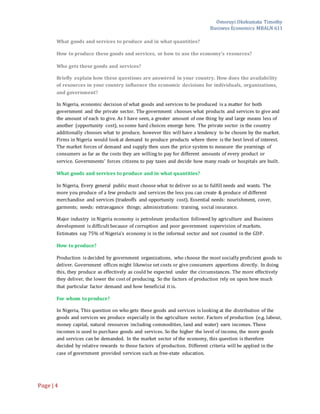
What goods and services to produce and in what quantities?
How to produce these goods and services, or how to use the economy's resources?
Who gets these goods and services?
Briefly explain how these questions are answered in your country. How does the availability
of resources in your country influence the economic decisions for individuals, organizations,
and government?
In Nigeria, economic decision of what goods and services to be produced is a matter for both
government and the private sector. The government chooses what products and services to give and
the amount of each to give. As I have seen, a greater amount of one thing by and large means less of
another (opportunity cost), so some hard choices emerge here. The private sector in the country
additionally chooses what to produce, however this will have a tendency to be chosen by the market.
Firms in Nigeria would look at demand to produce products where there is the best level of interest.
The market forces of demand and supply then uses the price system to measure the yearnings of
consumers as far as the costs they are willing to pay for different amounts of every product or
service. Governments’ forces citizens to pay taxes and decide how many roads or hospitals are built.
What goods and services to produce and in what quantities?
In Nigeria, Every general public must choose what to deliver so as to fulfill needs and wants. The
more you produce of a few products and services the less you can create & produce of different
merchandise and services (tradeoffs and opportunity cost). Essential needs: nourishment, cover,
garments; needs: extravagance things; administrations: training, social insurance.
Major industry in Nigeria economy is petroleum production followed by agriculture and Business
development is difficult because of corruption and poor government supervision of markets.
Estimates say 75% of Nigeria’s economy is in the informal sector and not counted in the GDP.
How to produce?
Production is decided by government organizations, who choose the most socially proficient goods to
deliver. Government offices might likewise set costs or give consumers apportions directly. In doing
this, they produce as effectively as could be expected under the circumstances. The more effectively
they deliver, the lower the cost of producing. So the factors of production rely on upon how much
that particular factor demand and how beneficial it is.
For whom to produce?
In Nigeria, This question on who gets these goods and services is looking at the distribution of the
goods and services we produce especially in the agriculture sector. Factors of production (e.g. labour,
money capital, natural resources including commodities, land and water) earn incomes. These
incomes is used to purchase goods and services. So the higher the level of income, the more goods
and services can be demanded. In the market sector of the economy, this question is therefore
decided by relative rewards to those factors of production. Different criteria will be applied in the
case of government provided services such as free-state education.
Omoruyi Okekumata Timothy
Business Economics MBALN 611
Page |5
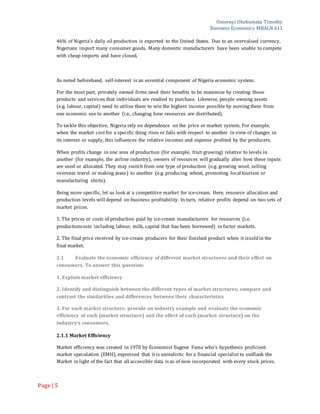
46% of Nigeria’s daily oil production is exported to the United States. Due to an overvalued currency,
Nigerians import many consumer goods. Many domestic manufacturers have been unable to compete
with cheap imports and have closed.
As noted beforehand, self-interest is an essential component of Nigeria economic system.
For the most part, privately owned firms need their benefits to be maximize by creating those
products and services that individuals are readied to purchase. Likewise, people owning assets
(e.g. labour, capital) need to utilize them to win the highest income possible by moving them from
one economic use to another (i.e., changing how resources are distributed).
To tackle this objective, Nigeria rely on dependence on the price or market system. For example,
when the market cost for a specific thing rises or falls with respect to another in view of changes in
its interest or supply, this influences the relative incomes and expense profited by the producers.
When profits change in one area of production (for example, fruit growing) relative to levels in
another (for example, the airline industry), owners of resources will gradually alter how these inputs
are used or allocated. They may switch from one type of production (e.g. growing wool, selling
overseas travel or making jeans) to another (e.g. producing wheat, promoting local tourism or
manufacturing shirts).
Being more specific, let us look at a competitive market for ice-cream. Here, resource allocation and
production levels will depend on business profitability. In turn, relative profits depend on two sets of
market prices.
1. The prices or costs of production paid by ice-cream manufacturers for resources (i.e.
productioncosts including labour, milk, capital that has been borrowed) in factor markets.
2. The final price received by ice-cream producers for their finished product when it issoldin the
final market.
2.1 Evaluate the economic efficiency of different market structures and their effect on
consumers. To answer this question:
1. Explain market efficiency
2. Identify and distinguish between the different types of market structures; compare and
contrast the similarities and differences between their characteristics
3. For each market structure, provide an industry example and evaluate the economic
efficiency of each (market structure) and the effect of each (market structure) on the
industry’s consumers.
2.1.1 Market Efficiency
Market efficiency was created in 1970 by Economist Eugene Fama who's hypothesis proficient
market speculation (EMH), expressed that it is unrealistic for a financial specialist to outflank the
Market in light of the fact that all accessible data is as of now incorporated with every stock prices.
Omoruyi Okekumata Timothy
Business Economics MBALN 611
Page |6
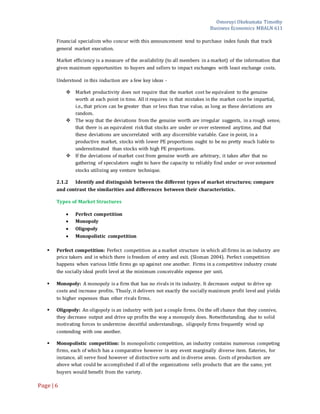
Financial specialists who concur with this announcement tend to purchase index funds that track
general market execution.
Market efficiency is a measure of the availability (to all members in a market) of the information that
gives maximum opportunities to buyers and sellers to impact exchanges with least exchange costs.
Understood in this induction are a few key ideas -
 Market productivity does not require that the market cost be equivalent to the genuine
worth at each point in time. All it requires is that mistakes in the market cost be impartial,
i.e., that prices can be greater than or less than true value, as long as these deviations are
random.
 The way that the deviations from the genuine worth are irregular suggests, in a rough sense,
that there is an equivalent risk that stocks are under or over esteemed anytime, and that
these deviations are uncorrelated with any discernible variable. Case in point, in a
productive market, stocks with lower PE proportions ought to be no pretty much liable to
underestimated than stocks with high PE proportions.
 If the deviations of market cost from genuine worth are arbitrary, it takes after that no
gathering of speculators ought to have the capacity to reliably find under or over esteemed
stocks utilizing any venture technique.
2.1.2 Identify and distinguish between the different types of market structures; compare
and contrast the similarities and differences between their characteristics.
Types of Market Structures
 Perfect competition
 Monopoly
 Oligopoly
 Monopolistic competition
 Perfect competition: Perfect competition as a market structure in which all firms in an industry are
price takers and in which there is freedom of entry and exit. (Sloman 2004). Perfect competition
happens when various little firms go up against one another. Firms in a competitive industry create
the socially ideal profit level at the minimum conceivable expense per unit.
 Monopoly: A monopoly is a firm that has no rivals in its industry. It decreases output to drive up
costs and increase profits. Thusly, it delivers not exactly the socially maximum profit level and yields
to higher expenses than other rivals firms.
 Oligopoly: An oligopoly is an industry with just a couple firms. On the off chance that they connive,
they decrease output and drive up profits the way a monopoly does. Notwithstanding, due to solid
motivating forces to undermine deceitful understandings, oligopoly firms frequently wind up
contending with one another.
 Monopolistic competition: In monopolistic competition, an industry contains numerous competing
firms, each of which has a comparative however in any event marginally diverse item. Eateries, for
instance, all serve food however of distinctive sorts and in diverse areas. Costs of production are
above what could be accomplished if all of the organizations sells products that are the same, yet
buyers would benefit from the variety.
Omoruyi Okekumata Timothy
Business Economics MBALN 611
Page |7
Basis Perfect Competition Monopoly
Monopolistic
Competition
Oligopoly
1. Number of
Sellers
Very large number of
sellers
Single seller Large number of
sellers
Few Big sellers
2. Nature of
Product
Homogeneous
Products
No Close Substitutes Closely related
but differentiated
Products
Products are homo-
geneous under Pure
Oligopoly and
differentiated under
Differentiated
Oligopoly
3. Entry and
Exit of Firms
Freedom of entry and
exit
Entry of new firms
and exit of old firms
is restricted
Freedom of entry
and exit
Restrictions on entry
of new firms
4. Demand
Curve
Perfectly elastic
demand curve
Downward sloping
demand curve (less
elastic)
Downward
sloping demand
(but more elastic)
Indeterminate
demand curve
5. Price Uniform price as
each firm is a price-
taker
Firm is a price-
maker. So, price
discrimination is
possible.
Firm has partial
control over price
due to product
differentiation.
Price rigidity due to
fear of price war
6. Selling Costs No selling costs are
incurred
Only informative
selling costs are
incurred
High selling costs
are spent
Huge selling costs are
incurred
7. Level of
Knowledge
Perfect Knowledge Imperfect
Knowledge
Imperfect
Knowledge
Imperfect Knowledge
The importance of market structure in an economy cannot be over emphasized as the effect of
market structure on an economy, it’s development or degradation is recently been realized. Thus we
as the part of the economy need to understand the value of this concept while dealing with others
(buyers/sellers) in any market place to yield the optimum benefit and to create win-win situation for
all of us.
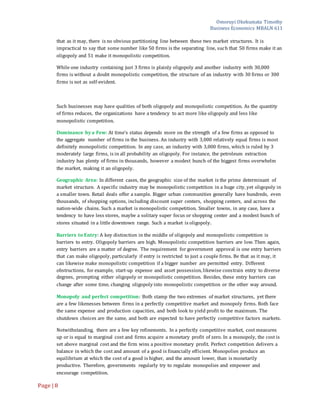
A comparison between these market structures offers a little insight into each
Many or Few: The essential difference between oligopoly and monopolistic competition is the
relative sizeand the market control of every firm in view of the quantity of rivals in the market. Be
Omoruyi Okekumata Timothy
Business Economics MBALN 611
Page |8
that as it may, there is no obvious partitioning line between these two market structures. It is
impractical to say that some number like 50 firms is the separating line, such that 50 firms make it an
oligopoly and 51 make it monopolistic competition.
While one industry containing just 3 firms is plainly oligopoly and another industry with 30,000
firms is without a doubt monopolistic competition, the structure of an industry with 30 firms or 300
firms is not as self-evident.
Such businesses may have qualities of both oligopoly and monopolistic competition. As the quantity
of firms reduces, the organizations have a tendency to act more like oligopoly and less like
monopolistic competition.
Dominance by a Few: At time’s status depends more on the strength of a few firms as opposed to
the aggregate number of firms in the business. An industry with 3,000 relatively equal firms is most
definitely monopolistic competition. In any case, an industry with 3,000 firms, which is ruled by 3
moderately large firms, is in all probability an oligopoly. For instance, the petroleum extraction
industry has plenty of firms in thousands, however a modest bunch of the biggest firms overwhelm
the market, making it an oligopoly.
Geographic Area: In different cases, the geographic size of the market is the prime determinant of
market structure. A specific industry may be monopolistic competition in a huge city, yet oligopoly in
a smaller town. Retail deals offer a sample. Bigger urban communities generally have hundreds, even
thousands, of shopping options, including discount super centers, shopping centers, and across the
nation-wide chains. Such a market is monopolistic competition. Smaller towns, in any case, have a
tendency to have less stores, maybe a solitary super focus or shopping center and a modest bunch of
stores situated in a little downtown range. Such a market is oligopoly.
Barriers to Entry: A key distinction in the middle of oligopoly and monopolistic competition is
barriers to entry. Oligopoly barriers are high. Monopolistic competition barriers are low. Then again,
entry barriers are a matter of degree. The requirement for government approval is one entry barriers
that can make oligopoly, particularly if entry is restricted to just a couple firms. Be that as it may, it
can likewise make monopolistic competition if a bigger number are permitted entry. Different
obstructions, for example, start-up expense and asset possession, likewise constrain entry to diverse
degrees, prompting either oligopoly or monopolistic competition. Besides, these entry barriers can
change after some time, changing oligopoly into monopolistic competition or the other way around.
Monopoly and perfect competition: Both stamp the two extremes of market structures, yet there
are a few likenesses between firms in a perfectly competitive market and monopoly firms. Both face
the same expense and production capacities, and both look to yield profit to the maximum. The
shutdown choices are the same, and both are expected to have perfectly competitive factors markets.
Notwithstanding, there are a few key refinements. In a perfectly competitive market, cost measures
up or is equal to marginal cost and firms acquire a monetary profit of zero. In a monopoly, the cost is
set above marginal cost and the firm wins a positive monetary profit. Perfect competition delivers a
balance in which the cost and amount of a good is financially efficient. Monopolies produce an
equilibrium at which the cost of a good is higher, and the amount lower, than is monetarily
productive. Therefore, governments regularly try to regulate monopolies and empower and
encourage competition.
Omoruyi Okekumata Timothy
Business Economics MBALN 611
Page |9
2.1.3 For each market structure, provide an industry example and evaluate the economic
efficiency of each (market structure) and the effect of each (market structure) on the
industry’s consumers.
 Perfect competition:
 Monopoly: Oil & Gas industry
 Oligopoly: Automobile industry
 Monopolistic competition: The restaurant business
Surveying the efficiency of firms is an effective method for assessing firms that are performing, and
the how the markets are also performing and the entire economies. There are a few types of
efficiency, including allocative and productive efficiency, specialized efficiency, "X" efficiency,
dynamic efficiency and social efficiency.
Monopoly
Possibility that the business is assumed control by a monopolist, the monopolist can charge a higher
cost to limitthe total output and along these lines lessen welfare and a rise in cost diminishes
consumer excess. For monopoly and control, market takes into account large scale manufacturing &
production. Here, a few expenses for every unit of output delivered can be lower and spread over
higher production volumes. Greater firms can accomplish higher efficiency and pick up economies of
substantial scale production.
The absence of competition may give a monopolist less motivating force to put resources into new
thoughts. Regardless of the possibility that the monopolist profits by economies of scale, they have
minimal motivation to control their prices and "X" inefficiencies will imply that there will be no
genuine cost investment funds contrasted with a competitive market.
Monopolistic competition
Since a good is constantly estimated higher than its marginal cost, a monopolistically competitive
market can never accomplish gainful or economic efficiency.
Suppliers in monopolistically focused firms will produce below their capacity.
Since monopolistic firms set costs higher than marginal costs, customer surplus is essentially short of
what it would be in a perfectly competitive market. This leads to deadweight loss and an overall
decrease in economic surplus.
Oligopoly
Oligopolies frequently manage economic benefits. They produce where P > minimum ATC so they are
not productively efficient. They produce where P > MC so they are not allocatively efficient. This
implies that in oligopolies, firms neither produce at all immoderate way nor produce the right
amount of an item as per society's needs. At this value, Output is beneath the output at which ATC is
minimal. There is an under allocation of resources.
Omoruyi Okekumata Timothy
Business Economics MBALN 611
Page |10
Oligopolists are less attractive than pure monopoly in light of the fact that government ordinarily
manages monopoly. Moreover, firms in an oligopoly-sort market, are at times enticed to conspire and
exhibit anti-competitive behaviour.. This confines competition, pushes up prices thereby reaping off
consumers. Higher costs decrease the purchasing power of individual incomes thereby bringing
down the expectations for the ordinary man.
Perfect competition
Some economists claim that perfect competition is not a good market structure for large amounts of
innovative work spending and the resulting item and process developments.
For sure the reality of the situation may prove that monopolistic or oligopolistic markets are more
powerful long run in making the environment for research and development to prosper. A cost-
reducing development from one manufacturer will, under the presumption of information that is
perfect, be quickly and without cost sent to the greater part of alternate suppliers.
That said a competitive market gives the order on firms to hold their expenses under control, to look
to minimize wastage of scarce assets and to avoid setting so as to take advantage of the buyer high
costs and getting a charge out of high profit revenues. In this sense, competition can instill
enhancements in both static and economic efficiency after over time.
The long run of perfect competition, in this manner, displays ideal levels of economic efficiency. In
any case, for this to be accomplished all of the conditions of perfect competition must hold –
including in related markets
References
1. Free Market Definition | Investopedia. 2015. Free Market Definition | Investopedia. [ONLINE]
Available at: http://www.investopedia.com/terms/f/freemarket.asp. [Accessed 29 November 2015
2. Free market - Wikipedia, the free encyclopedia. 2015. Free market - Wikipedia, the free encyclopedia.
[ONLINE] Available at: https://en.wikipedia.org/wiki/Free_market. [Accessed 29 November 2015
3. James Dick, Jeffrey Blais, Peter Moore, Civics and Government, Chapter One, How Has the Constitution
Shaped the Economic System in the United States?) Article updated April 17, 2014
4. Market economic system | features, advantages and disadvantages. 2015. Market economic system |
features, advantages and disadvantages. [ONLINE] Available at: http://www.dineshbakshi.com/as-a-
level-economics/basic-economic-ideas/117-revision-notes/1350-market-economic-system.
[Accessed 29 November 2015].
5. Economics Gummies: 2. The Allocation of Resources: How the Market Works; Market Failure.
[ONLINE] Available at: http://economics-gummies.blogspot.com.ng/2012/08/2-allocation-of-
resources-how-market.html. [Accessed 29 November 2015].
6. IB Economics/Introduction to Economics/Free Market vs Planned Economy - Wikibooks, open books
for an open world. 2015. IB Economics/Introduction to Economics/Free Market vs Planned Economy
- Wikibooks, open books for an open world. [ONLINE] Available at:
Omoruyi Okekumata Timothy
Business Economics MBALN 611
Page |11
https://en.wikibooks.org/wiki/IB_Economics/Introduction_to_Economics/Free_Market_vs_Planned_
Economy. [Accessed 01 December 2015].
7. Eyeing the Four Basic Market Structures - For Dummies . [ONLINE] Available at:
http://www.dummies.com/how-to/content/eyeing-the-four-basic-market-structures.html.
[Accessed 20 December 2015].
8. Hayek cited. Petsoulas, Christina. Hayek's Liberalism and Its Origins: His Idea of Spontaneous Order
and the Scottish Enlightenment. Routledge. 2001. p. 2
9. . 2015. . [ONLINE] Available at:
http://www.wcusd15.org/compardo/lessonuploads/African_Economic_Systems_DBQs.pdf.
[Accessed 19 December 2015].
10. Market Efficiency Definition | Investopedia. 2015. Market Efficiency Definition | Investopedia.
[ONLINE] Available at: http://www.investopedia.com/terms/m/marketefficiency.asp. [Accessed 19
December 2015].
11. . 2015. . [ONLINE] Available at:
http://mrscdeck.weebly.com/uploads/2/2/1/3/22133618/african_economies_comparecontrast.pdf
. [Accessed 19 December 2015].
12. The Comparison between Different Market Structures | Microeconomics. 2015. The Comparison
between Different Market Structures | Microeconomics. [ONLINE] Available at:
http://www.yourarticlelibrary.com/economics/the-comparison-between-different-market-
structures-microeconomics/9156/. [Accessed 19 December 2015].
13. Definition of market efficiency. 2015. Definition of market efficiency. [ONLINE] Available at:
http://pages.stern.nyu.edu/~adamodar/New_Home_Page/invemgmt/effdefn.htm. [Accessed 19
December 2015].
14. What are the three problems of economic organizations? Describe them with their solutions in various
economies. - Computer Programming. [ONLINE] Available at:
http://tanmayonrun.blogspot.com/2011/10/what-are-three-problems-of-economic.html. [Accessed
19 December 2015].
15. Boundless. “Market Differences Between Monopoly and Perfect Competition.” Boundless Economics.
Boundless, 21 Jul. 2015. Retrieved 19 Dec. 2015 from
https://www.boundless.com/economics/textbooks/boundless-economics-textbook/monopoly-
11/monopoly-production-and-pricing-decisions-and-profit-outcome-71/market-differences-
between-monopoly-and-perfect-competition-267-12364/
16. Oligopoly. 2015. Oligopoly. [ONLINE] Available at:
http://www.economicsonline.co.uk/Business_economics/Oligopoly.html. [Accessed 20 December
2015].
17. Boundless. “Efficiency of Monopolistic Competition.” Boundless Economics. Boundless, 21 Jul. 2015.
Retrieved 19 Dec. 2015 from https://www.boundless.com/economics/textbooks/boundless-
Omoruyi Okekumata Timothy
Business Economics MBALN 611
Page |12
economics-textbook/monopolistic-competition-12/monopolistic-competition-75/efficiency-of-
monopolistic-competition-286-12383/
18. Market Structure: Monopoly, Oligopoly, Monopolistic and Perfect Competition. 2015. Market
Structure: Monopoly, Oligopoly, Monopolistic and Perfect Competition. [ONLINE] Available at:
http://fintowin.com/2011/07/market-structure-monopoly-oligopoly-monopolistic-and-perfect-
competition/. [Accessed 20 December 2015].

Assignment 1

  • 1.
    Question 1 -3 Business Economics MBALN 611 Omoruyi Okekumata
  • 2.
    Omoruyi Okekumata Timothy BusinessEconomics MBALN 611 Page |1 ExecutiveSummary Resources are the ‘inputs’ used in the production or supply of goods or services. Without resources (also called factors of production), no goods and services can be produced. Here, national output (measured by the gross domestic productor GDP) wouldbe zero. There are two key things that limit or determine a nation’s potential level of GDP,or the economy’s productive capacity: 1. The volumeor quantity of resources available for use 2. How efficiently the available resources are being employed (i.e. efficiency orproductivity reflects the level of output produced from each unit of input or resource used). By limiting the volume of goods and services that can be produced by a country,resources also affecta nation’s material living standards. There are three main types of resource or productiveinputs supplied or made available in the economy —natural resources, labour resources (including entrepreneurship) and resources that involvecapital equipment.
  • 3.
    Omoruyi Okekumata Timothy BusinessEconomics MBALN 611 Page |2  Introduction Definition of Free market A free market is a market economy where the government doesn't control indispensable resources, profitable merchandise or any other available major fragment of the economy. In this way, associations run by the individuals focus on how the economy runs, how supply may be generated, and the thing that would be demanded, and so on. A totally allowed advertise will be an ideate structure of a market economy that place purchasers and dealers are permitted to transact uninhibitedly (i. e. Buy/sell/trade) dependent upon a shared understanding once value without state intercession in the manifestation for taxes, subsidies alternately regulation. 1.0 Major Concepts of Free Market Supply and demand One of the concepts to a free market economy will be supply. Supply is the readiness and capacity of sellers or suppliers to make accessible distinctive conceivable amounts of a good by any means applicable costs. It also portrays the aggregate sum of a particular good or administration that is accessible to consumers. For a free market economy, the producer gets to choose the thing he produce, what amount of what to produce, what to accuse customers for the individuals goods, Also the thing that he should pay employees. These choices for a free-market economy would be impacted toward the weights from claiming competition, supply, and demand. Demand is the outflow of readiness and capacity of a potential purchaser to gain certain amounts of an item for different conceivable costs the purchaser can sensibly offer. Demand can be considered as a timetable of costs and amounts in the mind of the buyer. Economic equilibrium A condition or state in which economic strengths are adjusted. These economic variables will be unaltered from their equilibrium values without outside impacts. Economic equilibrium might likewise be characterized as the point where supply meets demand for an item – the equilibrium price is where the hypothetical supply and demand curves intersect. It also makes beyond any doubt that everybody can need equivalent access to the business sectors. For example, government exerts punishments on monopolies, which unjustifiably limit rivalry. The government watches to verify if nobody is unjustifiably manipulating the individuals markets and ensure that every information is dispersed equally. Spontaneous order Friedrich Hayek advanced the traditional liberal view that market economies advance unconstrained request which results in a superior "allotment of societal assets than any design could achieve."[8] According to this view, in market economies are described by the development of complex value- based systems which deliver and appropriate merchandise and administrations all through the economy. These systems are not planned, but rather by and by develop as a consequence of decentralized individual monetary choices. The thought of unconstrained request is an elaboration on the undetectable hand proposed by Adam Smith in The Wealth of Nations. Smith composed that the person who
  • 4.
    Omoruyi Okekumata Timothy BusinessEconomics MBALN 611 Page |3 By preferring the support of domestic to that of foreign industry, he intends only his own security; and by directing that industry in such a manner as its produce may be of the greatest value, he intends only his own gain, and he is in this, as in many other cases, led by an invisiblehand to promote an end which was no part of his intention. Nor is it always the worse for society that it was no part of it. By pursuing his own interest [an individual] frequently promotes that of the society more effectually than when he really intends to promote it. I have never known much good done by those who affected to trade for the [common] good. — Adam Smith, Wealth of Nations "Every individual... by directing that industry in such a manner as its produce may be of the greatest value, he intends only his own gain, and he is in this, as in many other cases, led by an invisible hand to promote an end which was no part of his intention. " -- Adam Smith (1723 - 1790) Scottish philosopher 1.2 Critical Analysis of free Market allocation How will run an economy proficiently will be the principal concern about resource allotment. Trading and lending effectiveness is measured with extra welfare attained without intensifying any outcome. It implies that new reallocation of resource must not just have the ability to maintain the existing level but as well as accomplish new statures. Alternatively, reallocation might have a chance to be gainful some place yet all the causing losses elsewhere. The fundamental destination may be will an increment aggravator profitability of the economy. The first reason is purely intellectual due to how it responds rapidly to the people’s wants: Thus, organizations will produce what individuals need as a result it can be additional gainful inasmuch as anything which will not be requested will be taken out of production. The second reason is functional on the context of variety and creativity. I have become convinced that the system of free market brings about goods and services variety. Free market system would bring about total combination of products and service s that are accessible in the market to match everybody’s taste. The third reason would be based on the encouragement of Productive utilization of resources benefit being the sole motive; will drive the organizations to prepare products and services and what are more administrations at bringing down cost and additional proficiently. This will prompt organizations utilizing the most recent innovation to prepare at reduced costs. Market forces and the price mechanism without govt. intervention allocate resources using the signaling work that help to adjust to show where the resources would required and where they are not. & also reflect scarcities and surpluses when prices climb and fall. This helps when price rises due to strong demand from consumers, therefore allows a signal to be sent to suppliers to increase production to match up higher demand whether there may be overabundance supply in the market the price mechanism will assist to annihilate a surplus of goods by permitting a fall in the market price. 2.0 Every society, regardless of its wealth and power, must make certain choices about production and distribution. Specifically, every society faces three basic economic decisions:
  • 5.
    Omoruyi Okekumata Timothy BusinessEconomics MBALN 611 Page |4 What goods and services to produce and in what quantities? How to produce these goods and services, or how to use the economy's resources? Who gets these goods and services? Briefly explain how these questions are answered in your country. How does the availability of resources in your country influence the economic decisions for individuals, organizations, and government? In Nigeria, economic decision of what goods and services to be produced is a matter for both government and the private sector. The government chooses what products and services to give and the amount of each to give. As I have seen, a greater amount of one thing by and large means less of another (opportunity cost), so some hard choices emerge here. The private sector in the country additionally chooses what to produce, however this will have a tendency to be chosen by the market. Firms in Nigeria would look at demand to produce products where there is the best level of interest. The market forces of demand and supply then uses the price system to measure the yearnings of consumers as far as the costs they are willing to pay for different amounts of every product or service. Governments’ forces citizens to pay taxes and decide how many roads or hospitals are built. What goods and services to produce and in what quantities? In Nigeria, Every general public must choose what to deliver so as to fulfill needs and wants. The more you produce of a few products and services the less you can create & produce of different merchandise and services (tradeoffs and opportunity cost). Essential needs: nourishment, cover, garments; needs: extravagance things; administrations: training, social insurance. Major industry in Nigeria economy is petroleum production followed by agriculture and Business development is difficult because of corruption and poor government supervision of markets. Estimates say 75% of Nigeria’s economy is in the informal sector and not counted in the GDP. How to produce? Production is decided by government organizations, who choose the most socially proficient goods to deliver. Government offices might likewise set costs or give consumers apportions directly. In doing this, they produce as effectively as could be expected under the circumstances. The more effectively they deliver, the lower the cost of producing. So the factors of production rely on upon how much that particular factor demand and how beneficial it is. For whom to produce? In Nigeria, This question on who gets these goods and services is looking at the distribution of the goods and services we produce especially in the agriculture sector. Factors of production (e.g. labour, money capital, natural resources including commodities, land and water) earn incomes. These incomes is used to purchase goods and services. So the higher the level of income, the more goods and services can be demanded. In the market sector of the economy, this question is therefore decided by relative rewards to those factors of production. Different criteria will be applied in the case of government provided services such as free-state education.
  • 6.
    Omoruyi Okekumata Timothy BusinessEconomics MBALN 611 Page |5 46% of Nigeria’s daily oil production is exported to the United States. Due to an overvalued currency, Nigerians import many consumer goods. Many domestic manufacturers have been unable to compete with cheap imports and have closed. As noted beforehand, self-interest is an essential component of Nigeria economic system. For the most part, privately owned firms need their benefits to be maximize by creating those products and services that individuals are readied to purchase. Likewise, people owning assets (e.g. labour, capital) need to utilize them to win the highest income possible by moving them from one economic use to another (i.e., changing how resources are distributed). To tackle this objective, Nigeria rely on dependence on the price or market system. For example, when the market cost for a specific thing rises or falls with respect to another in view of changes in its interest or supply, this influences the relative incomes and expense profited by the producers. When profits change in one area of production (for example, fruit growing) relative to levels in another (for example, the airline industry), owners of resources will gradually alter how these inputs are used or allocated. They may switch from one type of production (e.g. growing wool, selling overseas travel or making jeans) to another (e.g. producing wheat, promoting local tourism or manufacturing shirts). Being more specific, let us look at a competitive market for ice-cream. Here, resource allocation and production levels will depend on business profitability. In turn, relative profits depend on two sets of market prices. 1. The prices or costs of production paid by ice-cream manufacturers for resources (i.e. productioncosts including labour, milk, capital that has been borrowed) in factor markets. 2. The final price received by ice-cream producers for their finished product when it issoldin the final market. 2.1 Evaluate the economic efficiency of different market structures and their effect on consumers. To answer this question: 1. Explain market efficiency 2. Identify and distinguish between the different types of market structures; compare and contrast the similarities and differences between their characteristics 3. For each market structure, provide an industry example and evaluate the economic efficiency of each (market structure) and the effect of each (market structure) on the industry’s consumers. 2.1.1 Market Efficiency Market efficiency was created in 1970 by Economist Eugene Fama who's hypothesis proficient market speculation (EMH), expressed that it is unrealistic for a financial specialist to outflank the Market in light of the fact that all accessible data is as of now incorporated with every stock prices.
  • 7.
    Omoruyi Okekumata Timothy BusinessEconomics MBALN 611 Page |6 Financial specialists who concur with this announcement tend to purchase index funds that track general market execution. Market efficiency is a measure of the availability (to all members in a market) of the information that gives maximum opportunities to buyers and sellers to impact exchanges with least exchange costs. Understood in this induction are a few key ideas -  Market productivity does not require that the market cost be equivalent to the genuine worth at each point in time. All it requires is that mistakes in the market cost be impartial, i.e., that prices can be greater than or less than true value, as long as these deviations are random.  The way that the deviations from the genuine worth are irregular suggests, in a rough sense, that there is an equivalent risk that stocks are under or over esteemed anytime, and that these deviations are uncorrelated with any discernible variable. Case in point, in a productive market, stocks with lower PE proportions ought to be no pretty much liable to underestimated than stocks with high PE proportions.  If the deviations of market cost from genuine worth are arbitrary, it takes after that no gathering of speculators ought to have the capacity to reliably find under or over esteemed stocks utilizing any venture technique. 2.1.2 Identify and distinguish between the different types of market structures; compare and contrast the similarities and differences between their characteristics. Types of Market Structures  Perfect competition  Monopoly  Oligopoly  Monopolistic competition  Perfect competition: Perfect competition as a market structure in which all firms in an industry are price takers and in which there is freedom of entry and exit. (Sloman 2004). Perfect competition happens when various little firms go up against one another. Firms in a competitive industry create the socially ideal profit level at the minimum conceivable expense per unit.  Monopoly: A monopoly is a firm that has no rivals in its industry. It decreases output to drive up costs and increase profits. Thusly, it delivers not exactly the socially maximum profit level and yields to higher expenses than other rivals firms.  Oligopoly: An oligopoly is an industry with just a couple firms. On the off chance that they connive, they decrease output and drive up profits the way a monopoly does. Notwithstanding, due to solid motivating forces to undermine deceitful understandings, oligopoly firms frequently wind up contending with one another.  Monopolistic competition: In monopolistic competition, an industry contains numerous competing firms, each of which has a comparative however in any event marginally diverse item. Eateries, for instance, all serve food however of distinctive sorts and in diverse areas. Costs of production are above what could be accomplished if all of the organizations sells products that are the same, yet buyers would benefit from the variety.
  • 8.
    Omoruyi Okekumata Timothy BusinessEconomics MBALN 611 Page |7 Basis Perfect Competition Monopoly Monopolistic Competition Oligopoly 1. Number of Sellers Very large number of sellers Single seller Large number of sellers Few Big sellers 2. Nature of Product Homogeneous Products No Close Substitutes Closely related but differentiated Products Products are homo- geneous under Pure Oligopoly and differentiated under Differentiated Oligopoly 3. Entry and Exit of Firms Freedom of entry and exit Entry of new firms and exit of old firms is restricted Freedom of entry and exit Restrictions on entry of new firms 4. Demand Curve Perfectly elastic demand curve Downward sloping demand curve (less elastic) Downward sloping demand (but more elastic) Indeterminate demand curve 5. Price Uniform price as each firm is a price- taker Firm is a price- maker. So, price discrimination is possible. Firm has partial control over price due to product differentiation. Price rigidity due to fear of price war 6. Selling Costs No selling costs are incurred Only informative selling costs are incurred High selling costs are spent Huge selling costs are incurred 7. Level of Knowledge Perfect Knowledge Imperfect Knowledge Imperfect Knowledge Imperfect Knowledge The importance of market structure in an economy cannot be over emphasized as the effect of market structure on an economy, it’s development or degradation is recently been realized. Thus we as the part of the economy need to understand the value of this concept while dealing with others (buyers/sellers) in any market place to yield the optimum benefit and to create win-win situation for all of us. A comparison between these market structures offers a little insight into each Many or Few: The essential difference between oligopoly and monopolistic competition is the relative sizeand the market control of every firm in view of the quantity of rivals in the market. Be
  • 9.
    Omoruyi Okekumata Timothy BusinessEconomics MBALN 611 Page |8 that as it may, there is no obvious partitioning line between these two market structures. It is impractical to say that some number like 50 firms is the separating line, such that 50 firms make it an oligopoly and 51 make it monopolistic competition. While one industry containing just 3 firms is plainly oligopoly and another industry with 30,000 firms is without a doubt monopolistic competition, the structure of an industry with 30 firms or 300 firms is not as self-evident. Such businesses may have qualities of both oligopoly and monopolistic competition. As the quantity of firms reduces, the organizations have a tendency to act more like oligopoly and less like monopolistic competition. Dominance by a Few: At time’s status depends more on the strength of a few firms as opposed to the aggregate number of firms in the business. An industry with 3,000 relatively equal firms is most definitely monopolistic competition. In any case, an industry with 3,000 firms, which is ruled by 3 moderately large firms, is in all probability an oligopoly. For instance, the petroleum extraction industry has plenty of firms in thousands, however a modest bunch of the biggest firms overwhelm the market, making it an oligopoly. Geographic Area: In different cases, the geographic size of the market is the prime determinant of market structure. A specific industry may be monopolistic competition in a huge city, yet oligopoly in a smaller town. Retail deals offer a sample. Bigger urban communities generally have hundreds, even thousands, of shopping options, including discount super centers, shopping centers, and across the nation-wide chains. Such a market is monopolistic competition. Smaller towns, in any case, have a tendency to have less stores, maybe a solitary super focus or shopping center and a modest bunch of stores situated in a little downtown range. Such a market is oligopoly. Barriers to Entry: A key distinction in the middle of oligopoly and monopolistic competition is barriers to entry. Oligopoly barriers are high. Monopolistic competition barriers are low. Then again, entry barriers are a matter of degree. The requirement for government approval is one entry barriers that can make oligopoly, particularly if entry is restricted to just a couple firms. Be that as it may, it can likewise make monopolistic competition if a bigger number are permitted entry. Different obstructions, for example, start-up expense and asset possession, likewise constrain entry to diverse degrees, prompting either oligopoly or monopolistic competition. Besides, these entry barriers can change after some time, changing oligopoly into monopolistic competition or the other way around. Monopoly and perfect competition: Both stamp the two extremes of market structures, yet there are a few likenesses between firms in a perfectly competitive market and monopoly firms. Both face the same expense and production capacities, and both look to yield profit to the maximum. The shutdown choices are the same, and both are expected to have perfectly competitive factors markets. Notwithstanding, there are a few key refinements. In a perfectly competitive market, cost measures up or is equal to marginal cost and firms acquire a monetary profit of zero. In a monopoly, the cost is set above marginal cost and the firm wins a positive monetary profit. Perfect competition delivers a balance in which the cost and amount of a good is financially efficient. Monopolies produce an equilibrium at which the cost of a good is higher, and the amount lower, than is monetarily productive. Therefore, governments regularly try to regulate monopolies and empower and encourage competition.
  • 10.
    Omoruyi Okekumata Timothy BusinessEconomics MBALN 611 Page |9 2.1.3 For each market structure, provide an industry example and evaluate the economic efficiency of each (market structure) and the effect of each (market structure) on the industry’s consumers.  Perfect competition:  Monopoly: Oil & Gas industry  Oligopoly: Automobile industry  Monopolistic competition: The restaurant business Surveying the efficiency of firms is an effective method for assessing firms that are performing, and the how the markets are also performing and the entire economies. There are a few types of efficiency, including allocative and productive efficiency, specialized efficiency, "X" efficiency, dynamic efficiency and social efficiency. Monopoly Possibility that the business is assumed control by a monopolist, the monopolist can charge a higher cost to limitthe total output and along these lines lessen welfare and a rise in cost diminishes consumer excess. For monopoly and control, market takes into account large scale manufacturing & production. Here, a few expenses for every unit of output delivered can be lower and spread over higher production volumes. Greater firms can accomplish higher efficiency and pick up economies of substantial scale production. The absence of competition may give a monopolist less motivating force to put resources into new thoughts. Regardless of the possibility that the monopolist profits by economies of scale, they have minimal motivation to control their prices and "X" inefficiencies will imply that there will be no genuine cost investment funds contrasted with a competitive market. Monopolistic competition Since a good is constantly estimated higher than its marginal cost, a monopolistically competitive market can never accomplish gainful or economic efficiency. Suppliers in monopolistically focused firms will produce below their capacity. Since monopolistic firms set costs higher than marginal costs, customer surplus is essentially short of what it would be in a perfectly competitive market. This leads to deadweight loss and an overall decrease in economic surplus. Oligopoly Oligopolies frequently manage economic benefits. They produce where P > minimum ATC so they are not productively efficient. They produce where P > MC so they are not allocatively efficient. This implies that in oligopolies, firms neither produce at all immoderate way nor produce the right amount of an item as per society's needs. At this value, Output is beneath the output at which ATC is minimal. There is an under allocation of resources.
  • 11.
    Omoruyi Okekumata Timothy BusinessEconomics MBALN 611 Page |10 Oligopolists are less attractive than pure monopoly in light of the fact that government ordinarily manages monopoly. Moreover, firms in an oligopoly-sort market, are at times enticed to conspire and exhibit anti-competitive behaviour.. This confines competition, pushes up prices thereby reaping off consumers. Higher costs decrease the purchasing power of individual incomes thereby bringing down the expectations for the ordinary man. Perfect competition Some economists claim that perfect competition is not a good market structure for large amounts of innovative work spending and the resulting item and process developments. For sure the reality of the situation may prove that monopolistic or oligopolistic markets are more powerful long run in making the environment for research and development to prosper. A cost- reducing development from one manufacturer will, under the presumption of information that is perfect, be quickly and without cost sent to the greater part of alternate suppliers. That said a competitive market gives the order on firms to hold their expenses under control, to look to minimize wastage of scarce assets and to avoid setting so as to take advantage of the buyer high costs and getting a charge out of high profit revenues. In this sense, competition can instill enhancements in both static and economic efficiency after over time. The long run of perfect competition, in this manner, displays ideal levels of economic efficiency. In any case, for this to be accomplished all of the conditions of perfect competition must hold – including in related markets References 1. Free Market Definition | Investopedia. 2015. Free Market Definition | Investopedia. [ONLINE] Available at: http://www.investopedia.com/terms/f/freemarket.asp. [Accessed 29 November 2015 2. Free market - Wikipedia, the free encyclopedia. 2015. Free market - Wikipedia, the free encyclopedia. [ONLINE] Available at: https://en.wikipedia.org/wiki/Free_market. [Accessed 29 November 2015 3. James Dick, Jeffrey Blais, Peter Moore, Civics and Government, Chapter One, How Has the Constitution Shaped the Economic System in the United States?) Article updated April 17, 2014 4. Market economic system | features, advantages and disadvantages. 2015. Market economic system | features, advantages and disadvantages. [ONLINE] Available at: http://www.dineshbakshi.com/as-a- level-economics/basic-economic-ideas/117-revision-notes/1350-market-economic-system. [Accessed 29 November 2015]. 5. Economics Gummies: 2. The Allocation of Resources: How the Market Works; Market Failure. [ONLINE] Available at: http://economics-gummies.blogspot.com.ng/2012/08/2-allocation-of- resources-how-market.html. [Accessed 29 November 2015]. 6. IB Economics/Introduction to Economics/Free Market vs Planned Economy - Wikibooks, open books for an open world. 2015. IB Economics/Introduction to Economics/Free Market vs Planned Economy - Wikibooks, open books for an open world. [ONLINE] Available at:
  • 12.
    Omoruyi Okekumata Timothy BusinessEconomics MBALN 611 Page |11 https://en.wikibooks.org/wiki/IB_Economics/Introduction_to_Economics/Free_Market_vs_Planned_ Economy. [Accessed 01 December 2015]. 7. Eyeing the Four Basic Market Structures - For Dummies . [ONLINE] Available at: http://www.dummies.com/how-to/content/eyeing-the-four-basic-market-structures.html. [Accessed 20 December 2015]. 8. Hayek cited. Petsoulas, Christina. Hayek's Liberalism and Its Origins: His Idea of Spontaneous Order and the Scottish Enlightenment. Routledge. 2001. p. 2 9. . 2015. . [ONLINE] Available at: http://www.wcusd15.org/compardo/lessonuploads/African_Economic_Systems_DBQs.pdf. [Accessed 19 December 2015]. 10. Market Efficiency Definition | Investopedia. 2015. Market Efficiency Definition | Investopedia. [ONLINE] Available at: http://www.investopedia.com/terms/m/marketefficiency.asp. [Accessed 19 December 2015]. 11. . 2015. . [ONLINE] Available at: http://mrscdeck.weebly.com/uploads/2/2/1/3/22133618/african_economies_comparecontrast.pdf . [Accessed 19 December 2015]. 12. The Comparison between Different Market Structures | Microeconomics. 2015. The Comparison between Different Market Structures | Microeconomics. [ONLINE] Available at: http://www.yourarticlelibrary.com/economics/the-comparison-between-different-market- structures-microeconomics/9156/. [Accessed 19 December 2015]. 13. Definition of market efficiency. 2015. Definition of market efficiency. [ONLINE] Available at: http://pages.stern.nyu.edu/~adamodar/New_Home_Page/invemgmt/effdefn.htm. [Accessed 19 December 2015]. 14. What are the three problems of economic organizations? Describe them with their solutions in various economies. - Computer Programming. [ONLINE] Available at: http://tanmayonrun.blogspot.com/2011/10/what-are-three-problems-of-economic.html. [Accessed 19 December 2015]. 15. Boundless. “Market Differences Between Monopoly and Perfect Competition.” Boundless Economics. Boundless, 21 Jul. 2015. Retrieved 19 Dec. 2015 from https://www.boundless.com/economics/textbooks/boundless-economics-textbook/monopoly- 11/monopoly-production-and-pricing-decisions-and-profit-outcome-71/market-differences- between-monopoly-and-perfect-competition-267-12364/ 16. Oligopoly. 2015. Oligopoly. [ONLINE] Available at: http://www.economicsonline.co.uk/Business_economics/Oligopoly.html. [Accessed 20 December 2015]. 17. Boundless. “Efficiency of Monopolistic Competition.” Boundless Economics. Boundless, 21 Jul. 2015. Retrieved 19 Dec. 2015 from https://www.boundless.com/economics/textbooks/boundless-
  • 13.
    Omoruyi Okekumata Timothy BusinessEconomics MBALN 611 Page |12 economics-textbook/monopolistic-competition-12/monopolistic-competition-75/efficiency-of- monopolistic-competition-286-12383/ 18. Market Structure: Monopoly, Oligopoly, Monopolistic and Perfect Competition. 2015. Market Structure: Monopoly, Oligopoly, Monopolistic and Perfect Competition. [ONLINE] Available at: http://fintowin.com/2011/07/market-structure-monopoly-oligopoly-monopolistic-and-perfect- competition/. [Accessed 20 December 2015].