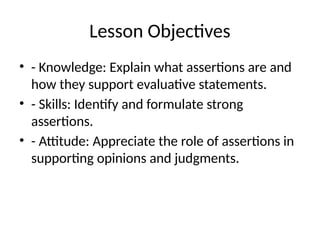
Lesson Objectives
• -Knowledge: Explain what assertions are and
how they support evaluative statements.
• - Skills: Identify and formulate strong
assertions.
• - Attitude: Appreciate the role of assertions in
supporting opinions and judgments.
3.
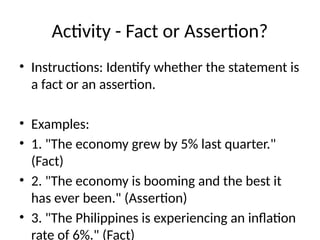
Activity - Factor Assertion?
• Instructions: Identify whether the statement is
a fact or an assertion.
• Examples:
• 1. "The economy grew by 5% last quarter."
(Fact)
• 2. "The economy is booming and the best it
has ever been." (Assertion)
• 3. "The Philippines is experiencing an inflation
rate of 6%." (Fact)
4.
What is anAssertion?
• A confident statement of fact or belief that
supports an evaluative judgment.
• Example: "This film is a masterpiece because
of its compelling storytelling."
5.
Weak vs. StrongAssertions
• - Weak Assertion: "This film is great!"
• - Strong Assertion: "This film is a masterpiece
because of its compelling storytelling and
well-developed characters."
• - Key Takeaway: Strong assertions provide
justification or evidence.
6.
Activity - StrengtheningWeak
Assertions
• - Weak: "This restaurant is bad."
• - Strong: "This restaurant is bad because the
service is slow, and the food is overpriced."
• - Weak: "Online learning is difficult."
• - Strong: "Online learning is difficult because
not all students have access to a stable
internet connection."
7.
Debate Activity -Defending
Assertions
• Topic: "Should schools require uniforms?"
• Instructions:
• 1. Write an assertion supporting your opinion.
• 2. Discuss with a partner and defend your
assertion.
• 3. Share in class and analyze strengths of each
assertion.
8.
Real-Life Applications
• -Persuading a friend to watch a movie.
• - Writing a product review.
• - Defending a point in a discussion.
9.
Summary
• - Strongassertions make evaluative
statements more credible.
• - An effective assertion includes justification or
evidence.
10.
Short Quiz
• -Identify whether the statement is a weak or
strong assertion.
• - Improve weak assertions by adding
justification.
11.
Homework
• - Task:Write an assertion about a school
policy and support it with evidence.
• - Example: "The school should extend lunch
breaks because students need more time to
eat and socialize."