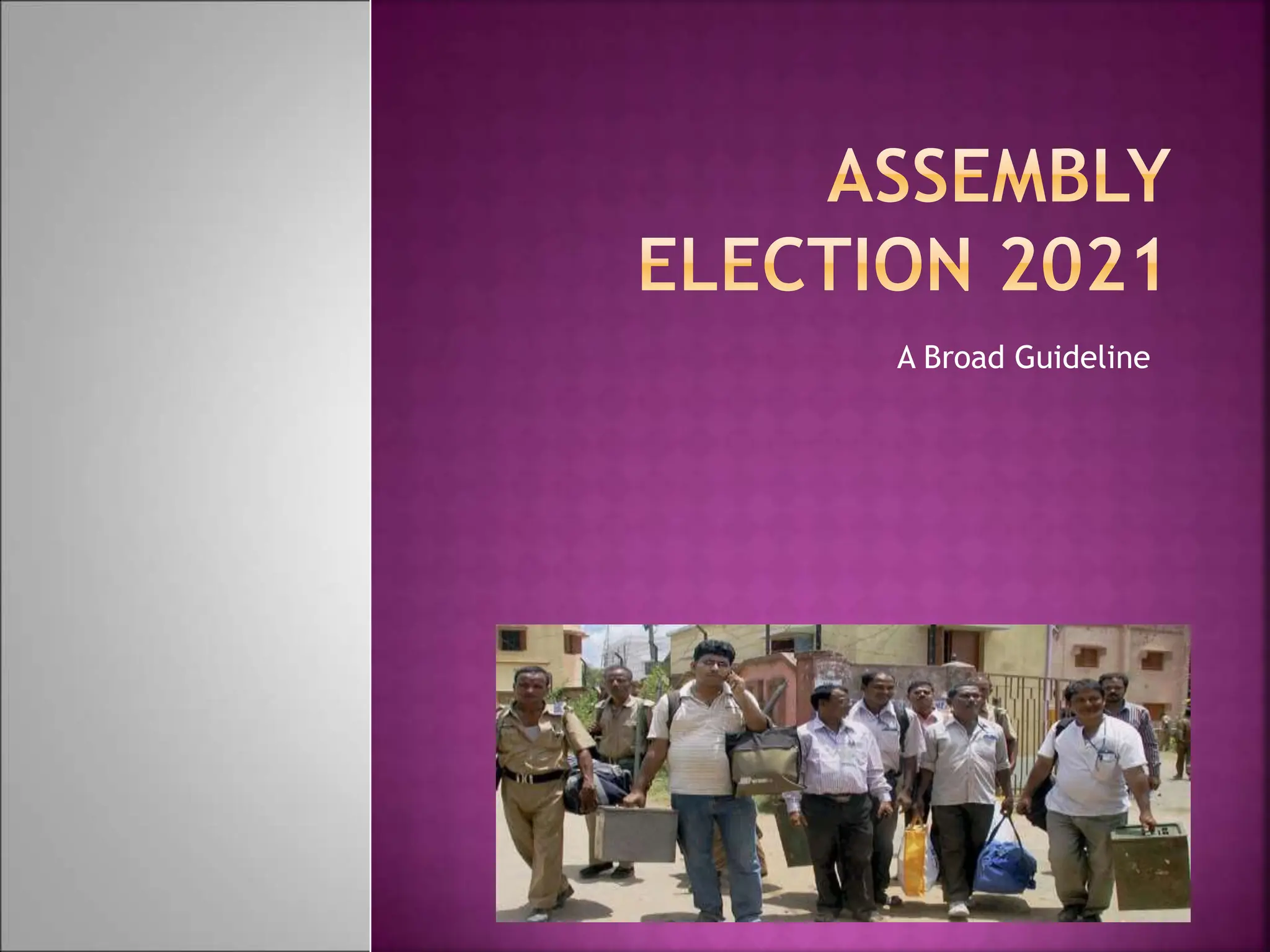
A Broad Guideline
PLEASE NOTE
This Power-point “manual” has been prepared as a
summary guide and we have tried to include all the
important aspects of Polls for ready reference
purpose only. THE LEGAL MANDATE OF THE
ELECTION COMMISSION OF INDIA IS THAT ALL
PRESIDING OFFICERS SHOULD BE THOROUGHLY
FAMILIAR WITH THE PRESIDING OFFICER”S
HANDBOOK. This manual, consequently, should
never be treated as a substitute for the Presiding
Officer’s Handbook. In addition, the Presiding
Officer must be vigilant and keep a close watch on
the announcements from ECI from time to time.
 A Polling Party is a group of 4 - 5 Govt. officials, who are
notified by the District Election Officer under Section – 26
of the RP Act, 1951 to conduct a free and fair poll at a
particular Polling Station (PS) on a pre-notified date and
time.
 The Polling Party is responsible for complete poll related
functions of the particular PS assigned to them starting from
collection to deposit of poll materials at a place notified for
the purpose.
 They should be well acquainted with the Representation of
the People Act, 1950 & 1951 and relevant rules under the
Conduct of Elections Rules, 1961, as well as the
Handbook for Presiding Officers, EVM Manual, and
instructions from the Returning Officer.
 At a single election, the polling party will normally
consist of one Presiding Officer (appointed under the
provisions of section 26 of the RP Act 1951) and
three Polling Officers.
 At a simultaneous election, the polling party will
consist of 5 Polling Officers, besides the Presiding
Officer.
 It will be the responsibility of the Polling Party to carry
out the entire voting process in the particular Polling
Station in a free and fair manner.
 They should be well-conversant with all relevant rules
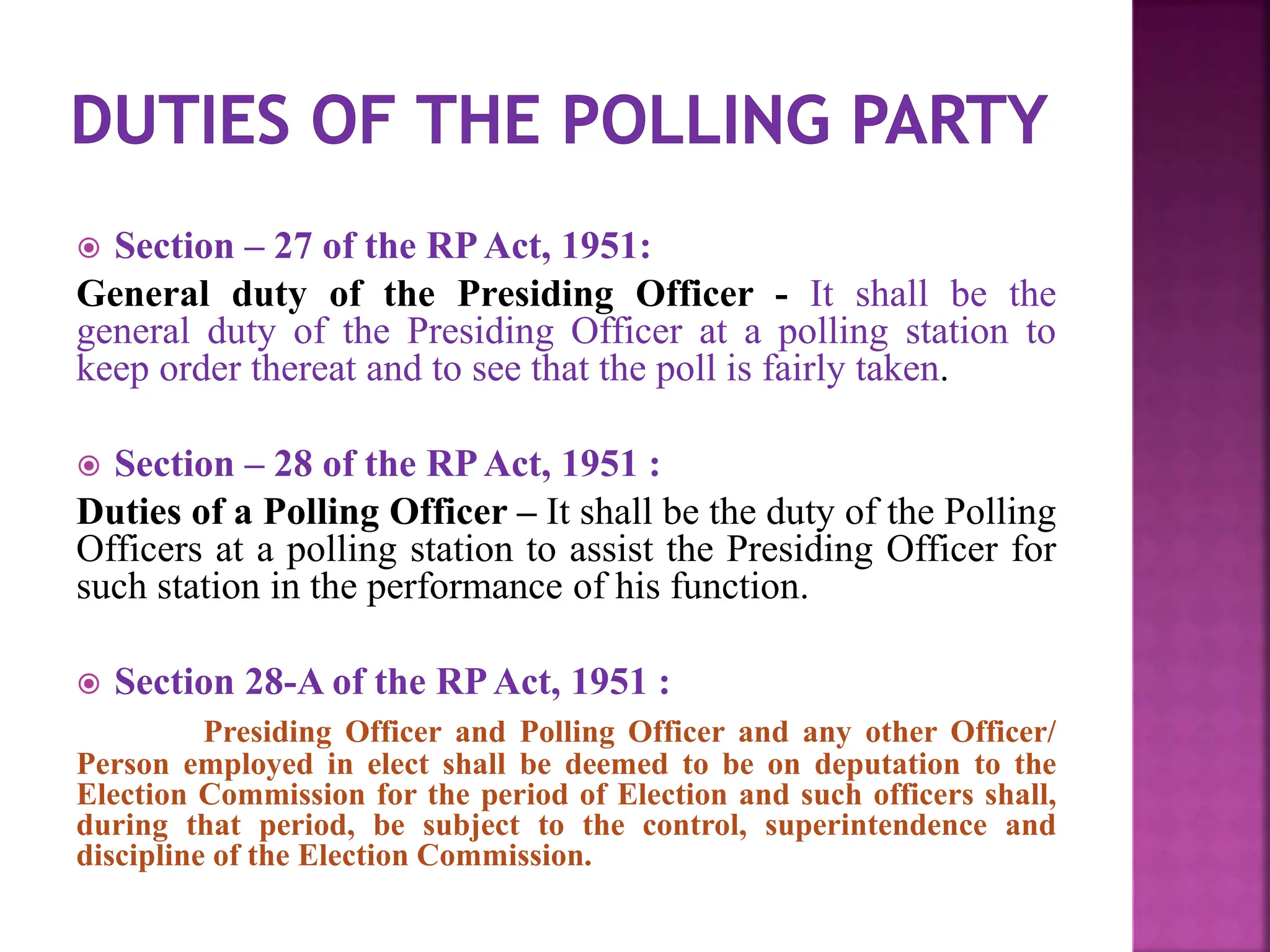
 Section – 27 of the RPAct, 1951:
General duty of the Presiding Officer - It shall be the
general duty of the Presiding Officer at a polling station to
keep order thereat and to see that the poll is fairly taken.
 Section – 28 of the RPAct, 1951 :
Duties of a Polling Officer – It shall be the duty of the Polling
Officers at a polling station to assist the Presiding Officer for
such station in the performance of his function.
 Section 28-A of the RPAct, 1951 :
Presiding Officer and Polling Officer and any other Officer/
Person employed in elect shall be deemed to be on deputation to the
Election Commission for the period of Election and such officers shall,
during that period, be subject to the control, superintendence and
discipline of the Election Commission.
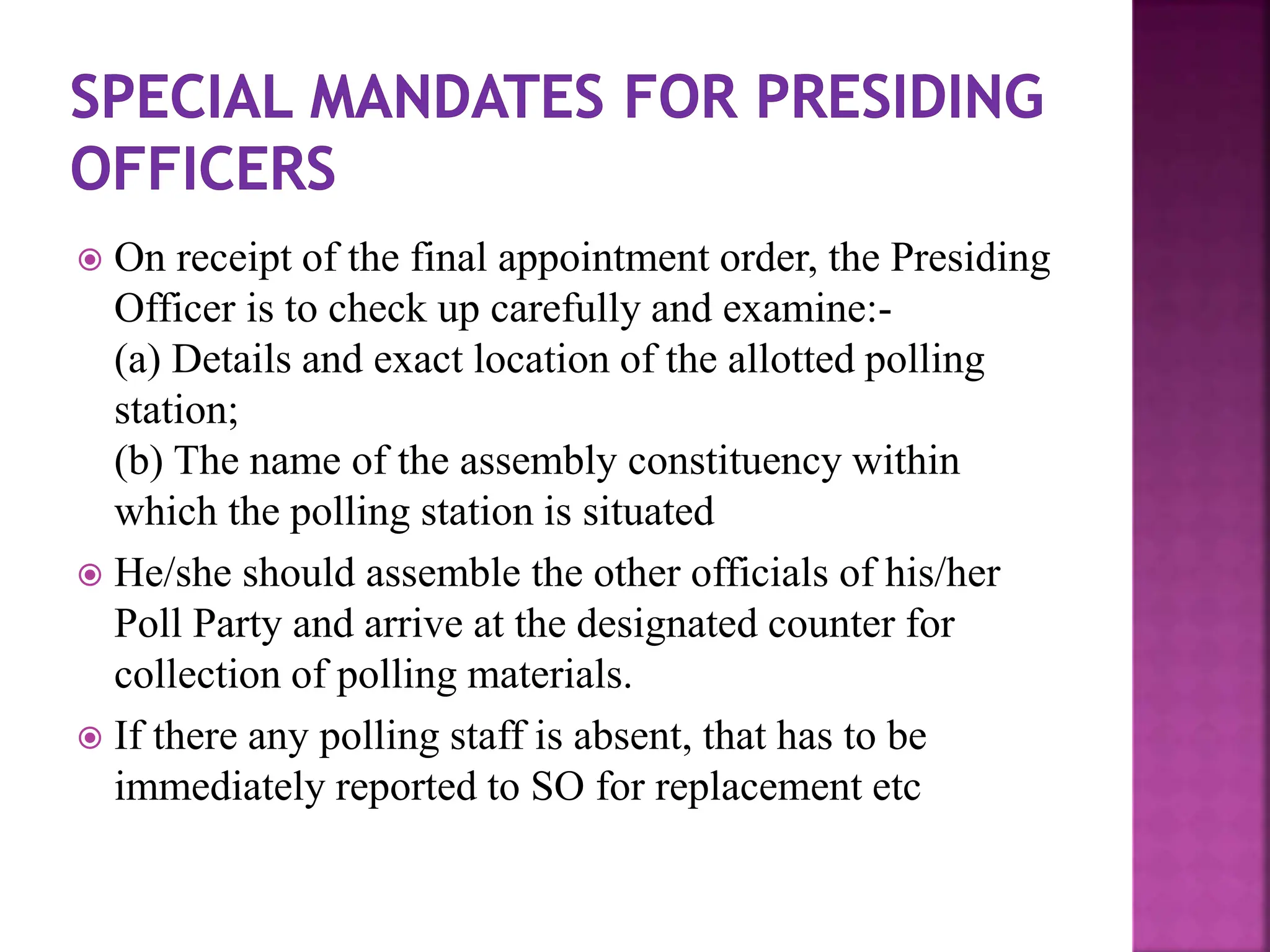
 On receipt of the final appointment order, the Presiding
Officer is to check up carefully and examine:-
(a) Details and exact location of the allotted polling
station;
(b) The name of the assembly constituency within
which the polling station is situated
 He/she should assemble the other officials of his/her
Poll Party and arrive at the designated counter for
collection of polling materials.
 If there any polling staff is absent, that has to be
immediately reported to SO for replacement etc
7
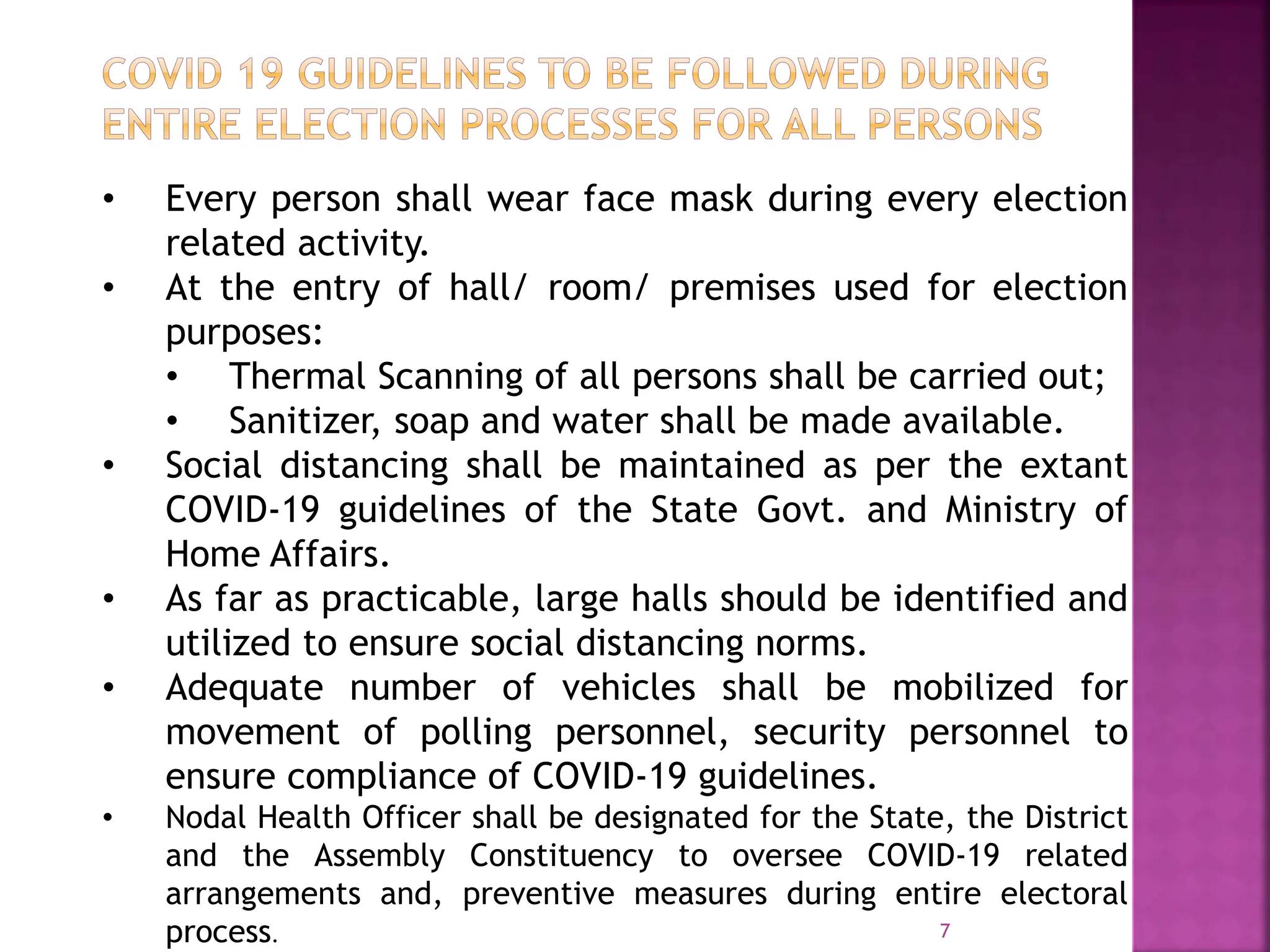
• Every person shall wear face mask during every election
related activity.
• At the entry of hall/ room/ premises used for election
purposes:
• Thermal Scanning of all persons shall be carried out;
• Sanitizer, soap and water shall be made available.
• Social distancing shall be maintained as per the extant
COVID-19 guidelines of the State Govt. and Ministry of
Home Affairs.
• As far as practicable, large halls should be identified and
utilized to ensure social distancing norms.
• Adequate number of vehicles shall be mobilized for
movement of polling personnel, security personnel to
ensure compliance of COVID-19 guidelines.
• Nodal Health Officer shall be designated for the State, the District
and the Assembly Constituency to oversee COVID-19 related
arrangements and, preventive measures during entire electoral
process.
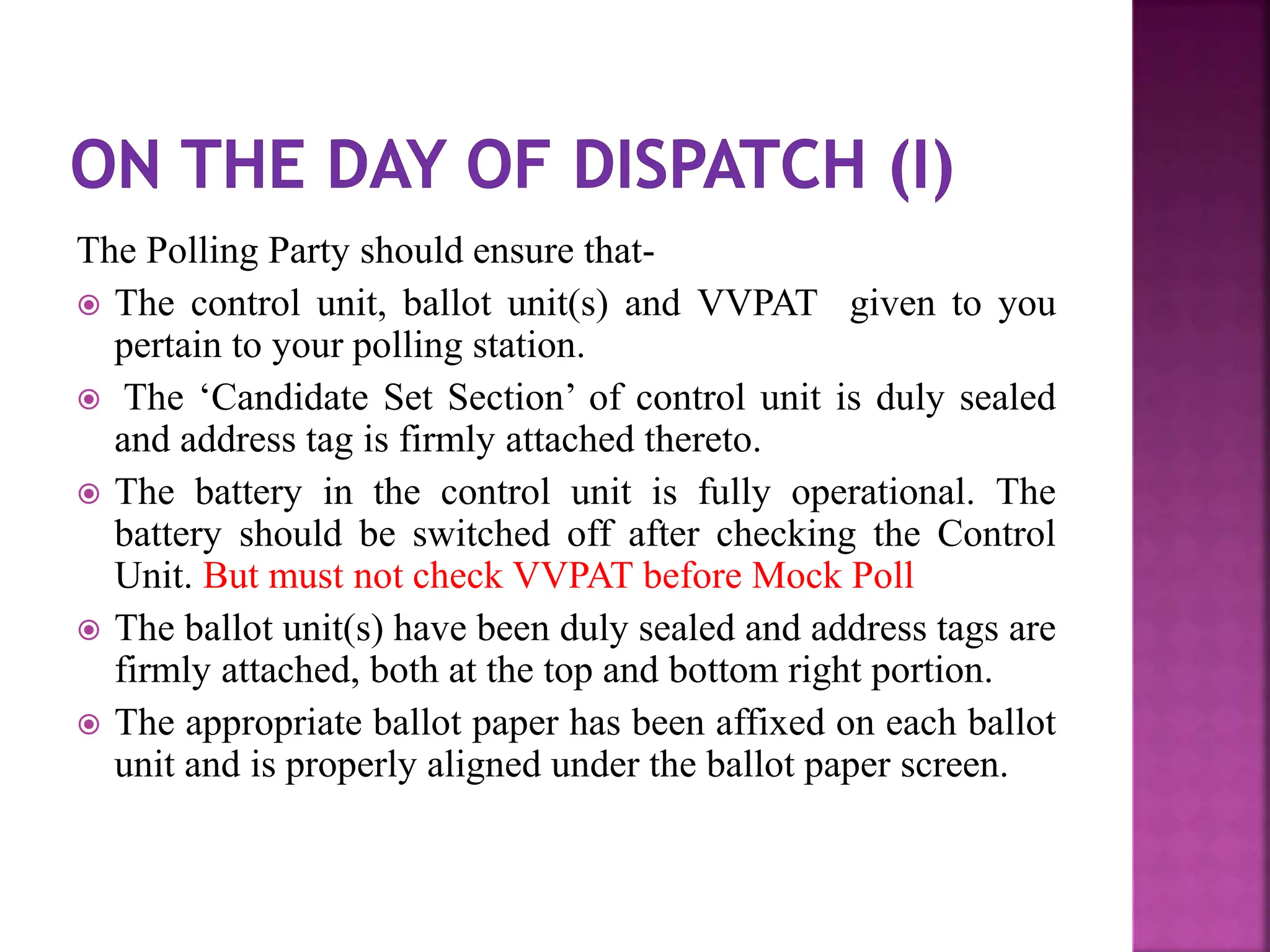
The Polling Party should ensure that-
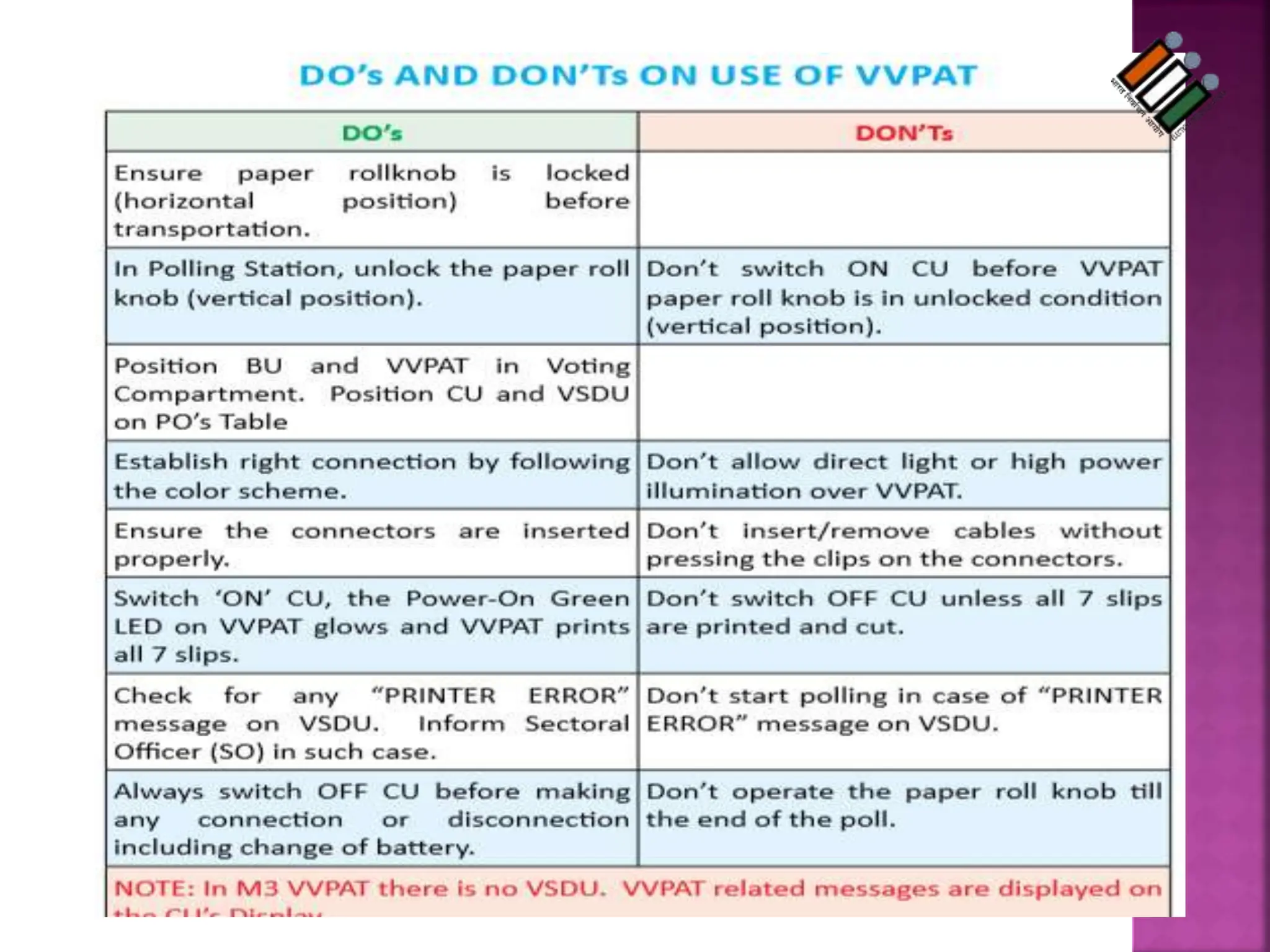
 The control unit, ballot unit(s) and VVPAT given to you
pertain to your polling station.
 The ‘Candidate Set Section’ of control unit is duly sealed
and address tag is firmly attached thereto.
 The battery in the control unit is fully operational. The
battery should be switched off after checking the Control
Unit. But must not check VVPAT before Mock Poll
 The ballot unit(s) have been duly sealed and address tags are
firmly attached, both at the top and bottom right portion.
 The appropriate ballot paper has been affixed on each ballot
unit and is properly aligned under the ballot paper screen.
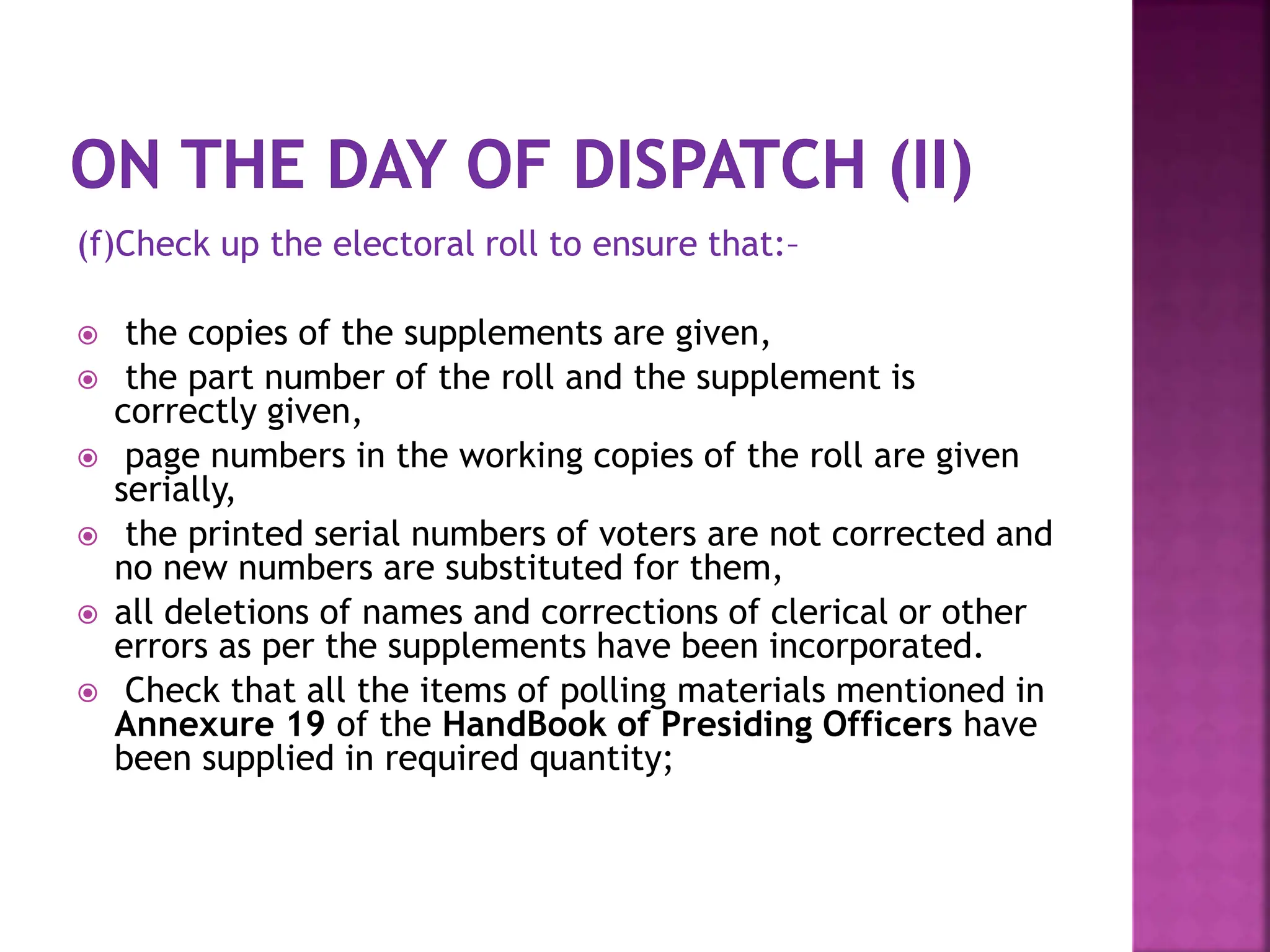
(f)Check up the electoral roll to ensure that:–
 the copies of the supplements are given,
 the part number of the roll and the supplement is
correctly given,
 page numbers in the working copies of the roll are given
serially,
 the printed serial numbers of voters are not corrected and
no new numbers are substituted for them,
 all deletions of names and corrections of clerical or other
errors as per the supplements have been incorporated.
 Check that all the items of polling materials mentioned in
Annexure 19 of the HandBook of Presiding Officers have
been supplied in required quantity;
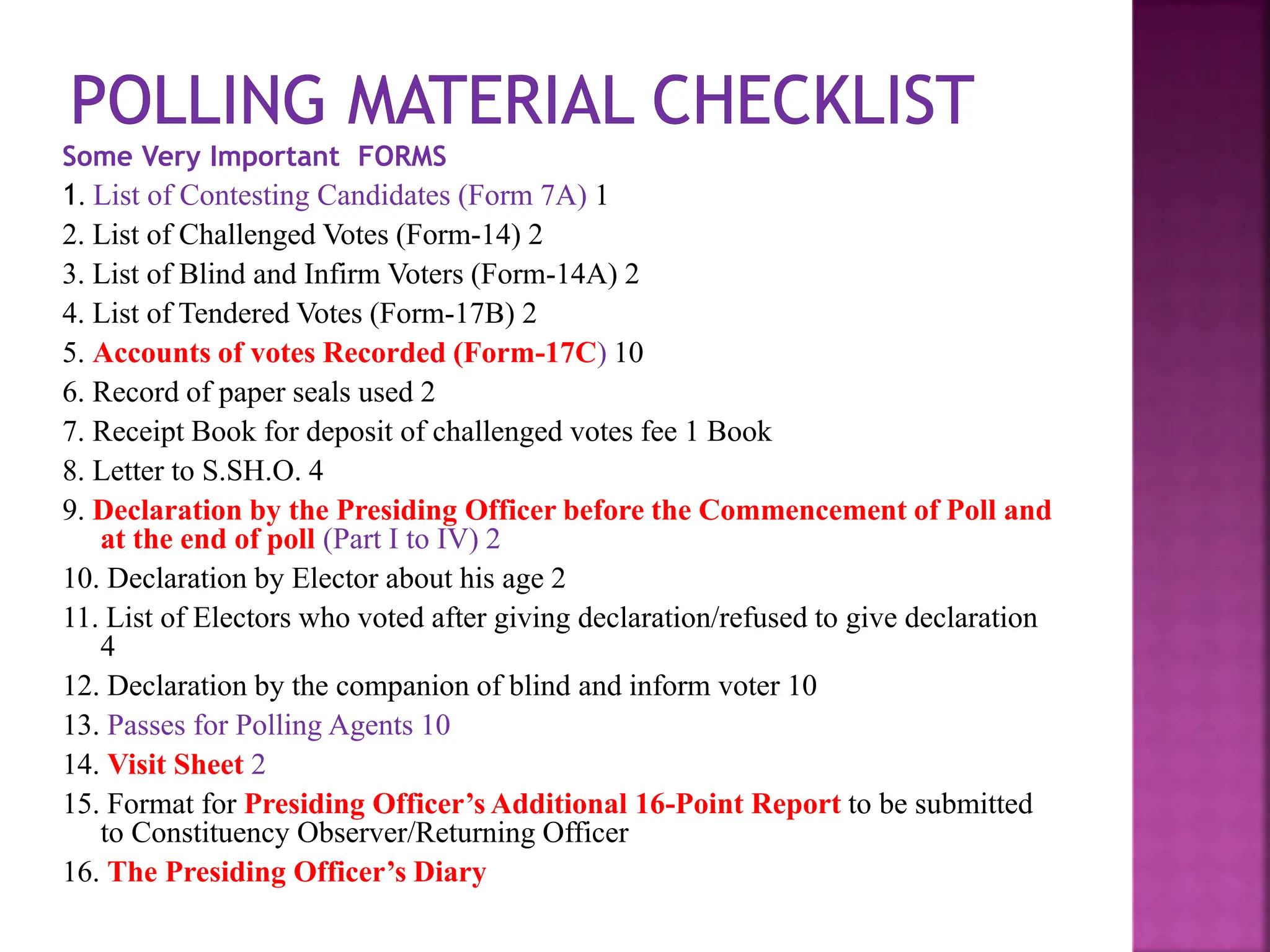
Some Very Important FORMS
1. List of Contesting Candidates (Form 7A) 1
2. List of Challenged Votes (Form-14) 2
3. List of Blind and Infirm Voters (Form-14A) 2
4. List of Tendered Votes (Form-17B) 2
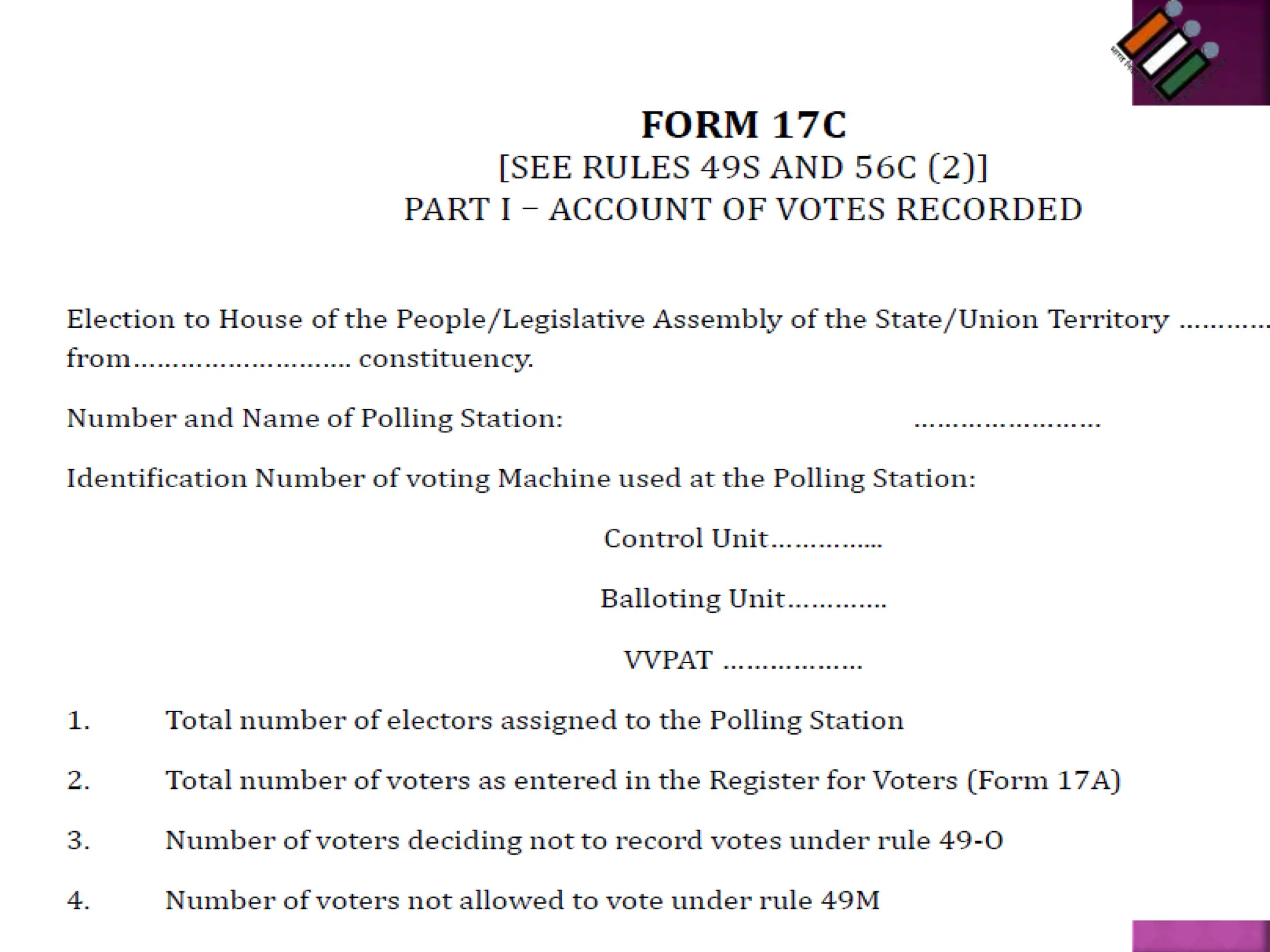
5. Accounts of votes Recorded (Form-17C) 10
6. Record of paper seals used 2
7. Receipt Book for deposit of challenged votes fee 1 Book
8. Letter to S.SH.O. 4
9. Declaration by the Presiding Officer before the Commencement of Poll and
at the end of poll (Part I to IV) 2
10. Declaration by Elector about his age 2
11. List of Electors who voted after giving declaration/refused to give declaration
4
12. Declaration by the companion of blind and inform voter 10
13. Passes for Polling Agents 10
14. Visit Sheet 2
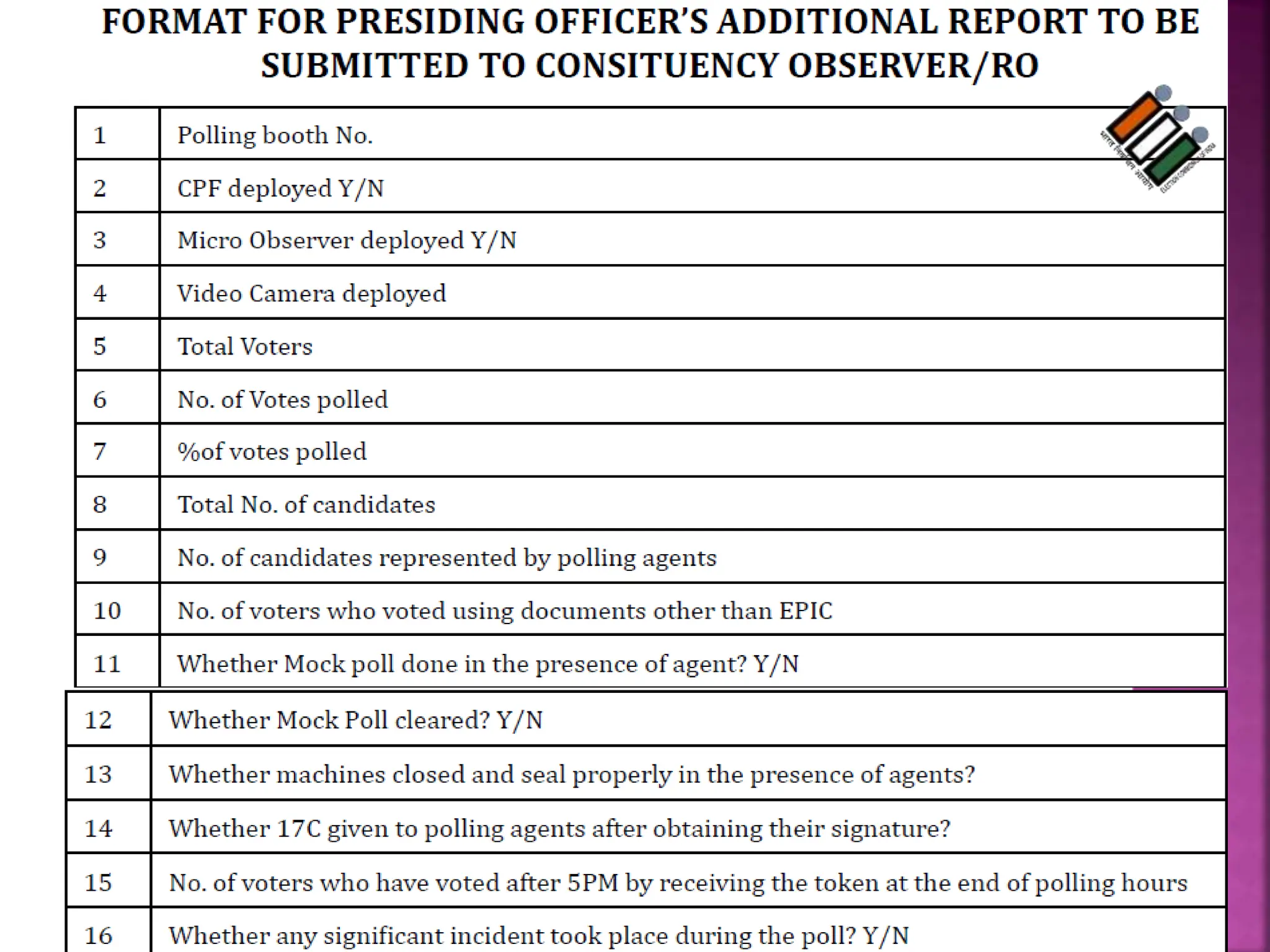
15. Format for Presiding Officer’s Additional 16-Point Report to be submitted
to Constituency Observer/Returning Officer
16. The Presiding Officer’s Diary
12
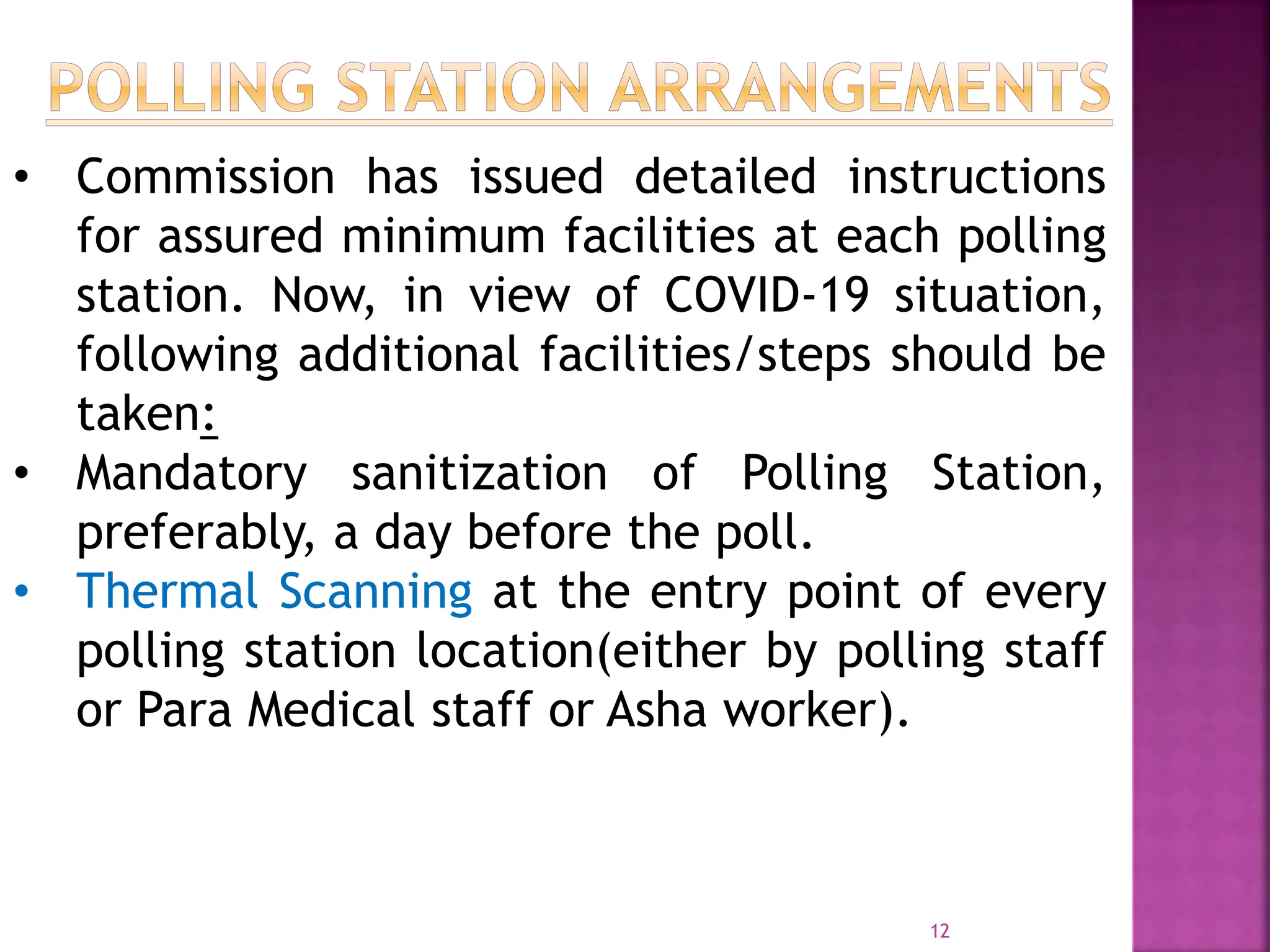
• Commission has issued detailed instructions
for assured minimum facilities at each polling
station. Now, in view of COVID-19 situation,
following additional facilities/steps should be
taken:
• Mandatory sanitization of Polling Station,
preferably, a day before the poll.
• Thermal Scanning at the entry point of every
polling station location(either by polling staff
or Para Medical staff or Asha worker).
14
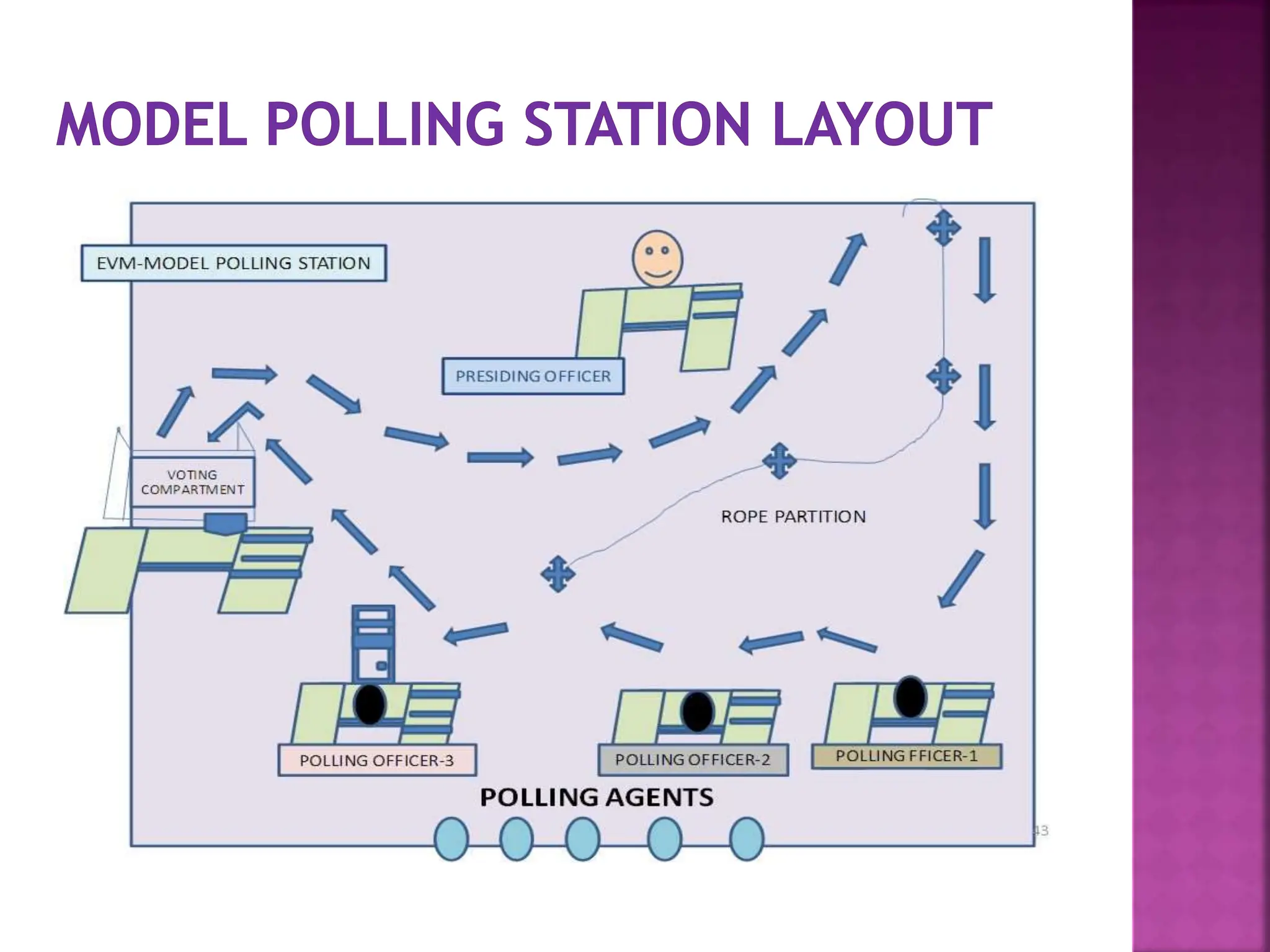
• Earmarking circle for 15-20 persons of 2 yards
(6 feet) distance for voters standing in the
queue depending on the availability of space.
• There shall be three queues each, for male,
female, and PwD/ Senior citizen voters.
• The services of BLOs, volunteers etc may be
engaged to monitor and regulate social
distancing norms strictly.
• One shaded waiting areas with chairs, dari etc.
will be provided, for male and female
separately, within the polling station premises.
• Wherever possible, Booth App shall be used at
the polling station.
15
• If temperature is above the set norms of
MoHFW at first reading, then it will be
checked twice and if it remains, then the
elector shall be provided with
token/certificate and will be asked to come
for voting at the last hour of poll. At the last
hour of poll, such electors shall be
facilitated voting, strictly following COVID-
19 related preventive measures.
• Help Desk for distribution of token to the
voters of first come first basis so that they do
not wait in the queue.
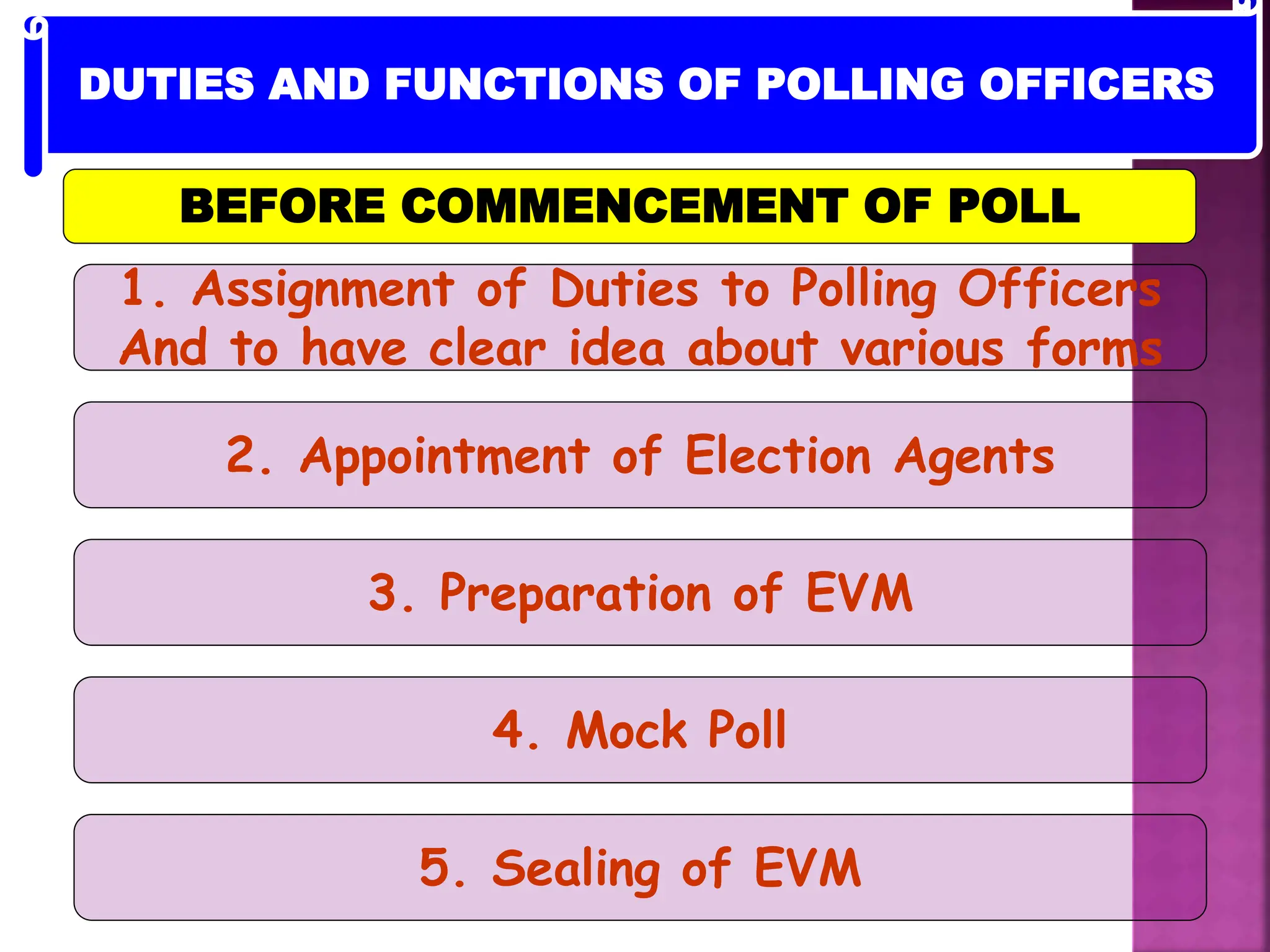
1. Assignment of Duties to Polling Officers
And to have clear idea about various forms
2. Appointment of Election Agents
3. Preparation of EVM
4. Mock Poll
5. Sealing of EVM
BEFORE COMMENCEMENT OF POLL
DUTIES AND FUNCTIONS OF POLLING OFFICERS
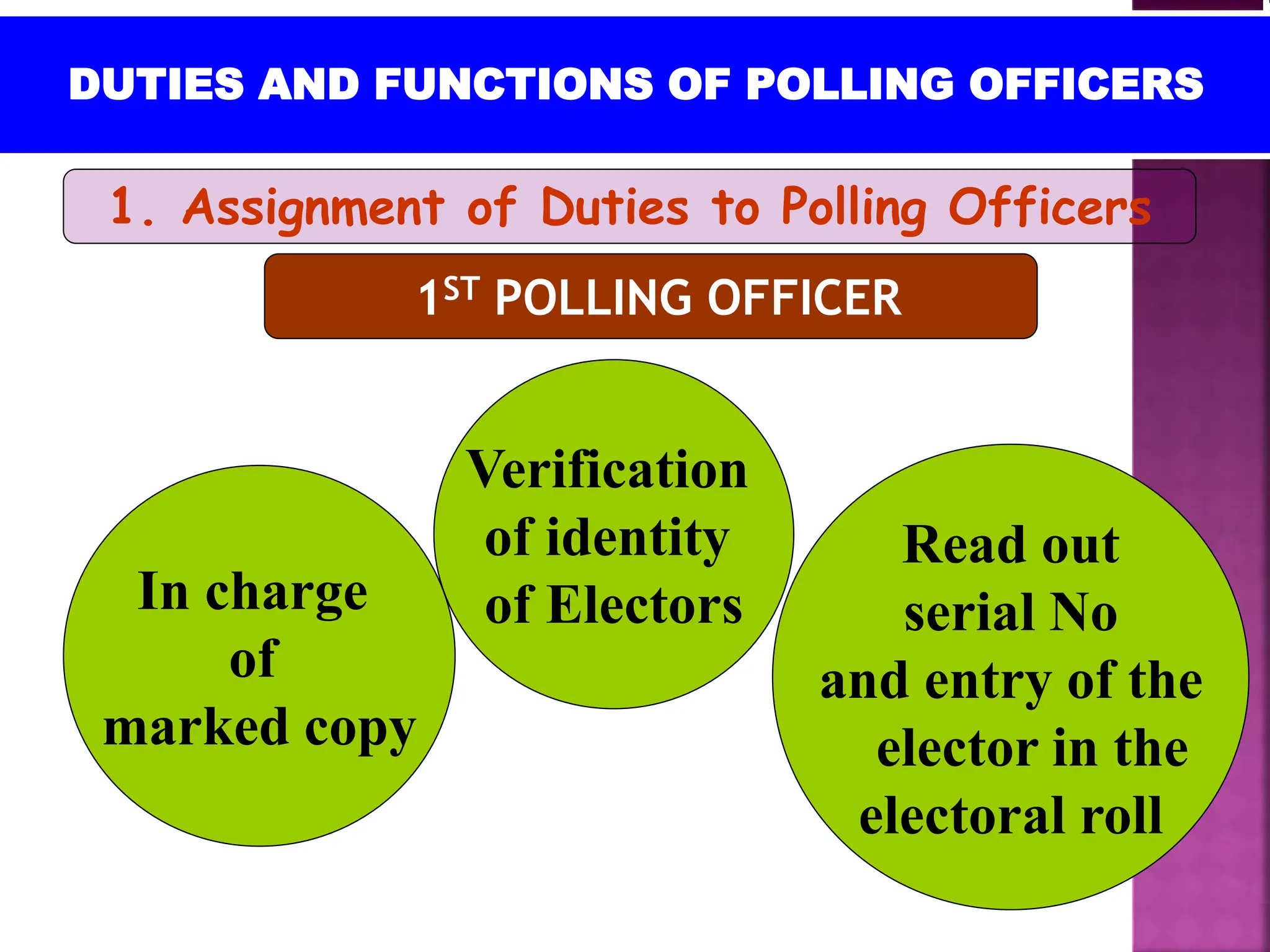
1ST POLLING OFFICER
In charge
of
marked copy
Verification
of identity
of Electors
Read out
serial No
and entry of the
elector in the
electoral roll
1. Assignment of Duties to Polling Officers
DUTIES AND FUNCTIONS OF POLLING OFFICERS
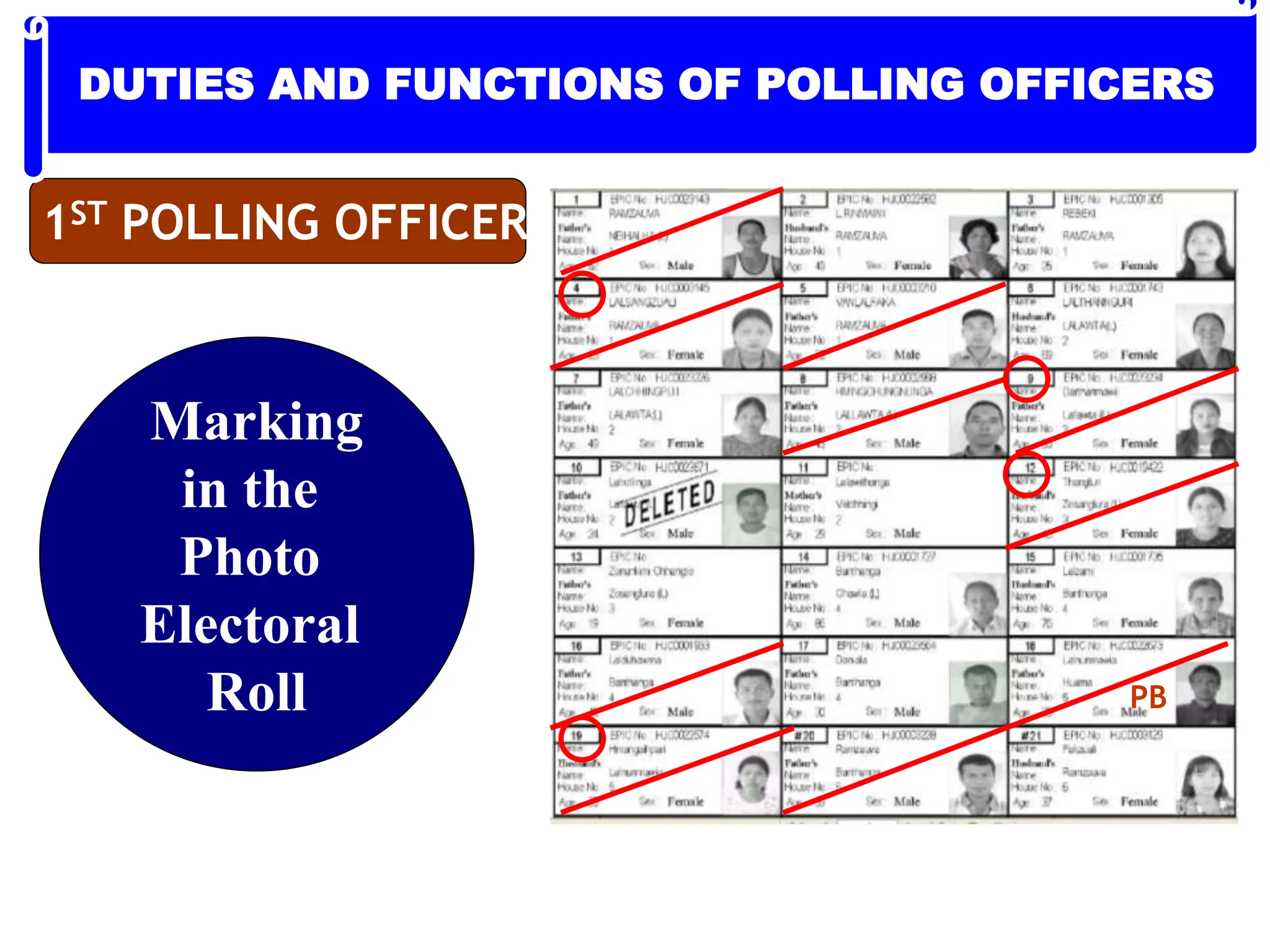
1ST POLLING OFFICER
Marking
in the
Photo
Electoral
Roll PB
DUTIES AND FUNCTIONS OF POLLING OFFICERS
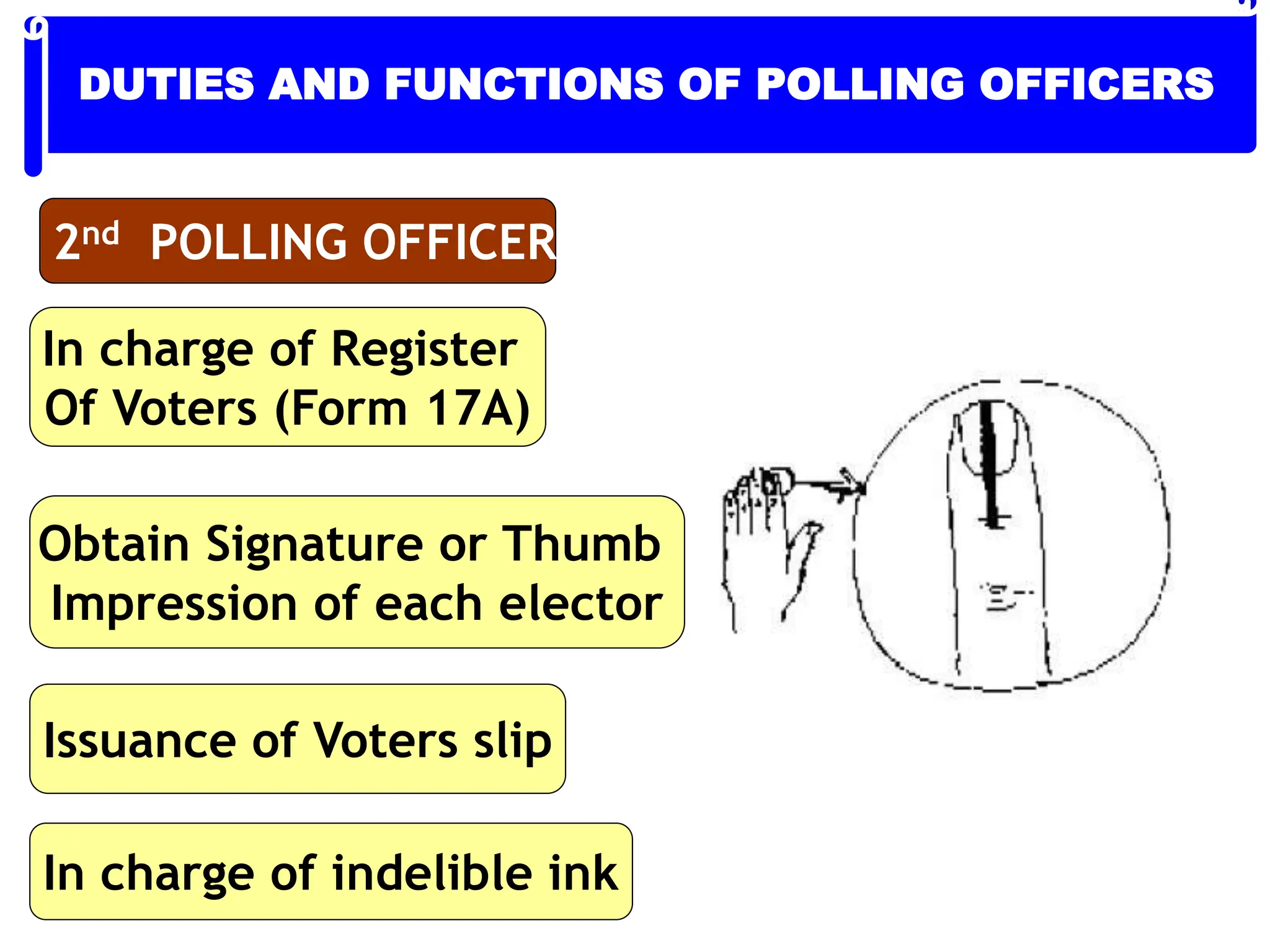
2nd POLLING OFFICER
Issuance of Voters slip
In charge of Register
Of Voters (Form 17A)
In charge of indelible ink
Obtain Signature or Thumb
Impression of each elector
DUTIES AND FUNCTIONS OF POLLING OFFICERS
3rd POLLING OFFICER
Receipt of Voters slip
In charge of CU (As per the direction of PO)
DUTIES AND FUNCTIONS OF POLLING OFFICERS
ON THE POLL DAY
SEQUENCE OF EVENTS INSIDE THE POLLING STATION
Part I: MOCK POLL
Conduct of Mock Poll and sealing of EVMs and WPATs
in the Polling Stations
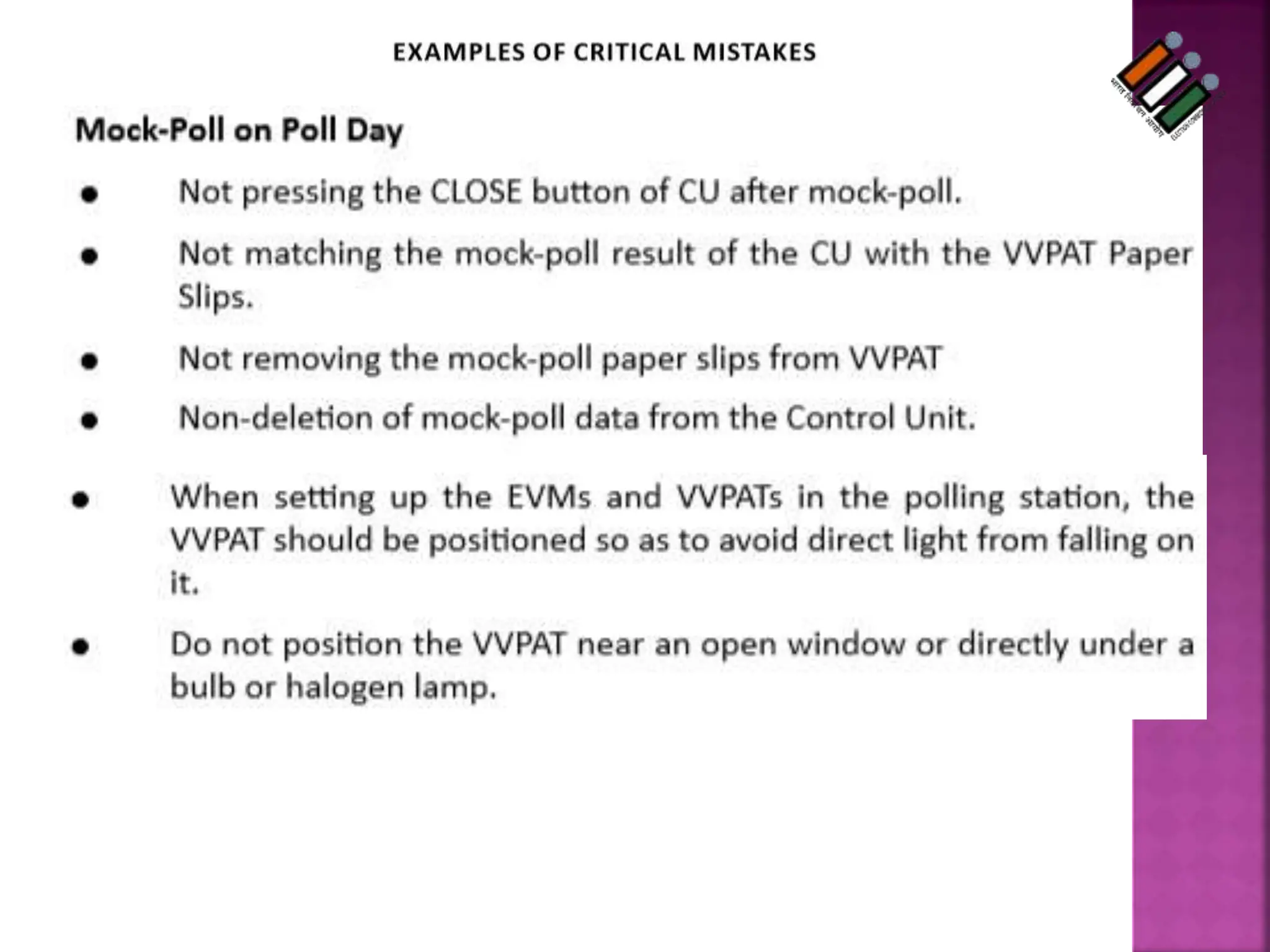
During the mock poll, BU and VVPAT should be
placed in the Voting Compartment, where a Polling
Officer should be present along with polling agents
to observe
This Polling Officer will keep a record of the votes
cast. After the mock poll, Presiding Officer will
ascertain the result in the CU, count the ballot slips
in the presence of the polling agents and confirm
that the results tally for each candidate.
All mock poll data in CU and ballot slips from WPAT must be
removed by the Presiding Officer and the drop box verified by the
Polling Agents
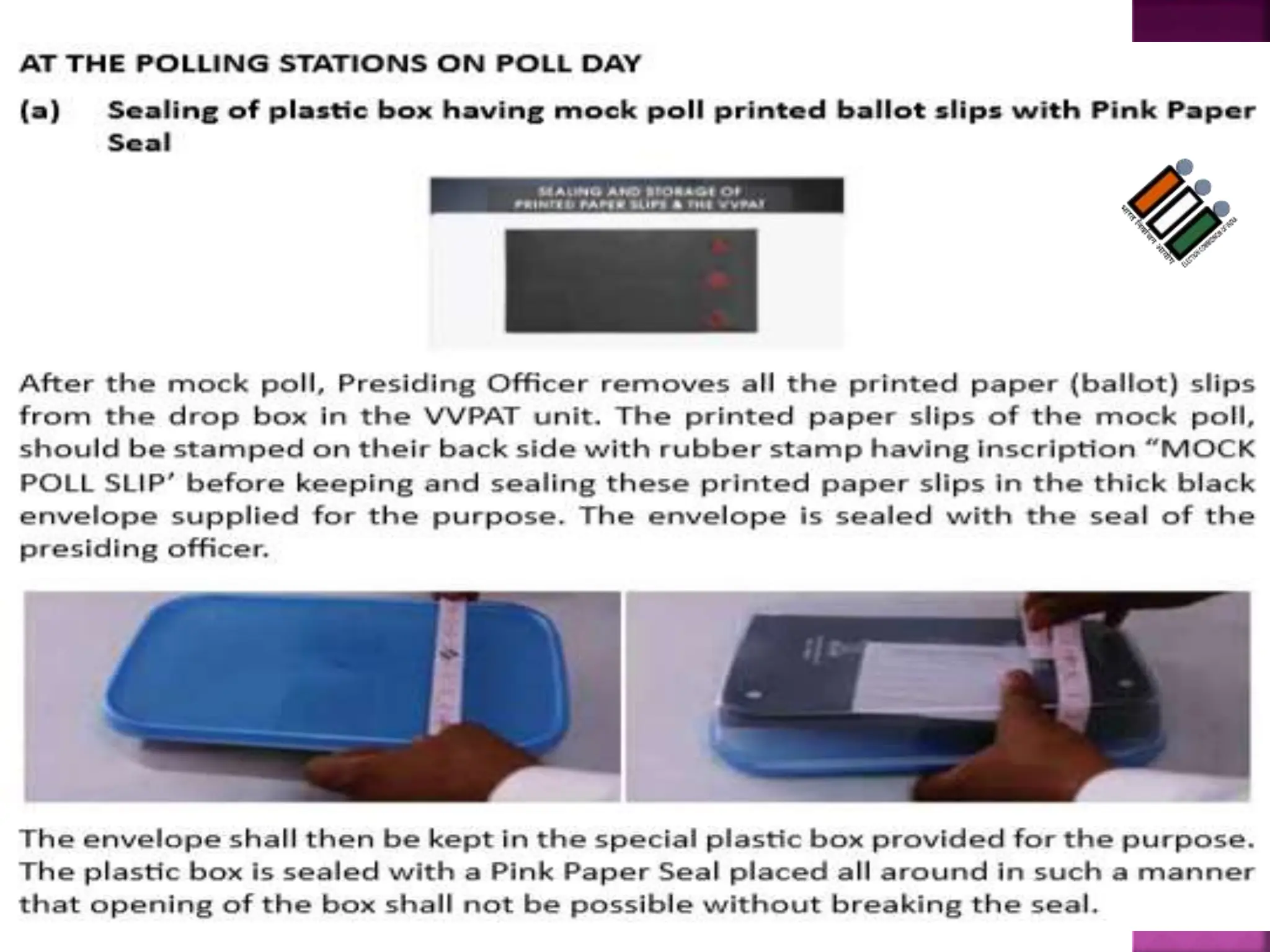
The mock poll ballot slips shall be kept in an envelope made of
thick black paper, sealed with the seal of the Presiding Officer.
The Presiding Officer and polling agents must put their signatures
on the envelope.
The number and name of the polling station, number and name of
Assembly Constituency, date of poll and the words "Printed paper
slips of Mock Poll" shall be written on the envelope.
This envelope must be kept in the special plastic box for mock poll and
sealed with a pink paper seal placed all around in such a manner that
opening of the box will require breaking of the seal. The number and name
of the polling station, number and name of Assembly Constituency and the
date of poll shall be written on the plastic box
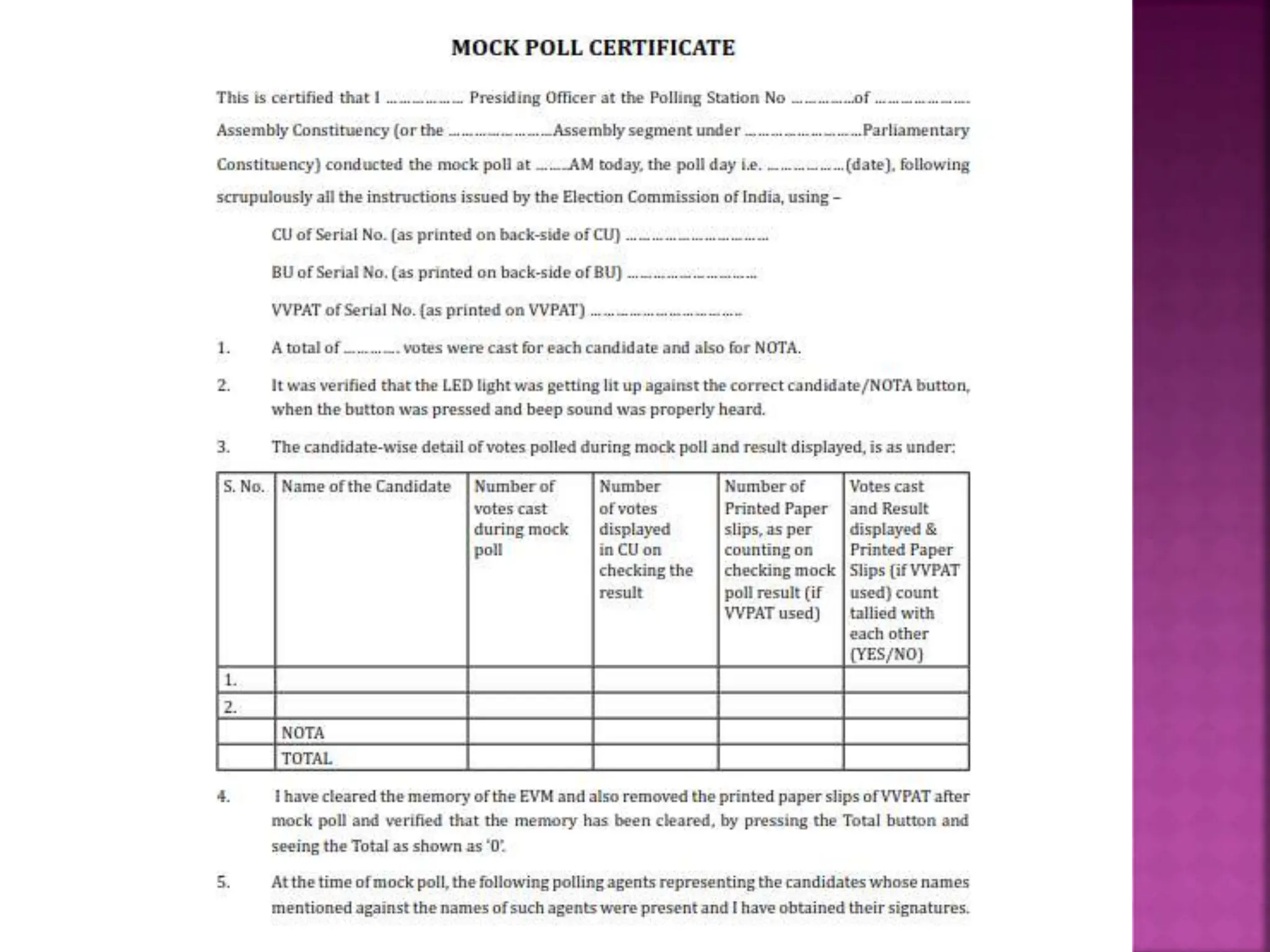
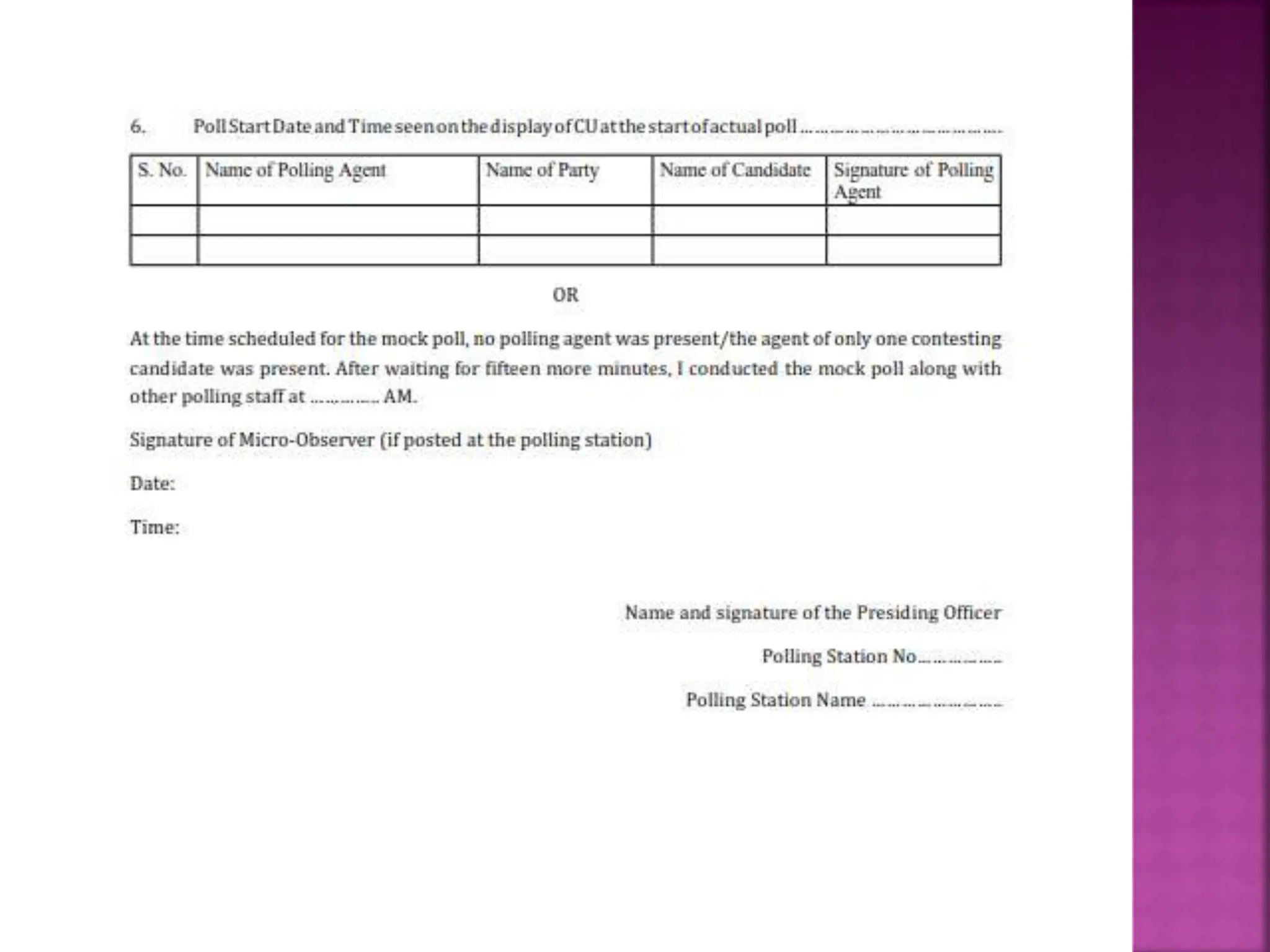
The Presiding Officer and Polling Agents must put their signatures on the
pink paper seal and keep the box along with other documents relating to
elections. Thereafter, Presiding Officer will sign the Mock Poll Certificate and
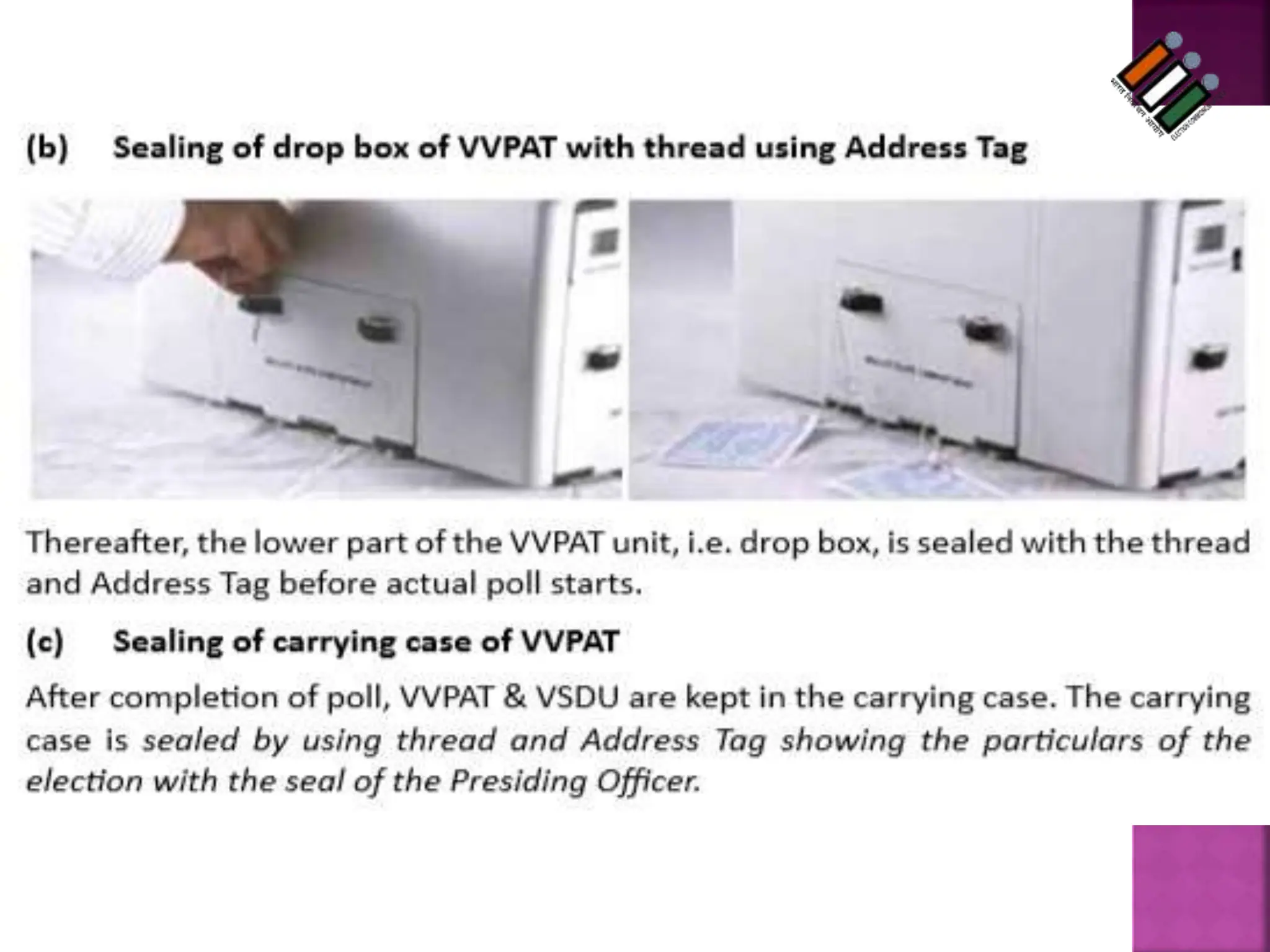
seal the CU. The drop box of VVPAT should be sealed with an address tag
before the actual poll starts.
Part II: ACTUAL POLL
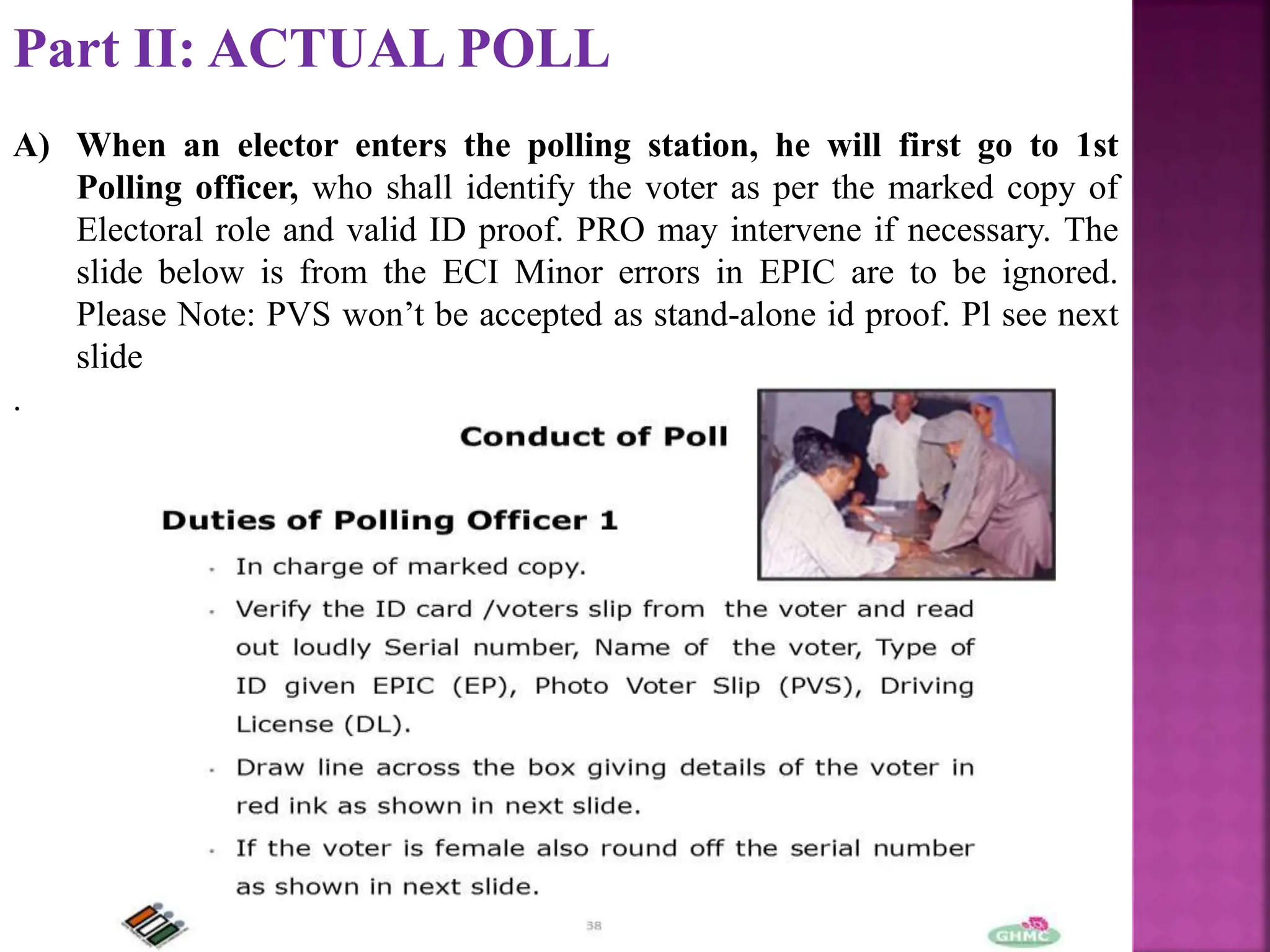
A) When an elector enters the polling station, he will first go to 1st
Polling officer, who shall identify the voter as per the marked copy of
Electoral role and valid ID proof. PRO may intervene if necessary. The
slide below is from the ECI Minor errors in EPIC are to be ignored.
Please Note: PVS won’t be accepted as stand-alone id proof. Pl see next
slide
.
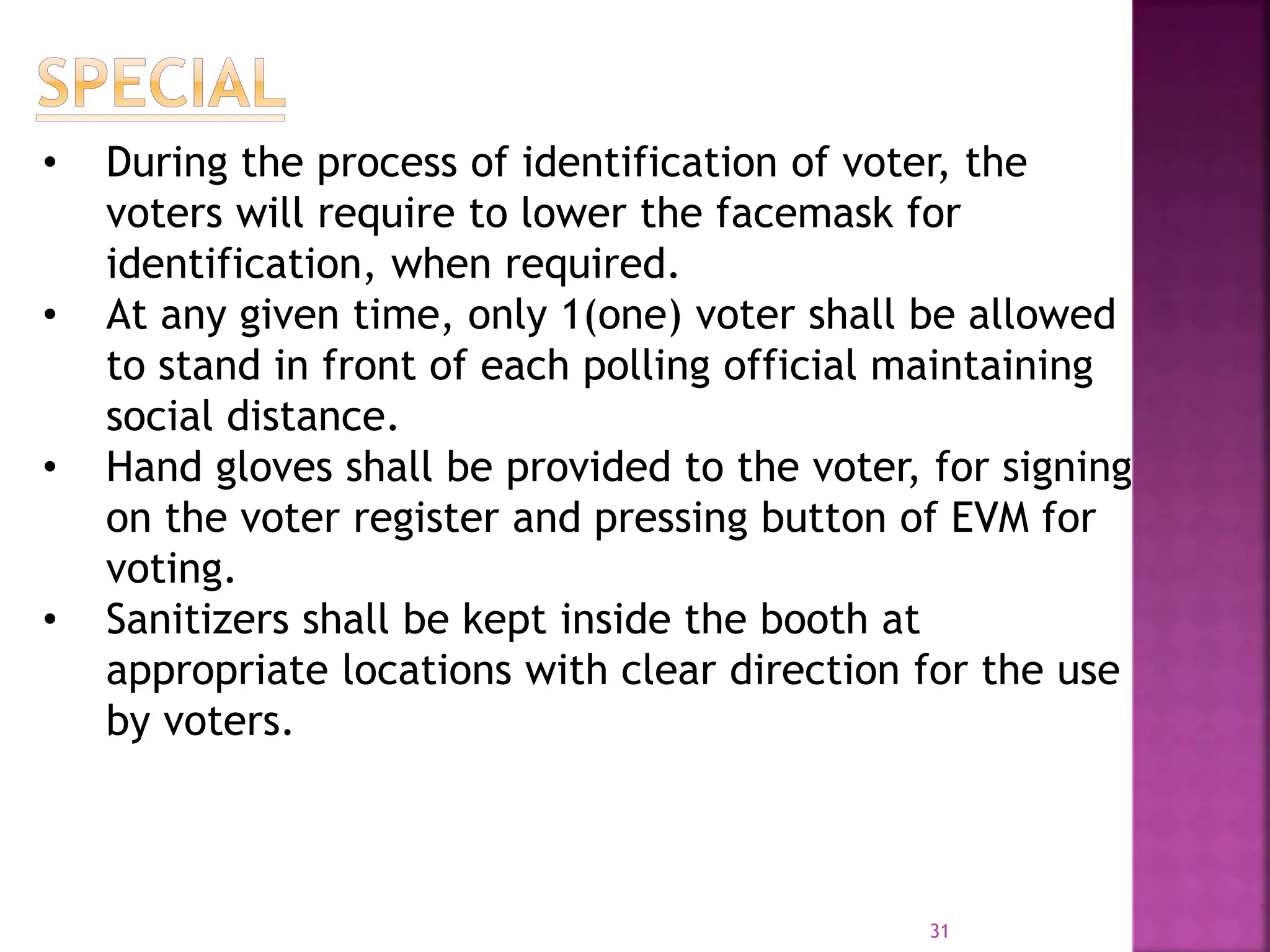
Electors Photo Identity Card or one of The Eleven Specified Photo
Identity Documents, Essential for Casting Vote
The Election Commission of India has directed that all electors in all constituencies who have
been issued Electors Photo Identity Card (EPIC) have to produce the Electors Photo Identity
Card for their identification at the polling station before casting their votes. Those electors
who are not able to produce the EPIC shall produce one of the following alternative photo
identity documents for establishing their identity. The list of eleven documents is:
1. Passport
2. Driving License
3. Service Identity Cards with photograph issued to employees by
Central/State Govt./PSUs/Public Limited Companies
4. Passbooks with photograph issued by Bank/Post Office
5. PAN Card
6. Smart Card issued by RGI under NPR
7. MNREGA Job Card
8. Health Insurance Smart Card issued under the scheme of
Ministry of Labour
9. Pension document with photograph
10.Official identity cards issued to MPs/MLAs/MLCs, and
11.Aadhaar Card
31
• During the process of identification of voter, the
voters will require to lower the facemask for
identification, when required.
• At any given time, only 1(one) voter shall be allowed
to stand in front of each polling official maintaining
social distance.
• Hand gloves shall be provided to the voter, for signing
on the voter register and pressing button of EVM for
voting.
• Sanitizers shall be kept inside the booth at
appropriate locations with clear direction for the use
by voters.
32
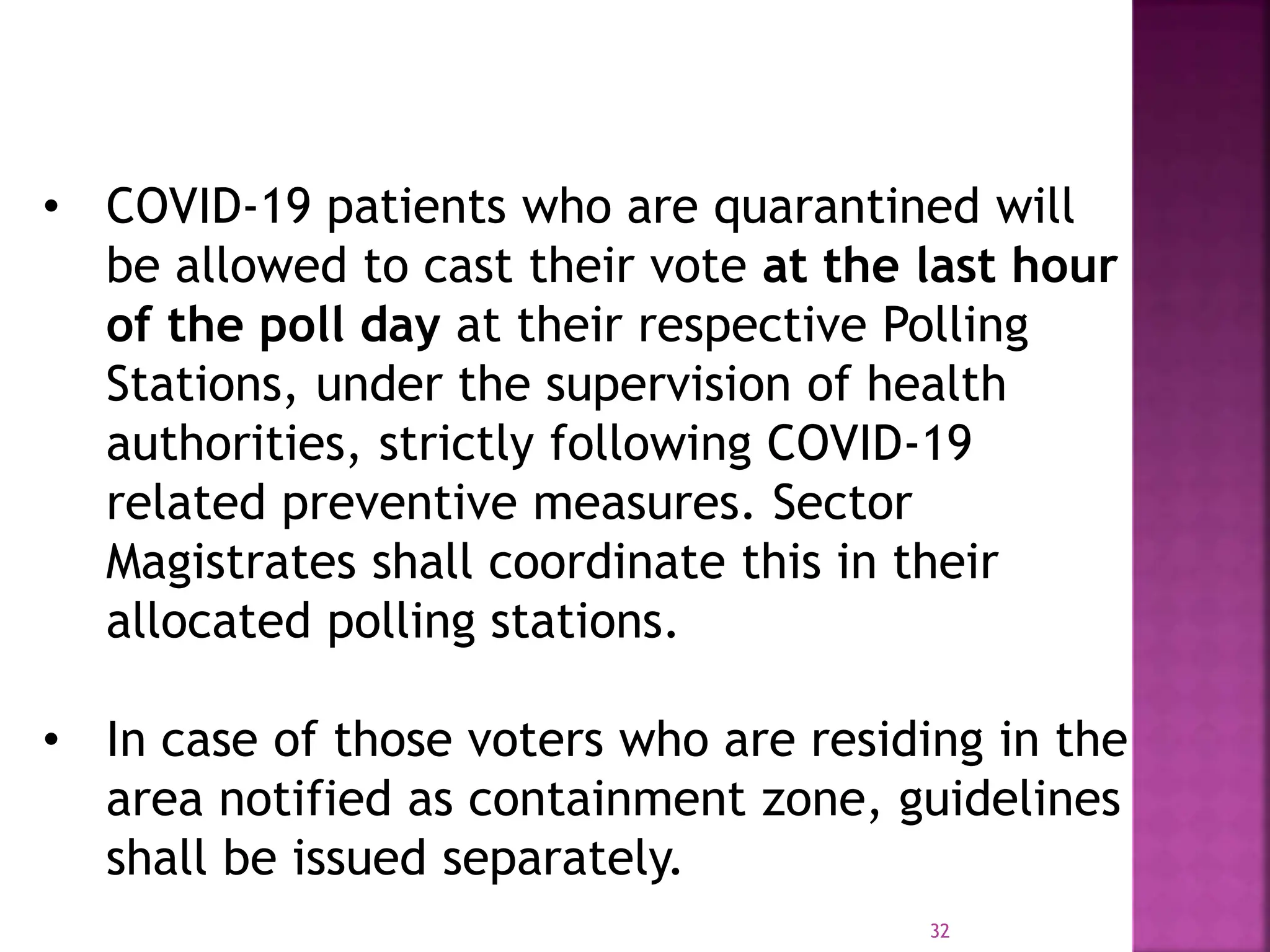
• COVID-19 patients who are quarantined will
be allowed to cast their vote at the last hour
of the poll day at their respective Polling
Stations, under the supervision of health
authorities, strictly following COVID-19
related preventive measures. Sector
Magistrates shall coordinate this in their
allocated polling stations.
• In case of those voters who are residing in the
area notified as containment zone, guidelines
shall be issued separately.
B) Then elector will move to 2nd Polling Officer who will
Note down the serial number of electoral roll of that elector as it is
read out aloud by 1st Polling Officer.
Apply indelible ink on the left forefinger of the elector in such a
way to make a line from the top end of the nail to the bottom of the
left forefinger first joint. If any elector refuses to allow his left
forefinger to be inspected or marked with indelible ink or he has
already such a mark on his left forefinger, or he does any act with a
view to removing the ink mark, he shall not be allowed to vote. After
the ink has been duly applied, then
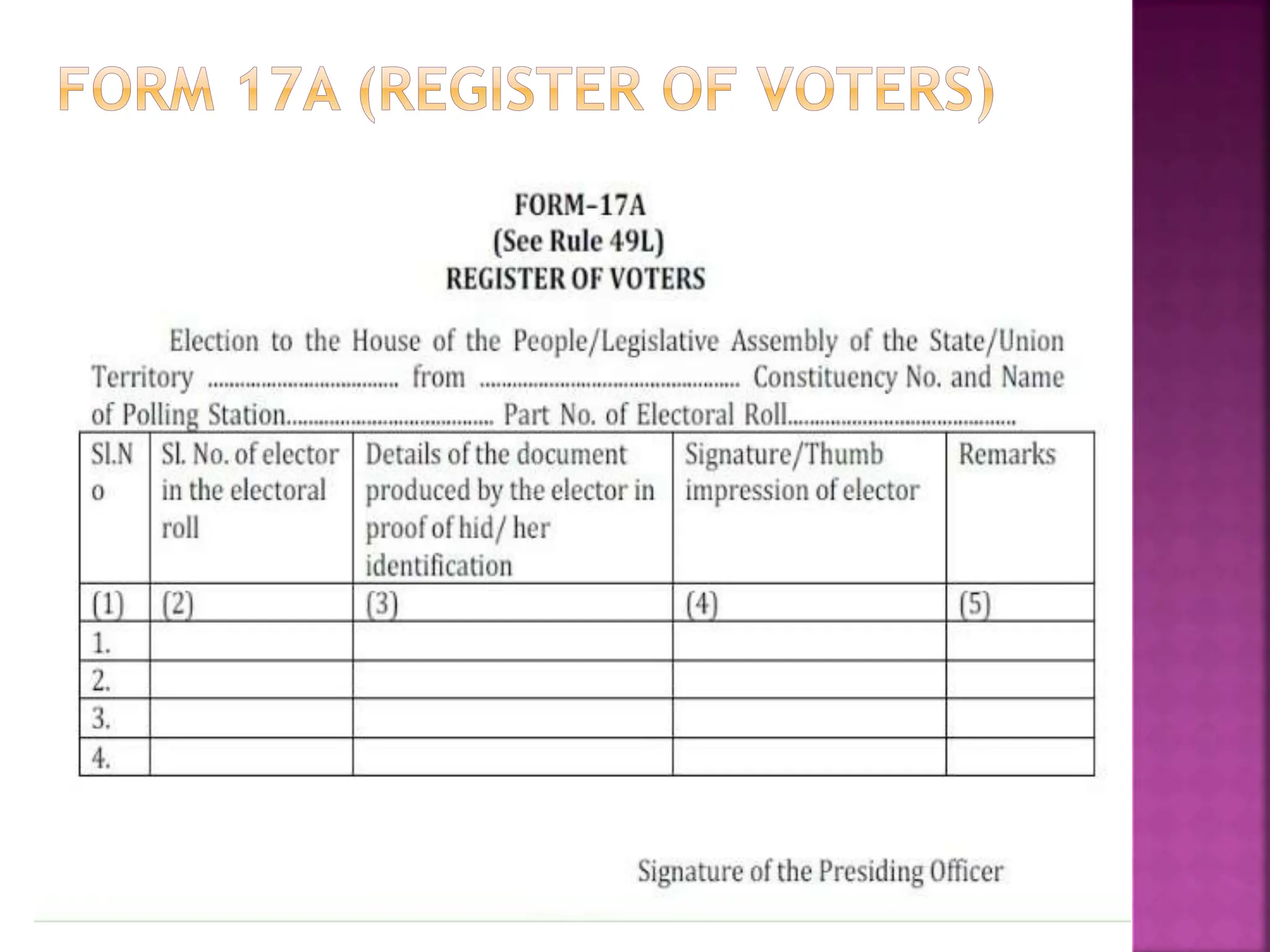
obtain elector’s signature or thumb impression in the Relevant
column of Register of voters in Form 17 A. Particulars of EPIC or
other alternate identification as prescribed by ECI, shall be mentioned
in Remarks column
Prepare a voter’s slip filling all required particulars
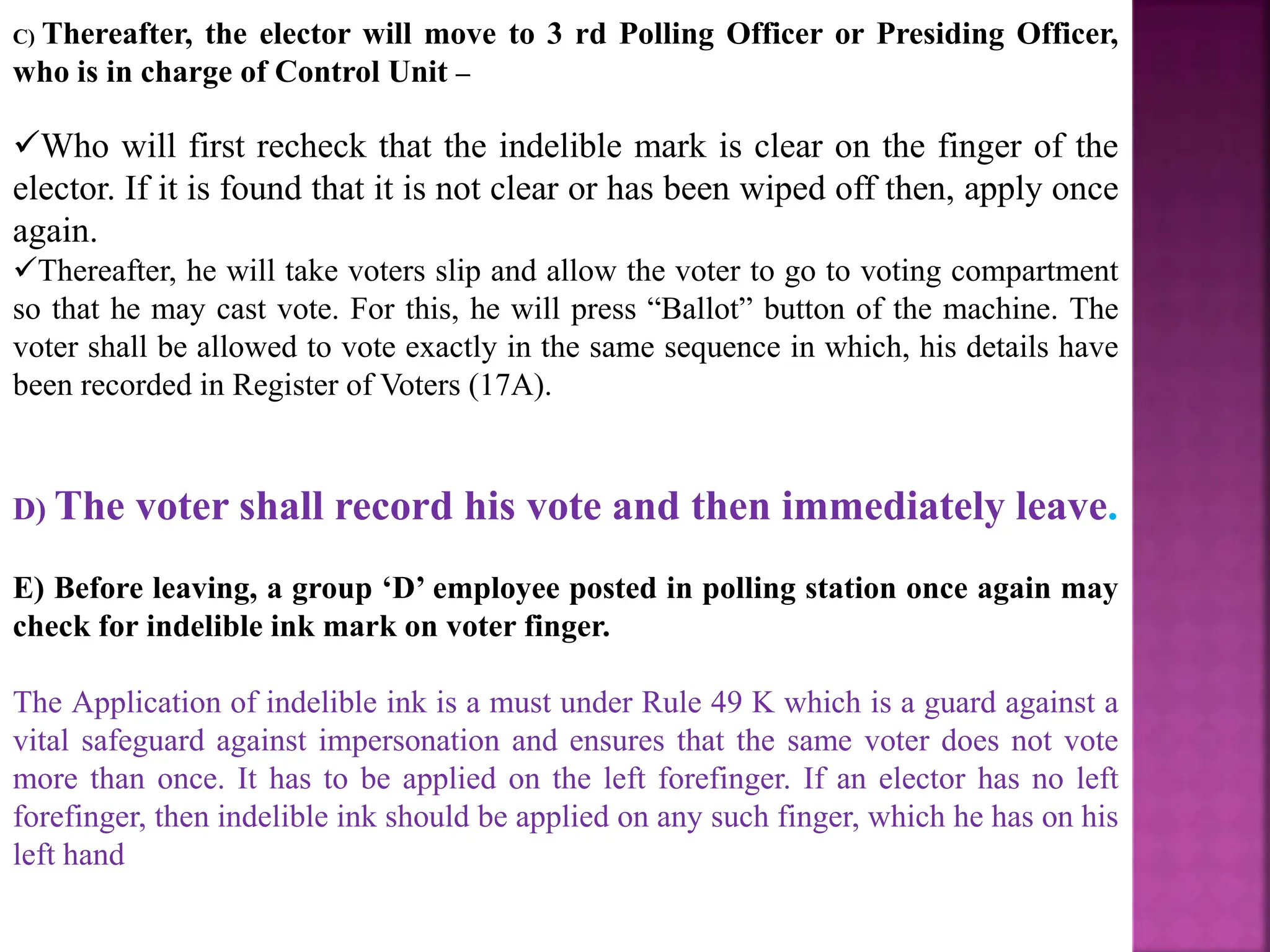
C) Thereafter, the elector will move to 3 rd Polling Officer or Presiding Officer,
who is in charge of Control Unit –
Who will first recheck that the indelible mark is clear on the finger of the
elector. If it is found that it is not clear or has been wiped off then, apply once
again.
Thereafter, he will take voters slip and allow the voter to go to voting compartment
so that he may cast vote. For this, he will press “Ballot” button of the machine. The
voter shall be allowed to vote exactly in the same sequence in which, his details have
been recorded in Register of Voters (17A).
D) The voter shall record his vote and then immediately leave.
E) Before leaving, a group ‘D’ employee posted in polling station once again may
check for indelible ink mark on voter finger.
The Application of indelible ink is a must under Rule 49 K which is a guard against a
vital safeguard against impersonation and ensures that the same voter does not vote
more than once. It has to be applied on the left forefinger. If an elector has no left
forefinger, then indelible ink should be applied on any such finger, which he has on his
left hand
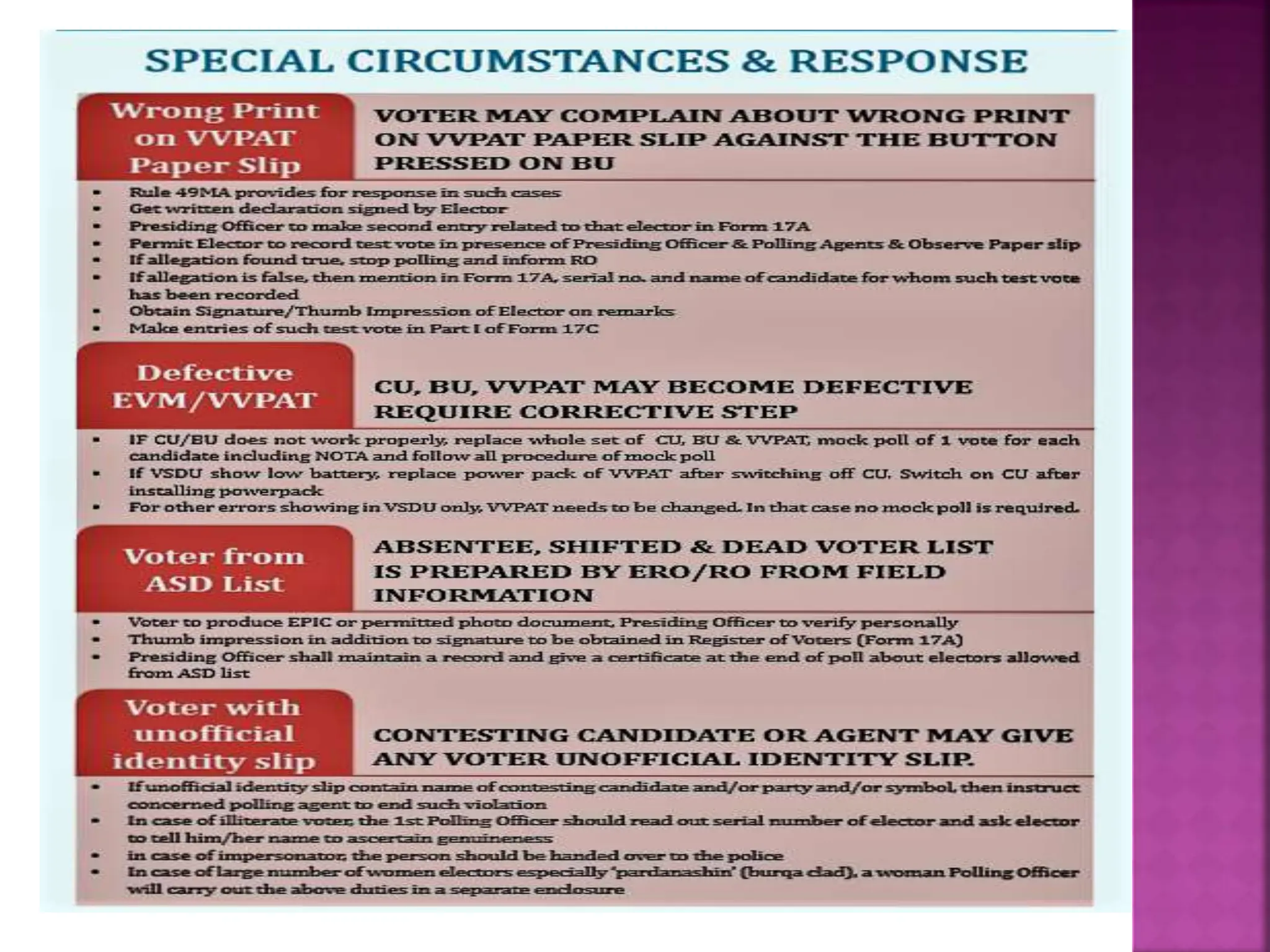
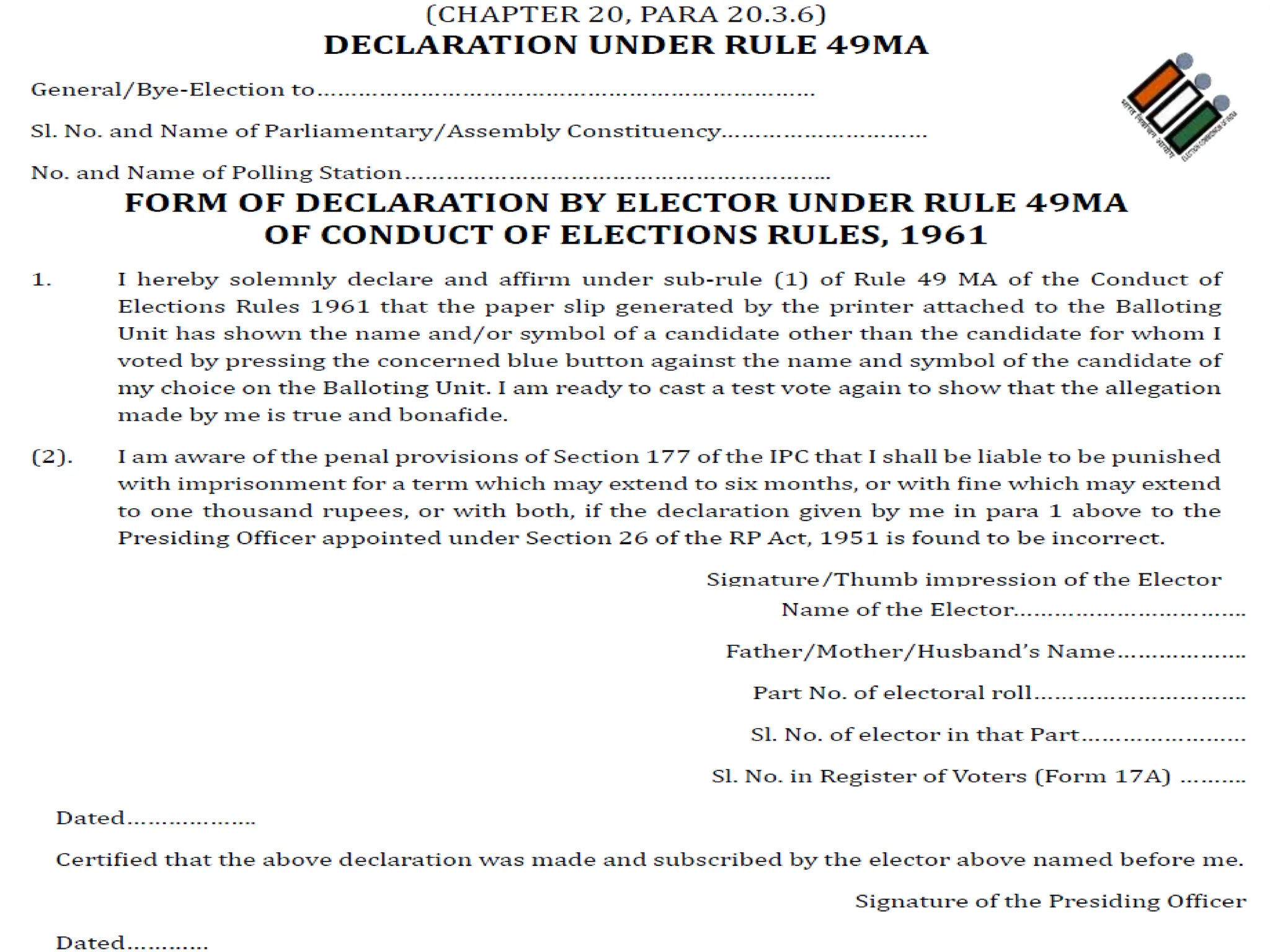
VVPAT COMPLAINT ISSUES
If an elector after having recorded his vote alleges that the
paper trail generated by the printer has shown the name or
symbol of a candidate other than the one he voted for, the
Presiding Officer shall :
obtain a written declaration from the elector as to the
allegation, after warning the elector about the consequence of
making a false declaration,
make a second entry related to that elector in Form 17A,
permit the elector to record a test vote in the voting
machine.
If the allegation is found to be true, the Presiding Officer
shall report the facts immediately to the Returning Officer;
stop further recording of votes in that machine. If the
allegation is found to be false, the Presiding Officer should
take appropriate action as given the Presiding Officer’s
Handbook
MAINTENANCE OF DIARY BY
PRESIDING OFFICER
 The Presiding Officer of every polling station should
be asked to maintain a diary in which he should
record the proceedings connected with the poll in
the polling station. He should be asked to go on
recording the relevant events in the diary as and
when they occur.
 If Presiding Officers do not make the entries in the
relevant columns of the diary at regular intervals or
from time to time and complete the diary at the end
of the poll that is highly objectionable and it should
be impressed upon all Presiding Officers that any
lapse on their part in the proper maintenance of
diary at all points of time during the process of poll
will be seriously viewed by the commission
 The Commission has recently directed that in
addition to Presiding Officer diary, Presiding Officer
will be required to submit additional inputs
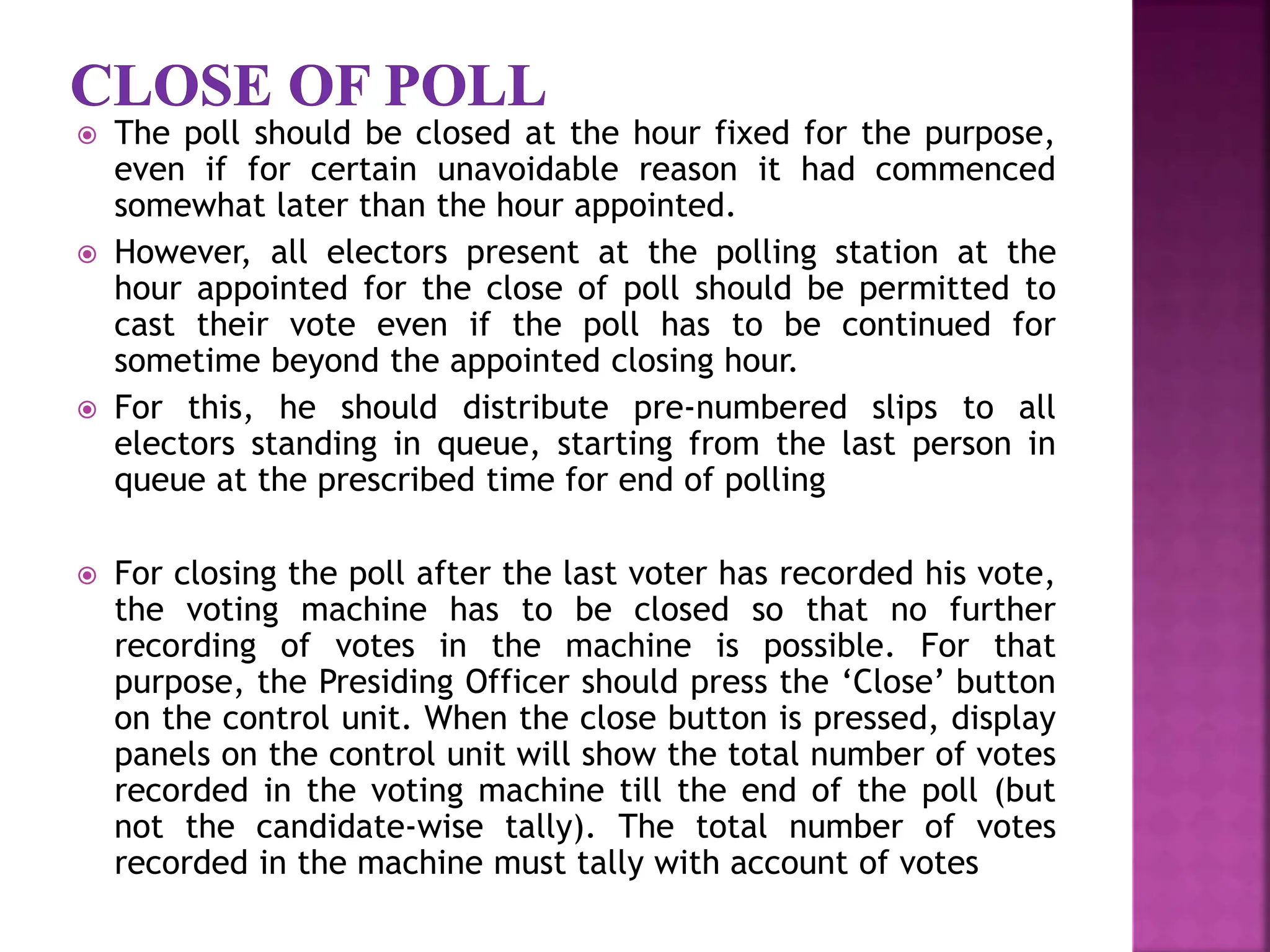
 The poll should be closed at the hour fixed for the purpose,
even if for certain unavoidable reason it had commenced
somewhat later than the hour appointed.
 However, all electors present at the polling station at the
hour appointed for the close of poll should be permitted to
cast their vote even if the poll has to be continued for
sometime beyond the appointed closing hour.
 For this, he should distribute pre-numbered slips to all
electors standing in queue, starting from the last person in
queue at the prescribed time for end of polling
 For closing the poll after the last voter has recorded his vote,
the voting machine has to be closed so that no further
recording of votes in the machine is possible. For that
purpose, the Presiding Officer should press the ‘Close’ button
on the control unit. When the close button is pressed, display
panels on the control unit will show the total number of votes
recorded in the voting machine till the end of the poll (but
not the candidate-wise tally). The total number of votes
recorded in the machine must tally with account of votes
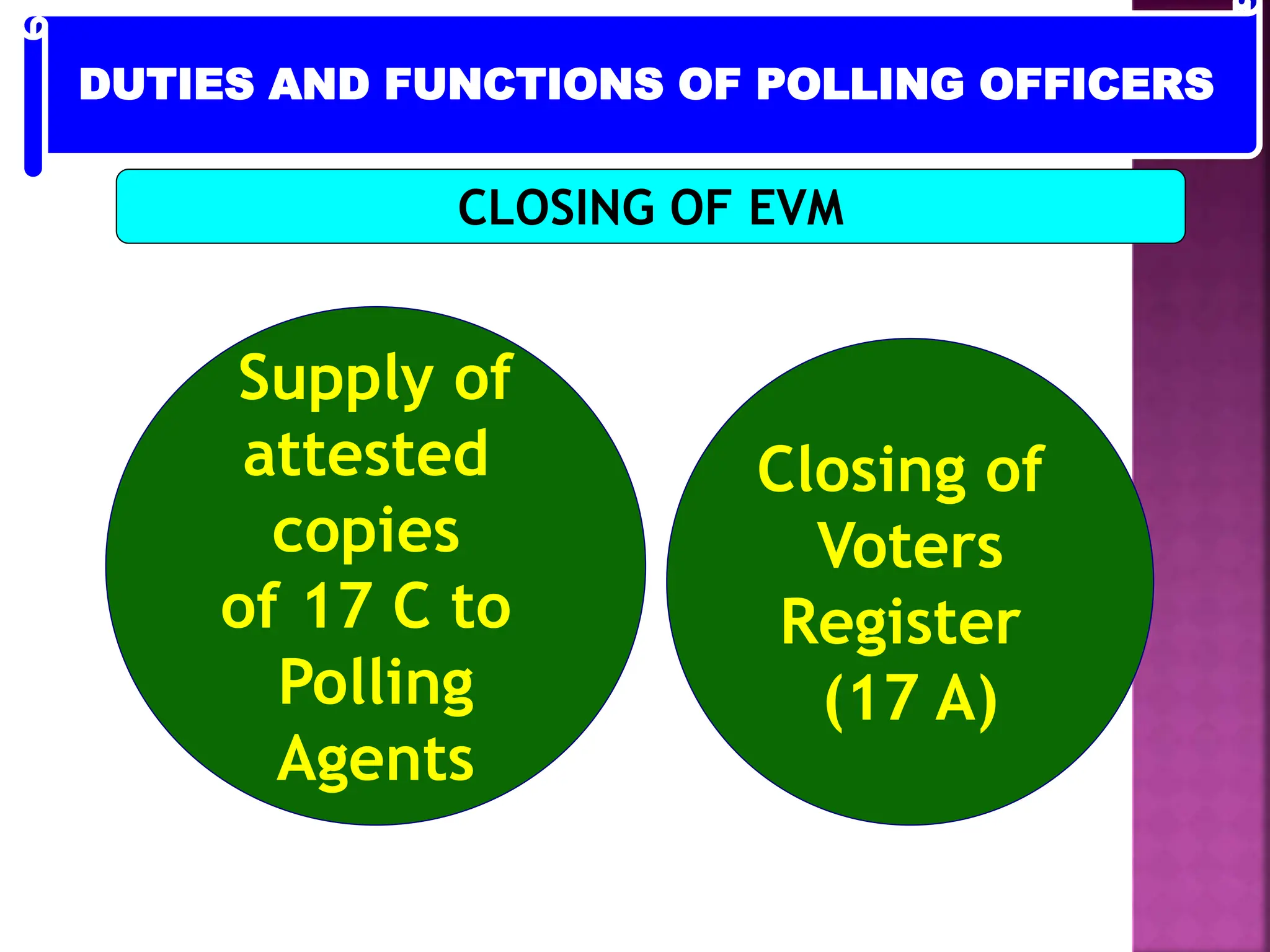
Supply of
attested
copies
of 17 C to
Polling
Agents
Closing of
Voters
Register
(17 A)
CLOSING OF EVM
DUTIES AND FUNCTIONS OF POLLING OFFICERS
SEALING OF ELECTION PAPERS
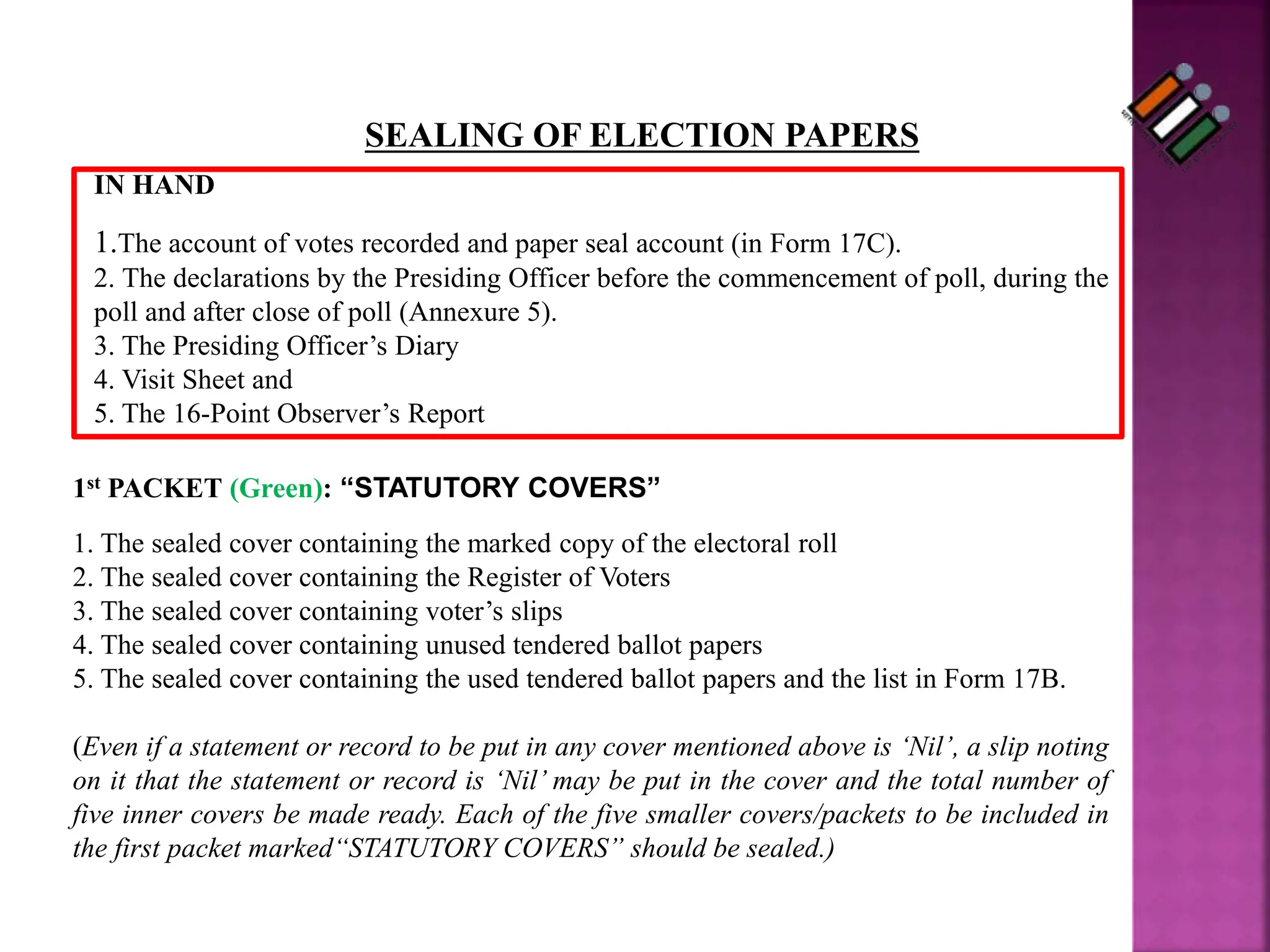
IN HAND
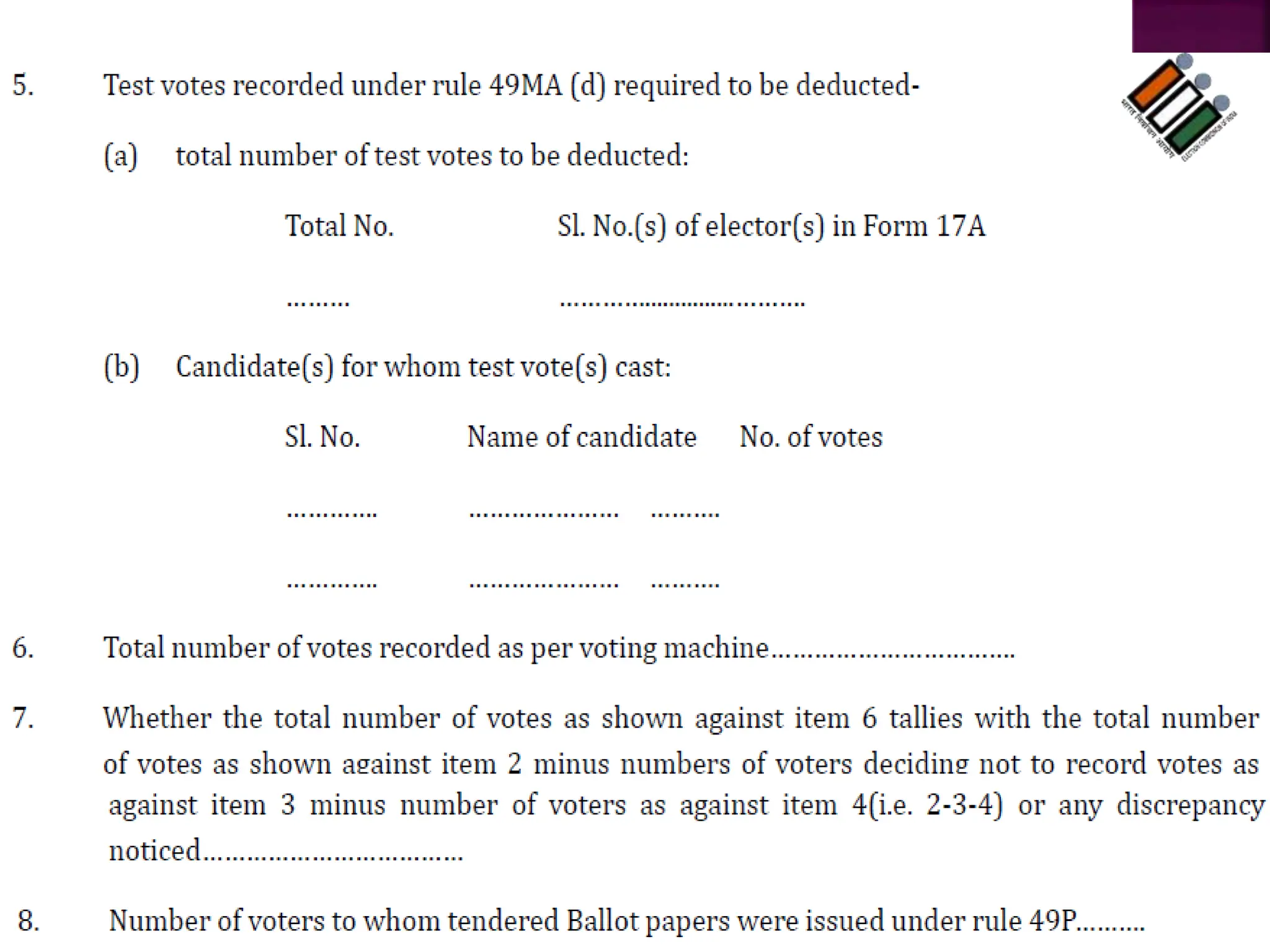
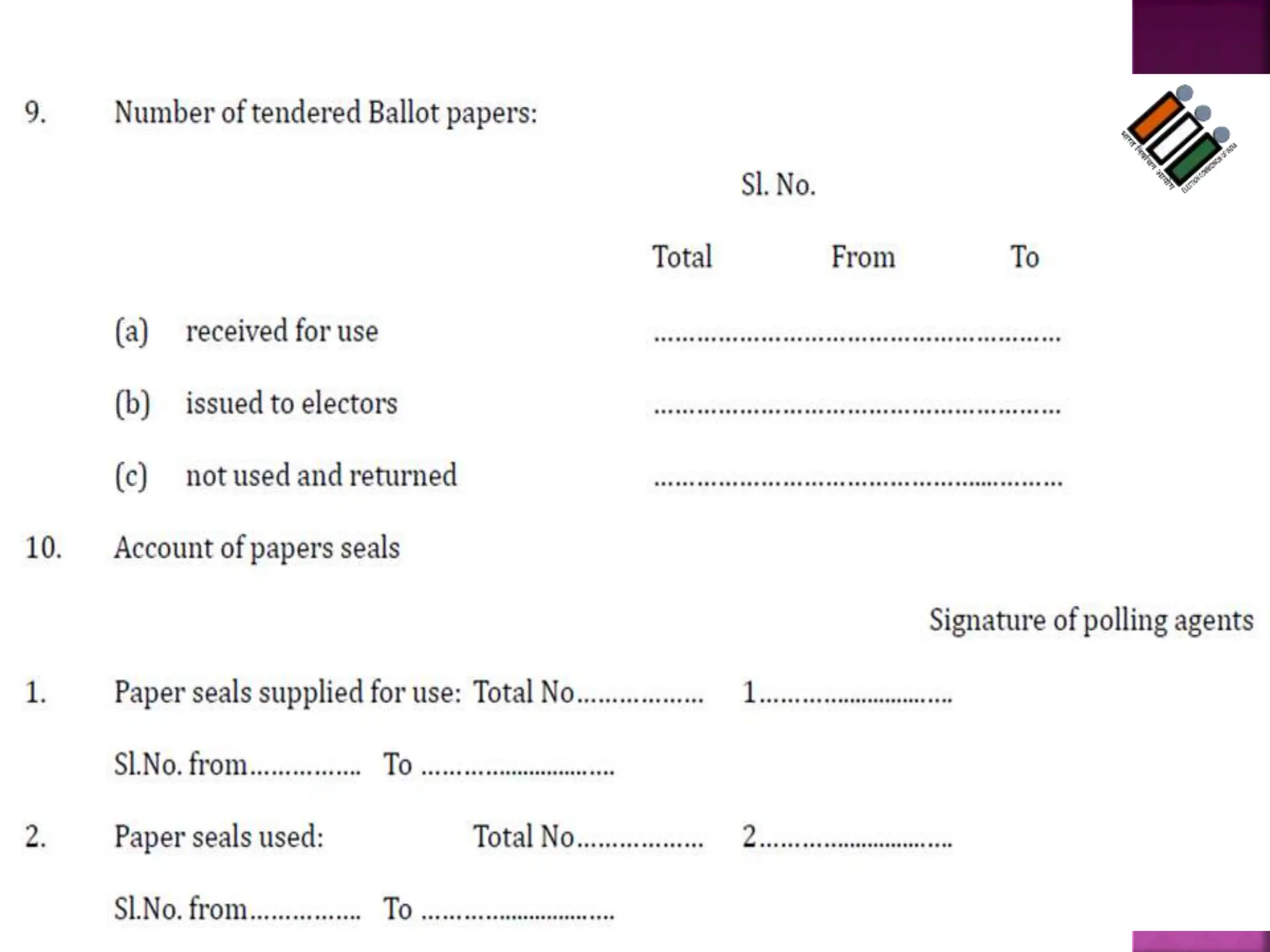
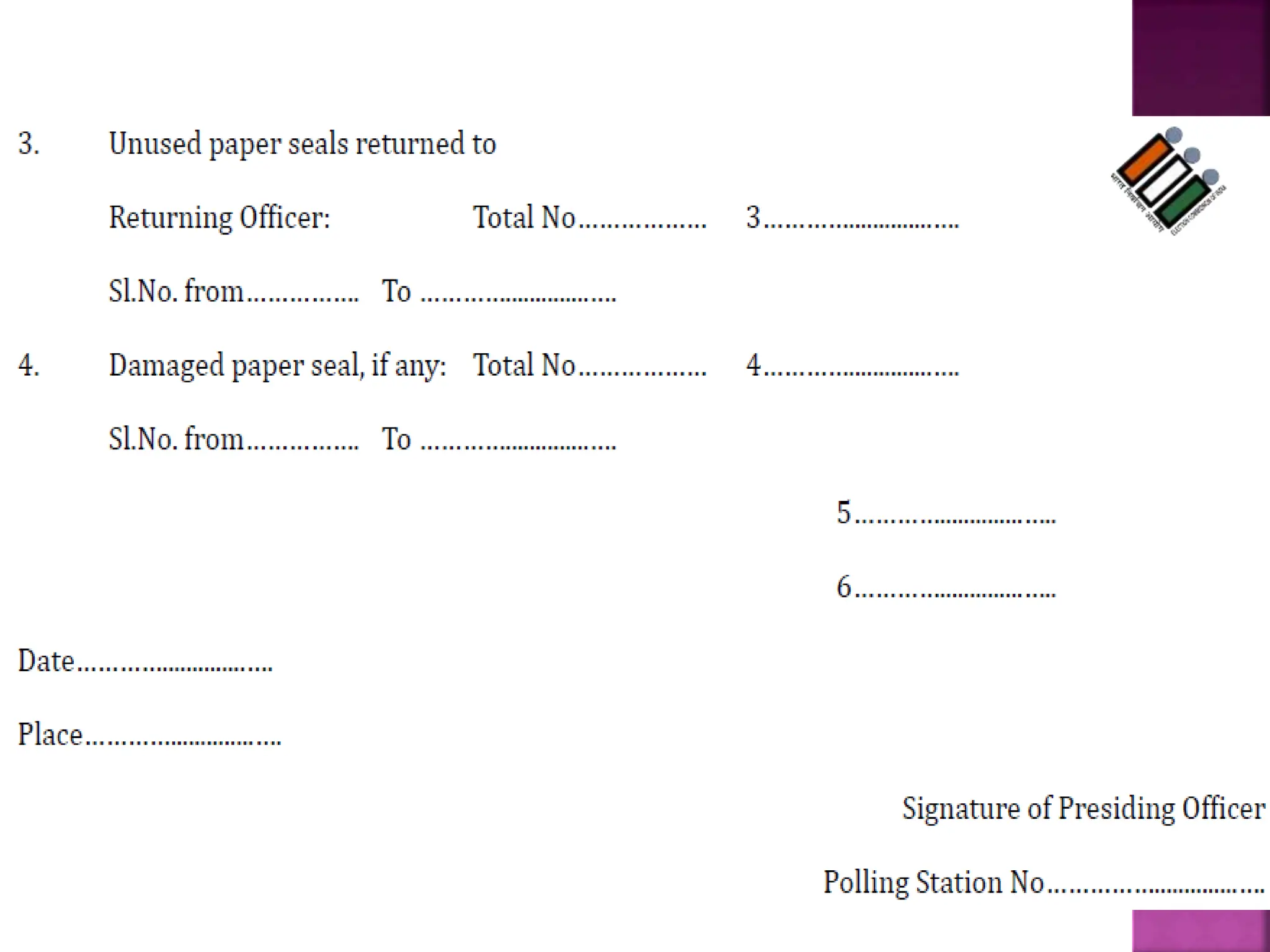
1.The account of votes recorded and paper seal account (in Form 17C).
2. The declarations by the Presiding Officer before the commencement of poll, during the
poll and after close of poll (Annexure 5).
3. The Presiding Officer’s Diary
4. Visit Sheet and
5. The 16-Point Observer’s Report
1st PACKET (Green): “STATUTORY COVERS”
1. The sealed cover containing the marked copy of the electoral roll
2. The sealed cover containing the Register of Voters
3. The sealed cover containing voter’s slips
4. The sealed cover containing unused tendered ballot papers
5. The sealed cover containing the used tendered ballot papers and the list in Form 17B.
(Even if a statement or record to be put in any cover mentioned above is ‘Nil’, a slip noting
on it that the statement or record is ‘Nil’ may be put in the cover and the total number of
five inner covers be made ready. Each of the five smaller covers/packets to be included in
the first packet marked“STATUTORY COVERS” should be sealed.)
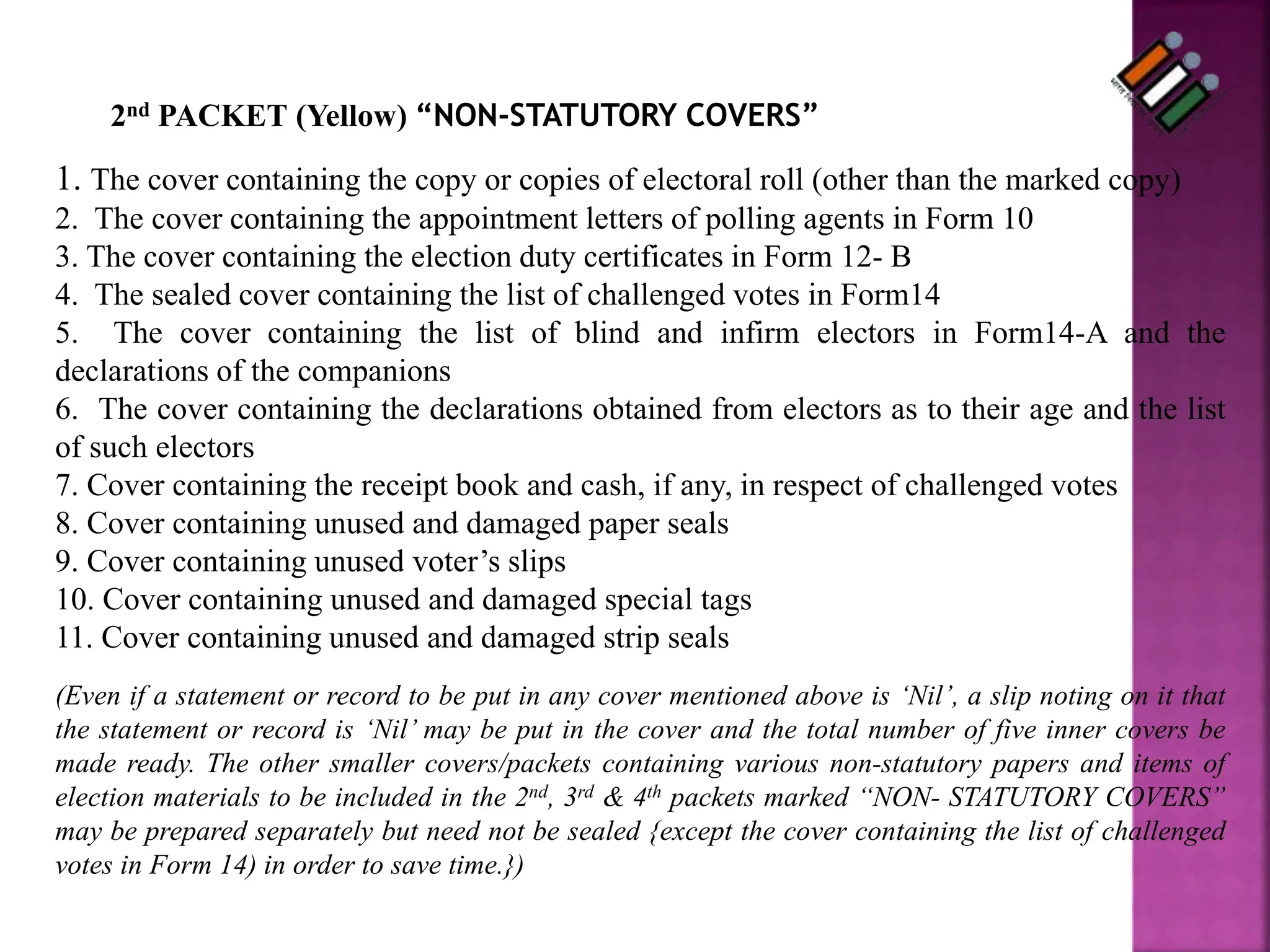
2nd PACKET (Yellow) “NON-STATUTORY COVERS”
1. The cover containing the copy or copies of electoral roll (other than the marked copy)
2. The cover containing the appointment letters of polling agents in Form 10
3. The cover containing the election duty certificates in Form 12- B
4. The sealed cover containing the list of challenged votes in Form14
5. The cover containing the list of blind and infirm electors in Form14-A and the
declarations of the companions
6. The cover containing the declarations obtained from electors as to their age and the list
of such electors
7. Cover containing the receipt book and cash, if any, in respect of challenged votes
8. Cover containing unused and damaged paper seals
9. Cover containing unused voter’s slips
10. Cover containing unused and damaged special tags
11. Cover containing unused and damaged strip seals
(Even if a statement or record to be put in any cover mentioned above is ‘Nil’, a slip noting on it that
the statement or record is ‘Nil’ may be put in the cover and the total number of five inner covers be
made ready. The other smaller covers/packets containing various non-statutory papers and items of
election materials to be included in the 2nd, 3rd & 4th packets marked “NON- STATUTORY COVERS”
may be prepared separately but need not be sealed {except the cover containing the list of challenged
votes in Form 14) in order to save time.})
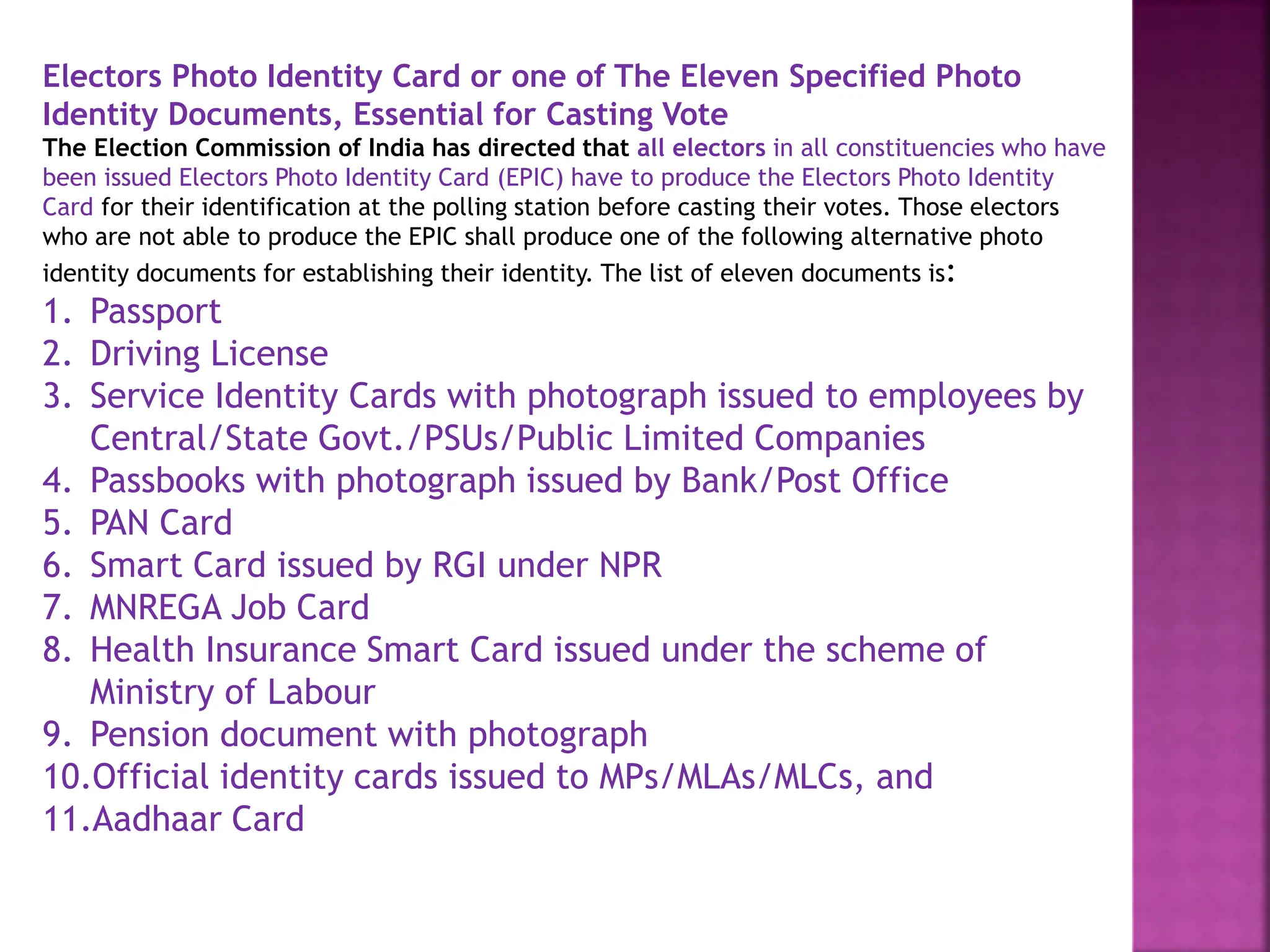
3rd PACKET (Brown) “NON-STATUTORY COVERS”
1. The Handbook for Presiding Officer
2. Manual of Electronic Voting Machine and VVPAT
3. Indelible ink set (with stopper having been secured on each phial effectively with
molten candle or wax applied thereon to prevent leakage or evaporation)
4. Self-inking pads
5. The metal seal of the Presiding Officer
6. The arrow cross-mark rubber stamp for marking tendered ballot papers
7. Cup for setting the indelible ink
4th PACKET (Blue) “NON-STATUTORY COVERS”
*All the other items, if any, should be packed into the Fourth packet
(The other smaller covers/packets containing various non-statutory papers and items of
election materials to be included in the 2nd, 3rd & 4th packets marked “NON-
STATUTORY COVERS” may be prepared separately but need not be sealed {except the
cover containing the list of challenged votes in Form 14) in order to save time.)
assembl.ppt election duties and responsibilities of polling personnel

assembl.ppt election duties and responsibilities of polling personnel

  • 1.
  • 2.
    PLEASE NOTE This Power-point“manual” has been prepared as a summary guide and we have tried to include all the important aspects of Polls for ready reference purpose only. THE LEGAL MANDATE OF THE ELECTION COMMISSION OF INDIA IS THAT ALL PRESIDING OFFICERS SHOULD BE THOROUGHLY FAMILIAR WITH THE PRESIDING OFFICER”S HANDBOOK. This manual, consequently, should never be treated as a substitute for the Presiding Officer’s Handbook. In addition, the Presiding Officer must be vigilant and keep a close watch on the announcements from ECI from time to time.
  • 3.
     A PollingParty is a group of 4 - 5 Govt. officials, who are notified by the District Election Officer under Section – 26 of the RP Act, 1951 to conduct a free and fair poll at a particular Polling Station (PS) on a pre-notified date and time.  The Polling Party is responsible for complete poll related functions of the particular PS assigned to them starting from collection to deposit of poll materials at a place notified for the purpose.  They should be well acquainted with the Representation of the People Act, 1950 & 1951 and relevant rules under the Conduct of Elections Rules, 1961, as well as the Handbook for Presiding Officers, EVM Manual, and instructions from the Returning Officer.
  • 4.
     At asingle election, the polling party will normally consist of one Presiding Officer (appointed under the provisions of section 26 of the RP Act 1951) and three Polling Officers.  At a simultaneous election, the polling party will consist of 5 Polling Officers, besides the Presiding Officer.  It will be the responsibility of the Polling Party to carry out the entire voting process in the particular Polling Station in a free and fair manner.  They should be well-conversant with all relevant rules
  • 5.
     Section –27 of the RPAct, 1951: General duty of the Presiding Officer - It shall be the general duty of the Presiding Officer at a polling station to keep order thereat and to see that the poll is fairly taken.  Section – 28 of the RPAct, 1951 : Duties of a Polling Officer – It shall be the duty of the Polling Officers at a polling station to assist the Presiding Officer for such station in the performance of his function.  Section 28-A of the RPAct, 1951 : Presiding Officer and Polling Officer and any other Officer/ Person employed in elect shall be deemed to be on deputation to the Election Commission for the period of Election and such officers shall, during that period, be subject to the control, superintendence and discipline of the Election Commission.
  • 6.
     On receiptof the final appointment order, the Presiding Officer is to check up carefully and examine:- (a) Details and exact location of the allotted polling station; (b) The name of the assembly constituency within which the polling station is situated  He/she should assemble the other officials of his/her Poll Party and arrive at the designated counter for collection of polling materials.  If there any polling staff is absent, that has to be immediately reported to SO for replacement etc
  • 7.
    7 • Every personshall wear face mask during every election related activity. • At the entry of hall/ room/ premises used for election purposes: • Thermal Scanning of all persons shall be carried out; • Sanitizer, soap and water shall be made available. • Social distancing shall be maintained as per the extant COVID-19 guidelines of the State Govt. and Ministry of Home Affairs. • As far as practicable, large halls should be identified and utilized to ensure social distancing norms. • Adequate number of vehicles shall be mobilized for movement of polling personnel, security personnel to ensure compliance of COVID-19 guidelines. • Nodal Health Officer shall be designated for the State, the District and the Assembly Constituency to oversee COVID-19 related arrangements and, preventive measures during entire electoral process.
  • 9.
    The Polling Partyshould ensure that-  The control unit, ballot unit(s) and VVPAT given to you pertain to your polling station.  The ‘Candidate Set Section’ of control unit is duly sealed and address tag is firmly attached thereto.  The battery in the control unit is fully operational. The battery should be switched off after checking the Control Unit. But must not check VVPAT before Mock Poll  The ballot unit(s) have been duly sealed and address tags are firmly attached, both at the top and bottom right portion.  The appropriate ballot paper has been affixed on each ballot unit and is properly aligned under the ballot paper screen.
  • 10.
    (f)Check up theelectoral roll to ensure that:–  the copies of the supplements are given,  the part number of the roll and the supplement is correctly given,  page numbers in the working copies of the roll are given serially,  the printed serial numbers of voters are not corrected and no new numbers are substituted for them,  all deletions of names and corrections of clerical or other errors as per the supplements have been incorporated.  Check that all the items of polling materials mentioned in Annexure 19 of the HandBook of Presiding Officers have been supplied in required quantity;
  • 11.
    Some Very ImportantFORMS 1. List of Contesting Candidates (Form 7A) 1 2. List of Challenged Votes (Form-14) 2 3. List of Blind and Infirm Voters (Form-14A) 2 4. List of Tendered Votes (Form-17B) 2 5. Accounts of votes Recorded (Form-17C) 10 6. Record of paper seals used 2 7. Receipt Book for deposit of challenged votes fee 1 Book 8. Letter to S.SH.O. 4 9. Declaration by the Presiding Officer before the Commencement of Poll and at the end of poll (Part I to IV) 2 10. Declaration by Elector about his age 2 11. List of Electors who voted after giving declaration/refused to give declaration 4 12. Declaration by the companion of blind and inform voter 10 13. Passes for Polling Agents 10 14. Visit Sheet 2 15. Format for Presiding Officer’s Additional 16-Point Report to be submitted to Constituency Observer/Returning Officer 16. The Presiding Officer’s Diary
  • 12.
    12 • Commission hasissued detailed instructions for assured minimum facilities at each polling station. Now, in view of COVID-19 situation, following additional facilities/steps should be taken: • Mandatory sanitization of Polling Station, preferably, a day before the poll. • Thermal Scanning at the entry point of every polling station location(either by polling staff or Para Medical staff or Asha worker).
  • 14.
    14 • Earmarking circlefor 15-20 persons of 2 yards (6 feet) distance for voters standing in the queue depending on the availability of space. • There shall be three queues each, for male, female, and PwD/ Senior citizen voters. • The services of BLOs, volunteers etc may be engaged to monitor and regulate social distancing norms strictly. • One shaded waiting areas with chairs, dari etc. will be provided, for male and female separately, within the polling station premises. • Wherever possible, Booth App shall be used at the polling station.
  • 15.
    15 • If temperatureis above the set norms of MoHFW at first reading, then it will be checked twice and if it remains, then the elector shall be provided with token/certificate and will be asked to come for voting at the last hour of poll. At the last hour of poll, such electors shall be facilitated voting, strictly following COVID- 19 related preventive measures. • Help Desk for distribution of token to the voters of first come first basis so that they do not wait in the queue.
  • 16.
    1. Assignment ofDuties to Polling Officers And to have clear idea about various forms 2. Appointment of Election Agents 3. Preparation of EVM 4. Mock Poll 5. Sealing of EVM BEFORE COMMENCEMENT OF POLL DUTIES AND FUNCTIONS OF POLLING OFFICERS
  • 17.
    1ST POLLING OFFICER Incharge of marked copy Verification of identity of Electors Read out serial No and entry of the elector in the electoral roll 1. Assignment of Duties to Polling Officers DUTIES AND FUNCTIONS OF POLLING OFFICERS
  • 18.
    1ST POLLING OFFICER Marking inthe Photo Electoral Roll PB DUTIES AND FUNCTIONS OF POLLING OFFICERS
  • 19.
    2nd POLLING OFFICER Issuanceof Voters slip In charge of Register Of Voters (Form 17A) In charge of indelible ink Obtain Signature or Thumb Impression of each elector DUTIES AND FUNCTIONS OF POLLING OFFICERS
  • 21.
    3rd POLLING OFFICER Receiptof Voters slip In charge of CU (As per the direction of PO) DUTIES AND FUNCTIONS OF POLLING OFFICERS
  • 22.
    ON THE POLLDAY SEQUENCE OF EVENTS INSIDE THE POLLING STATION Part I: MOCK POLL Conduct of Mock Poll and sealing of EVMs and WPATs in the Polling Stations During the mock poll, BU and VVPAT should be placed in the Voting Compartment, where a Polling Officer should be present along with polling agents to observe This Polling Officer will keep a record of the votes cast. After the mock poll, Presiding Officer will ascertain the result in the CU, count the ballot slips in the presence of the polling agents and confirm that the results tally for each candidate.
  • 26.
    All mock polldata in CU and ballot slips from WPAT must be removed by the Presiding Officer and the drop box verified by the Polling Agents The mock poll ballot slips shall be kept in an envelope made of thick black paper, sealed with the seal of the Presiding Officer. The Presiding Officer and polling agents must put their signatures on the envelope. The number and name of the polling station, number and name of Assembly Constituency, date of poll and the words "Printed paper slips of Mock Poll" shall be written on the envelope. This envelope must be kept in the special plastic box for mock poll and sealed with a pink paper seal placed all around in such a manner that opening of the box will require breaking of the seal. The number and name of the polling station, number and name of Assembly Constituency and the date of poll shall be written on the plastic box The Presiding Officer and Polling Agents must put their signatures on the pink paper seal and keep the box along with other documents relating to elections. Thereafter, Presiding Officer will sign the Mock Poll Certificate and seal the CU. The drop box of VVPAT should be sealed with an address tag before the actual poll starts.
  • 29.
    Part II: ACTUALPOLL A) When an elector enters the polling station, he will first go to 1st Polling officer, who shall identify the voter as per the marked copy of Electoral role and valid ID proof. PRO may intervene if necessary. The slide below is from the ECI Minor errors in EPIC are to be ignored. Please Note: PVS won’t be accepted as stand-alone id proof. Pl see next slide .
  • 30.
    Electors Photo IdentityCard or one of The Eleven Specified Photo Identity Documents, Essential for Casting Vote The Election Commission of India has directed that all electors in all constituencies who have been issued Electors Photo Identity Card (EPIC) have to produce the Electors Photo Identity Card for their identification at the polling station before casting their votes. Those electors who are not able to produce the EPIC shall produce one of the following alternative photo identity documents for establishing their identity. The list of eleven documents is: 1. Passport 2. Driving License 3. Service Identity Cards with photograph issued to employees by Central/State Govt./PSUs/Public Limited Companies 4. Passbooks with photograph issued by Bank/Post Office 5. PAN Card 6. Smart Card issued by RGI under NPR 7. MNREGA Job Card 8. Health Insurance Smart Card issued under the scheme of Ministry of Labour 9. Pension document with photograph 10.Official identity cards issued to MPs/MLAs/MLCs, and 11.Aadhaar Card
  • 31.
    31 • During theprocess of identification of voter, the voters will require to lower the facemask for identification, when required. • At any given time, only 1(one) voter shall be allowed to stand in front of each polling official maintaining social distance. • Hand gloves shall be provided to the voter, for signing on the voter register and pressing button of EVM for voting. • Sanitizers shall be kept inside the booth at appropriate locations with clear direction for the use by voters.
  • 32.
    32 • COVID-19 patientswho are quarantined will be allowed to cast their vote at the last hour of the poll day at their respective Polling Stations, under the supervision of health authorities, strictly following COVID-19 related preventive measures. Sector Magistrates shall coordinate this in their allocated polling stations. • In case of those voters who are residing in the area notified as containment zone, guidelines shall be issued separately.
  • 33.
    B) Then electorwill move to 2nd Polling Officer who will Note down the serial number of electoral roll of that elector as it is read out aloud by 1st Polling Officer. Apply indelible ink on the left forefinger of the elector in such a way to make a line from the top end of the nail to the bottom of the left forefinger first joint. If any elector refuses to allow his left forefinger to be inspected or marked with indelible ink or he has already such a mark on his left forefinger, or he does any act with a view to removing the ink mark, he shall not be allowed to vote. After the ink has been duly applied, then obtain elector’s signature or thumb impression in the Relevant column of Register of voters in Form 17 A. Particulars of EPIC or other alternate identification as prescribed by ECI, shall be mentioned in Remarks column Prepare a voter’s slip filling all required particulars
  • 34.
    C) Thereafter, theelector will move to 3 rd Polling Officer or Presiding Officer, who is in charge of Control Unit – Who will first recheck that the indelible mark is clear on the finger of the elector. If it is found that it is not clear or has been wiped off then, apply once again. Thereafter, he will take voters slip and allow the voter to go to voting compartment so that he may cast vote. For this, he will press “Ballot” button of the machine. The voter shall be allowed to vote exactly in the same sequence in which, his details have been recorded in Register of Voters (17A). D) The voter shall record his vote and then immediately leave. E) Before leaving, a group ‘D’ employee posted in polling station once again may check for indelible ink mark on voter finger. The Application of indelible ink is a must under Rule 49 K which is a guard against a vital safeguard against impersonation and ensures that the same voter does not vote more than once. It has to be applied on the left forefinger. If an elector has no left forefinger, then indelible ink should be applied on any such finger, which he has on his left hand
  • 38.
    VVPAT COMPLAINT ISSUES Ifan elector after having recorded his vote alleges that the paper trail generated by the printer has shown the name or symbol of a candidate other than the one he voted for, the Presiding Officer shall : obtain a written declaration from the elector as to the allegation, after warning the elector about the consequence of making a false declaration, make a second entry related to that elector in Form 17A, permit the elector to record a test vote in the voting machine. If the allegation is found to be true, the Presiding Officer shall report the facts immediately to the Returning Officer; stop further recording of votes in that machine. If the allegation is found to be false, the Presiding Officer should take appropriate action as given the Presiding Officer’s Handbook
  • 39.
    MAINTENANCE OF DIARYBY PRESIDING OFFICER  The Presiding Officer of every polling station should be asked to maintain a diary in which he should record the proceedings connected with the poll in the polling station. He should be asked to go on recording the relevant events in the diary as and when they occur.  If Presiding Officers do not make the entries in the relevant columns of the diary at regular intervals or from time to time and complete the diary at the end of the poll that is highly objectionable and it should be impressed upon all Presiding Officers that any lapse on their part in the proper maintenance of diary at all points of time during the process of poll will be seriously viewed by the commission  The Commission has recently directed that in addition to Presiding Officer diary, Presiding Officer will be required to submit additional inputs
  • 40.
     The pollshould be closed at the hour fixed for the purpose, even if for certain unavoidable reason it had commenced somewhat later than the hour appointed.  However, all electors present at the polling station at the hour appointed for the close of poll should be permitted to cast their vote even if the poll has to be continued for sometime beyond the appointed closing hour.  For this, he should distribute pre-numbered slips to all electors standing in queue, starting from the last person in queue at the prescribed time for end of polling  For closing the poll after the last voter has recorded his vote, the voting machine has to be closed so that no further recording of votes in the machine is possible. For that purpose, the Presiding Officer should press the ‘Close’ button on the control unit. When the close button is pressed, display panels on the control unit will show the total number of votes recorded in the voting machine till the end of the poll (but not the candidate-wise tally). The total number of votes recorded in the machine must tally with account of votes
  • 41.
    Supply of attested copies of 17C to Polling Agents Closing of Voters Register (17 A) CLOSING OF EVM DUTIES AND FUNCTIONS OF POLLING OFFICERS
  • 50.
    SEALING OF ELECTIONPAPERS IN HAND 1.The account of votes recorded and paper seal account (in Form 17C). 2. The declarations by the Presiding Officer before the commencement of poll, during the poll and after close of poll (Annexure 5). 3. The Presiding Officer’s Diary 4. Visit Sheet and 5. The 16-Point Observer’s Report 1st PACKET (Green): “STATUTORY COVERS” 1. The sealed cover containing the marked copy of the electoral roll 2. The sealed cover containing the Register of Voters 3. The sealed cover containing voter’s slips 4. The sealed cover containing unused tendered ballot papers 5. The sealed cover containing the used tendered ballot papers and the list in Form 17B. (Even if a statement or record to be put in any cover mentioned above is ‘Nil’, a slip noting on it that the statement or record is ‘Nil’ may be put in the cover and the total number of five inner covers be made ready. Each of the five smaller covers/packets to be included in the first packet marked“STATUTORY COVERS” should be sealed.)
  • 51.
    2nd PACKET (Yellow)“NON-STATUTORY COVERS” 1. The cover containing the copy or copies of electoral roll (other than the marked copy) 2. The cover containing the appointment letters of polling agents in Form 10 3. The cover containing the election duty certificates in Form 12- B 4. The sealed cover containing the list of challenged votes in Form14 5. The cover containing the list of blind and infirm electors in Form14-A and the declarations of the companions 6. The cover containing the declarations obtained from electors as to their age and the list of such electors 7. Cover containing the receipt book and cash, if any, in respect of challenged votes 8. Cover containing unused and damaged paper seals 9. Cover containing unused voter’s slips 10. Cover containing unused and damaged special tags 11. Cover containing unused and damaged strip seals (Even if a statement or record to be put in any cover mentioned above is ‘Nil’, a slip noting on it that the statement or record is ‘Nil’ may be put in the cover and the total number of five inner covers be made ready. The other smaller covers/packets containing various non-statutory papers and items of election materials to be included in the 2nd, 3rd & 4th packets marked “NON- STATUTORY COVERS” may be prepared separately but need not be sealed {except the cover containing the list of challenged votes in Form 14) in order to save time.})
  • 52.
    3rd PACKET (Brown)“NON-STATUTORY COVERS” 1. The Handbook for Presiding Officer 2. Manual of Electronic Voting Machine and VVPAT 3. Indelible ink set (with stopper having been secured on each phial effectively with molten candle or wax applied thereon to prevent leakage or evaporation) 4. Self-inking pads 5. The metal seal of the Presiding Officer 6. The arrow cross-mark rubber stamp for marking tendered ballot papers 7. Cup for setting the indelible ink 4th PACKET (Blue) “NON-STATUTORY COVERS” *All the other items, if any, should be packed into the Fourth packet (The other smaller covers/packets containing various non-statutory papers and items of election materials to be included in the 2nd, 3rd & 4th packets marked “NON- STATUTORY COVERS” may be prepared separately but need not be sealed {except the cover containing the list of challenged votes in Form 14) in order to save time.)