Server side technologies
ASP.Net
Amelina Ahmeti, Sultonmamad, Usman
Web Technologies – Prof. Dr. Ulrik Schroeder – WS 2010/111
The slides are licensed under a
Creative Commons Attribution 3.0 License
Overview
 ASP.Net v/s PHP
 The need for ASP.Net
 Introduction to ASP.Net
 .Net Framework
 .aspx and Code Behind files
 Page Life Cycle
 Controls
 State Management
 Configuration Files
ASP.Net Presentation2
Objectives
 Introduction to ASP.Net
 Basic Advantages
 Some Examples
ASP.Net Presentation3
Comparison with PHP
 Wide belief that PHP is faster
 ASP.Net is a platform
 Cost
 Web Server
 Propriety
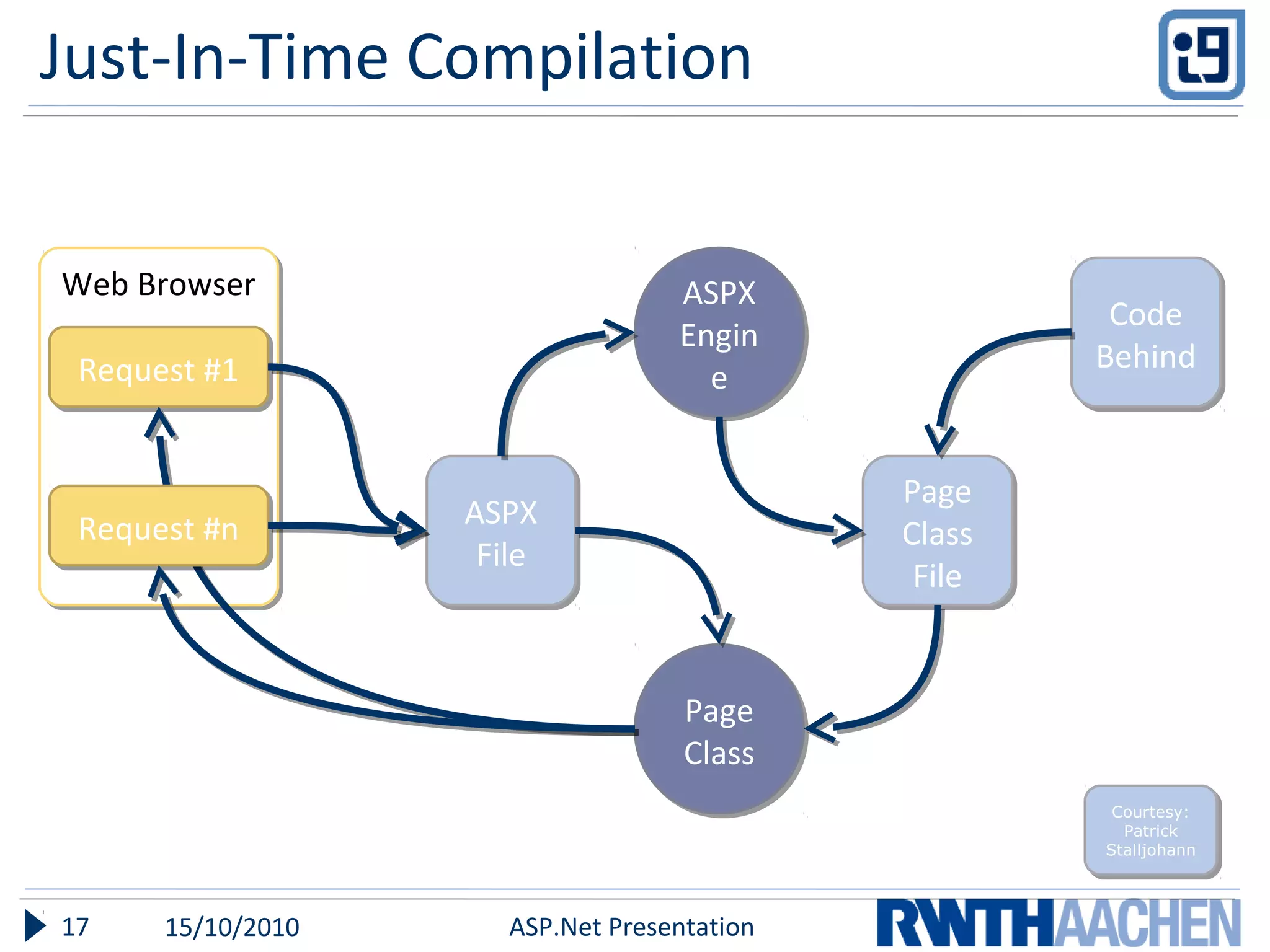
 JIT (Just In Time) Compilation
 Discussed in Detail Later!
4 ASP.Net Presentation
ASP – Active Server Pages
 Server-side scripts
 Also client-side scripts
 Validate user inputs
 Access database
 ASP provides solutions for transaction processing and managing
session state.
 One of the most successful languages for Web development.
ASP.Net Presentation5
Problems with ASP
 Interpreted and Loosely typed code
 Late binding of Variables
 Uses Jscript or VBScript
 Mixes layout (HTML) and logic (scripting code)
 Frequent switches between HTML and ASP code
 Hard to separate Content and Business Logic
 Limited Development and Debugging Tools
 Visual InterDev, Macromedia helped
 Debugging done using “Response.Write()”
ASP.Net Presentation6
Problems with ASP
 No real state management
 Process Dependent
 Server Farm Limitations
 Cookie Dependent
 Update files only when server is down
 To update components based site you have to stop the server
 If not Application fails
 Obscure Configuration Settings
 Configurations stored in IIS Metabase
 Difficult to port application
ASP.Net Presentation7
ASP.Net – Issues to Address
 Make sure ASP runs fine
 Since ASP was widely used
 Had a very large programmer base
 Introduction of .Net Framework
 ASP.DLL not modified while installing framework
 IIS could run ASP and ASP.Net simultaneously
 Overcome the short comings in ASP
ASP.Net Presentation8
ASP.Net - Advantages
 Support for compiled languages
 Separation of Code from HTML
 Use services provided by the .NET Framework
 Easier Debugging using Visual Studio
 Graphical Development Environment
 Session Management
 Update files while the server is running!
 XML-Based Configuration Files
ASP.Net Presentation9
ASP.Net - Overview
 Server side technology
 Web Forms used to build Web Applications
 Provides services to create and use Web Services
 Controls
 HTML Controls
 Web Server Control
 User Controls
 Ease of application development
ASP.Net Presentation10
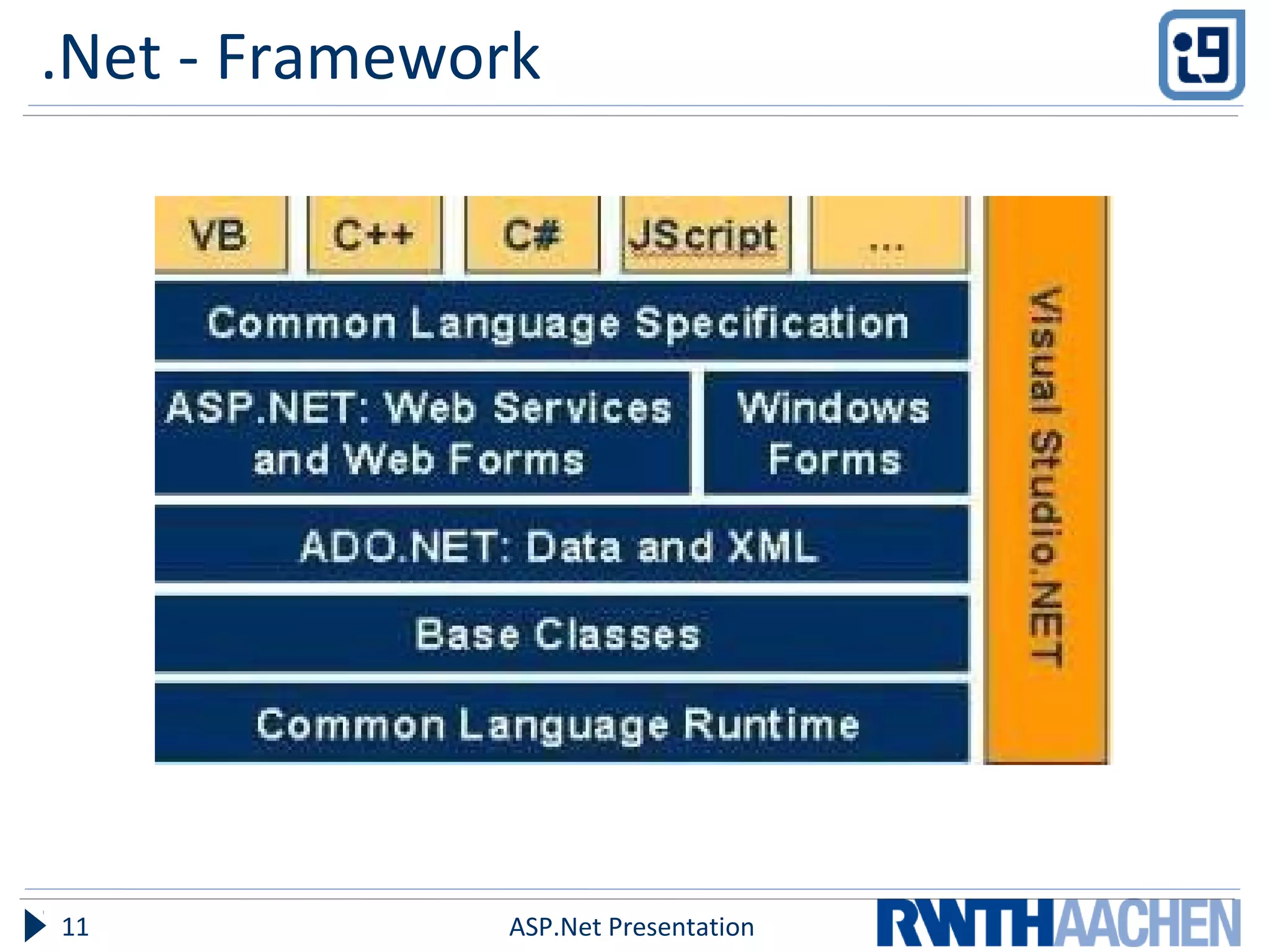
.Net - Framework
ASP.Net Presentation11
ASP.Net - Files
 A simple ASP.Net file consists of two files
 Presentation (.aspx)
 Code Behind (.aspx.cs for C#)
 Web Services have the extension .asmx
 Configuration Files
 Global.asax (also has a code behind file)
 Optional file containing global logic
 Also has a code behind file
 Web.config
 Application Configuration file
 Allows defining Name, Value pairs that could be accessed by application
ASP.Net Presentation12
Preserving Data Across Pages
 Session
 InProc
 StateServer
 SqlServer
 Cookies
 Query String
 Cookie Independent (Visual Studio 2010)
ASP.Net Presentation13
Execution Cycle
 Request aspx page
 ASP.Net runtime parses file for code to be compiled
 Generation of Page class (ASP.Net Page)
 Instantiates server controls
 Populates server controls
 Rendering of Controls
 Send the HTML to client browser
ASP.Net Presentation14
Execution Process
 Compiling the code
 First time request
 Code compiled to MSIL(Microsoft Intermediate Language)
 Similar to Assembly Language
 Used to achieve platform independency
 Not the target what Microsoft wants
 CPU independence
 Efficient conversion to Native code
 CLR(Common Language Runtime) compiles the code
 A copy of Page is Cached
 Used until changes are made to the page, and it needs to be compiled again
 Updating the page causes a re-build
ASP.Net Presentation15
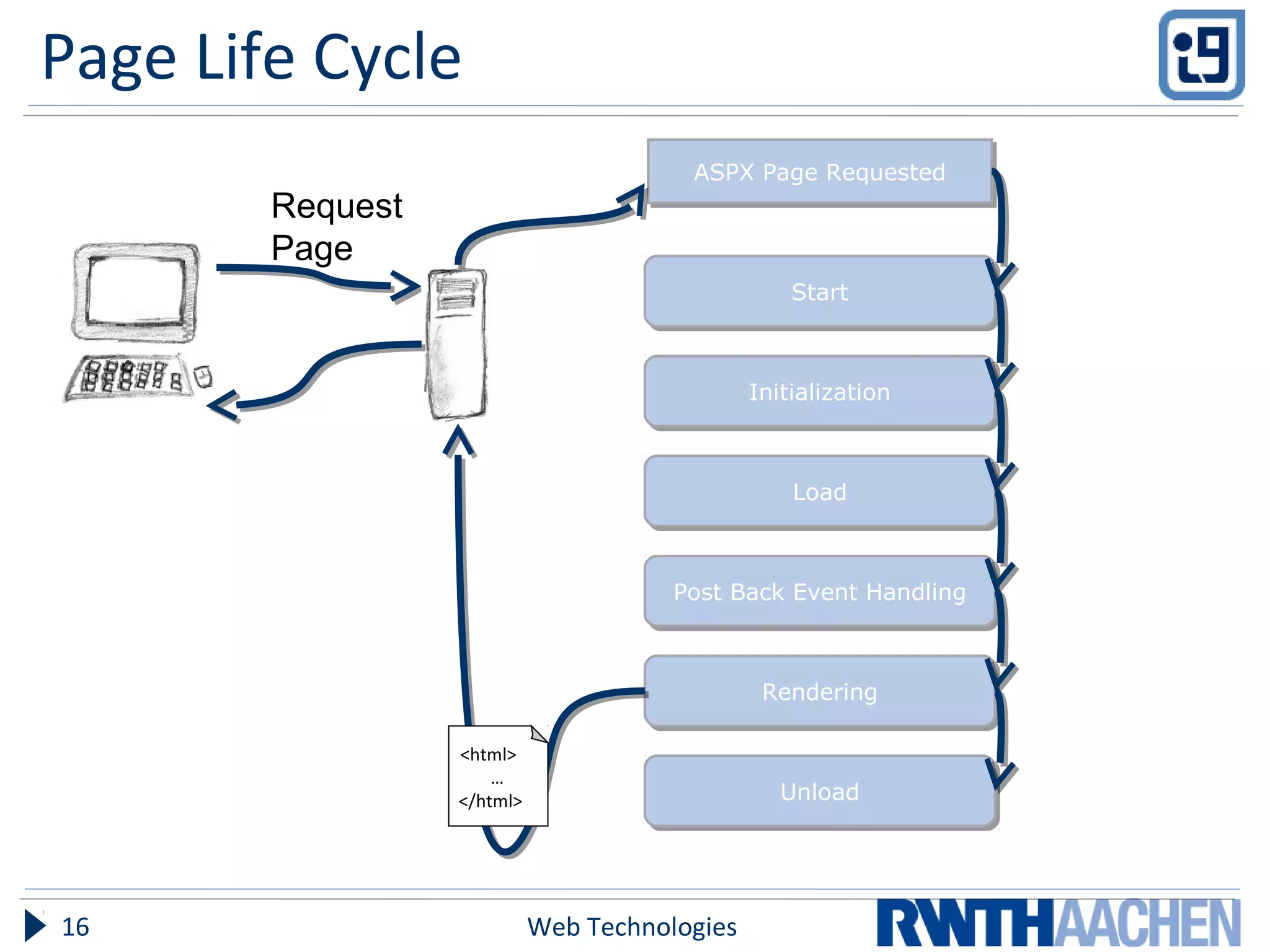
Page Life Cycle
Web Technologies16
ASPX Page RequestedASPX Page Requested
Request
Page
StartStart
InitializationInitialization
LoadLoad
Post Back Event HandlingPost Back Event Handling
RenderingRendering
UnloadUnload
<html>
…
</html>
Web BrowserWeb Browser
15/10/2010 ASP.Net Presentation17
Just-In-Time Compilation
ASPX
File
ASPX
File
Code
Behind
Code
Behind
Page
Class
File
Page
Class
File
ASPX
Engin
e
ASPX
Engin
e
Page
Class
Page
Class
Request #1Request #1
Request #nRequest #n
Courtesy:
Patrick
Stalljohann​
Courtesy:
Patrick
Stalljohann​
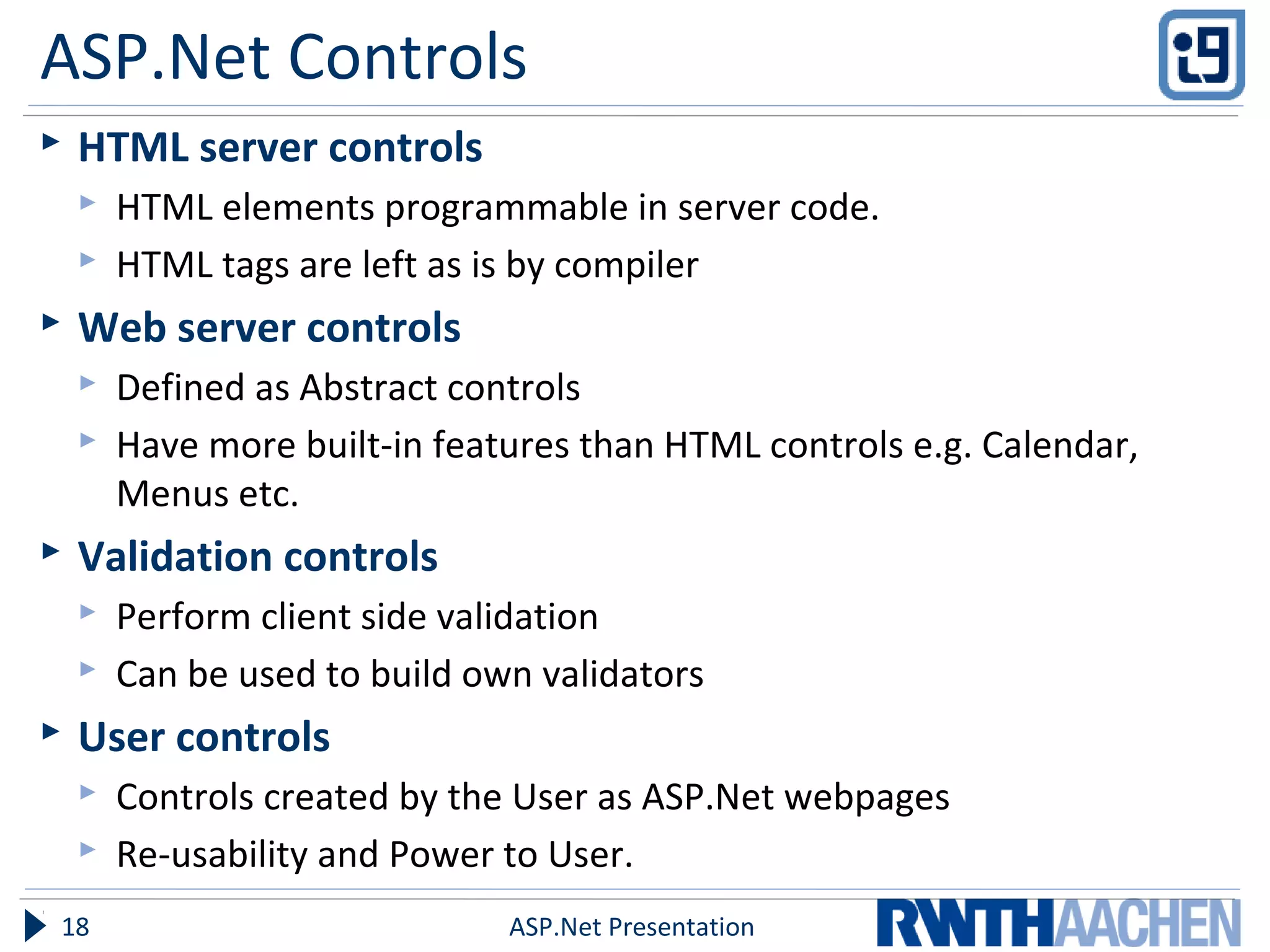
ASP.Net Controls
 HTML server controls
 HTML elements programmable in server code.
 HTML tags are left as is by compiler
 Web server controls
 Defined as Abstract controls
 Have more built-in features than HTML controls e.g. Calendar,
Menus etc.
 Validation controls
 Perform client side validation
 Can be used to build own validators
 User controls
 Controls created by the User as ASP.Net webpages
 Re-usability and Power to User.
ASP.Net Presentation18
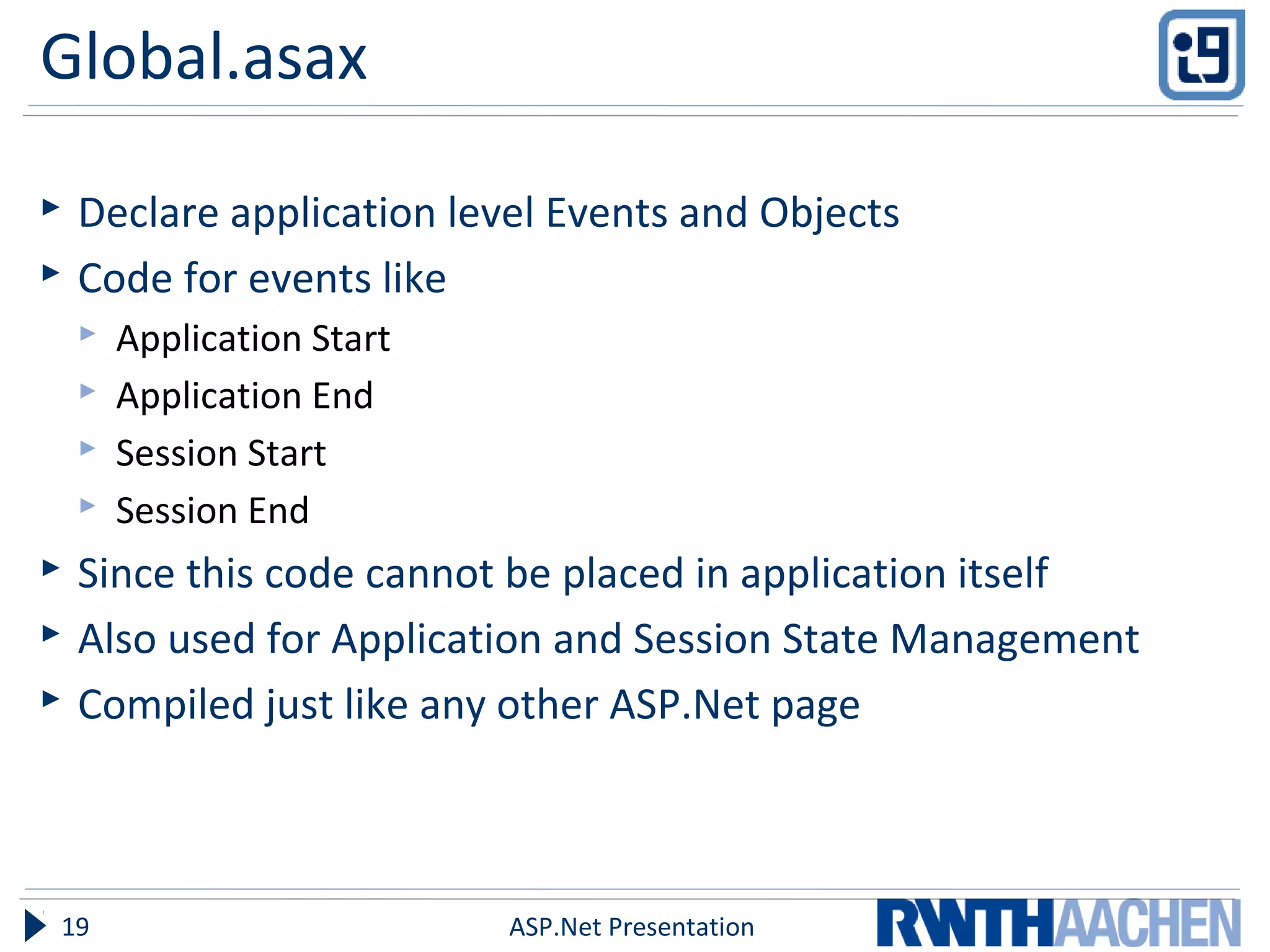
Global.asax
 Declare application level Events and Objects
 Code for events like
 Application Start
 Application End
 Session Start
 Session End
 Since this code cannot be placed in application itself
 Also used for Application and Session State Management
 Compiled just like any other ASP.Net page
ASP.Net Presentation19
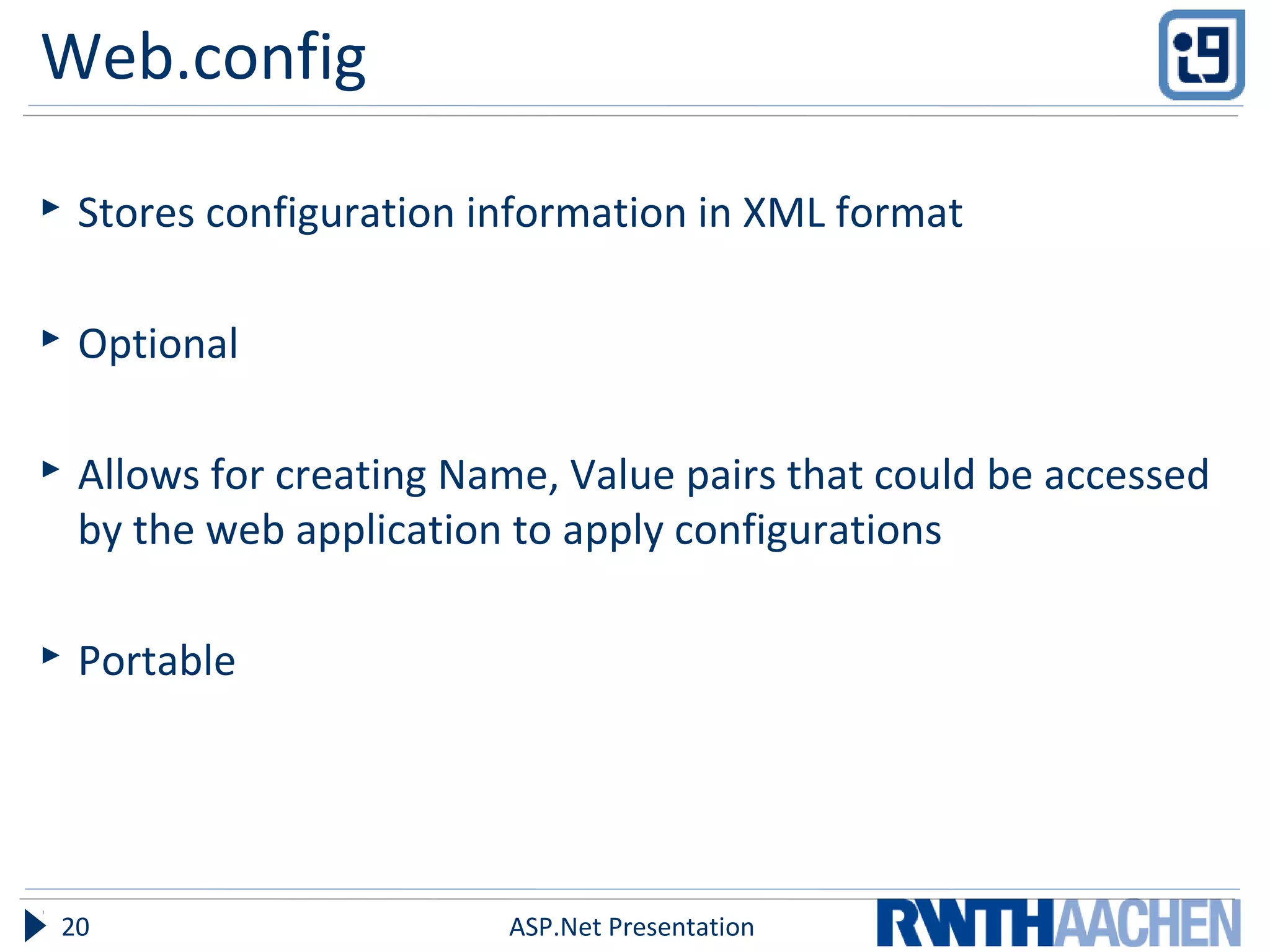
Web.config
 Stores configuration information in XML format
 Optional
 Allows for creating Name, Value pairs that could be accessed
by the web application to apply configurations
 Portable
ASP.Net Presentation20
References
 www.w3schools.com
 www.codeproject.com
 msdn.microsoft.com
 CiL – Center for Innovative Learning Technologies, RWTH Aachen
University
21 ASP.Net Presentation

Asp dot net final (1)

  • 1.
    Server side technologies ASP.Net AmelinaAhmeti, Sultonmamad, Usman Web Technologies – Prof. Dr. Ulrik Schroeder – WS 2010/111 The slides are licensed under a Creative Commons Attribution 3.0 License
  • 2.
    Overview  ASP.Net v/sPHP  The need for ASP.Net  Introduction to ASP.Net  .Net Framework  .aspx and Code Behind files  Page Life Cycle  Controls  State Management  Configuration Files ASP.Net Presentation2
  • 3.
    Objectives  Introduction toASP.Net  Basic Advantages  Some Examples ASP.Net Presentation3
  • 4.
    Comparison with PHP Wide belief that PHP is faster  ASP.Net is a platform  Cost  Web Server  Propriety  JIT (Just In Time) Compilation  Discussed in Detail Later! 4 ASP.Net Presentation
  • 5.
    ASP – ActiveServer Pages  Server-side scripts  Also client-side scripts  Validate user inputs  Access database  ASP provides solutions for transaction processing and managing session state.  One of the most successful languages for Web development. ASP.Net Presentation5
  • 6.
    Problems with ASP Interpreted and Loosely typed code  Late binding of Variables  Uses Jscript or VBScript  Mixes layout (HTML) and logic (scripting code)  Frequent switches between HTML and ASP code  Hard to separate Content and Business Logic  Limited Development and Debugging Tools  Visual InterDev, Macromedia helped  Debugging done using “Response.Write()” ASP.Net Presentation6
  • 7.
    Problems with ASP No real state management  Process Dependent  Server Farm Limitations  Cookie Dependent  Update files only when server is down  To update components based site you have to stop the server  If not Application fails  Obscure Configuration Settings  Configurations stored in IIS Metabase  Difficult to port application ASP.Net Presentation7
  • 8.
    ASP.Net – Issuesto Address  Make sure ASP runs fine  Since ASP was widely used  Had a very large programmer base  Introduction of .Net Framework  ASP.DLL not modified while installing framework  IIS could run ASP and ASP.Net simultaneously  Overcome the short comings in ASP ASP.Net Presentation8
  • 9.
    ASP.Net - Advantages Support for compiled languages  Separation of Code from HTML  Use services provided by the .NET Framework  Easier Debugging using Visual Studio  Graphical Development Environment  Session Management  Update files while the server is running!  XML-Based Configuration Files ASP.Net Presentation9
  • 10.
    ASP.Net - Overview Server side technology  Web Forms used to build Web Applications  Provides services to create and use Web Services  Controls  HTML Controls  Web Server Control  User Controls  Ease of application development ASP.Net Presentation10
  • 11.
  • 12.
    ASP.Net - Files A simple ASP.Net file consists of two files  Presentation (.aspx)  Code Behind (.aspx.cs for C#)  Web Services have the extension .asmx  Configuration Files  Global.asax (also has a code behind file)  Optional file containing global logic  Also has a code behind file  Web.config  Application Configuration file  Allows defining Name, Value pairs that could be accessed by application ASP.Net Presentation12
  • 13.
    Preserving Data AcrossPages  Session  InProc  StateServer  SqlServer  Cookies  Query String  Cookie Independent (Visual Studio 2010) ASP.Net Presentation13
  • 14.
    Execution Cycle  Requestaspx page  ASP.Net runtime parses file for code to be compiled  Generation of Page class (ASP.Net Page)  Instantiates server controls  Populates server controls  Rendering of Controls  Send the HTML to client browser ASP.Net Presentation14
  • 15.
    Execution Process  Compilingthe code  First time request  Code compiled to MSIL(Microsoft Intermediate Language)  Similar to Assembly Language  Used to achieve platform independency  Not the target what Microsoft wants  CPU independence  Efficient conversion to Native code  CLR(Common Language Runtime) compiles the code  A copy of Page is Cached  Used until changes are made to the page, and it needs to be compiled again  Updating the page causes a re-build ASP.Net Presentation15
  • 16.
    Page Life Cycle WebTechnologies16 ASPX Page RequestedASPX Page Requested Request Page StartStart InitializationInitialization LoadLoad Post Back Event HandlingPost Back Event Handling RenderingRendering UnloadUnload <html> … </html>
  • 17.
    Web BrowserWeb Browser 15/10/2010ASP.Net Presentation17 Just-In-Time Compilation ASPX File ASPX File Code Behind Code Behind Page Class File Page Class File ASPX Engin e ASPX Engin e Page Class Page Class Request #1Request #1 Request #nRequest #n Courtesy: Patrick Stalljohann​ Courtesy: Patrick Stalljohann​
  • 18.
    ASP.Net Controls  HTMLserver controls  HTML elements programmable in server code.  HTML tags are left as is by compiler  Web server controls  Defined as Abstract controls  Have more built-in features than HTML controls e.g. Calendar, Menus etc.  Validation controls  Perform client side validation  Can be used to build own validators  User controls  Controls created by the User as ASP.Net webpages  Re-usability and Power to User. ASP.Net Presentation18
  • 19.
    Global.asax  Declare applicationlevel Events and Objects  Code for events like  Application Start  Application End  Session Start  Session End  Since this code cannot be placed in application itself  Also used for Application and Session State Management  Compiled just like any other ASP.Net page ASP.Net Presentation19
  • 20.
    Web.config  Stores configurationinformation in XML format  Optional  Allows for creating Name, Value pairs that could be accessed by the web application to apply configurations  Portable ASP.Net Presentation20
  • 21.
    References  www.w3schools.com  www.codeproject.com msdn.microsoft.com  CiL – Center for Innovative Learning Technologies, RWTH Aachen University 21 ASP.Net Presentation