Moving beyond Excel: Budget Entry, Monitoring, and Reforecasting Dr. Andrew Harker Director of Budget Management
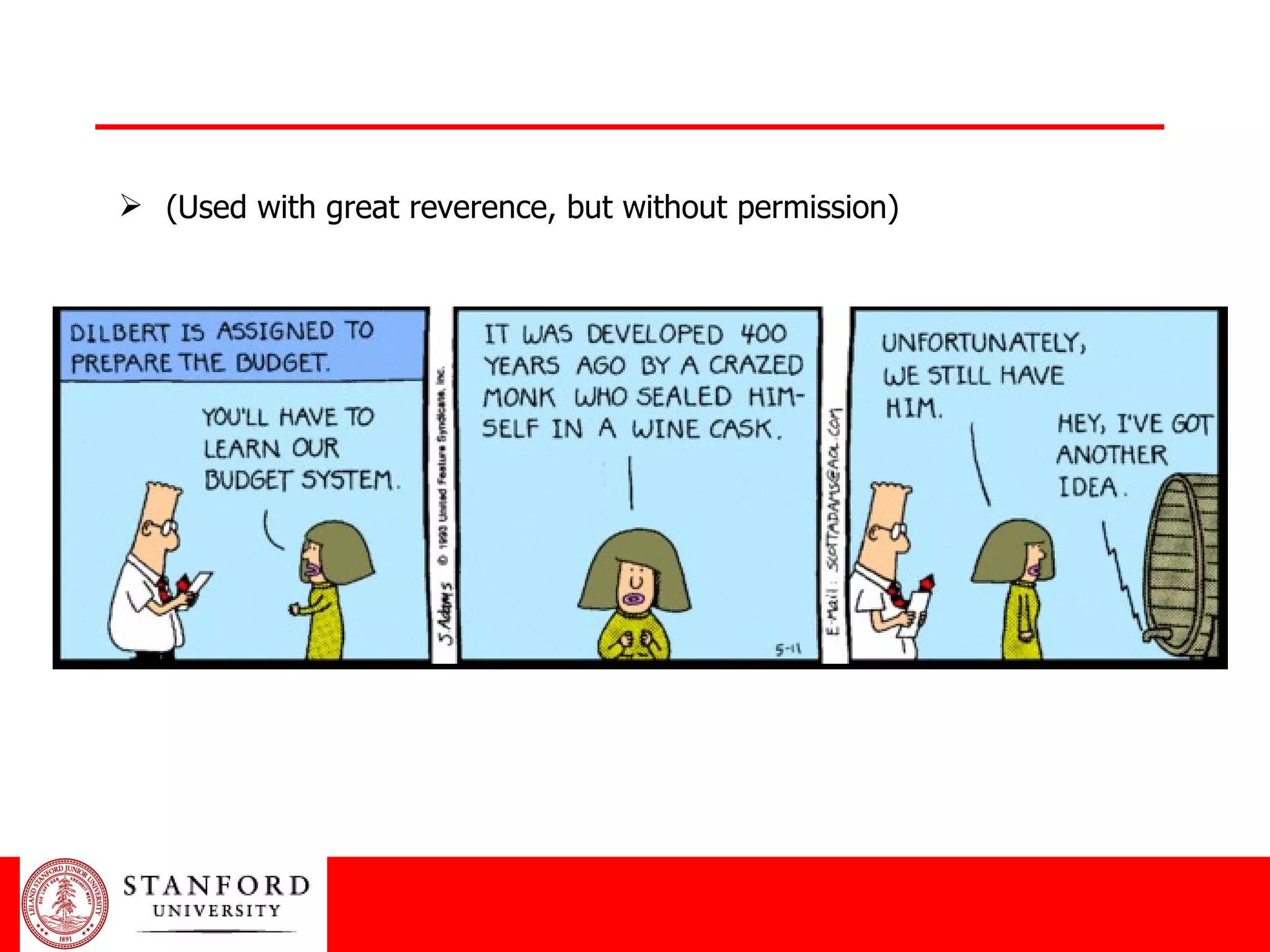
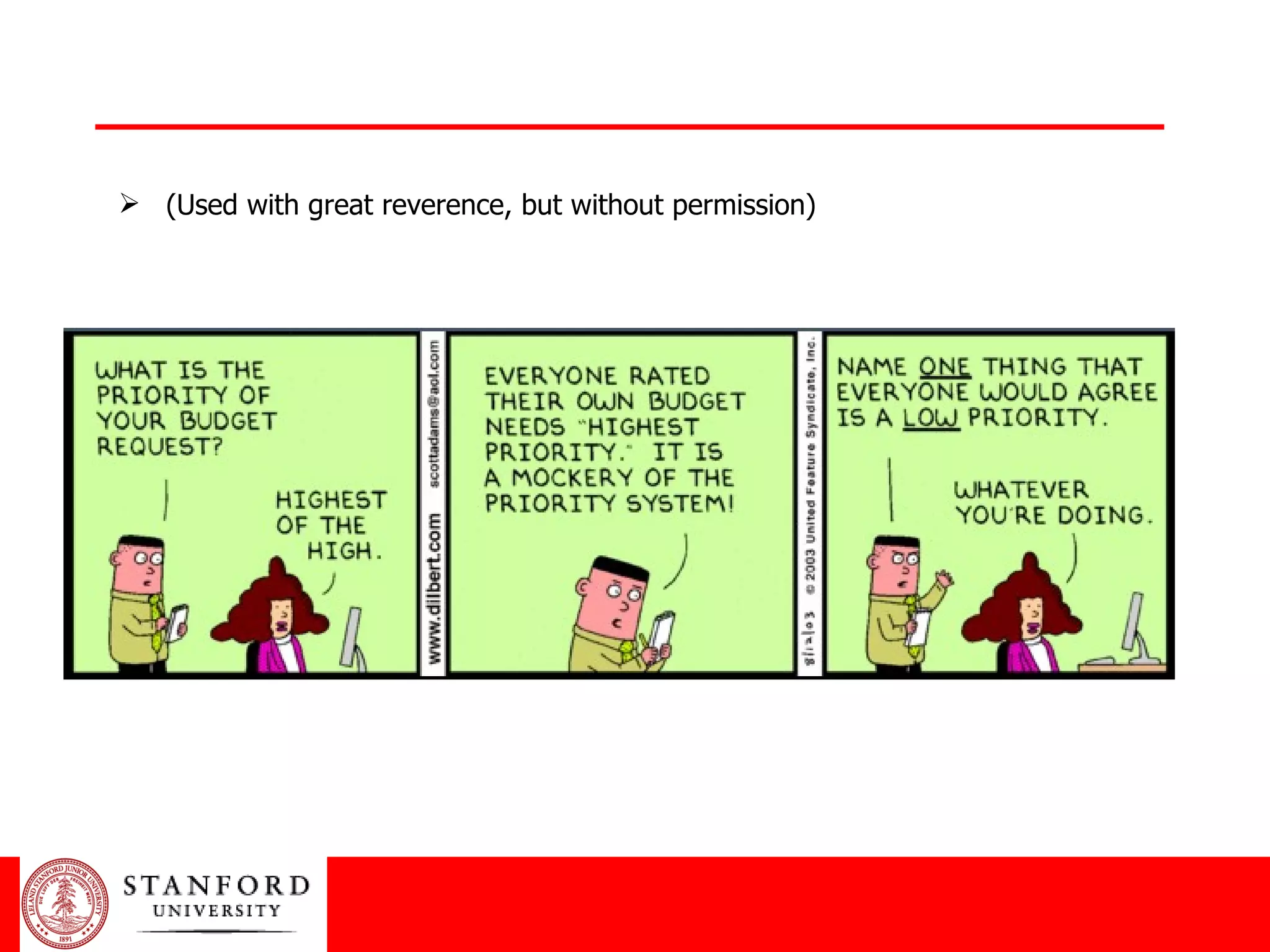
(Used with great reverence, but without permission)
Transforming the budget process Expand the notion of budgeting from a control mechanism to a strategic tool Freeing yourself from the yoke of Excel (while not totally ticking off your users) Getting immersed in and excited by the data Leveraging your ERP systems
Excel: A Necessary Evil Universally used Emotionally important to the users Very flexible Uncontrollable A nightmare to “consolidate” Manipulating or analyzing beyond two dimensions very difficult Distributed files; no version control Excel will probably never be fully out of the equation Users will always want to export/import
What should a budget system do? Salary planning across cost centers Annotation/line-item detail Consolidation & distribution Easy to add additional units, cost centers, natural classifications Be able to tag data with attributes (e.g. fund type, level of restriction) Be able to report dynamically in rows and columns Be able to handle Fund Accounting Ability to do “what-if?” analysis
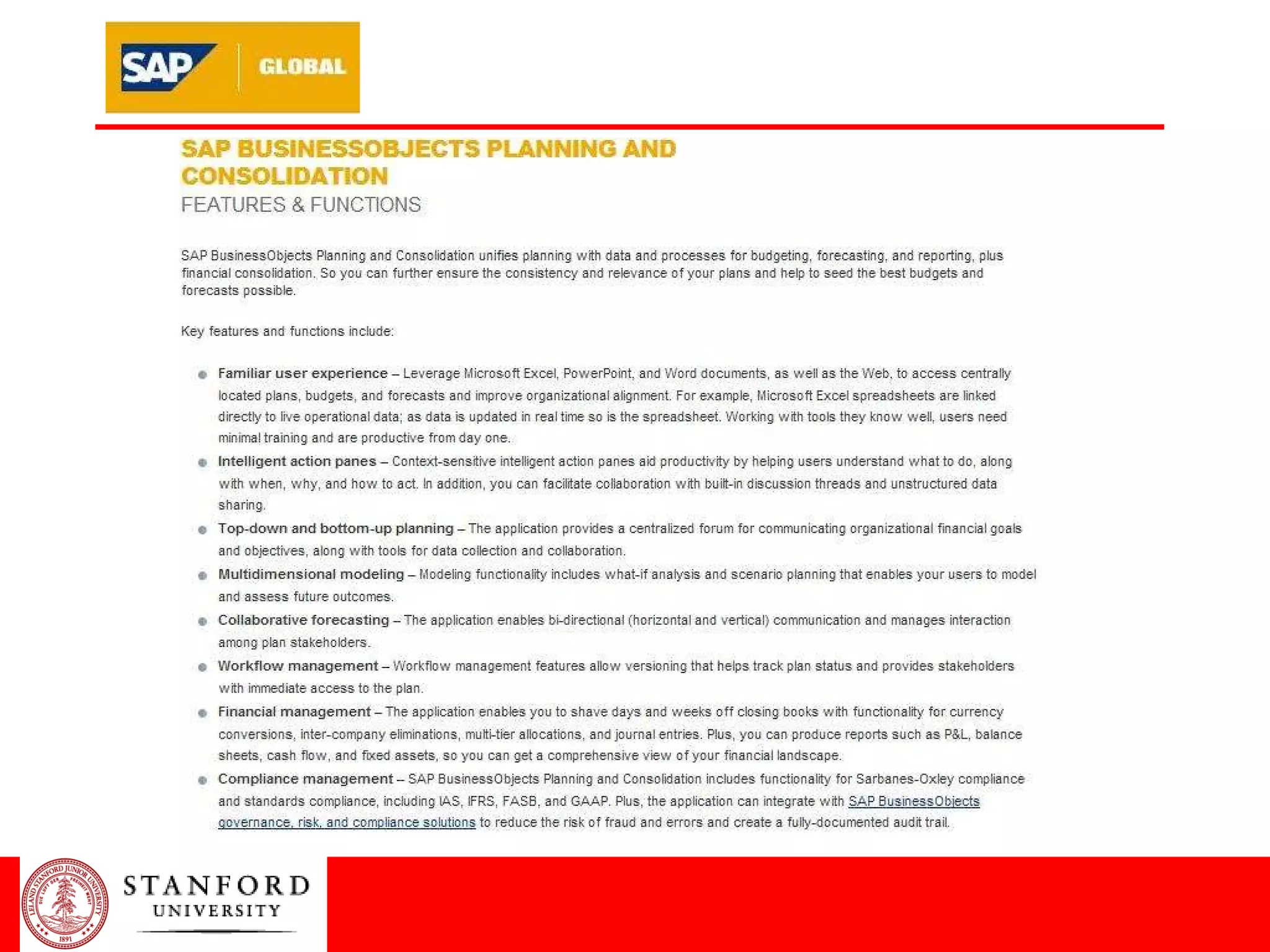
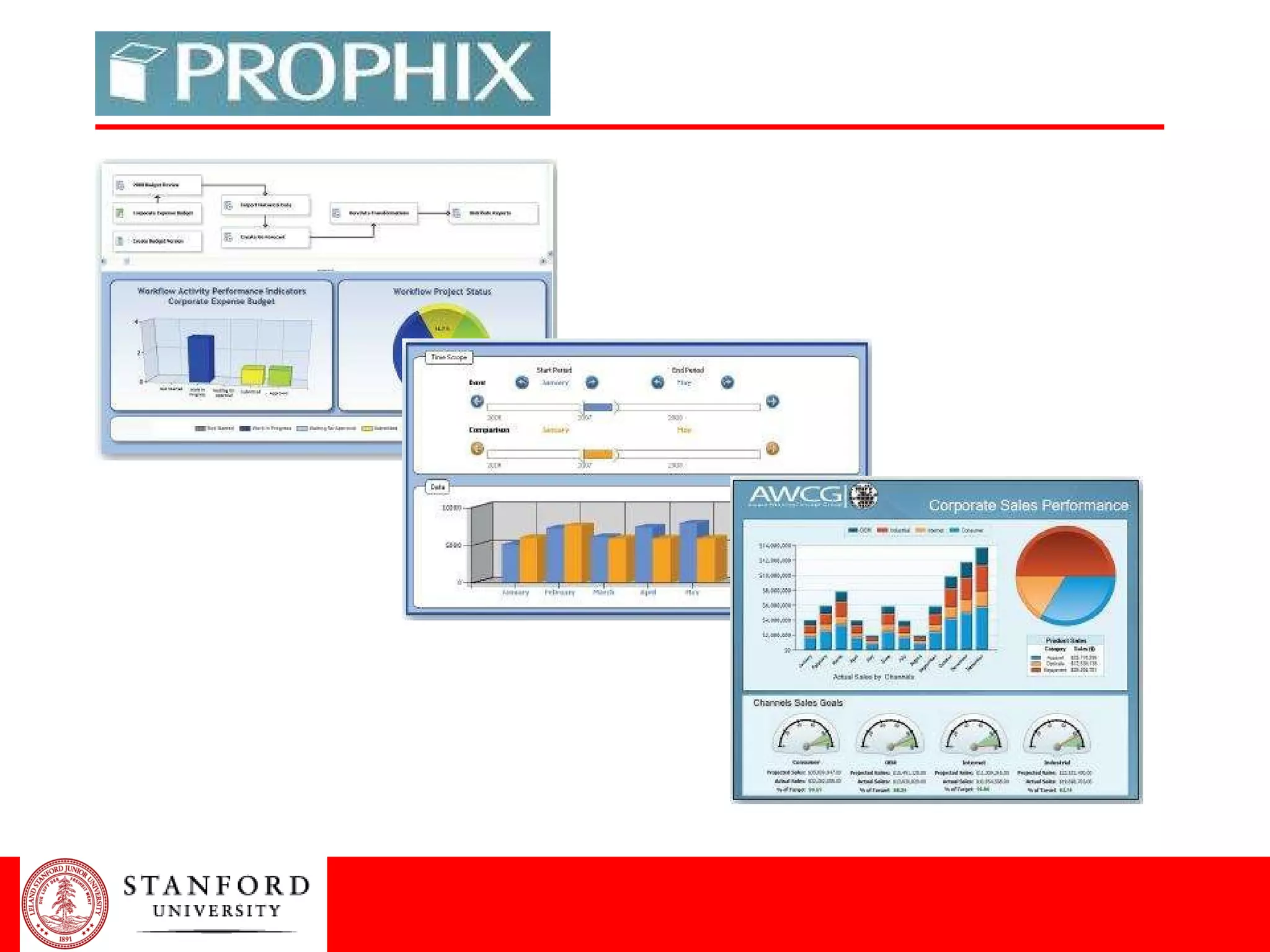
The Marketplace Larger scale implementations: (e.g. > $100k) Oracle: Hyperion Planning, Hyperion Strategic Finance www.oracle.com/hyperion SAP: BusinessObjects Planning and Consolidation (BPC) http://www.sap.com/solutions/sapbusinessobjects/large/enterprise-performance-management/planningandconsolidation/index.epx Prophix www.prophix.com Smaller scale, smaller budget: (e.g. < $100k) Alight Planning www.alightplanning.com Prophix Express www.prophix.com Adaptive Planning www.adaptiveplanning.com
A Case Study How Stanford has used Oracle’s Hyperion Planning for seven years for budget formulation, reforecasting, monitoring, and variance analysis
Overview Using Hyperion Planning, Stanford has brought discipline and analytical ability to its on-going budget monitoring and reforecasting processes with more utility and less pain than using Excel We have a process that facilitates financial information flow and analysis up and down the decision-making hierarchy
Use of Oracle Systems Oracle EBS for Financials (GL, GA, AP, AR, PO, LD) Peoplesoft for Student Information and HR Hyperion Planning for Budget entry and Monitoring Hyperion System 9 BI+ as interface into Data Warehouse Also use Business Objects WEBI
Budgeting at Stanford $4.0B in Revenues and Expense ~30 decentralized budget units ~350 end users >50k cost centers; >10k employees Fund Accounting standards High-level forecasting several months before detailed budget exercise “ Top-down” and “Bottom-up”
(Used with great reverence, but without permission)
Security (user access to data) Metadata “overhead”: Size of the cubes Performance (apparent speed to users, control over calculations) Tech Infrastructure unique to Universities System Design Priorities These design issues were of paramount concern:
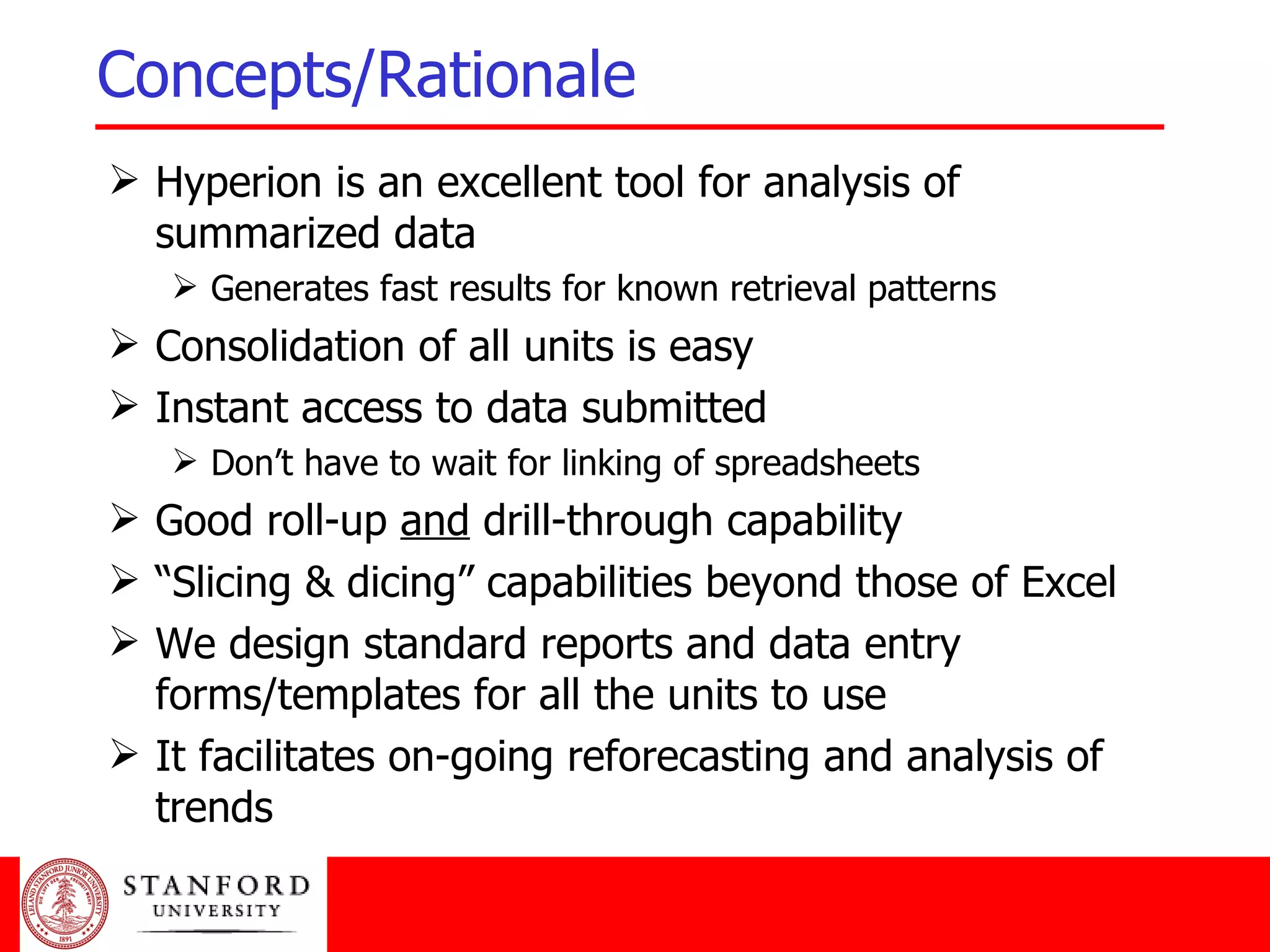
Concepts/Rationale Hyperion is an excellent tool for analysis of summarized data Generates fast results for known retrieval patterns Consolidation of all units is easy Instant access to data submitted Don’t have to wait for linking of spreadsheets Good roll-up  and  drill-through capability “ Slicing & dicing” capabilities beyond those of Excel We design standard reports and data entry forms/templates for all the units to use It facilitates on-going reforecasting and analysis of trends
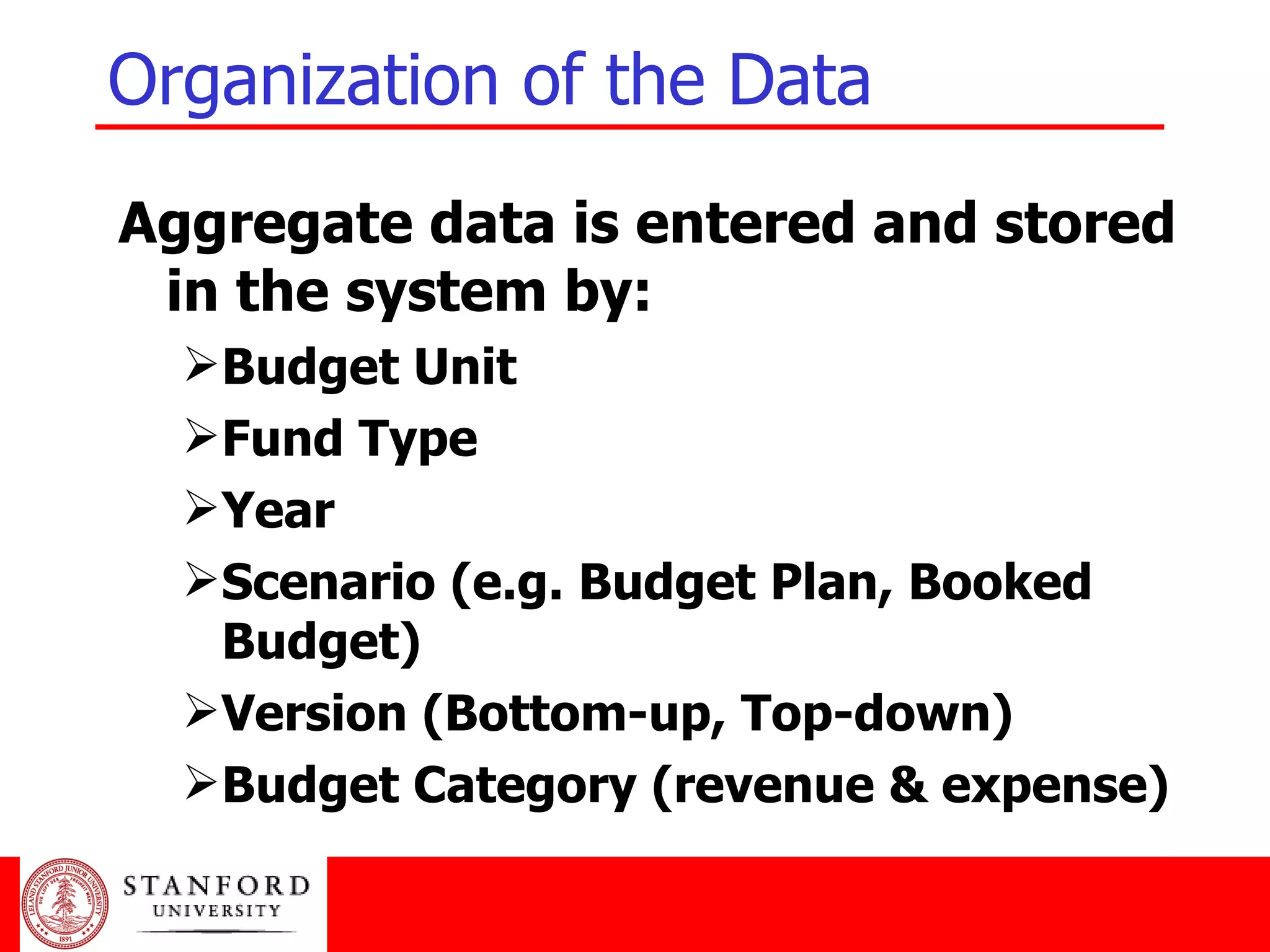
Organization of the Data Aggregate data is entered and stored in the system by: Budget Unit Fund Type Year Scenario (e.g. Budget Plan, Booked Budget) Version (Bottom-up, Top-down) Budget Category (revenue & expense)
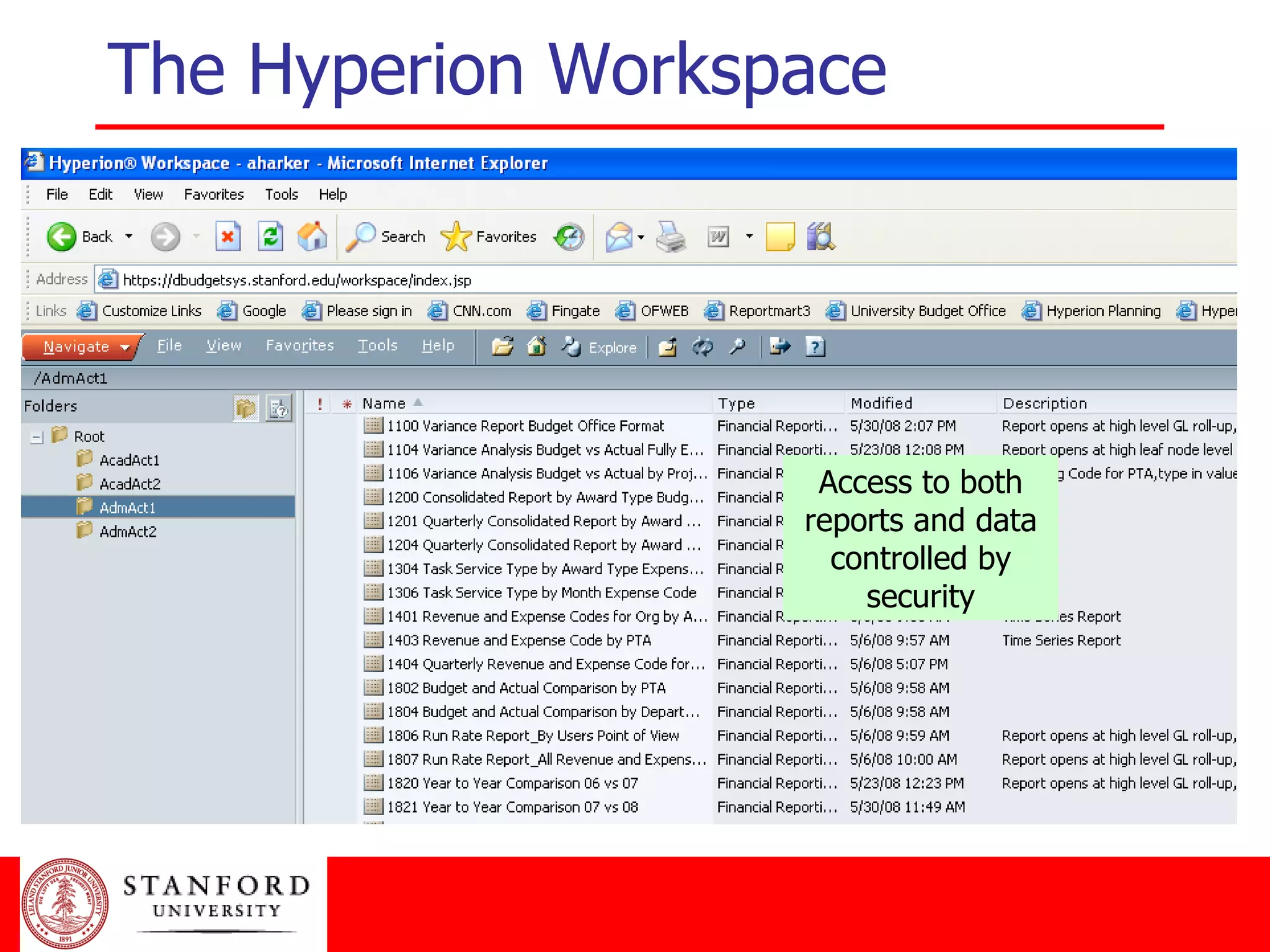
The Hyperion Workspace Access to both reports and data controlled by security
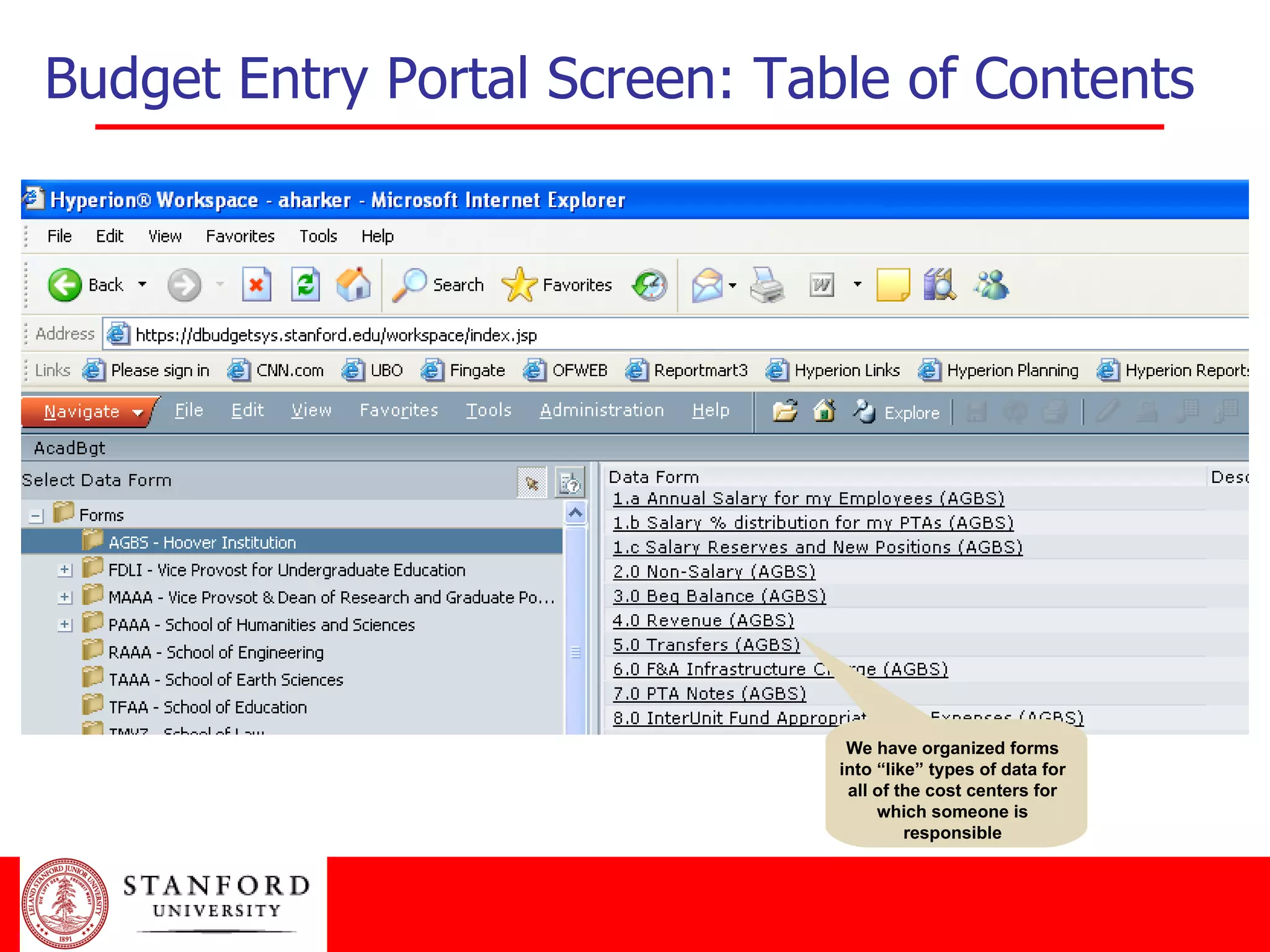
Budget Entry Portal Screen: Table of Contents We have organized forms into “like” types of data for all of the cost centers for which someone is responsible
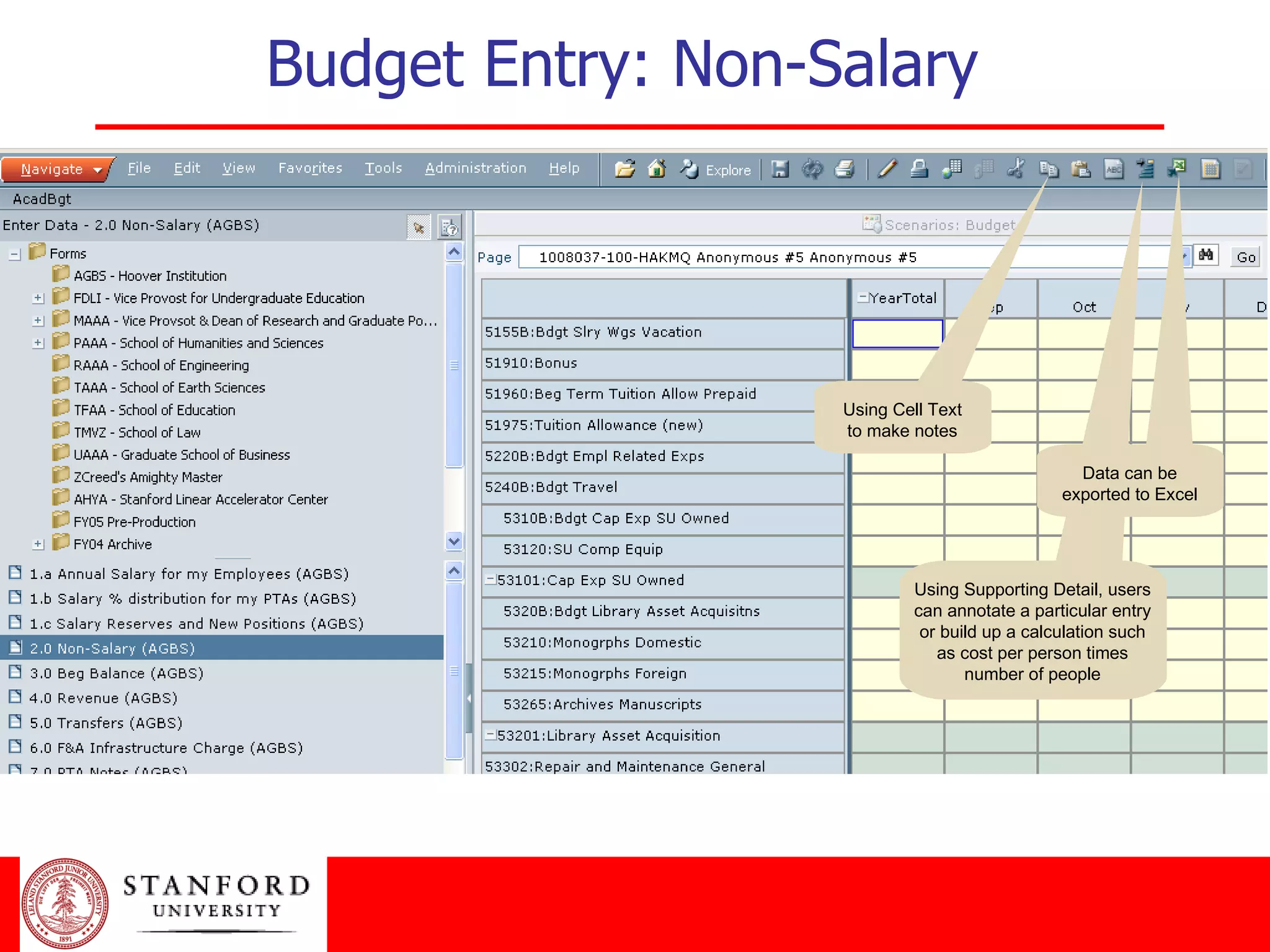
Budget Entry: Non-Salary Using Supporting Detail, users can annotate a particular entry or build up a calculation such as cost per person times number of people Data can be exported to Excel Using Cell Text to make notes
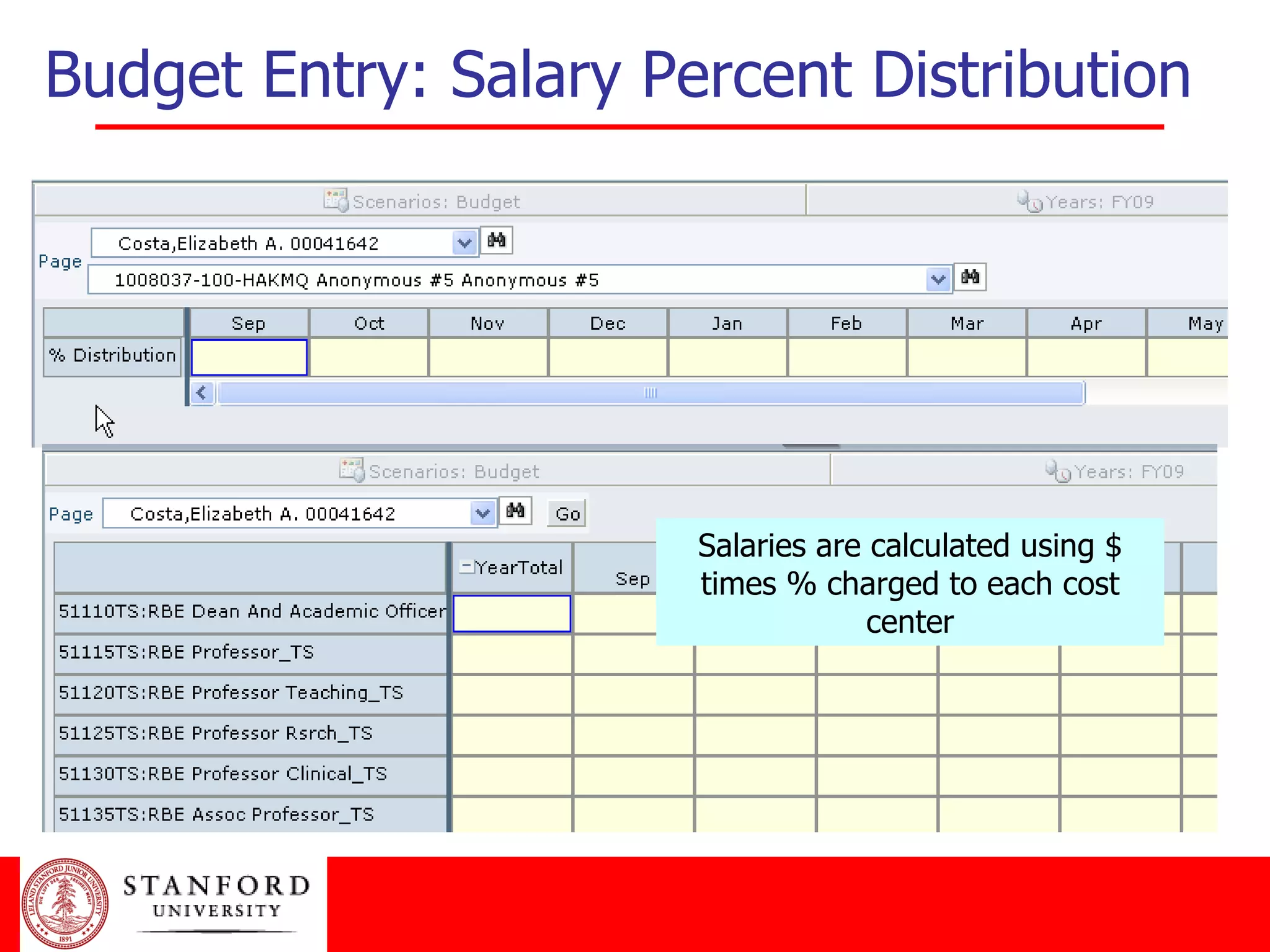
Budget Entry: Salary Percent Distribution Salaries are calculated using $ times % charged to each cost center
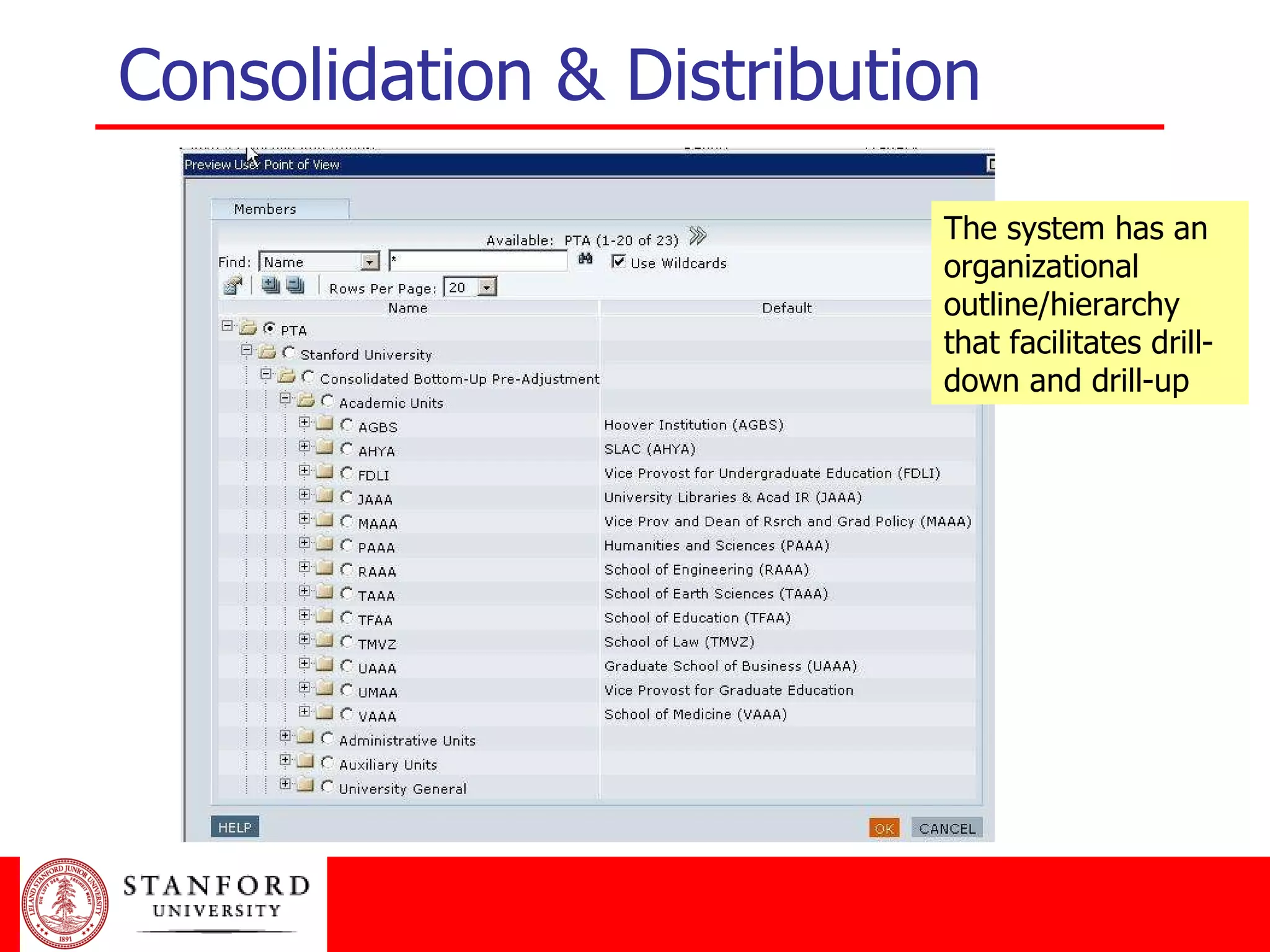
Consolidation & Distribution The system has an organizational outline/hierarchy that facilitates drill-down and drill-up
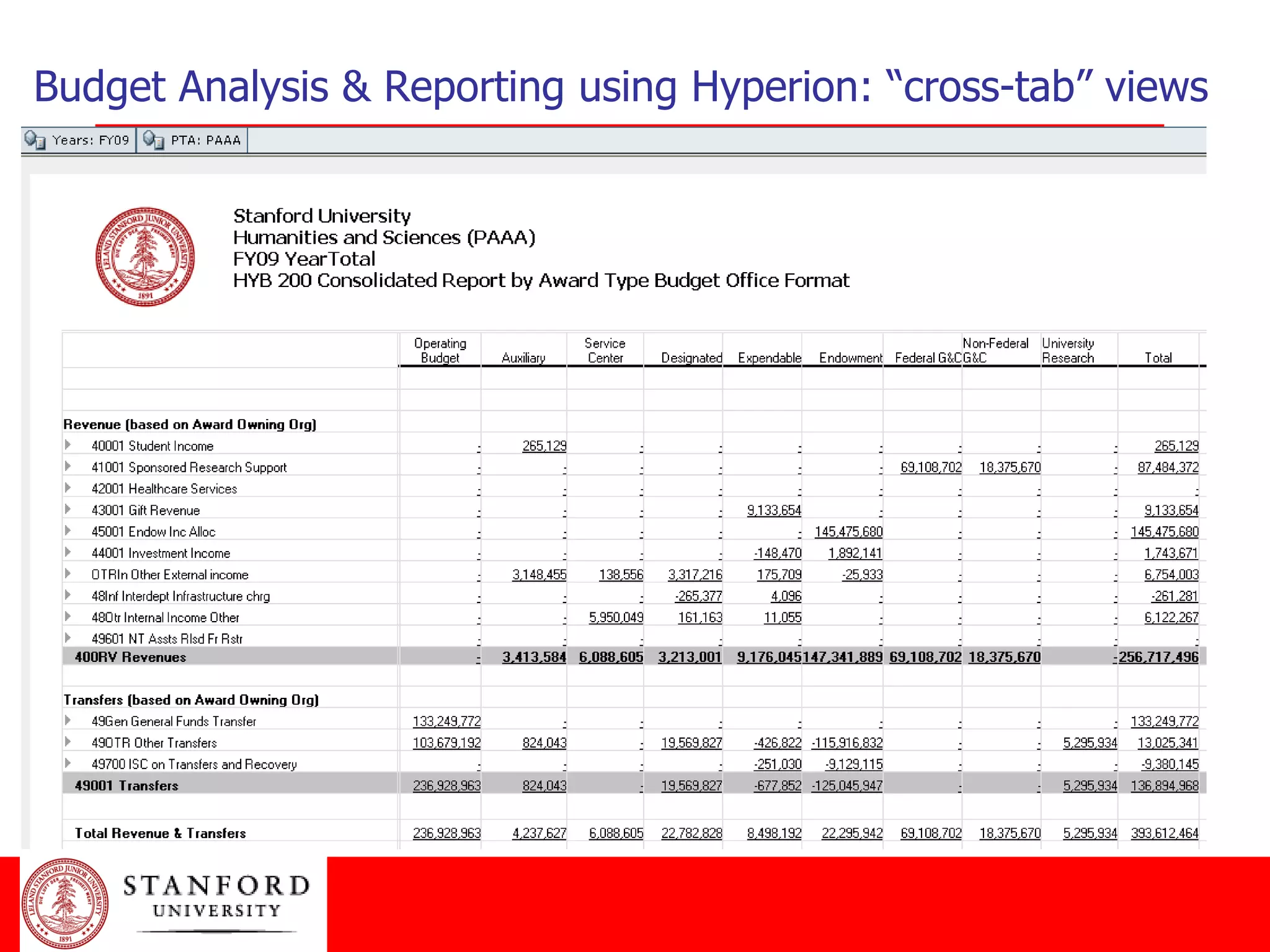
Budget Analysis & Reporting using Hyperion: “cross-tab” views
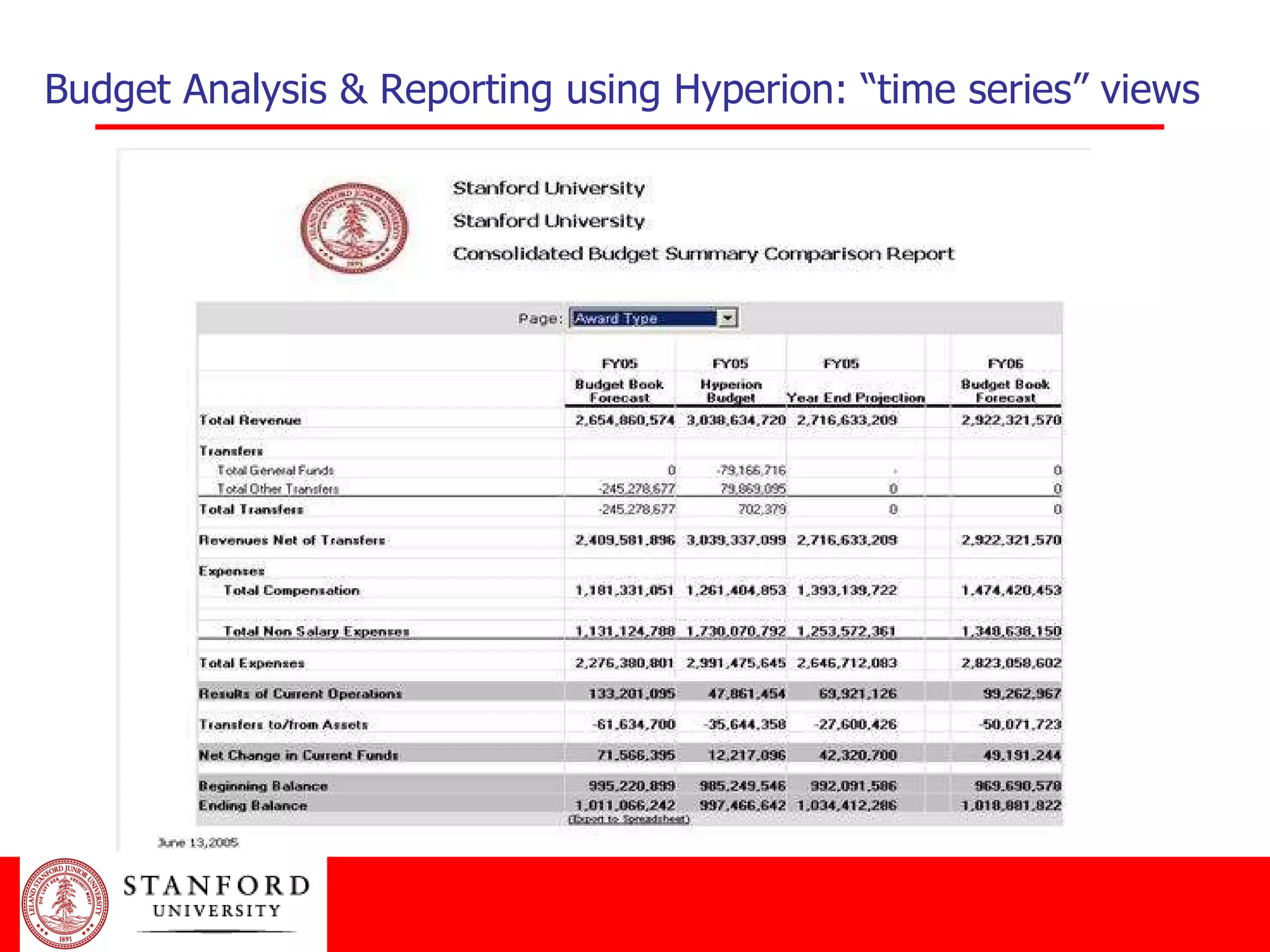
Budget Analysis & Reporting using Hyperion: “time series” views
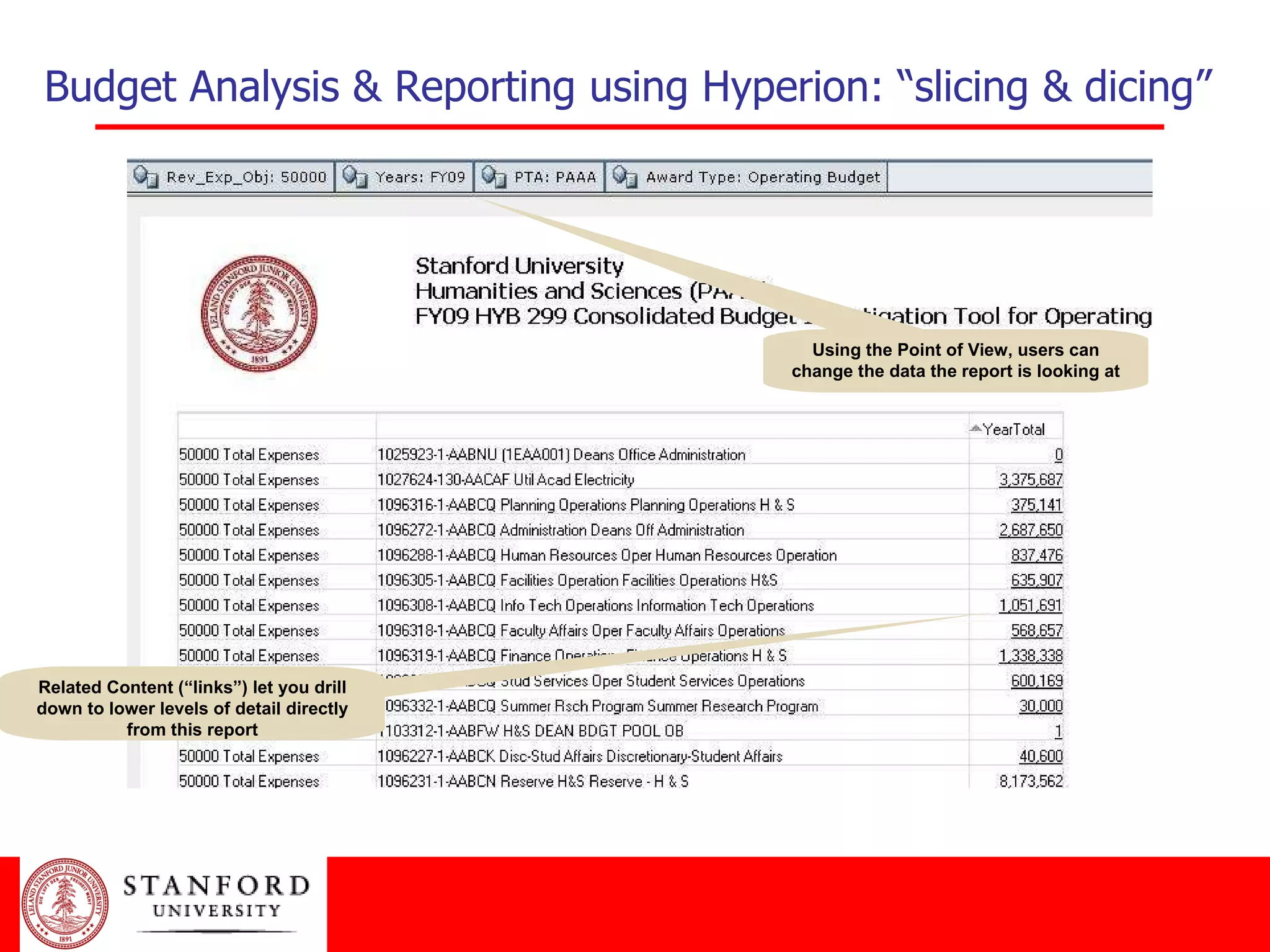
Budget Analysis & Reporting using Hyperion: “slicing & dicing” Using the Point of View, users can change the data the report is looking at Related Content (“links”) let you drill down to lower levels of detail directly from this report
(Used with great reverence, but without permission)
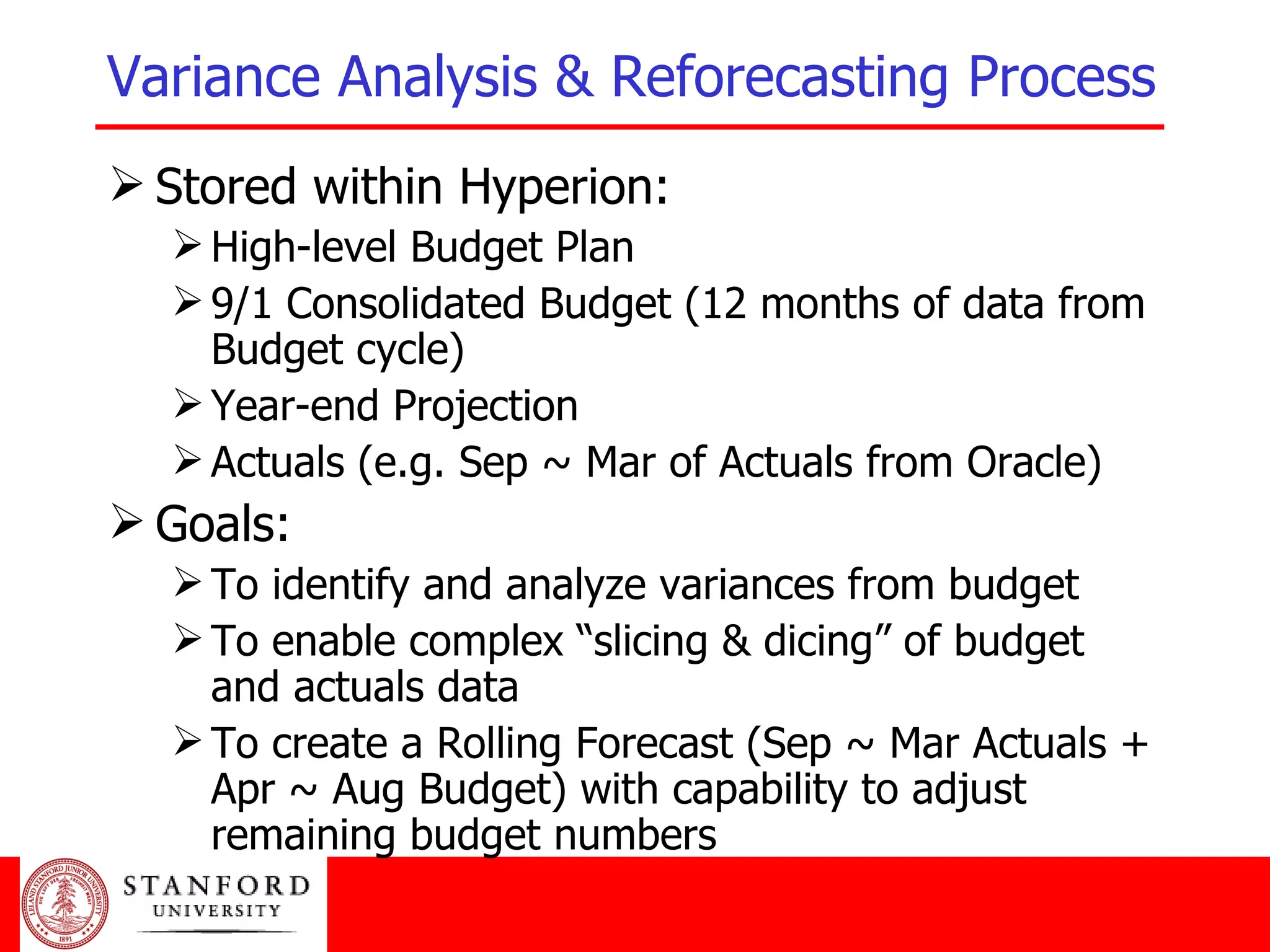
Variance Analysis & Reforecasting Process   Stored within Hyperion: High-level Budget Plan 9/1 Consolidated Budget (12 months of data from Budget cycle) Year-end Projection Actuals (e.g. Sep ~ Mar of Actuals from Oracle) Goals:  To identify and analyze variances from budget To enable complex “slicing & dicing” of budget and actuals data To create a Rolling Forecast (Sep ~ Mar Actuals + Apr ~ Aug Budget) with capability to adjust remaining budget numbers
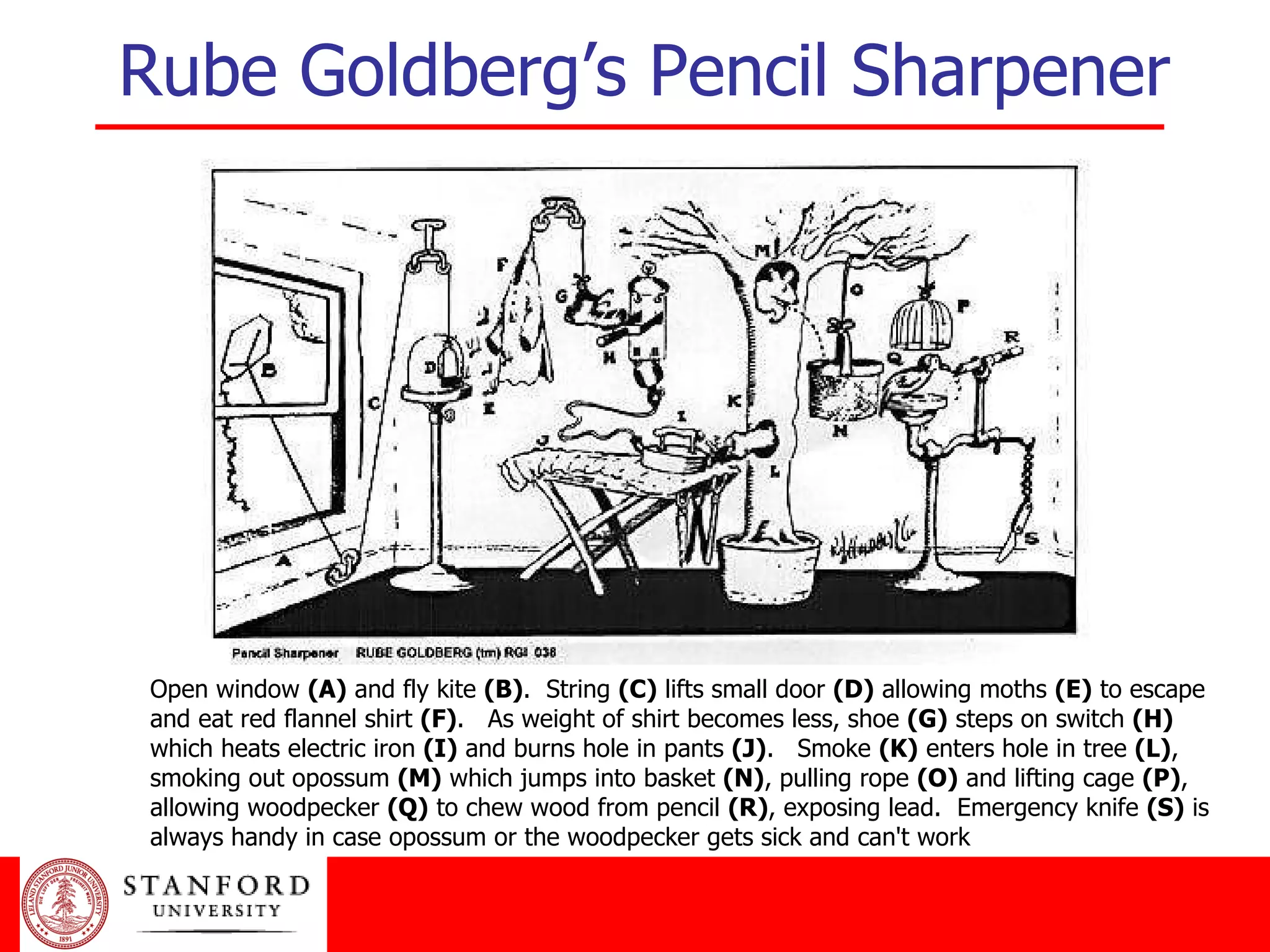
Rube Goldberg’s Pencil Sharpener Open window  (A)  and fly kite  (B) .  String  (C)  lifts small door  (D)  allowing moths  (E)  to escape and eat red flannel shirt  (F) .   As weight of shirt becomes less, shoe  (G)  steps on switch  (H)  which heats electric iron  (I)  and burns hole in pants  (J) .   Smoke  (K)  enters hole in tree  (L) , smoking out opossum  (M)  which jumps into basket  (N) , pulling rope  (O)  and lifting cage  (P) , allowing woodpecker  (Q)  to chew wood from pencil  (R) , exposing lead.  Emergency knife  (S)  is always handy in case opossum or the woodpecker gets sick and can't work
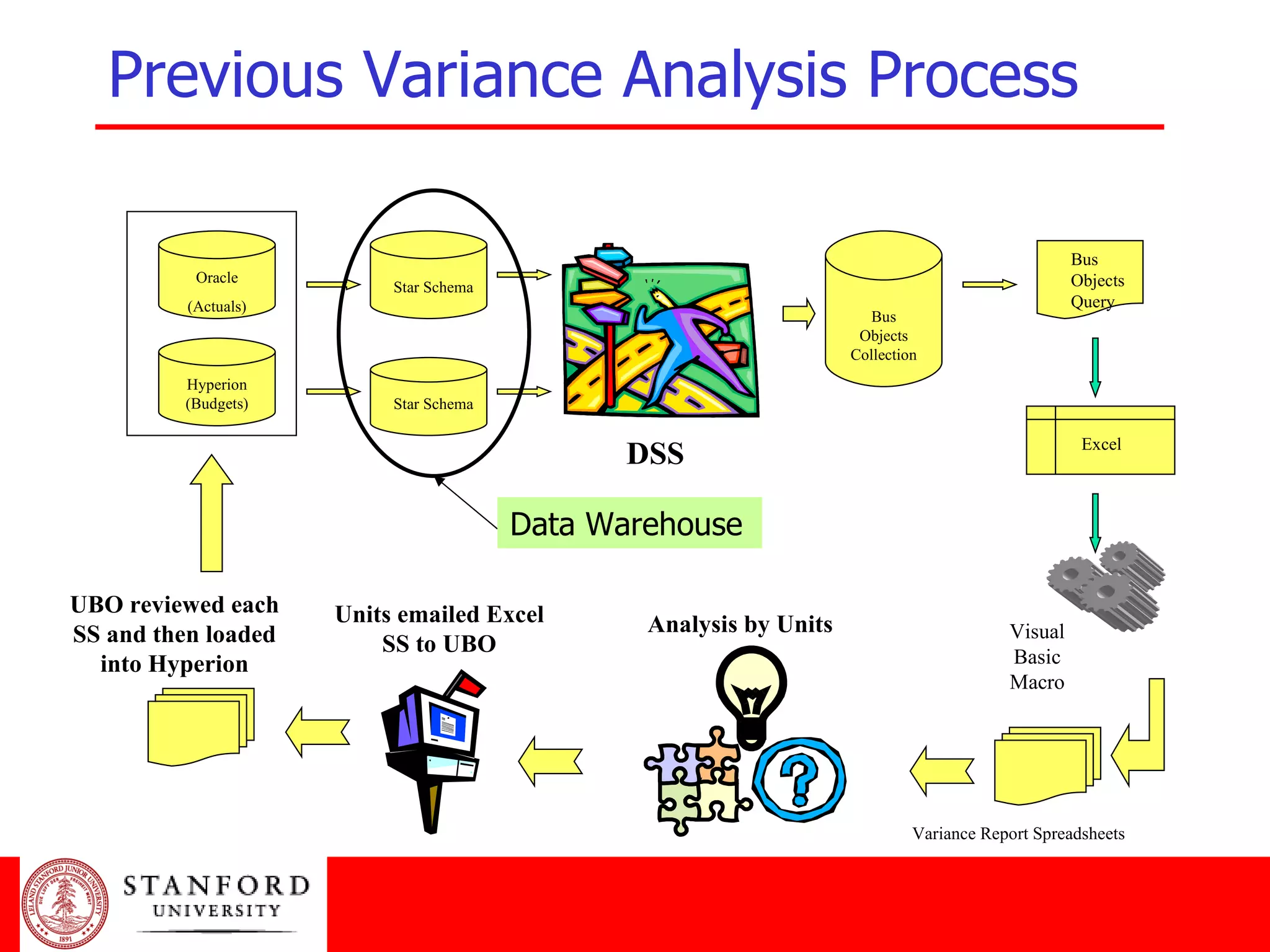
Previous Variance Analysis Process Data Warehouse Hyperion (Budgets) Oracle (Actuals) Star Schema Star Schema DSS Bus Objects Collection Bus Objects Query Excel Visual Basic Macro Variance Report Spreadsheets Analysis by Units Units emailed Excel SS to UBO UBO reviewed each SS and then loaded into Hyperion
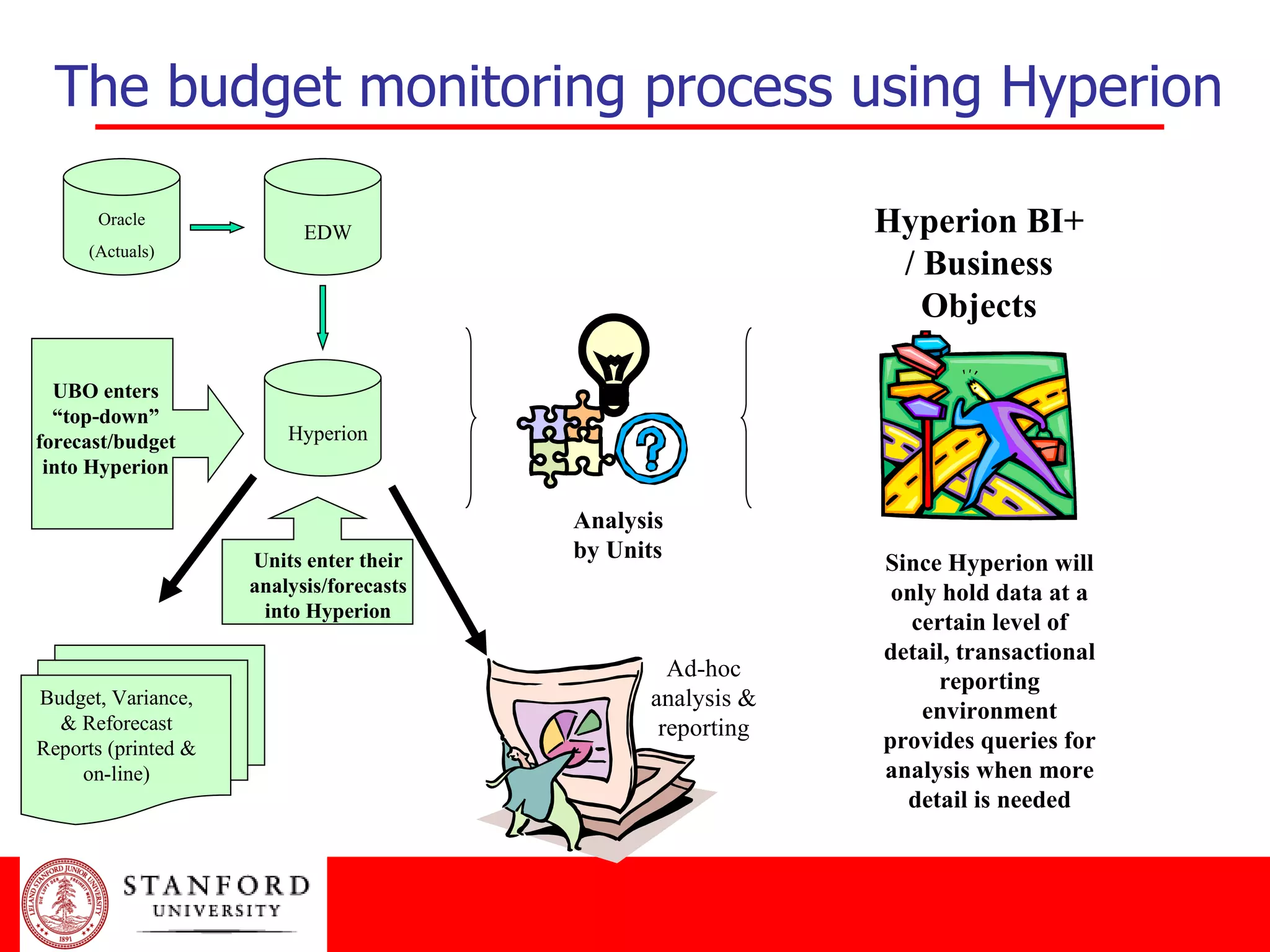
The budget monitoring process using Hyperion Hyperion BI+ / Business Objects Since Hyperion will only hold data at a certain level of detail, transactional reporting environment provides queries for analysis when more detail is needed Analysis by Units Hyperion Oracle (Actuals) EDW Units enter their analysis/forecasts into Hyperion UBO enters “top-down” forecast/budget into Hyperion Budget, Variance, & Reforecast Reports (printed & on-line) Ad-hoc analysis & reporting
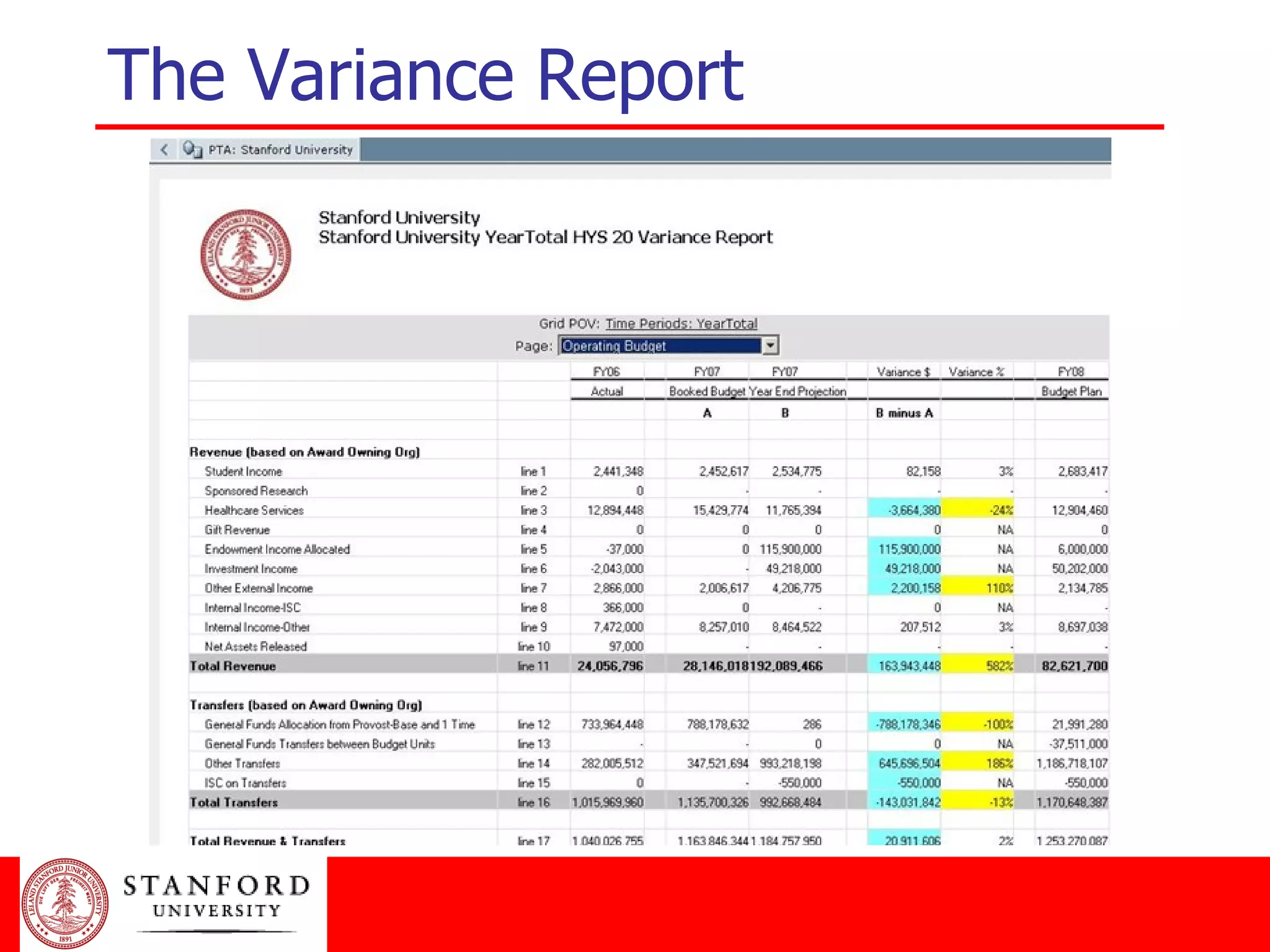
The Variance Report
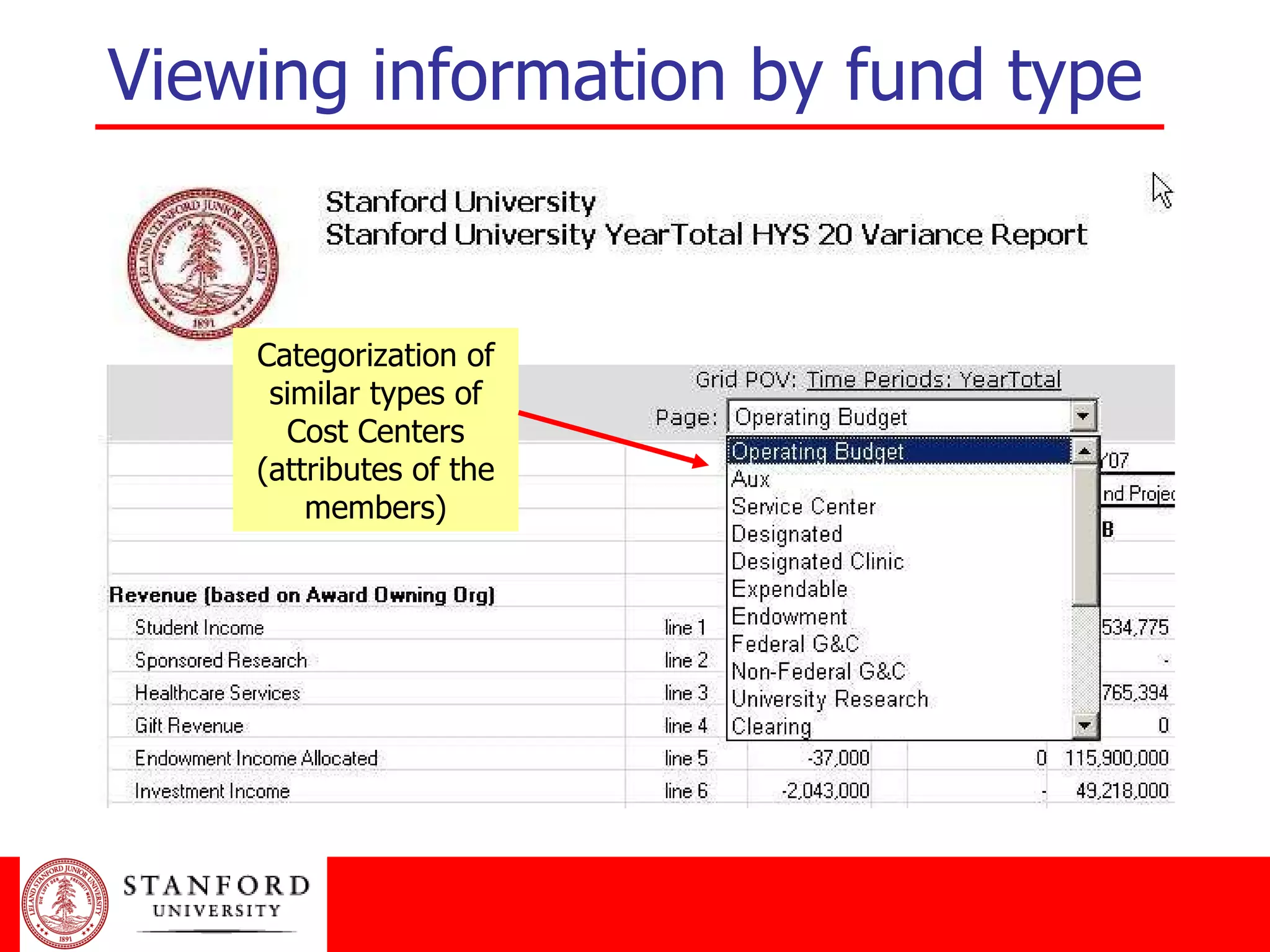
Viewing information by fund type Categorization of similar types of Cost Centers (attributes of the members)
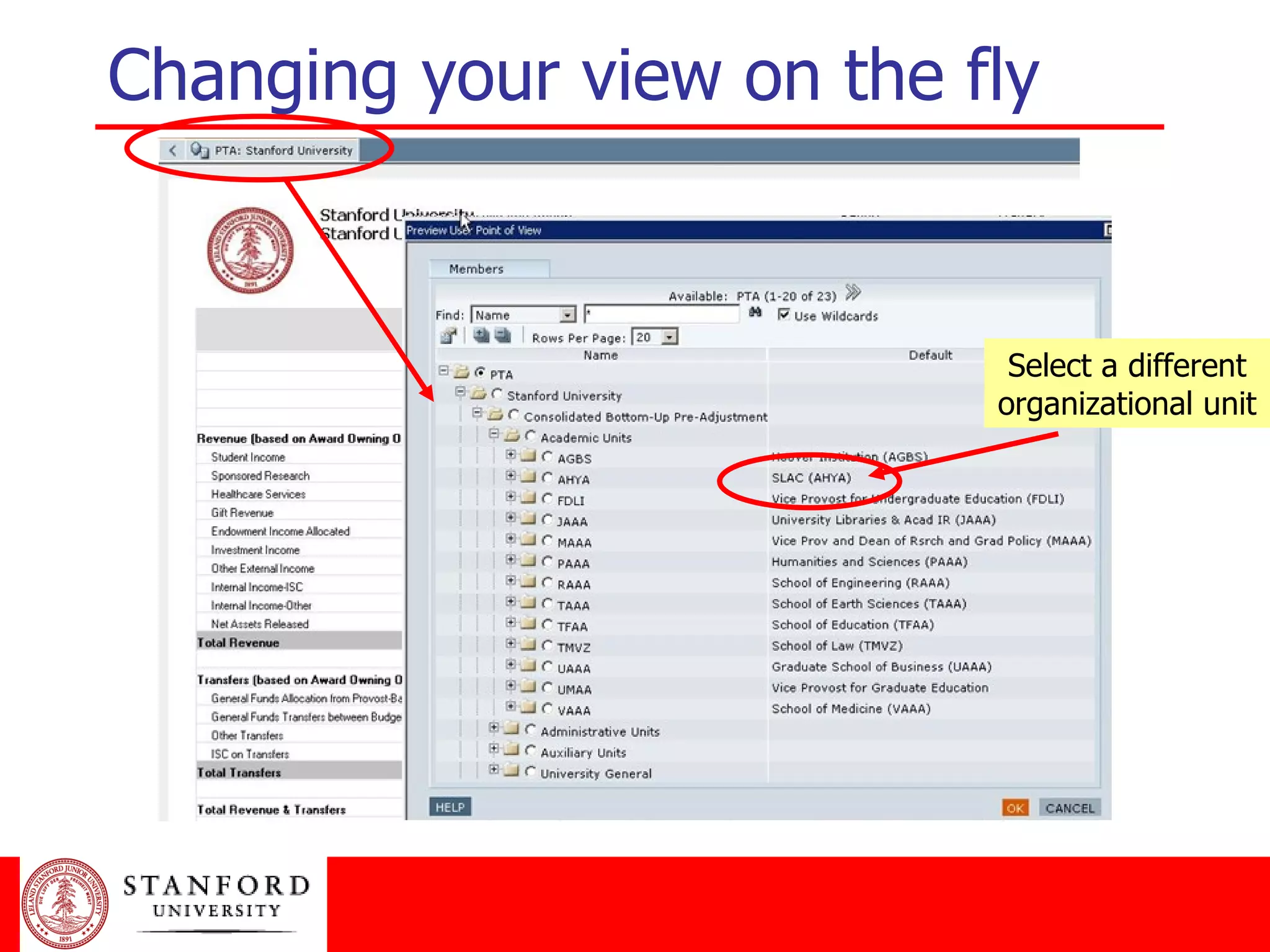
Changing your view on the fly  Select a different organizational unit
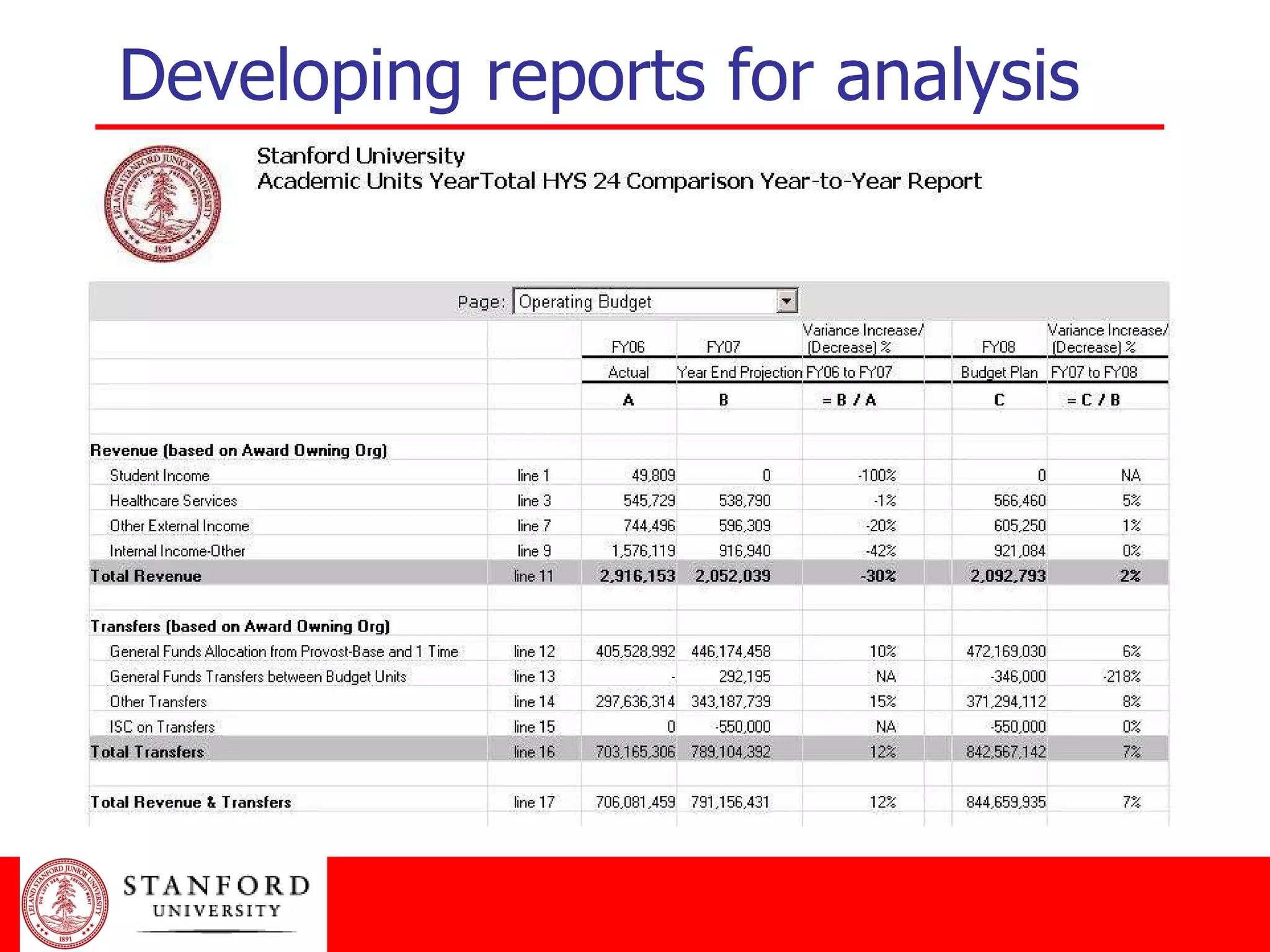
Developing reports for analysis
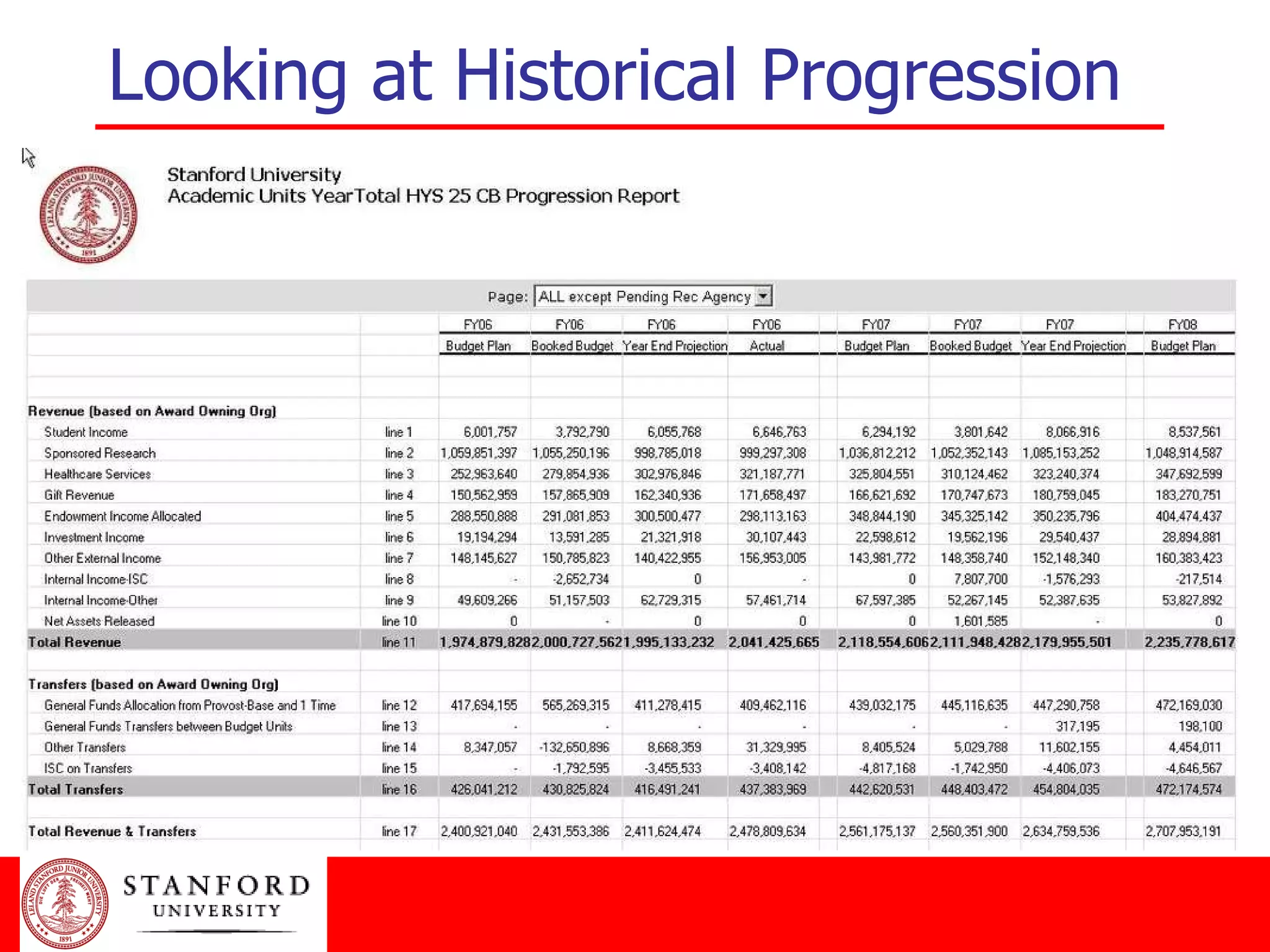
Looking at Historical Progression
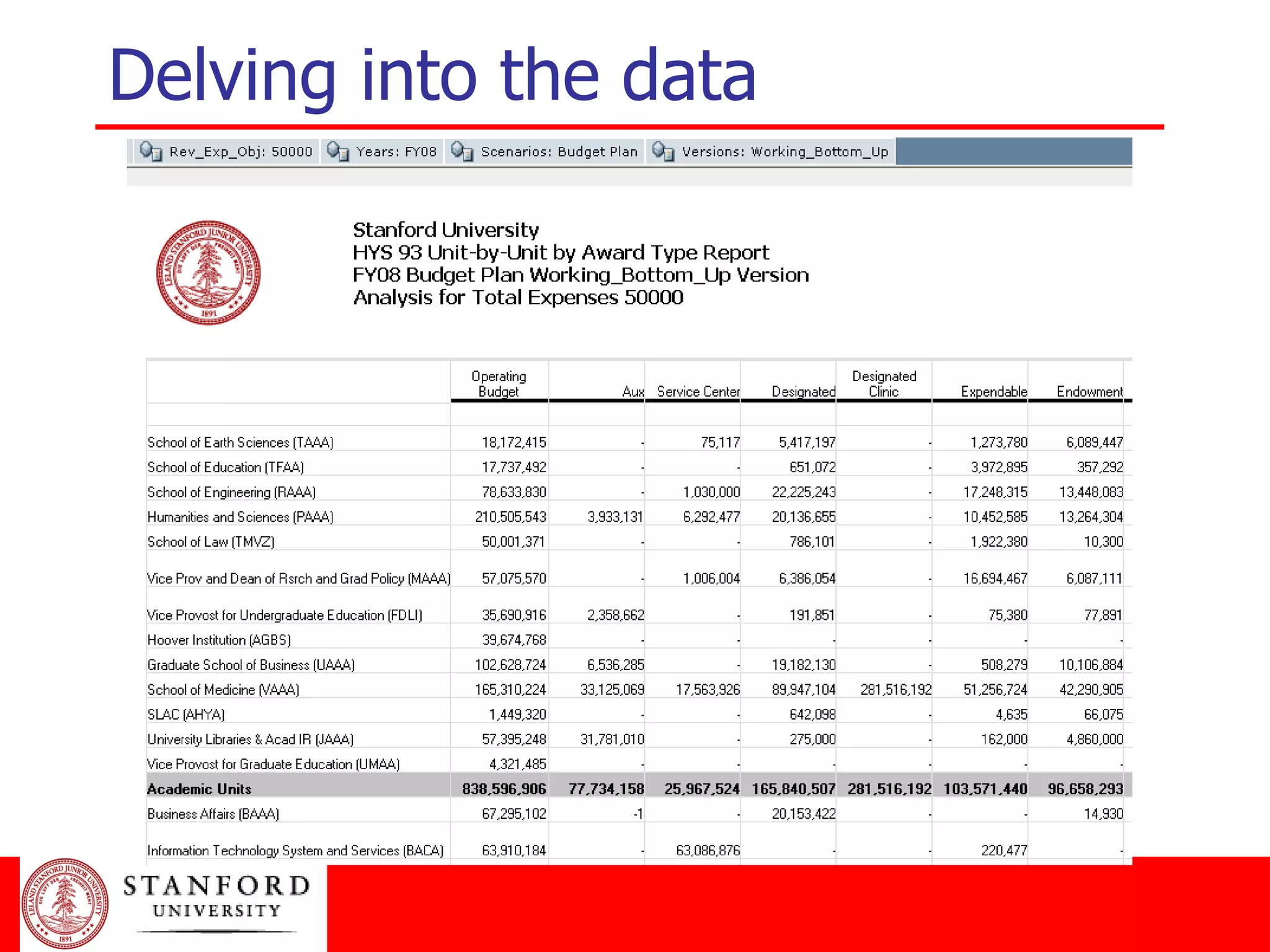
Delving into the data
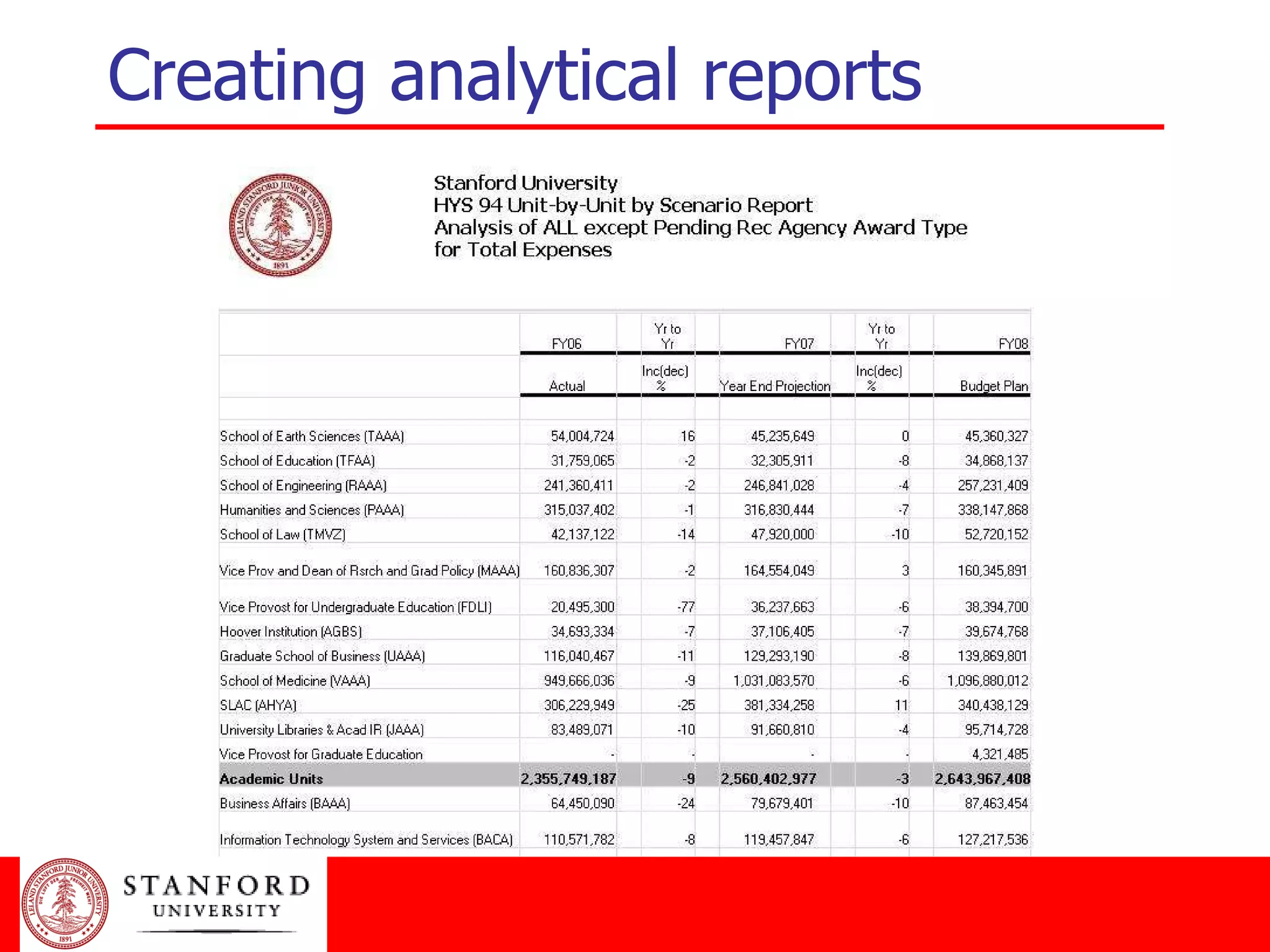
Creating analytical reports
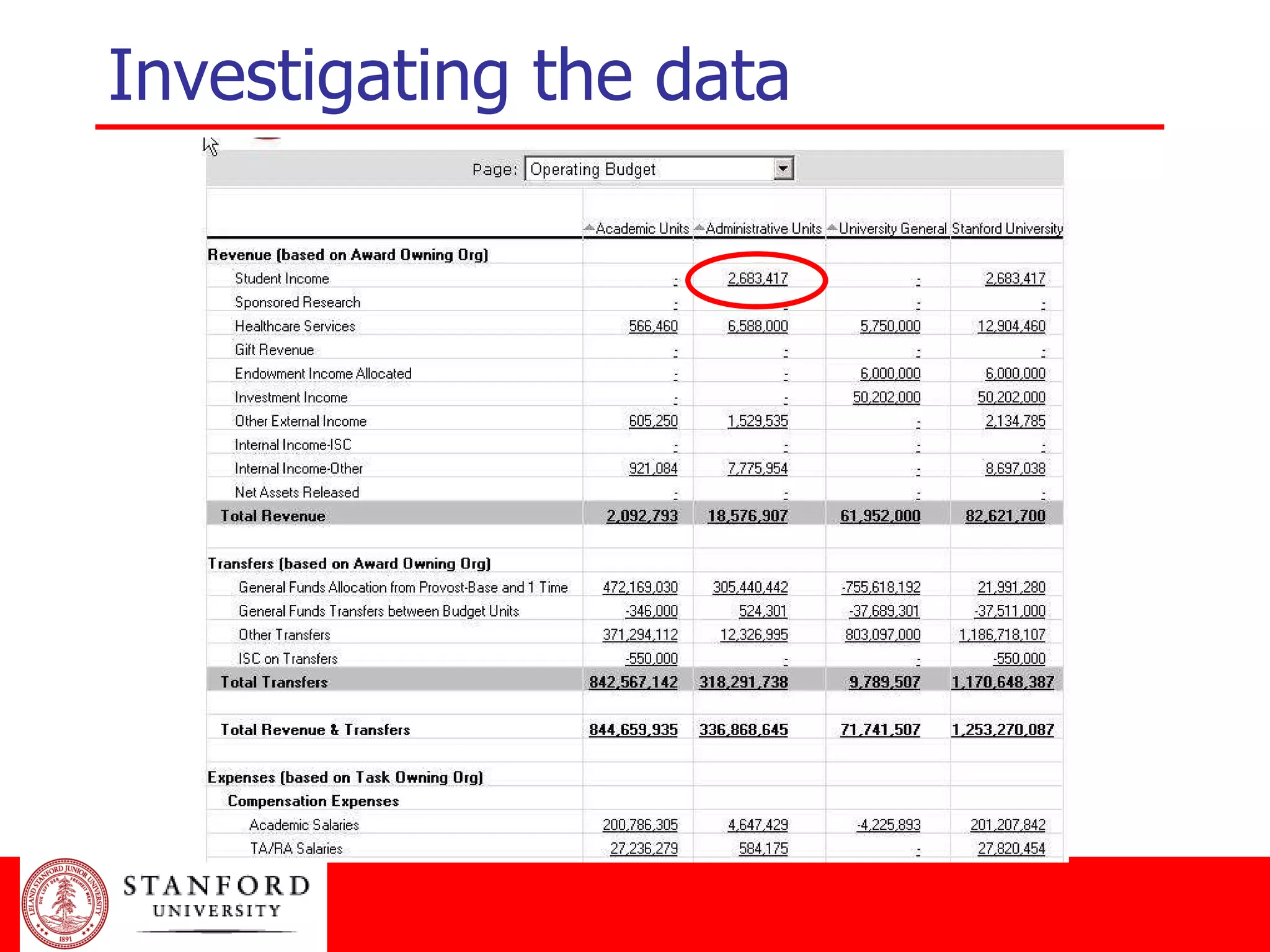
Investigating the data
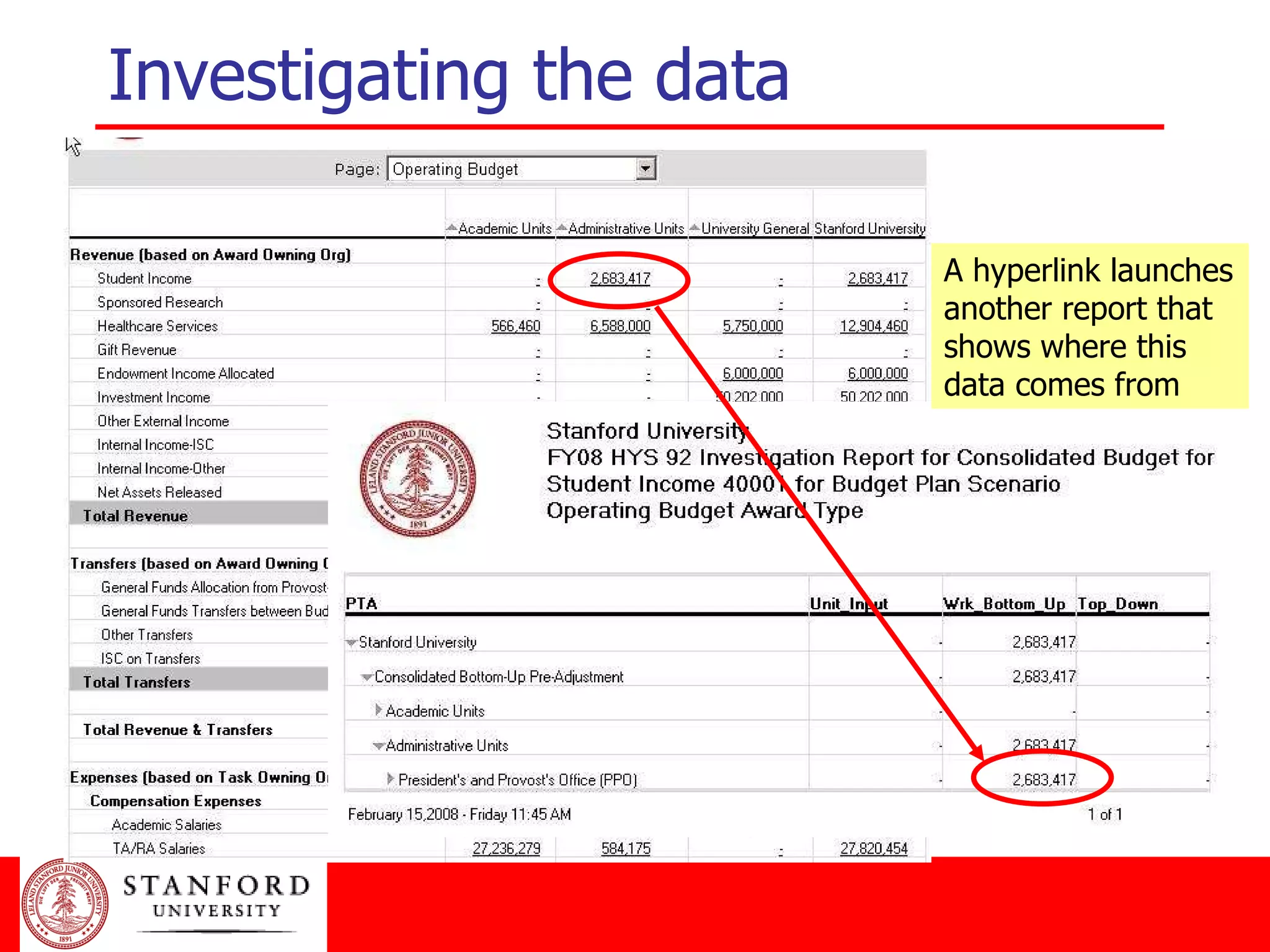
Investigating the data A hyperlink launches another report that shows where this data comes from
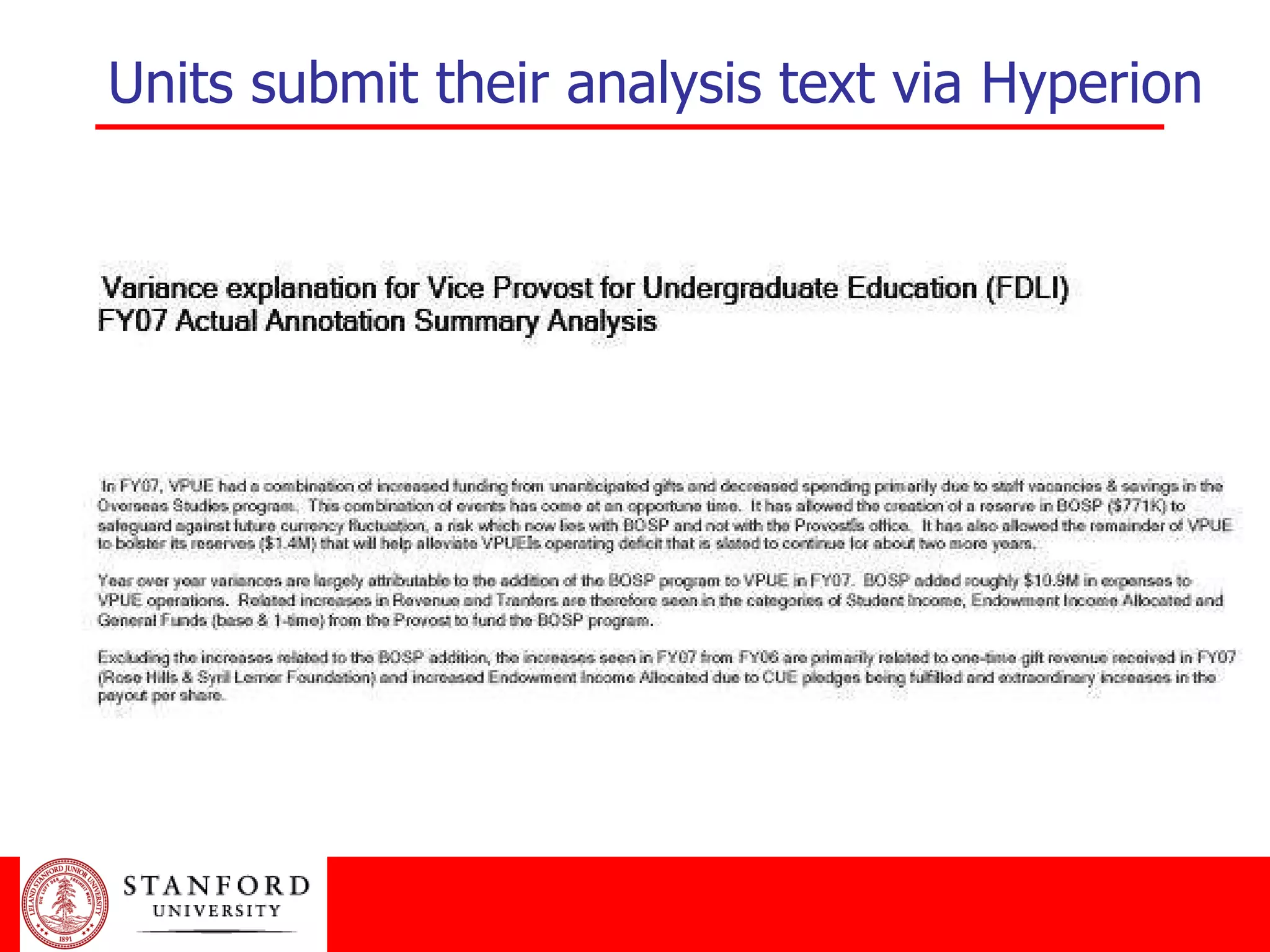
Units submit their analysis text via Hyperion
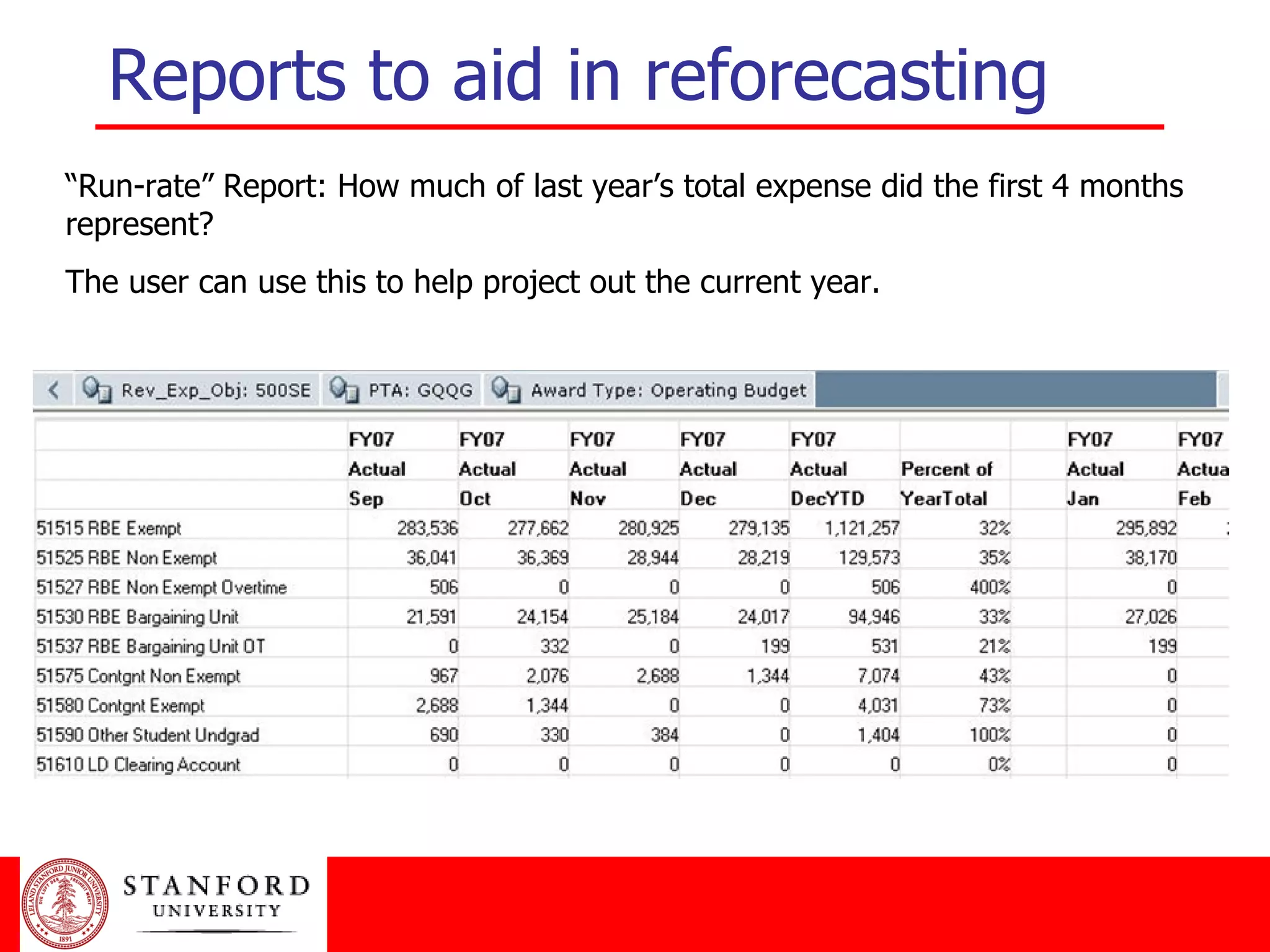
Reports to aid in reforecasting “ Run-rate” Report: How much of last year’s total expense did the first 4 months represent? The user can use this to help project out the current year.
What we have gained: the benefits A web-based budget formulation and reporting system Accessible from home/wherever A dynamic, yet controlled, system Better control over integrity of metadata “ Real-time” access to budget entry progress Much greater ability to monitor the budget along the way Better budget process management Greater flexibility in report design Better ability to analyze & report on Consolidated Budget No software overhead on user machines Allowing users still to use Excel as they feel appropriate
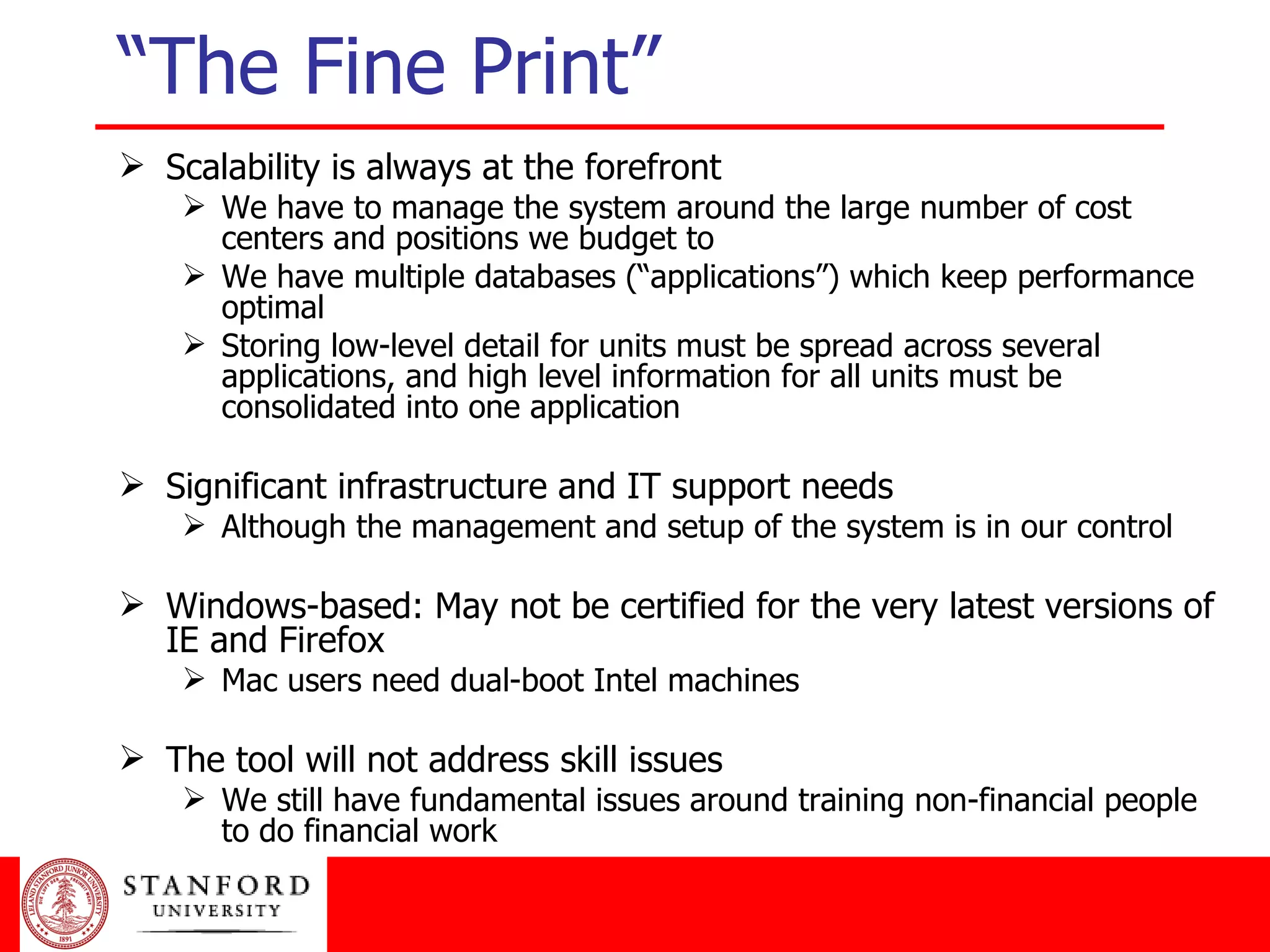
Scalability is always at the forefront We have to manage the system around the large number of cost centers and positions we budget to We have multiple databases (“applications”) which keep performance optimal Storing low-level detail for units must be spread across several applications, and high level information for all units must be consolidated into one application Significant infrastructure and IT support needs Although the management and setup of the system is in our control Windows-based: May not be certified for the very latest versions of IE and Firefox Mac users need dual-boot Intel machines The tool will not address skill issues We still have fundamental issues around training non-financial people to do financial work “The Fine Print”
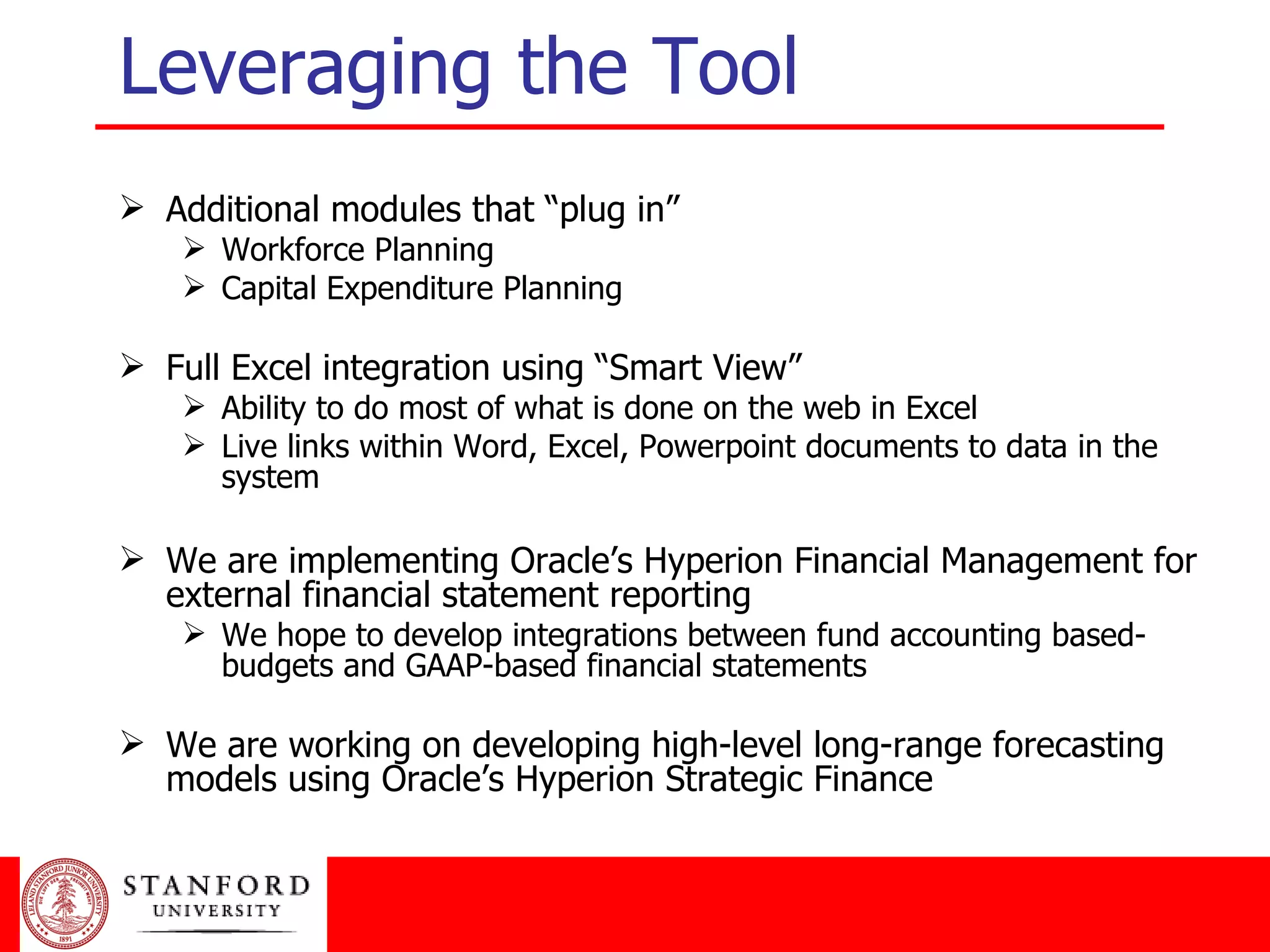
Additional modules that “plug in” Workforce Planning Capital Expenditure Planning Full Excel integration using “Smart View” Ability to do most of what is done on the web in Excel Live links within Word, Excel, Powerpoint documents to data in the system We are implementing Oracle’s Hyperion Financial Management for external financial statement reporting We hope to develop integrations between fund accounting based-budgets and GAAP-based financial statements We are working on developing high-level long-range forecasting models using Oracle’s Hyperion Strategic Finance Leveraging the Tool
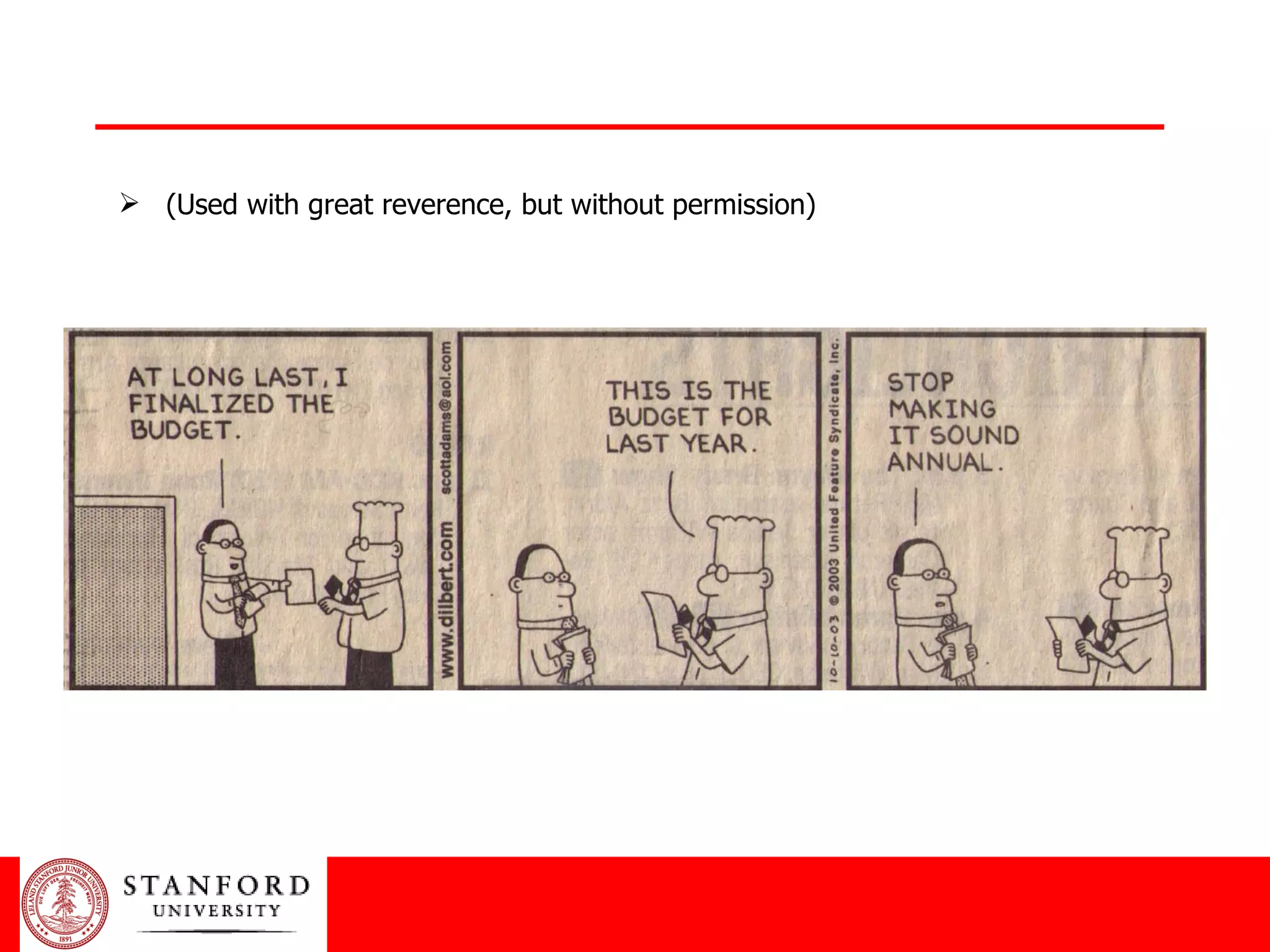
(Used with great reverence, but without permission)
Contact Andrew Harker, Ed.D. Principal Ralph Harker Associates www.RalphHarkerAssociates.com Email:  [email_address] +1-415-305-5844 Director of Budget Management University Budget Office Stanford University http://www.stanford.edu/dept/pres-provost/budget/hyperion/index.html E-mail:  [email_address] +1-650-725-0666
Additional Vendor Information
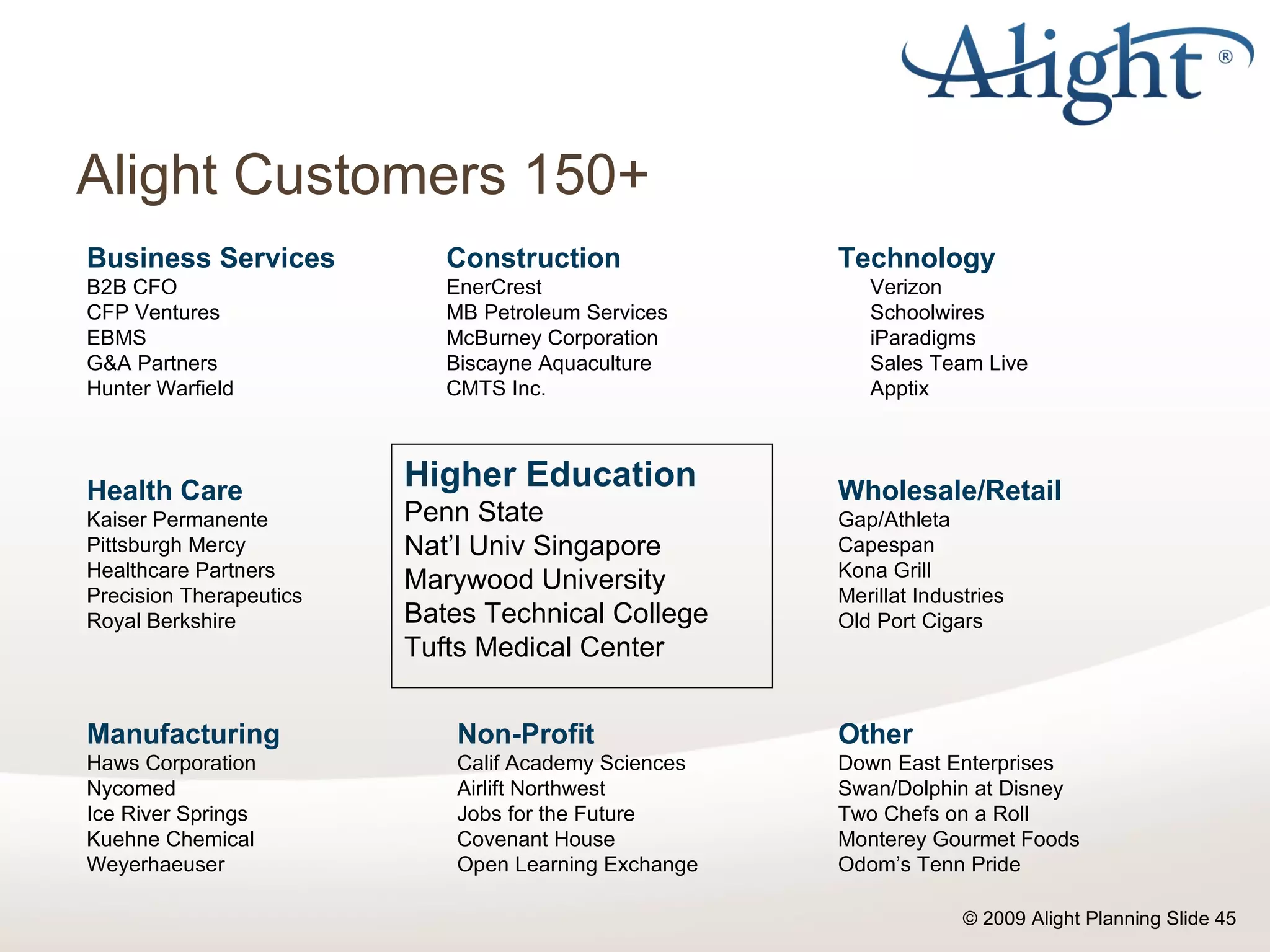
Alight Customers 150+ Construction EnerCrest MB Petroleum Services McBurney Corporation Biscayne Aquaculture CMTS Inc. Higher Education Penn State Nat’l Univ Singapore Marywood University Bates Technical College Tufts Medical Center Health Care Kaiser Permanente Pittsburgh Mercy Healthcare Partners Precision Therapeutics Royal Berkshire Manufacturing Haws Corporation Nycomed Ice River Springs Kuehne Chemical Weyerhaeuser Non-Profit Calif Academy Sciences Airlift Northwest Jobs for the Future Covenant House Open Learning Exchange Technology Verizon Schoolwires iParadigms Sales Team Live Apptix Wholesale/Retail Gap/Athleta Capespan Kona Grill Merillat Industries Old Port Cigars Other Down East Enterprises Swan/Dolphin at Disney Two Chefs on a Roll Monterey Gourmet Foods Odom’s Tenn Pride Business Services  B2B CFO CFP Ventures EBMS G&A Partners Hunter Warfield
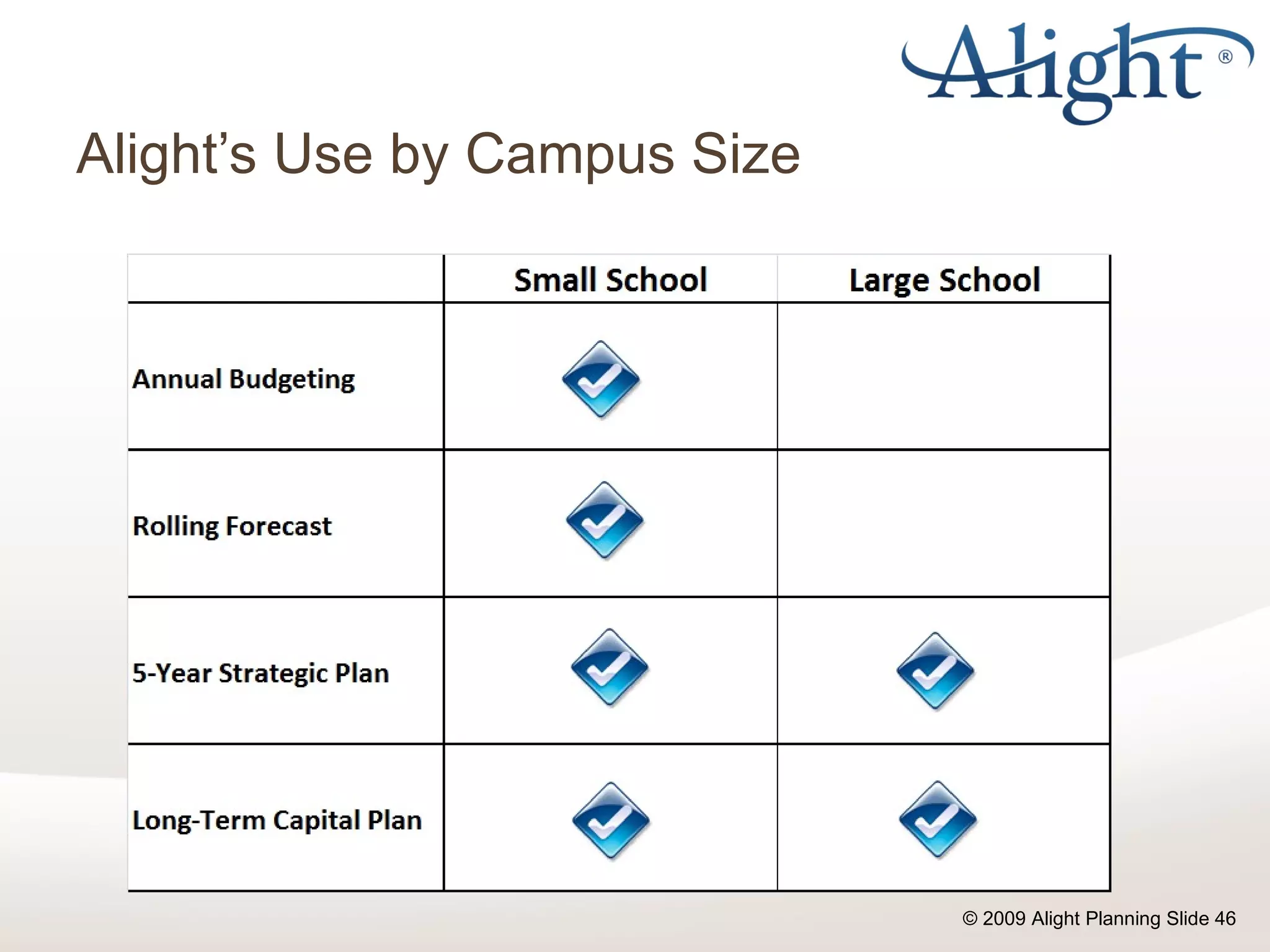
Alight’s Use by Campus Size
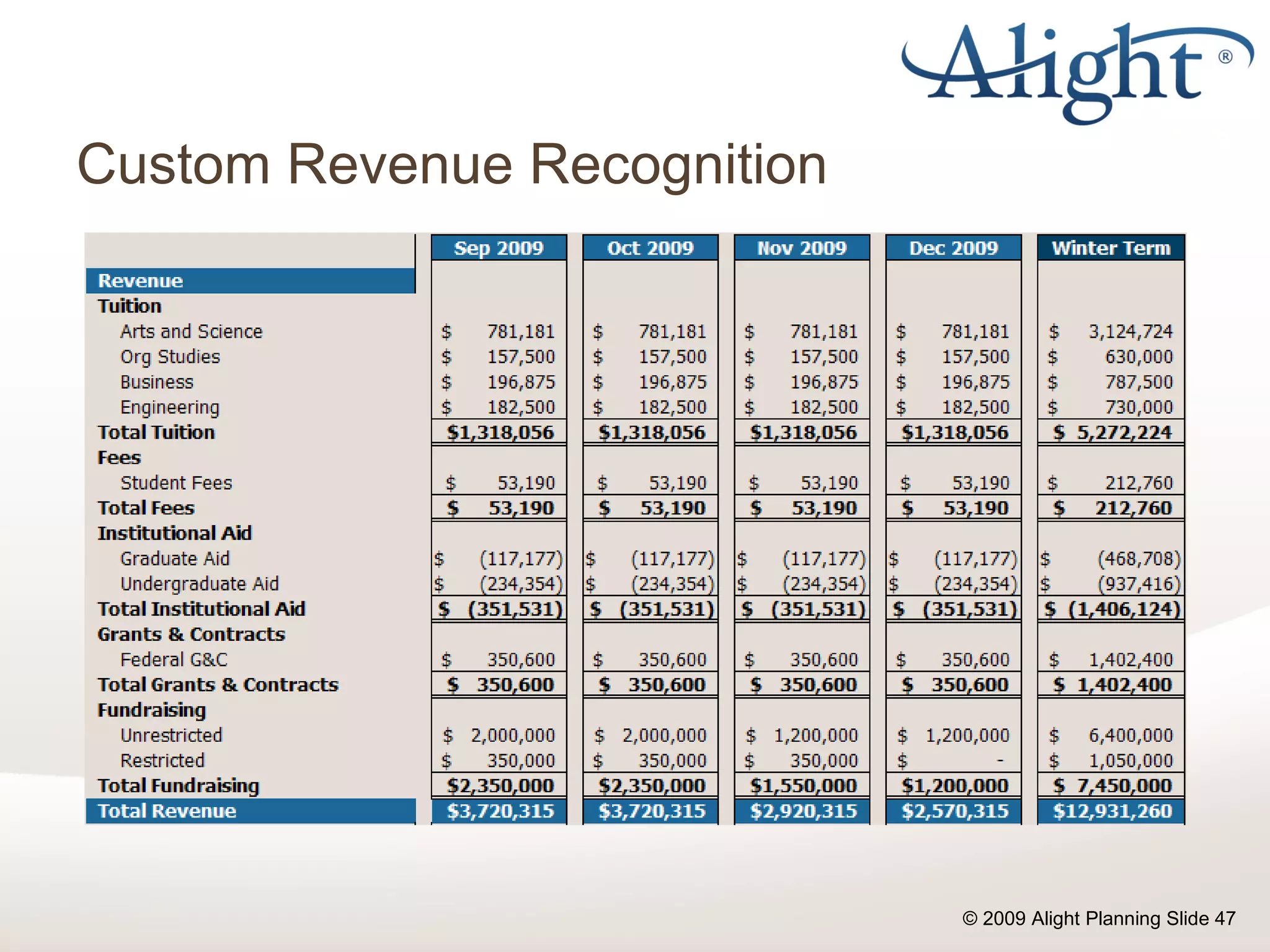
Custom Revenue Recognition
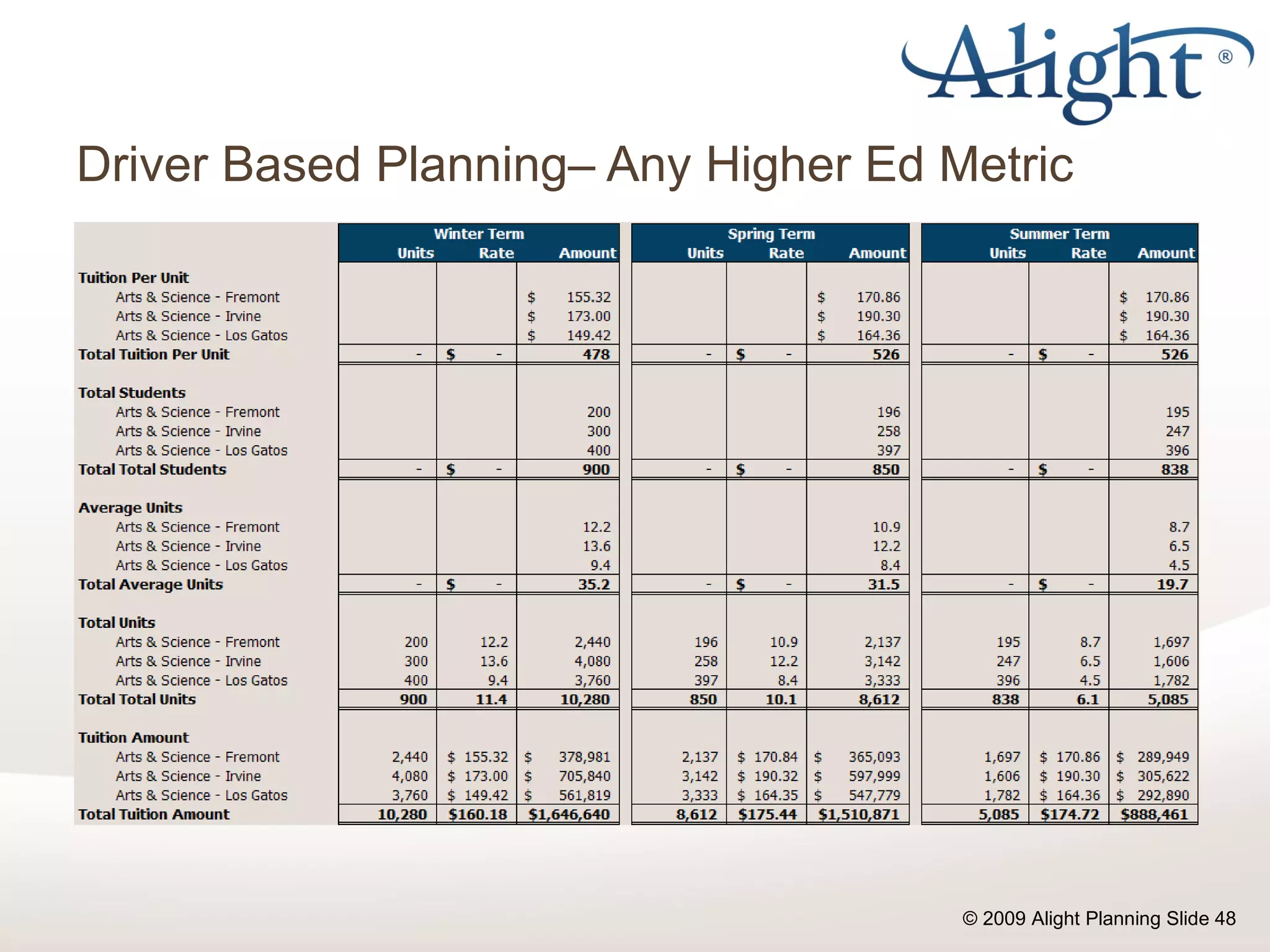
Driver Based Planning– Any Higher Ed Metric
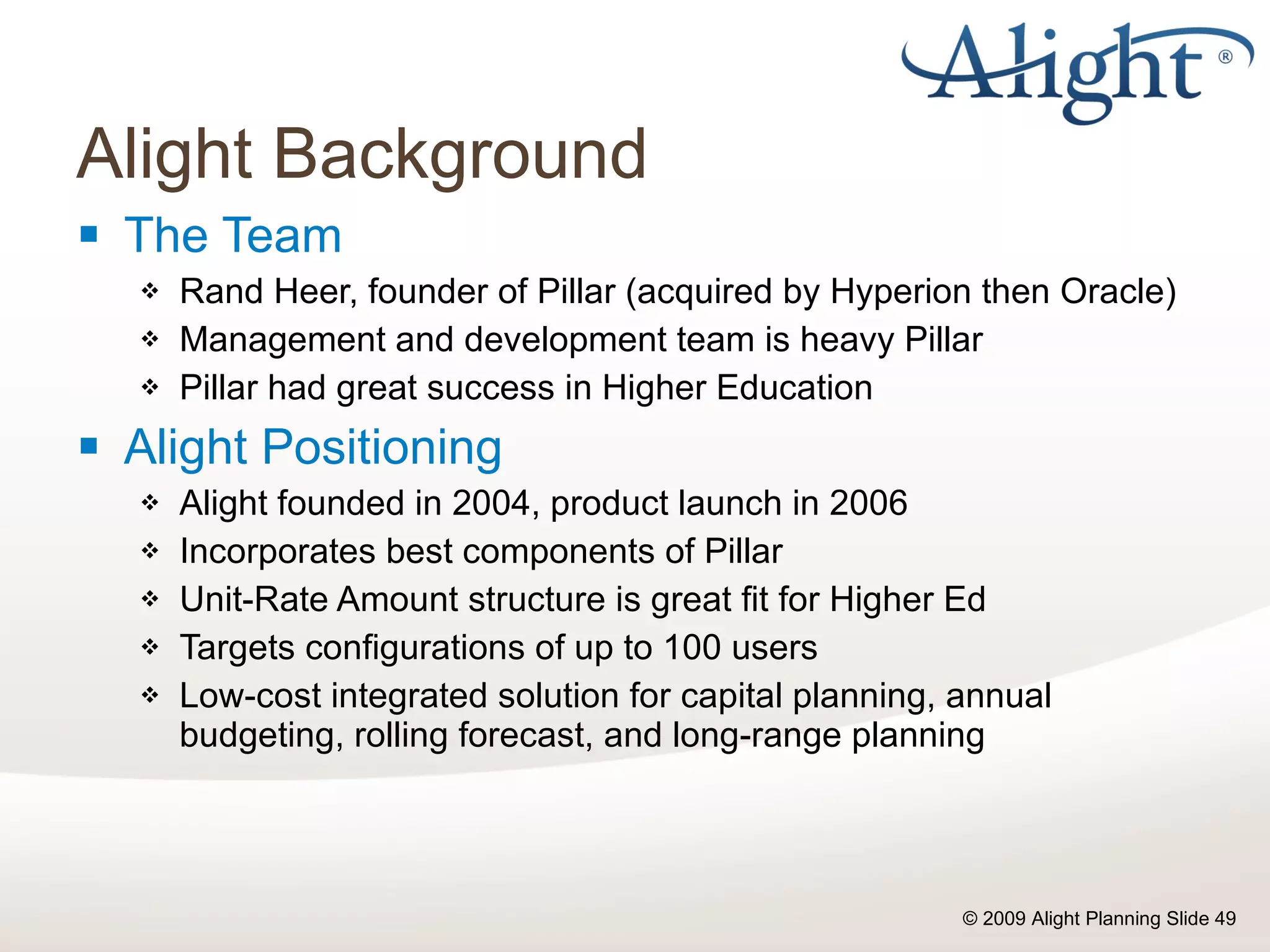
Alight Background The Team Rand Heer, founder of Pillar (acquired by Hyperion then Oracle) Management and development team is heavy Pillar Pillar had great success in Higher Education Alight Positioning Alight founded in 2004, product launch in 2006 Incorporates best components of Pillar Unit-Rate Amount structure is great fit for Higher Ed Targets configurations of up to 100 users Low-cost integrated solution for capital planning, annual budgeting, rolling forecast, and long-range planning
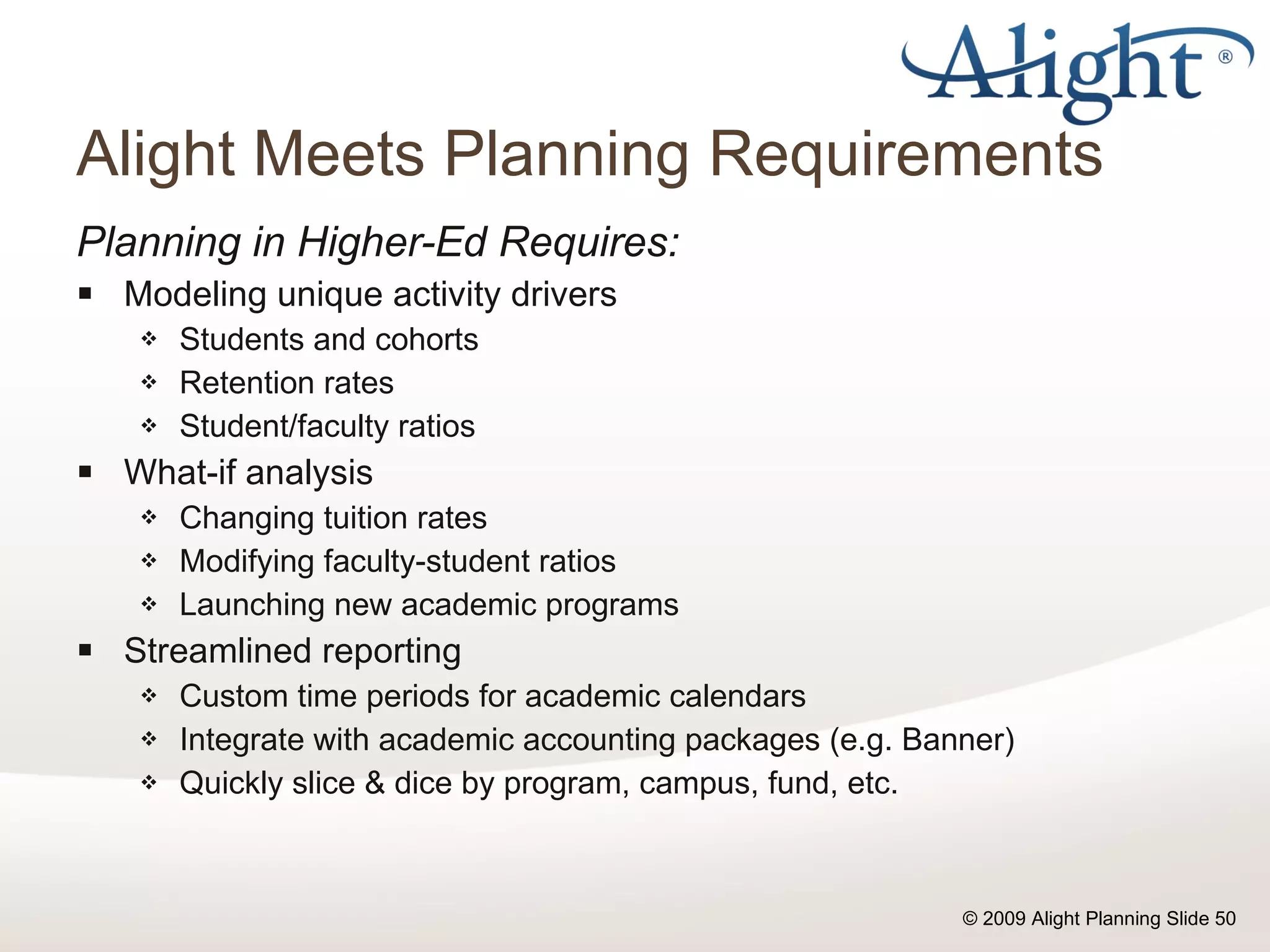
Alight Meets Planning Requirements Planning in Higher-Ed Requires: Modeling unique activity drivers Students and cohorts Retention rates Student/faculty ratios What-if analysis Changing tuition rates Modifying faculty-student ratios Launching new academic programs Streamlined reporting Custom time periods for academic calendars Integrate with academic accounting packages (e.g. Banner) Quickly slice & dice by program, campus, fund, etc.
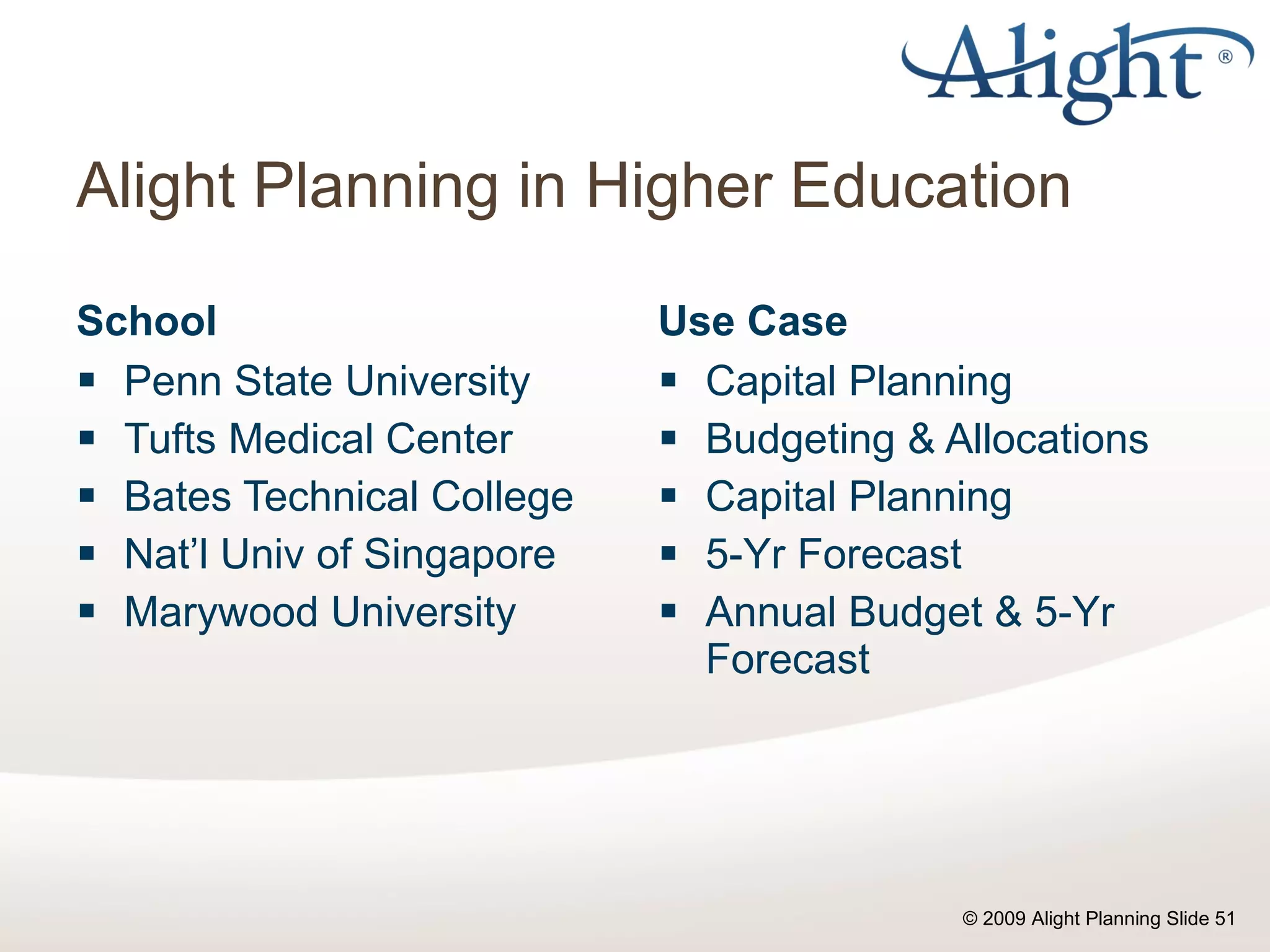
Alight Planning in Higher Education School Penn State University Tufts Medical Center Bates Technical College Nat’l Univ of Singapore Marywood University Use Case Capital Planning Budgeting & Allocations Capital Planning 5-Yr Forecast Annual Budget & 5-Yr Forecast
 
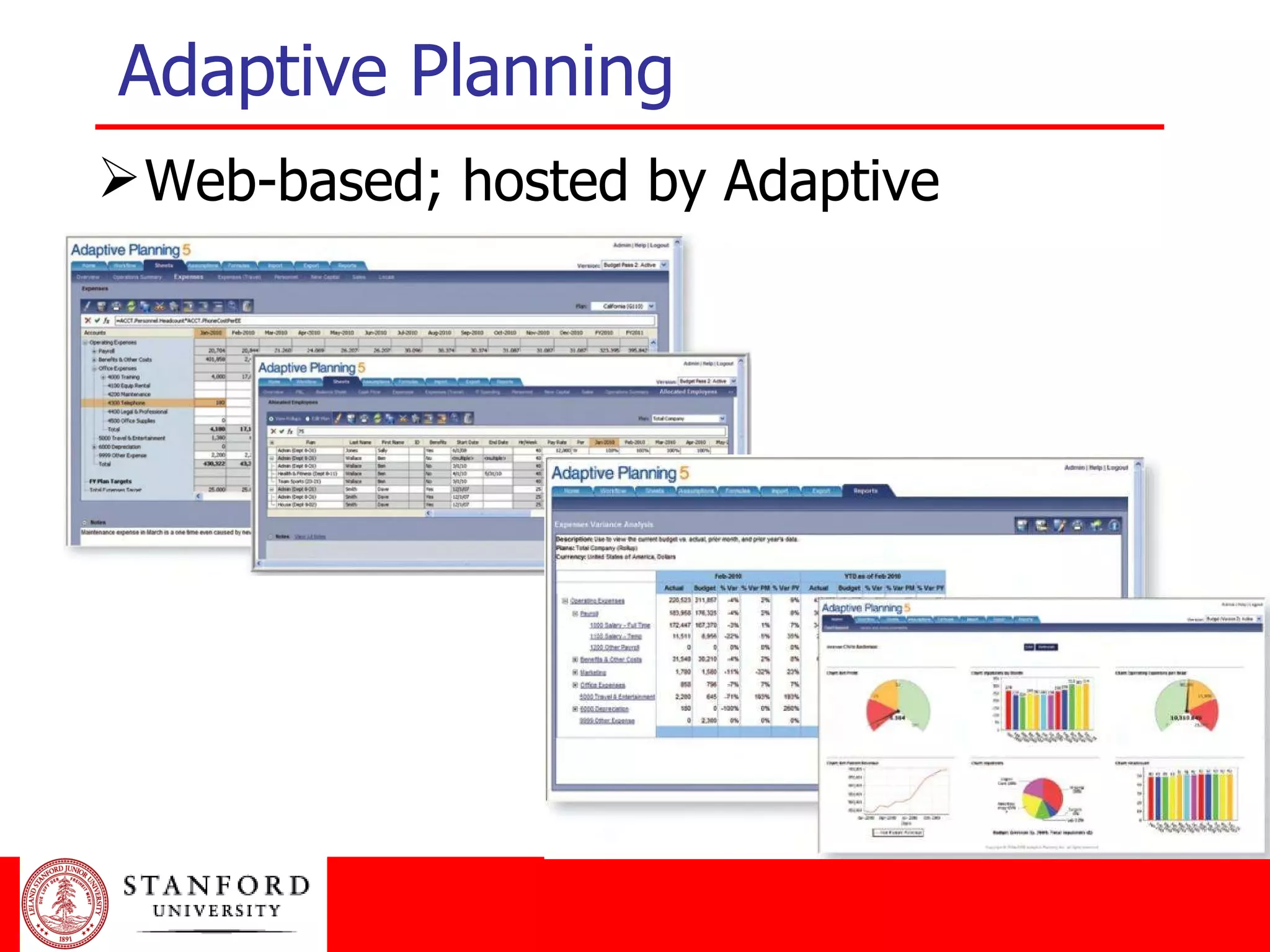
Adaptive Planning Web-based; hosted by Adaptive
 

Asmi Budget Monitoring Presentation 2010

  • 1.
    Moving beyond Excel:Budget Entry, Monitoring, and Reforecasting Dr. Andrew Harker Director of Budget Management
  • 2.
    (Used with greatreverence, but without permission)
  • 3.
    Transforming the budgetprocess Expand the notion of budgeting from a control mechanism to a strategic tool Freeing yourself from the yoke of Excel (while not totally ticking off your users) Getting immersed in and excited by the data Leveraging your ERP systems
  • 4.
    Excel: A NecessaryEvil Universally used Emotionally important to the users Very flexible Uncontrollable A nightmare to “consolidate” Manipulating or analyzing beyond two dimensions very difficult Distributed files; no version control Excel will probably never be fully out of the equation Users will always want to export/import
  • 5.
    What should abudget system do? Salary planning across cost centers Annotation/line-item detail Consolidation & distribution Easy to add additional units, cost centers, natural classifications Be able to tag data with attributes (e.g. fund type, level of restriction) Be able to report dynamically in rows and columns Be able to handle Fund Accounting Ability to do “what-if?” analysis
  • 6.
    The Marketplace Largerscale implementations: (e.g. > $100k) Oracle: Hyperion Planning, Hyperion Strategic Finance www.oracle.com/hyperion SAP: BusinessObjects Planning and Consolidation (BPC) http://www.sap.com/solutions/sapbusinessobjects/large/enterprise-performance-management/planningandconsolidation/index.epx Prophix www.prophix.com Smaller scale, smaller budget: (e.g. < $100k) Alight Planning www.alightplanning.com Prophix Express www.prophix.com Adaptive Planning www.adaptiveplanning.com
  • 7.
    A Case StudyHow Stanford has used Oracle’s Hyperion Planning for seven years for budget formulation, reforecasting, monitoring, and variance analysis
  • 8.
    Overview Using HyperionPlanning, Stanford has brought discipline and analytical ability to its on-going budget monitoring and reforecasting processes with more utility and less pain than using Excel We have a process that facilitates financial information flow and analysis up and down the decision-making hierarchy
  • 9.
    Use of OracleSystems Oracle EBS for Financials (GL, GA, AP, AR, PO, LD) Peoplesoft for Student Information and HR Hyperion Planning for Budget entry and Monitoring Hyperion System 9 BI+ as interface into Data Warehouse Also use Business Objects WEBI
  • 10.
    Budgeting at Stanford$4.0B in Revenues and Expense ~30 decentralized budget units ~350 end users >50k cost centers; >10k employees Fund Accounting standards High-level forecasting several months before detailed budget exercise “ Top-down” and “Bottom-up”
  • 11.
    (Used with greatreverence, but without permission)
  • 12.
    Security (user accessto data) Metadata “overhead”: Size of the cubes Performance (apparent speed to users, control over calculations) Tech Infrastructure unique to Universities System Design Priorities These design issues were of paramount concern:
  • 13.
    Concepts/Rationale Hyperion isan excellent tool for analysis of summarized data Generates fast results for known retrieval patterns Consolidation of all units is easy Instant access to data submitted Don’t have to wait for linking of spreadsheets Good roll-up and drill-through capability “ Slicing & dicing” capabilities beyond those of Excel We design standard reports and data entry forms/templates for all the units to use It facilitates on-going reforecasting and analysis of trends
  • 14.
    Organization of theData Aggregate data is entered and stored in the system by: Budget Unit Fund Type Year Scenario (e.g. Budget Plan, Booked Budget) Version (Bottom-up, Top-down) Budget Category (revenue & expense)
  • 15.
    The Hyperion WorkspaceAccess to both reports and data controlled by security
  • 16.
    Budget Entry PortalScreen: Table of Contents We have organized forms into “like” types of data for all of the cost centers for which someone is responsible
  • 17.
    Budget Entry: Non-SalaryUsing Supporting Detail, users can annotate a particular entry or build up a calculation such as cost per person times number of people Data can be exported to Excel Using Cell Text to make notes
  • 18.
    Budget Entry: SalaryPercent Distribution Salaries are calculated using $ times % charged to each cost center
  • 19.
    Consolidation & DistributionThe system has an organizational outline/hierarchy that facilitates drill-down and drill-up
  • 20.
    Budget Analysis &Reporting using Hyperion: “cross-tab” views
  • 21.
    Budget Analysis &Reporting using Hyperion: “time series” views
  • 22.
    Budget Analysis &Reporting using Hyperion: “slicing & dicing” Using the Point of View, users can change the data the report is looking at Related Content (“links”) let you drill down to lower levels of detail directly from this report
  • 23.
    (Used with greatreverence, but without permission)
  • 24.
    Variance Analysis &Reforecasting Process Stored within Hyperion: High-level Budget Plan 9/1 Consolidated Budget (12 months of data from Budget cycle) Year-end Projection Actuals (e.g. Sep ~ Mar of Actuals from Oracle) Goals: To identify and analyze variances from budget To enable complex “slicing & dicing” of budget and actuals data To create a Rolling Forecast (Sep ~ Mar Actuals + Apr ~ Aug Budget) with capability to adjust remaining budget numbers
  • 25.
    Rube Goldberg’s PencilSharpener Open window (A) and fly kite (B) .  String (C) lifts small door (D) allowing moths (E) to escape and eat red flannel shirt (F) .   As weight of shirt becomes less, shoe (G) steps on switch (H) which heats electric iron (I) and burns hole in pants (J) .   Smoke (K) enters hole in tree (L) , smoking out opossum (M) which jumps into basket (N) , pulling rope (O) and lifting cage (P) , allowing woodpecker (Q) to chew wood from pencil (R) , exposing lead.  Emergency knife (S) is always handy in case opossum or the woodpecker gets sick and can't work
  • 26.
    Previous Variance AnalysisProcess Data Warehouse Hyperion (Budgets) Oracle (Actuals) Star Schema Star Schema DSS Bus Objects Collection Bus Objects Query Excel Visual Basic Macro Variance Report Spreadsheets Analysis by Units Units emailed Excel SS to UBO UBO reviewed each SS and then loaded into Hyperion
  • 27.
    The budget monitoringprocess using Hyperion Hyperion BI+ / Business Objects Since Hyperion will only hold data at a certain level of detail, transactional reporting environment provides queries for analysis when more detail is needed Analysis by Units Hyperion Oracle (Actuals) EDW Units enter their analysis/forecasts into Hyperion UBO enters “top-down” forecast/budget into Hyperion Budget, Variance, & Reforecast Reports (printed & on-line) Ad-hoc analysis & reporting
  • 28.
  • 29.
    Viewing information byfund type Categorization of similar types of Cost Centers (attributes of the members)
  • 30.
    Changing your viewon the fly Select a different organizational unit
  • 31.
  • 32.
  • 33.
  • 34.
  • 35.
  • 36.
    Investigating the dataA hyperlink launches another report that shows where this data comes from
  • 37.
    Units submit theiranalysis text via Hyperion
  • 38.
    Reports to aidin reforecasting “ Run-rate” Report: How much of last year’s total expense did the first 4 months represent? The user can use this to help project out the current year.
  • 39.
    What we havegained: the benefits A web-based budget formulation and reporting system Accessible from home/wherever A dynamic, yet controlled, system Better control over integrity of metadata “ Real-time” access to budget entry progress Much greater ability to monitor the budget along the way Better budget process management Greater flexibility in report design Better ability to analyze & report on Consolidated Budget No software overhead on user machines Allowing users still to use Excel as they feel appropriate
  • 40.
    Scalability is alwaysat the forefront We have to manage the system around the large number of cost centers and positions we budget to We have multiple databases (“applications”) which keep performance optimal Storing low-level detail for units must be spread across several applications, and high level information for all units must be consolidated into one application Significant infrastructure and IT support needs Although the management and setup of the system is in our control Windows-based: May not be certified for the very latest versions of IE and Firefox Mac users need dual-boot Intel machines The tool will not address skill issues We still have fundamental issues around training non-financial people to do financial work “The Fine Print”
  • 41.
    Additional modules that“plug in” Workforce Planning Capital Expenditure Planning Full Excel integration using “Smart View” Ability to do most of what is done on the web in Excel Live links within Word, Excel, Powerpoint documents to data in the system We are implementing Oracle’s Hyperion Financial Management for external financial statement reporting We hope to develop integrations between fund accounting based-budgets and GAAP-based financial statements We are working on developing high-level long-range forecasting models using Oracle’s Hyperion Strategic Finance Leveraging the Tool
  • 42.
    (Used with greatreverence, but without permission)
  • 43.
    Contact Andrew Harker,Ed.D. Principal Ralph Harker Associates www.RalphHarkerAssociates.com Email: [email_address] +1-415-305-5844 Director of Budget Management University Budget Office Stanford University http://www.stanford.edu/dept/pres-provost/budget/hyperion/index.html E-mail: [email_address] +1-650-725-0666
  • 44.
  • 45.
    Alight Customers 150+Construction EnerCrest MB Petroleum Services McBurney Corporation Biscayne Aquaculture CMTS Inc. Higher Education Penn State Nat’l Univ Singapore Marywood University Bates Technical College Tufts Medical Center Health Care Kaiser Permanente Pittsburgh Mercy Healthcare Partners Precision Therapeutics Royal Berkshire Manufacturing Haws Corporation Nycomed Ice River Springs Kuehne Chemical Weyerhaeuser Non-Profit Calif Academy Sciences Airlift Northwest Jobs for the Future Covenant House Open Learning Exchange Technology Verizon Schoolwires iParadigms Sales Team Live Apptix Wholesale/Retail Gap/Athleta Capespan Kona Grill Merillat Industries Old Port Cigars Other Down East Enterprises Swan/Dolphin at Disney Two Chefs on a Roll Monterey Gourmet Foods Odom’s Tenn Pride Business Services B2B CFO CFP Ventures EBMS G&A Partners Hunter Warfield
  • 46.
    Alight’s Use byCampus Size
  • 47.
  • 48.
    Driver Based Planning–Any Higher Ed Metric
  • 49.
    Alight Background TheTeam Rand Heer, founder of Pillar (acquired by Hyperion then Oracle) Management and development team is heavy Pillar Pillar had great success in Higher Education Alight Positioning Alight founded in 2004, product launch in 2006 Incorporates best components of Pillar Unit-Rate Amount structure is great fit for Higher Ed Targets configurations of up to 100 users Low-cost integrated solution for capital planning, annual budgeting, rolling forecast, and long-range planning
  • 50.
    Alight Meets PlanningRequirements Planning in Higher-Ed Requires: Modeling unique activity drivers Students and cohorts Retention rates Student/faculty ratios What-if analysis Changing tuition rates Modifying faculty-student ratios Launching new academic programs Streamlined reporting Custom time periods for academic calendars Integrate with academic accounting packages (e.g. Banner) Quickly slice & dice by program, campus, fund, etc.
  • 51.
    Alight Planning inHigher Education School Penn State University Tufts Medical Center Bates Technical College Nat’l Univ of Singapore Marywood University Use Case Capital Planning Budgeting & Allocations Capital Planning 5-Yr Forecast Annual Budget & 5-Yr Forecast
  • 52.
  • 53.
    Adaptive Planning Web-based;hosted by Adaptive
  • 54.

Editor's Notes

  • #13 After we chose Hyperion’s web-based budgeting solution, there were several design considerations that were at the forefront in our implementation: Adequately addressing Security issues, both in terms of user access to data, and security of the system itself. Because we have complex position budgeting as part of our process, we needed to address allowing people to see salary budget data for individuals in their department that was not charged to their department, but not to be able to see other budget data outside their department. And we needed to do this with a minimum amount of effort in designing and maintaining the forms we were developing. As mentioned before, the sheer volume of both metadata and data had to be addressed. Signification design work went into balancing the volume of data in the system with the performance of the system. It was important that we would be able to calculate the databases in a minimum amount of time, and that the perceived speed of the system to the users accessing it would be fast. As well, many universities have a technological infrastructure that differs from that normally encountered in the corporate environment. Without a traditional firewall around the entire campus, there were specific security and access issues that we needed to work with Hyperion on.
  • #17 These next 4 slides are screen shots of the data entry tool (Planning), to give a sense of how the tool looks and works. This is the main “portal”, the table of contents. A user’s security controls not only access to specific data entry forms, but also the data that gets filtered upon opening the form. The number, organization, and definition of the forms is configured by analysts in our office. We chose to group “like” kinds of data in separate forms as a way of methodizing the budget formulation process. So, for example, a user would click on the Non-Salary data entry form to budget for non-salary expenses for each cost center for which they have responsibility.
  • #18 This data entry form shows the “excel-like” feel of the tool. Data is stored monthly, but can be entered yearly (or quarterly), spreading automatically across the time periods. The rows show the natural classifications (expenditure and revenue types) defined for the form; although the database structure has all the natural classifications in our chart of accounts, we have chosen the specific codes to which we want people budgeting. The “Page” view displays the cost center being budgeted to; the value set in this list is controlled by the user’s security access. Data from the form can be exported to (or copied from) Excel, and there are a number of different ways of annotating or listing detail on budget entries.
  • #19 Users then indicate the fraction of the salary that is to be charged to a specific cost center; that is 1.0 for 100%, 0.5 for 50%, and so on. Business Rules (calculations) are run several times a day to distribute the appropriate amount of budget to each cost center
  • #21 The following three screen shots show the flexibility in cross-tab reporting, and in comparing different scenarios side by side. Here we show the University’s Consolidated Budget, with revenue, transfer, and expense categories in the rows and groupings of funds into fund types in the columns. You will note that this report is fully formatted for presentation purposes, and can be displayed either in HTML or PDF formats. There also is functionality to export the report data (unformatted) to Excel.
  • #22 In this report, we have revenue, transfer, and expense categories in the rows, but instead we have put the award groupings in the page view. Instead in the columns we have different scenarios; for example, we have the Forecast (a high level early budget), the detailed budget that was entered a few months later, the reprojection of the fiscal year based on six months of data, and the next year’s high level forecast. In a way, this gives you a temporal view of how you thought things were going at different times in the budget and forecasting process. You would change the page view to see this data for each individual fund grouping. A PDF report would actually be generated cycling through all the values in the page view.
  • #23 And here, we show a report that only has expenses, but it lists them by budget unit and by fund type. Users can change the data on the report – say from expenses to revenues – by using the Point of View. As you can see, there is great flexibility in the definition of reports.
  • #40 So what have we achieved? Using Hyperion, we have a web-based budget formulation and reporting system that is accessible via the web, but which is sufficiently centralized so we have control over the integrity of the metadata plus real-time access to the budget data to see where people are all throughout the process. We have a dynamic reporting and analytical environment which addresses our needs both for internal and for external reporting. Although we have also inherited a more complex system that needs IT support to maintain, we no longer have to spend any real time going out to each user’s machine to make sure the software is properly installed and functioning. And now I turn it over to Geoffrey.
  • #41 So what have we achieved? Using Hyperion, we have a web-based budget formulation and reporting system that is accessible via the web, but which is sufficiently centralized so we have control over the integrity of the metadata plus real-time access to the budget data to see where people are all throughout the process. We have a dynamic reporting and analytical environment which addresses our needs both for internal and for external reporting. Although we have also inherited a more complex system that needs IT support to maintain, we no longer have to spend any real time going out to each user’s machine to make sure the software is properly installed and functioning. And now I turn it over to Geoffrey.
  • #42 So what have we achieved? Using Hyperion, we have a web-based budget formulation and reporting system that is accessible via the web, but which is sufficiently centralized so we have control over the integrity of the metadata plus real-time access to the budget data to see where people are all throughout the process. We have a dynamic reporting and analytical environment which addresses our needs both for internal and for external reporting. Although we have also inherited a more complex system that needs IT support to maintain, we no longer have to spend any real time going out to each user’s machine to make sure the software is properly installed and functioning. And now I turn it over to Geoffrey.
  • #46 Alight Planning Presentation
  • #47 Alight Planning Presentation
  • #48 Alight Planning Presentation
  • #49 Alight Planning Presentation
  • #50 Alight Planning Presentation
  • #51 Alight Planning Presentation
  • #52 Alight Planning Presentation