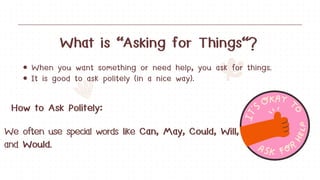
What is "Askingfor Things"?
When you want something or need help, you ask for things.
It is good to ask politely (in a nice way).
How to Ask Politely:
We often use special words like Can, May, Could, Will,
and Would.
3.
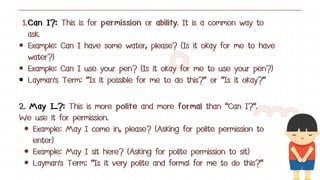
1.Can I?: Thisis for permission or ability. It is a common way to
ask.
Example: Can I have some water, please? (Is it okay for me to have
water?)
Example: Can I use your pen? (Is it okay for me to use your pen?)
Layman's Term: "Is it possible for me to do this?" or "Is it okay?"
2. May I...?: This is more polite and more formal than "Can I?".
We use it for permission.
Example: May I come in, please? (Asking for polite permission to
enter)
Example: May I sit here? (Asking for polite permission to sit)
Layman's Term: "Is it very polite and formal for me to do this?"
4.
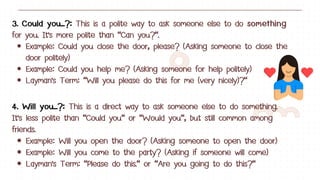
3. Could you...?:This is a polite way to ask someone else to do something
for you. It's more polite than "Can you?".
Example: Could you close the door, please? (Asking someone to close the
door politely)
Example: Could you help me? (Asking someone for help politely)
Layman's Term: "Will you please do this for me (very nicely)?"
4. Will you...?: This is a direct way to ask someone else to do something.
It's less polite than "Could you" or "Would you", but still common among
friends.
Example: Will you open the door? (Asking someone to open the door)
Example: Will you come to the party? (Asking if someone will come)
Layman's Term: "Please do this." or "Are you going to do this?"
5.
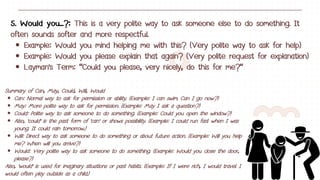
5. Would you...?:This is a very polite way to ask someone else to do something. It
often sounds softer and more respectful.
Example: Would you mind helping me with this? (Very polite way to ask for help)
Example: Would you please explain that again? (Very polite request for explanation)
Layman's Term: "Could you please, very nicely, do this for me?"
Summary of Can, May, Could, Will, Would
Can: Normal way to ask for permission or ability. (Example: I can swim. Can I go now?)
May: More polite way to ask for permission. (Example: May I ask a question?)
Could: Polite way to ask someone to do something. (Example: Could you open the window?)
Also, 'could' is the past form of 'can' or shows possibility. (Example: I could run fast when I was
young. It could rain tomorrow.)
Will: Direct way to ask someone to do something or about future action. (Example: Will you help
me? When will you arrive?)
Would: Very polite way to ask someone to do something. (Example: Would you close the door,
please?)
Also, 'would' is used for imaginary situations or past habits. (Example: If I were rich, I would travel. I
would often play outside as a child.)
6.
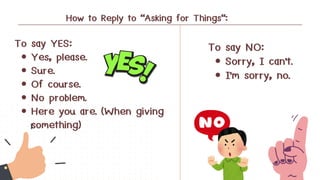
To say YES:
Yes,please.
Sure.
Of course.
No problem.
Here you are. (When giving
something)
To say NO:
Sorry, I can't.
I'm sorry, no.
How to Reply to "Asking for Things":
7.
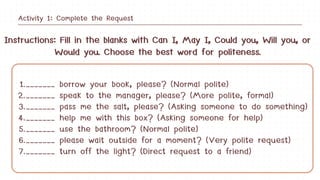
1._______ borrow yourbook, please? (Normal polite)
2._______ speak to the manager, please? (More polite, formal)
3._______ pass me the salt, please? (Asking someone to do something)
4._______ help me with this box? (Asking someone for help)
5._______ use the bathroom? (Normal polite)
6._______ please wait outside for a moment? (Very polite request)
7._______ turn off the light? (Direct request to a friend)
Instructions: Fill in the blanks with Can I, May I, Could you, Will you, or
Would you. Choose the best word for politeness.
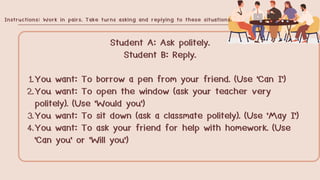
Activity 1: Complete the Request
Student A: Askpolitely.
Student B: Reply.
1.You want: To borrow a pen from your friend. (Use 'Can I')
2.You want: To open the window (ask your teacher very
politely). (Use 'Would you')
3.You want: To sit down (ask a classmate politely). (Use 'May I')
4.You want: To ask your friend for help with homework. (Use
'Can you' or 'Will you')
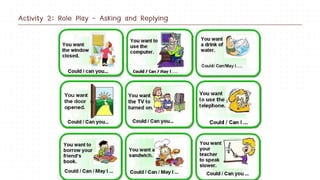
Instructions: Work in pairs. Take turns asking and replying to these situations.
10.
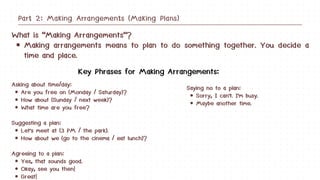
What is "MakingArrangements"?
Making arrangements means to plan to do something together. You decide a
time and place.
Part 2: Making Arrangements (Making Plans)
Asking about time/day:
Are you free on (Monday / Saturday)?
How about (Sunday / next week)?
What time are you free?
Suggesting a plan:
Let's meet at (3 PM / the park).
How about we (go to the cinema / eat lunch)?
Agreeing to a plan:
Yes, that sounds good.
Okay, see you then!
Great!
Saying no to a plan:
Sorry, I can't. I'm busy.
Maybe another time.
Key Phrases for Making Arrangements:
11.
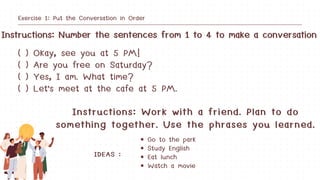
Instructions: Work witha friend. Plan to do
something together. Use the phrases you learned.
Instructions: Number the sentences from 1 to 4 to make a conversation
Exercise 1: Put the Conversation in Order
( ) Okay, see you at 5 PM!
( ) Are you free on Saturday?
( ) Yes, I am. What time?
( ) Let's meet at the cafe at 5 PM.
Go to the park
Study English
Eat lunch
Watch a movie
IDEAS :
12.
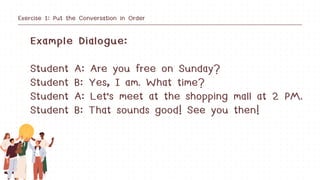
Exercise 1: Putthe Conversation in Order
Example Dialogue:
Student A: Are you free on Sunday?
Student B: Yes, I am. What time?
Student A: Let's meet at the shopping mall at 2 PM.
Student B: That sounds good! See you then!
13.
Part 3: PhoneCalls
1. Basic Phone Call Phrases
When you call someone or answer the phone, these words are useful:
Hello? (When you answer the phone or start a call)
This is [Your Name]. (When you call someone and say who you are)
May I speak to [Person's Name], please? (When you want to talk to someone
specific)
Speaking. (If you are the person the caller asked for)
Goodbye. (When you finish the call)
14.
Part 3: PhoneCalls
2. Asking for Someone on the Phone & Asking
Someone to Wait
Sometimes the person you want to talk to is not
there. Or you need a moment.
Asking for someone:
1."Is [Name] there?"
2."Could I talk to [Name], please?"
If the person is NOT there:
3."Sorry, [Name] is not here right now."
4."She is busy."
5."He is out."
Asking someone to wait:
6."One moment, please."
7."Please wait a moment."
8."Hold on, please." (More casual)
3. Leaving a Voice Message
If the person doesn't answer, you can leave a
voice message. You speak after the "beep."
What to say:
Hello. This is [Your Name].
I called because [reason - e.g., "I have a
question," "I want to make a plan"].
Please call me back.
My phone number is [Your Phone Number].
Thank you. Goodbye.
Activity 4: Role Play - Phone
Call Scenarios
15.
Scenario 1: Askingfor a friend (and they
are there)
Student A: (Dials phone) Hello?
Student B: Hello. May I speak to
[Friend's Name], please?
Student A: Speaking. / Yes, this is
[Friend's Name].
Student B: Oh, hello! How are you?
Student A: I'm good, thanks!
Instructions: Work in pairs. Practice these phone call situations.
Scenario 2: Asking for a teacher (and they are NOT
there)
Student A: (Teacher's phone rings) Hello? (You are the
teacher's assistant)
Student B: Hello. This is [Your Name]. Can I speak to
[Teacher's Name], please?
Student A: Sorry, [Teacher's Name] is not here right now.
Can I take a message?
Student B: Yes, please tell [Teacher's Name] to call me
back. My number is [Your Phone Number].
Student A: Okay. I will tell [Teacher's Name].
Student B: Thank you. Goodbye
Student A: Goodbye.

![Part 3: Phone Calls
1. Basic Phone Call Phrases
When you call someone or answer the phone, these words are useful:
Hello? (When you answer the phone or start a call)
This is [Your Name]. (When you call someone and say who you are)
May I speak to [Person's Name], please? (When you want to talk to someone
specific)
Speaking. (If you are the person the caller asked for)
Goodbye. (When you finish the call)](https://image.slidesharecdn.com/m6slash1-260127044810-8bd411f1/85/Asking-for-things-and-replying-ppt-for-m6-1-esl-students-13-320.jpg)
![Part 3: Phone Calls
2. Asking for Someone on the Phone & Asking
Someone to Wait
Sometimes the person you want to talk to is not
there. Or you need a moment.
Asking for someone:
1."Is [Name] there?"
2."Could I talk to [Name], please?"
If the person is NOT there:
3."Sorry, [Name] is not here right now."
4."She is busy."
5."He is out."
Asking someone to wait:
6."One moment, please."
7."Please wait a moment."
8."Hold on, please." (More casual)
3. Leaving a Voice Message
If the person doesn't answer, you can leave a
voice message. You speak after the "beep."
What to say:
Hello. This is [Your Name].
I called because [reason - e.g., "I have a
question," "I want to make a plan"].
Please call me back.
My phone number is [Your Phone Number].
Thank you. Goodbye.
Activity 4: Role Play - Phone
Call Scenarios](https://image.slidesharecdn.com/m6slash1-260127044810-8bd411f1/85/Asking-for-things-and-replying-ppt-for-m6-1-esl-students-14-320.jpg)
![Scenario 1: Asking for a friend (and they
are there)
Student A: (Dials phone) Hello?
Student B: Hello. May I speak to
[Friend's Name], please?
Student A: Speaking. / Yes, this is
[Friend's Name].
Student B: Oh, hello! How are you?
Student A: I'm good, thanks!
Instructions: Work in pairs. Practice these phone call situations.
Scenario 2: Asking for a teacher (and they are NOT
there)
Student A: (Teacher's phone rings) Hello? (You are the
teacher's assistant)
Student B: Hello. This is [Your Name]. Can I speak to
[Teacher's Name], please?
Student A: Sorry, [Teacher's Name] is not here right now.
Can I take a message?
Student B: Yes, please tell [Teacher's Name] to call me
back. My number is [Your Phone Number].
Student A: Okay. I will tell [Teacher's Name].
Student B: Thank you. Goodbye
Student A: Goodbye.](https://image.slidesharecdn.com/m6slash1-260127044810-8bd411f1/85/Asking-for-things-and-replying-ppt-for-m6-1-esl-students-15-320.jpg)