Letter (s)
formal and Informal
Miss Aydelina Medina Gajardo
4ªMedio A-B
IMPORTANT
THINGS BEFORE TO START
WHAT IS IT A LETTER?
A letter is a form of non-fictional written,
typed or printed communication. These
are usually written to facilitate
communication between two individuals
and are usually sent to the recipient via
mail or post in an envelope.
COMMON SALUTATIONS FOR LETTERS
FORMAL
• Dear Sir or Madam
• Dear
• To who may concern
INFORMAL
• GOOD MORNING/ NIGHT/ AFTERNOON
• HELLO
• Hi!
TYPE OF LETTERS
• Job Application: Formal or business-
related letters could include job
applications such as a resume and
cover letter.
• Keeping in touch with older relatives:
Letter writing can be a lovely way to keep in
touch with people who remember a time
when letter writing was more popular
Thank you letter: A thank you letter is
also a great way to encourage children's
emotional development, as it's important
to teach kids to be grateful and
appreciative.
Writing home or to a friend on holiday:
While students are spending time away
from the classroom, they can often miss
the social connections and bonds that
they've made in school.
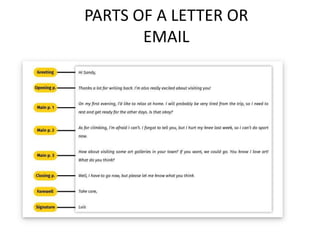
PARTS OF A LETTER OR
EMAIL
• Greetings: we greet the other person
• Opening paragraph: we react to the other person’s
news and ask them how they are feeling and whatever
else you feel is appropriate.
• Main paragraph 1: in this paragraph we deal with the
first important point, which we can identify in the
instructions.
• Main paragraph 2: if there is a different point to deal
with, this paragraph will do so.
• (We might have more main paragraphs, depending on
the task.)
• Closing paragraph: in this paragraph we «start» to say
goodbye by wishing the other person well and asking
them to reply to your letter or Email
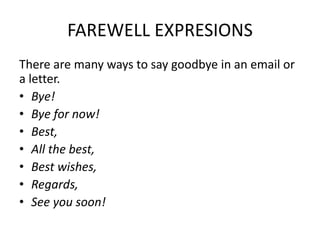
FAREWELL EXPRESIONS
There are many ways to say goodbye in an email or
a letter.
• Bye!
• Bye for now!
• Best,
• All the best,
• Best wishes,
• Regards,
• See you soon!
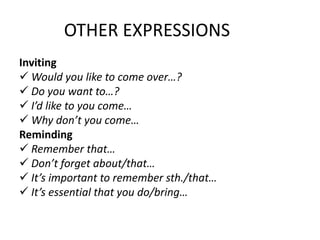
OTHER EXPRESSIONS
Inviting
 Would you like to come over…?
 Do you want to…?
 I’d like to you come…
 Why don’t you come…
Reminding
 Remember that…
 Don’t forget about/that…
 It’s important to remember sth./that…
 It’s essential that you do/bring…
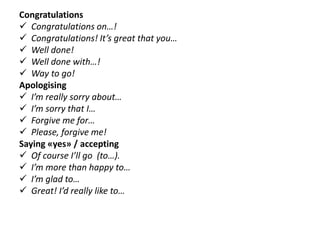
Congratulations
 Congratulations on…!
 Congratulations! It’s great that you…
 Well done!
 Well done with…!
 Way to go!
Apologising
 I’m really sorry about…
 I’m sorry that I…
 Forgive me for…
 Please, forgive me!
Saying «yes» / accepting
 Of course I’ll go (to…).
 I’m more than happy to…
 I’m glad to…
 Great! I’d really like to…
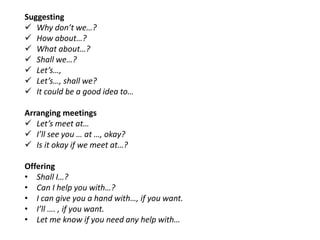
Suggesting
 Why don’t we…?
 How about…?
 What about…?
 Shall we…?
 Let’s…,
 Let’s…, shall we?
 It could be a good idea to…
Arranging meetings
 Let’s meet at…
 I’ll see you … at …, okay?
 Is it okay if we meet at…?
Offering
• Shall I…?
• Can I help you with…?
• I can give you a hand with…, if you want.
• I’ll …. , if you want.
• Let me know if you need any help with…
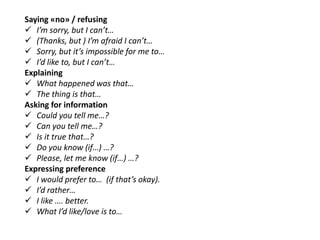
Saying «no» / refusing
 I’m sorry, but I can’t…
 (Thanks, but ) I’m afraid I can’t…
 Sorry, but it’s impossible for me to…
 I’d like to, but I can’t…
Explaining
 What happened was that…
 The thing is that…
Asking for information
 Could you tell me…?
 Can you tell me…?
 Is it true that…?
 Do you know (if…) …?
 Please, let me know (if…) …?
Expressing preference
 I would prefer to… (if that’s okay).
 I’d rather…
 I like …. better.
 What I’d like/love is to…
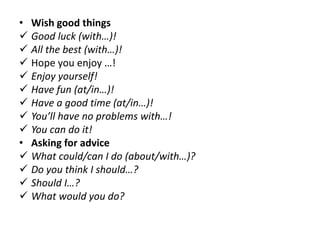
• Wish good things
 Good luck (with…)!
 All the best (with…)!
 Hope you enjoy …!
 Enjoy yourself!
 Have fun (at/in…)!
 Have a good time (at/in…)!
 You’ll have no problems with…!
 You can do it!
• Asking for advice
 What could/can I do (about/with…)?
 Do you think I should…?
 Should I…?
 What would you do?
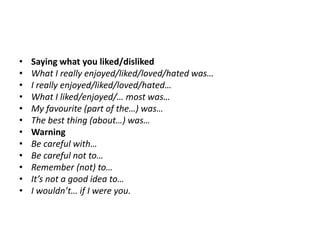
• Saying what you liked/disliked
• What I really enjoyed/liked/loved/hated was…
• I really enjoyed/liked/loved/hated…
• What I liked/enjoyed/… most was…
• My favourite (part of the…) was…
• The best thing (about…) was…
• Warning
• Be careful with…
• Be careful not to…
• Remember (not) to…
• It’s not a good idea to…
• I wouldn’t… if I were you.
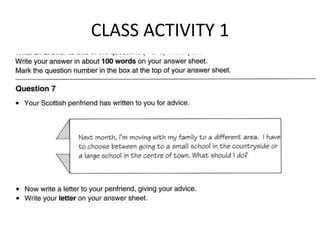
CLASS ACTIVITY 1

Letter (s).pptx

  • 1.
    Letter (s) formal andInformal Miss Aydelina Medina Gajardo 4ªMedio A-B
  • 2.
  • 3.
    WHAT IS ITA LETTER? A letter is a form of non-fictional written, typed or printed communication. These are usually written to facilitate communication between two individuals and are usually sent to the recipient via mail or post in an envelope.
  • 4.
    COMMON SALUTATIONS FORLETTERS FORMAL • Dear Sir or Madam • Dear • To who may concern INFORMAL • GOOD MORNING/ NIGHT/ AFTERNOON • HELLO • Hi!
  • 5.
    TYPE OF LETTERS •Job Application: Formal or business- related letters could include job applications such as a resume and cover letter. • Keeping in touch with older relatives: Letter writing can be a lovely way to keep in touch with people who remember a time when letter writing was more popular
  • 6.
    Thank you letter:A thank you letter is also a great way to encourage children's emotional development, as it's important to teach kids to be grateful and appreciative. Writing home or to a friend on holiday: While students are spending time away from the classroom, they can often miss the social connections and bonds that they've made in school.
  • 7.
    PARTS OF ALETTER OR EMAIL
  • 8.
    • Greetings: wegreet the other person • Opening paragraph: we react to the other person’s news and ask them how they are feeling and whatever else you feel is appropriate. • Main paragraph 1: in this paragraph we deal with the first important point, which we can identify in the instructions. • Main paragraph 2: if there is a different point to deal with, this paragraph will do so. • (We might have more main paragraphs, depending on the task.) • Closing paragraph: in this paragraph we «start» to say goodbye by wishing the other person well and asking them to reply to your letter or Email
  • 9.
    FAREWELL EXPRESIONS There aremany ways to say goodbye in an email or a letter. • Bye! • Bye for now! • Best, • All the best, • Best wishes, • Regards, • See you soon!
  • 10.
    OTHER EXPRESSIONS Inviting  Wouldyou like to come over…?  Do you want to…?  I’d like to you come…  Why don’t you come… Reminding  Remember that…  Don’t forget about/that…  It’s important to remember sth./that…  It’s essential that you do/bring…
  • 11.
    Congratulations  Congratulations on…! Congratulations! It’s great that you…  Well done!  Well done with…!  Way to go! Apologising  I’m really sorry about…  I’m sorry that I…  Forgive me for…  Please, forgive me! Saying «yes» / accepting  Of course I’ll go (to…).  I’m more than happy to…  I’m glad to…  Great! I’d really like to…
  • 12.
    Suggesting  Why don’twe…?  How about…?  What about…?  Shall we…?  Let’s…,  Let’s…, shall we?  It could be a good idea to… Arranging meetings  Let’s meet at…  I’ll see you … at …, okay?  Is it okay if we meet at…? Offering • Shall I…? • Can I help you with…? • I can give you a hand with…, if you want. • I’ll …. , if you want. • Let me know if you need any help with…
  • 13.
    Saying «no» /refusing  I’m sorry, but I can’t…  (Thanks, but ) I’m afraid I can’t…  Sorry, but it’s impossible for me to…  I’d like to, but I can’t… Explaining  What happened was that…  The thing is that… Asking for information  Could you tell me…?  Can you tell me…?  Is it true that…?  Do you know (if…) …?  Please, let me know (if…) …? Expressing preference  I would prefer to… (if that’s okay).  I’d rather…  I like …. better.  What I’d like/love is to…
  • 14.
    • Wish goodthings  Good luck (with…)!  All the best (with…)!  Hope you enjoy …!  Enjoy yourself!  Have fun (at/in…)!  Have a good time (at/in…)!  You’ll have no problems with…!  You can do it! • Asking for advice  What could/can I do (about/with…)?  Do you think I should…?  Should I…?  What would you do?
  • 15.
    • Saying whatyou liked/disliked • What I really enjoyed/liked/loved/hated was… • I really enjoyed/liked/loved/hated… • What I liked/enjoyed/… most was… • My favourite (part of the…) was… • The best thing (about…) was… • Warning • Be careful with… • Be careful not to… • Remember (not) to… • It’s not a good idea to… • I wouldn’t… if I were you.
  • 16.