Dave Voutila <dv@openbsd.org>, AsiaBSDCon 2023
Hardening Emulated Devices in
OpenBsd’s vmd(8) Hypervisor
fork&
exec&
fork&
exec.
Dave Voutila (dv@)
Vermont 🍁, USA 🇺🇸
(40 mins from Québec 🇨🇦)
Hypervisors as High Value Targets
Why do you rob a bank? It’s where the money is. 💰
• Shift to multi-tenant public cloud means target rich environments
• If it’s networked, it’s vulnerable.
• Pop one ESXi instance, now you own many systems
• “it’s ok, i’m running it in a vm”
A Potpourri of CVE’s
Some classic guest-to-host escapes
• QEMU
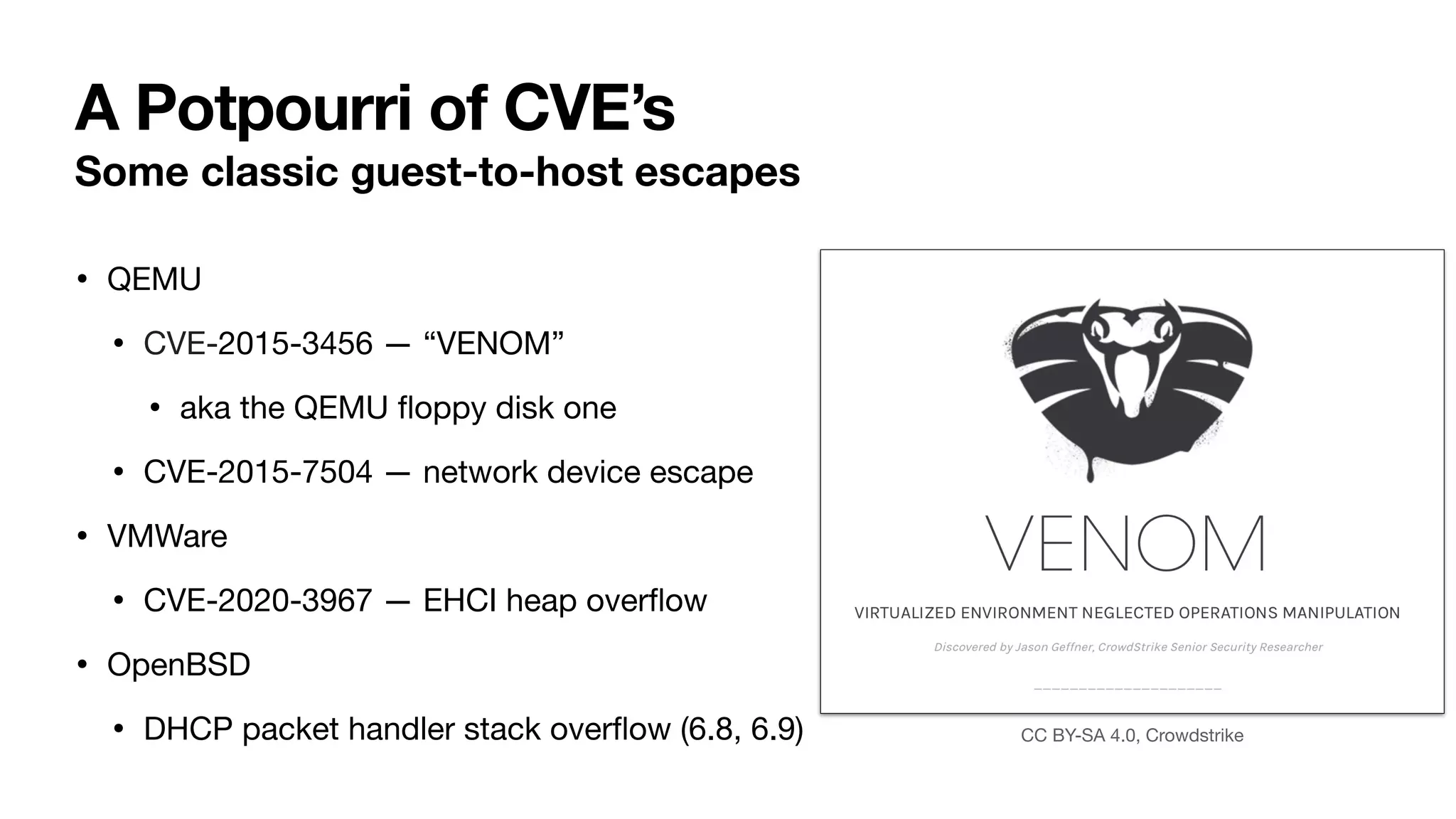
• CVE-2015-3456 — “VENOM”
• aka the QEMU
fl
oppy disk one
• CVE-2015-7504 — network device escape
• VMWare
• CVE-2020-3967 — EHCI heap over
fl
ow
• OpenBSD
• DHCP packet handler stack over
fl
ow (6.8, 6.9) CC BY-SA 4.0, Crowdstrike
Emulated Devices are the Problem
When in doubt, cut it out. ✂
• By de
fi
nition, always handling untrusted (guest) input
• Need read/write to guest physical memory
• Need read/write to host interfaces (network,
fi
les, etc.)
• Emulating in kernel is asking for trouble, so commonly done in userland
• In OpenBSD, only pvclock(4) is handled in the kernel (vmm(4))
Multi-process QEMU
First Type-2 open source hypervisor doing this?
• Oracle started work in 2017, landed in QEMU December 2020
• Elena U
fi
mtseva, Jag Raman, John G. Johnson
• https://lists.gnu.org/archive/html/qemu-devel/2020-12/msg00268.html
• …but, who uses it?
• I’d presume Oracle Cloud
• ¯_(ツ)_/¯ 🤷
• Documentation is primarily about design, future ideas, & not present day usage.
• Additional burden placed upon the poor administrators 😩
vmm(4) / vmd(8)
OpenBSD’s native hypervisor
• Originally released with OpenBSD 5.9 by mlarkin@ & reyk@
• Currently amd64 only with support for both amd64 and i386 guests
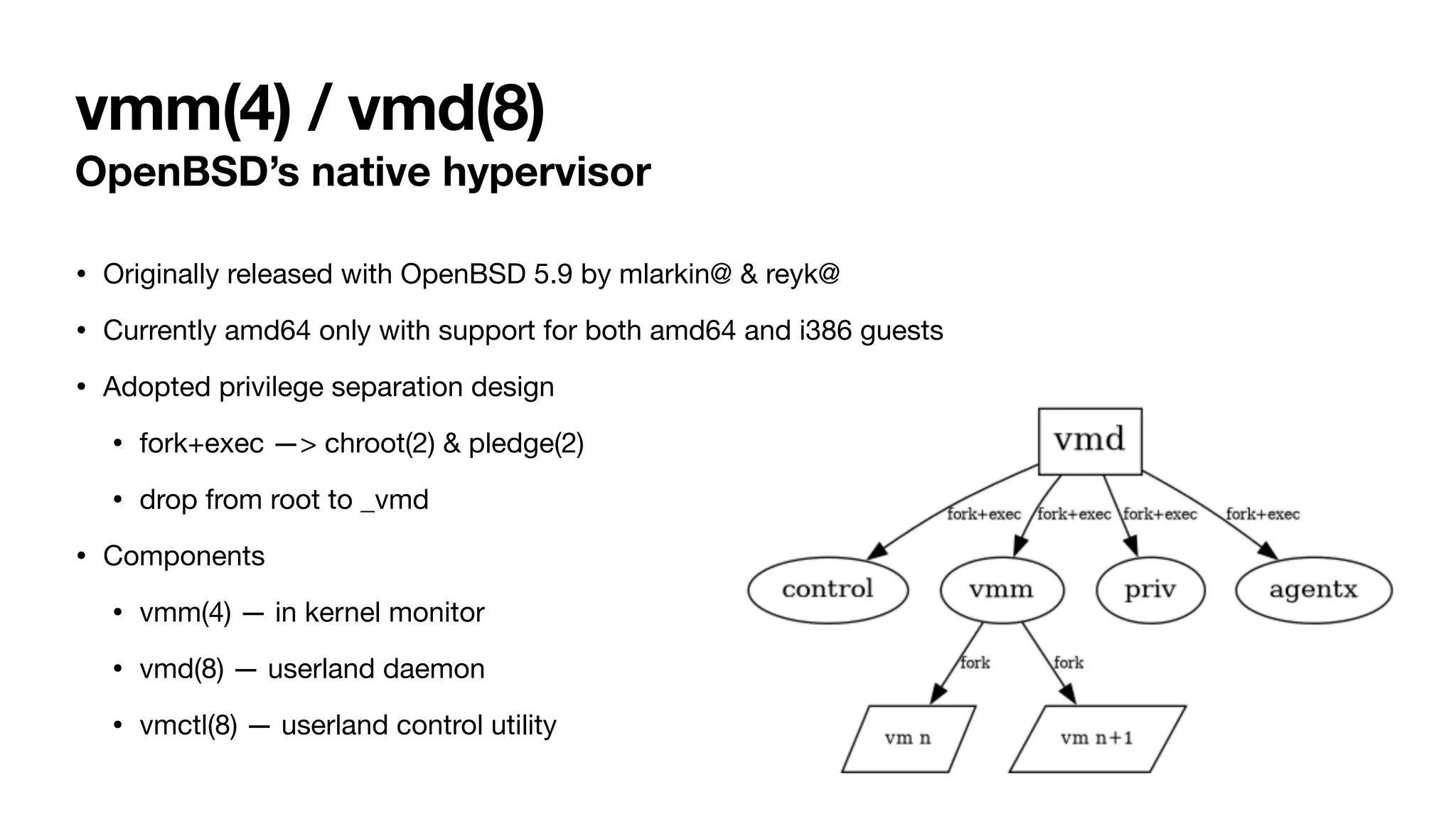
• Adopted privilege separation design
• fork+exec —> chroot(2) & pledge(2)
• drop from root to _vmd
• Components
• vmm(4) — in kernel monitor
• vmd(8) — userland daemon
• vmctl(8) — userland control utility
vmd(8) gaps & weaknesses
Room for improvement
• vm process is fork(2)’d from the vmm process, without execv*(2)
• Every vm gets same address space layout
• Every vm has junk left over from vmm process (global state)
• vm process isn’t chroot’ed & vmm process isn’t running as root
• vm process has multiple pledge(2) promises beyond “stdio”
• “recvfd” — vm send/recv
• “vmm” — vmm(4) ioctl for vcpu, interrupts, registers r/w
Existing Synthetic Mitigations
A house is only as good as its foundation.
• ASLR — force attackers to need info leaks (3.4)
• RETGUARD — control
fl
ow integrity (6.4 for amd64?)
• pledge(2) — minimize syscalls available to attackers (5.9)
• unveil(2) — hide parts of the
fi
le system without root (6.4)
• In -current and landing as part OpenBSD 7.3:
• mimmutable(2) — prevent changing page permissions or mappings
• pinsyscall(2) — minimize allowed call point for syscalls like execve
• execute-only — enforce execute-only on .text to prevent ROP (amd64 via kernel PK
Step 1: fork+exec for each vm
Minimizing info leaks across vm’s
• Switch vmm process from just fork(2) to: fork(2) + execvp(2)
• Easy wins 🙌
• Reuse socketpair for IPC between vmm proc and vm
• Simply pass the fd number for the channel in argv
• Headaches 😖
• vmm process needs absolute path to vmd executable
• vm process can’t rely on existing global state for con
fi
guration
Step 2: Isolate the VirtIO Device
“Breaking up is hard to do.” — the Oracle Blog post
• vmd uses multiple vm_mem_ranges (bios/reserved, mmio, regular)
• The approach:
• shm_mkstemp(3) — create temporary
fi
le for mapping shared
memory
• ftruncate(2) & shm_unlink(3) — size and remove the temp
fi
le
• fcntl(2) — set the fd to not close on exec
• mmap(2) guest memory ranges MAP_SHARED | MAP_CONCEAL
• Pass the fd number after exec & re-mmap vm_mem_ranges
Step 3: Wiring up RPC
Here’s a dime…call someone who cares.
• Sync Channel
• Bootstrapping device con
fi
g post-exec
• Virtio PCI register reads/writes
• Async Channel
• Lifecycle events (vm pause/resume, shutdown)
• Assert/Deassert IRQ
• Set host MAC (vionet)
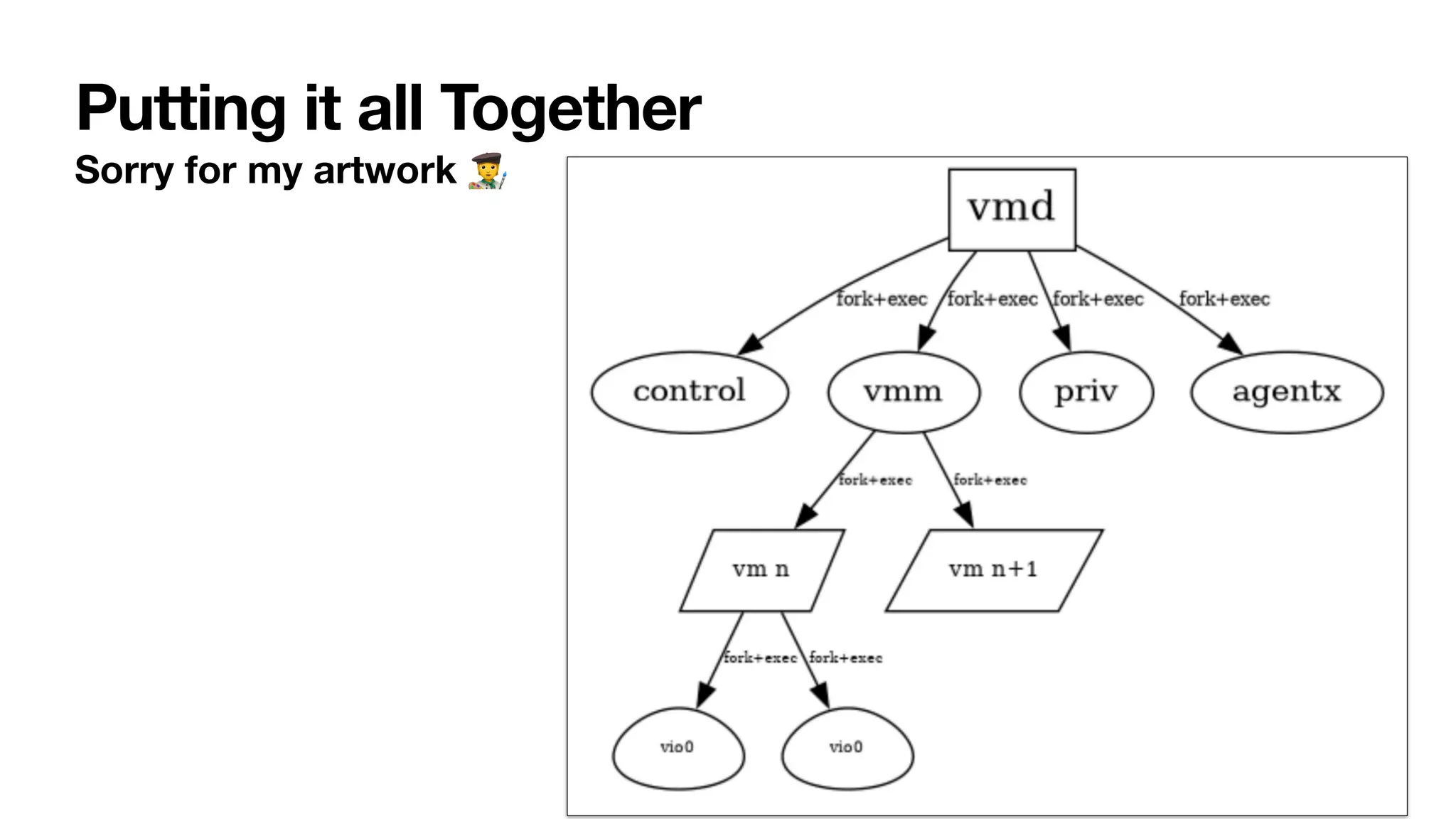
Putting it all Together
Sorry for my artwork 🧑🎨
High-level Message Flow
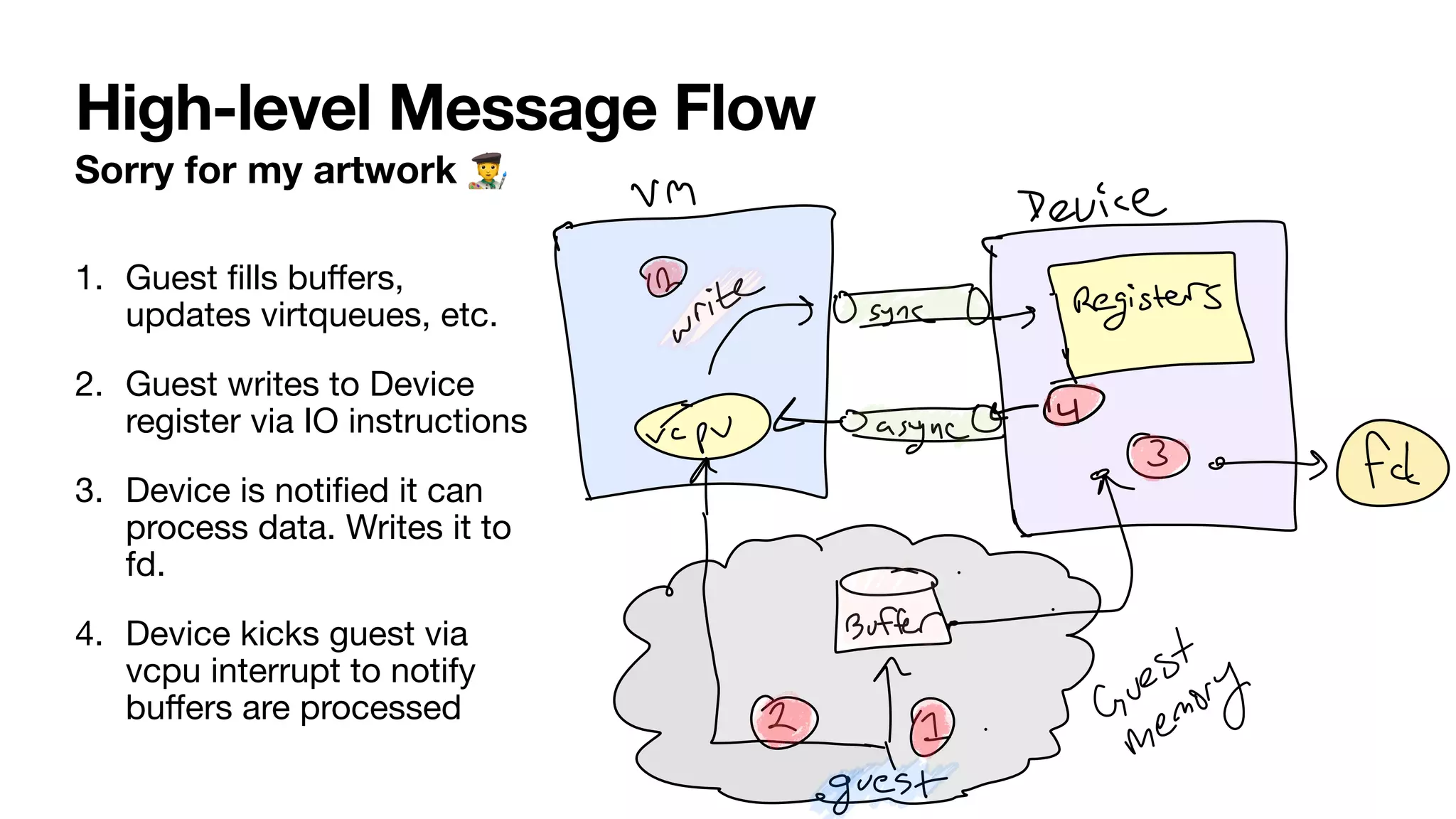
Sorry for my artwork 🧑🎨
1. Guest
fi
lls bu
ff
ers,
updates virtqueues, etc.
2. Guest writes to Device
register via IO instructions
3. Device is noti
fi
ed it can
process data. Writes it to
fd.
4. Device kicks guest via
vcpu interrupt to notify
bu
ff
ers are processed
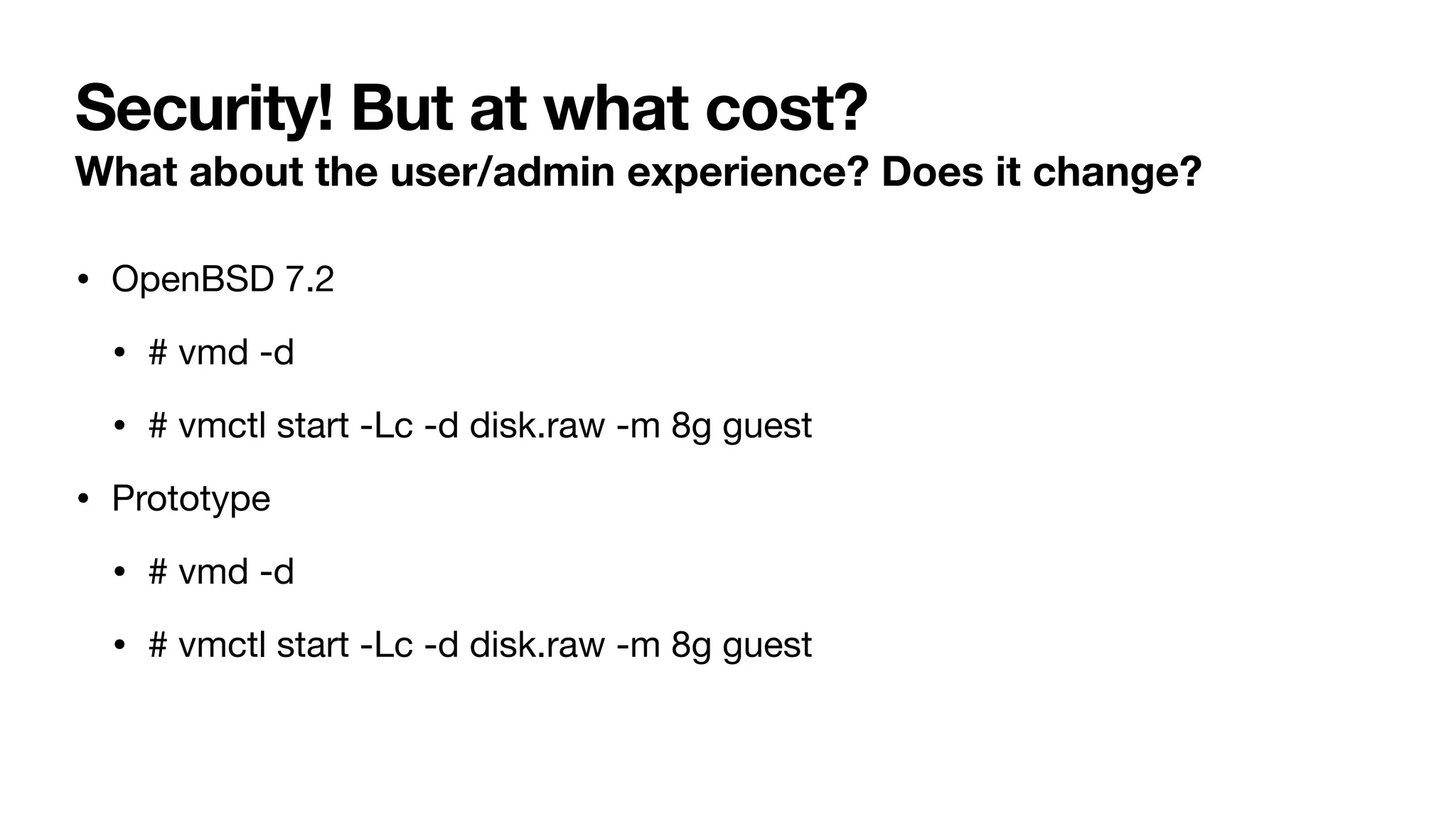
Security! But at what cost?
What about the user/admin experience? Does it change?
• OpenBSD 7.2
• # vmd -d
• # vmctl start -Lc -d disk.raw -m 8g guest
• Prototype
• # vmd -d
• # vmctl start -Lc -d disk.raw -m 8g guest
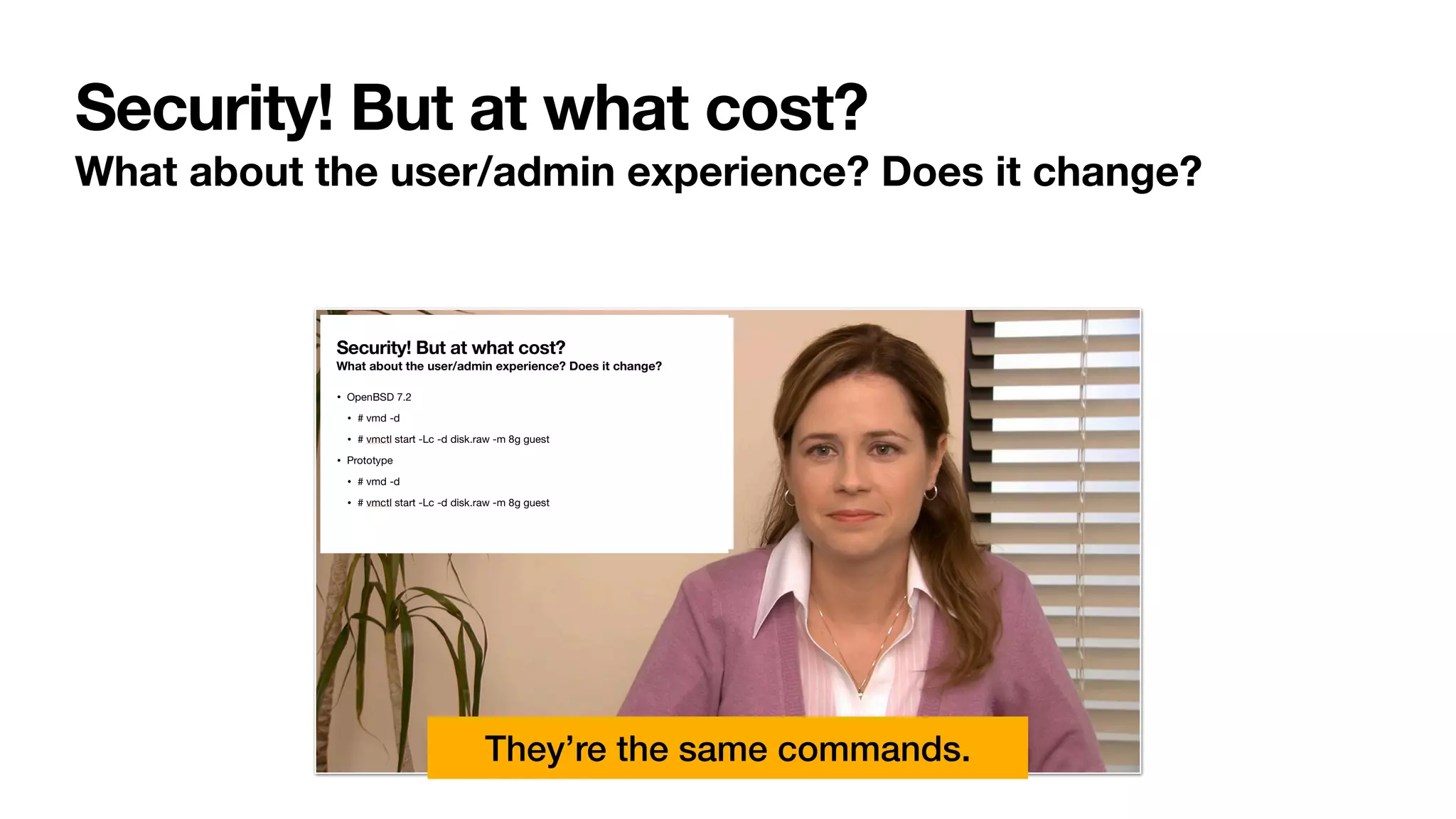
Security! But at what cost?
What about the user/admin experience? Does it change?
They’re the same commands.
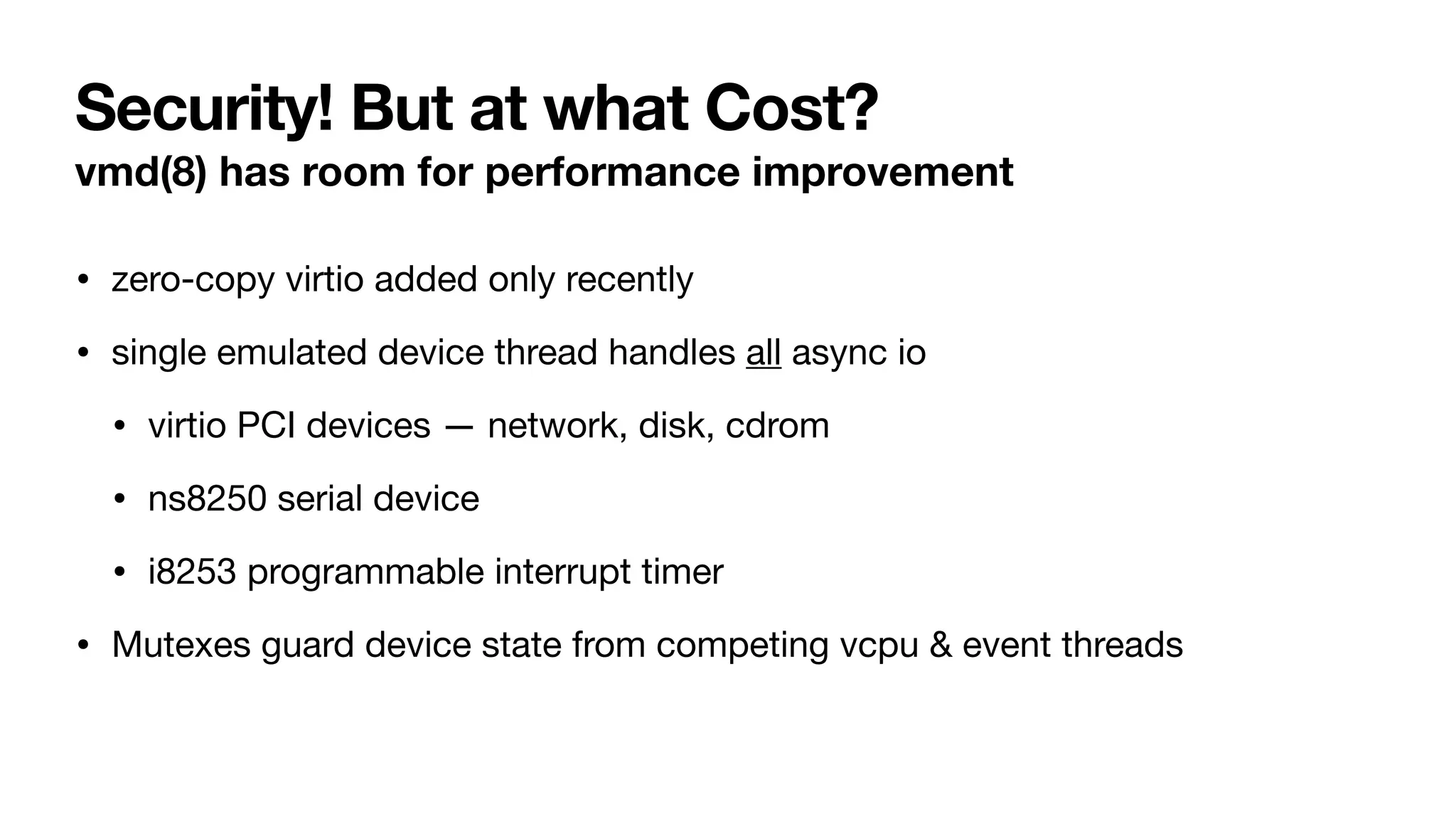
Security! But at what Cost?
vmd(8) has room for performance improvement
• zero-copy virtio added only recently
• single emulated device thread handles all async io
• virtio PCI devices — network, disk, cdrom
• ns8250 serial device
• i8253 programmable interrupt timer
• Mutexes guard device state from competing vcpu & event threads
Quick & Dirty Benchmarking
This is not a benchmarking talk 🙅
• Lenovo X1 Carbon (10th gen)
• 12th gen Intel i7-1270P @ 2.2 GHz
• 32 GiB RAM
• 1 TB NVME disk
• Guest Operating Systems
• OpenBSD 7.2
• Alpine Linux 3.7 (kernel vTKTKT)
vioblk(4) benchmark
fi
o(1) [ports] performing 8 KiB random writes to 2GiB
fi
le for 5 minutes
• Very little di
ff
erence in
throughput
• Very little di
ff
erence in
latency
• Long-tail slightly
worse on Alpine??
Host
Version
Guest
Version
Throughput
MiB/s
clat avg
(usec)
clat stdev
(usec)
99.90th %
(usec)
99.95%
(usec)
OpenBSD-
current
OpenBSD-
current
90.3 89.9 8730 338 379
Prototype
OpenBSD-
current
100 76.4 7220 388 429
OpenBSD-
current
Alpine
Linux 3.17
131 11.2 534 32 38
Prototype
Alpine
Linux 3.17
132 11.7 682 594 685
vio(4) benchmark
iperf3(1) [ports] with 1 thread run for 30 seconds, alternating TX/RX
• iperf(3) used with 1
thread in alternating
client / server modes
• Observations
• More consistent
throughput in
OpenBSD guests
• Negligible
performance
decrease for Linux
guests (not sure why)
Host
Version
Guest
Version
Receiving
Bitrate
(Mbit/s)
%
Sending
Bitrate
(MBit/s)
%
-current
OpenBSD
7.2
0.86 — 1.26 —
prototype
OpenBSD
7.2
1.22 63% 1.35 7%
-current
Alpine Linux
3.17
1.26 — 4.26 —
prototype
Alpine Linux
3.17
1.30 5% 3.19 -25%
Headaches!
Some things weren’t so easy. 😰
• Dual-channel connectivity
• synchronous register io from vcpu thread needs to avoid deadlocks
• vcpu vs. event thread isolation
• libevent(3) is not thread-safe (OpenBSD bundles v1.x)
• Debugging multi-process, async code is often challenging
• printf & ktrace can quickly generate lots of noise
• nanosleep(2) + gdb attaching directly to device process helps
Future Work & Research
Plans for the next hackathon (m2k23) 📋
• Finish lifecycle cleanup (vm send/receive)
• QCOW2 disk support — only supports raw images at the moment
• Begin merging changes into tree after 7.3 release
• vm fork+exec dance
• vioblk
• vionet
• Expand to other devices
• ns8250?
• Tighten exposure of guest physical memory
• guest aware drivers? (is there anything to gain by limiting how much of guest memory we remap?)
Thanks!
See you in Ottawa?

AsiaBSDCon2023 - Hardening Emulated Devices in OpenBSD’s vmd(8) Hypervisor

  • 1.
    Dave Voutila <dv@openbsd.org>,AsiaBSDCon 2023 Hardening Emulated Devices in OpenBsd’s vmd(8) Hypervisor fork& exec& fork& exec.
  • 2.
    Dave Voutila (dv@) Vermont🍁, USA 🇺🇸 (40 mins from Québec 🇨🇦)
  • 3.
    Hypervisors as HighValue Targets Why do you rob a bank? It’s where the money is. 💰 • Shift to multi-tenant public cloud means target rich environments • If it’s networked, it’s vulnerable. • Pop one ESXi instance, now you own many systems • “it’s ok, i’m running it in a vm”
  • 4.
    A Potpourri ofCVE’s Some classic guest-to-host escapes • QEMU • CVE-2015-3456 — “VENOM” • aka the QEMU fl oppy disk one • CVE-2015-7504 — network device escape • VMWare • CVE-2020-3967 — EHCI heap over fl ow • OpenBSD • DHCP packet handler stack over fl ow (6.8, 6.9) CC BY-SA 4.0, Crowdstrike
  • 5.
    Emulated Devices arethe Problem When in doubt, cut it out. ✂ • By de fi nition, always handling untrusted (guest) input • Need read/write to guest physical memory • Need read/write to host interfaces (network, fi les, etc.) • Emulating in kernel is asking for trouble, so commonly done in userland • In OpenBSD, only pvclock(4) is handled in the kernel (vmm(4))
  • 6.
    Multi-process QEMU First Type-2open source hypervisor doing this? • Oracle started work in 2017, landed in QEMU December 2020 • Elena U fi mtseva, Jag Raman, John G. Johnson • https://lists.gnu.org/archive/html/qemu-devel/2020-12/msg00268.html • …but, who uses it? • I’d presume Oracle Cloud • ¯_(ツ)_/¯ 🤷 • Documentation is primarily about design, future ideas, & not present day usage. • Additional burden placed upon the poor administrators 😩
  • 7.
    vmm(4) / vmd(8) OpenBSD’snative hypervisor • Originally released with OpenBSD 5.9 by mlarkin@ & reyk@ • Currently amd64 only with support for both amd64 and i386 guests • Adopted privilege separation design • fork+exec —> chroot(2) & pledge(2) • drop from root to _vmd • Components • vmm(4) — in kernel monitor • vmd(8) — userland daemon • vmctl(8) — userland control utility
  • 8.
    vmd(8) gaps &weaknesses Room for improvement • vm process is fork(2)’d from the vmm process, without execv*(2) • Every vm gets same address space layout • Every vm has junk left over from vmm process (global state) • vm process isn’t chroot’ed & vmm process isn’t running as root • vm process has multiple pledge(2) promises beyond “stdio” • “recvfd” — vm send/recv • “vmm” — vmm(4) ioctl for vcpu, interrupts, registers r/w
  • 9.
    Existing Synthetic Mitigations Ahouse is only as good as its foundation. • ASLR — force attackers to need info leaks (3.4) • RETGUARD — control fl ow integrity (6.4 for amd64?) • pledge(2) — minimize syscalls available to attackers (5.9) • unveil(2) — hide parts of the fi le system without root (6.4) • In -current and landing as part OpenBSD 7.3: • mimmutable(2) — prevent changing page permissions or mappings • pinsyscall(2) — minimize allowed call point for syscalls like execve • execute-only — enforce execute-only on .text to prevent ROP (amd64 via kernel PK
  • 10.
    Step 1: fork+execfor each vm Minimizing info leaks across vm’s • Switch vmm process from just fork(2) to: fork(2) + execvp(2) • Easy wins 🙌 • Reuse socketpair for IPC between vmm proc and vm • Simply pass the fd number for the channel in argv • Headaches 😖 • vmm process needs absolute path to vmd executable • vm process can’t rely on existing global state for con fi guration
  • 11.
    Step 2: Isolatethe VirtIO Device “Breaking up is hard to do.” — the Oracle Blog post • vmd uses multiple vm_mem_ranges (bios/reserved, mmio, regular) • The approach: • shm_mkstemp(3) — create temporary fi le for mapping shared memory • ftruncate(2) & shm_unlink(3) — size and remove the temp fi le • fcntl(2) — set the fd to not close on exec • mmap(2) guest memory ranges MAP_SHARED | MAP_CONCEAL • Pass the fd number after exec & re-mmap vm_mem_ranges
  • 12.
    Step 3: Wiringup RPC Here’s a dime…call someone who cares. • Sync Channel • Bootstrapping device con fi g post-exec • Virtio PCI register reads/writes • Async Channel • Lifecycle events (vm pause/resume, shutdown) • Assert/Deassert IRQ • Set host MAC (vionet)
  • 13.
    Putting it allTogether Sorry for my artwork 🧑🎨
  • 14.
    High-level Message Flow Sorryfor my artwork 🧑🎨 1. Guest fi lls bu ff ers, updates virtqueues, etc. 2. Guest writes to Device register via IO instructions 3. Device is noti fi ed it can process data. Writes it to fd. 4. Device kicks guest via vcpu interrupt to notify bu ff ers are processed
  • 15.
    Security! But atwhat cost? What about the user/admin experience? Does it change? • OpenBSD 7.2 • # vmd -d • # vmctl start -Lc -d disk.raw -m 8g guest • Prototype • # vmd -d • # vmctl start -Lc -d disk.raw -m 8g guest
  • 16.
    Security! But atwhat cost? What about the user/admin experience? Does it change? They’re the same commands.
  • 17.
    Security! But atwhat Cost? vmd(8) has room for performance improvement • zero-copy virtio added only recently • single emulated device thread handles all async io • virtio PCI devices — network, disk, cdrom • ns8250 serial device • i8253 programmable interrupt timer • Mutexes guard device state from competing vcpu & event threads
  • 18.
    Quick & DirtyBenchmarking This is not a benchmarking talk 🙅 • Lenovo X1 Carbon (10th gen) • 12th gen Intel i7-1270P @ 2.2 GHz • 32 GiB RAM • 1 TB NVME disk • Guest Operating Systems • OpenBSD 7.2 • Alpine Linux 3.7 (kernel vTKTKT)
  • 19.
    vioblk(4) benchmark fi o(1) [ports]performing 8 KiB random writes to 2GiB fi le for 5 minutes • Very little di ff erence in throughput • Very little di ff erence in latency • Long-tail slightly worse on Alpine?? Host Version Guest Version Throughput MiB/s clat avg (usec) clat stdev (usec) 99.90th % (usec) 99.95% (usec) OpenBSD- current OpenBSD- current 90.3 89.9 8730 338 379 Prototype OpenBSD- current 100 76.4 7220 388 429 OpenBSD- current Alpine Linux 3.17 131 11.2 534 32 38 Prototype Alpine Linux 3.17 132 11.7 682 594 685
  • 20.
    vio(4) benchmark iperf3(1) [ports]with 1 thread run for 30 seconds, alternating TX/RX • iperf(3) used with 1 thread in alternating client / server modes • Observations • More consistent throughput in OpenBSD guests • Negligible performance decrease for Linux guests (not sure why) Host Version Guest Version Receiving Bitrate (Mbit/s) % Sending Bitrate (MBit/s) % -current OpenBSD 7.2 0.86 — 1.26 — prototype OpenBSD 7.2 1.22 63% 1.35 7% -current Alpine Linux 3.17 1.26 — 4.26 — prototype Alpine Linux 3.17 1.30 5% 3.19 -25%
  • 21.
    Headaches! Some things weren’tso easy. 😰 • Dual-channel connectivity • synchronous register io from vcpu thread needs to avoid deadlocks • vcpu vs. event thread isolation • libevent(3) is not thread-safe (OpenBSD bundles v1.x) • Debugging multi-process, async code is often challenging • printf & ktrace can quickly generate lots of noise • nanosleep(2) + gdb attaching directly to device process helps
  • 22.
    Future Work &Research Plans for the next hackathon (m2k23) 📋 • Finish lifecycle cleanup (vm send/receive) • QCOW2 disk support — only supports raw images at the moment • Begin merging changes into tree after 7.3 release • vm fork+exec dance • vioblk • vionet • Expand to other devices • ns8250? • Tighten exposure of guest physical memory • guest aware drivers? (is there anything to gain by limiting how much of guest memory we remap?)
  • 23.