PROSPECTUS
Special education and support
for young people aged 5 to 18
Apioneering,
life-changingschool
Ashcroft School is one of the North West’s leading
specialist education providers. We are a pioneering,
life-changing school, supporting children and young
people with needs including social, emotional and
behavioural difficulties. Our students may have struggled
to cope in other settings because of their individual
barriers to learning.
As part of the Together Trust charity, we have nearly
150 years of experience of providing specialist education,
care and community services to children, young people
and adults. This means that we have a long established
track record of success when it comes to supporting
students with a range of complex needs.
At Ashcroft School we pride ourselves in working with
each student to offer a bespoke education package that
meets their individual needs. Staff relight the spark in
our young people and reengage them with learning.
We build confidence and self esteem and change how
students feel about themselves.
Ashcroft staff are experienced and dedicated and led
by a national award winning headteacher. We are
committed to ensuring that every young person coming
through our door reaches their potential - that means
building trust with our students, providing intensive
support and tailoring all we offer to their specific needs.
We’re proud that Ashcroft School students break through
their barriers and achieve. Staff are committed to helping
our young people to move forward into a happy and
fulfilled future, equipped with the skills they need for
their chosen life path.
Nothing beats seeing first hand all that Ashcroft School
offers our students. Please call now and we’ll be
delighted to arrange a visit. All contact details are on
the back cover.
We look forward to meeting you.
Eileen Sheerin
Headteacher, Ashcroft School
Everybody deserves
an equal chance in
life - no exceptions!
Eileen
03
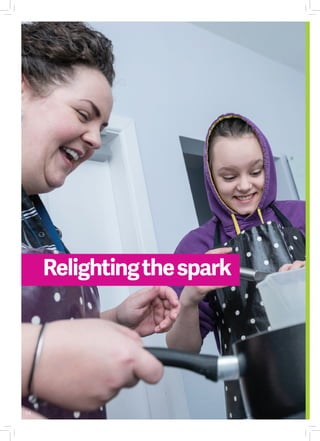
Relightingthespark
04
Reengaging our young people with learning is one of
the most important things we do at Ashcroft School.
Our students may have had long periods out of school,
they may have a history of failure in the traditional
educational system and they may have been permanently
excluded or at risk from permanent exclusion from school
and the rest of society.
In order to learn students must feel secure and develop a
positive attachment to their learning environment. From
the start of their time with us each young person is
allocated a key worker to provide them with the intensive
personal support they need to succeed.
We build confidence and self-esteem and look for the one
thing that can make a difference to the young person,
changing their outlook on themselves as well as school
and the education system.
Learning support is delivered through a range of stimulating
activities that motivate and engage students in ways that
are not readily available elsewhere. In fact, our success
comes from moving away from the school experiences
that have failed our young people in the past. Through
these learning experiences we change behaviour and help
students to develop more positive relationships with others.
We have particular expertise in providing education services
for children in public care, within foster care
or living in
children’s homes. The school works closely with local
authorities to provide education services
for children in
public care who struggle to access mainstream schools.
We promote learning and positive emotional development
by improving self-esteem and celebrating achievements.
Reengaging
students
with learning
The school places a strong focus on the personal
development
of pupils; teachers seize every opportunity to
encourage pupils to consider their actions and to improve.
Ashcroft School
Ofsted Inspection Report , February 2013
05
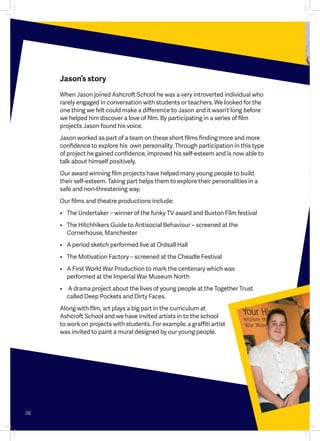
Jason’s story
When Jason joined Ashcroft School he was a very introverted individual who
rarely engaged in conversation with students or teachers. We looked for the
one thing we felt could make a difference to Jason and it wasn’t long before
we helped him discover a love of film. By participating in a series of film
projects Jason found his voice.
Jason worked as part of a team on these short films finding more and more
confidence to explore his 
own personality. Through participation in this type
of project he gained confidence, improved his self-esteem and is now able to
talk about himself positively.
Our award winning film projects have helped many young people to build
their self-esteem. Taking part helps them to explore their personalities in a
safe and non-threatening way.
Our films and theatre productions include: 

•	 The Undertaker – winner of the funky TV award and Buxton Film festival 

•	 The Hitchhikers Guide to Antisocial Behaviour – screened at the
Cornerhouse, Manchester
•	 A period sketch performed live at Ordsall Hall 

•	 The Motivation Factory – screened at the Cheadle Festival 

•	 A First World War Production to mark the centenary which was
performed at the Imperial War Museum North
•	 A drama project about the lives of young people at the Together Trust
called Deep Pockets and Dirty Faces.
Along with film, art plays a big part in the curriculum at
Ashcroft School and we have invited artists in to the school
to work on projects with students. For example, a graffiti artist
was invited to paint a mural designed by our young people.
06
07
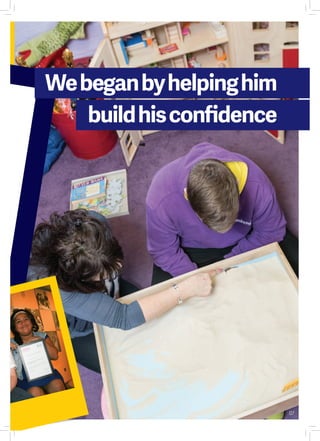
Webeganbyhelpinghim
buildhisconfidence
08
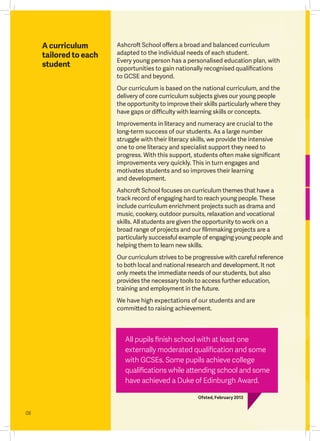
A curriculum
tailored to each
student
All pupils finish school with at least one
externally moderated qualification and some
with GCSEs. Some pupils achieve college
qualifications while attending school and some
have achieved a Duke of Edinburgh Award.
Ofsted, February 2013
Ashcroft School offers a broad and balanced curriculum
adapted to the individual needs of each student.
Every young person has a personalised education plan, with
opportunities to gain nationally recognised qualifications
to GCSE and beyond.
Our curriculum is based on the national curriculum, and the
delivery of core curriculum subjects gives our young people
the opportunity to improve their skills particularly where they
have gaps or difficulty with learning skills or concepts.
Improvements in literacy and numeracy are crucial to
the
long-term success of our students. As a large number
struggle with their literacy skills, we provide the intensive
one to one literacy and specialist support they need to
progress. With this support, students often make significant
improvements very quickly. This in turn engages and
motivates students and so improves their learning
and development.
Ashcroft School focuses on curriculum themes that have a
track record of engaging hard to reach young people. These
include curriculum enrichment projects such as drama and
music, cookery, outdoor pursuits, relaxation and vocational
skills. All students are given the opportunity to work on a
broad range of projects and our filmmaking projects are a
particularly successful example of engaging young people and
helping them to learn new skills.
Our curriculum strives to be progressive with careful reference
to both local and national research and development. It not
only meets the immediate needs of our students, but also
provides the necessary tools to access further education,
training and employment in the future.
We have high expectations of our students and are
committed to raising achievement.
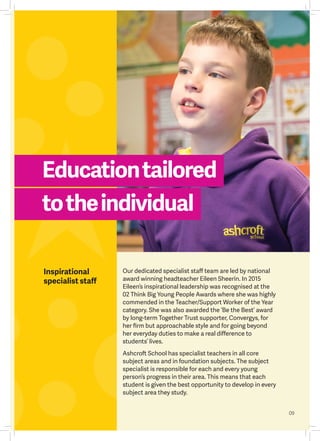
Educationtailored
totheindividual
09
Inspirational
specialist staff
Our dedicated specialist staff team are led by national
award winning headteacher Eileen Sheerin. In 2015
Eileen’s inspirational leadership was recognised at the
02 Think Big Young People Awards where she was highly
commended in the Teacher/Support Worker of the Year
category. She was also awarded the ‘Be the Best’ award
by long-term Together Trust supporter, Convergys, for
her firm but approachable style and for going beyond
her everyday duties to make a real difference to
students’ lives.
Ashcroft School has specialist teachers in all core
subject areas and in foundation subjects. The subject
specialist is responsible for each and every young
person’s progress in their area. This means that each
student is given the best opportunity to develop in every
subject area they study.
09
10
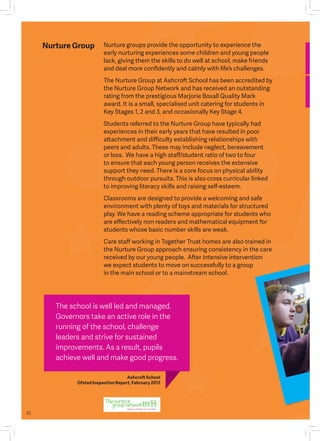
Nurture groups provide the opportunity to experience the
early nurturing experiences some children and young people
lack, giving them the skills to do well at school, make friends
and deal more confidently and calmly with life’s challenges.
The Nurture Group at Ashcroft School has been accredited by
the Nurture Group Network and has received an outstanding
rating from the prestigious Marjorie Boxall Quality Mark
award. It is a small, specialised unit catering for students in
Key Stages 1, 2 and 3, and occasionally Key Stage 4.
Students referred to the Nurture Group have typically had
experiences in their early years that have resulted in poor
attachment and difficulty establishing relationships with
peers and adults. These may include neglect, bereavement
or loss. We have a high staff/student ratio of two to four
to ensure that each young person receives the extensive
support they need. There is a core focus on physical ability
through outdoor pursuits. This is also cross curricular linked
to improving literacy skills and raising self-esteem.
Classrooms are designed to provide a welcoming and safe
environment with plenty of toys and materials for structured
play. We have a reading scheme appropriate for students who
are effectively non readers and mathematical equipment for
students whose basic number skills are weak.
Care staff working in Together Trust homes are also trained in
the Nurture Group approach ensuring consistency in the care
received by our young people. After intensive intervention
we expect students to move on successfully to a group
in the main school or to a mainstream school.
Nurture Group
The school is well led and managed.
Governors take an active role in the
running of
the school, challenge
leaders and strive for sustained
improvements. As a result, pupils
achieve well and make good progress.
Ashcroft School
Ofsted Inspection Report, February 2013
11
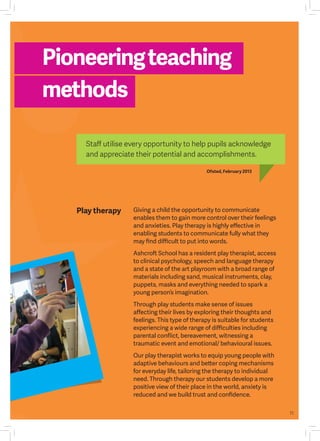
Play therapy Giving a child the opportunity to communicate
enables them to gain more control over their feelings
and anxieties. Play therapy is highly effective in
enabling students to communicate fully what they
may find difficult to put into words.
Ashcroft School has a resident play therapist, access
to clinical psychology, speech and language therapy
and a state of the art playroom with a broad range of
materials including sand, musical instruments, clay,
puppets, masks and everything needed to spark a
young person’s imagination.
Through play students make sense of issues
affecting their lives by exploring their thoughts and
feelings. This type of therapy is suitable for students
experiencing a wide range of difficulties including
parental conflict, bereavement, witnessing a
traumatic event and emotional/ behavioural issues.
Our play therapist works to equip young people with
adaptive behaviours and better coping mechanisms
for everyday life, tailoring the therapy to individual
need. Through therapy our students develop a more
positive view of their place in the world, anxiety is
reduced and we build trust and confidence.
Pioneeringteaching
methods
Ofsted, February 2013
Staff utilise every opportunity to help pupils acknowledge
and appreciate their potential and accomplishments.
12
Groundbreaking
teaching
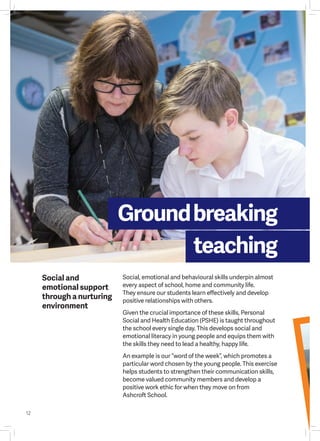
Social, emotional and behavioural skills underpin almost
every aspect of school, home and community life.
They ensure our students learn effectively and develop
positive relationships with others.
Given the crucial importance of these skills, Personal
Social and Health Education (PSHE) is taught throughout
the school every single day. This develops social and
emotional literacy in young people and equips them with
the skills they need to lead a healthy, happy life.
An example is our “word of the week”, which promotes a
particular word chosen by the young people. This exercise
helps students to strengthen their communication skills,
become valued community members and develop a
positive work ethic for when they move on from
Ashcroft School.
Social and
emotional support
through a nurturing
environment
13
Outdooreducation
– equipping young
people for life and
work
Given that most pupils come
from backgrounds where
disengagement from education
was the norm, attendance rates
at the school are good.
Ofsted, February 2013
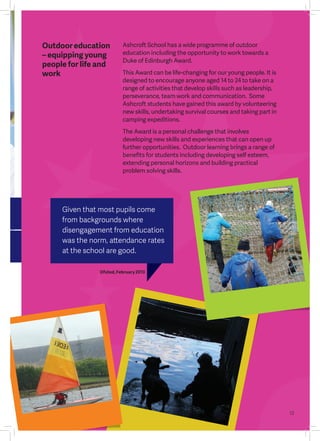
Ashcroft School has a wide programme of outdoor
education including the opportunity to work towards a
Duke of Edinburgh Award.
This Award can be life-changing for our young people. It is
designed to encourage anyone aged 14 to 24 to take on a
range of activities that develop skills such as leadership,
perseverance, team work and communication. Some
Ashcroft students have gained this award by volunteering
new skills, undertaking survival courses and taking part in
camping expeditions.
The Award is a personal challenge that involves
developing new skills and experiences that can open up
further opportunities. Outdoor learning brings a range of
benefits for students including developing self esteem,
extending personal horizons and building practical
problem solving skills.
14
Behaviour management at Ashcroft School is highly
individualised and is built around the principles of clear
expectations and a consistent response. We believe that
it is important to create an environment in which positive
behaviour is encouraged through positive reinforcement.
Each student has a personalised behaviour management
plan which sets appropriate limits, creates a safe
learning environment, supports change and maintains
placement stability.
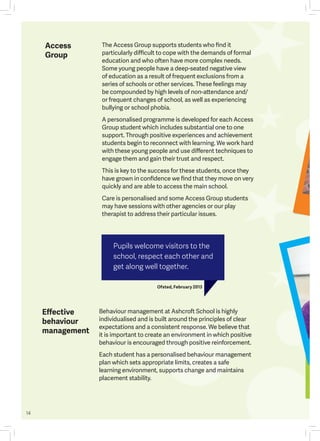
The Access Group supports students who find it
particularly difficult to cope with the demands of formal
education and who often have more complex needs.
Some young people have a deep-seated negative view
of education as a result of frequent exclusions from a
series of schools or other services. These feelings may
be compounded by high levels of non-attendance and/
or frequent changes of school, as well as experiencing
bullying or school phobia.
A personalised programme is developed for each Access
Group student which includes substantial one to one
support. Through positive experiences and achievement
students begin to reconnect with learning. We work hard
with these young people and use different techniques to
engage them and gain their trust and respect.
This is key to the success for these students, once they
have grown in confidence we find that they move on very
quickly and are able to access the main school.
Care is personalised and some Access Group students
may have sessions with other agencies or our play
therapist to address their particular issues.
Effective
behaviour
management
Access
Group
Pupils welcome visitors to the
school, respect each other and
get along well together.
Ofsted, February 2013
15
Provision for students whom English
is an additional language
Where English is not the first language of parents we
use translation services to translate at meetings or to
translate documents.
For students for whom English is an additional language
we seek advice from Stockport’s Ethnic Diversity Service.
Ashcroft School will implement an individual programme
focused on improving communication skills to enable
students to access the curriculum better and where
necessary the school will seek specialist English language
teacher input from the Stockport Ethnic Diversity Service.
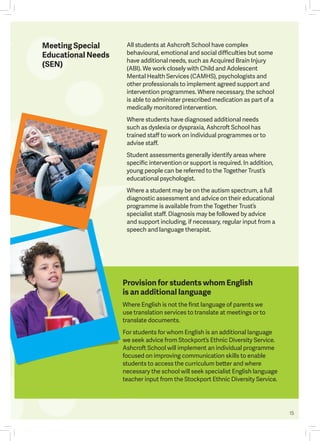
All students at Ashcroft School have complex
behavioural, emotional and social difficulties but some
have additional needs, such as Acquired Brain Injury
(ABI). We work closely with Child and Adolescent
Mental Health Services (CAMHS), psychologists and
other professionals to implement agreed support and
intervention programmes. Where necessary, the school
is able to administer prescribed medication as part of a
medically monitored intervention.
Where students have diagnosed additional needs
such as dyslexia or dyspraxia, Ashcroft School has
trained staff to work on individual programmes or to
advise staff.
Student assessments generally identify areas where
specific intervention or support is required. In addition,
young people can be referred to the Together Trust’s
educational psychologist.
Where a student may be on the autism spectrum,
a full
diagnostic assessment and advice on their educational
programme is available from the Together Trust’s
specialist staff. Diagnosis may
be followed by advice
and support including, if necessary, regular input from a
speech and language therapist.
Meeting Special
Educational Needs
(SEN)
Susan’s story
Susan joined Ashcroft School with considerable learning
difficulties. She had been diagnosed with foetal alcohol syndrome,
attachment disorder and had a range of emotional, social and
behavioural difficulties.
On arrival Susan found it difficult to sit still, listen and focus her
attention. She struggled with a delayed vocabulary, which made
following instructions difficult and her IQ was well below average.
Her presenting behaviour on arrival meant she was disengaged
with a negative attitude towards her education. Susan was
stubborn, distant, resistant and refused to follow staff instructions.
She was socially inept and lacked awareness of social cues.
We placed Susan in our award winning Nurture Group where
specialist staff focussed on her social and emotional difficulties.
With intensive support, she has been given daily opportunities to
learn and practise her social skills to build positive relationships
in a small group. There are consistent boundaries and regular
staff to develop her skills in following instructions, routines and
understanding of a satisfactory level of behaviour. Play therapy has
been used to help Susan communicate her anxieties and come to
terms with a traumatic early life experience.
Following this intensive support, Susan’s self-esteem has grown
and she has flourished at school. She has confidently participated
in a wide range of activities from a music project with unfamiliar
staff to activities in the wider community.
Throughskillsandpatience
-anewwayforward
16
17
e
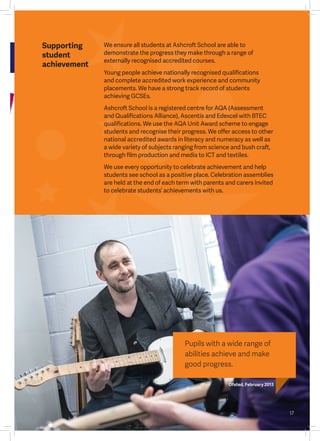
We ensure all students at Ashcroft School are able to
demonstrate the progress they make through a range of
externally recognised accredited courses.
Young people achieve nationally recognised qualifications
and complete accredited work experience and community
placements. We have a strong track record of students
achieving GCSEs.
Ashcroft School is a registered centre for AQA (Assessment
and Qualifications Alliance), Ascentis and Edexcel with BTEC
qualifications. We use the AQA Unit Award scheme to engage
students and recognise their progress. We offer access to other
national accredited awards in literacy and numeracy
as well as
a wide variety of subjects ranging from science and bush craft,
through film production and media to ICT and textiles.
We use every opportunity to celebrate achievement and help
students see school as a positive place. Celebration assemblies
are held at
the end of each term with parents and carers invited
to celebrate students’ achievements with us.
Supporting
student
achievement
Pupils with a wide range of
abilities achieve and make
good progress.
Ofsted, February 2013
18
Building
Opportunities
19
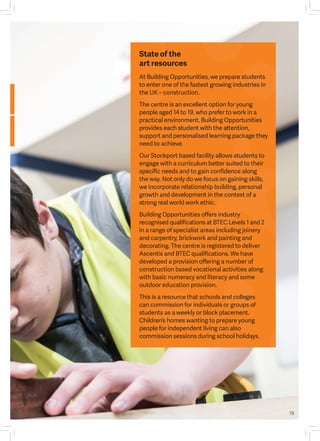
At Building Opportunities, we prepare students
to enter one of the fastest growing industries in
the UK – construction.
The centre is an excellent option for young
people aged 14 to 19, who prefer to work in a
practical environment. Building Opportunities
provides each student with the attention,
support and personalised learning package they
need to achieve.
Our Stockport based facility allows students to
engage with a curriculum better suited to their
specific needs and to gain confidence along
the way. Not only do we focus on gaining skills,
we incorporate relationship building, personal
growth and development in the context of a
strong real world work ethic.
Building Opportunities offers industry
recognised qualifications at BTEC Levels 1 and 2
in a range of specialist areas including joinery
and carpentry, brickwork and painting and
decorating. The centre is registered to deliver
Ascentis and BTEC qualifications. We have
developed a provision offering a number of
construction based vocational activities along
with basic numeracy and literacy and some
outdoor education provision.
This is a resource that schools and colleges
can commission for individuals or groups of
students as a weekly or block placement.
Children’s homes wanting to prepare young
people for independent living can also
commission sessions during school holidays.
State of the
art resources
Students aged 14 to 16 who may have been excluded or close
to being excluded from mainstream education are supported
at Ashcroft College, which offers study in a range of exciting
subjects while providing crucial specialist support.
Ashcroft College welcomes young people aged 14 to 16.
The College is a partnership education provision designed
to support Manchester Education Pupil Referral Services.
Studying at Ashcroft College will open the door to a range
of new opportunities for our students. The college offers a
varied curriculum including four key vocational subjects in
hair and beauty, sports, catering and construction.
Ashcroft College
(Manchester
Vocational Pupil
Referral Unit)
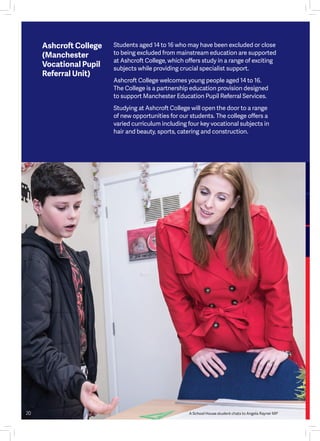
A School House student chats to Angela Rayner MP20
Students will equip themselves with the necessary skills
and qualifications to find employment, undertake training or
continue into further education.
Students at Ashcroft College benefit from a nurturing
environment, with a committed, dedicated staff team who
ensure that each learner feels fully supported and safe.
Every student receives an individual learning plan aimed at
promoting an inclusive learning environment with the main
focus to facilitate equality and diversity.
At Ashcroft College we believe that each of our young people
should be given every opportunity to achieve and succeed.
The School House
(Manchester
Education Pupil
Referral Unit)
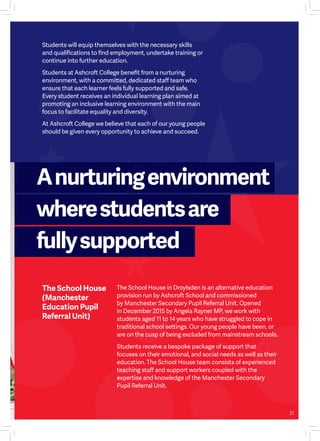
The School House in Droylsden is an alternative education
provision run by Ashcroft School and commissioned
by Manchester Secondary Pupil Referral Unit. Opened
in December 2015 by Angela Rayner MP, we work with
students aged 11 to 14 years who have struggled to cope in
traditional school settings. Our young people have been, or
are on the cusp of being excluded from mainstream schools.
Students receive a bespoke package of support that
focuses on their emotional, and social needs as well as their
education. The School House team consists of experienced
teaching staff and support workers coupled with the
expertise and knowledge of the Manchester Secondary
Pupil Referral Unit.
Anurturingenvironment
wherestudentsare
fullysupported
21
Workingwithparents
andcarershelpsstudents
reachtheirfullpotential
22
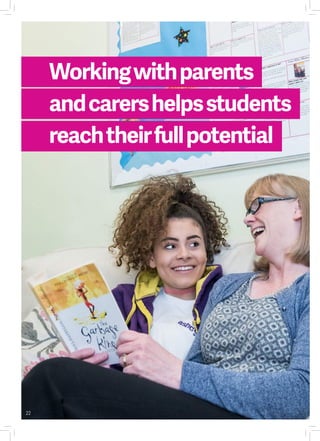
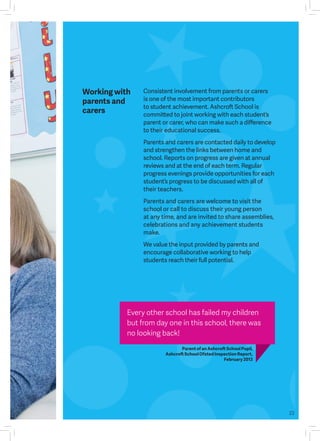
Consistent involvement from parents or carers
is one of the most important contributors
to student achievement. Ashcroft School is
committed to joint working with each student’s
parent or carer, who can make such a difference
to their educational success.
Parents and carers are contacted daily to develop
and strengthen the links between home and
school. Reports on progress are given at annual
reviews and at the end of each term. Regular
progress evenings provide opportunities for each
student’s progress to be discussed with all of
their teachers.
Parents and carers are welcome to visit the
school or call to discuss their young person
at any time, and are invited to share assemblies,
celebrations and any achievement students
make.
We value the input provided by parents and
encourage collaborative working to help
students reach their full potential.
Working with
parents and
carers
Every other school has failed my children
but from day one in this school, there was
no looking back!
Parent of an Ashcroft School Pupil,
Ashcroft School Ofsted Inspection Report,
February 2013
s
23
Ashcroft
School
students win
local history
award
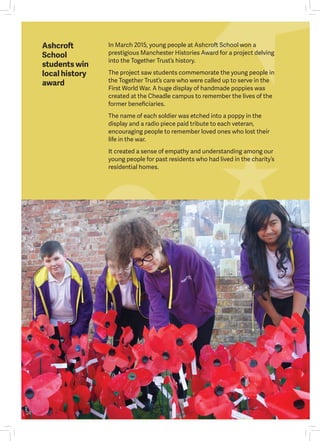
In March 2015, young people at Ashcroft School won a
prestigious Manchester Histories Award for a project delving
into the Together Trust’s history.
The project saw students commemorate the young people in
the Together Trust’s care who were called up to serve in the
First World War. A huge display of handmade poppies was
created at the Cheadle campus to remember the lives of the
former beneficiaries.
The name of each soldier was etched into a poppy in the
display and a radio piece paid tribute to each veteran,
encouraging people to remember loved ones who lost their
life in the war.
It created a sense of empathy and understanding among our
young people for past residents who had lived in the charity’s
residential homes.
24
25
Creativeandengaging
projectwinsprestigious
historyaward
Ashcroft School
Additional Information
PSHE and sex education.......................................................26
Religious education/ British values.................................. 26
Careers education................................................................... 26
Specialist programmes..........................................................26
Assessment................................................................................26
Staff training...............................................................................26
Observations of teaching and scrutiny of work............27
Quality assurance.....................................................................27
Anti-bullying and cyber safety..............................................27
Incident management and physical intervention........27
Management of students at risk of exclusion...............27
Attendance..................................................................................27
Safeguarding.............................................................................. 28
Health and Safety..................................................................... 28
Medicines and health care plans....................................... 28
School day................................................................................... 28
School meals.............................................................................. 28
School wear and equipment................................................29
School council...........................................................................29
Transport and travel training ..............................................29
Voluntary contributions.........................................................29
Equality and diversity..............................................................29
Data protection.........................................................................29
Photography and media permissions..............................29
Complaints..................................................................................30
Student complaints.................................................................30
Governing body.........................................................................30
Referrals and admissions.......................................................31
26
PSHE and sex education
Students are taught about anti-bullying, dangers of
smoking, drugs and alcohol abuse, cyber-bullying and
keeping safe through PSHE. We pride ourselves on
ensuring our sometimes very vulnerable students are
well informed.
Copies of the sex education and relationships policy
are available upon request.
Religious education/ British values
Spiritual and moral matters are always recognised
and are an important part of the school’s pastoral
work. Religious education is included on the school
timetable.
Careers education
Careers education forms part of the Personal
Social
and Health Education (PSHE) programme and
specific careers education sessions are provided. Links
are made with Connexions in Stockport or to each
student’s home local authority.
Specialist programmes
Ashcroft School has a range of specialist programmes
available to its students including:
•	 Nurture group (see page 10) 

•	 Play therapy (see page11) 

•	 Access group (see page 14) 

•	 Building Opportunities (see page 18) 

•	 Ashcroft College (see page 20)
•	 School House PRU (see page 21)
Assessment
Students that arrive with us in the first instance are
given a six week assessment programme including
the Boxall assessment. This is an ideal opportunity
to understand the needs of the young person and
enables us to determine their individual needs – both
academically and emotionally.
We use the assessment to group young people
according to their ability and this enables them to
access all curriculum tailored to their needs. We also
assess formally each term so we can measure progress.
Each student’s assessment is recorded on our system
which has a red, amber or green flag so we see at a
glance if intervention is needed for any of the young
people in any subject.
Staff training
Continuing professional development sets a model for
the entire school. The expectation and ethos
of Ashcroft School is to provide an inclusive place
of learning.
Staff complete a comprehensive package of ongoing
training opportunities, supported by the Together
Trust’s in-house training department. Some of the
induction and training courses undertaken by
staff are:
• 	 Safeguarding through in house training and courses
from the local Safeguarding Children’s Board (SCB)
• 	 PROACT SCIPr-UK® (Strategies for Crisis
Intervention and Prevention) is an internationally
recognised approach in supporting people who
have challenging reputations
• 	 Behaviour management with de-escalation
techniques to prevent unwanted or more serious
bad behaviour
• 	 Assessment – we keep up to date with all
government initiatives and staff are trained
accordingly
• 	 Curriculum and curriculum improvements
• 	 Expectations of professional culture
• 	 Specialist training if required e.g. the therapeutic
use of art and nurture group principles.
To ensure a high quality of teaching and learning we
recruit specialist staff especially in practical curriculum
areas. Staff are encouraged to further enhance their
expertise in their specialist subject areas and attend
regular accredited training.
Observations of teaching and scrutiny of work
Senior management, supported by Governors, carry out
lesson observations to ensure the quality of teaching is
up to the standard required by Ofsted.
We also look at planning against work taught in school,
choosing work files for each subject at random to
scrutinise the quality of work produced by the young
people. This ensures they are receiving the best
possible opportunities.
Quality assurance
The quality of provision at Ashcroft School is under a
continual programme of improvement. This is achieved
by internal monitoring of teaching and learning by
scrutinising planning and work, lesson observations,
regular staff training and discussion of case work and
practice, regular consultation with local authorities,
review of performance management procedures and
regular Ofsted inspections.
The school is proud to hold the Investors in People and
PQASSO Level 2 Standards.
Anti-bullying and cyber safety
Bullying in any form is unacceptable. Learning the
effects and consequences that bullying has on the lives
of others is taught as part of the curriculum, and the
school participates in all government initiatives such as
Anti-Bullying Week.
Students are monitored closely when using the internet
and topics on bullying and cyber bullying are included
in ICT and PSHE lessons. Staff are trained in areas such
as CEOP (Child Exploitation and Online Protection)
ambassador training, enabling effective monitoring and
management of all aspects of cyber bullying.
Cyber bullying is a very real and serious issue, and
should it arise it will be dealt with following our incident
management procedures. We ask parents and carers
to assist the school in reducing occurrences of cyber
bullying by regularly checking social networking sites
which are not accessible in school. We do not allow
mobile phones in school as social networking sites are
also available via mobile networks, and we will work
with parents to inform our young people of the dangers
and effects of cyber bullying and to discourage its
practice.
Our policy on bullying and cyber bullying is available
from the school office on request.
Incident management and physical intervention
All staff undergo PROACT SCIPr-UK® training which
focuses upon de-escalation techniques. This does
incorporate some physical intervention which
can
be used, however this is employed rarely and only in
exceptional circumstances.
Management of students at risk of exclusion
Fixed term exclusions are only used as part of a
planned intervention for the shortest time necessary.
It is part of Ashcroft School’s
behaviour management plan to
maintain discipline, good conduct
and an orderly and safe learning
environment.
The purpose of exclusion is to help provide boundaries
and consequences to ensure the safety of those who
use the school and to safeguard the education and
welfare of all. We follow relevant guidance from the DfE
(Department for Education) and other agencies.
Permanent exclusions are avoided if at all possible
– if a placement is at risk then a review is held to try
and retain and re-engage the young person. The local
authority and parents/carers are informed at an early
stage and asked to engage in planned re-engagement
or, as a last resort, a planned move. If permanent
exclusion is inevitable then the review team will plan a
managed transfer with a transitional plan. There is an
appeal process to ensure needs and entitlements are
considered.
Attendance
Every student at Ashcroft School has a fundamental
right to be educated as inclusively as possible. Parents
and carers have a duty to ensure maximum attendance
at school.
27
Parents, carers and professionals should encourage
students to take full advantage of their educational
opportunity by attending regularly.
Staff maintain daily contact with parents and carers.
Parents or carers are always contacted on the first day
of a student’s absence.
Absence
Should a young person be unable to attend school for
any reason, it is important that we are informed as soon
as possible.
If the young person is ill and therefore unable to
attend school, parents and carers must call in the first
instance to let us know. If the absence is planned,
please let us know before the event.
Parents and carers do not have the right to remove
children from school for the purpose of a holiday. Since
September 2013 headteachers may not grant any leave
of absence (holiday) during term time unless they are
emotional circumstances.
Unauthorised absences may lead to a fixed penalty
notice being issued by the Local Authority, incurring a
fine of £60 per parent.
More information can be found at:
www.stockport.gov.uk/services/education
Safeguarding
All staff employed at Ashcroft School are required
to complete an enhanced DBS Disclosure and are
appointed through safer recruitment procedures.
Parents and carers should be aware that if staff suspect
that a young person is at risk of harm, they have a duty
to inform the relevant authority.
A copy of the school safeguarding
policy is available on the website:
www.togethertrust.org.uk/education/ashcroftschool
or can be requested from the school office.
Health and safety
Staff receive training on key issues such as First Aid,
Asthma Awareness, Epilepsy Awareness and the
administration of medication. The school follows the
Together Trust’s comprehensive Health and Safety
policies and are guided by the Together Trust’s Health
and Safety Officer.
MIDAS training is provided for minibus drivers and
Ashcroft School has its own fire management plan and
fire drills take place once a term.
The health and safety of students that attend Ashcroft
School is paramount. In order to maintain high
standards we keep up to date with all areas of safety.
Staff receive training on areas such as first aid, asthma
awareness, epilepsy awareness and general safety such
as fire regulations.
Medicines and health care plans
Ashcroft School follows the Together Trust policies
and procedures on administration of medication.
Students should not bring ‘over the counter’ medicines
into school. Any medication – prescribed or otherwise
– must be handed in to a member of staff at the
beginning of the school day.
If a student needs to take prescribed medication, it
must be sent into school in its original packaging with
dosage information. This must be given to staff and will
be stored in a locked medicine cupboard and/or in a
locked container in a refrigerator. We must also receive
authorisation in writing to administer medicines.
Students with complex medical
needs have a health care plan drawn
up in consultation with their parents
and carers and where necessary
advice from doctors and/or
specialist nurses.
The school has a medical room for students taken
ill during the school day. If students are seriously
unwell their parents/ carers will be contacted and
asked to take them home. In case of an emergency an
ambulance will be called and/or students taken directly
to A&E accompanied by staff. In all cases parents/
carers are notified.
Ashcroft School follows the Asthma UK guidance
about managing asthma and the use and storage of
inhalers, and has adopted Stockport Council’s
asthma policy.
In school
School day
Ashcroft School operates on a standard 38 week school
year. Students must be in school by 9am, and will finish
by 3:15pm.
On Friday afternoons students undertake a different
activity programme and students in the main school
will finish at 2:15pm. The Nurture Group finishes at
12 noon.
The timetable showing school holidays
for the school year is available for download
from our website:
www.togethertrust.org.uk/education/ashcroft school
School meals
We believe that meal times are an important
opportunity not only to develop social skills, but also
to experience healthy eating and to try out new foods
and recipes. Ashcroft School offers high quality ‘cooked
from scratch’ healthy meals.
These meet nutritional guidelines for school menus.
Water and fresh fruit are always available throughout
the day. We promote healthy eating and exercise to
28
help students take responsibility for their own long-
term well-being. Meals are not included in the fees
charged to local authorities, and parents/carers are
asked to pay for meals or provide a packed lunch. The
local authority covers costs for those entitled to free
school meals. We are able to cater for special diets if
required.
School wear and equipment
Students should come to school suitably dressed,
and we have a uniform requirement. Ashcroft School
students should wear:
• 	 Black trousers or skirt

• 	 Plain white polo or shirt or blouse – no logos
allowed
• 	 Black school shoes – no trainers and no logos
• 	 Purple sweatshirt with Ashcroft School logo
• 	 Sportswear/outdoor education wear as required.
We do not allow our students to wear jewellery in
school or to bring expensive toys with them.
Students are discouraged from bringing games,
personal stereos/MP3 players with them to school,
although we accept enforcing this is difficult. Mobile
phones are not allowed in school.
Parents and carers should note however that Ashcroft
School and/or the Together Trust cannot be held
responsible for any loss or damage of such items whilst
students are on Together Trust property or during
school activities/trips.
We would therefore ask parents/carers to help us
ensure that these items are not brought into school.
School council
Our school council meets each term and discuss
a
wide range of topics – school reward trips, issues
around curriculum, activities they would like in school
and free time activities.
We are committed to encouraging
the student voice and our young
people take the role of councilor
very seriously.
Transport and travel training
Ashcroft School encourages students to learn to
travel safely and independently and works with local
authorities to achieve this where all parties, including
the young person, agree it is appropriate.
Independent travel in some cases is part of an
individual plan to work towards independence which
is accredited.
Students travelling to their placement from home may
be provided with a minibus or taxi funded by their
local authority.
Voluntary contributions
There are generally no charges for school visits and
activities that are linked to the curriculum or provided
as rewards. However students are encouraged to
get
involved in fundraising and as the Together Trust
is a registered charity, voluntary income is used to
supplement school funds
Equality and diversity
It is the policy of Ashcroft School that all students
have full access to a broad and balanced curriculum,
regardless of gender, class, ethnic origin, culture,
first language, and nature or degree of disability.
Activities are planned to maximise opportunities for
each student, taking into account their individual
background, interests and experiences. The school
also operates an equal opportunities approach to the
appointment of staff in keeping with Together Trust
policies and procedures.
Data protection
All schools collect, manage and update personal data
about their students and we are a Data Controller for
the purposes of the Data Protection Act 1998. We hold
this personal data and use it to:
• 	Support teaching and learning
• 	Monitor and report on progress

• 	Provide appropriate pastoral care

• 	Assess how well the school is doing.
This information includes contact details, national
curriculum assessment results, attendance
information, characteristics such as ethnic group,
special educational needs and any relevant medical
information. We will not give information about our
students to anyone outside the school without parental
consent unless the law and our rules permit it. Please
see the Together Trust Website’s ‘School Privacy Notice’
for more information on this. We are required by law to
pass some of your information to the local authority
(LA), and the Department for Education (DFE).
We will not give information about our students to
anyone outside the school without parental consent
unless the law and our rules permit it. Please visit our
website for further details. We are required by law to
pass some of your information to the local authority
(LA), and the Department for Education (DFE).
Photography and media permissions
The school is careful how photographs and films of
students are stored and used. Photographs are only
used with the permission of parents and carers or where
appropriate, social workers. Photographs or films that
are used in publicity about the school or Together Trust
are kept for new use for a maximum of three years.
29
30
Complaints
Parents, carers and students have the right to complain
about issues causing them concern, and we take all
complaints seriously.
A copy of the complaints procedure is available from the
school office on request, or can be downloaded from
our website: www.togethertrust.org.uk/ education/
ashcroftschool
If there is a problem or concern, every effort is made to
resolve issues informally. If this fails, a formal complaint
should be made in writing to the headteacher. Students
will be supported should they wish to complain.
Student complaints
It is important that all young people who have a reason
to complain know school will listen to their concerns
and taken them seriously. If a student has a problem or
concern but are unsure if they need to make a formal
complaint, they can talk to their key teacher or another
member of staff; talk to their key worker, social worker or
a member of their family.
Students of Ashcroft School have their own policy
guidelines that set out the process to follow. The aim
will always be to resolve complaints as soon as possible
through discussion with the people concerned to
prevent any unnecessary distress.
All complaints will be handled in accordance with the
Together Trust’s complaints policy and procedure.
The policy and guidelines for our students is available
from the school office.
Governing body
The Governing Body of Ashcroft School helps to shape
the vision and direction of the school and ensures the
school fulfills its duties, including the promotion of
inclusive policies on special needs together with equality
and diversity.
Our Governors have vast experience in their own fields
of expertise, and apply this knowledge along with their
understanding of the strengths and weaknesses of the
school, enabling them to provide continuous challenge
and support to the senior management team.
They contribute to the School Improvement Plan (SIP),
approve the school Policies and Procedures and monitor
the implementation of these documents.
They also inform the Trustees of the Together Trust on
issues relating to the school, and take an active role in
Ashcroft School.
If you are interested in knowing more about the
Governing Body or would like to become a Governor
please contact the Chairman:
Mr R. Horne
, c/o Clerk to Ashcroft School Governors
Together Trust Centre,
Schools Hill, Cheadle
Cheshire SK8 1JE
t: 0161 283 4801 f: 0161 283 4803
e: governors.clerk@togethertrust.org.uk
Referrals and admissions
Enquiries about places at Ashcroft School should be
made to the headteacher, Eileen Sheerin.
Ashcroft School welcomes direct enquiries from
parents and other professionals such as educational
psychologists or CAMHS team workers.
Parents and professionals are
encouraged to visit the school, meet
the headteacher, explore our teaching
and learning environment, meet our
students and staff.
Referrals are usually initiated through the headteacher
by the referring agency and Ashcroft School accepts
formal referrals from:
• Local authority teams
• Social workers
• Residential care homes or fostering services
• Virtual school teams
We will require a copy of the Statement of SEN or EHCP,
the last AER minutes and any other relevant documents
to make an informed decision.
We work closely with the referring agency at every stage
of the student’s education until they are ready to leave
Ashcroft School to attend mainstream education, further
education, or move into a work placement.
Alternative provision – Building Opportunities
(Ashcroft Development Centre)
Ashcroft School also welcomes enquiries and referrals
from schools and colleges investigating alternative
education programmes and who are interested in
commissioning vocational provision.
Detailed information about the programmes available
and facilities can be found on the Together Trust website:
www.togethertrust.org.uk/education/ ashcroftschool
Please contact the headteacher, Eileen Sheerin, for an
initial discussion and information on charges.
Following initial discussions, a member of the senior
leadership team can be identified as the link for the
commissioning school or college and will oversee
the programme and ensure reports are provided on
individual students.
31
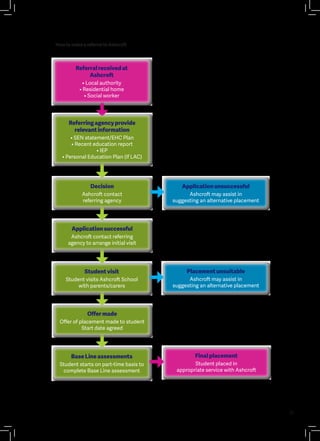
How to make a referral to Ashcroft
Referringagencyprovide
relevantinformation
• SEN statement/EHC Plan
• Recent education report
• IEP
• Personal Education Plan (if LAC)
Referringagencyprovide
relevantinformation
• SEN statement/EHC Plan
• Recent education report
• IEP
• Personal Education Plan (if LAC)
Referralreceivedat
Ashcroft
• Local authority
• Residential home
• Social worker
Referralreceivedat
Ashcroft
• Local authority
• Residential home
• Social worker
Decision
Ashcroft contact
referring agency
Decision
Ashcroft contact
referring agency
Applicationsuccessful
Ashcroft contact referring
agency to arrange initial visit
Applicationsuccessful
Ashcroft contact referring
agency to arrange initial visit
Offermade
Offer of placement made to student
Start date agreed
Offermade
Offer of placement made to student
Start date agreed
BaseLineassessments
Student starts on part-time basis to
complete Base Line assessment
BaseLineassessments
Student starts on part-time basis to
complete Base Line assessment
Finalplacement
Student placed in
appropriate service with Ashcroft
Finalplacement
Student placed in
appropriate service with Ashcroft
Placementunsuitable
Ashcroft may assist in
suggesting an alternative placement
Placementunsuitable
Ashcroft may assist in
suggesting an alternative placement
Applicationunsuccessful
Ashcroft may assist in
suggesting an alternative placement
Applicationunsuccessful
Ashcroft may assist in
suggesting an alternative placement
Studentvisit
Student visits Ashcroft School
with parents/carers
Studentvisit
Student visits Ashcroft School
with parents/carers
For any queries or to arrange a visit to
Ashcroft School, please contact:
Ashcroft School
SchoolsHill,Cheadle
CheshireSK81JE
t:01612834832
 f:01612834843

e:ashcroft.school@togethertrust.org.uk
Registered charity number 209782
Facebook “f” Logo CMYK / .eps Facebook “f” Logo CMYK / .eps
/SupportTogetherTrust @TogetherTrust
ChairmanofGovernors
Mr R Horne
c/o Clerk to Ashcroft School Governors
Together Trust
Schools Hill, Cheadle
Cheshire SK8 1JE
t: 0161 283 4790
 f: 0161 283 4789
e: governors.clerk@togethertrust.org.uk

Ashcroft Prospectus 2016.compressed (2)

  • 1.
    PROSPECTUS Special education andsupport for young people aged 5 to 18
  • 2.
  • 3.
    Ashcroft School isone of the North West’s leading specialist education providers. We are a pioneering, life-changing school, supporting children and young people with needs including social, emotional and behavioural difficulties. Our students may have struggled to cope in other settings because of their individual barriers to learning. As part of the Together Trust charity, we have nearly 150 years of experience of providing specialist education, care and community services to children, young people and adults. This means that we have a long established track record of success when it comes to supporting students with a range of complex needs. At Ashcroft School we pride ourselves in working with each student to offer a bespoke education package that meets their individual needs. Staff relight the spark in our young people and reengage them with learning. We build confidence and self esteem and change how students feel about themselves. Ashcroft staff are experienced and dedicated and led by a national award winning headteacher. We are committed to ensuring that every young person coming through our door reaches their potential - that means building trust with our students, providing intensive support and tailoring all we offer to their specific needs. We’re proud that Ashcroft School students break through their barriers and achieve. Staff are committed to helping our young people to move forward into a happy and fulfilled future, equipped with the skills they need for their chosen life path. Nothing beats seeing first hand all that Ashcroft School offers our students. Please call now and we’ll be delighted to arrange a visit. All contact details are on the back cover. We look forward to meeting you. Eileen Sheerin Headteacher, Ashcroft School Everybody deserves an equal chance in life - no exceptions! Eileen 03
  • 4.
  • 5.
    Reengaging our youngpeople with learning is one of the most important things we do at Ashcroft School. Our students may have had long periods out of school, they may have a history of failure in the traditional educational system and they may have been permanently excluded or at risk from permanent exclusion from school and the rest of society. In order to learn students must feel secure and develop a positive attachment to their learning environment. From the start of their time with us each young person is allocated a key worker to provide them with the intensive personal support they need to succeed. We build confidence and self-esteem and look for the one thing that can make a difference to the young person, changing their outlook on themselves as well as school and the education system. Learning support is delivered through a range of stimulating activities that motivate and engage students in ways that are not readily available elsewhere. In fact, our success comes from moving away from the school experiences that have failed our young people in the past. Through these learning experiences we change behaviour and help students to develop more positive relationships with others. We have particular expertise in providing education services for children in public care, within foster care
or living in children’s homes. The school works closely with local authorities to provide education services
for children in public care who struggle to access mainstream schools. We promote learning and positive emotional development by improving self-esteem and celebrating achievements. Reengaging students with learning The school places a strong focus on the personal development
of pupils; teachers seize every opportunity to encourage pupils to consider their actions and to improve. Ashcroft School Ofsted Inspection Report , February 2013 05
  • 6.
    Jason’s story When Jasonjoined Ashcroft School he was a very introverted individual who rarely engaged in conversation with students or teachers. We looked for the one thing we felt could make a difference to Jason and it wasn’t long before we helped him discover a love of film. By participating in a series of film projects Jason found his voice. Jason worked as part of a team on these short films finding more and more confidence to explore his 
own personality. Through participation in this type of project he gained confidence, improved his self-esteem and is now able to talk about himself positively. Our award winning film projects have helped many young people to build their self-esteem. Taking part helps them to explore their personalities in a safe and non-threatening way. Our films and theatre productions include: 
 • The Undertaker – winner of the funky TV award and Buxton Film festival 
 • The Hitchhikers Guide to Antisocial Behaviour – screened at the Cornerhouse, Manchester • A period sketch performed live at Ordsall Hall 
 • The Motivation Factory – screened at the Cheadle Festival 
 • A First World War Production to mark the centenary which was performed at the Imperial War Museum North • A drama project about the lives of young people at the Together Trust called Deep Pockets and Dirty Faces. Along with film, art plays a big part in the curriculum at Ashcroft School and we have invited artists in to the school to work on projects with students. For example, a graffiti artist was invited to paint a mural designed by our young people. 06
  • 7.
  • 8.
    08 A curriculum tailored toeach student All pupils finish school with at least one externally moderated qualification and some with GCSEs. Some pupils achieve college qualifications while attending school and some have achieved a Duke of Edinburgh Award. Ofsted, February 2013 Ashcroft School offers a broad and balanced curriculum adapted to the individual needs of each student. Every young person has a personalised education plan, with opportunities to gain nationally recognised qualifications to GCSE and beyond. Our curriculum is based on the national curriculum, and the delivery of core curriculum subjects gives our young people the opportunity to improve their skills particularly where they have gaps or difficulty with learning skills or concepts. Improvements in literacy and numeracy are crucial to
the long-term success of our students. As a large number struggle with their literacy skills, we provide the intensive one to one literacy and specialist support they need to progress. With this support, students often make significant improvements very quickly. This in turn engages and motivates students and so improves their learning and development. Ashcroft School focuses on curriculum themes that have a track record of engaging hard to reach young people. These include curriculum enrichment projects such as drama and music, cookery, outdoor pursuits, relaxation and vocational skills. All students are given the opportunity to work on a broad range of projects and our filmmaking projects are a particularly successful example of engaging young people and helping them to learn new skills. Our curriculum strives to be progressive with careful reference to both local and national research and development. It not only meets the immediate needs of our students, but also provides the necessary tools to access further education, training and employment in the future. We have high expectations of our students and are committed to raising achievement.
  • 9.
    Educationtailored totheindividual 09 Inspirational specialist staff Our dedicatedspecialist staff team are led by national award winning headteacher Eileen Sheerin. In 2015 Eileen’s inspirational leadership was recognised at the 02 Think Big Young People Awards where she was highly commended in the Teacher/Support Worker of the Year category. She was also awarded the ‘Be the Best’ award by long-term Together Trust supporter, Convergys, for her firm but approachable style and for going beyond her everyday duties to make a real difference to students’ lives. Ashcroft School has specialist teachers in all core subject areas and in foundation subjects. The subject specialist is responsible for each and every young person’s progress in their area. This means that each student is given the best opportunity to develop in every subject area they study. 09
  • 10.
    10 Nurture groups providethe opportunity to experience the early nurturing experiences some children and young people lack, giving them the skills to do well at school, make friends and deal more confidently and calmly with life’s challenges. The Nurture Group at Ashcroft School has been accredited by the Nurture Group Network and has received an outstanding rating from the prestigious Marjorie Boxall Quality Mark award. It is a small, specialised unit catering for students in Key Stages 1, 2 and 3, and occasionally Key Stage 4. Students referred to the Nurture Group have typically had experiences in their early years that have resulted in poor attachment and difficulty establishing relationships with peers and adults. These may include neglect, bereavement or loss. We have a high staff/student ratio of two to four to ensure that each young person receives the extensive support they need. There is a core focus on physical ability through outdoor pursuits. This is also cross curricular linked to improving literacy skills and raising self-esteem. Classrooms are designed to provide a welcoming and safe environment with plenty of toys and materials for structured play. We have a reading scheme appropriate for students who are effectively non readers and mathematical equipment for students whose basic number skills are weak. Care staff working in Together Trust homes are also trained in the Nurture Group approach ensuring consistency in the care received by our young people. After intensive intervention we expect students to move on successfully to a group in the main school or to a mainstream school. Nurture Group The school is well led and managed. Governors take an active role in the running of
the school, challenge leaders and strive for sustained improvements. As a result, pupils achieve well and make good progress. Ashcroft School Ofsted Inspection Report, February 2013
  • 11.
    11 Play therapy Givinga child the opportunity to communicate enables them to gain more control over their feelings and anxieties. Play therapy is highly effective in enabling students to communicate fully what they may find difficult to put into words. Ashcroft School has a resident play therapist, access to clinical psychology, speech and language therapy and a state of the art playroom with a broad range of materials including sand, musical instruments, clay, puppets, masks and everything needed to spark a young person’s imagination. Through play students make sense of issues affecting their lives by exploring their thoughts and feelings. This type of therapy is suitable for students experiencing a wide range of difficulties including parental conflict, bereavement, witnessing a traumatic event and emotional/ behavioural issues. Our play therapist works to equip young people with adaptive behaviours and better coping mechanisms for everyday life, tailoring the therapy to individual need. Through therapy our students develop a more positive view of their place in the world, anxiety is reduced and we build trust and confidence. Pioneeringteaching methods Ofsted, February 2013 Staff utilise every opportunity to help pupils acknowledge and appreciate their potential and accomplishments.
  • 12.
    12 Groundbreaking teaching Social, emotional andbehavioural skills underpin almost every aspect of school, home and community life. They ensure our students learn effectively and develop positive relationships with others. Given the crucial importance of these skills, Personal Social and Health Education (PSHE) is taught throughout the school every single day. This develops social and emotional literacy in young people and equips them with the skills they need to lead a healthy, happy life. An example is our “word of the week”, which promotes a particular word chosen by the young people. This exercise helps students to strengthen their communication skills, become valued community members and develop a positive work ethic for when they move on from Ashcroft School. Social and emotional support through a nurturing environment
  • 13.
    13 Outdooreducation – equipping young peoplefor life and work Given that most pupils come from backgrounds where disengagement from education was the norm, attendance rates at the school are good. Ofsted, February 2013 Ashcroft School has a wide programme of outdoor education including the opportunity to work towards a Duke of Edinburgh Award. This Award can be life-changing for our young people. It is designed to encourage anyone aged 14 to 24 to take on a range of activities that develop skills such as leadership, perseverance, team work and communication. Some Ashcroft students have gained this award by volunteering new skills, undertaking survival courses and taking part in camping expeditions. The Award is a personal challenge that involves developing new skills and experiences that can open up further opportunities. Outdoor learning brings a range of benefits for students including developing self esteem, extending personal horizons and building practical problem solving skills.
  • 14.
    14 Behaviour management atAshcroft School is highly individualised and is built around the principles of clear expectations and a consistent response. We believe that it is important to create an environment in which positive behaviour is encouraged through positive reinforcement. Each student has a personalised behaviour management plan which sets appropriate limits, creates a safe learning environment, supports change and maintains placement stability. The Access Group supports students who find it particularly difficult to cope with the demands of formal education and who often have more complex needs. Some young people have a deep-seated negative view of education as a result of frequent exclusions from a series of schools or other services. These feelings may be compounded by high levels of non-attendance and/ or frequent changes of school, as well as experiencing bullying or school phobia. A personalised programme is developed for each Access Group student which includes substantial one to one support. Through positive experiences and achievement students begin to reconnect with learning. We work hard with these young people and use different techniques to engage them and gain their trust and respect. This is key to the success for these students, once they have grown in confidence we find that they move on very quickly and are able to access the main school. Care is personalised and some Access Group students may have sessions with other agencies or our play therapist to address their particular issues. Effective behaviour management Access Group Pupils welcome visitors to the school, respect each other and get along well together. Ofsted, February 2013
  • 15.
    15 Provision for studentswhom English is an additional language Where English is not the first language of parents we use translation services to translate at meetings or to translate documents. For students for whom English is an additional language we seek advice from Stockport’s Ethnic Diversity Service. Ashcroft School will implement an individual programme focused on improving communication skills to enable students to access the curriculum better and where necessary the school will seek specialist English language teacher input from the Stockport Ethnic Diversity Service. All students at Ashcroft School have complex behavioural, emotional and social difficulties but some have additional needs, such as Acquired Brain Injury (ABI). We work closely with Child and Adolescent Mental Health Services (CAMHS), psychologists and other professionals to implement agreed support and intervention programmes. Where necessary, the school is able to administer prescribed medication as part of a medically monitored intervention. Where students have diagnosed additional needs such as dyslexia or dyspraxia, Ashcroft School has trained staff to work on individual programmes or to advise staff. Student assessments generally identify areas where specific intervention or support is required. In addition, young people can be referred to the Together Trust’s educational psychologist. Where a student may be on the autism spectrum,
a full diagnostic assessment and advice on their educational programme is available from the Together Trust’s specialist staff. Diagnosis may
be followed by advice and support including, if necessary, regular input from a speech and language therapist. Meeting Special Educational Needs (SEN)
  • 16.
    Susan’s story Susan joinedAshcroft School with considerable learning difficulties. She had been diagnosed with foetal alcohol syndrome, attachment disorder and had a range of emotional, social and behavioural difficulties. On arrival Susan found it difficult to sit still, listen and focus her attention. She struggled with a delayed vocabulary, which made following instructions difficult and her IQ was well below average. Her presenting behaviour on arrival meant she was disengaged with a negative attitude towards her education. Susan was stubborn, distant, resistant and refused to follow staff instructions. She was socially inept and lacked awareness of social cues. We placed Susan in our award winning Nurture Group where specialist staff focussed on her social and emotional difficulties. With intensive support, she has been given daily opportunities to learn and practise her social skills to build positive relationships in a small group. There are consistent boundaries and regular staff to develop her skills in following instructions, routines and understanding of a satisfactory level of behaviour. Play therapy has been used to help Susan communicate her anxieties and come to terms with a traumatic early life experience. Following this intensive support, Susan’s self-esteem has grown and she has flourished at school. She has confidently participated in a wide range of activities from a music project with unfamiliar staff to activities in the wider community. Throughskillsandpatience -anewwayforward 16
  • 17.
    17 e We ensure allstudents at Ashcroft School are able to demonstrate the progress they make through a range of externally recognised accredited courses. Young people achieve nationally recognised qualifications and complete accredited work experience and community placements. We have a strong track record of students achieving GCSEs. Ashcroft School is a registered centre for AQA (Assessment and Qualifications Alliance), Ascentis and Edexcel with BTEC qualifications. We use the AQA Unit Award scheme to engage students and recognise their progress. We offer access to other national accredited awards in literacy and numeracy
as well as a wide variety of subjects ranging from science and bush craft, through film production and media to ICT and textiles. We use every opportunity to celebrate achievement and help students see school as a positive place. Celebration assemblies are held at
the end of each term with parents and carers invited to celebrate students’ achievements with us. Supporting student achievement Pupils with a wide range of abilities achieve and make good progress. Ofsted, February 2013
  • 18.
  • 19.
    19 At Building Opportunities,we prepare students to enter one of the fastest growing industries in the UK – construction. The centre is an excellent option for young people aged 14 to 19, who prefer to work in a practical environment. Building Opportunities provides each student with the attention, support and personalised learning package they need to achieve. Our Stockport based facility allows students to engage with a curriculum better suited to their specific needs and to gain confidence along the way. Not only do we focus on gaining skills, we incorporate relationship building, personal growth and development in the context of a strong real world work ethic. Building Opportunities offers industry recognised qualifications at BTEC Levels 1 and 2 in a range of specialist areas including joinery and carpentry, brickwork and painting and decorating. The centre is registered to deliver Ascentis and BTEC qualifications. We have developed a provision offering a number of construction based vocational activities along with basic numeracy and literacy and some outdoor education provision. This is a resource that schools and colleges can commission for individuals or groups of students as a weekly or block placement. Children’s homes wanting to prepare young people for independent living can also commission sessions during school holidays. State of the art resources
  • 20.
    Students aged 14to 16 who may have been excluded or close to being excluded from mainstream education are supported at Ashcroft College, which offers study in a range of exciting subjects while providing crucial specialist support. Ashcroft College welcomes young people aged 14 to 16. The College is a partnership education provision designed to support Manchester Education Pupil Referral Services. Studying at Ashcroft College will open the door to a range of new opportunities for our students. The college offers a varied curriculum including four key vocational subjects in hair and beauty, sports, catering and construction. Ashcroft College (Manchester Vocational Pupil Referral Unit) A School House student chats to Angela Rayner MP20
  • 21.
    Students will equipthemselves with the necessary skills and qualifications to find employment, undertake training or continue into further education. Students at Ashcroft College benefit from a nurturing environment, with a committed, dedicated staff team who ensure that each learner feels fully supported and safe. Every student receives an individual learning plan aimed at promoting an inclusive learning environment with the main focus to facilitate equality and diversity. At Ashcroft College we believe that each of our young people should be given every opportunity to achieve and succeed. The School House (Manchester Education Pupil Referral Unit) The School House in Droylsden is an alternative education provision run by Ashcroft School and commissioned by Manchester Secondary Pupil Referral Unit. Opened in December 2015 by Angela Rayner MP, we work with students aged 11 to 14 years who have struggled to cope in traditional school settings. Our young people have been, or are on the cusp of being excluded from mainstream schools. Students receive a bespoke package of support that focuses on their emotional, and social needs as well as their education. The School House team consists of experienced teaching staff and support workers coupled with the expertise and knowledge of the Manchester Secondary Pupil Referral Unit. Anurturingenvironment wherestudentsare fullysupported 21
  • 22.
  • 23.
    Consistent involvement fromparents or carers is one of the most important contributors to student achievement. Ashcroft School is committed to joint working with each student’s parent or carer, who can make such a difference to their educational success. Parents and carers are contacted daily to develop and strengthen the links between home and school. Reports on progress are given at annual reviews and at the end of each term. Regular progress evenings provide opportunities for each student’s progress to be discussed with all of their teachers. Parents and carers are welcome to visit the school or call to discuss their young person at any time, and are invited to share assemblies, celebrations and any achievement students make. We value the input provided by parents and encourage collaborative working to help students reach their full potential. Working with parents and carers Every other school has failed my children but from day one in this school, there was no looking back! Parent of an Ashcroft School Pupil, Ashcroft School Ofsted Inspection Report, February 2013 s 23
  • 24.
    Ashcroft School students win local history award InMarch 2015, young people at Ashcroft School won a prestigious Manchester Histories Award for a project delving into the Together Trust’s history. The project saw students commemorate the young people in the Together Trust’s care who were called up to serve in the First World War. A huge display of handmade poppies was created at the Cheadle campus to remember the lives of the former beneficiaries. The name of each soldier was etched into a poppy in the display and a radio piece paid tribute to each veteran, encouraging people to remember loved ones who lost their life in the war. It created a sense of empathy and understanding among our young people for past residents who had lived in the charity’s residential homes. 24
  • 25.
  • 26.
    Ashcroft School Additional Information PSHEand sex education.......................................................26 Religious education/ British values.................................. 26 Careers education................................................................... 26 Specialist programmes..........................................................26 Assessment................................................................................26 Staff training...............................................................................26 Observations of teaching and scrutiny of work............27 Quality assurance.....................................................................27 Anti-bullying and cyber safety..............................................27 Incident management and physical intervention........27 Management of students at risk of exclusion...............27 Attendance..................................................................................27 Safeguarding.............................................................................. 28 Health and Safety..................................................................... 28 Medicines and health care plans....................................... 28 School day................................................................................... 28 School meals.............................................................................. 28 School wear and equipment................................................29 School council...........................................................................29 Transport and travel training ..............................................29 Voluntary contributions.........................................................29 Equality and diversity..............................................................29 Data protection.........................................................................29 Photography and media permissions..............................29 Complaints..................................................................................30 Student complaints.................................................................30 Governing body.........................................................................30 Referrals and admissions.......................................................31 26 PSHE and sex education Students are taught about anti-bullying, dangers of smoking, drugs and alcohol abuse, cyber-bullying and keeping safe through PSHE. We pride ourselves on ensuring our sometimes very vulnerable students are well informed. Copies of the sex education and relationships policy are available upon request. Religious education/ British values Spiritual and moral matters are always recognised and are an important part of the school’s pastoral work. Religious education is included on the school timetable. Careers education Careers education forms part of the Personal Social
and Health Education (PSHE) programme and specific careers education sessions are provided. Links are made with Connexions in Stockport or to each student’s home local authority. Specialist programmes Ashcroft School has a range of specialist programmes available to its students including: • Nurture group (see page 10) 
 • Play therapy (see page11) 
 • Access group (see page 14) 
 • Building Opportunities (see page 18) 
 • Ashcroft College (see page 20) • School House PRU (see page 21) Assessment Students that arrive with us in the first instance are given a six week assessment programme including the Boxall assessment. This is an ideal opportunity to understand the needs of the young person and enables us to determine their individual needs – both academically and emotionally. We use the assessment to group young people according to their ability and this enables them to access all curriculum tailored to their needs. We also assess formally each term so we can measure progress. Each student’s assessment is recorded on our system which has a red, amber or green flag so we see at a glance if intervention is needed for any of the young people in any subject. Staff training Continuing professional development sets a model for the entire school. The expectation and ethos of Ashcroft School is to provide an inclusive place of learning.
  • 27.
    Staff complete acomprehensive package of ongoing training opportunities, supported by the Together Trust’s in-house training department. Some of the induction and training courses undertaken by staff are: • Safeguarding through in house training and courses from the local Safeguarding Children’s Board (SCB) • PROACT SCIPr-UK® (Strategies for Crisis Intervention and Prevention) is an internationally recognised approach in supporting people who have challenging reputations • Behaviour management with de-escalation techniques to prevent unwanted or more serious bad behaviour • Assessment – we keep up to date with all government initiatives and staff are trained accordingly • Curriculum and curriculum improvements • Expectations of professional culture • Specialist training if required e.g. the therapeutic use of art and nurture group principles. To ensure a high quality of teaching and learning we recruit specialist staff especially in practical curriculum areas. Staff are encouraged to further enhance their expertise in their specialist subject areas and attend regular accredited training. Observations of teaching and scrutiny of work Senior management, supported by Governors, carry out lesson observations to ensure the quality of teaching is up to the standard required by Ofsted. We also look at planning against work taught in school, choosing work files for each subject at random to scrutinise the quality of work produced by the young people. This ensures they are receiving the best possible opportunities. Quality assurance The quality of provision at Ashcroft School is under a continual programme of improvement. This is achieved by internal monitoring of teaching and learning by scrutinising planning and work, lesson observations, regular staff training and discussion of case work and practice, regular consultation with local authorities, review of performance management procedures and regular Ofsted inspections. The school is proud to hold the Investors in People and PQASSO Level 2 Standards. Anti-bullying and cyber safety Bullying in any form is unacceptable. Learning the effects and consequences that bullying has on the lives of others is taught as part of the curriculum, and the school participates in all government initiatives such as Anti-Bullying Week. Students are monitored closely when using the internet and topics on bullying and cyber bullying are included in ICT and PSHE lessons. Staff are trained in areas such as CEOP (Child Exploitation and Online Protection) ambassador training, enabling effective monitoring and management of all aspects of cyber bullying. Cyber bullying is a very real and serious issue, and should it arise it will be dealt with following our incident management procedures. We ask parents and carers to assist the school in reducing occurrences of cyber bullying by regularly checking social networking sites which are not accessible in school. We do not allow mobile phones in school as social networking sites are also available via mobile networks, and we will work with parents to inform our young people of the dangers and effects of cyber bullying and to discourage its practice. Our policy on bullying and cyber bullying is available from the school office on request. Incident management and physical intervention All staff undergo PROACT SCIPr-UK® training which focuses upon de-escalation techniques. This does incorporate some physical intervention which
can be used, however this is employed rarely and only in exceptional circumstances. Management of students at risk of exclusion Fixed term exclusions are only used as part of a planned intervention for the shortest time necessary. It is part of Ashcroft School’s behaviour management plan to maintain discipline, good conduct and an orderly and safe learning environment. The purpose of exclusion is to help provide boundaries and consequences to ensure the safety of those who use the school and to safeguard the education and welfare of all. We follow relevant guidance from the DfE (Department for Education) and other agencies. Permanent exclusions are avoided if at all possible – if a placement is at risk then a review is held to try and retain and re-engage the young person. The local authority and parents/carers are informed at an early stage and asked to engage in planned re-engagement or, as a last resort, a planned move. If permanent exclusion is inevitable then the review team will plan a managed transfer with a transitional plan. There is an appeal process to ensure needs and entitlements are considered. Attendance Every student at Ashcroft School has a fundamental right to be educated as inclusively as possible. Parents and carers have a duty to ensure maximum attendance at school. 27
  • 28.
    Parents, carers andprofessionals should encourage students to take full advantage of their educational opportunity by attending regularly. Staff maintain daily contact with parents and carers. Parents or carers are always contacted on the first day of a student’s absence. Absence Should a young person be unable to attend school for any reason, it is important that we are informed as soon as possible. If the young person is ill and therefore unable to attend school, parents and carers must call in the first instance to let us know. If the absence is planned, please let us know before the event. Parents and carers do not have the right to remove children from school for the purpose of a holiday. Since September 2013 headteachers may not grant any leave of absence (holiday) during term time unless they are emotional circumstances. Unauthorised absences may lead to a fixed penalty notice being issued by the Local Authority, incurring a fine of £60 per parent. More information can be found at: www.stockport.gov.uk/services/education Safeguarding All staff employed at Ashcroft School are required to complete an enhanced DBS Disclosure and are appointed through safer recruitment procedures. Parents and carers should be aware that if staff suspect that a young person is at risk of harm, they have a duty to inform the relevant authority. A copy of the school safeguarding policy is available on the website: www.togethertrust.org.uk/education/ashcroftschool or can be requested from the school office. Health and safety Staff receive training on key issues such as First Aid, Asthma Awareness, Epilepsy Awareness and the administration of medication. The school follows the Together Trust’s comprehensive Health and Safety policies and are guided by the Together Trust’s Health and Safety Officer. MIDAS training is provided for minibus drivers and Ashcroft School has its own fire management plan and fire drills take place once a term. The health and safety of students that attend Ashcroft School is paramount. In order to maintain high standards we keep up to date with all areas of safety. Staff receive training on areas such as first aid, asthma awareness, epilepsy awareness and general safety such as fire regulations. Medicines and health care plans Ashcroft School follows the Together Trust policies and procedures on administration of medication. Students should not bring ‘over the counter’ medicines into school. Any medication – prescribed or otherwise – must be handed in to a member of staff at the beginning of the school day. If a student needs to take prescribed medication, it must be sent into school in its original packaging with dosage information. This must be given to staff and will be stored in a locked medicine cupboard and/or in a locked container in a refrigerator. We must also receive authorisation in writing to administer medicines. Students with complex medical needs have a health care plan drawn up in consultation with their parents and carers and where necessary advice from doctors and/or specialist nurses. The school has a medical room for students taken ill during the school day. If students are seriously unwell their parents/ carers will be contacted and asked to take them home. In case of an emergency an ambulance will be called and/or students taken directly to A&E accompanied by staff. In all cases parents/ carers are notified. Ashcroft School follows the Asthma UK guidance about managing asthma and the use and storage of inhalers, and has adopted Stockport Council’s asthma policy. In school School day Ashcroft School operates on a standard 38 week school year. Students must be in school by 9am, and will finish by 3:15pm. On Friday afternoons students undertake a different activity programme and students in the main school will finish at 2:15pm. The Nurture Group finishes at 12 noon. The timetable showing school holidays for the school year is available for download from our website: www.togethertrust.org.uk/education/ashcroft school School meals We believe that meal times are an important opportunity not only to develop social skills, but also to experience healthy eating and to try out new foods and recipes. Ashcroft School offers high quality ‘cooked from scratch’ healthy meals. These meet nutritional guidelines for school menus. Water and fresh fruit are always available throughout the day. We promote healthy eating and exercise to 28
  • 29.
    help students takeresponsibility for their own long- term well-being. Meals are not included in the fees charged to local authorities, and parents/carers are asked to pay for meals or provide a packed lunch. The local authority covers costs for those entitled to free school meals. We are able to cater for special diets if required. School wear and equipment Students should come to school suitably dressed, and we have a uniform requirement. Ashcroft School students should wear: • Black trousers or skirt
 • Plain white polo or shirt or blouse – no logos allowed • Black school shoes – no trainers and no logos • Purple sweatshirt with Ashcroft School logo • Sportswear/outdoor education wear as required. We do not allow our students to wear jewellery in school or to bring expensive toys with them. Students are discouraged from bringing games, personal stereos/MP3 players with them to school, although we accept enforcing this is difficult. Mobile phones are not allowed in school. Parents and carers should note however that Ashcroft School and/or the Together Trust cannot be held responsible for any loss or damage of such items whilst students are on Together Trust property or during school activities/trips. We would therefore ask parents/carers to help us ensure that these items are not brought into school. School council Our school council meets each term and discuss
a wide range of topics – school reward trips, issues around curriculum, activities they would like in school and free time activities. We are committed to encouraging the student voice and our young people take the role of councilor very seriously. Transport and travel training Ashcroft School encourages students to learn to travel safely and independently and works with local authorities to achieve this where all parties, including the young person, agree it is appropriate. Independent travel in some cases is part of an individual plan to work towards independence which is accredited. Students travelling to their placement from home may be provided with a minibus or taxi funded by their local authority. Voluntary contributions There are generally no charges for school visits and activities that are linked to the curriculum or provided as rewards. However students are encouraged to
get involved in fundraising and as the Together Trust is a registered charity, voluntary income is used to supplement school funds Equality and diversity It is the policy of Ashcroft School that all students have full access to a broad and balanced curriculum, regardless of gender, class, ethnic origin, culture, first language, and nature or degree of disability. Activities are planned to maximise opportunities for each student, taking into account their individual background, interests and experiences. The school also operates an equal opportunities approach to the appointment of staff in keeping with Together Trust policies and procedures. Data protection All schools collect, manage and update personal data about their students and we are a Data Controller for the purposes of the Data Protection Act 1998. We hold this personal data and use it to: • Support teaching and learning • Monitor and report on progress
 • Provide appropriate pastoral care
 • Assess how well the school is doing. This information includes contact details, national curriculum assessment results, attendance information, characteristics such as ethnic group, special educational needs and any relevant medical information. We will not give information about our students to anyone outside the school without parental consent unless the law and our rules permit it. Please see the Together Trust Website’s ‘School Privacy Notice’ for more information on this. We are required by law to pass some of your information to the local authority (LA), and the Department for Education (DFE). We will not give information about our students to anyone outside the school without parental consent unless the law and our rules permit it. Please visit our website for further details. We are required by law to pass some of your information to the local authority (LA), and the Department for Education (DFE). Photography and media permissions The school is careful how photographs and films of students are stored and used. Photographs are only used with the permission of parents and carers or where appropriate, social workers. Photographs or films that are used in publicity about the school or Together Trust are kept for new use for a maximum of three years. 29
  • 30.
    30 Complaints Parents, carers andstudents have the right to complain about issues causing them concern, and we take all complaints seriously. A copy of the complaints procedure is available from the school office on request, or can be downloaded from our website: www.togethertrust.org.uk/ education/ ashcroftschool If there is a problem or concern, every effort is made to resolve issues informally. If this fails, a formal complaint should be made in writing to the headteacher. Students will be supported should they wish to complain. Student complaints It is important that all young people who have a reason to complain know school will listen to their concerns and taken them seriously. If a student has a problem or concern but are unsure if they need to make a formal complaint, they can talk to their key teacher or another member of staff; talk to their key worker, social worker or a member of their family. Students of Ashcroft School have their own policy guidelines that set out the process to follow. The aim will always be to resolve complaints as soon as possible through discussion with the people concerned to prevent any unnecessary distress. All complaints will be handled in accordance with the Together Trust’s complaints policy and procedure. The policy and guidelines for our students is available from the school office. Governing body The Governing Body of Ashcroft School helps to shape the vision and direction of the school and ensures the school fulfills its duties, including the promotion of inclusive policies on special needs together with equality and diversity. Our Governors have vast experience in their own fields of expertise, and apply this knowledge along with their understanding of the strengths and weaknesses of the school, enabling them to provide continuous challenge and support to the senior management team. They contribute to the School Improvement Plan (SIP), approve the school Policies and Procedures and monitor the implementation of these documents. They also inform the Trustees of the Together Trust on issues relating to the school, and take an active role in Ashcroft School. If you are interested in knowing more about the Governing Body or would like to become a Governor please contact the Chairman: Mr R. Horne
, c/o Clerk to Ashcroft School Governors Together Trust Centre, Schools Hill, Cheadle Cheshire SK8 1JE t: 0161 283 4801 f: 0161 283 4803 e: governors.clerk@togethertrust.org.uk Referrals and admissions Enquiries about places at Ashcroft School should be made to the headteacher, Eileen Sheerin. Ashcroft School welcomes direct enquiries from parents and other professionals such as educational psychologists or CAMHS team workers. Parents and professionals are encouraged to visit the school, meet the headteacher, explore our teaching and learning environment, meet our students and staff. Referrals are usually initiated through the headteacher by the referring agency and Ashcroft School accepts formal referrals from: • Local authority teams • Social workers • Residential care homes or fostering services • Virtual school teams We will require a copy of the Statement of SEN or EHCP, the last AER minutes and any other relevant documents to make an informed decision. We work closely with the referring agency at every stage of the student’s education until they are ready to leave Ashcroft School to attend mainstream education, further education, or move into a work placement. Alternative provision – Building Opportunities (Ashcroft Development Centre) Ashcroft School also welcomes enquiries and referrals from schools and colleges investigating alternative education programmes and who are interested in commissioning vocational provision. Detailed information about the programmes available and facilities can be found on the Together Trust website: www.togethertrust.org.uk/education/ ashcroftschool Please contact the headteacher, Eileen Sheerin, for an initial discussion and information on charges. Following initial discussions, a member of the senior leadership team can be identified as the link for the commissioning school or college and will oversee the programme and ensure reports are provided on individual students.
  • 31.
    31 How to makea referral to Ashcroft Referringagencyprovide relevantinformation • SEN statement/EHC Plan • Recent education report • IEP • Personal Education Plan (if LAC) Referringagencyprovide relevantinformation • SEN statement/EHC Plan • Recent education report • IEP • Personal Education Plan (if LAC) Referralreceivedat Ashcroft • Local authority • Residential home • Social worker Referralreceivedat Ashcroft • Local authority • Residential home • Social worker Decision Ashcroft contact referring agency Decision Ashcroft contact referring agency Applicationsuccessful Ashcroft contact referring agency to arrange initial visit Applicationsuccessful Ashcroft contact referring agency to arrange initial visit Offermade Offer of placement made to student Start date agreed Offermade Offer of placement made to student Start date agreed BaseLineassessments Student starts on part-time basis to complete Base Line assessment BaseLineassessments Student starts on part-time basis to complete Base Line assessment Finalplacement Student placed in appropriate service with Ashcroft Finalplacement Student placed in appropriate service with Ashcroft Placementunsuitable Ashcroft may assist in suggesting an alternative placement Placementunsuitable Ashcroft may assist in suggesting an alternative placement Applicationunsuccessful Ashcroft may assist in suggesting an alternative placement Applicationunsuccessful Ashcroft may assist in suggesting an alternative placement Studentvisit Student visits Ashcroft School with parents/carers Studentvisit Student visits Ashcroft School with parents/carers
  • 32.
    For any queriesor to arrange a visit to Ashcroft School, please contact: Ashcroft School SchoolsHill,Cheadle CheshireSK81JE t:01612834832
 f:01612834843
 e:ashcroft.school@togethertrust.org.uk Registered charity number 209782 Facebook “f” Logo CMYK / .eps Facebook “f” Logo CMYK / .eps /SupportTogetherTrust @TogetherTrust ChairmanofGovernors Mr R Horne c/o Clerk to Ashcroft School Governors Together Trust Schools Hill, Cheadle Cheshire SK8 1JE t: 0161 283 4790
 f: 0161 283 4789 e: governors.clerk@togethertrust.org.uk