Impact of Automatic Code Selection 
with ppOpen‐AT
Takahiro Katagiri
1
The 20th ASE Seminar, 16:55 ‐ 17:25, October 16th (Friday), 2015
4F Remote Conference Room, Information Technology Center (ITC), 
The University of Tokyo
Collaborators: Masaharu Matsumoto, Satoshi Ohshima
Information Technology Center,
The University of Tokyo
Information Technology Center,
The University of Tokyo
Outline
1. Background
2. ppOpen‐HPC and ppOpen‐AT
3. Code Selection in Seism3D and 
Its Implementation by ppOpen‐AT 
4. Performance Evaluation
5. Conclusion
Outline
1. Background
2. ppOpen‐HPC and ppOpen‐AT
3. Code Selection in Seism3D and 
Its Implementation by ppOpen‐AT 
4. Performance Evaluation
5. Conclusion
Background
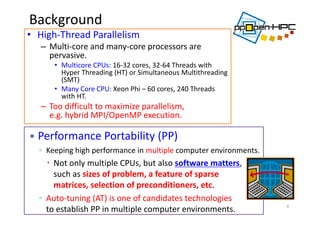
• High‐Thread Parallelism
– Multi‐core and many‐core processors are 
pervasive. 
• Multicore CPUs: 16‐32 cores, 32‐64 Threads with 
Hyper Threading (HT) or Simultaneous Multithreading 
(SMT)
• Many Core CPU: Xeon Phi – 60 cores, 240 Threads 
with HT.
– Too difficult to maximize parallelism, 
e.g. hybrid MPI/OpenMP execution.
4
 Performance Portability (PP)
◦ Keeping high performance in multiple computer environments.
 Not only multiple CPUs, but also software matters, 
such as sizes of problem, a feature of sparse 
matrices, selection of preconditioners, etc.
◦ Auto‐tuning (AT) is one of candidates technologies 
to establish PP in multiple computer environments. 
Outline
1. Background
2. ppOpen‐HPC and ppOpen‐AT
3. Code Selection in Seism3D and 
Its Implementation by ppOpen‐AT 
4. Performance Evaluation
5. Conclusion
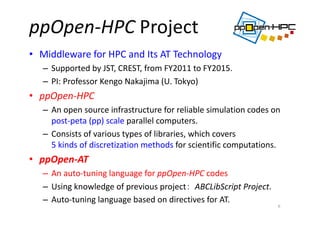
ppOpen‐HPC Project
• Middleware for HPC and Its AT Technology
– Supported by JST, CREST, from FY2011 to FY2015.
– PI: Professor Kengo Nakajima (U. Tokyo)
• ppOpen‐HPC 
– An open source infrastructure for reliable simulation codes on 
post‐peta (pp) scale parallel computers.
– Consists of various types of libraries, which covers 
5 kinds of discretization methods for scientific computations. 
• ppOpen‐AT 
– An auto‐tuning language for ppOpen‐HPC codes 
– Using knowledge of previous project: ABCLibScript Project.
– Auto‐tuning language based on directives for AT.
6
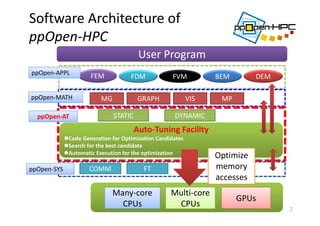
Software Architecture of 
ppOpen‐HPC
7
FVM DEMFDMFEM
Many‐core 
CPUs
GPUs
Multi‐core
CPUs
MG
COMM
Auto‐Tuning Facility
Code Generation for Optimization Candidates
Search for the best candidate
Automatic Execution for the optimization
ppOpen‐APPL
ppOpen‐MATH
BEM
ppOpen‐AT
User Program
GRAPH VIS MP
STATIC DYNAMIC
ppOpen‐SYS FT
Optimize 
memory 
accesses 
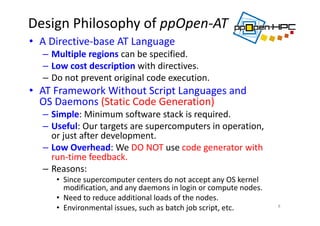
Design Philosophy of ppOpen‐AT 
• A Directive‐base AT Language
– Multiple regions can be specified.
– Low cost description with directives.
– Do not prevent original code execution.
• AT Framework Without Script Languages and 
OS Daemons (Static Code Generation)
– Simple: Minimum software stack is required. 
– Useful: Our targets are supercomputers in operation, 
or just after development.
– Low Overhead: We DO NOT use code generator with 
run‐time feedback.
– Reasons: 
• Since supercomputer centers do not accept any OS kernel 
modification, and any daemons in login or compute nodes. 
• Need to reduce additional loads of the nodes.
• Environmental issues, such as batch job script, etc. 8
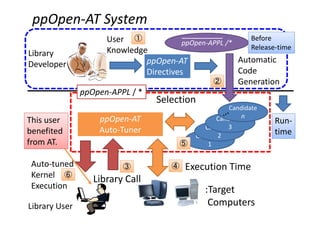
ppOpen‐AT System
ppOpen‐APPL /*
ppOpen‐AT
Directives
User 
KnowledgeLibrary 
Developer
① Before 
Release‐time
Candidate
1
Candidate
2
Candidate
3
Candidate
nppOpen‐AT
Auto‐Tuner
ppOpen‐APPL / *
Automatic
Code
Generation②
:Target 
Computers
Execution Time④
Library User
③
Library Call
Selection
⑤
⑥
Auto‐tuned
Kernel
Execution
Run‐
time
This user 
benefited 
from AT.
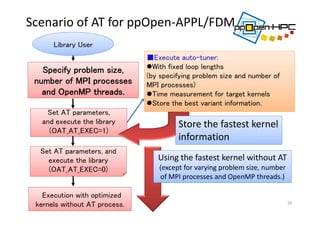
Scenario of AT for ppOpen‐APPL/FDM
10
Execution with optimized
kernels without AT process.
Library User
Set AT parameters,
and execute the library
(OAT_AT_EXEC=1)
■Execute auto-tuner:
With fixed loop lengths
(by specifying problem size and number of
MPI processes)
Time measurement for target kernels
Store the best variant information.
Set AT parameters, and
execute the library
(OAT_AT_EXEC=0)
Store the fastest kernel
information
Using the fastest kernel without AT 
(except for varying problem size, number 
of MPI processes and OpenMP threads.)
Specify problem size,
number of MPI processes
and OpenMP threads.
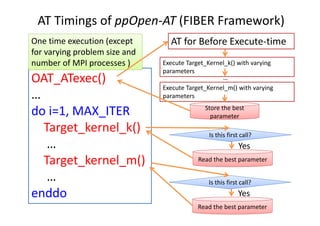
AT Timings of ppOpen‐AT (FIBER Framework)
OAT_ATexec()
…
do i=1, MAX_ITER
Target_kernel_k()
…
Target_kernel_m()
…
enddo
Read the best parameter
Is this first call?
Yes
Read the best parameter
Is this first call?
Yes
One time execution (except 
for varying problem size and 
number of MPI processes )
AT for Before Execute‐time
Execute Target_Kernel_k() with varying 
parameters
Execute Target_Kernel_m() with varying 
parameters
parameter 
Store the best 
parameter 
…
A Scenario to Software Developers for 
ppOpen‐AT
12
Executable Code with
Optimization Candidates and
AT Function
Invocate dedicated
Preprocessor
Software
Developer
Description of AT by Using
ppOpen-AT
Program with AT Functions
Optimization
that cannot be
established by
compilers
#pragma oat install unroll (i,j,k) region start
#pragma oat varied (i,j,k) from 1 to 8
for(i = 0 ; i < n ; i++){
for(j = 0 ; j < n ; j++){
for(k = 0 ; k < n ; k++){
A[i][j]=A[i][j]+B[i][k]*C[k][j]; }}}
#pragma oat install unroll (i,j,k) region end
■Automatic Generated
Functions
Optimization
Candidates
Performance Monitor
Parameter Search
Performance Modeling
Description By Software Developer
Optimizations for Source Codes,
Computer Resource, Power Consumption
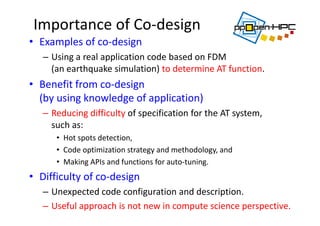
Importance of Co‐design
• Examples of co‐design 
– Using a real application code based on FDM 
(an earthquake simulation) to determine AT function.
• Benefit from co‐design 
(by using knowledge of application)
– Reducing difficulty of specification for the AT system, 
such as:
• Hot spots detection,
• Code optimization strategy and methodology, and
• Making APIs and functions for auto‐tuning.
• Difficulty of co‐design
– Unexpected code configuration and description.
– Useful approach is not new in compute science perspective.
Outline
1. Background
2. ppOpen‐HPC and ppOpen‐AT
3. Code Selection in Seism3D and 
Its Implementation by ppOpen‐AT 
4. Performance Evaluation
5. Conclusion
Target Application
• Seism3D: 
Simulation for seismic wave analysis.
• Developed by Professor T.Furumura
at the University of Tokyo.
–The code is re‐constructed as 
ppOpen‐APPL/FDM.
• Finite Differential Method (FDM) 
• 3D simulation
–3D arrays are allocated.
• Data type: Single Precision (real*4) 15
Flow Diagram of 
ppOpen‐APPL/FDM
16
),,,(
}],,,)
2
1
({},,)
2
1
({[
1
),,(
2/
1
zyxqp
zyxmxzyxmxc
x
zyx
dx
d
pqpq
M
m
m
pq



 


 Space difference by FDM.
),,(,
12
1
2
1
zyxptf
zyx
uu n
p
n
zp
n
yp
n
xpn
p
n
p 

















 


 Explicit time expansion by central 
difference.
Initialization
Velocity Derivative (def_vel)
Velocity Update (update_vel)
Stress Derivative (def_stress)
Stress Update (update_stress)
Stop Iteration?
NO
YES
End
Velocity PML condition (update_vel_sponge)
Velocity Passing (MPI) (passing_vel)
Stress PML condition (update_stress_sponge)
Stress Passing (MPI) (passing_stress)
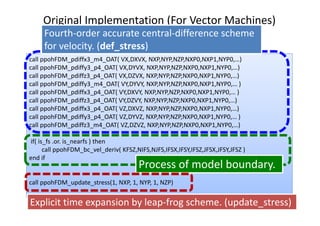
Original Implementation (For Vector Machines)
call ppohFDM_pdiffx3_m4_OAT( VX,DXVX, NXP,NYP,NZP,NXP0,NXP1,NYP0,…)
call ppohFDM_pdiffy3_p4_OAT( VX,DYVX, NXP,NYP,NZP,NXP0,NXP1,NYP0,…)
call ppohFDM_pdiffz3_p4_OAT( VX,DZVX, NXP,NYP,NZP,NXP0,NXP1,NYP0,…)
call ppohFDM_pdiffy3_m4_OAT( VY,DYVY, NXP,NYP,NZP,NXP0,NXP1,NYP0,… )
call ppohFDM_pdiffx3_p4_OAT( VY,DXVY, NXP,NYP,NZP,NXP0,NXP1,NYP0,… )
call ppohFDM_pdiffz3_p4_OAT( VY,DZVY, NXP,NYP,NZP,NXP0,NXP1,NYP0,…)
call ppohFDM_pdiffx3_p4_OAT( VZ,DXVZ, NXP,NYP,NZP,NXP0,NXP1,NYP0,…)
call ppohFDM_pdiffy3_p4_OAT( VZ,DYVZ, NXP,NYP,NZP,NXP0,NXP1,NYP0,… )
call ppohFDM_pdiffz3_m4_OAT( VZ,DZVZ, NXP,NYP,NZP,NXP0,NXP1,NYP0,…)
if( is_fs .or. is_nearfs ) then
call ppohFDM_bc_vel_deriv( KFSZ,NIFS,NJFS,IFSX,IFSY,IFSZ,JFSX,JFSY,JFSZ )
end if
call ppohFDM_update_stress(1, NXP, 1, NYP, 1, NZP)
Fourth‐order accurate central‐difference scheme 
for velocity. (def_stress)
Process of model boundary. 
Explicit time expansion by leap‐frog scheme. (update_stress)
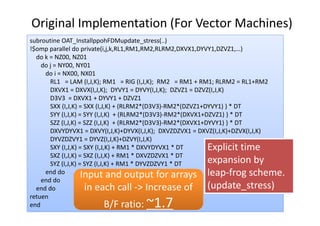
Original Implementation (For Vector Machines)
subroutine OAT_InstallppohFDMupdate_stress(..)
!$omp parallel do private(i,j,k,RL1,RM1,RM2,RLRM2,DXVX1,DYVY1,DZVZ1,…)
do k = NZ00, NZ01
do j = NY00, NY01
do i = NX00, NX01
RL1   = LAM (I,J,K); RM1   = RIG (I,J,K);  RM2   = RM1 + RM1; RLRM2 = RL1+RM2
DXVX1 = DXVX(I,J,K);  DYVY1 = DYVY(I,J,K);  DZVZ1 = DZVZ(I,J,K)
D3V3  = DXVX1 + DYVY1 + DZVZ1
SXX (I,J,K) = SXX (I,J,K) + (RLRM2*(D3V3)‐RM2*(DZVZ1+DYVY1) ) * DT
SYY (I,J,K) = SYY (I,J,K)  + (RLRM2*(D3V3)‐RM2*(DXVX1+DZVZ1) ) * DT
SZZ (I,J,K) = SZZ (I,J,K)  + (RLRM2*(D3V3)‐RM2*(DXVX1+DYVY1) ) * DT
DXVYDYVX1 = DXVY(I,J,K)+DYVX(I,J,K);  DXVZDZVX1 = DXVZ(I,J,K)+DZVX(I,J,K)
DYVZDZVY1 = DYVZ(I,J,K)+DZVY(I,J,K)
SXY (I,J,K) = SXY (I,J,K) + RM1 * DXVYDYVX1 * DT
SXZ (I,J,K) = SXZ (I,J,K) + RM1 * DXVZDZVX1 * DT
SYZ (I,J,K) = SYZ (I,J,K) + RM1 * DYVZDZVY1 * DT
end do
end do
end do
retuen
end
Explicit time 
expansion by 
leap‐frog scheme. 
(update_stress)
Input and output for arrays Input and output for arrays 
in each call ‐> Increase of 
B/F ratio: ~1.7
Implementation Strategy for
Code Variants 
• Change of computation order based on mathematics.
• With experimental knowledge, we implement the 
following codes for the variants.
• For time expansion of stress tensor, the loop can be 
separated to two loops with respect to nature of 
isotropic elastic body (Loop Spilit):
– Loop1: Sxx, Syy, Szz, and 
– Loop2: Sxy, Sxz, Syz, 
where the stress tenser S is defined by: 
S = [(Sxx, Sxy, Sxz), (Sxy, Syy, Syz), (Sxz, Syz, Szz)]  
• The three nested loop for the above two loops is 
collapsed with the outer two loops.
The Code Variants (For Scalar Machines)
 Variant1 (IF‐statements inside)
– The followings include inside loop:
1. Fourth‐order accurate central‐difference scheme for velocity.
2. Process of model boundary.
3. Explicit time expansion by leap‐frog scheme.
 Variant2 (IF‐free, but there is IF‐statements inside loop for 
process of model boundary. )
– To remove IF sentences from the variant1, the loops are 
reconstructed. 
– The order of computations is changed, but the result without round‐
off errors is same. 
– [Main Loop]
1. Fourth‐order accurate central‐difference scheme for velocity.
2. Explicit time expansion by leap‐frog scheme.
– [Loop for process of model boundary]
1. Fourth‐order accurate central‐difference scheme for velocity.
2. Process of model boundary.
3. Explicit time expansion by leap‐frog scheme.
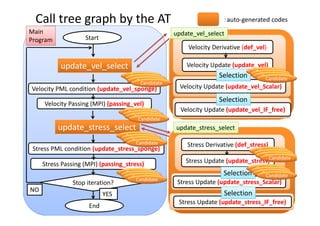
Call tree graph by the AT
Start
Stress Derivative (def_stress)
Stress Update (update_stress)
Stop iteration?
NO
YES
End
Velocity PML condition (update_vel_sponge)
Velocity Passing (MPI) (passing_vel)
Stress PML condition (update_stress_sponge)
Stress Passing (MPI) (passing_stress)
Velocity Derivative (def_vel)
Velocity Update (update_vel)
Main
Program
Velocity Update (update_vel_Scalar)
Stress Update (update_stress_Scalar)
Selection
Selection
update_vel_select
update_stress_select
update_vel_select
update_stress_select
:auto‐generated codes
Velocity Update (update_vel_IF_free)
Selection
Stress Update (update_stress_IF_free)
Selection
CandidateCandidateCandidateCandidate
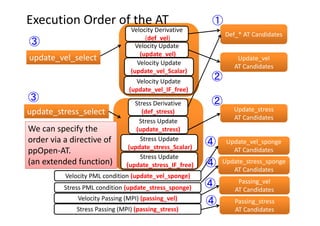
Execution Order of the AT
Velocity PML condition (update_vel_sponge)
Velocity Passing (MPI) (passing_vel)
Stress PML condition (update_stress_sponge)
Stress Passing (MPI) (passing_stress)
update_vel_select
update_stress_select
Stress Derivative 
(def_stress)
Stress Update 
(update_stress)
Velocity Derivative
(def_vel)
Velocity Update
(update_vel)
Velocity Update 
(update_vel_Scalar)
Stress Update
(update_stress_Scalar)
Def_* AT Candidates
Update_vel
AT Candidates
Update_stress
AT Candidates
Update_vel_sponge
AT Candidates
Update_stress_sponge
AT Candidates
Passing_vel
AT Candidates
Passing_stress
AT Candidates
①
②
②
③
③
④
④
④
④
Velocity Update 
(update_vel_IF_free)
Stress Update
(update_stress_IF_free)
We can specify the 
order via a directive of 
ppOpen‐AT.
(an extended function)
Outline
1. Background
2. ppOpen‐HPC and ppOpen‐AT
3. Code Selection in Seism3D and 
Its Implementation by ppOpen‐AT 
4. Performance Evaluation
5. Conclusion
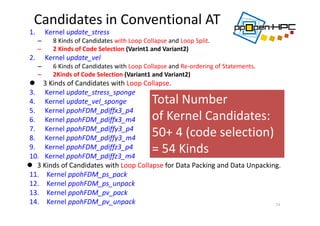
Candidates in Conventional AT
1. Kernel update_stress
– 8 Kinds of Candidates with Loop Collapse and Loop Split.
– 2 Kinds of Code Selection (Varint1 and Variant2)
2. Kernel update_vel
– 6 Kinds of Candidates with Loop Collapse and Re‐ordering of Statements.
– 2Kinds of Code Selection (Variant1 and Variant2)
 3 Kinds of Candidates with Loop Collapse.
3. Kernel update_stress_sponge
4. Kernel update_vel_sponge
5. Kernel ppohFDM_pdiffx3_p4
6. Kernel ppohFDM_pdiffx3_m4
7. Kernel ppohFDM_pdiffy3_p4
8. Kernel ppohFDM_pdiffy3_m4
9. Kernel ppohFDM_pdiffz3_p4
10. Kernel ppohFDM_pdiffz3_m4
 3 Kinds of Candidates with Loop Collapse for Data Packing and Data Unpacking.
11. Kernel ppohFDM_ps_pack
12. Kernel ppohFDM_ps_unpack
13. Kernel ppohFDM_pv_pack
14. Kernel ppohFDM_pv_unpack 24
Total Number 
of Kernel Candidates: 
50+ 4 (code selection)
= 54 Kinds
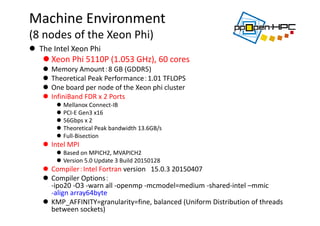
Machine Environment 
(8 nodes of the Xeon Phi)
 The Intel Xeon Phi 
 Xeon Phi 5110P (1.053 GHz), 60 cores
 Memory Amount:8 GB (GDDR5)
 Theoretical Peak Performance:1.01 TFLOPS
 One board per node of the Xeon phi cluster
 InfiniBand FDR x 2 Ports 
 Mellanox Connect‐IB
 PCI‐E Gen3 x16
 56Gbps x 2
 Theoretical Peak bandwidth 13.6GB/s
 Full‐Bisection
 Intel MPI
 Based on MPICH2, MVAPICH2
 Version 5.0 Update 3 Build 20150128 
 Compiler:Intel Fortran version 15.0.3 20150407
 Compiler Options:
‐ipo20 ‐O3 ‐warn all ‐openmp ‐mcmodel=medium ‐shared‐intel –mmic
‐align array64byte
 KMP_AFFINITY=granularity=fine, balanced (Uniform Distribution of threads 
between sockets)
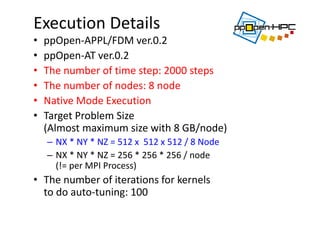
Execution Details
• ppOpen‐APPL/FDM ver.0.2
• ppOpen‐AT ver.0.2
• The number of time step: 2000 steps
• The number of nodes: 8 node
• Native Mode Execution
• Target Problem Size 
(Almost maximum size with 8 GB/node)
– NX * NY * NZ = 512 x  512 x 512 / 8 Node
– NX * NY * NZ = 256 * 256 * 256 / node
(!= per MPI Process)
• The number of iterations for kernels 
to do auto‐tuning: 100
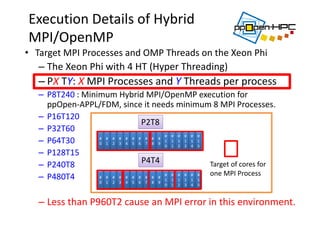
Execution Details of Hybrid 
MPI/OpenMP
• Target MPI Processes and OMP Threads on the Xeon Phi
– The Xeon Phi with 4 HT (Hyper Threading) 
– PX TY: X MPI Processes and Y Threads per process
– P8T240 : Minimum Hybrid MPI/OpenMP execution for 
ppOpen‐APPL/FDM, since it needs minimum 8 MPI Processes.
– P16T120
– P32T60
– P64T30
– P128T15  
– P240T8
– P480T4
– Less than P960T2 cause an MPI error in this environment.
#
0
#
1
#
2
#
3
#
4
#
5
#
6
#
7
#
8
#
9
#
1
0
#
1
1
#
1
2
#
1
3
#
1
4
#
1
5
P2T8
#
0
#
1
#
2
#
3
#
4
#
5
#
6
#
7
#
8
#
9
#
1
0
#
1
1
#
1
2
#
1
3
#
1
4
#
1
5
P4T4 Target of cores for 
one MPI Process
BREAK DOWN OF TIMINGS 
THE BEST IMPLEMENTATION
Outline
1. Background
2. ppOpen‐HPC and ppOpen‐AT
3. Code Selection in Seism3D and 
Its Implementation by ppOpen‐AT 
4. Performance Evaluation
5. Conclusion
RELATED WORK
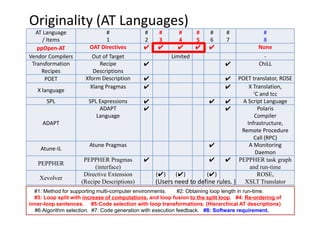
Originality (AT Languages)
AT Language 
/ Items
#
1
#
2
#
3
#
4
#
5
#
6
#
7
#
8
ppOpen‐AT OAT Directives ✔ ✔ ✔ ✔ ✔ None
Vendor Compilers Out of Target Limited ‐
Transformation 
Recipes 
Recipe
Descriptions
✔ ✔ ChiLL
POET Xform Description ✔ ✔ POET translator, ROSE
X language 
Xlang Pragmas ✔ ✔ X Translation,
‘C and tcc
SPL SPL Expressions ✔ ✔ ✔ A Script Language
ADAPT
ADAPT 
Language
✔ ✔ Polaris
Compiler 
Infrastructure, 
Remote Procedure 
Call (RPC)
Atune‐IL
Atune Pragmas ✔ A Monitoring 
Daemon
PEPPHER
PEPPHER Pragmas
(interface)
✔ ✔ ✔ PEPPHER task graph
and run-time
Xevolver
Directive Extension
(Recipe Descriptions)
(✔) (✔) (✔) ROSE,
XSLT Translator
#1: Method for supporting multi-computer environments. #2: Obtaining loop length in run-time.
#3: Loop split with increase of computations, and loop fusion to the split loop. #4: Re-ordering of
inner-loop sentences. #5:Code selection with loop transformations. (Hierarchical AT descriptions)
#6:Algorithm selection. #7: Code generation with execution feedback. #8: Software requirement.
(Users need to define rules. )
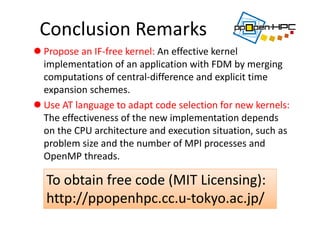
Conclusion Remarks
 Propose an IF‐free kernel: An effective kernel 
implementation of an application with FDM by merging 
computations of central‐difference and explicit time 
expansion schemes. 
 Use AT language to adapt code selection for new kernels: 
The effectiveness of the new implementation depends 
on the CPU architecture and execution situation, such as 
problem size and the number of MPI processes and 
OpenMP threads. 
To obtain free code (MIT Licensing):
http://ppopenhpc.cc.u‐tokyo.ac.jp/
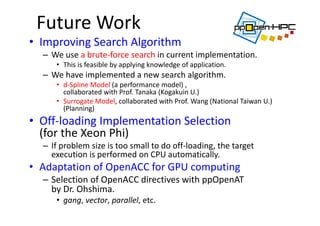
Future Work
• Improving Search Algorithm
– We use a brute‐force search in current implementation.
• This is feasible by applying knowledge of application.
– We have implemented a new search algorithm.
• d‐Spline Model (a performance model) ,
collaborated with Prof. Tanaka (Kogakuin U.)
• Surrogate Model, collaborated with Prof. Wang (National Taiwan U.) 
(Planning)
• Off‐loading Implementation Selection 
(for the Xeon Phi)
– If problem size is too small to do off‐loading, the target 
execution is performed on CPU automatically.
• Adaptation of OpenACC for GPU computing
– Selection of OpenACC directives with ppOpenAT 
by Dr. Ohshima.
• gang, vector, parallel, etc. 
http://ppopenhpc.cc.u‐tokyo.ac.jp/
Thank you for your attention!
Questions?
References (related to the authors)
1) H. Kuroda, T. Katagiri, Y. Kanada: Knowledge discovery in auto‐tuning parallel numerical library, 
Progress in Discovery Science”, Springer LNAI, Vol. 2281, pp.628‐639 (2001)
2) T. Katagiri, K. Kise, H. Honda, T. Yuba: FIBER: A general framework for auto‐tuning software, The Fifth 
International Symposium on High Performance Computing (ISHPC‐V), Springer LNCS 2858, pp. 146‐
159 (2003)
3) T. Katagiri, K. Kise, H. Honda, T. Yuba: Effect of auto‐tuning with user's knowledge for numerical 
software, Proceedings of the ACM 1st conference on Computing frontiers (CF2004), pp.12‐25, (2004)
4) T. Katagiri, Y. Ishii, H. Honda: RAO‐SS: A prototype of run‐time auto‐tuning facility for sparse direct 
solvers, Technical Report of UEC‐IS‐2005‐2, pp. 1‐10, (2005)
5) 櫻井隆雄、直野健、片桐孝洋、中島研吾、黒田久泰: OpenATLib: 数値計算ライブラリ向け自動
チューニングインターフェース、情報処理学会論文誌:ACS, Vol.3, No.2, pp.39‐47 (2010)
6) T. Katagiri, S. Ito, S. Ohshima: Early experiences for adaptation of auto‐tuning by ppOpen‐AT to an 
explicit method, Special Session: Auto‐Tuning for Multicore and GPU (ATMG) (In Conjunction with the 
IEEE MCSoC‐13), Proceedings of MCSoC‐13 (2013) 
7) T. Katagiri, S. Ohshima, M. Matsumoto: Auto‐tuning of computation kernels from an FDM Code with 
ppOpen‐AT, Special Session: Auto‐Tuning for Multicore and GPU (ATMG) (In Conjunction with the IEEE 
MCSoC‐14), Proceedings of MCSoC‐14 (2014) 
8) T.Katagiri, S.Ohshima, M. Matsumoto: Directive‐based Auto‐tuning for the Finite Difference Method 
on the Xeon Phi, The Tenth International Workshop on Automatic Performance Tuning (iWAPT2015) 
(In Conjunction with the IEEE IPDPS2015 ), Proceedings of IPDPSW2015, pp.1221‐1230 (2015)
Framework of Auto‐tuning 
9) 黒田久泰,片桐孝洋,佃良生,金田康正:自動チューニング機能付き並列数値計算ライブラリ構築
の試み ‐‐‐ 対称疎行列用の連立一次方程式ソルバを例にして ‐‐‐, 情報処理学会第57回全国大会講
演論文集(1), pp.1‐10 ‐ 1‐11 (1998)
10) T. Katagiri, H. Kuroda, and Y. Kanada: A Methodology for Automatically Tuned Parallel Tri‐
diagonalization on Distributed Memory Parallel Machines, Proceedings of VecPar2000, pp.265 ‐277 
(2000)
11) H. Kuroda, T. Katagiri, Y. Kanada: Performance of Automatically Tuned Parallel GMRES(m) Method on 
Distributed Memory Machines, Proceedings of VecPar2000, pp.251‐264, (2000)
12) 片桐孝洋,黒田久泰,大澤清,金田康正: ILIB: 自動チューニング機能付き並列数値計算ライブラリと
その性能評価, 2000年 並列処理シンポジウム(JSPP'2000),  JSPP'2000 論文集,pp. 27‐34 (2000)
13) 片桐孝洋, 黒田久泰, 大澤清, 工藤誠, 金田康正: 自動チューニング機構が並列数値計算ライブ
ラリに及ぼす効果, 情報処理学会論文誌: ハイパフォーマンスコンピューティングシステム, Vol.42, 
No.12, pp.60‐76 (2001)
14) T. Katagiri: A study on large scale eigensolvers for distributed memory parallel machines, Ph. D Thesis, 
the Department of Information Science, the University of Tokyo (2001) 
15) H. Kuroda, T. Katagiri, M. Kudoh, Y. Kanada: ILIB_GMRES: An auto‐tuning parallel iterative solver for 
linear equations, Proceedings of SC2001 (2001) (Poster)
16) 木下靖夫,片桐孝洋,弓場敏嗣: AutoTuned‐RB: 再帰BLASライブラリの自動チューニング方式, 2005
年 ハイパフォーマンスコンピューティングと計算科学シンポジウム(HPCS2005),HPCS2005 論文集,
pp. 33‐40 (2005)
Numerical Libraries with Auto‐tuning Facility : Part I of II
References (related to the authors)
17) T. Katagiri, K. Kise, H. Honda, T. Yuba: ABCLib_DRSSED: A parallel eigensolver with an auto‐tuning facility, Parallel 
Computing, Vol. 32, Issue 3, pp. 231 ‐ 250 (2006)
18) T. Katagiri, C. Vömel, JW Demmel: Automatic performance tuning for the multi‐section with multiple eigenvalues 
method for symmetric tridiagonal eigenproblems, Proceedings of  Applied Parallel Computing, State of the Art in 
Scientific Computing (PARA2006), Springer LNCS, Vol. 4699, pp.938‐948 (2007)
19) T. Katagiri, P.Y. Aquilanti, S. Petiton: A smart tuning strategy for restart frequency of GMRES (m) with hierarchical cache 
sizes, Proceedings of High Performance Computing for Computational Science‐VECPAR 2012, Springer LNCS, Vol.7851, 
pp.314‐328 (2013)
20) K. Naono, T. Katagiri, T. Sakurai, M. Igai, S. Ohshima, H. Kuroda, S. Itoh and K. Nakajima: A Fully Run‐time Auto‐tuned 
Sparse Iterative Solver with OpenATLib, The 4th International Conference on Intelligent and Advanced Systems 
(ICIAS2012), Proceedings of ICIAS2012, pp. 143‐148 (2012)
21) S. Ito, S. Ohshima, T. Katagiri: SSG‐AT: An Auto‐tuning Method of Sparse Matrix‐vector Multiplicataion for Semi‐
Structured Grids ‐ An Adaptation to OpenFOAM ‐, Special Session of Special Session: Auto‐Tuning for Multicore and GPU 
(ATMG) , Proceedings of MCSoC‐2012, pp.191‐197 (2012)
22) T. Katagiri, T. Sakurai, M. Igai, S. Ohshima, H. Kuroda, K. Naono and K. Nakajima: Control Formats for Unsymmetric and 
Symmetric Sparse Matrix‐vector Multiplications, Selected Papers of 10th International Meeting on High‐Performance 
Computing for Computational Science (VECPAR'2012) , Springer Lecture Notes in Computer Science, Volume 7851, 
pp.236‐248 (2013) 
23) T. Sakurai, T. Katagiri, H. Kuroda, K. Naono, M. Igai, S. Ohshima: A Sparse Matrix Library with Automatic Selection of 
Iterative Solvers and Preconditioners, Eighth international Workshop on Automatic Performance Tuning (iWAPT2013) (In 
conjunction workshop with International Conference on Computational Science, ICCS2013), Proceedings of the 
International Conference on Computational Science, ICCS 2013,Vol. 18, pp.1332‐1341 (2013)
24) Kengo Nakajima, Masaki Satoh, Takashi Furumura, Hiroshi Okuda, Takeshi Iwashita, Hide Sakaguchi, Takahiro Katagiri, 
Masaharu Matsumoto, Satoshi Ohshima, Hideyuki Jitsumoto, Takashi Arakawa, Futoshi Mori, Takeshi Kitayama, Akihiro 
Ida and Miki Y. Matsuo: ppOpen‐HPC: Open Source Infrastructure for Development and Execution of Large‐Scale 
Scientific Applications on Post‐Peta‐Scale Supercomputers with Automatic Tuning (AT), Optimization in the Real World, 
Mathematics for Industry 13, K. Fujisawa et al. (eds.), Springer, pp.15‐35 (2016) DOI:10.1007/978‐4‐431‐55420‐2_2 
References (related to the authors)
Numerical Libraries with Auto‐tuning Facility : Part II of II
25) T. Tanaka, T. Katagiri, T. Yuba: d‐Spline based incremental parameter estimation in automatic performance 
tuning, Proceedings of  Applied Parallel Computing, State of the Art in Scientific Computing (PARA2006), 
Springer LNCS, Vol. 4699, pp.986‐995 (2007)
26) 田中輝雄,片桐孝洋,弓場敏嗣: ソフトウェア自動チューニングにおける標本点追加型性能パラメタ推定
法,  電子情報通信学会論文誌 A,Vol.J90‐A, No.4, pp .281‐‐291 (2007)
27) 田中輝雄,片桐孝洋,弓場敏嗣:ソフトウェア自動チューニングにおける標本点逐次追加型性能パラメタ
推定法の疎行列計算への適用, 情報処理学会論文誌:コンピューティングシステム,Vol.48, No. SIG13 
(ACS 19), pp. 223‐234 (2007)
28) R. Suda, L. Cheng, T. Katagiri: A Mathematical Method for Online Autotuning of Power and Energy 
Consumption with Corrected Temperature Effects, Eighth international Workshop on Automatic 
Performance Tuning (iWAPT2013) (In conjunction workshop with International Conference on 
Computational Science, ICCS2013), Proceedings of the International Conference on Computational Science, 
ICCS 2013,Vol. 18, pp.1302–1311 (2013)
29) T. Tanaka, R. Otsuka, A. Fujii, T. Katagiri, T. Imamura: Implementation of d‐Spline‐based incremental 
performance parameter estimation method with ppOpen‐AT,  Scientific Programming,  IOS Press, Vol. 22, 
Issue 4, pp. 299‐307 (2014)
30) Riku Murata, Jun Irie, Akihiro Fujii, Teruo Tanaka, Takahiro Katagiri: Enhancement of Incremental 
Performance Parameter Estimation on ppOpen‐AT, Special Session: Auto‐Tuning for Multicore and GPU 
(ATMG‐15) (In Conjunction with the IEEE MCSoC‐15 ), Proceedings of MCSoC2015, Politecnico di Torino, 
Turin, Italy, September 23‐25, 2015, pp.‐, (2015) (In printing)
References (related to the authors)
Performance modeling for Auto‐tuning

Ase20 20151016 hp