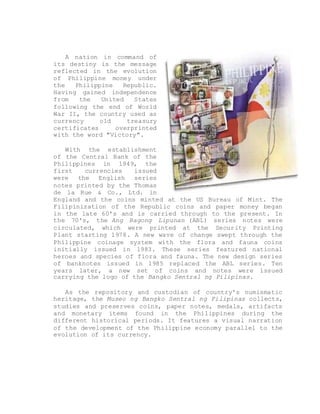
A nation in command of
its destiny is the message
reflected in the evolution
of Philippine money under
the Philippine Republic.
Having gained independence
from the United States
following the end of World
War II, the country used as
currency old treasury
certificates overprinted
with the word "Victory".
With the establishment
of the Central Bank of the
Philippines in 1949, the
first currencies issued
were the English series
notes printed by the Thomas
de la Rue & Co., Ltd. in
England and the coins minted at the US Bureau of Mint. The
Filipinization of the Republic coins and paper money began
in the late 60's and is carried through to the present. In
the 70's, the Ang Bagong Lipunan (ABL) series notes were
circulated, which were printed at the Security Printing
Plant starting 1978. A new wave of change swept through the
Philippine coinage system with the flora and fauna coins
initially issued in 1983. These series featured national
heroes and species of flora and fauna. The new design series
of banknotes issued in 1985 replaced the ABL series. Ten
years later, a new set of coins and notes were issued
carrying the logo of the Bangko Sentral ng Pilipinas.
As the repository and custodian of country's numismatic
heritage, the Museo ng Bangko Sentral ng Pilipinas collects,
studies and preserves coins, paper notes, medals, artifacts
and monetary items found in the Philippines during the
different historical periods. It features a visual narration
of the development of the Philippine economy parallel to the
evolution of its currency.
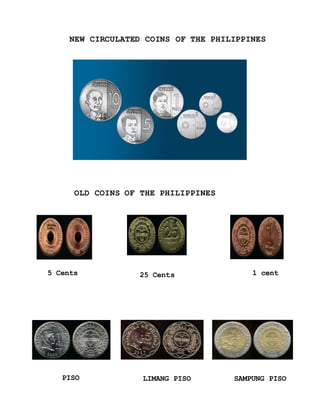
5 Cents 25 Cents 1 cent
PISO LIMANG PISO SAMPUNG PISO
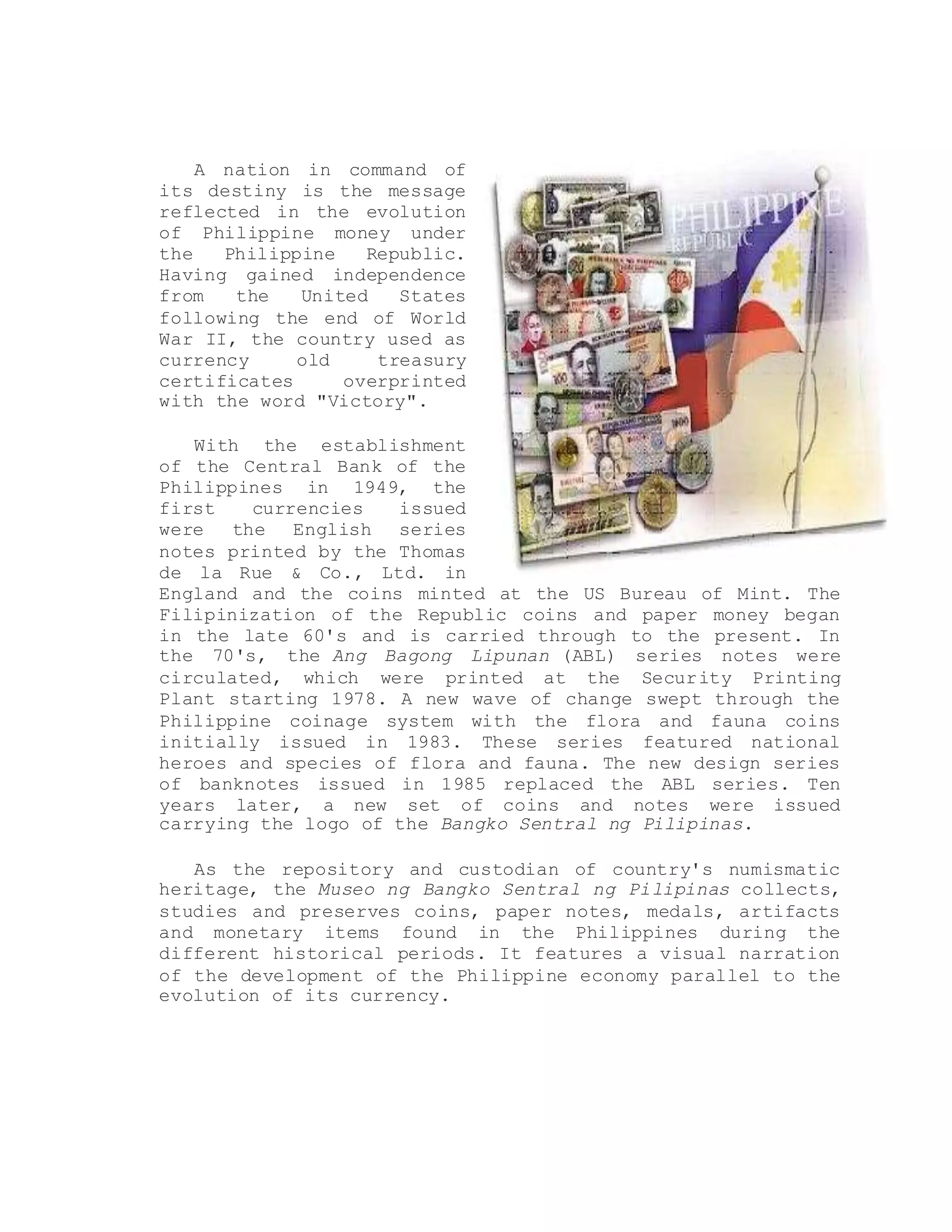
NEW CIRCULATED COINS OF THE PHILIPPINES
OLD COINS OF THE PHILIPPINES
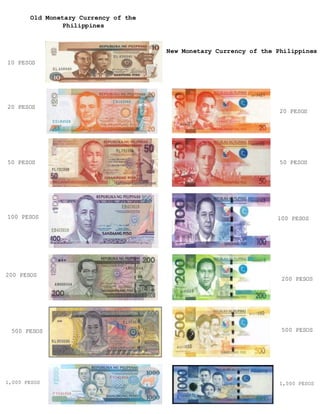
10 PESOS
Old Monetary Currency of the
Philippines
New Monetary Currency of the Philippines
20 PESOS
50 PESOS
100 PESOS
200 PESOS
500 PESOS
1,000 PESOS
20 PESOS
50 PESOS
100 PESOS
200 PESOS
500 PESOS
1,000 PESOS
The euro came into existence on 1 January 1999, although it had been a
goal of the European Union (EU) and its predecessors since the 1960s. After
tough negotiations, particularly due to opposition from the United Kingdom,
the Maastricht Treaty entered into force in 1993 with the goal of creating
an economic and monetary union by 1999 for all EU states except the UK and
Denmark (even though Denmark has a fixed exchange rate policy with the euro).
In 1999 the currency was born virtually and in 2002 notes and coins began to
circulate. It rapidly took over from the former national
currencies and slowly expanded behind the rest of the EU. In 2009 the Lisbon
Treaty finalised its political authority, the Eurogroup, alongside
the European Central Bank.
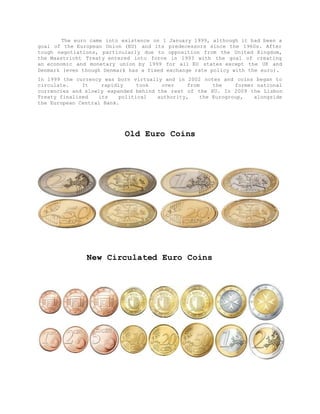
Old Euro Coins
New Circulated Euro Coins
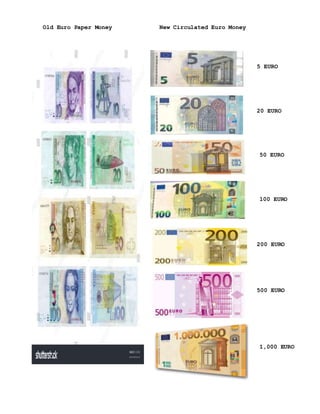
Old Euro Paper Money New Circulated Euro Money
5 EURO
20 EURO
50 EURO
100 EURO
200 EURO
500 EURO
1,000 EURO
Presented to the
Basic Finance Adviser
Mr.JuliusBaybado
In partial fullfillment of the
requirements for the degree of
Bachelor of Science in Office
Administration
Prepared by:
Mr.DanteBraulioBaniquedJr.
BSOA IV STUDENT

 asdf123456

  • 1.
    A nation incommand of its destiny is the message reflected in the evolution of Philippine money under the Philippine Republic. Having gained independence from the United States following the end of World War II, the country used as currency old treasury certificates overprinted with the word "Victory". With the establishment of the Central Bank of the Philippines in 1949, the first currencies issued were the English series notes printed by the Thomas de la Rue & Co., Ltd. in England and the coins minted at the US Bureau of Mint. The Filipinization of the Republic coins and paper money began in the late 60's and is carried through to the present. In the 70's, the Ang Bagong Lipunan (ABL) series notes were circulated, which were printed at the Security Printing Plant starting 1978. A new wave of change swept through the Philippine coinage system with the flora and fauna coins initially issued in 1983. These series featured national heroes and species of flora and fauna. The new design series of banknotes issued in 1985 replaced the ABL series. Ten years later, a new set of coins and notes were issued carrying the logo of the Bangko Sentral ng Pilipinas. As the repository and custodian of country's numismatic heritage, the Museo ng Bangko Sentral ng Pilipinas collects, studies and preserves coins, paper notes, medals, artifacts and monetary items found in the Philippines during the different historical periods. It features a visual narration of the development of the Philippine economy parallel to the evolution of its currency.
  • 2.
    5 Cents 25Cents 1 cent PISO LIMANG PISO SAMPUNG PISO NEW CIRCULATED COINS OF THE PHILIPPINES OLD COINS OF THE PHILIPPINES
  • 3.
    10 PESOS Old MonetaryCurrency of the Philippines New Monetary Currency of the Philippines 20 PESOS 50 PESOS 100 PESOS 200 PESOS 500 PESOS 1,000 PESOS 20 PESOS 50 PESOS 100 PESOS 200 PESOS 500 PESOS 1,000 PESOS
  • 4.
    The euro cameinto existence on 1 January 1999, although it had been a goal of the European Union (EU) and its predecessors since the 1960s. After tough negotiations, particularly due to opposition from the United Kingdom, the Maastricht Treaty entered into force in 1993 with the goal of creating an economic and monetary union by 1999 for all EU states except the UK and Denmark (even though Denmark has a fixed exchange rate policy with the euro). In 1999 the currency was born virtually and in 2002 notes and coins began to circulate. It rapidly took over from the former national currencies and slowly expanded behind the rest of the EU. In 2009 the Lisbon Treaty finalised its political authority, the Eurogroup, alongside the European Central Bank. Old Euro Coins New Circulated Euro Coins
  • 5.
    Old Euro PaperMoney New Circulated Euro Money 5 EURO 20 EURO 50 EURO 100 EURO 200 EURO 500 EURO 1,000 EURO
  • 6.
    Presented to the BasicFinance Adviser Mr.JuliusBaybado In partial fullfillment of the requirements for the degree of Bachelor of Science in Office Administration Prepared by: Mr.DanteBraulioBaniquedJr. BSOA IV STUDENT