CORE BIOLOGY PRACTICALS
                                       You will need to know these practicals as the exam board may ask you questions based on them. Below is a summary of each one.
   Name of practical and            Other variables to         Other equipment                                           Method and outcome                                                Possible evaluation issues
 independent & dependent               be controlled
        variables
                                    Temperature               Microscope, counter,        Method: Remove 1 Daphnia and place in cavity slide. Remove pond water and                   Ensuring Daphnia were same size
 Effect of caffeine on Daphnia      Volume of solutions       cavity slide, dropping      replace with distilled water. Leave for 5mins to acclimatise then observe & count           If left too long under microscope, temp
            heart rate              Stress of Daphnia          pipettes, stop clock,      heart rate under microscope for 30s, multiply number by 2 to calculate beats/min.           increases (due to lamp) = increased heart rate
                                    Size of Daphnia            distilled water, test      Repeat with 2 more Daphnia. Repeat again, this time with small concentration of             Ensuring enough data is collected
     Independent: caffeine          Time of                      tubes, stop clock        caffeine solution in place of distilled water. Carry out for 5 concentrations of caffeine   Too high concentration of caffeine kills
         concentration              acclimatisation                                       = 3 repeats at 3 concentrations.                                                            Daphnia
    Dependent: heart rate of                                                              Outcome: as caffeine concentration increased, heart rate increased                          Counting of heart beat can be inaccurate
           Daphnia
                                    Temperature               1% DCPIP solution, 1%       Method: pipette 1cm3 blue DCPIP into test tube. Using burette (or accurate pipette)         Difficulty in controlling temperature
   Measuring the content of         Concentration of         vitamin C solution, range    add 1% vitamin C solution drop by drop. Shake tube gently after each drop. Continue         Amount of shaking (too much adds oxygen
    Vitamin C in fruit juice        DCPIP solution (1%)          of fruit juices, test    until the blue colour just disappears. Record volume of solution needed to                  which will slightly restore the DCPIP to blue)
                                    Shake each tube             tubes/conical flasks,     decolourise the DCPIP. Repeat further 2 times and calculate mean result. Repeat             End point difficult to judge as needs to be just
   Independent: fruit juice         same number of                beakers, pipette        procedure with different fruit juices.                                                      when blue colour disappears especially in
  Dependent: volume of juice        times                        accurate to 1cm3,        Calculations: 1cm3 of 1% vitamin C solution contains 10mg Vitamin C, therefore mass         highly coloured juices
required to decolourise 1cm3 of     Same end point            burette, safety goggles     in 1cm3 = 10mg x volume of 1% vitamin C to decolourise 1cm3 of DCPIP.                       Some loss of solution when transferring from
             DCPIP                  colour. i.e. until the                                Mass in sample = mass of vitamin C to decolourise 1cm3 DCPIP volume of sample               one beaker to another
                                    blue colour of DCPIP                                  required to decolourise 1cm3 DCPIP                                                          Accuracy of measuring equipment
                                    just disappears
                                    Volume of distilled        Raw beetroot, size 4       Method: using cork borer and knife, cut pieces of beetroot into 1 cm length                 Some beetroot may have skin on affecting
The effect of temperature on cell   water                     cork borer, white tile,     cylinders. Place in distilled water overnight to remove any dye released on                 surface area.
           membranes                Time left in water         knife, ruler, beaker,      preparation. Wash and blot dry. Place 8 boiling tubes of distilled water into 8 water       Difficulty in maintaining temperature
                                    Size of beetroot          forceps, water baths,       baths of different temperature. Once at temperature, add a piece of beetroot to             Accurate reading of the colorimeter
  Independent: temperature of       piece                          boiling tubes,         each and leave for 30 mins. Remove beetroot and shake tubes to disperse dye. Set            Accurate size of beetroot
              water                                               thermometer,            colorimeter to % absorbance on blue/green filter. Calibrate using distilled water in a      From the different parts of the root
  Dependent: % transmission of                               colorimeter & cuvettes,      cuvette first then add 2cm3 of beetroot solution from the first temp to a new               Ensuring same amount of time at the
 light through resulting solution                               stop clock, distilled     cuvette. Place into colorimeter to read % absorbance. Repeat for all other pieces.          different temperatures
                                                                  water, syringe          Calculations & outcome: to calculate % transmission = 100-%absorbance.
                                                                                          As temperature increased, % transmission slightly increased to a point at which it
                                                                                          greatly increased due to membrane molecules gaining more heat energy, vibrating
                                                                                          more to a point where the vibrations caused large gaps in the membrane enabling the
                                                                                          release of dye also proteins in membrane denatured leaving large pores.
                                     Temperature             Protease e.g.1% trypsin,     Method: make up different concentrations of enzyme using distilled water. Ensure            Maintaining constant temperature
 The effect of changing enzyme       Volume of enzyme         casein solution, small      different syringes for different chemicals to prevent cross contamination. Set up           Accurately making up the different
    concentration on rate of         Volume of               beakers, thermometer,        water bath for temperature to keep constant. Place 1 test tube of 5cm3 casein               concentrations
            reaction.                substrate               distilled water, syringes,   solution into water bath alongside second tube containing 2cm3 of 0.2% trypsin.             Identifying end point consistently
                                     Concentration of        stopclock, large beaker      Allow to acclimatise for 3 mins so that at same temperature then add trypsin to             Difficult to see the cross through the solution
 Independent: concentration of       substrate                                            casein, start stop clock. Time how long it takes for casein solution to turn transparent.
           enzyme                    pH                                                   (mark a ‘X’ on the other side of tube, as soon as seen through solution stop clock).
   dependent: time taken for                                                              Repeat a further 2 times then repeat for next concentration.
enzyme to break down substrate                                                            Calculations & outcome: rate = 1 time
                                                                                          As concentration of enzyme increases, rate of reaction increases until a plateau point
                                                                                          where all enzyme has metabolised all substrate immediately.
                                                             Using catalase in yeast      Method: using first concentration of yeast solution, acclimatise to desired                 Attaching syringe can be slower allowing loss
                                                             and hydrogen peroxide        temperature alongside separate tube of hydrogen peroxide. Set up gas syringe and            of gas
                                                                                          set to 0. Quickly add peroxide to yeast and attach gas syringe. Read off the volume of      Inaccurate reading of gas syring
                                                                                          oxygen gas produced every 10 mins until 3 readings are the same. Repeat 3 times for         Inaccurate reading of syringes in making up
                                                                                          each concentration of yeast solution.                                                       dilutions
                                                                                          Calculations & outcome: rate = initial rate of reaction = gradient at steepest point        Reaction going too quickly to read
                                                                                          from graphs of volume against time for each concentration. Outcome as protease
                                                                                          above
Name of practical and          Other variables to       Other equipment                                           Method and outcome                                                 Possible evaluation issues
 independent & dependent             be controlled
        variables
                                                         Garlic roots, sharp knife,   Method: place test tube of 2cn3 1M HCl into 60˚C waterbath. Cut off 1-2cm of root            Resolution of microscope
      Observing Mitosis                                    1M hydrochloric acid,      tip from garlic root. Put in watch glass containing 2cm3 of acetic alcohol for at least 12   Human error in counting numbers of cells
                                                         Ethanoic alcohol, Orcein     mins. Remove then place into another watch glass containing 5cm3 ice cold distilled          Enough time in the solutions to enable
Chromosomes stained blue using                            ethanoic stain, ice-cold    water. Leave for 4-5 mins, then remove and dry. Place tips into heated HCl for 5mins         successful maceration or staining.
     orcein ethanoic stain                                 distilled water, water     then repeat process again by placing tips back into acetic alcohol etc. Tips will be very
                                                           bath @ 60˚C, 2 watch       fragile at this point. Transfer 1 tip to microscope slide, cut 4-5mm from growing tip
                                                            glasses, test tube, 2     (site of mitosis) and keep the tip. Gently break up (macerate) with mounted needle,
                                                            pipettes, microscope      add 1 small drop of orcein ethanoic stain and leave for 2 mins. Add coverslip and blot
                                                         slides, forceps, mounted     with filter paper. View under microscope and identify the stages of mitosis.
                                                            needle, filter paper,     Calculations: percentage of cells in each stage of mitosis
                                                           microscope with mag        Mitotic index: number of cells containing visible chromosomes total number of
                                                                x100 & x400           cells in the field of view
                                                         Seeds of white mustard,      Method: sprinkle seeds on damp sponge and allow to germinate. Use when just                  Unwanted pathogens growing in the gel as it
 Totipotency & Tissue Culture                               agar, distilled water,    starting to unfold their cotyledons (seed leaves). Make up Agar gel and pour 2cm             is a good source of water and nutrients
                                                         damp sponge, cling film,     height of gel into McCartney bottles and allow to set. With sharp scissors, cut the tops     Wrong part of the plant cut and inserted into
                                                             McCartney bottles,       off just below the shoot apex (including the cotyledons). This is called an explants.        gel.
                                                          weighing scales, plastic    Push the stem of the explant into the gel (making sure cotyledons don’t touch agar)
                                                         tray, 250ml beaker, glass    cover with cling film and place on sunny windowsill. Observe over 10 days.
                                                             rod, scissors, sunny     Outcome: explant grows roots and leaves continue to grow. You need to be able to
                                                                 window sill          explain why they are covered in cling film and why they continue to grow even when
                                                                                      covered. Also why they shouldn’t be opened again.
                                   Length of fibre       Stems of stinging nettles    Method: plant material should be left to soak in a bucket of water for about a week in       Maintaining length of fibres
  The strength of plant fibres     Size of each          or celery, bucket, gloves,   order for the fibres to be easily extracted (called retting). Or celery stalks should be     Ensuring consistency when twisting or plaiting
                                   individual mass         paper towels, clamp        left in beaker of coloured water in order for fibres to be easily seen and pulled out.       Using fibres of the same age (as they get older
Independent: source and type of                           stands, slotted masses      Once fibres removed, connect between 2 clamp stands and gradually add mass in the            they become more brittle)
             fibre                                        and holders, white tile,    middle until the fibre snaps. Try with individual fibres from different plants and           Extracting whole fibres that are useful
  Dependent: mass that can be                                   sharp knife           different ways of combining fibres eg twists and plaits. Can also compare stem to
             held                                                                     individual fibres.
                                                                                      Outcome: the more fibres combined together the stronger it is.
                                   Volume of mineral     Mexican hat plantlets or     Method: half fill a tube with the ‘all nutrients present’ solution. Cover the top of the     Ensuring accurate measurement of solutions
  Investigating plant mineral      solution              geranium leaves, 7 test      tube with foil or paraffin and push down on covering so that there is a well in the          No air bubble caught in xylem of geranium
          deficiencies             Species of plant      tubes, test tube holder,     centre. Gently push the geranium stem/roots of Mexican hat plantlet through the              possible microorganism growth in nutrient
                                   Size of container         different mineral        hole so it is in solution below. Repeat with solutions lacking in nitrogen or phosphate      solution
Independent: minerals present      Amount of light       solutions:- each lacking     or potassium or magnesium or calcium or lacking all. Wrap all tubes in aluminium foil        insufficient time to see an effect.
     Dependent: physical           received                   1 nutrient and 1        and place in tube holder on sunny window sill. Observe regularly.
  characteristics of the plant                                 containing all,        Outcome: the ‘all nutrients present’ plant will look healthy whereas the others will all
                                                               aluminium foil         have some abnormality. Make sure you know what nutrient deficiencies affect plants.
                                   concentration of       Agar plate seeded with      Method: make plant extract by crushing 3g of plant material with 10cm3 industrial            Growth of unwanted microbes on agar plates
  Effect of garlic and mint on     plant material        bacteria, plant material     denatured alcohol. Shake occasionally for 10 mins. Pipette 0.1cm3 of extract onto            due to bad aseptic techniques
       bacterial growth            lawn of bacteria on   e.g. garlic & mint, pestle   sterile paper disc. Allow to dry on sterile petri dish. Meanwhile label agar plates with     Not shaking extract enough to ensure enough
                                   petri dish                 & mortar, 10cm3         date and split into 4 sections. 1 for each type of plant extract. Place 1 disc of each       active ingredient
Independent: presence of garlic    contamination of        industrial denatured       extract in each quadrant of the agar plate, close and tape with hazard tape. Leave to        Inconsistency when adding plant extract to
          or mint                  petri dish by other    alcohol, sterile pipette,   incubate over night and observe zone of inhibition. Carry out controls with just             paper discs.
 Dependent: zone of inhibition     microbes              paper discs, sterile petri   distilled water on discs.                                                                    Contaminating controls
        around disc                same volume of           dish, sterile forceps,    Outcome: the control discs completely covered with bacteria, some plant extracts will        Using wrong species of bacteria for lawn
                                   plant material on       hazard tape, marker        create larger zones of inhibition than others, meaning they are more effective at
                                   each disc                         pen.             lower concentrations.

As biology core_practical_summary

  • 1.
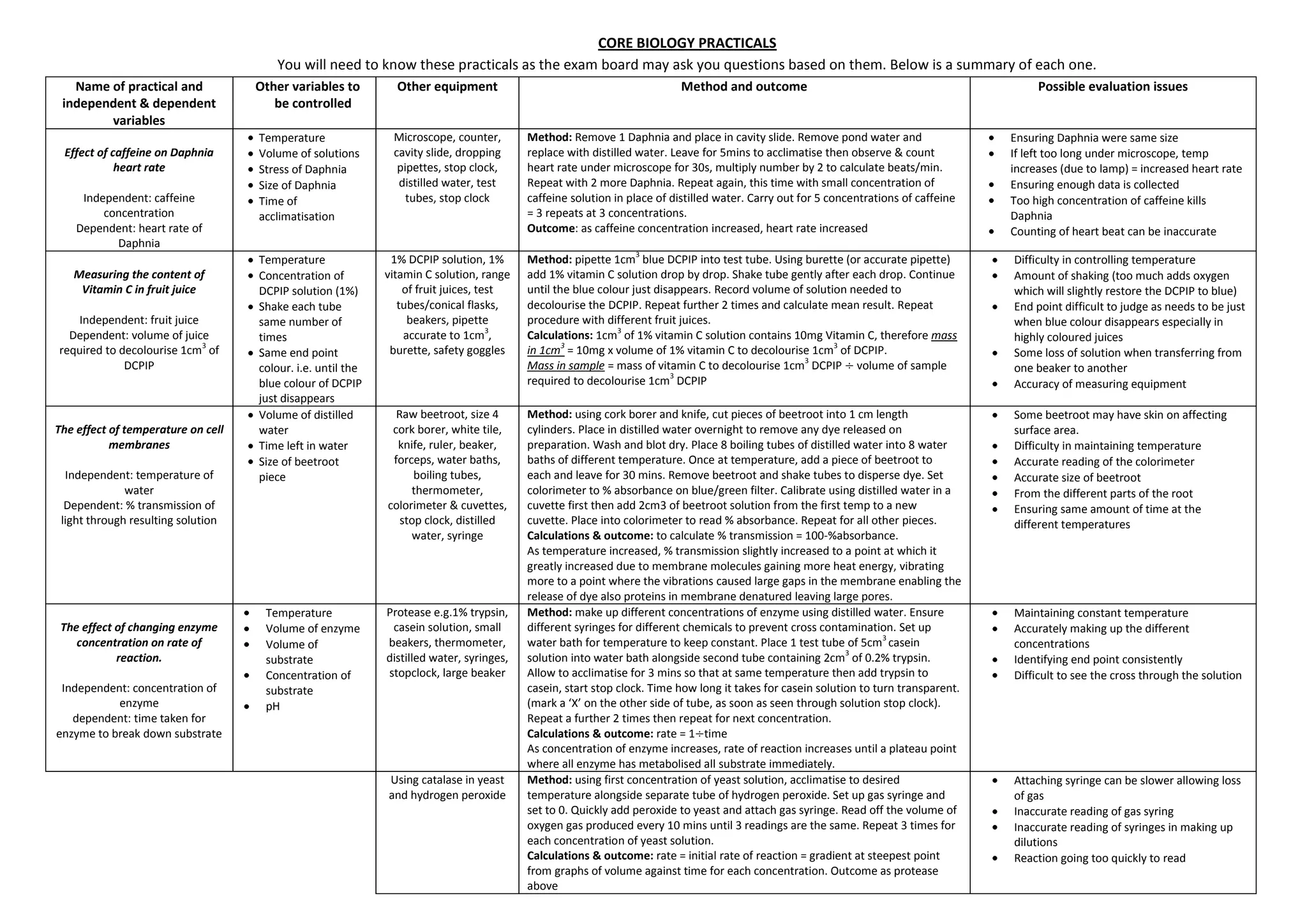
    CORE BIOLOGY PRACTICALS You will need to know these practicals as the exam board may ask you questions based on them. Below is a summary of each one. Name of practical and Other variables to Other equipment Method and outcome Possible evaluation issues independent & dependent be controlled variables Temperature Microscope, counter, Method: Remove 1 Daphnia and place in cavity slide. Remove pond water and Ensuring Daphnia were same size Effect of caffeine on Daphnia Volume of solutions cavity slide, dropping replace with distilled water. Leave for 5mins to acclimatise then observe & count If left too long under microscope, temp heart rate Stress of Daphnia pipettes, stop clock, heart rate under microscope for 30s, multiply number by 2 to calculate beats/min. increases (due to lamp) = increased heart rate Size of Daphnia distilled water, test Repeat with 2 more Daphnia. Repeat again, this time with small concentration of Ensuring enough data is collected Independent: caffeine Time of tubes, stop clock caffeine solution in place of distilled water. Carry out for 5 concentrations of caffeine Too high concentration of caffeine kills concentration acclimatisation = 3 repeats at 3 concentrations. Daphnia Dependent: heart rate of Outcome: as caffeine concentration increased, heart rate increased Counting of heart beat can be inaccurate Daphnia Temperature 1% DCPIP solution, 1% Method: pipette 1cm3 blue DCPIP into test tube. Using burette (or accurate pipette) Difficulty in controlling temperature Measuring the content of Concentration of vitamin C solution, range add 1% vitamin C solution drop by drop. Shake tube gently after each drop. Continue Amount of shaking (too much adds oxygen Vitamin C in fruit juice DCPIP solution (1%) of fruit juices, test until the blue colour just disappears. Record volume of solution needed to which will slightly restore the DCPIP to blue) Shake each tube tubes/conical flasks, decolourise the DCPIP. Repeat further 2 times and calculate mean result. Repeat End point difficult to judge as needs to be just Independent: fruit juice same number of beakers, pipette procedure with different fruit juices. when blue colour disappears especially in Dependent: volume of juice times accurate to 1cm3, Calculations: 1cm3 of 1% vitamin C solution contains 10mg Vitamin C, therefore mass highly coloured juices required to decolourise 1cm3 of Same end point burette, safety goggles in 1cm3 = 10mg x volume of 1% vitamin C to decolourise 1cm3 of DCPIP. Some loss of solution when transferring from DCPIP colour. i.e. until the Mass in sample = mass of vitamin C to decolourise 1cm3 DCPIP volume of sample one beaker to another blue colour of DCPIP required to decolourise 1cm3 DCPIP Accuracy of measuring equipment just disappears Volume of distilled Raw beetroot, size 4 Method: using cork borer and knife, cut pieces of beetroot into 1 cm length Some beetroot may have skin on affecting The effect of temperature on cell water cork borer, white tile, cylinders. Place in distilled water overnight to remove any dye released on surface area. membranes Time left in water knife, ruler, beaker, preparation. Wash and blot dry. Place 8 boiling tubes of distilled water into 8 water Difficulty in maintaining temperature Size of beetroot forceps, water baths, baths of different temperature. Once at temperature, add a piece of beetroot to Accurate reading of the colorimeter Independent: temperature of piece boiling tubes, each and leave for 30 mins. Remove beetroot and shake tubes to disperse dye. Set Accurate size of beetroot water thermometer, colorimeter to % absorbance on blue/green filter. Calibrate using distilled water in a From the different parts of the root Dependent: % transmission of colorimeter & cuvettes, cuvette first then add 2cm3 of beetroot solution from the first temp to a new Ensuring same amount of time at the light through resulting solution stop clock, distilled cuvette. Place into colorimeter to read % absorbance. Repeat for all other pieces. different temperatures water, syringe Calculations & outcome: to calculate % transmission = 100-%absorbance. As temperature increased, % transmission slightly increased to a point at which it greatly increased due to membrane molecules gaining more heat energy, vibrating more to a point where the vibrations caused large gaps in the membrane enabling the release of dye also proteins in membrane denatured leaving large pores. Temperature Protease e.g.1% trypsin, Method: make up different concentrations of enzyme using distilled water. Ensure Maintaining constant temperature The effect of changing enzyme Volume of enzyme casein solution, small different syringes for different chemicals to prevent cross contamination. Set up Accurately making up the different concentration on rate of Volume of beakers, thermometer, water bath for temperature to keep constant. Place 1 test tube of 5cm3 casein concentrations reaction. substrate distilled water, syringes, solution into water bath alongside second tube containing 2cm3 of 0.2% trypsin. Identifying end point consistently Concentration of stopclock, large beaker Allow to acclimatise for 3 mins so that at same temperature then add trypsin to Difficult to see the cross through the solution Independent: concentration of substrate casein, start stop clock. Time how long it takes for casein solution to turn transparent. enzyme pH (mark a ‘X’ on the other side of tube, as soon as seen through solution stop clock). dependent: time taken for Repeat a further 2 times then repeat for next concentration. enzyme to break down substrate Calculations & outcome: rate = 1 time As concentration of enzyme increases, rate of reaction increases until a plateau point where all enzyme has metabolised all substrate immediately. Using catalase in yeast Method: using first concentration of yeast solution, acclimatise to desired Attaching syringe can be slower allowing loss and hydrogen peroxide temperature alongside separate tube of hydrogen peroxide. Set up gas syringe and of gas set to 0. Quickly add peroxide to yeast and attach gas syringe. Read off the volume of Inaccurate reading of gas syring oxygen gas produced every 10 mins until 3 readings are the same. Repeat 3 times for Inaccurate reading of syringes in making up each concentration of yeast solution. dilutions Calculations & outcome: rate = initial rate of reaction = gradient at steepest point Reaction going too quickly to read from graphs of volume against time for each concentration. Outcome as protease above
  • 2.
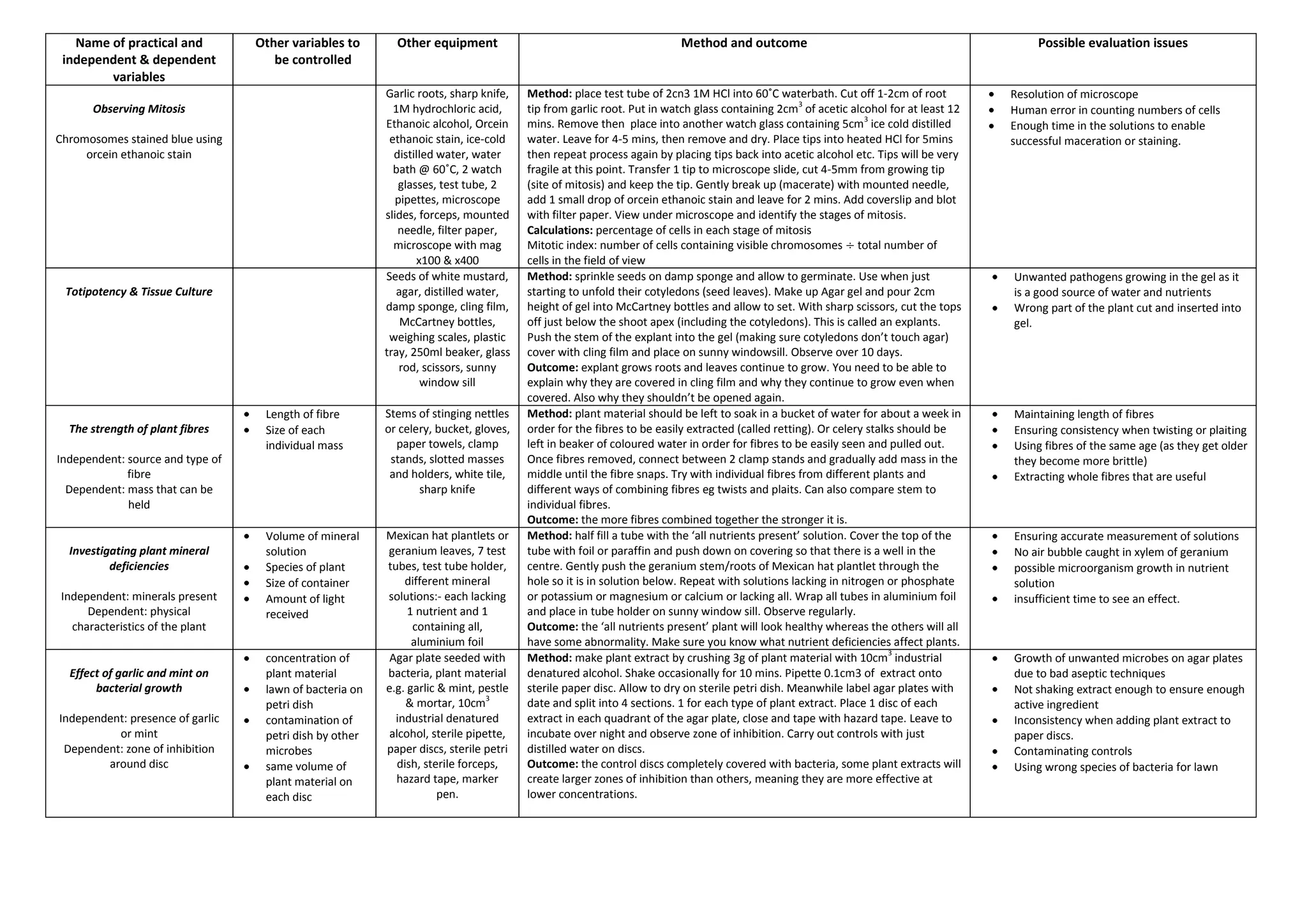
    Name of practicaland Other variables to Other equipment Method and outcome Possible evaluation issues independent & dependent be controlled variables Garlic roots, sharp knife, Method: place test tube of 2cn3 1M HCl into 60˚C waterbath. Cut off 1-2cm of root Resolution of microscope Observing Mitosis 1M hydrochloric acid, tip from garlic root. Put in watch glass containing 2cm3 of acetic alcohol for at least 12 Human error in counting numbers of cells Ethanoic alcohol, Orcein mins. Remove then place into another watch glass containing 5cm3 ice cold distilled Enough time in the solutions to enable Chromosomes stained blue using ethanoic stain, ice-cold water. Leave for 4-5 mins, then remove and dry. Place tips into heated HCl for 5mins successful maceration or staining. orcein ethanoic stain distilled water, water then repeat process again by placing tips back into acetic alcohol etc. Tips will be very bath @ 60˚C, 2 watch fragile at this point. Transfer 1 tip to microscope slide, cut 4-5mm from growing tip glasses, test tube, 2 (site of mitosis) and keep the tip. Gently break up (macerate) with mounted needle, pipettes, microscope add 1 small drop of orcein ethanoic stain and leave for 2 mins. Add coverslip and blot slides, forceps, mounted with filter paper. View under microscope and identify the stages of mitosis. needle, filter paper, Calculations: percentage of cells in each stage of mitosis microscope with mag Mitotic index: number of cells containing visible chromosomes total number of x100 & x400 cells in the field of view Seeds of white mustard, Method: sprinkle seeds on damp sponge and allow to germinate. Use when just Unwanted pathogens growing in the gel as it Totipotency & Tissue Culture agar, distilled water, starting to unfold their cotyledons (seed leaves). Make up Agar gel and pour 2cm is a good source of water and nutrients damp sponge, cling film, height of gel into McCartney bottles and allow to set. With sharp scissors, cut the tops Wrong part of the plant cut and inserted into McCartney bottles, off just below the shoot apex (including the cotyledons). This is called an explants. gel. weighing scales, plastic Push the stem of the explant into the gel (making sure cotyledons don’t touch agar) tray, 250ml beaker, glass cover with cling film and place on sunny windowsill. Observe over 10 days. rod, scissors, sunny Outcome: explant grows roots and leaves continue to grow. You need to be able to window sill explain why they are covered in cling film and why they continue to grow even when covered. Also why they shouldn’t be opened again. Length of fibre Stems of stinging nettles Method: plant material should be left to soak in a bucket of water for about a week in Maintaining length of fibres The strength of plant fibres Size of each or celery, bucket, gloves, order for the fibres to be easily extracted (called retting). Or celery stalks should be Ensuring consistency when twisting or plaiting individual mass paper towels, clamp left in beaker of coloured water in order for fibres to be easily seen and pulled out. Using fibres of the same age (as they get older Independent: source and type of stands, slotted masses Once fibres removed, connect between 2 clamp stands and gradually add mass in the they become more brittle) fibre and holders, white tile, middle until the fibre snaps. Try with individual fibres from different plants and Extracting whole fibres that are useful Dependent: mass that can be sharp knife different ways of combining fibres eg twists and plaits. Can also compare stem to held individual fibres. Outcome: the more fibres combined together the stronger it is. Volume of mineral Mexican hat plantlets or Method: half fill a tube with the ‘all nutrients present’ solution. Cover the top of the Ensuring accurate measurement of solutions Investigating plant mineral solution geranium leaves, 7 test tube with foil or paraffin and push down on covering so that there is a well in the No air bubble caught in xylem of geranium deficiencies Species of plant tubes, test tube holder, centre. Gently push the geranium stem/roots of Mexican hat plantlet through the possible microorganism growth in nutrient Size of container different mineral hole so it is in solution below. Repeat with solutions lacking in nitrogen or phosphate solution Independent: minerals present Amount of light solutions:- each lacking or potassium or magnesium or calcium or lacking all. Wrap all tubes in aluminium foil insufficient time to see an effect. Dependent: physical received 1 nutrient and 1 and place in tube holder on sunny window sill. Observe regularly. characteristics of the plant containing all, Outcome: the ‘all nutrients present’ plant will look healthy whereas the others will all aluminium foil have some abnormality. Make sure you know what nutrient deficiencies affect plants. concentration of Agar plate seeded with Method: make plant extract by crushing 3g of plant material with 10cm3 industrial Growth of unwanted microbes on agar plates Effect of garlic and mint on plant material bacteria, plant material denatured alcohol. Shake occasionally for 10 mins. Pipette 0.1cm3 of extract onto due to bad aseptic techniques bacterial growth lawn of bacteria on e.g. garlic & mint, pestle sterile paper disc. Allow to dry on sterile petri dish. Meanwhile label agar plates with Not shaking extract enough to ensure enough petri dish & mortar, 10cm3 date and split into 4 sections. 1 for each type of plant extract. Place 1 disc of each active ingredient Independent: presence of garlic contamination of industrial denatured extract in each quadrant of the agar plate, close and tape with hazard tape. Leave to Inconsistency when adding plant extract to or mint petri dish by other alcohol, sterile pipette, incubate over night and observe zone of inhibition. Carry out controls with just paper discs. Dependent: zone of inhibition microbes paper discs, sterile petri distilled water on discs. Contaminating controls around disc same volume of dish, sterile forceps, Outcome: the control discs completely covered with bacteria, some plant extracts will Using wrong species of bacteria for lawn plant material on hazard tape, marker create larger zones of inhibition than others, meaning they are more effective at each disc pen. lower concentrations.