Special Educators
and Mathematics Phobia: An
Initial Qualitative Investigation
MICHAEL HUMPHREY and JACK J. HOURCADE
Abstract: Special educators are uniquely challenged to
be content experts in all curricular areas, including
mathematics, because students in their caseloads may
require academic instruction in any area. However, spe-
cial educators with math phobia may be limited in their
ability to provide effective instruction to their students
with mathematical deficits or needs, and they may ex-
perience additional challenges in their professional and
personal lives. This qualitative study seeks to better un-
derstand the nature of math phobia in two special ed-
ucators through extensive interviews, journaling, and
observations in math experiences, with a number of
primary themes identified. Several potential resolutions
for the issues emerging from math phobia in special
educators are identified and discussed.
Keywords: mathematics, math phobia, special educa-
tors
In the middle grades through high school (sixth
through twelfth grade), teachers are frequently able
to teach primarily or exclusively within the content ar-
eas in which they have some interest, aptitude, or both.
For example, English or writing teachers often teach lan-
guage arts because it was their favorite or strongest sub-
ject in school, social studies teachers teach civics because
they enjoy the dynamics of government and society, and
so on.
What about the special education teacher? Do aspir-
ing special education teachers share a common favorite
subject from high school or college? If so, it seems un-
likely that this subject was special education. Did these
future special educators receive special education ser-
vices as students themselves during their K–12 educa-
tions? This possibility again seems unlikely for most.
Michael Humphrey, EdD, is an assistant professor of special education at Boise State
University, Boise, ID. Jack J. Hourcade, PhD, is a professor of special education at Boise
State University. Copyright © 2010 Heldref Publications
The lack of content-area identification with their work
is a potentially noteworthy difference between special
educators and their general education counterparts.
Special educators (and most teachers in K–3 settings)
are typically expected to teach in all content areas that
are included in the school’s curriculum, because stu-
dents with disabilities may require instructional or be-
havioral support in any curricular area. However, unlike
their K–3 general education counterparts, many special
educators are certified on a K–12 basis, and, thus, they
are expected to teach sophisticated academic content to
students in secondary schools. This reality may pose dif-
ficulties for some special educators, because many have
had only minimal exposure to upper-level mathemat-
ics coursework in their teacher preparation programs.
For a variety of reasons, teachers may lack confidence in
their ability to teach mathematics knowledge and skills
(Kopp 2006).
Math phobia has been defined as a condition char-
acterized by feelings of panic, helplessness, paralysis,
and/or mental disorganization that arises when an indi-
vidual faces mathematical reasoning or calculation (To-
bias and Weissbrod 1980). What happens when a spe-
cial education teacher experiences math phobia? How
might this condition affect their professional and per-
sonal lives, the quality of their instruction, and their
students’ mathematical competence? How do math-
phobic special educators view their experiences in in-
structing mathematics and how do they respond when
faced with tasks involving mathematics? Can a special
educator be effective in mathematics instruction when
he or she feels uncomfortable or even incompetent in
that content area?
This qualitative study sought to produce insights
about and understanding of special educators who ex-
perience math phobia. Questions included how these
26
Special Educators and Mathematics Phobia 27
teachers remembered and perceived their own experi-
ences in mathematics, and how they currently perceive
the impact of their math phobias on their provision of
educational services to students with disabilities.
Methodology
Participants and Setting
In 2006, Dr. Humphrey cotaught a university course
entitled Mathematics and Content Area Learning for Stu-
dents with Disabilities. This course was part of a graduate-
level program that culminated in teacher certification in
special education. Dr. Humphrey identified a total of
eight graduate students from two sections of this course
(out of a total thirty-five students from both sections)
who made comments consistent with math phobia,
including aversion to mathematics and mathematics-
based activities and histories of struggle with mathe-
matical tasks and demands.
After the course ended and final grades were recorded,
these eight individuals were contacted and invited to
participate in a study on math anxiety in special educa-
tors. When informed of the nature of proposed inves-
tigation, a common response was a sigh or a muttered
“Oh . . . ” Given that even talking about mathematics
might be difficult for self-described math phobics, it is
not surprising that few were willing to participate. Only
two of the eight students, “Angela” and “Athena,” self-
identified as math phobic and agreed to participate.
Angela and Athena both possessed a bachelor’s de-
gree, and each was pursuing certification and a master’s
degree in special education. Angela’s undergraduate de-
gree was in psychology. She had taught special educa-
tion for three years under a state emergency license. At
the time of this study, she was working in a special ed-
ucation resource room setting at an elementary school.
Athena had a bachelor’s in social work and had for-
merly worked as a school social worker. She began her
career as a special educator at a public school through
the state’s emergency licensure program, and, at the time
of the study, she was teaching middle school students
with learning, emotional, and behavioral disorders in
inclusive settings.
Data Collection
All data were collected over a three-month period.
During that time, Dr. Humphrey conducted three in-
depth, private, individual interview sessions with each
participant. Each session lasted approximately 45 to
60 minutes. Each participant was questioned about her
past experiences with mathematics, loosely following
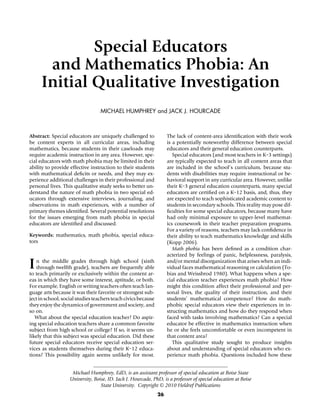
the interview script outlined in Table 1.
Each participant was also given a mathematics jour-
nal (see Table 2) and asked to record her experiences
and feelings before or after mathematics-related activi-
ties during the study. In addition, toward the end of the
TABLE 1. Interview Script
1. Can you tell me a story about a math class you had in
elementary or secondary school?
2. How do you feel when faced with a difficult
algorithm?
3. Do you balance your checkbook?
4. Did you ever enjoy math as a student?
5. How do you feel when instructing math now?
6. How important do you feel mathematic instruction is?
7. What impact do you think you have in your students’
math development and progress?
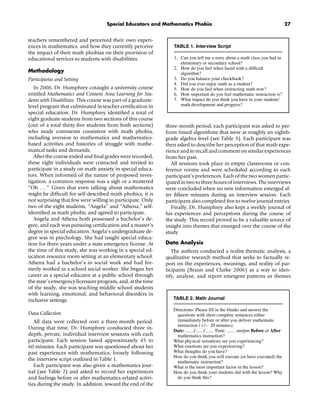
three-month period, each participant was asked to per-
form timed algorithms that were at roughly an eighth-
grade algebra level (see Table 3). Each participant was
then asked to describe her perception of that math expe-
rience and to recall and comment on similar experiences
from her past.
All sessions took place in empty classrooms or con-
ference rooms and were scheduled according to each
participant’s preferences. Each of the two women partic-
ipated in two to three hours of interviews. The interviews
were concluded when no new information emerged af-
ter fifteen minutes during an interview session. Each
participant also completed five to twelve journal entries.
Finally, Dr. Humphrey also kept a weekly journal of
his experiences and perceptions during the course of
the study. This record proved to be a valuable source of
insight into themes that emerged over the course of the
study.
Data Analysis
The authors conducted a realist thematic analysis, a
qualitative research method that seeks to factually re-
port on the experiences, meanings, and reality of par-
ticipants (Braun and Clarke 2006) as a way to iden-
tify, analyze, and report emergent patterns or themes
TABLE 2. Math Journal
Directions: Please fill in the blanks and answer the
questions with short complete sentences either
immediately before or after you deliver mathematic
instruction (+/− 20 minutes).
Date: / / Time: am/pm Before or After
mathematics instruction?
What physical sensations are you experiencing?
What emotions are you experiencing?
What thoughts do you have?
How do you think you will execute (or have executed) the
mathematic instruction?
What is the most important factor in the lesson?
How do you think your students did with the lesson? Why
do you think this?
28 The Clearing House 83(1) 2010
TABLE 3. Timed Algorithms
Question 1.
7 − [7 (−3 + 6) − 6] =
(A) 34 (B) 22 (C) –8 (D) −14 (E) −20
Question 2.
If 0.05x = 20 then x =
(A) 400 (B) 100 (C) 19.95 (D) 4 (E) 1.00
Question 3.
7p + 5(p−q)−q =
(A) 2(6p − q) (B) 6(2p − q) (C) 4 (3p + q) (D) 12p (E) 2 (6p − 5q)
Question 4.
5x + 7(x − 5)−3(y − 5) =
(A) 7x − 3y (B) 7x − 3y − 20 (C) 12x − 3y − 10 (D) 12x − 3y − 50 (E) 12x − 3y − 20
from a variety of data sources. Triangulation of the data
was based on multiple data sources, including (a) in-
terviews, (b) journal entries recorded by each partici-
pant over a two-week period, (c) observation of each
participant’s engagement during a timed mathematics
performance evaluation, and (d) a subsequent debrief-
ing of each participant after that mathematics experi-
ence (Creswell 1998; Merriam 1998). Dr. Humphrey re-
viewed the interview transcripts with each participant,
collected and analyzed each participant’s journal en-
tries, and observed and interviewed each during and
after the mathematics evaluation to learn more about
her affective and behavioral responses to that mathe-
matics task. Four primary themes emerged from this
cumulative pool of information. These themes were:
• Teachers’ own mathematics struggles as students,
• teachers’ instructional issues with mathematics in
school,
• teachers’ students’ competence in mathematics, and
• teachers’ engagement with mathematics outside of
school.
Teachers’ Own Mathematics Struggles as Students
Recollections of their own mathematical experiences
as students often seemed difficult and unpleasant for
both participants. Neither reported taking any mathe-
matics courses voluntarily beyond high school. Con-
sidering her own precollege educational experiences in
mathematics, Athena recalled:
I wasn’t really math-oriented at all. I took a computer
class [that] we were able to take as a required math course.
I wouldn’t have passed a math class, or I didn’t think I
would have passed. I don’t know, but I guess at that time
in my life, I didn’t want to do the math because I was
always doing badly in it, you know, so why would I want
to do something that would be a lot harder on myself?
Similarly, Angela said that she only took the mini-
mum math courses required for high school graduation,
and that she avoided mathematics courses as much as
possible throughout her undergraduate program.
The required mathematics course in the graduate cer-
tification program dramatically impacted both women.
Athena reported, “I did not have an easy time with that
class. I was worried that I wasn’t on the right track. I
was upset that I wasn’t going to pass, and I thought I
was going to fail.” Angela said, “I always used to make a
lot of mistakes. I used to dread going to class and had a
minor panic attack when I got my assignments back all
marked up with the red pen. I’m glad I took that course,
even though I was freaking out because it had to do with
math.”
In general, many of this study’s discussions centered
on the participants’ self-perceived math phobia and
deficits in math. Angela said, “I’ve never been a math
person, but I can’t have my children or students ever
know that. I am really good at finding someone to help
me, or explain the problem to me before I try and help
my kids.” Similarly, Athena recounted her experiences
in receiving mathematics tutoring in high school as a
result of her struggles in that area and reported that her
parents were unable to help her with her mathematics
homework.
Teachers’ Instructional Issues with Mathematics
Special educators are often responsible for providing
direct mathematics instruction to students with disabil-
ities, ranging from basic number concepts in the pri-
mary grades to algebra and geometry at the secondary
level. Angela blamed the poor performance of her stu-
dents in math on her own lack of knowledge and skills,
bluntly saying, “I don’t think I should be here. I don’t
understand this material.” She described feelings of anx-
iety, lack of confidence, and fear of failure when she
attempted to teach mathematics.
Angela adaptively dealt with these feelings, however,
by reaching out to other school professionals for as-
sistance. She reported being comfortable with finding
Special Educators and Mathematics Phobia 29
other teachers to help her when the level of mathe-
matics for which she had instructional responsibilities
became too challenging. She explained that she worked
very closely with the mathematics teachers in her build-
ing: “I go to them all the time and ask them for the
material that they are going to be going over next week
so I can prepare myself for next week’s lessons.”
Both participants felt that mathematics was an impor-
tant skill that their students should possess. Angela said,
“I think math is as important as reading. Everything you
do as an adult is somehow involved with money, and
if you can’t calculate your funds, you struggle being a
responsible adult.”
Teachers’ Students’ Competence in Mathematics
When Athena and Angela were asked about the over-
all mathematical performance of their students, both re-
ported that their students struggled in the classroom as
well as on standardized assessments. Angela explained,
“Not many of my students enjoy math. They would
rather do something else than complete a test or a math-
ematic assignment.”
Discussing her mathematics lessons for her students
with disabilities, Athena said, “I had them do a lot of
math puzzles, and [I] pulled stuff off the Internet.”
When asked how her students had performed on a re-
cent statewide standardized assessment of mathematics,
Athena rolled her eyes, looked down at the table, then
said:
My students bombed all the [mathematics] assessments.
They weren’t engaged. Most of them guessed. I think it
has something to do with the test. They didn’t understand
a lot of the questions because they weren’t very evolved
in their critical thinking.
In reviewing her students’ struggles with mathemat-
ics, Athena blamed her students’ poor performance on
several nonteacher factors, including the test itself and
her students’ lack of critical-thinking skills. Notably, she
did not significantly address her own math issues as a
potential contributor to her students’ struggles in math-
ematics.
When queried as to how mathematics instruction
might be improved for their students, neither partici-
pant referred to increased teacher competence. Athena
suggested that one approach that may have potential
is standards-based education. She noted that “the stan-
dards are there to guide the instruction.” Athena also ex-
pressed her concern with the mathematics instructional
materials provided to her special education students in
a previous high school setting: “We had the textbooks
that were stored in the basement. They were out of date
and were poor quality.”
Teachers’ Engagement with Mathematics Outside of School
Both participants reported that they preferred not to
engage in math outside of their professional work. Both
said they avoided such common adult mathematical
tasks as balancing a checkbook. Angela said, “I don’t
do the bills. I let my husband take care of that.” Athena
reported, “I’m good with a budget. I don’t really bal-
ance my checkbook very much, but I really don’t write
many checks. I use the debit card or American Express
or credit cards. I always have enough money [so that]
I never come up short.” Nevertheless, she concluded
that skill in mathematics “is an important skill that I
expect my students or children to be able to do. I would
not be comfortable if my daughter didn’t balance her
checkbook, but she’s not really good with money.”
Both Athena and Angela were asked—and initially
agreed—to participate in a timed mathematic perfor-
mance evaluation that was designed to provide addi-
tional insight into and perspectives on their math pho-
bia. However, when the time for the evaluation arrived,
Athena flatly refused to participate. She declined to com-
ment extensively on this; instead, she simply stated, “I
don’t like doing math in front of other people.”
After seeing the task, Angela said that she felt uncom-
fortable using a laptop computer to record her answers
to single-digit addition and multiplication problems.
She complained about the placement of the keys on the
laptop’s standard full-size keyboard. During the evalua-
tion, she appeared very nervous and read each problem
aloud. When presented with four algebra problems, she
exclaimed in a fearful tone, “Oh my God, I don’t know
how to do this.” Dr. Humphrey prompted her to guess
from the multiple-choice answers, but after completing
two problems, she stopped, saying, “This is stupid.”
When asked why she stopped, she said that she does
not perform well under pressure, and then asked, “Are
you trying to upset me?” She was reassured that the pur-
pose of this component of the study was simply to ascer-
tain how mathematics tasks affected her. She responded
by stating that she doesn’t agree with high-stakes testing
and added, “I just feel sorry for those students of mine
that feel like this on a day-to-day basis.”
Discussion
Many adults experience math phobia. Often, the roots
of this condition date from early school experiences
(Li 2003; Pan and Tang 2005). Similarly, Angela and
Athena both recalled that their math phobias originated
early in their school careers. Each woman reported that
this fear caused them to avoid tasks that involved math-
ematics whenever possible throughout their elementary
and secondary education programs. Each also described
how math phobia caused significant issues in their work
as special educators.
30 The Clearing House 83(1) 2010
Perhaps the most major professional issue associated
with math phobia in special educators is how this con-
dition affects their ability to carry out their professional
responsibilities, including the effective delivery of math-
ematical instruction to students with disabilities. Special
educators with math phobia may respond to this chal-
lenge in several ways, two of which emerged in this
initial study. The first is simple avoidance and denial.
Athena reported that for her mathematics instruction,
she “pulled stuff off the Internet” and asked students to
complete math puzzles as an alternative to delivering
instruction based on the school’s rigorous standards-
based mathematics curriculum. This approach might
allow the math phobic teacher to largely evade profes-
sional and personal feelings of frustration and anxiety
about math. Although avoidance might momentarily
assuage a teacher’s math phobia, it does not resolve the
issue in the long term. More important, when teach-
ers avoid mathematics instruction, students are short-
changed and shackled by their teachers’ inability to de-
liver critical instruction in this domain.
A second and more functional approach to math pho-
bia is collaboration with a skilled colleague or partner.
For example, Angela reported that her husband did the
mathematical tasks in their household. In the schools,
the equivalent would be professional collaboration.
When two or more educators with distinct and com-
plementary sets of professional skills work with each
other, the outcome is a potentially powerful instruc-
tional package (e.g., Hourcade and Bauwens 2001). An-
gela specifically referred to such an approach when she
noted her comfort and ease in asking other teachers
for assistance in preparing mathematics lessons for her
students. Significantly, she specifically sought out help
from mathematics teachers, who presumably possessed
high levels of knowledge and skills in the very area in
which she most struggled.
A third general approach is to resolve the fundamen-
tal issue of the math phobia. The professional literature
provides a number of useful strategies to help minimize
or avoid math phobias in elementary and secondary
students. For example, Woolfolk (2007) suggests that
teachers help their students by (a) reducing or elim-
inating competitive aspects of performance in mathe-
matics, (b) ensuring that instructions are clear, and (c)
minimizing or eliminating time and other pressures in
mathematics-related activities.
Adults with math phobias may profit from short-term
or long-term math tutoring. In addition, starting with
small mathematical achievements (such as adding a
column of figures on a grocery receipt or calculating
a restaurant tip with a calculator) can generate initial
successes that may help change long-standing and mal-
adaptive feelings about mathematics (Knapp 2008).
Every educator has a professional obligation to be
at least minimally competent in those content ar-
eas in which he or she teaches. For special educa-
tors, this curricular obligation may be doubly chal-
lenging, because (a) special educators typically teach
in all areas of the curriculum, depending upon indi-
vidual student needs; and (b) the students with dis-
abilities to whom the special educator provides ser-
vices are especially vulnerable to the impact of in-
adequate levels of teacher content knowledge and
instructional skills. Thus, special educators have es-
pecially powerful professional and ethical obligations
to identify their own areas of content and instruc-
tional weakness—especially the common weakness in
mathematics—and then take direct and substantial steps
to resolve this problem.
Extrapolation of the results of this initial study of
math phobia in special educators must be limited, given
that only two participants were willing to engage in this
examination. Subsequent investigations should target
larger sample sizes and might seek empirical verification
of the potential impact of math phobia on the profes-
sional performance of special educators, especially the
acquisition of mathematics skills by their students with
disabilities.
REFERENCES
Braun, V., and V. Clarke. 2006. Using thematic analysis in psychology.
Qualitative Research in Psychology 3:77–100.
Creswell, J. W. 1998. Qualitative inquiry and research design: Choosing
among five traditions. Thousand Oaks, CA: Sage.
Hourcade, J. J., and J. Bauwens. 2001. Cooperative teaching: The re-
newal of teachers. The Clearing House 74:242–47.
Knapp, A. 2008. Math help for the adult student returning to
school. http://www.isnare.com/?aid=297151&ca=Education (ac-
cessed November 26, 2008).
Kopp, J. 2006. Let’s replace math phobia with math appreciation.
ASTC Dimensions. http://www.astc.org/pubs/dimensions/2006/
jan feb/index.htm (accessed November 11, 2008).
Li, Q. 2003. Would we teach without technology? A professor’s experi-
ence of teaching mathematics education incorporating the Internet.
Educational Research 45(1): 61–77.
Merriam, S. B. 1998. Qualitative research and case study in education. San
Francisco, CA: Jossey-Bass.
Pan, W., and M. Tang. 2005. Students’ perceptions on factors of statis-
tics anxiety and instructional strategies. Journal of Instructional Psy-
chology 32(3): 205–14.
Tobias, S., and C. Weissbrod. 1980. Anxiety and mathematics: An
update. Harvard Educational Review 50(1): 63–70.
Woolfolk, A. E. 2007. Educational psychology. 10th ed. Boston, MA:
Allyn & Bacon.
Reproduced with permission of the copyright owner. Further reproduction prohibited without permission.

Artikel 1 example_qualitative_study_math

  • 1.
    Special Educators and MathematicsPhobia: An Initial Qualitative Investigation MICHAEL HUMPHREY and JACK J. HOURCADE Abstract: Special educators are uniquely challenged to be content experts in all curricular areas, including mathematics, because students in their caseloads may require academic instruction in any area. However, spe- cial educators with math phobia may be limited in their ability to provide effective instruction to their students with mathematical deficits or needs, and they may ex- perience additional challenges in their professional and personal lives. This qualitative study seeks to better un- derstand the nature of math phobia in two special ed- ucators through extensive interviews, journaling, and observations in math experiences, with a number of primary themes identified. Several potential resolutions for the issues emerging from math phobia in special educators are identified and discussed. Keywords: mathematics, math phobia, special educa- tors In the middle grades through high school (sixth through twelfth grade), teachers are frequently able to teach primarily or exclusively within the content ar- eas in which they have some interest, aptitude, or both. For example, English or writing teachers often teach lan- guage arts because it was their favorite or strongest sub- ject in school, social studies teachers teach civics because they enjoy the dynamics of government and society, and so on. What about the special education teacher? Do aspir- ing special education teachers share a common favorite subject from high school or college? If so, it seems un- likely that this subject was special education. Did these future special educators receive special education ser- vices as students themselves during their K–12 educa- tions? This possibility again seems unlikely for most. Michael Humphrey, EdD, is an assistant professor of special education at Boise State University, Boise, ID. Jack J. Hourcade, PhD, is a professor of special education at Boise State University. Copyright © 2010 Heldref Publications The lack of content-area identification with their work is a potentially noteworthy difference between special educators and their general education counterparts. Special educators (and most teachers in K–3 settings) are typically expected to teach in all content areas that are included in the school’s curriculum, because stu- dents with disabilities may require instructional or be- havioral support in any curricular area. However, unlike their K–3 general education counterparts, many special educators are certified on a K–12 basis, and, thus, they are expected to teach sophisticated academic content to students in secondary schools. This reality may pose dif- ficulties for some special educators, because many have had only minimal exposure to upper-level mathemat- ics coursework in their teacher preparation programs. For a variety of reasons, teachers may lack confidence in their ability to teach mathematics knowledge and skills (Kopp 2006). Math phobia has been defined as a condition char- acterized by feelings of panic, helplessness, paralysis, and/or mental disorganization that arises when an indi- vidual faces mathematical reasoning or calculation (To- bias and Weissbrod 1980). What happens when a spe- cial education teacher experiences math phobia? How might this condition affect their professional and per- sonal lives, the quality of their instruction, and their students’ mathematical competence? How do math- phobic special educators view their experiences in in- structing mathematics and how do they respond when faced with tasks involving mathematics? Can a special educator be effective in mathematics instruction when he or she feels uncomfortable or even incompetent in that content area? This qualitative study sought to produce insights about and understanding of special educators who ex- perience math phobia. Questions included how these 26
  • 2.
    Special Educators andMathematics Phobia 27 teachers remembered and perceived their own experi- ences in mathematics, and how they currently perceive the impact of their math phobias on their provision of educational services to students with disabilities. Methodology Participants and Setting In 2006, Dr. Humphrey cotaught a university course entitled Mathematics and Content Area Learning for Stu- dents with Disabilities. This course was part of a graduate- level program that culminated in teacher certification in special education. Dr. Humphrey identified a total of eight graduate students from two sections of this course (out of a total thirty-five students from both sections) who made comments consistent with math phobia, including aversion to mathematics and mathematics- based activities and histories of struggle with mathe- matical tasks and demands. After the course ended and final grades were recorded, these eight individuals were contacted and invited to participate in a study on math anxiety in special educa- tors. When informed of the nature of proposed inves- tigation, a common response was a sigh or a muttered “Oh . . . ” Given that even talking about mathematics might be difficult for self-described math phobics, it is not surprising that few were willing to participate. Only two of the eight students, “Angela” and “Athena,” self- identified as math phobic and agreed to participate. Angela and Athena both possessed a bachelor’s de- gree, and each was pursuing certification and a master’s degree in special education. Angela’s undergraduate de- gree was in psychology. She had taught special educa- tion for three years under a state emergency license. At the time of this study, she was working in a special ed- ucation resource room setting at an elementary school. Athena had a bachelor’s in social work and had for- merly worked as a school social worker. She began her career as a special educator at a public school through the state’s emergency licensure program, and, at the time of the study, she was teaching middle school students with learning, emotional, and behavioral disorders in inclusive settings. Data Collection All data were collected over a three-month period. During that time, Dr. Humphrey conducted three in- depth, private, individual interview sessions with each participant. Each session lasted approximately 45 to 60 minutes. Each participant was questioned about her past experiences with mathematics, loosely following the interview script outlined in Table 1. Each participant was also given a mathematics jour- nal (see Table 2) and asked to record her experiences and feelings before or after mathematics-related activi- ties during the study. In addition, toward the end of the TABLE 1. Interview Script 1. Can you tell me a story about a math class you had in elementary or secondary school? 2. How do you feel when faced with a difficult algorithm? 3. Do you balance your checkbook? 4. Did you ever enjoy math as a student? 5. How do you feel when instructing math now? 6. How important do you feel mathematic instruction is? 7. What impact do you think you have in your students’ math development and progress? three-month period, each participant was asked to per- form timed algorithms that were at roughly an eighth- grade algebra level (see Table 3). Each participant was then asked to describe her perception of that math expe- rience and to recall and comment on similar experiences from her past. All sessions took place in empty classrooms or con- ference rooms and were scheduled according to each participant’s preferences. Each of the two women partic- ipated in two to three hours of interviews. The interviews were concluded when no new information emerged af- ter fifteen minutes during an interview session. Each participant also completed five to twelve journal entries. Finally, Dr. Humphrey also kept a weekly journal of his experiences and perceptions during the course of the study. This record proved to be a valuable source of insight into themes that emerged over the course of the study. Data Analysis The authors conducted a realist thematic analysis, a qualitative research method that seeks to factually re- port on the experiences, meanings, and reality of par- ticipants (Braun and Clarke 2006) as a way to iden- tify, analyze, and report emergent patterns or themes TABLE 2. Math Journal Directions: Please fill in the blanks and answer the questions with short complete sentences either immediately before or after you deliver mathematic instruction (+/− 20 minutes). Date: / / Time: am/pm Before or After mathematics instruction? What physical sensations are you experiencing? What emotions are you experiencing? What thoughts do you have? How do you think you will execute (or have executed) the mathematic instruction? What is the most important factor in the lesson? How do you think your students did with the lesson? Why do you think this?
  • 3.
    28 The ClearingHouse 83(1) 2010 TABLE 3. Timed Algorithms Question 1. 7 − [7 (−3 + 6) − 6] = (A) 34 (B) 22 (C) –8 (D) −14 (E) −20 Question 2. If 0.05x = 20 then x = (A) 400 (B) 100 (C) 19.95 (D) 4 (E) 1.00 Question 3. 7p + 5(p−q)−q = (A) 2(6p − q) (B) 6(2p − q) (C) 4 (3p + q) (D) 12p (E) 2 (6p − 5q) Question 4. 5x + 7(x − 5)−3(y − 5) = (A) 7x − 3y (B) 7x − 3y − 20 (C) 12x − 3y − 10 (D) 12x − 3y − 50 (E) 12x − 3y − 20 from a variety of data sources. Triangulation of the data was based on multiple data sources, including (a) in- terviews, (b) journal entries recorded by each partici- pant over a two-week period, (c) observation of each participant’s engagement during a timed mathematics performance evaluation, and (d) a subsequent debrief- ing of each participant after that mathematics experi- ence (Creswell 1998; Merriam 1998). Dr. Humphrey re- viewed the interview transcripts with each participant, collected and analyzed each participant’s journal en- tries, and observed and interviewed each during and after the mathematics evaluation to learn more about her affective and behavioral responses to that mathe- matics task. Four primary themes emerged from this cumulative pool of information. These themes were: • Teachers’ own mathematics struggles as students, • teachers’ instructional issues with mathematics in school, • teachers’ students’ competence in mathematics, and • teachers’ engagement with mathematics outside of school. Teachers’ Own Mathematics Struggles as Students Recollections of their own mathematical experiences as students often seemed difficult and unpleasant for both participants. Neither reported taking any mathe- matics courses voluntarily beyond high school. Con- sidering her own precollege educational experiences in mathematics, Athena recalled: I wasn’t really math-oriented at all. I took a computer class [that] we were able to take as a required math course. I wouldn’t have passed a math class, or I didn’t think I would have passed. I don’t know, but I guess at that time in my life, I didn’t want to do the math because I was always doing badly in it, you know, so why would I want to do something that would be a lot harder on myself? Similarly, Angela said that she only took the mini- mum math courses required for high school graduation, and that she avoided mathematics courses as much as possible throughout her undergraduate program. The required mathematics course in the graduate cer- tification program dramatically impacted both women. Athena reported, “I did not have an easy time with that class. I was worried that I wasn’t on the right track. I was upset that I wasn’t going to pass, and I thought I was going to fail.” Angela said, “I always used to make a lot of mistakes. I used to dread going to class and had a minor panic attack when I got my assignments back all marked up with the red pen. I’m glad I took that course, even though I was freaking out because it had to do with math.” In general, many of this study’s discussions centered on the participants’ self-perceived math phobia and deficits in math. Angela said, “I’ve never been a math person, but I can’t have my children or students ever know that. I am really good at finding someone to help me, or explain the problem to me before I try and help my kids.” Similarly, Athena recounted her experiences in receiving mathematics tutoring in high school as a result of her struggles in that area and reported that her parents were unable to help her with her mathematics homework. Teachers’ Instructional Issues with Mathematics Special educators are often responsible for providing direct mathematics instruction to students with disabil- ities, ranging from basic number concepts in the pri- mary grades to algebra and geometry at the secondary level. Angela blamed the poor performance of her stu- dents in math on her own lack of knowledge and skills, bluntly saying, “I don’t think I should be here. I don’t understand this material.” She described feelings of anx- iety, lack of confidence, and fear of failure when she attempted to teach mathematics. Angela adaptively dealt with these feelings, however, by reaching out to other school professionals for as- sistance. She reported being comfortable with finding
  • 4.
    Special Educators andMathematics Phobia 29 other teachers to help her when the level of mathe- matics for which she had instructional responsibilities became too challenging. She explained that she worked very closely with the mathematics teachers in her build- ing: “I go to them all the time and ask them for the material that they are going to be going over next week so I can prepare myself for next week’s lessons.” Both participants felt that mathematics was an impor- tant skill that their students should possess. Angela said, “I think math is as important as reading. Everything you do as an adult is somehow involved with money, and if you can’t calculate your funds, you struggle being a responsible adult.” Teachers’ Students’ Competence in Mathematics When Athena and Angela were asked about the over- all mathematical performance of their students, both re- ported that their students struggled in the classroom as well as on standardized assessments. Angela explained, “Not many of my students enjoy math. They would rather do something else than complete a test or a math- ematic assignment.” Discussing her mathematics lessons for her students with disabilities, Athena said, “I had them do a lot of math puzzles, and [I] pulled stuff off the Internet.” When asked how her students had performed on a re- cent statewide standardized assessment of mathematics, Athena rolled her eyes, looked down at the table, then said: My students bombed all the [mathematics] assessments. They weren’t engaged. Most of them guessed. I think it has something to do with the test. They didn’t understand a lot of the questions because they weren’t very evolved in their critical thinking. In reviewing her students’ struggles with mathemat- ics, Athena blamed her students’ poor performance on several nonteacher factors, including the test itself and her students’ lack of critical-thinking skills. Notably, she did not significantly address her own math issues as a potential contributor to her students’ struggles in math- ematics. When queried as to how mathematics instruction might be improved for their students, neither partici- pant referred to increased teacher competence. Athena suggested that one approach that may have potential is standards-based education. She noted that “the stan- dards are there to guide the instruction.” Athena also ex- pressed her concern with the mathematics instructional materials provided to her special education students in a previous high school setting: “We had the textbooks that were stored in the basement. They were out of date and were poor quality.” Teachers’ Engagement with Mathematics Outside of School Both participants reported that they preferred not to engage in math outside of their professional work. Both said they avoided such common adult mathematical tasks as balancing a checkbook. Angela said, “I don’t do the bills. I let my husband take care of that.” Athena reported, “I’m good with a budget. I don’t really bal- ance my checkbook very much, but I really don’t write many checks. I use the debit card or American Express or credit cards. I always have enough money [so that] I never come up short.” Nevertheless, she concluded that skill in mathematics “is an important skill that I expect my students or children to be able to do. I would not be comfortable if my daughter didn’t balance her checkbook, but she’s not really good with money.” Both Athena and Angela were asked—and initially agreed—to participate in a timed mathematic perfor- mance evaluation that was designed to provide addi- tional insight into and perspectives on their math pho- bia. However, when the time for the evaluation arrived, Athena flatly refused to participate. She declined to com- ment extensively on this; instead, she simply stated, “I don’t like doing math in front of other people.” After seeing the task, Angela said that she felt uncom- fortable using a laptop computer to record her answers to single-digit addition and multiplication problems. She complained about the placement of the keys on the laptop’s standard full-size keyboard. During the evalua- tion, she appeared very nervous and read each problem aloud. When presented with four algebra problems, she exclaimed in a fearful tone, “Oh my God, I don’t know how to do this.” Dr. Humphrey prompted her to guess from the multiple-choice answers, but after completing two problems, she stopped, saying, “This is stupid.” When asked why she stopped, she said that she does not perform well under pressure, and then asked, “Are you trying to upset me?” She was reassured that the pur- pose of this component of the study was simply to ascer- tain how mathematics tasks affected her. She responded by stating that she doesn’t agree with high-stakes testing and added, “I just feel sorry for those students of mine that feel like this on a day-to-day basis.” Discussion Many adults experience math phobia. Often, the roots of this condition date from early school experiences (Li 2003; Pan and Tang 2005). Similarly, Angela and Athena both recalled that their math phobias originated early in their school careers. Each woman reported that this fear caused them to avoid tasks that involved math- ematics whenever possible throughout their elementary and secondary education programs. Each also described how math phobia caused significant issues in their work as special educators.
  • 5.
    30 The ClearingHouse 83(1) 2010 Perhaps the most major professional issue associated with math phobia in special educators is how this con- dition affects their ability to carry out their professional responsibilities, including the effective delivery of math- ematical instruction to students with disabilities. Special educators with math phobia may respond to this chal- lenge in several ways, two of which emerged in this initial study. The first is simple avoidance and denial. Athena reported that for her mathematics instruction, she “pulled stuff off the Internet” and asked students to complete math puzzles as an alternative to delivering instruction based on the school’s rigorous standards- based mathematics curriculum. This approach might allow the math phobic teacher to largely evade profes- sional and personal feelings of frustration and anxiety about math. Although avoidance might momentarily assuage a teacher’s math phobia, it does not resolve the issue in the long term. More important, when teach- ers avoid mathematics instruction, students are short- changed and shackled by their teachers’ inability to de- liver critical instruction in this domain. A second and more functional approach to math pho- bia is collaboration with a skilled colleague or partner. For example, Angela reported that her husband did the mathematical tasks in their household. In the schools, the equivalent would be professional collaboration. When two or more educators with distinct and com- plementary sets of professional skills work with each other, the outcome is a potentially powerful instruc- tional package (e.g., Hourcade and Bauwens 2001). An- gela specifically referred to such an approach when she noted her comfort and ease in asking other teachers for assistance in preparing mathematics lessons for her students. Significantly, she specifically sought out help from mathematics teachers, who presumably possessed high levels of knowledge and skills in the very area in which she most struggled. A third general approach is to resolve the fundamen- tal issue of the math phobia. The professional literature provides a number of useful strategies to help minimize or avoid math phobias in elementary and secondary students. For example, Woolfolk (2007) suggests that teachers help their students by (a) reducing or elim- inating competitive aspects of performance in mathe- matics, (b) ensuring that instructions are clear, and (c) minimizing or eliminating time and other pressures in mathematics-related activities. Adults with math phobias may profit from short-term or long-term math tutoring. In addition, starting with small mathematical achievements (such as adding a column of figures on a grocery receipt or calculating a restaurant tip with a calculator) can generate initial successes that may help change long-standing and mal- adaptive feelings about mathematics (Knapp 2008). Every educator has a professional obligation to be at least minimally competent in those content ar- eas in which he or she teaches. For special educa- tors, this curricular obligation may be doubly chal- lenging, because (a) special educators typically teach in all areas of the curriculum, depending upon indi- vidual student needs; and (b) the students with dis- abilities to whom the special educator provides ser- vices are especially vulnerable to the impact of in- adequate levels of teacher content knowledge and instructional skills. Thus, special educators have es- pecially powerful professional and ethical obligations to identify their own areas of content and instruc- tional weakness—especially the common weakness in mathematics—and then take direct and substantial steps to resolve this problem. Extrapolation of the results of this initial study of math phobia in special educators must be limited, given that only two participants were willing to engage in this examination. Subsequent investigations should target larger sample sizes and might seek empirical verification of the potential impact of math phobia on the profes- sional performance of special educators, especially the acquisition of mathematics skills by their students with disabilities. REFERENCES Braun, V., and V. Clarke. 2006. Using thematic analysis in psychology. Qualitative Research in Psychology 3:77–100. Creswell, J. W. 1998. Qualitative inquiry and research design: Choosing among five traditions. Thousand Oaks, CA: Sage. Hourcade, J. J., and J. Bauwens. 2001. Cooperative teaching: The re- newal of teachers. The Clearing House 74:242–47. Knapp, A. 2008. Math help for the adult student returning to school. http://www.isnare.com/?aid=297151&ca=Education (ac- cessed November 26, 2008). Kopp, J. 2006. Let’s replace math phobia with math appreciation. ASTC Dimensions. http://www.astc.org/pubs/dimensions/2006/ jan feb/index.htm (accessed November 11, 2008). Li, Q. 2003. Would we teach without technology? A professor’s experi- ence of teaching mathematics education incorporating the Internet. Educational Research 45(1): 61–77. Merriam, S. B. 1998. Qualitative research and case study in education. San Francisco, CA: Jossey-Bass. Pan, W., and M. Tang. 2005. Students’ perceptions on factors of statis- tics anxiety and instructional strategies. Journal of Instructional Psy- chology 32(3): 205–14. Tobias, S., and C. Weissbrod. 1980. Anxiety and mathematics: An update. Harvard Educational Review 50(1): 63–70. Woolfolk, A. E. 2007. Educational psychology. 10th ed. Boston, MA: Allyn & Bacon.
  • 6.
    Reproduced with permissionof the copyright owner. Further reproduction prohibited without permission.