‫الرحيم‬ ‫الرحمن‬ ‫هللا‬ ‫بسم‬
Assisted Reproductive Technologies
Surrogacy, Artificial Insemination, and IVF in the Face of Islam
Dr AbdulHakeem Miftahudeen
1st Jumadal Awwal, 1445
15th November, 2023
Contents
1.0. Introduction
2.0. History of Assisted Reproductive Technology
3.0. Indications
4.0. Procedure
5.0. Islamic Perspective
1.0. Introduction
 Assisted Reproductive Technologies include
1. In-Vitro Fertilization (IVF)
2. Artificial Insemination (AI)
3. Surrogacy
 Insemination means introduction of semen into a female. Synonym with
fertilization.
 Surrogate means someone who takes the place of another person.
Synonym with foster.
1.0. Introduction
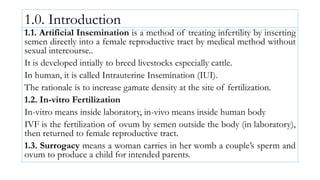
1.1. Artificial Insemination is a method of treating infertility by inserting
semen directly into a female reproductive tract by medical method without
sexual intercourse..
It is developed intially to breed livestocks especially cattle.
In human, it is called Intrauterine Insemination (IUI).
The rationale is to increase gamate density at the site of fertilization.
1.2. In-vitro Fertilization
In-vitro means inside laboratory, in-vivo means inside human body
IVF is the fertilization of ovum by semen outside the body (in laboratory),
then returned to female reproductive tract.
1.3. Surrogacy means a woman carries in her womb a couple’s sperm and
ovum to produce a child for intended parents.
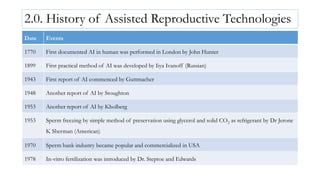
2.0. History of Assisted Reproductive Technologies
Date Events
1770 First documented AI in human was performed in London by John Hunter
1899 First practical method of AI was developed by Iiya Ivanoff (Russian)
1943 First report of AI commenced by Guttmacher
1948 Another report of AI by Stoughton
1953 Another report of AI by Kholberg
1953 Sperm freezing by simple method of preservation using glycerol and solid CO2 as refrigerant by Dr Jerone
K Sherman (American)
1970 Sperm bank industry became popular and commercialized in USA
1978 In-vitro fertilization was introduced by Dr. Steptoe and Edwards
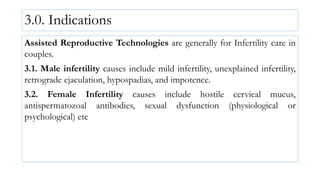
3.0. Indications
Assisted Reproductive Technologies are generally for Infertility care in
couples.
3.1. Male infertility causes include mild infertility, unexplained infertility,
retrograde ejaculation, hypospadias, and impotence.
3.2. Female Infertility causes include hostile cervical mucus,
antispermatozoal antibodies, sexual dysfunction (physiological or
psychological) etc
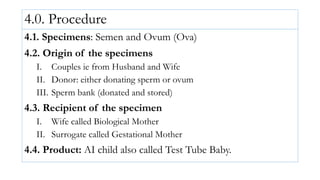
4.0. Procedure
4.1. Specimens: Semen and Ovum (Ova)
4.2. Origin of the specimens
I. Couples ie from Husband and Wife
II. Donor: either donating sperm or ovum
III. Sperm bank (donated and stored)
4.3. Recipient of the specimen
I. Wife called Biological Mother
II. Surrogate called Gestational Mother
4.4. Product: AI child also called Test Tube Baby.
4.0. Procedure
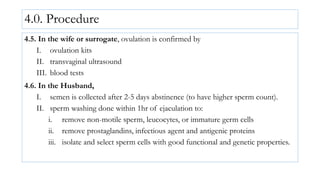
4.5. In the wife or surrogate, ovulation is confirmed by
I. ovulation kits
II. transvaginal ultrasound
III. blood tests
4.6. In the Husband,
I. semen is collected after 2-5 days abstinence (to have higher sperm count).
II. sperm washing done within 1hr of ejaculation to:
i. remove non-motile sperm, leucocytes, or immature germ cells
ii. remove prostaglandins, infectious agent and antigenic proteins
iii. isolate and select sperm cells with good functional and genetic properties.
4.0. Procedure
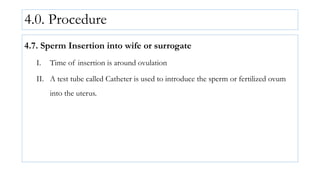
4.7. Sperm Insertion into wife or surrogate
I. Time of insertion is around ovulation
II. A test tube called Catheter is used to introduce the sperm or fertilized ovum
into the uterus.
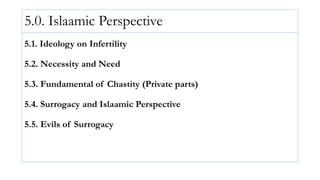
5.0. Islaamic Perspective
5.1. Ideology on Infertility
5.2. Necessity and Need
5.3. Fundamental of Chastity (Private parts)
5.4. Surrogacy and Islaamic Perspective
5.5. Evils of Surrogacy
5.1. Ideology on Infertility
Infertility is believed to be pre-determined by Allaah, Who said
thus:
“To Allaah belongs the kingdom of heavens and earths. He
creates whatever He wills. He bestows females (progeny) to whom
He wills and bestows males (progeny) to whom He wills(49) Or
He bestows both males and females, and He renders barren
whom He wills. Verily, He is All-Knowing Able to do all things
(50)” [Al-Muminuun]
Barreness (infertility) is by Allaah and can be temporary or
permanent. Some Prophets are barren eg. Yahya, Yusuf etc; while
some had temporary barreness eg Ibraaheem, Zakariyya etc.
As stated in the Hadeeth that for every disease there is a cure.
Also, it is stated that Allaah has not put a cure in whatever He has
forbidden.
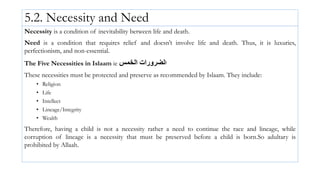
5.2. Necessity and Need
Necessity is a condition of inevitability between life and death.
Need is a condition that requires relief and doesn’t involve life and death. Thus, it is luxuries,
perfectionism, and non-essential.
The Five Necessities in Islaam ie ‫ا‬
‫لضرورات‬
‫الخمس‬
These necessities must be protected and preserve as recommended by Islaam. They include:
• Religion
• Life
• Intellect
• Lineage/Integrity
• Wealth
Therefore, having a child is not a necessity rather a need to continue the race and lineage, while
corruption of lineage is a necessity that must be preserved before a child is born.So adultary is
prohibited by Allaah.
5.3. Fundamentals of Chastity (Private Parts)
 The Islamic Scholars agreed that the fundamental of private parts is sacred.
 The Prophet(Allaah’s praise, mercy and peace be on him) said:
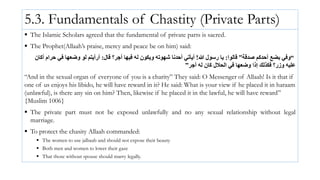
“
‫صدقة‬ ‫آحدكم‬ ‫بضع‬ ‫وفي‬
”
‫قالوا‬
:
‫هللا‬ ‫رسول‬ ‫يا‬
!
‫قال‬ ‫أجر؟‬ ‫فيها‬ ‫له‬ ‫ويكون‬ ‫شهوته‬ ‫أحدنا‬ ‫أيأتي‬
:
‫أكان‬ ‫حرام‬ ‫في‬ ‫وضعها‬ ‫لو‬ ‫أرأيتم‬
‫أجر‬ ‫له‬ ‫كان‬ ‫الحالل‬ ‫في‬ ‫وضعها‬ ‫إذا‬ ‫فكذلك‬ ‫وزر؟‬ ‫عليه‬
”
“And in the sexual organ of everyone of you is a charity” They said: O Messenger of Allaah! Is it that if
one of us enjoys his libido, he will have reward in it? He said: What is your view if he placed it in haraam
(unlawful), is there any sin on him? Then, likewise if he placed it in the lawful, he will have reward”
{Muslim 1006}
 The private part must not be exposed unlawfully and no any sexual relationship without legal
marriage.
 To protect the chasity Allaah commanded:
 The women to use jalbaab and should not expose their beauty
 Both men and women to lower their gaze
 That those without spouse should marry legally.
5.3. Fundamentals of Chastity (Private Parts)
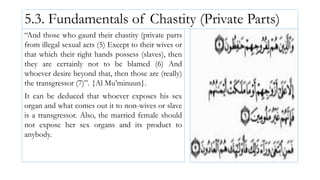
“And those who gaurd their chastity (private parts
from illegal sexual acts (5) Except to their wives or
that which their right hands possess (slaves), then
they are certainly not to be blamed (6) And
whoever desire beyond that, then those are (really)
the transgressor (7)”. {Al Mu’minuun}.
It can be deduced that whoever exposes his sex
organ and what comes out it to non-wives or slave
is a transgressor. Also, the married female should
not expose her sex organs and its product to
anybody.
5.4. Surrogacy and Islaamic Perspective
5.4.1. Real Mother is by Birth
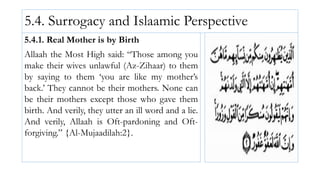
Allaah the Most High said: “Those among you
make their wives unlawful (Az-Zihaar) to them
by saying to them ‘you are like my mother’s
back.’ They cannot be their mothers. None can
be their mothers except those who gave them
birth. And verily, they utter an ill word and a lie.
And verily, Allaah is Oft-pardoning and Oft-
forgiving.” {Al-Mujaadilah:2}.
5.4. Surrogacy and Islaamic Perspective
In the above verse, it clear that any woman that gave birth to a child is the real
mother. Therefore, the Artificially inseminated surrogate mother (who is not the
wife) is the real mother because she went through the birth processes of carrying
the pregnancy and went through the labour. Allaah the Great said: “And We have
enjoined on man (to be dutiful and good) to his parents. His mother bore him in
weakness and hardship upon weakness and hardiship...” Q31:14. So, the duty and
goodness of the child belong to the gestational mother!
Also, Allaah forbids the surnaming of an adopted child with the foster father’s
name, so He said: ...Neither has He made your wives whom you declare to be like
your mothers’ backs your real mother. Nor has He made your adopted sons your
real sons. That is but your saying with your mouths...” Q33:4. Then what about the
foster father’s sperm and the surrogate mother’s egg?!
5.4. Surrogacy and Islaamic Perspective
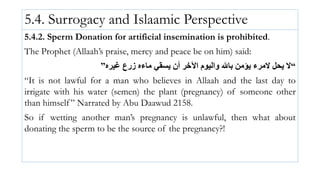
5.4.2. Sperm Donation for artificial insemination is prohibited.
The Prophet (Allaah’s praise, mercy and peace be on him) said:
“
‫غيره‬ ‫زرع‬ ‫ماءه‬ ‫يسقي‬ ‫أن‬ ‫اآلخر‬ ‫واليوم‬ ‫باهلل‬ ‫يؤمن‬ ‫المرء‬ ‫يحل‬ ‫ال‬
”
“It is not lawful for a man who believes in Allaah and the last day to
irrigate with his water (semen) the plant (pregnancy) of someone other
than himself” Narrated by Abu Daawud 2158.
So if wetting another man’s pregnancy is unlawful, then what about
donating the sperm to be the source of the pregnancy?!
5.4. Surrogacy and Islaamic Perspective
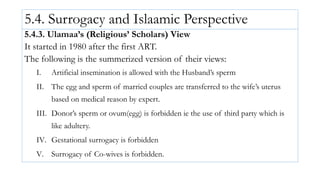
5.4.3. Ulamaa’s (Religious’ Scholars) View
It started in 1980 after the first ART.
The following is the summerized version of their views:
I. Artificial insemination is allowed with the Husband’s sperm
II. The egg and sperm of married couples are transferred to the wife’s uterus
based on medical reason by expert.
III. Donor’s sperm or ovum(egg) is forbidden ie the use of third party which is
like adultery.
IV. Gestational surrogacy is forbidden
V. Surrogacy of Co-wives is forbidden.
5.4. Surrogacy and Islaamic Perspective
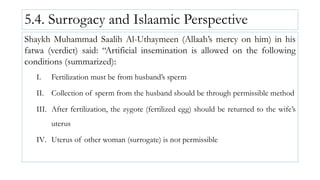
Shaykh Muhammad Saalih Al-Uthaymeen (Allaah’s mercy on him) in his
fatwa (verdict) said: “Artificial insemination is allowed on the following
conditions (summarized):
I. Fertilization must be from husband’s sperm
II. Collection of sperm from the husband should be through permissible method
III. After fertilization, the zygote (fertilized egg) should be returned to the wife’s
uterus
IV. Uterus of other woman (surrogate) is not permissible
5.4. Surrogacy and Islaamic Perspective
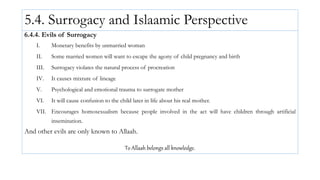
6.4.4. Evils of Surrogacy
I. Monetary benefits by unmarried woman
II. Some married women will want to escape the agony of child pregnancy and birth
III. Surrogacy violates the natural process of procreation
IV. It causes mixture of lineage
V. Psychological and emotional trauma to surrogate mother
VI. It will cause confusion to the child later in life about his real mother.
VII. Encourages homosexualism because people involved in the act will have children through artificial
insemination.
And other evils are only known to Allaah.
To Allaah belongs all knowledge.

Artificial Reproductive Technologyy.pptx

  • 1.
    ‫الرحيم‬ ‫الرحمن‬ ‫هللا‬‫بسم‬ Assisted Reproductive Technologies Surrogacy, Artificial Insemination, and IVF in the Face of Islam Dr AbdulHakeem Miftahudeen 1st Jumadal Awwal, 1445 15th November, 2023
  • 2.
    Contents 1.0. Introduction 2.0. Historyof Assisted Reproductive Technology 3.0. Indications 4.0. Procedure 5.0. Islamic Perspective
  • 3.
    1.0. Introduction  AssistedReproductive Technologies include 1. In-Vitro Fertilization (IVF) 2. Artificial Insemination (AI) 3. Surrogacy  Insemination means introduction of semen into a female. Synonym with fertilization.  Surrogate means someone who takes the place of another person. Synonym with foster.
  • 4.
    1.0. Introduction 1.1. ArtificialInsemination is a method of treating infertility by inserting semen directly into a female reproductive tract by medical method without sexual intercourse.. It is developed intially to breed livestocks especially cattle. In human, it is called Intrauterine Insemination (IUI). The rationale is to increase gamate density at the site of fertilization. 1.2. In-vitro Fertilization In-vitro means inside laboratory, in-vivo means inside human body IVF is the fertilization of ovum by semen outside the body (in laboratory), then returned to female reproductive tract. 1.3. Surrogacy means a woman carries in her womb a couple’s sperm and ovum to produce a child for intended parents.
  • 5.
    2.0. History ofAssisted Reproductive Technologies Date Events 1770 First documented AI in human was performed in London by John Hunter 1899 First practical method of AI was developed by Iiya Ivanoff (Russian) 1943 First report of AI commenced by Guttmacher 1948 Another report of AI by Stoughton 1953 Another report of AI by Kholberg 1953 Sperm freezing by simple method of preservation using glycerol and solid CO2 as refrigerant by Dr Jerone K Sherman (American) 1970 Sperm bank industry became popular and commercialized in USA 1978 In-vitro fertilization was introduced by Dr. Steptoe and Edwards
  • 6.
    3.0. Indications Assisted ReproductiveTechnologies are generally for Infertility care in couples. 3.1. Male infertility causes include mild infertility, unexplained infertility, retrograde ejaculation, hypospadias, and impotence. 3.2. Female Infertility causes include hostile cervical mucus, antispermatozoal antibodies, sexual dysfunction (physiological or psychological) etc
  • 7.
    4.0. Procedure 4.1. Specimens:Semen and Ovum (Ova) 4.2. Origin of the specimens I. Couples ie from Husband and Wife II. Donor: either donating sperm or ovum III. Sperm bank (donated and stored) 4.3. Recipient of the specimen I. Wife called Biological Mother II. Surrogate called Gestational Mother 4.4. Product: AI child also called Test Tube Baby.
  • 8.
    4.0. Procedure 4.5. Inthe wife or surrogate, ovulation is confirmed by I. ovulation kits II. transvaginal ultrasound III. blood tests 4.6. In the Husband, I. semen is collected after 2-5 days abstinence (to have higher sperm count). II. sperm washing done within 1hr of ejaculation to: i. remove non-motile sperm, leucocytes, or immature germ cells ii. remove prostaglandins, infectious agent and antigenic proteins iii. isolate and select sperm cells with good functional and genetic properties.
  • 9.
    4.0. Procedure 4.7. SpermInsertion into wife or surrogate I. Time of insertion is around ovulation II. A test tube called Catheter is used to introduce the sperm or fertilized ovum into the uterus.
  • 10.
    5.0. Islaamic Perspective 5.1.Ideology on Infertility 5.2. Necessity and Need 5.3. Fundamental of Chastity (Private parts) 5.4. Surrogacy and Islaamic Perspective 5.5. Evils of Surrogacy
  • 11.
    5.1. Ideology onInfertility Infertility is believed to be pre-determined by Allaah, Who said thus: “To Allaah belongs the kingdom of heavens and earths. He creates whatever He wills. He bestows females (progeny) to whom He wills and bestows males (progeny) to whom He wills(49) Or He bestows both males and females, and He renders barren whom He wills. Verily, He is All-Knowing Able to do all things (50)” [Al-Muminuun] Barreness (infertility) is by Allaah and can be temporary or permanent. Some Prophets are barren eg. Yahya, Yusuf etc; while some had temporary barreness eg Ibraaheem, Zakariyya etc. As stated in the Hadeeth that for every disease there is a cure. Also, it is stated that Allaah has not put a cure in whatever He has forbidden.
  • 12.
    5.2. Necessity andNeed Necessity is a condition of inevitability between life and death. Need is a condition that requires relief and doesn’t involve life and death. Thus, it is luxuries, perfectionism, and non-essential. The Five Necessities in Islaam ie ‫ا‬ ‫لضرورات‬ ‫الخمس‬ These necessities must be protected and preserve as recommended by Islaam. They include: • Religion • Life • Intellect • Lineage/Integrity • Wealth Therefore, having a child is not a necessity rather a need to continue the race and lineage, while corruption of lineage is a necessity that must be preserved before a child is born.So adultary is prohibited by Allaah.
  • 13.
    5.3. Fundamentals ofChastity (Private Parts)  The Islamic Scholars agreed that the fundamental of private parts is sacred.  The Prophet(Allaah’s praise, mercy and peace be on him) said: “ ‫صدقة‬ ‫آحدكم‬ ‫بضع‬ ‫وفي‬ ” ‫قالوا‬ : ‫هللا‬ ‫رسول‬ ‫يا‬ ! ‫قال‬ ‫أجر؟‬ ‫فيها‬ ‫له‬ ‫ويكون‬ ‫شهوته‬ ‫أحدنا‬ ‫أيأتي‬ : ‫أكان‬ ‫حرام‬ ‫في‬ ‫وضعها‬ ‫لو‬ ‫أرأيتم‬ ‫أجر‬ ‫له‬ ‫كان‬ ‫الحالل‬ ‫في‬ ‫وضعها‬ ‫إذا‬ ‫فكذلك‬ ‫وزر؟‬ ‫عليه‬ ” “And in the sexual organ of everyone of you is a charity” They said: O Messenger of Allaah! Is it that if one of us enjoys his libido, he will have reward in it? He said: What is your view if he placed it in haraam (unlawful), is there any sin on him? Then, likewise if he placed it in the lawful, he will have reward” {Muslim 1006}  The private part must not be exposed unlawfully and no any sexual relationship without legal marriage.  To protect the chasity Allaah commanded:  The women to use jalbaab and should not expose their beauty  Both men and women to lower their gaze  That those without spouse should marry legally.
  • 14.
    5.3. Fundamentals ofChastity (Private Parts) “And those who gaurd their chastity (private parts from illegal sexual acts (5) Except to their wives or that which their right hands possess (slaves), then they are certainly not to be blamed (6) And whoever desire beyond that, then those are (really) the transgressor (7)”. {Al Mu’minuun}. It can be deduced that whoever exposes his sex organ and what comes out it to non-wives or slave is a transgressor. Also, the married female should not expose her sex organs and its product to anybody.
  • 15.
    5.4. Surrogacy andIslaamic Perspective 5.4.1. Real Mother is by Birth Allaah the Most High said: “Those among you make their wives unlawful (Az-Zihaar) to them by saying to them ‘you are like my mother’s back.’ They cannot be their mothers. None can be their mothers except those who gave them birth. And verily, they utter an ill word and a lie. And verily, Allaah is Oft-pardoning and Oft- forgiving.” {Al-Mujaadilah:2}.
  • 16.
    5.4. Surrogacy andIslaamic Perspective In the above verse, it clear that any woman that gave birth to a child is the real mother. Therefore, the Artificially inseminated surrogate mother (who is not the wife) is the real mother because she went through the birth processes of carrying the pregnancy and went through the labour. Allaah the Great said: “And We have enjoined on man (to be dutiful and good) to his parents. His mother bore him in weakness and hardship upon weakness and hardiship...” Q31:14. So, the duty and goodness of the child belong to the gestational mother! Also, Allaah forbids the surnaming of an adopted child with the foster father’s name, so He said: ...Neither has He made your wives whom you declare to be like your mothers’ backs your real mother. Nor has He made your adopted sons your real sons. That is but your saying with your mouths...” Q33:4. Then what about the foster father’s sperm and the surrogate mother’s egg?!
  • 17.
    5.4. Surrogacy andIslaamic Perspective 5.4.2. Sperm Donation for artificial insemination is prohibited. The Prophet (Allaah’s praise, mercy and peace be on him) said: “ ‫غيره‬ ‫زرع‬ ‫ماءه‬ ‫يسقي‬ ‫أن‬ ‫اآلخر‬ ‫واليوم‬ ‫باهلل‬ ‫يؤمن‬ ‫المرء‬ ‫يحل‬ ‫ال‬ ” “It is not lawful for a man who believes in Allaah and the last day to irrigate with his water (semen) the plant (pregnancy) of someone other than himself” Narrated by Abu Daawud 2158. So if wetting another man’s pregnancy is unlawful, then what about donating the sperm to be the source of the pregnancy?!
  • 18.
    5.4. Surrogacy andIslaamic Perspective 5.4.3. Ulamaa’s (Religious’ Scholars) View It started in 1980 after the first ART. The following is the summerized version of their views: I. Artificial insemination is allowed with the Husband’s sperm II. The egg and sperm of married couples are transferred to the wife’s uterus based on medical reason by expert. III. Donor’s sperm or ovum(egg) is forbidden ie the use of third party which is like adultery. IV. Gestational surrogacy is forbidden V. Surrogacy of Co-wives is forbidden.
  • 19.
    5.4. Surrogacy andIslaamic Perspective Shaykh Muhammad Saalih Al-Uthaymeen (Allaah’s mercy on him) in his fatwa (verdict) said: “Artificial insemination is allowed on the following conditions (summarized): I. Fertilization must be from husband’s sperm II. Collection of sperm from the husband should be through permissible method III. After fertilization, the zygote (fertilized egg) should be returned to the wife’s uterus IV. Uterus of other woman (surrogate) is not permissible
  • 20.
    5.4. Surrogacy andIslaamic Perspective 6.4.4. Evils of Surrogacy I. Monetary benefits by unmarried woman II. Some married women will want to escape the agony of child pregnancy and birth III. Surrogacy violates the natural process of procreation IV. It causes mixture of lineage V. Psychological and emotional trauma to surrogate mother VI. It will cause confusion to the child later in life about his real mother. VII. Encourages homosexualism because people involved in the act will have children through artificial insemination. And other evils are only known to Allaah. To Allaah belongs all knowledge.